Box Turtle Bulletin
 News and commentary about the anti-gay lobby
“Now you must raise your children up in a world where that union of man and box turtle is on the same legal footing as man and wife…”
News and commentary about the anti-gay lobbyMarch 14th, 2012
TODAY’S AGENDA:
Celebrations This Weekend: Texas Bear Roundup, Dallas, TX.
TODAY IN HISTORY:
McCarthy Adds Names to His Famous List: 1950. In February, Sen. Joseph McCarthy’s national profile went through the roof when, during a speech at the Republican Women’s Club if Wheeling, West Virginia, he announced, “I have here in my hand a list of 205—a list of names that were made known to the Secretary of State as being members of the Communist Party and who nevertheless are still working and shaping policy in the State Department.” He never did make that list public, but on this date in history he submitted 25 more names of State Department employees that he said should be investigated to the Senate Foreign Relations Subcommittee. He also claimed, according to press reports, “that a homosexual had been hired by the Central Intelligence Agency after the State Department allowed him to resign. He did not name the man, but said his perversion made him a bad security risk.”
If you know of something that belongs on the agenda, please send it here. Don’t forget to include the basics: who, what, when, where, and URL (if available).
And feel free to consider this your open thread for the day. What’s happening in your world?
March 13th, 2012
If it’s possible to die of embarrassment, then the nationwide uproar over Tennessee’s proposed “Don’t Say Gay” bill may well kill the bill. The (Nashville) Tennessean reports that the bill’s sponsors have agreed to put off debating the bill until the end of the legislative session, using a procedural move often used when sponsors decide not to push a bill:
Sponsors had been under pressure to amend the original bill, which would have banned any teaching about homosexuality apart from “natural human reproduction” before eighth grade. The measure was meant to keep schools and teachers from initiating discussions about gays and lesbians, but even its backers conceded Tuesday that it might have brought unintended consequences. “We found out there really is not sex education curriculum in K-8 right now,” said state Rep. Bill Dunn, R-Knoxville, the bill’s original sponsor.
After slapping his forehead an exclaiming a Homer-esque “Doh!”, backers say they will instead shift their focus towards abstinence-only education.Another Sponsor, Rep. Hoey Hensley (R-Hohenwald), said that he would push for the bill again if the abstinence-ed bill fails. Gob. Bill Haslam criticized the “Don’t Say Gay” bill earlier this week, saying it was an unnecessary distraction that could cause more problems than it allegedly solves.
March 13th, 2012
It is clear that New Hampshire Rep. Bob Bates would ban recognition for same sex couples entirely if he were to have his way. It is becoming increasingly clear that Bates is realizing that he may not get anything.
When Republicans won veto-proof majorities in both state houses, conventional wisdom assumed that they would reverse the state’s marriage law.
And bates was quick with a bill that would not only ban equality but make a mockery of civil unions. (AP)
Bates’ first amendment to the repeal bill would have allowed civil unions for any two adults and would have let anyone refuse to recognize the unions. It also would have allowed anyone to discriminate against such couples in employment, housing and public accommodations based on religious or moral beliefs.
But with a populace that has accepted – and now supports – the marriage law and with party leadership more interested in fiscal issues, the likelihood of that threat has diminished. Now it seems promising that enough Republicans will vote to retain the law so that Democratic Governor John Lynch’s promised veto will hold.
And Bates is beginning to sound a little desperate.
His latest proposal is to revert to civil unions for same sex couples but not siblings or bowling buddies, but to put it to the people in November in a non-binding resolution. While he says that this would give the legislature time to reverse itself if marriage has public support, it is obvious that his hope is that he could marshal enough Republicans to ignore the people’s position. (It is politically easier to block the passage offerings equality than it is to reverse it – even against popular opinion).
While watching weather vanes is not a very exact political indicator, this sounds like good news to me.
March 13th, 2012
THIS MONTH IN HISTORY:
Harper’s Examines New York’s “Middle Class” Homosexuals: 1963. By 1963, reporting on gay people followed a predictable arc: homosexuals were sad and lonely people, desperate for love and acceptance, and incapable of living a fulfilling life. With fulfillment being defined as the achievement of the middle class American Dream: with a home in the suburbs, a car, two kids and a dog, and a lovely June Cleaver waiting at home with a fresh batch of cookies. The classic middle class American Dream was out of reach for gay people, but that didn’t keep Harper’s William J. Helmer from providing a very interesting and well-balanced look at New York’s gay middle class. In New York’s “Middle-class” Homosexuals — were the quotation marks ironic or emphatic? — Helmer’s profile was anything but sensationalistic. For example, here’s his description of a typical gay bar in West Greenwich, with a bar in the front and a dance floor in the back:
Although we went on a Thursday night, the back room was so crowded that many were standing, and the atmosphere was that of a speakeasy: dim lights, loud noise, cigarette smoke, music, and, I was told, a signal to stop dancing in the event of a police raid. My reaction to the unusual sight of men embracing each other on the dance floor was one more of curiosity than aversion, probably because the dancers appeared so casual and others in the room so indifferent. I was far more surprised to see no one who “looked” homosexual. A few were a little too well-groomed or elegant in their behavior, and a few were dressed younger than their age (though all looked to be under thirty), but otherwise the only noticeable difference was that everyone resembled the dashing young men in college sportswear advertisements. At other bars I did see a few obviously effeminate persons, but they were not flamboyant. and I was told that the better class of gay bar usually discourages conspicuous homosexuals in order to avoid police crackdowns.
If it was all about appearances in 1963 America generally, it’s easy to imagine that appearances were similarly important in the gay community. There was, of course, what respectable Americans would consider the “dark underbelly,” but in Helmer’s description, the respectable gay counterpart was equally eager to keep its distance from those unseemly scenes. “The genuine orgy,” he wrote,” is less common and regarded by some as rather jading and degrading, but still ‘okay if you like that sort of thing’.” But as for the parties:
A colorful — but not necessarily sexual — event in the gay world is the “drag party” to which guests may come dressed as women. Unlike genuine transvestitism, however, such masquerading is often done as a titillating joke, the idea being to dress like a ridiculous parody of the female in order to humorously exaggerate one’s “perversion.” The term gay, which often strikes a heterosexual as inappropriate if not ironic becomes meaningful at parties and dancing bars. Any private gathering is an opportunity to relax and “drop the mask” one wears in public, and there is usually an air of conspiracy and intrigue which is not without its appeal. Such conditions tend to promote a spirit of good-fellowship, and everyone tries to outdo each other in being friendly, sociable, and “gay.” Part of this is artificial — the same sort of attempt at jolly behavior that may go on between males and females after a few drinks at a dull cocktail party. But no doubt homosexuals do feel a genuine exuberance in temporarily escaping the sense of rejection implicit in their frequent need to conceal their nature from employer, acquaintances, and family.
But like the rest of society, appearances and neighborhood were important marks to social standing:
Wealth and family background themselves usually are not sources of status within the homosexual community, though their manifestations — possessions, manners, etc. — may be. Since most homosexuals have no dependents and only personal expenses, a modest income will usually provide the obvious luxuries of “sophisticated” city life, reducing the importance of real wealth. Most homosexuals who participate exclusively in gay social life have a relatively low income, so there exists no real moneyed class within the community toward which to aspire. A prominent family background brings little status since few homosexuals can afford to mix their gay life with their straight life.
…In gay society an individual is often typed (not always accurately) according to his neighborhood. The “East Side Snob” is described as an elegant, high-class dandy, or a bland, pseudosophisticated “organization man with a flair,” and both tend to confine themselves to their own more private social circles. The West Sider is thought to be a lower-class, sometimes bizarre person, and the two extremes seem to meet in the Village where stereotypes mix. To some homosexuals, Forty-second Street between Sixth and Eighth Avenues is practically a taboo area because of the hustlers, hoodlums, and generally undesirable types who often congregate there. The West Seventies are said to be a “pansy patch” because of the number of obviously effeminate homosexuals, often Puerto Rican, who live there; and some areas of the Upper East Side are called “fairy flats” because they are supposedly inhabited by “conspicuously elegant types usually walking poodles,” as one informant put it. Brooklyn Heights, just across the East River from Lower Manhattan, is thought of as a kind of homosexual suburbia popular with “young marrieds.”
(Thanks to BTB reader Rob for providing a copy of the Harper’s article.)
If you know of something that belongs on the agenda, please send it here. Don’t forget to include the basics: who, what, when, where, and URL (if available).
And feel free to consider this your open thread for the day. What’s happening in your world?
March 12th, 2012
Well since you asked, I’ll tell you: I think Christianity is irrational. I think that it’s detrimental and ultimately destructive to so many of the foundations of civilization. There’s never been a country ever in history that has embraced Christianity and survived. If history is any guide, the same thing’s going to happen to us as happened to the Roman empire, the Papal States, Byzantium, and the Holy Roman Empire, just to name a few.
But I’m not judging anyone. I’m speaking as a man who, as a human being, believe that all of us are flawed. I could stand at the top of the list and say that I need an overhaul of the heart more than anyone.
But I believe that freedom of speech and freedom of religion go hand-in-hand in America. I should be able to express moral views on social issues, especially those that have been suppressed in Western civilization for 2,000 years without being slandered, accused of hate speech, and told from those who preach “love” that I need to either bend my beliefs to their moral standards or be silent when I’m in the public square.
I believe we need to learn how to debate these things with greater love and respect. I’ve been encouraged by the support of many friends (including Christian friends, incidentally).
The few facts – the very few facts – briefly mentioned above are both literally correct and easily rebuttable. Many of the opinions derived from those facts are both supportable and refutable. But the overarching conclusion is as ridiculous as it is commonplace among those who make the very same arguments with only a few judicious substitutions here and there.
Of course, I’m speaking of Kirk Cameron’s interview with Piers Morgan last week, which is very similar to views expressed by many others (including, in this example, by Pat Robertson last summer). I find it incredible that people like Cameron can say things like this and then act surprised when others are deeply offended.
Because here’s the thing: either the above statement is rightly offensive to self-respecting Christians or it isn’t. I’m willing to let Christians make the call on that, but if Christians agree that those sentiments are offensive and worth condemning, then those who are a part of the subset of Christians who agree with Cameron need to explain why Cameron’s statements aren’t offensive with at least a passing nod toward consistency.
They can’t of course, although I’m sure many will try. And if they do, I would recommend remaining firm, but also (most importantly) patient, because
…many of us know how heart-wrenching it is to watch those affected by Christianity, especially when they are our loved ones, as they struggle with their unwanted cognitive dissonance. Most Christian-identified people are so wrapped up in their Christian identity that it’s important for you to not allow that to be the central focus of your conversation or relationship with them.
Because with patience and kindness, you can become an instrument of healing and change. Let them know through your friendship that you see beyond their Christian identity; just as there is more to you than your struggles, attractions, and feelings. There are thousands, tens of thousands, even perhaps even hundreds of thousands of former Christians who have found freedom after having been trapped in the Christian lifestyle. I’ve never met an ex-Black, but I know a lot of ex-Christians. People who are personally affected by these issues are free to determine their own identity, and can choose to pursue freedom and change, as evidenced by the many people who have successfully done so.
You see? There’s nothing offensive or patronizing at all in any of that, is there?
March 12th, 2012
TODAY IN HISTORY:
New York Times Magazine’s “Homosexuality On Campus”: 1978. In February of 1978, the U.S. Supreme Court, in declining to review a lower court ruling, let stand a decision requiring the University of Missouri to recognize a gay student group as an official campus organization. That ruling became the backdrop for journalists Grace and Fred Hechinger’s profile on the state of homosexuality on the nation’s campuses for the New York Times Magazine. The Hechingers traveled to six campuses — Yale, Stanford, U.C. Berkeley, Northwestern, Missouri, and Hood College, a small women’s college in Frederick, Maryland — to explore the extent to which attitudes had changed on campus toward gay people, and the growing visibility of gays themselves. There were inevitable conflicts, but the journalists focused less on overt displays of homophobia and concentrated instead on the interpersonal challenges:
For many members of the homosexual minority, being homosexual is still almost as much a disadvantage as it was 30 years ago. As freshmen, they enter into a peer culture that, for the first time, is free of most parental and general adult restraints. A new world of experimentation opens up. The homosexuals — many of them for the first time confronting, or perhaps merely suspecting, their homosexuality — are thrown into a world in which they must function without feeling fully part of it. It is a world dominated by powerful traditional and communal mores and symbols. All around them, heterosexual preoccupations with dating and mating are at a peak. Sex looms large among student concerns and conversation. The basic difference in interest is bound to erect a barrier between homosexual and heterosexual roommates….
An editor of an undergraduate daily admitted that he felt a certain sickness about homosexuals,” but on the political level I’m supportive.” As a junior he had picked a homosexual roommate from a choice of two. The heterosexual candidate was addicted to loud music; the homosexual one had a lot of books, was interested in history. “On a conscious level,” the editor, now a senior, said, “there was no problem. But still I didn’t get to be good pals with him. His life outside school was different from mine. There was a gap. I feel like the white liberal kid talking about a black roommate.”
But most of the article focused on gay students themselves, mainly on issues surrounding how and whether to come out on campus and with their families. Some campuses had responded with group programs to aide in navigating the complex waters:
At Northwestern, James E. Avery, the university’s young and articulate chaplain, arranged for us to meet with a group of homosexual students and Samuel Todes, the associate professor of philosophy, who is one of the rare species of homosexual faculty members willing to “come out.” Professor Todes reported that every Wednesday evening a discussion group is held, attended by some 40 students, most of whom are in the process of “coming out.” The discussion group, said Professor Todes, “is a small breathing hole in what is still a pretty airtight closet.”
…At Standord, we joined The Bridge, a peer-counseling group, in an informal afternoon discussion. Sitting in a circle, cross-legged on pillows, the group of young men and women looked like any other college rap session. Although we had been told that at least half of those present were homosexual, it would have been impossible to tag them, confirming our observation that on campuses, as elsewhere, only a small number of homosexuals matched popular stereotypes.
In sharing the emotional strain of many of their follow students, these young people underscored the tough side effects of coming out, even the tentative declarations to a few friends. One heterosexual student described her reaction when a member of the group had told her he was homosexual. “What was I supposed to say? You can’t just reply, ‘That’s interesting, what else is new?’ ”
…”Coming out,” said Dave, a peer counselor as well as a leader in the Gay People’s Union, “is a very liberating experience, but you have to be awfully sure of yourself to handle negative attitudes.”
TODAY’S BIRTHDAY:
 Edward Albee: 1928. The playwright best known for The Zoo Story (1958), The Sandbox (1959), Who’s Afraid of Virginia Woolf? (1962), Albee was adopted just a few weeks after he was born by a wealthy theatrical management family involved with the Keith-Albee vaudeville circuit in New York. His parents gave him all of the advantages of wealth, but he never felt close to them. He figured out he was gay when he was twelve and away at boarding school. He never really came out to his parents — “There were many things they never discussed with me – that being one of them – but I didn’t feel close enough to them to impose on them to discuss anything, not that I felt I needed any discussion about it.”
Friends and collaborators describe him as crusty and curmudgeonly. Writers, when writing about him, find it impossible to resist titling their efforts, “Who’s Afraid of Edward Albee?” His reaction to being labelled a “gay writer” illustrates this trait. When he was given the Pioneer Award at the 2011 Lambda Literary Awards, he said, “A writer who happens to be gay or lesbian must be able to transcend self. I am not a gay writer. I am a writer who happens to be gay. Any definition which limits us is deplorable.” Many artists in attendance took offense at that remark, but Albee stuck to his guns, explaining to NPR “Who goes around talking about abstract expressionist painters and making a definition or a distinction between those of them that were straight and those of them who were or are gay? Nobody does it. People only do it with writers and I find that so ridiculous.” But that doesn’t mean he’s a fan of assimilation:
Why do all gay people wish to vanish into this society? Is it self-protection? I don’t know. I just don’t want us to be forced to think that we must imitate other people and behave the way they do in order to become invisible.
I had a 35-year relationship. Were we married? Yeah, I guess we were. We certainly felt that we were. We certainly treated each other like we were married to each other. Did we ever feel the need to get a marriage license? No, of course not. We knew we were married to each other. All this legality that people seem so involved with nowadays, it troubles me just a little bit. I understand all the problems to come with wills and families denying access to the loved one and all of that, but come on, do we really want to be exactly like straight people?
Albee has received three Pulitzer Prizes, for A Delicate Balance (1967), Seascape (1975), and Three Tall Women (1994). The Pulitzer’s drama jury selected Who’s Afraid of Virginia Woolf for the 1963 prize, but the jury was overruled by the advisory committee which decided not to give a drama award for that year.
If you know of something that belongs on the agenda, please send it here. Don’t forget to include the basics: who, what, when, where, and URL (if available).
And feel free to consider this your open thread for the day. What’s happening in your world?
March 11th, 2012
TODAY’S AGENDA:
Community Events This Weekend: Cape Town Pride, Cape Town, SA; AIDS Walk, Houston, TX.
TODAY’S BIRTHDAY:
 David LaChapelle: 1963. When the kid from Connecticut move to New York City and started hanging out at Studio 54, he met Andy Warhol who hired the aspiring young photographer to work for Interview magazine. He would go on become a fashion photographer for Vanity Fair, Rolling Stone. GQ, Vogue, and Photo. He depicted David Duchovney in Lycra bondage pants, Chris Rock in a Blaxploitation fantasy, Kanye West as an African-American Jesus, Michael Jackson as an archangel, Jason Priestly as Elvis, Eminem naked, Elizabeth Taylor in a shocking pink turban, Lady Gaga as, well, Lady Gaga, and Dolly Parton’s breasts as a mountainous backdrop for Dollywood. His 1995 photo of the “kissing sailors” ad for Diesel was one of the first public ads showing a gay couple kissing. It was extremely controversial, landing in the glossy mags fresh off of the debate over Don’t Ask, Don’t Tell. He also branched out into videos, working for Elton John, Moby, Enrique Iglesias, Macy Gray, Amy Winehouse, and many others. In 2004, he produced a documentary about the South Central L.A. dance style know as “krumping.”
LaChapelle’s color-saturated, provocative and surreal images have been in high demand in the fashion and music world, both for his photography and his videos, and the workaholic put in grinding hours getting each painstaking detail just right. It took him fourteen years, he says, before he finally learned how to say no. That came when Madonna was haranguing him about a video the two were planning. LaChapelle had enough, pulled the cell phone away from his ear, and snapped it shut. That’s right. He hung up on Madonna. He’s still working, but at his own pace and on his own terms. He no longer feels he has to say yes to everyone, which now leaves artists scrambling for substitutes when he turns them down. In 2011, LaChapelle accused Rihanna of copying his imagery for her video “S&M.” The two settled out of court just as the case was about to go to trial.
If you know of something that belongs on the agenda, please send it here. Don’t forget to include the basics: who, what, when, where, and URL (if available).
And feel free to consider this your open thread for the day. What’s happening in your world?
March 10th, 2012
TODAY’S AGENDA:
Alan Chambers Talks About Not Being Gay Anymore: Temecula, CA. According to a notice posted on Exodus International’s web site:
For all those living in southern California, Exodus International president, Alan Chambers, will be speaking at all weekend services at Rancho Community Church March 10th and 11th. Check their website for times. All our welcome. Below is a brief article written by one of the Rancho leaders.
Alan Chambers, president of Exodus International, will deliver speeches at Rancho Community Church.
Chambers, who was once gay, will speak March 10-11, the church announced. He will discuss the church’s role in compassionately ministering to gay people and their families. The March 10 session is at 5 p.m. The March 11 installment will feature speeches at 8 a.m., 9:30 a.m. and 11 a.m. [Emphasis mine]
Ahem.
Community Events This Weekend: Cape Town Pride, Cape Town, SA; AIDS Walk, Houston, TX.
TODAY IN HISTORY:
Court-Martial of Lt. Frederick Gotthold Enslin: 1778. Gen. George Washington’s general orders for March 14, 1776 at Valley Forge, PA., included the following description of a court martial that occurred on the 10th:
At a General Court Martial whereof Colo Tupper was President (10th March 1778) Lieutt. Enslin of Colo. Malcom’s Regiment tried for attempting to commit sodomy, with John Monhort a soldier; Secondly For Perjury in swearing to false Accounts, found guilty of the charges exhibited against him being breaches of 5th. Article 18th. Section of the Articles of War and do sentence him to be dismiss’d the service with Infamy. His Excellency the Commander in Chief approves the sentence and with Abhorrence and Detestation of such Infamous Crimes orders Lieutt. Enslin to be drummed out of Camp tomorrow morning [March 15] by all the Drummers and Fifers in the Army never to return; the Drummer and Fifers to attend on the Grand Parade at Guard mounting for that Purpose.
This case began in late February with the court-martial of Ensign Anthony Maxwell, who was charged with “propagating a scandalous report prejudicial to the character of Lieut. Enslin.” Maxwell, who had accused Enslin of “attempted sodomy with a private,” was acquitted. Whatever he said, the court-martial found that it wasn’t “prejudicial to the Character of Lieutt. Enslin further than the strict lien of his duty required.” If Maxwell didn’t slander Enslin as the court found, then that evidently meant that Enslin was guilty. Enslin was quickly court-martialed, and is believed to be the first person to be forced out of the forerunner of the U.S. Army on charges of homosexual behavior.
If you know of something that belongs on the agenda, please send it here. Don’t forget to include the basics: who, what, when, where, and URL (if available).
And feel free to consider this your open thread for the day. What’s happening in your world?
March 9th, 2012
 If I believed in reincarnation, I’d be convinced that someone truly slimy in a previous life is being punished by being Khloe Kardashian in this one. Completely lacking in class or personal dignity is one thing, but to be astonishingly stupid while doing so is a fate I’d wish on no one.
Entertainment sources tell the same story, but for amusement sake I’ll quote the Christian Post (they must be beside themselves in glee):
The 27-year-old conducted an on-air interview with reality TV star Scott Disick on her program “Mix Up w/ Khloe Kardashian Odom” on Dallas radio station Mix 102.9, when she began criticizing his style.
“What kind of homo are you? Seriously? That is not what men…a straight man doesn’t carry a Birkin Bag,” Kardashian told Disick.
The word “homo” is slang for homosexual, but the slang is often used to insult gays, and 28-year-old Disick was not impressed with Kardashian’s choice of words.
“Listen to me. First of all, you shouldn’t say homo on the radio. It’s not a bad thing to be a homosexual. You’re making it sound like a negative thing. Third I’m not a homosexual. Fourth, I didn’t come out of the closet. It’s a man bag,” Disick shot back at Kardashian.
A defiant Kardashian went on to defend her use of the word, insisting that she is not homophobic and in fact the opposite.
“First of all, let me just tell you: I am the queen of my gay community which I love and adore. And I promote doing the tranny look-alike contest. I am queen bee over here so don’t even try it,” Kardashian warned.
All I can say is that for a queen bee, whatever that might be, Khloe seems to have an instinct for just the wrong word and very little understanding of LGBT people. None of the transgender people I’ve encountered were trying to look like anything other than themself, consistent with their internally experienced gender.
And, just in case she momentarily got confused and really meant drag queen (or perhaps drag queen bee), I offer this advice:
Khloe, if some drag queen said she was trying to “look just like Khloe Kardashian”, believe me, honey, that wasn’t a tribute.
March 9th, 2012
When I read Extreme Makeover: The story behind the story of Lawrence v. Texas, Dahlia Lithwick’s review in the New Yorker of Dale Carpenter’s new book, Flagrant Conduct: The Story of Lawrence v. Texas
My response was not universal.
It seems that Lithwick ruffled a few feathers by being a bit less deferential than some parties wished and used language that allowed some to infer criticism, whether or not intended.
Kevin Cathcart, executive director of Lambda Legal, wrote a huffy rebuttal in the Huffington Report. Well, not exactly a rebuttal; Cathcart doesn’t assert a single fact to dispute the story. Rather, Cathcart uses innuendo and implies that Carpenter (and thus Lithwick) is telling some distorted version of the tale.
In Dahlia Lithwick’s review in The New Yorker (March 12) of Dale Carpenter’s new book about the Lawrence case, Flagrant Conduct (Norton), she recounts Carpenter’s version of the events leading up to the arrest of the defendants, John Lawrence and Tyron Garner, in which Carpenter concludes that Garner and Lawrence were merely acquaintances who may not have been having sex when the police stormed into Lawrence’s apartment and arrested them. She accepts Carpenter’s conclusion, then writes, “That’s the punch line: the case that affirmed the right of gay couples to have consensual sex in private spaces seems to have involved two men who were neither a couple nor having sex.”
I strongly disagree. That certainly was not the punch line for the hundreds of thousands of gay men and lesbians who were finally relieved of the harms and the daily fear caused by laws that criminalized their sexuality. [emphasis added]
That is a tacky tactic. Hint that Carpenter is telling a distorted version and “strongly disagree”… with something else.
Dale Carpenter did not just conjure his “version of the events” out of thin air. He did not rely solely on legal briefs or news coverage. Being familiar with Carpenter’s writing for some time, I know that he is thoughtful and nuanced and, while at times controversial, not inclined to statements that lack support. Carpenter spent nine years of research, interviewing the parties and weighing the disparities, and “his version” is more a presentation of all versions, including those that Cathcart seems would rather have unknown.
As for the specific point of contention, either it is true that “Garner and Lawrence were merely acquaintances” or it is true that they were something more. Either it is true that they “may not have been having sex” or it is definite that they were so engaged. And, it should be noted, the assertions are actually “John Lawrence’s version of events”.
If Mr. Cathcart has any evidence – any statement by any person at any time – which contradicts Carpenter’s narrative, he should say so. And surely, as the executive director at the time of the case, Cathcart would be privy to all such information. Even if bound by confidentiality and unable to disclose details, he could say that Carpenter is incorrect, not just imply so.
Cathcart’s indignant response – which neither contradicts nor clarifies – seems to be in reaction to inferred criticism about Lambda’s methods. Personally, to me they seem to be but good representation: control the story, keep your client from torpedoing his own boat, and fight for the real issue at hand rather than the specifics of the unique situation. But perhaps Cathcart sees Lambda as above the riffraff ambulance chaser.
I continue to hold Lambda Legal in high regard and Lithwick’s review only increased my admiration. I’m sad that Cathcart responded in a manner that lowered my esteem.
Also jumping to Lambda Legal’s defense is Ari Ezra Waldman, writing at Towelroad. Waldman see’s Lithwick’s review as “obscuring the undisputed good work done by Lambda Legal, the American Foundation for Equal Rights (AFER), and other legal organizations to win our rights through impact litigation.” I think Waldman sees criticism where I see admiration, but in his taking of Lithwick to task, I see a misunderstanding of what it all means.
It is natural to want our heroes to be heroic. Whether Lambda Legal or John Lawrence or Tyrone Garner, we want them bigger than life, beyond reproach, and unworthy of criticism, implied, inferred or vaguely hinted.
But here’s the funny thing about heroes: they seldom are.
Heroes do not live above the fray, marshaling their power and reaping the consequence of their advantage. Heroes fight impossible odds with no resources and in defense of honor and justice, not for some personal gain.
Sure, it’s admirable when someone steps forward and puts their life on display to serve a cause. It is worthy of praise when beautiful people seeking marriage equality kiss their babies to rounds of applause at a podium. And surely those people do good work – they provide an image that the public can agree deserves respect and equality. I do not mean to diminish that contribution or in any way criticize those who live a life of quality and responsibility.
But that’s not heroism.
When a drunk and a loser, someone who isn’t respected by anyone, agrees to put their life on display so as to fight injustice, I see the seeds of heroism. And when, with nothing else to contribute, John Lawrence let his name become equated with sodomy – and let us not pretend that this did not come without cost – I see classic heroism.
The little guys, the ones with no resources or social standing, stood up to the system and fought for their rights – even before the big city lawyers got involved. And they deserve that their story, warts and all, be told. And, in a grander sense, theirs is the story of why we have a constitution.
And despite Cathcart’s huffy indignation, when lawyers look at their clients, see their personal limitations, know the burden of selling them to nine elderly ivy-league people whose lives have never encountered anyone like these plaintiffs, and still push forward with whatever they can muster – be it a carefully crafted image and clients who promise silence – to advance my freedom, I see heroism.
As Linda Hirshman at Slate notes, civil rights cases are seldom about pretty people. They are about the law and the victims of the law.
The law is for the powerful and influential. But the Constitution and it’s protections are for losers. And drunks. And the unpopular. And deviates and perverts and faggots and c*cksuckers and sodomites like John Lawrence and Tyrone Garner. And for radical homosexual activists like Lambda Legal who have to scrap and fight and work with what they have.
It does no disservice to acknowledge and honor that fact.
March 9th, 2012
TODAY’S AGENDA:
Community Events This Weekend: Cape Town Pride, Cape Town, SA; AIDS Walk, Houston, TX.
TODAY’s BIRTHDAYS:
 Will Geer: 1902. He was Grampa Walton on screen, and a social activist off. He had been a member of the Communist Party in 1934, where he met Harry Hay who would go on to found the Mattachine Society in the 1950s. Geer and Hay briefly became lovers while working on union organizing in Los Angeles and San Francisco. But they soon parted ways when Geer married his wife, actress and fellow political activist Herta Ware. Geer went on to work with folk singers Burle Ives and Woodie Guthrie in advocating for migrant farm workers and organized labor. He also found time to do some acting, mostly on the stage, often Shakespeare. Between 1948 and 1951, he was also in more than a dozen movies, but he was soon blacklisted for refusing to testify before the House Committee on Un-American Activities.
With the blacklist in force, Geer fell back on his training as a botanist (he had a master’s degree from the University of Chicago) and founded the Theatricum Botanica in Topanga Canyon near Santa Monica, California, with his wife. They would divorce in 1954, but they remained very close friends thereafter. Together, they turned Theatricum Botanica into an artists colony, with an outdoor summer theater and Woody Guthrie living in a small shack.
By the late 1950s, Geer was back on Broadway, and in 1964 he was nominated for a Tony for his role in the musical 110 in the Shade. His career in film resumed in 1963 with a minor part in Advise and Consent, and in 1967 he played the prosecutor in the film adaptation of Truman Capote’s In Cold Blood. When he died after completing the sixth season of The Waltons in 1978, his remains were cremated and his ashes burried at his beloved Theatricum Botanicum, which continues to host performances and youth acting workshops.
 Samuel Barber: 1910. He was apparently a very precocious child. In a very anxious letter at the tender age of nine, he came out to his mother — as a composer:
Dear Mother: I have written this to tell you my worrying secret. Now don’t cry when you read it because it is neither yours nor my fault. I suppose I will have to tell it now without any nonsense. To begin with I was not meant to be an athlet [sic]. I was meant to be a composer, and will be I’m sure. I’ll ask you one more thing .—Don’t ask me to try to forget this unpleasant thing and go play football.—Please—Sometimes I’ve been worrying about this so much that it makes me mad (not very).
He wrote his first musical at seven, tried his first opera at 10, became an organist at 12, and began studying piano, voice and composition at the Curtis Institute in Philadelphia at 14. That’s where he met his lover, partner and musical collaborator Gian Carlo “Johnny” Menotti, and they would remain together for the next forty years. By Barber’s twenties, his compositions were commissioned or debuted by Vladimir Horowitz, Leontyne Price, Arturo Toscanini, among others. He won the Pulitzer Prize for music for his 1957 opera Vanessa, and for his 1962 Concerto for Piano and Orchestra. But his 1966 opera Antony and Cleopatra was a dud, and he spent his remaining years in isolation and depression, while Menotti, a successful composer in his own right, indulged in dalliances with a string of much younger men. Barber died in 1981, Menotti in 2007, and it is Barber’s work that is better remembered.
http://www.youtube.com/watch?v=4XwieZNtJzMIf you know of something that belongs on the agenda, please send it here. Don’t forget to include the basics: who, what, when, where, and URL (if available).
And feel free to consider this your open thread for the day. What’s happening in your world?
March 8th, 2012
It’s been a while since I posted one of these:
Why won't they listen to me?
Times are more desperate than ever. The Radical Homosexual Lobby has forced homosexual “marriage” upon two more states. In just the past few weeks, both Washington State and Maryland have acted to mandate homosexual “marriage.”
These are particularly bitter losses to me… Just last year you and I fought the Homosexual Lobby to a standstill in Maryland’s House and forced the legislators to reject homosexual “marriage.” And only days before the Washington state senate cast their vote, Public Advocates supporters launched a blistering phone campaign demanding a halt to this legislation. Regretfully, they did not listen.
Legislators in both states willfully ignored the wishes of the constituents — and the cries from pro-Family Americans across the nation — in order to appease a radical minority and their bloated bank accounts.
…You see, this is their grand strategy. Homosexual “marriage” by legislative decree. The Radical Homosexual Lobby knows that they will never win the support of mainstream America. But, they can buy off a few politicians in each state. This is exactly how homosexual “marriage” was passed in New York last summer — backroom deals and homosexual slush funds. I’m afraid to say it, but this strategy is the most dangerousone I have ever seen them try.
He ends with this: “Chipping in only $20 will allow Public Advocate to reach up to a thousand people or more with online alerts.” Which, of course, is just about all he does.
But hey, congrats on the SPLC shout-out.
March 8th, 2012
The revision came out this morning, but at the time I didn’t know who was new and who wasn’t among the now 26 hate anti-gay hate groups. Based on this cache from archive.org, these are the additions:
The San Diego-based Biblical Family Associates is no longer on the list this year. It appears to be inactive. Sandy, Utah-based America Forever has also been dropped after reportedly disbanding in 2010.
March 8th, 2012
Within the more than 2 billion people on the planet who fall under the very diverse umbrella of Christianity, there are a good many voices who claim to speak for the founder of the faith. What Would Jesus Do is not only a trite slogan but a question that many religious leaders seek to answer, often with “exactly what I want to do”.
But sometimes that isn’t a question without an answer. If the gospels reflect the attitudes and theological positions expressed by Jesus, then sometimes it’s really pretty clear what Jesus would do, or say, or expect. Take, for example, this small disagreement between a Methodist minister and the Catholic Diocese of Sacramento.
For decades Francis House in Sacramento has served the needy of the community. The Bee describes them thusly:
Each morning, dozens of poor people line up at Francis House, in Sacramento’s homeless services epicenter on C and 14th streets, for help with basic services such as housing and transportation. Now in its 42nd year, the organization is one of the largest homeless services agencies in the Sacramento region, serving upward of 25,000 people. It has an annual budget of about $500,000.
More than a soup kitchen or homeless shelter, Francis House is partly referral agency for address substance abuse, legal issues, and basic needs and partly an effort to provide the immediate necessities for people to become employable or safe. They do things like provide bus tokens, training in what is expected from employers, and yes get food and shelter to individuals and families in crisis. But, recognizing that while food may address hunger, it cannot change a life, a significant part of their work is counseling.
And though some of this is possible through programs funded by various levels of government, the majority is contributions from individuals and organizations. With three full time employees, three part time, and about 50 volunteers, they try to put their faith into action to change the world for those who most need change. The final paragraph in their Form 990 listing of accomplishments puts it this way:
Through God’s grace and the generous support of our community, we strive to serve the poorest among us, as worthy of His grace and His love regardless of circumstances. As we open our hearts to healing and growth we strive to assist our guests to discover a better life.
(I love the language that sees the necessity for healing and growth in the hearts of those who are not disadvantaged)
The group is not denominationally driven and receives funding from a wide variety of sources, one of which was an annual $7,000 to $10,000 contribution from the Catholic Church. But in December 2010 the director for the past 2 decades died from a heart attack and the new director just doesn’t live up to the Church’s expectations.
You see, before Rev. Faith Whitmore became the executive director, when she was still the senior pastor at St. Mark’s United Methodist Church, she expressed her personal views on some issue and her personal views are in disagreement with the declarations of the Vatican.
No, these views were not about liturgy or sacraments. They didn’t address papal infallibility, transubstantiation, or the veneration of Mary. No problem arose about catechism, form of baptism, or even whether each could consider the other a brother or sister in Christ.
But the issues about which Whitmore expressed opinion go to the heart of the differences between where the United Methodist Church and the Roman Catholic Church today: the extent to which each church believes it has a claim on the unquestioning obedience of those around them. Whitmore expressed opinions which “publicly oppose Catholic teaching” and that makes her and Francis house unacceptable. And these teachings, unlike the mystical matters of faith that purported divide denominations, are the matters which define the approach of each.
Within her own denomination, she has been a strong advocate of same-sex marriage. In 2008, during a short period in which gay marriage was legal in California, Whitmore openly defied church law by marrying same-sex couples. She has said publicly that she supports a woman’s right to obtain an abortion.
Gay marriage and abortion. These are the issues with which one MUST conform to Catholic teaching (a position that would disqualify most Catholics). And the difference is not even whether each should be a part of sacrament or even recognized as morally acceptable, the difference is what society can and should demand of its citizens and to whom it should defer.
It should be noted that Whitmore does not hold these views despite her faith. These are not matters of a secular nature, but rather are to her matters of justice and mercy situated at the heart of Christ and his message.
And so here we have two intractable positions, both integral to their faith, both established and bound by what each party believes is the will of God. Each believes that their view is the holy and righteous position.
And I can see how each came to hold their views and why they believe them to be moral. But views are not all we are discussing. And when we look at the priorities chosen and the behaviors resulting from a clenched hold to these views, I cannot see how one of these two parties can see themselves as being ambassadors of Christ.
Because one of these parties has been on a consistent path: if society will not conform to their doctrine, they will not run orphanages. Civil law must follow church law or they will not administer governmental aid programs. And now, if anyone dare differ with their beliefs, they will not feed the hungry or provide counsel for those seeking to reestablish themselves in the working world.
There are many issues on which Christian voices can claim to speak for Christ, but on this one, I’ll let Jesus speak for himself.
“Then the King will say to those on his right, ‘Come, you who are blessed by my Father; take your inheritance, the kingdom prepared for you since the creation of the world. For I was hungry and you gave me something to eat, I was thirsty and you gave me something to drink, I was a stranger and you invited me in, I needed clothes and you clothed me, I was sick and you looked after me, I was in prison and you came to visit me.’
“Then the righteous will answer him, ‘Lord, when did we see you hungry and feed you, or thirsty and give you something to drink? When did we see you a stranger and invite you in, or needing clothes and clothe you? When did we see you sick or in prison and go to visit you?’
“The King will reply, ‘Truly I tell you, whatever you did for one of the least of these brothers and sisters of mine, you did for me.’
“Then he will say to those on his left, ‘Depart from me, you who are cursed, into the eternal fire prepared for the devil and his angels. For I was hungry and you gave me nothing to eat, I was thirsty and you gave me nothing to drink, I was a stranger and you did not invite me in, I needed clothes and you did not clothe me, I was sick and in prison and you did not look after me.’
“They also will answer, ‘Lord, when did we see you hungry or thirsty or a stranger or needing clothes or sick or in prison, and did not help you?’
“He will reply, ‘Truly I tell you, whatever you did not do for one of the least of these, you did not do for me.’
March 8th, 2012
To the growing list of prominent Democrats who are calling on the Party to make marriage equality part of their platform, you can add the Chairman of the 2012 Democratic National Convention. (LA Times)
Los Angeles Mayor Antonio Villaraigosa, serving as chairman of the 2012 Democratic National Convention, called for the party’s platform to push for the legalization of gay marriage.
Featured Reports
 In this original BTB Investigation, we unveil the tragic story of Kirk Murphy, a four-year-old boy who was treated for “cross-gender disturbance” in 1970 by a young grad student by the name of George Rekers. This story is a stark reminder that there are severe and damaging consequences when therapists try to ensure that boys will be boys.
When we first reported on three American anti-gay activists traveling to Kampala for a three-day conference, we had no idea that it would be the first report of a long string of events leading to a proposal to institute the death penalty for LGBT people. But that is exactly what happened. In this report, we review our collection of more than 500 posts to tell the story of one nation’s embrace of hatred toward gay people. This report will be updated continuously as events continue to unfold. Check here for the latest updates.
In 2005, the Southern Poverty Law Center wrote that “[Paul] Cameron’s ‘science’ echoes Nazi Germany.” What the SPLC didn”t know was Cameron doesn’t just “echo” Nazi Germany. He quoted extensively from one of the Final Solution’s architects. This puts his fascination with quarantines, mandatory tattoos, and extermination being a “plausible idea” in a whole new and deeply disturbing light.
On February 10, I attended an all-day “Love Won Out” ex-gay conference in Phoenix, put on by Focus on the Family and Exodus International. In this series of reports, I talk about what I learned there: the people who go to these conferences, the things that they hear, and what this all means for them, their families and for the rest of us.
Prologue: Why I Went To “Love Won Out”
Part 1: What’s Love Got To Do With It?
Part 2: Parents Struggle With “No Exceptions”
Part 3: A Whole New Dialect
Part 4: It Depends On How The Meaning of the Word "Change" Changes
Part 5: A Candid Explanation For "Change"
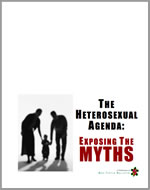 At last, the truth can now be told.
Using the same research methods employed by most anti-gay political pressure groups, we examine the statistics and the case studies that dispel many of the myths about heterosexuality. Download your copy today!
And don‘t miss our companion report, How To Write An Anti-Gay Tract In Fifteen Easy Steps.
 Anti-gay activists often charge that gay men and women pose a threat to children. In this report, we explore the supposed connection between homosexuality and child sexual abuse, the conclusions reached by the most knowledgeable professionals in the field, and how anti-gay activists continue to ignore their findings. This has tremendous consequences, not just for gay men and women, but more importantly for the safety of all our children.
Anti-gay activists often cite the “Dutch Study” to claim that gay unions last only about 1½ years and that the these men have an average of eight additional partners per year outside of their steady relationship. In this report, we will take you step by step into the study to see whether the claims are true.
Tony Perkins’ Family Research Council submitted an Amicus Brief to the Maryland Court of Appeals as that court prepared to consider the issue of gay marriage. We examine just one small section of that brief to reveal the junk science and fraudulent claims of the Family “Research” Council.
 The FBI’s annual Hate Crime Statistics aren’t as complete as they ought to be, and their report for 2004 was no exception. In fact, their most recent report has quite a few glaring holes. Holes big enough for Daniel Fetty to fall through.
“Google” is a trademark of Google Inc.
© Box Turtle Bulletin. All Rights Reserved.

 Posts
Posts  Posts via daily email: