Box Turtle Bulletin
 News and commentary about the anti-gay lobby
“Now you must raise your children up in a world where that union of man and box turtle is on the same legal footing as man and wife…”
News and commentary about the anti-gay lobbyPosts Tagged As: Daily Agenda
December 2nd, 2012
Events This Weekend: International Bear Pride, Cologne, Germany; Hong Kong Gay and Lesbian Film Festival, Hong Kong, China; Holly Folly, Provincetown, MA.
THIS MONTH IN HISTORY:
What Probation Officers Can Do For Homosexuals: 1949. Until Illinois became the first state in the nation to decriminalize homosexuality in 1961 (see Jul 28), it was illegal, and often a felony, in all fifty states and the District of Columbia. When caught, some were imprisoned, some were sent to mental institutions, some were fined (and some were blackmailed and forced to pay bribes), and some were placed on probation. Which meant that the question of who to do with gay people became a probation officer’s problem, whose task it was to serve multiple roles: law enforcer, social worker, employment counselor, and psychologist. Naturally, probation officers sought the opinions of psychologists and psychiatrists on how to deal with the many problems that they encountered.
In December 1949, the professional journal Federal Probation published an article by Dr. Manly B. Root, staff psychiatrist at the U.S. Penitentiary in Lewisburg, Pennsylvania, which the journal’s editor emphasized, “is mustreading for all probation officers.” Dr. Root wrote that one of the more perplexing questions confronting probation officers is “how a normal baby with all potentialities for good grows into an individual whose lax moral standards, thoughtless hedonism, callous conscience, and rebellious aggressiveness make of his character and personality a person who has to be locked up by society for its own protection.” And among the different characters Root addressed were alcoholics, drug addicts, psychopathic personalities, neurotics, psychotics, and “sexual deviates.” Of the latter, he identified four categories:
Root defined the second and third categories this way:
Active homosexuality.– These persons have as their sexual object a person of the same sex; as their sexual aim, sexual union with the other person. They desire the masculine role, acting toward their homosexual lover as a normal person would toward a lover of the opposite sex.
Passive homosexuality.– These persons have as their sexual object a person of the same sex; as their sexual aim, sexual union with the other person. They desire the feminine role, acting toward their lovers as normal persons would toward lovers of the opposite sex.
Remember these distinctions: the active homosexual (when a man) treats a male lover as though he were a female. The passive homosexual (when a man) treats the male lover as though the lover were a male, and he (the passive homosexual) a female. All three of these types [Here, Root includes “uncontrolled heterosexuals”] may be aggressive or not; that is, they may seek the lover or may respond to the lover’s seeking. All three may be constantly true to their abnormal type, or may be what we call facultative; that is, sometimes “normal” and sometimes “abnormal.” In the field of personality distortions hardly anyone is the same sort of person all of the time.
As you can see, in 1949, the gender role played by gay men (and it was mostly men who were convicted) was still deemed to be of great significance, even though the advice Root gave was undifferentiated based on whether he was “active” or “passive.” His first piece of advice, aside from suggesting that probation officers read Freud’s Three Contributions to the Theory of Sex, was to “advise and discuss, but do not be ‘preachy’. Almost everyone has some peculiarities and worries and guilt feelings and conflicts about his or her sex life.” He also reminded his readers that “you cannot control another person’s sex life. You can only give guidance and leadership.” He continued:
Much of the good done by doctors, by friends, and by priests at the confessional, comes from what psychoanalysts call catharsis — letting off steam and relieving tension by talking to a sympathetic listener. Another point to remember is that the tension caused by a person tortured by psychosexual pathology can be relieved in only four ways, as follows:
(1) Frank acceptance of the abnormal sexual desires and frank yielding to them. This results in the individual becoming an overt participant in his particular kind of sexual pathological activity. He is then no longer ashamed of his longings and activities, enjoys them, and considers the people we call normal as narrow-minded. Tension leaves him for he has avoided conflict about the matter.
(2) Frank acceptance of the abnormal sexual desires but refusal to yield to them. This results in some tension because of the constant restraint, but the acceptance of the abnormal desires does away with the more serious conflict which always occurs when an individual refuses to admit his personality or character peculiarities, sexual or otherwise. His mental state is then to be compared on a heterosexual level to the normally sexed man or woman who for some reason remains unmarried and continent. He is consciously exercising self-control, not fighting an inward conflict.
(3) Relief of tension by sublimation. This word, which is taken from physics, refers to the purification of an impulse or tendency or desire into a socially acceptable form of activity. This is not done consciously like the solution discussed under (2), but is an unconsciously developed mechanism. Its explanation lies in the field of psychoanalytic theory, not at all universally accepted. It is pretty generally believed, however, that many people find happiness by satisfying their antisocial tendencies in a way which does good instead of harm. To give specific examples of this sublimation in a paper prepared for nonmedical readers might cause embarrassment. Suffice it to say here that any overpowering interest or vocation or avocation which your clients show may lead the way to a possible sublimation of antisocial or abnormal sexual tendencies.
I’m going to pause here to wonder aloud what he meant when he said that giving examples of sublimation “might cause embarrassment.” Did he sense there were a number of people with “abnormal sexual desires” among probation officers? Among mental health professionals? Anyway, he continued:
(4) Repression of the sexual conflict. Another and always tragic solution of an individual’s conflict about his sexual peculiarities involves its repression. According to psychoanalytic theory, at least, such a person is actually able to repress his conflict. Thus a homosexual, for instance, comes to believe that he is not a homosexual at all. If this were all, it would be a happy solution. Unfortunately for such a patient — for such persons then become psychotic — the repressed desires remain active and seek expression in some way. These ways take place through delusions and hallucinations in which homosexual threats seem to come from other persons. Depending upon the subject’s personality makeup, varied symptoms may develop and the individual becomes the victim, as he sees it, of a hostile world which is trying to force him into homosexuality, and of hallucinations and voices which accuse him of the very perversions he has repressed. Thus a person cannot safely repress his desires without becoming psychotic or exhibit some sex deviation.
Root conlcuded that “the only safe way of keeping his mental health are the first three alternatives,” ruling out the fourth for obvious reasons. But he advised probation officers to try to direct their charges to the second and third alternatives because “it is probable that we can do little to help the probationer as to the way in which he solves the conflict.” He left unmentioned that the first option might get the probationer in trouble with the law all over again, an option that the very audience Root is writing to would reject out of hand. Besides, Root added, “He is never as effective an individual as is the man who accepts his peculiarities and succeeds in controlling them” — and by “controlling them,” he meant “not doing it.” Easy advice for Root to dispense; he went home every night to his wife Dorothy and son Charles.
[Source: Manly B. Root “What the probation officer can do for special types of offenders.” Federal Probation 13, no. 4 (December 1949): 36-46.]
If you know of something that belongs on the Agenda, please send it here. Don’t forget to include the basics: who, what, when, where, and URL (if available).
As always, please consider this your open thread for the day.
December 1st, 2012
TODAY’S AGENDA:
 World AIDS Day: Everywhere. Today is the day set aside to increase awareness, fight prejudice, and improve education about HIV/AIDS. Worldwide, it is estimated that about 35 million people are are living with HIV/AIDS. The good news is that the rate of new HIV infections worldwide are still declining, as have AIDS-related deaths. Where access to antiretroviral (ARV) medications is available, AIDS changed from being a fatal disease to a chronic one, albeit a very serious one. Those who are on ARVs can now expect a near–normal lifespan.
The bad news is that men who have sex with men (MSM) made up 64% of all new HIV infections in 2010. Alarmingly, African-American men make up about 37% of that category (PDF: 1.9MB / 79 pages; see page 26). The epidemic has also shifted from the major Northeastern, Midwestern and West Coast cities of the 1990s to becoming an increasing problem in rural and urban areas of the Southeast. While ARV’s have proven to be a literal lifesaver, access remains difficult. Treatment in the U.S. can run about $10,000 per year per person. Young people under 25 represent more than a quarter of new HIV infections each year (26 percent) and most of them (60 percent) don’t know they’re infected. All told, an estimated 75% of people with HIV do not have their virus under control because about quarter of all people with HIV don’t even know they have it. Do you know your status? Find out today. You can even do it from the comfort of your own home, so there’s no excuse not to.
Events This Weekend: International Bear Pride, Cologne, Germany; Hong Kong Gay and Lesbian Film Festival, Hong Kong, China; Holly Folly, Provincetown, MA.
TODAY IN HISTORY:
Connecticut Passes It’s First Sodomy Law: 1642. “If any man lyeth with mankind as hee lyeth with woman, both of them shave committed abomination, they both shall surely be put to death. — Levit. 21. 13.” If it’s any consolation, the same penalty also applied to adultery.
TODAY’S BIRTHDAY:
 Matthew Shepard: 1976. I’m not sure what to say about him that hasn’t already been said. He has become so much larger in death than he was in life — except, of course, to those who knew him. For the rest of us, he’s an icon, not unlike the golden images venerated in Orthodox churches of impossibly heroic saints who suffered their unimaginable tortures in stoic silence. Most of what we know about him can be summed up in a simple creed: he suffered, died, and was buried. Even one popular description of how he was found — tied to a fence with his arms outstretched — took on religious significance, even if the image it portrayed was inaccurate. Judy Shepard, Matthew’s mother, has always been uncomfortable with the deification.
“People call him a martyr, but I take exception to that,” she said. “I’ve tried very hard to keep him real. It’s unfair to make him larger than life. He had foibles. He made mistakes. He was not a perfect child by any means.
“When he was killed he was not on a victory march or a protest march or anything that you would consider fighting for gay rights. He was just living his life as a 21-year-old college student who smoked too much, drank too much and didn’t study enough.
“He was a college kid trying to figure out his future.”
But he wasn’t given the chance to figure it out. If he had not been beaten and left to die on a cold rural Wyoming fence, he would have turned 36 today. Instead, he is forever 21 and still much too young to die.
If you know of something that belongs on the Agenda, please send it here. Don’t forget to include the basics: who, what, when, where, and URL (if available).
As always, please consider this your open thread for the day.
November 30th, 2012
TODAY’S AGENDA:
Protest At Uganda House: New York, NY. According to the American Equality Bill Project’s Facebook page, there will be a peaceful protest in front of the Ugandan Mission in New York. Picket signs will include messages like “Shame on Uganda” and “Gays Like Christmas, Too,” in reference to Speaker Rebecca Kadaga’s vow to pass the Anti-Homosexuality Bill by Christmas. The protest will take place at noon, at 336 East 45th Street.
US Supreme Court To Consider Hearing Multiple Marriage Cases: Washington, D.C. the Supreme Court Justices will gather this morning for a private conference to decide which of the many cases that have been appealed to the Court they will hear for this term. The conference doesn’t go into the substance of the cases themselves, but whether there is a compelling reason for the Court to take the case or let the lower court’s ruling stand. It only takes four of the nine justice to agree to hear the case for the Court to issue a writ of certiorari, which is the Court’s go-ahead for the case to proceed. Here’s an interesting statistic: For the 2009-1020 term, the Court received 8,159 petitions for writ of certiorari. They only accepted 87, or 1.005%.
It would take a pretty complicated scorecard to keep track of all of the marriage equality-related cases that are before the court this morning, but, broadly speaking, they fall nicely into three distinct categories. Let’s take the easiest one first:
Hollingsworth v. Perry. Formerly Perry v. Brown which was formerly Perry v. Schwarzenegger, this case comes to the Supreme Court after the Ninth Circuit Court of Appeals issued a very narrow ruling which declared that California’s Proposition 8 banning same-sex marriage unconstitutional. The Ninth Court didn’t rule on whether denying marriage violates the Constitution. Instead, its decision declaring Prop 8 unconstitutional hinged on the fact that same-sex couples saw their rights to marry taken away after having been able to legally marry for several months. It was the removal of an existing right that the Court found problematic.
Because of the narrowness of the Ninth’s decision, many legal observers speculate that the court may decline to take the case. And if that happens, then the Ninth Circuit Court of Appeals’ decision striking down Prop 8 as unconstitutional will stand and California’s same-sex couples will have their marriage rights restored. But if the Supreme Court takes the case — especially if it also decides to take one or more of the DOMA cases that are also before the court — then it may signal that the court is willing to take a more ambitious (and possibly aggressive) look at marriage for same-sex couples. The Court also has the option of holding Hollingsworth v. Perry for consideration later.
The DOMA Cases. While more than a dozen cases challenging Section 3 of the Defense of Marriage Act are working their way through the federal court system, I’ve managed to track down five of them in which one party or another has asked the Supreme Court to consider this term. They are:
U.S. v. Windsor. This case was brought by Edie Windsor, who is being forced to pay an inheritance tax of $363,053 after her legally married wife passed away. If she had been married to a man, would not have been required to pay the tax. But because DOMA’s Section 3 prohibits the federal government from recognizing same-sex marriages for any purpose, the IRS has billed her for the tax on her wife’s estate. Last October, the Second Court of Appeals in Manhattan has affirmed a lower court’s decision which held that Section 3 of the Defense of Marriage Act is unconstitutional. What makes this case notable is that the Court found that heightened scrutiny is justified in evaluating the constitutionality of DOMA. Of the DOMA challenges before the court, many feel that this case is the most likely one for the justices to take. It is also the case that the Justice Department selected as its preferred case.
BLAG vs. Gill. Formerly Gill vs. Office of Personnel Managementm the case was brought on behalf of several same-sex couples who were denied specific benefits which are routinely granted to opposite-sex married couples. The First Circult Court of Appeals ruling employed the rational basis test to evaluate the constitutionality of Section 3 because of a prior binding Circuit precedent which prohibited it from considering a higher level uf scrutiny. But even under rational basis, the court found that Section 3 violates the equal protection component of the Due Process Clause of the Fifth Amendment. This is the case that the House Bipartisan Legal Advisory Committee selected as its preferred case to defend Section 3 with. BLAG stepped in to defend DOMA when the Justice Department announced that they could find no constitutional reason to defend it. But one possible strike against this case is that Justice Elena Kagan is expected to recuse herself from this case because she served as the top appellate lawyer in the Obama administration before joining the court. She joined the court after Windsor made its way to the Appelate Court stage.
HHS v. Massachusetts. This case was brought by the State of Massachusetts, alleging that Section 3 of DOMA forced Massachusetts to discriminate against its own legally-married citizens while administering federally-funded programs. The First Circuit combined this case with what is now BLAG vs. Gill when it struck down Section 3.
Other DOMA cases which the Supreme Court may take up include:
The Court has the option of selecting any one or more these cases to hear. If it decides to hear more than one case, the Court may decide to combine the cases and hear them together. Of course, the court could decide to deny certiorari to all of these cases and leave the lower court decisions intact, but that is extremely unlikely.
A third marriage-related case (sort of) before the court is Brewer v. Diaz, in which the Ninth Circuit Court of Appeals struck down an attempt by the Arizona legislature to eliminate health care benefits for the same-sex partners and dependents of state employees following the passage of Proposition 102 in 2008. Prop 102 was a “narrow” same-sex marriage ban, one which did not eliminate domestic partnerships or other arrangements. Prop 102 supporters claimed that if it passed, they wouldn’t go after domestic partner benefits. But wouldn’t you know it, that turned out to be one of Gov. Janet Brewer’s (R) top priorities when she took office. None of that backstory is relevant to this case though; I’m just airing my gripes. The question before the Court is whether Arizona’s action violates the Equal Protection Clause by limiting healthcare benefits to married spouses and dependents. The Ninth says it does. Brewer says it doesn’t.
So what’s next? After the conference, the Court could announce which cases it will hear as early as this afternoon. If not, then we will probably know more on Monday morning when the Court is expected to release an Order List, which will list the cases that the court decided to deny certiorari. And if these cases don’t appear on either set of announcements, then that means that the court is continuing to hold the cases pending further consideration.
Events This Weekend: International Bear Pride, Cologne, Germany; Hong Kong Gay and Lesbian Film Festival, Hong Kong, China; Holly Folly, Provincetown, MA.

Robert T. Odeman (right) and Martin Ulrich “Muli” Eppendorf (left).
TODAY’S BIRTHDAY:
Robert Odeman: 1904. Born Martin Hoyer in Hamburg, he took his stage name when he began traveling throughout Europe performing as a classical pianist. When his playing career ended after suffering a hand injury, he turned to the theater as an actor. He met his first love, Martin Ulrich Eppendorf, at the age of 17, and they remained together for the next ten years. After his beloved Muli died in 1932, Odeman became musical director of a theater in Hamburg, and in 1935 he opened his own cabaret. The Nazis closed it a year later on the grounds that it was politically subversive. A year after that, in 1937, the Nazi’s pressured a bookseller to renounce Odeman as a homosexuals, and he was convicted under Paragraph 175, Germany’s notorious statute that outlawed homosexual acts between men.
After serving in prison for 27 months, he was released in 1940 under the terms of a Berufsverbot, or a professional ban on certain professions including public performances. He was also kept under police surveillance. In 1942, he was arrested again under Paragraph 175 and was sent to Sachsenhausen concentration camp. He was assigned an office job, which probably saved his life. An estimated 30,000 prisoners lost their lives there, from exhaustion through forced labor, disease, or were executed. When the Red Army advanced on Sachsenhausen, the camp’s SS guards ordered the 33,000 remaining inmates on a forced March. Thousands more prisoners did not survive the death march. But Odeman and two other “175’ers” were able to escape.
After the war, Odeman returned to Berlin, where he worked as an actor, composer, and author of satirical poems. Because Paragraph 175 remained on the books, Odeman continued to be regarded as a convicted criminal under the law and, like others convicted under the statute, he was denied compensation. He died in 1985 at the age of 81.
If you know of something that belongs on the Agenda, please send it here. Don’t forget to include the basics: who, what, when, where, and URL (if available).
As always, please consider this your open thread for the day.
November 29th, 2012
TODAY IN HISTORY:
Der Spiegel Reports On Arrests of 750 Gay Men: 1950. The Third Reich had been defeated five years earlier, but Germany’s notorious Paragraph 175 lived on to claim more victims. On this date in 1950, Germany’s news weekly Der Spiegel featured a surprisingly sympathetic report on the arrest of 750 gay men by the Frankfurt Criminal Police resulting in 140 criminal charges as of November 25. Magistrate Kurt Romini denied that an official campaign had been launched, saying he was only responding to complaints from “young persons.” But it turns out that Romini himself had been in charge of handling criminal cases against gay men as State Attorney during the Nazi regime. “During his work in the Third Reich,” Der Spiegel reported, “it was not in the interest of a defendant to admit to homosexuality. As soon as he confessed, he was on the way to the concentration camp (with a pink triangle on his chest) and certain to eventually be castrated.”
Castration was no longer in vogue, but Der Spiegel discovered a new twist in this latest campaign. Police relied almost entirely on street hustlers to make arrests and build cases. “They (the hustlers) are driven, for example, through the city in unmarked cars. Then they indicate which passers-by they recognize in the street traffic. The auto stops, and the subject is arrested and interrogated. Moreover, he is entered into the criminal records system. That is, he is photographed; the picture is then shown to all hustlers in custody and informants until someone recognizes him. When someone admits that he visits bars frequented by homosexuals, then a detailed description of a sex act by a hustler is sufficient for a court to convict him. There are known cases where such relationships persons with homosexual tendencies with a certain hustler did not exist. The ‘boys’ invented experiences, and a conviction resulted.”
One hustler, identified as 19-year-old Otto Blankenstein, had been the star witness (and often the only witness) in at least 40 cases. This was true even though “tangible symptoms of mental illness are apparent” in Blankenstein. Der Spiegel also reported that a number of the cases involved blackmail, where the men refused to pay a bribe to some of the street hustlers in exchange for not naming them to police. It’s likely that some of the men weren’t even gay. Their only “crime” was to respond to a few innocuous questions from a hustler at a train station, who then surreptitiously followed them as they walked home. On learning the man’s address, the hustler could then learn more about him; if he was unmarried, the hustler was extra-lucky and his mark would be easier for the inevitable blackmail demands. Refusal to pay resulted in being turned over to police.
If the victim was lucky and wasn’t convicted, his problems still weren’t over. “The citizen is recorded as a suspected homosexual, and a duplicate of his mug shot, which he had to let the police take, is now placed in the Frankfurt mug shot library, and will be shown to hustlers and other people in custody. They will point at it and say, ‘That one, that one, I saw him too in the Kleist Kasino (a popular gay bar), and he offered me DM10 for the night.'” At the peak of the campaign, Judge Romini, who was in charge of all Paragraph 175 cases, was presiding over four trials per day. At least six of the accused men committed suicide.
On February 14, 1951, Der Spiegel carried a brief update revealing that Romini’s star witness, Otto Blankenstein, had been declared mentally ill, and Romini himself had been accused by his housekeepers of “severe night-time disorderly conduct and outburst in the presence of his professional colleagues.”
[Thanks to Rob in NYC for the translations]
If you know of something that belongs on the Agenda, please send it here. Don’t forget to include the basics: who, what, when, where, and URL (if available).
As always, please consider this your open thread for the day.
November 28th, 2012
TODAY’S AGENDA:
Events This Weekend: International Bear Pride, Cologne, Germany; Hong Kong Gay and Lesbian Film Festival, Hong Kong, China; Holly Folly, Provincetown, MA.
TODAY IN HISTORY:
Dallas Judge Gives Light Sentence In Gay Man’s Murder: 1988. It was a common sport among Dallas-area high school students throughout the 1980s and well into the 1990s: drive into the Oak Lawn gayborhood on a weekend night and spend the evening “gay bashing” — their term for it. (Full disclosure: one of my friends was stabbed in the chest and spent days in intensive care in one such attack while walking along Throckmorton St. His assailants were never found.) In one case, nine friends from North Mesquite High School drove to Oak Lawn one night in May to “pester the homosexuals.” According to the New York Times’s description of the event:
Witnesses who were in that group said the boys were standing on a street corner and shouting at passers-by, and then Tommy Lee Trimble, 34, and John Lloyd Griffin, 27, drove up and invited the boys into their car. Mr. Bednarski was said to have persuaded one more friend in his group to get in the car.After the car reached a secluded area of Reverchon Park, Mr. Bednarski is said to have ordered Mr. Trimble and Mr. Griffin to remove their clothes. On their refusal, a witness said, Mr. Bednarski drew a pistol and began firing. Mr. Trimble died immediately. Mr. Griffin died five days later.
Bednarksy was found guilty of murder, but Texas law allows the defendant to decide whether the judge or jury would determine the sentence. Bednarksy’s defense lawyer sensed that the judge was sympathetic and chose him. On November 19, Judge Jack Hampton announced that he considered, among other things, that Bednarski has no prior criminal record, was attending college, and was raised n a “good home” by a father who was a police officer, before deciding on the sentence: 30 years in prison instead of a life sentence. As he explained to the Dallas Times Herald two days later: “They two guys that got killed wouldn’t have been killed if they hadn’t been cruising the street picking up teenage boys. I don’t care for queers cruising the streets picking up teenage boys. I’ve got a teenage boy.”
Those remarks touched off a furor in the gay community. Paul Varnell of the Illinois Gay and Lesbian Task Force summed up the reaction and said, “It appears that we do have one law for heterosexuals and one law for homosexuals.” John Wiley Price, the outspoken African-American activist and Dallas County Commissioner, said, “The only difference between the Ku Klux Klan and Judge Hampton is that one wears a white robe and the other a black robe.” Hampton, who had been first elected judge in 1981 and would be up for re-election in 1990, remained unconcerned. “Just spell my name right. Nobody will remember by 1990 anyway.” He was right. He was re-elected in 1990, but lost his seat finally in 1992.
If you know of something that belongs on the Agenda, please send it here. Don’t forget to include the basics: who, what, when, where, and URL (if available).
As always, please consider this your open thread for the day.
November 27th, 2012
TODAY IN HISTORY:
Pennsylvania Outlaws Sodomy: 1700. The Pennsylvania assembly passed a new sodomy law to replace the old one which had been abrogated in 1693. The new law read:
…whoever shall be legally convicted of sodomy or bestiality, shall suffer imprisonment during life, and be whipped at the discretion of the magistrates, once every three months during the first year after conviction. And if he be a married man, he shall also suffer castration, and the injured wife shall hae a divorce if required.
In keeping with the pacifist nature of the Quakers who dominated the political structures in Pennsylvania, the colony’s law against sodomy was quite lenient: it was the only colonial law which didn’t call for the death penalty. That relative pacifism however didn’t extend to those of African descent. Another law, “An Act for the Trial of Negroes,” added this:
…”if any negro or negroes within this government shall commit a rape or ravishment upon any white woman or maid, or shall commit murder, buggery or burglary, they shall be …. punished by death.”
[Source: Jonathan Ned Katz. Gay/Lesbian Almanac (New York: Harper & Row, 1983), pages 122-123.]
 Harvey Milk Assassinated: 1978. Harvey Milk finally succeeded in winning political office as a gay man for two reasons. One, he refused to hide who he was; and two, he made it his mission to build alliances with groups that other gay activists thought were impossible to reach. Among those alliances, initially, was with the most conservative member of the San Francisco Board of Supervisors, Dan White. There couldn’t have been two politicians from more opposite ends of the political spectrum. White, a former cop, was a conservative Catholic representing a blue-collar neighborhood, while Milk, a gay Jew from New York, represented the growing gay districts surrounding the Castro. Milk and White made several media appearances in which they spoke warmly of each other, and Milk began telling friends that he thought White was “educable.” That began to change however when Milk changed his mind about White’s opposition to a proposed psychiatric treatment center in White’s district. Harvey initially supported White, which would have given White the 6-5 majority he needed to block the facility. But as Harvey learned more about the center, he discovered that San Francisco children would be sent instead far away to a state hospital where they would be cut off from their families. He concluded that “they’ve got to be next to somebody’s house,” and switched his vote.
The loss stunned White, and for several months he refused to speak to Milk or his aides. He also tried to retaliated by switching his vote on Harvey’s gay rights bill, but the bill passed anyway 10-1. White became increasingly disillusioned with politics, and abruptly resigned on November 10, 1978. He quickly regretted his decision, and asked Mayor George Moscone to re-appoint him as Supervisor. Instead of complying with the request immediately, Moscone said he would think it over and announce his decision on November 27.
 The night before the scheduled announcement, White learned through a reporter that he would not get the reappointment. The next morning White went to City Hall with his loaded .38 Smith & Wesson. He went to Moscone’s office and asked for a meeting. Moscone agreed and invited him into the mayor’s office. There, White shot Moscone twice in the abdomen and twice in the head. He then went down the hall to Milk’s office. When Milk got up out of his seat to greet White, White shot him three times in the chest, once in the back, and twice more in the head.
On November 27, 1978, tens of thousands of stunned mourners gathered in the Castro for an impromptu candlelight march to City Hall. The sea of candles stretched ten city blocks long. At the steps of city hall, Joan Baez led the crowd in singing “Amazing Grace” and the San Francisco Gay Men’s Chorus sang a hymn by Felix Mendelssohn.
TODAY’S BIRTHDAY:
 John Aravosis: 1963. An attorney, Democratic political consultant, gay activist and blogger, Aravosis is the founder of Americablog. His first major success as a gay activist came in 1998 when he defended U.S. sailor Timothy R. McVeigh (not to be confused with the Oklahoma City bomber Timothy McVeigh), who was being kicked out of the Navy after he was outed by America Online. The internet provider had released the identity behind McVeigh’s email account even though the Navy never bothered to get a court order or warrant, in direct violation of AOL’s terms of service. McVeigh was days from being discharged when Aravosis embarked on a massive publicity campaign that caught the attention of ABC News, Time and Newsweek. It also got the attention of another lawyer, who took McVeigh’s case pro bono. McVeigh not only won an honorable discharge from the Navy, but also a large settlement from AOL.
Aravosis founded AmericaBlog in 2004. AmericaBlog first received widespread media attention in 2005 after it outed “Jeff Gannon” (real name: Jeff Guckert), a member of the White House press corps who had a reputation for fielding softball questions during news conferences.
If you know of something that belongs on the Agenda, please send it here. Don’t forget to include the basics: who, what, when, where, and URL (if available).
As always, please consider this your open thread for the day.
November 26th, 2012
TODAY’S BIRTHDAYS:
 Simon Tseko Nkoli: 1957. Born in Soweto, Nkoli became a youth activist against apartheid with the Congress of South African Students and with the United Democratic Front. He also became a gay rights activist when he joined the mainly white Gay Association of South African in 1983 and later formed the Saturday Group, the first black gay group in Africa. Nkoli’s anti-apartheid activism led to his arrest in 1984, when he faced the death penalty for treason with twenty-one others who became collectively known as the Delmas 22. While prisoner, he came out as gay. Fearing that the state would use his homosexuality against the entire group, the others of the Delmas 22 demanded a separate trial. But in the end he won them over and they stood trial together because, as they all realized, they were in the same struggle together. As Nkoli later wrote in the anthology, Defiant Desire: Gay and Lesbian Lives in South Africa
By coming out as gay while a prisoner against apartheid, he is credited with helping to change the attitude of the African National Congress toward gay rights. Patrick “Terror” Lekota, who later became chairman of the ANC, remarked, “all of us acknowledged that [Nkoli’s coming out] was an important learning experience . . . His presence made it possible for more information to be discussed, and it broadened our vision, helping us to see that society is composed of so many people whose orientations are not the same, and that one must be able to live with it.” And so, when it came to writing the Constitution, “how could we say that men and women like Simon, who had put their shoulders to the wheel to end apartheid, how could we say that they should now be discriminated against?”
After his acquittal and release from prison in 1988, he founded the Gay and Lesbian Organisation of the Witwatersrand (GLOW), which organized South Africa’s first Gay Pride march in 1990. He also was among the first African gay men to come out publicly as HIV-positive and founded Positive African Men in Johannesburg. He was among the first gay activists to meet with President Nelson Mandela in 1994, and he campaigned successfully for anti-discrimination measures on the Bill of Rights of the South African Constitution. Nkoli lived long enough to see South African repeal its sodomy law in 1998, shortly before he died on November 30.
If you know of something that belongs on the Agenda, please send it here. Don’t forget to include the basics: who, what, when, where, and URL (if available).
As always, please consider this your open thread for the day.
November 25th, 2012
TODAY’S AGENDA:
Events This Weekend: Hong Kong Gay and Lesbian Film Festival, Hong Kong, China; White Party, Miami, FL; NOLA Masquerade, New Orleans, LA;
TODAY IN HISTORY:
Judge Rules Utah Teacher’s Rights Were Violated: 1998. Wendy Weaver, who taught psychology and physical education at the high school in Spanish Fork, Utah, became embroiled in controversy when her ex-husband, Gary Weaver, told the district in 1997 that she was a lesbian. Rumors quickly began to swirl around Spanish Fork High School, and that summer students began asking her if she was gay. She answered truthfully, and a few of the girls dropped out of the girl’s volleyball team that she was coaching. On July 14, the school district removed her as volleyball coach and banned her mentioning her “lifestyle” or partner to students, parents or staff. If she mentioned a word about her sexuality to anyone, she would be fired. A letter to that effect was placed in her employee record.
When word got out, an overflow crowd showed up to denounce Weaver at a Nebo Board of Education meeting on November 14, 1997, where parents demanding the right to pull their children out of any class she taught. A group of parents formed Nebo Citizens for Moral and Legal Values and presented a petition signed by 2,700 parents demanding her removal. After Weaver filed suit in Federal Court alleging that her First Amendment Rights were being violated, the parents group filed a suit of their own demanding the revocation of Weaver’s teaching certification.
It all came to a head on November 25, 1998 when U.S. District Judge Bruce Jenkins issued a sweeping 25-page ruling finding that Weaver’s constitutional rights of free speech and equal protection were violated. The judge ordered the school district to remove its threat to fire her from their files, restore her to the girl’s volleyball coaching job, and to pay her $1,5000 in damages. He found the limits on Weaver’s speech to be overly broad. “Indeed,” wrote Judge Jenkins, ” these restrictions limit Ms. Weaver’s ability to speak on her sexuality outside of the school, as, for example, when meeting a parent of a student in the supermarket, or when speaking at dinner with a friend who may be a staff member at the school, or even when speaking with her own children, who are students in the school district.” All of this was a gross violation of Weaver’s constitutional rights. “Simple as it may sound, as a matter of fairness and evenhandedness, homosexuals should not be sanctioned or restricted for (speech) where heterosexuals are not likewise sanctioned or restricted.”
If you know of something that belongs on the Agenda, please send it here. Don’t forget to include the basics: who, what, when, where, and URL (if available).
As always, please consider this your open thread for the day.
November 24th, 2012
TODAY’S AGENDA:
Events This Weekend: Hong Kong Gay and Lesbian Film Festival, Hong Kong, China; White Party, Miami, FL; NOLA Masquerade, New Orleans, LA;
THIS MONTH IN HISTORY:
The Mental Hygiene Aspects of Homosexuality: 1917. The theories behind the Eugenics movement were formulated by Sir Francis Galton, half-cousin of Charles Darwin. Drawing on Darwin’s theories of evolution, Galton sought to create a practical application of those theories in his 1883 book, Inquiries into Human Faculty and its Development, in which he suggested that, through carefully considered interventions, the human condition could be improved. In addition to Eugenics, which took a more narrow human-husbandry approach to improving the population, those ideas launched a broader “social hygiene” movement which had many positive results: the regulation and eventual abolition of child labor, mandatory and free education primary and (eventually) secondary education, workplace health and safety rules, anti-tenement ordinances, pre-natal care, food safety regulations, immunizations, sanitation, and birth control — although the latter, in some of its manifestations, also had its negative qualities as well. Particularly where forced sterilization of “undesired” population groups were concerned.
Eugenics was the dark side of the social hygiene movement, as was its “racial hygiene” component which simply provided a weak scientific gloss over longstanding prejudices and racial policies designed to prevent “race-mixing.” While not everyone involved in social hygienes were eugenicists, there was often a certain degree of crossed influences between the two areas of discussion. We can best see this in a textbook which was published in November 1917 by William Alanson White, a professor of nervous and mental diseases at Georgetown University. In The Principles of Mental Hygiene, he touched on a large number of topics, including homosexuality. That passage is particularly striking because of the way White described homosexuality according to its impact on “the herd.”
THE HOMOSEXUAL
This social group, like the others, is a complex and heterogeneous one and one, too, that we have only recently come to study scientifically. Perhaps no group of individuals have suffered from less understanding, have been treated with greater lack of consideration, than this group. The antipathic emotions have held almost complete sway and so have made the scientific approach to the problem practically impossible. The history of society’s attitude towards the homosexual is much the same as the history of its attitude towards the prostitute except that it has, if possible, been more completely dominated by the antipathic emotions.
Homosexuality has come of late to have a much broader meaning than that usually connoted by the popular speech. It means that degree of attraction for the same sex which turns the individual aside on the path towards a heterosexual goal and therefore away from those activities which naturally lead to procreation and are therefore race-preservative. The term by no means necessarily connotes actual concrete acts of sexual perversion. In this large sense it is readily seen why it should be tabooed by the herd. Its tendency is destructive to the interests of the herd as a biological unit and therefore the reaction against it. The reaction of hate and its congeners is the instinctive way of self-protection and must necessarily precede any judicial, intelligent attitude based upon scientific knowledge which can only come in the course of development when instinct shall have been controlled and directed by reason.
As already intimated, the homosexual group is a large and complex one and we are only beginning to be able to approach its problems with a clear scientific vision, but as we are able to do this we come more and more to an appreciation of how widely this particular type of inefficiency is distributed. Again, therefore, we come to appreciate the emphasis which I have all along put upon the necessity for studying the individual in order that he may be dealt with for what he is rather than perfunctorily classified with this or that social group just because, and for no other reason, the accident of circumstance has found him momentarily identified with it. Distinct homosexual types are found among the insane, the criminal, the feeble-minded, the epileptic, the vagrant, etc., etc., so that we must come to realize that it is a type of reaction, not a label to distinguish a given individual from all others, and try in our investigations to evaluate the part it has played in the social inadequacy of the particular individual under consideration.
Viewed in this way it becomes a problem like all the others and the objects of treatment come out clearly instead of being befogged by a haze of emotion.
The homosexual reaction should be corrected if possible. Psychotherapy is the most hopeful way of approach. Failing this the individual should be taught to use his energies as best he can based upon an understanding of himself. The ideal, next to cure, would be a direction of the energies into socially useful channels, which direction would at the same time afford an adequate fulfilment (sic) of the individual.
Homosexuality, in the broad sense here used, is found as a type of reaction in a great many conditions which constitute or lead to social inadequacy. It, therefore, offers a natural barrier to procreation of the socially inadequate classes the immense value of which, to the herd, has not been appreciated. It is, so to speak, a natural means of sterilization.
[Source: William A. White. The Principles of Mental Hygiene (New York: The Macmillan Company, 1917): 208-211.]
If you know of something that belongs on the Agenda, please send it here. Don’t forget to include the basics: who, what, when, where, and URL (if available).
As always, please consider this your open thread for the day.
November 23rd, 2012

J.C. Leyendecker, “Merry Christmas from Kuppenheimer,” 1924.
Today is Black Friday, the traditional start of the Christmas shopping season. Apparently the name Black Friday has two origins. In Philadelphia in the early 1960s, it referred to the gridlocked traffic that occurred as everyone rushed to the stores to take advantage of post-Thanksgiving sales. In the ’70s, economists began calling the day “Black Friday” because it was the day in which many retailers would begin to turn their profits for the year (or, go “in the black,” as opposed to remaining “in the red.”) But with the rise of online shopping, and with some stores beginning to open earlier on the evening of Thanksgiving day to get an early start on the lucrative shopping season, Black Friday may go the way of the dodo bird. For me, it already has. I’ve never seen a dodo bird, and I’ve never bothered to venture within a half-mile of a shopping mall or retail outlet on Black Friday. How about you?
TODAY’S AGENDA:
Events This Weekend: Hong Kong Gay and Lesbian Film Festival, Hong Kong, China; White Party, Miami, FL; NOLA Masquerade, New Orleans, LA;
TODAY IN HISTORY:
Georgia Supreme Court Strikes Down State Sodomy Law: 1998. It took twelve years for the Georgia Supreme Court to do what the U.S. Supreme Court refused to do. In 1986, the U.S. Supreme Court upheld Georgia’s sodomy law as constitutional in Bowers v. Hardwick (see Jun 30), a ruling that deeply disappointed the gay community and set back the quest to get rid of the nation’s sodomy laws by nearly two decades. But in 1998, the Georgia Supreme Court struck down that state’s law, the very law that was in question in Bowers, as a violation to the right to privacy under the state’s constitution. Unlike the 1986 case which involved a gay man who was in a consensual sexual relationship with another man, this case a heterosexual man who was accused of performing non-consensual oral sex on a niece. The jury acquitted him of the non-consensual portion of the charge due to lack of evidence, but convicted him of sodomy since Georgia, like many states, defined sodomy to include oral sex. And unlike many states, Georgia made it a crime regardless of whether it was heterosexual or homosexual. On appeal, the defense held that the statute was unconstitutional, but the state was confident. After all, the law had already been validated by the U.S. Supreme Court.
But the Georgia Supreme Court saw it differently. “While many believe that acts of sodomy, even those involving consenting adults, are morally reprehensible, this repugnance alone does not create a compelling justification for state regulation of the activity,” the court ruled in its 6-1 decision. Citing a 1905 state ruling, the state Supreme Court found that the defendant had “the right to be let alone,” a right that was more expansive than the right to privacy protected by the U.S. Constitution. “We cannot think of any other activity that reasonable persons would rank as more private and more deserving of protection from governmental interference than consensual, private, adult sexual activity,” Chief Justice Robert Benham wrote in the decision.
If you know of something that belongs on the Agenda, please send it here. Don’t forget to include the basics: who, what, when, where, and URL (if available).
As always, please consider this your open thread for the day.
November 22nd, 2012

J.C. Leyendecker’s Thanksgiving cover for the Saturday Evening Post, 1928.
My parents and Chris’s parents, both sets, are coming to our house for Thanksgiving this year. His parents are coming in from Texas; mine from Ohio, after having performed their duty of selecting the next President on behalf of the entire nation. On the menu: turkey, mashed potatoes and gravy, cornbread dressing, oyster dressing, green bean casserole, savory tomato crisp, deviled eggs, assorted veggies, cranberry sauce, pumpkin pie and pecan pie, all of it home made (except for the cranberry sauce, which, by tradition, must be jellied and cylindrical, retaining the indentations molded into its sides by the can from which it came). There will also be wine and Miller Lite and football. Pretty ordinary, I guess. No mac and cheese though — not that there’s anything wrong with that.

David Cecil (AP)
TODAY’S AGENDA:
British Producer of Gay Play To Appear in Uganda Court: Kampala, Uganda. Last September, David Cecil was arrested and charged with “disobeying lawful orders” after he staged a play, “The River and the Mountain” at two small venues in the Kampala suburbs. He went ahead with those performances after the Uganda Media Council had banned its performance at the National Theater. The Uganda Media Council reportedly determined that the play, which depicts a gay business man who experiences harassment by the friends, family and government and is murdered by his employees, was “obnoxious.” Cecil contends that the order banning the play at the National Theatre did not clearly state that the play was banned altogether everywhere in Uganda, so he went ahead with the performances at alternate venues. He was released on bail after spending four days in Uganda’s notorious Luzira maximum security prison. Cecil is due back in court today for a second hearing, where his lawyer will argue that the Media Council is an advisory body with no regulatory authority. If Cecil is convicted, he faces up to two years imprisonment.
Events This Weekend: Hong Kong Gay and Lesbian Film Festival, Hong Kong, China; White Party, Miami, FL; NOLA Masquerade, New Orleans, LA;

Benjamin Britten and Peter Pears
TODAY’S BIRTHDAYS:
Benjamin Britten. 1913. Fame came early to the English composer with his a cappella choral work, A Boy Was Born when he was just 21, and his 1945 opera Peter Grimes sealed his international reputation. His compositions were both prodigious and varied: working in orchestral, chamber, instrumental, choral and solo vocal. Much of his vocal work was written for tenor Peter Pears, who he met in 1937 and who became his musical inspiration and life partner. In 1939, Britten and Pears went to America, where his friendship with Aaron Copland inspired the development of Britten’s own work, notably his operetta Paul Bunyan.
Britten’s sexuality wasn’t the only thing controversial about him: he was was also a pacifist during World War II. On returning to Britain in 1942, he fought a long battle to wing the status of conscientious objector. That greatly hindered his ability to have his works performed in London both during and after the war. It also shaped his work; many of his operas throughout the 1950s and 1960s featured an “outside” character on the fringes of society, many of them at least suggestive of being gay. His 1973 opera, Death in Venice, based on a novel by Thomas Mann, is perhaps the first to feature an openly gay character. As the decades wore on, Britten found that he was no longer an outsider, but an acclaimed 20th century composer. On July 2, 1976, he was awarded a life peerage as Baron Britten, just a few months before he died. Pears died ten years later, and was buried next to Britten at a churchyard in Aldeburgh.
 Billie Jean King: 1943. Like all tennis greats, she started playing at a young age and won her first Wimbledon double’s title in 1962 at the age if eighteen. That was the the first of 20 Wimbledon titles between 1961 and 1979. she also one 13 U.S. titles, four French and two Australian. Throughout her career, she fought for equal prize money for men and women players. When she won the U.S. Open in 1972 but received $15,000 less than the men’s champion, she announced that she would not play the next year if the prize money weren’t made equal. The following year, the U.S. Open became the first major tournament to equalize its prize money for men and women.

Billie Jean King being congratulated by Bobby Riggs after his defeat.
Her campaign for tennis equality took a particularly public turn in 1973 when Bobby Riggs, a champion mens player from the 1940s, claimed that women’s tennis was so inferior to men’s that even a fifty-five year old like himself could beat the top women’s players. King accepted the challenge, and the Battle of the Sexes was on. Before more than 30,000 spectators at Houston’s Astrodome and a worldwide audience of 50 million people in 27 countries, King beat Rigs 6-4, 6-3, 6-3.
In 1974, King became the first president of the Women’s Tennis Association. In 1983, she retired from singles play, but continued to play doubles sporadically from 1984 through 1990. In 1981, King was sued for palimony by a former lover with whom she had had a relationship since 1971. The lawsuit effectively outed King, making her the first prominent professional female athlete to be openly gay. This came about despite her having been married to her husband since 1965. They divorced in 1987. Since then, she has been very involved with the Women’s Sports Foundation and the Elton John AIDS Foundation. In 2012, she was awarded the Presidential Medal of Freedom by President Barrack Obama for her work in advocating for the rights of woman and the LGBT community.
If you know of something that belongs on the Agenda, please send it here. Don’t forget to include the basics: who, what, when, where, and URL (if available).
As always, please consider this your open thread for the day.
November 21st, 2012
TODAY’S AGENDA:
Events This Weekend: Hong Kong Gay and Lesbian Film Festival, Hong Kong, China; White Party, Miami, FL; NOLA Masquerade, New Orleans, LA;

Michael Sandy
TODAY IN HISTORY:
Michael Sandy’s Killers Sentenced. 2008. On October, 5, 2006, Michael Sandy, 29, was lured to a secluded beach in the New York area by three others who he met in an online chat room. When he arrived, he was pulled from his car and beaten. In trying to escape, he was chased onto a busy freeway where he was struck by an SUV. One of his attackers pulled him to the side of the road and went through his pockets before fleeing. Sandy was taken to the hospital, where he remained on life support for five days without regaining consciousness. His family removed him from life support one day before his 29th birthday.
The four men who were accused of planning the attack were arrested on hate crime charges. The police investigation showed that Sandy had been selected to be robbed because he was gay, believing a gay man would hesitate to resist the attack or report it to the police.
Michael’s death brought to the fore an ongoing debate over the intersection of race and sexuality in regards to community reactions to hate crimes. Los Angeles commentatorer Jasmyne Cannick noted,
Michael Sandy could have been anyone of us, and yet he was us. He was black. He was a black male and he was a black gay male. If Michael Sandy would have been heterosexual, would that have brought out the Reverend Jesse Jacksons and the Reverend Al Sharptons a black America? Would that have made it okay for the NAACP to get involved and for other black civil right groups to take notice? I’m beginning to think so.
…When Matthew Shepard was murdered, the world stopped. Why? Because whites across this country made that white gay boy’s death an issue for the media, politicians and community groups. Do we care enough to do the same? So again I ask, where’s the outrage?
Gary Timmins, 17, pleaded guilty to attempted robbery with a hate crime enhancement. As part of his plea agreement, he testified against his friends in exchange for a four-year prison sentence. John Fox, 20, who posed as a gay man in the internet chat room, was charged with manslaughter and attempted robbery as hate crimes and was sentenced to between 13 and 21 years in prison. Anthony Fortunato, 21, tried to avoid the hate crime enhancement by claiming he was gay himself. He was convicted of manslaughter as a hate crime and was sentenced to 7 to 21 years. Ilya Shurov, 21, pleaded guilty to manslaughter and attempted robbery as hate crimes and was sentenced to 17½ years. Before sentencing, Michael’s father, Zeke Sandy rose to address the court. “These hate crimes become a cancer; it’s a disease,” he said. “I don’t know why we have to go butcher one another because we don’t like what they are, who they are.”
If you know of something that belongs on the Agenda, please send it here. Don’t forget to include the basics: who, what, when, where, and URL (if available).
As always, please consider this your open thread for the day.
November 20th, 2012
TODAY’S AGENDA:
Transgender Day of Remembrance: Everywhere. Today is the day set aside to remember those who have been murdered as a result of transphobia and to bring attention to the brutal violence endured by the transgender community. TDoR began in reaction to the brutal murder of Rita Hester, who was killed on November 28, 1998. Her murder resulted in the creation of the Remembering Our Dead web site and a candlelight vigil in 1999. Observances for the Transgender Day of Rememberance typically consist of the reading of the names of those who have died because of their gender identity, expression, presentation or perception of gender variance. Observances are being held in cities all around the world. Click here to find an observance near you.
TODAY IN HISTORY:
California Supreme Court Restores Teacher’s Credentials: 1969. In 1967, California’s state Board of Education revoked two lifetime teaching diplomas for Marc. S. Morrison, who had taught high school in the Lowell Joint School District for a “limited, noncriminal, physical relationship which Morrison described as being homosexual in nature” with a fellow teacher. After the Los Angeles Superior Court upheld the Board’s decision, Morrison appealed to the California State Supreme Court, which ruled 5-4 that an individual cannot be denied his teaching credentials unless evidence shows that homosexual behavior affected his fitness as an instructor.
John Geddes Lawrence and Tyron Garner Fined $200: 1998. One of the biggest steps toward gay equality, the end of America’s sodomy laws, began on November 17, 1998 when a 911 operator received a call about “a black male going crazy with a gun” at John Geddes Larence’s home in the Houston suburbs. Harris County sheriff’s deputies responded to the call and entered Lawrence’s unlocked apartment. There, they purportedly found Lawrence and Tyron Garner engaging in consensual sex. What they actually found is a matter of contention. Lawrence and Garner weren’t lovers — in fact, that false report had been phoned in by Garner’s actual lover, Robert Eubanks, who suspected Garner and Lawrence of having an affair. One deputy wrote in his report that he saw Garner on the bed “on all fours” on the receiving end of anal sex with Lawrence, and that both were completely naked. Another said that he saw them on the floor, and that Garner wasn’t naked. He wasn’t sure whether he saw them having anal sex or oral sex — two completely different acts which would be very difficult to confuse. “The black guy was giving him head or they was [sic] doing each other from behind. I don’t remember.”
Lawrence and Garner were arrested, held in jail overnight, and charged with violating Section 21.06 of the Texas Penal Code, otherwise known as the Texas “Homosexual Conduct” law, which prohibited engaging “in deviant sexual intercourse with another individual of the same sex.” They both denied having sex that night, but their lawyers, sensing that the case might have the makings of a landmark case, advised them to plead no contest, neither admitting guilt nor protesting innocence. Because they didn’t actually have sex, the lawyers didn’t want to make the case about their innocence. After all, it’s hard to argue that two consenting adults of the same sex have the right to have sexual relations in the privacy of their home when the two adults in question hadn’t actually had sex. And so on November 20, 1998, Lawrence and Garner were convicted of the Class C misdemeanor by a Justice of the Peace in Houston, and were fined $200 each.
And with that, landmark case of Lawrence v. Texas then began to make its way through the court system: to the Texas Criminal Court (which rejected the defense’s request to dismiss the charges), a three-judge panel of the Texas 14th Court of Appeals (which ruled the law unconstitutional), and the full nine-judge panel of the 14th Court of Appeals (which reversed the three-judge panel). The appeals then reached the Texas Court of Criminal Appeals, which serves as Texas’s Supreme Court for criminal cases. That court refused to hear the case, which left the lower court’s decision standing. Lawrence vs. Texas was then appealed to the U.S. Supreme Court, which agreed to hear the case. On June 26, 2003, the U.S. Supreme Court, in a 6-3 ruling, struck down the Texas anti-sodomy law, along with similar laws in twelve other states.
In 2011, Dale Carpenter published Flagrant Conduct: The Story of Lawrence v. Texas, in which he reconstructed the events leading up to the arrest, initial trial, and the building of a landmark civil rights case, revealing the ironic fact that the case about two men having sex was almost certainly based on a case in which neither man had ever had sex with the other, before that fateful night or since.
If you know of something that belongs on the Agenda, please send it here. Don’t forget to include the basics: who, what, when, where, and URL (if available).
As always, please consider this your open thread for the day.
November 19th, 2012
TODAY IN HISTORY:
American Council of Christian Churches Calls AIDS “God’s Wrath”: 1989. Peter Steinfels wrote in the New York Times about a gathering earlier in November of U.S. Catholic Bishops in Baltimore that had met to hammer out a document responding to the AIDS crisis. The bishops decided overwhelmingly to reject the theological proposition that AIDS was in any way a punishment from God, a position held by one in four Americans, according to a recent poll. J. Gordon Melton, director of the Institute for the Study of American Religion in Santa Barbara, had published 68 statements on AIDS from 45 different religious groups in the United States, Canada and Great Britain, and found “a remarkable” across both liberal and conservative religious groups recognizing that AIDS was not just a gay problem, and “that special ministries should be established to serve AIDS victims, their families and friends, and that the civil rights of homosexuals or of those with the AIDS virus should be protected.” But, The Times learned, that consensus wasn’t unanimous:
The Bible repeatedly describes God as employing all kinds of terrors, natural and human, to punish those who disobey his commands. These biblical accounts naturally governed the reaction of the American Council of Christian Churches, a fundamentalist group that recently expressed dismay at the consensus discovered by Mr. Melton. The council, which claims to represent about two million ”Bible Christians,” promptly went on record upholding the idea that AIDS is God’s wrath visited on homosexuals and drug addicts, although for their ultimate benefit if they turn to Jesus.

The Ramrod, about 1978.
Gay Bar Shooting Spree Kills 2, Injures 6: 1980. Ronald Crumpley, 38, had been seen cruising the streets of New York’s Greenwich Village in his father’s stolen blue Cadillac. Dressed in a dark wool topcoat, print shirt, a vest and a black fedora sporting a red feather he fired three shots from an automatic handgun at Sim’s Deli shortly before 11:00 p.m., wounding at least three people and shattering the front plate glass window. Minutes later, he drove to Christopher Street and stopped in front of two gay bars, Ramrod and Sneakers, which were next door to each other. Dann Hedges, 30, was in Sneakers and watched as the horror unfolded. “The man in the Cadillac waited about two or three minutes, drove around the block, returned, stepped out of the car calmly, walked up to the curb and and shot a man standing on the curb waiting for a cab. The man fell to the ground, then he shot another guy who ran around the corner. He started spraying both bars through the plate-glass windows. Then he got back into the car and drove off.” Hedges scribbled the car’s license plate number on a dollar bill and gave it to police.
John Ganrecki, 27, was one of six who were injured. “I heard a noise up front. … It sounded like a string if firecrackers. People were falling on the floor screaming and yelling. My friend, Fred, said ‘Hit the floor! Hit the floor!’ … I was already on the flor, looking at my hand, and it was bleeding. It was like something in Al Capone; there was a row of bullet holes across the glass behind the bar.” Ronald Greenberg, 52, also survived the shooting. “It was a massacre, a bloodbath.”
After Crumpley drove off, he stopped again at 10th and Greenwich and fired eight more shots at another group of men. This time he missed, and as police cars approach he sped away. As many as 15 police cars chased Crumpley’s car to Broadway and West 10th Street, where Crumpley abandoned the car. Officers found him trying to pull himself up underneath a van’s undercarriage. Two were killed: Vernon Koenig, an organist at Greenwich Village’s St. Joseph’s church, died on the operating table at St. Vincent’s Hospital, and Jorg Wenz, Ramrod’s 21-year-old doorman, died soon after surgery. Rene Malute, 23, was in intensive care, and five others were admitted in stable condition.
Crumpley, a former Transit Authority policeman and son of a minister, was arrested after a police chase through Village streets. He charged with murder, attempted murder, and possession of illegal weapons. Police found four weapons: A .357 Magnu, a .45 caliber automatic pistol, a 9mm automatic pistol, and the Uzi. Crumpley told police that he attacked the bars and the deli bcause he hated homosexuals. “I want to kill them all,” he reportedly told police. “They’re no good. They ruin everything.” Lt. John Yuknes said, “He had a dislike for homosexuals, a rather intense one I would say, under the circumstances.”

The Ramrod’s doors during the candlelight vigil.
The next day, about a thousand people joined a solemn candlelight procession to mourn those killed in the shooting. Arthur Bennett, one of those marching, told reporters, “Everybody’s been almost waiting for something like this. It’s not because we wanted it to happen but because we feared it. There have been a lot of people down here getting beat up.”
During Crumpley’s trail, the prosecution presented 35 witnesses, and the defense five. At issue was Crumpley’s mental state at the time of the shooting. Prosecutors contended the shootings were “deliberate” and conscious.” Crumpley’s psychiatrist testified that he was “paranoid.” Crumpley himself took the stand and described gay people s “agents of the devil” who were following him continuously for three years and were trying to convert him. The jury found him not guilty by reason of insanity and was committed Kirby Forensic Psychiatric Center on Wards Island. In 2001, a judge turned down Crumpleys’s request to be moved to a less restrictive psychiatric facility.
If you know of something that belongs on the Agenda, please send it here. Don’t forget to include the basics: who, what, when, where, and URL (if available).
As always, please consider this your open thread for the day.
November 18th, 2012
TODAY’S AGENDA:
Events This Weekend: Hong Kong Gay and Lesbian Film Festival, Hong Kong, China; Mazipatra Queer Film Festival, Prague/Brno, Czech Republic; Pride, Rio de Janeiro, Brazil.
TODAY IN HISTORY:
Massachusetts Supreme Court Rules In Favor of Marriage Equality: 2003. It’s been nine years since marriage equality arrived in the Bay State, and the sky still hasn’t fallen. Massachusetts still has the lowest divorce rate in the nation, and school children are still not being subjected to live gay sex demonstrations as part of their state-mandated curriculum. But gay couples can marry, and that was due to the Massachusetts Supreme Judicial Court decision in 2003, which became the first state supreme court to rule that same-sex couples had constitutional right to marry.
In Goodridge v. Department of Public Health, the court ruled 4-3 that the state could not “deny the protections, benefits and obligations conferred by civil marriage to two individuals of the same sex who wish to marry,” and gave the state legislature 180 days to “take any such action as it may deem appropriate” to begin issuing marriage licenses to same-sex couples. Liberty Counsel tried to get the Federal Courts involved, but those efforts failed when the judge denied their request, the First Circuit Court of Appeals backed him up, and the Supreme Court declined to hear the case. After a long drawn-out battle in which the Massachusetts high court ruled in response to a question from the state Senate that civil unions would not satisfy the court’s ruling. The legislature ended up taking no action, neither blocking nor implementing the Goodridge decision, and the state began marrying same-sex couples on May 17, 2004.
If you know of something that belongs on the Agenda, please send it here. Don’t forget to include the basics: who, what, when, where, and URL (if available).
And feel free to consider this your open thread for the day. What’s happening in your world?
Featured Reports
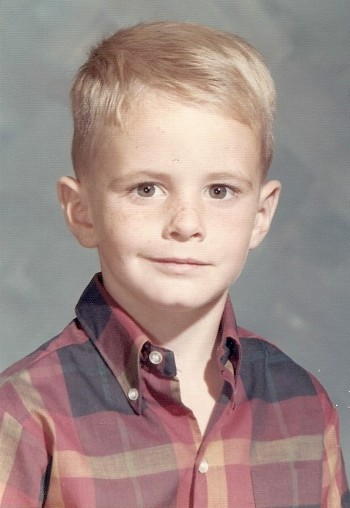 In this original BTB Investigation, we unveil the tragic story of Kirk Murphy, a four-year-old boy who was treated for “cross-gender disturbance” in 1970 by a young grad student by the name of George Rekers. This story is a stark reminder that there are severe and damaging consequences when therapists try to ensure that boys will be boys.
When we first reported on three American anti-gay activists traveling to Kampala for a three-day conference, we had no idea that it would be the first report of a long string of events leading to a proposal to institute the death penalty for LGBT people. But that is exactly what happened. In this report, we review our collection of more than 500 posts to tell the story of one nation’s embrace of hatred toward gay people. This report will be updated continuously as events continue to unfold. Check here for the latest updates.
In 2005, the Southern Poverty Law Center wrote that “[Paul] Cameron’s ‘science’ echoes Nazi Germany.” What the SPLC didn”t know was Cameron doesn’t just “echo” Nazi Germany. He quoted extensively from one of the Final Solution’s architects. This puts his fascination with quarantines, mandatory tattoos, and extermination being a “plausible idea” in a whole new and deeply disturbing light.
On February 10, I attended an all-day “Love Won Out” ex-gay conference in Phoenix, put on by Focus on the Family and Exodus International. In this series of reports, I talk about what I learned there: the people who go to these conferences, the things that they hear, and what this all means for them, their families and for the rest of us.
Prologue: Why I Went To “Love Won Out”
Part 1: What’s Love Got To Do With It?
Part 2: Parents Struggle With “No Exceptions”
Part 3: A Whole New Dialect
Part 4: It Depends On How The Meaning of the Word "Change" Changes
Part 5: A Candid Explanation For "Change"
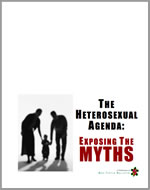 At last, the truth can now be told.
Using the same research methods employed by most anti-gay political pressure groups, we examine the statistics and the case studies that dispel many of the myths about heterosexuality. Download your copy today!
And don‘t miss our companion report, How To Write An Anti-Gay Tract In Fifteen Easy Steps.
 Anti-gay activists often charge that gay men and women pose a threat to children. In this report, we explore the supposed connection between homosexuality and child sexual abuse, the conclusions reached by the most knowledgeable professionals in the field, and how anti-gay activists continue to ignore their findings. This has tremendous consequences, not just for gay men and women, but more importantly for the safety of all our children.
Anti-gay activists often cite the “Dutch Study” to claim that gay unions last only about 1½ years and that the these men have an average of eight additional partners per year outside of their steady relationship. In this report, we will take you step by step into the study to see whether the claims are true.
Tony Perkins’ Family Research Council submitted an Amicus Brief to the Maryland Court of Appeals as that court prepared to consider the issue of gay marriage. We examine just one small section of that brief to reveal the junk science and fraudulent claims of the Family “Research” Council.
 The FBI’s annual Hate Crime Statistics aren’t as complete as they ought to be, and their report for 2004 was no exception. In fact, their most recent report has quite a few glaring holes. Holes big enough for Daniel Fetty to fall through.
“Google” is a trademark of Google Inc.
© Box Turtle Bulletin. All Rights Reserved.

 Posts
Posts  Posts via daily email: