Box Turtle Bulletin
 News and commentary about the anti-gay lobby
“Now you must raise your children up in a world where that union of man and box turtle is on the same legal footing as man and wife…”
News and commentary about the anti-gay lobbyJuly 31st, 2016

(d. 2007) Her friend and fellow gay rights activist Jack Nichols (Mar 16) called her “the Grand Mother of Lesbian and Gay Liberation.” In fact, it would be very difficult to overstate her contributions toward where we are today. Her quest for equality and dignity began when she flunked out of her freshman year at Northwestern University because she spent too much time in the library trying to understand what it meant to be a lesbian. “I devoured everything! I looked for myself in the books on abnormal psychology. I tried to find myself in legal books. I tried to find myself in encyclopedias. I found everything I possibly could. What I found was puzzling. It was me they were talking about, but it wasn’t me at all. It was very clinical; it didn’t speak of love; it didn’t have very much humanity to it.”
But one book in particular did catch her attention: Daniel Webster Cory’s The Homosexual In America (Sep 18). “The book was fascinating because, now that I look back on it, Cory’s book was very much a call to arms. … He said that we were a legitimate minority like any other minority group.” In 1956, she got in touch with Cory to find out what she could do for her minority group. He told her about One, Inc in Los Angeles, which had a large library and published ONE, the first national gay magazine to be sold on newstands. She flew to Los Angeles and went to One, Inc’s offices and asked what she could do. They told her about the Mattachine Society in San Francisco. She hopped on another plane and flew to San Francisco where the Mattachine folks told her about the Daughters of Bilitis. “Then I found myself for the first real time, not in a bar, but in someone’s living room in a nice setting with twelve other lesbians.”
Two years later and living in Philadelphia, Gittings got a call from Del Martin and Phyllis Lyon asking if she would organize a DoB chapter in New York. She formally joined DoB and traveled every weekend to New York to get the chapter established. It was through the New York DoB that Gittings met her life partner, Kay Lahusen (Jan 5, she adopted the alias of Kay Tobin when she took up activism herself). Gittings later gained a national platform within the gay and lesbian community as the editor of the DoB newsletter, The Ladder in the mid-1960s.

No Limits: Barbara Gittings picketing the White House, 1965.
In 1963, Gittings and Lahusen met Frank Kameny (May 21), the pioneering gay rights activist based in Washington, D.C.. He was, as she described him, “the first gay person I met who took firm, uncompromising positions about homosexuality and homosexuals’ right to be considered fully on a par with heterosexuals.” Together, they formed a collaboration that would transform the gay rights movement from one of timidity and defensiveness to bold action and determined demands for equality. Those actions included the first ever gay rights protests in front of the White House (Apr 17), Philadelphia’s Independence Hall (Jul 4), and the Pentagon (above), all beginning 1965. The protests were audacious for their time — the Daughters of Bilitis officially opposed picketing, and they would force her removal as editor of The Ladder in 1966 over the issue.

Barbara Gittings, Frank Kameny, and John E. Fryer as “Dr. H. Anonymous” at the 1972 APA panel on homosexuality.
Gittings, Lahusen and Kameny made a powerful team. Their greatest accomplishment came in the campaign to remove homosexuality from the American Psychiatric Association’s list of mental disorders. In 1971 Kameny and Gittings organized an exhibit at the APA convention in Washington, D.C. While there, they attended a panel discussion on homosexuality, and were outraged to discover that there were no gay psychiatrists on the panel. Kameny grabbed the microphone and demanded that the APA hear from gays themselves. The following year they were invited to participate in a panel discussion entitled “Psychiatry, Friend or Foe to Homosexuals? A Dialogue.” They got Dr. Judd Marmor, a pro-gay psychiatrist to appear on the panel, and of course Gittings and Kameny would participate. Lahusen thought something was still missing. “Look, you have psychiatrists on the panel who are not gay, and you have gays on the panel who are not psychiatrists. What you’re lacking on the panel are gay psychiatrists.” After considerable effort, Gittings finally convinced Dr. John E. Fryer, a gay psychiatrist to take part. But he would do so only on the condition that he would remain anonymous; he could wear a disguise and use a microphone to alter his voice. The appearance of “Dr. H. Anonymous” on that panel created a sensation at the convention, as he described how he was forced to be closeted while practicing psychiatry (May 2). Gittings, in turn, read aloud letters from other gay psychiatrists who refused to participate out of fear of professional ostracism. The following year, homosexuality was removed from the APA’s list of mental disorders, and Gittings celebrated by being photographed with newspaper headlines, “Twenty Million Homosexuals Gain Instant Cure.”
In the 1970s, Gittings’ passion returned to where she first tried to find information about what it means to be a lesbian: the library. She helped to found the American Library Association’s Gay Task Force, which is believed to be the first professional organization for gay people in the country. In 1971, she hit on an idea that would sure to gain attention at the ALA’s 1971 convention in Dallas. “We needed to get an audience,” she remembered. “So we decided… let’s show gay love live. We were offering free—mind you, free—same-sex kisses and hugs. Let me tell you, the aisles were mobbed, but no one came into the booth to get a free hug. So we hugged and kissed each other. It was shown twice on the evening news, once again in the morning. It put us on the map.”
She continued, “You know that kissing booth wasn’t only a public stunt. It gave the message that gay people should not be held to double standards of privacy. We should be able to show our affections.”
 Gittings never turned down an opportunity to represent the gay community. She appeared on the Phil Donahue Show in 1970, and on the David Suskind Show with a panel of six lesbians in 1971. A week after her David Suskind appearance, a middle-aged couple spotted her in a supermarket. The wife approached her and said, “You made me realize that you gay people love each other just the way Arnold and I do.”
Gittings died in 2007 after a long battle with breast cancer. She is survived by Kay Tobin Lahusen (Jan 5), a fellow gay rights advocate and her partner of 46 years. You can see a personal remembrance of Barbara Gittings by Jack Nichols here. You can view a three-part video of a 1988 interview with Gittings and Lahusen here, here, and here. In 2012, a portion of Locust Street in Philadelphia was re-named Barbara Gittings Way in her honor, and she was inducted into Chicago’s Legacy Walk.
[Additional source: Eric Marcus. Making History: The Struggle for Gay and Lesbian Equal Rights, 1940-1990. An Oral History(New York: HarperCollins, 1992): 104-126, 213-227.]
July 31st, 2016

The hunky Australian made headlines in 1995 when, as a playor for the Manly-Warringah Sea Eagles rugby club, he came out as gay. He came out in a big way: by posing nude for the first issue of Blue magazine. Public reaction was mostly positive, and his teammates were supportive. He sat out the 1996 season due to injuries, and signed with the North Queensland Cowboys in 1997. He retired from regular play in 1998 after his injuries kept piling up. That same year, he began studying acting at the National Institute of Dramatic Art in Sydney. He had a brief cameo in the 2005 Australian film Little Fish, and he took the role of Riley, a henchman of Lex Luthor in 2006’s Superman Returns. He also appeared in the final season of Comedy Central’s Reno 911, in the 2009 Australian mini-series Underbelly: A Tale of Two Cities, and in the ABC1 drama The Cut. In 2012, he appeared in his first starring role, as a gay characer, in the indy film Saltwater.
July 30th, 2016
That’s one takeaway from this report:
It was 2011 and Ryan, then the CEO of Politico, was on a mission to repair relations between the two media organizations, sources with knowledge of the situation said. Years earlier, Fox News had banned Politico reporters from its airwaves because of suspicions of anti-Fox bias, and Ryan was pushing for a fresh start.
Then, according to the sources, Ailes told Ryan what he wanted: He wanted fair coverage from Politico; he wanted the website to take stock of Fox News’ successes, not just its controversies; and he wanted Politico to stop taking talking points from “that faggot David Brock.”
…”Why am I not surprised?” Brock told CNNMoney when informed of the alleged slur.
After all, it was Brock who noted in his own book, “The Fox Effect,” that Ailes once told President George H. W. Bush he shouldn’t wear a short-sleeve shirt because he’d “look like a fucking faggot.”
Obviously, this shouldn’t have been surprising. People are now coming out of the woodwork to describe instances when Ailes has made derogatory comments about women, Jews, and racial minorities. In a sign of the times when simple manners and polite conversation is derided as “political correctness”, one media consultant who actually admires Ailes described him as the “Toscanini of inappropriateness.”
David Brock is the founder of Media Matters. He is a former conservative journalist and protégé of John Podhoretz, who cut his teeth as a self-described “Right-Wing Hit Man” in his books and articles excoriating Anita Hill the Clintons and. In 1997, he denounced his own writings and in 2002, published Blinded by the Right: The Conscience of an Ex-Conservative. Media Matters has been aggressive in its criticism of conservative journalism and of Fox News especially.
July 30th, 2016

From the souvenir program for the Great Plains Regional Rodeo, Wichita, KS, August 1-2, 1992, page 20. (Source.)
July 30th, 2016
A tiny notice appeared in The Guardian of London:
BANKRUPTCIES GAZETTED, July 30, 1895.– Oscar Fingal O’Flahertie Wills Wilde, late Tite-Street, now of her Majesty’s Prison at Petonville, author.

From the Commercial Gazette, September 4, 1895, page 35.
Wilde was arrested (Apr 5) after losing his libel case against the Marquess of Queensberry, the irate father of Lord Alfred Douglas. “Bosie,” as Wilde called Douglas, was Wilde’s lover, and Queensberry publicly accused Wilde of “posing as a somdomite” (Feb 18). Wilde sued Queensberry and lost, which meant that Wilde really must have been a “somdomite.” On that basis, he was charged with gross indecency. His first trial ended in a hung jury, but the second trial resulted in his conviction and sentencing to two years imprisonment at hard labor (May 25).
Wilde may have been in prison, but he still legally owed Queensberry £677/3/8d, to cover Queensbury’s legal expenses from the libel trial. Queensberry, not satisfied with just seeing the little bugger in jail, brought bankruptcy proceedings against Wilde for payment of the £677 and change owed by Wilde, who obviously now had no means of paying, what with his royalties having dried up and him being in prison and all. Wilde may have been in prison, but Queensberry made sure there would be another humiliating public trial where Wilde was subjected to insults from the sizable crowd.
When the Commercial Gazette published a listing of Wilde’s creditors, it listed Wilde’s total liabilities at £3,591/9/9d, of which only £914 was partially secured. The largest debt listed was £1558 owed to Sir H. Lloyd, the trustee of Wilde’s divorce settlement from his wife. Wilde also owed £71 to the Savoy Hotel, which was something of a second home for Wilde. He often stayed there for weeks at a time, whenever he wanted to entertain certain particular guests who couldn’t be so well entertained in the Tite Street home Wilde shared with his wife and children. Guests like Bosie and a few other special friends or tricks he would pick up from time to time. Other debts were to various vendors for tobacco, jewelry, wines, and to cover a theater rental.
It’s not clear what might have happened with those other debts if Queensberry hadn’t decided to pursue Wilde into bankruptcy. But as it happened, Wilde was never able to emerge from bankruptcy and he died peniless in Paris in 1900. His estate was finally discharged from bankruptcy in 1906.
[Sources: “Bankruptcies Gazetted.” The Guardian (London, August 7, 1895): page 15.
“Oscar F. O’F. W. Wilde” The Commercial Gazette (London, September 4, 1895): page 35.]
July 30th, 2016
Through the early part of the twentieth century, American medical and psychological writers began taking an increasing interest in homosexuality (or “sexual inversion,” “contrary sexual feeling,” “perverted sexual instinct,” or any number of other terms which they had yet to settle on). It was rare, however, to hear from “inverts” themselves. The July 1919 issue of the Journal of Urology and Sexology carried one interesting letter to the editor that gives some indication of the frustration that many felt due to the severe societal disapproval that was prevalent a the time:
A PLEA FROM AN INVERT
To the Editor:
A plea to be heard before it is too late — will you not listen and perhaps advise me? If you only knew how I need help!
I am a misfit. I am a young man who has never cared for any women. Am I to blame because God has given me a feminine nature? Why should I be shunned by all people, loathed by them!
I am clean and refined, am well educated in the fine arts and have high ideals concerning all things. And yet men who are covered with filthy sores from evil living, who have never had a decent thought or ideal in their lives, sneer at me. I am an outcast; I am lower than the lowest!
What few who are kind to me are women who have praised me for my high ideal concerning life.
Because the custom is not that two men shall marry, is it so wrong? If I love and respect a friend and he loves me, is it not as pure a marriage as between a man and woman; and far more equal?
I wish I had a friend to go and live with, to work out our ideals, and to grow in every way. Yet this has made me accursed among men; I am damned to a living hell!
Must I — who have denied myself almost too much, to become worthy of the highest friendship — must I forever walk alone?
Is there aught but beauty in the love of Marius and Cornelius in “Marius the Epicurian” by Walter Pater? Is Marius to be considered vile, because he had that “feminine refinement” that made him idealize life, that led him finally to the Christian faith and martyrdom?
I am alone and tired. Is it not a sad thing that I and many other young men who are worthy of much, should have but one hope — that Death shall come soon!
I need advice. If some young man among your readers might write to me! Do you not think we would save each other?
You must not believe me physically or mentally deficient — though I am near to suicide I
–Homo.
[Source: Anonymous. Letter to the editor: “A plea from an invert.” American Journal of Urology and Sexology 15, no. 7 (July 1919): 336. Available online via Google Books here.]
July 30th, 2016
 50 YEARS AGO: After earning his Bachelor’s degree in 1988, Maloney spent a year volunteering with the Jesuits in the slums of Chimbote, Peru. He then returned to get his Juris Doctor from the University of Virginia’s School of Law in 1992. He entered politics in 1991, working for Bill Clinton’s first presidential campaign, and he returned to work on his re-election campaign in 1996. After that campaign, he was offered a position in the White House staff, where he was senior advisor and White House Staff Secretary from 1999 to 2000. When Matthew Shepard was brutally murdered in Wyoming, Maloney was one of two officials sent by President Clinton to represent him at the funeral. One newspaper noted that Maloney was “the highest ranking openly homosexual man on the White House staff.”
After 2000, he became a senior attorney at the law firm which represented the Shepard family. He returned to politics in 2006, first as a member of Governor Eliot Spitzer’s administration, then in Gov. David Paterson’s administration after Spitzer’s resignation due to a prostitution scandal. In 2012, Maloney ran for New York’s 18th Congressional district and won, making Maloney one of six openly gay and bisexual members of Congress. Maloney and his partner, Randy Florke, together since 1992, are raising three adoptive children. Despite New York becoming a marriage equality state in 2011, the two had chosen not to marry because their marriage would not have been recognized under the Defense of Marriage Act. DOMA was declared unconstitutional in 2013, and Maloney and Florke married the following year in Cold Spring, New York, making Maloney only the second member of Congress to legally marry his same-sex partner.
July 29th, 2016
A group of twenty LGBT Orlando-area Republicans signed on to a resolution pledging to support legislation that would ban discrimination based on sexual orientation or gender identity. This was done in conjunction with a commemoration of the Pulse gay night club massacre in which 49 victims lost their lives. According to the Orlando Sentinel:
The resolution supports the creation laws and ordinances that promote fairness by banning anti-gay and gender based discrimination and reads “Now, Therefore, we the undersign do hereby Resolve that all Americans should be treated with equality, dignity and respect, and support efforts of Florida Businesses and individuals to pass legislation banning discrimination based on sexual orientation or gender identification”.
“These are what I like to think are the new generation of Republicans.” said (Orlando Mayor Teresa) Jacobs “What we grieved over a few weeks ago wasn’t a loss of gay people or Hispanic people, it was a loss of human beings. Human beings regardless of where they come from or who they love, had dreams and aspirations just like you and I.”
The Sentinel published a complete list of signatories. It included U.S. Congressman John Mica, and state Reps. Mike Miller and Rene Plasencia. Also signing the resolution were seven Orlando-area mayors, one city council president, two Orlando city commissioners, four county commissioners, two school board members, and the Orange County Republican Executive Committee Chairman Lew Oliver.
The inclusion of gender identity in the resolution seems particularly significant, given the hostility towards discrimination protections for transgender people that Republicans have recently shown elsewhere.
It’s hard to gauge how much support exists elsewhere in the state for any kind of LGBT non-discrimination. According to one report, Florida Gov. Rick Scott (R) met with Miami state Rep. David Richardson (D-Miami/Miami Beach), the state’s only openly gay lawmaker, and signaled that he might be willing to support some kind of unspecified non-discrimination bill. The Governor’s office would only confirm that a meeting took place. Meanwhile U.S. Sen. Mark Rubio (R-FL), who is re-booting his senatorial re-election campaign after his failed run for the GOP presidential nomination, is clearly banking on Florida’s politics being as anti-gay as ever. He is slated to headline an anti-gay event in Orlando in two weeks.
July 29th, 2016

From Lesbian Tide, September 1977, page 39.
July 29th, 2016
Speaking of political conventions, Lesbian Tide reported the results of the Social Workers party convention in 1980:
SWP COMES OUT AGAINST GAYS
At its 30th national convention, Socialist Workers Party (SWP) members decided to end its support of and intervention into the lesbian and gay rights movement. In the early 70s, the SWP had dropped their policy of excluding open lesbians and gay men from membership. In this latest move, however, SWP flatly stated that “coming out (especially on the job) is not political, but purely personal, and even has dangers of leading into “peti-bourgeois utopian lifestylism”!
— From Lesbian Tide, May 1980, page 22.
July 29th, 2016
Stonewall was still eleven years away. The first Christopher Street Liberation Day march would be a year after that. And it would be two years after that when Jeanne Manford marched with her son during that year’s Pride parade with a sign reading “Parents of Gays Unite in Support for Our Children.” In 1958, the idea of publicly-proclaimed pride was impossible to imagine. Simple visibility was still the single greatest hurdle for gay people, thanks to the very real dangers it brought: police raids (Aug 14), arrest (Jun 23), loss of employment (Mar 22, Dec 20), commitment to a psychiatric hospital (Apr 14, Jul 26), murder (Aug 3, Jan 5). There were few visible examples of gay people, and almost no visible examples of family members who accepted and supported their gay relatives.
Actually, there were few visible examples of gay people accepting themselves. But more often than not, they saw themselves as freaks, perverts, deviants, delinquents, degenerates, sick — not just because society said so, but also because the “experts” said so, from all the respected professional organizations, prestigious universities and the most trusted hospitals. When Frank Kameny dared to challenge psychiatry’s verdict that gay people were mentally ill in 1965 (May 11), the push-back was furious within the gay community. The reaction could be summed up this way: who died and made you an expert on homosexuality? What credentials do you have to challenge those who have spent an entire lifetime studying the “problem.” Kameny’s answer was simple: “We are the true authorities on homosexuality, whether we are accepted as such or not.”
Getting gays and lesbians to accept themselves was still the biggest challenge facing the homophile organizations, and an essay written by a mother of a lesbian in the July 1958 issue of The Ladder, the official newsletter of the Daughters of Bilitis, shows just what a challenge that was. She spent her essay countering a lot of misinformation that a lot of people — including a lot of gay people –shared. To counter the assumption that her daughter would live a life of lonely spinsterhood, she described her daughter’s “congenial, intelligent, loving and kind ‘mate’.” Against the prevailing view that mothers were responsible for their child’s sexuality, she defended herself by pointing to her daughter’s morality (“she could not be cheap and promiscuous”) and her good citizenship. And to counter society’s assumptions that a faithful heterosexual marriage was every woman’s birthright, she offered the example of her own sad marriage.
In all, this isn’t so much a portrait of a mother and her lesbian daughter, but a counter-narrative to the prevailing opinions of gay people at that time. The essay’s defensiveness isn’t what we would recognize as a proclamation of pride today, but when you consider how oppressive the dominant assumptions were at that time, Mrs. Doris Lyles had to start somewhere.
My daughter is a Lesbian. By all measures of accepted society, that is a pretty blunt statement. If I were an average mother, I wouldn’t even bring this assertion out and view it furtively, even when alone. Nevertheless, I do not think I would come under what one would call average, and I say this in a far from self-satisfied manner. However, I do not believe in hiding truth under our stilted, self-imposed laws of society. Many people today are frustrated and under mental treatment because of these frustrations, simply because they refuse to face the truth and prefer to delude themselves in so many ways.
My daughter from small girlhood seemed to be a little different from the average child. For one thing, she was above average mentally and had very strong will power and determination that even in childhood seemed to brook no interference. Frankly, I believe that if I had been a dictatorial, demanding mother whose child had to bend to her ego and demands, I might have had a pretty serious case of delinquency to contend with today, instead of an intelligent, serious-minded daughter who holds a fine position in a respected professional field, lives what is for her a full, rounded-out life of contentment and security, with no frustrations or problems, at least none that amount to much.
I will be very frank in saying that I am lucky in that she found a congenial, intelligent, loving and kind “mate” in this association of which I am aware but do not understand completely as a normal mother and wife. I do not like that word “normal” applied here, for there are no two more normal persons alive than my daughter and her charming associate.
In finding out about my daughter’s preferences, I had one very firm belief. I knew she would find someone of kindred tastes and lead a very circumspect life no matter what path she chose, for I knew my child and understood she could not be cheap and promiscuous, whether Lesbian or heterosexual. This thought was a great comfort and from the beginning I knew she would need love, appreciation and understanding from me; not censure, shame or withdrawal. One thing I have done to an extent most people would feel was too much to the extreme: I have left her to her own devices and now, in her middle twenties, she leads her own life completely and when she wishes to come to me, for whatever period of time she chooses, she knows she is welcome and won’t be importuned to “come oftener” and “stay longer”. As a child, I led a sheltered life in which my mother dominated all my moves and actions. When she passed away, I was at completely loose ends and made a very foolish marriage which would not have happened had I been free to follow my own course in life. This had made me wary of being possessive and trying to shape and run the lives of others. As a consequence, I think I have my daughter’s love and loyalty — even to a greater degree than most mothers who make demands and expect them to be carried out.
With the background of theatrical people during my childhood, I learned rather early that all of us, men or women, did not come within the realm of “norms.” Maybe this is why my daughter’s fate didn’t seem so terrible to me. I could think of a great many worse things, such as the unhappy twenty years of marriage I had shed at the time I learned of my daughter’s “difference”. I spent those years with a man who was a congenital liar, who preferred a lie when the truth would have served him better, and who couldn’t leave town for a week’s trip as a Salesman who travelled without having his quota of affairs with anyone — waitresses, nurses, — he seemed to prefer uniforms. It was a question of keeping my marriage together by not digging too deeply in the barrel, and keeping my temper, but definitely losing my self-respect. This I believe is a fate far worse for a girl. Maybe I’m wrong and maybe I should use every means within my power to help my daughter in her situation, but frankly I do not believe she needs help from me or anyone else. If ever the time should come when she feels the need for advice or counsel, I only hope I will be able to advise her wisely, but certainly not against what she believes with all her being to be her path in life.
We preach freedom of speech, freedom of religion, and even though reams and reams have been written on the subject, there are very few who will admit belief in freedom of love.
[Source: Mrs. Doris Lyles. “My Daughter Is a Lesbian.” The Ladder 2, no. 10 (July 1958):4-5.]
July 29th, 2016

His role on Project Runway is that of a fashion professor and mentor, in line with his previous life as a member of the faculty at Parson The New School for Design, where he served as the fashion design chair before moving to Liz Claiborne in 2007 to work as their chief creative officer. Meanwhile, he’s been “making it work” at the Lifetime reality series which just started its thirteenth season last week. He is an animal rights advocate and speaks out against the use of fur in fashion. He also made an “It Gets Better” video, motivated by his own suicide attempt when he was seventeen. He’s been a rather private person, not given to opening his life to public scrutiny. But that began to change in 2006 when, in an interview with Instinct, Gunn said that he hadn’t been in a relationship since the early 1980s, after the end of a six-year relationship with the love of his life, whom he still loves today. He’s been celibate ever since then. In 2012, he wrote a short essay, Shaken, Not Stirred (available only as a Kindle Single) in which he described growing up with a rigid, controlling FBI-agent father who was J. Edgar Hoover’s ghostwriter.
July 28th, 2016
Because of course they did.
Fox News wasn't that interested in Khizr Khan's speech. pic.twitter.com/raF2RQVy0j
— John Whitehouse (@existentialfish) July 29, 2016
July 28th, 2016
The Seventh Circuit Court of Appeals in Chicago has reluctantly upheld a lower court ruling which held that sex discrimination protections found in Title VII of the Civil Rights Act of 1964 cannot be extended to include sexual orientation.
The case was filed by Kimberly Hively, a former teacher at Ivy Tech Community College in South Bend, Indiana, who filed a grievance with the Equal Employment Opportunity Commission (EEOC) charging that she had been blocked from full time employment because of her sexual orientation. When she exhausted her appeals with the EEOC, she filed a lawsuit in Federal District Court. The college countered that Title VII doesn’t apply to sexual orientation claims, and the court agreed.
The Appeals Court decision, written by Judge Ilana Rovner and joined by Judge William Bauer, shows that the court didn’t like issuing the decision that it did (PDF: 347KB/42 pages). “This panel could make short shrift of its task and affirm the district court opinion by referencing two cases (released two months apart), in which this court held that Title VII offers no protection from nor remedies for sexual orientation discrimination,” wrote Rovner. However, she wrote that the court was not only bound by those two previous decisions, but many others as well. “Our precedent has been unequivocal in holding that Title VII does not redress sexual orientation discrimination. That holding is in line with all other circuit courts to have decided or opined about the matter.”
That was page six. The remainder of the 42-page document continued to defend the ruling against “a paradoxical legal landscape in which a person can be married on Saturday and then fired on Monday for just that act”:
For although federal law now guarantees anyone the right to marry another person of the same gender, Title VII, to the extent it does not reach sexual orientation discrimination, also allows employers to fire that employee for doing so. From an employee’s perspective, the right to marriage might not feel like a real right if she can be fired for exercising it. Many citizens would be surprised to learn that under federal law any private employer can summon an employee into his office and state, “You are a hard‐working employee and have added much value to my company, but I am firing you because you are gay.” And the employee would have no recourse whatsoever — unless she happens to live in a state or locality with an anti‐discrimination statute that includes sexual orientation. More than half of the United States, however, do not have such state protections. …Moreover, the truth of this scenario would also apply to perceived sexual orientation. And so, for example, an employer who merely has a hunch that an employee is gay can terminate that employee for being gay whether or not she actually is. And even if the employer is wrong about the sexual orientation of the non‐gay employee, the employee has no recourse under Title VII as the discharge still would be based on sexual orientation.
…As things stand now, however, our understanding of Title VII leaves us with a somewhat odd body of case law that protects a lesbian who faces discrimination because she fails to meet some superficial gender norms — wearing pants instead of dresses, having short hair, not wearing make up — but not a lesbian who meets cosmetic gender norms, but violates the most essential of gender stereotypes by marrying another woman. We are left with a body of law that values the wearing of pants and earrings over marriage. It seems likely that neither the proponents nor the opponents of protecting employees from sexual orientation discrimination would be satisfied with a body of case law that protects “flamboyant” gay men and “butch” lesbians but not the lesbian or gay employee who act and appear straight. This type of gerrymandering to exclude some forms of gender‐norm discrimination but not others leads to unsatisfying results.
Despite the policy paradox set up by current law, Rovner held that the law, coupled with a large body of previous court decisions, is the law. It also noted that “Congress has time and time again said ‘no,’ to every attempt to add sexual orientation to the list of categories protected from discrimination by Title VII.” Rovner concluded:
Perhaps the writing is on the wall. It seems unlikely that our society can continue to condone a legal structure in which employees can be fired, harassed, demeaned, singled out for undesirable tasks, paid lower wages, demoted, passed over for promotions, and otherwise discriminated against solely based on who they date, love, or marry. The agency tasked with enforcing Title VII does not condone it, (see Baldwin, 2015 WL 4397641 at **5,10); many of the federal courts to consider the matter have stated that they do not condone it (see, e.g., Vickers, 453 F.3d at 764‐65; Bibby, 260 F.3d at 265; Simonton, 232 F.3d at 35; Higgins, 194 F.3d at 259; Rene, 243 F.3d at 1209, (Hug, J., dissenting); Kay, 142 F. Appʹx at 51; Silva, 2000 WL 525573, at *1); and this court undoubtedly does not condone it (see Ulane, 742 F.2d at 1084). But writing on the wall is not enough. Until the writing comes in the form of a Supreme Court opinion or new legislation, we must adhere to the writing of our prior precedent, and therefore, the decision of the district court is AFFIRMED.
Judge Kenneth Ripple also joined the ruling, but not the extended discussion beyond page 9.
July 28th, 2016

Florida Gov. Rick Scott
There are no specifics, and this is based on conversations Florida Republican Gov. Rick Scott had with state Rep. David Richardson (D-Miami/Miami Beach), the state’s only openly gay lawmaker.
“We didn’t talk about specific laws, but what he said to me privately and in the presence of his staff is that he’s a grandfather and if any of his grandchildren happened to be gay he would want them to be treated with dignity and respect and have their rights,” state Rep. David Richardson said after a panel discussion on Wednesday. “And he also told me that for anyone that might be critical of him and having these meetings, that he got elected to represent all 20 million Floridians.”
…Richardson said the meetings with Scott offered some leverage that he would use depending on what bills reach the governor’s desk.
“I will happily call him up and remind him what he told me in Orlando,” said Richardson, who told the audience he was sharing the story as an example of “relationship-building.”
Scott had been heavily criticized for refusing to describe the Pulse gay night club massacre victims as members of the LGBT community. Richardson texted Scott’s chief of staff to complain about the omission.
“He didn’t say anything about the gay community, the LGBT community. I texted her and I said, ‘Would you tell him that he has to say the word gay?’ ” Richardson said. “He has to say the word ‘gay’ because the gay community is taking note that he’s not acknowledging the community.”
Scott didn’t acknowledge the victims until June 14, two days after the attack. Scott called Richardson to seek help in reaching out to the LGBT community. Richardson agreed to help, but only on Richardson’s terms: “I’m willing to help you but only if you can do this on my terms, and my terms are no press and no photo opportunities. I didn’t want to be used to facilitate him after he has not been responsive to our community.”
Featured Reports
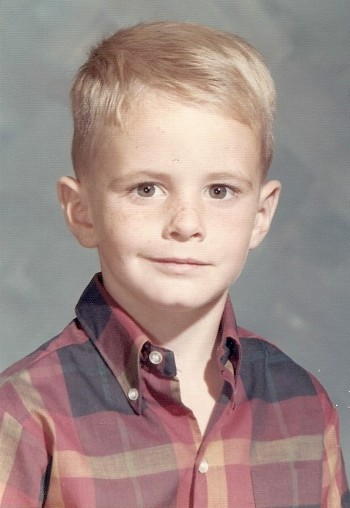 In this original BTB Investigation, we unveil the tragic story of Kirk Murphy, a four-year-old boy who was treated for “cross-gender disturbance” in 1970 by a young grad student by the name of George Rekers. This story is a stark reminder that there are severe and damaging consequences when therapists try to ensure that boys will be boys.
When we first reported on three American anti-gay activists traveling to Kampala for a three-day conference, we had no idea that it would be the first report of a long string of events leading to a proposal to institute the death penalty for LGBT people. But that is exactly what happened. In this report, we review our collection of more than 500 posts to tell the story of one nation’s embrace of hatred toward gay people. This report will be updated continuously as events continue to unfold. Check here for the latest updates.
In 2005, the Southern Poverty Law Center wrote that “[Paul] Cameron’s ‘science’ echoes Nazi Germany.” What the SPLC didn”t know was Cameron doesn’t just “echo” Nazi Germany. He quoted extensively from one of the Final Solution’s architects. This puts his fascination with quarantines, mandatory tattoos, and extermination being a “plausible idea” in a whole new and deeply disturbing light.
On February 10, I attended an all-day “Love Won Out” ex-gay conference in Phoenix, put on by Focus on the Family and Exodus International. In this series of reports, I talk about what I learned there: the people who go to these conferences, the things that they hear, and what this all means for them, their families and for the rest of us.
Prologue: Why I Went To “Love Won Out”
Part 1: What’s Love Got To Do With It?
Part 2: Parents Struggle With “No Exceptions”
Part 3: A Whole New Dialect
Part 4: It Depends On How The Meaning of the Word "Change" Changes
Part 5: A Candid Explanation For "Change"
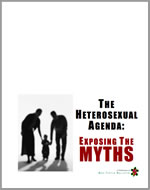 At last, the truth can now be told.
Using the same research methods employed by most anti-gay political pressure groups, we examine the statistics and the case studies that dispel many of the myths about heterosexuality. Download your copy today!
And don‘t miss our companion report, How To Write An Anti-Gay Tract In Fifteen Easy Steps.
 Anti-gay activists often charge that gay men and women pose a threat to children. In this report, we explore the supposed connection between homosexuality and child sexual abuse, the conclusions reached by the most knowledgeable professionals in the field, and how anti-gay activists continue to ignore their findings. This has tremendous consequences, not just for gay men and women, but more importantly for the safety of all our children.
Anti-gay activists often cite the “Dutch Study” to claim that gay unions last only about 1½ years and that the these men have an average of eight additional partners per year outside of their steady relationship. In this report, we will take you step by step into the study to see whether the claims are true.
Tony Perkins’ Family Research Council submitted an Amicus Brief to the Maryland Court of Appeals as that court prepared to consider the issue of gay marriage. We examine just one small section of that brief to reveal the junk science and fraudulent claims of the Family “Research” Council.
 The FBI’s annual Hate Crime Statistics aren’t as complete as they ought to be, and their report for 2004 was no exception. In fact, their most recent report has quite a few glaring holes. Holes big enough for Daniel Fetty to fall through.
“Google” is a trademark of Google Inc.
© Box Turtle Bulletin. All Rights Reserved.

 Posts
Posts  Posts via daily email: