Box Turtle Bulletin
 News and commentary about the anti-gay lobby
“Now you must raise your children up in a world where that union of man and box turtle is on the same legal footing as man and wife…”
News and commentary about the anti-gay lobbyJanuary 1st, 2014
Atlantic City has a new mayor, gay Republican Don Guardian. He has a tough job ahead of him. (PolitickerNJ)
This beleaguered gaming capital swore in a new mayor Wednesday amid the usual hoopla of “a new beginning,” then promptly had to turn its attention to the same old problem that has plagued it for years: revenue, and the fact the town does not see as much of it from casinos as it used to.
Minutes after Republican Don Guardian took the oath of office from Congressman Frank LoBiondo in a packed council chamber, the new council found itself forced to make decisions on lingering and sometimes contentious issues.
As Guardian took his seat, the council had to make difficult decisions on accelerated tax sales and approving a temporary budget to pay salaries and contracts in the near term all the while realizing that in the long term more unwelcome financial news looms depending on the fallout from the $50 million Borgata tax appeal case and eventual new tax valuations.
January 1st, 2014
TODAY’S AGENDA is brought to you by:

The Connection was one of Phoenix’s more popular bars in the 1970s and 1980s. From the Arizona Gay News, December 23, 1977, page 4. Available online here.
TODAY IN HISTORY:
English Criminal Law Amendment Act Takes Effect: 1885. English law had long held that homosexuality was an “abominable crime” punishable with death by hanging, but in 1861, the law was modified to provide imprisonment from ten years to life instead. But crime of sodomy was always difficult to prosecute because it required a witness and evidence that the sexual act had been fully consummated, complete with penetration and what we would call a happy ending. Obviously, that made convictions rare.
That changed in 1885, although the change may have been somewhat unintentional. During the middle of the nineteenth century, there was a growing concern over the dangers suffered by England’s daughters over the “gross indecencies” imposed upon them. But again, convictions were rare because the statute required that the sexual assault take place in a “public place.” And so on January 1, 1885, a revision to the criminal code raised the age of consent for girls from thirteen to sixteen, and it made “gross indecencies” punishable regardless of age and place a misdemeanor, punishable with up to two years imprisonment. It didn’t take long for “gross indecency” to be interpreted by the courts to include homosexuality. In fact, it would be under this statute that Oscar Wilde would be convicted and sentenced to the maximum two year term ten years later.

San Francisco Police Raid New Year’s Day Ball: 1965. Early San Francisco LGBT-rights advocates had long recognized that much of the opposition to homosexuality rested on religious objections, and that if any progress was to be made, it was necessary to foster links between the gay community and the bay area’s religious leaders — at least those leaders who might be inclined to be supportive, whether publicly or privately. Earlier in 1964, Daughters of Bilitis founders Phyllis Lyon (see Nov 10) and Del Martin (see May 5), together with Glide Memorial Methodist Church, formed the Council on Religion and the Homosexual. CRH was notable for two reasons: not only was it the first organization in the U.S. to incorporate the word “Homosexual” in its name, but it was also the first organization to bring straight and gay people together to minister to the gay community.
And that opportunity for those early straight allies to get a first-hand taste of what gay people routinely experienced came on New Year’s Day of 1965, when CHR held a New Years Mardi Gras as a fundraiser at California Hall. When the ministers informed the San Francisco Police Department on December 23 of their planned costume party, the police tried to coerce the hall’s owners into cancelling the rental. Organizers again met with police on December 29, for negotiations which the ministers described “strained.” SFPD officials couldn’t understand why these ministers were arguing on behalf of gay people. Observing the wedding bands on the ministers’ fingers, one officer reportedly said, “We see you’re married. How do your wives accept this?” Their wives, the ministers explained, would be at the ball also, along with other members of their congregations. Police tried to question them on theology and warned them that they were being “used” by local homophile organizations, but the ministers persisted. Finally, the two parties reached a deal where police promised not to arrest anyone in costume, including those in drag.

A couple walks past police officers to attend the New Year’s Mardi Gras ball.
Those promises quickly proved empty. As guests began arriving at 9:00 p.m. on New Year’s Day, they encountered police officers snapping photographs of everyone as they entered the building. The obvious attempt at intimidation deterred many — organizers expected 1500 to show up but only about 500 actually attended. Later that evening, police demanded entry into the building. Three CRH lawyers explained that the party was a private party under California law and that police could not enter without buying tickets or showing a warrant. The lawyers were arrested, along with a ticket-taker, and charged with obstructing an officer. Two other gay men were arrested for “disorderly conduct” after one of them tripped over a chair; police accused him of trying to kiss another man and both were hauled in.
Throughout the night, police repeatedly entered the hall to conduct “fire code inspections.” The ball was scheduled to end at midnight, but organizers decided to end the ball an hour earlier. Their next job was to get their guests safely out of the building. One minister was threatened with arrest while escorting two guests to their cars.

Police photographer snaps photos of everyone as they enter California Hall.
For many of the straight attendees, this was their first exposure to routine police intimidation tactics against the gay community. Del Martin said, “This is the type of police activity that homosexuals know well, but heretofore the police had never played their hand before Mr. Average Citizen … It was always the testimony of the police officer versus the homosexual, and the homosexual, fearing publicity and knowing the odds were against him, succumbed. But in this instance the police overplay their part.”
The following morning seven of the ministers who had attended the party held a press conference where they described the pre-event negotiations and the resulting “intimidation, broken promises and obvious hostility” of the San Francisco Police. The American Civil Liberties Union agreed to represent those under arrest.
The New Year’s Mardi Gras party, occurring as it did some five years before Stonewall, proved to be a turning point for gay rights in San Francisco. As the Mattachine Society’s Hal Call (see Sep 20) recalled, “That was when we got newspapers, TV, and radio on our side. The police were so brutal. And with some respectable clergymen on our side, that was a turning point.” Phyllis Lyon said that it was “our first step into some kind of connectedness with the rest of the city.” City officials, embarrassed by the obvious police misconduct, responded by designating officer Elliot Blackstone as the first liaison between the department and the LGBT community. (At his retirement dinner in 1975, Blackstone was saluted by LGBT community leaders for his ensuing twenty years of advocacy and support.)
When the three lawyers’ trial began in February, the police department were still trying to figure out the legal basis for their actions. When asked why police were taking pictures of guests arriving at the ball even though no crime had occurred, one official replied that police “wanted pictures of these people because some of them might be connected to national security.” He also said that the contingent of more than a dozen officers and two photographers were needed because “we went just to inspect the premises.” After four days of prosecution testimony and before the defense could begin presenting their case, the judge ordered a directed verdict of “not guilty” after four days of prosecution testimony. One of the lawyers who had been arrested and charged, Herb Donaldson, would go on to become San Francisco’s first openly gay judge.
A documentary, “Lewd and Lascivious,” premiered at the 2013 Palm Springs Gay and Lesbian Film Festival, featuring eyewitness interviews and vintage photos. Donations for the project to bring it to a wider audience are being accepted here. Here is the film’s trailer:
[Other sources: Kay Tobin. “After the ball…” The Ladder 9, no. 5 (February 1965): 4-5.
Unsigned. “Cross currents.” The Ladder 9, no. 9 (June 1965): 14-16.
Edward Alwood. Straight News: Gays, Lesbians and the News Media
Marcia M. Gallo. Different Daughters: A History of the Daughters of Bilitis and the Rise of the Lesbian Rights Movement
LGBT Religious Archives Network. “Raid at New Year’s Day Ball at California Hall.”]
 Los Angeles Gay Bar Raided: 1967. It all was sparked by the temerity of a kiss, when a small group of gay men at Silver Lake’s Black Cat bar, upon the countdown to midnight on New Years’ Eve, had the gall to kiss each other “on the mouth for three to five seconds” in the presence of about six undercover policemen who had infiltrated the gay bar. As soon as the pecks on the lips began, police identified themselves and began viciously beating and arresting the kissing offenders. As the melee widened, several people tried to escape to the New Faces bar across the street. Undercover officers followed and raided that bar as well. One of the New Faces workers was beaten so badly by police that they cracked a rib, fractured his skull and ruptured his spleen. Six Black Cat kissers were tried and convicted of “lewd or dissolute conduct” in a public place — legaleese for, in this instance, hugging and kissing.
Just as with the New Year’s Mardi Gras raid in San Francisco two years earlier, the Black Cat raid had the effect of galvanizing the gay community in Los Angeles. Gays turned out for protests and demonstrations in the months that followed, and they began to pass a newsletter around which would eventually morph into The Advocate. By the time a similar police raid took place in a dive bar in Greenwich Village two years later, the ground was well prepared for gays to come out nationally to declare their presence in society. In 2008, the Black Cat bar was declared a historical-cultural landmark by the city of Los Angeles, in a move that was partly inspired by the story of the Black Cat bar posted on BTB in 2006.
Homosexuality decriminalized: The first day of the year often marks the day in which new state laws take effect, which explains why on this day in history, a number of states officially decriminalized homosexuality effective January 1. Among the states that I know of in which laws prohibiting same-sex relations include: Arizona (1980), California (1975), Colorado (1971), Hawaii (1972), Illinois (1962), Iowa (1976), New Mexico (1975), North Dakota (1978). Ohio (1974), Oregon (1971) and Vermont (1977). If you know of any others, please let me know in the comments below.

TODAY’S BIRTHDAYS:
135 YEARS AGO: E.M. Forster: 1879-1970. Why did the author of such classics as Where Angels Fear to Tread


Before Forster’s lifelong conflict with his sexuality, he was well on his way to becoming a celebrated man of letters. His first novel, 1905’s Where Angels Fear to Tread
Forster’s lifetime publication ended in 1924, but that didn’t mean he stopped writing altogether. He worked on a novel of a homosexual love story set in London, Cambridge, and Wiltshire, with parts of the story likely drawn from personal experiences. But given his reputation that had already been established with the earlier novels — and given that homosexual relationship between men was a criminal offense throughout Britain — Forster could see no way to out himself by publishing Maurice
Based on the strength of his earlier works, Forster was elected an honorary fellow at King’s College, Cambridge, in 1946, where he remained for the rest of his life, doing relatively little save an occasional essay and an appearance on the BBC. He maintained his relationship with Buckingham, the “love of his life,” and became close friends with Buckingham’s wife, Mary. In 1964, three years before Britain finally decriminalized homosexuality, Forster complained to his diary, “Now I am 85 how annoyed I am with society for wasting my time by making homosexuality criminal. The subterfuges and the self-consciousnesses that might have been avoided.” He passed away following a stroke in their Coventry home in 1970, and Maurice

James Hormel: 1933. The grandson of the founder of Hormel Foods made history of his own in 1999 when President Bill Clinton appointed him U.S. Ambassador to Luxembourg, making him the first openly gay man to represent to U.S. as an ambassador. Clinton first considered Hormel for Ambassador to Fiji in 1994, but following protests from Fiji, Clinton declined to submit Hormel’s nomination to the Senate. Instead, Hormel was named to the U.N’s Human Rights Commission in 1995, and he became an alternate for the U.N. General Assembly in 1996.
Clinton nominated Hormel for the Luxembourg post in 1997, but the Republican-controlled senate blocked his nomination for the next two years. Senate Majority Leader Trent Lott (R-MS) compared homosexuality to alcoholism and kleptomania and other Senators and anti-gay activists called Hormel pro-pornography and anti-Catholic. Hormel was finally named Ambassador in May 1999 as a recess appointment. He was sworn in as ambassador in June with his partner holding the Bible, and his former wife, five children and several grandchildren in attendance.
Previously, Hormel had been one of the co-founders of the Human Rights Campaign in 1981, and he funded the Kames C. Hormel Gay and Lesbian Center of the San Francisco Public Library in 1995. He currently lives in San Francisco with his partner, Michael P. Nguyen. His memoir, Fit to Serve: Reflections on a Secret Life, Private Struggle, and Public Battle to Become the First Openly Gay U.S. Ambassador
If you know of something that belongs on the agenda, please send it here. Don’t forget to include the basics: who, what, when, where, and URL (if available).
And feel free to consider this your open thread for the day. What’s happening in your world?
December 31st, 2013

Have a joyous and safe New Year’s Eve and may 2014 bring you happiness and prosperity.
December 31st, 2013
The State of Utah has now requested that the Supreme Court halt the ongoing issuance of same-sex marriage licenses that have been occurring since their ban on same-sex marriage was ruled unconstitutional by federal Judge Richard Shelby (that wascally wepublican “activist judge”).
In papers filed Tuesday with Justice Sonia Sotomayor, the state asked her to overturn court decisions to let the marriages go forward. Sotomayor handles emergency requests from Utah and other Rocky Mountain states. She can act by herself or get the rest of the court involved.
As the stay request was filed hours before the New Year holiday, I’m curious to see what argument they made to convince Sotomayor that the federal judges in the Tenth Circuit abused their discretion.
December 31st, 2013
The Mennonite Church USA is the largest of the Mennonite denominations, with about 100,000 congregants. And being such a small religious community, often Mennonites are misunderstood and confused with Amish.
But while Mennonites do share many theological foundations with the Amish, they do not avoid electricity or motor vehicles. Think of them more as more akin to Quakers in their daily lives: living simply, practicing service, and supporting peace.
As with all bodies of faith, Mennonites have been struggling with the role of gay men and women in the body of the church. Perhaps not surprising from a people who oppose conflict, they members of the Mennonite Church USA have decided to live in peace though perhaps in disagreement. Churches that wish to be affirming may be, while others may be less so.
Nevertheless, it is a rather momentous event that that a lesbian pastor has been ordained. (Gaystarnews)
Theda Good will become the first openly gay or lesbian person to lead a Mennonite congregation in the United States when she becomes pastor of the First Mennonite Church of Denver in February.
Good is in a committed relationship with another woman and joined the First Mennonite Church of Denver’s staff in August of 2012.
The Mennonite Church USA’s Mountain States Conference leadership board announced on 22 December that it has unanimously voted to approve Good being licensed as a pastor.
December 31st, 2013
TODAY’S AGENDA is brought to you by:

Andy Warhol’s The Flesh, the film that introduced actor Joe Dallesandro to a wider audience. The Village Voice, January 9, 1969, p. 51.

TODAY IN HISTORY:
LIFE Magazine’s “Homosexuals In Revolt”: 1971. In Mel Brooks’s History of the World, Part I (1981), there is the famous pun in which the Count de Monet tells King Louis XVI, “It is said that the people are revolting.” The king replies, “You said it. They stink on ice.” Ten years earlier, Life magazine found homosexuals revolting all over the place, in its year-end photo essay covering “the year that one liberation movement turned militant”:
It was the most shocking and, to most Americans, the most surprising liberation movement yet. Under the slogan “Out of the closets and into the streets,” thousands of homosexuals, male and female, were proudly confessing what they had long hidden. They were, moreover, moving into direct confrontation with conventional society. Their battle was far from won. But in 1971 militant homosexuals showed they were prepared to fight it.
…They resent what they consider to be savage discrimination against them on the basis of a preference which they did not choose and which they cannot — and do not want to — change. And while mist will admit that “straight” society’s attitudes have caused them unhappiness, they respond to the charge that all homosexuals are guilt-ridden and miserable with the defiant rallying cry “Gay is Good!” … Never before have homosexuals been so visible.
The photo essay consisted of eleven pages of angry gays, fists clenched and raised in the air, confronting police, marching in the streets, organizing, and, of course, wierding people out. Later in the essay came mentions of early gay rights groups and activists, including Frank Kameny (May 21), Jack Baker (see May 18), Rev. Ray Broshears (see Sep 27), Merle Miller (see Jan 17), and Rev. Troy Perry (see Jul 27) — each and every one of them a “militant.” As for the younger and more nameless “militants”:
Most of the young militants shown here are members of homosexual liberation’s most effective organization, New York City’s Gay Activists Alliance. …GAA has developed a form of protest called a “zap,” which is part picket line and part sit-in. … The activists claim that demonstrations offer them the best therapy for the humiliations inflicted by anti-homosexual society. “One good zap,” they say, “is worth six months on a psychiatrist’s couch.”
Life‘s follow-up article asked the burning question, “Is Homosexuality Normal or Not?”, and they tackled it pretty much the way everyone did back then: by talking to a lot of straight people about gay people, but without quoting from a single gay person. Featured in the article was noted anti-gay therapists Edmund Bergler (despite being dead for nearly ten years), Lawrence Hatterer (who conducted electric shock aversion therapy), Irving Bieber, and Charles Socarides — who would later go on to co-found the National Association for Research and Therapy of Homosexuality (NARTH). The article tried to present a rundown on what makes gay men gay (there was virtually no mention of lesbians in the article), and then, without quoting from a single “homosexual militant”, asserted that these militants opposed all research on homosexuality. All of this led to the article’s final two paragraphs:
Whether liberationists choose introspection, militancy, or violence as a course of action, the basic stumbling block remains the same: heterosexual antipathy to homosexuality. Will this ever change? Dr. Hatterer has observed that society’s tolerance of homosexuality is increasing but he doubts that we will ever accept it as a desirable “alternative lifestyle.” Nonetheless he and virtually all other psychiatrists advocate repealing the laws that violate this minority’s civil rights.
On the question of “normality,” much remains to be learned. In opposing all inquiry, the militants expose fears of what science might find out about them. Dr. (Evelyn) Hooker’s task force on homosexuality makes the sensible recommendation that the National Institute of Mental Health fund a center for the study of all sexual behavior. “It is essential,” says the report, “that a study of homosexuality be placed within the context of the study of the broad range of sexuality, normal and deviant.”
[Source: “Homosexuals In Revolt” Life 71, no. 26 (December 31, 1971): 62-71. Available online via Google Books here.
“Is Homosexuality Normal or Not?” Life 71, no. 26 (December 31, 1971): 72. Available online via Google Books here.]
 TODAY’S BIRTHDAY:
Joe Dallesandro: 1948. His father was in the Navy and his mother just sixteen when Joe was born, and by the time he was five his mother was serving time for auto theft. The younger Dallesandro ended up on foster care before being reunited with his father in Queens. By age fifteen Dallesandro was expelled for punching the school principal and began to follow in his mother’s footsteps steeling cars. After wrecking one stolen car in the Holland Tunnel, he was stopped by police and shot in the leg. He was sentenced to a boy’s rehab center in 1964.
Dallesandro escaped a few months later, robbed a theater in Brooklyn, and fled to Mexico before eventually hitchhiking to Los Angeles. There, he took to hanging out at the bus station where, among the many lucrative offers, was one for modeling for Bob Mizar’s Physique Pictoral as part of Mizar’s Athletic Model Guild. After getting into more trouble in L.A., Dallesandro made his way back to New York, where he appeared in his first Andy Warhol film in 1967, the experimental 25-hour Four Stars. Dallesandro’s work with Warhol and Paul Morrissey changed everything:
“There’s no rhyme or reason why I wound up where I wound up,” says Joe, still sounding vaguely incredulous about his fate. “I walked into that place and everything changed. It wasn’t until Paul and Andy came into my life that I got what you might call ‘direction’. It was only then that I started to know what I wanted to do with my life. If I hadn’t met them I’d probably have ended up in prison because I kept making the same mistakes over and over again. When I got connected with Paul and Andy I got some good direction.”
 The following year, his nude scenes in his role as a hustler in Warhol’s Flesh brought Dallesandro to somewhat more mainstream audiences. His comfortable nonchalance with nudity and his laid-back film presence made him the first explicitly-eroticized male sex symbol of the 1970s. His onscreen comfort in his beautiful skin extended to both genders, on screen and off. The New York Times‘ Vincent Canby nodded to Dallesandro’s bisexual appeal when he wrote, “His physique is so magnificently shaped that men as well as women become disconnected at the sight of him.” Warhol said simply, “In my movies, everyone’s in love with Joe Dallesandro.” Fashion photographer Francesco Scavullo called Dallesandro “one of the ten most photogenic men in the world.” Dallesandro’s crotch served as the cover art for the Rolling Stones’ 1971 album Sticky Fingers, and Lou Reed immortalized him as “Little Joe” in his 1972 hit “Walk on the Wild Side.”
Dallesandro’s collaboration with Warhol and Paul Morrissey continued, with Lonesome Cowboys (1968), Trash (1970), Heat (1972), and Flesh for Frankenstein

By 1980, Dallesandro decided to move to New York, kick the drugs, and eventually dry out. Dallesandro’s movie career then received its second breath with minor roles in The Cotton Club (1984, as the mobster “Lucky” Luciano), Sunset (1988), and Cry-Baby (1990). He also appeared in several guest roles on television, including Miami Vice and Matlock. But since the 1990s, Dallesandro had been semi-retired from acting. At last report, he and his third wife were happily managing an apartment complex in Los Angeles.

Jennifer Higdon: 1962. Who says playing flute in a Tennessee high school band is a dead end? It certainly wasn’t for Jennifer Higdon, who majored in the instrument at Bowling Green State University where she also began composing. After graduation, she served as Composer-in-Residence with the Pittsburgh Symphony, the Green Bay Symphony, the Philadelphia Orchestra and the Fort Worth Symphony. Her one-movement tone poem blue cathedral, inspired by her brother’s death from cancer, has become among the most performed modern orchestral works by a living American composer. Her Violin Concerto, which premiered in 2009 in Indianapolis, was awarded the 2010 Pulitzer Prize. That same year, her Percussion Concerto won a Grammy for Best Contemporary Classical Composition. Higdon lives with her high school sweetheart, Cheryl Lawson, in Philadelphia, where Higdon teaches at the Curtis Institute, where she holds the Milton L. Rock Chair in Compositional Studies.
If you know of something that belongs on the agenda, please send it here. Don’t forget to include the basics: who, what, when, where, and URL (if available).
And feel free to consider this your open thread for the day. What’s happening in your world?
December 30th, 2013
The Navajo Nation is a semi-autonomous territory slightly larger than West Virginia occupying portions of northeastern Arizona, southeastern Utah, and northwestern New Mexico. About 175,000 Navajo live there, along with some Paiute and Hopi.
Aljazeera discusses an effort to bring marriage equality to the nation.
Alray Nelson, founder of the Coalition for Navajo Equality, says he wants the Navajo Nation to respect gay relationships like two of the states that surround its territory — New Mexico, where gay marriage was legalized this month, and Utah, where it was recently ruled legal but faces a mounting appeal.
“There’s no organized faction against this, like in the fight (for) Proposition 8 in California,” said Nelson, 27, whose organization is seeking to make tribal legislators review a 2005 tribal ban on gay marriage early next year.
December 30th, 2013
Mexico’s position on marriage equality is a convoluted one. Same-sex marriages may be conducted in Mexico City and in the state of Quintana Roo, but are recognized across the nation.
One state bans same-sex marriage, a few others offer civil unions, and the rest are in a sort of flux.
A year ago the Mexican Supreme Court ruled that same-sex couples have the civil right of marriage. However, the amparo process is not that of a single universal decision; rather, it speaks specifically to each case and, absent any contrary decisions, eventually and cumulatively gains the weight of law.
Now two more states have contributed to that on-going process, Jalisco and Chihuahua (ai!). From CNN Mexico (with a miserable Google translation)
Zaira de la O and Martha Sandoval will give you the “I do” before a judge in Jalisco on Saturday, becoming the first gay couple in a civil marriage in this state.
The Jalisco Civil Code does not provide for marriage between same sex couples get married but after the fourth Civil District Judge Material, granted them under.
and Diario (equally bad translation)
Accompanied by family and friends, Marco Quiroz and Jaime Villaseñor Gándara Salcido, were married on Friday at 18:00 in the city of Chihuahua. Judge who married in the Registry Office of Chihuahua, explained that because District judge ordered an injunction that marriage promoted by the parties and by the authority conferred by the State, the said united in marriage. “With all the rights that the law gives them, but also with all the obligations that it provides for married “both nodded at each word judge and became the first same-sex marriage in the state of Chihuahua.
It appears that there are four more couples in Chihuahua who wish to marry. If I understand the process correctly (and I don’t claim to), if each is granted an ampara, marriage equality becomes law in that state.
December 30th, 2013
 The New York Times has run an informative, though not particularly thorough, article about Judge Robert Shelby, the Federal judge who found that the state of Utah’s ban on same-sex marriage violated the US Constitution.
He had been a combat engineer in the Persian Gulf conflict and was, according to state voter records, a registered Republican. Senator Orrin G. Hatch, a seven-term Utah Republican, recommended him for a federal judgeship, calling him an experienced lawyer “with an unwavering commitment to the law.” Senator Mike Lee, a Tea Party Republican, said that Mr. Shelby was “pre-eminently qualified” and predicted he would be an outstanding judge.
…
He was active in the state and local bar associations, and was a leader in a group that mentors young trial lawyers. But he largely stayed out of the spotlight and away from politics. In 2010, he and his wife gave a $50 contribution to a Republican candidate for the State Legislature — the only political donation found in state and national campaign-finance databases.Former colleagues said they did not know his religious background. The judge did not respond to emails and a phone call requesting an interview.
December 30th, 2013
 The Episcopal Church is a strong supporter of our community and advocate for equality. But it hasn’t always been that way and did not become so without struggle.
One person who shares much credit for the evolution of the denomination is the Right Reverend Otis Charles, former Episcopal Bishop of Utah. (Sentinel)
Charles was the eighth bishop of the Episcopal Diocese of Utah. Soon after his retirement in 1993 he came out as an openly gay man, making him the first openly gay bishop of any Christian denomination in history. Soon after he and his wife divorced. He relocated to San Francisco, where he helped to found Oasis California, the LGBT Ministry of the Episcopal Diocese of California. which seeks to open dialogue between LGBT communities and the congregations in which they worship.
Originally from New Jersey, he served first as a priest in Washington, Connecticut. From 1968 until 1982 he was a member of the Standing Liturgical Commission of the Episcopal Church, which developed the 1979 edition of the Book of Common Prayer. In 1971, he was elected Bishop of Utah. He was active in the peace movement, and opposed Nevada and Utah being launching sites for the MX missile. In the >House of Bishops, Charles was chair of the Prayer Book Committee and a member of the Bishops’ Committee on Racism. Charles became Dean of the Episcopal Divinity School in 1985. Charles also has significant academic achievements, including a Doctorate of Divinity, and a Doctorate of Sacred Theology.
Following his coming out, Charles retained his voting seat in the 300-plus member House of Bishops. Before and following his announcement, he was an active and forceful advocate on behalf of LGBT communities. In 1979, Charles was one of 17 dissenting bishops when the Episcopal Church’s General Convention stated that practicing homosexual clergy were prohibited from ordination – a decision that continues to generate controversy to this day. In 1999, Charles was arrested and led away in handcuffs for his civil disobedience at the Church’s General Convention in Denver, Colorado during a protest against what demonstrators described as the Church’s long history of oppression against lesbian and gay peoples.
Otis Charles died on December 26th, at the age of 87.
Rev. Charles was in a heterosexual marriage for 42 years, and has five children. He has been married since 2004 (religiously, legally since 2008) to Dr. Felipe Sanchez-Paris. Dr. Sanchez-Paris died earlier this year. Charles’ story is included in the documentary Love Free or Die, winner of the Special Jury Prize at Sundance.
December 30th, 2013

TODAY’S BIRTHDAY:
Beauford Delaney: 1901-1979. His mother had been born into slavery and never learned to read or write. Because of her experiences, and in keeping with the family’s hard-fought position of respectability in Knoxville where his father was a Methodist minister, the values of dignity, education and a keen awareness of injustices were paramount in the Delaney household. Beauford and his younger brother, Joseph, developed an interest in art at an early age, when they drew copies of pictures they saw on Sunday school cards and the family Bible. As a teenager, Beauford got a job at a local sign company, where his work was noticed by Lloyd Branson, Knoxville’s best known artist. Delaney became Branson’s apprentice and, with Branson’s backing, moved to Boston to study art in 1924. His escape from the Jim Crow south opened up a huge world, where he learned the essentials of painting techniques, was first exposed to the black activist politics, and experienced his first intimate encounter with another young man.

Beauford Delaney, “Can Fire In The Park”, 1946
By 1929, Beauford used up Boston and moved to Harlem, which coincided with the great artistic and political flowering known as the Harlem Renaissance. Despite being penniless during the early crushing years of the Great Depression, Delaney found an affinity with the “multiple of people of all races [who] spend every night of their lives in parks and cafes.” As he wrote in his journal, their courage inspired him to believe that “somehow, someway there was something I could manage if only with some stronger force of will I could find the courage to surmount the terror and fear of this immense city and accept everything insofar as possible with some calm and determination.”
That calm and determination became the subject of some of his greatest works. Delaney eventually found work here and there — as a bellhop, telephone operator, doorman, janitor — while also finding, slowly, an audience for his paintings. He rubbed shoulders Georgia O’Keefe and Henry Miller, and became close friends with author James Baldwin (see Aug 2), and yet he remained an isolated individual, presenting carefully crafted faces to the people he encountered depending on where he was. To his neighbors in Greenwich Village, where his studio was, he was part of a larger gay (and mostly white) circle of friends; in Harlem, he kept his other life hidden. The decidedly macho world of modernist and impressionist art in New York undoubtedly added to his isolation. Those who knew him saw an introverted and private person, one who had apparently never formed any lasting romantic relationships.

Beauford Delaney, “Nativity Scene,” 1961.
In 1953, Delaney moved to Paris where he found a greater sense of freedom in an already well-established expatriate community of ex-patriate African-American artists. His paintings shifted from the figurative images of his New York period to more of an abstract impressionist exploration of color and light. But by 1961, his mental and physical health began to deteriorate, problems which were compounded by continuing poverty, hunger, and heavy drinking. Baldwin remembered, “He has been starving and working all of his life – in Tennessee, in Boston, in New York, and now in Paris. He has been menaced more than any other man I know by his social circumstances and also by all the emotional and psychological stratagems he has been forced to use to survive; and, more than any other man I know, he has transcended both the inner and outer darkness.”
Delaney returned briefly to the U.S. in 1969 to visit family, but he was dogged by paranoia and hallucinations. He returned to Paris in 1970 and tried to resume working, but it became increasingly clear to his friends that he was no longer capable of living independently. In 1975, he was hospitalized, then committed to St. Anne’s Hospital for the Insane. He died there in 1979, and was buried in an unmarked grave.
Denaley’s work was mostly forgotten through much of the 1970s and 1980s, despite his influence on fellow artists. In 1986, Baldwin wrote that Delaney was “the first living proof, for me, that a black man could be an artist. In a warmer time, a less blasphemous place, he would have been recognised as my Master and I as his Pupil. He became, for me, an example of courage and integrity, humility and passion. An absolute integrity: I saw him shaken many times and I lived to see him broken but I never saw him bow.”
If you know of something that belongs on the agenda, please send it here. Don’t forget to include the basics: who, what, when, where, and URL (if available).
And feel free to consider this your open thread for the day. What’s happening in your world?
December 29th, 2013
I got my regular NOM money-beg email today and it contained this unintentionally hilarious line:
The good news is that 2014 promises to be a year full of opportunity for the marriage movement to regain ground and seize back the momentum!
Well, yes, that’s absolutely true. The only time you have an opportunity to “regain ground” and “seize back the momentum” is when you’re losing.
Looked at from that angle, 2014 may be NOM’s opportunitiest year ever!
December 29th, 2013

John Addington Symonds (left) and Edward Carpenter (right)
TODAY IN HISTORY:
“The Most Beneficial Results Accrue from the Sexual Relations Between Men”: 1892. John Addington Symonds was an English poet and literary critic who, although married and a father, was an early advocate of male homosexuality (see Oct 5). Edward Carpenter was a poet, socialist philosopher, and an early gay advocate — and among the very few who lived openly as a gay man (see Aug 29) in Victorian England. In 1892, Symonds was beginning his collaboration with sexologist Havelock Ellis for Ellis’s first installment of his six-volume Studies in the Psychology of Sex, when Symonds wrote to Carpenter to discuss some of the topics he intended to cover. While Ellis intended to stick strictly to a psychological discussion on homosexuality (or Sexual Inversion, as it was called at the time), Symonds was keen to open the topic up to historical and ethical considerations:
It is a pity that we cannot write freely on the topic. But when we meet, I will communicate to you facts which prove beyond all doubt to my mind that the most beneficial results, as regards health and nervous energy, accrue from the sexual relations between men: also, that when they are carried on with true affection, through a period of years, both comrades become united in a way which would be otherwise quite inexplicable.
The fact appears to me proved. The explanation of it I cannot give, & I do not expect it to be given yet. Sex has been unaccountably neglected. Its physiological & psychological relations even in the connection between man & woman are not understood. We have no theory which is worth anything upon the differentiation of the sexes, to begin with. In fact, a science of what is the central function of human beings remains to be sought.
This, I take it, is very much due to psychologists, assuming that sexual instincts follow the build of the sexual organs; & that when they do not, the phenomenon is criminal or morbid. In fact, it is due to science at this point being clogged with religious & legal presuppositions.
…My hope has always been that eventually a new chivalry, i.e.., a second elevated form of human love, will emerge & take its place for the service of mankind by the side of that other which was wrought out in the Middle Ages.
…How far away that dream seems! And yet I see in human nature stuff neglected, ever-present — pariah and outcast now — from which I am as certain as I live, such a chivalry could arise.
Whitman, in Calaumus, seems to strike the key-note. And though he repudiated (in a very notable letter to myself) the deductions which have logically to be drawn from Calamus, his work will remain infinitely helpful.
[Source Chris White’s Nineteenth-Century Writings on Homosexuality: A Sourcebook
Catholic Church Reaffirms Opposition to Homosexuality: 1975. It wasn’t the first time, and it certainly wouldn’t be the last. But on this date in 1975, the Congregation for the Doctrine of the Faith — think of it as the Vatican’s equivalent of the Justice Department (so to speak) — issued Persona Humana, addressing “certain questions concerning sexual ethics.” On the subject of homosexuality, the Congregation stated:
A distinction is drawn, and it seems with some reason, between homosexuals whose tendency comes from a false education, from a lack of normal sexual development, from habit, from bad example, or from other similar causes, and is transitory or at least not incurable; and homosexuals who are definitively such because of some kind of innate instinct or a pathological constitution judged to be incurable.
In regard to this second category of subjects, some people conclude that their tendency is so natural that it justifies in their case homosexual relations within a sincere communion of life and love analogous to marriage, in so far as such homosexuals feel incapable of enduring a solitary life.
In the pastoral field, these homosexuals must certainly be treated with understanding and sustained in the hope of overcoming their personal difficulties and their inability to fit into society. Their culpability will be judged with prudence. But no pastoral method can be employed which would give moral justification to these acts on the grounds that they would be consonant with the condition of such people. For according to the objective moral order, homosexual relations are acts which lack an essential and indispensable finality. In Sacred Scripture they are condemned as a serious depravity and even presented as the sad consequence of rejecting God. This judgment of Scripture does not of course permit us to conclude that all those who suffer from this anomaly are personally responsible for it, but it does attest to the fact that homosexual acts are intrinsically disordered and can in no case be approved of.
The same statement also reaffirmed the Church’s opposition to premarital sex, extramarital sex and masturbation (which is also branded “an intrinsically and seriously disordered act”).

TODAY’S BIRTHDAY:
Billy Tipton: 1914-1989. It wasn’t until his death in 1989 when it became widely known that the American jazz pianist, saxophonist and bandleader was a transman. Early in his career, Tipton performed as a man while continuing to present as a woman otherwise, but by the 1940s, he had transitioned his gender identity fully to male — except for when he went home to his family, where he became Dorothy again, leading fellow musicians to believe he was lesbian.
By the 1950s, Tipton was identifying solely as a man. It was during that time when he was awarded a recording contract with Top records, for whom he recorded two albums of jazz standards. The albums were reasonably successful, and he was given the opportunity to sign a contract for four more. He declined the offer, and took his Billy Tipton Trio to Spokane where he performed weekly at a downtown nightclub called Allen’s Tin Pan Alley and worked as a talent broker at the Dave Sobol Theatrical Agency. He also entered into at least five heterosexual relationships, including a common-law marriage with Kitty Kelly with whom Tipton adopted three sons. One son, William, remembered Billy as a good father who loved to go on Scout camping trips. It was William who would learn that his father had been born a woman, when he was looking on as paramedics tried to resuscitate him after collapsing with a hemorrhaging peptic ulcer.
If you know of something that belongs on the agenda, please send it here. Don’t forget to include the basics: who, what, when, where, and URL (if available).
And feel free to consider this your open thread for the day. What’s happening in your world?
December 28th, 2013

For weeks we’ve been subjected to the duck war.
On one side are those whose argument seems to me to be, “How dare Phil Robertson have vile homophobic opinions? He should not have access to the public airways with opinions like that!” And, yes, his opinions are homophobic. And also racist. And more than a little ignorant.
On the other are those who are screaming about censorship (it’s not) about religious freedom (which does not include the unquestionable right to be on television) and about the horrible horrible homosexuals.
In a nation that values free speech, even odious speech has a right to compete in the marketplace of ideas (right up there with the “ideas” of Honey Boo Boo, Sarah Palin, and Perez Hilton). And in a capitalist economy, television producers can decide what ideas with which they want to be associated.
But this isn’t really much about ideas. I suspect that most of those “supporting Phil” have no idea what he actually said or why it is that gay people are offended. They are just emotionally connecting a fear that in a rapidly changing world, their ability to practice their faith openly may be further curtailed.
And GLAAD and other gay supporters failed in articulating the concerns we had with his speech, missed that part of it was a paraphrase of a scripture, and lost the opportunity to distinguish between religious position and hate speech.
This is little more than a replay of the Chic-fil-A squabble. It’s people supporting “their side”.
The vast majority of pro-gay people really are not looking to silence and censor and ban all of those who are religious, even those who are conservatively religious and have beliefs which include the idea that homosexual acts are sinful. And the vast majority of religious people really do not think that gay people are like terrorists or that homosexuality and bestiality are in any way comparable. It’s just the stupid pointless Culture War.
And now A&E has announced that taping of Duck Dynasty – including Phil Robertson – will resume this spring. And the quacking from ‘family’ activists has resumed with vigor.
But maybe now this whole thing will soon be over.
December 28th, 2013

TODAY IN HISTORY:
Closeted Anti-Gay Activist Dies of AIDS: 1986. Terry Dolan, who helped to found the National Conservative Political Action Committee, was pretty well known in elite gay circles. According to Randy Shilts’s And the Band Played On
Among those awful things was sending out fundraising letters for NCPAC, which claimed that “Our nation’s moral fiber is being weakened by the growing homosexual movement and the fanatical E.R.A. pushers (many of whom publicly brag they are lesbians).” Meanwhile, Dolan had, at the time of that 1984 encounter with Kramer, had just ended an affair with a male epidemiologist at the New York City Health Department, and was then enjoying everything the gay social scene had to offer.
Dolan knew how to raise money. “The “shriller you are,” he said in 1982, “the easier it is to raise money.” That’s been the recipe for anti-gay activists ever since. But four years later, Dolan himself was dead of AIDS at the age of 36. The following May, The Washington Post published an article about “the cautious closet” of Terry Dolan. His brother, Reagan White House speechwriter Anthony Dolan was livid, and took out an two-page ad in The Washington Times, arguing that “the greatest and most malicious falsehood in this story was its entire thrust, its basis: the claim that my brother lived and died a homosexual.” But he did live and die a homosexual, and a deeply closeted one at that. But despite his and the family’s best efforts, the secret was out, and no amount of wishful thinking otherwise would ever change that.
If you know of something that belongs on the agenda, please send it here. Don’t forget to include the basics: who, what, when, where, and URL (if available).
And feel free to consider this your open thread for the day. What’s happening in your world?
Featured Reports
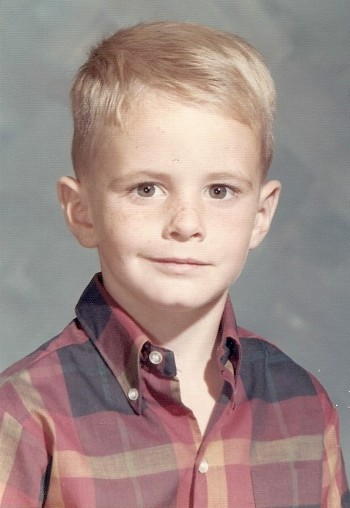 In this original BTB Investigation, we unveil the tragic story of Kirk Murphy, a four-year-old boy who was treated for “cross-gender disturbance” in 1970 by a young grad student by the name of George Rekers. This story is a stark reminder that there are severe and damaging consequences when therapists try to ensure that boys will be boys.
When we first reported on three American anti-gay activists traveling to Kampala for a three-day conference, we had no idea that it would be the first report of a long string of events leading to a proposal to institute the death penalty for LGBT people. But that is exactly what happened. In this report, we review our collection of more than 500 posts to tell the story of one nation’s embrace of hatred toward gay people. This report will be updated continuously as events continue to unfold. Check here for the latest updates.
In 2005, the Southern Poverty Law Center wrote that “[Paul] Cameron’s ‘science’ echoes Nazi Germany.” What the SPLC didn”t know was Cameron doesn’t just “echo” Nazi Germany. He quoted extensively from one of the Final Solution’s architects. This puts his fascination with quarantines, mandatory tattoos, and extermination being a “plausible idea” in a whole new and deeply disturbing light.
On February 10, I attended an all-day “Love Won Out” ex-gay conference in Phoenix, put on by Focus on the Family and Exodus International. In this series of reports, I talk about what I learned there: the people who go to these conferences, the things that they hear, and what this all means for them, their families and for the rest of us.
Prologue: Why I Went To “Love Won Out”
Part 1: What’s Love Got To Do With It?
Part 2: Parents Struggle With “No Exceptions”
Part 3: A Whole New Dialect
Part 4: It Depends On How The Meaning of the Word "Change" Changes
Part 5: A Candid Explanation For "Change"
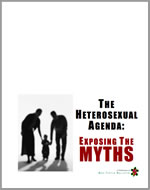 At last, the truth can now be told.
Using the same research methods employed by most anti-gay political pressure groups, we examine the statistics and the case studies that dispel many of the myths about heterosexuality. Download your copy today!
And don‘t miss our companion report, How To Write An Anti-Gay Tract In Fifteen Easy Steps.
 Anti-gay activists often charge that gay men and women pose a threat to children. In this report, we explore the supposed connection between homosexuality and child sexual abuse, the conclusions reached by the most knowledgeable professionals in the field, and how anti-gay activists continue to ignore their findings. This has tremendous consequences, not just for gay men and women, but more importantly for the safety of all our children.
Anti-gay activists often cite the “Dutch Study” to claim that gay unions last only about 1½ years and that the these men have an average of eight additional partners per year outside of their steady relationship. In this report, we will take you step by step into the study to see whether the claims are true.
Tony Perkins’ Family Research Council submitted an Amicus Brief to the Maryland Court of Appeals as that court prepared to consider the issue of gay marriage. We examine just one small section of that brief to reveal the junk science and fraudulent claims of the Family “Research” Council.
 The FBI’s annual Hate Crime Statistics aren’t as complete as they ought to be, and their report for 2004 was no exception. In fact, their most recent report has quite a few glaring holes. Holes big enough for Daniel Fetty to fall through.
“Google” is a trademark of Google Inc.
© Box Turtle Bulletin. All Rights Reserved.
 Posts
Posts  Posts via daily email: