Box Turtle Bulletin
 News and commentary about the anti-gay lobby
“Now you must raise your children up in a world where that union of man and box turtle is on the same legal footing as man and wife…”
News and commentary about the anti-gay lobbyNovember 30th, 2013
TODAY’S AGENDA:
Events This Weekend: International Bear Pride, Cologne, Germany; White Party, Miami, FL; Side-By-Side LGBT Film Festival, St. Petersburg, Russia.

Sir Francis Galton
THIS MONTH IN HISTORY:
The Mental Hygiene Aspects of Homosexuality: 1917. The theories behind the Eugenics movement were formulated by Sir Francis Galton, half-cousin of Charles Darwin. Drawing on Darwin’s theories of evolution, Galton sought to create a practical application of those theories in his 1883 book, Inquiries into Human Faculty and its Development, in which he suggested that, through carefully considered interventions, the human condition could be improved. In addition to Eugenics, which took a more narrow human-husbandry approach to improving the population, those ideas launched a broader “social hygiene” movement which had many positive results: the regulation and eventual abolition of child labor, mandatory and free education primary and (eventually) secondary education, workplace health and safety rules, anti-tenement ordinances, pre-natal care, food safety regulations, immunizations, sanitation, and birth control — although the latter, in some of its manifestations, also had its negative qualities as well. Particularly where forced sterilization of “undesired” population groups were concerned.

Dr. William Alanson White
Eugenics was the dark side of the social hygiene movement, as was its “racial hygiene” component which simply provided a weak scientific gloss over longstanding prejudices and racial policies designed to prevent “race-mixing.” While not everyone involved in social hygienes were eugenicists, there was often a certain degree of crossed influences between the two areas of discussion. We can best see this in a textbook which was published in November 1917 by William Alanson White, a prominent psychoanalyst and professor of nervous and mental diseases at Georgetown University. In The Principles of Mental Hygiene, he touched on a large number of topics, including homosexuality. That passage is particularly striking because of the way White described homosexuality according to its impact on “the herd.”
THE HOMOSEXUAL
This social group, like the others, is a complex and heterogeneous one and one, too, that we have only recently come to study scientifically. Perhaps no group of individuals have suffered from less understanding, have been treated with greater lack of consideration, than this group. The antipathic emotions have held almost complete sway and so have made the scientific approach to the problem practically impossible. The history of society’s attitude towards the homosexual is much the same as the history of its attitude towards the prostitute except that it has, if possible, been more completely dominated by the antipathic emotions.
Homosexuality has come of late to have a much broader meaning than that usually connoted by the popular speech. It means that degree of attraction for the same sex which turns the individual aside on the path towards a heterosexual goal and therefore away from those activities which naturally lead to procreation and are therefore race-preservative. The term by no means necessarily connotes actual concrete acts of sexual perversion. In this large sense it is readily seen why it should be tabooed by the herd. Its tendency is destructive to the interests of the herd as a biological unit and therefore the reaction against it. The reaction of hate and its congeners is the instinctive way of self-protection and must necessarily precede any judicial, intelligent attitude based upon scientific knowledge which can only come in the course of development when instinct shall have been controlled and directed by reason.
As already intimated, the homosexual group is a large and complex one and we are only beginning to be able to approach its problems with a clear scientific vision, but as we are able to do this we come more and more to an appreciation of how widely this particular type of inefficiency is distributed. Again, therefore, we come to appreciate the emphasis which I have all along put upon the necessity for studying the individual in order that he may be dealt with for what he is rather than perfunctorily classified with this or that social group just because, and for no other reason, the accident of circumstance has found him momentarily identified with it. Distinct homosexual types are found among the insane, the criminal, the feeble-minded, the epileptic, the vagrant, etc., etc., so that we must come to realize that it is a type of reaction, not a label to distinguish a given individual from all others, and try in our investigations to evaluate the part it has played in the social inadequacy of the particular individual under consideration.
Viewed in this way it becomes a problem like all the others and the objects of treatment come out clearly instead of being befogged by a haze of emotion.
The homosexual reaction should be corrected if possible. Psychotherapy is the most hopeful way of approach. Failing this the individual should be taught to use his energies as best he can based upon an understanding of himself. The ideal, next to cure, would be a direction of the energies into socially useful channels, which direction would at the same time afford an adequate fulfilment (sic) of the individual.
Homosexuality, in the broad sense here used, is found as a type of reaction in a great many conditions which constitute or lead to social inadequacy. It, therefore, offers a natural barrier to procreation of the socially inadequate classes the immense value of which, to the herd, has not been appreciated. It is, so to speak, a natural means of sterilization.
[Source: William A. White. The Principles of Mental Hygiene (New York: The Macmillan Company, 1917): 208-211. Available online via the Internet Archive here.]

Robert Odeman (right) and Martin Ulrich “Muli” Eppendorf (left).
TODAY’S BIRTHDAY:
Robert Odeman: 1904-1985. Born Martin Hoyer in Hamburg, he took his stage name when he began traveling throughout Europe performing as a classical pianist. When his playing career ended after suffering a hand injury, he turned to the theater as an actor. He met his first love, Martin Ulrich Eppendorf, at the age of 17, and they remained together for the next ten years. After his beloved Muli died in 1932, Odeman became musical director of a theater in Hamburg, and in 1935 he opened his own cabaret. The Nazis closed it a year later on the grounds that it was politically subversive. A year after that, in 1937, the Nazi’s pressured a bookseller to renounce Odeman as a homosexuals, and he was convicted under Paragraph 175, Germany’s notorious statute that outlawed homosexual acts between men.
After serving in prison for 27 months, he was released in 1940 under the terms of a Berufsverbot, or a professional ban on certain professions including public performances. He was also kept under police surveillance. In 1942, he was arrested again under Paragraph 175 and was sent to Sachsenhausen concentration camp. He was assigned an office job, which probably saved his life. An estimated 30,000 prisoners lost their lives there, from exhaustion through forced labor, disease, or were executed. When the Red Army advanced on Sachsenhausen, the camp’s SS guards ordered the 33,000 remaining inmates on a forced March. Thousands more prisoners did not survive the death march. But Odeman and two other “175’ers” were able to escape.
After the war, Odeman returned to Berlin, where he worked as an actor, composer, and author of satirical poems. Because Paragraph 175 remained on the books, Odeman continued to be regarded as a convicted criminal under the law and, like others convicted under the statute, he was denied compensation. He died in 1985 at the age of 81.

Ryan Murphy: 1965. The screenwriter, director, producer and creator or co-creater of Nip/Tuck, Glee, and The New Normal grew up in a writerly Irish Catholic familiy in Indianapolis: his father was newspaper circulation director and his mother, though a stay-at-home mom, had written five books and worked in communications for more than 20 years. Murphy ended up being outed to his parents at the age of fifteen when they discovered that he had been having a covert affair with a 21-year-old. They removed him from summer camp, sold his car, threatened to file statutory rape charges, and sent him to a therapist in the hopes of making him straight. Murphy drew a lucky card with his therapist, “who after two sessions called my parents in and said, ‘Your child is very smart and manipulative, and clearly he’s getting A-pluses in school even though this is going on, so either you deal with it honestly or he will turn 18 and you will never see him again.’ There was a long silent car ride home, and we never spoke of it again.”
Murphy wrote for the school newspaper while attending Indiana University, then got jobs at papers in Miami, L.A., New York, and Knoxville before selling his first script to Steven Spielberg in the late 1990s for something called, “Why Can’t I Be Audrey Hepburn?”. Murphy’s first television project was with the WB teen comedy series Popular, but his first critical and popular hit came with FX’s Nip/Tuck. He followed that with Fox’s Glee, which was based, in part, on Murphy’s own experiences in choir back in Indiana. In addition to his writing and producing duties, Murphy selects much of the music that gets covered on <em<Glee, which has led to a number of public spats with Slash from Guns N’ Roses, Dave Grohl of the Foo Fighters, and the Followill brothers of Kings of Leo, over their refusals to allow their music on Glee.
In 2012, Murphy was co-creater of NBC’s The New Normal, about a gay couple and a surrogate who will carry their child. Again, Murphy’s inspiration for The New Normal was drawn on real life. In 2012, Murphy and his husband, photographer David Miller, welomed their first son in December. Murphy announced this year that the sixth season of Glee will be its last.
If you know of something that belongs on the Agenda, please send it here. Don’t forget to include the basics: who, what, when, where, and URL (if available).
As always, please consider this your open thread for the day.
November 29th, 2013
 The Church of England, fresh off a political campaign in which they sealed their inability to sanctify same-sex marriages, is now going to consider blessing the same unions they fought so hard not to officiate. (Mail)
Bishops should lift their official ban on ceremonies to mark civil partnerships and the relationships of gay and lesbian churchgoers, a long-awaited CofE report said.
It signalled an end to the Church’s longstanding insistence that gay relationships are sinful and less worthy than heterosexual marriage.
The report, written by former civil servant Sir Joseph Pilling and a team of senior churchmen and women, may now open the way for a reversal of the CofE’s opposition to same-sex marriage and the eventual appointment of actively homosexual priests and bishops.
The report appears to have the support of Justin Welby, the Archbishop of Canterbury, and may reflect the intent of the church to bring it’s rules in line with the reality that such blessings are already widely conducted.
November 29th, 2013

J.C. Leyendecker, “Merry Christmas from Kuppenheimer,” 1924.
Yes, yes, yes, today is Black Friday, the traditional start of the Christmas shopping season. Apparently the name Black Friday has two origins. In Philadelphia in the early 1960s, it referred to the gridlocked traffic that occurred as everyone rushed to the stores to take advantage of post-Thanksgiving sales. In the ’70s, economists began calling the day “Black Friday” because it was the day in which many retailers would begin to turn their profits for the year (or, go “in the black,” as opposed to remaining “in the red”). This year, some retails are beginning to push their luck by actually opening their doors on Thanksgiving day.
But here’s the thing. Those so-called “door-buster” Black Friday savings really aren’t great deals for the vast majority of shoppers, but they are a tremendous deal to retailers. Serious Christmas shopping discounts won’t begin to kick in for another two weeks. But if retailers can sucker people into shopping today (or yesterday), they can get them to spend more money than they would have if they had waited. But not only that, retailers will still have the rest of the shopping season to try to entice those early bird shoppers into buying even more stuff that they absolutely have to have in the weeks ahead.
So I don’t play the Black Friday game. And neither should you, although as a recreational shopper I can understand the allure and won’t judge you too harshly if you’re out there fighting the crowds today. But I have to be honest: if you were out shopping yesterday, then just go away. I don’t even want to know you. Unless you vow never to do it again.
TODAY’S AGENDA:
Events This Weekend: International Bear Pride, Cologne, Germany; White Party, Miami, FL; Side-By-Side LGBT Film Festival, St. Petersburg, Russia.
TODAY IN HISTORY:
Der Spiegel Reports On Arrests of 750 Gay Men: 1950. The Third Reich had been defeated five years earlier, but Germany’s notorious Paragraph 175 lived on to claim more victims. On this date in 1950, Germany’s news weekly Der Spiegel featured a surprisingly sympathetic report on the arrest of 750 gay men by the Frankfurt Criminal Police resulting in 140 criminal charges as of November 25. Magistrate Kurt Romini denied that an official campaign had been launched, saying he was only responding to complaints from “young persons.” But it turns out that Romini himself had been in charge of handling criminal cases against gay men as State Attorney during the Nazi regime. “During his work in the Third Reich,” Der Spiegel reported, “it was not in the interest of a defendant to admit to homosexuality. As soon as he confessed, he was on the way to the concentration camp (with a pink triangle on his chest) and certain to eventually be castrated.”
Castration was no longer in vogue, but Der Spiegel discovered a new twist in this latest campaign. Police relied almost entirely on street hustlers to make arrests and build cases. “They (the hustlers) are driven, for example, through the city in unmarked cars. Then they indicate which passers-by they recognize in the street traffic. The auto stops, and the subject is arrested and interrogated. Moreover, he is entered into the criminal records system. That is, he is photographed; the picture is then shown to all hustlers in custody and informants until someone recognizes him. When someone admits that he visits bars frequented by homosexuals, then a detailed description of a sex act by a hustler is sufficient for a court to convict him. There are known cases where such relationships persons with homosexual tendencies with a certain hustler did not exist. The ‘boys’ invented experiences, and a conviction resulted.”
One hustler, identified as 19-year-old Otto Blankenstein, had been the star witness (and often the only witness) in at least 40 cases. This was true even though “tangible symptoms of mental illness are apparent” in Blankenstein. Der Spiegel also reported that a number of the cases involved blackmail, where the men refused to pay a bribe to some of the street hustlers in exchange for not naming them to police. It’s likely that some of the men weren’t even gay. Their only “crime” was to respond to a few innocuous questions from a hustler at a train station, who then surreptitiously followed them as they walked home. On learning the man’s address, the hustler could then learn more about him; if he was unmarried, the hustler was extra-lucky and his mark would be easier for the inevitable blackmail demands. Refusal to pay resulted in being turned over to police.
If the victim was lucky and wasn’t convicted, his problems still weren’t over. “The citizen is recorded as a suspected homosexual, and a duplicate of his mug shot, which he had to let the police take, is now placed in the Frankfurt mug shot library, and will be shown to hustlers and other people in custody. They will point at it and say, ‘That one, that one, I saw him too in the Kleist Kasino (a popular gay bar), and he offered me DM10 for the night.'” At the peak of the campaign, Judge Romini, who was in charge of all Paragraph 175 cases, was presiding over four trials per day. At least six of the accused men committed suicide.
On February 14, 1951, Der Spiegel carried a brief update revealing that Romini’s star witness, Otto Blankenstein, had been declared mentally ill, and Romini himself had been accused by his housekeepers of “severe night-time disorderly conduct and outburst in the presence of his professional colleagues.”
[Thanks to BTB reader Rob in NYC for the translations]
Bush Signs Immigration Bill Ending Gay Ban: 1990. When Congress overhauled the nation’s immigration laws in 1950, it was still in the grip of the McCarthy Red and Lavender Scares. Consequently, Congress banned Communists and “persons afflicted with psychopathic personality” from entering the U.S. That latter clause was added by a Senate Judiciary subcommittee with the express purpose of excluding “homosexuals and other sex perverts.” The legislation that was ultimately signed into law didn’t mention homosexuals, but the U.S. Public Health Service consistently interpreted the language to be “sufficiently broad to provide for the exclusion of homosexuals and sex perverts.” When Congress addressed immigration reform again in 1965, it added “sexual deviation” to the list of characteristics that would preclude immigration. But even then, the law didn’t single out homosexuality for exclusion, but it nevertheless remained official immigration policy even after homosexuality was removed from the American Psychiatric Association’s list of mental disorders in 1973.
The nation’s doctors may have changed their understanding of gay people, but immigration authorities did not. That change wouldn’t come about until Congress again set out to reform the nation’s immigration laws again in 1990. This time, Congress decided to lift the political litmus test which automatically barred Communists and people with other potentially controversial political views from entering the U.S., and it also specifically struck down the exclusion of entry based on sexual orientation. When President George H.W. Bush signed the bill into law, gay people, for the first time, could enter the U.S without fear of automatic exclusion if their sexuality were discovered.
The new law was supposed to go further, with a clause which was intended to eliminate the automatic exclusion of people with AIDS from immigrating. But the law contained another clause which left it up the Health and Human Services Department to determine the list of communicable diseases which would prevent travel and immigration to the U.S. That list, as of 1990, still included HIV/AIDS, thanks to an amendment added to a 1987 appropriations bill by Sen. Jesse Helms (R-NC) which required that HIV/AIDS be included on the list of excludable diseases. When public health officials tried to remove AIDS from the list, it touched off a massive political firestorm of opposition from conservatives. HHS backed down, and the HIV travel and immigration ban would remain in place as an interim policy. When HHS moved to remove AIDS from the list in 1993, Congress retaliated by approving a measure that made the HIV/AIDS immigration and travel ban law. That ban was finally lifted in 2010.

TODAY’S BIRTHDAY:
Billy Strayhorn: 1915-1967. Born in Dayton and raised in Pittsburgh, Billy Straygorn was a classical music enthusiast from a very early age. But imagine how hard it was for a black kid to try to become a concert pianist in the 1930s. There was little encouragement for him, but Strayhorn persisted, even taking a job in high school so he could buy his own piano. His musical focus shifted when he hears his first jazz record. From then on, Strayhorn’s compositional focus turned toward jazz, but always with a classical influence.
Strayhorn composed “Lush Life,” which would become his signature song, while still performing in Pittsburgh. That changed when he met Duke Ellington in 1938. Ellington, who was certainly no slouch as a bandleader and composer himself, was immediately impressed with Strayhorn’s talent. Strayhorn moved to Harlem, where he and Ellington composed such standards as “Take the A Train,” and “Satin Doll.” Ellington was hit-or-miss in giving Strayhorn credit. He gave Strayhorn credit for some of their collaborations, but for others Ellington took sole credit (and royalties). But there was little doubt that Ellington valued the quiet young composer, and if anything bothered Strayhorn, it seemed to be centered more on his own lack of independence than on any perceptions that Ellington was taking advantage of him.
But if Strayhorn lacked independence, there was something of a benefit for him being out of the spotlight. He was one of the few openly gay jazz musicians in Harlem. In fact, he met one earlier long-term partner, musician Aaron Bridgers, in 1939, who was friends with Ellington’s son. Strayhorn and Bridgers remained together, as an openly gay couple, for eight years until Bridgers moved to Paris in 1947.
In the 1940s, Strayhorn composed several songs for Lena Horne, including “Maybe,” “Something to Live For,” and “Love Like This Can’t Last.” That raised his profile somewhat, even as he continued composing for Ellington. By the 1950s, Ellington gave Strayhorn full credit on several larger works like “Such Sweet Thunder,” “A Drum Is a Woman,” and “The Far East Suite.” Ellington later said of him, “Billy Strayhorn was my right arm, my left arm, all the eyes in the back of my head, my brain waves in his head, and his in mine.” In 1960, Ellington and Strayhorn collaboration on a Jazz interpretation of Tchaikovsky’s “The Nutcracker.” That album featured Strayhorn’s name and likeness along with Ellington’s on the front cover.
Strayhorn was diagnosed with esophageal cancer in 1964, and he died in 1967 with his partner, Bill Grove, by his side. Before he died, he handed off his final composition to Ellington, “Blood Count,” which appeared on Ellington’s 1967 memorial album, And His Mother Called Him Bill.
If you know of something that belongs on the Agenda, please send it here. Don’t forget to include the basics: who, what, when, where, and URL (if available).
As always, please consider this your open thread for the day.
November 28th, 2013

J.C. Leyendecker’s Thanksgiving cover for the Saturday Evening Post, 1928.
Turkey, oyster dressing, mashed sweet potatoes, basmati rice with walnuts and raisins, green bean casserole, spicy tomato crumble, steamed asparagus, cranberry sauce, wine, and homemade bourbon-molasses-pecan pie. That’s what’ll be on our table for Thanksgiving. What about you?
TODAY’S AGENDA:
Events This Weekend: International Bear Pride, Cologne, Germany; White Party, Miami, FL; Side-By-Side LGBT Film Festival, St. Petersburg, Russia.
 TODAY IN HISTORY:
25 YEARS AGO: Dallas Judge Gives Light Sentence In Gay Men’s Murder: 1988. It was a common sport among Dallas-area high school students throughout the 1980s and well into the 1990s: drive into the Oak Lawn gayborhood on a weekend night and spend the evening “gay bashing” — their term for it. (One of my friends was stabbed in the chest and spent days in intensive care in one such attack while walking along Throckmorton Street with his boyfriend. His assailants were never found.) In one case, nine guys from North Mesquite High School drove to Oak Lawn one night in May to “pester the homosexuals.” According to the New York Times’s description of the event:
Witnesses who were in that group said the boys were standing on a street corner and shouting at passers-by, and then Tommy Lee Trimble, 34, and John Lloyd Griffin, 27, drove up and invited the boys into their car. [Richard Lee] Bednarski was said to have persuaded one more friend in his group to get in the car. After the car reached a secluded area of Reverchon Park, Mr. Bednarski is said to have ordered Mr. Trimble and Mr. Griffin to remove their clothes. On their refusal, a witness said, Mr. Bednarski drew a pistol and began firing. Mr. Trimble died immediately. Mr. Griffin died five days later.
At first, the crime was thought to be a botched robbery. Former Dallas Gay Alliance president William Waybourn later remembered, “Reverchon Park was a notorious mugging point. We don’t even know they would gay at first.” But as details unfolded, it became clear that there was more going on. Bednarski, the son of a police officer, began bragging about the shootings, then he became worried that Griffin might live to identify against him.
Bednarski was found guilty of two counts of murder, but Texas law allows the defendant to decide whether the judge or jury would determine the sentence. Bednarksi’s defense lawyer sensed that Judge Jack Hampton was sympathetic and chose him. Prosecuters demanded the maximum: life in prison. But Hampton announced that he considered, among other things, that Bednarski has no prior criminal record, was attending college, and was raised n a “good home.” He then handed down the sentence: 30 years in prison instead of life.
The sentence was considered light. Hampton explained his reasoning two days later to the Dallas Times Herald: “The two guys that got killed wouldn’t have been killed if they hadn’t been cruising the street picking up teenage boys. I don’t care for queers cruising the streets picking up teenage boys. I’ve got a teenage boy.” He also said that he would have handed down a much harsher sentence if the victims had been “a couple of housewives out shopping, not hurting anybody. I put prostitutes and gays at about the same levee, and I’d be hard pressed to give someone life for killing a prostitute.”
Those remarks touched off a furor in the gay community. Paul Varnell of the Illinois Gay and Lesbian Task Force summed up the reaction and said, “It appears that we do have one law for heterosexuals and one law for homosexuals.” John Wiley Price, the outspoken African-American activist and Dallas County Commissioner, said, “The only difference between the Ku Klux Klan and Judge Hampton is that one wears a white robe and the other a black robe.” On December 19, 200 people attended a rally outside the county courthouse. The next day, Sen. Edward Kennedy joined another protest at City Hall Plaza, where he described Hampton’s comments as “bigotry at its worst.”
Hampton had his supporters though. Two days later, fifty supporters demonstrated outside the courthouse. The Rev. Donald Skelton of Victory Tabernacle Church said that his reason for demonstrating had less to do with supporting Hampton as it was to “protest sodomy.” “He explained, “Our sole thrust is against sodomy. I feel sorry for them [homosexuals].” That same day, Hampton called a press conference and apologized for his “poor choice of words,” although he also protested that the Time Herald reporter had “distorted” his remarks. “I did not intend to stat ethat any victim of crime was entitled to less fair treatment.”
The gay community wasn’t satisfied. Waybourn responded that Hampton had “raised the question of his judicial fitness and ability to be impartial. This question cannot be answered with a simple apology.”
LGBT leaders filed a complaint with the Commission on Judicial Conduct, which publicly censured Hampton for making “irresponsible statements” which “created an additional burden for the entire judiciary.” But it fell short of condemning his prejudice or removing him from the bench. Hampton, who had been first elected judge in 1981 and would be up for re-election in 1990, remained unconcerned. “Just spell my name right,” he told the Times-Herald. “If it makes anybody mad, they’ll forget by 1990.” He was right. He was re-elected in 1990, but his judicial career finally ended when when he ran for an appellate court seat in 1992 and lost.
Bednarski was released in 2007 after serving less than nineteen years in Huntsville.
[Additional Source: Arnold Wayne Jones. “Jack Hampton’s Injustice.” The Dallas Voice (October 17, 2008): 1, 12-13, 16. Available online here, here, here and here.]
If you know of something that belongs on the Agenda, please send it here. Don’t forget to include the basics: who, what, when, where, and URL (if available).
As always, please consider this your open thread for the day.
November 28th, 2013

November 27th, 2013

November 27th, 2013
When I was in my teens, Thanksgiving time meant anticipation mixed with dread.
On the one hand, there was my late-November birthday and the big turkey feast to look forward to. But on the other, Thanksgiving was when Harold Colbert came to town for a four day revival.
Thursday night, Friday night, Saturday night, and twice on Sunday, Brother Colbert preached fire and brimstone, railing against the evils of Coors Beer and White Owl Cigars (neither of which seemed to me to be the chief temptations of the congregation).
These were services in the true Pentecostal tradition: lots of singing, even more preaching, and ending with a prayer line in which those who felt the need for prayer for healing or blessing or reconsecration (which surely meant virtually every person in church) stood in line so that they could receive prayer with the laying on of hands.
Colbert would put olive oil on the index, middle, and ring finger of his right hand and touch it to the forehead of the one seeking prayer and call on the Almighty for blessing, deliverance or healing, whatever was needed.
Often the supplicants would be overcome by the power of the Holy Ghost, grow week in the knees and become slain in the spirit and, after being caught by those so assigned, would lie on the floor speaking in tongues. More often, should the supplicant not sufficiently feel the Holy Ghost, the power of Colbert’s right arm was there to assist.
While my father looked forward to Colbert’s revivals with excitement, I was decided less enthusiastic. As a pastor’s son, there was no chance of my skipping services, and as I didn’t find his sermons much instructive or uplifting, I had only hours of boredom to anticipate. But I did learn the art of stepping into a prayer line and mingling with the post-prayer parishioners returning to their seats, thus appearing to participate while avoiding strain on my neck.
And while I didn’t enjoy his sermons, I found the man charming and enjoyed the time he spent with our family. His stories took me outside of the small homogenous town and gave me a taste of something else, something bigger.
Colbert was one of the few African-Americans that we knew. Another was a church member and, filling out the roster, my sister-in-law’s nephew, whose father lived in Belize.
And based on this limited sample, we made our assumptions about black people.
You would think that this would result in universal adoration and a desire to rally against injustice. These were three people who we liked and about whom the only differences we could find was the hue of their skin. And certainly no one in our social circle would actively and intentionally discriminate or say hateful words or treat any of these people as inferior. That was un-Christian.
But quiet bigotry and long-standing prejudice are powerful things. Rather than see the physical examples of people in front of us and change the unspoken presumptions about what black people “are like”, our community subconsciously decided that there were two types of African Americans, our blacks, and those radicals down there in Oakland who were doing sit-ins and demanding bussing and protesting and causing all sorts of problems.
We didn’t actually know anything about the blacks in Oakland – other than what we read in the paper that scared and troubled us – but we liked our blacks. Probably more so because they weren’t the Oakland type.
It never occurred to us that the black people we knew and liked were just exactly like the ones who lived in Oakland, with the same opinions and the same anger about unfairness and indignity, and that the only difference was that they didn’t have the luxury of living somewhere that they could protest. It somehow even slipped our attention that Brother Colbert lived in Hayward, a stone’s throw from Oakland.
It was easier to just divide “them” into two groups. And though we didn’t use these terms, we did think in terms of the ‘good blacks’ – the few ones we knew and probably what ‘most real ones are like’ – and the ‘bad blacks’ who we read about in the paper.
I think that this is a common reaction when reality comes into contact with prejudice. Survival instinct has ingrained in our psyche a fear of the other people, the other tribe, the other cave. And letting go of the fear of the unknown is unsettling.
But we’re also geared to learn from experience. Which can set up a conflict.
Our solution is often to assign two entirely contradictory assumptions to the now-less-unknown group and arbitrarily assign its members according to how we perceive them to fit. That way we react from our experience – for some – but still cling to what we’ve read about or heard about or fear.
Even the gay community is not immune.
With regularity I hear about, how rural people “think”, what Republicans “are like”, what conservatives “want to do to us”, how Christians “really believe”. Sure we all know instances of rural Americans, Republicans, conservatives, and Christians (and even rural conservative Republican Christians) who don’t fit those presumptions, but seldom does that change our presumptions. Rather, we go by what we read about on the internet, what we fear.
And, to an even greater extent, we are the subject of this odd double-classification. Those who fight against the rights and equalities of gay people frequently do so while genuinely believing that they like gay people… just not the ones who are causing trouble.
Sarah Palin assures us that she has gay friends. Ex-gay groups for decades felt concern and pain for the poor person trapped in the homosexual lifestyle and railed against the militant activists who were forcing them to stay gay.
This month, when Rep. Jo Jordan, a Hawaiian legislator who is a lesbian, voted against equality, The Christian Post, Christianity Today, and Deseret News were but a few of those who rushed to tell the story and defend the woman from her homosexual critics, thus propping up their good gay/bad gay dichotomy.
But it is not only our opponents who have difficulty in letting go of presumptions and double-classification. Sometimes even those who have spoken in favor of civil equality can see gay people as either good or bad, depending on the extent to which we challenge their assumptions of superiority.
Take, for example, Alec Baldwin.
Baldwin, certainly no conservative, has long been a supporter of gay causes. If questioned, there is no doubt but that Baldwin would tell you that he believes – and genuinely so – that gay people should have all the same legal rights and privileges as heterosexuals and that those who disagree are biased and bigoted and hateful.
But Baldwin also has the bad habit of using anti-gay slurs or challenges to someone’s masculinity whenever displeased. Most recently he was caught on film by TMZ calling a photographer a “cock-sucking faggot”. He has since insisted that he called him a “cock-sucking fathead” or, alternately, a “cock-sucking maggot”, neither of which seem credible.
Personally, I don’t see this outburst as an indication of “secret homophobia”. I think it’s an example of a man who says things that he himself knows are unacceptable but who is emotionally out-of-control and has issues with masculinity.
But irrespective of whether Baldwin used the word “faggot” (he did), it is Baldwin’s latest assertion that illustrates that he, too, sees gay people not simply as people, but through the eyes of double-classification.
Baldwin, who was in negotiation for a show on MSNBC, has been dropped. And his response is sad, but perhaps to be expected. (Gothamist)
“Martin Bashir’s on the air, and he made his comment on the air! I dispute half the comment I made… if I called him ‘cocksucking maggot’ or a ‘cocksucking motherfucker’… ‘faggot’ is not the word that came out of my mouth. That I know. But you’ve got the fundamentalist wing of gay advocacy—Rich Ferraro and Andrew Sullivan—they’re out there, they’ve got you. Rich Ferraro, this is probably one of his greatest triumphs. They killed my show. And I have to take some responsibility for that myself.”
You see, the good gays are okay… but those “fundamentalist gays” are intolerant. They don’t accept it when you accidentally toss out “faggot”. They don’t let you backtrack and claim you used “maggot” instead. They even object to “cocksucking” as an insult.
Baldwin makes the same mistake that my town made about blacks. He assumes that the people who are not directly confronting him must surely agree with him. He fails to see that we all, nearly every gay person, finds his behavior and language choices offensive. Even the hairdresser he pulled out to vouch for his non-homophobia.
This is not to suggest that every gay person should confront or denounce Alec Baldwin. That would accomplish little other than reduce his double-classification to a single classification: his enemy.
Certainly there would have been little accomplished had the few blacks we knew in our small town taken up the role of activist. They would have personally suffered and probably only inflamed racial strife.
But perhaps someone will have the standing and trust to speak to Baldwin about the reality of his offense and let him know that he needs to get off the defensive. Perhaps a ‘good gay’, not one of the ‘fundamentalist wing’, can break through.
I recall Harold Colbert talking to my parents about race issues. And to their credit, they listened. And while they’ve never quite conquered their own racial consciousness (my father recently described his doctor as “an Indian fella from India” but assured me that “he’s the best doctor around”), they’ve come a long way.
The road to equality and decency always requires those who stand firm and lay out their demands and the terms by which they are willing to live. The activists and the militants. The “fundamentalists”. Without Dr. King and the many other civil rights activists, there would have been no change.
But it has also been largely the gentle discussion of the ‘good blacks’ that let their neighbors know that these demands were not unreasonable. That it wasn’t just “some blacks in Oakland” who objected to poor education and discriminatory housing lending and tiny daily demeaning acts. And it was their often overlooked efforts that paved the road for much of America to stop seeing African Americans in terms of ‘what kind of black’ they were but in terms of what kind of person they were.
Much of time, anyway.
November 27th, 2013
 Hey! You Got Your Hanukkah In My Thanksgiving! Tonight at sundown marks the start of the first night of Hanukkah. A few hours later at the stroke of Midnight, it’ll be Thanksgiving morning. Some are calling it “Thanksgivukkah,” and the Hasidic Chabad.org explains how this mashup happened:
Chanukah was declared a Jewish national holiday 2178 years ago. Thanksgiving was declared a national American holiday on the last Thursday of every November by Abraham Lincoln in 1863. Before then, Thanksgiving was celebrated on different dates in different states, so we won’t count those. But, using the Chabad.org Date Converter, you will see that Thanksgiving coincided with the first day of Chanukah on November 29, 1888. It also coincided with the fourth day of Chanukah on November 30, 1899.
On November 28, 1918, Thanksgiving was on Chanukah eve. But since it’s still Thanksgiving until midnight, and Jewish days begin at night, that would still mean that Jewish Americans would have eaten their turkeys that Thanksgiving to the light of their first Chanukah candle.
In 1941, Thanksgiving was changed from the last Thursday in November to the fourth Thursday, making November 28 the latest possible date that Thanksgiving can fall on. Cabad.org, says that Thanksgiving will next overlap with Hanukkah on November 27, 2070/Kislev 24, 5831, but only if you wait to have Thanksgiving dinner after sundown. Waiting until after sundown looks like a good tradeoff to me, because if you’re going to insist on having your Thanksgivukkah celebration while it’s still daylight, you’ll have to wait another 74,682 years.
TODAY’S AGENDA:
Events This Weekend: International Bear Pride, Cologne, Germany; White Party, Miami, FL; Side-By-Side LGBT Film Festival, St. Petersburg, Russia.
TODAY IN HISTORY:
Pennsylvania Outlaws Sodomy: 1700. The Pennsylvania assembly passed a new sodomy law to replace the old one which had been abrogated in 1693. The new law read:
…whoever shall be legally convicted of sodomy or bestiality, shall suffer imprisonment during life, and be whipped at the discretion of the magistrates, once every three months during the first year after conviction. And if he be a married man, he shall also suffer castration, and the injured wife shall hae a divorce if required.
In keeping with the pacifist nature of the Quakers who dominated the political structures in Pennsylvania, the colony’s law against sodomy was quite lenient: it was the only colonial law which didn’t call for the death penalty. That relative pacifism however didn’t extend to those of African descent. Another law, “An Act for the Trial of Negroes,” added this:
…”if any negro or negroes within this government shall commit a rape or ravishment upon any white woman or maid, or shall commit murder, buggery or burglary, they shall be …. punished by death.”
[Source: Jonathan Ned Katz. Gay/Lesbian Almanac (New York: Harper & Row, 1983), pages 122-123.]

35 YEARS AGO: Harvey Milk Assassinated: 1978. Harvey Milk finally succeeded in winning political office as a gay man for two reasons. One, he refused to hide who he was; and two, he made it his mission to build alliances with groups that other gay activists thought were impossible to reach. Among those alliances, initially, was with the most conservative member of the San Francisco Board of Supervisors, Dan White. There couldn’t have been two politicians from more opposite ends of the political spectrum. White, a former cop, was a conservative Catholic representing a blue-collar neighborhood, while Milk, a gay Jew from New York, represented the growing gay districts surrounding the Castro. Milk and White made several media appearances in which they spoke warmly of each other, and Milk began telling friends that he thought White was “educable.” That began to change however when Milk changed his mind about White’s opposition to a proposed psychiatric treatment center in White’s district. Harvey initially supported White, which would have given White the 6-5 majority he needed to block the facility. But as Harvey learned more about the center, he discovered that San Francisco children would be sent instead far away to a state hospital where they would be cut off from their families. He concluded that “they’ve got to be next to somebody’s house,” and switched his vote.
The loss stunned White, and for several months he refused to speak to Milk or his aides. He also tried to retaliate by switching his vote on Harvey’s gay rights bill, but the bill passed anyway 10-1. White became increasingly disillusioned with politics, and abruptly resigned on November 10, 1978. He quickly regretted his decision, and asked Mayor George Moscone to re-appoint him as Supervisor. Instead of complying with the request immediately, Moscone said he would think it over and announce his decision on November 27.
 The night before the scheduled announcement, White learned through a reporter that he would not get the reappointment. The next morning White went to City Hall with his loaded .38 Smith & Wesson. He went to Moscone’s office and asked for a meeting. Moscone agreed and invited him into the mayor’s office. There, White shot Moscone twice in the abdomen and twice in the head. He then went down the hall to Milk’s office. When Milk got up out of his seat to greet White, White shot him three times in the chest, once in the back, and twice more in the head.
News of the two assassinations sent the city reeling. To make matters worse, San Franciscans were still grappling with the shocking news of the Jonestown, Guyana massacre and mass suicide the week before, which had been led by San Francisco-based preacher Jim Jones and resulted in 918 deaths. That night, tens of thousands of stunned mourners gathered in the Castro for an impromptu candlelight march to City Hall. The sea of candles stretched ten city blocks long. At the steps of city hall, Joan Baez led the crowd in singing “Amazing Grace” and the San Francisco Gay Men’s Chorus sang a hymn by Felix Mendelssohn.

TODAY’S BIRTHDAY:
50 YEARS AGO: John Aravosis: 1963. An attorney, Democratic political consultant, gay activist and blogger, Aravosis is the founder of Americablog. His first major success as a gay activist came in 1998 when he defended U.S. sailor Timothy R. McVeigh (not to be confused with the Oklahoma City bomber Timothy McVeigh), who was being kicked out of the Navy after he was outed by America Online. The internet provider had released the identity behind McVeigh’s email account even though the Navy never bothered to get a court order or warrant, in direct violation of AOL’s terms of service. McVeigh was days from being discharged when Aravosis embarked on a massive publicity campaign that caught the attention of ABC News, Time and Newsweek. It also got the attention of another lawyer, who took McVeigh’s case pro bono. McVeigh not only won an honorable discharge from the Navy, but also a large settlement from AOL.
Aravosis founded AmericaBlog in 2004. AmericaBlog first received widespread media attention in 2005 after it outed “Jeff Gannon” (real name: Jeff Guckert), a member of the White House press corps who had a reputation for fielding softball questions during news conferences.
If you know of something that belongs on the Agenda, please send it here. Don’t forget to include the basics: who, what, when, where, and URL (if available).
As always, please consider this your open thread for the day.
November 26th, 2013
 Earlier this month we reported that Greece had been found guilty of discrimination for their domestic partnership registry which explicitly excludes same-sex couples. Now changes have been proposed. (Greek Reporter)
Dimokratiki Aristera (DIMAR), submitted an amendment to Parliament, which brings changes in Law 3719/2008 regarding the cohabitation agreement aimed to stop the discrimination against couples of the same-sex.
…
The amendment was submitted in the draft law of the Ministry of Justice “Ratification of the Optional Protocol to the Convention against Torture and Other Cruel, Inhuman or Degrading Treatment or Punishment of the General Assembly of the United Nations.”
DIMAR holds about 5% of the votes in Parliament.
November 26th, 2013
In January of this year, Rev. Maurice “Bojangles” Blanchard and Dominique James went down to the Jefferson County Clerk’s office (Kentucky) to request a marriage license. When they were denied, they refused to leave until such time as their civil rights were honored.
At the end of the day they were arrested for trespass.
Today a jury found them guilty and levied a fine. (Courier-Journal)
A Jefferson County jury Tuesday convicted a gay couple of trespassing for refusing to leave the county clerk’s office after they were denied a marriage license — fining them a penny for their crime.
November 26th, 2013
H.I.V. rates and heroin use have risen significantly, with about half of new H.I.V. infections being self-inflicted to enable people to receive benefits of €700 per month and faster admission on to drug substitution programs
So declared the World Health Organization about HIV infections in Greece.
And so trumpeted social conservatives, including radio personality Rush Limbaugh, who declared it to be an evidence of “what the welfare state does to people”.
What it really illustrates is how leaving out a few words, followed by shoddy review, and based on third hand sources can result in meaningless reporting.
The report intended to say
H.I.V. rates and heroin use have risen significantly, with about half of new H.I.V. infections being due to needle injection, some of which is deliberate self-infection to enable people to receive benefits of €700 per month and faster admission on to drug substitution programs
And even that isn’t really supported by evidence. Rather, the WHO report was relying on a Lancet report from Greece, which itself only reported a “well-founded suspicion that some problem users are intentionally infected with H.I.V., because of the benefit they are entitled to”.
They didn’t actually find a single verified anecdote of anyone deliberately self-infecting. Much like there didn’t ever seem to be any actual cases of real “bug chasers” that were the darlings of anti-gay activists a few years back.
But you know that now that it’s been said, the notion of half of the HIV cases in Greece being deliberate self infection will linger out there in the public subconsious.
November 26th, 2013

So this happened. A customer in a New Jersey restaurant stiffed waitress Dayna Morales of a tip on a $93.55 bill, and scrawled a note reading, “I am sorry but I cannot tip because I do not agree with your lifestyle.” Morales, who is lesbian and a Marine, posted a photo of the receipt on Facebook. She got lots of attention, and got lots of extra tips which she said she would donate to the Wounded Warriors Project, a worthy charity that provides services to wounded veterans.
Well, I guess I should say that this allegedly happened. The couple who supposedly stiffed Moralis has come forward with a copy of their receipt showing an $18 tip (that would be just under 20%, for those keeping tabs). They also provided a credit card statement indicating that the full $111.55 was charged to their account.
The couple told NBC 4 New York that they believed their receipt was used for a hoax. The wife says she is left-handed and could not have made the slash in the tip line, which she said looks to be drawn from the right.
“We’ve never not left a tip when someone gave good service, and we would never leave a note like that,” the wife said.
The husband said he and his wife have both worked in restaurants and believe in the value of tipping, and noted that he didn’t vote for Gov. Chris Christie because the governor doesn’t support gay marriage.
“Never would a message like that come from us,” he said.
…”I just felt like people have a right to know that — it’s fine if people want to donate to her or to the Wounded Warriors, but they’re doing it under a false pretense,” the wife said
Morales says the handwriting on the receipt is not hers and that she did not receive a tip. The restaurant says that it is launching an internal investigation.
November 26th, 2013

Vernita Gray, 64, left, and Pat Ewert, 65, right at their 2011 civil union ceremony.
A Federal District Court took the unusual step in ordering the state of Illinois to issue a marriage license to a lesbian couple, one of whom is terminally ill, so the couple can marry without waiting until marriage equality becomes legal there in June of next year. U.S. District Judge Thomas Durkin signed a temporary restraining order yesterday ordering Cook County Clerk David Orr to gant a marriage license to Vernita Gray, 64, and Patricia Ewert, 65:
Even though the Cook County couple entered into a civil union in 2011, Gray and Ewert wish to marry in Illinois before Gray passes away. Erik Roldon, a spokesperson for Lambda Legal, said now that the couple has the temporary restraining order, they could marry as soon as Wednesday.
In a statement, Gray expressed tremendous joy that she’d finally be able to marry her long-time partner in their home state.
“I have two cancers, bone and brain and I just had chemo today — I am so happy to get this news,” Gray said. “I’m excited to be able to marry and take care of Pat, my partner and my family, should I pass.”
Doctors say Gray may have only weeks to live. This is believed to be the first time that a federal judge has ordered a state to provide a marriage license to a same-sex couple. Last July, a federal judge in Cincinnati ordered the state of Ohio to recognize the marriage of a gay couple who married in Maryland, one of whom was terminally ill with amyotrophic lateral sclerosis (ALS, or Lou Gehrig’s Disease). He passed away
in October.
November 26th, 2013

TODAY IN HISTORY:
55 YEARS AGO: British Parliament Shelves Wolfenden Report Recommendations: 1958. More than a year had passed since the Wolfenden committee issued its groundbreaking report urging Parliament to decriminalize homosexual activity between consenting adults (see Sep 4). The Wolfenden committee, named for chairman Lord John Wolfenden, had spent the previous three years combing through studies and soliciting testimony from experts in medicine, science, theology, ethics, and the law. The first print run of 5,000 copies of the Wolfenden Committee’s 155-page “Report on Homosexual Offences and Prostitution” sold out within hours of its publication. In it, the committee recommended that “homosexual behaviour between consenting adults in private should no longer be a criminal offence… It is not, in our view, the function of the law to intervene in the private life of citizens, or to seek to enforce any particular pattern of behaviour.”
When Parliament finally got around to considering the report on November 25, 1958, Conservative Home Secretary Rab Butler opened the debate by announcing that the government was not prepared to alter the country’s laws with regard to homosexual relationships. He explained the reasons, in part, in terms of what he believed the effect the law’s removal would have on those who were not particularly religious:
Home Secretary Rab Butler
Many people outside the influence of religion found no other basis for their notions of right and wrong but in the criminal law. Could we be sure that if the support of the criminal law were removed from these people they would find any other support?
What is clear to me is that there is at present a large section of the population which strongly repudiates homosexual conduct and whose moral sense would be offended by an alteration ot the law seeming to imply approval or tolerance of what they regard as a great social evil. Therefore the considerations I have indicated satisfy the Government that it would not be justified, on the basis of opinions expressed so far, in proposing legislation to carry out the recommendations of the Committee.
Opposition MP Anthony Greenwood (Lab-Rossendale) spoke in favor of the Wolfenden Committee’s recomendations, although he stressed that his position was not an official Labour position. He said that he hoped that during the debate, Members would “extend tolerance to each other and compassion to minorities in our midst who are denied the happiness and fulfilment which is the lot of most of us.” He then added:
MP Anthony Greenwood
What we have to decide is whether men who, for some reason we do not understand, are practising homosexuals should live their lives under the shadow of the law and at the mercy of the blackmail. I believe that life is harsh enough for these people without society adding to their burdens. The fact that the law is largely unenforced, and indeed largely unenforceable, is certainly no reason for retaining it. I am fortified in my view by the fact that it is shared by many of the great religious leaders of the country. … I believe that ultimately this reform will come. I am saddened by the fact that it should only come after a still greater toll of human misery has been extracted by society.
Arguments for and against the Wolfenden recommendations cut across party lines. Labor MP Frederick Bellenger (Lab-Bassetlaw) opposed any change in the law. He described those in the “cult” as “a malignant canker in the comminuty. If this were allowed to grow, it would eventually kill what is known as normal life.” But Conservative MP High Linstead (C-Putney) argued that because homosexuality was “fixed in people at an early age,” the law would make “no difference to a man’s tendencies.” Labour MP Jean Mann (Lab-Coatbridge and Airdrie) opposed any changes to the law, but the feminist in her couldn’t let one point pass without comment. On observing that lesbian relationships had never been criminalized under British law, Mann wryly remarked that this time it was “the male (who) was now demanding equality with the female.”
The greater consensus on both sides of the House was against scrapping the laws criminalizing consensual homosexual relationships. The House approved, without dissent, a motion put forward by Prime Minister Harold Macmillan’s Conservative government which said, simply, “That this House takes note of the report.”
[Source: “No Action on Homosexuals Yet: Mr. Butler Sets Out the Problems.” Daily Telegraph (November 27, 1958). As reprinted in The Mattachine Review 5, no. 1 (January 1959): 4-12.]
 35 YEARS AGO: ABC Airs “A Question of Love”: 1978. Six years earlier, ABC broke ground in providing a positive portrayal of a gay relationship with the broadcast of “That Certain Summer” in 1972 (see Nov 11) depicting a divorced father’s relationship with another man. But portrayals of lesbians remained limited to criminals, prisoners and sexual abusers (see, for example, Nov 8). In response to pressure from LGBT activists, ABC opted to produce a docu-drama based on a true-life custody battle by a Texas lesbian mother for her two sons. Gena Rowlands played the mother, with Jane Alexander as her partner, as they contended with the mother’s abusive ex-husband who discovers their relationship and sues for custody. In the end, the jury sided with the father, despite his history of violence and infidelity. The made-for-TV movie aired on Sunday night of Thanksgiving weekend following a warning that the program may not be suitable for young people. It was greeted with a few smarmy reviews, but surprisingly for being in the year of Anita Bryant, the telecast prompted very little protest or controversy.

TODAY’S BIRTHDAYS:
Wayland Flowers: 1939-1988. The thing about puppets is that they get to say and do things that ordinary people aren’t allowed to do. Maybe that’s why Georgia-native Wayland Flowers took up puppetry and created “Madame,” which Hofstra University’s Patricia Jukliana Smith aptly described as “a grotesquely ugly and flamboyantly ribald old crone festooned in outrageous evening gowns, tiaras, and rhinestones.” In other words, an outrageously campy drag queen in wood and wire, a hideous hag who thought herself glamorous and who spoke in double entendres and bitchy take-downs.
Flowers developed Madame in night clubs and gay bars throughout the 1960s before landing frequent appearances on Laugh-In. The act then appeared as a recurring comedy skit on Solid Gold before eventually replacing Paul Lynde as Center Square on Hollywood Squares. In 1982, Madame was star of her own sitcom, Madame’s Place, a half-hour syndicated program that ran five days a week for one season. Madame’s talk show within the series drew Debbie Reynolds, Foster Brooks and William Shatner as guests. Flowers died on October 11, 1988, five weeks after collapsng during a performance at Harra’s resort in Lake Tahoe. The family attributed his death to cancer, and asked that no other details about his AIDS-releated death be released to the public.
 Simon Tseko Nkoli: 1957-1998. Born in Soweto, Nkoli became a youth activist against apartheid with the Congress of South African Students and with the United Democratic Front. He also became a gay rights activist when he joined the mainly white Gay Association of South African in 1983 and later formed the Saturday Group, the first black gay group in Africa. Nkoli’s anti-apartheid activism led to his arrest in 1984, when he faced the death penalty for treason with twenty-one others who became collectively known as the Delmas 22. While prisoner, he came out as gay. Fearing that the state would use his homosexuality against the entire group, the others of the Delmas 22 demanded a separate trial. But in the end he won them over and they stood trial together because, as they all realized, they were in the same struggle together. As Nkoli later wrote in the anthology, Defiant Desire: Gay and Lesbian Lives in South Africa
By coming out as gay while a prisoner against apartheid, he is credited with helping to change the attitude of the African National Congress toward gay rights. Patrick “Terror” Lekota, who later became chairman of the ANC, remarked, “all of us acknowledged that [Nkoli’s coming out] was an important learning experience . . . His presence made it possible for more information to be discussed, and it broadened our vision, helping us to see that society is composed of so many people whose orientations are not the same, and that one must be able to live with it.” And so, when it came to writing the Constitution, “how could we say that men and women like Simon, who had put their shoulders to the wheel to end apartheid, how could we say that they should now be discriminated against?”
After his acquittal and release from prison in 1988, he founded the Gay and Lesbian Organisation of the Witwatersrand (GLOW), which organized South Africa’s first Gay Pride march in 1990. He also was among the first African gay men to come out publicly as HIV-positive and founded Positive African Men in Johannesburg. He was among the first gay activists to meet with President Nelson Mandela in 1994, and he campaigned successfully for anti-discrimination measures on the Bill of Rights of the South African Constitution. Nkoli lived long enough to see South African repeal its sodomy law in 1998, shortly before he died on November 30.

John Amaechi: 1970. The Boston-born son of a Nigerian father and English mother grew up in England and didn’t take up basketball he was seventeen, when he moved to Toledo and played hoops at St. John’s Jesuit High School. His college career began at Vanderbilt, then he transferred to Penn state, where he was named to First Team Academic All-American twice. He also when he began his career as a motivational speaker and youth mentor. After college, he played one season with Cleveland (1995-6), then played a few years in Europe before returning to the Orlando Magic in 1999. He was so grateful to Orlando for hiring him when no other NBA team would that the next year he turned down a $17 million contract from the Lakers so he could remain in Orlando for $600,000 per year. “There are many people who are asked what their word is worth,” he later explained, “and when people ask me that I can say, ‘At least $17 million.'” After Orlando, Amaechi was traded to the Utah Jazz, where he played for two years. He then went to the Houston Rockets for a season before retiring from the New York Knicks.
Since then, Amaechi has launched his second career as NBA broadcaster for UK’s Channel Five and he provided broadcast commentary for the BBC’s coverage of the 2008 Olympics. He also returned to school to earn a Ph.D. in psychology. In 2007, Amaechi became the first openly gay former NBA player after coming out in his memoir, Man in the Middle
If you know of something that belongs on the Agenda, please send it here. Don’t forget to include the basics: who, what, when, where, and URL (if available).
As always, please consider this your open thread for the day.
November 25th, 2013

Central Station, a popular Moscow gay club, sustained what was described as a “gas attack” Saturday night.
In the night of November, 23 a well-known Moscow gay club “Central Station” was again under attack. Unknown malefactors sprayed some harmful gas inside the club among about 500 attendees. Several people sought medical attention but refused to go to a hospital.
The club staff immediately turned on a smoke removal machine which eliminated the gas from the premises in a couple of minutes, LifeNews reports.
“Today is the fourth provocation against the club arranged by unknown persons. We believe that they are connected with the building owner”, says Andrey Leschinsky, the club general director. “They are spaying the gas inside the club premises, thereby trying to express their extremist views against LGBT community, which likes to visit our club”.
 On the previous Saturday, security cameras caught two men harassing patrons outside Central Station, and then shot at the club’s exterior when security refused their admission. No one was injured. Police have not made any arrests in either incident.
Featured Reports
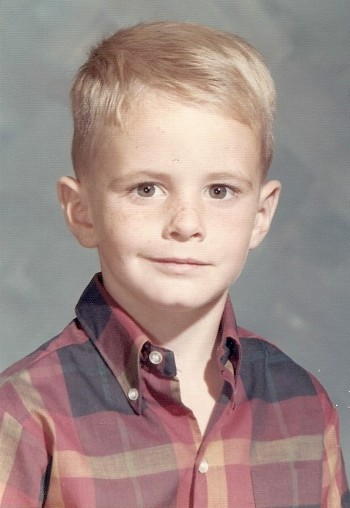 In this original BTB Investigation, we unveil the tragic story of Kirk Murphy, a four-year-old boy who was treated for “cross-gender disturbance” in 1970 by a young grad student by the name of George Rekers. This story is a stark reminder that there are severe and damaging consequences when therapists try to ensure that boys will be boys.
When we first reported on three American anti-gay activists traveling to Kampala for a three-day conference, we had no idea that it would be the first report of a long string of events leading to a proposal to institute the death penalty for LGBT people. But that is exactly what happened. In this report, we review our collection of more than 500 posts to tell the story of one nation’s embrace of hatred toward gay people. This report will be updated continuously as events continue to unfold. Check here for the latest updates.
In 2005, the Southern Poverty Law Center wrote that “[Paul] Cameron’s ‘science’ echoes Nazi Germany.” What the SPLC didn”t know was Cameron doesn’t just “echo” Nazi Germany. He quoted extensively from one of the Final Solution’s architects. This puts his fascination with quarantines, mandatory tattoos, and extermination being a “plausible idea” in a whole new and deeply disturbing light.
On February 10, I attended an all-day “Love Won Out” ex-gay conference in Phoenix, put on by Focus on the Family and Exodus International. In this series of reports, I talk about what I learned there: the people who go to these conferences, the things that they hear, and what this all means for them, their families and for the rest of us.
Prologue: Why I Went To “Love Won Out”
Part 1: What’s Love Got To Do With It?
Part 2: Parents Struggle With “No Exceptions”
Part 3: A Whole New Dialect
Part 4: It Depends On How The Meaning of the Word "Change" Changes
Part 5: A Candid Explanation For "Change"
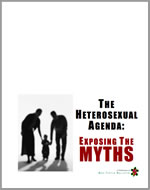 At last, the truth can now be told.
Using the same research methods employed by most anti-gay political pressure groups, we examine the statistics and the case studies that dispel many of the myths about heterosexuality. Download your copy today!
And don‘t miss our companion report, How To Write An Anti-Gay Tract In Fifteen Easy Steps.
 Anti-gay activists often charge that gay men and women pose a threat to children. In this report, we explore the supposed connection between homosexuality and child sexual abuse, the conclusions reached by the most knowledgeable professionals in the field, and how anti-gay activists continue to ignore their findings. This has tremendous consequences, not just for gay men and women, but more importantly for the safety of all our children.
Anti-gay activists often cite the “Dutch Study” to claim that gay unions last only about 1½ years and that the these men have an average of eight additional partners per year outside of their steady relationship. In this report, we will take you step by step into the study to see whether the claims are true.
Tony Perkins’ Family Research Council submitted an Amicus Brief to the Maryland Court of Appeals as that court prepared to consider the issue of gay marriage. We examine just one small section of that brief to reveal the junk science and fraudulent claims of the Family “Research” Council.
 The FBI’s annual Hate Crime Statistics aren’t as complete as they ought to be, and their report for 2004 was no exception. In fact, their most recent report has quite a few glaring holes. Holes big enough for Daniel Fetty to fall through.
“Google” is a trademark of Google Inc.
© Box Turtle Bulletin. All Rights Reserved.


 Posts
Posts  Posts via daily email: