Box Turtle Bulletin
 News and commentary about the anti-gay lobby
“Now you must raise your children up in a world where that union of man and box turtle is on the same legal footing as man and wife…”
News and commentary about the anti-gay lobbyJuly 27th, 2012
Pope Benedict the Evil holds you in contempt.
Really, that’s the only explanation. When someone take a step to insult you, exclude you, and show you just how little they value you, it must be out of contempt.
 San Francisco is known world wide as a city that is not only disproportionately gay in population but also deeply supportive of gay rights. A Pope with a sense of respect for Catholics in the City would have appointed an Archbishop that had a history of compassion for gay people and who could be perceived if not as an ally, at least as being non-antagonistic.
This Pope took a different approach. He appointed the single most anti-gay Catholic in the Country, Father Salvatore Cordileone, the author of Proposition 8. Truly a bigger insult to San Francisco’s Catholics could not be imagined.
While no doubt anti-gays within the church rejoiced, they may want to note that their rejoicing is echoing louder in increasingly empty cathedrals around the world.
July 27th, 2012
 Amazon’s founder, Jeff Bezos, and his wife, MacKenzie, have joined the list of prominent Washington businesses and CEO’s that have come out in support of marriage equality in that state. And all because former employee Jennifer Cast – one of the company’s first – asked.
On Sunday cast emailed Bezos asking for a contribution to the campaign in support of Referendum 74. “We need help from straight people. To be very frank, we need help from wealthy straight people who care about us and who want to help us win.” Bezos’ reply:
Jen, this is right for so many reasons. We’re in for $2.5 million. Jeff & MacKenzie.
I’m sorry. I should have given you a tissue warning.
Oddly enough, NOM’s blog site seems not to have gotten the news. They’re still talking about chicken.
July 27th, 2012
 At the turn of the 20th century, “Indian lore” was quite the rage for boys. In an increasingly industrialized and urban society, the romanticized native American with his ability to move soundlessly through the forest and build shelter and transportation without tools was an idealized hero. And when Lord Baden-Powell’s scouting movement made its way to the States, a number of boys groups had already been created based around Indian themes. These groups – and the themes – were incorporated into the Boy Scouts of America. And as the Boy Scouts grew over the next century, it’s American Indian theme became prominent, seen as a significant part of the scouting tradition and influencing the names of the national divisions.
Meet Frankie Crow Flag. Frankie’s father was Blackfoot and his mother raised him to respect his heritage.
Native American culture is still active in the Pacific Northwest. And Frankie, who lived in Portland, Oregon, attended pow-wows, learned the dances, and kept traditional symbols in his home.
And, appropriately for a young Blackfoot boy, Frankie’s mother did not cut his hair. By six, it hung in a straight full sheet down his back.
Frankie was a bit shy and not the most masculine boy in town, but he was a boy and he wanted to do “boy things”. And he very very much wanted to join the Cub Scouts.
So, in the mid 80’s, Frankie’s mother took him to sign up and begin his scouting adventure. But for the Cub Scout Master, gender conformity and gender appearance far outweighed any ideals he may have had about Native American culture. He told Frankie’s mother that he wasn’t welcome in the Cub Scouts because “he looks like a little girl and it will confuse the other boys.”

I didn’t understand. At that age, the only time I felt different was when I tried to fit in.
A loss for both Frankie and the other little boys who could have learned about a culture different from their own.
Today Frankie lives in Los Angeles and is part of the exclusive team of servers at The Abbey, where no one has any trouble figuring out if he is a boy or a girl.
To participate in the Local History Project, please email Timothy Kincaid (timothydkinla@yahoo.com) or Randy Potts (randyrpotts@gmail.com) and tell us your story in your own words.
July 27th, 2012
The Chronicle of Higher Education has obtained a copy of a highly critical audit showing that Mark Regnerus’s widely discussed paper on gay and lesbian parenting underwent a flawed peer-reviewed process which failed to find significant methodological problems and conflicts of interest. BTB was the first to review many of those methodological problems here on the day the study first appeared in the journal Social Science Research. According to The Chronicle:
Like Regnerus, the editor of Social Science Research, James D. Wright, has been at the receiving end of an outpouring of anger over the paper. At the suggestion of another scholar, Wright, a professor of sociology at the University of Central Florida, assigned a member of the journal’s editorial board—Darren E. Sherkat, a professor of sociology at Southern Illinois University at Carbondale—to examine how the paper was handled.
Sherkat was given access to all the reviews and correspondence connected with the paper, and was told the identities of the reviewers. According to Sherkat, Regnerus’s paper should never have been published. His assessment of it, in an interview, was concise: “It’s bullshit,” he said.
The audit criticized the paper’s identification of “lesbian mothers” and “gay fathers,” which was at the heart of our criticism of the report when the paper first appeared. Sherkat found the those labels for the categories of families that Regnerus created “extremely misleading.” He added: “Reviewers uniformly downplayed or ignored the fact that the study did not examine children of identifiably gay and lesbian parents, and none of the reviewers noticed that the marketing-research data were inappropriate for a top-tier social-scientific journal.” Sherkat found that that fact alone should have “disqualified it immediately” from publication.
The audit also found conflicts of interests among the reviewers and states that “scholars who should have known better failed to recuse themselves from the review process,” according to The Chronicle. Three of the six reviewers were on record as opposing same-sex marriage and were “not without some connection to Regnerus.” Sherkat did not however find that the paper had been inappropriately expedited as I questioned. But Sherkat did question the paper’s funding — $785,000 from the conservative Whiterspoon Institute and Bradly Foundation — and the study’s timing auspicious timing ahead of the 2012 elections, were serious concerns.
“There should be reflection about a conservative scholar garnering a very large grant from exceptionally conservative foundations,” he writes in the audit, “to make incendiary arguments about the worthiness of LGBT parents—and putting this out in time to politicize it before the 2012 United States presidential election.”
Journals are judged and scored according to what’s known as an “Impact Factor” by Journal Citation Reports. The Impact Factor identifies the number of times articles are cited by other journals over a period of time. Higher Impact Factors are earned when other authors more frequently cite journal articles in their published papers, and the higher the Impact Factor, the greater the journal’s prestige. Social Science Research’s Five-Year Impact Factor is 1.994, which is considered low for social science research journals. Wright admitted to Sherkat that he believed the Regnerus paper would generate a high level of discussion and possibly elevate the journal’s Impact Factor, and admits that “perhaps this prospect caused me to be inattentive to things I should have kept a keener eye on.”
Wright told The Chronicle that he has experienced “sleepless nights” and angry emails, both from colleagues and strangers. Wright told The Chronnicle that he supports civil rights for gays and lesbians, and found accusations that he was fostering an anti-gay climate “hurtful and preposterous.” (You can read one email exchange between Wright and a BTB reader here.)
Editor James Wright provided a copy of the audit to The Chronicle, and it will appear in the November edition of Social Science Research. The September issue of the bi-monthly journal has already been issued and posted online.
July 27th, 2012
TODAY’S AGENDA (Ours):
Pride Celebrations This Weekend: Bourneymouth, UK; Braunschweig, Germany; Detroit, MI (Black Pride); Ft. Wayne, IN; Halifax, NS; Harrisburg, PA; Norwich, UK; Nottingham, UK; Plymouth, UK; Pittsburgh, PA (Black Pride); Raleigh-Durham, NC (Black Pride); Reno, NV; and Stuttgard, Germany.
Other Events This Weekend: RodeoFest, Belleville, MI; POUTfest Film Festival, Cork, Ireland; HomoClimbtastic Rock Climbing Convention, Fayeteville, WV; Newfest LGBT Film Festival, New York, NY; and Up Your Alley, San Francisco, CA.

Radclyffe Hall
TODAY IN HISTORY”
“The Well of Loneliness” Published: 1927. The book was so controversial that three publishers turned it down. When it was finally published in England, it appeared in a plain, discreet black cover. It wasn’t particularly racy; the only sexual description consisted of the phrase, “and that night, they were not divided.” By today’s standards, the book may seem tame. But in 1927 Radclyffe Hall’s novel caused a sensation in Britain. The publisher sent review copies only to a few select newspapers and magazines who he thought could handle the lesbian-themed content. But he misjudged one of those editors. James Douglas, editor of the Sunday Express responded by mounting a massive campaign against the novel. He wrote “I would rather give a healthy boy or a healthy girl a phial of prussic acid than this novel.”
Despite most of the British press’s defending the novel, the publisher soon landed in court on obscenity charges. Several authors came to his defense — E.M. Forster, Virginia Woolf, and James Melville among them — but the judge declared the novel obscene. It wasn’t the story line he found objectionable; it was the novel’s plea for tolerance and acceptance that would “deprave and corrupt those whose minds are open to such immoral influences.” The ban and the massive newspaper campaign against the book, of course, only served to increase the public’s curiosity and demand for the book. Wherever there’s a demand, there’s a supply, and in the case of The Well, that supply was met by a publisher in France who shipped copies surreptitiously to newsstands throughout Britain. That had the effect of lowering British officials’ enthusiasm for banning other lesbian-themed novels that followed. A Home Office memo observed, “It is notorious that the prosecution of the Well Of Loneliness resulted in infinitely greater publicity about lesbianism than if there had been no prosecution.” It wouldn’t be until 1949 when The Well could be published in Britain again, not because any laws had changed, but because the Home Office simply decided to look the other way. It has remained in continuous publication since then.
Surprisingly, the book’s appearance in the U.S. generated a different reaction. Sure, there were attempts to ban it in the U.S. Customs Court and in New York City, where police seized 865 copies from its American publisher’s offices, but both attempts came to naught. The ensuing publicity from the trials raised demand for the book. Despite it’s high price of $5 (about twice the cost of an average hardback novel), The Well would go through six printings and sell over 100,00 copies by the time it was cleared by the courts. As in Britain, The Well of Loneliness
TODAY’S BIRTHDAY:
 Troy Perry: 1940. By the time he was fifteen years old, he was already a Baptist preacher and a self-described “religious fanatic.” He married in 1959 and fathered two sons, but he was not faithful to his wife. He had a few gay dalliances on the side. When the elders at the church he was pastoring found out, they forced him to resign and he moved his family to Southern California and began preaching for the Church of God of Prophecy. While there, his wife found a copy of Donald Webster Cory’s groundbreaking The Homosexual In America hidden in a mattress. That led to an immediate divorce and an end to his preaching career. After a stint in the army beginning in 1965, Perry felt called to offer a place for gay people to worship freely. He placed an ad in The Advocate announcing a worship service designed for gays in Los Angeles. and twelve people turned up on that first Sunday in October 1968. That would be the genesis for the Metropolitan Community Church, the only Christian denomination founded specifically to address the spiritual needs of LGBT people. MCC now has 250 congregations in 23 countries around the world.
If you know of something that belongs on the agenda, please send it here. Don’t forget to include the basics: who, what, when, where, and URL (if available).
And feel free to consider this your open thread for the day. What’s happening in your world?
A Commentary
July 26th, 2012
 I grew up in a smallish town in which my father was a church pastor. Which means that his life – and that of his family – was subjected to constant scrutiny. And what might be considered the height of rudeness if others were to face it was justified due to the ever present threat of possible hypocrisy. And, of course, any deviation from perfection in his children is evidence that he’s not a man of God.
So decisions which others chose with ease had to take public perception into consideration. What car you drive, where you go on vacation, what clothes you wear all are up for public debate. And if you don’t like it, well then you shouldn’t have become a minister, should you!
Consequently, privacy was highly valued in my family. So much so that secrecy – to the point of serious dysfunction – ruled the way in which my family was structured. Combined with temperament and natural reticence, this pretty much destroyed any interpersonal relationships that normally develop within a family structure.
So it through the lens of this experience that I view debates about outing. I’m intimately aware of the damage done to family and associates who are impacted by a belief that the public is entitled to know details of someone’s life. And I have some hint at the price paid by those “in the public eye” to live with some semblance of normalcy.
But it isn’t just my childhood that flavors the way in which I think about outing and other issues of privacy. I’m a blogger who uses his real name and whose opinions are not always popular. Some who don’t agree with my views would feel no reservation about trying to use situations in my life to discredit my views. And they feel that because I choose to make my views public that they are therefore entitled to engage in personal destruction.
But what do people have a right to know? I don’t mean a legal right, of course, but what is fair game? What is reasonable?
Many have set the standard to be what they consider “hypocrisy”. But their definition of hypocrisy too often sounds like “disagreeing with me”.
For example if someone is gay – and not public about that fact – and takes a position of disagreement on an issue like same-sex marriage, that’s “hypocrisy” to those who see them as a political obstacle rather than a person. But hypocrisy is exhibiting one public position and secretly holding a different position or benefiting somehow from that which you publicly oppose. We know openly gay people who do not support marriage equality (or didn’t in the past) so we know that one does not equate the other.
But still many in our community have come to expect that if someone that they have heard of is gay, then they have the right to know it. Even absent some real or imagined hypocrisy, that there is an obligation on the part of someone like Sally Ride to make her orientation a public statement. They have the right to know.
Often this is justified by insisting that they, the person demanding, are not closeted. They are perfectly open to all of their family, or most of their family and many of their acquaintances. And that is probably true. But so was Sally Ride.
But because Sally was successful and accomplished – because they had heard of her – they want more. They insist that Sally be open to total strangers, people whom she doesn’t know or trust. And they want Sally to take on the cause of gay rights – to fight their battles for them. Because that’s what coming out means when you are a celebrity of sorts – that’s the issue that journalists and legislators and random people on the street will ask you about. Or curse you about. Or denounce you about.
Few of us seek out public attack. But yet for some reason we think it reasonable to demand that others subject themselves to that which we avoid simply because they are famous. That they are hypocrites from benefiting from rights that we – albeit behind the veil of obscurity – have fought so hard for.
And others see “hypocrisy” in those who seek to make spirituality a part of their lives. And there certainly is plenty in the lives of those who practice their religion as a form of political oppression.
But it is not hypocrisy to see the flaws, temptations, and difficulties in your own life and declare them to be less than ideal. And if you listen closely to most religious speakers, ministers, or counselors, you hear very little condemnation of others that does not include recognition of their own failings. This tradition in Christianity goes back to the Apostle Paul who wrote, “For I have the desire to do what is good, but I cannot carry it out. For I do not do the good I want to do, but the evil I do not want to do—this I keep on doing.”
And some seem to believe that simply speaking publicly gives them a right to the details of your life. Or, as Azariah Southworth said in justifying his vague but suggestive outing of young Christian writer Jonathan Merritt, “Transparency is required of anyone who chooses to lead discussions on a large public platform.” He didn’t even pretend that Merritt was a hypocrite; all that mattered was that Jonathan moved in conservative Christian circles (though as a voice of moderation), that he had on at least one occasion engaged in some level of intimacy with Azariah, and that he knew this fact would discredit Merritt.
Of course, Southworth is not “transparent”. None of us are. We all have secrets, situations, history, flaws, judgment errors, or just embarrassing moments that we want to put behind us. We all have areas we seek to overcome or advance past or goals left unaccomplished. I have many skeletons, and I want them kept firmly in the closet where they belong (and please do not view this as a Gary Hart invitation).
Who has a right to know? What is “a large public platform”? What is fair game, or is anything at all off limits?
I understand the frustration with those who want to benefit from the hard work that some do while taking no risk themselves. But what are we entitled to demand of others?
I guess I wouldn’t be as troubled if those who did the demanding held themselves to the same cost. Not “the same standard”, because that’s just another way of saying “you must make the same decisions as me”. But the same cost. If they were willing to pay the same costs that they demand in others.
Sadly, that seldom is the case.
I learned something very young: those who want to know your secrets are usually extremely protective of their own. The type who were quick to gossip about my family’s life would be horrified if my father were to casually drop the flaws and mistakes about which they sought spiritual counsel. And, indeed, they should be; but they didn’t see that what was a given for themselves was worth considering for others.
In a culture that seems to find an increasing gap between rights and obligations, I worry about the ever growing assumptions that we have in a right to know the details of the lives of others. What was off-limits in celebrity rags just a decade ago is now de rigueur. And people are increasingly incensed if a public figure – no matter how they became “public” or how hard they seek to protect their privacy – does not divulge their dirty laundry. “I’ve heard of you” seems to be the only criteria for turning the personal into the public realm.
But I hope that as we go forward into an age of increasing visibility in which technology makes the very possibility of privacy elusive, that we keep in mind that our targets are people and that it is we, not they, who are flawed when we demand of them that which we are not willing to pay.
And as a starting spot, maybe we should ask ourselves this, can we ask for the details of a person’s life while hiding behind an online identity that shields our own? Can we insist that “public” people reveal their finances when we would tell anyone so bold as to ask our salary, “That’s none of your business!”? Can we insist that the details of a scandal be explained in minutia if we would find such an exposure to be horrifying?
I know that there are very valid reasons for some outing. And I know that my experiences flavor my views in ways that others’ experiences do not. But as we each take our position on outing and when it is appropriate, I hope we keep in mind that our targets are human and that they experience the same levels of pain and humiliation that we experience. And let us soundly reject the “transparency is required” standard proposed by Southworth.
If we do not, we soon will find that the only ones willing to speak are those who champion conventionality – and have limited their lives accordingly – or those who are so desperate that they have nothing to lose. And while these voices should be a part of the conversation, we will lose those from whom we may benefit but who do not want the details of their life to be the conversation.
July 26th, 2012
The AARP has an entire section of its web site dedicated to LGBT issues, including this “Gay Man’s Guide to Dating After 50“:
The truth is that you’ve earned your age. You really can own it. Focus on what you’ve gained — rich experiences, accomplishments, survivor skills and wisdom. Your next romantic partner will benefit from all of that, and from your passions for the life that’s in front of you.
Good advice for those of you — those of us — who are now of a certain age, regardless of whether we’re dating or not. I don’t know about you, but I’m finding 51 to be a lovely age.
July 26th, 2012
TODAY’S AGENDA (Ours):
Pride Celebrations This Weekend: Bourneymouth, UK; Braunschweig, Germany; Detroit, MI (Black Pride); Ft. Wayne, IN; Halifax, NS; Harrisburg, PA; Norwich, UK; Nottingham, UK; Plymouth, UK; Pittsburgh, PA (Black Pride); Raleigh-Durham, NC (Black Pride); Reno, NV; and Stuttgard, Germany.
Other Events This Weekend: RodeoFest, Belleville, MI; POUTfest Film Festival, Cork, Ireland; HomoClimbtastic Rock Climbing Convention, Fayeteville, WV; and Up Your Alley, San Francisco, CA.
TODAY’S AGENDA (Theirs):
NOM’s Ruth Institute Conference: San Diego, CA. The Ruth Institute, a project of the National Organization for Marriage, will conduct a conference this weekend in San Diego’s Skyline Church. Under the unwieldy title of “It Takes A Family To Raise a Village,” the conference will bring together what NOM calls “emerging leaders” to learn at the knee of some of the nation’s most virulent anti-gay extremists. The most prominent speaker at that conference will be Dr. Robert Gagnon, who argues that “homosexual practice is a more serious violation of Scripture’s sexual norms than even incest, adultery, plural marriage, and divorce.” Gagnon is quickly emerging as the Paul Cameron of the new millennium, and he is rapidly becoming the hero of the most extreme elements of the anti-gay industry. This sinister gathering begins today and continues through Sunday.
THIS MONTH IN HISTORY:
Homosexuality and Lesbianism Treated with Metrazol: 1940. The professional literature before 1980 festers with countless torturous descriptions of psychiatry’s barbarous attempts at “curing” homosexuality. Many accounts deal with the application of painful electric shock delivered via electrodes attached to sensitive regions of the body (See, for example, Jan 18, Mar 15, Jun 3). But the imagination for new methods of torture didn’t end there. Dr. Newdigate M. Owensby, who practiced at Atlanta’s famed Medical Arts Building, published a brief paper in the July 1940 edition of the prestigious Journal of Nervous and Mental Disease describing his own unique experiments to cure homosexuality. He worked on “the assumption that homosexuality and lesbianism are symptoms of an under developed schizophrenia,” and this led him to try something new: injecting subjects with Metrazol, to produce an epileptic-type grand mal seizure. Other psychiatrists had been experimenting with Metrazol-induced seizures for schizophrenia since 1934, and their logic went like this: since epilepsy (which was considered a mental illness) and schizophrenia very rarely existed in the same individual, maybe inducing an artificial seizure might rid one of schizophrenia. Owensby extended his theory further believing that Metrazol seizures might “liberate this previous fixation of the libido and the psychosexual energy becomes free once more to flow through regular physiological channels.” Who knows where he got that idea. To give you an idea of what this seizure was like, here is a brief film clip (unrelated to Owensby’s report) of an unidentified patient undergoing Metrazol treatment:
Ownesby provided six case studies of his experiments:
Case I.-A white male of 19 years had been arrested and sentenced to prison because of moral turpitude (homosexuality). He was paroled for treatment and promised a pardon if his perversion was corrected. The family history was not enlightening. Homosexual experiences began during his fourteenth year and continued thereafter. Feminine mannerisms were evident. Metrazol was administered until fifteen shocks were produced. All homosexual desires had disappeared after the ninth shock, but treatment was continued until all feminine mannerisms had been removed. Normal sex relations were established and eighteen months later there had been no return of homosexual tendencies. He was granted a pardon.
Case 2.-A white male aged thirty-four years. Had been a homosexual since his fifteenth year. He was frank enough to admit that the only reason for seeking treatment was fear of exposure and subsequent disgrace. All homosexual desires disappeared after seven grand mal attacks were induced by metrazol. He was married four months later. At the expiration of ten months he stated there had been no recurrence of homosexual desires or practices.
Case 3.-A white male aged forty-four years. Had been a homosexual since early youth. Most of his past life had been spent in penal institutions because of the opportunities to indulge his perversion. He seemed proud of the fact that he was a “man-woman”. Was constantly inebriated when out of prison. Metrazol was administered until ten grand mal attacks had occurred. He appeared to be regenerated after the ninth seizure. His common law wife states that, with the exception of an occasional overindulgence in alcohol, he has been a normal, hard working man for the past six months.
Case 4–A white male aged twenty-five years. Has been a homosexual since his fifteenth year. His mother was a neurotic. A sister had a manic depressive attack. A brother was an alcoholic. The patient was seclusive and spent most of his free time in his room. Would take an occasional trip to another city in order to satiate his homosexual desires. Was reluctant to discuss his perversion. Six grand mal attacks were induced by metrazol. Normal sex relations became established shortly thereafter and at the expiration of three months the patient claimed to be sexually healthy.
Case 5.-A white male aged twenty-six years. Married. Had indulged in active homosexuality since his seventeenth year. Appeared to be an ambulatory schizophrenic. His marriage had been arranged by a doting mother. Had never been self supporting. An obvious personality change followed the sixth induced grand mal attack. Whereas he had formerly been indifferent to his family and friends, he began to show interest and affection for them. He secured a position after returning home and became self supporting. Six months after receiving the metrazol treatment, he reported that he had continued to be free from all homosexual desires.
Case 6.-A white female aged twenty-four years. Name and address given were admittedly fictitious. Said to have been a lesbian since puberty. Promiscuous. Preferred the active role. Inclined to boast of her conquests. Inebriate for past four years. Ten grand mal seizures were induced by metrazol. Became infatuated with an intern after the treatment had been discontinued and frequently complained of nocturnal emissions. Remained institutionalized for six weeks after the last treatment and appeared to be healthy in every way. No subsequent reports.
The report’s weak findings are obvious: no measures of sexual orientation before or after, no long-term follow-up, widespread evidence of involuntary or coerced participation — not to mention a deeply flawed belief in the nature of homosexuality itself. What’s more, it’s easy to imagine that anyone being subjected to this kind of torture would say or do anything to make it stop. In fact, the use of Metrazol-induced seizures was finally halted when it was found to be both ineffective and terrifying to patients. The seizures themselves were sometimes so severe that it wasn’t entirely unusual for a patient to fracture their spine. It was later discovered that repeated treatments could, in some cases, lead to lasting brain damage. Needless to say, there is no evidence whatsoever that this treatment had any kind of effect in changing anyone’s sexual orientation. Indeed, in June 1949, Dr. George N. Thompson, writing for the same journal, would conclude that Metrazol shock therapy was ineffective in “curing” homosexuality.
But the National Association for the Research and Treatment of Homosexuality (NARTH) didn’t bother to read that memo. When they issued their so-called “Journal” in 2009 with a report which supposedly documents successful efforts to change sexual orientation, they included Owensby’s 1940 paper as a success story. Under the heading of “pharmacological interventions,” they write simply, “Owensby (1940) reported that six patients ceased all homosexual behavior after taking the drug Metrazol (pentetrazol).” They not only neglected to mention what Metrazol was all about — it wasn’t just some pill prescribed to patients — they also forgot to point out that the FDA revoked its approval of the drug in 1982.
If you know of something that belongs on the agenda, please send it here. Don’t forget to include the basics: who, what, when, where, and URL (if available).
And feel free to consider this your open thread for the day. What’s happening in your world?
July 25th, 2012
This email comes from a mysterious “Barry Caron, Attorney at Law,” whose practice is utterly invisible to Google.
The mysterious "Barry Caron"
** CONFIDENTIAL ** To Public Advocate supporters only:
Government agencies threaten legal action against Public Advocate of the U.S. over correspondence Mr. Delgaudio has sent to you. Mr. Delgaudio has told me that he cannot give up communication to you, that every Public Advocate member is vital to his efforts in Congress. That’s why he has hired me to evaluate the legal threat posed by these agencies and the bureaucrats that run them.
I am convinced Mr. Delgaudio has done nothing wrong. Unfortunately, right and wrong do not always matter to government bureaucrats. That’s why I have informed Mr. Delgaudio that if he chooses to stand up to these threats, the consequences could be severe. The legal costs alone could be enormous. Public Advocate could even be forced to close its doors before a court rules in its favor (which I think is very likely). Unless members like you are 100% committed to supporting Public Advocate this year, I believe that Eugene Delgaudio has no choice but to shut down Public Advocate’s battle to stop the Homosexual Lobby.
If, on the other hand, every Public Advocate member is truly committed to support Mr. Delgaudio’s efforts, I believe the battle can be won. Mr. Delgaudio needs to hear back from you today so he can decide what to do next. Please read his email here and let him know.
July 25th, 2012
TODAY’S AGENDA:
Pride Celebrations This Weekend: Bourneymouth, UK; Braunschweig, Germany; Detroit, MI (Black Pride); Ft. Wayne, IN; Halifax, NS; Harrisburg, PA; Norwich, UK; Nottingham, UK; Plymouth, UK; Pittsburgh, PA (Black Pride); Raleigh-Durham, NC (Black Pride); Reno, NV; and Stuttgard, Germany.
Other Events This Weekend: RodeoFest, Belleville, MI; POUTfest Film Festival, Cork, Ireland; and Up Your Alley, San Francisco, CA.
TODAY IN HISTORY:
 Dr. Barry’s Death Reveals a Lifelong Secret: 1865. Before Britain’s Inspector General of Military Hospitals, Dr. James Barry, died, he left strict instructions that no one was to change him out of the clothes in which he died. But the charwoman sent to prepare his corpse had no room for such nonsense. And so when she pulled his nightshirt up to wash his boody, she screamed, “The devil! It’s a woman!”
Dr Barry, while alive, was known as a fierce and demanding doctor, and in the process became one of the most highly respected and feared surgeons in Victorian England, feared for his combative temper and fierce determination. He famously got in a bitter argument with Florence Nightingale, who called him a “brute” and “the most hardened creature I ever met throughout the Army.” As Inspector General, he fought for better food, hygiene, sanitation and proper medical care for soldiers and for prisoners. His reforms undoubtedly saved thousands of lives. He became the top-ranking doctor in the British Army, where despite his argumentative personality, was also reputed to have an very good bedside manner. Many who knew him also remarked on his high, soft voice and his diminutive stature — he stood barely five feet tall on special stacked-soled shoes. His black manservant, who joined Barry’s employment in South Africa and would remain with him for the next fifty years, was entrusted with the task of laying out six small towels every morning that Barry used to conceal his curves and broaden his shoulders.
Despite the charwoman’s discovery upon his death, his secret remained tightly held and he was buried under the only name he had gone by since his early twenties. It wouldn’t be until the 1950s when his British Army records were unsealed that it was revealed that Barry had been born in Ireland as Margaret Buckley to a forward thinking family who were staunch supporters of women’s rights. Margaret became James Barry shortly after beginning training to become a doctor. But since women were not admitted to universities at the time, the only way Barry could continue his education and career was to do so as a man. And in every respect, he remained a man in what was very much a man’s world until the day he died.
Barry’s life and career is the subject of Rachel Holmes’s 2007 book, The Secret Life of Dr James Barry: Victorian England’s Most Eminent Surgeon
 Rock Hudson’s AIDS Diagnosis Confirmed: 1985. The rumors had been swirling for some time, coming to a head when Rock Hudson was admitted into Paris’s Pasteur Institute for what was clearly a very serious illness. He had appeared a few days earlier on Doris Day’s television talk show appearing gaunt, and his speech was nearly incoherent. His admission to Pasteur only increased speculation that Hudson was suffering from AIDS, since the world-famous Institute was a leading research and treatment center for the disease. But the official line remained that Hudson was battling liver cancer until this date in 1985, when his publicist revealed that Hudson had been diagnosed with AIDS the year before. Of Hudson’s stay at the Paris hospital, the spokesperson said, “He’s lucid. He’s talking, He’s joking… He’s feeling much better and in quite good spirits.” But his publicist remained circumspect about Hudson’s sexuality, saying only, “He doesn’t have any idea now how he contracted AIDS. … Nobody around him has AIDS.”
That would change a few weeks later when, apparently with Hudson’s blessing, close friends Angie Dickinson, Robert Stack and Mamie Van Doren acknowledged Hudson’s sexuality in a supportive article in People magazine. Messages of support flowed in from Morgan Fairchild, Joan Rivers, and, of course Elizabeth Taylor. Hudson’s death less than three months later provoked another wave of sympathy and galvanized much of Hollywood, with Elizabeth Taylor’s prodding, to undertake the task of reducing the stigma surrounding HIV/AIDS.
TODAY’S BIRTHDAYS:
 J. Warren Kerrigan: 1879. While little-known today, Kerrigan had been a very popular silent film star, appearing in films for Essanay, Biograph, and later Universal. He typically played a leading role, as a modern, well-dressed man-about town. He nearly killed his career over a glib remark about his refusal to enlist in World War I. He managed to salvage his reputation in 1923 with the lead role in The Covered Wagon. That success opened the doors to five more hit films in the next year, and with that his financial security was assured. He retired from filmmaking and lived with his devoted partner of forty years until Kerrigan died in 1947 at the age of 67.
If you know of something that belongs on the agenda, please send it here. Don’t forget to include the basics: who, what, when, where, and URL (if available).
And feel free to consider this your open thread for the day. What’s happening in your world?
A commentary
July 24th, 2012
 I first learned about the death of pioneering astronaut Sally Ride from this CNN report. When she flew aboard a Space Shuttle Challenger flight in 1983, she became the first American woman in space. She took another trip aboard the Challenger a year later. She was scheduled for a third mission, but it was cancelled after the Challenger exploded shortly after take-off in 1986. She served on the accident review crew for that flight, and served again in the investigation of the 2003 Columbia accident.
All of that was covered in the CNN report, as with all of the other obituaries. But there was one line which, at the moment of her death, has overshadowed all of her accomplishments in life. It was this:
Ride is survived by her partner of 27 years, Tam O’Shaughnessy, her mother, her sister and other family members.
Look around the blogs and tell me what you see. What are they talking about? Her accomplishments? Or the fact of her partner? Andrew Sullivan, for example, reacted:
I’m not so understanding. We can judge this decision in the context of Ride’s life. Her achievements as a woman and as a scientist and as an astronaut and as a brilliant, principled investigator of NASA’s screw-ups will always stand, and vastly outshine any flaws. But the truth remains: she had a chance to expand people’s horizons and young lesbians’ hope and self-esteem, and she chose not to.
She was the absent heroine.
An absent heroine? Really?
When she took her first flight in 1983, I was a year away from graduating with an Engineering degree. There was exactly one woman in my sixty-some member class. The male-female ratio in many of the hard sciences was typically greater than the straight-nonstraight ratio in the general population. Even within my graduating class, gays outnumbered women. I’m still not sure that has changed much since then. Ride most certainly expanded people’s horizons in ways that I think, sadly thirty years later, many still fail to see.
I don’t know what it says about us that we expect — demand, really — that anyone who gains any kind of achievement, fame, or notoriety, they must accede to our demands and come out of the closet — which we define not in terms of acknowledging their relationships to their friends, familes, neighbors, coworkers and others who are important to them, but to reporters, bloggers and PR specialists who are important to us.
Don’t get me wrong. I’m grateful to those who do come out publicly and with great fanfare. I appreciate their value as role models. But isn’t it one of the goals that we are striving to achieve that everyone can live their own lives as publicly — and as privately — as they wish, for whatever reason they may wish it? Isn’t our fight a fight for self-determination and against the interference of busybodies who would presume to tell us how we should live based on what they think we should do?
I’m not going to second-guess her any more than I’ve second-guessed anyone else’s decision in how much they want to disclose about themselves, as long as they don’t act in a way that is hypocritical or in conflict with those in similar situations who choose differently. It’s why I was never all that agitated over Anderson Cooper’s decision until recently not to discuss his personal life for so many years. Sally Ride was a hero in the way that she chose — and fought — to be a hero, and there are many women and young girls today who are rightfully grateful for it. I can live with that.
July 24th, 2012
Last winter, Exodus International began the process of erasins all references to NARTH and Reparative from its web site with the removal of RT books from its online book store. In June, Exodus issued a formal statement saying, “As an organization, we do not subscribe to therapies that make changing sexual orientation a main focus or goal.” Since then, Exodus president Alan Chambers has explained that he was moving Exodus away from RT because, as he briefly explained during the opening night plenary sessions, “I feel like so often in that line of work or in that field of work, we have said, this is what causes homosexuality, this is how you deal with it, and this is what your outcome will be if you do everything right. And I don’t think that’s fair.”
This is his main objection to RT, but it’s not the only one. During a Q&A session at the 2012 conference in St. Paul, Chambers disclosed, briefly, that Nicolosi, who had been a regular speaker at previous Exodus conferences, wanted to present a workshop in which he would discuss the use of pornographic materials to lessen same-sex attraction through a controversial therapy known as Eye Movement Desensitization and Reprocessing (EMDR). As Chambers explained, recommending the use of porn was a line that Exodus, an explicitly Evangelical Christian organization, would not cross. Exodus refused to accept Nicolosi’s workshop proposal for 2010. Warren Throckmorton obtained a copy of that proposal:
Gay Pornography as a Therapeutic Tool
Reparative Therapists have recently developed a therapeutic technique utilizing gay pornographic images to expose deeper emotional needs beneath mere sexual arousal. While many clients have been told that their homosexuality is a defense against emotional needs, this technique offers “experiential knowing” resulting from personal experience. The result is a diminishment of pornographic appeal and movement toward resolving deeper conflicts.For men and leaders.
Despite Exodus refusal of that proposed workshop, Nicolosi conducted two other workshops at the 2010 conference, “Preceding Scenario to Homosexual Enactment,” and “Identifying your Shame Based Self Statement.” Throckmorton obtained audio from one of those workshops (he doesn’t say which one), in which Nicolosi, despite Exodus’s ban, recommends using gay porn as part of EMDR therapy:
Chambers briefly mentioned this during a recent interview on MSNBC’s Hardball, but the guest host failed to pick up and follow through on it. Nicolosi had written a letter to Chambers (it’s now posted on Facebook) denying that he recommended using porn, but this audio supports Chambers’s version of events. Nicolosi did not appear at the 2011 or 2012 conference, and I noticed that his books were not available at the conference bookstore in 2012.
July 24th, 2012

Kitty Lambert and Cheryle Rudd were married at midnight at Niagara Falls.
TODAY IN HISTORY:
New Yorkers Get Married: 2011. Shortly after the stroke of midnight, Niagara Falls mayor Paul Dyster pronounced Kitty Lambert and Cheryle Rudd spouses for life as the world-famous falls in the background were lit in rainbow hues.
At about the same time, Albany Mayor Jerry Jennings presided over the wedding of Dale Getto and Barb Lavin in the Common Council’s chambers. And with that, New Yorkers began to celebrate the arrival of marriage equality in the Empire State. On this date, New York became the most populous state in the union providing marriage equality for all of its citizens.

Dale Getto and Barb Laven married in Albany shortly after midnight.
When New York City officials announced that they would open their doors on Sunday for the first day of marriage equality, they worried that high demand would overload city clerk’s offices throughout the city. To manage the demand, they had established a lottery for 764 slots. But on Thursday before the big day, officials announced that they would be able to issue licenses for all 823 couples who applied for the slots. New York law provides for a 24-hour waiting period after obtaining a license before they can marry, but judges from around the state volunteered to be available at registrars offices to offer that exemption.
TODAY’S BIRTHDAYS:
 Gus Van Sant: 1952. Born in Louisville, Kentucky, Van Sant’s traveling salesman father moved the family around through much of his childhood. One thing remained constant though, and it was the young Van Sant’s interest in painting and Super-8 filmmaking. He enrolled at the Rhode Island School of Design to study painting, but he switched to cinema after being introduced to avant-garde films. Since avant-garde films were never much of a money-maker, Van Sant became familiar with some of the more derelict areas along Hollywood Boulevard, and 1985’s Mala Noche


His 1993 flop, Even Cowgirls Get the Blues


Kirk, at the age of 4 years and 6 months, just a few months before entering treatment at UCLA's Feminine Boy Project (Photo courtesy of the family)
Kirk Andrew Murphy: 1965. For nearly four decades, Kirk was known only as “Kraig,” but under that pseudonym he was well known among behavioral therapists who were trying to prevent homosexuality and transgender identities in very young children. The seeds for “Kraig’s” fame were planted in the summer of 1970, when Kirk’s mother saw a television program featuring famed sexologist Dr. Richard Green describing a new federally-funded treatment program at UCLA’s Neuropsychiatric Institute. She listened to his spiel about the dangers of effeminate boys growing up to become homosexual, and she worried that her own young son was headed for trouble. So a month before his fifth birthday, she him to UCLA where Kirk came under the care of a young grad student by the name of George Rekers. Ten months later, five-year-old Kirk was declared to be rid of his “severe gender identity disturbance,” and Kirk’s case would help Rekers earn his Ph.D. in 1972.
Two years later, Rekers published his case report of “Kyle” in the Journal of Applied Behavioral Analysis, where he described “Kyle’s” treatment and the astounding “success.” This was the first time anyone had reported curing a young child’s budding homosexuality or transgenderism — no one was ever quite sure what it was they though they saw in Kirk — and that paper became one of the more widely-cited papers in the late 1970s. Kirk’s case launched Rekers’s career, first as an acclaimed or controversial young psychologist (depending on one’s point of view at the time), and later as a significant anti-gay activist when he co-founded the Family Research Council in 1983. Throughout Rekers’s career he would write at least twenty papers describing Kirk’s case as an example of the power of his treatment program to prevent homosexuality and transgender identity in very young children. The most recent publication touting “Kraig’s” supposedly successful cure appeared in a 2009 book promoted by the National Association for Research and Therapy of Homosexuality (NARTH), where Rekers served on its Scientific Advisory Committee. Of course, all of that was before Rekers was discovered returning from a European vacation in the company of a male escort in 2010.
But it wouldn’t be until last year when the truth would finally emerge. Our award winning original BTB investigation revealed that Kirk’s therapy was highly abusive; that contrary to Rekers’s persistent reports, Kirk was not straight; that Kirk struggled all his life with the shame that his treatment at UCLA had been instilled in him; and that his struggle finally ended with his suicide in December of 2003. If Kirk were alive today, he would be 47 years old. His is still deeply missed by his mother, brother, sister and friends.
If you know of something that belongs on the agenda, please send it here. Don’t forget to include the basics: who, what, when, where, and URL (if available).
And feel free to consider this your open thread for the day. What’s happening in your world?
July 23rd, 2012

Jean-Fabrice Nardelli's "Robert Gagnon's 'The Bible and Homosexual Practice' Ten Years After. A Non-Theological Assessment" (Click to download. PDF: 474KB/40 pages)
Dr. Robert Gagnon, the anti-gay activists’ favorite theologian, has enjoyed the advantage of a second rate scholar: those who look to him to justify their prejudices accept his assertions with adoration while serious scholars have mostly ignored him.
Those who have challenged Gagnon have mostly done so from a theological approach. But Jean-Fabrice Nardelli, a classical philologist at l’Université de Provence, has determined that the time is right to take on Gagnon’s handling of the evidence and subject it to a scholarly review.
Nardelli’s published work focuses on Homer and the Ancient Near East (Le motif de la paire d’amis héroïques à prolongements homophiles. Perspectives odysséennes et proche-orientales, 2004 ; La diction épique en débat. Un commentaire linguistique d’Odyssée XXIV 205-412, 2006), literary anthropology of sexuality (Homosexuality and Liminality in the Gilgamesh and Samuel, 2007) and philological or historical fallacies in the fields of Classics, Bible and Assyriology (Aristarchus antibarbarus. Pseudologies mésopotamiennes, bibliques, classiques, 2012).
I very strongly recommend Nardelli’s monograph. While it is heavily notated, it is not dry, boring, nor above the head of those who lack an education in the classics or ancient languages.
Nardelli: Robert Gagnon’s ‘The Bible and Homosexual Practice’ Ten Years After. A Non-Theological Assessment (PDF: 474KB/40 pages).
July 23rd, 2012
TODAY’S AGENDA:
 Vito Documentary Television Premiere: HBO. The press release lays out the background:
On June 27, 1969, a police raid on the Stonewall Inn, a New York City gay bar, took a surprising turn when patrons decided it was time to fight back. As a riot erupted in Greenwich Village, a new era in the gay rights movement was born. Among the crowd that day was 23-year-old film student Vito Russo. In the aftermath of the infamous rebellion, a raid on an after-hours bar he frequented ended with a young gay man impaling himself on a fence while trying to escape the police. This is when Vito found his voice as a gay activist and critic of homosexual representation in the media. Over the next 20 years, until his death from AIDS in 1990, Vito Russo was one of the most outspoken and inspiring activists in the LGBT community’s fight for equal rights.
Russo would go on to become active in ACT-UP, found GLAAD, and write The Celluloid Closet: Homosexuality in the Movies

TODAY’S BIRTHDAYS:
 Charlotte Saunders Cushman: 1816. The American stage actress began her career as an opera singer at the age of thirteen, following the death of her father. She had learned to sing from a friend of her father, who was also a foreman at a Boston piano factory, and she is said to have possessed a remarkable contralto range. But when her singing voice suddenly failed due to strain, she switched gears and became a noted drama actress, with a particular flair for Shakespeare. She and her sister, Susan Webb Cushman, became famous for playing Romeo and Juliet together, with Charlotte playing the role of Romeo to Susan’s Juliet.
In 1848 while in Europe, Charlotte met journalist and sometime actress Matilda Hays, and they began a ten year affair, during which they became known for dressing alike. Charlotte retired from the stage in 1852, and the couple moved to Rome, where they immersed themselves an expatriate community consisting mainly of lesbian artists. Hays and Cushman split in 1857, and Cushman became involved with the sculptor Emma Stebens. She returned to the U.S. for a tour, and before returning to Italy in 1861 she was offered a farewell performance of the title role of Hamlet in Washington, D.C., the first of at least seven different so-called farewell performances over the next seven years. Her final final performance on the stage wouldn’t be until May of 1875 at Boston’s Globe Theater, nine months before she died at the age of 59 of pneumonia.
If you know of something that belongs on the agenda, please send it here. Don’t forget to include the basics: who, what, when, where, and URL (if available).
And feel free to consider this your open thread for the day. What’s happening in your world?
Featured Reports
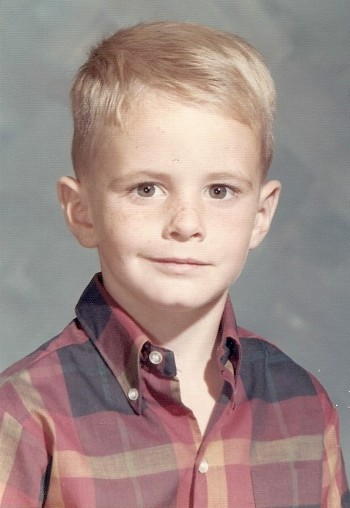 In this original BTB Investigation, we unveil the tragic story of Kirk Murphy, a four-year-old boy who was treated for “cross-gender disturbance” in 1970 by a young grad student by the name of George Rekers. This story is a stark reminder that there are severe and damaging consequences when therapists try to ensure that boys will be boys.
When we first reported on three American anti-gay activists traveling to Kampala for a three-day conference, we had no idea that it would be the first report of a long string of events leading to a proposal to institute the death penalty for LGBT people. But that is exactly what happened. In this report, we review our collection of more than 500 posts to tell the story of one nation’s embrace of hatred toward gay people. This report will be updated continuously as events continue to unfold. Check here for the latest updates.
In 2005, the Southern Poverty Law Center wrote that “[Paul] Cameron’s ‘science’ echoes Nazi Germany.” What the SPLC didn”t know was Cameron doesn’t just “echo” Nazi Germany. He quoted extensively from one of the Final Solution’s architects. This puts his fascination with quarantines, mandatory tattoos, and extermination being a “plausible idea” in a whole new and deeply disturbing light.
On February 10, I attended an all-day “Love Won Out” ex-gay conference in Phoenix, put on by Focus on the Family and Exodus International. In this series of reports, I talk about what I learned there: the people who go to these conferences, the things that they hear, and what this all means for them, their families and for the rest of us.
Prologue: Why I Went To “Love Won Out”
Part 1: What’s Love Got To Do With It?
Part 2: Parents Struggle With “No Exceptions”
Part 3: A Whole New Dialect
Part 4: It Depends On How The Meaning of the Word "Change" Changes
Part 5: A Candid Explanation For "Change"
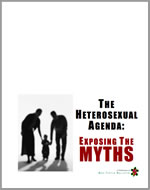 At last, the truth can now be told.
Using the same research methods employed by most anti-gay political pressure groups, we examine the statistics and the case studies that dispel many of the myths about heterosexuality. Download your copy today!
And don‘t miss our companion report, How To Write An Anti-Gay Tract In Fifteen Easy Steps.
 Anti-gay activists often charge that gay men and women pose a threat to children. In this report, we explore the supposed connection between homosexuality and child sexual abuse, the conclusions reached by the most knowledgeable professionals in the field, and how anti-gay activists continue to ignore their findings. This has tremendous consequences, not just for gay men and women, but more importantly for the safety of all our children.
Anti-gay activists often cite the “Dutch Study” to claim that gay unions last only about 1½ years and that the these men have an average of eight additional partners per year outside of their steady relationship. In this report, we will take you step by step into the study to see whether the claims are true.
Tony Perkins’ Family Research Council submitted an Amicus Brief to the Maryland Court of Appeals as that court prepared to consider the issue of gay marriage. We examine just one small section of that brief to reveal the junk science and fraudulent claims of the Family “Research” Council.
 The FBI’s annual Hate Crime Statistics aren’t as complete as they ought to be, and their report for 2004 was no exception. In fact, their most recent report has quite a few glaring holes. Holes big enough for Daniel Fetty to fall through.
“Google” is a trademark of Google Inc.
© Box Turtle Bulletin. All Rights Reserved.

 Posts
Posts  Posts via daily email: