Box Turtle Bulletin
 News and commentary about the anti-gay lobby
“Now you must raise your children up in a world where that union of man and box turtle is on the same legal footing as man and wife…”
News and commentary about the anti-gay lobbyJune 12th, 2012

It’s also the one with a hit song called, “Jesus, Take the Wheel.”
It’s also the one who is so squeaky-clean that it would surprise you if she covered up for pedophiles.
It’s also the one who talks about faith like it’s something that she actually believes and lives by: (the Independent)
Before she goes, I ask about a topic she calls the most important thing in her life, and one of the recurring themes in the music she now hopes to export to our shores: her faith. She grew up Baptist, she tells me, saying it offered an old-fashioned, didactic take on Christianity, but these days attends a liberal, inter-denominational church which “embraces all sorts”. She and Mike pray every morning, and before every meal. She also prays before every show, often with bandmates.
Does she ever struggle, I ask, to square her religion with the progressive, gay-friendly mores of the music industry? “Our church is gay-friendly,” she responds, seeming suddenly energised. “Above all, God wanted us to love others. It’s not about setting rules, or [saying] ‘everyone has to be like me’. No. We’re all different. That’s what makes us special. We have to love each other and get on with each other.” Then she offers a totally unexpected, unequivocal endorsement of gay marriage. “As a married person myself, I don’t know what it’s like to be told I can’t marry somebody I love, and want to marry. I can’t imagine how that must feel. I definitely think we should all have the right to love, and love publicly, the people that we want to love.”
June 12th, 2012
I spoke today to someone who both supported and contributed to Rick Santorum’s campaign. He explained it simply; it was a matter of self interest. He’s a bankruptcy attorney. He was looking forward to Santorum’s policies driving the economy into utter chaos.
True story.
June 12th, 2012
The Washington Times has (indirectly) declared that not being “entirely heterosexual” is a negative outcome. And it did this in a news article, not an editorial.
In a widely-quoted piece on Mark Regnerus’ gay-parenting study, the Washington Times wrote:
He found that, when compared with adults raised in married, mother-father families, adults raised by lesbian mothers had negative outcomes in 24 of 40 categories…
Actually, no. Regnerus didn’t find that at all. Rather he found 24 statistically-significant differences, and of those differences he wrote:
…in the vast majority of cases the optimal outcome—where one can be readily discerned—favors [intact biological families].
Emphasis added. See what the Times did? It put words into Regnerus’s mouth. Regnerus did not say all these outcomes were negative. That was invented by the Times.
Here’s the kicker. One of the those differences is whether someone “identifies as entirely heterosexual.” Regneros didn’t classify this was positive or negative. He gives a few examples of outcomes that are “obviously suboptimal (such as education, depression, employment status, or marijuana use),” but sexual orientation isn’t on that list.
By now, though, this Washington Times falsehood has been widely reported as truth when it’s nothing of the sort.
What makes this so insidious is that it’s unstated. In one place the reader hears that all the differences were negative. In another, that one of those differences was sexual orientation. The association sinks in without ever being explicitly connected.
But it’s still there, a little splash of anti-gay bias that lands in the article almost unnoticed, one more drop of rain added to the river of homophobia.
June 12th, 2012
 Split, on the beautiful Adriatic coast in Croatia, had a Pride Parade over the weekend (AJC)
Riot police watched on as several hundred people, including some government ministers, marched unhindered through the Croatian town of Split on Saturday, many carrying flags and banners reading “Gay is OK” and “We are all equal.”
As treatment of a country’s gay citizens is being seen more and more as a defining characteristic for countries with European sensibilities, and as Croatia wishes to join the European Union next year, the government viewed a safe and successful Pride Parade as being politically necessary. They were serious.
The crowd walked along a route that was fenced off by the police, while a helicopter flew overhead and a water cannon was parked nearby.
The police were delighted to report no incidents of violence and the Minister for Foreign Affairs made statements in support of the event.
June 12th, 2012
The key to understanding Mark Regnerus’ study – and to understanding it’s failure – is understanding the motivations of the author and his funders. And, sadly, this is something that I think we fail to grasp with subtlety.
We tend to look at individuals and organizations who oppose our equality as being “anti-gay” and, as that is important to us, we elevate it’s importance to them. We see them as primarily and “anti-gay organization” and attribute motives and malices to them. This may not always be accurate. Anti-gay malice may simply be but a small – incidental even – part of their motivation.
Let me give an illustration: If one is Jewish, then it can be easy to see the Ku Klux Klan’s efforts over the years through the lens of how it impacts you. If one is insufficiently aware of the totality of their endeavors, one might confuse them of being an “anti-Jewish organization”. If one is black, that is not at all how they are perceived.
We need to understand that Regnerus’ study was not necessarily to prove that gay families are inferior. Rather, his goal was to prove that married heterosexual biological parents (intact biological families – “IBFs”) are superior. Not just superior to gays, but superior to everyone else. Gays are just one group, joining divorced parents, single parents, widows, adoptive parents, and all who aren’t IBF.
Children appear most apt to succeed well as adults when they spend their entire childhood with their married mother and father, and especially when the parents remain married to the present day.
Regnerus did not set out to say anything about orientation, he simply set out to prove that a certain family structure is superior. And that’s where he failed.
When discussing heterosexual parents, he did compare family structures. The distinctions and differences between the groups were determined by marital status, divorce, step-parentage and the like, all of which address the structure of the families. However when it came time to discuss children of parents in which one was same-sex attracted, Regnerus played a sleight of hand. He redefined his terms such that ‘having a gay parent’ became in and of itself a family structure.
Regnerus did the same thing for adopted children. The stability of the family, divorce, age of adoption, prior trauma, nothing at all was important other than the way in which they differed from IBF, and as they violated the “B” (biological) then that is the only measure that was important. Regnerus’ “family structures” became defined not by what they were, but by what they were not. There were the Not-I’s: divorce, step-family, single; and the Not-B’s: adopted by ‘strangers’, gay fathers, lesbian mothers (and especially violates the unstated but underlying requirement that the IBF be heterosexual).
Oddly enough, while claiming that he didn’t “go into orientation of parents in this study”, that is precisely what he did. Should one parent have had a same-sex relationship of any sort, that was the determinant that pulled them out of whatever family structure they might have been included in and placed them, de facto, into a non-IBF family structure.
(Imagine if he had done a study in which some other situation were used to create a new family structure: “Families in which the parents are married fare better than ones in which one parent abuses drugs.” Or perhaps “Families in which the parents are married fare better than ones in which both parents work.” It sounds meaningful until you try find the meaning.)
So what is Regnerus to do with this data? He didn’t get the data he hoped for. He didn’t get meaningful data to address the premise he wished to support. He can’t break up the same-sex attracted parents into statistically meaningful family structure groups; he doesn’t have sufficient sample size.
So he has two choices:
He can eliminate the same-sex attracted parents from the study (or put them in comparable family structure groups) or even report that sample sizes disallowed any meaningful conclusions about the comparisons between IBFs and gay families. But then he’s left with a study that says “married parents do better than divorced parents” and that wouldn’t generate headlines in his mother’s Christmas letter, much less in mainstream press. And his funders would object to three quarters of a million bucks being spent on something that has been shown to be true in many studies before this one.
They know that they are superior (and just a bit more special) than divorced parents or those slutty single mothers (who surely are all on welfare). They have studies to prove it. But so far they didn’t have anything to point to which would prove them to be superior to same-sex families.
So instead he chose to play word games. He decided to claim that “one parent is same-sex attracted” is a family structure in the same way that married or separated is a family structure. And, of course, this could be presented (with lots of “oh, no, really”) as implied evidence that IBF is superior to same-sex married couples. Which is precisely what Regnerus did when he said:
In fact, the most significant story in this study is arguably not about the differences among young–adult children whose parents who have had same-sex relationships and those whose parents are married biological mothers and fathers, but between the latter and nearly everyone else.
But, ultimately, once one says “oh, but being gay is not a family structure” then his study becomes meaningless. As Mark Regnerus is discovering.
June 12th, 2012
We will win our battle for equality. And when we do, many of those who do not support us today will be cheering.
The irony is that equality is a value that people believe in and the exceptions made so as to disenfranchise gay people from our place in the social fabric are flimsy and it is only prejudice and tradition and ignorance that allow them to sound reasonable.
And those who live their lives under a structure of faith-based love are rapidly discovering them to be contrary to what they believe. As they come to join us, they will so because of their faith – not despite it – and will advocate with religious fervor and zeal.
Religion Dispatches interviewed Sara Long and Scott Holley about what led them to become pro-gay Mormons and their efforts towards equality in Washington State. I found about eight things I wanted to copy and write about here – which was about the whole interview and way too much – so you have to go read it yourself.
But the heart of it lies in this:
SL: Yes, when my children grow up I want them to look back and know that I did something during this civil rights effort. I want to make it clear that I did everything I could to advocate for equality.
[Note: above corrected: “…they will so not because of their faith – not despite it…”]
June 12th, 2012
Whoever invented the term “crowd-sourcing” was onto something, and the BTB crowd is among the best. Regular commenter StraightGrandmother had an interesting email exchange which she posted in the comments section. I want to bring up those email responses here.
Her first email began: “You can’t just force all the Children of Parents who had a same sex relationship into one bucket. it is not representative of what that respondent grew up in for a home life,” She then peppered him with several questions: How many LM/GF had biological parents who were married and stay married, how many were married then divorced, were never married, had a “fling”, etc. In other words, how many LM/GF people fit the more homogenous categories that he created for adult children of heterosexual couples. You can read her full email here. Regnerus replied:
Dear Ms. _______,
I will do my best to get answers to most if not all of your questions, hopefully in the next few days. However, there is not data on “flings,” only the presence or absence of relationships, and whether the respondent lived with the parent and their same-sex partner, and at what age (plumbing the calendar data is time-consuming work, however.)
I believe the article should be publicly available for free on Monday, from the publisher’s website. That is my understanding. I’m sorry you paid for it. I could’ve sent you a copy upon request.
People of good will (and some without) have and will continue to have lots of comments on measurement decisions, etc. Is understandable. Your comments are well-taken. A key priority, however, was always sample size. Curb it too much by slicing groups (wisely, even) into different categories and statistical power drops precipitously. With a much larger sample size, I would’ve done that. Was a judgment call with which some disagree. I maxed what Knowledge Networks could do with their panel, and no research firm out there is in a position to generate a larger N. Perhaps I could’ve left it in the field for another year, but that is quite awhile, and wouldn’t have doubled the sample size of LMs or GFs.
The study was reviewed the regular way, with multiple blind reviews to which I was required to respond.
I added some commentary about the study background, context, at the place where I blog once a week:http://www.patheos.com/blogs/blackwhiteandgray/2012/06/q-a-with-mark-regnerus-about-the-background-of-his-new-study/.
You can cut, paste, and post whatever you wish…
Sincerely yours,
Mark Regnerus
StraightGrandmother thanked him and clarified why she asked about “flings” :
There is something much much different about a home environment where the parents are in a Mixed Orientation Marriage and one spouse has an extra marital affair with someone of their same sex. The troubling part is the extra marital affair not just the fact that it was with a person of the same sex.
This situation is much different than a sole lesbian who establishes a same sex relationship. See the difference between an extra marital fling and a normal two person relationship?
Regnerus responded:
Please post…
By the way, one of the key methodological criticisms circulating is that–basically–in a population-based sample, I haven’t really evaluated how the adult children of stably-intact coupled self-identified lesbians have fared. Right? Right. And I’m telling you that it cannot be feasibly accomplished. It is a methodological (practical) impossibility at present, for reasons I describe: they really didn’t exist in numbers that could be amply obtained *randomly*. It may well be a flaw–limitation, I think–but it is unavoidable. We maxxed Knowledge Networks’ ability, and no firm is positioned to do better. It would have cost untold millions of dollars, and still may not generate the number of cases needed for statistical analyses. If randomness wasn’t the key priority, then we could’ve done it. And we’d have had a nonrandom sample that was no better than anything before it. So, while critics are taking potshots, they should remember that there’s a (low) ceiling to what’s possible here. My team of consultants elected to go with the screener questions (including the one about same-sex relationships) that we did, anticipating–accurately, too–that there would be no way of generating ample sample size if we narrowed the criteria (for who counts as a lesbian parent) to the sort that critics are calling for. We figured that, with the household roster/calendar offering the opportunity to identify who you lived with, we’d comfortably get enough cases wherein the respondent reported living with mom and her partner for many consecutive years. But few did.
Ergo, in contrast to some impressions, I didn’t construct the study to tell the sort of story I wanted.
I hope that people read the three comments that were also published with the study. They voice confidence in the data, while asserting ample concerns about its use.
Sincerely yours,
Mark
You can read an overview of those three commentaries published in Social Science Review here.
In the third email, StraightGrandmother emphasized her concerns about mixed orientation marriages being included in the LM and GF categories:
If your gay/lesbian population primarily produced children in a Mixed Orientation marriage then I feel you should have clearly said that. Because then your research is showing what I believe to be true, Mixed Orientation Marriages are very hard on children. We know that only 1/3 of Mixed Orientation Marriages attempt to stay together after disclosure and of that 1/3 only half manage to stay together for 3 years or more (and it goes really down hill after 7 years).
IF your gay/lesbian population primarily produced children in a Mixed Orientation marriage then I feel you should have clearly said that. Because then your research is showing what I believe to be true, Mixed Orientation Marriages are very hard on children. We know that only 1/3 of Mixed Orientation Marriages attempt to stay together after disclosure and of that 1/3 only half manage to stay together for 3 years or more (and it goes really down hill after 7 years).
She mentioned Zach Wahls, the young man who was raised by two mothers as the only family he ever knew and who testified about his family before an Iowa statehouse hearing to consider rescinding same-sex marriages in that state, as an example of someone who was really the product of Lesbian Mothers. StraightGrandmother castigated Regnerus for what she saw as carelessness with how he described his “lesbian mothers” category. “You were not up front saying, ‘99.5% of the respondents with a gay or lesbian parent were raised in a home where the parents had a Mixed Orientation Marriage.’ Just that simple sentence would have made everything right. …Because of that one missing sentence clearly stating the Mixed Orientation Status you are being attacked instead of being praised.”
Regnerus replied:
Well, it was quite unlikely that I would be praised in the scholarly community. Nor did I expect to be. Trust me, I’m not surprised by the antagonism, but nor does it feel like a badge of honor to me.
The Daddy donor study, with which I am familiar, is not a population-based random sample. It’s an opt-in sample. I even inquired about this study with Abt SRBI and it was apparent that they couldn’t handle it like KN could. They didn’t randomly survey 1,000,000 people. Only the Census–or some precious few deep-pocketed federal studies–contacts that many. The research team discussed an opt-in sample supplement to boost N, and advised against it because the probability of respondents’ inclusion could not be ascertained. Been there, discussed that, elected not to go there in order to preserve the quality of the sample.
I don’t go into orientation of parents in this study. That is a deeper well, and in the cohort that I’m studying, I don’t presume that either they or their parents would confidently call their parent gay or lesbian (or something else). Ergo, we made it about behavior–and not discreet behavior but something their child would be aware of.
Moreover, plenty of scholars, like Lisa Diamond, assert that women’s sexuality is more fluid than men’s. (I make no claim or assertion either way.) If she’s right, your claim about mixed-orientation marriages seems more fixed, especially for women, than it need be in social and marital reality. But I elected NOT to make this about orientation or self-identity. You suggest more ominous motivation, but I assure you that was not true.
Your accusations are getting more heated, and I’m afraid unless we can correspond civilly, I may have to call a conclusion to this.
Again, please post.
Mark
June 12th, 2012
TODAY’S AGENDA (Ours):
Senate Hearing on ENDA: Washington, D.C. Last week, Sen. Tom Harkin (D-IA), chair of the Senate Health, Education, Labor and Pensions Committee, announced that he will hold another set of hearings today on the Employment Non-Discrimination Act. Among the five witnesses for today’s hearing will be Kylar Broadus, who will become the first openly transgender person to testify about the lack of employment non-discrimination protections for LGBT people. He is the founder of Trans People of Color Coalition of Columbia, MD. The other four witnesses include M.V. Lee Badgett, Research Director of the Williams Institute; Samuel Bagenstos, law professor at the University of Michigan Law SChool; Ken Charles, Vice President of Diversity and Inclusion at General Mills, Inc.; and Craig Parshal, Senior Vice President and General Council of the National Religious Broadcasters Association. The hearing will at place today at 10:00 a.m. in Room 106 of the Dirksen Senate office Building.
TODAY IN HISTORY:
 Loving v. Virginia: 1967. Mildred Jeter and Richard Loving were an unusual couple. They had long crossed the racial barrier as friends in rural Central Point, Virginia: she was Black and Native American, he was white. But friendship turned to dating, and when Mildred became pregnant at the age of 18 in 1958, they decided to go to Washington, D.C. to elope. When they returned home, a group of police officers invaded their house late at night hoping to catch them in the act of having sex (which would have been a crime because of their racial differences). Mildred pointed to the marriage license that they had hung on the wall, hoping that it would protect them. Little did she know, but that license was proof that they had committed another crime. Virginia’s Racial Integrity Act of 1924 prohibited any “colored” person with so much as one drop of African American or Indian blood from marrying a white person. Miscegenation was a felony, punishable by a prison sentence of between one and five years. The couple pleaded guilty on January 6, 1959, and they were sentenced to one year, with the sentence suspended for 25 years on the condition that they left Virginia.
The Lovings moved to D.C., and in 1963 the ACLU began a series of motions and lawsuits alleging that Virginia’s Racial Integrity Act violated the Fourteenth Amendment of the U.S. Constitution. Those lawsuits eventually made their way all the way up to the U.S. Supreme Court. On June 12, 1967, the Supreme Court struck down Virginia’s anti-miscegenation law, along with similar laws in fifteen other states. In the unanimous ruling, the Court held that “Marriage is one of the ‘basic civil rights of man,’ fundamental to our very existence and survival.” Despite this ruling, anti-miscegenation laws remained on the books for several years to come, despite their being unenforceable. In 2000, Alabama voters approved a ballot initiative to repeal its anti-miscegenation law, although even then more than half a million — 40% — voted to keep it.
Mildred and Richard were never political people. After the Supreme Court victory, the couple returned to Virginia and raised three children. Richard died in 1975 at the age of 41 when their car was struck by a drunk driver. Mildred lost her right eye in the accident. She passed away in 2008 of pneumonia at the age of 68. But a year before she died, she issued a statement on the 40th anniversary of Loving v. Virginia, in which she saw the fight for the freedom to marry as unfinished business:
My generation was bitterly divided over something that should have been so clear and right. The majority believed that what the judge said, that it was God’s plan to keep people apart, and that government should discriminate against people in love. But I have lived long enough now to see big changes. The older generation’s fears and prejudices have given way, and today’s young people realize that if someone loves someone, they have a right to marry.
Surrounded as I am now by wonderful children and grandchildren, not a day goes by that I don’t think of Richard and our love, our right to marry, and how much it meant to me to have that freedom to marry the person precious to me, even if others thought he was the ‘wrong kind of person’ for me to marry. I believe all Americans, no matter their race, no matter their sex, no matter their sexual orientation, should have that same freedom to marry. Government has no business imposing some people’s religious beliefs over others. Especially if it denies people’s civil rights.
I am still not a political person, but I am proud that Richard’s and my name is on a court case that can help reinforce the love, the commitment, the fairness, and the family that so many people, black or white, young or old, gay or straight, seek in life. I support the freedom to marry for all. That’s what Loving, and loving, are all about.
If you know of something that belongs on the agenda, please send it here. Don’t forget to include the basics: who, what, when, where, and URL (if available).
And feel free to consider this your open thread for the day. What’s happening in your world?
June 11th, 2012
Two days after leaving the AIDS/LifeCycle bubble of love, I force myself to click on NOM’s blog page, and you know what I find?
Same sh*t, different day.
NOM (and the rest of the anti-gay world) is crowing about a study on the awfulness of gay parenting. You can read more about that here and here and here. Let me focus on one distinct and familiar flaw: The study compares the children of married biological parents with those from broken homes — and the study’s “lesbian mothers” that our opponents are vilifying generally weren’t married to each other; nor were the gay fathers. No, they were often in opposite-sex relationships that broke down.
Our opponents’ reporting hasn’t focused on that. But I can easily imagine how how an unstable, dishonest mom/dad relationship would (a) be harmful to the kids, and (b) have nothing to do with same-sex parenting!
Now, you can combat this sort of thing with careful analysis. But the error is so common, so recurring, that I’ve put together a cartoon I now can just whip out when the need arises. Who knows, maybe this is the best way to make such an obvious and elementary point:

Feel free to post it where needed.
June 11th, 2012
For those of you returning from the weekend, you may have missed the release of a new study published in the July issue of the journal Social Science Research. That study claims to show “numerous, consistent differences, especially between children of women who have had a lesbian relationship and those with still-married (heterosexual) biological parents.” If true, these results would up-end some thirty years of established scientific research which had previously shown that gay and lesbian parents are, on the whole, just as good parents as their straight counterparts. The study received one-sided coverage in the Deseret News and the Washington Times.
If you haven’t already done so, I would recommend you read my analysis of Mark Regnerus’s study, “How Different are the Adult Children of Parents Who Have Same-Sex Relationships? Findings from the New Family Structures Study” (Social Science Review 41, no. 4 (July 2012): 752-770.)
Later yesterday morning, I learned that the July 2012 issue of Social Science Review also includes three commentaries on Regnerus’s paper and a rejoinder by Regnerus. That same issue also published a related paper by Loren Marks reviewing and identifying several weaknesses of the past thirty years of social science research about gay parents. I probably won’t be able to review Marks’s paper until later in the week. The three commentaries also remarked on Marks’s paper, but I will concentrate this overview on their observations about the Regnerus paper.
Commentary #1: Paul R. Amato, of Penn State’s Department of Sociology. Amato, like the other two commenters who we will review shortly, commended the Regnerus paper for its strongest feature: the use of a large, national probability sample. As I said yesterday, this is an extraordinarily rare achievement in social science research, and it is why Regnerus’s paper is so important. Amato reviewed Regnerus’s data and for the most part verified Regnerus’s finding that Regnerus’s sample of children of Lesbian Mothers (with all of the issues surrounding the construction of that sample I noted yesterday), did indeed depart from the Intact Biological Family sample.
Amato used a different statistical method to come to that conclusion, a method known as “effect size.” A very brief description is in order. Effect size is, according to this paper, “a simple way of quantifying the difference between two groups that has many advantages over the use of tests of statistical significance alone.” Traditional statistical tests, like those Rengnerus used, identify the statistical significance of two measures, meaning that they measure whether the similarity or difference between two measures can be explained by random chance — sort of like two numbers that fall within the same margin of error. If they can’t, then they are said to be statistically significant. Effect size, on the other hand, estimates the strength of an apparent relationship between two populations based on the standard deviation of results of the control population. This is important because if the control population has a high degree of variability, then even a large differences in the averages between the two groups might not mean anything since there would still be a large overlap.
I know that’s not enough of an explanation to make you (or me) an expert on statistical significance and effect size. But the important thing to keep in mind is that in social science and medical research, it is increasingly recognized that both calculations should be performed. Traditionally, only statistical significance is calculated (as Regnerus did in his paper) and many authors today still only rely on statistical significance tests to evaluate their data. But some journals are beginning to require effect size calculations alongside statistical significance measures, and statistical software packages are beginning to include effect size in their libraries. But calculating effect size has not yet become a standard standard practice.
So, getting back to Amato’s paper, he ran some effect size calculations and, as I said, he confirmed Regnerus’s finding that children growing up in lesbian households (as aggregated in Regnerus’s sample with all of its problems — and I want to keep reiterating that) differed from children growing up in intact biological families with “a moderately large effect size.” However:
The choice of comparison group makes a difference, however. Comparisons of offspring with lesbian mothers and offspring from heterosexual stepfamilies revealed a mean effect size of only .15. When children with divorced or continuously single mothers served as the comparison group, the mean effect size was only .19. I would describe these effect sizes as weak.
What is the most appropriate comparison group? This is a difficult question, given the heterogeneity of gay and lesbian families with children. Consider lesbian couples who have children through sperm donation, or gay couples who have children through surrogacy. Is it reasonable to compare these children with the children of continuously married heterosexual parents? Or should children in the heterosexual comparison group be limited to those born via sperm donation or surrogacy? What about lesbian mothers or gay fathers with children from former marriages or unions? Should these children be compared with those of heterosexual parents who are married, cohabiting, remarried, divorced, or never married? The fact that same-sex marriage is now allowed in several states adds another level of complexity to the problem. Perhaps in future studies, married same-sex parents should be matched with married heterosexual parents.
Which pretty much echoed my concerns yesterday.
Commentary #2: David J. Eggebeen of Penn State’s Department of Human Development and Family Studies. Eggebeen echoed many of Amato’s sentiments. First, he praised the sophistication of Regnerus’s raw data set, which represents a significant advance over previous studies. However:
Nevertheless these data are far from ideal. A larger sample does not translate into a sufficiently large sample. Given some of the complexity of the family lives detailed above, a sample of 163 young adults who report a lesbian mother and 73 who report a gay father are frustratingly inadequate for doing anything but broad comparisons across family characteristics.
Eggebeen also cautions against jumping to quick conclusions about what the data means:
Finding a significant number of negative correlates of well-being for children with gay or lesbian parents, even if they are derived from simple models, invites thinking about some possible mechanisms. It is hard to imagine explanations that point to the quality of parenting per se. Parents, regardless of sexual orientation, are equally motivated to provide the best care possible for their children. It is reasonable, however, to posit that gay and lesbian parents and their children face challenges that may make parenting more difficult.
He concludes that Regnerus’s study has the potential to address the shortcomings of previous studies, but with an important caveat:
The analyses in the Regnerus paper are provocative but far from conclusive. These very preliminary findings should not detract from the real importance of this paper, the description of a new data set that offers significant advantages. Whether the New Family Structures Study has the possibility of unsettling previously settled questions depends in equal parts on richness of the information collected, as well as the willingness of scholars to make use these data.
Regnerus’s larger data set and variable list will become publicly available in the fall so that other researchers to perform their own sets of calculations and comparisons.
Commentary #3: Cynthia Osborne, of the University of Texas LBJ School of Public Affairs. Osborne, like the others, also noted the heterogeneity (i.e. the large in-group differences) of the Lesbian Mother and Gay Fathers groups:
To increase the sample size of children who experienced a same-sex parent, Regnerus included respondents in either the LM or GF comparison groups if they reported that their parent ever had a same-sex relationship. Although this decision has a lot of merit, it makes comparisons across groups somewhat of a challenge. Because the LM group is comprised of young adults who experienced multiple family forms and transitions, it is impossible to isolate the effects of living with a lesbian mother from experiencing divorce, remarriage, or living with a single parent.
She also questioned the decision of what to use as an outcome variable verses a control variable. For the straight populations, the control variables included divorce parents, step-parents, adopted parents, single parents, etc. Among the outcome variables were questions about sexual molestation, forced sex, and whether the family received welfare. She wondered what the data might look like of those were used as control variables rather than outcome variables, since each of them can have a strong effect on childhood outcomes. But while there are all sorts of comparisons that might be made, assigning a cause for the outcome cannot be done based on the data at hand:
Importantly, one cannot clearly link having a lesbian mother (or gay father) with any of these outcomes. As stated earlier, the group is comprised of young adults who experienced multiple family structures, not only a same-sex parent household (indeed, some of the respondents never lived with the mother’s same-sex partner). It is quite possible, for example, that many or most of the negative outcomes result from the divorce of the young adult’s biological parents that preceded the mother’s same-sex relationship. …
…The concern for Regnerus is not Type II errors (saying something is NOT significant when it is), but the possible attribution of differences to living in a same-sex household rather than to experiencing multiple family structures in childhood, one of which happened to be a same-sex parenting relationship.
Osborne emphasized that researchers in this particular field — those who focus on children of same-sex parents — bear a particular responsibility for how their research is presented to the public:
The focus on children of same-sex parents seems, then, to be driven more by the sensitive political and social issues surrounding same-sex relationships than by evidence that this family structure is increasing rapidly or, for that matter, harmful to children. Because the topic is so politicized, scholars must pay even more careful attention to the presentation and interpretation of their findings. Although scholars are trained to use great care to disentangle the causal versus selection effects of family structure and child well-being, we understand that true causation can never be determined because we cannot randomly assign children to various family structures. Consumers of research on children of same-sex relationships, by contrast, may not always have the same training or be so careful in their interpretations. The results of scholarly studies are often scrutinized by pundits and legislators to support their pre-existing ideas of differences or ”no differences” across groups.
…Regnerus (2012) finds substantial differences across groups and uses great care to note that his descriptive analysis does not imply causation and that the LM respondents may have lived in many different family structures. Still, the rigor of the study may lead some advocates to claim that growing up with a same-sex parent causes harm and should, therefore, be illegal.
I think we can bank on Osborne’s concern coming true. I’m willing to lay odds that we will see it coming true today.
Mark Regnerus’s Rejoinder. Regnerus’s response was brief. His first comment was to reiterate Amato’s and Osborne’s concerns about the political rammifications of the study:
I recognize, with Paul and Cynthia, that organizations may utilize these findings to press a political program. And I concur with them that that is not what data come prepared to do. Paul offers wise words of caution against it, as did I in the body of the text. Implying causation here—to parental sexual orientation or anything else, for that matter—is a bridge too far.
Regnerus acknowledged that “the sample size of respondents whose parents report a same-sex relationship is substantial but not large enough to explore some of the more fine-grained distinctions that may well be present.” He also said that he is already planning to use the detailed dataset in future studies, and invited other researchers to mine the data when it becomes publicly available in the fall. Finally, he ends with this paragraph defending his emphasis on biologically intact heterosexual families:
As each of the three explicitly or indirectly notes, family instability—whatever the sources—is often a top culprit in predicting dysfunction in the lives of children, and the data analyses in my article likewise point in this direction. In fact, the most significant story in this study is arguably not about the differences among young–adult children whose parents who have had same-sex relationships and those whose parents are married biological mothers and fathers, but between the latter and nearly everyone else. Contexts of instability—whether in gay or straight households—appear suboptimal for children’s healthy long-term development. While much is made in the scholarly literature about ”resilient” youth—those who thrive despite the odds against them and in lieu of an optimal family context—resilience is, on average and perhaps by definition, not normal. Moreover, even resilient children would likely prefer to have engaging parents who are not simply in their lives but in their households. Adults of good will, and most family scholars, typically agree on this. Whether some relationship arrangements are more systematically prone to disorganization than others is an important and empirically-testable question.
June 11th, 2012
Jim, could you guys make a tag for these Daily Agendas?
You’ve got it. And I’ve also tagged the Daily Agendas all the way back to January 1.
TODAY’S BIRTHDAY:
 Wilma Burgess: 1939. Before Chely Wright came out, there was k.d. lang. But before k.d. — before everyone, in fact, there was Wilma Burgess. The difference with Burgess however was that she never really came out. She was always out throughout her career. She enjoyed recording romantic ballads, but in a break from most “girl singers,” she avoided recording gender-specific songs whenever she could. A southerner from Orlando, Wilma wasn’t much interested in country music when she first began singing professionally. But when she attended an Eddie Arnold concert, she was struck by the emotional honesty of Arnold’s music. She made her way to Nashville in 1962 where she cut her first single. “Confuses” didn’t really go anywhere, but it got her a contract for Decca Records.
After a several singles, she landed pay dirt in 1965 with “Baby,” which peaked at #7 on the country music charts. That same year, she purchased Patsy Cline’s old home in Nashville. In 1966 she recorded two more notable hits, “Don’t Touch Me” and “Misty Blue,” which became her signature song. That song was eventually covered by the man who inspired her to perform country music, Eddie Arnold. She had several more Top Forty country hits, but by the mid-1970s she decided to retire from the music business. She then opened the Hitching Post, Nashville’s first lesbian bar, where she regularly performed. She died suddenly in 2003 of a massive heart attack.
If you know of something that belongs on the agenda, please send it here. Don’t forget to include the basics: who, what, when, where, and URL (if available).
And feel free to consider this your open thread for the day. What’s happening in your world?
June 10th, 2012
Deseret News in Salt Lake City this morning published a lengthy 2,100-word article on Mark Regnerus’s study of adult children of parents In same-sex relationships, making it their top story this morning. Not only did Deseret News find no flaws in the study (Surprise!), they even made it the subject of an editorial saying that “family structure counts” in the childhood development. “Those findings,” the editorial reads, “if true, are significant because in the legal battles over same-sex marriage it has been largely accepted that there is no discernable (sic) difference between the outcomes for children of heterosexual parents and the children of gay parents.”
But are those findings true? Anyone who has an understanding of the design of experiments would look at the study and see its obvious flaws. Deseret News, unsurprisingly, saw no flaws, nor did any of the experts they contacted to comment on it. The one person in a position to be critical of the study could not comment on it because Deseret News refused to show a copy of it to him, saying they were honoring an embargo of that study. Unfortunately, all the other commenters Deseret News interviewed who applauded the study were privy to what the study said. They weren’t restrained by the embargo.
I think you can see what’s happening. Robert George is a senior fellow at the Whitherspoon Institute, which provided $695,000 for this study. He also sits on the board of the Bradley Foundation, which provided an additional $90,000. George also just happens to be a member of the Deseret News Editorial Advisory Board. The man gets around. That’s not to say that Robert George is the man responsible for all of this, but I do think it’s safe to say that there will be a massive media campaign orchestrated around this study.
Update: The Washington Times also has a laudatory article, although it’s considerably shorter. Again, no voices are available to intelligently discuss the study. “Jennifer Chrisler, executive director of the Family Equality Council, declined to comment on the studies, which she had not seen.” [Emphasis added.] Come on! What’s with the secrecy?
June 10th, 2012

Mark Regnerus. "How different are the adult children of parents who have same-sex relationships? Findings from the New Families Structure Study." Social Science Research 41, no 4 (July 2012): 752-770.
A new study slated for the July issue of the journal Social Science Research claims to show significant differences in adverse outcomes among children raised by gay and lesbian parents when compared to children raised by both biological parents in a heterosexual-headed household. The study is not yet online but I have been provided an advance copy. [Update: it is now available for purchase.] It is by Mark Regnerus of the University of Texas’s Department of Sociology and Population Research Center, and is titled, “How Different are the Adult Children of Parents Who Have Same-Sex Relationships? Findings from the New Family Structures Study.”
This study finds “numerous, consistent differences, especially between children of women who have had a lesbian relationship and those with still-married (heterosexual) biological parents.” The results of this study would up-end some thirty years of established scientific research which showed that gay and lesbian parents are, on the whole, just as good as their straight counterparts. It would, at least, if the study’s methodology were designed to prove that point. But as is the case with all studies, the conclusions drawn by this study are only as good as the methodologies used to inform them.
The Study’s Sample
On that score, there is one significant strength to this study which makes it stand out. Unlike prior studies, the New Family Structures Study (NFSS) is based on a national probability sampled population. This is the gold standard for all social science studies, and it’s extremely rare for a study to achieve that mark. As far as I am aware, all of the studies to date of gay and lesbian parenting use non-representative convenience samples. National probability samples, unlike convenience samples, are important because they alone can be generalized to the broader populations, to the extent that key characteristics in the design of the probability sample (demographics, etc.) match those of the general population. Convenience samples can’t do that. (For more information on convenience samples versus national probability samples, click here.)
So why don’t the other studies use national probability samples? Believe me, every researcher would much rather work with national probability samples instead of convenience samples. But virtually nobody can afford the huge cost of putting such a study together. It is a massive undertaking, and the cost of creating such a data set is just too prohibitive. Regnerus however has overcome this limitation (PDF: 74KB/12 pages) with a generous $695,000 grant from the Witherspoon Institute and a supplemental $90,000 grant from the Bradley Foundation. With more than three quarters of a million dollars, he has the kind of funding that other researchers can only dream of.
June 10th, 2012
TODAY’S AGENDA:
Pride Celebrations Today: Albany, NY; Birmingham, AL; Boston, MA; Des Moines, IA; Edmunton, AB; El Paso, TX; Key West, FL; Los Angeles, CA; Milwaukee, WI; Olympia, WA; Philadelphia, PA; Pittsburgh, PA; Prince Albert, SK; São Paulo, Brazil; Saskatoon, SA; and Washington, DC.
Other Events Today: Sierra Stampede Gay Rodeo, Rio Linda, CA; and Tel Aviv LGBT International Film Festival, Tel Aviv, Israel.
TODAY IN HISTORY:
Ontario Court of Appeal Strikes Down Canada’s Ban on Same-Sex Marriage: 2003. It was nearly a year earlier, on July 22, 2002, when the Ontario Superior Court issued a 3-0 ruling in the case of Halpern et al. v. Canada, finding that restricting marriage to opposite-sex couples violated the equality provisions of the Charter of Rights. While also finding that current statutes didn’t prohibit same-sex marriage, the court stayed its ruling for two years to give the federal government time to pass legislation implementing same-sex marriage. The plaintifs appealed the decision, requesting that the decision take effect immediatly. On June 10, 2003, the Court of Appeals for Ontario agreed, and struck down the lower court’s stay. The next day, the Attorney General of Ontario annnounced that he would comply with the ruling.
While the Ontario Appeals Court ruled on Canadian law, its jurisdiction was limited to Ontario, making the province the first jurisdiction in North America to provide same-sex marriage. (Massachusetts wouldn’t begin marrying until almost a year later: see May 17.) On February 24, the provincial legislature enacted Bill 171, (“An Act to amend various statutes in respect of spousal relationships”) which cleaned up several Ontario laws to bring them into accord with the court rulings. Meanwhile, other provincial courts began issuing similar rulings — British Columbia in 2003; Quebec, Yukon Territory, Manitoba, Nova Scotia, Saskatchewan, and Newfoundland and Labrador in 2004; and New Brunswick in 2005. By the time Parliament enacted marriage equality nationwide in July of 2005, only Alberta, Prince Edward Island, Nunavut and Northwest Territories had yet to act on marriage equality.

Judy Garland's legendary 1961 Carnegie Hall concert.
TODAY’S BIRTHDAYS:
Judy Garland: 1922. A straight friend of mine, shortly after I came out to him, asked me to explain “the Judy Garland thing.” What was I to say? The Rainbow reference seemed obvious to me — Somewhere Over the Rainbow, the rainbow flag — but that didn’t explain why she meant so much to so many generations of gay men. (I would later learn that the rainbow flag was meant to symbolize diversity, not Judy Garland. Silly me.) I then turned to the song’s lyrics, but it turns out they are incredibly simple — almost a throw-away. So it’s not the song itself either. Instead, I think the explanation begins with how she sang about her yearning to find a land of happiness somewhere over there, where “the dreams that you dare to dream really do come true.” And if birds can fly overt there, “why then, oh why can’t I?”
Why can’t I? — that’s the plaintive refrain that every LGBT person has uttered in the most painful moments of their lives. Judy’s life also had its painful moments, including a marriage to the barely-closeted gay director Vincente Minnelli, a nervous breakdown, morphine addiction, alcohol problems, you name it. But her Carnegie Hall comeback concert in 1961 was called by many “the greatest night in show business history.” The resulting two-record recording, Judy At Carnegie Hall,
That and those ruby shoes.
 Maurice Sendak: 1928. He was known for more than a dozen books he wrote and illustrated himself, most famously his 1963 best-seller Where the Wild Things Are


Sendak remained publicly closeted most of his life, despite a fifty year enduring relationship with his partner, psychoanalyst Dr. Eugene Glynn. Sandak wasn’t even out to his parents, Polish Jewish immigrants whose relatives died in the Holocaust. “All I wanted was to be straight so my parents could be happy,” he once said. “They never, never, never knew.” Glynn died in May 2007, and Sendak came out in a 2008 interview, saying that the idea of a gay man writing children books would have hurt his career when he was in his 20s and 30s. But when Sendak died last May at the age of 83, he was hailed by The New York Times as “the most important children’s book artist of the 20th century.” Another picture book, My Brother’s Book, is scheduled to be published next February.
If you know of something that belongs on the agenda, please send it here. Don’t forget to include the basics: who, what, when, where, and URL (if available).
And feel free to consider this your open thread for the day. What’s happening in your world?
June 9th, 2012
TODAY’S AGENDA (Ours):
Pride Celebrations This Weekend: Albany, NY; Anchorage, AK; Athens, Greece; Birmingham, AL; Blackpool, UK; Bologna, Italy; Boston, MA; Bromsgrove, UK; Brooklyn, NY; Cheyenne, WY; Des Moines, IA; Edmunton, AB; El Paso, TX; Indianapolis, IN; Kalamazoo, MI; Key West, FL; Huntington, NY; Los Angeles, CA; Milwaukee, WI; Olympia, WA; Philadelphia, PA; Pittsburgh, PA; Prince Albert, SK; San Antonio, TX; São Paulo, Brazil; Saskatoon, SK; Split, Croatia; Spokane, WA; Tel Aviv, Israel; and Washington, DC.
Other Events This Weekend: Connecticut Gay and Lesbian Film Festival, Hartford, CT; Razzle Dazzle Dallas, Dallas, TX; Sierra Stampede Gay Rodeo, Rio Linda, CA; and Tel Aviv LGBT International Film Festival, Tel Aviv, Israel.
TODAY’S AGENDA (Theirs):
Maine’s “No Special Rights PAC” To Officially (Re)launch: Lewiston, ME. Yeah, I know. Conservative gadflies Michael Heath and Paul Madore already launched their “no sodomy-based marriage” outfit once before last April, but I guess nobody was paying enough attention, so they’re doing it again. Their press release reiterates their their campaign message against Maine’s upcoming ballot initiative to provide marriage equality, using language which we can only hope will become the loudest message for their side:
A hallmark of their campaigns is a willingness to be frank about both their Christian convictions, and the moral aspects of the so-called “gay” rights movement. Heath and Madore are known for their candor and directness in their public tactics, and use of rhetoric.
This is why they have decided to inject the idea of sodomy and sodomy based marriage into this campaign. For the first time in Maine a campaign will directly link the goals of the so-called “gay” movement to the evil and destructive act of sodomy.
Heath is ashamed of the fact that he stayed away from the use of that word, and especially the word “sodomite” while serving as leader of the Christian Civic League of Maine. Sodomite is used many times in the popular King James Version of the Bible to describe the practitioners of sodomy. It is a legitimate word. “We’ve allowed forces in our society aligned with soft-selling the condemnation of sex outside of marriage to dictate our tone, style and tactics,” said Heath. “Those days are over.”
Michael Heath was forced out of the Christian Civic League in 2009 because anti-gay activists thought that his extreme rhetoric would wreck their plans to ban marriage at the ballot box that year. He left, and they prevailed. But now he’s back, he’s refusing to go away, and I couldn’t be happier. Their (re)launch will take place this morning at 10:30 a.m. on the steps of Lewiston City Hall. I don’t know about you, but I hope reporters from every newspaper, radio station and television channel in the Pine Tree State shows up.

An “undesirable” discharge from the Navy, 1948 (click to enlarge).
TODAY IN HISTORY:
Newsweek on “Homosexuals in Uniform”: 1947. “Although Army regulations strictly forbade the drafting of homosexuals, scores of these inverts managed to slip through induction centers during the second world war. Between 3,000 and 4,000 were discharged for this abnormality; others were released as neuropsychiatric cases. Last week, with most of the records on homosexuals tabulated, Army medical officers, for the first time, summed up their strange story.”
That strange story, in retrospect, was that gay people came from all walks of life. But in 1947, neither the Army nor Newsweek in its June 9, 1947 story could wrap their heads around that fact. Gays on average were found to be intelligent, not particularly feminine, and “as a whole, these men were law-abiding and hard working. In spite of nervous, unstable and often hysterical temperaments they performed admirably as workers. Many tried to be good soldiers.” If gay soldiers were “nervous,” that undoubtedly came from the consequences of being found out. “Once this abnormality was detected, the man was usually evacuated by the unit doctors to a general hospital where he received psychiatric treatment while a military board decided whether or not he was reclaimable. A good number begged to be cured, but doctors usually doubted their sincerity, and recommended discharge.”
But being discharged was far from the end to these soldiers’ problems. During the first half of the war, they were brought up on court-martial, punished and dishonorably discharged. But by 1943, courts-martial were overwhelmed by the rising caseload, so the Army decided to let them go with an administrative “blue” discharge — neither honorable or dishonorable, and so named for the color of paper they were printed on. The suspiciously vague nature of blue discharges made it very difficult when these soldiers hit the job market. In an economy where nearly everyone served and the vast majority could report honorable discharges to their prospective employers, these blue discharges stood out. The Veterans Administration also routinely denied benefits to blue discharge holders, despite the law’s explicit language stating that only dishonorable discharges were grounds for denial of benefits. As of July 1, 1947, the situation was about to get worse: “Instead of leaving the service with the vague and protective ‘blue’ discharge, the homosexuals who had not been guilty of a definite office would receive an ‘undesirable’ discharge.”

Saint Elizabeth’s Hospital, Washington, D.C.
Congress Allows Indefinite Confinement of “Sexual Psychopaths” in Washington, D.C.: 1948. The nation’s capital had experienced explosive growth through the New Deal and World War II. And in the relatively short time period, the sleepy Southern town became a major bustling East Coast city, with all of the attendant problems and anxieties which comes with rapid urban growth. Among those anxieties were worries over a declining moral environment in the growing city. In response, Congress passed and the President Harry Truman signed Public Law 615 on June 9, 1948 which provided for the indefinite interment and treatment for “sexual psychopaths” in the District. (Before D.C. was given Home Rule with an elected mayor and council in 1973, the district was ruled directly by Congress and administered by a three-person appointed commission.) “Sexual Psychopath” was defined as a:
“person, not insane, who by a course of repeated misconduct in sexual matters has evidenced such lack of power to control his sexual impulses as to be dangerous to other persons because he is likely to attack or otherwise inflict injury, loss, pain, or other evil on the objects of desire.”
The act specifically excluded rape or assault with intent to rape. Those charges were handled as normal criminal complaints. But according to this new law, the US Attorney was empowered to initiate proceedings against anyone else — even if they hadn’t been charged with a crime — to have them committed to St. Elizabeth’s Hospital until the superintendent “finds that he has sufficiently recovered so as not to be dangerous to other person.”
The law’s wording suggested the aim was to keep dangerous people off the streets, but the vague definition of “sexual psychopath” left the door open to all sorts of abuse. According to a paper read at a meeting of the American Psychiatric Association in 1950, the law’s reach naturally extended to gay men in consensual relationships. Dr. Francis Tartaglino of St. Elizabeth reported that as of March 1, 1950, twenty-four patients had been admitted to the hospital’s maximum security ward under this new law, “including 2 non-coercive homosexuals and 1 aggressive sodomist.” Nothing further was reported of the “non-coercive homosexuals.”

TODAY’S BIRTHDAY:
Cole Porter: 1891. American songwriters could match the sophistication, wit, and discreet naughtiness of Let’s Do It (1928), You Do Something To Me (1929), Love for Sale (1930), Anything Goes (1934), Let’s Misbehave (1937), Well Did You Evah! (1939) or Too Darn Hot (1948). That barely scratches the surface of Porter’s musical output. He was born to a wealthy family in Peru, Indiana, and after graduating from an exclusive prep school, he studied law, first at Yale (where he wrote two of Yale’s football fight songs that are still played today), then at Harvard for his graduate studies. But after finally deciding that he was more interested in music, he left Harvard Law and enrolled in Harvard’s music program. In 1917, he moved to Paris to lend his hand at the war effort, and where his luxury Paris apartment became the scene of lavish parties.
That was where he met Linda Thomas, a rich Kentucky divorced socialite who was eight years his senior. She was reportedly aware of Porters homosexuality — his affair with Ballet Russes star Borish Koncho in 1925 wasn’t much of a secret — but they both found marriage mutually advantageous. For Porter, a wife like Linda afforded a respectable heterosexual front, and for Linda, Porter’s success and growing fame only enhanced her social position. And besides, he was genuinely kind to her, which was very unlike her abusive first husband.
In 1928, Porter returned to Broadway, where he found considerable success and offers from Hollywood. The Porters moved there in 1935, but Linda didn’t appreciate Cole’s increasingly open dalliances with other men. She moved back to their home in Paris, and Porter became about as openly closeted as any other Hollywood A-gay. A severe horse riding accident in 1937, which left Porter with a permanently-crippling leg injury, brought the Porters back together, but they reconciled with an apparently renewed understanding. Linda was more than just a beard to Porter: by all accounts they were very close, at least in a spiritual or emotional sense. Yet throughout their marriage, Porter also had significant relationships with several men, including Boston socialite Howard Sturges, architect Ed Tauch (who inspired “Easy to Love”), choreographer Nelson Barclift (who inspired “You’d Be So Nice To Come Home To”), actor Robert Bray, and longtime companion Ray Kelly, to whose children Porter left half of his royalties when he died in 1964. (Linda preceded him in death ten years earlier.) Porter’s life was significantly de-gayed in the 2004 biopic De-Lovely: The Cole Porter Story

If you know of something that belongs on the agenda, please send it here. Don’t forget to include the basics: who, what, when, where, and URL (if available).
And feel free to consider this your open thread for the day. What’s happening in your world?
Featured Reports
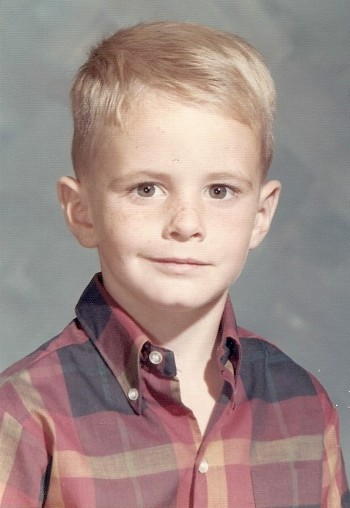 In this original BTB Investigation, we unveil the tragic story of Kirk Murphy, a four-year-old boy who was treated for “cross-gender disturbance” in 1970 by a young grad student by the name of George Rekers. This story is a stark reminder that there are severe and damaging consequences when therapists try to ensure that boys will be boys.
When we first reported on three American anti-gay activists traveling to Kampala for a three-day conference, we had no idea that it would be the first report of a long string of events leading to a proposal to institute the death penalty for LGBT people. But that is exactly what happened. In this report, we review our collection of more than 500 posts to tell the story of one nation’s embrace of hatred toward gay people. This report will be updated continuously as events continue to unfold. Check here for the latest updates.
In 2005, the Southern Poverty Law Center wrote that “[Paul] Cameron’s ‘science’ echoes Nazi Germany.” What the SPLC didn”t know was Cameron doesn’t just “echo” Nazi Germany. He quoted extensively from one of the Final Solution’s architects. This puts his fascination with quarantines, mandatory tattoos, and extermination being a “plausible idea” in a whole new and deeply disturbing light.
On February 10, I attended an all-day “Love Won Out” ex-gay conference in Phoenix, put on by Focus on the Family and Exodus International. In this series of reports, I talk about what I learned there: the people who go to these conferences, the things that they hear, and what this all means for them, their families and for the rest of us.
Prologue: Why I Went To “Love Won Out”
Part 1: What’s Love Got To Do With It?
Part 2: Parents Struggle With “No Exceptions”
Part 3: A Whole New Dialect
Part 4: It Depends On How The Meaning of the Word "Change" Changes
Part 5: A Candid Explanation For "Change"
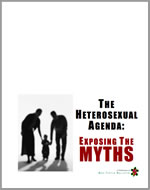 At last, the truth can now be told.
Using the same research methods employed by most anti-gay political pressure groups, we examine the statistics and the case studies that dispel many of the myths about heterosexuality. Download your copy today!
And don‘t miss our companion report, How To Write An Anti-Gay Tract In Fifteen Easy Steps.
 Anti-gay activists often charge that gay men and women pose a threat to children. In this report, we explore the supposed connection between homosexuality and child sexual abuse, the conclusions reached by the most knowledgeable professionals in the field, and how anti-gay activists continue to ignore their findings. This has tremendous consequences, not just for gay men and women, but more importantly for the safety of all our children.
Anti-gay activists often cite the “Dutch Study” to claim that gay unions last only about 1½ years and that the these men have an average of eight additional partners per year outside of their steady relationship. In this report, we will take you step by step into the study to see whether the claims are true.
Tony Perkins’ Family Research Council submitted an Amicus Brief to the Maryland Court of Appeals as that court prepared to consider the issue of gay marriage. We examine just one small section of that brief to reveal the junk science and fraudulent claims of the Family “Research” Council.
 The FBI’s annual Hate Crime Statistics aren’t as complete as they ought to be, and their report for 2004 was no exception. In fact, their most recent report has quite a few glaring holes. Holes big enough for Daniel Fetty to fall through.
“Google” is a trademark of Google Inc.
© Box Turtle Bulletin. All Rights Reserved.
 Posts
Posts  Posts via daily email: