Box Turtle Bulletin
 News and commentary about the anti-gay lobby
“Now you must raise your children up in a world where that union of man and box turtle is on the same legal footing as man and wife…”
News and commentary about the anti-gay lobbyPosts for 2009
June 22nd, 2009
Senator Dodd of Connecticut has adopted a supportive position on marriage equality (NY Times):
Senator Christopher J. Dodd, Democrat of Connecticut, has changed his position on gay marriage, announcing over the weekend that he now supports it.
Mr. Dodd, who finds himself in a tough fight for reelection next year, had already backed civil unions, but had rejected endorsing gay marriage during his campaign for the Democratic presidential nomination in 2008.
His reversal comes on the heels of growing upset among gay activists toward President Obama and his administration, many of whom called the president\’s decision last week to extend partnership benefits extension as a minor move.
It’s interesting that in some places it’s a political liability to oppose marriage equality.
June 22nd, 2009
Although now generally known as “Don’t Ask – Don’t Tell”, the policy on gay servicemen signed into law sixteen years ago once also had a third don’t: “Don’t Pursue”.
Today 77 House Members (15% of the membership), including some in leadership, have requested that the President at least uphold the law as it was intended until DADT can be reversed:
The House lawmakers are asking Obama to direct the military leadership not to initiate any investigation of personnel to determine their sexual orientation and to instruct military officials to disregard any accusations made by third parties with the regard to sexual orientation of personnel.
“We request that you impose that no one is asked and that you ignore, as the law requires, third parties who tell,” the lawmakers, led by Rep. Alcee Hastings (D-Fla.) wrote. “Under your leadership, Congress must then repeal and replace don’t ask, don’t tell with a policy of inclusion and non-discrimination.”
Not exceed the law by aggressively pursuing gay service personnel based on third party gossip? Hmmm, that sounds reasonable.
Let’s see how the President will respond.
This commentary is the opinion of the author and may not necessarily reflect those of other authors at Box Turtle Bulletin.
June 22nd, 2009
Last week, word went out that the Justice Department will meet with LGBT groups to try to iron out how the Justice Department can go forward with future litigation with DOMA without insulting a key group of fellow Americans. I think that has the potential of being a very good move, and I’m glad LGBT advocacy groups are being invited to this working meeting. But we are also learning that the White House plans on inviting LGBT leadership to a cocktail party of some sort later in the week. I can’t think of anything more inappropriate than that.
I think Michelangelo Signorile sums it up just right. I agree that it was important for LGBT leaders to be on hand when President Barack Obama signed the president’s memorandum providing for very limited benefits for gay employees. It was, as Signorile points out, LGBT business, and we expect LGBT leaders to be on hand whenever LGBT business is being conducted. And it’s good that LGBT leaders will be meeting with the Justice Department tomorrow. Again, more business.
But a cocktail party? I can’t imagine that any self-respecting gay person would agree to go to a cocktail party at this stage in our difficult relationship with the current administration, although I have to concede that House and Senate Republicans, even some of the most conservative ones, have taken the White House up on similar invitations.
But still, I think that attending a cocktail party sends two wrong signals. One, serious business like what we’ve gone through over the past week calls for serious and frank meetings. What we need is actual movement on repealing the Defense of Marriage Act, repealing “Don’t Ask, Don’t Tell,” enacting the Employment Non-Discrimination Act, and (this one was supposed to be “easy”) finally enacting the Hate Crimes bill that was supposed to have come out this week but now is more likely before Congress recesses in August, if Sen. Majority Leader Harry Reid can be taken at his word. We’re looking for real movement and a plan forward, not drinks and witty reparté.
And there’s another message that I have trouble squaring. The Human Rights Campaign in particular has labored under criticisms of being too cozy with the Washington power structure, and that those cozy relationships have led the HRC to go easy on pressing for important issues like repealing Don’t Ask, Don’t Tell.” That’s the perception, and it’s one that the HRC may just now be growing sensitive to. This latest flap over the Justice Department’s DOMA brief led the HRC to play catch-up with grassroots anger and suspicion, and they did that by issuing an unusually sternly worded letter to the White House. If the HRC really wants to shed its image of the go-along-to-get-along Washington schmoozing machine, the worst thing they could do would be to take the White House up on this latest invitation.
It looks like, for the time being, our relationship with the Obama administration can be divided into two periods: pre-DOMA brief and post-DOMA brief. In the pre-DOMA brief days, this party would have been seen as a good sign. We would have rejoiced that the White House engaged in this symbolic act, and the HRC would have basked in the glow. But that was before the DOMA brief — and before there were cocktail invitations. That brief changed everything. One way to understand the negative reaction surrounding the presidentail memorandum is that symbolic acts no longer cut it. LGBT leaders need to be cognizant of that or risk their own relevance in the LGBT community.
Update: I’ve changed my mind.
June 22nd, 2009
Early this month we told you of a report by Jason Bellini which claimed that HRC had derailed the repeal of the military’s anti-gay ‘Don’t Ask – Don’t Tell’ policy in favor of fast-tracking the bills which they support. HRC strongly denied the claim.
However, the military paper Stars and Stripes is confirming the claim:
An official with the House Democratic leadership said the House is committed to repealing “don\’t ask” but has agreed with civil rights groups to put new hate crime legislation and a workplace nondiscrimination bill on the legislative calendar before taking up the military issue.
Stars and Stripes also reminds us that legislation is ready to go and just waiting for the President’s support:
The House of Representatives has had a bill to overturn the law pending since March, but no hearings have been scheduled on the measure. Bill sponsor Rep. Ellen Tauscher, D-Calif., collected 147 co-sponsors for the legislation but publicly said she wouldn\’t push for passage without support from the president.
And they raise an interesting observation about the limitations on the new benefits announced by the President last week:
But planned changes don\’t contain any privacy or anonymity guarantees. Edmund Burns, spokesman for the Office of Personnel Management, said everyone applying for benefits is essentially “outing” themselves and their partners.
That means a Defense Department employee with a same-sex partner in the military could run afoul of the “don\’t ask” rules.
Pentagon officials said they are not aware of any plans to adopt special guidelines shielding benefits information from “don\’t ask” investigations.
June 22nd, 2009
It’s been more than a week since Americablog’s John Aravosis posted a copy of the Justice Department’s brief (PDF: 164KB/54 pages) defending the Defense of Marriage Act in the case of Smelt v United States. When I first wrote about Avarosis’ post, I objected to his claim that the brief compares same-sex marriage to incest and pedophilia. He didn’t like that, and made his feelings known in a comment accusing me of being “comfortable” with someone discussing my relationships and ” their mind suddenly goes to someone marrying an underage (legal) child.”
Aravisis also protested, “I never once mentioned pedophilia. I did, however, mention pederasty…” At the time, I suppose he might have had a point. His post didn’t actually use the word “pedophilia.” Instead, his headline screamed that the brief “[i]nvokes incest and marrying children.” That sounded to me an awful lot like pedophilia, but if he meant pederasty, then he was technically correct. But if he really meant pederasty, then why did he and fellow Americablog writer Joe Sudbay subsequently use the word “pedophilia” in just about every major post they have written on the subject since then?
The whole “Incest and pedophilia” meme has now gone viral, spreading around the blogosphere and mainstream media with very few stopping to question whether it’s really true. The line certainly grabs a lot of attention, and Avarosis’ assertion feels true to so many of us who have seen precisely this same comparison made by others throughout our struggle for equality. The claim is an old standby that we’ve seen countless time before.
The problem is, though, that when I read the brief on Friday a week ago, I didn’t see the comparison. But because so many people have taken that ball and run with it, I actually began to question myself and wonder if I really read what I thought I read. Gee, I thought, maybe I was wrong. Maybe I just missed it.
I’m a strong believer in going directly to the source material myself rather than relying on someone else’s word for it. That is, after all, the whole rationale behind this blog. So I went back and read the brief again, and I encourage you to do the same. First, download the brief (PDF: 164KB/54 pages). Go to page 1 of the brief (the eleventh page of the PDF document), and you will find this summary of what this case is all about:
This case does not call upon the Court to pass judgment, however, on the legal or moral right of same-sex couples, such as plaintiffs here, to be married. Plaintiffs are married, and their challenge to the federal Defense of Marriage Act (“DOMA”) poses a different set of questions: whether by virtue of their marital status they are constitutionally entitled to acknowledgment of their union by States that do not recognize same-sex marriage, and whether they are similarly entitled to certain federal benefits. Under the law binding on this Court, the answer to these questions must be no.
In other words, there are two questions before the court, and each question relates to one of two specific sections of the Defense of Marriage Act::
John Avarosis’ “incest and pedophilia” meme comes from the portion of the brief which was trying to answer the first question. Plaintiffs argue that DOMA’s Section 2 violates the “Full Faith and Credit” clause of the U.S. Constitution, the clause that requires states to recognize contracts entered into in other states. The DOJ argues on page 17 of the brief that there are already exceptions to that clause in contracts under certain circumstances, and that this exception already applies to marriages as well. Now read pages 17 and 18 (27th and 28th page of the PDF document) very carefully, especially this first paragraph:
The courts have followed this principle, moreover, in relation to the validity of marriages performed in other States. Both the First and Second Restatements of Conflict of Laws recognize that State courts may refuse to give effect to a marriage, or to certain incidents of a marriage, that contravene the forum State’s policy. See Restatement (First) of Conflict of Laws § 134; Restatement (Second) of Conflict of Laws § 284.5 And the courts have widely held that certain marriages performed elsewhere need not be given effect, because they conflicted with the public policy of the forum. See, e.g., Catalano v. Catalano, 170 A.2d 726, 728-29 (Conn. 1961) (marriage of uncle to niece, “though valid in Italy under its laws, was not valid in Connecticut because it contravened the public policy of th[at] state”); Wilkins v. Zelichowski, 140 A.2d 65, 67-68 (N.J. 1958) (marriage of 16-year-old female held invalid in New Jersey, regardless of validity in Indiana where performed, in light of N.J. policy reflected in statute permitting adult female to secure annulment of her underage marriage); In re Mortenson’s Estate, 316 P.2d 1106 (Ariz. 1957) (marriage of first cousins held invalid in Arizona, though lawfully performed in New Mexico, given Arizona policy reflected in statute declaring such marriages “prohibited and void”).
Accordingly, Section 2 of DOMA hews to long-established principles in relation to the recognition of marriages performed in other States, and ensures that States may continue to rely on their own public policies to reject (or accept) requests to recognize same-sex marriages. The fact that States have long had the authority to decline to give effect to marriages performed in other States based on the forum State’s public policy strongly supports the constitutionality of Congress’s exercise of its authority in DOMA. Surely the Full Faith and Credit Clause cannot be read, in light of these established principles, to preclude a State from applying its own definition of marriage in situations involving same-sex couples, married elsewhere, who are domiciled within its own borders. That Clause clearly does not mandate such interference with “long established and still subsisting choice-of-law practices.” Sun Oil Co., 486 U.S. at 728-29.
Okay, did anyone happen to catch the sentence which says that same-sex marriage is the same as incest and pedophilia? Me neither. But John Aravosis thinks the whole first paragraph did exactly that. But pay very close attention to what this section is saying — and more importantly, what it is not saying.
The brief recognizes that different states have long had different laws regulating who can get married and who cannot. And because states already regulate marriages differently from one state to another, they are (according to the DOJ anyway) free to determine whether a marriage in one state is legal in another. And what are some of those differences? Kinship and age of consent. Let’s dive in.
Comparison to Incest?
Many states allow marriage between first cousins (New Mexico is cited in this brief), while others do not. Those that do, do not consider such marriages to be incest — it’s not in New Mexico. And in the case of Arizona, which the DOJ cites as a state that does not allow first cousins to marry, there is an exception: first cousins are allowed to marry in Arizona, as long as both are sixty-five years old or older, or if they can prove that one of them cannot reproduce. So even in Arizona, the prohibition has nothing to do with incest. If marriage between first cousins were incest, how would it magically stop being incest once both partners turn 65 or one partner become infertile?
Different jurisdictions have many different limits on kinship, and many have even provided exceptions to those limits. The DOJ brief says that very Catholic and socially-conservative Italy allows uncles to marry nieces. This is a new one on me, but if it’s true, then it means that Italy does not consider this to be incest. But guess what? Minnesota might be willing to consider uncle-niece marriages to be kosher as well. That state prohibits marriage between uncles and nieces, as well as between first cousins, “except as to marriages permitted by the established customs of aboriginal cultures.” So Caucasian nieces marrying their uncle is incestuous but Indians not? Of course not. But it does mean that if an Italian uncle-neice couple were to move to Minnesota and successfully claim to be from an “aboriginal culture” (i.e. “characteristic of or relating to people inhabiting a region from the beginning”), then their would be perfectly acceptable in Minnesota. Minnesota would not see it as incestuous.
And if Italian couples can’t claim to be aboriginal for Minnesota’s purposes, then Rhode Island can provide safe haven for at least a few of those Italian couples. That state has a similar religious exception for Jews.
But none of this has anything to do with incest. Many states have different definitions for incest verses definitions for who can marry based on kinship. Rhode Island, with its many kinship prohibitions against marriage for its non-religious Jewish residents, has nevertheless repealed its incest law in 1989. In other words, there is legally no such thing as incest in Rhode Island. New Jersey doesn’t apply any penalties for incest if both parties are over the age of 18, but they do have all sorts of restrictions on marriage regardless of age. Kentucky prohibits first cousins from marrying, but that’s not because those unions would be prosecuted under Kentucky’s incest law. That law only defines incest as sex with “an ancestor, descendant, brother, or sister” By the way, if you asked most ordinary people on the street for a definition for incest, that is probably the definition they would most likely come up with. Not the convoluted, inconsistent definitions for allowable kinships our states have come up with.
These statutes are as much about what states allow as they are about what states prohibit. Citing a litany of the many differences in the degrees kinships that states allow is not the same as invoking incest. The DOJ brief simply makes no such comparison, nor does it declare any sort of “equivalency.” It merely states, very briefly and not very completely, what the situation is right now in terms of allowable kinship.
Comparison to Pedophilia?
Age is another common restriction placed on marriage, and there are similarly wide variations on how different jurisdictions define age of consent for marriage. Most set that age of consent at 18, although you have to wait until you’re 21 to marry in Puerto Rico without parental consent. So does that mean that a Puerto Rican groom marrying a 20-year-old Puerto Rican bride in the state of New Jersey is engaging in pedophilia? Of course not. But that’s the standard you’d have to set if you wanted to claim that this brief compares same-sex marriage to incest.
What’s more, all jurisdictions allow exceptions with parental consent, with many going as low as 15 years of age. A few states allow even younger ages to marry under certain circumstances, and none of this is considered pedophilia either. California, for example, has no lower limit as long as a court goes along with it. And yet, back in Puerto Rico, if you’re a man you can’t get married if you’re under 18 even if you do have your parents’ blessing (for women, the age drops to 16 with parental consent; all bets are off if the woman is pregnant.)
Want more proof that this has little to do with pedophilia? How about this: states often set the age of consent for marriage very differently from their age of consent for sex. Where most states set the age of consent for marriage at 18, the age of sexual consent is most commonly set at 16 years if age.
And many provide for even lower ages of consent for sexual activity when the two partners are close in age. In Alaska, that age can go as low as 13 under certain circumstances. Same with Connecticut, Michigan, Minnesota, New Hampshire, New Jersey, New Mexico, North Carolina, Pennsylvania, South Dakota. In Arkansas, Louisiana and Nebraska, that limit can even go as low as the age of 12. Some states appear to have no such lower limit when the two partners are within a few years of each other (Maryland and New York, for example). But no matter how much perfectly legal, non-pedophilic sex those exceptionally young lovers may be having, they can’t get married under those states’ marriage laws.
Still not convinced that this isn’t about pedophilia? Well then how about this: in every one of those states which provide exemptions to their age of sexual consent when the two sex partners’ ages are close to each other, those exemptions completely disappear under those same states’ age of marital consent statutes. The purpose for setting an age of consent for marriage has less to do with statutory rape or pedophilia, and more to do with trying to keep young adults or teenagers from rushing into marriage when both are very young — a much more common situation than that of old geezers trying to legally take advantage of children.
No comparison
Most states right now regulate marriages according to three criteria: age, kinship and gender. It’s not “equating” same-sex marriages with incest and pedophilia to simply point out that these are, right now, the three primary areas of regulation. Furthermore, pointing out the many ways in which states define allowable kinships in marriage is not “equating” same-sex marriage with incest. And describing all the ways in which different states allow people of different ages to marry is not “equating” same-sex marriage with pedophilia.
But that is all that the DOJ brief did, and as far as this particular topic is concerned, the brief stopped there. It simply described the state of the law as it is right now. Whether it is an acceptable state of the law (the DOJ apparently thinks so) or not (and I most definitely do not think it’s acceptable where same-sex marriage is concerned) is a completely different matter.
(And by the way, in case there is any confusion, I strongly disagree with the DOJ when they claim, for example, that marriages between first cousins go unrecognized in many states. They cited the case of New Mexico allowing first cousins to marry but Arizona prohibiting it. But I know for a fact that if first cousins marry in New Mexico and move to Arizona, the Arizona Department of Revenue isn’t going to bring them up on charges of perjury if they checked the “married” box on state tax returns. States do, by default and as a matter of course, recognize marriages from other states even when those marriages would not be legal in their own states. Only same-sex marriages are singled out for special scrutiny and treatment.)
Offensive Nevertheless
Okay, so the brief doesn’t say same-sex marriage is equivalent to incest or pedophilia. Big deal. It’s still patently contemptuous of gays and lesbians even without that. For one, the DOJ lawyers seem to think that gay people, deep down, don’t really exist. How else can one explain this (page 27)?
Even viewing the right asserted here as the right of gay and lesbian couples to marry, DOMA does not directly or substantially interfere with the ability of anyone, including homosexuals, to marry the individual of his or her choice. …Hence, under DOMA, gay and lesbian couples suffer no greater interference with their ability to obtain recognition of their marriages, either in the States where they were wed, or elsewhere.
That could only be true under one condition: that homosexuals can “marry the individual of his or her choice” as long as that individual is of the opposite sex. In other words, just because I’m gay, it doesn’t mean I can’t settle down with a nice Catholic girl (or a nice religious Jewish niece if I lived in Rhode Island) and have that marriage go unchallenged virtually everywhere I go. That sort of argument is precisely the stuff we’ve heard from some of our more unhinged anti-gay opponents.
And then there’s this bit of creative “logic” on page 27-28:
…gay and lesbian individuals who unite in matrimony are denied no federal benefits to which they were entitled prior to their marriage; they remain eligible for every benefit they enjoyed beforehand. DOMA simply provides, in effect, that as a result of their same-sex marriage they will not become eligible for the set of benefits that Congress has reserved exclusively to those who are related by the bonds of heterosexual marriage.
Got that? We’re not denied anything, we’re just not allowed the extra stuff (and obligations) that heterosexual couples get when they’re married. In the eyes of the Justice Department, that’s not discrimination. Maybe women who are denied promotions aren’t discriminated against because they still have a job; they just don’t get the extra pay and perks the employer gave to a lesser-qualified man.
But even if it is discrimination, that’s okay too, according to the Department of Justice (page 2):
Thus, by defining “marriage” and “spouse” as the legal union of a man and a woman and affording federal benefits on that basis, Section 3 of DOMA simply maintained the status quo: it continues the longstanding federal policy of affording federal benefits and privileges on the basis of a centuries-old form of marriage, without committing the federal government to devote scarce resources to newer versions of the institution that any State may choose to recognize.
That’s right. Congress can choose to deny its “scarce resources” to a very tiny proportion of married couples just because it wants to. Never mind that those same married couples pay taxes just like everyone else.
It doesn’t end there. There’s so much more in this brief that’s risible, like the continual reference to a “new form of marriage,” a phrase that may as well place scare-quotes around the word “marriage” when referring to same-sex couples. And to add insult to injury, the brief then contrasts that “new form of marriage” to what it calls “traditional marriage,” which, inexplicably, is likely meant to preclude the traditional and biblical examples of brother-sister marriages, non-consensual marriages and plural marriages, although it doesn’t explicitly say so.
This brief’s contemptuous tone is breathtaking. LGBT advocates are right to denounce it and to encourage very direct and vigorous avenues of protest to make our anger known. I’m glad to see the LGBT community call Obama and the Democratic Party on the carpet for this, and I hope that many more join them.
It’s Important To Speak The Truth
I started this web site because I wanted to expose our opponents when they distort the written record. That is the driving force behind so much of what we do here at BTB. But if I see similar examples among our own advocates — including those advocates who do wonderful work otherwise — how can I remain silent?
This definitely isn’t the pathway to mega-blogger status. I’m probably going to be called self-loathing, an appeaser, an Uncle Tom or an Obama apologist — you name it. Or, just as likely, this post may be ignored. But that’s okay. I’d much rather speak the truth than repeat talking points intended solely to inflame. The “incest and pedophilia” meme is the latter, not the former, and it’s been seriously bugging me all week. There are plenty of reasons to be outraged by this DOJ brief, but no matter how you slice it, it just doesn’t say what many of our leading advocates claim it does.
I like John Aravosis a lot. He has been unparalleled in covering the ongoing developments surrounding the Obama administration’s reactions to the outrage this brief has generated. No one else has stayed on top of this story the way he has.
But it was Karl Rove who perfected the art of manufactured outrage, and it reflects poorly on us when we deploy the same tactic. If there’s anything we should have learned from the Bush administration, it’s that such behavior will weaken our position, not strengthen it. It’s time we gave it a rest and be outraged over what’s really there.
June 21st, 2009
 Occasionally I’m amused at the disconnect between an article and its headline.
Today the Albany Times-Union has an article about the New York State Bar Association, the statewide organization of attorneys. The lawyer group has endorsed gay marriage as the “only viable way to establish marriage equality.”
The headline reads:
Bar group backs gay marriage right
Although, based on some attorneys I’ve met, they may not be that far off.
June 19th, 2009
White House Press Secretary Robert Gibbs seems unusually prepared today when LGBT issues came up during the press conference. This is very different from previous press conferences. They really are worried.
http://www.youtube.com/watch?v=sD_Z3semeKgJune 19th, 2009
LGBT advocates have continued to express their outrage over the Justice Department’s DOMA brief. That brief has sparked a rebellion among LGBT Democrats who have continued to pull out of next week’s DNC fundraiser organized by the LGBT Leadership Conference and featuring Vice-president Joe Biden. Eleven LGBT leaders have announced that they will not attend the fundraising event. Even the Stonewall Democrats have withdrawn their support.
That has set the White House on a mad rush to try to quell the rebellion. Two top Obama aides, Deputy Chief of Staff Jim Messina and Political Director Patrick Gaspard, will hold an emergency conference call on Monday afternoon with the LGBT caucus of the Democratic National Committee (DNC). The reported purpose of the call is to provide “important updates on the Administration’s LGBT agenda and how we move forward.” That move is in addition to news from earlier today that the Justice Department will meet with LGBT groups to discuss how it deals with DOMA cases going forward.
This follows President Barack Obama’s hastily called Oval Office photo-op on Wednesday to sign a Presidential Memorandum directing federal agencies to adopt policies to treat their LGBT employees on equal footing with their other employees — although health and retirement benefits aren’t included because they are barred by federal law. The White House has also directed the Census Bureau to determine changes in its procedures to allow same-sex unions to be counted.
The White House has finally gotten the message that they have stumbled badly. After months of silence and footdragging on LGBT issues, they have now come to understand that they are on the verge of losing one of their most reliable constituencies. And so over the past three days, we’ve seen an unprecedented string of minor initiatives. None of these small steps are earth-shattering; all of them could have been thrown together at any time in the administration’s first 100 days. But the fact that they are coming out now tells us that the pressure exerted by the LGBT community this week has had an effect. It also tells us that only through continued unrelenting pressure will the White House and Congress to take our concerns seriously.
I’m glad the pressure is working and we appear to have the White House’s attention. We now need to grab Congress’s attention as well. We need to make House Speaker Nancy Pelosi and Senate Majority Leader Harry Reid to feel the same heat as we’ve applied to President Obama.
And we also need to put our money where it will really make a difference. Right now the best place is firmly in our own bank accounts and not in the DNC’s. They say money talks, but people really notice the silence when it’s gone missing.
June 19th, 2009
From Reuters
Lost in the 2009 election wreckage for gays was the marriage campaign’s relative success in Asian communities, which have swung toward support of same-sex marriage at a faster rate than the rest of California and have become a model for other groups.
Asian Americans have been building grass-roots support in Chinatown, Little Tokyo, Filipinotown for four years. Gays, lesbians and straight allies have talked about the often-taboo topic of homosexuality, set up booths at festivals, harangued non-English language media to change coverage and lobbied elected officials for support.
How did that work for them?
polls of Asians by the Asian Pacific American Legal Center showed a 36 point margin of victory for the ban in 2000, falling to 6 points in 2008. The decline in support [for banning gay marriage] was clearly faster than in the state overall, the center said.
Perhaps there are lessons to be learned.
June 19th, 2009
A new LA Times poll shows that support for marriage equality differs in Los Angeles by race:
White voters were most emphatic in their support for same-sex marriage, with 68% supporting it and 27% opposing. African American voters were strongly against it, with 54% opposing same-sex marriage and 37% supporting it.
Opposition to gay marriage by African Americans was widely seen as a major factor contributing to the passage of Proposition 8. Latinos in the current poll were split, with 45% supporting same-sex marriage and 46% opposing.
June 19th, 2009
In the wake of the nationwide anger being expressed over the Justice Department’s insulting court brief defending the so-called “Defense of Marriage Act,” the Obama administration has begun to react with some very limited, short term steps to try to assuage that anger. On Wednesday, President Barack Obama signed a Presidential Memorandum directing federal agencies to adopt policies to treat their LGBT employees on equal footing with their other employees. (That memorandum, however, doesn’t include key employment benefits like health care or retirement, which are prohibited by federal law.) The White House has also directed the Census Bureau to determine changes in its procedures to allow same-sex unions to be counted.
Both steps however are very tiny steps, and they have done little to quell the outrage over the DOJ’s brief. That anger continues to threaten the Democratic National Committee’s LGBT fundraiser slated for next week.
Now The Plum Line blog is reporting that the Justice Department has scheduled a private meeting with major LGBT groups for next week:
Tracy Russo, a spokesperson for Justice, confirmed the meeting to me, after I posted below that top gay rights lawyers were miffed that administration lawyers had rebuffed their requests to meet and discuss ongoing litigation involving DOMA.
At the meeting — which hasn\’t been announced and is expected to include leading gay rights groups like GLAD and Lambda Legal — both sides are expected to hash out how to proceed with pending DOMA cases.
The Justice Department is due to file another brief by June 29 in a lawsuit filed by Gay and Lesbian Advocates and Defenders in Boston\’s Federal District Court on behalf of eight married couples and three surviving spouses from Massachusetts who have been denied federal legal protections available to spouses. That DOMA challenge, Gill v. Office of Personel Management is considered a much stronger suit than Smelt v. United States, which the recent controversial DOJ brief addressed.
I don’t know whether LGBT groups would be permitted to weigh in on Gill v. OPM specifically. But if this meeting really does happen, it does appear to be a sign that the Justice Department may try to head off the kind of missteps it made with its Smelt v. US filing.
And if that’s the case, then it appears that the Obama Administration may have begun to recover its sense of hearing. But the only lesson I think we can safely draw from all of this is to keep shouting.
June 19th, 2009
Now we’re up to eleven. Mary Bonauto, the Civil Rights Project Director of Gay and Lesbian Advocates and Defenders (GLAD), has announced that she will not be attending the Democratic fundraiser next week:
It would be counterproductive at this point for me to attend the dinner. I see and understand the anger of many in the community. At GLAD, we’re angry, too. We’re angry because we see and live and feel the discrimination every day. Many states and our national government enforce existing anti-gay laws or simply fail to see discrimination against lgbt people as both personally devastating and a stain on our nation’s commitment to equal justice under law
Bonauto was lead counsel in Goodridge v. Dept. of Public Health, which resulted in the Massachusetts Supreme Judicial Court declaring that prohibiting civil marriage for same-sex couples is unconstitutional. Bonauto joins ten others who have publicly announced that they will not attend the event.
June 19th, 2009
If we believe our politicians, health care is broken in America and the Federal Government is the only one who can fix it. Our President is so concerned about implementing healthcare reform that he can\’t spare a moment to work on equality for gays and lesbians.
However, a more cynical observation may be that for gay and lesbian Americans, the Federal Government is the problem rather than the solution to our immediate health care concerns. And before we focus on the controversial and highly combative effort to overhaul the country\’s methods of providing health care, let\’s at least make sure the rules are applied fairly and equally.
Here are four things that the administration could work with Congress to make health care more affordable for gay people… should they want to.
Pass the Domestic Partners Benefits and Obligations Act.
This tax based solely on sexual orientation is probably unconstitutional, is definitely immoral, and is entire unjustifiable.
The President can try to sell us on his medical overhaul based on its merits, benefits and costs. But I\’ll not be impressed in the slightest if it does not correct the inequities that the government has set up to unfairly deny health care rights to gay Americans and to unfairly tax them on the ones they do get.
June 18th, 2009
 Oh, dear. Sen. John Ensign’s (R-NV) mistress scandal is taking some very interesting turns. When he first revealed that he had cheated on his wife, he said that he was coming forward because his former mistress and employee, Cynthia Hampton, was threatening to blackmail him. Then he said no, it wasn’t her, it was her husband and former Ensign staffer, Doug Hampton, who was doing the blackmailing.
The problem of course, is that extortion is a federal crime, and one would expect the authorities to launch into a full-scale investigation. But Talking Points Memo learned that neither the FBI nor local police are investigating any such reports. Ensign is now backing down from all of that talk about blackmail.
But now the Associated press found some very interesting tidbits. Like the fact that Ensign placed the Hampton’s 19-year-old son on the payroll, or that Doug Hampton received a final payment of $19,679 for his final month of employment in May 2008. And then there’s this point about Cynthia Hampton’s salary:
Her salary also doubled at Ensign’s campaign committee, where she was treasurer, beginning around the time the affair began. It went from $500 a month to $1,000 a month.
Everyone seems to think it odd that Hampton’s salary would double “around the time the affair began.” But when you think about it, of course her salery went up. I mean, c’mon think about it. She took on more responsibilities…
June 18th, 2009
From the Wall Street Journal
The White House said Thursday it was seeking ways to include same-sex marriages, unions and partnerships in 2010 Census data, the second time in a week the administration has signaled a policy change of interest to the gay community.
The administration has directed the Census Bureau to determine changes needed in tabulation software to allow for same-sex marriage data to be released early in 2011 with other detailed demographic information from the decennial count. The bureau historically hasn’t released same-sex marriage data.
Featured Reports
 In this original BTB Investigation, we unveil the tragic story of Kirk Murphy, a four-year-old boy who was treated for “cross-gender disturbance” in 1970 by a young grad student by the name of George Rekers. This story is a stark reminder that there are severe and damaging consequences when therapists try to ensure that boys will be boys.
When we first reported on three American anti-gay activists traveling to Kampala for a three-day conference, we had no idea that it would be the first report of a long string of events leading to a proposal to institute the death penalty for LGBT people. But that is exactly what happened. In this report, we review our collection of more than 500 posts to tell the story of one nation’s embrace of hatred toward gay people. This report will be updated continuously as events continue to unfold. Check here for the latest updates.
In 2005, the Southern Poverty Law Center wrote that “[Paul] Cameron’s ‘science’ echoes Nazi Germany.” What the SPLC didn”t know was Cameron doesn’t just “echo” Nazi Germany. He quoted extensively from one of the Final Solution’s architects. This puts his fascination with quarantines, mandatory tattoos, and extermination being a “plausible idea” in a whole new and deeply disturbing light.
On February 10, I attended an all-day “Love Won Out” ex-gay conference in Phoenix, put on by Focus on the Family and Exodus International. In this series of reports, I talk about what I learned there: the people who go to these conferences, the things that they hear, and what this all means for them, their families and for the rest of us.
Prologue: Why I Went To “Love Won Out”
Part 1: What’s Love Got To Do With It?
Part 2: Parents Struggle With “No Exceptions”
Part 3: A Whole New Dialect
Part 4: It Depends On How The Meaning of the Word "Change" Changes
Part 5: A Candid Explanation For "Change"
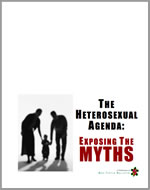 At last, the truth can now be told.
Using the same research methods employed by most anti-gay political pressure groups, we examine the statistics and the case studies that dispel many of the myths about heterosexuality. Download your copy today!
And don‘t miss our companion report, How To Write An Anti-Gay Tract In Fifteen Easy Steps.
 Anti-gay activists often charge that gay men and women pose a threat to children. In this report, we explore the supposed connection between homosexuality and child sexual abuse, the conclusions reached by the most knowledgeable professionals in the field, and how anti-gay activists continue to ignore their findings. This has tremendous consequences, not just for gay men and women, but more importantly for the safety of all our children.
Anti-gay activists often cite the “Dutch Study” to claim that gay unions last only about 1½ years and that the these men have an average of eight additional partners per year outside of their steady relationship. In this report, we will take you step by step into the study to see whether the claims are true.
Tony Perkins’ Family Research Council submitted an Amicus Brief to the Maryland Court of Appeals as that court prepared to consider the issue of gay marriage. We examine just one small section of that brief to reveal the junk science and fraudulent claims of the Family “Research” Council.
 The FBI’s annual Hate Crime Statistics aren’t as complete as they ought to be, and their report for 2004 was no exception. In fact, their most recent report has quite a few glaring holes. Holes big enough for Daniel Fetty to fall through.
“Google” is a trademark of Google Inc.
© Box Turtle Bulletin. All Rights Reserved.
 Posts
Posts  Posts via daily email: