Box Turtle Bulletin
 News and commentary about the anti-gay lobby
“Now you must raise your children up in a world where that union of man and box turtle is on the same legal footing as man and wife…”
News and commentary about the anti-gay lobbyPosts Tagged As: Daily Agenda
March 22nd, 2012
TODAY’S AGENDA:
Celebrations This Weekend: Black Party Expo, New York, NY.
AIDS Walks This Weekend: South Dallas, TX; Vincennes, IN.
TODAY IN HISTORY:
Suspensions Announced of Allegedly Gay Teachers in Florida: 1961. Pinellas County School Superintendent Floyd T. Christian confirmed that five Pinellas County teachers had been suspended for “alleged homosexual practices” at a school board meeting. The action came after accusations against the teachers were lodged by a state Legislative Investigative Committee which had been formed in 1956 to root out communists from government but switched its focus to look for gays among teachers and university professors. Superintendent Christian said that following the accusations from the state, the teachers were suspended last October “with the full knowledge and approval of the board.” The matter was referred to the state’s Cabinet Board of Education in Tallahassee for a decision on whether to revoke their teaching certificates. The state board revoked the certificates of three of the teachers, but that decision was overturned by the State Supreme Court in 1962, saying the state board didn’t follow proper procedures. The three teachers’ certificates were finally restored in 1963.
Montana Senate Requires Convicted Gays To Register With Police: 1995. In a 41-8 vote, the Montana Senate gave its approval to a bill that would require offenders of the state’s anti-homosexuality law (which prohibited “deviate sexual conduct”) to register for life with local law enforcement officials. The provision was a last minute amendment to a bill requiring registration for those convicted of murder, rape, aggravated assault, incest, sexual assault, and indecent exposure. During the debate, Sen. Al Bishop (R-Billings) said that homosexual acts, even consensual acts between adults, were “even worse than a violent sexual act,” a statement that drew outrage among women’s rape crisis advocates. Gay rights advocates quickly organized rallies in Helena, Billings and Missoula, and the entire state became the target of national scorn. By noon the next day, red-faced lawmakers were in full retreat mode, repealing the provision specifying “deviate sexual conduct” from the bill that they had just passed the day before in a unanimous voice vote with no debate.
If you know of something that belongs on the agenda, please send it here. Don’t forget to include the basics: who, what, when, where, and URL (if available).
This your open thread for the day. What’s happening in your world?
March 21st, 2012
TODAY’S AGENDA:
New Hampshire House to Vote on Marriage Repeal: Concord, NH. The New Hampshire House of Representatives plan to vote today on a bill to repeal marriage equality. The vote is expected to pass the House, which the GOP holds with a veto-proof majority. The only question is whether they will have to votes to override a promised veto from Democratic Governor John Lynch.
TODAY’S BIRTHDAY:
 Vadim Alekseevich Kozin: 1903. The great Russian tenor Vadim Alekseevich Kozin was celebrated throughout the Soviet Union in the 1920s for his recordings and concerts specializing in gypsy romances and love songs. He sang those songs, which he wrote himself, with such passion and tenderness that garnered him the title of the “Russian Orpheus.” He once gave a concert with American Paul Robeson and is said to have performed for Winston Churchill, Franklin Delano Roosevelt and Joseph Stalin at the Tehran conference in 1943. But in those precarious days during Stalin’s rule, Kozin fell out of favor with the Kremlin and was arrested in 1944. He was sent to a prison camp near Magadan in the Russian Far East for five years for political offenses, “corruption of youth” and homosexuality. From that moment on, his songs disappeared from the radio and his public concerts came to an end.

After his release in 1950, Vadim resumed performing in local theaters in the Russian Far East and Siberia, but he was prohibited from performing in Moscow and Leningrad. It was during this period when Vadim began to keep a diary. “How I would like even just once,” he wrote of one unnamed man in 1956, “even for one instant, to look into the depth of those green eyes. Why does it happen like this? One person appears, and there is nothing else sacred in the world. He has filled it all himself. Who that person is, no one will ever find out.”
Kozin also used his diary to express his impatience with the official attitude toward homosexuality. “There is nothing unnatural in the life I want to live,” he wrote. “There is real, good friendship and complete mutual trust.” In another entry, he criticized actors with their “demonstration of fictional family values” and waving of party cards. “Do I have the moral right, with my defects, to see them that way? After torturous and long thought, I have realized that I do. They are much more rotten people.”
But Kozin worried that he risked further imprisonment. In another entry, he was alarmed by another actor while on tour. “His behavior will lead him to the camp. I must tell him that his sexual motives shouldn’t affect me at all. … I don’t want people to think about me like that again. I will try to suffer alone.”
 Kozin’s fears were well-founded. He was arrested again in 1959 for homosexuality and was forced to write a humiliatingly detailed confession. Despite a brief revival in the 1980’s when his records were reissued, he was never officially rehabilitated. He died in Madagan in 1994 at the age of 91. Since his death, Vadim Kozin has become an icon in Russia’s gay community. One of his most famous songs is one called “Friendship” which, he later confided to a friend, was dedicated to another man:
“We are so close that words do not have to be repeated. Our tenderness and our friendship are stronger than passion and greater than love.”
Vadim Kozin with friends in Madagan in 1993:
If you know of something that belongs on the agenda, please send it here. Don’t forget to include the basics: who, what, when, where, and URL (if available).
This your open thread for the day. What’s happening in your world?
March 20th, 2012
TODAY’S AGENDA:
March To Protest Anti-LGBT Violence: Washington, D.C. There has been a terrible spate of shootings of transgender and gay people in the nation’s capital over the past year. The most recent shooting was of a 31-year-old gay man at an IHOP in the Columbia Heights neighborhood on March 11. He suffered a bullet wound to the liver. In the same 24-hour period, another gay man and transgender woman were badly beaten in separate incidents. Both men are still in the hospital, while the woman was treated and released. A march has been called to protest the rise of anti-LGBT violence in the city. It will begin at 7:00 p.m. this evening outside the IHOP at 14th and Irving Streets, N.W., and will go east on Irving to Georgia Avenue, N.W., then to Morton Street, and then back to 14th St., where it will head south to R St, N.W. From there it will turn right on R St. and travel to 17th Street and end at the gay bar Cobalt. (I hope locals will understand all that.)
TODAY IN HISTORY:
Florida Supreme Court: Gays Can’t Be Barred From State Bar: 1978. In 1976, Robert F. Eimers, a recent graduate of the Hastings College of Law in San Francisco, had already been certified for admission to the Pennsylvania bar when he moved to Florida and took the exam for the Florida bar. He passed, but the Florida Board of Bar Examiners found that he might fail to meet the “good moral character” standard for admission because, in response to a question at a hearing, Eimers said that he was gay. The twelve member board deadlocked on whether to admit him and referred the matter to the Florida Supreme Court. On March 20, the Supreme Court ruled in a 6-1 decision that a “substantial connection” between private behavior and the ability to carry out professional responsibilities would be required to bar Eimers from practicing law, and his homosexuality did not rise to that level. “Otherwise, the bar will be virtually unfettered in its power to censor the private morals of Florida bar members, regardless of any nexus between the behavior and the ability to responsibly perform as an attorney.”
Well, that’s our gay history for the day, and usually this is where such stories end. But as I was looking around the web for more information on Eimers, I discovered that while Florida’s Supreme Court was correct in ruling that a gay man cannot be prohibited from practicing law because of his “private morals,” that same that same court court would wind up disbarring Eimers nine years later because of his public morals. In 1982 Eimers, his law partner (who was not licensed to practice law) and husband-and-wife clients Daniel and Sally Phelps, were the subjects of an undercover sting involving money laundering and prostitution. In November 1982, they were all charged with two counts of money laundering, and the Phelps’s, in addition, were charged with three counts associated with the prostitution ring. After their arrest and indictment, they were all released on bail. The Phelps and Eimers were tried and convicted in June, 1983, but Eimers’s conviction was in absentia due to his becoming a fugitive in March. Eimers was sentenced to ten years and fined $100,000. In 1987, the Florida Supreme Court officially disbarred him (PDF: 176KB/6 pages) because of his felony conviction and allegations that he had misappropriated funds from three of his clients. I can’t find any record of his having served his sentence, but in 1993 the Pennsylvania Supreme Court also ordered his disablement in that state as well. He apparently died in 1998 at the age of 51.
And that, as they say, is the rest of the story.
If you know of something that belongs on the agenda, please send it here. Don’t forget to include the basics: who, what, when, where, and URL (if available).
This your open thread for the day. What’s happening in your world?
March 19th, 2012
TODAY IN HISTORY:
Africans Identified As AIDS Risk Group: 1983. As we’ve mentioned before, by the time 1983 came around the panic surrounding the emerging HIV/AIDS crisis had already reached epic proportions, with anti-gay groups and individuals pinning everlasting blame on the gay community. When they had bothered to notice, some would acknowledge that Haitians, drug addicts and hemophiliacs were also at risk for AIDS. But it was the gay community which bore the brunt of the responsibility for the new “plague.”
If ignorance among many Americans was running a fevered pitch, things were very different in Europe, particularly in Belgium and France where doctors had been noticing a strange development for quite some time. For several years, they had been treating wealthy Africans from their former colonies who were suffering from diseases which were remarkably similar to those reported by AIDS patients in America. While AIDS was also showing up in gay communities in Europe, it was these African patients which signaled to European specialists that AIDs was neither a homosexual nor western disease. Finally on March 19, 1983, the rest of the world would learn what they have been noticing with the publication of this brief letter by Dr. NAthan Clumeck of the Université Libre de Bruxelles in the respected journal The Lancet:
Acquired Immune Deficiency Syndrome in Black Africans
SIR,-Acquired immune deficiency syndrome (AIDS) has been described in homosexual or bisexual men, in drug addicts, in haemophiliacs, and in Haitian immigrants. To our knowledge there is no report of AIDS and opportunistic infections in previously healthy Black Africans with no history of homosexuality or drug abuse.
Tables I and II show the clinical and immunological data on five Black patients seen in Brussels and who were from Central Africa (Zaire and Chad). Three of them had been living in Belgium, for between 8 months and 3 years. All were of good socioeconomic status. They presented with prodromes of fever, weight loss, and generalised lymphadenopathy, and extensive investigations did not reveal any neoplasia. Patients A and E died; the three survivors are still ill.
Because the HIV virus had not been discovered yet, there was no test for it. Doctors had to rely on a process of elimination to determine whether the patient really had AIDS:
These patients fulfilled all the criteria of AIDS. Two of them had severe herpes simplex infections and to exclude the possible role of herpes virus in their immune deficiency we did lymphocyte subset analyses in a control group of eight patients with HSV-2 infections. None had OKT4+ deficiency and their OKT4/OKT8 ratios were between 0.99 and 2.52 (mean 1.80), so it is unlikely that HSV-2 alone was responsible for the AIDS in the African patients.
Responses to mitogen stimulation (phytohaemagglutinin, concanavalin A, pokeweed) were well below normal in all cases. In eleven healthy Black Africans reactions to intradermal tuberculin, candida, and streptodornase were >5 mm: all five patients were skin test negative to these antigens.
This preliminary report suggests that Black Africans, immigrants or not, may be another group predisposed to AIDS.
This small letter to the editor would later prove to be an important first indication of the horror that had been stalking the Congo river region for decades. Clumeck and his colleagues would follow up that letter with a larger study a year later published in the New England Journal of Medicine. That study presented detailed data on 23 Africans treated for AIDS as far back as May, 1979. That would be a full two years before the CDC reported on the five gay patients in Los Angeles (See June 5). Eighteen of the patients treated in Brussels were from Zaire (now the Democratic Republic of Congo), one from Chad, two from Rwanda, and two from Burundi. By then, ten had died. On further investigation, researchers found that the husband of one patient had died in 1976 in Belgium at the age of 27 from diseases “consistent with AIDS.”
In December 1984, Clumeck and associates published another paper in the Annals of the New York Academy of Sciences expanding their study to 40 patients who had undergone treatment in Belgium. Only two of them were gay male Belgians; the rest were Africans. By then, they had concluded, “It is likely that AIDS is endemic now in Central Africa, and that the cases seen in Belgium represent only the tip of the iceberg.”
[Sources: N. Clumek, F. Mascart-Lemone, J. de Maubeuge, D. Brenez, L. Marcelis. Letter to the editor: “Acquired Immune Deficiency Syndrome in Black Africans.” Lancet 1, no. 8325 (March 19, 1983): 624.
Nathan Clumeck, Jean Sonnet, Henri Taelman, et al. “Acquired immunodeficiency syndrome in African patients.” New England Journal of Medicine 310, no, 8 (February 23, 1984): 492-497.
Nathan Clumeck, Jean Sonnet, Henri Taelman, et al. “Acquired immune deficiency syndrome in Belgium and its relation to Central Africa.” Annals of the New York Academy of Sciences 437 (December 1984): 264-269.]
If you know of something that belongs on the agenda, please send it here. Don’t forget to include the basics: who, what, when, where, and URL (if available).
This your open thread for the day. What’s happening in your world?
March 18th, 2012
TODAY’S AGENDA:
Celebrations This Weekend: Texas Bear Roundup, Dallas, TX.
TODAY IN HISTORY:
William F. Buckley, Jr. Proposes Tattooing “All AIDS Carriers”: 1986. Two op-eds appeared in The New York Times’s editorial page under the heading, “Critical Steps in Combatting the AIDS Epidemic.” One was written by Harvard Law professor Alan Dershowitz, and the other by conservative pundit William F. Buckley, Jr. Dershowitz’s column, in keeping with the general hysteria of the day, was not without its alarmist elements. He repeated the belief that “AIDS may, in fact, be transmissible by tears, saliva, bodily fluids and mosquito bites” — a contention that was quickly refuted by those more familiar with the disease. But he also pleaded that “the flow of solid data should not be polluted by personal moralism. … We have a right to know the hard facts about AIDS, unvarnished by moralistic prejudgements.”
That recommendation contrasted sharply with Buckley’s op-ed that appeared on the same page. Buckley acknowledged that many who see homosexuality as morally wrong also saw AIDS as a “special curse of the homosexual, transmitted through anal sex between males.” But that didn’t stop him from trying to claim that those who “tend to disapprove forcefully of homosexuality … (tend) to approach the problem of AIDS empirically.” And how did Buckley “empirically” approach the AIDS crisis?
We face a utilitarian imperative, and the requires absolutely nothing less than the identifaction of the million-odd people who, the doctors estimate, are carriers.
How?
Well, the military has taken the first concrete step. Two million soldiers will be given the blood test, and those who have AIDS will be discreetly discharged. …The next logical step would be to require of anyone who seeks a marriage license that he present himself not only with a Wassermann test but also an AIDS test.
But if he has AIDS, should he then be free to marry?
Only after the intended spouse is advised that her intended husband has AIDS, and agrees to sterilization. We know already of children born with the disease, transmitted by the mother, who contracted it from the father.
…The next logical enforcer is the insurance company. Blue Cross, for instance, can reasonably require of those who wish to join it a physical examination that requires tests. Almost every American, making his way from infancy to maturity, needs to pass by one or another institutional turnstile. Here the lady will spring out, her right hand on a needle, her left on a computer, to capture a blood specimen.
Is it then proposed …that AIDS carriers should be publicly identified as such?
The evidence is not completely in as to the communicability of the disease. But while much has been said that is reassuring, the moment has not yet come when men and women of science are unanimously agreed that AIDS cannot be casually communicated. Let us be patient on that score, pending any tilt in the evidence: If the news is progressively reassuring, public identification would not be necessary. If it turns in the other direction and AIDS develops among, say, children who have merely roughhoused with other children who suffer from AIDS, then more drastic segregation measures would be called for.
But if the time has not come, and may never come, for public identification, what then of private identification?
Everyone detected with AIDS should be tattooed in the upper forearm, to protect common-needle users, and on the buttocks, to prevent the victimization of other homosexuals.
That was in 1986, which might seem like ancient history. But in 2005 when the news media would initiate a new round of hysteria over an imaginary AIDS “superbug,” Buckley was there again, saying that “murderers need to be stopped”:
The objective is to identify the carrier, and to warn his victim. Someone, 20 years ago, suggested a discreet tattoo the site of which would alert the prospective partner to the danger of proceeding as had been planned. But the author of the idea was treated as though he had been schooled in Buchenwald, and the idea was not widely considered, but maybe it is up now for reconsideration.
The so-called “superbug” was a phantom; but Buckley’s Buchenwaldist proposal was, apparently, serious — serious enough for him to raise again unapologetically 20 years later.
If you know of something that belongs on the agenda, please send it here. Don’t forget to include the basics: who, what, when, where, and URL (if available).
This your open thread for the day. What’s happening in your world?
March 17th, 2012
 Today is St. Patrick’s Day, a day of special camaraderie for Irish-Americans and anyone who wishes to be Irish-American — unless you’re gay. Gays are no longer banned from the Military, and they can marry in a handful of states including Massachusetts and New York. But in Boston and New York City, LGBT people are barred from participating in St. Patrick’s Day Parades. Last year, the Irish Foreign Minister condemned the New York parade, and the President of Ireland declined an invitation to be Grand Marshal. So I guess that means we’ll have to take our party somewhere else, and make it way, way more fabulous.
TODAY’S AGENDA:
Celebrations This Weekend: Texas Bear Roundup, Dallas, TX.
TODAY IN HISTORY:
Florida Legislature Issues Report On Homosexuality: 1964. The Legislative Investigations Committee of the Florida legislature released a report declaring homosexuality the crisis of the moment, and called for “increased research efforts to expose the underlying causes of homosexuality and its possible cures.” The report declared homosexuality to be a problem “of control, and that established procedures and stern penalties will serve both as encouragement to law enforcement officials and as a deterrent to the homosexual hungry for youth.” The report included a dictionary of slang terms and even included photos that it said were taken from collections of gay people. The report lamented that “little has been done to reveal the role of the male muscle and physique magazines, the pinup books of homosexuality. The report called for mandatory psychiatric evaluations of anyone convicted of homosexuality, the creation of outpatient treatment centers, a registry that potential employers could check, and making a second conviction a felony.
The report provoked an immediate outcry, but not for the obvious reasons. The State Attorney for Dade County warned the committee not to send any more copies of the report to his area or he would file obscenity charges, declaring that the report was “becoming the object of curiosity in every school in the state and could engender perversion.” Another politician from Daytona Beach criticized the committee for “becoming engaged in the publication of such vile material.” The Miami Herald ran an editorial saying “It is shocking to see that it bears the Great Seal of Florida and the governor’s office as the return address. We feel that the immediate resignation of every state official who had a hand in it, and the full investigation of possible violations of obscenity laws, are called for.” Rep. Richard Mitchell, the committee’s chairman, responded with a special news conference and said that the report would not be distributed “indiscriminately.”

TODAY’S BIRTHDAY:
Bayard Rustin: 1912. Many African-Americans are offended whenever some assert that “gays are the new Black.” That controversy isn’t a new one; just try to imagine the blowback when, in a 1986 speech, the venerable civil rights leader and aid to Dr. Martin Luther King, Jr. declared “The new niggers are gays”:
Today, blacks are no longer the litmus paper or the barometer of social change. Blacks are in every segment of society and there are laws that help to protect them from racial discrimination. The new “niggers” are gays. No person who hopes to get politically elected, even in the deep South, not even Governor Wallace, would dare to stand in the schoolhouse door to keep blacks out. Nobody would dare openly and publicly to argue that blacks should not have the right to use public accommodation. Nobody would dare say any number of things about blacks that they are perfectly prepared to say about gay people. It is in this sense that gay people are the new barometer for social change.
Indeed, if you wan to know whether today people believe in democracy, if you want to know whether they are true democrats, if you want to know whether they are human rights activists, the question to ask is, “What about gay people?” Because that is now the litmus paper by which this democracy is to be judged. The barometer for social change is measured by selecting the group which is most mistreated. … The question of social change should be framed with the most vulnerable group in mind: gay people.
Rustin insisted on the connection between civil rights for gay people and civil rights for African-Americans. He had a special authority to assert that connection: openly gay his whole life, he was the main organizer of King’s 1963 March on Washington. By then, he had already devoted two decades to Mahatma Ghandi’s teachings on non-violent resistance, having been jailed for refusing to fight in World War II. He is credited with teaching King about the principles of nonviolent protest when he met King during the Montgomery bus boycott, techniques he honed during the first Freedom Rides in 1947. Rustin helped found the Congress for Racial Equality and the Southern Christian Leadership Conference. Rustin’s open sexuality was not without complications. It was often used against him by enemies of segregation and, later, by more militant members of the Black Power movement. He was forced to resign from King’s organization during the bus boycott, but King turned to Rustin to organize the 1963 March. In the end, King and other civil rights leaders refused to abandon him and expressed their confidence in Ruston’s abilities.
After the passage of the Civil Rights Act in 1964 and the Voting Rights Act of 1965, Rustin became more active directly in the Democratic Party. He also became more involved in the labor movement and the gay rights movement. And through it all, he insisted that all fights for equal rights were connected by a common thread, running from Auschwitz to Montgomery to Stonewall:
There are four burdens, which gays, along with every other despised group, whether it’s blacks follow slavery and reconstruction, or Jews fearful of Germany, must address. The first is recognize one must overcome fear. The second is overcoming self-hate. The third is overcoming self-denial. The fourth is more political. It is to recognize that the job of the gay community is not to deal with extremists who would castigate us or put us on an island and drop an H-bomb on us. The fact of the matter is that there is a small percentage of people in America who understand the true nature of the homosexual community. There is another small percentage who will never understand us. Our job is not to get those people who dislike us to love us. Nor was our aim in the civil rights movement to get prejudiced white people to love us. Our aim was to try to create the kind of America, legislatively, morally, and psychologically, such that even though some whites continued to hate us, they could not openly manifest that hate. That’s our job today: to control the extent to which people can publicly manifest antigay sentiment.
If you know of something that belongs on the agenda, please send it here. Don’t forget to include the basics: who, what, when, where, and URL (if available).
This your open thread for the day. What’s happening in your world?
March 16th, 2012
TODAY’S AGENDA:
Bayard Rustin: A Centennial Celebration for Social Justice: Greensboro, NC. Saturday is the centennial of the birth of Bayard Rustin, a leading strategist for the civil rights movement, organizer of the Southern Christian Leadership Conference, and the chief organizer of Dr. Martin Luther King, Jr.’s 1963 March on Washington. Being openly gay made him open to attacks from segregationists and the more militant elements of the Black Power movement. To salute his advocacy for racial and gay equality, a free conference will be held in Greensboro, North Carolina this weekend, beginning this evening at 6:30 with the screening of “Brother Outsider, the Life of Bayard Rustin”, at the New Garden Friends (Quaker) Meeting House, at 801 New Garden Road in Greensboro. While the conference is free, pre-registration is encouraged so they can plan for meals, packets and other logistics. You can pre-register here where you can find out more information on the conference schedule, speakers, etc. There will be a dance party on Saturday night.
Celebrations This Weekend: Texas Bear Roundup, Dallas, TX.
TODAY’S BIRTHDAY:
 Jack Nichols: 1938. The co-founder with Frank Kameny of the Washington, D.C., chapter of the Mattachine Society, Nichols was out to his parents since he age of fifteen, when he was inspired by the poems of Walt Whitman and the writings of Edward Carpenter. Beginning in 1963, he chaired the Washington Mattachine’s committee on religious concerns, which eventually became the Washington Area Council on Religion and Homosexuality. With Kameny, he led the first gay rights March in front of the White House in April, 1965, he participated in the annual marches at Philadelphia’s Independence Hall on each July 4 from 1965 to 1969, and led the challenge to remove homosexuality from the APA’s list of mental disorders beginning in 1970. Nichols was among those who appeared on the 1967 documentary CBS Reports: The Homosexuals. (See March 7) He appeared under the pseudonym “Warren Adkins” to protect his FBI agent father. In 1969, he and his partner, Lige Clarke, moved to New York and founded GAY, reputed to be the first gay weekly newspaper in the US distributed on newsstands. He wrote four books: 1974’s Roommates Can’t Always be Lovers: An Intimate Guide to Male-male Relationships, 1975’s Men’s Liberation: A New Definition of Masculinity, 1996’s The Gay Agenda: Talking Back to the Fundamentalists

If you know of something that belongs on the agenda, please send it here. Don’t forget to include the basics: who, what, when, where, and URL (if available).
This your open thread for the day. What’s happening in your world?
March 15th, 2012
TODAY’S AGENDA:
Celebrations This Weekend: Texas Bear Roundup, Dallas, TX.
THIS MONTH IN HISTORY:
The Delivery of “Safe” Electric Shock for Psychological Treatments: 1935. Two years earlier in April 1933, the New York Branch of the American Psychological Association decided to form the Committee on the Use of Electric Shock in Psychological Experimentation. The committee was formed to “exchange views regarding some of the difficulties involved in electrical stimulation,” namely the delivery of powerful electric shock in aversion therapy as part of the popular new therapeutic craze known as Behavioral Therapy. The electric shock had to be powerful enough to serve as a negative reinforcement against undesired thoughts, feelings or behaviors, but not so strong that it would prove lethal. That was not a small issue in the 1930s. Electrical executions had been by then well on their way to replacing the hangman’s noose and the firing squad as more “humane” ways of imposing the death penalty on criminals. To avoid the same fate for psychiatric patients, research was needed to invent “safer” devices and institute safety standards so that clinicians could begin shocking their patients into conformity.
In a paper published in the March 1935 edition of Psychological Bulletin, New York University’s Louis William Max came to the rescue with a nine page thesis, describing his research into the problem. He had experimented with three types of protective devises: fuses, mechanical relays, and vacuum tube-based devices:
The ideal protective device must meet three requirements: (1) it must operate smoothly and unfailingly at the pre-determined cut-off current; (2) this operation must be sufficiently rapid, since the duration factor is an important one in lethal shock; and (3) the cut-off action must never occur below the prearranged maximum, as this would interfere with experimentation. Since the quantitative evidence thus far available is of a more or less anecdotal nature, and the physiologically safe limits both as to time and intensity have not yet been satisfactorily determined, we recommend as provisional maxima 12 m.a. and 8 sigma (½ cycle of 60 cycle A.C), these values being subject to subsequent increase when justified by further experimentation. This means that an adequate safety device must eliminate all currents above 12 m.a., and that this elimination must take place within 8 sigma after the onset of the stimulus. The 8 sigma limit is but a small fraction of the threshold shock-duration reported by Duchosal as producing ventricular fibrillation in the animal heart, and thus affords a good margin of safety; as ½ cycle A.C. it also provides a convenient electrical parameter for specifying and checking the speed of A.C. protective devices.
While his study of the three types of devices was still ongoing, his investigation into the use of fuses and mechanical relays didn’t appear promising. Instead, he recommended a “vacuum-tube protective device for A.C. shock with adjustable cut-off,” complete with crude hand-drawn schematics. He had been using a version of his device using D.C. electric shocks on human subjects for the previous two years. But D.C. shocks were unsatisfying; A.C. was what delivered the best jolt (electric chairs, for this reason, used A.C., not D.C.):

Schematic diagram of Louis William Max's device for inducing a powerful electric shock. (Click to enlarge.)
Of the vacuum-tube devices investigated, the one which best meets our requirements is that of Fig. 2. As regards expense, a complete stimulator circuit built around this device would cost less than present electrostimulators. Its chief disadvantage is that its underlying circuit is more complicated than a fuse or relay circuit would be. But the manipulative adjustments required are rather simple, and could easily be made even by a non-electrically minded experimenter, by following a set of operating instructions.
…Regardless of which protective device proves most adequate, the design of shock apparatus needs improvement. All live and exposed connections with which an operator may come in contact or which may be short-circuited by an accidentally dropped screwdriver or metal pencil should be eliminated. Experimenters, for example, have reported unpleasant shocks from exposed studs and tap switches…
Even the most ideal of protective devices cannot substitute for the exercise of care in the use of shock apparatus. For the operator’s protection, it is recommended that only one hand be employed in the manipulation of the controls in present high-voltage apparatus. In locating the shocking electrodes on the subject, avoid all contralateral leads {i.e., from one side of the body to the other), or ipselateral leads above and below the heart (such as right hand to right foot). Where possible, electrodes should be firmly fastened to the subject, especially when intense shocks are contemplated, as the subject’s “startle” responses may dislodge an electrode and throw it into contact with a body part to be avoided. The subject might well be insulated from the ground, by means of a rubber mat or glass casters, particularly where the floor is of cement or composition. Finally, every experimenter using shock apparatus on human subjects should learn the Shaefer method of resuscitation.
Six months later, Max would present a paper before the 43rd annual meeting of the American Psychological Association, Ann Arbor, Michigan (See Sept 6) describing the use of his new invention in an attempt at “breaking up” a “homosexual neurosis in a young man.”
[From Louis W. Max. “Protective devices and precautions against lethal shock” Psychological Bulletin 32, no. 3 (March 1935): 203-211.]
If you know of something that belongs on the agenda, please send it here. Don’t forget to include the basics: who, what, when, where, and URL (if available).
And feel free to consider this your open thread for the day. What’s happening in your world?
March 14th, 2012
TODAY’S AGENDA:
Celebrations This Weekend: Texas Bear Roundup, Dallas, TX.
TODAY IN HISTORY:
McCarthy Adds Names to His Famous List: 1950. In February, Sen. Joseph McCarthy’s national profile went through the roof when, during a speech at the Republican Women’s Club if Wheeling, West Virginia, he announced, “I have here in my hand a list of 205—a list of names that were made known to the Secretary of State as being members of the Communist Party and who nevertheless are still working and shaping policy in the State Department.” He never did make that list public, but on this date in history he submitted 25 more names of State Department employees that he said should be investigated to the Senate Foreign Relations Subcommittee. He also claimed, according to press reports, “that a homosexual had been hired by the Central Intelligence Agency after the State Department allowed him to resign. He did not name the man, but said his perversion made him a bad security risk.”
If you know of something that belongs on the agenda, please send it here. Don’t forget to include the basics: who, what, when, where, and URL (if available).
And feel free to consider this your open thread for the day. What’s happening in your world?
March 13th, 2012
THIS MONTH IN HISTORY:
Harper’s Examines New York’s “Middle Class” Homosexuals: 1963. By 1963, reporting on gay people followed a predictable arc: homosexuals were sad and lonely people, desperate for love and acceptance, and incapable of living a fulfilling life. With fulfillment being defined as the achievement of the middle class American Dream: with a home in the suburbs, a car, two kids and a dog, and a lovely June Cleaver waiting at home with a fresh batch of cookies. The classic middle class American Dream was out of reach for gay people, but that didn’t keep Harper’s William J. Helmer from providing a very interesting and well-balanced look at New York’s gay middle class. In New York’s “Middle-class” Homosexuals — were the quotation marks ironic or emphatic? — Helmer’s profile was anything but sensationalistic. For example, here’s his description of a typical gay bar in West Greenwich, with a bar in the front and a dance floor in the back:
Although we went on a Thursday night, the back room was so crowded that many were standing, and the atmosphere was that of a speakeasy: dim lights, loud noise, cigarette smoke, music, and, I was told, a signal to stop dancing in the event of a police raid. My reaction to the unusual sight of men embracing each other on the dance floor was one more of curiosity than aversion, probably because the dancers appeared so casual and others in the room so indifferent. I was far more surprised to see no one who “looked” homosexual. A few were a little too well-groomed or elegant in their behavior, and a few were dressed younger than their age (though all looked to be under thirty), but otherwise the only noticeable difference was that everyone resembled the dashing young men in college sportswear advertisements. At other bars I did see a few obviously effeminate persons, but they were not flamboyant. and I was told that the better class of gay bar usually discourages conspicuous homosexuals in order to avoid police crackdowns.
If it was all about appearances in 1963 America generally, it’s easy to imagine that appearances were similarly important in the gay community. There was, of course, what respectable Americans would consider the “dark underbelly,” but in Helmer’s description, the respectable gay counterpart was equally eager to keep its distance from those unseemly scenes. “The genuine orgy,” he wrote,” is less common and regarded by some as rather jading and degrading, but still ‘okay if you like that sort of thing’.” But as for the parties:
A colorful — but not necessarily sexual — event in the gay world is the “drag party” to which guests may come dressed as women. Unlike genuine transvestitism, however, such masquerading is often done as a titillating joke, the idea being to dress like a ridiculous parody of the female in order to humorously exaggerate one’s “perversion.” The term gay, which often strikes a heterosexual as inappropriate if not ironic becomes meaningful at parties and dancing bars. Any private gathering is an opportunity to relax and “drop the mask” one wears in public, and there is usually an air of conspiracy and intrigue which is not without its appeal. Such conditions tend to promote a spirit of good-fellowship, and everyone tries to outdo each other in being friendly, sociable, and “gay.” Part of this is artificial — the same sort of attempt at jolly behavior that may go on between males and females after a few drinks at a dull cocktail party. But no doubt homosexuals do feel a genuine exuberance in temporarily escaping the sense of rejection implicit in their frequent need to conceal their nature from employer, acquaintances, and family.
But like the rest of society, appearances and neighborhood were important marks to social standing:
Wealth and family background themselves usually are not sources of status within the homosexual community, though their manifestations — possessions, manners, etc. — may be. Since most homosexuals have no dependents and only personal expenses, a modest income will usually provide the obvious luxuries of “sophisticated” city life, reducing the importance of real wealth. Most homosexuals who participate exclusively in gay social life have a relatively low income, so there exists no real moneyed class within the community toward which to aspire. A prominent family background brings little status since few homosexuals can afford to mix their gay life with their straight life.
…In gay society an individual is often typed (not always accurately) according to his neighborhood. The “East Side Snob” is described as an elegant, high-class dandy, or a bland, pseudosophisticated “organization man with a flair,” and both tend to confine themselves to their own more private social circles. The West Sider is thought to be a lower-class, sometimes bizarre person, and the two extremes seem to meet in the Village where stereotypes mix. To some homosexuals, Forty-second Street between Sixth and Eighth Avenues is practically a taboo area because of the hustlers, hoodlums, and generally undesirable types who often congregate there. The West Seventies are said to be a “pansy patch” because of the number of obviously effeminate homosexuals, often Puerto Rican, who live there; and some areas of the Upper East Side are called “fairy flats” because they are supposedly inhabited by “conspicuously elegant types usually walking poodles,” as one informant put it. Brooklyn Heights, just across the East River from Lower Manhattan, is thought of as a kind of homosexual suburbia popular with “young marrieds.”
(Thanks to BTB reader Rob for providing a copy of the Harper’s article.)
If you know of something that belongs on the agenda, please send it here. Don’t forget to include the basics: who, what, when, where, and URL (if available).
And feel free to consider this your open thread for the day. What’s happening in your world?
March 12th, 2012
TODAY IN HISTORY:
New York Times Magazine’s “Homosexuality On Campus”: 1978. In February of 1978, the U.S. Supreme Court, in declining to review a lower court ruling, let stand a decision requiring the University of Missouri to recognize a gay student group as an official campus organization. That ruling became the backdrop for journalists Grace and Fred Hechinger’s profile on the state of homosexuality on the nation’s campuses for the New York Times Magazine. The Hechingers traveled to six campuses — Yale, Stanford, U.C. Berkeley, Northwestern, Missouri, and Hood College, a small women’s college in Frederick, Maryland — to explore the extent to which attitudes had changed on campus toward gay people, and the growing visibility of gays themselves. There were inevitable conflicts, but the journalists focused less on overt displays of homophobia and concentrated instead on the interpersonal challenges:
For many members of the homosexual minority, being homosexual is still almost as much a disadvantage as it was 30 years ago. As freshmen, they enter into a peer culture that, for the first time, is free of most parental and general adult restraints. A new world of experimentation opens up. The homosexuals — many of them for the first time confronting, or perhaps merely suspecting, their homosexuality — are thrown into a world in which they must function without feeling fully part of it. It is a world dominated by powerful traditional and communal mores and symbols. All around them, heterosexual preoccupations with dating and mating are at a peak. Sex looms large among student concerns and conversation. The basic difference in interest is bound to erect a barrier between homosexual and heterosexual roommates….
An editor of an undergraduate daily admitted that he felt a certain sickness about homosexuals,” but on the political level I’m supportive.” As a junior he had picked a homosexual roommate from a choice of two. The heterosexual candidate was addicted to loud music; the homosexual one had a lot of books, was interested in history. “On a conscious level,” the editor, now a senior, said, “there was no problem. But still I didn’t get to be good pals with him. His life outside school was different from mine. There was a gap. I feel like the white liberal kid talking about a black roommate.”
But most of the article focused on gay students themselves, mainly on issues surrounding how and whether to come out on campus and with their families. Some campuses had responded with group programs to aide in navigating the complex waters:
At Northwestern, James E. Avery, the university’s young and articulate chaplain, arranged for us to meet with a group of homosexual students and Samuel Todes, the associate professor of philosophy, who is one of the rare species of homosexual faculty members willing to “come out.” Professor Todes reported that every Wednesday evening a discussion group is held, attended by some 40 students, most of whom are in the process of “coming out.” The discussion group, said Professor Todes, “is a small breathing hole in what is still a pretty airtight closet.”
…At Standord, we joined The Bridge, a peer-counseling group, in an informal afternoon discussion. Sitting in a circle, cross-legged on pillows, the group of young men and women looked like any other college rap session. Although we had been told that at least half of those present were homosexual, it would have been impossible to tag them, confirming our observation that on campuses, as elsewhere, only a small number of homosexuals matched popular stereotypes.
In sharing the emotional strain of many of their follow students, these young people underscored the tough side effects of coming out, even the tentative declarations to a few friends. One heterosexual student described her reaction when a member of the group had told her he was homosexual. “What was I supposed to say? You can’t just reply, ‘That’s interesting, what else is new?’ ”
…”Coming out,” said Dave, a peer counselor as well as a leader in the Gay People’s Union, “is a very liberating experience, but you have to be awfully sure of yourself to handle negative attitudes.”
TODAY’S BIRTHDAY:
 Edward Albee: 1928. The playwright best known for The Zoo Story (1958), The Sandbox (1959), Who’s Afraid of Virginia Woolf? (1962), Albee was adopted just a few weeks after he was born by a wealthy theatrical management family involved with the Keith-Albee vaudeville circuit in New York. His parents gave him all of the advantages of wealth, but he never felt close to them. He figured out he was gay when he was twelve and away at boarding school. He never really came out to his parents — “There were many things they never discussed with me – that being one of them – but I didn’t feel close enough to them to impose on them to discuss anything, not that I felt I needed any discussion about it.”
Friends and collaborators describe him as crusty and curmudgeonly. Writers, when writing about him, find it impossible to resist titling their efforts, “Who’s Afraid of Edward Albee?” His reaction to being labelled a “gay writer” illustrates this trait. When he was given the Pioneer Award at the 2011 Lambda Literary Awards, he said, “A writer who happens to be gay or lesbian must be able to transcend self. I am not a gay writer. I am a writer who happens to be gay. Any definition which limits us is deplorable.” Many artists in attendance took offense at that remark, but Albee stuck to his guns, explaining to NPR “Who goes around talking about abstract expressionist painters and making a definition or a distinction between those of them that were straight and those of them who were or are gay? Nobody does it. People only do it with writers and I find that so ridiculous.” But that doesn’t mean he’s a fan of assimilation:
Why do all gay people wish to vanish into this society? Is it self-protection? I don’t know. I just don’t want us to be forced to think that we must imitate other people and behave the way they do in order to become invisible.
I had a 35-year relationship. Were we married? Yeah, I guess we were. We certainly felt that we were. We certainly treated each other like we were married to each other. Did we ever feel the need to get a marriage license? No, of course not. We knew we were married to each other. All this legality that people seem so involved with nowadays, it troubles me just a little bit. I understand all the problems to come with wills and families denying access to the loved one and all of that, but come on, do we really want to be exactly like straight people?
Albee has received three Pulitzer Prizes, for A Delicate Balance (1967), Seascape (1975), and Three Tall Women (1994). The Pulitzer’s drama jury selected Who’s Afraid of Virginia Woolf for the 1963 prize, but the jury was overruled by the advisory committee which decided not to give a drama award for that year.
If you know of something that belongs on the agenda, please send it here. Don’t forget to include the basics: who, what, when, where, and URL (if available).
And feel free to consider this your open thread for the day. What’s happening in your world?
March 11th, 2012
TODAY’S AGENDA:
Community Events This Weekend: Cape Town Pride, Cape Town, SA; AIDS Walk, Houston, TX.
TODAY’S BIRTHDAY:
 David LaChapelle: 1963. When the kid from Connecticut move to New York City and started hanging out at Studio 54, he met Andy Warhol who hired the aspiring young photographer to work for Interview magazine. He would go on become a fashion photographer for Vanity Fair, Rolling Stone. GQ, Vogue, and Photo. He depicted David Duchovney in Lycra bondage pants, Chris Rock in a Blaxploitation fantasy, Kanye West as an African-American Jesus, Michael Jackson as an archangel, Jason Priestly as Elvis, Eminem naked, Elizabeth Taylor in a shocking pink turban, Lady Gaga as, well, Lady Gaga, and Dolly Parton’s breasts as a mountainous backdrop for Dollywood. His 1995 photo of the “kissing sailors” ad for Diesel was one of the first public ads showing a gay couple kissing. It was extremely controversial, landing in the glossy mags fresh off of the debate over Don’t Ask, Don’t Tell. He also branched out into videos, working for Elton John, Moby, Enrique Iglesias, Macy Gray, Amy Winehouse, and many others. In 2004, he produced a documentary about the South Central L.A. dance style know as “krumping.”
LaChapelle’s color-saturated, provocative and surreal images have been in high demand in the fashion and music world, both for his photography and his videos, and the workaholic put in grinding hours getting each painstaking detail just right. It took him fourteen years, he says, before he finally learned how to say no. That came when Madonna was haranguing him about a video the two were planning. LaChapelle had enough, pulled the cell phone away from his ear, and snapped it shut. That’s right. He hung up on Madonna. He’s still working, but at his own pace and on his own terms. He no longer feels he has to say yes to everyone, which now leaves artists scrambling for substitutes when he turns them down. In 2011, LaChapelle accused Rihanna of copying his imagery for her video “S&M.” The two settled out of court just as the case was about to go to trial.
If you know of something that belongs on the agenda, please send it here. Don’t forget to include the basics: who, what, when, where, and URL (if available).
And feel free to consider this your open thread for the day. What’s happening in your world?
March 10th, 2012
TODAY’S AGENDA:
Alan Chambers Talks About Not Being Gay Anymore: Temecula, CA. According to a notice posted on Exodus International’s web site:
For all those living in southern California, Exodus International president, Alan Chambers, will be speaking at all weekend services at Rancho Community Church March 10th and 11th. Check their website for times. All our welcome. Below is a brief article written by one of the Rancho leaders.
Alan Chambers, president of Exodus International, will deliver speeches at Rancho Community Church.
Chambers, who was once gay, will speak March 10-11, the church announced. He will discuss the church’s role in compassionately ministering to gay people and their families. The March 10 session is at 5 p.m. The March 11 installment will feature speeches at 8 a.m., 9:30 a.m. and 11 a.m. [Emphasis mine]
Ahem.
Community Events This Weekend: Cape Town Pride, Cape Town, SA; AIDS Walk, Houston, TX.
TODAY IN HISTORY:
Court-Martial of Lt. Frederick Gotthold Enslin: 1778. Gen. George Washington’s general orders for March 14, 1776 at Valley Forge, PA., included the following description of a court martial that occurred on the 10th:
At a General Court Martial whereof Colo Tupper was President (10th March 1778) Lieutt. Enslin of Colo. Malcom’s Regiment tried for attempting to commit sodomy, with John Monhort a soldier; Secondly For Perjury in swearing to false Accounts, found guilty of the charges exhibited against him being breaches of 5th. Article 18th. Section of the Articles of War and do sentence him to be dismiss’d the service with Infamy. His Excellency the Commander in Chief approves the sentence and with Abhorrence and Detestation of such Infamous Crimes orders Lieutt. Enslin to be drummed out of Camp tomorrow morning [March 15] by all the Drummers and Fifers in the Army never to return; the Drummer and Fifers to attend on the Grand Parade at Guard mounting for that Purpose.
This case began in late February with the court-martial of Ensign Anthony Maxwell, who was charged with “propagating a scandalous report prejudicial to the character of Lieut. Enslin.” Maxwell, who had accused Enslin of “attempted sodomy with a private,” was acquitted. Whatever he said, the court-martial found that it wasn’t “prejudicial to the Character of Lieutt. Enslin further than the strict lien of his duty required.” If Maxwell didn’t slander Enslin as the court found, then that evidently meant that Enslin was guilty. Enslin was quickly court-martialed, and is believed to be the first person to be forced out of the forerunner of the U.S. Army on charges of homosexual behavior.
If you know of something that belongs on the agenda, please send it here. Don’t forget to include the basics: who, what, when, where, and URL (if available).
And feel free to consider this your open thread for the day. What’s happening in your world?
March 9th, 2012
TODAY’S AGENDA:
Community Events This Weekend: Cape Town Pride, Cape Town, SA; AIDS Walk, Houston, TX.
TODAY’s BIRTHDAYS:
 Will Geer: 1902. He was Grampa Walton on screen, and a social activist off. He had been a member of the Communist Party in 1934, where he met Harry Hay who would go on to found the Mattachine Society in the 1950s. Geer and Hay briefly became lovers while working on union organizing in Los Angeles and San Francisco. But they soon parted ways when Geer married his wife, actress and fellow political activist Herta Ware. Geer went on to work with folk singers Burle Ives and Woodie Guthrie in advocating for migrant farm workers and organized labor. He also found time to do some acting, mostly on the stage, often Shakespeare. Between 1948 and 1951, he was also in more than a dozen movies, but he was soon blacklisted for refusing to testify before the House Committee on Un-American Activities.
With the blacklist in force, Geer fell back on his training as a botanist (he had a master’s degree from the University of Chicago) and founded the Theatricum Botanica in Topanga Canyon near Santa Monica, California, with his wife. They would divorce in 1954, but they remained very close friends thereafter. Together, they turned Theatricum Botanica into an artists colony, with an outdoor summer theater and Woody Guthrie living in a small shack.
By the late 1950s, Geer was back on Broadway, and in 1964 he was nominated for a Tony for his role in the musical 110 in the Shade. His career in film resumed in 1963 with a minor part in Advise and Consent, and in 1967 he played the prosecutor in the film adaptation of Truman Capote’s In Cold Blood. When he died after completing the sixth season of The Waltons in 1978, his remains were cremated and his ashes burried at his beloved Theatricum Botanicum, which continues to host performances and youth acting workshops.
 Samuel Barber: 1910. He was apparently a very precocious child. In a very anxious letter at the tender age of nine, he came out to his mother — as a composer:
Dear Mother: I have written this to tell you my worrying secret. Now don’t cry when you read it because it is neither yours nor my fault. I suppose I will have to tell it now without any nonsense. To begin with I was not meant to be an athlet [sic]. I was meant to be a composer, and will be I’m sure. I’ll ask you one more thing .—Don’t ask me to try to forget this unpleasant thing and go play football.—Please—Sometimes I’ve been worrying about this so much that it makes me mad (not very).
He wrote his first musical at seven, tried his first opera at 10, became an organist at 12, and began studying piano, voice and composition at the Curtis Institute in Philadelphia at 14. That’s where he met his lover, partner and musical collaborator Gian Carlo “Johnny” Menotti, and they would remain together for the next forty years. By Barber’s twenties, his compositions were commissioned or debuted by Vladimir Horowitz, Leontyne Price, Arturo Toscanini, among others. He won the Pulitzer Prize for music for his 1957 opera Vanessa, and for his 1962 Concerto for Piano and Orchestra. But his 1966 opera Antony and Cleopatra was a dud, and he spent his remaining years in isolation and depression, while Menotti, a successful composer in his own right, indulged in dalliances with a string of much younger men. Barber died in 1981, Menotti in 2007, and it is Barber’s work that is better remembered.
http://www.youtube.com/watch?v=4XwieZNtJzMIf you know of something that belongs on the agenda, please send it here. Don’t forget to include the basics: who, what, when, where, and URL (if available).
And feel free to consider this your open thread for the day. What’s happening in your world?
March 8th, 2012
Today is Purim, a minor Jewish holiday celebrating the deliverance of the people of Israel from Persia, as recounted in the Book of Esther. It’s a festive holiday involving gift giving, dressing in costumes or masks, charity, a festive meal, and listening to a public reading of the book of Esther, during which the congregation dutifully drowns out the reader with ratchet noisemakers whenever the reader encounters the name of Haman, the evil royal adviser to the Persian King who plotted to kill the Jews. Haman’s name appears in Esther 54 times. Interrupting a reading in the synagogue with toy noisemakers sets the tone for the holiday. According to the Talmud, “It is the duty of a man to mellow himself [with wine] on Purim until he cannot tell the difference between ‘cursed be Haman’ and ‘blessed be Mordeca’.” I think a lot of religions could benefit from an annual observance of levity. Purim officially began last night at sunset.
TODAY’S AGENDA:
Community Events This Weekend: Cape Town Pride, Cape Town, SA; AIDS Walk, Houston, TX.
TODAY IN HISTORY:
First Post-WWII Gay Organization Formed: 1948. The Veterans Benevolent Association had been meeting in New York City since 1945, serving as a social club for 75-100 regular members. It had been formed by four honorably discharged veterans, and the VBA became an important resource for those who needed assistance with a nasty employer or with legal problems. On March 9, the New York State Department issued a Certificate of Incorporation for the group. Its purpose was described this way:
To unite socially and fraternally, all veterans and their friends, of good and moral character, over the age of twenty years. To foster, create, promote, and maintain the spirit of social, fraternal, and benevolent feeling among the members and all those connected by any means and ties. To enhance the mutual welfare of its members. To promote and advance good fellowship, mutuality, and friendship, and to promote the best idealism and interests of its members. To advance the social and economic interests of its members; to provide suitable places for meeting of members and the establishment of facilities for social, fraternal, benevolent, and economic activities and functions.
Of course missing from that description is any reference to homosexuality.
As time went on, a split developed within the group between those who wanted the VBA to become more politically active and others who wanted the group to remain a social organization. The conflicts grew until the group was finally disbanded in 1954.
New York Police Raid A Gay Bar: 1970. It may come as a surprise to those who are not of a certain age, but raids on gay bars by the New York police department didn’t end with the Stonewall uprising in the summer of 1969. In fact, raids continued, virtually uninterrupted. At about 5:00 a.m. of March 8, 1970, New York police descended on the Snake Pit, an after-hours unlicensed bar in Greenwich Village. Deputy Inspector Seymore Pine showed up with a fleet of police wagons, and without bothering to sort out the owners from the clientele, arrested all 167 customers and took them to the station house, an act which violated police policy. One patron, Diego Vinales, panicked. An immigrant from Argentina who was in the country illegally, he feared what would happen to him in the police station and tried to escape by jumping out a second story window. He landed on a fence below, its 14-inch spikes piercing his leg and pelvis. He was not only critically wounded, but was also charged with disorderly conduct and resisting arrest. As paramedics attended to Vinales, a cop told a fireman, “You don’t have to hurry, he’s dead, and if he’s not, he’s not going to live long,” sparking a false rumor that Vinales had died.
Following on that rumor, the Gay Activist Alliance immediately organized a protest for later that night. A pamphlet publicizing the protest read, “Any way you look at it, Diego Vinales was pushed. We are all being pushed. A march on the Sixth Precinct will take place tonight, March 8, at 9pm, gathering at Sheridan Square. Anyone who calls himself a human being, who has the guts to stand up to this horror, join us. A silent vigil will occur immediately following the demonstration.” Nearly 500 people showed up for the protest. After Rep. Edward Koch accused New York City Police Commissioner Howard Leary of green-lighting the resumption of raids and illegal illegal arrests on the gay community, Leary resigned and Pine was reassigned to Flatbush in Brooklyn. And the gay community, which had already witnessed a burst of organizing activity since the Stonewall uprising nine months earlier, became even more politically and socially active, setting the stage for a very successful Christopher Street commemoration later that Summer for the first anniversary of Stonewall.
If you know of something that belongs on the agenda, please send it here. Don’t forget to include the basics: who, what, when, where, and URL (if available).
And feel free to consider this your open thread for the day. What’s happening in your world?
Featured Reports
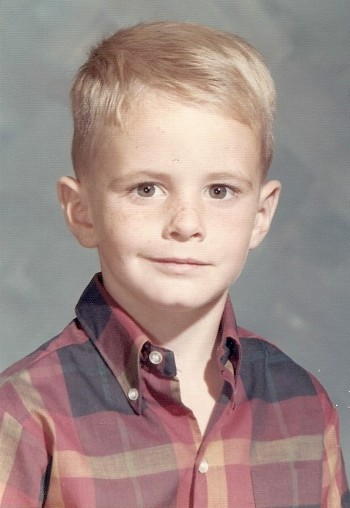 In this original BTB Investigation, we unveil the tragic story of Kirk Murphy, a four-year-old boy who was treated for “cross-gender disturbance” in 1970 by a young grad student by the name of George Rekers. This story is a stark reminder that there are severe and damaging consequences when therapists try to ensure that boys will be boys.
When we first reported on three American anti-gay activists traveling to Kampala for a three-day conference, we had no idea that it would be the first report of a long string of events leading to a proposal to institute the death penalty for LGBT people. But that is exactly what happened. In this report, we review our collection of more than 500 posts to tell the story of one nation’s embrace of hatred toward gay people. This report will be updated continuously as events continue to unfold. Check here for the latest updates.
In 2005, the Southern Poverty Law Center wrote that “[Paul] Cameron’s ‘science’ echoes Nazi Germany.” What the SPLC didn”t know was Cameron doesn’t just “echo” Nazi Germany. He quoted extensively from one of the Final Solution’s architects. This puts his fascination with quarantines, mandatory tattoos, and extermination being a “plausible idea” in a whole new and deeply disturbing light.
On February 10, I attended an all-day “Love Won Out” ex-gay conference in Phoenix, put on by Focus on the Family and Exodus International. In this series of reports, I talk about what I learned there: the people who go to these conferences, the things that they hear, and what this all means for them, their families and for the rest of us.
Prologue: Why I Went To “Love Won Out”
Part 1: What’s Love Got To Do With It?
Part 2: Parents Struggle With “No Exceptions”
Part 3: A Whole New Dialect
Part 4: It Depends On How The Meaning of the Word "Change" Changes
Part 5: A Candid Explanation For "Change"
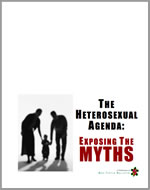 At last, the truth can now be told.
Using the same research methods employed by most anti-gay political pressure groups, we examine the statistics and the case studies that dispel many of the myths about heterosexuality. Download your copy today!
And don‘t miss our companion report, How To Write An Anti-Gay Tract In Fifteen Easy Steps.
 Anti-gay activists often charge that gay men and women pose a threat to children. In this report, we explore the supposed connection between homosexuality and child sexual abuse, the conclusions reached by the most knowledgeable professionals in the field, and how anti-gay activists continue to ignore their findings. This has tremendous consequences, not just for gay men and women, but more importantly for the safety of all our children.
Anti-gay activists often cite the “Dutch Study” to claim that gay unions last only about 1½ years and that the these men have an average of eight additional partners per year outside of their steady relationship. In this report, we will take you step by step into the study to see whether the claims are true.
Tony Perkins’ Family Research Council submitted an Amicus Brief to the Maryland Court of Appeals as that court prepared to consider the issue of gay marriage. We examine just one small section of that brief to reveal the junk science and fraudulent claims of the Family “Research” Council.
 The FBI’s annual Hate Crime Statistics aren’t as complete as they ought to be, and their report for 2004 was no exception. In fact, their most recent report has quite a few glaring holes. Holes big enough for Daniel Fetty to fall through.
“Google” is a trademark of Google Inc.
© Box Turtle Bulletin. All Rights Reserved.
 Posts
Posts  Posts via daily email: