Box Turtle Bulletin
 News and commentary about the anti-gay lobby
“Now you must raise your children up in a world where that union of man and box turtle is on the same legal footing as man and wife…”
News and commentary about the anti-gay lobbyPosts Tagged As: Daily Agenda
January 7th, 2012
 Merry Christmas! Yes, today is Christmas day — if you grew up in or are a member of an Orthodox Church which follows the Julian calendar. That would include churches in Ethiopia, Russia, Georgia, Armenia, Ukraine, Serbia, Macedonia, Montenegro and Moldova. (Greek, Bulgarian, Romanian, Antiochian and others celebrates Christmas on December 25). Christmas day formally ends the 40-day Nativity Fast. In Russia, the main celebration takes place on Christmas Eve, where the family returns home from services for the traditional “Holy Supper” consisting of 12 dishes, one for each of the apostles. In Georgia, people dress up and go an an “Alilo walk” and wish each other Christmas greetings and hand out sweets to children. Serbs spread their Christmas celebrations out over three days with numerous feasts, gatherings and traditional activities for each day.
TODAY’S BIRTHDAY:
 Jann Wenner: 1946. He founded Rolling Stone in 1967 when he was just 21, after borrowing $7,500 from family members. In 1977 he founded Outside magazine, and in 1985 he bought a share of US. In 1995, he separated from his wife, Jane Wenner, to live with Matt Nye, a former model and fashion designer. Jann and Jane have never divorced — she is still vice president of Wenner Media — and Jann and Matt are still together. In addition to the three sons he had with Jane, Jann and Matt also have three children.
If you know of something that belongs on the agenda, please send it here. Don’t forget to include the basics: who, what, when, where, and URL (if available).
And feel free to consider this your open thread for the day. What’s happening in your world?
January 6th, 2012
TODAY IN HISTORY:
Addressing “A Horror of Everything Related to the Homosexual Tendency”: 1899. In 1897, British sexologist Havelock Ellis published the first installment of his six-volume Studies in the Psychology of Sex. Volume 1 was subtitled Sexual Inversion, as homosexuality was more often called in the English language at that time. Two years later, his book was still making waves. In the January 1899 edition of the International Journal of Ethics, reviewer H. Sturt reviewed Ellis’s book, calling it “a solid and valuable contribution to psychology” and commending Ellis as “give(ing) the impression that he is a genuine scientific man doing his best to illustrate an obscure… province of human nature.” Sexual Inversion was revolutionary, being the first scientific book to discuss homosexuality in a humane and nonjudgmental way. Ellis argued against the contemprary attitudes about homosexuality being abnormal, criminal, or immoral, and presented it instead as a variation in a broad spectrum of sexual expressions. Ellis concluded that it was useless to try to change sexual orientation, and he advocated for the abolishment of Britain’s anti-gay laws like the “gross indecency” law under which Oscar Wilde was prosecuted in 1895.
Most books about homosexuality at the turn of the century were severely restricted in their distribution. Sexual Inversion was first published in German in 1896 because Ellis feared it would be censored in England. Since several other books on sexuality had already been published there, German had become the lingua franca, so to speak, of sexuality research. When the first English edition was published in London in 1897, its distribution was restricted to the professional trade. Sturt, in his review of Sexual Inversion, argued that this was a misguided policy:
There are some who would raise the general question whether a subject like the present can fitly be made the matter of a published treatise. Many excellent persons have a horror of everything related to the homosexual tendency. Their feelings commands our respect, and yet it seems better to have the subject brought out publicly. That all sorts of immature and half-educated people should read Mr. Ellis’s book is, of course, most undesirable. But in view of the prevalence of sexual inversion it is necessary that every schoolmaster, every criminal lawyer, we had almost said every head of a family, should be acquainted with its phenomena. Were the subject better understood, mistakes would be avoided that have ruined thousands of lives.
[In Jonathan Ned Katz, Gay/Lesbian Almanac: A New Documentary (New York: Harper & Row, 1983): pp 296-297.]
If you know of something that belongs on the agenda, please send it here. Don’t forget to include the basics: who, what, when, where, and URL (if available).
And feel free to consider this your open thread for the day. What’s happening in your world?
January 5th, 2012
TODAY IN HISTORY:
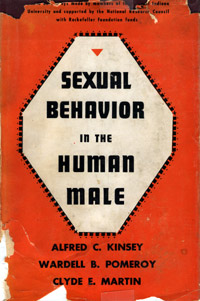 Kinsey’s “Sexual Behavior in the Human Male” Released: 1948. The dry, scientific, statistics-laden Sexual Behavior in the Human Male was published by W.B. Saunders, a respected publisher of medical textbooks and journals who had no idea what they were getting into when they agreed to publish this book. Their experience was with a limited customer base where a run of 5,000 copies was considered a huge success. W.B. Saunders ended up publishing a quarter of a million copies during that first year instead.
The only person who wasn’t surprised by the runaway success of what became known simply as “The Kinsey Report” was Alfred Kinsey himself. He and his colleagues had spent the previous nine years interviewing nearly 12,000 people across the country, asking them questions covering more than five hundred details of their intimate, sexual lives. When the book was finally published, America was emerging from the frugality that marked the Great Depression and World War II, full of economic and cultural vitality and itching to settle down in their Levittown houses and start making thousands of babies. The Kinsey Reports quickly entered popular culture along with Tiki-chic, bachelor pads, and a huge post-war baby boom. Sex was breaking out all over, and “Kinsey” became a popular code-word for anything risque. It also introduced millions of Americans to the notion that gay people — and a lot of other people as well — have gay sex. Now more than sixty years later, Sexual Behavior in the Human Male (and its companion volume, 1953’s Sexual Behavior in the Human Female) are still the books that everyone loves — especially those who have never read them. They are also the books that social conservatives love to hate, blaming them for sparking the sexual revolution of the 1960’s. For more information about the book’s impact, you can check out our report, “According To The Kinsey Reports,” which was written on the occasion of the book’s sixtieth anniversary.
TODAY’S BIRTHDAY:
 Alvin Ailey, Jr.: 1931. It can be said that Alvin Ailey singlehandedly elevated African-American dance from popular steps to modern art. It’s hard to imagine African-American modern dance with without his Alvin Ailey American Dance Theater, even though he was always proud of the fact that his dance company was integrated. Ailey combined modern dance with classical styles, bringing together a long, unbroken leg line (“a ballet bottom”) and a dramatically expressive upper torso (“a modern top”). “What I like is the line and technical range that classical ballet gives to the body. But I still want to project to the audience the expressiveness that only modern dance offers, especially for the inner kinds of things,” he once explained. His signature work, Revelations, drew on his memories of his early childhood in Texas, combining elements of blues, spirituals, and gospel music with a thoroughly modern choreography. His 1970 American Ballet Theatre commission, The River, had the ABT’s ballet company employing classical dance styles with the music of Duke Ellington.
 Ailey was openly gay, a fact which caused tensions between him and his mother. When he was dying of AIDS in 1989, he asked his doctor to announce that he had died of a blood disorder to spare his mother the social stigma of dying from AIDS. Considering the many barriers that Ailey smashed to smithereens during the course of his career in dance, his final act stands as a sad anomaly. And yet his work endures. His dance troupe carries on his legacy through performances, commissions and in providing higher education to dance students through The Ailey School.
If you know of something that belongs on the agenda, please send it here. Don’t forget to include the basics: who, what, when, where, and URL (if available).
And feel free to consider this your open thread for the day. What’s happening in your world?
January 4th, 2012
TODAY IN HISTORY:
 The Bicycle in the Treatment of Nervous Diseases: 1892. In the late 1800s, the entire country was swept up in a massive bicycling craze. Before the bike came along, transportation was either by horse (cumbersome and expensive) or by foot (slow). Bicycles became the favored mode of transportation, and it had the added benefit of being health exercise. By 1885, over 400 bicycle factories were working non-stop to keep up with demand. In 1895, Americans bought 2 million bikes, one for every 27 people in the country. And so it should come as no surprise that doctors would find novel prescriptions for their patients’ ailments involving the bicycle. Dr. Graeme M. Hammond of New York City wrote to the Journal of Nervous and Mental Disease extolling the virtues of the contraption to calm his patient’s nervous disorders. He presented thirteen cases, which included “one of sexual perversion, and the thirteenth case was one of abnormally developed sexual appetite”:
CASES XII. and XIII. both suffered from abnormal sexual appetites. Case XII. a young man, twenty-four years of age, had observed for the past year a gradually increasing desire for members of his own sex. He had been able to control his appetite so far, but was fearful lest it should finally overcome him and lead him to perpetrate acts which were naturally abhorrent to him. Case XIII. was a man, thirty years of age, whose naturally vigorous sexual appetite had been fed by indulgence, till it seemed as if the gratification of his desires was his only object in life.
I have observed during my twenty years experience among athletes, that physical fatigue is antagonistic to the sexual appetite, and that men who devote their lives to the cultivation of their physical strength are seldom, if ever, immoderate sexually, and during the periods of active training are often abstemious simply from lack of desire. Energy, which, in others might be expended sexually, is in them consumed by hard physical work. It has, therefore, been my custom in those cases, in whom I have considered it advisable to diminish or to abolish the sexual appetite, to prescribe severe and fatiguing exercise in conjunction with suitable medicinal treatment. I have found nothing more serviceable than the bicycle to accomplish this object. It should be used daily, preferably in the afternoon, and the patient should be directed to ride long distances at a rapid rate of speed, not carrying it to such an extent as to produce exhaustion, yet sufficiently so to induce well-marked fatigue.
Both of these patients have repeatedly told me that a hard ride would invariably abolish all sexual desire, even if the appetite was at its strongest just before the ride was taken. Of course, medicinal treatment was administered in both instances; but there can be no doubt that their recovery was hastened and facilitated by the hard physical labor they were subjected to by the use of the bicycle.
Paging NARTH…
[Hammond, Graeme. “The bicycle in the treatment of nervous diseases.” Journal of Nervous and Mental Disease 17, no. 1 ( January 1892): 36-46.]
TODAY’S BIRTHDAY:
 Michael Stipe: 1960. Stipe met bandmate Peter Buck at a record store in Athens, Georgia, that Peter managed. “He was a striking-looking guy and he also bought weird records, which not everyone in the store did.” Buck later recalled. They formed R.E.M. with Bill Berry and Mike Mills, and with Stipe as lead singer. The band’s first album, Murmer (1983), found critical success, even though critics couldn’t make out the lyrics due to Stipe’s mumbling. His vocal styling continued on their second album Reckoning (1984), by which time Stipe’s mumbling became fodder for parodies. Stipe answered his critics: “It’s just the way I sing. If I tried to control it, it would be pretty false.” But R.E.M. finally began to hit their musical stride when Stipe decided to enunciate more clearly for Fables of the Reconstruction (1985). The clearer singing began to reveal an earnest, albeit nonlinear, writing style in his lyrics. That nonlinearity extends to his personal life as well: doesn’t consider himself gay. “I don’t,” he reiterated in 2005. “I think there’s a line drawn between gay and queer, and for me, queer describes something that’s more inclusive of the grey areas.” In a 2011 interview, Stipe said that he was “around 80-20” gay, but still prefers to identify as queer. “A lot of younger people have a much more it-is-what-it-is approach to sexuality. The black and white binary approach just does not work. So you find the terms that make you most comfortable.” R.E.M announced their retirement as a band in September 2011.
If you know of something that belongs on the agenda, please send it here. Don’t forget to include the basics: who, what, when, where, and URL (if available).
And feel free to consider this your open thread for the day. What’s happening in your world?
January 3rd, 2012
TODAY’S BIRTHDAY:
 Dorothy Arzner: 1897. Hollywood was a man’s world, but Dorothy Arzner managed to become a director despite the obstacles. When she first decided that her future lay in motion pictures after serving in the ambulance corps during World War I, she was first given a job as stenographer at Paramount. She used that position to move on to script writer, then film editor, where her work in the 1922 classic Blood and Sand, starring Rudolph Valentino, won her praise for her editing style. When Paramount refused to promote her to director, she threatened to move to Columbia Studios. But Paramount relented and named her director for the successful silent comedy Fashions for Women. She directed the first talkie for “The It Girl,” Clara Bow, in The Wild Party (1929). Arzner showed considerable ingenuity in making the film: She invented the boom mike when she had the sound crew suspend a microphone from a fishing rod so Bow could move uninhibited around the set. The Wild Party, set in a women’s college, introduced coded references to lesbian themes. Similar themes would emerge in Anybody’s Woman (1930) and Working Girls (1931). Arzner launched the careers of Katherine Hepburn in Christopher Strong (1933), Rosalind Russell in Craig’s Wife (1936), and Lucille Ball in Dance, Girl, Dance (1940). For that last film, Arzner collaborated with choreographer Marion Morgan, who had been Arzner’s partner for at least ten years and would remain so until Morgan’s death in 1971.

Dorothy Arzner and Joan Crawford
When World War II came along, Arzner directed several army training films. By 1943, Arzner stopped directing major studio feature films due to an illness. When she was ready to return after the war, she found that the workplace had grown impatient with women holding on to “men’s” jobs now that the men were returning from fighting overseas. Arzner then began teaching, first at the Pasadena Playhouse and then at the newly-established film school at UCLA where Francis Ford Coppola was one of her students. Meanwhile, her old friend (and rumored paramour) Joan Crawford, who had married the chairman of Pepsico, got Arzner hired to make more than 50 television commercials in the 1950s. In 1975, Aarzner was recognized with a special tribute by the Directors Guild of America, after having become the guild’s first female member in 1936. She continued teaching until her death in 1979 at the age of 82.
Here are a couple of clips from The Wild Party:
http://www.youtube.com/watch?v=L0ZOGBj3cMMIf you know of something that belongs on the agenda, please send it here. Don’t forget to include the basics: who, what, when, where, and URL (if available).
And feel free to consider this your open thread for the day. What’s happening in your world?
January 2nd, 2012
TODAY IN HISTORY:
Governor vows to rid islands of homosexuals: 1963. The following item appeared below the fold of the front page of the Virgin Islands Daily News:
Action to Rid Here of Deviates Begins
Governor Paiewonsky today declared that his Administration has no intention of permitting the Virgin Islands to become a haven for homosexuals in which to spread their peculiar perversions.
To this end he has directed Commissioner of Public Safety, Otis L. Felix to undertake an immediate investigation into the extent of the problem in the Virgin Islands simultaneous with an all out drive against offenders.
If existing law is inadequate, says the Governor, the Attorney General will prepare legislation designed to eliminate this offensive activity in the Islands.
Noting that a large number of such persons are reported to have come to the Virgin Islands from other places, the Governor stated that the public interest required that our children be protected from the spread of homosexual practices.
The U.S. Virgin Islands repealed its sodomy law on October 18, 1984, with repeal becoming effective on January 16, 1985.
TODAY’S BIRTHDAY:
 William Haines: 1900. From 1924 through 1930, he was one of Hollywood’s most dashing leading men during the Silent era, and he was already starting to successfully transition to talkies when he picked up a sailor in Los Angeles’s Pershing Square and took him to a room at the YMCA. The police raided the Y and Haines was arrested. MGM head Louis B. Mayer demanded that Haines enter into a sham marriage to salvage his career, but Haines refused to leave his longtime lover Jimmie Shields. Haines was fired and his name was entered into the so-called Doom Book, the blacklist maintained by Hays Commission.
Haines and Sheilds turned their attentions to each other and to interior design. Their design business took off quickly, thanks to Haines’s connections in Hollywood which allowed them to become the designers to the stars. Clients included Joan Crawford, Gloria Swanson, Carole Lombard, George Cukor, Betsy Bloomingdale, the Annenbergs and the Reagans. Haines and Shields remained together for nearly fifty years, prompting their friend Joan Crawford to dub them the “the happiest married couple in Hollywood.” Gloria Swanson tried to get Haines back into the movie studio for Sunset Boulevard in 1950, but Haines declined. Haines died on December 26, 1973 of cancer. Soon after, Jimmie Shields put on Haines’s pajamas, crawled into their bed, and took an overdose of pills. They are buried together at Woodlawn Memorial Cemetery. In 1999, Haines was the subject of a biography, Wisecracker: The Life and Times of William Haines, Hollywood’s First Openly Gay Star
If you know of something that belongs on the agenda, please send it here. Don’t forget to include the basics: who, what, when, where, and URL (if available).
And feel free to consider this your open thread for the day. What’s happening in your world?
January 1st, 2012
Happy 2012, everyone. 2012. 2012. 2012. And for the next several weeks, whenever you write a check (that is, if you are still writing checks and not already paying for everything online), you will probably, out of force of habit, mistakenly date it for 2011, only to have to scratch it out and correct the year to 2012. And so that is why today’s Daily Agenda is late. It’s not actually late; when I wrote it yesterday afternoon, I post-dated it in the software to show up overnight on January 1 — 2011. Which is why if you checked in earlier this morning to see it, you wouldn’t have found it. Instead, you would have had to go back a full year, to New Year’s day of last year, to find it. Now that that has been properly sorted out, here’s to a very happy, productive, informative, and prosperous (in whatever way you measure prosperity) New Year.

The Delaware State Capitol
TODAY’S AGENDA:
Civil Unions Law Takes Effect: Delaware. Last May, Governor Mack Markell signed Delaware’s civil unions bill into law, which gives same-sex couples the same rights and responsibilities at the state level that are granted/imposed on married couples. It also recognizes marriages and civil unions performed in other states. The law take effect today.
TODAY IN HISTORY:
English Criminal Law Amendment Act Takes Effect: 1885. English law had long held that homosexuality was an “abominable crime” punishable with death by hanging, but in 1861, the law was modified to provide imprisonment from ten years to life instead. But crime of sodomy was always difficult to prosecute because it required a witness and evidence that the sexual act had been fully consummated, complete with penetration and what we would call a happy ending. Obviously, that made convictions rare.
That changed in 1885, although the change was rather unintentional. During the middle of the nineteenth century, there was a growing concern over the dangers suffered by England’s daughters over the “gross indecencies” imposed upon them. But again, convictions were rare because the statute required that the sexual assault take place in a “public place.” And so on January 1, 1885, a revision to the criminal code raised the age of consent for girls from thirteen to sixteen, and it made “gross indecencies” punishable regardless of age and place a misdemeanor, punishable with up to two years imprisonment. It didn’t take long for “gross indecency” to be interpreted by the courts to include homosexuality. In fact, it would be under this statute that Oscar Wilde would be convicted and sentenced to the maximum two year term ten years later.
Los Angeles Gay Bar Raided: 1967. It all was sparked by the temerity of a kiss, when a small group of gay men at Silverlake’s Black Cat bar, upon the countdown to midnight on New Years’ eve, had the gall to kiss each other “on the mouth for three to five seconds” in the presence of about six undercover policemen s who had infiltrated the gay bar. As soon as the pecks on the lips began, police identified themselves and began viciously beating and arresting the kissing offenders. As the melee widened, several people tried to escape to the nearby New Faces bar. Undercover officers followed and raided that bar as well. One of the New Faces workers was beaten so badly by police that they cracked a rib, fractured his skull and ruptured his spleen. Six Black Cat kissers were tried and convicted of “lewd or dissolute conduct” in a public place, conduct that consisted of male couples hugging and kissing.
 Two years before the Stonewall uprising in New York, the Black Cat raid had the effect of galvanizing the gay community in Los Angeles. Gays turned out for protests and demonstrations in the months that followed, and they began to pass a newsletter around which would eventually morph into The Advocate. By the time of a similar police raid on a dive bar in Greenwich Village two years later, the ground was well prepared for gays to come out nationally to declare their presence in society. In 2008, the Black Cat bar was declared a historical-cultural landmark by the city of Los Angeles, in a move that was partly inspired by the story of the Black Cat bar posted on BTB in 2006.
Homosexuality decriminalized: The first day of the year often marks the day in which new state laws take effect, which explains why on this day in history, a number of states officially decriminalized homosexuality effective January 1. Among the states that I know of in which laws prohibiting same-sex relations include: Arizona (19800, California (1971), Colorado (1971), Hawaii (1972), Iowa (1976), New Mexico (1975), North Dakota (1978). Ohio (1974), Oregon (1971) and Vermont (1977). If you know of any others, please let me know in the comments below.
If you know of something that belongs on the agenda, please send it here. Don’t forget to include the basics: who, what, when, where, and URL (if available).
And feel free to consider this your open thread for the day. What’s happening in your world?
December 13th, 2011
TODAY’S BIRTHDAY:
 Allen R. Schindler, Jr.: 1969. When “little Allen” was growing up, his step-father regaled him with stories of surviving the sinking of the battleship USS Arizona in Pearl Harbor. And so when he decided to enlist in the Navy on turning eighteen, it came as no surprise to his mother. He was ecstatic to learn that he would be assigned to the aircraft carrier Midway, but in 1991 he was transferred to the Belleau Wood, a smaller ship with a reputation for poor discipline. On October 27, 1992 while on shore leave in Sasebo, Japan, two drunken shipmates from the Belleau Wood followed Schindler into a public restroom in a park. Airman Charles Vins watched — and occasionally joined in — as Airman Apprentice Terry Helvey kneed Schindler in the arm, punched him repeatedly on the floor, and stomped on him with the heel of his boot. The pathologist described Schindler’s body as the worst case he had ever seen, and compared the damage to that of a “high-speed auto accident or a low-speed aircraft accident.” He also said that it was worse than another case he had seen, that of a man who had been trampled to death by a horse. The pathologist’s report chronicled a litany of lacerations, contusions and abrasions of the forehead, eyes, noes, lips, chin, neck, Adam’s apple, trachea, lungs, liver (which was “like a smushed tomato”) and, tellingly, penis. All but two ribs were broken, and both his lungs and brain had hemorrhaged. The only thing recognizable about Allen’s body was a tattoo on his right arm, of the USS Midway.
The Navy stonewalled the investigation. The murder occurred just as the pre-DADT debate was getting started over allowing gays to serve in the military. The Navy refused to confirm how Schindler died or whether a weapon was involved. At one point, a Navy senior officer leaked the story that Schindler’s murder was the result of a romance with Helvey gone bad. Meanwhile, Schindler’s mother, Dorothy Hajdys, was kept in the dark by Navy officials about what happened to her son or about the investigation. Her journal told the story: “Oct. 30: Heard nothing. Nov. 1: Sill heard nothing.” Meanwhile, the Navy tried Vins without her knowledge and sentenced him to four months in the brig. All the information Dorothy received about her son’s case came from the press. That’s how she learned her son was gay and had been killed by his shipmates in an anti-gay orgy of violence. “If one more reporter calls me with information before you do,” she told the Navy commander in charge of the case, “you haven’t even heard me scream!” Two months after the murder, Navy officials finally admitted that Schindler had been killed in a gay bashing.
The Navy denied that they had received any complaints of harassment. But as the investigation continued, it was slowly revealed that Schindler’s ship, the amphibious assault ship Belleau Wood, was a living nightmare for him. His locker had been glued shut and he was the brunt of frequent comments, like, “There’s a faggot on this ship and he should die.” Schindler requested a separation from the Navy, but his superiors insisted he remain aboard ship until the process was finished. During Helvey’s trial , it was revealed that Helvey told one investigator that he had no remorse for the killing. “I don’t regret it. I’d do it again. … He deserved it.” After confessing to the murder, he wrote in a four page statement, “Homosexuality is disgusting, sick and scary and I hate homosexuals.” When the investigator suggested that he might want to consider expressing remorse, he wrote, “I regret this incident happened and I feel like it could have been averted had homosexuals not been allowed in the military.”
Helvey avoided the death penalty by pleading guilty to “inflicting great bodily harm,” and was sentenced to life in prison. The ship’s captain who had tried to keep the crime quiet was demoted and transferred to Florida. Dorothy, virtually overnight, became a fierce advocate for hate crime protections and for gays being allowed to serve in the military. Helvey is still serving his lifetime sentence. In 1994, two years after the murder, he still had no regrets. He told a reporter:
We were just doing the Navy thing … We were drinking and fighting. It happened so many times, I can’t count them. That’s all we ever did was drink and fight. I was having fun and this dude ended up dying.”
If you know of something that belongs on the agenda, please send it here. Don’t forget to include the basics: who, what, when, where, and URL (if available).
And feel free to consider this your open thread for the day. What’s happening in your world?
October 12th, 2011
TODAY’S AGENDA:
AIDS Walks This Weekend: Atlanta, GA; Austin, TX; Los Angeles; CA; Philadelphia, PA and Watertown, NY.
Pride Celebrations This Weekend: Bakersfield, CA; Jacksonville, FL; Memphis, TN; Minsk, Belarus; Oklahoma, OK (Black Pride) and Tucson, AZ.
Also This Weekend: Floatilla, Hong Kong.
TODAY IN HISTORY:
 Matthew Shephard Died: 1998. At about 4:30 a.m., the Poudre Valley Hospital’s CEO Rulon Stacey released this medical update during a hastily called press conference at 4:30 a.m.:
At 12 midnight on Monday, October 12, Matthew Shepard’s blood pressure began to drop. We immediately notified his family who were already at the hospital. At 12:53 a.m. Matthew Shepard died, his family was at his bedside.
Matthew arrived at 9:15 p.m. Wednesday, October 7, in critical condition. Matthew remained in critical condition during his entire stay at Poudre Valley Hospital. During his stay, efforts to improve his condition proved to no avail. Matthew died while on full life support measures.
If you know of something that belongs on the agenda, please send it here. Don’t forget to include the basics: who, what, when, where, and URL (if available).
And feel free to consider this your open thread for the day. What’s happening in your world?
Featured Reports
 In this original BTB Investigation, we unveil the tragic story of Kirk Murphy, a four-year-old boy who was treated for “cross-gender disturbance” in 1970 by a young grad student by the name of George Rekers. This story is a stark reminder that there are severe and damaging consequences when therapists try to ensure that boys will be boys.
When we first reported on three American anti-gay activists traveling to Kampala for a three-day conference, we had no idea that it would be the first report of a long string of events leading to a proposal to institute the death penalty for LGBT people. But that is exactly what happened. In this report, we review our collection of more than 500 posts to tell the story of one nation’s embrace of hatred toward gay people. This report will be updated continuously as events continue to unfold. Check here for the latest updates.
In 2005, the Southern Poverty Law Center wrote that “[Paul] Cameron’s ‘science’ echoes Nazi Germany.” What the SPLC didn”t know was Cameron doesn’t just “echo” Nazi Germany. He quoted extensively from one of the Final Solution’s architects. This puts his fascination with quarantines, mandatory tattoos, and extermination being a “plausible idea” in a whole new and deeply disturbing light.
On February 10, I attended an all-day “Love Won Out” ex-gay conference in Phoenix, put on by Focus on the Family and Exodus International. In this series of reports, I talk about what I learned there: the people who go to these conferences, the things that they hear, and what this all means for them, their families and for the rest of us.
Prologue: Why I Went To “Love Won Out”
Part 1: What’s Love Got To Do With It?
Part 2: Parents Struggle With “No Exceptions”
Part 3: A Whole New Dialect
Part 4: It Depends On How The Meaning of the Word "Change" Changes
Part 5: A Candid Explanation For "Change"
 At last, the truth can now be told.
Using the same research methods employed by most anti-gay political pressure groups, we examine the statistics and the case studies that dispel many of the myths about heterosexuality. Download your copy today!
And don‘t miss our companion report, How To Write An Anti-Gay Tract In Fifteen Easy Steps.
 Anti-gay activists often charge that gay men and women pose a threat to children. In this report, we explore the supposed connection between homosexuality and child sexual abuse, the conclusions reached by the most knowledgeable professionals in the field, and how anti-gay activists continue to ignore their findings. This has tremendous consequences, not just for gay men and women, but more importantly for the safety of all our children.
Anti-gay activists often cite the “Dutch Study” to claim that gay unions last only about 1½ years and that the these men have an average of eight additional partners per year outside of their steady relationship. In this report, we will take you step by step into the study to see whether the claims are true.
Tony Perkins’ Family Research Council submitted an Amicus Brief to the Maryland Court of Appeals as that court prepared to consider the issue of gay marriage. We examine just one small section of that brief to reveal the junk science and fraudulent claims of the Family “Research” Council.
 The FBI’s annual Hate Crime Statistics aren’t as complete as they ought to be, and their report for 2004 was no exception. In fact, their most recent report has quite a few glaring holes. Holes big enough for Daniel Fetty to fall through.
“Google” is a trademark of Google Inc.
© Box Turtle Bulletin. All Rights Reserved.
 Posts
Posts  Posts via daily email: