Box Turtle Bulletin
 News and commentary about the anti-gay lobby
“Now you must raise your children up in a world where that union of man and box turtle is on the same legal footing as man and wife…”
News and commentary about the anti-gay lobbyPosts Tagged As: Marriage
Prop 107 fails but same-sex marriage is still illegal in Arizona.
November 16th, 2006
To everyone’s surprise and many people’s delight, Arizona’s Prop 107, the so-called “marriage” amendment continues to go down with an ever-widening margin. Late yesterday, the Center for Arizona Policy (CAP), Prop 107’s chief sponsor, conceded defeat, but not before blaming their opponents for pointing out how their amendment would have affected straight unmarried couples:
Our opponents were able to focus the debate on what Proposition 107 was not about: benefits for unmarried individuals. Our opponents were able to scare seniors into believing they would lose their social security benefits if prop 107 passed. Our coalition simply did not have the funds to respond to opponents’ attacks and distortions about the true intent of Prop 107.
As I pointed out yesterday, the 2000 census showed that there were 105,864 households with opposite-sex unmarried partners in Arizona, but only 12,332 same-sex unmarried partners. This suggests that opposite-sex unmarried couples outnumbered same-sex unmarried couples by a ratio of more than 8.5 to 1.
CAP may have intended for the debate to center around gay couples, but the simple fact of the matter is that there are far more straight couples in Arizona that stood to lose from Prop 107 than gay couples. CAP was never honest about that fact, and its not wonder. CAP and its supporters are just as hostile to straight couples “living in sin” as they are to gay couples.
In Michigan, Ohio, and other states, domestic partners — gay and straight — of state and local governments and universities are losing their health insurance. In Ohio, unmarried couples — gay and straight — stand to lose domestic violence protections with the active encouragement of their marriage amendment supporters. Cincinnati-based Citizens for Community Values (CCV) filed this brief with the state Supreme Court demanding that the court strike down Ohio’s domestic violence laws:
The Marriage Amendment does not proscribe the extension of benefits to persons in marriage-mimicking relationships. Rather, it proscribes the very legal recognition of the relationships in the first place, for any purpose.
The fact remains that many more straight couples are harmed by these amendments than gay couples. CAP refused to acknowledge that, and still clings to the fantasy that this amendment was all about gay marriage. It was not. Same-sex marriage was illegal before election day and it is still illegal today. The only thing that would have changed had Prop 107 passed would be that thousands of families would have woken Wednesday morning to find their health insurance and other protections under assault. And the chances are more than 8.5 to one that that family would have been headed by a heterosexual couple. These are the plain and simple facts that CAP have refused to address. But they will have to if they try to put a similar measure on the ballot in two years.
Were Arizona’s Same-Sex Marriage Ban Opponents Deceptive?
Arizona Is Still Going Strong
De-Gaying The Marriage Debate?
Appraising Arizona
Gay Marriage Is Still Illegal In Arizona
November 15th, 2006
The vote counting for Arizona’s Proposition 107, the same-sex marriage amendment, goes on as absentee and provisional ballots continue to be processed. Interestingly, Prop 107’s margin of defeat has actually widened over recent days. Meanwhile, same-sex marriage opponents are starting to cry foul, claiming that the only reason Prop 107 failed is because Arizona Together “distorted” the issues. Leading gay-marriage opponent Maggie Gallagher complains:
You may beat a so-called gay marriage ban, as long as you never use the word “marriage” … or “gay.”
And the Scottsdale-based Alliance Defense Fund says:
Even in Arizona, the only state where a marriage amendment has apparently failed (defeat has not been conceded yet as many ballots are still being counted), opponents of the amendment have admitted that they had to distort the real issues in an effort to confuse the public.
The Center for Arizona Policy had intended Prop 107 to be a referendum on same-sex marriage — following the playbook in every other state where this issue has come up for a vote. By “distorting the real issues”, ADF is referring to the fact that Arizona Together built their campaign message on how Prop 107 would affect straight people.
But how is that message “distorting the real issues”? The Houston Chronicle begged precisely that question the other day.
When Arizona voters signed enough petitions to put a same-sex marriage ban on Tuesday’s ballot, opponents decided their best shot at defeating it was to shine a light on real people who would be hurt by Proposition 107.
If most of those real people were not gay, they said, all the better.
Here are the statistics. According to the 2000 census, there were 105,864 households with opposite-sex unmarried partners in Arizona, but only 12,332 same-sex unmarried partners. This suggests that opposite-sex unmarried couples outnumbered same-sex unmarried couples by a ratio of more than 8.5 to 1.
The Center for Arizona Policy, who wrote Prop 107 and got it on the ballot, clearly intended to target gay couples. But their over-reaching proposal would have hit far more opposite-sex couples than same-sex couples. And if many times more opposite-sex couples were going to suffer the consequences of Prop 107, how is it deceptive for Arizona Together to make that the centerpiece of their message?
The fact is, same-sex marriage was illegal before Prop 107 was put on the ballot, and it is still illegal now that Prop 107 has been defeated. Absolutely nothing would have changed for same-sex marriage regardless of whether Prop 107 passed or failed. And to argue that Prop 107 was needed to guard against activist judges, well I have to wonder where these swarms of activist judges in Arizona have been hiding. The very idea of it is ludicrous.
The only thing that would have changed if Prop 107 passed was the ability to create alternatives paths to some of the benefits for unmarried couples. Tempe, Tucson, Phoenix, Scottsdale and Pima County all offer some type of benefits to domestic partners of their unmarried workers. Tucson also has a domestic-partner registry that grants certain rights, such as hospital visitation, to those who sign up. Prop 107 would have take that away for far more straight couples than gay couples. This fact is inescapable.
If the Center for Arizona Policy (CAP) had written a “clean” proposition similar to the one that passed in Colorado which simply ended with their proposed definition of marriage and didn’t try to destroy other avenues for unmarried families to see protections and benefits, Arizona Together would have been left without a message. Or at least, their message would have been limited to gay equality, and that would almost certainly have meant that Arizona would have joined the other seven states in adding discrimination to the constitution.
But CAP’s careless shotgun blast at gays in Arizona would have inflicted far more “collateral damage” on straight couples. Arizona Together was just smart enough to point that out to everyone. Arizona voters, like voters everywhere, are just smart enough to vote for preserving their own interests. This isn’t deception. It’s the truth. And it’s nothing but sour grapes on the part of gay rights opponents to gripe about it.
Center for Arizona Policy Concedes
Arizona Is Still Going Strong
De-Gaying The Marriage Debate?
Appraising Arizona
Gay Marriage Is Still Illegal In Arizona
November 13th, 2006
The late vote tally continues, and Prop 107, the so-called “Protect Marriage Arizona” amendment is continuing its slide toward defeat — 621,488 (48.5%) for, versus 660,509 (51.5%) against. According to news reports, there are still some 120,000 mail-in ballots yet to be counted, mostly in Maricopa county (Phoenix, Tempe, Scottsdale, Mesa, Glendale and other suburbs). Since Maricopa county is defeating the measure by a nearly three percent margin, we would have to see a very sudden reversal in the trend, and see the remaining ballots break more than two-to-one for the proposed amendment.
So the question now is, what line of reasoning will the Center for Arizona Policy (CAP) take in explaining its defeat?
Center for Arizona Policy Concedes
Were Arizona’s Same-Sex Marriage Ban Opponents Deceptive?
De-Gaying The Marriage Debate?
Appraising Arizona
Gay Marriage Is Still Illegal In Arizona
November 9th, 2006
On Tuesday, November 7, 2006,
And today comes news that the Mexico City assembly voted 43-17 to allow civil unions. This means that gay couples in the Federal District will be granted inheritance, pension rights and other social benefits upon registering their unions.
Congratulations, chilangos!
November 9th, 2006
The Los Angeles Times this morning published an analysis of various marriage amendment outcomes across the country. Two quotes jumped out at me. The first is from Scott Duffy, who led Colorado’s campaign against their anti-marriage amendment:
“Our whole campaign was about explaining the commitment of same-sex couples who spend 15, 30 years together in a monogamous relationship, and the media here was wall-to-wall with stuff that was decidedly the opposite…. We had a tough sell,” Duffy said.
The fact is, they really did have a tough sell. Colorado’s proposal, unlike Arizona’s, was a “clean” proposal, defining marraige as the union of a man and a woman and ending there. There were no additional clauses trying to limit partnerships, civil unions, etc. This left Colorado’s Amendment 43 opponents with little choice but to talk about same-sex couples.
Things were different in Arizona, which brings me to the second quote. This is from Kyrsten Sinema, who led Arizona Together’s campaign against Prop 107, which continues to lose 48.6%-51.4% as the mail-in ballots are being counted:
Kyrsten Sinema, who chaired the campaign to defeat Arizona’s proposed ban, said Wednesday that opponents of the amendment focused on how the initiative would take benefits away from all unmarried couples — not just gays and lesbians.
I have no doubt that marriage opponents will seize on this as an admission of dishonesty or sneakiness. But the fact is these amendments really do take away benefits from all unmarried couples. It has already happened in Michigan, Ohio, and several other states. It took Arizona Together’s disciplined message to drive that point home.
But because the Arizona election turned on what Prop 107 would do to straight couples, it’s hard to argue that this outcome represents some sort of advancement for gay rights. In reality, we haven’t turned any corners. Instead, I think this is a perfect demonstration of how much work we really have ahead of us.
Center for Arizona Policy Concedes
Were Arizona’s Same-Sex Marriage Ban Opponents Deceptive?
Arizona Is Still Going Strong
Appraising Arizona
Gay Marriage Is Still Illegal In Arizona
November 8th, 2006
Update 11/9/06: There are still 341,000 mail-in ballots to be counted, and these ballots probably won’t be counted for several days. With Arizona’s Proposition 107, the so-called “Protect Marriage Amendment”, stlll teetering inthe balance, I’ve updated this post to reflect that uncertainty.
A few weeks ago, Arizona was derided for ranking dead last in Morgan Quitno’s annual reference book, Education State Rankings, 2006-2007. While Arizona was derided as the “dumbest state in the union”, its citizens displayed a remarkable level of simple common sense in the 2006 mid-term elections by defeating Proposition 107, the so-called “Protect Marriage Amendment.”
The results are in still tricking in, but Prop 107 appears to have been defeated. Current results show it going down by 32,226 votes out of 1,151,012 votes cast (48.6% “yes” vs. 51.4% “no”). However, there are still some 341,000 ballots left to be counted so the final result can still change. But win or lose, this is a good day to be an Arizonan. I couldn’t be more proud.
Even though it may be early, LGBT and allies around the country are cheering this as a historic triumph. I imagine that gay-advocacy offices from coast to coast were looking over the data to see if this reversal can be repeated elsewhere. And we all hope that this represents a harbinger for things to come. At the very least, political scapegoating of gays and lesbians is not the reliable tactic it used to be.
But I’m afraid its too easy to look at Arizona’s potential defeat of Proposition 107 and assume it’s some sort of high-water mark for anti-gay extremists. What happened here was the result of a very unique set of circumstances, a combination of luck, organization, and Western common sense. Many factors lead to the proposition’s apparent defeat, and as I see it these factors boil down to:
Let’s look at what happened in detail.
Prop 107 was authored and supported by the Center for Arizona Policy (CAP), which often lobbies the state legislature on social conservative issues. Len Munsil was CAP’s president when they proposed the measure and began ushering it through the process of getting it on the ballot. As the measure was going through the petitioning process he resigned to run for governor, and this prompted suspicions that Prop 107 was nothing but a ploy to energize the conservative base and propel him to the governor’s office. (In fact, he was soundly defeated 63%-35%, losing in all seventeen counties)
When Len Munsil resigned, the task of ushering Prop 107 fell to his replacement, Cathi Herrod, who struggled to get the measure on the ballot. They had difficulties with lining up petition circulaters, difficulties with getting the minimum number of signatures, and dificulties getting the petitions gathered and turned in on time.
But in the end, CAP managed to get it done and their next task was to sell the measure to Arizona voters. And again, they ran into difficulties.
The truth is, Prop 107 never polled very well in Arizona, and CAP never mounted a wide-ranging campaign in response to the polls. They apparently assumed it would pass simply because Arizona is a very conservative state and, well, these measure always passed everywhere else.
CAP’s message was unfocused and aimed largely at the choir. Most members of CAP appear to have an evangelical background, and their message was presented using the cultural language of evangelicals. Because they did little outreach outside of evangelical, fundamentalist, or Catholic circles, they were never able to connect with Arizona voters outside of their own little Amen-corner. The guest editorial columns they submitted to Arizona newspapers were often illogical, inconsistent, and poorly written. What’s more, Arizona doesn’t have much in the way of mega-churches, and except for CAP and the Alliance Defense Fund, there are very few organized anti-gay organizations. This means CAP had few allies to help carry their message to a larger audience.
Soon after the anti-marriage onslaught of 2004, a small group of Arizona activists got together to discuss what to do if an anti-marriage amendment was proposed for Arizona. They didn’t know when it would happen but they felt that it was only a matter of time. They began a post-mortem on campaigns in other states and identified several strengths and weaknesses. With that data, they began to formulate a strategy for responding to an amendment in Arizona. In other words, they didn’t wait for Prop 107 to show up. They were strategizing before CAP began their efforts.
Arizona Together was the result of all that work, and their first big break came when CAP decided to go for the Cadillac of anti-marriage proposals, basing it on the Ohio amendment that passed in 2004. CAP’s proposal read:
To preserve and protect marriage in this state, only a union between one man and one woman shall be valid or recognized as a marriage by this state or its political subdivisions and no legal status for unmarried persons shall be created or recognized by this state or its political subdivisions that is similar to that of marriage. [emphasis mine]
When Arizona Together saw they second half of the amendment’s wording, they knew it was their best shot at defeating it. Based on what was happening in Ohio, Michigan, and other states to heterosexual couples because of their amendments, Arizona Together knew that the unintended consequences of banning gay marriages and anything similar to it would be their opening. And Arizona Together was ready, with polling data, market research, a superb fundraising campaign (almost all of their funding was raised in the state), a massive outreach strategy that went far outside the usual LGBT and progressive political organizations, and a clearly defined and disciplined message.
The disciplined message that Arizona Together sent out didn’t rely on arguments about marriage equality or gay rights. Instead, they focused their arguments on what the ballot measure’s passage would mean for straight people:
Rep. Kyrsten Sinema, D-Phoenix, chair of the campaign to defeat Proposition 107, conceded that the strategy of the media campaign was to show straight couples who would lose their domestic partner benefits. That’s because the initiative would not only have constitutionally barred gay marriage but also precluded governments from adopting policies that allow employees to add their domestic partners — whether of the same or opposite sex — to their health insurance or to gain any other benefits.
Sinema, who is bisexual, justified that by saying that out of an estimated 112,000 unmarried couples living together in Arizona, only about 18,000 are gay. She said the $2.1 million campaign was necessary to convince Arizona voters that this is more than just an issue affecting gays.
I attended a message training session last summer where this was hotly debated. Many were upset that the LGBT community was invisible in Arizona Together’s campaign messages. Some felt that we were passing up a good opportunity to educate the public about LGBT issues and concerns. But Arizona Together representatives pointed out that supporters of gay marriage have an easy bumper sticker message with “one man and one woman”, while our issues are too complex to be told in the short span of a campaign season.
They also had focus-grouped research that said that people vote according to their own personal concerns and priorities, and less so from an altruistic sense of helping others. When messages about equality and fairness were put before focus groups, the messages fell flat. But when concrete examples were presented about what happened to straight couples in Ohio and elsewhere, they sat up and took notice.
For example, Arizona Together pointed out that Arizona is a retiree haven. And many of these retirees are widows and widowers who meet, fall in love and move in together. But they often don’t marry because pension plans often force a spouse to give up his or her pension upon remarriage. With Prop 107, they had a lot to lose, especially those who take advantage of Tucson’s domestic partner registry which makes city services and fees based on marriage status available to domestic partners. For senior on fixed incomes this can be important. Also, Tucson’s domestic partner registry guaranteed hospital visitation and medical decision-making rights. This too would have disappeared with Prop 107 along with the registry.
This message seems to have taken root among Arizona’s retirees. Older Americans tend to be very strongly supportive of same-sex marriage bans, but according to exit poll results posted at CNN, 45% of Arizona’s voters aged sixty-five or older voted against Prop 107. This compares to only 35% in Virginia and 29% in Wisconsin who voted against their marriage amendments.
So, while it may be a great victory if the amendment go down in defeat, it would be a terrible mistake to take it as a victory for the LGBT community. It wasn’t. Prop 107 was failed or nearly failed because of what it would do to unmarried heterosexual couples. Gays and lesbians were largely invisible in the debate.
Arizona is a classically western state which famously values the idea of rugged individualism. Arizonans, while deeply conservative, prefer their governments small, their freedoms large, and their neighbor’s noses very far away. Mr. Conservative himself, Barry Goldwater, was a supporter of gay rights. Arizona’s conservatism often has a distinctly libertarian feel.
Arizona’s gay community largely fits in well with that spirit. Phoenix and Tucson both have very large and active gay communities, but neither city has much of a “gayborhood.” In Phoenix, most gay businesses are scattered around the north-central part of the city, but the concentration of LGBT residents in that area is quite low, especially compared to “gayborhoods” in most other cities. Tucson has no recognizable gay neighborhood at all; its gay citizens are spread pretty evenly throughout the city.
What this means is that while Arizona is about average in terms of the proportion of gay people, almost all of its LGBT citizens live among straight neighbors. This means that Arizonans in general are more likely to know someone who is gay than citizens in many other states.
Think about it: if the bulk of Arizona’s gays lived in just a few neighborhoods, if there were Arizona Castros, WeHos and Chelseas, then that means that there would be fewer straight people with constant casual contact with the nice gay couple down the street. This geographic integration, I think, is an important part of why Prop 107 failed. An awful lot of straight Arizonans know their gay neighbors, and they are apparently reluctant to vote on something that would be harmful to their neighbors.
It was a great thing that Arizona has apparently defeated Prop 107. If the result doesn’t hold, then its passage is likely to be razor-thin. In any case, I’m immensely proud of my adoptive state, and I am especially proud my own neighbors.
I hope that the Arizona Together’ success can be repeated elsewhere when our opponents look for someone to scapegoat. But I think it is important to recognize the possibility that what happened here may be unique. If CAP had offered a “cleaner” amendment without the domestic partnership prohibitions, if CAP had reached out beyond its own base, if Arizona’s gay community were less integrated, if Arizona Together hadn’t gotten its act together before CAP began their efforts — if any of this had been different, we might not be celebrating today. As it is, the margin of Prop 107’s defeat so far is not large. But it may be large enough.
Center for Arizona Policy Concedes
Were Arizona’s Same-Sex Marriage Ban Opponents Deceptive?
Arizona Is Still Going Strong
De-Gaying The Marriage Debate?
Gay Marriage Is Still Illegal In Arizona
November 8th, 2006
Sorry to throw cold water in everyone’s faces, but the truth is nothing has changed in Arizona. When we woke up this morning, Chris and I still could not get married.
Nevertheless, I could not be more proud to be an Arizona citizen than I am right now. But before we get too carried away, we should remember that while just about all of the precincts have reported their one million votes, there are still some 300,000 mail-in ballots left to be counted. A quarter of the results hasn’t been counted yet (my vote is somewhere in that stack). With the No-Yes margin barely over a single percentage point, this can be significant.
I am crazy busy right now at work, as I was yesterday. But this evening, I hope to be able to sit down and offer some thoughts on what I think this possible victory really means for equality — and what it doesn’t mean. Given that Chris and I still can’t marry, we still have a very long and difficult road ahead of us.
Update: These unofficial results from the Arizona Secretary of State are pretty strong. The margin is 51.4 against verses 48.6 for, a difference of 32,599 votes. It’s unclear how many mailed-in votes are included in this total, but if 300,000 votes are still out, those votes would have to break more than ten percent the other way to make a difference.
Center for Arizona Policy Concedes
Were Arizona’s Same-Sex Marriage Ban Opponents Deceptive?
Arizona Is Still Going Strong
De-Gaying The Marriage Debate?
Appraising Arizona
August 29th, 2006
Opponents to a proposed marriage amendment to Arizona’s constitution have gained some unlikely allies: Republicans.
Republican Tucson Mayor Bob Walkup, Democratic Phoenix Mayor Phil Gordon have joined Republican gubernatorial candidate Mike Harris to oppose Prop 107, which would ban gays from marrying. It would also prevent anyone, gay or straight, from entering into civil unions or from receiving domestic partner benefits.
“As a Reagan Republican, I want government out of our private lives,” Harris said.
It also may prove a case of a group thinking it has a winning issue and over-reaching.
Instead of writing a clean proposition defining marriage as between a man and a woman, Christian conservatives went the extra step and proposed banning men and women from civil unions.
Gay-rights groups shrewdly jumped all over that.
Arizona’s primary isn’t until September 12, and Harris lags behind two other Republicans in a four-way race to unseat the popular Democratic incumbent, Janet Napolitano. One of these front-runners is Len Munsel, the former president of the Center for Arizona Policy which put the amendment on the ballot. The other front-runner is Don Goldwater, nephew of the late Barry Goldwater.
That’s why it’s way to early to call this a positive sign, especially since Harris has been extremely coy about making his views known.
August 18th, 2006
Some opponents to gay marriage claim that all of the rights that gay couples seek can be obtained through other legal documents. But that’s not true, as a case in New York state painfully illustrates:
Linda Saegert and Victoria Sarafino lived together for 18 years, owned a house and a business together, and raised two children together. They were married in a ceremony at a Unitarian church in Freeport.
“We did everything that’s the criteria for a nuclear family,” said Saegert, a Valley Stream resident, adding that the two women even signed the children’s report cards together. “We were a couple as well as any husband and wife.”
But a State Supreme Court justice in Nassau County does not agree. Acting New York Supreme Court Judge Daniel Palmieri ruled that Saegert does not qualify as the late Sarafino’s legal partner or spouse. Palmieri rejected last week Saegert’s attempt to seek wrongful-death damages after Sarafino was killed in a car accident in 2003.
Gay couples can sign powers of attorney, financial partnership agreements, wills, living wills, trusts, a whole mountain of paperwork costing thousands of dollars, but in the end there are still rights and obligations that cannot be had any other way but for the price of a $35 marriage license:
Those include: receiving survivor’s benefits if a spouse dies; being able to file joint taxes and receive various tax deductions; entering hospitals, jails and other places restricted to immediate family; obtaining family health insurance and other employment benefits; collecting unemployment benefits if you move because of a spouse’s job change; recovering damages from an injury to a spouse; making medical decisions for an injured or incapacitated spouse; and inheriting a spouse’s property if he or she dies without a will.
Some say that these aren’t really problems. And whenever the issue of hospital visitation or medical decision-making comes up, it has even been suggested that the problem is an urban myth — that it never really happens. They say a Durable Power of Attorney takes care of that. But consider the story of Robert Daniel and Bill Flanigan. Robert was admitted to the University of Maryland’s Shock Trauma Unit in Baltimore in 2000 due to complications from AIDS. He and Bill had been traveling to Washington D.C. to visit family when he suddenly became ill. But officials at the Shock Trauma Center wouldn’t let Bill see Robert or confer with Robert’s doctors because he wasn’t “family”.
Flanigan explained he had a Durable Power of Attorney for Health Care Decisions and that he and Daniel were registered as domestic partners (in California). The Shock Trauma Center also had the records of the first hospital to which Daniel was admitted, where Flanigan was recognized as family, having spent the night in a chair by Daniel’s bed.
The Shock Trauma Center acted quite differently. For four hours, personnel kept Flanigan away from Daniel and his doctors – meanwhile allowing family members of other patients to visit their loved ones and confer with doctors. Flanigan, on the other hand, was not given the opportunity to make surgeons aware of Daniel’s wish not to have life-prolonging measures performed on him, including the insertion of a breathing tube.
After four hours, Daniel’s sister and mother arrived from out of town. Only then did the Shock Trauma Center provide information on Daniel’s status that had been repeatedly denied to Flanigan, and subsequently allow the entire family, including Flanigan, to see Daniel. By that point, Daniel was no longer conscious, his eyes were taped shut, and the two men never had the chance to say goodbye.
So just because you paid good money to have a lawyer draw up an agreement, it doesn’t mean a hospital will feel bound by it. When that happens, the partner is left with “no standing.”
Opponents to same sex marriage acknowledge that those who are married are often healthier than those who aren’t, but they don’t go bother to ask why that would be the case. But the simple fact is that those who are married are empowered by the state to take better care of themselves and their partners than those who aren’t. And this empowerment extends to all phases of life.
State Medicare regulations provide protections of a married couple’s home should a spouse require nursing home care. But for couples who aren’t married, the healthy partner is forced to sell of all jointly-owned property to pay for the care of the partner requiring care in order to satisfy Medicare requirements for single patients. And if the second partner needs nursing home care, there are no provisions to guarantee that they can share the same room, or even be housed in the same facility. And after death occurs, the coroner is often not allowed to release the body of the loved one to his or her partner.
All of this is because the partner has “no standing.” It’s as if that relationship, no matter how long or enduring, never existed. And outside of a $35 marriage license, there is no legal document that can fix that.
August 3rd, 2006
 The next time anti-gay activists claim that the love that gay couples feel for one another isn’t really love, but is instead some sort of counterfeit imitation of it, I’d like for them to take a good hard look at this photograph.
The two men in the photograph are Ray Vahey and Richard Taylor. For nearly forty-nine years, they were devoted partners who did not speak openly about their lives, neither to their family nor to their friends at work. But when Wisconsin extremists proposed an amendment to the constitution banning gay marriage, Ray and Richard decided it was time to end the silence. Last December, they testified at a state hearing on the proposed amendment.
Richard and I met and fell in love in 1956. For 49 years, we have yearned for a marriage recognized in America. Yet until this year, we had never come out in a public way. We decided this cause is not only worth it to us but to millions of others…
Richard was a World War II veteran, having served on a navy tanker on convoy duty in the North Atlantic and the Mediterranean. Later, his tanker was moved to the Pacific where it operated in the battle of Iwo Jima. It later came under kamikaze attack at Okinawa.
Richard voluntarily put himself into harm’s way to protect his country and the rights of all Americans of that day, and all of the generations that have followed. Now there is an attempt to separate Richard from society and take away his right to equality under the law.
Richard and Ray had planned a religious wedding ceremony for September 16, which would have been their fiftieth anniversary together. But Richard became ill, so they moved the date up to last Memorial Day. Richard died last Friday at the age of eighty-one.
 The next time someone claims that gay couples are incapable of stable, long-term relationships, I’d like for them to take a good hard look at this photograph. This is the very picture of love and dedication. Nearly fifty years ago, they met and fell in love, and they remained together throughout those decades in the face of tremendous obstacles and discrimination, yearning for their relationship to be acknowledged and recognized. The next time someone claims that gay couples are a danger to marriage, I’d like for them to know about Ray and Richard.
My thoughts and prayers go out to Ray Vahey in his time of loss.
August 1st, 2006
I’ve always agreed with conservatives when they say that protecting marriage is in children’s best interests. It’s partly why I want to protect — or more properly, extend — marriage to everyone, including gay and lesbian couples, because their children deserve these same protections.
But marriage isn’t just about children; people who cannot procreate get married all the time. But if opponents to same-sex marriage insist on putting all their eggs into a single child-filled basket, they’re bound to find more than a few of their eggs crushed.
Columnist Dan Savage has an excellent op-ed piece in last Sunday’s New York Times about the recent rulings on same-sex marriage in New York and Washington. He believes that both courts’ reliance on arguments about procreation is the key to turning these setbacks into future victories:
A perverse cruelty characterizes both decisions. The courts ruled, essentially, that making my child’s life less secure somehow makes the life of a child with straight parents more secure. Both courts found that making heterosexual couples stable requires keeping homosexual couples vulnerable. And the courts seemed to agree that heterosexuals can hardly be bothered to have children at all — or once they’ve had them, can hardly be bothered to care for them — unless marriage rights are reserved exclusively for heterosexuals. And the religious right accuses gays and lesbians of seeking “special rights.”
Even if you believe that marriage plays a special role in the lives of heterosexuals with children (another point I’m happy to concede), can it not play a similar role in the lives of homosexual couples, whether they’re parents or not? Marriage, after all, is not reserved for couples with children. (Perhaps it will be soon, if courts keep heading in this direction.)
Read the whole thing while it’s still available.
July 19th, 2006
Glenn T. Stanton, senior analyst and Director of Global Insight for Cultural and Family Renewal at Focus on the Family, offered some thoughts on same-sex marriage in a book review on Christianity Today’s web site. In his review of The Meaning of Marriage: Family, State, Market and Morals (Robert P. George, Jean Bethke Elshtain, eds.), Mr Stanton discusses one of the chapters:
Don Browning and Elizabeth Marquardt, self-described religious and political liberals, assert that “same-sex marriage is unjust in many ways and that liberals should be cautious about endorsing it.”
Unjust? Yes, by changing the focus from the needs of children and the larger society to the desires of adults. They warn that civil marriage for homosexuals would change marriage from being concerned about raising a community’s next generation to being concerned about close, personal adult relationships.
After which he adds his own thoughts:
We are moving from this natural, universal model to a greater embrace of what I call “disembodied procreation” in same-sex unions, where sperm and egg meet only in a Petri dish and foreplay is a legal contract.
This has become a growing argument among opponents of same-sex marriage, that gays and lesbians who want to marry are elevating their own desires above the needs of children, especially since, on their own, they cannot have children biologically as a gay and lesbian couple.
Yet gays and lesbian couples become parents through many different means; most of them are the result of a previous heterosexual marriage. The American Academy of Pediatrics note that according to the 2000 census:
— Same-gender couples are raising children in at least 96% of all US counties.
— Nearly one quarter of all same-gender couples are raising children.
— Nationwide, 34.3% of lesbian couples are raising children, and 22.3% of gay male couples are raising children (compared with 45.6% of married heterosexual and 43.1% of unmarried heterosexual couples raising children).
…
— Six percent of same-gender couples are raising children who have been adopted compared with 5.1% of heterosexual married couples and 2.6% of unmarried heterosexual couples.
— Eight percent of same-gender parents are raising children with special health care needs, compared with 8.3% of heterosexual unmarried parents and 5.8% of heterosexual married parents.
— Of same-gender partners raising children, 41.1% have been together for 5 years or longer, whereas 19.9% of heterosexual unmarried couples have stayed together for that duration. …
It is difficult to determine exactly how many children are being raised by a gay or lesbian parent or parents because of many of the same factors that impact the determination of the number of same-gender couples. Estimates range between 1 and 10 million. The majority of these children were born in the context of a heterosexual relationship.
These statistics are instructive. They point out that the impulse to marriage and to raise children is a distinctly selfless impulse. Not only are gay men and lesbians more likely to adopt children who don’t have homes, they are more likely to adopt hard-to-place children than heterosexual couples overall. Gay parents don’t blithely choose to raise children as if they were deciding to take in a homeless puppy — nobody adopts hard-to-place children on a lark. Instead, these couples have demonstrated a selfless willingness to do the hard work and make the commitments necessary to take on the arduous task of raising a child who needs a family. You can bet that these couples are very much “concerned about raising a community’s next generation.”
But what’s more, the impulse to marriage is also a distinctly conservative impulse. Even though these couples are not bound together by a marriage license, they are much more likely to stay together than heterosexual couples who are not bound together by a marriage license. And we know that marriage is a stabilizing influence in a family. Think of how much more stable these gay- and lesbian-led families would be if they were supported by the same civil protections, rights, and responsibilities afforded to and expected of heterosexual couples.
Mr. Stanton’s arguments willfully ignore the simple fact that gays and lesbians have always been parents and they will always be parents. There is nothing in history that says otherwise, nor is there anything in the future that will ever change that reality. And as much as we like to talk about the importance of marriage to gay and lesbian couples, we cannot ignore how vital it is for their children, the vast majority of whom, unlike those of Mr. Stanton’s imagination, were not conceived by the “disembodied procreation” of a petri dish. And because marriage is vital to these children, it is, in the end, a tremendous benefit to society overall — especially the society that our community’s next generation will inhabit.
July 6th, 2006
 Pawelski, James G.; Perrin, Ellen C.; Foy, Jane M., et al. “Effects of marriage, civil union, and domestic partnership laws on the health and well-being of children.”Pediatrics 118, no. 1 (July 2006): 349-364. Free full text available at http://pediatrics.aappublications.org/cgi/content/full/118/1/349.
The Board of Directors of the American Academy of Pediatrics (AAP) commissioned a study last year on the challenges same-sex couples and their children face as a result of a public policy that excludes them from civil marriage and (in most states) second-parent adoption rights. That study appears in this month’s edition of the journal Pediatrics. It has also been made available for free to the general public via the journal’s web site. This report is highly readable, and provides an excellent rundown on all the reasons why marriage and civil unions are crucially important to the children of gays and lesbians.
Pediatricians have a very rich professional perspective on the importance of marriage in the family, and specifically, the special issues facing gays and lesbians. The authors note:
Because many pediatricians are fortunate to care for 2 or more generations of a family, we are likely to encounter and remain involved with our patients, regardless of sexual orientation, as they mature and mark the milestones of establishing a committed partnership with another adult, deciding to raise a family, and entrusting the health and well-being of their own children to us.
Data from the 2000 census shows that the highest concentration of same-sex couples raising children is found in the South, where 36% of lesbian couples and 24% of gay couples are raising children. The second highest percentage is in the Midwest. These regions represent the bedrock of what we often consider to be “family values,” where the data clearly shows gays and lesbians are living examples of those values despite the obstacles.
The State of the Union
The report begins with an excellent overview of the state of marriage, civil union, and domestic partnership laws across all fifty states and the District of Columbia, including descriptions of the strengths and weaknesses of the various definitions of civil union and domestic partnership that exists in many localities. Also included is a overview of the famous list of 1,136 federal provisions identified by the Government Accountability Office related to the rights, protections, benefits and obligations related to marriage.
The authors also note the obstacles to adoption and foster parenting placed against gays and lesbians. Coparent or second-parent adoptions are recognized only in nine states (California, Connecticut, D.C., Illinois, Indiana, Massachusetts, New Jersey, New York, Pennsylvania, and Vermont; and the District of Columbia). Most children raised in same-sex households were originally born into a heterosexual relationship, before one or both parents came out of the closet. This means that later, when that parent enters into a relationship with a same-sex partner, that parent is the only one recognized as the child’s legal parent. The partner often has no parental rights available whatsoever.
When coupled with barriers to marriage rights, this situation places very serious and sometimes dangerous barriers between the non-biological parent and the child. For example:
These are just a few of the many barriers that stand between parents and children in same-sex families. Others include ongoing acts of discrimination and hate crimes which serve to cast a pall on the atmosphere surrounding the child as he or she grows up in the world.
The article concludes with a rundown on the usual studies on the psychological well-being of the children of gay and lesbian parents, and summarizes the position statements of several organizations. Overall, it is an excellent, easy-to-read source for information on the the importance of marriage for the well-being of children.
The authors conclude:
Gays and lesbian people have been raising children for may years and will continue to do so in the future; the issue is whether these children will be raised by parents who have the rights, benefits, and protections of civil marriage. …
Conscientious and nurturing adults, whether they are men or women, heterosexual or homosexual, can be excellent parents. The rights, benefits, and protections of civil marriage can further strengthen these families.
Conservatives Are Right: Marriage Protects Children
Opponents to marriage equality for gays and lesbians often invoke the positive, supportive role marriage plays in families and children. The Heritage Foundation produced The Positive Effects of MArriage: A Book of Charts, which demonstrates the many ways in which marriage benefits are crucial to children’s well-being. So all of this begs the question: If marriage provides so many vital protections for children, how can conservatives continue to deny these very protections for the children of gay and lesbian couples? Are these children somehow less deserving?
Social conservatives are correct when they say that marriage protects children. It is time we offered all children that measure of protection.
June 2nd, 2006
Monday, June 5th will be the 25th anniversary of the first CDC Report of what would later become known as AIDS. Since then, it is estimated that some half a million Americans died of AIDS. Today, more than 415,000 people in the U.S. are living with AIDS, and according to some estimates more than a million are HIV-positive.
PBS’s Frontline aired a very informative two-part documentary Tuesday and Wednesday of this week entitled “The Age of AIDS.”
In an act with impeccable timing, President George W. Bush will commemorate the anniversary on Monday with a quiet ceremony in which he will announce his support for the proposed constitutional amendment to prohibit gay couples from marrying.
May 15th, 2006
Dale Carpenter’s op-ed from the May 11, 2006 Bay Area Reporter has been posted at the Independent Gay Forum in response to the Institute for Marriage and Public Policy’s report which suggests that gays aren’t really much interested in marriage. According to that report:
The highest estimate to date of the proportion of gays and lesbians who have married in any jurisdiction where it is available is 16.7% (Massachusetts). More typically, our survey of marriage statistics from various countries that legally recognize same-sex unions suggests that today between 1% and 5% of gays and lesbians have entered into a same-sex marriage.
Dale has some very interesting thoughts on this, beginning with the idea that if so few gays marry when given the option, then it’s very difficult to see exactly what kind of harm they would pose to the institution.
But assuming the report is true (and as far as I am able to discern, there aren’t any seriously glaring weaknesses that would suggest otherwise), the question that springs to mind is why are so few gays marrying? Dale suggests five reasons:
Whatever the reasons, it appears that this much is true: despite the accusations leveled against gays and lesbians, they really do take marriage very seriously. Having been denied it for all their lives, they are much less likely to rush into marriage for all of the same superficial reasons that a small number of heterosexual couples do. (Britney Speers provides the best over-used example.) I suspect that, as Dale points out, the prospect of marrying someone “’til death do us part” is a very daunting prospect for those who until now never considered marriage would ever be a possibility for themselves.
In my view, the low marriage rate is a positive development. I suspect it will be the younger generation who will be more inclined to consider the possibilities of settling down and getting married. When there’s no one around saying it can’t be done, they will be free to imagine themselves marrying “when they grow up,” just like everyone else
Featured Reports
 In this original BTB Investigation, we unveil the tragic story of Kirk Murphy, a four-year-old boy who was treated for “cross-gender disturbance” in 1970 by a young grad student by the name of George Rekers. This story is a stark reminder that there are severe and damaging consequences when therapists try to ensure that boys will be boys.
When we first reported on three American anti-gay activists traveling to Kampala for a three-day conference, we had no idea that it would be the first report of a long string of events leading to a proposal to institute the death penalty for LGBT people. But that is exactly what happened. In this report, we review our collection of more than 500 posts to tell the story of one nation’s embrace of hatred toward gay people. This report will be updated continuously as events continue to unfold. Check here for the latest updates.
In 2005, the Southern Poverty Law Center wrote that “[Paul] Cameron’s ‘science’ echoes Nazi Germany.” What the SPLC didn”t know was Cameron doesn’t just “echo” Nazi Germany. He quoted extensively from one of the Final Solution’s architects. This puts his fascination with quarantines, mandatory tattoos, and extermination being a “plausible idea” in a whole new and deeply disturbing light.
On February 10, I attended an all-day “Love Won Out” ex-gay conference in Phoenix, put on by Focus on the Family and Exodus International. In this series of reports, I talk about what I learned there: the people who go to these conferences, the things that they hear, and what this all means for them, their families and for the rest of us.
Prologue: Why I Went To “Love Won Out”
Part 1: What’s Love Got To Do With It?
Part 2: Parents Struggle With “No Exceptions”
Part 3: A Whole New Dialect
Part 4: It Depends On How The Meaning of the Word "Change" Changes
Part 5: A Candid Explanation For "Change"
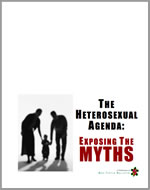 At last, the truth can now be told.
Using the same research methods employed by most anti-gay political pressure groups, we examine the statistics and the case studies that dispel many of the myths about heterosexuality. Download your copy today!
And don‘t miss our companion report, How To Write An Anti-Gay Tract In Fifteen Easy Steps.
 Anti-gay activists often charge that gay men and women pose a threat to children. In this report, we explore the supposed connection between homosexuality and child sexual abuse, the conclusions reached by the most knowledgeable professionals in the field, and how anti-gay activists continue to ignore their findings. This has tremendous consequences, not just for gay men and women, but more importantly for the safety of all our children.
Anti-gay activists often cite the “Dutch Study” to claim that gay unions last only about 1½ years and that the these men have an average of eight additional partners per year outside of their steady relationship. In this report, we will take you step by step into the study to see whether the claims are true.
Tony Perkins’ Family Research Council submitted an Amicus Brief to the Maryland Court of Appeals as that court prepared to consider the issue of gay marriage. We examine just one small section of that brief to reveal the junk science and fraudulent claims of the Family “Research” Council.
 The FBI’s annual Hate Crime Statistics aren’t as complete as they ought to be, and their report for 2004 was no exception. In fact, their most recent report has quite a few glaring holes. Holes big enough for Daniel Fetty to fall through.
“Google” is a trademark of Google Inc.
© Box Turtle Bulletin. All Rights Reserved.
 Posts
Posts  Posts via daily email: