Box Turtle Bulletin
 News and commentary about the anti-gay lobby
“Now you must raise your children up in a world where that union of man and box turtle is on the same legal footing as man and wife…”
News and commentary about the anti-gay lobbyPosts Tagged As: United Methodists
July 16th, 2016
In defiance of a United Methodist ban on ordaining “self-avowed practicing homosexuals,” delegates of the Western Jurisdictional Conference meeting in Scottsdale, Arizona, selected Rev. Karen Oliveto to be the denomination’s first openly gay/lesbian bishop. Ovieto is the senior pastor of Glide Memorial Church in San Francisco, which has a pro-LGBT history that goes back nearly six decades. Ovieto’s election came after two days and seventeen ballots. Two other contenders withdrew just before the seventeenth vote:
“I think at this moment I have a glimpse of the realm of God. I want to thank the candidates who I have journeyed with these past few days, for the grace with which we walked with each other. And know I stand before you because of the work and prayers of so many, especially those saints who yearned to live for this day, who blazed a trail where there was none, who are no longer with us, and yet whose shoulders I stand on,” Oliveto said after her election.
She especially thanked the delegates of the Western Jurisdiction “who dared to live into this Kairos moment. Today we took a step closer to embody beloved community and while we may be moving there, we are not there yet. We are moving on to perfection,” Oliveto said.
She said as along as people “walk by our churches and wonder” if they belong, because of race, sexuality orientation, ethnicity, social class or immigration status, then “we have work to do.”
Bishop Bruce R. Ough, president of the United Methodist Council of Bishops, responded in a statement:
Rev. Oliveto has been described as “an openly lesbian clergyperson.” This election raises significant concerns and questions of church polity and unity.
Our Book of Discipline has clearly delineated processes in place for resolving issues even as complex and unprecedented as this election.
The authority to elect bishops is constitutionally reserved to the jurisdictional and central conferences. Any elder in good standing is eligible for election as a bishop of the church. An elder under an unresolved complaint is still considered to be in good standing. Being a self-avowed, practicing homosexual is a chargeable offense for any clergyperson in The United Methodist Church, if indeed this is the case.
The Council of Bishops is monitoring this situation very closely. The Council does not have constitutional authority to intervene in the election or supervisory processes at either the annual conference, jurisdictional or central conference levels. And, we are careful to not jeopardize any clergy or lay person’s due process by ill-advised comments.
Ough cautioned that “an endless cycle of actions, reactions and counter-reactions is not a viable path and tears at the very fabric of our Connections. …Our differences are real and cannot be glossed over, but they are also reconcilable.”
The United Methodist Reporter provided some background:
Most Annual Conferences in the Western Jurisdiction passed resolutions that said sexual orientation should not be a consideration for qualifications to be bishop. The 2012 Discipline only indicates that “Elders in good standing” are eligible to be Bishop, and many Annual Conferences interpreted that as not a bar to sexual orientation. All of the episcopal candidates in the West are in good standing.
However, some are wondering the implications of this election, given the United Methodist Book of Discipline’s proscriptions against homosexual clergy being ordained as ministers in the UMC. While a complaint could be made, it would have to be filed with the Western Jurisdiction College of Bishops and they generally been more inclusive of LGBTQ persons in ministry in the past.
Rev. Oliveto was formally consecrated this afternoon at Paradise Valley UMC in Scottsdale.
June 24th, 2014

Rev. Frank Schaefer with his son Tim
Last year a regional court of the United Methodist Church expelled Frank Schaefer from ministry.
Schaefer was a pastor of a small church in rural Pennsylvania when he officiated at his son’s wedding to another man. He didn’t make a big statement about it, and no one seemed to know or care until years later. But right before the statute of limitations on violations of the church rules ran out, a disgruntled parishioner complained to his Bishop and Schaefer was brought on trial.
There a jury of 13 pastors found him guilty of “conducting a ceremony that celebrates same-sex unions” and “disobedience to order and discipline of the Methodist Church.” They sentences him to a 30 day suspension, and insisted that he promise to never officiate at same-sex weddings again.
But Schaefer has two more gay children and refused to promise to reject their future marriages, and so he was defrocked.
This didn’t actually decrease Schaefer’s ministry. He was invited by serve in a quasi-pastoral role by the Los Angeles Diocese and has been in much demand around the country as a guest minister in Methodist (and other) Churches who wished to show support for inclusion and equality.
And Schaefer has never agreed that his action was contrary to the spirit of his faith. Nor has he taken the ruling lying down. Schaefer appealed the decision to a higher Methodist court, insisting that a failure to promise is not a punishable offense. The court agreed (NYTimes)
A United Methodist Church appeals committee — a nine-member panel made up of laypeople and clergy members — said Tuesday that it had decided to overturn the ouster of the Rev. Frank Schaefer, who with three gay children and a determination to celebrate their relationships has become an unexpected champion of gay men and lesbians in church life.
The panel deemed the defrocking to be an illegitimate effort to punish Mr. Schaefer for his refusal to promise not to preside at another same-sex wedding.
The decision is likely less based in the language of the Book of Order and more in the increasing refusal of American Methodists to be held to the anti-gay votes of international members of the global denomination. And it does suggest that at some point the US’ second largest Protestant denomination was schism.
The next assembly of the United Methodist Church is in 2016. Supporters of gay equality will push hard for a change in the denomination’s rules, and conservatives will continue to rally support from Asia and Africa in hopes of holding to anti-gay positions. It seems increasingly unlikely that anyone can stand outside the debate or not select sides. And irrespective of the outcome, a separation seems likely.
As for Schaefer, now that he has been “refrocked” he will be serving as pastor of a UMC church in Santa Barbara, California.
April 30th, 2014
A majority of United Methodist Churches in the United States have, for several years, attempted to be inclusive and supportive of gay Methodists and same-sex couples.
However, unlike most American denominations, the UMC is a global organization and representatives from Africa and Asia join local conservative churches to vote down progress on these issues. It is highly likely that this will soon lead to a division in the denomination and, indeed, this past year has seen an escalation of inclusive pastors defying the mandates of the Methodist Book of Discipline and publicly officiating at same-sex weddings.
A new move by the denomination may play a large role in schism (Religion News Service)
Same-sex partners can’t marry in a United Methodist Church. But if one of the spouses works at one of the denomination’s 13 general agencies, the couple can get benefits if state laws allow it.
The decision, made at last week’s meeting of the UMC’s Judicial Council in Little Rock, Ark., affirms one made in October by the church’s General Council on Finance and Administration, which expanded the definition of “spouse” to include same-sex spouses and partners.
March 11th, 2014

Bishop Martin McLee
The United Methodist Church has been split for decades over the issue of where gay people fit within the body of faith. Many churches, even districts, have made loud gestures of inclusion and advocated for equality. But the UMC is a global, rather than national, denomination and representatives from Asia and Africa have allied with conservatives in the US to block advancement and inclusion. And so gay members remain banned from the clergy and officiating at same-sex marriages is forbidden.
Consequently, there is a growing sense of frustration by many of the UMC laity and clergy and an increasing likelihood of schism. This has been exacerbated by the ferocious and punitive responses by conservative Methodists who, holding the advantage of votes from foreign delegates, have arrogantly imposed their values on the majority of American Methodists.
The latest example was in November when a church trial in Pennsylvania convicted Frank Schaefer of violating the Methodist Book of Discipline by officiating at his son’s wedding. Those leading the charge were vile in their attack and succeeded in having Schaefer de-credentialed.
In response, Minerva Carcaño, UMC Bishop of Los Angeles, invited Schaefer to Southern California to work out of her office and to minister, though in a somewhat lesser capacity.
But while Schaefer’s trial caught the attention of the church and the public, it promised to pale in comparison to the scheduled trial of another Methodist minister accused of breaking the church’s doctrine by officiating at his son’s wedding. Schaefer was somewhat obscure, but Rev. Dr. Thomas W. Ogletree is not. (Yale)
Professor Ogletree has served as dean of Yale Divinity School (1990–96) and the Theological School at Drew University (1981–90). He was director of graduate studies in religion at Vanderbilt University (1978–81). He is the author of five books… He was also one of the principal drafters of the current United Methodist Disciplinary statement on doctrinal standards. Under the auspices of a Guggenheim Fellowship and a Cross-Disciplinary Fellowship from the Society for Values in Higher Education, he pursued postdoctoral studies at the Free University in West Berlin, and at the Center for Advanced Studies at the Sorbonne in Paris. He is a life member of Clare Hall at Cambridge University.
Defrocking a pastor of a rural Pennsylvania church is one thing. But seeking to expel the former dean of Yale Divinity School from your denomination commands global news coverage, and not in a way that makes your church look more Christian.
And so, with less than a week before trial, the bishop responsible for Ogletree’s trial made a dramatic decision. (NYTimes)
Bishop McLee, who oversees about 460 churches in lower New York State and Connecticut, agreed to drop all charges against Dr. Ogletree; in exchange, he asked only that Dr. Ogletree participate in a dialogue about the church and its stance on matters of sexuality. Promoting dialogue, the bishop said, could be a model for other United Methodist bishops to follow.
“While many insist on the trial procedure for many reasons, I offer that trials are not the way forward,” Bishop McLee said in a statement attached to the resolution of Dr. Ogletree’s case. “Church trials result in harmful polarization and continue the harm brought upon our gay and lesbian brothers and sisters.”
McLee said that he would not prosecute cases in his district in which UMC ministers violated the Book of Discipline by officiating at same sex weddings, effectively giving permission to begin UMC gay marriages in New York.
It is too soon to know whether other bishops follow McLee’s lead, but I think it likely. And the consequence will be either to disunite the Methodists, or to result in an uneasy alliance under which each bishop or church can follow their conscience and the conservatives will fade into the corners. But irrespective of the eventual consequence to the denomination, to gay and lesbian Methodists this is an exciting and joyous moment.
January 20th, 2014
Today the Oklahoma United Methodists for Equality ran the following ad in the Tulsa World:

November 20th, 2013
 Having been found guilty yesterday of breaking the Methodist Book of Discipline by officiating at his son’s wedding, United Methodist minister Frank Schaefer went back before the jury today to be sentenced. But today Schaefer was defiant and dared them to do their worst. (NY Daily News)
“I have to minister to those who hurt and that’s what I’m doing,” said Schaefer.
The prosecutor, the Rev. Christopher Fisher, invited Schaefer to “repent of your actions” and pledge never again to perform a homosexual union.
“I cannot,” Schaefer replied.
His refusal to submit to the church law infuriated his accusers.
Jon Boger, who filed the initial complaint against Schaefer, was outraged by the pastor’s recalcitrance. The career Naval officer grew up in Zion United Methodist Church of Iona, the church that Schaefer has led for 11 years.
“Frank Schaefer sat here and openly rebuked the United Methodist Church, its policies, standards and doctrines,” Bolger said when called as a rebuttal witness. “He should no longer be in service as a minister of the United Methodist Church, not at Iona, not anywhere else.”
But Schaefer did not back down. He chided the church about hate speech and insisted that it needs to stop treating gays as “second class Christians”. In closing, he put on a rainbow colored stole, a symbol within the church of gay supporters, and said,
I cannot go back to being a silent supporter. I must continue to be in ministry with all people and speak for LGBTQ people. Members of the jury, before you decide my penalty, you need to know I wear his rainbow stole as a visible sign that this is who I am called to be.
After deliberation, the jury sentenced him to a 30 day suspension, a very lenient sentence considering the subject and Schaefer’s refusal to repent and his pledge to take this fight as his mission.
They warned him, however, not to break any rules within 30 days or he’d lose his credentials. This story may be far from over.
November 19th, 2013
Yesterday the United Methodist Church put Rev. Frank Schaefer on trial. (WaPo)
By the end of the day, the rare jury of 13 Methodist pastors had found Schaefer guilty on two charges: “conducting a ceremony that celebrates same-sex unions” and “disobedience to order and discipline of the Methodist Church.” On Tuesday morning, the jury reconvened to devise Schaefer’s penalty for agreeing in 2006 to marry his son Tim, who earlier had contemplated suicide over his homosexuality.
Schaefer’s punishment will be decided today and could range from a reprimand to expulsion. And the prosecutor is seeking as severe a punishment as possible. (Sun Times)
The Rev. Christopher Fisher, who is serving as the church’s prosecutor, urged the jury in his opening statement to consider whether Schaefer will “repent of and renounce his disobedience to the (Methodist Book of) Discipline,” and promise to obey the denomination’s book of law and doctrine in the future.
…
Fisher told jurors that Schaefer’s disobedience couldn’t go unpunished.“Ministers are not free to reinterpret (their) vows according to personal preference,” said Fisher, whose closing argument condemning homosexuality prompted Schaefer’s supporters to stand in silent protest in the gymnasium that served as a temporary courtroom.
“As a father, I understand the desire to show love and support to my children,” Fisher said. “It’s not always true we can do for our children everything they want us to do. True love draws boundaries.”
This line of attack does call into question the extent to which the denomination is sincere in it’s welcome and pledge of ministry to gay persons. If the crime was breaking a rule, that is one thing; but if the punishment is based on opposition to homosexuality, that is quite another.
And, finally, we now have learned the motivation behind the accuser. The mother of Jon Bolger, the man who filed the claim, was recently removed from her position as choir director.
November 18th, 2013
One of the more contentious battleground over religious acceptance of same-sex marriage is within the United Methodist Church.
Unlike many other denominations, the UMC is not an American denomination; rather it is a global church with about a third of it’s membership outside the US. Ever four years, a convention of representatives meets to set it’s doctrines and policies and the issue of gay Methodists, pastors, and marriage are regularly debated. And while many Methodists are fiercely supportive of our rights, both civil and religious, the delegates from Africa and Asia uniformly oppose any movement towards acceptance.
In 2012, with 39% of delegates from outside the US, the church again confirmed the position that “homosexuality is incompatible with Christian teaching” and during scheduled ‘holy conversations’ on the subject, a number of participants felt that they were bullied and derided by those who oppose inclusion.
After the convention, the many within the church in the US began a stage of discontent. Several regional conferences express dissatisfaction with the decision, and in Washington and Minnesota they encouraged voters to support marriage equality on the ballot.
Many others, supported by retired Bishop Melvin Talbert, are rebelling against the rules. In Pennsylvania, over 30 UMC ministers pledged to defy the Methodist Book of Discipline and to jointly officiate at a same-sex wedding. They are making the stand in support of a fellow Pennsylvania minister, Frank Schaefer, who went on trial today.
Six years ago Schaefer’s son Tim asked him to officiate at his wedding. Schaefer agreed and for six years no one complained. Then a few weeks before the statute of limitations ran, a congregant who was “dismayed and shocked” to learn about the event pressed charges. (yahoo)
A United Methodist minister who officiated at his son’s same-sex wedding pleaded not guilty Monday to charges that he broke his pastoral vows.
The Rev. Frank Schaefer of Lebanon entered his plea at the beginning of a high-profile church trial in southeastern Pennsylvania that is rekindling debate over the denomination’s policy on gay marriage.
Schaefer contends that the Methodist Book of Discipline also directs pastors to address the needs of their flock, including gay members and that this was an act of love, not of rebellion.
This trial is being closely watched both within and without the church, including by several other ministers who are also up for trial.
Depending on the outcome of this trial – and others – the United Methodist Church could be in for some tumultuous years. The church is growing rapidly in Africa and the Philippines while it is decreasing in the United States. While support is growing locally, the delegation is increasingly from parts of the world where gays are treated with open contempt, allowing the anti-gay minority in the US to punish those who stand up for justice and mercy.
November 6th, 2013
 Retired Bishop Melvin Talbert is one of a number of United Methodist Ministers who are not only speaking out for equality, but defying their denomination to do so. (The Tennesseean)
Despite warnings from his denomination that he’d be violating the faith’s Book of Discipline, Bishop Melvin Talbert traveled from Nashville to near Birmingham, Ala., to perform the Oct. 26 wedding of Joe Openshaw and Bobby Prince. They were legally married Sept. 3 in Washington, D.C., but wanted a church wedding.
Talbert sees his involvement as an act of civil disobedience for a moral cause, and if you want to disagree, you’d better have some pretty big boots.
He volunteered to perform same-sex weddings and urged fellow clergy to do the same. He likens his work to the nation’s civil rights movement, a comparison he doesn’t make lightly. Talbert, now 79, shared an Atlanta jail cell with Martin Luther King Jr. in October 1960 after being arrested at an Atlanta lunch counter sit-in.
Talbert was one of the student organizers who invited King to join their protest. He spent three days and nights in the cell with King, which molded the direction of his life.
See also the Huntsville Times
July 6th, 2012
… the United Methodist Church in Washington votes to endorse the marriage referendum, Referendum 74. (SeattlePI)
The church’s Pacific Northwest Annual Conference passed a resolution worded to “encourage all people to approve Referendum 74 so that the Marriage Equality Act can be put into law.”
June 8th, 2012
There is a fairly new but growing trend in Christianity: moderate Christians who have finally decided that far right conservatives will not be the only face of the faith. I’ve been saying for a while that if moderates don’t speak up that they have only themselves to blame if the unchurched think that all Christians are extremists and homophobes. But now they are speaking up.
In Minnesota, ministers from different denominations have joined together to oppose the proposed marriage ban. (Necn.com)
Among the latter was the Rev. Kelly Chatman, lead pastor of Redeemer Lutheran Church in Minneapolis. He took take a public stand against the amendment, he said Friday, “because I don’t want that other voice to be the only voice, I don’t want same-sex people to see all churches that way.
“I’m doing this because it’s important people see a pastor who believes that God is loving to everybody.”
…
Plenty of prominent Minnesota denominations have come out squarely against the amendment. Five Minnesota synods of the Evangelical Lutheran Church in America have approved formal resolutions in opposition to the marriage amendment. Earlier this month, the general assembly of Minnesota’s United Methodists overwhelmingly approved a resolution against the amendment.
This is so important for us for two reasons: first, it is essential that people not believe that the position of all people of faith is to support discrimination or that this is what God wants (many who never darken a church door will do “what God wants” on an issue they are not real clear on).
But as important is that when ministers begin to see this as a matter of justice and what they believe to be consistent with the call of Christ, they can get pretty worked up about it. And they can inspire their congregations to become allies for equality. And little old Methodist church ladies can reach people we have no access to with the message of “well, I just believe God wants us to treat gay people the way we want to be treated”. And that is a very powerful message indeed.
And I think that when compared to the other voices, those who call for equality, justice, and mercy have a natural advantage. They don’t sound like this:
The Rev. Bryan Pedersen of Sacred Heart Catholic Church in Robbinsdale, said he’s been approached by parishioners at odds with his own public stand for the amendment.
“Every one of them will be accountable to God for how they’re informed by their conscience,” Pedersen said. “The definition of marriage is non-negotiable.”
March 8th, 2012
Within the more than 2 billion people on the planet who fall under the very diverse umbrella of Christianity, there are a good many voices who claim to speak for the founder of the faith. What Would Jesus Do is not only a trite slogan but a question that many religious leaders seek to answer, often with “exactly what I want to do”.
But sometimes that isn’t a question without an answer. If the gospels reflect the attitudes and theological positions expressed by Jesus, then sometimes it’s really pretty clear what Jesus would do, or say, or expect. Take, for example, this small disagreement between a Methodist minister and the Catholic Diocese of Sacramento.
For decades Francis House in Sacramento has served the needy of the community. The Bee describes them thusly:
Each morning, dozens of poor people line up at Francis House, in Sacramento’s homeless services epicenter on C and 14th streets, for help with basic services such as housing and transportation. Now in its 42nd year, the organization is one of the largest homeless services agencies in the Sacramento region, serving upward of 25,000 people. It has an annual budget of about $500,000.
More than a soup kitchen or homeless shelter, Francis House is partly referral agency for address substance abuse, legal issues, and basic needs and partly an effort to provide the immediate necessities for people to become employable or safe. They do things like provide bus tokens, training in what is expected from employers, and yes get food and shelter to individuals and families in crisis. But, recognizing that while food may address hunger, it cannot change a life, a significant part of their work is counseling.
And though some of this is possible through programs funded by various levels of government, the majority is contributions from individuals and organizations. With three full time employees, three part time, and about 50 volunteers, they try to put their faith into action to change the world for those who most need change. The final paragraph in their Form 990 listing of accomplishments puts it this way:
Through God’s grace and the generous support of our community, we strive to serve the poorest among us, as worthy of His grace and His love regardless of circumstances. As we open our hearts to healing and growth we strive to assist our guests to discover a better life.
(I love the language that sees the necessity for healing and growth in the hearts of those who are not disadvantaged)
The group is not denominationally driven and receives funding from a wide variety of sources, one of which was an annual $7,000 to $10,000 contribution from the Catholic Church. But in December 2010 the director for the past 2 decades died from a heart attack and the new director just doesn’t live up to the Church’s expectations.
You see, before Rev. Faith Whitmore became the executive director, when she was still the senior pastor at St. Mark’s United Methodist Church, she expressed her personal views on some issue and her personal views are in disagreement with the declarations of the Vatican.
No, these views were not about liturgy or sacraments. They didn’t address papal infallibility, transubstantiation, or the veneration of Mary. No problem arose about catechism, form of baptism, or even whether each could consider the other a brother or sister in Christ.
But the issues about which Whitmore expressed opinion go to the heart of the differences between where the United Methodist Church and the Roman Catholic Church today: the extent to which each church believes it has a claim on the unquestioning obedience of those around them. Whitmore expressed opinions which “publicly oppose Catholic teaching” and that makes her and Francis house unacceptable. And these teachings, unlike the mystical matters of faith that purported divide denominations, are the matters which define the approach of each.
Within her own denomination, she has been a strong advocate of same-sex marriage. In 2008, during a short period in which gay marriage was legal in California, Whitmore openly defied church law by marrying same-sex couples. She has said publicly that she supports a woman’s right to obtain an abortion.
Gay marriage and abortion. These are the issues with which one MUST conform to Catholic teaching (a position that would disqualify most Catholics). And the difference is not even whether each should be a part of sacrament or even recognized as morally acceptable, the difference is what society can and should demand of its citizens and to whom it should defer.
It should be noted that Whitmore does not hold these views despite her faith. These are not matters of a secular nature, but rather are to her matters of justice and mercy situated at the heart of Christ and his message.
And so here we have two intractable positions, both integral to their faith, both established and bound by what each party believes is the will of God. Each believes that their view is the holy and righteous position.
And I can see how each came to hold their views and why they believe them to be moral. But views are not all we are discussing. And when we look at the priorities chosen and the behaviors resulting from a clenched hold to these views, I cannot see how one of these two parties can see themselves as being ambassadors of Christ.
Because one of these parties has been on a consistent path: if society will not conform to their doctrine, they will not run orphanages. Civil law must follow church law or they will not administer governmental aid programs. And now, if anyone dare differ with their beliefs, they will not feed the hungry or provide counsel for those seeking to reestablish themselves in the working world.
There are many issues on which Christian voices can claim to speak for Christ, but on this one, I’ll let Jesus speak for himself.
“Then the King will say to those on his right, ‘Come, you who are blessed by my Father; take your inheritance, the kingdom prepared for you since the creation of the world. For I was hungry and you gave me something to eat, I was thirsty and you gave me something to drink, I was a stranger and you invited me in, I needed clothes and you clothed me, I was sick and you looked after me, I was in prison and you came to visit me.’
“Then the righteous will answer him, ‘Lord, when did we see you hungry and feed you, or thirsty and give you something to drink? When did we see you a stranger and invite you in, or needing clothes and clothe you? When did we see you sick or in prison and go to visit you?’
“The King will reply, ‘Truly I tell you, whatever you did for one of the least of these brothers and sisters of mine, you did for me.’
“Then he will say to those on his left, ‘Depart from me, you who are cursed, into the eternal fire prepared for the devil and his angels. For I was hungry and you gave me nothing to eat, I was thirsty and you gave me nothing to drink, I was a stranger and you did not invite me in, I needed clothes and you did not clothe me, I was sick and in prison and you did not look after me.’
“They also will answer, ‘Lord, when did we see you hungry or thirsty or a stranger or needing clothes or sick or in prison, and did not help you?’
“He will reply, ‘Truly I tell you, whatever you did not do for one of the least of these, you did not do for me.’
June 30th, 2011
 When I wrote about the United Methodists who are up in arms in Minnesota over marriage equality, some readers thought I was mocking them. This is the farthest from the truth: I respect and admire them.
But truly, Methodists tend to be a steady bunch. Very nice people, but just not all that excitable.
But every once in a while an issue comes along that fires them up and gets them agitating for change. And when they do, change happens. Which is why I am delighted that the United Methodist marriage movement is spreading. (Although, yes, I’m amused as well.)
Inspired by the Minneapolis letter, Methodists in New England are signing on to their own letter of defiance, declaring that they too will “offer the grace of the church’s blessing to any prepared couple desiring Christian marriage.” And they got a lot more support than expected. (Portland Press Herald)
“We used the exact same statement they used in Minnesota, and we invited like-minded colleagues to sign with us” during the conference, he said.
He hoped for 12 people to stand with them. Fifty signed the statement on the first day.
That number grew to 90 by the end of the conference, and it now stands at 123, about one in nine clergy members in the New England Conference.
Now it may not seem that one in nine is significant enough to represent drastic change. But this is one in nine willing to sign a letter of defiance, expressing intent to violate the rules of the church, declaring that this issue is one of such importance that unity and formality fall secondary. In other words, this is ten percent of the church that is pissed off, fired up, and ready to love their opposition into submission.
And never ever underestimate the power of a pissed off Methodist.
June 3rd, 2011
How do you piss off a United Methodist minister?
Seriously? Have you ever met a United Methodist minister? Not exactly an excitable bunch.
But it seems to me that some UMC ministers have found a cause around which they are willing to be radical militant activists: marriage.
Now the UMC has not adopted a same-sex marriage rite. It hasn’t even approved Methodist ministers being allowed to conduct marriages. But those in the church who believe in equality have become rather, shall we say, disinclined to quietly wait for change.
I first noticed this in 2008 when California’s two conferences (Northern and Southern) thumbed their nose at their national rules and said “Fine, so our current pastors are banned from conducting marriages… well, then, we’ll vote to encourage and support retired ministers conducting same-sex marriages. That ain’t breaking no rules!”
And then this past weekend, the Baltimore – Washington Conference passed the following resolution, ensuring that this issue will be brought up next April at the national convention.
“[I]n those civil jurisdictions where homosexual persons have been granted the right to same gender marriage or civil union, ceremonies celebrating those marriages or unions may be conducted in our churches and by our ministers, the decision being the right and responsibility of the pastor.”
That wasn’t expected to pass. But the pro-gay ministers are refusing to sit still and respect the hesitations of others.
But that wasn’t really the example of how you piss off a UMC minister. That’s just progress. To really piss one off, you have to propose a marriage ban.
During the Methodists’ annual conference in St. Cloud this week, about 40 clergy members signed a statement saying they would “offer the grace of the Church’s blessing to any prepared couple desiring Christian marriage.”
“Groups have been meeting who want to challenge parts of the United Methodist polity with which we disagree — that which relates to the lesbian, gay, transgender, and bisexual community and Christian marriage,” said the Rev. Bruce Robbins, who serves at Hennepin Avenue United Methodist Church in Minneapolis.
“With the possibility of a constitutional amendment in the state of Minnesota [defining marriage as limited to heterosexual couples], this seems important.”
I can just see the indignation. “A ban? Well, I’m so angry I’ll just, I’ll just… offer the grace of the Church’s blessing, by golly! That’s what I’ll do!”
Don’t you love it when the Methodists get all defiant and activisty?
………
UPDATE: The Christian Post says that the number of signatories has now increased to 70. They are really pissed.
Update 2: There seems to be some confusion due to the tone of the commentary. I am not mocking these Methodist ministers. They are taking rather large risks, and are true heroes.
May 6th, 2011
 That is the message from the Central United Methodist Church in Toledo, Ohio. It’s part of a larger campaign which the church calls “a prophetic call to the Church to get out of the business of marginalizing gay and lesbian persons from the Church, and to welcome them as full members. The electronic billboard lit up with the message on April 25, and the church has secured the billboard for one month. They’d like to extend it if they can raise enough money.
[Hat tip: Lez Get Real]
Featured Reports
 In this original BTB Investigation, we unveil the tragic story of Kirk Murphy, a four-year-old boy who was treated for “cross-gender disturbance” in 1970 by a young grad student by the name of George Rekers. This story is a stark reminder that there are severe and damaging consequences when therapists try to ensure that boys will be boys.
When we first reported on three American anti-gay activists traveling to Kampala for a three-day conference, we had no idea that it would be the first report of a long string of events leading to a proposal to institute the death penalty for LGBT people. But that is exactly what happened. In this report, we review our collection of more than 500 posts to tell the story of one nation’s embrace of hatred toward gay people. This report will be updated continuously as events continue to unfold. Check here for the latest updates.
In 2005, the Southern Poverty Law Center wrote that “[Paul] Cameron’s ‘science’ echoes Nazi Germany.” What the SPLC didn”t know was Cameron doesn’t just “echo” Nazi Germany. He quoted extensively from one of the Final Solution’s architects. This puts his fascination with quarantines, mandatory tattoos, and extermination being a “plausible idea” in a whole new and deeply disturbing light.
On February 10, I attended an all-day “Love Won Out” ex-gay conference in Phoenix, put on by Focus on the Family and Exodus International. In this series of reports, I talk about what I learned there: the people who go to these conferences, the things that they hear, and what this all means for them, their families and for the rest of us.
Prologue: Why I Went To “Love Won Out”
Part 1: What’s Love Got To Do With It?
Part 2: Parents Struggle With “No Exceptions”
Part 3: A Whole New Dialect
Part 4: It Depends On How The Meaning of the Word "Change" Changes
Part 5: A Candid Explanation For "Change"
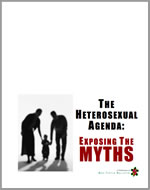 At last, the truth can now be told.
Using the same research methods employed by most anti-gay political pressure groups, we examine the statistics and the case studies that dispel many of the myths about heterosexuality. Download your copy today!
And don‘t miss our companion report, How To Write An Anti-Gay Tract In Fifteen Easy Steps.
 Anti-gay activists often charge that gay men and women pose a threat to children. In this report, we explore the supposed connection between homosexuality and child sexual abuse, the conclusions reached by the most knowledgeable professionals in the field, and how anti-gay activists continue to ignore their findings. This has tremendous consequences, not just for gay men and women, but more importantly for the safety of all our children.
Anti-gay activists often cite the “Dutch Study” to claim that gay unions last only about 1½ years and that the these men have an average of eight additional partners per year outside of their steady relationship. In this report, we will take you step by step into the study to see whether the claims are true.
Tony Perkins’ Family Research Council submitted an Amicus Brief to the Maryland Court of Appeals as that court prepared to consider the issue of gay marriage. We examine just one small section of that brief to reveal the junk science and fraudulent claims of the Family “Research” Council.
 The FBI’s annual Hate Crime Statistics aren’t as complete as they ought to be, and their report for 2004 was no exception. In fact, their most recent report has quite a few glaring holes. Holes big enough for Daniel Fetty to fall through.
“Google” is a trademark of Google Inc.
© Box Turtle Bulletin. All Rights Reserved.
 Posts
Posts  Posts via daily email: