Box Turtle Bulletin
 News and commentary about the anti-gay lobby
“Now you must raise your children up in a world where that union of man and box turtle is on the same legal footing as man and wife…”
News and commentary about the anti-gay lobbyJune 12th, 2013
Exodus International has issued the following statement:
The Exodus International Board of Directors officially voted to withdraw from the Exodus Global Alliance (EGA) May 28, 2013 after 18 years of membership. Exodus International was a founding member of EGA in 1995. This change in relationship releases both ministries to serve the Lord, the Church and their constituents in ways that honor their respective calling.
EGA is the worldwide coalition of “Exodus” ministries, which seek to work together under one umbrella structure. In 2005 Exodus Europe withdrew from EGA, as well.
Exodus International wishes to thank Bryan Kliewer, the EGA Board and network of ministries for their longstanding partnership and friendship.
There has been longstanding confusion over the relationship between Exodus International and Exodus Global Alliance. Despite having “International” in its name, Exodus International has mainly confined its organizational activities to North America, although several Exodus officers, board members and member ministries have traveled throughout the world to participate in conferences, church missions, and other activities to spread the ex-gay message. Exodus Global Alliance, on the other hand, has operated as an international umbrella organization and resource for ministries around the world, similar to the role that Exodus International has played in North America.
Organizationally, the two organizations are separate, with separate leadership and governing boards, with Exodus International being a member organization of the Exodus Global Announcement But with this announcement of Exodus International’s departure from Exodus Global Alliance, the confusion between the two organizations will undoubtedly be compounded as they both continue to share the Exodus name.
This announcement is the latest in a long string of developments over the past year and a half, in which Exodus International president Alan Chambers has steered the organization through several changes in messaging and tone. The changes began with his acknowledgment in January 2012 that, “the majority of people that I have met, and I would say the majority meaning 99.9% of them, have not experienced a change in their orientation.” Later that month, Chambers withdrew his organization’s support for the particular from of conversion therapy known as “reparative therapy.” Chambers came under increasing criticism from several key players in the ex-gay movement, and many member ministries have withdrawn from Exodus to form the much more hard-core Restored Hope Network. Joe Dallas, who had led Exodus International from 1991 to 1993 and has been closely identified with Exodus as a conference speaker throughout the past two decades, was one of the founding members of RHN. Last week, he announced that he was leaving Exodus International.
So far, there has been no comment from Exodus Global Alliance.
In related news, it was announced last week that Our America, with Lisa Ling will air an episode on June 20 on Orah Winfrey’s OWN network, in which Chambers will speak with several ex-gay survivors and offer an apology:
The story of Exodus International, the LGBT men and women who have been affected by the organization and the nationwide dialogue that surrounds this topic continues in an Our America special report.
For almost 40 years, Exodus International claimed to offer a “cure” for homosexuality. Alan Chambers, the leader of Exodus, decided last year to stop endorsing the controversial practice of gay-reparative therapy. And now, he has a new message: an apology.
In a special episode, Lisa Ling is joined by a group of survivors of the condemned and damaging practice of “reparative therapy” as they confront Alan Chambers. Chambers recently asked Ling to help orchestrate an opportunity in which he could formally apologize to those who felt deceived and defrauded by Exodus’ practices and to announce that the organization will cease to be an “ex gay” organization.
Tune in Thursday, June 20th at 10/9c for a special presentation of this powerful report.
June 12th, 2013
TODAY’S AGENDA:
Pride Celebrations This Weekend: Anchorage, AK; Baltimore, MD; Baton Rouge, LA; Bisbee, AZ; Boise, ID; Butte, MT; Chemnitz, Germany; Denver, CO; Edinburgh, UK; Erie, PA; Flagstaff, AZ; Iowa City, IA; Kalamazoo, MI; Lancaster, PA; Ljubljana, Slovenia; Louisville, KY; Luleå, Sweden; Lyon, France; Memphis, TN (Black Pride); Münster, Germany; Nantes, France; Nashville, TN; Oldenburg, Germany; Pittsburgh, PA; Portland, OR; Portland, ME; Providence, RI; Rome, Italy; Sacramento, CA; Saskatoon, SK; Sitges, Spain; Spencer, IN; Strasbourg, France; Syracuse, NY; Thessaloniki, Greece; Thunder Bay, ON; Toulouse, France; Venice, Italy; Vienna, Austria; Warsaw, Poland; Zagreb, Croatia.
AIDS Walks This Weekend: London, UK.
Other Events This Weekend: Lesbian and Gay Stadtfest, Berlin, Germany; Out In the Vineyard Gay Wine Weekend: Sonoma, CA; Tel Aviv LGBT International Film Festival, Tel Aviv, Israel; Bush Garden Gay Days, Williamsburg, VA.

TODAY IN HISTORY:
Loving v. Virginia: 1967. Mildred Jeter and Richard Loving were an unusual couple. They had long crossed the racial barrier as friends in rural Central Point, Virginia: she was Black and Native American, he was white. But friendship turned to dating, and when Mildred became pregnant at the age of 18 in 1958, they decided to go to Washington, D.C. to elope. When they returned home, a group of police officers invaded their house late at night hoping to catch them in the act of having sex (which would have been a crime because of their racial differences). Mildred pointed to the marriage license that they had hung on the wall, hoping that it would protect them. Little did she know, but that license was proof that they had committed another crime. Virginia’s Racial Integrity Act of 1924 prohibited any “colored” person with so much as one drop of African American or Indian blood from marrying a white person. Miscegenation was a felony, punishable by a prison sentence of between one and five years. The couple pleaded guilty on January 6, 1959, and they were sentenced to one year, with the sentence suspended for 25 years on the condition that they left Virginia.
The Lovings moved to D.C., and in 1963 the ACLU began a series of motions and lawsuits alleging that Virginia’s Racial Integrity Act violated the Fourteenth Amendment of the U.S. Constitution. Those lawsuits eventually made their way all the way up to the U.S. Supreme Court. On June 12, 1967, the Supreme Court struck down Virginia’s anti-miscegenation law, along with similar laws in fifteen other states. In the unanimous ruling, the Court held that “Marriage is one of the ‘basic civil rights of man,’ fundamental to our very existence and survival.” Despite this ruling, anti-miscegenation laws remained on the books for several years to come, despite their being unenforceable. In 2000, Alabama voters approved a ballot initiative to repeal its anti-miscegenation law, although even then more than half a million — 40% — voted to keep it.
Mildred and Richard were never political people. After the Supreme Court victory, the couple returned to Virginia and raised three children. Richard died in 1975 at the age of 41 when their car was struck by a drunk driver. Mildred lost her right eye in the accident. She passed away in 2008 of pneumonia at the age of 68. But a year before she died, she issued a statement on the 40th anniversary of Loving v. Virginia, in which she saw the fight for the freedom to marry as unfinished business:
My generation was bitterly divided over something that should have been so clear and right. The majority believed that what the judge said, that it was God’s plan to keep people apart, and that government should discriminate against people in love. But I have lived long enough now to see big changes. The older generation’s fears and prejudices have given way, and today’s young people realize that if someone loves someone, they have a right to marry.
Surrounded as I am now by wonderful children and grandchildren, not a day goes by that I don’t think of Richard and our love, our right to marry, and how much it meant to me to have that freedom to marry the person precious to me, even if others thought he was the ‘wrong kind of person’ for me to marry. I believe all Americans, no matter their race, no matter their sex, no matter their sexual orientation, should have that same freedom to marry. Government has no business imposing some people’s religious beliefs over others. Especially if it denies people’s civil rights.
I am still not a political person, but I am proud that Richard’s and my name is on a court case that can help reinforce the love, the commitment, the fairness, and the family that so many people, black or white, young or old, gay or straight, seek in life. I support the freedom to marry for all. That’s what Loving, and loving, are all about.

TODAY’S BIRTHDAY:
Jim Nabors: 1930. The Sylacauga, Alabama, learned to sing at his high school and church, and didn’t get into acting until he attended the University of Alabama. After graduating, he eventually landed his first job in television: cutting film for a television station in Chattanooga. He eventually decided to move to Los Angeles because of his asthma, where he began singing and acting in a local Santa Monica cabaret. That’s where he developed a character similar to the one we would later come to know as Gomer Pyle: a naive, golly-gee southern bumpkin with a high-pitched voice and thick accent would would launch into a nearly operatic baritone when singing. That’s where Andy Griffith discovered him, and signed to play a gas station attendant on The Andy Griffith Show. Nabor’s character was so popular that he soon ended up with his own spin-off, Gomer Pyle, U.S.M.C, which ran for five seasons from 1964 to 1969.
Nabors was among a handful of actors who were openly gay among friends and co-workers, but who were never put publicly. “I haven’t ever made a public spectacle of it. Well, I’ve known since I was a child, so, come on. It’s not that kind of a thing. I’ve never made a huge secret of it at all,” Nabors said recently. What made Nabors so unusual is that he never bothered to play the game of “dating” women for publicity’s sake. There was one rumor going around that Nabors had “married” Rock Hudson in the early 1970’s, sparked by a joke invitation that went out among friends which said that Hudson wold take the last name of Nabor’s character and become “Rock Pyle.” When fan magazines found the invitation, they turned the joke into a story, causing embarrassment for both men. It’s also the only time I know of when Nabors gave the standard 1960s response to why he wasn’t married. “I love kids,” he said. “But I’ve been so busy with my career that I really haven’t given marriage much thought.”
After CBS decided to re-vamp its lineup and cancel all of its “cornball” programs (which constituted almost all of the network’s comedic lineup by 1969), Nabors briefly hosted his own variety show and made several guest appearances on other programs, including a few children’s television programs. But by the mid-1970s, he was pretty much done with TV, and move to Hawaii, where he and his longtime partner and now husband, Stan Cadwallader, have made their home.
If you know of something that belongs on the agenda, please send it here. Don’t forget to include the basics: who, what, when, where, and URL (if available).
And feel free to consider this your open thread for the day. What’s happening in your world?
June 11th, 2013

Police break up a fight between LGBT activist and anti-gay protester. (Photo: Reuters/Maxim Shemetov)
Russia’s State Duma gave its unanimous approval today to a federal law banning “propaganda of non-traditional sexual relations” among minors. The law prohibits advocating the moral equivalency of gay relationships to straight ones, as well as the distributing of material advocating for gay rights. The Duma vote was 434-0, with one abstention. Similar bans are already in place in several Russian regions and the city of St. Petersburg. The bill now goes on to the Federation Council, Russia’s upper house of Parliament, where passage is expected. As RIA Novosti reported:
There are a total of 450 deputies in the State Duma, and a majority of 226 was needed for the bill to pass.
If the bill is signed into law by Putin, the “promotion of non-traditional sexual relationships” will be punishable by fines from 4,000 ($120) to 5,000 rubles ($160) for individuals, from 40,000 ($1,200) to 50,000 ($1,500) for officials, and from 800,000 ($25,000) to 1 million rubles ($31,000) for organizations.
There will also be tougher fines for promoting such relationships in the media or on the Internet: from 50,000 rubles to 1 million rubles, or even 90 days of arrest for people involved in organizations found guilty of the offense.
Violent clashes broke out between LGBT advocates and Orthodox anti-gay protesters outside the State Duma as the body began considering the bill:
A RIA Novosti reporter at the scene witnessed how the demonstration started peacefully, with a police cordon separating anti-bill LGBT activists from those backing the bill.
When some of the gay couples protesting against the bill to restrict “the promotion of same-sex relationships” started kissing, pro-bill activists responded by hurling eggs and bundles of nettles.
Some anti-bill protesters chanted “Moscow is not Baghdad” (seemingly more of a reference to a generic anti-gay, conservative, religious society, than a specific comment on today’s Iraq) while pro-bill demonstrators shouted: “Moscow is not Sodom.”
…Masha Gessen, a prominent Moscow-based journalist and outspoken defender of gay rights, was one of those taken to a police station. She tweeted that she was detained after a pro-Orthodox Church activist attacked her “physically” but was not detained by riot police.
Reuters reports:
The gay protesters were far outnumbered by around 200 anti-gay activists who surrounded them, chanting “Russia is not Sodom”, singing Orthodox Christian prayers and crossing themselves. They threw rotten eggs at the gay protesters.
After scuffles in which one man was knocked to the ground and kicked by the anti-gay activists, police began detaining the gay protesters and bundling them into waiting buses.
The State Duma will also consider today another bill which would make “insulting religious believers’ feelings” a criminal offense, punishable with finds of up to $15,000, 200 hours of compulsory labor, or up to three years’ imprisonment.
In February, Russian Foreign Minister Sergei Lavrov said that the proposed ban would not infringe on the human rights of LGBT people in Russia:
We’re not discriminating against anyone, we just don’t want reverse discrimination, when one group of citizens gets the right to aggressively impose their values, unsupported by most of the population, especially on children,” Lavrov said in Moscow.
In April, Russian President Vladimir Putin reiterated those sentiments and blamed gay people, in part, for Russia’s declining population.
June 11th, 2013
 I usually hate the term “internalized homophobia”. Far too often it’s flung as a weapon against some gay person who disagrees with whatever the accepted position must be.
(Vote for a Republican? Internalized homophobia! Disapprove of some gay person’s extreme behavior? Internalized homophobia! Refuse to be in an open relationship? Internalized homophobia! Enjoy country music, refuse to watch Partners, go to the gym, avoid the gym, think Rachel Maddow actually does look ‘mannish’, love RuPaul, hate RuPaul, not know who RuPaul is, pretty much anything anyone can think of, and you’re just oozing internalized homophobia!)
But sometimes the description is accurate. Sometimes a person who has a homosexual orientation also has such a so gut-level, knee jerk response, negative about every aspect of gay people and/or their lives that it can only be seen as homophobia.
I’ve mostly tried to avoid discussing the small handful of same-sex attracted people who have captured a moment in the spotlight due to their opposition to civil equality in marriage. There are a good many people, straight and gay, who are not comfortable with the idea of gay marriage not out of malice but due to reasons that are based on their beliefs about marriage and children or even just a lack of good data.
So while it may seem as though by now all such reasons should be transparent to gay people, I still allow that some do not think that marriage is the appropriate venue for same-sex relationships. And I see little value in speculating about their motivations.
I’ve not called Doug Mainwaring names or demeaned Robert Oscar Lopez. Both claim to be gay men and to have some notion of the nature of gay men and use this as a basis for high-profile declarations about the dangers of allowing same-sex couples to be recognized in law. But while I find their choices and their rhetoric to be dishonorable, until now I’ve not assailed their character.
However in the latest piece written for the Witherspoon Institute about what he learned from French opposition to equality, Lopez reveals his own valuation of his character. It isn’t very high.
The French resistance to same-sex marriage has demonstrated that an ostensibly progressive nation that had little issue with homosexuality as a moral question can change its mind, not based on ignorance of reality, but based on knowing more about what same-sex marriage really means.
…
The drop in support for same-sex marriage came with education and broader public debate. As the French knew more gay people individually and learned more about the ramifications of their legalized marriage on the community at large—especially children and poor communities overseas targeted for adoption and surrogacy—they liked the idea of same-sex marriage less and less.
Lopez’ basic assumption in this piece is that the more you get to know gay people, the more you hate them.
I suggest that Lopez does not speak for me or any gay people I know. I’m sure that Lopez would insist that it is the disreputable homosexual activists about which he speaks, but sadly, I think he speaks for himself.
This looks to me like a recurrence of a once-common phenomenon, the gay person who so hates who they are that they overlay their own perceived flaws – their own self-imposed shame – on a gay community populated only by their own imagination.
Yes, I believe that this is a real and all too sad example of internalized homophobia.
June 11th, 2013
TODAY IN HISTORY:
Life Magazine Opposes Decriminalization: 1965. A year before, Life magazine published a groundbreaking essay on “Homosexuality in America,” (see Jun 26), which was notable for being one of the earliest relatively balanced portrayals of gay life in California. Gay rights advocates had hoped that the article might portend more positive press for gay issues, at least in the pages of Life, but that hope proved short-lived. In 1965, there was a proposal before the New York legislature to repeal that state’s sodomy law, which banned “deviant sexual intercourse” between unmarried persons. If passed, New York would have become only the second state, after Illinois, to decriminalize consensual sexual behavior between gay adults (see Jul 28). Life, in an unsigned, self-contradictory and illogical editorial in its June 11, 1965 edition, opposed the proposal:
As readers of LIFE’s survey of homosexuality in America will remember, the “gay world” (actually a sad world) is coming increasingly above ground in many big cities and is lobbying for more sympathetic treatment. Homosexuality is frequently curable, but jail is the last place to expect a cure, and the laws restricting it are notoriously ineffective. Enforcement is either nonexistent or unjust and repugnant because of its peep-hole and entrapment methods. …
But the legislative debates have produced some robustious arguments on the other side. In Albany one legislator, who favored lifting the sanctions against adultery but not against homosexuality, explained that “after all, there are more of us than there are of them.”
There are more cogent arguments for retaining the laws against homosexuality. Its practice can and does break up families; and protection of the family is a legitimate area for legislation. Repeal would imply an indifference that society cannot afford. Until it finds a better way of discouraging the practice, a statute at least expresses society’s disapproval.
The proposal failed to make it into law, and New York’s sodomy law would remain on the books until 1980 when the New York Court of Appeals struck it down as unconstitutional.
[Source: “The law and the homosexual problem.” Life 58, no. 23. (June 11, 1965): 4.]

TODAY’S BIRTHDAY:
Wilma Burgess: 1939. Before Chely Wright came out, there was k.d. lang. But before k.d. lang — before everyone, in fact — there was Wilma Burgess. The difference with Burgess however was that she never really came out. She was always out, throughout her career. She enjoyed recording romantic ballads, but in a break from most “girl singers,” she avoided recording gender-specific songs whenever she could. A southerner from Orlando, Wilma wasn’t much interested in country music when she first began singing professionally. But when she attended an Eddie Arnold concert, she was struck by the emotional honesty of Arnold’s music. She made her way to Nashville in 1962 where she cut her first single. “Confuses” didn’t really go anywhere, but it got her a contract for Decca Records.
After a several singles, she landed pay dirt in 1965 with “Baby,” which peaked at #7 on the country music charts. That same year, she purchased Patsy Cline’s old home in Nashville. In 1966 she recorded two more notable hits, “Don’t Touch Me” and “Misty Blue,” which became her signature song. That song was eventually covered by the man who inspired her to perform country music, Eddie Arnold. She had several more Top Forty country hits, but by the mid-1970s she decided to retire from the music business. She then opened the Hitching Post, Nashville’s first lesbian bar, where she regularly performed. She died suddenly in 2003 of a massive heart attack.
If you know of something that belongs on the agenda, please send it here. Don’t forget to include the basics: who, what, when, where, and URL (if available).
And feel free to consider this your open thread for the day. What’s happening in your world?
June 10th, 2013
Mark Regnerus first came to attention when he published what was described as a study of children of same sex couples based on a national probability sampled population. After review and some careful sleuthing it was discovered that Regnerus’ study was anything but scientific. It was paid for by an advocacy group, released for political impact, “peer reviewed” by people who helped structure the study, and constructed to give a pre-determined outcome.
It claimed to report on a group of people (same-sex couples raising children) based on what turned out to be a sample of three children. It was pretty much the antithesis of research.
But just in case there was any question as to whether Regnerus was motivated by anti-gay political advocacy goals, he has cleared that up by writing an article for the Witherspoon Institute titled “Yes, Marriage Will Change–and Here’s How“.
I won’t bother quoting it, but if you read it you’ll quickly see his intent. He delights that old page out of the anti-gay playbook: quote a gay person as though any gay speaks for all gays. Find any position pondered by a theorist and breathlessly say, “See! See! And it was one of The Gays who said it so don’t blame me.”
Its mostly wild stereotypes about what men are like, what women are like, and how allowing The Gays to marry will lead to open heterosexual marriages. And he knows this because heterosexuals engage in anal sex.
Those who support anti-gay positions will lap it up. But anyone else will likely shrug and say, “This guy doesn’t know much about men, women, or marriage, does he?”
June 10th, 2013
Some anti-gay activists have warned that a broad decision on marriage equality would have the same sort of cultural division and long-term social protest that has been the result of the decision on Roe v. Wade. James Richardson, a GOP “conservative communications strategist”, writes in the Christian Science Monitor on why that is not so.
The evolution of public opinion concerning the right to marry for gays and lesbians, too, follows a divergent track from abortion. Whereas the public sentiment on abortion has remained largely static since the Roe ruling 40 years ago, an uncommonly decisive shift in attitudes in recent years concerning gay marriage has radically reorganized the political landscape.
The support for same-sex marriage recently reached a record high, at 58 percent in a March survey by ABC News and The Washington Post. That number represents a 26-percentage-point growth over the span of just nine years. And in those 12 states where same-sex marriage is already legal, the support trend line is even more pronounced. In the few months since the Supreme Court heard oral arguments on gay marriage, three states changed their laws to afford equal rights and protections for gay marriage.
June 10th, 2013
TODAY IN HISTORY:
TEN YEARS AGO: Ontario Court of Appeal Strikes Down Canada’s Ban on Same-Sex Marriage: 2003. Nearly a year earlier, on July 22, 2002, the Ontario Superior Court issued a 3-0 ruling in the case of Halpern et al. v. Canada, finding that restricting marriage to opposite-sex couples violated the equality provisions of the Charter of Rights. While also finding that current statutes didn’t prohibit same-sex marriage, the court stayed its ruling for two years to give the federal government time to pass legislation implementing same-sex marriage. The plaintiffs appealed the decision, requesting that the decision take effect immediately. On June 10, 2003, the Court of Appeals for Ontario agreed, and struck down the lower court’s stay. The next day, the Attorney General of Ontario announced that he would comply with the ruling.
While the Ontario Appeals Court ruled on Canadian law, its jurisdiction was limited to Ontario, making the province the first jurisdiction in North America to provide same-sex marriage. (Massachusetts wouldn’t begin marrying until almost a year later: see May 17.) On February 24, the provincial legislature enacted Bill 171, (“An Act to amend various statutes in respect of spousal relationships”) which cleaned up several Ontario laws to bring them into accord with the court rulings. Meanwhile, other provincial courts began issuing similar rulings — British Columbia in 2003; Quebec, Yukon Territory, Manitoba, Nova Scotia, Saskatchewan, and Newfoundland and Labrador in 2004; and New Brunswick in 2005. By the time Parliament enacted marriage equality nationwide in July of 2005, only Alberta, Prince Edward Island, Nunavut and Northwest Territories had yet to act on marriage equality.

Judy Garland’s legendary 1961 Carnegie Hall concert.
TODAY’S BIRTHDAYS:
Judy Garland: 1922. A straight friend of mine, shortly after I came out to him, asked me to explain “the Judy Garland thing.” What was I to say? The Rainbow reference seemed obvious to me — Somewhere Over the Rainbow, the rainbow flag — but that didn’t explain why she meant so much to so many generations of gay men. (I would later learn that the rainbow flag was meant to symbolize diversity, not Judy Garland. Silly me.) I then turned to the song’s lyrics, but it turns out they are incredibly simple — almost a throw-away. So it’s not the song itself either. Instead, I think the explanation begins with how she sang about her yearning to find a land of happiness somewhere over there, where “the dreams that you dare to dream really do come true.” And if birds can fly overt there, “why then, oh why can’t I?”
Why can’t I? — that’s the plaintive refrain that every LGBT person has uttered at some of the most painful moments of their lives, at least for those who spent any significant time in the closet. Judy’s life also had its painful moments, including a marriage to the barely-closeted gay director Vincente Minnelli, a nervous breakdown, morphine addiction, alcohol problems, you name it. But her Carnegie Hall comeback concert in 1961 was called by many “the greatest night in show business history.” The resulting two-record recording, Judy At Carnegie Hall,
That and those ruby shoes.

85 YEARS AGO: Maurice Sendak: 1928. He was known for more than a dozen books he wrote and illustrated himself, most famously his 1963 best-seller Where the Wild Things Are


Sendak remained publicly closeted most of his life, despite a fifty year enduring relationship with his partner, psychoanalyst Dr. Eugene Glynn. Sandak wasn’t even out to his parents, Polish Jewish immigrants whose relatives died in the Holocaust. “All I wanted was to be straight so my parents could be happy,” he once said. “They never, never, never knew.” Glynn died in May 2007, and Sendak came out in a 2008 interview, saying that the idea of a gay man writing children books would have hurt his career when he was in his 20s and 30s. But when Sendak died in 2012 at the age of 83, he was hailed by The New York Times as “the most important children’s book artist of the 20th century.” Another picture book, My Brother’s Book

Dustin Lance Black: 1974. Growing up in a Mormon family, Black’s early childhood included fears of going straight to hell. “I had my first crushes on a boy neighbor when I was like six, seven. I knew what was going on, I knew I liked him, but what Texas did and what the culture of growing up Mormon, growing up military [reinforced], was, the very second thought I had, ‘I really like that boy, and it’s not just as a friend,’ the very second thought was, ‘I’m sick, I’m wrong, I’m going to hell. And if I ever admit it, I’ll be hurt, and I’ll be brought down.'” No wonder he became withdrawn, intensely shy, and had thoughts of suicide. “I was a pretty dark kid, because I had an acute awareness of my sexuality, and was absolutely convinced that I was wrong.”
That darkness lifted when he went off to college, coming out during his senior year and graduating with honors from UCLA’s School of Theater, Film and Television. Much of his career as a screenwriter, director, and producer has touched on LGBT themes. In 2000, he wrote and directed the gay romance films The Journey of Jared Price

“It was tough. It was clearly, in my mind, a gay movie. I wasn’t so interested in the politics, I wasn’t so interested in Dan White; I was interested in this man who, to me at least, was a father figure to his people — to people who lost their fathers, their parents and their families because of their sexuality. Here was this father figure, and it was something I craved!”
Milk was a critical and commercial success, and Black won the Oscar for Best Original Screenplay in 2009.
Black has turned his writing skills to other topics as well. He leveraged his Mormon background as one of the screenwriters (and the only Mormon writer) for HBO’s Big Love, and he wrote the sceenplay for 2011’s J. Edgar. In 2010, Black narrated the documentary 8: The Mormon Proposition, which portrays the heavy investment made by the LDS church in California’s Proposition 8. In 2011, Black wrote the play 8, which is based on the actual transcripts in the Perry v. Schwarzenegger trial (now Hollingsworth v. Perry), the federal court challenge against Prop 8, which was declared unconstitutional at the trial court level and also by the Ninth District Court of Appeals and is now awaiting a final decision by the U.S. Supreme Court. Black wrote the play after a federal court blocked the release of the trial’s video recordings. Black is a founding board member for the American Foundation for Equal Rights, which brought the suit against Prop 8.
If you know of something that belongs on the agenda, please send it here. Don’t forget to include the basics: who, what, when, where, and URL (if available).
And feel free to consider this your open thread for the day. What’s happening in your world?
June 9th, 2013
TODAY’S AGENDA:
Pride Celebrations This Weekend: Albany, NY; Anchorage, AK; Birmingham, AL; Blackpool, UK; Boston, MA; Des Moines, IA; Detroit, MI; Edmonton, AB; El Paso, TX; Indianapolis, IN; Innsbruck, Austria; Key West, FL; Los Angeles, CA; Ljubljana, Slovenia; Milwaukee, WI; Oxford, UK; Philadelphia, PA; Söderhamn, Sweden; Washington, DC; Zurich, Switzerland.
Other Celebrations This Weekend: Sierra Stampede, Rio Linda, CA; Tel Aviv LGBT International Film Festival, Tel Aviv, Israel.

An “undesirable” discharge from the Navy, 1948 (click to enlarge).
TODAY IN HISTORY:
Newsweek on “Homosexuals in Uniform”: 1947. “Although Army regulations strictly forbade the drafting of homosexuals, scores of these inverts managed to slip through induction centers during the second world war. Between 3,000 and 4,000 were discharged for this abnormality; others were released as neuropsychiatric cases. Last week, with most of the records on homosexuals tabulated, Army medical officers, for the first time, summed up their strange story.”
That strange story, in retrospect, was that gay people came from all walks of life. But in 1947, neither the Army nor Newsweek in its June 9, 1947 story could wrap their heads around that fact. Gays on average were found to be intelligent, not particularly feminine, and “as a whole, these men were law-abiding and hard working. In spite of nervous, unstable and often hysterical temperaments they performed admirably as workers. Many tried to be good soldiers.” If gay soldiers were “nervous,” that undoubtedly came from the consequences of being found out. “Once this abnormality was detected, the man was usually evacuated by the unit doctors to a general hospital where he received psychiatric treatment while a military board decided whether or not he was reclaimable. A good number begged to be cured, but doctors usually doubted their sincerity, and recommended discharge.”
But being discharged was far from the end to these soldiers’ problems. During the first half of the war, they were brought up on court-martial, punished and dishonorably discharged. But by 1943, courts-martial were overwhelmed by the rising caseload, so the Army decided to let them go with an administrative “blue” discharge — neither honorable or dishonorable, and so named for the color of paper they were printed on. The suspiciously vague nature of blue discharges made it very difficult when these soldiers hit the job market. In an economy where nearly everyone served and the vast majority could report honorable discharges to their prospective employers, these blue discharges stood out. The Veterans Administration also routinely denied benefits to blue discharge holders, despite the law’s explicit language stating that only dishonorable discharges were grounds for denial of benefits. As of July 1, 1947, the situation was about to get worse: “Instead of leaving the service with the vague and protective ‘blue’ discharge, the homosexuals who had not been guilty of a definite office would receive an ‘undesirable’ discharge.”

Saint Elizabeth’s Hospital, Washington, D.C.
65 YEARS AGO: Congress Allows Indefinite Confinement of “Sexual Psychopaths” in Washington, D.C.: 1948. The nation’s capital had experienced explosive growth through the New Deal and World War II. And in the relatively short time period, the sleepy Southern town became a major bustling East Coast city, with all of the attendant problems and anxieties which comes with rapid urban growth. Among those anxieties were worries over a declining moral environment in the growing city. In response, Congress passed and the President Harry Truman signed Public Law 615 on June 9, 1948 which provided for the indefinite interment and treatment for “sexual psychopaths” in the District. (Before D.C. was given Home Rule with an elected mayor and council in 1973, the district was ruled directly by Congress and administered by a three-person appointed commission.) The Miller Act, as it was popularly known, defined a “sexual psychopath” as a:
“person, not insane, who by a course of repeated misconduct in sexual matters has evidenced such lack of power to control his sexual impulses as to be dangerous to other persons because he is likely to attack or otherwise inflict injury, loss, pain, or other evil on the objects of desire.”
The act specifically excluded rape or assault with intent to rape. Those charges were handled as normal criminal complaints. But according to this new law, the U.S. Attorney was empowered to initiate proceedings against anyone else — even if they hadn’t been charged with a crime — to have them committed to St. Elizabeth’s Hospital until the superintendent “finds that he has sufficiently recovered so as not to be dangerous to other person.” The act refers to the individual as “the patient”, not the accused or the defendant. It was the sole prerogative of the U.S. Attorney, after reviewing “information… from any source” to decide whether to initiate proceedings. And those proceedings were civil proceedings, not a criminal one with constitutional guarantees against self-incrimination that a criminal procedure would guarantee. Instead, the accused “patient” was required to submit to an examination by two psychiatrists and was required to answer their questions which became part of the official record.
The law’s wording suggested the aim was to keep dangerous people off the streets, but the vague definition of “sexual psychopath” left the door open to all sorts of abuse. U.S. Attorney Sidney Sachs, who helped draft the legislation, recalled in 1964 as a guest speaker at a conference of the East Coast Homophile Organizations (ECHO) — this was long after he left the Justice Department for a position in private practice — that the law was an open invitation to abuse:
“Though it’s not right,” Mr. Sachs admitted, the courts generally take the path of least resistance when the mental condition of someone accused of sex crime “comes into question”: they commit him to Washington’s mental hospital. There the overworked psychiatrists “write brief reports” on the person. And when his trial comes up, it’s “just perfectly understandable then” that the doctors’ judgment is chiefly relied on.
A women in the audience challenged the merit of the Miller Act by pointing out — and Mr. Sachs had to agree — that condemnation to psychiatric incarceration is potentially worse than jail because the person could languish in a mental hospital forever. Then a man bluntly asked the prime question: “Would I, as a habitual practicing homosexual, be called a sexual psychopath?” “I think that you would be,” Mr. Sachs replied. Yet, he reminded us, “everything that’s on the books that is oppressive to homosexuals is not carried out to the letter.”
According to a paper read at a meeting of the American Psychiatric Association in 1950, the law’s reach did, in fact, extended to “habitual practicing homosexuals” in consensual relationships. Dr. Francis Tartaglino of St. Elizabeth reported that as of March 1, 1950, twenty-four patients had been admitted to the hospital’s maximum security ward under this new law, “including 2 non-coercive homosexuals and 1 aggressive sodomist.”
[Sources: Bernard A. Cruvant, Milton Meltzer, Francis J. Tartaglino. “An institutional program for committed sex deviants.” American Journal of Psychiatry 107, no. 3 (September 1950): 190-194.
Lily Hansen, Barbara Gittings. “East Coast Homophile Organizations — Report ’64. Part Two: Highlights of ECHO.” The Ladder 9, no. 4 (January 1965): 10-11.]

TODAY’S BIRTHDAY:
Cole Porter: 1891. American songwriters could match the sophistication, wit, and discreet naughtiness of Let’s Do It (1928), You Do Something To Me (1929), Love for Sale (1930), Anything Goes (1934), Let’s Misbehave (1937), Well Did You Evah! (1939) or Too Darn Hot (1948). That barely scratches the surface of Porter’s musical output. He was born to a wealthy family in Peru, Indiana, and after graduating from an exclusive prep school, he studied law, first at Yale (where he wrote two of Yale’s football fight songs that are still played today), then at Harvard for his graduate studies. But after finally deciding that he was more interested in music, he left Harvard Law and enrolled in Harvard’s music program. In 1917, he moved to Paris to lend his hand at the war effort, and where his luxury Paris apartment became the scene of lavish parties.
That was where he met Linda Thomas, a rich Kentucky divorced socialite who was eight years his senior. She was reportedly aware of Porters homosexuality — his affair with Ballet Russes star Borish Koncho in 1925 wasn’t much of a secret — but they both found marriage mutually advantageous. For Porter, a wife like Linda afforded a respectable heterosexual front, and for Linda, Porter’s success and growing fame only enhanced her social position. And besides, he was genuinely kind to her, which was very unlike her abusive first husband.
In 1928, Porter returned to Broadway, where he found considerable success and offers from Hollywood. The Porters moved there in 1935, but Linda didn’t appreciate Cole’s increasingly open dalliances with other men. She moved back to their home in Paris, and Porter became about as openly closeted as any other Hollywood A-gay. A severe horse riding accident in 1937, which left Porter with a permanently-crippling leg injury, brought the Porters back together, but they reconciled with an apparently renewed understanding. Linda was more than just a beard to Porter: by all accounts they were very close, at least in a spiritual or emotional sense. Yet throughout their marriage, Porter also had significant relationships with several men, including Boston socialite Howard Sturges, architect Ed Tauch (who inspired “Easy to Love”), choreographer Nelson Barclift (who inspired “You’d Be So Nice To Come Home To”), actor Robert Bray, and longtime companion Ray Kelly, to whose children Porter left half of his royalties when he died in 1964. (Linda preceded him in death ten years earlier.) Porter’s life was significantly de-gayed in the 2004 biopic De-Lovely: The Cole Porter Story

If you know of something that belongs on the agenda, please send it here. Don’t forget to include the basics: who, what, when, where, and URL (if available).
And feel free to consider this your open thread for the day. What’s happening in your world?
June 8th, 2013
TODAY’S AGENDA:
Pride Celebrations This Weekend: Albany, NY; Anchorage, AK; Athens, Greece; Birmingham, AL; Blackpool, UK; Boston, MA; Brooklyn, NY; Des Moines, IA; Detroit, MI; Edmonton, AB; El Paso, TX; Indianapolis, IN; Innsbruck, Austria; Karlsruge, Germany; Key West, FL; Long Island (Huntington), NY; Los Angeles, CA; Ljubljana, Slovenia; Milwaukee, WI; Oxford, UK; Philadelphia, PA; Shanghai China; Söderhamn, Sweden; Split, Croatia; Spokane, WA; Turin, Italy; Washington, DC; Zurich, Switzerland.
Other Celebrations This Weekend: Razzle Dazzle Dallas, Dallas, TX; Connecticut Gay and Lesbian Film Festival, Hartford, CT; Sierra Stampede, Rio Linda, CA; AIDS Lifecycle, San Francisco to Los Angeles, CA (Sponsor BTB’s Rob Tisinai here!); Tel Aviv LGBT International Film Festival, Tel Aviv, Israel.

Gov. Reubin Askew
TODAY IN HISTORY:
Florida Bans Gay Marriage and Adoption: 1977. Florida’s gay community took a triple whammy today. On the very day after Miami voters overwhelmingly sided with Anita Bryant to rescind that county’s anti-discrimination ordinance, Governor Reuben Askew (D) signed into law two anti-gay measures. The first one banned same-sex marriage and the second one banned gay adults from adopting. State Sen. Curtis Peterson, (D-Eaton Park) sponsored the measures, and said that the new laws tell homosexuals, “We are tired of you and wish you would go back in the closet.” He continued, “The problem in Florida is that homosexuals are surfacing to such an extent that they are infringing on average, normal people who have a few rights, too.” The bills sailed through the legislature with little opposition and became effective immediately upon Askew’s signing.
In 2008, Florida voters made same-sex marriage even more illegaler when they passed Amendment 2. In 2010, a Florida appeals court upheld a lower court ruling that found the adoption ban unconstitutional.

First Gay Days at Disney World: 1991. It started as a very modest idea: a time for about 3,000 gays and lesbians in central Florida to enjoy a day at Orlando’s top attraction — and to become more visible. “Twenty years ago, there were hardly any visible portrayals of our community other than the pride parades,” Chris Alexander-Manley, president of Gay Days Inc., told Time in 2010. He was also one of the volunteers who helped organize the first event in 1991. He said, that the media tended to show “the drag queens and the extremes, the leather people, but that’s only a small part of the overall community.” To increase their visibility, gay attendees wore read shirts in the park. And it was that very visibility which caught the attention of anti-gay activists. The Southern Baptist Convention launched a boycott of all things Disney, despite the fact that Disney never sanctioned the event. Disney always instructed their employees to treat the first Saturday of June just like any other Saturday, which put the SBC in an odd position of, I guess, demanding that Disney ban red shirts or something.
Gay Days at Disney World has grown from that modest 3,000 assemblage to an estimated 150,000 participants in recent years. And with that growth the nature of the event has changed somewhat. There are still family events taking place catering to LGBT families, but they occur alongside pool parties, dance raves and other circuit party-style activities of a more specifically adult orientation. But within the confines of the park itself, it’s all about Mickey Mouse and Magic Mountain and getting the kids in line for the spinning teacups. And despite ongoing grumbling from social conservatives — Disney typically issues refunds to families offended by the sight of red shirts — Gay Days continues to appeal to the kids in all of us.

TODAY’S BIRTHDAYS:
Peter Jepson-Young: 1957. The Vancouver, BC doctor was known to millions across Canada simply as Dr. Peter, host of a regular segment on the CBC’s news broadcast called The Dr. Peter Diaries. That platform made Dr. Peter the country’s best-known educator for AIDS and HIV awareness. Dr. Peter’s approach was uniquely personal: he documented, on his own program, his experiences both as a doctor and as a person with AIDS. He began the segment in 1990, after he was unable to continue his medical practice because of his deteriorating health. His 111 episodes, which continued until a few weeks before he died in November 1992. He brought a sense of humor to his weekly video diaries, and his frank discussion of the disease helped to break down stereotypes and stigma surrounding the disease. Shortly before he died, Dr. Peter established the Dr. Peter AIDS Foundation to provide care for people with HIV/AIDS.
In 1993, the CBC and HBO jointly produced a 45-minute documentary, The Broadcast Tapes of Dr. Peter, which consisted of excerpts from his video diary. It was nominated for an Academy Award for Best Documentary Feature. Today, all 111 episodes are available on the CBC’s website.

Mary Bonauto: 1961. If you’re in a state where you’re allowed to marry, or if you’re in a state where you can get civilunionized, or even if you’re in a state where they just thinking about letting you get married or civilly united, then you have Mary Bonauto to thank. The civil rights attorney, lauded as “our Thurgood Marshal,” has been working with the Gay & Lesbian Advocates & Defenders (GLAD) since 1990, playing key roles in methodically building the legal foundation through a series of court cases which eventually opened the doors, at least part way, to marriage equality for same-sex couples. As Roberta Kaplan told The New York Times in March 2013, “No gay person in this country would be married without Mary Bonauto.”
Bonauto began her work at GLAD by litigating several employment discrimination, custody and free speech cases throughout New England. Seven years later, she was co-counselor for three Vermont couples seeking a marriage license. The goal was full marriage, but at that time it was still difficult to make a legal case. Instead, Baker v. Vermont compelled the Vermont legislature to enact the nation’s first civil union law in 2000. The following year, Bonauto took another crack at marriage as lead counsel for Goodridge v. Department of Public Health. That led to the landmark 2003 decision by the Massachusetts Supreme Judicial Court which led the Bay State to become the first in the nation in marriage equality. She was also co-counsel in the Connecticut court case which prompted that state legislature to enact a civil union law.
Bonauto now has her sights set on the Section 3 of the Defense of Marriage Act as lead counsel for Gill v. Office of Personnel Management, one of five federal cases challenging DOMA’s constitutionality. In the Gill case, the Federal District Court held that DOMA violates the U.S. Constitution’s Equal Protection clause, and the First Circuit Court of Appeals upheld that decision. The case is now pending at the U.S. Supreme Court, which heard oral arguments for a different DOMA challenge in March and is expected to issue its ruling sometime this month.
Bonauto is currently GLAD’s Civil Rights Project Director. She lives in Portland, Maine with her wife and their twin daughters.
If you know of something that belongs on the agenda, please send it here. Don’t forget to include the basics: who, what, when, where, and URL (if available).
And feel free to consider this your open thread for the day. What’s happening in your world?
June 7th, 2013
We are winning. Sometimes we see huge signs and hear fanfare and know that we’ve accomplished another victory. And sometimes the signs of our success are small and subtle and even a bit amusing.
Consider, for example Susana Martinez, Governor of New Mexico.
Martinez, a Republican, has pretty consistently stated that she supports “one man, one woman” marriage. She has expressed support for a constitutional amendment banning equality and has done nothing in her state for same-sex couples.
But yesterday Attorney General Gary King held a press conference in which he stated that while the state law does not allow same-sex marriage, it was likely an unconstitutional law. He did not issue a formal opinion. (Albuquerque Journal)
King said he did not issue a formal legal opinion on same-sex marriage to prevent conflict with the pending lawsuits. Instead, he advised county clerks around the state to continue to restrict marriage licenses only to opposite-sex couples until a court overturns New Mexico law or the Legislature weighs in.
Today Martinez said something sort of odd. (kob)
Gov. Susana Martinez says Attorney General Gary King was right in not issuing a formal opinion on whether same-sex marriage is legal in New Mexico and her office will not get involved in any challenges.
Martinez told the Associated Press on Friday that she also believed the courts decide if same-sex marriage is legal in the state.
This is not an endorsement. This is not exactly a positive statement. But it is a far cry from a call for constitutional bans. It’s stating that when the Attorney General goes before the court to say that he does not believe the law to be constitutional, her office will not contradict him.
It’s a drip. Just a drip. But that’s how icebergs melt.
June 7th, 2013
TODAY’S AGENDA:
Pride Celebrations This Weekend: Albany, NY; Anchorage, AK; Athens, Greece; Birmingham, AL; Blackpool, UK; Boston, MA; Brooklyn, NY; Des Moines, IA; Detroit, MI; Edmonton, AB; El Paso, TX; Indianapolis, IN; Innsbruck, Austria; Karlsruge, Germany; Key West, FL; Long Island (Huntington), NY; Los Angeles, CA; Ljubljana, Slovenia; Milwaukee, WI; Oxford, UK; Philadelphia, PA; Shanghai China; Söderhamn, Sweden; Split, Croatia; Spokane, WA; Tel Aviv, Israel (Today only); Turin, Italy; Washington, DC; Zurich, Switzerland.
Other Celebrations This Weekend: Razzle Dazzle Dallas, Dallas, TX; Connecticut Gay and Lesbian Film Festival, Hartford, CT; Sierra Stampede, Rio Linda, CA; AIDS Lifecycle, San Francisco to Los Angeles, CA (Sponsor BTB’s Rob Tisinai here!); Tel Aviv LGBT International Film Festival, Tel Aviv, Israel.

TODAY IN HISTORY:
Miami Voters Rescind Gay Rights Ordinance: 1977. The Dade County Commission approved an ordinance in January of 1977 that would outlaw discrimination against gay people in employment, housing and public services. Miami joined about 40 other communities around the nation had similar anti-discrimination laws in effect.
Reaction from local Christian conservatives was swift. Former beauty queen and Florida Orage Juice spokeswoman Anita Bryant learned about the ordinance when it was denounced from the pulpit at Northwest Baptist Church. She sprang into action, creating a group called “Save Our Children” to overturn the ordinance at the ballot box. Fearmongering about “access to children” would be the group’s main focus. “When the law requires you to let an admitted homosexual teach your children and serve as a role model for them, it’s time to stop being so tolerant,” Bryant said. Her mean-spiritedness reportedly cost her a planned syndicated television series when producers backed away from the controversial singer. This gave her a chance to reveal her persecution complex. Declaring that “the blacklisting of Anita Bryant has begun,” she claimed that in losing that job, “it destroys the dream that I have had since I was a child.” Gay rights leader and local businessman Bob Kunst relished the irony. “She wants to cause gays to lose their jobs and she complains because she has lost a job. The lady is a hypocrite.”
As acrimonious as the campaign was, the final vote wasn’t even close. When the day of the special election came around, the final tally was 202,319 to just 89,562. Dade County voted overwhelmingly to jump onto Anita Bryant’s bandwagon. Bryant responded, “The laws of God and the cultural values of man have been vindicated,” and announced that she would take her campaign to other cities across America.
If you know of something that belongs on the agenda, please send it here. Don’t forget to include the basics: who, what, when, where, and URL (if available).
And feel free to consider this your open thread for the day. What’s happening in your world?
June 6th, 2013
 Sometimes you read something that simply must be shared.
Patrick Jenkin is a rather accomplished man from a distinguished family. He served in several positions in the Thatcher Cabinet and has been Baron Jenkin of Roding since 1987.
In the debate in the House of Lords over marriage equality, Lord Jenkin said the following: (PinkNews)
Finally, I return to the right reverend Prelate the Bishop of Leicester. I hope that he will not feel it is unfair if I call him my “old friend”, as indeed he is. I have come to the firm conclusion that there is nothing to fear in gay marriage and that, indeed, it will be a positive good not just for same-gender unions but for the institution of marriage generally. The effect will be to put right at the centre of marriage the concept of a stable, loving relationship. As a practising Christian, perhaps I may make the point to the Bishops’ Benches, including to the most reverend Primate, that there is every reason why, in time, the Anglican Church should come to accept that, although I recognise that it may take some time. The character of love which marriage reflects—that it is faithful, stable, tough, unselfish and unconditional—is the same character that most Christians see in the love of God. Marriage is therefore holy, not because it is ordained by God, but because it reflects that most important central truth of our religion: the love of God for all of us.
This is a very compelling argument for those who value their faith as something more than a mask for their prejudices.
June 6th, 2013
If there is one thing that annoys the National Organization for (not your) Marriage more than any other, it’s the notion that they are one the losing side of history, that marriage equality is inevitable. No one wants to think of their efforts as pointless, and especially not an organization that has hefty salaries to pay.
For example, in their amusingly titled blog post “The Tide Has Turned! Victory in Illinois” in response to the failure of the Illinois House of Representative to vote on equality, Brian Brown begins his declaration thusly:
Dear Marriage Supporter,
The myth of gay marriage inevitability died last night in Illinois! [emphasis in the original[]
So it must have been a bitter feeling that crept into his soul when he saw the results of a Pew Poll:

Yes, 59% of those who support NOM’s position recognize that equality is inevitable and that any money thrown in NOM’s direction could be better spent on reinforcing their own marriage (or, for that matter, on booze and hookers).
June 6th, 2013
Although Germany has one of the most supportive populaces (in some measures) in Europe, political forces in that nation have resulted in a more incremental approach to equality. Now the Federal Constitutional Court has ordered a further step in that path. (ABC)
Gay rights campaigners won a victory over the German government Thursday as the country’s top court ruled that homosexual couples in civil unions should receive the same tax benefits as heterosexual married couples.
The Federal Constitutional Court in Karlsruhe ruled that treating the two forms of partnership differently for tax purposes violates the country’s guarantee of equal rights.
This decision is to be applied retroactively to 2001 which will, I suppose, give same sex couples the unique opportunity to decide whether to go through the hassle and expense of restating their income for the past decade or just letting it be.
While the government has vowed to pass legislation implementing the change, I think that a wise leader would recognize the futility of battling the increments and just opt for true equality, in name as well as in rights. I’m not expecting Merkel to make that recognition, and her recalcitrance about equal treatment is increasingly being seen as a weakness.
Featured Reports
 In this original BTB Investigation, we unveil the tragic story of Kirk Murphy, a four-year-old boy who was treated for “cross-gender disturbance” in 1970 by a young grad student by the name of George Rekers. This story is a stark reminder that there are severe and damaging consequences when therapists try to ensure that boys will be boys.
When we first reported on three American anti-gay activists traveling to Kampala for a three-day conference, we had no idea that it would be the first report of a long string of events leading to a proposal to institute the death penalty for LGBT people. But that is exactly what happened. In this report, we review our collection of more than 500 posts to tell the story of one nation’s embrace of hatred toward gay people. This report will be updated continuously as events continue to unfold. Check here for the latest updates.
In 2005, the Southern Poverty Law Center wrote that “[Paul] Cameron’s ‘science’ echoes Nazi Germany.” What the SPLC didn”t know was Cameron doesn’t just “echo” Nazi Germany. He quoted extensively from one of the Final Solution’s architects. This puts his fascination with quarantines, mandatory tattoos, and extermination being a “plausible idea” in a whole new and deeply disturbing light.
On February 10, I attended an all-day “Love Won Out” ex-gay conference in Phoenix, put on by Focus on the Family and Exodus International. In this series of reports, I talk about what I learned there: the people who go to these conferences, the things that they hear, and what this all means for them, their families and for the rest of us.
Prologue: Why I Went To “Love Won Out”
Part 1: What’s Love Got To Do With It?
Part 2: Parents Struggle With “No Exceptions”
Part 3: A Whole New Dialect
Part 4: It Depends On How The Meaning of the Word "Change" Changes
Part 5: A Candid Explanation For "Change"
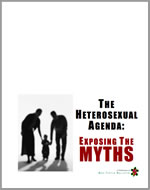 At last, the truth can now be told.
Using the same research methods employed by most anti-gay political pressure groups, we examine the statistics and the case studies that dispel many of the myths about heterosexuality. Download your copy today!
And don‘t miss our companion report, How To Write An Anti-Gay Tract In Fifteen Easy Steps.
 Anti-gay activists often charge that gay men and women pose a threat to children. In this report, we explore the supposed connection between homosexuality and child sexual abuse, the conclusions reached by the most knowledgeable professionals in the field, and how anti-gay activists continue to ignore their findings. This has tremendous consequences, not just for gay men and women, but more importantly for the safety of all our children.
Anti-gay activists often cite the “Dutch Study” to claim that gay unions last only about 1½ years and that the these men have an average of eight additional partners per year outside of their steady relationship. In this report, we will take you step by step into the study to see whether the claims are true.
Tony Perkins’ Family Research Council submitted an Amicus Brief to the Maryland Court of Appeals as that court prepared to consider the issue of gay marriage. We examine just one small section of that brief to reveal the junk science and fraudulent claims of the Family “Research” Council.
 The FBI’s annual Hate Crime Statistics aren’t as complete as they ought to be, and their report for 2004 was no exception. In fact, their most recent report has quite a few glaring holes. Holes big enough for Daniel Fetty to fall through.
“Google” is a trademark of Google Inc.
© Box Turtle Bulletin. All Rights Reserved.
 Posts
Posts  Posts via daily email: