Box Turtle Bulletin
 News and commentary about the anti-gay lobby
“Now you must raise your children up in a world where that union of man and box turtle is on the same legal footing as man and wife…”
News and commentary about the anti-gay lobbyFebruary 25th, 2013
Last Friday, President Obama’s Solicitor General, Donald Verrilli, filed this brief in United States v. Windsor, urging the Supreme Court to strike down Section 3 of the Defense of Marriage Act as unconstitutional. Section 3 is the portion of the law which bars the federal government from recognizing same-sex marriages which are lawfully performed by the states.
The brief argues that the case before the Supreme Court deserves heightened scrutiny due to the long history of discrimination that gays and lesbians have experienced throughout history. This argument is in keeping with the Justice Department’s announcement in 2011 that it would no longer actively defend DOMA in Federal Court. After laying out the reasons for examining the law under heightened scrutiny, Verrilli contends that DOMA fails that test.
But in an interesting twist, Verrilli also recognized that the Court has long been reluctant to apply heightened scrutiny. If the Court says that the proper standard for evaluating DOMA is the “rational basis” standard — which is highly deferential to Congress’ decision-making — then the Defense of Marriage Act would survive constitutional muster. But Verrilli also contends that the U.S. Supreme Court, in striking down state sodomy laws in 2003’s Lawrence v. Texas, the court already chose a standard that goes above “rational basis,” Justice Sandra Day O’Connor called “a more searching form of rational basis.” And under this view, DOMA would fail the test:
To the extent sexual orientation may be considered to fall short in some dimension [to apply heightened scrutiny test], the history of discrimination and the absence of relation to one’s capabilities associated with this particular classification would uniquely qualify it for scrutiny under an approach that calls for a measure of added focus to guard against giving effect to a desire to harm an”unpopular group.”
Section 3 would fail to satisfy any such analysis,largely for the reasons it fails heightened scrutiny.Like the law struck down in Romer (Romer v. Evans, which struck down a Colorado constitutional amendment prohibiting gays and lesbians from seeking anti-discrimination protections in state and local laws), Section 3 is “at once too narrow and too broad.” It imposes a “broad and undifferentiated disability” on the same narrow class of people at issue in Romer — gay and lesbian people — by denying effect to their state-recognized marital relationships across the entire spectrum of federal law. And the asserted rationales are sufficiently “far removed from” the effect of the law — particularly given its breadth — that they should not be credited as valid justifications.
The brief concludes:
BLAG (Br. 58-59) makes an appeal to this Court to allow the democratic process to run its course. That approach would be very well taken in most circumstances. This is, however, the rare case in which deference to the democratic process must give way to the fundamental constitutional command of equal treatment under law. Section 3 of DOMA targets the many gay and lesbian people legally married under state law for a harsh form of discrimination that bears no relation to their ability to contribute to society. It is abundantly clear that this discrimination does not substantially advance an interest in protecting marriage, or any other important interest. The statute simply cannot be reconciled with the Fifth Amendment’s guarantee of equal protection. The Constitution therefore requires that Section 3 be invalidated.
February 25th, 2013
Nothing.
I got nothing.
I’m looking at the calendar, going through back issues of ONE, Mattachine Review and The Ladder, combing through my library, trying to find something I can write about for today. Something that happened on this day in history, someone who was born today, or just something that happened in the month of February that I haven’t already written about. It’s the shortest month of the year, but I’m coming up empty.
It’s been a very long time since I’ve been in this situation. But it does happen from time to time. And don’t get me wrong: I’m not saying nothing happened on February 25 before, or that nobody worth mentioning has a birthday on this date. For all I know, this might be your birthday. But I don’t know about it. And if I don’t know about it, I can’t write about it.
So instead, maybe I can use this down time to try to figure out what on earth this whole “Harlem Shake” thing is all about.
I see that Rob Tisinai’s been putting his spare time to good use as well.
If you know of something that belongs on the agenda, please send it here. Don’t forget to include the basics: who, what, when, where, and URL (if available).
And feel free to consider this your open thread for the day. What’s happening in your world?
February 24th, 2013
TODAY’S AGENDA:
Events This Weekend: Pride Cape Town, South Africa; Telluride Gay Ski Week, Mountain Village, CO; Elevation: Utah Gay Ski Week, Park City, UT; Sydney Mardis Gras, Sydney, NSW.
TODAY IN HISTORY:
President George Bush Backs Federal Marriage Amendment: 2004. With Massachusetts Supreme Judicial Court ruling that nothing short of marriage would provide full equality for same-sex couples as required in the state’s constitution (see May 17), and with San Francisco Mayor Gavin Newsom’s order that the county clerk begin issuing marriage licenses to gay couples (see Feb 12), pressure had been building on President Goerge W. Bush, then running for a second term as President, to do something! And so, in lockstep with his conservative Christian base — and in keeping with his campaign strategist Karl Rove’s encouraging several important states (including, critically, Ohio) to place marriage bans on their ballots as part of a get-out-the-vote effort — Bush declared his support for a the Federal Marriage Amendment, which, if enacted, would have permanently and nationally banished all same-sex marriages “or the legal incidents thereof.”
And in the typical black-is-white rhetoric that had become a hallmark of his administration, he blamed his decision on gay people. “After more than two centuries of American jurisprudence, and millennia of human experience, a few judges and local authorities are presuming to change the most fundamental institution of civilization,” he said. “Their actions have created confusion on an issue that requires clarity.”
Declaring that “the voice of the people must be heard,” he urged Congress to “promptly pass… an amendment to our Constitution defining and protecting marriage as a union of a man and woman as husband and wife,” during televised remarks from the White House’s Roosevelt Room. After urging that the nation consign gay Americans to permanent second-class citizenship, he called on the nation to begin the debate “without bitterness or anger.”
Log Cabin Republicans, who enthusiastically supported Bush four years ago after a closed-door meeting with the then-Texas governor, felt betrayed by the statement. Patrick Guerriero, executive director of the Log Cabin Republicans, said. “Log Cabin considers support for this amendment a declaration of war on gay and lesbian families and an attack on our sacred Constitution.” LCR political director Chris Barron (he would later go on to co-found GOProud), would later comment, “It is impossible to overstate the depth of anger and disappointment caused by the president’s support for an anti-family constitutional amendment. This amendment would not only ban gay marriage, it would also jeopardize civil unions and domestic partnerships.” LCR would go on to withhold its endorsement of Bush for the 2004 election cycle.
Later in September, the proposed amendment would fail in the House, 227 to 186, with 290 votes needed to cross the two-thirds requirement to send a Constitutional Amendment to the States for ratification. The Senate had, by then, already failed to break a filibuster against the proposal.
American Evangelicals Announce Anti-Gay Conference In Uganda: 2009. BTB was the first Western outlet to discover and report the shocking announcement that Exodus International board member Don Schmierer and a little-known staffer at Richard Cohen’s International Healing Foundation, Caleb Lee Brundidge, would join Holocaust revisionist and anti-gay extremist Scott Lively for a three day conference in Kampala. Lively was already known to regular BTB readers for his involvement with the international anti-gay extremist group Watchmen On the Walls (not to be confused with an unrelated Family Research Council initiative by the same name) and for his book, The Pink Swastika: Homosexuality in the Nazi Party, in which he writes that “the Nazi Party was entirely controlled by militaristic male homosexuals throughout its short history.” Knowing that Lively was bringing his brand of extremism to Uganda was very worrying. As I wrote at the time:
Lively’s brand of rhetoric is unusually vitriolic, even by some of the more ardent anti-gay standards. He regularly describes gays as being sick and“followers of the Father of Lies.” When the Watchmen On the Walls held a rally in Novosibirsk, Russia, Lively excused Satander Singh’s murder in Sacramento. Lively contends that “civilization and homosexuals” are engaged in a full-blown war, which is part of the Devil’s design to destroy civilizations.
The Kampala conference was organized by Steven Langa, director of Kampala-based Family Life Network. Lively had struck up a friendship with Langa during a tour of the African continent in 2002. Throughout the decade, Ugandan pastors adopted increasingly violent rhetoric against gay people, with one pastor, Martin Ssempa, leading hundreds of his followers in 2007 through the streets of Kampala demanding harsh punishments against gay people, and publishing the names and addresses of Ugandan gay rights advocates. Many were forced to go into hiding.
With Lively’s incendiary rhetoric being thrown into the mix, I didn’t know what would happen, but feared the worst. My worst fears, however, were nothing compared to what actually followed: a long series of anti-gay rallies, vigilante campaigns, and reports of violence which ultimately culminated in the introduction of the Anti-Homosexuality Bill, otherwise known as the “Kill the Gays Bill,” in Uganda’s parliament in October, 2009. That bill still threatens LGBT Ugandans today. Since February 24, 2009, BTB has followed every twist and turn of the events in Uganda. Our compilation, Slouching Toward Kampala: Uganda’s Deadly Embrace of Hate, is a timeline and index of the nearly 500 posts that we have written documenting the events in Uganda since then.
If you know of something that belongs on the agenda, please send it here. Don’t forget to include the basics: who, what, when, where, and URL (if available).
And feel free to consider this your open thread for the day. What’s happening in your world?
February 23rd, 2013
TODAY’S AGENDA:
Events This Weekend: Pride Cape Town, South Africa; Telluride Gay Ski Week, Mountain Village, CO; Elevation: Utah Gay Ski Week, Park City, UT; Sydney Mardis Gras, Sydney, NSW.
TODAY IN HISTORY:
A Suicide in St. Louis: 1892. When I wrote about this suicide last year, I didn’t know the date nor the name of the man in question. All I had was this description of a man whose desperation over an unrequited (or a no longer requited) love led to his untimely and sad end. Charles H Hughes, editor of the Alienist and Neurologist (“Alienist” was an early term for psychiatrist) gave a talk before the Section of Mental and Nervous Diseases at the Pan-American Medical Congress in 1893 on “Erotopathia” — among the many early terms given to homosexuality before the word “homosexual” entered the English language — in which he gave the following account:
In February of the past year (1892), a quiet, cultured and gentlemanly appearing young man committed suicide by shooting himself at his room in a hotel in St. Louis. A combination of causes probably led to the despondency which ended in the rash act. Pecuniary embarrassment may have been one of them, but the chief cause, as elicited at the Coroner’s inquest, as testified by the male friend of whom he was enamored, was that he had a morbid attachment for that friend. He wrote long letters to him teeming with endearing words. They had roomed together, but at the time of the tragedy they were rooming apart. This was his second attempt at suicide. At the time of his death he carried a locket about his neck containing the picture of the man be loved. He was an educated professional man, kindhearted and of good address.
The following letters, written in a neat hand shortly prior to, and about the time of, his death, serve to show the erotopathic condition of this young man’s mind. They reveal the ardent feeling of the anxious, disappointed lover, much the same feeling as one madly in love might normally have for his heart’s idol of the other sex, but never but unnaturally and abnormally for one’s own sex, with homicidal and suicidal impulses of maddened desperation added.
“My Dear Friend: — Are you ill, angry or merely careless? I looked for my usual Thursday’s letter Saturday morning. It came not. I then felt sure you would write me on Sunday. I watched for the postman. No letter. He has been here this A. M. and still no letter. It makes me not only unhappy, but very anxious — unhappy since I am deprived of all that is left me to care for or look forward to; unhappy in the thought that I have displeased you; in suspense and anxiety lest some bodily ailment has seized that goodly frame and rendered you unable to communicate with me. If I do not hear from you in a day or so I shall be frantic and unfit for anything. I sent the stud on Thursday, which must have reached you Saturday, and not later than Monday, in which case I should have heard from you by this time.”
“My Dear Friend: — I have just returned from the Cathedral, where Bishop Tuttle preached. My mind is not in a very receptive frame, so I can hardly tell anything he said. The pass was all a myth. The only pass I have is one into eternity. I even sold my dress suit and my old clothes to raise the funds to get here on. I came, intending to first kill you, then myself. I shall only make an end of my own miserable existence. My Jove for you has been my ruin. I can no more live a life apart from you than I can fly. The past month has been the test and I cannot do it. There is but one thing which could save me, and that is to pass the remainder of my life in your presence. I shall do that anyhow, for to die in your arms relieves death of half its terrors. I wish it would come to me naturally and you would have nothing to dishonor or grieve you. It is cruel in me to do this act, for it will blight your life. I should be more cruel to myself to try and live without you. You have done all but the one right and effective thing to save and make me, but it has all failed. I would gladly beg, steal, do anything — forego riches, forget friends, home, kindred, but for a life of blissful association with you. My office and outfit are all intact and you can realize something on those things. Mr. C—- H—-, XI6 M—- Avenue, will see to the things. I appreciate all you did, and the effort and sacrifice you made for me. It was not in the right direction.
“This letter to you is all I leave behind. I cannot write anything to my parents. The blow will probably kill my mother. I shudder to think of it. We might have been happy together had it not been for W—-. The W—-, your brother’s family, your other rich friends, your high social and business standing, your high ideas of morality, which you never filled — but ’tis too late, the end must come. I don’t see why God did not let me die that Saturday night. I suppose there was some purpose waiting till you had made the outlay and sacrificed so much. You see, the end is all the same. Good-by, dear I—-, I won’t wish you happiness; you will never have that again and you will follow in my footsteps sometime. Men of our natures and sins must have their punishment, and ours comes in a terrible shape. You are mine in the light of heaven and no family ties can claim you from me in death. I pity you, but oh, to be free from all this agony of separation, suspense, doubt, is so welcome. May God deal with me according to my weakness. Keep my stud as long as you live. send my watch and ring to my mother. Let my last rites be attended by as little expense as possible. A pauper cannot expect to repose in a metallic casket. I am going to bed, to sleep and gain nerve to face my fate. I have felt it must be, and since I have known you, I knew you were to be the last straw. I have Joved you better than you have ever loved or will ever be loved again. Think kindly of that love sometimes. I am unworthy, but my love for you is worth a thought. Pray for my soul. Amen.”
Much more than a sentiment of warm friendship for one’s benefactor is breathed in these epistles of passion, desperation and love, with its sequel of chagrin and suicide, without remorse for, or full appreciation of, the unnatural character of his perverted love. Though his Christian training had taught him to regard his unnatural passion as a sin.
This is why I love BTB readers. Soon after this appeared on a Daily Agenda last year, John Manion wrote to me after having sleuthed out the following information:
I noticed your St Louis suicide story, it sure caught my interest and I wanted to know a little more about those involved. I am into genealogy and I took it as a challenge to find out their names. I found more than I expected and got a little carried away, but, I am stopping here. I am forwarding the items to BTB. The following is from online sources (genealogybank.com, ancestry.com, google books, etc)
Dr Hughes lived in St. Louis and may have seen the letters firsthand. He states in your column that Breedlove and Judson roomed together for a while, which is something I do not think I have seen in the news, so maybe he talked with some of the people involved. There is a sketch of Dr Breedlove.
The date of the death was reported in the newspapers of the day as happening in the morning of Feb 23 1892 in St Louis at the Hurst’s Hotel. Between 8 and 8:30. The story was in many papers from coast to coast. The man who died was Dr. Charles Breedlove, a young dentist of age 28, born in 1864, a graduate of the University of Maryland. He was single. Dr Breedlove was the last of 4 children his parents had, the other 3 all died in early life and his family hails from the south. Of course, the family was completely surprised but supportive of their son, but did not know he was unhappy. His body was sent home to Fort Smith, Arkansas, where his family lived. His father was a medical doctor. His parents died in 1906, within a few months of each other. Charles Breedlove’s friends from Baltimore thought he was not sad and certainly slandered by Prof Judson.
The man he wrote the letters to was Isaac Judson, born in 1853. They had met in Sept of 1891 and became fast friends. He was 38 and single. He was a Yale graduate and spoke at his commencement ceremonies during his graduation. His dad went to Yale too and both were members of Skull & Bones. He was a professor of Greek and Latin at the St Louis High School. His family hails from the Northeast. He was suspended from teaching for a few days until a special committee could review the case. They exonerated him from any blame in the situation and allowed him to continue his profession “without prejudice”. After the suicide he stayed in St Louis until at least 1920, working as the Head Assistant in the School. He was always single up to the 1920 census, his last one. After that he returned to New York, and died there in 1926. His funeral notice does not mention family members. He was the youngest of 4 children, with one surviving brother.
Breedlove waited for him to arrive at the hotel, walk into the room, handed him a letter. Judson was reading it and behind him Breedlove shot himself in the head. Breedlove was wearing a charm around his neck, when opened was a picture of Judson. Breedlove’s letters gave the story a life it would not have had. His family and friends believed Prof Judson, had he cared enough, would have kept the letters private. That may not have been an option, as at least one other letter was found by the medical examiner.
Judson consulted a Dr Ware (he is a dentist!!) about the feelings Charles was having, and Judson didn’t understand what was going on. Judson “seemed horrified” as Dr Ware explained what it means. Judson told Dr Ware he had “never before heard of such a thing”. Judson “then resolved to throw Breedlove aside, and asked me the best way to do it.”
Dr Ware continued “Breedlove came to me once for treatment. When he offered to pay me I declined to take his money…..a few days later…we went to the theater together. I did not like the man from the start.”
Poor guy!
Prof Judson had a roommate. This is the one Breedlove was “intensely jealous” of, Prof Herbert A Wheeler, of Washington University of St Louis. His statement is Judson was introduced to Dr Breedlove last September by a mutual friend. “the two soon grew to be fast friends and frequent visits were made by them to one another’s boarding houses.”
Professor Wheeler was born in Brooklyn in 1859 Wheeler graduated in 1880 from the Columbia College School of Mines. Herbert A Wheeler got married at age 66. It was his first marriage. He did not have any children listed at age 71, the 1930 census. He died in March 11 1950 in St Louis County. He was the youngest of 5 children.
Judson taught school in Brooklyn, from 1877 to 1880.
John also sent a wealth of newspaper clippings and other documents, and he created a public family tree page at Ancestry.com in order to make this information accessible for other historians and genealogists.
[Original source: Charles H. Hughes. “Erotopathia — Morbid eroticism.” Alienist and Neurologist 14, no. 4 (October 1893): 531-578. Available via Google Books here.]
If you know of something that belongs on the agenda, please send it here. Don’t forget to include the basics: who, what, when, where, and URL (if available).
And feel free to consider this your open thread for the day. What’s happening in your world?
February 22nd, 2013
Quarterback Tim Tebow recently cancelled an appearance at the opening of Robert Jeffress’ $115 million church after finding out about Jeffress’ controversial reputation.
The good pastor has spoken out against:
and, of course,
Of course, while Jeffress is merely exercising his religious freedom, any attempt to disagree with him is an attack on that freedom:
Denny Burk, a cultural commentator and professor at Boyce College in Louisville, Ken., said Tebow’s decision is a significant event for the nation’s Christian community and could serve as a troubling bellwether.
“This moment will appear to many as another marker of Christianity’s cultural marginalization,” he wrote on his website. “In the broad tolerance of views in our public discourse, who’s in and who’s out? What voices are allowed in the cacophony that is American democracy? Which voices should be excluded? Christian voices have long been a part of the din but moments like these make it seem like those days are coming to an end.”
Pass the smelling salts! I’ll need them when I stop laughing. Apparently disagreeing with Jeffress, deciding not to associate with him, suggesting that others rethink their association with him, is an assault on Jeffress’ liberty — wait, no, that’s not right — is an assault on Christianity itself and American democracy along with it.
See, it’s fine to call someone a Satanic, heretical pervert from the pit of Hell, but if your target calls you a bigot in reply then you get to be all, OMG, Can you believe what he just said??
I actually got into a twitter battle with Super-Anti-Gay Peter Labarbera over this. Frankly I stumbled badly at first. I’m a big opponent of measures that stifle freedom of speech. I’m horrified by European hate speech laws and I’m against the notion that some ideas are too egregious even to be debated:
For here we are not afraid to follow truth wherever it may lead, nor to tolerate any error so long as reason is left free to combat it. [Thomas Jefferson]
I stand by that, but in this case it led me down the wrong track, when Labarbera invoked the Gay Thought Police. My basic error? Letting my opponent set the terms of the debate. I forgot this:
When debating someone, you don’t have to respond to the words they’ve chosen. You don’t always have to offer a point-by-point rebuttal. Sometimes the best thing is to offer an alternative perspective, one that renders your opponents’ words obsolete.
That’s a hard lesson for me because you know how I love my point-by-point rebuttals. But twitter 140-character limit forced meto change strategy. After stumbling about offering hypothetical reasons why the Gay Lobby might not have been the main pressure on Tebow, I got a reply from LaBarbera saying, “Who started the campaign? It was the Gay Lobby. Own it.” And I thought…
Why not?
All that would mean is the Gay Lobby prevented Tebow from endorsing an anti-gay, anti-Catholic, anti-Judaism, anti-Mormon bigot. It would mean Catholics, Jews, and Mormons should thank us, and Tebow should be grateful, too. It would mean we’re doing God’s work. And I said so.
Peter LaBarbera stopped responding after that.
Some of you may be thinking, “Well, DUH, Rob.” But this was a good experience for me. I can get so wrapped up in the minutiae of a debate that I forget to step back and wonder if we’re even talking about the right thing. I forget to touch base with the basic principles that led me into the debate in the first place.
Of course, before I congratulate myself too hard, I have to remember I was arguing with Peter LaBarbera, and that presents all the challenge of trying to overpower an elderly squirrel.
If you’re curious, the tweet sequence is after the jump. Read the rest of this entry »
February 22nd, 2013
TODAY’S AGENDA:
Events This Weekend: Pride Cape Town, South Africa; Telluride Gay Ski Week, Mountain Village, CO; Elevation: Utah Gay Ski Week, Park City, UT; Sydney Mardis Gras, Sydney, NSW.
TODAY IN HISTORY:
Modesto Youth Gets Probation On “Morals Charge”: 1950. Vernon Edward Jensen, a clerk at a florist shop, pleaded guilting to what The Modesto (CA) Bee described simply as a “sex peversion charge.” The circumstances behind the arrest aren’t descrbed, except that
Jensen was one of nine recently arrested on perversion charges in a police roundup. Two of the nine were county teachers, Rolla H. Nuckles, 37, of 110 Roselawn Avenue, Modesto High School public speaking instructor, and Charles Lloyd Martin, 23, at 310 South Broadway, Turlock, who taught English and history at the Wakefield School there.
The charge against Nuckles were dismissed two days earlier, after having been held in jail since January 27 at the recommendation of the Deputy District Attorney. But that didn’t shield him from having his name and address printed once again in the paper. There is no mention of what happened to Martin. As for Jensen, a psychiatrist, Dr. Ralph Gladen, head of the Modesto State Hospital, said that he wasn’t a “psychiatric abnormal person”:
As quoted by the court, Dr. Gladen pictured Jensen as not a homosexual but as “foolish kid,” now highly penitent and disgusted with his past action, and deserving of another chance.
The court agreed, and sentenced him to three years probation, during which time “he must obey all laws, report to the probation officer at regular intervals, remain in the county and refrain from excessive use if liquor.”
I see these names in the papers and often wonder what happened to them. Whenever people were arrested on a “morals charge” or for “lewd vagrancy,” their names, addresses and places of employment were typically printed in the paper, and that publicity often made whatever official punishment they may have received mild in comparison to losing their job or being shunned by their families and neighbors. It must have been an extraordinarily humiliating experience for each of these three men. But sixty years later, those very details are sometimes the only thing which can truly remind us that these were real people suffering from this kind of official oppression and not just characters in long-forgotten newspaper clippings.
Like I said, I often wonder what happened to some of these people that I run across, so I went sleuthing on Ancestry.com. There, I found a Vernon Edward Jenson, born February 11, 1929 in Butte, California, who died in 1995 in Alameda. Unfortunately, that’s all I was able to find for him. I wasn’t able to come up with much of anything for Martin.

Rolla H. Nuckles from a 1933 college yearbook
But I may have found some interesting information on Nuckles, the teacher against whom the charges were dismissed. Rolla Hargiss Nuckles was born in Kansas City, Missouri, and attended the University of Kansas where, in 1932 and 1933, he was a member of the Dramatic Club, and in 1933 was president of the local chapter of the National Collegiate Players, “one of the many units in all nation-wide dramatic movements.”) That same year, he appeared on the Dramatic Club’s performance of “Uncle Tom’s Cabin,” where, according to the college yearbook, “Elizabeth Crafton stole the show and Rolla Nuckles wore lace.” Nuckles appears to have been quite the performer. As a member of the Sigma Alpha Epsilon fraternity, he was described as “perhaps the most delectable tap dancer to nauseate the Hill in some years.” In 1938, he’s still there, teaching “radio speaking” for students at the University of Kansas’ radio station KFKU and directing radio dramas as well as theatrical plays. This seems to match pretty well with being a public speaking instructor in Modesto. A 1944 Corpus Christi city directory lists a Rolla H. Nuckles as a radio announcer for radio station KEYS. From there, the record runs dry, with the exception of the arrest in Modesto, until his death in 2000 in San Antonio.

Frank Kameny Becomes First Openly Gay Candidate for Congress: 1971. The U.S. Constitution grants each state voting representation in both houses of Congress, but because the District of Columbia isn’t one, its more than half-a-million residents are taxed without voting representation (even though its population is larger than Wyoming). But in 1971, Congress agreed to allow D.C. to be represented in the House of Representatives by a single by a non-voting delegate. On February 22, pioneering gay rights advocate Franklin E. Kameny (see May 21) filed his nominating papers and proclaimed himself “the first publicly declared homosexual ever to run for Congress.” In announcing his run, Kameny declared, “We intend to remind a government and a country, which seems in may ways to have forgotten it, exactly what Americanism means — that this is a country of personal freedom and individual diversity; that Queen Victoria is dead, and the Puritans are long gone.”
 Kameny joined a crowded field of eight (soon narrowed to six after two candidates’ petitions were thrown out), led by front-runner Democrat Rev. Walter E. Fauntroy, who had been an associate of Dr. Martin Luther King, Jr. Contrary to expectations, Kameny didn’t run a single-issue campaign. He spoke at forums and television appearances about welfare reform, crime, the Vietnam war, freeway construction, home rule for the District, and other issues in terms similar to other candidates. But, as he told one audience, his campaign added “a special concern for what America stands for in terms of human rights for minorities like homosexuals.” One audience member exclaimed, “Are you serious?” Kameny answered, characteristically, “Yes, I certainly am.”
The overarching theme of the campaign was personal freedom. “I offer you beyond what the other candidates offer,” he told one forum at Howard University, “a special sensitivity to personal freedom, the right to live your life as you choose to live it.”
At one point in the campaign, Kameny told reporters, “My candidacy is a special one and will be conducted in some special ways.” One of those special ways was a campaign event he held at 1:00 a.m. on an early Friday Morning at Pier Nine, one of the city’s largest gay bars at Half and T Streets SW. The goal was to make sure the gay vote became a visible one. “Even if we don’t win,” he said, “if we can get 5,000 to 10,000 votes, things will not be the same again. That many votes would not be overlooked. …We are part of society; we are citizens of Washington, and we love this city. We want to play an active role in the life of Washington.”
On March 23, Fauntroy, as expected, won and became the District’s first non-voting delegate to Congress. (He would also, years later, become an outspoken foe of marriage equality in the District and a supporter of the Federal Marriage Amendment.) Kameny came in fourth with 1,841 votes. The vote count may have been small (only 1.6% of the total), but it did wind up changing the local political dynamic. In the following year, several candidates for the newly elected city school board went out of their way to court gay and lesbian voters.
[Sources: David R. Boldt. “Homosexual files delegate papers.” The Washington Post (February 23, 1971): A17
William L. Claiborne. “Candidate seeks end to homosexual ban.” The Washington Post (March 10, 1971): C1, C3.
Bart Barneas. “Kameny stresses personal freedom.” The Washington Post (March 13, 1971): B1, B2.
“Kameny for Congress.” The Rainbow History Project (Undated): Online.]
If you know of something that belongs on the agenda, please send it here. Don’t forget to include the basics: who, what, when, where, and URL (if available).
And feel free to consider this your open thread for the day. What’s happening in your world?
February 21st, 2013
 Jon Huntsman, former governor of Utah from 2005 through 2009 and Ambassador to China until 2011, was one of the second tier presidential candidates in last year’s GOP primaries. His best showing was in New Hampshire, where he came in third.
Huntsman had a good working relationship with the gay community in Utah, and expressed support for civil unions. Today he penned an article for the American Conservative entitled Marriage Equality is a Conservative Cause:
While serving as governor of Utah, I pushed for civil unions and expanded reciprocal benefits for gay citizens. I did so not because of political pressure—indeed, at the time 70 percent of Utahns were opposed—but because as governor my role was to work for everybody, even those who didn’t have access to a powerful lobby. Civil unions, I believed, were a practical step that would bring all citizens more fully into the fabric of a state they already were—and always had been—a part of.
That was four years ago. Today we have an opportunity to do more: conservatives should start to lead again and push their states to join the nine others that allow all their citizens to marry. I’ve been married for 29 years. My marriage has been the greatest joy of my life. There is nothing conservative about denying other Americans the ability to forge that same relationship with the person they love.
All Americans should be treated equally by the law, whether they marry in a church, another religious institution, or a town hall.
Much more quickly than I anticipated, the trickle of Republican support for equality is becoming a stream.
February 21st, 2013
I’ve just finished reading the introduction of Olson and Boies’ Supreme Court brief against Prop 8. I’m so certain you’d love it that I’m reprinting the whole section here. For readability’s sake I’ve removed all but two of the legal citations. You can find those in the original.
This case is about marriage, “the most important relation in life,” a relationship and intimate decision that this Court has variously described at least 14 times as a right protected by the Due Process Clause that is central for all individuals’ liberty, privacy, spirituality, personal autonomy, sexuality, and dignity; a matter fundamental to one’s place in society; and an expression of love, emotional support, public commitment, and social status.
This case is also about equality. After a $40 million political campaign during which voters were urged to “protect our children” from exposure to the notion that “gay marriage is okay,” and “the same as traditional marriage,” and thus deserving of equal dignity and respect, Proposition 8 engraved into California’s constitution the cardinal principle that unions among gay men and lesbians are not valid or recognized as marriages, and therefore second-class and not equal to heterosexual marriages. Proposition 8 thus places the full force of California’s constitution behind the stigma that gays and lesbians, and their relationships, are not “okay,” that their life commitments “are not as highly valued as opposite-sex relationships,” and that gay and lesbian individuals are different, less worthy, and not equal under the law. That “generates a feeling of inferiority” among gay men and lesbians—and especially their children— “that may affect their hearts and minds in a way unlikely ever to be undone.” Brown v. Bd. of Educ., 347 U.S. 483, 494 (1954).
Proponents accuse Plaintiffs (repeatedly) of “redefining marriage.” But it is Proponents who have imagined (not from any of this Court’s decisions) a cramped definition of marriage as a utilitarian incentive devised by and put into service by the State—society’s way of channeling heterosexual potential parents into “responsible procreation.” In their 65-page brief about marriage in California, Proponents do not even mention the word “love.” They seem to have no understanding of the privacy, liberty, and associational values that underlie this Court’s recognition of marriage as a fundamental, personal right. Ignoring over a century of this Court’s declarations regarding the emotional bonding, societal commitment, and cultural status expressed by the institution of marriage, Proponents actually go so far as to argue that, without the potential for procreation, marriage might not “even..exist[ ] at all” and “there would be no need of any institution concerned with sex.” (internal quotation marks omitted). Thus, under Proponents’ peculiar, litigation-inspired concept of marriage, same-sex couples have no need to be married and no cause to complain that they are excluded from the “most important relation in life.” Indeed, Proponents’ state-centric construct of marriage means that the State could constitutionally deny any infertile couple the right to marry, and could prohibit marriage altogether if it chose to pursue a society less committed to “responsible” procreation.
This, of course, reflects a complete “failure to appreciate the extent of the liberty at stake,” not to mention matters such as love, commitment, and intimacy that most Americans associate with marriage. As Proponents see it, marriage exists solely to serve society’s interest; it makes no sense to speak of an individual’s right to marry.
Proponents view this case as a referendum on whether the institution of marriage should exist in the first place, focusing almost exclusively on why it makes sense for the States to grant heterosexuals the right to marry. But this case is not about whether marriage should be abolished or diminished. Quite the contrary, Plaintiffs agree with Proponents that marriage is a unique, venerable, and essential institution. They simply want to be a part of it—to experience all the benefits the Court has described and the societal acceptance and approval that accompanies the status of being “married.”
The only substantive question in this case is whether the State is entitled to exclude gay men and lesbians from the institution of marriage and deprive their relationships—their love—of the respect, and dignity and social acceptance, that heterosexual marriages enjoy. Proponents have not once set forth any justification for discriminating against gay men and lesbians by depriving them of this fundamental civil right. They have never identified a single harm that they, or anyone else, would suffer as a result of allowing gay men and lesbians to marry. Indeed, the only harms demonstrated in this record are the debilitating consequences Proposition 8 inflicts upon tens of thousands of California families, and the pain and indignity that discriminatory law causes the nearly 40,000 California children currently being raised by same-sex couples.
The unmistakable purpose and effect of Proposition 8 is to stigmatize gay men and lesbians—and them alone—and enshrine in California’s Constitution that they are “unequal to everyone else,” that their committed relationships are ineligible for the designation “marriage,” and that they are unworthy of that “most important relation in life.” Neither tradition, nor fear of change, nor an “interest in democratic self-governance,” can absolve society, or this Court, of the obligation to identify and rectify discrimination in all its forms. If a history of discrimination were sufficient to justify its perpetual existence, as Proponents argue, our public schools, drinking fountains, and swimming pools would still be segregated by race, our government workplaces and military institutions would still be largely off-limits to one sex—and to gays and lesbians, and marriage would still be unattainable for interracial couples. Yet the Fourteenth Amendment could not tolerate those discriminatory practices, and it similarly does not tolerate the permanent exclusion of gay men and lesbians from the most important relation in life. “In respect of civil rights, all citizens are equal before the law.” Plessy v. Ferguson, 163 U.S. 537, 559 (1896) (Harlan, J., dissenting).
February 21st, 2013
David Boies and Ted Olson, the good guys in the Prop 8 battle, have filed their brief with the Supreme Court. At the end of page 1 they say,
Proposition 8 thus places the full force of California’s constitution behind the stigma that gays and lesbians, and their relationships, are not “okay,” that their life commitments “are not as highly valued as opposite-sex relationships”…and that gay and lesbian individuals are different, less worthy, and not equal under the law. That “generates a feeling of inferiority” among gay men and lesbians—and especially their children— “that may affect their hearts and minds in a way unlikely ever to be undone.” Brown v. Bd. of Educ., 347 U.S. 483, 494 (1954).
My third blog post ever, in 2008, barely a month after Prop 8 passed (and long before I was writing for Box Turtle Bulletin), was about the Brown court case, and how poorly I understood it for so many years, and how relevant it is to our battle for legal dignity. This seems like an appropriate moment to bring it back.
I’ve seen documentaries about Brown v. Topeka, and the producers always compare a spiffy 1950s whites-only school with a ramshackle "negro" schoolhouse. That made me think the Supreme Court struck down the "separate but equal" doctrine because the equal part never really happened. But if you read the Brown decision, the Court believed the separate facilities really were equal, or pretty close.
But the good guys won anyway. Why? Because they arrived with studies showing the mere fact of separateness did harm to black kids. The decision included this:
Segregation of white and colored children in public schools has a detrimental effect upon the colored children. The impact is greater when it has the sanction of the law, for the policy of separating the races is usually interpreted as denoting the inferiority of the negro group. A sense of inferiority affects the motivation of a child to learn.
Relate this to gay kids. We already know they’re at a greater risk for suicide. Now they hear people say, “Settle for civil unions–we’ll give you the rights of marriage but not the word itself. What’s the difference?” Here’s the difference:
Any relationship you have might be good enough for civil unions, but not for marriage. Good enough for an uninspired legal phrase–not for the real thing. Good enough to live on the awkward outskirts of our culture, but not the heart, the core, the soul of America.
When I read the Brown decision, I have to think segregation of straight and gay relationships has a detrimental effect on gays. It denotes the inferiority of gay relationships. It leaves gays with an attitude of futility when it comes to commitment.
I don’t have any evidence on that. I’m not sure evidence is out there. It’s probably time for an enterprising grad student to take that on as a Ph.D. dissertation. And it’s not like we’re helpless victims here. Gay men can fight against this conditioning, and many of us succeed. But why should we have the burden to begin with?
And that leads to me back to gay kids. I just talked to my sister, a surgeon in Frankfurt, Indiana. Now, the city of Indianapolis might be gay-friendly, but the 50-mile drive to Frankfurt might as well be a 50-year voyage back in time as far as gays are concerned. I wonder about gay kids in Frankfurt. I think about Harvey Milk saying that victories in San Francisco gave hope to gay kids in small towns everywhere. And it makes me ashamed I didn’t do more to fight Prop 8, because that loss was a betrayal of gay kids everywhere.
And settling for civil unions instead of fighting for marriage–that would betray them again.
February 21st, 2013
TODAY’S AGENDA:
Events This Weekend: Pride Cape Town, South Africa; Telluride Gay Ski Week, Mountain Village, CO; Elevation: Utah Gay Ski Week, Park City, UT; Sydney Mardis Gras, Sydney, NSW.
TODAY IN HISTORY:
Oklahoma Prohibits Gay Teachers: 1978. When Oklahoma State Sen. Mary Helm (R-OKC) introduced the “Feature Fitness Statute” in the state Senate, she had more than just gay teachers in her sights. The bill would allow public schools to fire or refuse to hire anyone who engaged in “public homosexuality activity,” which the proposed broadly defined to also include not just sexual activity, but also “advocating, soliciting, imposing, encouraging or promoting public or private homosexual activities in a manner that creates a substantial risk that such conduct will come to the attention of schoolchildren or school employees.”
Think of what that meant. A straight teacher writing a letter to the editor supporting gay rights or, perhaps, denouncing the formation of a student KKK chapter in the public schools to bash gay people — which occurred in the northern suburbs of Oklahoma City soon after the bill was introduced (see Jan 25) — that teacher would be subject to being fired by the school board. But lawmakers weren’t focused on gay bashing, but on anyone who might publicly say that gay bashing was abhorrent. When the bill was introduced into the House by Rep. John Monks (D-Muskogee), he told reporters that the measure would allow school boards to “fire those who are afflicted with this degenerate problem … people who are mentally deranged this way.” (Monks was famous for saying stupid shit. In a successful effort to defeat a bill to ban cockfighting, Monks thundered, “In every country the communists have taken over, the first thing they do is outlaw cockfighting.”)
When the House passed the measure by a lopsided 88-2 vote without debate on February 7, the Associated Press speculated that “it is expected to face stiffer opposition in the Senate.” Fat chance. Anita Bryant, a former Miss Oklahoma who was fresh off of her victory in repealing a gay rights ordinance in Miami (see Jun 7), lobbied the state Senate to prohibit “the flaunting of homosexuality.” On February 21, the Senate passed the bill unanimously, and it quickly became law in April.
It took two years before the National Gay Task Force could even find a teacher willing to challenge the law. But after several false starts, the NGTF was finally able to bring a case to Federal Court challenging the law’s constitutionality. After the slow trek through the appeals process, the United States Supreme Court finally struck down the law in 1986 (see Mar 26).
Atlanta Gay Bar Bombed: 1997. Memrie Wells-Cresswell, of Snellville, GA, went to Atlanta’s Otherside Lounge to celebrate a friend’s birthday. Memrie had not told many people that she was lesbian, but the bombing that night at the popular lesbian bar would change all that. Five people were injured, but hers were the most serious: a three to four inch nail entered her arm and severed a brachial artery. When Mayor Bill Campbell mentioned her by name everyone suddenly knew her secret, including her employer who fired her. She later told The Advocate, “The company ended up giving me some hush money just to make me go away.”
Police found a second bomb just outside the bar, which they detonated with a robot. It had been placed there to harm police and medical workers responding to the first explosion. That fit a pattern established with two earlier Atlanta bombings, one at the Centennial Olympic Park on July 27, 1996 and another at an Atlanta abortion clinic on January 16, 1997. Three days after the Otherside Lounge Bombing, police received a letter from an organization calling themselves The Army of God claiming responsibility. The letter threatened “total war” and promised more attacks against abortion clinics and gay people.
 In 1998, Federal Authorities charged Eric Rudolph with the three Atlanta bombings and a fourth one at an abortion clinic in Birmingham, Alabama. They spent the next four and a half years looking for him around the town of Murphy, North Carolina, where Randolph spent his teenage years. Murphy residents printed tee-shirts reading “Run, Rudolph Run.” He was finally captured there on May 31, 2003. He was well-groomed and well-fed, suggesting he had help in Murphy. On August 13, 2005, Rudolph pleaded guilty to all four bombings in a plea agreement that allowed him to avoid the death penalty. In an eleven page statement, he wrote, “Whether it is gay marriage, homosexual adoption, hate crimes laws including gays, or the attempt to introduce a homosexual normalizing curriculum into our schools, all of these efforts should be ruthlessly opposed.” He also said that the attack on The Otherside Lounge was “meant to send a powerful message in protest of Washington’s continued tolerance and support for the homosexual political agenda.” He is currently serving four life sentences.
If you know of something that belongs on the agenda, please send it here. Don’t forget to include the basics: who, what, when, where, and URL (if available).
And feel free to consider this your open thread for the day. What’s happening in your world?
February 20th, 2013
 Cyprus is a oddity. It is a member state of European Union and is ethnically about three quarters Greek. But it is geographically in the Middle East, bout 50 miles south of Turkey and within 100 miles off shore of Syria and Lebanon.
While there is a Turkish Muslim minority, Cyprus prides itself as one of the earliest Christian outposts, evangelized by Paul. Most Cypriots are Greek Orthodox and the nation is very religious.
However, Cyprus provides a slightly bizarre service to one of its other close neighbors.
In Israel, marriage is controlled by the official religious institutions which, if you are Jewish, is the orthodox Israeli rabbinate. And if you don’t qualify for a traditional halakhah wedding – or aren’t particularly religious – your options are limited. However, Israel registers foreign marriages without much question (including same-sex marriages), so many mixed-faith or non-religious Israelis travel out of the country to marry. Most go to Cyprus.
And it is against this background that Cyprus is beginning the process of allowing same sex couples to have some form of legal recognition. (CyprusMail) They’ve been discussing it since 2010 (though the news tended to translate as “marriages” at that time) but it looks as though a bill is finally going forward.
HUMAN rights group ACCEPT-LGBT yesterday hailed the Cabinet’s recent decision to pass a draft bill on civil partnership in order to enable couples to be legally recognised outside of marriage.
The process has several more steps, but as best I can tell it has support from most of the political power structure. It’s fascinating to watch as the nations on the borders between East and West begin to address issues of equality.
February 20th, 2013
 From the StarTribune:
Republican state Sen. Branden Petersen is preparing to become a co-sponsor of a bill to legalize same-sex marriage in Minnesota.
Having a Republican co-author would be an enormous political coup for same-sex marriage advocates as they prepare to unveil their proposal in the days ahead. Petersen would become the first Republican legislator to publicly support same-sex marriage, highlighting the rapidly changing dynamics of the issue at the Capitol.
What makes this a bit interesting is that just a year ago he voted to put Minnesota’s anti-gay marriage amendment on the ballot. It failed by a 51 – 48 margin (1% left their ballot blank and they were counted as “no”).
What makes this shocking is where Petersen hails from, Anoka County. His neighbors’ kids attend the Anoka-Hennepin School District, perhaps the most hostile to their gay children in the nation. His hometown banned a support group for at-risk gay youth from participating in the Halloween Parade. His constituents regularly reelect Michele Bachmann.
Part of Petersen’s decision may be based in his observations about Illinois. There GOP Senators demanded changes to the proposed bill to appease concerns of their constituents. But just a month before they had been given a bill with those conditions in it and they rallied in opposition; so Democrats, who now control the legislature with votes to spare, felt no need to give any consideration to the Republicans’ newfound call for compromise.
Petersen said he has several concerns that must be addressed before he will sign onto the measure. He wants to add language guaranteeing that any religious leader can choose not to wed same-sex couples. He also insists that kids in same-sex marriages have the same financial guarantees as children of other married couples in time of divorce.
“It’s only a matter of time before same-sex marriage is legal,” Petersen said. “I thought it was important to engage the issue now, and when we do it, do it right, and that there’s some perspective from the people I represent in that.”
These are concerns that neither I nor the bill sponsors have a problem with. The first is constitutionally protected anyway, and the second is a responsible action that our community can support. And I think it is wise of Petersen to recognize that if you join the movement, you get to have a say in the details.
But, as will come as no surprise, Peterson is also strongly motivated by his personal relationships.
Petersen, 27, admits this is a wrenching issue for him and could be politically damaging back home. His father-in-law has been in a same-sex relationship for nearly 20 years, but Petersen says this issue has fiercely divided his family in the same way it has split the rest of the state. He started discussing the issue with colleagues, his pastor and close friends before taking his public stance.
Petersen’s support is a significant advantage for our community. As it is certain that some Democratic legislators will vote against us, we will need Republican support to win.
February 20th, 2013
Technically, a straw man is “an informal fallacy based on misrepresentation of an opponent’s position.”
And boy do I have an example for you.
Gilles Bernheim, author of a new article against same-sex marriage, is the Chief Rabbi of France. That’s impressive. But just in case don’t you didn’t realize it, he spends the first 716 words of the article explaining how important he and his article are. Eventually, though, he gets to this (it’s long, but relish it):
The argument for marriage for all conceals a split between two existing visions of marriage. According to one worldview, which I share with a great number of people, both believers and nonbelievers, marriage is not only the recognition of a loving attachment. It is the institution that articulates the union between man and woman as part of the succession of generations. It is the establishment of a family—that is, a social cell that creates a set of parent–child relations among its members. Beyond the common life of two individuals, it organizes the life of a community consisting of descendants and ancestors. So understood, marriage is a fundamental act in the construction and the stability of individuals as well as of society.
According to another worldview, marriage is an obsolete and rigid institution, the absurd legacy of a traditional and alienating society. Is it not paradoxical to hear those who share this worldview raising their voices in favor of homosexual marriage? Why do those who reject marriage and prefer free unions demonstrate alongside activists in favor of homosexual marriage?
Whichever worldview you hold…
Yes! Because — obviously! — you must be holding one of these two views!
I can well understand how Bernheim is confused that we are fighting for marriage equality if we think marriage itself obsolete and absurd. It must baffle him that we spend time and money fighting for something he’s so certain we so despise. He must be flabbergasted that I and thousands of others have given up weekends to go knocking on door after door in unfamiliar neighborhoods to have personal chats with total strangers about the vital importance of marriage to our lives.
Why would we do this, when we give not one fig for marriage? It’s a paradox! Incomprehensible! Ridiculudicrous!
It’s every one of those things — to someone closing his eyes to what his opponents actually believe, to who they really are. Rabbi Bernheim characterizes us, tells us his characterization makes no sense…and then never bothers to wonder whether his characterization is true.
The irony is sad: The good rabbi needs to understand that we are not his caricatures; that we are not made of straw; that if he pricks us, we do bleed.
February 20th, 2013
TODAY’S AGENDA:
Rally for Anti-Discrimination and Anti-Bullying Legislation: Frankfort, KY. The Fairness Campaign will hold a rally this afternoon at the Capitol Rotunda to call for the passage of S.B. 28 and H.B. 171, which would add sexual orientation and gender identity to Kentucky’s Civil Rights Act which bars discrimination in employment, housing, and public accommodations. The rally will also call for the passage of House Bill 377, which would require schools to add LGBT students to their anti-bullying and anti-harassment discipline policies. Supporters will lobby legislators in small teams in the morning, when they will help deliver more than11,000 constituent post cards advocating passage of the two bills. The rally itself will take place in the Capitol Rotunda at 1:30 p.m.
Events This Weekend: Pride Cape Town, South Africa; Telluride Gay Ski Week, Mountain Village, CO; Elevation: Utah Gay Ski Week, Park City, UT; Sydney Mardis Gras, Sydney, NSW.
TODAY IN HISTORY:
Marcus Welby, M.D. Episode “The Other Martin Loring” Airs: 1973. Marcus Welby was America’s favorite doctor, and Marcus Welby, M.D. was the first program to hit number one in the Nielsen ratings for the perpetually struggling ABC. But America’s favorite doctor made a bad call in its fourth season when it aired an episode titled “The Other Martin Loring.” The episode centers around Loring, who consults Dr. Welby for being an alcoholic, overweight, depressed and diabetic. Relax, take it easy, don’t work too hard, Welby tells Loring. That night, Loring who goes home to his wife, who demand a divorce and custody of their son. When he threatens to countersue, Mrs. Loring says she won’t “hold anything back.” He later collapses under the strain and under Welby’s care again. One thing led to another, including a drunk-driving car accident. Eventually, Welby figures out that Loring is gay. Welby’s advice: Loring had a “serious illness” and he should suppress his desires and see a psychiatrist because his “tendencies” were “degrading and loathsome.”
Shortly before the episode’s scheduled air date, a script was leaked to the Gay Activist Alliance, which organized a protest of two dozen demonstrators at ABC’s New York headquarters. Another group of thirty activists entered the building, guided by a detailed map provided by someone within the network, and took over the thirty-ninth floor offices of the network’s top executives. “It was one of the first big actions we took,” Ron Gold, GAA’s media director, later recalled. “It was also one of the biggest mistakes we made. ABC offered to set up a meeting for two of us with their standards and practices person and the president of the network if the rest of us would go away. But we were afraid that we were going to get screwed over so we said no. That was very foolish because we didn’t get to talk to anybody. They thought we were crazy — and to a certain extent we were. But we were also justifiably paranoid.”
Other protests broke out in Los Angeles when the episode aired, and gay activists tried to launch a nationwide advertiser boycott. But the boycott fizzled, largely because the fractious gay activist community didn’t have the means to communicate with each other effectively, let alone to the general public. In a sense, LGBT-advocacy was still in its infancy, learning the ways of effective demonstration and publicity. But they were quick learners. More than a year later, when Marcus Welby, M.D. would air another homophobic episode (see Oct 8), gay activists were better prepared, and their actions would lead to seventeen ABC affiliates dropping that episode, and at least seven major sponsors pulling out.

Joseph McCarthy and Roy Cohn
TODAY’S BIRTHDAY:
Roy Cohn: 1927. Could there be a more despicable character in all of gay history? The Columbia Law grad showed signs of legal brilliance early, having been admitted to the bar at twenty-one, becoming an Assistant U.S. attorney in Manhattan and playing a prominent role in the prosecution of Julius and Ethel Rosenberg in 1951. In 1952, Sen. Joseph McCarthy (R-WI) appointed him as chief counsel to the Senate Permanent Subcommittee on Investigations on the recommendation of FBI chief J. Edgar Hoover, where Cohn became known for his aggressive questioning of suspected Communists. Cohn brought in his good friend, David Schine as consultant to McCarthy’s staff. But when the young and handsome Schine was drafted into the army in 1953, Cohn embarked on a private campaign to ensure special treatment for Schine — light duties, extra leave, an exemption from overseas assignment — and threatened to “wreck the Army” if they didn’t accede to his demands. The bitter irony of all this is that while Cohn was pursuing special treatment for his special friend, McCarthy’s witch hunt extended beyond communists to also include gay people (See, for example, Mar 14, Jul 2, Sep 7).

Roy Cohn and David Schine on the cover of Time.
By 1954, McCarthy’s anti-communist and anti-gay witch hunt extended to the Army, which decided to fight back. During one exchange during a committee hearing, the Army’s head counsel, Joseph Welch, asked a McCarthy staffer about the origin of a photo of Schine and Army Secretary Robert Stevens, which had been doctored to omit the presence of Air Force Colonel Jack Bradley. Welch asked the staffer sarcastically, “Did you think it came from a pixie?” McCarthy interjected, “Will counsel (Welch) for my benefit define– I think he might be an expert on that– what a pixie is?” Welch responded, “Yes. I should say, Mr. Senator, that a pixie is a close relative of a fairy.” Others in the chamber who were in on the rumors, broke into laughter. Cohn later called the remark, “malicious,” “wicked,” and “indecent.”

Roy Cohn, four months before he died in 1986.
Cohn later forced to resign from McCarthy’s staff due to growing outrage over his tactics. He returned to New York and entered private practice, where his clients included mafia figures, the New York Yankees, the Roman Catholic Archdiocese of New York, and Studio 54 owners Steve Rubell and Ian Schrager. He was friends with Barbara Walters (she served as his “beard” for a while), columnist Walter Wenchell, and North Carolina Sen. Jesse Helms. While publicly closeted and working actively against gay rights, he partied at the best gay bars and threw lavish parties in New York and Provincetown. In 1984, he was diagnosed with AIDS. He used his connections to jump to the head of the line for treatment with the then-scarce and experimental AZT. By the time he died in 1986, he maintained his public denial both of his homosexuality and his disease — he said it was “cancer.” In Tony Kushner’s Angels In America, Cohn is portrayed as a power hungry, self-loathing hypocrite who is dying of AIDS while haunted by the ghost of Ethel Rosenberg. Cohn’s name is also on a panel of the AIDS memorial quilt. It reads, “Roy Cohn: Bully, Coward, Victim.” A fitting eulogy if there ever was one.
If you know of something that belongs on the agenda, please send it here. Don’t forget to include the basics: who, what, when, where, and URL (if available).
And feel free to consider this your open thread for the day. What’s happening in your world?
February 19th, 2013
 When Pope Benendict resigned, Cardinal O’Malley lamented that “the demands of extensive international travel, played a central role in his decision”.
And he’s undoubtedly right. Though the “demands” are perhaps a bit different from what the Church would have us believe. His fear is likely less about falling and breaking a hip than it is facing increasing international condemnation.
The internet got a moment of excitement yesterday when something calling itself “the International Tribunal into Crimes Against Church and State” declared that it has issued a summons for Joseph Ratziger, aka Pope Benedict XVI, to appear before it and answer for his crimes against humanity. But they have roughly the same authority that I have, so that’s worth little more than histrionic denouncements from a soap box. What they did say, however, that was of interest was this:
On Friday, February 1, 2013, on the basis of evidence supplied by our affiliated Common Law Court of Justice (itccs.org), our Office concluded an agreement with representatives of a European nation and its courts to secure an arrest warrant against Joseph Ratzinger, aka Pope Benedict, for crimes against humanity and ordering a criminal conspiracy.
I highly doubt that they have an agreement with any nation for Ratzinger to be arrested and brought to them for judgment. They also declare that “Common Law peace officers [aka people without any legal authority] working for our de jure Court and Tribunal will apprehend [aka kidnap]” the Pope and drag him there in chains and that this Easter they will seize the assets of the Church. Cue the circus music.
But what I do think is possible is that some nation soon will, under their own laws, issue an arrest warrant for Ratzinger based on his involvement in the global cover-up of child molestation by Catholic Priests. As more documents are being demanded – and produced – it is becoming increasingly clear that before ascending to the Papal See, Ratzinger was individually responsible for keeping authorities unaware of abuse and for using international law to hide and protect priests who engaged in the most horrific abuse of trust. And even more likely is that a nation will refuse entry to a known criminal.
As head of state of the Vatican, Benedict would have diplomatic immunity. But the embarrassment would be seriously detrimental to the Church’s continued influence. And even if the Pope were to have continued in his position, he would have been forced to limit his travels to the extent that he would be a virtual prisoner in the Vatican. Reuters suggests that this is probably his fate in any case.
Pope Benedict’s decision to live in the Vatican after he resigns will provide him with security and privacy. It will also offer legal protection from any attempt to prosecute him in connection with sexual abuse cases around the world, Church sources and legal experts say.
“His continued presence in the Vatican is necessary, otherwise he might be defenseless. He wouldn’t have his immunity, his prerogatives, his security, if he is anywhere else,” said one Vatican official, speaking on condition of anonymity.
“It is absolutely necessary” that he stays in the Vatican, said the source, adding that Benedict should have a “dignified existence” in his remaining years.
And, indeed, if he does leave the compound, his life will increasingly be less dignified. Though it’s unlikely he’ll ever be arrested for his crimes, fewer political leaders will wish to be gracious to a man whom they know chose with full knowledge to turn the young children entrusted to his Church’s care over to pedophile rapists.
Yes, his criminal past has made it impossible for him to meet the demands of extensive international travel.
Featured Reports
 In this original BTB Investigation, we unveil the tragic story of Kirk Murphy, a four-year-old boy who was treated for “cross-gender disturbance” in 1970 by a young grad student by the name of George Rekers. This story is a stark reminder that there are severe and damaging consequences when therapists try to ensure that boys will be boys.
When we first reported on three American anti-gay activists traveling to Kampala for a three-day conference, we had no idea that it would be the first report of a long string of events leading to a proposal to institute the death penalty for LGBT people. But that is exactly what happened. In this report, we review our collection of more than 500 posts to tell the story of one nation’s embrace of hatred toward gay people. This report will be updated continuously as events continue to unfold. Check here for the latest updates.
In 2005, the Southern Poverty Law Center wrote that “[Paul] Cameron’s ‘science’ echoes Nazi Germany.” What the SPLC didn”t know was Cameron doesn’t just “echo” Nazi Germany. He quoted extensively from one of the Final Solution’s architects. This puts his fascination with quarantines, mandatory tattoos, and extermination being a “plausible idea” in a whole new and deeply disturbing light.
On February 10, I attended an all-day “Love Won Out” ex-gay conference in Phoenix, put on by Focus on the Family and Exodus International. In this series of reports, I talk about what I learned there: the people who go to these conferences, the things that they hear, and what this all means for them, their families and for the rest of us.
Prologue: Why I Went To “Love Won Out”
Part 1: What’s Love Got To Do With It?
Part 2: Parents Struggle With “No Exceptions”
Part 3: A Whole New Dialect
Part 4: It Depends On How The Meaning of the Word "Change" Changes
Part 5: A Candid Explanation For "Change"
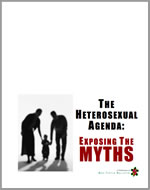 At last, the truth can now be told.
Using the same research methods employed by most anti-gay political pressure groups, we examine the statistics and the case studies that dispel many of the myths about heterosexuality. Download your copy today!
And don‘t miss our companion report, How To Write An Anti-Gay Tract In Fifteen Easy Steps.
 Anti-gay activists often charge that gay men and women pose a threat to children. In this report, we explore the supposed connection between homosexuality and child sexual abuse, the conclusions reached by the most knowledgeable professionals in the field, and how anti-gay activists continue to ignore their findings. This has tremendous consequences, not just for gay men and women, but more importantly for the safety of all our children.
Anti-gay activists often cite the “Dutch Study” to claim that gay unions last only about 1½ years and that the these men have an average of eight additional partners per year outside of their steady relationship. In this report, we will take you step by step into the study to see whether the claims are true.
Tony Perkins’ Family Research Council submitted an Amicus Brief to the Maryland Court of Appeals as that court prepared to consider the issue of gay marriage. We examine just one small section of that brief to reveal the junk science and fraudulent claims of the Family “Research” Council.
 The FBI’s annual Hate Crime Statistics aren’t as complete as they ought to be, and their report for 2004 was no exception. In fact, their most recent report has quite a few glaring holes. Holes big enough for Daniel Fetty to fall through.
“Google” is a trademark of Google Inc.
© Box Turtle Bulletin. All Rights Reserved.
 Posts
Posts  Posts via daily email: