Box Turtle Bulletin
 News and commentary about the anti-gay lobby
“Now you must raise your children up in a world where that union of man and box turtle is on the same legal footing as man and wife…”
News and commentary about the anti-gay lobbyFebruary 11th, 2013
 For the first time since 1415, when Pope Gregory XII announced he would step down to allow fresh elections to put an end to the Great Western Schism, Pope Benedict XVI has announced his resignation effective February 28:
Dear Brothers,
I have convoked you to this Consistory, not only for the three canonizations, but also to communicate to you a decision of great importance for the life of the Church. After having repeatedly examined my conscience before God, I have come to the certainty that my strengths, due to an advanced age, are no longer suited to an adequate exercise of the Petrine ministry. I am well aware that this ministry, due to its essential spiritual nature, must be carried out not only with words and deeds, but no less with prayer and suffering.
However, in today’s world, subject to so many rapid changes and shaken by questions of deep relevance for the life of faith, in order to govern the bark of Saint Peter and proclaim the Gospel, both strength of mind and body are necessary, strength which in the last few months, has deteriorated in me to the extent that I have had to recognize my incapacity to adequately fulfill the ministry entrusted to me. For this reason, and well aware of the seriousness of this act, with full freedom I declare that I renounce the ministry of Bishop of Rome, Successor of Saint Peter, entrusted to me by the Cardinals on 19 April 2005, in such a way, that as from 28 February 2013, at 20:00 hours, the See of Rome, the See of Saint Peter, will be vacant and a Conclave to elect the new Supreme Pontiff will have to be convoked by those whose competence it is.
Dear Brothers, I thank you most sincerely for all the love and work with which you have supported me in my ministry and I ask pardon for all my defects. And now, let us entrust the Holy Church to the care of Our Supreme Pastor, Our Lord Jesus Christ, and implore his holy Mother Mary, so that she may assist the Cardinal Fathers with her maternal solicitude, in electing a new Supreme Pontiff. With regard to myself, I wish to also devotedly serve the Holy Church of God in the future through a life dedicated to prayer.
From the Vatican, 10 February 2013
There’s a great deal of speculation as to who the next pope would be. Some suggest that New York Archbishop Timothy Cardinal Dolan might become the first American Pope. Given various geopolitical realities — and the fact that the American Catholic Church is something of a rather small runt in global Catholicism — I find such speculation unconvincing. Which means I could very easily be wrong.
Pope Benedict XVI has been an anti-gay crusader of long standing. In a 2007 message for World Peace Day, in which the Pope had a whole range of worldly ills which stand as a barrier to peace, he singled out gay marriage as “an objective obstacle on the road to peace.” This, while the Vatican opposed a UN resolution on decriminalization of homosexuality and the removal of the death penalty for those countries which impose it. While the Vatican is credited for exerting its influence against Uganda’s Anti-Homosxuality Bill in 2010, the Pope last December met with Parliament Speaker Rebecca Kadaga, the bill’s supporter, while she was in Italy for, ironically, a human rights conference.
In 2010, the pedophile scandal reached the Pope himself when it was revealed that as Archbishop in Bavaria, he had facilitated the repeated employment of at least one pedophile priest for pastoral assignments. It was also revealed that while head of the Congregation for the Doctrine of the Faith, the then-Cardinal Ratzinger made no moves to defrock an American priest who had molested some 200 boys at a school for the deaf in Wisconsin, and that he was directly involved in a cover-up of a sexual predator priest in California.
February 11th, 2013
This guest post is by Paul Canning, British gay rights activist and, until last year, editor of LGBT Asylum News. He has also written on global LGBT issues for The Guardian.

Labour MP Sadiq Khan.
Last week’s historic vote on gay marriage in the British House of Commons was noteworthy not just for the quality of the speeches, such as this one by MP David Lammy, but also for how Muslim MPs voted.
Five Labour Muslim MPs supported gay marriage as did one Conservative. Three other MPs who could not attend had previously stated their support, two Conservatives and one Labour. Only one Muslim MP, the Conservative Rehman Chisti, joined the scores of MPs citing ‘religious grounds’ in their opposition.
Many MPs explicitly said that they took their orders from the Vatican, or cited Bible verses in the debate. That seven out of eight Muslim MPs did the opposite should be better known. It’s unfortunate that it is not as it would probably surprise many, although it should not.
Muslim MPs only arrived in any numbers in Britain at the last election but both locally in Britain as well as in other Western democracies numerous Muslim politicians have shown themselves to be gay friendly and supportive of LGBT rights. The sole Muslim member of the US House of Representatives, Keith Ellison, has a 100% Rating from the Human Rights Campaign (HRC). HRC President Joe Solmonese calls him “a true champion”.
Although senior Muslim organizations joined the opposition led by the English and Scottish Catholic Churches to the marriage bill, you would hardly know it — a source of anger to some Muslims. In contrast to various Bishops, there have been no headlines about the latest outrageous statement from prominent Muslim clerics claiming that civilization is about to end.
Why not? Perhaps because any assumption that British Muslims are opposed to LGBT equality is somewhat dashed not just by these MPs actions but also by polls. One in 2011 found that British Muslims are more likely to strongly agree with the statement ‘I am proud of how Britain treats gay people’ than are people of no religion. Only Sikhs were more likely to strongly agree.
According to journalist Brian Whitaker:
However much Muslims may disapprove of gay sex, opposing discrimination on principle serves the interests of Muslims and gay people alike.
He notes that the Muslim Council of Britain (MCB), the major representative body, formally declared its support in 2007 for the Equality Act outlawing discrimination on the grounds of sexual orientation.
The MPs who votes for gay marriage supported the position made by the most senior Muslim MP, Sadiq Khan, the Shadow Justice Secretary, who said he voted in favor of the legislation “because I believe that this is fundamentally an issue of equality.”
One, Nadhim Zahawi, made a point in debating a Christian Same-Sex Marriage MP opponent from his own Conservative Party, arguing, like Prime Minister David Cameron has, that:
“I think as Conservatives we should be supporting civil partnerships moving towards marriage between a man and a man, and a woman and a woman, because having a fabric of society that is held together by strong relationships is a conservative value.”
Several of the MPs represent large Muslim communities, such as Rushanara Ali in East London. Her seat was famously won by the anti-Iraq war left-wing MP George Galloway after Labour kicked him out and he formed the Respect Party as an odd coalition between Trotskyists and Muslims. Galloway, now representing a different seat, voted in favor of gay marriage, and that doesn’t seem to have gone down well with East London Respect supporters.
Galloway was accused in the 2010 election campaign by Peter Tatchell of appeasing homophobic sections of the Muslim community. MPs like Rushanara Ali may well see some dirty tricks, and may well lose local support in the 2015 election, because of their gay marriage vote.
Homosexuality and Islam has recently come right to the fore in Britain as an issue for Muslim communities, highlighted by a long running storyline about a gay Muslim character in the top rating soap opera East Enders, as well as numerous stories running on the the BBC’s radio network catering for Britain’s Asian communities.
So it’s not surprising that the Labour MP’s vote is, away from the mainstream media spotlight, causing some consternation, and not just in the UK but also in Pakistan, from where much of Britain’s Muslim population originates.
Online the five are being debated amongst Muslims across social networks with some calling them names like Munkars – angels who test the faith of the dead in their graves – or the ubiquitous Kaffirs.
Others are arguing that, as the writer Abdullah al Andalusi puts it, the MPs actions just shows why voting and Western-style politics is not something that good Muslims should engage in. It’s all corruption. Voting is “intellectual inconsistent with the concept of sovereignty to God alone (not man) but naive, and self-defeating”, he writes.
But there are also many comments like this one wondering why Muslims are in a lather about this issue and not ‘more important’ ones:
Why is it that the Muslim community wakes up and turns their attention to Muslim MPs on non-issues that quite frankly doesn’t really affect their society at large. BUT chooses to sleep when Muslim MPs make efforts to build strategies to improve general society at large that have a direct impact on the Muslim community?
In short, people are comfortable sitting on their sofas bad-mouthing MPs on non-issues but can’t stand up and show support for our Muslim MPs on day-to-day issues that affect them directly. It doesn’t always have to be religious issues you know everyone has a duty to serve society in general regardless of creed.
Please tell me, am I missing something here.
Muslim politicians everywhere in the West have battled assumptions about their political views from Muslims and non-Muslims alike. Kamal Qureshi, a Member of the Danish Parliament, says that:
Because I have a Muslim background people kept expecting me to have a certain attitude. Equal rights were one of my issues, and soon LGBT rights became my issue. I was one of the first people to attend a gay parade in Denmark who was not gay himself. At first there was opposition within the Parliament and even within my own party, but I said that this was an opportunity to make clear if we really believed in equality or if we did not. And after struggle my party (Socialist People’s Party) accepted this.
Gay marriage backer Saqib Ali, a Representative in Maryland, says that his position is nothing to do with his faith in Islam but a decision he made as a politician representing his constituents with and without faith backgrounds:
If I tried to enforce religion by law – as in a theocracy – I would be doing a disservice to both my constituents and to my religion.
After Scottish Muslim clerics called for pro-gay marriage politicians to be voted against, Hanzala Malik, a Labour member of the Scottish parliament, said that although they had every right to their opinions:
People of any community are living in the real world and want more than a single view on faith to be the focus of an elected representative. The Muslim community expects others to give us freedom so why would we deny it to others? And to say this could affect the outcome of the election is just pie in the sky.
Threats of vote-denial or being called names is not, unfortunately, the only risk which some Muslim politicians have taken to support LGBT rights. The Dutch MP Ahmed Marcouch has been called a traitor for his encouragement of integration and his prize winning work promoting gay rights in the Moroccan community in the Netherlands.
In 2004 the Hijab-wearing NDP candidate Itrath Syed in Vancouver was excommunicated along with her parents from her local Mosque, one they had helped to build, because of her politics. In an angry open letter she argued that:
Muslims in Canada must be clear that we can not demand our own equality in Canada, our own rights to be who we are, while also calling for the rights of others to be restricted. If the principle of equality under Canadian law is compromised, it will be compromised for all minority communities.
I am not running for leadership of the Muslim community, I am running for a position in Canadian government. I am not asked about my religious views, I am asked about my views on Canadian law. These are two completely separate things. As we all know because we make those distinctions every day of our lives.
The stories of these pro-gay British Muslim MPs as well as the others I’ve cited as well as many more around Europe deserve to be better known. But it should also be pointed out that, like the British Conservative politician Chisti, there are also others in conservative parties who aren’t supportive of marriage equality — but that’s because of their politics. People like the very prominent Dutch Muslim Christian Democrat MP CoÅŸkun Çörüz.
And then there is Alabama State Rep. Yusuf Salaam, the Democratic politician who introduced a constitutional amendment banning same-sex marriage…
February 11th, 2013


Time magazine, Feb 9,1976.
TODAY IN HISTORY:
Newspapers Pull “Doonesbury” Over Gay Character: 1976. Garry Trudeau’s Doonesbury, which had been in syndication for little over five years, had gained a reputation for taking on a host of controversial subjects: sex, drugs, the Vietnam War, race, women’s lib, Watergate, you name it. In 1975, Trudeau won a Pulitzer for Editorial Cartooning, making Doonesbury the first regular comic strip to be so honored. Trudeau was, you might say, the Jon Stewart of his day. President Gerald Ford, who was often skewered in Doonesbury, remarked, “There are only three major vehicles to keep us informed as to what is going on in Washington—the electronic media, the print media and Doonesbury, and not necessarily in that order.” On February 9, 1976, Time magazine put the cast of Doonesbury on its front cover, and noting, “The panels are so volatile that half a dozen editors regularly run the strip on the editorial page.”
As if to prove that volatility, newspaper editors across the country were confronted with what to do with that day’s latest Donnesbury installment. The strip for that day was, by today’s standards, pretty innocuous: a simple conversation between Walden College law student Joanie Caucus and classmate Andy Lippincott, with whom Joanie has developed a crush. Andy sits down with her and explains the situation: he’s gay. That panel sent dozens of newspaper editors over the cliff. At least three major newspapers — The Columbus (Ohio) Citizen-Journal, The Cleveland Press and The Houston Post — and an unknown number of smaller ones suspended the strip. Thomas Boardmen of The Cleveland Press tried to put a thoughtful, but ultimately self-contradictory spin on their decision: “The subject of homosexuality is one of the most important issues facing our society today and it deserves special treatment. We are not shying away from it but we do not believe that it is proper for the comic page.”
Charles Egger, editor of the Citizen-Journal said simply, “We felt the subject matter was not appropriate for the comic page.” After the Citizen-Journal’s switchboard was flooded with thousands of complaints, it offered to mail copies of the deleted strip to those who requested it. In Houston, The Post editors also called the strip “inappropriate on a comic page,” but a local radio station responded by reading it over the air, as did member of the Gay Activist Alliance at the University of Houston when anyone called their office number. “We’ve been getting about 50 calls a day,” said an unnamed GAA spokesman. All three papers resumed publishing the strip by the following Monday.

TODAY’S BIRTHDAY:
Tammy Baldwin: 1962. Her political career began in 1986 when she won a seat to the Dane County (Madison, Wisconsin) Board of Supervisors. In 1992, she won a a race for the Wisconsin State Assembly by defeating two other candidates while garnering 59% of the vote. She was one of only six openly gay politicians nationwide to win a general election that year, and she was the first openly lesbian Assembly member. When Congressman Scott Klug announced his retirement in 1998, Baldwin ran for that seat and won, making her the first woman to be sent to Congress from Wisconsin, and the first person to enter Congress as an openly gay representative. She would go on to represent the 2nd District for seven terms. This year, she became the first openly gay Senator when she defeated former Gov. Tommy Thompson to represent Wisconsin in the U.S. Senate.
If you know of something that belongs on the agenda, please send it here. Don’t forget to include the basics: who, what, when, where, and URL (if available).
And feel free to consider this your open thread for the day. What’s happening in your world?
February 10th, 2013
Self-described Catholic blogger Brandon Vogt recently published Rebuttals to arguments for same-sex marriage. He tries to disprove 10 common same-sex-marriage arguments, but merely highlights the most common mistakes of his own camp. I’m addressing each of his 10 points in separate posts as a kind of back-to-basics review of our opposition.
Vogt’s offers this tenth item in his list of “our” arguments:
10. Same-sex marriage is inevitable, so we should stand on the right side of history.
Do we actually say this? If so, stop it!
I believe that same-sex marriage is inevitable. I believe we’re on the right side of history. But Vogt’s phrasing of #10 suggests we think people should believe something simply because everyone else is starting to. That would be ridiculous. Granted, Vogt himself engaged in that kind of thinking when he made a big deal over the 70% of African-Americans he (falsely) claimed voted for Prop 8, but I’m glad he’s given up that reasoning here.
Personally, I’d phrase #10 like this: If you find people are changing their minds and abandoning your position, even people whom your side once held up as its best experts, then perhaps you should take a moment to recheck your arguments — ask whether you’re holding on to them out of habit and poor information rather than reason.
And that’s not just advice for Vogt. That’s sound policy in general, good mental housekeeping, even if you don’t end up changing your mind.
Most of Vogt’s #10, however, he spends trying to convince us to join him in denial:
Many advocates of same-sex marriage considered [the votes in Maine, Maryland, Washington, and Minnesota] a sign that the marriage tides are turning. But is that true? And if so, how does that shift impact the case for same-sex marriage?
First, if the tide is in fact turning, it’s still little more than a ripple.
What comes next is fascinating. He offers a series of facts, and each one of them strikes down what he’s trying to prove.
The states that voted in November to redefine marriage did so with slim margins, none garnering more than 53 percent of the vote.
Our side has gone from lop-sided defeats, to slim defeats, to slim but uncontested wins. You know what that means? The tide is turning.
The tiny victories were despite record-breaking funding advantages, sitting governors campaigning for same-sex marriage and strong support among the media.
A record-breaking fundraising advantage for our side? The tide is turning.
Sitting governors campaigning for same-sex marriage, when just a few years ago they frantically avoided the issue? The tide is turning.
Before these four aberrations, 32 states had voted on the definition of marriage. Each and every time they voted to affirm marriage as the union of one man and one woman. Of the six states that recognized same-sex marriage before the November election, none arrived there through a vote by the people.
I love his characterization of these wins as “aberrations.” That, of course, is what he’s trying to prove, yet he just sticks the word in as if he’s earned it. But anyway: After a long series of defeats, our side wins not one, not two, not three, but four out of four victories in the same election? The tide is turning!
Each redefinition [before those victories] was imposed by state legislatures and courts.
So now our side’s winning strategies include not just legislatures and courts, but direct votes by the people as well? The tide is turning, turning, turning.
I don’t know what Vogt is thinking with these paragraphs. If I created a new blog post titled, “The Tide is Turning,” I could use Vogt’s litany of facts as a great and persuasive outline (heck, I just did!). This, folks, is what desperation looks like.
Speaking of desperation, Vogt continues:
Overall, Americans remain strongly in favor of traditional marriage. Most polls show roughly two-thirds of the country wants to keep marriage as it is.
Hello? This is the point at which a link would be valuable. Some sort of — any sort of — evidence. For instance, if I were to argue that a majority of Americans support same-sex marriage, I might link to a poll by CBS. Or ABC and the Washington Post. Or Gallup. I might use those links to show this is a tremendous jump in support. I might toss in a graph showing this radical shift. Even better, I might point out that not only is support for marriage equality getting stronger in each age group, but that people get more supportive as they age, contrary to expectations that they ought to be getting more conservative.
But Vogt does none of that. He makes a silly claim about “most polls” and gives us not a shred of evidence. Unless…
Unless he’s saying that most polls taken in the past 20 years are solidly against same-sex marriage. But that wouldn’t work for him either; it would just highlight the big shift going on now. It would just highlight turning of the tide.
Of course, at the beginning of this piece I didn’t merely say the tide is turning. I said I believe same-sex marriage is inevitable, and we’re on the right side of history. You might think I’m invoking Martin Luther King’s quote, “The arc of the moral universe is long, but it bends towards justice.” But I’m skeptical of that. It’s more of a hope and aspiration than a prediction. I prefer this quote by the great man:
Actually, time itself is neutral; it can be used either destructively or constructively. More and more I feel that the people of ill will have used time much more effectively than have the people of good will. We will have to repent in this generation not merely for the hateful words and actions of the bad people but for the appalling silence of the good people. Human progress never rolls in on wheels of inevitability; it comes through the tireless efforts of men willing to be co-workers with God, and without this ‘hard work, time itself becomes an ally of the forces of social stagnation. We must use time creatively, in the knowledge that the time is always ripe to do right. Now is the time to make real the promise of democracy and transform our pending national elegy into a creative psalm of brotherhood.
Same-sex marriage is inevitable because of the tireless efforts, the hard work, the valiant and dangerous battle already foughtby those who came before us, the battle to set us free of the closet. Once that happened, once straight people realized they counted us among their colleagues, their family, their friends, then their bias against us began to collapse, with a cultural acceptance rising in its place, leading now to a legal acceptance as well.
Same-sex marriage is inevitable because our efforts, our work, our battle is built on their achievement. All we need to do is live outside that closet, step through the door they opened for us, and live true, authentic lives. We’ll gather more straight allies; everything else will follow. And in our lifetimes we’ll be able to say the arc of the moral universe was long, but it bended toward justice.
Next: Vogt on bigotry, homophobia and religious hatred.
February 10th, 2013
This year once again, I’ll be doing the AIDS/LifeCycle, a 7-day, 540-mile bicycle ride from San Francisco to Los Angeles, raising money for AIDS treatment and prevention. It’s a big challenge and worthy cause, now so more than ever since four years of hard economic conditions have left so many unable to pay for vital medical care.
If you’ve ever found my posts useful or worth your time, can I ask for you sponsorship? Even just a couple bucks can do wonders. The donation link is here. And below is a graphic showing just what your donation can accomplish.

You can also use the links below to share this on Facebook and other social media. Thanks so much.
Rob
February 10th, 2013
TODAY’S AGENDA:
Events This Weekend: Cologne Street Carnival, Cologne, Mardi Gras, New Orleans, LA; Germany; Sydney Mardis Gras, Sydney, NSW; Sitges Carnival, Sitges, Spain; GayWhistler Winter Pride, Whistler, BC.

Post cards by J.C. Leyendecker, 1900.
THIS MONTH IN HISTORY:
A New Homosexual Trait?: 1920. That’s the question that Dr. Walter Courtenay Rivers sought to explore in the February, 1920 issue of Medical Review of Reviews:
A sexuological brochure published in 1913 brought me some correspondence both home and foreign. Among the writers of these letters was an English public school ‘coach,’ whom later I met. I then found that altho he had written he was glad my book had appeared, he was an invert himself; not only that, but a member of a homosexual coterie; and besides, one who physically indulged his abnormality. Upon which I felt that his acquaintance and correspondence were too potentially compromising for my as yet extremely slight scientific name. I asked him to send his ‘case’ to Dr HAVELOCK ELLIS (to whom I wrote about him also), and declined further communication with regret, for of course clinical experience is the only road to discovery. However, one clue I did get. He kept a large cat of which he seemed very fond, and he remarked that many of his friends had the same taste in pets.
The “brochure” that Rivers mentioned was a booklet published in 1913, titled Walt Whitman’s Anomaly, which explores exactly what its title implied: that Walt Whitman was a sexual invert or, in the still-newfangled terminology of the medical literature, a homosexual. Rivers was undoubtedly surprised by his “coach’s” interest in the book, as its sale was “restricted to members of the legal and medical professions. This was quite common at a time when anything which might be remotely construed as non-condemning of the “abominable vice” was routinely banned as obscene. Havelock Ellis’s early works were not immune from such official attentions (see Feb 2). And so Rivers’s nervousness over merely maintaining a correspondence with an invert was neither out of the ordinary nor out of line.
And yet, Rivers’s articles and writings were among a growing body of literature which was just beginning to try to figure out who these homosexuals were that they kept encountering. Given how little was really known about gay people, coupled with reluctance of the overwhelming majority of gay people to make themselves known, every tiny clue took in a huge significance. Including cats.
Since [Magnus] HIRSCHFELD’S (see May 14) exhaustive work does not mention such a trait, the matter seemed worth inquiry, and it is attacked here in the following way: First I have taken HIRSCFIELD’S list of eminent men who were of inverted disposition, and looked for record of their affection’ for cats as pets; secondly I have taken eminent persons who are stated to have been cat lovers, and looked for evidence of inversion in them.
Rivers encountered several difficulties in the first approach; Hirschfeld’s list went back into antiquity; Hirschfeld didn’t see pet ownership as an important detail to record, some names on Hirshfeld’s list weren’t prominent enough for such details to survive. But Rivers did find four worth mentioning: the 18th-century art historian and Member of Parliament Horace Walpole, the English poet Edward Fitzgerald, the French poet Charles Baudelaire, and the English essayist Walter Pater, for whom Rivers provided the following evidence of homosexuality:
The evidence of PATER’S inverted disposition might first be briefly given. He never smoked and never married; he was entirely averse to outdoor games altho not physically weak; he wore always a green tie; his works show passim a special sensibility to young male beauty.
But about their cats:
Four out of thirty-one is a proportion of one in eight. Is one out of every eight men, or, for the matter of that, one out of every eight distinguished men, devoted to cats? I imagine most people would say no. Some men, and particularly distinguished men, have notoriously a horror of them. These four, by the way, were all writers, and HAVELOCK ELLIS states that inversion is particularly frequent amongst authors. They were also pretty exclusively homosexual; there is no evidence of a bisexual disposition
Rivers then compiled his list of known cat-lovers in history “taking only those who have been dead some time” — undoubtedly to avoid impugning the reputation of a living person and opening himself up to charges of libel. Rivers then lists them:
Pope GREGORY the GREAT, HOKUSAI, TASSO, A. DE MUSSET, PAUL DE KOCK, PETRARCH, COWPER, WORDSWORTH, LISTON the SURGEON, RICHELIEU, CIIATEAUBRIAND, T. GAUTIER, DR. JOHNSON, SIR WALTER SCOTT, DUMAS the ELDER, SHELLEY, JEREMY BENTHAM.
Of how many of these may inversion be deemed a likely characteristic?
The quest now is much more difficult. To begin with, of none can we expect the trait looked for to be recorded outright. It will be a matter of inferring its presence from other, and commonly associated, characteristics, such as friendship enthusiasm, feminine tastes, aversion to women, physical stigmata of degeneration, and so forth; while even these may easily escape biographical mention. Again, bisexuality, physical attraction to men and women both, may mask inversion. Perhaps for these reasons, none of these cat lovers figure in HIRSCHFELD’S list of eminent inverts already spoken of.
You will notice Rivers’s referring to “physical stigmata of degeneration,” a reference to degeneracy theory that I’ve mentioned elsewhere in these historical notes (see, for example, Sept 3, Jan 25, Feb 7). It was a medical axiom in those days that homosexuality, along with many other physical and mental ailments, were the result of evolution gone wrong. Before the industrial era, natural selection meant that the fittest survived. But modern society was now allowing all sorts of lesser-fit people to survive and breed, resulting in a kind of reversal of evolution — they called it “de-generation” — in which mankind was de-evolving or “degenerating” to a more primitive, less advanced state. The theory further held that degeneracy was not only imprinted on the brain, but the “physical stigmata” or signs of the degeneracy could also be found on the body as well, whether it was a physical abnormality, or the shape of the head, the cut of the brow, the width of the nose — you can see racially where this went, can’t you?
At any rate, River’s struck two from his list immediately as not being gay, and concluded that only three were definitely gay. Three of seventeen now brings the ratio to somewhere closer to one in five. Clearly, he thought, he was onto something. But why cats?
And there is something else relevant to cats which is also relevant to our subject, and that is the close association in the human mind of cats with femininity. One always associates cats with the woman’s world, and of course male inverts are very often of feminine tastes. The former proposition seems the truer and profounder the more one tests it…
A good many readers, perhaps, will agree that fondness for cats does, on the whole, seem entitled to a place among male homosexual characteristics. If it be, then the reason is that it is a woman’s taste. My subject aforesaid, the public school coach, had his cat beside him when pouring out tea; which he did, if not, like COMPTON MACKENZIE’S inverted author WILMOT dispensing similar hospitality. See Sinister Street Vol 1. ‘with a myriad mincing gestures,’ still with quite unmasculine competence, gusto and deliberation; he sucked sweets, smoked only cigarettes. Indeed the tale of male homosexual traits has probably not yet been given anywhere with anything like completeness. For the heart of the inverted man seems always reaching out after something womanish in order to adopt it; or else recoiling from something that reminds him he is bodily a man. Of that unfortunate being it might almost be said:
Femina est: nihil feminitatis a se alienum putat.
I think we can conduct a survey that is as scientific as anything Rivers accomplished. I’m generally a cat person myself — I like their independence — but we have two lovable dogs in the Burroway household: Twister, a bossy Beagle mix, and Buster, a purebred feral dog who looks exactly like the wild dogs seen on the nearby Indian reservation. What about you?
[Source: W.C. Rivers. “A new male homosexual trait?” Medical Review of Reviews 26, no. 2 (February 1920): 55-60. Available online via Google Books here.]
If you know of something that belongs on the agenda, please send it here. Don’t forget to include the basics: who, what, when, where, and URL (if available).
And feel free to consider this your open thread for the day. What’s happening in your world?
February 9th, 2013
Pomeroy, Ohio is located on the Ohio River, in the Appalachian southeast part of the state, about midway between Huntington, WV and Marrieta, OH. It’s the part of the state that is as red and conservative as they come. It’s also not far from where I grew up, and the familiar name in the headlines caught my notice:
Pomeroy Mayor Resigns Over Comments About Gay Officer
The mayor of a small southeastern Ohio town is resigning over accusations she made derogatory comments about a gay police officer.The president of council for the village of Pomeroy said Mayor Mary McAngus submitted a letter of resignation on Saturday. The police chief told village council McAngus repeatedly used slurs about a gay officer in front of other officers and dispatchers. The chief warned council any such comments could expose the village to a lawsuit.
This certainly caught me by surprise. I know the culture there, and a story about a small village rallying around a gay part-time police officer seemed very uncharacteristic of the area. But it turns out the Gallapolis Daily Tribune has been on this story for several days, and reported these details:
“Unfortunately, allegations have been made by several officers and dispatchers in reference to Mayor Mary McAngus’s continued behavior and vulgar language used against a gay officer in our department,” (Police chief Mark) Proffitt stated.
“Officers have provided me with statements that they were made uncomfortable during interviews with the use of [the term] ‘queer’ by the Mayor,” said Proffitt. “She also called an officer into her office and informed him that another officer was ‘queer’ and used the word many times. She then asked if [the officer called in] was gay, and he became uncomfortable and left. Another officer responded to the mayor that he has a family member who is gay and did not feel someone of her stature (mayor) should talk like that about an employee.”
Now it all makes sense. This wasn’t just a story about a village rallying around a gay police officer, nor was it just a story about employment discrimination and the threat of a lawsuit. It was about both of those two things, but also about something else which might have been just enough to push this thing over the edge.
Appalachia is an area that doesn’t deal well in abstracts. Everything is literal, especially the Bible, and attitudes are as hard as concrete. You can talk about abstract ideas like fairness and equality until you’re blue in the face, and it won’t mean much to someone who is confronted daily with a host of cold, hard realities.
But one of those realities is family, and kith- and kinship take on a much greater importance in Appalachia than in most other areas of the country. And since the calendar reads 2013 in this tiny river town (Population: 1,852) just like everywhere else, it now appears that you can’t swing a dead slur without hitting a gay person. And in Appalachia, when someone says something that comes across as an attack on family, well, those are fighting words. Coming out is a powerful thing everywhere, but the particular dynamics of Appalachian culture can have a way of amplifying that power. And so its not much of a surprise to me that McAngus lost that fight. She was fighting against an apparently well-liked police officer, a well-liked police officer’s partner, and other people who had gay family members who were, naturally, going to stand by them. She didn’t stand a chance.
That’s not to say that Appalachia is quickly becoming all warm and accepting. West Virginia isn’t going to be gay-marrying anytime soon. Turning abstractions into realities is a person-to-person, one-person-at-a-time thing there. But when it does happen, watch out.
February 9th, 2013
TODAY’S AGENDA:
Events This Weekend: Cologne Street Carnival, Cologne, Mardi Gras, New Orleans, LA; Germany; Sydney Mardis Gras, Sydney, NSW; Sitges Carnival, Sitges, Spain; GayWhistler Winter Pride, Whistler, BC.
TODAY IN HISTORY:
AIDS Employment Discrimination Declared Illegal in California: 1987. In the first such case in the nation, the California Fair Employment and Housing Commission unanimously ordered that the defense contractor Raytheon pay damages of about $6,000 to a Santa Barbara employee who was denied reinstatement to work following hospitalization due to an AIDS-related illness. John Chadbourne was given medical leave in December 19983 when he was hospitalized with pneumonia. He was diagnosed with AIDS one month later. He recovered from pneumonia and his doctor said he healthy enough to return to work, but his employer would not reinstate him without assurances that other employees would not be endangered. Instead, Raytheon kept him on medical leave, which meant that he retained his benefits (including medical insurance), but was living on significantly reduced income from his disability insurance. The Commission ruled that AIDS is a disability under the law and employers may not discriminate against people with AIDS who are able to work. With that ruling, Chadbourne was vindicated — or at least his estate was. Chadbourne died in January 1985, two years before the Commission’s ruling.
Raytheon went on to significantly improve its policies toward LGBT people and people with AIDS, becoming the first defense contractor to earn a 100% rating on the Human Rights Campaign’s Corporate Equality Index in 2005.

TODAY’S BIRTHDAY’S:
Amy Lowell: 1874. Her pedigree was impeccable: her family were those Lowells, of Brookline, Massachusetts. Her brother, Lawrence, was president of Harvard; another brother, Percival, was a renowned mathematician and astronomer, founder of the Lowell Observatory in Flagstaff, Arizona, and who began the effort which led to the discovery of Pluto fourteen years after his death. Amy, born and reared at Seveneies, the ten-acre family estate, was the baby of the family. Befitting a daughter of a fine Episcopalian family of New England, she was first tutored at home, then attended the best private schools in Boston when she was not touring Europe with her family. At seventeen, her family decided that attending college was not a proper activity for a young woman, so she ensconced herself in the family’s 7,000-volume library at Seveneis and taught herself literature.
In 1902, on one of her many tours of Europe, she was inspired to take up poetry. In 1910, her work began appearing in Atlantic Monthly, and her first published collection, A Dome of Many-Coloured Glass, was published two years later. At about that time, she and actress Ada Dwyer Russell entered what was then known as a “Boston Marriage,” and they remained together for the rest of Lowell’s life. It is believed that Russell is the subject of Lowell’s love poems in ‘Two Speak Together’, from Pictures of the Floating World.
During one of the couple’s European tours, they met the Imagist poet Ezra Pound. Lowell embraced the Imagist style, so named by the precise use of visual images to convey a clarity of expression. It was also marked by free verse, where, according to Lowell, “one must abandon all desire to find in it the even rhythm of metrical feet. One must allow the lines to flow as they will when read aloud by an intelligent reader.” Then an Anglo-American movement, Lowell’s contribution to the style was in what she called “polyphonic prose,” in which the very written structure of the poetry was broken down and rendered as prose, which was then sometimes intermixed with structured verse. Her embrace and promotion of Imagist Poetry was so intense that it actually had the effect of driving a wedge between Pound and the Imagists, who he began derisively calling “Amygists.” His criticism of Lowell became pointedly personal. Referring to her short stature, her glandular-induced weight problems (and, undoubtedly, put off by her habit of smoking cigars), Pound referred to her as the “hippo-poetess” among his friends and accused her of hijacking the movement.
While Lowell remained dedicated to modern poetry, she was also a fan of historical poets as well. In Fir-Flower Tablets, she produced prose-poetry re-workings of the literal translations of ancient Chinese poetry, and she wrote several critical works about French literature. When she died in 1925 of a brain hemorrhage at Seveneies, she left behind an uncompleted two-volume biography of John Keats, with whom she undoubtedly felt a kinship. “The stigma of oddness,” she wrote of him, “is the price a myopic world always exacts of genius.” Her own genius was recognized posthumously with a 1926 Pulitzer Prize for Poetry for What’s O’Clock.

Holly Johnson: 1960. When the Liverpool-based band Frankie Goes to Hollywood released its first single “Relax,” with Holly Johnson on vocals, in October 1983, it took a slow three months before it hit the top of the UK singles chart. It’s rise to number one was helped along, ironically, by BBC 1 disk jockey Mike Read, who happened to notice what he called the “overtly sexual” nature of record sleeve and the printed lyrics as the single was playing. He unceremoniously lifted the tonearm, live on air, and denounced it as “obscene.” The BBC followed that with an on-air ban on all of its radio and television outlets (with the narrow exception of its top-40 countdown show). Until then, “Relax” had been a middling top-40 dance hit, but within two weeks it hit number one and remained there for the next five. It became the seventh best selling single in UK single’s history, and the temporarily ubiquitous “Frankie Say” T-shirts became not just a musical statement but a political one as well. The Beeb finally relented and lifted its ban at the end if 1984, just as a re-worked version of “Relax” was enjoying a second bout of popularity with the release of the band’s album Welcome to the Pleasuredome.
Johnson left Frankie in 1987 over differences in the group’s musical direction. After a bitter contract dispute, Johnson was finally able to start a solo career in 1989. His first album, Blast, met with some critical and commercial success, but his 1991 album Dreams That Money Can’t Buy tanked. That hear, he learned he was HIV-positive and withdrew from public life. In the 1990s, he re-emerged as an occasional singer and, mainly, as a painter, with shows at the Tate Liverpool and the Royal Academy.
If you know of something that belongs on the agenda, please send it here. Don’t forget to include the basics: who, what, when, where, and URL (if available).
And feel free to consider this your open thread for the day. What’s happening in your world?
February 8th, 2013
Self-described Catholic blogger Brandon Vogt recently published Rebuttals to arguments for same-sex marriage. He tries to disprove 10 common same-sex-marriage arguments, but merely highlights the most common mistakes of his own camp. I’m addressing each of his 10 points in separate posts as a kind of back-to-basics review of our opposition.
I’d planned to write on Vogt’s point 8 (about bigotry and homophobia) but I’ll leave that for last. Instead, let’s look at Vogt’s #9, his rebuttal of:
9. The struggle for same-sex marriage is just like the civil rights movement of the 1960s.
He’s stacking the language by saying “just like.” Nothing is “just like” anything else. India’s independence movement, the suffragette movement, black civil rights, women’s equality, gay equality — all of these are civil rights movements, all of them part of a greater, international, cross-generational civil rights movement, but none of them are “just like” each other.
Phrasing it this way, though, makes it easy for him to focus on their differences rather than their commonality:
The suggestion here is that sex is similar to race, and therefore denying marriage for either reason is wrong. The problem, however, is that interracial marriage and same-sex marriage are significantly different.
For instance, nothing prevents interracial couples from fulfilling the basic essence of marriage — a public, lifelong relationship ordered toward procreation. Because of this, the anti-miscegenation laws of the 1960s were wrong to discriminate against interracial couples. Yet same-sex couples are not biologically ordered toward procreation and, therefore, cannot fulfill the basic requirements of marriage.
Too — many — mistakes! Let’s sort this out.
First, Vogt has never established that the “basic essence of marriage” is procreation. He keeps saying it, but never proves it. Marriage vows rarely mention it, focusing instead on the commitment between two adults to build a life together. This commitment is clearly a better candidate for marriage’s “basic essence” than procreation. A marriage without that commitment is a broken marriage. A marriage without children? Still a marriage.
Then there’s this bit of nonsense:
Yet same-sex couples are not biologically ordered toward procreation and, therefore, cannot fulfill the basic requirements of marriage.
Surely he’s not saying that if you cannot procreate then you cannot fulfill the basic requirement of marriage (again: whose basic requirement?). But then that leaves him trying to convince us that procreation is not a requirement, but having the parts to procreate is — even if those parts don’t work anymore, or never did. Why? Because…because…because…the parts!
Then again, this is the same man who said we let infertile and elderly couples marry because “it’s not worth the effort to restrict them,” so who knows what kind of nonsense he’s saying.
Vogt opposes discriminating against interracial couples: they can procreate, and procreation is the purpose of marriage. But he’s only a few generations from judges who believed that purebred procreation was the purpose of marriage. Read this from the trial judge in Loving v Virginia, the court case that (eventually) declared banning interracial marriage unconstitutional:
Almighty God created the races white, black, yellow, malay and red, and he placed them on separate continents. And but for the interference with his arrangement there would be no cause for such marriages. The fact that he separated the races shows that he did not intend for the races to mix.
Wow — epiphany! The judge justified banning interracial marriage by invoking society’s interest in responsible procreation — just like Vogt and his allies who want to ban same-sex marriage.
That might be worth repeating.
The judge justified banning interracial marriage by invoking society’s interest in responsible procreation — just like Vogt and his allies who want to ban same-sex marriage.
Vogt would surely disagree with the judge over what “responsible” means, but they’re both working from the same error: that society’s stake in marriage is entirely about procreation and not at all about what it brings to the adults getting married — a theory so strange even our opponents don’t really believe it.
Maybe Vogt knows his case is weak, because he suddenly veers in a new direction:
It’s important to note that African-Americans, who have the most poignant memories of marital discrimination, generally disagree that preventing interracial marriage is like banning same-sex marriage. For example, when Californians voted on Proposition 8, a state amendment defining marriage as between one man and one woman, some 70 percent of African-Americans voted in favor.
Once again, so many things wrong here.
First, the 70% figure is likely wrong. It was based on one exit poll (remember those, President Kerry?). Subsequent analysis showed it’s almost certainly wrong. But Vogt presents it as fact.
Second, any figure from 2008 is surely outdated. A recent poll from ABC News shows that African-American opposition to same-sex marriage is down to 51%. If it was at 70% in 2008, then that position is crumbling fast. This is partly due to the many African-American civil rights leaders coming out in support of marriage equality — including Coretta Scott King, Julian Bond, and John Lewis.
Vogt really ought to know these things.
Then there’s this: I’m not African-American and I can’t present myself as an authority on the black civil rights struggle. Everything I know about what it means to be African-American is second-hand at best. Likewise, no straight person (of any race) can speak first-hand of what it means to be gay in America. When they try, we often end up empty rhymes like, “They’re equating their sin with my skin.” It difficult to say whether one struggle is “just like” another when you’ve only lived one of them.
I can say that some civil rights activists who are both gay and African American do see the parallels. For example, Vogt might want to learn a bit more about Bayard Rustin, the gay man who introduced Ghandi’s philosophy of non-violence to Martin Luther King and who organized the great 1963 civil rights March on Washington.
But I can’t say even that matters, because the most basic problem with Vogt’s 70% argument is that it’s not an argument at all, just an appeal to authority — in this case, public opinion, a fallacy known as argumentum ad populum. That’s odd coming from a self-defined Catholic writer, a man who doesn’t think matters of right and wrong are determined by popular vote. If a moral proposition is true, it’s true whether everyone agrees with it or none of us do. Tossing out a 70% figure is just a lazy substitute for creating a moral argument.
Ultimately, it comes down to this: Vogt has to realize we do the civil rights struggle an injustice if we think of it only in terms of race — or gender, or caste, or romantic orientation. Its victories inspire us precisely because they transcend those categories and reveal a human struggle — we see oppressed and falsely-maligned group stand up with courage and demand full recognition of their humanity, both in the culture and in the law. The civil rights movement of the 1960s can inspire all of humanity, and that humanity includes us.
Next: “Same-sex marriage is inevitable, so we should stand on the right side of history.”
February 8th, 2013
 Back in February 2011, the Republican-led Indiana legislature overwhelming supported a bill which would bring an anti-gay marriage constitutional amendment up for a vote. But in order to amend that state’s constitution, two separately elected legislatures have to support the bill, which means that it has to be voted on again either this year or next.
This year is off the table. (indystar.com)
Legislative leaders, even as they believe it is time for voters to weigh in on the issue, decided to postpone until next year the necessary and final vote in the Indiana General Assembly.
Their reason? Well there’s the public reason and the reason I think is real – and, oddly, they are a variation of each other.
I think that the Indiana GOP (unlike the Iowa GOP) is not suicidal. And they’ve pretty much figured out that not only would an amendment lose in a 2014 election, but that it just might take the Party down with it. So, they’re going to find some reason not to vote on this beast.
The public reason is that they want to wait until after the Supreme Court rules on Proposition 8.
“Prudence dictates that we wait,” Bosma said.
If lawmakers had voted this year, he said, “we could find ourselves in the very inadvisable situation of having a matter on the ballot in 2014 that has been ruled unconstitutional and there is no means of removing it from the ballot.”
Which is, in a way, sort of the same thing. Both are based on recognition that society has moved on, that equality is now increasingly seen as constitutionally protected and that the Supreme Court may well find it to be so.
February 8th, 2013
 Now we like to think that humans react rationally, that if provided with sufficient knowledge we will take the action that predicts the best outcome. So we put warning labels on cigarettes and alcohol, post speed limits, run PSAs about overeating, and warn our friends about the people they date.
But we really aren’t a particularly rational species. So we smoke, drink, speed, overeat, and end up on Jerry Springer.
Yet some are rational. Some measure risks and advise of the best course. And there is a kind of evolutionary-modeled survival of the fittest in some settings.
Especially political settings. Those who make truly stupid decisions about predicting the will of constituents are soon removed from office (though, sadly, this rule does not apply to truly stupid character decisions or truly stupid policy decisions).
So it is particularly surprising to see a politician make a decision this truly breathtakingly stupid.
You see, in Iowa folks have gotten used to marriage being equal. Most either support marriage or don’t really care much at all. And the younger the voter, the more likely they are to support equality and think that you’re a bit of a loser if you don’t.
So a group of Republicans in Iowa have started thinking about – and talking about – the future of the Party. And how if it is to have one, they need to drop the crazy Ban Teh Gheys nonsense that seems to have less and less support each day.
Not so, says the Iowa GOP Chairman. And if you don’t agree then you’re not welcome in Spiker’s party (WCFCourier)
Appearing on Iowa Public Television’s “Iowa Press” show, GOP state party chairman A.J. Spiker, 33, of Ames, said his party “wants to be welcoming and we’re a big tent and we want to have people of a lot of different views that are part of the party.
“But what they also need to understand is that there is a gay marriage party in the state of Iowa and that’s the Iowa Democratic Party. The Republican Party embraces one-man, one-woman marriage and embraces the right of the people to vote on the definition of marriage,” he added.
So just in case you were confused about he apparent about-face that is going on in the Republican Party in much of the country, be informed that in Iowa, equality supporters are not welcome. If you believe in equality under the law, if you suppose that all people are created equal, or if you think that your sister or cousin or son are just as much an Iowan as anyone else and deserves to be treated at least as decently as a heroin addict, bank robber, or Catholic bishop, then know this: “there is a gay marriage party in the state of Iowa and that’s the Iowa Democratic Party.”
And if you were thinking that maybe this was something that you could agree to disagree about and that you wanted to support the principles of the Republican Party when it comes to economic or defense issue, why bother? Unless they dump Spiker and his ideology, the Iowa Republican Party won’t be around long enough to make it worth your time.
Now it’s possible that the members will respond by giving Spiker the boot. But, if not, voter registration forms can be found here.
February 8th, 2013
From Bangkok Post
More than 200 people turned out yesterday to show their support for a so-called civil partnership bill that would allow same-sex couples equal marriage rights.
The supporters attended the bill’s first public hearing at Chandrakasem Rajabhat University in Bangkok.
It was jointly held by the Rights and Liberties Protection Department and the House committee on Legal Affairs, Justice, and Human Rights.
If the bill passes, I believe that Thailand will be the first nation in Asia to recognize the relationships of same-sex couples.
February 8th, 2013
This is a bit late, but well worth listening to:
What I find fascinating is that certain events take on a global importance. As MP Lammy discusses Rosa Parks, you can sense how a tiny moment of personal dignity can change the world.
(thanks Paul)
February 8th, 2013

David Cecil at a court appearance in September
The Guardian has confirmed that David Cecil, the British National who had been arrested for staging a pro-gay play in the Kampala, Uganda, suburbs, is back in police detention and facing possible deportation.
Cecil was arrested last September after successfully staging the play, “The River and the Mountain” in a couple of small Kampala-area theaters. The play, about a gay businessman and his mother who tries various schemes to make him straight, was staged after the Uganda Media Council banned the play’s performance at the National Theatre. Cecil was subsequently arrested for staging the play “against lawful orders,” but Ugandan court dismissed those charges in January.
In the latest developments, The Guardian reports:
Immigration officers took Cecil from his home in the outskirts of the capital, Kampala, on Thursday to Jinja Road police station, where he is being held. Fridah Mutesi, a human rights lawyer in Uganda, said the government did not disclose the grounds on which Cecil was being deported, but that it had the power to deport individuals deemed “undesirable”.
…Cecil, who has a partner and young family in Kampala, said he would appeal against the deportation order, either from Uganda or from the UK. He said the arrest was “political, not legal”.
February 8th, 2013
TODAY’S AGENDA:
Events This Weekend: Cologne Street Carnival, Cologne, Mardi Gras, New Orleans, LA; Germany; Sydney Mardis Gras, Sydney, NSW; Sitges Carnival, Sitges, Spain; GayWhistler Winter Pride, Whistler, BC.
TODAY IN HISTORY:
Modesto Police Round Up Gay Men: 1957. The headline in the local paper read “Modesto Sex Gang Smashed.” That “gang” consisted of a group of local gay men, and the paper played it up for all it was worth while probably ruining a few lives in the process:
A police crackdown on an alleged homosexual ring known as the “Lavender Gang” was revealed today with the arrest of two Modestoans, including a former department store manager.
Police Chief James Neel announced 15 to 20 persons, including some bay area, Salinas and Merced residents, are believed to be members of the ring. He said more arrests were planned.
Charged with lewd and lascivious conduct is Elmer J. Kreuger, 55, who resigned from his managerial post Saturday after being employed by the chain store for 24 years.
Accused of sodomy as well as lewd and lascivious conduct is William Howard Moore, 26, office worker for a diary products distribution firm. … The chief reported Moore admitted he had associated with known homosexuals in Modesto and the bay area and had hosted all male parties.
If you know of something that belongs on the agenda, please send it here. Don’t forget to include the basics: who, what, when, where, and URL (if available).
And feel free to consider this your open thread for the day. What’s happening in your world?
Featured Reports
 In this original BTB Investigation, we unveil the tragic story of Kirk Murphy, a four-year-old boy who was treated for “cross-gender disturbance” in 1970 by a young grad student by the name of George Rekers. This story is a stark reminder that there are severe and damaging consequences when therapists try to ensure that boys will be boys.
When we first reported on three American anti-gay activists traveling to Kampala for a three-day conference, we had no idea that it would be the first report of a long string of events leading to a proposal to institute the death penalty for LGBT people. But that is exactly what happened. In this report, we review our collection of more than 500 posts to tell the story of one nation’s embrace of hatred toward gay people. This report will be updated continuously as events continue to unfold. Check here for the latest updates.
In 2005, the Southern Poverty Law Center wrote that “[Paul] Cameron’s ‘science’ echoes Nazi Germany.” What the SPLC didn”t know was Cameron doesn’t just “echo” Nazi Germany. He quoted extensively from one of the Final Solution’s architects. This puts his fascination with quarantines, mandatory tattoos, and extermination being a “plausible idea” in a whole new and deeply disturbing light.
On February 10, I attended an all-day “Love Won Out” ex-gay conference in Phoenix, put on by Focus on the Family and Exodus International. In this series of reports, I talk about what I learned there: the people who go to these conferences, the things that they hear, and what this all means for them, their families and for the rest of us.
Prologue: Why I Went To “Love Won Out”
Part 1: What’s Love Got To Do With It?
Part 2: Parents Struggle With “No Exceptions”
Part 3: A Whole New Dialect
Part 4: It Depends On How The Meaning of the Word "Change" Changes
Part 5: A Candid Explanation For "Change"
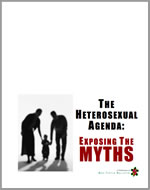 At last, the truth can now be told.
Using the same research methods employed by most anti-gay political pressure groups, we examine the statistics and the case studies that dispel many of the myths about heterosexuality. Download your copy today!
And don‘t miss our companion report, How To Write An Anti-Gay Tract In Fifteen Easy Steps.
 Anti-gay activists often charge that gay men and women pose a threat to children. In this report, we explore the supposed connection between homosexuality and child sexual abuse, the conclusions reached by the most knowledgeable professionals in the field, and how anti-gay activists continue to ignore their findings. This has tremendous consequences, not just for gay men and women, but more importantly for the safety of all our children.
Anti-gay activists often cite the “Dutch Study” to claim that gay unions last only about 1½ years and that the these men have an average of eight additional partners per year outside of their steady relationship. In this report, we will take you step by step into the study to see whether the claims are true.
Tony Perkins’ Family Research Council submitted an Amicus Brief to the Maryland Court of Appeals as that court prepared to consider the issue of gay marriage. We examine just one small section of that brief to reveal the junk science and fraudulent claims of the Family “Research” Council.
 The FBI’s annual Hate Crime Statistics aren’t as complete as they ought to be, and their report for 2004 was no exception. In fact, their most recent report has quite a few glaring holes. Holes big enough for Daniel Fetty to fall through.
“Google” is a trademark of Google Inc.
© Box Turtle Bulletin. All Rights Reserved.
 Posts
Posts  Posts via daily email: