Box Turtle Bulletin
 News and commentary about the anti-gay lobby
“Now you must raise your children up in a world where that union of man and box turtle is on the same legal footing as man and wife…”
News and commentary about the anti-gay lobbyFebruary 23rd, 2011
Jeffrey Cox, Indiana deputy Attorney General responded to a report that riot police may be used to clear protesters from the Wisconsin Capital building, tweeted “Use live ammunition.” You know, just like Libya’s Muammar al-Gaddafi. When challenged on his statement, Cox doubled down:
Cox remained steadfast in his position that the protestors should be killed when confronted on Twitter by Mother Jones’ Adam Weinstein, writing that “against thugs physically threatening legally-elected state legislators & governor? You’re damn right I advocate deadly force.” (There have been no reports that the protestors have physically threatened any elected officials).
Meanwhile, posters at Free Republic are calling on counter-protesters to an Atlanta pro-labor rally to arrive “with the usual accoutrements” because “the lefties are idiots who are very good at running their mouths… and also very good at keeping their distance from an armed American.”
Update: Cox was canned.
February 23rd, 2011
From AP
The Obama administration says it will no longer defend the constitutionality of a federal law that bans recognition of same-sex marriage.
In a statement Wednesday, Attorney General Eric Holder says President Barack Obama has concluded that the administration can no longer defend the federal law that defines marriage as only between a man and a woman.
It’s a bit early, but here is my assessment: [NOTE: this is an early assessment and I’ll likely provide a revised assessment at more information appears.]
In July 2010, Federal Court Judge Tauro found that the Defense of Marriage Act (DOMA) violated the US Constitution in two ways. 1) Congress cannot usurp the rights of states to define marriage for their citizens (the Commonwealth case) and 2) The federal government cannot treat gay married individuals differently from straight married individuals (the Gill case). It appears that the DOJ will now drop its appeal of Tauro’s decision.
This would immediately impact the First Federal Court District (Maine, Massachusetts, Puerto Rico, New Hampshire, Rhode Island) and would mean that same-sex marriages in Massachusetts and New Hampshire would be given full federal recognition. But by accepting the court’s determination that these provisions of DOMA are unconstitutional, the Obama Administration is signaling either that the federal government will immediately recognize all state’s same-sex marriages or that it will not oppose suits that seek such recognition in other court districts (such as the case already progressing in California).
This has an immense effect on those couples. This provides for equal federal taxation, spousal recognition for immigration (congratulations Tim and Junior), social security, and many many other rights and obligations. And perhaps as importantly, it removes the last barrier to “really married” that set same-sex couples apart.
But this also changes the political playing field tremendously.
Supporters of marriage equality have been given a powerful new message. It is now no longer a matter of nomenclature where states grant all the rights of marriage but not the name.
The federal government has no provision by which to recognize civil unions or domestic partnerships. So “protecting marriage” by reserving that title for heterosexuals now means denying gay citizens access to federal rights. This is, almost certainly, to tip the scales on the Perry v. Schwarzenegger case. The Proponents – assuming they are granted standing – are now required to argue that the state has a rational basis for granting all state marriage rights and denying all federal marriage rights that can meet heightened scrutiny. That is unlikely to be an easy task.
Further, this will impact the decisions of politicians who want to straddle the fence and make both sides happy. They can no longer say, “well I support your rights” when they are blocking access to social security or other federal benefits.
And this change puts anti-gay Republicans in a difficult position. The provisions of DOMA that allow Alabama to ignore Iowa’s marriages were not challenged. And they can hardly call for a Constitutional Amendment to disallow the citizens or representatives of a state to determine their own laws and still pretend to believe in local control or federalism. They can rant about Obama “usurping Congress’ role,” but they run the risk of alienating part of their own base if they insist that they should dictate to states what their laws should be.
This is a very significant day.
February 23rd, 2011
The Justice Department today announced that they will no longer defend the so-called “Defense of Marriage Act” in two lawsuits that had recently been filed in Federal District Court challenging the law.
In a letter sent to House speaker John Boehner, Attorney General Eric Holder wrote that Section 3 of the statute which bars the federal government from recognizing legal marriages of same-sex couples is a violation of the equal protection clause of the Fifth Amendment. Holder wrote that in response the the lawsuit which had been filed recently (Windsor v. United States, No. 1:10-cv-8435 (S.D.N.Y.); Pedersen v. OPM, No. 3:10-cv-1750 (D. Conn.)). These lawsuits challenge whether sexual-orientation classifications are subject to rational basis review or whether they must satisfy some form of heightened scrutiny, which represents a new type of challenge:
Previously, the Administration has defended Section 3 in jurisdictions where circuit courts have already held that classifications based on sexual orientation are subject to rational basis review, and it has advanced arguments to defend DOMA Section 3 under the binding standard that has applied in those cases.
These new lawsuits, by contrast, will require the Department to take an affirmative position on the level of scrutiny that should be applied to DOMA Section 3 in a circuit without binding precedent on the issue. As described more fully below, the President and I have concluded that classifications based on sexual orientation warrant heightened scrutiny and that, as applied to same-sex couples legally married under state law, Section 3 of DOMA is unconstitutional.
The administration and justice department determined that heightened scrutiny is appropriate for sexual orientation, citing three factors. The first is an acknowledgement that LGBT people have faced a history of discrimination, a position that is shared not just by LGBT advocates, but also by anti-gay activists who have defended the very nature of discrimination against LGBT people in the past. The second factor is a growing consensus that sexual orientation is immutable by outside factors for most people. But the third factor I found more interesting: it is based on historical and legal precedent:
…the adoption of laws like those at issue in Romer v. Evans, 517 U.S. 620 (1996), and Lawrence, the longstanding ban on gays and lesbians in the military, and the absence of federal protection for employment discrimination on the basis of sexual orientation show the group to have limited political power and “ability to attract the [favorable] attention of the lawmakers.” Cleburne, 473 U.S. at 445. And while the enactment of the Matthew Shepard Act and pending repeal of Don’t Ask, Don’t Tell indicate that the political process is not closed entirely to gay and lesbian people, that is not the standard by which the Court has judged “political powerlessness.” Indeed, when the Court ruled that gender-based classifications were subject to heightened scrutiny, women already had won major political victories such as the Nineteenth Amendment (right to vote) and protection under Title VII (employment discrimination).
Heightened scrutiny trumps “rational basis” in a very key way:
…under heightened scrutiny, the United States cannot defend Section 3 by advancing hypothetical rationales, independent of the legislative record, as it has done in circuits where precedent mandates application of rational basis review. Instead, the United States can defend Section 3 only by invoking Congress’ actual justifications for the law.
Moreover, the legislative record underlying DOMA’s passage contains discussion and debate that undermines any defense under heightened scrutiny. The record contains numerous expressions reflecting moral disapproval of gays and lesbians and their intimate and family relationships – precisely the kind of stereotype-based thinking and animus the Equal Protection Clause is designed to guard against. See Cleburne, 473 U.S. at 448 (“mere negative attitudes, or fear” are not permissible bases for discriminatory treatment); see also Romer, 517 U.S. at 635 (rejecting rationale that law was supported by “the liberties of landlords or employers who have personal or religious objections to homosexuality”); Palmore v. Sidotti, 466 U.S. 429, 433 (1984) (“Private biases may be outside the reach of the law, but the law cannot, directly or indirectly, give them effect.”).
The Justice Department will remain a party to the case, but will inform the court that heightened scrutiny is the appropriate standard for those cases. But it appears that Congress, if it so chooses, can intervene. “Our attorneys will also notify the courts of our interest in providing Congress a full and fair opportunity to participate in the litigation in those cases.” But as to the DOJ’s participation in this and other cases before the Federal Court:
Furthermore, pursuant to the President’s instructions, and upon further notification to Congress, I will instruct Department attorneys to advise courts in other pending DOMA litigation of the President’s and my conclusions that a heightened standard should apply, that Section 3 is unconstitutional under that standard and that the Department will cease defense of Section 3.
Other pending DOMA cases include Gill v OPM and Commonwealth v HHS.
Click here to read the full letter from Attorney General Holder to House Speaker John Boehner
February 23rd, 2011

MT State Rep. Kristin Hansen
Montana’s House voted 60-30 to pass House Bill 516, which would prohibit any local government from passing any anti-discrimination ordinances to protect LGBT people. The bill, written by Tea Party-backed Rep Kristin Hansen (R-Havre), was written in response to a 2010 Missoula ordinance that bans discrimination against city residents based on their sexual orientation, gender identity, or gender expression. The bill faces a final vote in the House before moving on to the Senate.
Hansen represents the branch of the G.O.P. which advocates for local control of important issues which impact the community without interference from higher levels of government, except for where they don’t.
Update: During testimony for Hansen’s bill in the Montana House Judiciary Committee, pastor Harris Himes of the Hamilton, MT’s Big Sky Christian Center and an attorney for the Alliance Defense Fund, testified in defense of HB516, saying that LGBT people should be discriminated against because the Bibles condemns them to death:
February 22nd, 2011

Buju Banton, at the time of his arrest.
Jamaican Dance Hall performer Buju Banton was found guilty in Federal Court today of conspiring to set up a cocaine deal in 2009. The performer, whose real name is Mark Myrie, was arrested last year in Miami following a sting by federal FBI agents. According to the Associated Press:
Banton was found guilty of conspiracy to possess with the intent to distribute cocaine, possession of a firearm in furtherance of a drug trafficking offense and using the wires to facilitate a drug trafficking offense. He was acquitted of attempted possession with the intent to distribute cocaine. Much of the case hinged on meetings and phone calls that were video and audiotaped by the confidential informant, who was working with the Drug Enforcement Administration — and who made $50,000 in commission after the bust.
This is Banton’s second trail on these charges. A jury deadlocked in the first trial earlier last year. Banton, who won a Grammy Award for Best Reggae Album for his latest release”Before the Dawn” last weekend, is imensely popular in Jamaica. The Jamaica Observer describes fans as “reeling”, and they’ve been Tweeting their objections:
Meanwhile fans of Reggae mourned the loss one of its biggest stars, the self-titled ‘Voice of Jamaica’.
“Buju a di heart a Reggae enu..Buju is not guilty..tell dem gu find di real criminal deem,” said fellow artiste ‘DiStar’.
For many, however, the verdict was the final act in a conspiracy against the artiste. “He’s been framed well good am still not convince he’s guilty,” said Abigale Bogle.
Banton faces the possibility of life in prison.
Buju Banton’s 1992 single, “Boom Bye Bye” calls for gay people to be shot in the head with automatic weapons, have acid poured on them, and burned “like an old tire wheel.” British LGBT Activist Peter Tatchel called the song “probably the most murderous incitement recorded by any singer anywhere in the world.” In 2007 Banton was among a number of reggae artists who signed the Reggae Compassionate Act, promising to refrain from performing homophobic songs or making homophobic statements. He later denied signing the pact, and he has performed “Boom Bye Bye” since renouncing the agreement.
In 2009, Banton’s U.S. tour was marked with several concert cancellations due to protests from members of local and national LGBT groups. During the tour, Banton told a Jamaican radio station, “This is a fight, and as I said in one of my songs ‘there is no end to the war between me and faggot’ and it’s clear.”
February 22nd, 2011
 While the death of gay-themed book stores (and the waning of traditional book stores in general) has cut back on one’s ability to peruse shelves of books with gay themes and characters, there is still an abundance of gay literature available. You may have to search online, but it is there.
Books on gay politics, theory, history, biography and erotica abound. But nothing is more important than novels, books which tell our stories and which connect us to the world. Fiction removes the specifics of real situations and generalizes in a way that allows a reader to step outside their world, empathize with a character, and share a new experience.
And there are many many novels available which express the lives of gay men. Some of them are even worth the time to read. Fewer, but still present, are novels which share the dreams, passions and possibilities of gay women.
But novels – or fiction of any sort – which share the lives of the trans members of our community are almost unheard of. And what fiction that does include trans characters or stories can feel a bit like ‘oooh, look at the freak’ or Very Very Earnest, neither of which make for a particularly pleasurable read.
So when I ran across Annabel by Canadian author Kathleen Winter
Annabel isn’t strictly a trans story (the main character was born intersex) but it does speak to gender discovery and is likely to have feeling of familiarity to both intersex and trans people. This is not my story or my experience, so I can’t be much of a judge as to its honesty or accuracy.
While this book is not without some technical and literary flaws, I’m enjoying the story. However, I wonder what our trans and intersex readers think. Have any of you read the book?
Please share with us your perspectives on this book or on other trans literature.
NOTE: I’m still a few chapters from finishing – and no doubt there will be others who will want to pick up the book without having the story spoiled – so please don’t give away of the plot.
February 20th, 2011
You may know of Galileo’s battles with the Catholic Church over the earth’s movement around the sun. Recently, though, I learned of the Church’s reaction to his discovery (using a telescope) of four moons around Jupiter.
He published his findings in a treatise called The Sidereal Messenger. Here’s how it was received:
In a very different spirit did the Aristotelians receive the Sidereal Messenger of Galileo. The principal professor of philosophy at Padua resisted Galileo’s repeated and urgent entreaties to look at the moon and planets through his telescope; and he even labored to convince the Grand Duke that the satellites of Jupiter could not possibly exist.
[The professor said:] “There are seven windows given to animals in the domicile of the head, through which the air is admitted to the tabernacle of the body, to enlighten, to warm, and to nourish it. What are these parts of the microcosmos? Two nostrils, two eyes, two ears, and a mouth. So in the heavens, as in a macrocosmos, there are two favorable stars, two unpropitious, two luminaries, and Mercury undecided and indifferent. From this and many other similarities in nature, such as the seven metals, etc. which it were tedious to enumerate, we gather that the number of planets is necessarily seven. Moreover, these satellites of Jupiter are invisible to the naked eye, and therefore can exercise no influence on the earth, and therefore would be useless, and therefore do not exist. Besides, the Jews and other ancient nations, as well as modern European, have adopted the division of the week into seven days, and have named them after the seven planets. Now, if we increase the number of the planets, this whole and beautiful system falls to the ground.”
The philosophy professor thought he had a great argument, even one based in empirical fact:
Padua’s philosophy professor was an extreme rationalist. Despite his appeal to a few carefully-selected facts, once he built his argument he refused to check it against reality. In fact, for him, if this fancy “telescope” revealed contrary evidence, then Galileo must be a trickster or a liar.
As for the “Aristotelians” mentioned, the author isn’t using the term the way I have (Aristotle has inspired many writers, and in many ways). No, these Aristotelians are the Scholastics, medieval natural law philosophers committed to demonstrating the truth of Church doctrine through the use of reason. They are quite literally Robert George’s intellectual forbears.
I bring this up because it’s a great example of how dangerous extreme rationalism can be. I think we see a milder (but equally sloppy) version of it in George’s work, when he starts with a known conclusion (i.e., Church doctrine is correct) and attempts to reason his way toward it, disregarding how well the outcome matches reality.
By the way, a few readers have pointed out the dangers of going the opposite way and embracing extreme empiricism instead. That’s worth remembering. Galileo is also known for his research into falling bodies and the nature of acceleration. He worked out basic principles by combining geometric principles with ingenious measurement techniques (which included using his pulse to count time in the absence of a stopwatch, and using a steady stream of water flowing into a vase, using the volume of water to compare intervals). It’s tough to walk the path between rationalism and empiricism. Robert George and the professor from Padua illustrate what happens when you go too far to one side.

The Galilean moons. Aren't they beautiful?
February 19th, 2011
NOM is trumpeting a new Maryland poll about same-sex marriage:
By a 54-37 margin, Maryland voters believe that marriage should only be between a man and a woman, according to a new poll released today by Lawrence Research.
And here’s the question they asked:
As far as you personally are concerned, should marriage be between a man and a woman, or should it also be available to same-sex couples.
Emphasis added, for one simple reason: This is not an either/or question!
People could say, without contradicting themselves:
Yes, I believe marriage should be between a man and a woman, and yes, it should also be available to same-sex couples.
Just as they could say:
I believe everyone should abstain from alcohol, and I think it should be available to adults.
or
I believe birth control is wrong, and I think people should have the option of deciding that for themselves.
So much for Live and let live. So much for letting people make their own decisions. So much for any conception of liberty. If, “as far as you personally are concerned,” you disapprove of something, it never occurs to NOM that your respect for freedom might keep you from trying to control your neighbor’s life.
Nope, according to NOM, if you think something is wrong, then you want impose that belief on everyone.
This attitude pops up again and again. Remember Miss America contestant Carrie Prejean?
Well I think it’s great that Americans are able to choose one way or the other. We live in a land where you can choose same-sex marriage or opposite marriage. And, you know what, in my country, in my family, I think that, I believe that marriage should be between a man and a woman, no offense to anybody out there. But that’s how I was raised and I believe that it should be between a man and a woman.
Taken literally, she’s offering support for marriage equality even as she expresses her personal belief that it’s wrong. That’s not what she intended, but it’s what she said, without even realizing it.
Obama’s just as guilty:
I’m a Christian. And so, although I try not to have my religious beliefs dominate or determine my political views on this issue, I do believe that tradition, and my religious beliefs say that marriage is something sanctified between a man and a woman.
If he’s offering this to explain why he opposes legalizing same-sex marriage, he’s failed. He can believe exactly what he said and still support marriage equality.
I suppose, then, it’s not fair to single out NOM for this. They’re just the latest perpetrators.
My hunch is that NOM is so blind to their own assumptions, they didn’t even realize they weren’t asking an either/or question. Another possibility, though, is that they knew exactly what they were doing.
Look at the opening phrase: As far as you personally are concerned, should marriage be between a man and a woman…
It’s almost as if they added “As far as you personally are concerned” as a deliberate attempt to distract people from the issue of legalizing same-sex marriage. As if NOM knew the wording would let them dishonestly claim for their own side those respondents with a live-and-let-live attitude, those who think it should be legal despite their own personal disapproval.
As if they knew they could then distort these results to understate Maryland’s support for legal equality.
So which is it? A careless mistake or a conscious manipulation of the question? I bet the answer depends on whose mind you’re looking into: that of Maggie Gallagher (a canny operator) or Brian Brown (a blundering bull).
Ultimately, I see one lesson take away from this. We need to add another weapon to our rhetorical arsenal this one for people who are more comfortable with liberty than with homosexuality:
You can disapprove of something and still think it should be legal!
February 18th, 2011
OOOOPS: I think I misread the bill. It would recognize out of state marriages as domestic partnerships within the state. So the rest of this commentary is not useful.
The House of Representative in State of Washington is posed to perform an odd act: recognize out-of-state same-sex marriages but not those conducted within the state. While the state offers domestic partnership which is identical to marriage in rights and obligations – a law confirmed by a vote of the people – it does not yet offer full marriage recognition.
The state House Judiciary Committee on Thursday approved legislation under which Washington sate would legally recognize gay marriages performed elsewhere.
Seven Democrats on the committee voted for the bill and six Republicans voted against it. The bill now moves to the House floor. It has 55 co-sponsors, enough for a majority in a floor vote.
A bill which would have allowed recognition of in-state same-sex marriages did not make it out of committee on Thursday, the final day to do so. It is not certain why the out-of-state bill is assured passage while the local marriage one is not, but it may have to do with the difficulty that anti-gay activists will have in whipping up opposition to recognizing the laws of other states and countries.
Should the bill pass, it would appear that Washingtonians will be able to cross the border into Canada, marry there, and return with the full recognition of the state. This will add to the hodge-podge of laws ranging from full recognition of other states’ marriages but no local recognition at all (New York and New Mexico) to a date-based window of recognition of both instate and out-of-state marriages (California) to the various states which convert out-of-state marriages into civil unions upon entry (Hawaii and others) to outright bans on all recognition (most states).
February 18th, 2011
From the Las Cruses Sun News
The House Consumer & Public Affairs Committee essentially killed two proposed constitutional amendments that would define marriage, for legal purposes as being between a man and a woman.
House Joint Resolution 7, sponsored by Rep. Nora Espinoza, R-Roswell, would have made gay marriage unconstitutional if approved by the Legislature and by voters in the 2012 general election.
HJR8, sponsored by Rep. David Chavez, R-Los Lunas, also would seek to amend the Constitution to prevent New Mexico from recognizing otherwise legal out-of-state marriages between persons of the same sex. Earlier this year, state Attorney General Gary King said New Mexico should recognize such marriages, even though they legally can’t be performed in this state.
The committee also tabled House Bill 162, also sponsored by Chavez, which would bar the state from recognizing same-sex marriages from out of state.
All three measures were tabled on a 3-2 party-line vote.
February 18th, 2011
The Wyoming Senate narrowly voted Friday to stop recognition of same-sex marriages and civil unions from outside the state.
House Bill 74 passed 16-14 after tagging on a last-second amendment guaranteeing out-of-state couples in civil unions access to Wyoming courts.
This is closer than might have been expected. Ten Republicans joined all four Democrats in voting “No”.
Further, the language of this bill is interesting. It appears to invalidate all same-sex marriage, but only invalidate civil unions that would not be recognized in Wyoming. I may be misreading this, but it does seem to leave open the possibility of a civil unions bill being passed.
February 18th, 2011
The California Supreme Court has now answered a number of questions about the legality of same-sex marriage in California.
Now it will answer one more.
As part of Perry v. Schwarzenegger, the Ninth Circuit Court of Appeals found no provision by which the authors of a proposition could appeal a federal decision if the elected representatives of the state chose not to do so. However, as the State of California is the entity which determines who will represent its interests, it asked the California Supreme Court to determine if California law had some provision by which non-elected representatives could step into the shoes of elected officials and appeal on behalf of the state.
Last week the State Supremes took up the challenge. Opening briefs are due March 14, 2011.
If the CA court finds that there are no substitute-appellant provisions in California law, then the Ninth Circuit is likely to accept that finding and, as there is no one to appeal the decision, uphold Judge Walker’s finding that Proposition 8 violates the equal protections and due process clauses of the US Constitution. This ruling would likely trigger challenges in other states in the Ninth Circuit that are banned by constitutional amendment from recognizing same-sex marriages, particularly the ‘all but the name’ states of Oregon and Nevada.
The Proposition 8 Proponents will, of course, appeal to the US Supreme Court to get standing, but that is unlikely to be granted.
Should the CA Supremes determine that the Proponents can appeal the ruling, then the Ninth Circuit will determine whether Judge Walker’s ruling is correct on its merits.
February 18th, 2011
[This post is part of a series analyzing Robert George’s widely-read article, “What is Marriage“, which appeared on pages 245-286 of the Harvard Journal of Law and Public Policy. You can view all posts in the series here.]
This is it. This is the meat you’ve been waiting for. This is the next generation of anti-gay talking points. Because this is…
Pages 252-255: In which Robert George tries to prove only a man and a woman can marry.
George gets off to a bad start.
George writes:
As many people acknowledge, marriage involves: first, a comprehensive union of spouses; second, a special link to children; and third, norms of permanence, monogamy, and exclusivity. All three elements point to the conjugal understanding of marriage.
Hmm. That second word, “many,” is one of the slipperiest in our language. More troubling, though, is why he’s even invoking what “many people acknowledge.” George holds that marriage is not just whatever we say it is, so why does it matter to him what “many people acknowledge”? This vague appeal to public opinion feels like he’s trying to get people to buy in for the wrong reasons.
I have a still bigger issue with “All three elements point to the conjugal understanding of marriage,” especially the phrase point to: What does it mean?
To achieve his goal with the article, he must mean that these three concepts are necessary for a marriage to be a real marriage — that a marriage lacking any one or more of these three items is not a real marriage.
Remember, he’s not just saying that conjugal/procreative marriage is a real marriage. He’s trying to establish that other kinds of marriage are not real, that only the conjugal/procreative view is valid.
We’re seeing some slick PR here. George isn’t being upfront, and it’s easy to see why: This idea of three necessary conditions is a tough sell, especially to elderly folk who can’t have kids but do want to marry. It’s easier to say something meaningless like “point to” and thus avoid a situation where even your most traditional readers say, But that doesn’t match my real-life experience.
For George to succeed, then, he has to establish two things:
If you break either of those statements, you break his argument.
We’ll break them both. Read the rest of this entry »
February 18th, 2011

New York photographer Brandon Stanton is on a mission to take a photo of every interesting person in New York, and that was the (altered) title* of his post expressing his admiration for gay people: There comes a point in every out gay person’s life when he or she has to say, “I don’t give a f—!” And when Stanton traveled to Chicago recently, he found a great example of the kind of bravery that statement requires:
“It’s not true,” he said “What they say about drag queens.”
“What do they say about drag queens?” I asked.
“That we’re attention whores– just desperate for love.” I’d never heard that before. He went on: “But I’m happy just the way I am.” He wasn’t smiling. He reached for some bright blue lipstick and began putting it on. “But its hard.” (I know its hard, Robert.) “I’ll meet a gay man in a club, and they’ll like Robert. Then I’ll bring them here. And I’ll show them this.” He motioned toward the boxes of feathers and colors. “And they’ll see this, and they’ll be like, I didn’t sign up for this.” (That’s what you get for not giving a f—.) “It’s too much for them.” (You’re just too different.) I’m too much for them.” (Even me Robert. Even I’m a little uncomfortable. I don’t want to be. But I am.) “So I don’t know if I’ll be able to do this forever.” He stared into the mirror for a second, and then Cyon came back. He sat up straight in his chair. He leaned close into the mirror, admiring his handiwork. “But if they have a problem with me, that’s their problem. Because it’s who I was born to be. I am living my energy. And nothing could be more joyful.” (Or painful.) “Here,” he said, “come photograph me with this.”
*I really hate censoring words, especially when a word has such magnificent power as this one. But because we strive to give nanny-bots the fewest number of reasons possible to filter this blog out (yeah, I know, being a gay blog is reason enough for many of them), this is the trade-off we’re making. I’d rather all the young Cyons out there have access to this than risk getting block over a few words. But given the nature of the post, that makes the unhappy trade-off all the more ironic.
February 17th, 2011

Lou Engle addressing a rally in Kampala, Uganda.(Marc Hofer/New York Times)
Soulforce and the Human Rights Campaign have announced a vigil this Sunday morning outside of the International House of Prayer in Kansas City, to ask fundamentalist pastor Lou Engle to “abandon his hateful and dangerouls anti-LGBT rhetoric and actions.”
The vigil appears prompted by the recent murder of Ugandan LGBT advocate David Kato. Last summer, Engle traveled to Uganda where he voiced his support for the draconian Anti-Homosexuality Bill that would impose the death penalty of LGBT people under certain circumstances. He denied supporting the death penalty itself, but he did confirm that he does support the criminalization of consensual same-sex relationships between consenting adults. According to an updated press release from Soulforce and HRC, Engle has agreed to meet with the group “at a date to be determined.”
Click here to read the full press release from Soulforce and HRC
Featured Reports
 In this original BTB Investigation, we unveil the tragic story of Kirk Murphy, a four-year-old boy who was treated for “cross-gender disturbance” in 1970 by a young grad student by the name of George Rekers. This story is a stark reminder that there are severe and damaging consequences when therapists try to ensure that boys will be boys.
When we first reported on three American anti-gay activists traveling to Kampala for a three-day conference, we had no idea that it would be the first report of a long string of events leading to a proposal to institute the death penalty for LGBT people. But that is exactly what happened. In this report, we review our collection of more than 500 posts to tell the story of one nation’s embrace of hatred toward gay people. This report will be updated continuously as events continue to unfold. Check here for the latest updates.
In 2005, the Southern Poverty Law Center wrote that “[Paul] Cameron’s ‘science’ echoes Nazi Germany.” What the SPLC didn”t know was Cameron doesn’t just “echo” Nazi Germany. He quoted extensively from one of the Final Solution’s architects. This puts his fascination with quarantines, mandatory tattoos, and extermination being a “plausible idea” in a whole new and deeply disturbing light.
On February 10, I attended an all-day “Love Won Out” ex-gay conference in Phoenix, put on by Focus on the Family and Exodus International. In this series of reports, I talk about what I learned there: the people who go to these conferences, the things that they hear, and what this all means for them, their families and for the rest of us.
Prologue: Why I Went To “Love Won Out”
Part 1: What’s Love Got To Do With It?
Part 2: Parents Struggle With “No Exceptions”
Part 3: A Whole New Dialect
Part 4: It Depends On How The Meaning of the Word "Change" Changes
Part 5: A Candid Explanation For "Change"
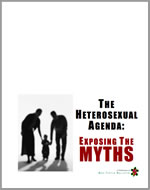 At last, the truth can now be told.
Using the same research methods employed by most anti-gay political pressure groups, we examine the statistics and the case studies that dispel many of the myths about heterosexuality. Download your copy today!
And don‘t miss our companion report, How To Write An Anti-Gay Tract In Fifteen Easy Steps.
 Anti-gay activists often charge that gay men and women pose a threat to children. In this report, we explore the supposed connection between homosexuality and child sexual abuse, the conclusions reached by the most knowledgeable professionals in the field, and how anti-gay activists continue to ignore their findings. This has tremendous consequences, not just for gay men and women, but more importantly for the safety of all our children.
Anti-gay activists often cite the “Dutch Study” to claim that gay unions last only about 1½ years and that the these men have an average of eight additional partners per year outside of their steady relationship. In this report, we will take you step by step into the study to see whether the claims are true.
Tony Perkins’ Family Research Council submitted an Amicus Brief to the Maryland Court of Appeals as that court prepared to consider the issue of gay marriage. We examine just one small section of that brief to reveal the junk science and fraudulent claims of the Family “Research” Council.
 The FBI’s annual Hate Crime Statistics aren’t as complete as they ought to be, and their report for 2004 was no exception. In fact, their most recent report has quite a few glaring holes. Holes big enough for Daniel Fetty to fall through.
“Google” is a trademark of Google Inc.
© Box Turtle Bulletin. All Rights Reserved.
 Posts
Posts  Posts via daily email: