Box Turtle Bulletin
 News and commentary about the anti-gay lobby
“Now you must raise your children up in a world where that union of man and box turtle is on the same legal footing as man and wife…”
News and commentary about the anti-gay lobbyOctober 31st, 2010
Multiple reports indicate that Uganda’s Rolling Stone (no relation to the venerable U.S. publication by the same name) has hit the streets again following a nearly month-long haitus with another installment of its anti-gay vigilante campaign. According to editor Muhame Giles’ Facebook posting:
The Rolling Stone has again published 20 more pictures of homosexuals in Uganda. The early edition for monday is already on the street. Our kampala readers can pick copies from Petro (jinja road) and “sell-out” point -Bugolobi stage,” said Circulation chief Nicholas. There we roll….
The latest edition reportedly carries the headline, “More homos’ faces exposed.” Giles defended the tabloid’s outing campaign last week, saying, that homosexuality was “bigger than terrorism. He also said, “we thought that by publishing that story, the police would investigate them and prosecute them and hang them.” Giles also claims that there have been no attack against LGBT people as a result of the previous campaign, despite verified reports to the contrary. It is very easy to imagine that should there be blood on his hands as a result of his irresponsible actions, he’ll rush another edition to print just to brag about it.
When people say that there is no such thing as evil personified, all you have to do is look at this man and see it in all its banality.
October 29th, 2010
Some conservative Christians are dismissive of the notion that their campaign against “the normalization of homosexuality” contributes negatively to the mental health of young people. They may say “no one should be bullied,” but this brief aside is quickly drowned out by protestations of innocence and further denunciation of gay people. Take, for example, the statement released by a coalition of some anti-gay activists led by Linda Harvey:
“Gay” activists nationwide are fueling an effort to indict traditional moral values as “guilty until proven innocent” in some bullying incidents involving teens. Their proposed solutions end up sexualizing teens at young ages into known high-risk behaviors and silencing concerned parents.
In debate, they loudly insist that those children who go to church are taught not to bully, and that the guilty parties in most of the cases were not regular church attendees. We do not have any way of knowing the extent to which bullies do or do not attend regular services, but considering that anti-gay activist have taken their culture of condemnation of homosexuality outside of the boundaries of their sanctuary and into the public square, it really doesn’t matter.
It is, one would assume, incontrovertible that statements which rail against “homosexual activists” (defined as any self-identified gay person) in terms of contempt and loathing would have some impact on kids who recognize within themselves same-sex attraction. Any person working from logic would have to recognize that national organizations who claim that God doesn’t want a same-sex attracted kid to be able to have a support group in school has to play havoc on that kid’s self-worth.
Yet, the loudest voices who claim to speak for Christianity deny any fault. They are only speaking “the truth in love.”
We are not fooled by this, but they really don’t believe it themselves. They know – though they may not admit it – that bullied children are a victim in their war on our lives, freedoms, and civil rights. They know that those kids who commit suicide as a result of anti-gay bullying are a direct consequence of their political and social endeavors.
They simply believe it to be a sad but acceptable collateral damage. Yes, it’s a tragedy, but it’s better that that some kids be dead than that others think it is okay to be gay. As one anti-gay activist (who, to their credit, did not sign on to Linda Harvey’s statement) responded in private correspondence to my concern, “You are willing to put children through suffering in the assumption that your understanding of scripture is correct. Because of what you believe, others get to suffer.”
Timothy, you are affirming homosexuality to children based on your assumption that your understanding of Scripture is correct, and if it’s not, your facilitating their eternal suffering and separation from God. Eternity is a very long time.
But the blame does not lie solely with those who come bringing accusations of “abomination” and fears about the destruction of society. It also lies with those who let such statements be credited as holy. And for far too long, those less hostile within the Christian faith have been complicit in this message; they have stood aside lamenting the pain that was being caused, but doing little to counter-act it.
Those who read here regularly know that I defend Christians and others of faith from blanket accusations. But let me be bold to say that the Christian Church in America, collectively, is the primary facilitator of the message of condemnation that young gay kids hear, be it by active denunciation or by failure to counterbalance those who do.
So it was with a great deal of joy that I watched the contribution of Mark Hanson, the Presiding Bishop of the Evangelical Lutheran Church in America to the It Gets Better campaign.
Hanson speaks of love, he speaks of being the person God created you to be, he speaks of nothing being able to come between you and God. And at no point does he feel compelled to temper his comments with denunciation of “homosexual acts” or rants about agendas. He even acknowledges the hurt caused by some Christians and takes ownership for the pain caused by the silence of others.
I truly hope that every gay kid out there who is being raised in a Christian family and has equated their own person as being immoral or vile or ungodly will hear this message.
It is of tremendous importance that the inclusive Christian denominations find their voice in the debate over the place of gay men and women in society and the church. I welcome Hanson’s contribution, and hope that it is but the first of many positions on which the Lutherans, along with the other mainline churches, will be willing to speak out in favor of love and inclusion and in opposition to those who would usurp the authority of Christendom to engage in evil against our community.
October 29th, 2010
The survey of troops and their families about their attitudes on repealing Don’t Ask Don’t Tell has been completed and the results have been compiled. And while the analysis of the results continues and the report will not be available until December 1, some information has been leaked to the media. (WaPo)
A majority of active-duty and reserve service members surveyed by the Defense Department would not object to serving and living alongside openly gay troops, according to multiple people familiar with the findings.
The survey’s results are expected to be included in a Pentagon report, due to President Obama on Dec. 1, regarding how the military would end enforcement of the “don’t ask, don’t tell” law that bans openly gay men and lesbians from serving in uniform.
Some troops surveyed – but not a majority – objected strongly to the idea of serving with gays and said they would quit the military if the policy changed, said the sources, who spoke on the condition of anonymity because they were not authorized to publicly share details of the survey.
Terms such as “a majority” and “some troops” are probably useless at this point for anything other than political positioning, but considering that it had been feared that only those most motivated by anti-gay animus would answer the survey, I am encouraged by this leak and am hopeful that the end result will not be a document that will allow Senator McCain much ammunition in his war against openly gay soldiers.
October 28th, 2010
Anti-gay activists are working hard to duck responsibility for anti-gay bullying and teen suicides. These attempts occasionally veer into sheer lunacy, as when they claim gay teens are in despair because society is too accepting of homosexuality. But there’s one dodge I find particularly offensive. From the comments on NOM’s Facebook page:
The only people responsible for the suicides are the people that comitted them.
Nobody forces anyone to take his own life; ergo, only those who commit suicide are responsible.
Each person is responsible 4 their own actions. U make believe u r gay. God did not make u gay & He does not make u commit sucicide. nor does anyone else
I don’t know if gay is always a choice, or not. But suicide is ALWAYS a choice. The ultimate cop-out.
To be fair, I don’t see this from polished anti-gay leaders. But it’s all over the comments on their web pages and blogs. It’s a strange argument coming from conservatives, who generally believe teenagers require strict discipline and are still learning to make wise decisions. They think a 15-year-old like Billy Lucas can’t handle alcohol, a car, the vote, or serving in the military, but he’ll have no trouble hearing that in the core of his being he’s an abomination, a pervert, an affront to God.
We have good reason not to trust kids to their own judgment when it comes to the big stuff. The human brain isn’t mature until it’s 23 to 25 years old. Through magnetic resonance imaging (MRI), scientists are now able to track blood flow — and therefore activity — in the brains of adults and teens as they confront information and solve problems. The science is new, but some differences are clear:
Between childhood and adulthood, the brain’s “wiring diagram” becomes richer, more complex and more efficient, especially in the brain’s frontal lobe, or front outer mantle, which is the seat of such higher order functions as learning and socialization. An important part of the frontal lobes is the prefrontal cortex (PFC), which is often referred to as the “CEO” or executive of the brain and is responsible for such skills as setting priorities, organizing plans and ideas, forming strategies, controlling impulses, and allocating attention. New research suggests that the PFC is one of the last areas of the brain to fully mature…
[O]ne key MRI study found that when identifying emotions expressed on faces, teens more often activated their amygdala—the brain area that experiences fear, threat and danger— whereas adults more often activated their prefrontal cortex—the area of the brain linked more to reason and judgment—and performed better on the task. Behaviorally, the adult’s responses were more intellectual, the teens’ more from the gut. These findings and others suggest that although the plasticity and changeability of the adolescent brain are extremely well suited to meet the demands of teen life, guidance from parents and other adult institutions are essential while decision-making circuitry is being formed.
Impulse control, planning and decisionmaking are largely frontal cortex functions that are still maturing during adolescence…[O]ne reason adolescents may have difficulty inhibiting inappropriate impulses is that the circuitry needed for such control is not fully mature in early adolescence, thereby making such tasks relatively difficult.
In short, kids have less impulse control than adults, and they listen to their gut when processing emotional cues.
 Adults: prefrontal cortex |
 Teens: amygdala |
Imagine then that you’re a gay teen, and you’re watching this Jimmy Swaggart broadcast with your parents, who have demonized gays in front of you all your life. Look at Swaggart’s face as he speaks. Take in his “emotional cues.” Hear your parents murmuring “Mm hmm. That’s right.”
Imagine reacting from your gut, not your intellect. Imagine your brain has only limited impulse control.
Imagine all that — as the only life you know.
http://vimeo.com/16299268Maggie Gallagher wants to know if she has blood on her hands. Jimmy Swaggart. Peter Sprigg. Tony Perkins. Bryan Fischer. Linda Harvey. Whether you’re calling us an abomination, or phrasing it more gently (like Maggie) and merely saying we can never feel the love that a man and a woman can. You all have blood on your hands.
October 28th, 2010
MetroCatholic has written up an article about the controversy resulting from the AOL News story about Kansas State University professor Walter Schumm and his “study” finding that the “children of homosexuals are more likely to be homosexuals.”
In what is either a poorly contrived effort at preemptive damage control or a case of absurd irony, Schumm discusses the motivations for his study:
“Most scholars actually agree with the concept that gay people ought to be more likely to have gay children,” he told CNA in an Oct. 19 interview. “Even people on the liberal side of things actually pretty much agree with the idea that there are going to be social influences.”
He noted that prominent gay activist Jim Burroway has criticized proponents of the “parental influence” theory but has also said that such findings would not be surprising. In a column published on a gay and lesbian website in 2006, Burroway noted that virtually every theory about the origin of homosexuality would likely predict a higher incidence in children of gay parents.
Schumm wanted to test that prediction, and to improve on previous research he said was too limited and not sufficiently rigorous. He analyzed data obtained from 26 studies of gay parents and their children.
I was unable to identify – among the many many articles discussing the contributing factors that play into the development of sexual orientation – one that directly fits Schumm’s description. But I did find that in December 2006, Jim said this:
If we are ever able to tease out all of the possible factors that influence sexuality, we will probably learn that there are many different “types” of homosexuality. For some, it may be genetic. For others, maybe their later birth order after a string of brothers. For others still, it may be the same thing that made them left-handed. For others, their left-handedness may be a red herring and the real cause was their distant father. And for others, maybe their absent father had nothing to do with it; prenatal hormones made it inevitable. And for most — maybe all — it is more likely to be the unique combination of any and all of these factors (and others that we haven’t discovered yet) which forms the basis for who we are.
Ultimately, the issue is not whether the “parental influence” theory – or any of the other theories – will be found to be the most accurate. This issue is whether Schumm or his “study” has credibility to contribute to the conversation. And having reviewed his methods, we have determined that he has none.
October 27th, 2010
This is revised version of an earlier post, which some people found offensive. I try not to worry about offending people (I hate this increasingly popular notion that to offend someone is to do them harm), but in this case the rhetorical device seemed to overshadow the point itself.
Noted anti-gay crusader Linda Harvey (founder of Mission America) has a new strategy in the battle to evade responsibility for anti-gay bullying and suicide: She’s comparing herself to Michelle Obama.
Traditional morality is not responsible for harassing speech. Are healthy nutrition programs or the First Lady’s anti-obesity initiative responsible for slurs and insults to overweight students? Of course not.
No, of course not. But could the First Lady’s tactics differ a bit from Linda Harvey’s, who has said:
I’m confident that if Michelle Obama said anything comparable in her anti-obesity campaign, we’d hold her accountable for adding more stigma and toxic shame to the world.
Of course, she hasn’t said these things.. That makes Harvey’s argument a false equivalence. That’s a fallacy, a handy fallacy, but a fallacy nonetheless.
It’s good to have a name for this sort of thinking; having a label for it in your head makes it easier to spot. You’ll probably be hearing a lot of false equivalence from the religious right as the nation talks more and more about anti-gay bullying and suicide. Be ready to call them on it when it occurs.
Huge thanks to goodasyou for the Linda Harvey info.
October 26th, 2010
Perry v. Schwarzenegger is about whether California’s Proposition 8 was in violation of the US Constitution… but not really. That’s just the issue. Perry is about something much larger. And it is in the opening paragraphs of the plaintiffs’ rebuttal to appeal (pdf) that this is so eloquently made clear:
This case tests the proposition whether the gay and lesbian Americans among us should be counted as “persons” under the Fourteenth Amendment, or whether they constitute a permanent underclass ineligible for protection under that cornerstone of our Constitution.
Perry is a question about marriage, but the real question, the one that drives the motivations behind Proposition 8 and all of the anti-gay activists, is whether the US Constitution also covers gay people or whether the words “any person” contains an invisible asterisk that references a special exclusion.
This battle, like that over DADT, adoption, and all of the other areas in which gays are segregated and excluded is a battle over whether gay people will be seen as full citizens, or whether the “normalization of homosexuality” is so great a threat that the equality principles enshrined in our founding documents have to be discarded or ignored.
Ted Olson’s response to appeal is as much a stirring call to uphold our values as a people as it is a legal argument. Yes, his logic is sound and his legal reasoning is beyond reproach (and amazingly easy for a lay person to understand); but it is his reminder of why we believe what we believe that makes this document such a great read.
The purpose of the Proponents is not, as they suppose, to protect some idealized institution of marriage. Rather, it is to further and support the culture of disapproval of homosexuality and to do so by carving out an exclusion from the protections afforded by the Constitution. But this is not just a “social discussion” or a “moral position” without direct and dire consequences. As Olson concludes:
Last month, in a widely publicized tragedy, a young Rutgers student jumped to his death from the George Washington Bridge after being outed on the Internet as gay. A few days later, across the Hudson River in the Bronx, two 17-year-old young men were beaten and tortured to the brink of death by a gang of nine because they were suspected of being gay. Incidents such as these are all too familiar to our society.
And it is too plain for argument that discrimination written into our constitutional charters inexorably leads to shame, humiliation, ostracism, fear, and hostility. The consequences are all too often very, very tragic.
October 26th, 2010

"Hang Them; They Are After Our Kids", published in the October 2, 2010 edition of the Ugandan tabloid Rolling Stone (Names, places and photo obscured by BTB. Click to enlarge)
That’s the promise being made by the Muhame Giles, the editor of the Ugandan tabloid Rolling Stone (no relation to the U.S. publication by the same name), who posted this on Facebook earlier today:
An extraordinary meeting of The Rolling Stone management last nyt resolved we hit the streets this Friday irrespective of media council’s refusal to reconsider it’s decision of blocking our publication. We registered editor’s particulars on October15 but up to now they are “still consulting!!!” Our lawyers have given us a green light. Any attempts of confiscating the Stone will land someone in jail…U HAVE MY WORD.
Rolling Stone lauched a major anti-gay vigilante campaign earlier this month with an article that outed a couple dozen LGBT Ugandans, complete with photos gleaned from Gaydar.co.uk and Facebook. That article, accompanied with the headline “Hang Them”, promised to be the first of a four-part series. The tabloid, which was launched just five weeks earlier, had failed to register with Uganda’s Media Council, prompting an ordered shut down by authorities. That order came before the second part of the series could be published, but not before several LGBT people were threatened and forced to leave their homes.
The real Rolling Stone has denounced the tabloid as an “African impostor spread[ing] hate.”
Giles told the BBCthat he was acting in the “public interest,” saying Ugandans did not know to what extent that homosexuality was “ravaging the moral fabric of our nation.”
October 26th, 2010
Conservative Evangelical professor Warren Throckmorton, who has been a stalwart opponent to the draconian Anti-Homosexuality Bill that continues to linger in Uganda’s Parliament, received a message from Las Vegas-based Canyon Ridge Christian Church indicating that after several months’ delay and excuse-making, are considering dropping their financial support for Ugandan pastor Martin Ssempa, one of that country’s most ardent supporters of the proposed bill. The statement has also been posted on Canyon Ridge’s web site with a prominent link on the front page:
Because of the current controversy in Uganda over the Anti-Homosexuality Bill, and because of Pastor Ssempa’s involvement in the support of the bill, we have been in regular communication with him to clarify his positions and opinions. While we have come to understand that Pastor Ssempa advocates for an amended version of the Anti-Homosexuality bill that removes the death penalty and reduces other severe penalties, he is still supports passage of this bill.
We, however, do not support him in this effort.We are in the process of determining how we can redirect our support in Uganda to activities specifically related to addressing HIV/AIDS issues.
It is still unclear exactly what this statement means. Will they continue to provide financial assistance for Ssempa’s work in “HIV/AIDS issues” while condemning the passage of the anti-gay bill? As I read it, that scenario could conceivably fit within the parameters of this statement. But it’s also worth noting that while Ssempa’s profile on Canyon Ridge’s web site is still accessible, the link to it from the Global Partners page has been removed and replaced with a link to the statement.
October 22nd, 2010
On October 21st, Ritch Savin-Williams, professor of developmental psychology at Cornell University, was interviewed by NPR’s Robert Siegel about LGBT youth suicide and the significant attention the issue has received over the past several weeks. In the interview, Savin-Williams claims there is no “epidemic” of LGBT teen suicide and that attention to the issue may be stigmatizing the majority of LGBT youth who are, in fact, just as happy and healthy as their straight peers.
SIEGEL And what, if anything, is harmful about all this attention?
Prof. WILLIAMS: For me, first off, scientifically it’s not true. That is that, as a developmental psychologist, when we look at the wide population of youth who identify as gay or who have same-sex attractions, it appears to me when I look at the data that they’re actually just as healthy, and just as resilient, and just as positive about their life as are straight youth.
So from a scientific perspective, there is certainly no gay suicide epidemic. But the more problematic aspect for me is that I worry a great deal about the image that we are giving gay-identified youth.
Savin-Williams is a noted researcher and published author. He isn’t a right-wing hack with an anti-gay agenda hiding behind a faux academic mask.
Rather, much of his work has focused on the experiences of LGBT youth, the resilience factors present in their lives that enable them to thrive in anti-LGBT climates, and the new ways LGBT youth are assimilating and expressing their identities, often without adopting the labels used by established LGBT culture. (For more, see his book The New Gay Teenager).
When asked in the interview about the differences between reported research confirming that LGBT Youth are significantly more likely to attempt suicide than their straight peers and his own conclusions, Savin-Willams claims that those results may be skewed by lack of representative samples:
…As we get a more representative sample of youth who identify as gay, who have sane-sex attraction, what we discovered is that difference begins to narrow considerably. So, do we emphasize this kind of difference, group difference, or do we begin to say, well actually it’s not quite as bad as we have portrayed it to be , or at least as how the medical sciences, the mental health providers and research, and the public policy people have said.
While many academics are just as quick to point out limitations of research on LGBT people – an issue often discussed here on BTB – Savin-Williams seems to stand nearly alone in his conclusions that life for LGBT teenagers is not that bad. He admits that it is possible to “cherry pick” studies that support either conclusion about LGBT youth, but for him it is more about the strategy and message employed by those working to support and protect them.
Do we solely focus on the cohort of LGBT youth struggling the most? Or, should we broaden our attention to the larger proportion of LGBT youth who are healthy, well-adjusted, and not suicidal?
In the interview, Savin-Willams concludes:
Most gay youth – how many gay youth? I would say 90 percent – are actually doing quite well. They are not depressed, They are not anxious. They are not attempting suicide. They are really quite ordinary adolescents.
On the surface it may seem like this interview is fodder for anti-gay leaders’ efforts to discredit research on LGBT populations and absolve themselves of responsibility for the affect the homophobic society they create has on young people.
However, Savin-Williams is simply trying to get us to look at the “other side” of the data often cited when we are confronted by tragic incidents of LGBT youth suicide.
For example, in 2007 the American Journal of Public Health published the results of a study of over 14,000 youth ages 18 to 26 who participated in the federal National Longitudinal Study of Adolescent Health. Nearly 5 percent of youth who identified as LGB in the study reported attempting suicide compared to 1.6 percent of non-LGB youth. In other words, LGB youth were over three times more likely to attempt suicide – certainly cause for alarm.
However, approximately 95 percent of the LGB youth in the study did not report that they attempted suicide.
This is not merely a matter of semantics. There is a critical need to examine the lives of the overwhelming majority of LGB youth who are not suicidal. The goal is not to be critical of the focus on youth in despair. Rather, a better understanding of the factors and circumstances that support resilience and health in the lives of LGB youth will help us further support and decrease the prevalence of suicide for those most in need.
Still, I personally struggle with trying to balance focus on the lives of LGBT youth when confronted with the seemingly never-ending, heart-breaking stories about those who have completed suicide.
More than 15 studies have consistently shown that gay and lesbian youth attempt suicide at higher rates than their heterosexual peers (see: Kitts, R. L. (2005, Fall). Gay adolescents and suicide: Understanding the association. Adolescence, 40(159), 621-629.) Clearly LGBT youth suicide is widespread, even if “epidemic” is not the appropriate word to describe it.
To further explore this struggle, I took a closer look at Savin-Williams earlier research, in which he hypothesizes that LGB youth who participate in studies through their connection to programs at LGBT community centers or who are willing to identify as LGB on a government survey may be at higher risk for suicide than the population of LGB youth as a whole.
Additionally, he points out that many of the surveys used to asses suicide risk do not ask questions that differentiate between reported and more serious suicide attempts, such as those that are life-threatening and require medical attention.
In support of his assertions, in 2001 Savin-Williams published the results of a study of 226 youth ages 17 to 25 recruited at introductory human development and sexuality college courses, which though small may have provided a more representative sample than participants recruited at LGBT community centers and youth programs.
While he did find that the LGB men and women in his study were more likely to report past suicide attempts, the magnitude of difference decreased when only “true” and “life-threatening” attempts were considered. For example, lesbian, bisexual and heterosexual women reported the same incidence of life threatening attempts (3 percent).
However, gay or bisexual men were still significantly more likely to report a life-threatening attempt (6 percent) than heterosexual men (0 percent).
In 2005, a study of 528 LGB youth in the New York City metro area incorporated some of the critiques of Savin-Williams and other researchers concerned about the impact of research design. While nearly 33 percent of the LGB youth in that study reported a past suicide attempt, less than half (15 percent) reported “serious” attempts, about half of which required medical attention. (See D’Augelli, A. R., et. al. .(2005, December). Predicting suicide attempts of lesbian, gay, and bisexual youth. Suicide and Life-Threatening Behavior, 35(6), 646-661).
The researchers compared these findings to comparable epidemiological data from New York City, which showed that approximately 11 percent of high school students reported planning suicide. They concluded that, when making a reasonable assumption that many of the attempts reported in these epidemiological data were not serious, LGB youth still attempt suicide at higher rates than heterosexual youth, even if only attempts that are serious and life-threatening are considered.
What should we conclude based on this analysis and should our approach to the needs of LGBT youth change based on Savin-Williams’ critique?
First, there is an overwhelming preponderance of evidence that LGB (and T, though there is a need for more quantitative research) youth attempt suicide at higher rates than their heterosexual peers. Yes, the magnitude of that difference may decrease when more representative samples are studied and when only attempts that are “serious” or “life-threatening” are considered. However, we should continue to focus attention and resources on creating socio-political pressure and demanding appropriate policy change that addresses this threat to the health and well-being of America’s youth.
Second, the goal of reducing the incidence of LGBT youth suicide would be even better served by researchers and activists focusing as well on the resilience factors that enable the majority of LGBT youth to be healthy and well-adjusted despite the anti-gay climate perpetrated by conservative religious political leaders and organizations. Caitlin Ryan’s research on family rejection is an excellent example of how we can identify critical factors that affect the health and well-being of LGBT youth and direct public policy and public education efforts accordingly.
Finally, in addition to focusing resources on creating long-term and large-scale social change, we need to concurrently support the growing number of programs and interventions that make it better for LGBT youth today. From Gay-Straight Alliances and other programs at schools that create community for LGBT youth to innovative efforts like the It Gets Better Project that connect youth to the millions of adults, gay and straight, who support them and have survived despite their own struggles, there are considerable opportunities to provide hope to youth who are struggling and continued support to those who are thriving.
We must never forget the youth whose lives were taken far too soon – their stories inspire us to work even harder. Concurrently, a more holistic approach to understanding the lives of LGBT youth will only enhance our efforts to support and protect them.
October 22nd, 2010
CNN has a story following up on the “Hang Them” outing campaign recently waged by the now-suspended tabloid Rolling Stone (no relation to the U.S. magazine by the same name). CNN spoke with LGBT advocate Julian Pepe, who said that in the aftermath of the outing campaign, Sexual Minorities Uganda is helping those who are being attacked:
“We are providing some with psychological support,” she said. “People have been attacked, we are having to relocate others, some are quitting their jobs because they are being verbally abused. It’s a total commotion.”
Ethics and Integrity Minister James Nsaba Butoro dismisses the reports that LGBT people are being attacked:
“They [the activists] are always lying,” Buturo said. “It’s their way of mobilizing support from outside, they are trying to get sympathy from outside. It’s part of the campaign.”
Buturo also told CNN that the draconian Anti-Homosexuality Bill, which has been held in Parliamentary committee for most of the year, will be debated in Parliament and passed “in due course.” He added, “Of course I hope it passes.”
The bill, if passsed in its current form, would impose the death penalty on LGBT people under certain circumstances (including if the individual is HIV-positive or is a “serial offender”). It would also impose a three year sentence on anyone who failed to report an LGBT person to police within 24 hours of learning of that fact. The bill would also outlaw all free speech and advocacy by or on behalf of LGBT people in Uganda, and provide for extradition of LGBT Ugandans living abroad for prosecution back home.
"Hang Them; They Are After Our Kids", published in the October 2, 2010 edition of the Ugandan tabloid Rolling Stone (Names, places and photo obscured by BTB. Click to enlarge)
Meanwhile, the Ugandan tabloid which launched the latest outing campaign may be back in business soon. Paul Mukasa, secretary of the Media Council, said that the reason Rolling Stone was shut down was because they failed to file the required permits
“Until they fill in the required paperwork, they are breaking the law,” Mukasa said.
The secretary said the newspaper has initiated the process “to put their house in order.”
“Some rights groups have complained that the newspaper is inciting people, but the council is focusing on its lack of paperwork,” Mukasa said.
This contradicts what Media Council’s Executive Secretary Haruna Kanaah told Voice of America yesterday, but it is consistent with the letter that was sent to Rolling Stone’s editors from the media council.
Which means that any day now, we may see Rolling Stone’s parts two through four of their vigilante campaign hit the streets again. The tabloid’s editor, Giles Muhame, defended the campaign, saying that he published the names so authorities could arrest those named. He also told VOA that journalists had a duty to expose the so-called “evil in the Ugandan society,” and that the campaign will resume in upcoming issues once the paper resumes publication.
October 21st, 2010
Whatever complaints and irritations the gay community has right now, this video matters. People do still listen to the President in a way in which they don’t listen to us bloggers and activists. Yes, people will make potshots at the speech. We’re pretty angry over DADT, DOMA and all the other areas of active discrimination that are written into our laws.
And as Alvin McEwen’s facebook friend said, “Heck, we can’t even thank someone without getting into an argument. ”
Well, I’ll go ahead and say it anyway: thank you Mr. President.
October 21st, 2010

Front cover of the Oct 2, 2010 edition of Rolling Stone. (Click to enlarge.)
The real, genuine Rolling Stone— the venerable U.S. cultural, music and entertainment bi-weekly founded in 1967 by Jann Wenner — has weighed in on the upstart impostor from Uganda that has captured so much attention the past three weeks:
A new newspaper out of Uganda bearing the name Rolling Stone has published one of the most vile and hateful anti-gay screeds we have ever read. The article printed the addresses and photos of 100 homosexuals in the country, calling for them to be hanged. Not only are we not affiliated in any way with the Ugandan paper, we have demanded they cease using our name as a title. But there is a larger issue at stake: Homosexuality is still a crime in much of Africa, often punishable by life in prison. “Half the world’s countries that criminalize homosexual conduct do so because they cling to Victorian morality and colonial laws,” says Scott Long of Human Rights Watch. “Getting rid of these unjust remnants of the British empire is long overdue.”
"Hang Them; They Are After Our Kids", published in the October 2, 2010 edition of the Ugandan tabloid Rolling Stone (Names, places and photo obscured by BTB. Click to enlarge)
The fake Rolling Stone was shut down last week by Uganda’s Media Council over the failure of the tabloid’s owner to properly register the paper with the authorities. The Voice of America spoke with the Media Council’s Executive Secretary Haruna Kanaah, who said that the tabloid has also run afoul of the nation’s journalism code of ethics:
He says Uganda Rolling Stone, a weekly tabloid launched by a group of journalism graduates two months ago, is now being closely monitored.
“In Uganda, we have a journalism code of ethics, which is very clear,” said Kanaah. “The media should be balanced, accurate and fair. Intruding into people’s privacy, that is not journalism. It is witch-hunting.”
Ugandan LGBT activists say that at least four people, including one woman named in the Oct 2 article, have been attacked. Some have been forced to leave their homes and go into hiding.
October 21st, 2010
Chris Geidner reports that, in reaction to yesterday’s temporary stay by the Ninth Circuit Court of Appeals of an injunction prohibiting the enforcement of “Don’t Ask, Don’t Tell,” the Department of Defense has issued revised guidelines on the policy’s enforcement:
Until further notice, pursuant to a memorandum from Defense Secretary Robert Gates and a follow-up memorandum from Undersecretary of Defense for Personnel and Readiness Clifford Stanley, no service member can be discharged under DADT without the ”personal approval of the secretary of the military department concerned, and only in coordination with me and the General Counsel of the Department of Defense.”
The Court of Appeals will decide sometime after October 25 whether to make their stay permanent for the duration of the appeals process. A senior DoD defense lawyer, noting the temporary nature of the stay, concedes that “We are clearly in a legally uncertain territory.”
It is unclear how this new memorandum will affect recent enlistments of LGBT people into the military.
October 21st, 2010
That’s the harrowing possibility that Jeff Sharlet raised yesterday during his interview on Amy Goodman’s Democracy Now.
Sharlet, author of C Street: The Fundamentalist Threat to American Democracy
Well, this article in Rolling Stone, the Ugandan Rolling Stone, what it marks is really an escalation. We’ve already seen this happening in Uganda. Rolling Stone is a new paper. The big national tabloid, you might say, is called Red Pepper, and they’ve been publishing so-called kill lists for some time now, with names, sometimes addresses, photographs, of gay people. You see also some Ugandans taking out ads in these papers to say, “Here’s this person I don’t like, arrival at work,” or something like this, “I have secret information that he’s gay.” This idea of sort of formalizing the list, naming the top hundred, this is a real escalation.
And I think what it shows us, and with what’s going on in the bill right now and what’s alarming, is the bill hasn’t been passed. It got stalled after it was introduced, in response to international pressure. But it’s still there. It’s, in effect, kind of a tiger on a leash that the regime can let off depending on its own fortunes in upcoming elections. And what I’m hearing from David Bahati, the author of the bill, with whom I remain in touch, that he is now being promised a second reading. And I think this new step in the press is a very alarming one, because it shows it moving right back to the forefront of Ugandan society.
Sharlet also expresses concern that Las Vegas-based Canyon Ridge Community Church, which is a financial backer of Ugandan pastor and staunch Anti-Homosexuality Bill support Martin Ssempa, has not only maintained ties to Ssempa, but is misleading their own congregation on what Ssempa stands for.
What’s interesting about it is it’s not even a far-right megachurch, and there’s a lot of members of Canyon Ridge who would be, I think, really outraged if they understood that their church was supporting one of the leaders of the anti-gay movement, Pastor Martin Ssempa, who’s also received US federal dollars, PEPFAR money. He has testified before our Congress. He’s held up as a champion in the fight against AIDS. His method has boiled down to “kill them.” The Canyon Ridge Church, there’s been a lot of pressure put on it, and I should say, by the way, by some evangelical activists. There’s a man named Warren Throckmorton, a professor at a Christian college, who’s been leading the fight to get Canyon Ridge to be accountable for the fact that they are financing part of this campaign. But, you know, even that is just one piece of this equation.
Warren Throckmorton has learned that the Las Vegas Steering Committee of the Human Rights Campaign met with Canyon Ridge more than a month ago. Throckmorton writes:
And I continue to wonder why the Human Rights Campaign of Las Vegas, who met with Canyon Ridge leaders over a month ago, have said nothing about a church in their community which indirectly supports a bill which is terrorizing GLBT people in Uganda.
This is beyond troubling. Supporters of the bill have disseminated tons of misinformation about what the bill would do if enacted (falsely claiming that it only affects pedophiles and rapists) and about its current status (falsely claiming that the bill has been withdrawn or shelved.) Both of those claims have been widely as fact by the mainstream press, and some of them have even entered into the LGBT press and held among advocates. This might help explain HRC-LV’s silence on their meeting with Canyon Ridge. If HRC officials were misinformed and accepted Canyon Ridge’s assurances, would anyone in the gay community be surprised?
I think it’s time for the HRC-LV to come forward with what they know about Canyon Ridge and join the effort to hold Canyon Ridge accountable. Failure to do so is not much different from collaboration. Surely the HRC can be a fierce advocate for something, can’t they?
Featured Reports
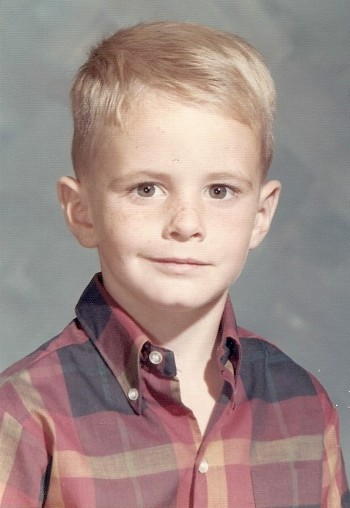 In this original BTB Investigation, we unveil the tragic story of Kirk Murphy, a four-year-old boy who was treated for “cross-gender disturbance” in 1970 by a young grad student by the name of George Rekers. This story is a stark reminder that there are severe and damaging consequences when therapists try to ensure that boys will be boys.
When we first reported on three American anti-gay activists traveling to Kampala for a three-day conference, we had no idea that it would be the first report of a long string of events leading to a proposal to institute the death penalty for LGBT people. But that is exactly what happened. In this report, we review our collection of more than 500 posts to tell the story of one nation’s embrace of hatred toward gay people. This report will be updated continuously as events continue to unfold. Check here for the latest updates.
In 2005, the Southern Poverty Law Center wrote that “[Paul] Cameron’s ‘science’ echoes Nazi Germany.” What the SPLC didn”t know was Cameron doesn’t just “echo” Nazi Germany. He quoted extensively from one of the Final Solution’s architects. This puts his fascination with quarantines, mandatory tattoos, and extermination being a “plausible idea” in a whole new and deeply disturbing light.
On February 10, I attended an all-day “Love Won Out” ex-gay conference in Phoenix, put on by Focus on the Family and Exodus International. In this series of reports, I talk about what I learned there: the people who go to these conferences, the things that they hear, and what this all means for them, their families and for the rest of us.
Prologue: Why I Went To “Love Won Out”
Part 1: What’s Love Got To Do With It?
Part 2: Parents Struggle With “No Exceptions”
Part 3: A Whole New Dialect
Part 4: It Depends On How The Meaning of the Word "Change" Changes
Part 5: A Candid Explanation For "Change"
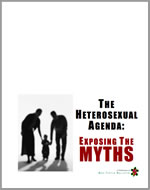 At last, the truth can now be told.
Using the same research methods employed by most anti-gay political pressure groups, we examine the statistics and the case studies that dispel many of the myths about heterosexuality. Download your copy today!
And don‘t miss our companion report, How To Write An Anti-Gay Tract In Fifteen Easy Steps.
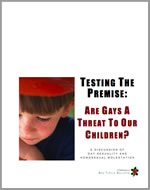 Anti-gay activists often charge that gay men and women pose a threat to children. In this report, we explore the supposed connection between homosexuality and child sexual abuse, the conclusions reached by the most knowledgeable professionals in the field, and how anti-gay activists continue to ignore their findings. This has tremendous consequences, not just for gay men and women, but more importantly for the safety of all our children.
Anti-gay activists often cite the “Dutch Study” to claim that gay unions last only about 1½ years and that the these men have an average of eight additional partners per year outside of their steady relationship. In this report, we will take you step by step into the study to see whether the claims are true.
Tony Perkins’ Family Research Council submitted an Amicus Brief to the Maryland Court of Appeals as that court prepared to consider the issue of gay marriage. We examine just one small section of that brief to reveal the junk science and fraudulent claims of the Family “Research” Council.
 The FBI’s annual Hate Crime Statistics aren’t as complete as they ought to be, and their report for 2004 was no exception. In fact, their most recent report has quite a few glaring holes. Holes big enough for Daniel Fetty to fall through.
“Google” is a trademark of Google Inc.
© Box Turtle Bulletin. All Rights Reserved.
 Posts
Posts  Posts via daily email: