Box Turtle Bulletin
 News and commentary about the anti-gay lobby
“Now you must raise your children up in a world where that union of man and box turtle is on the same legal footing as man and wife…”
News and commentary about the anti-gay lobbyNovember 25th, 2008
Tough economic times is hitting everyone, including non-profits. Last week, it was Focus On the Family. Today, it’s the Gay and Lesbian Alliance Against Defamation. GLAAD announced a reduction in force hitting all departments.
In addition to the overall dismal economy, GLAAD President Neil G. Giuliano also cites the election as another factor. “People were donating to the candidates and also gave a historic amount to fight anti-gay ballot measures,” he said.
November 25th, 2008
The Westboro Baptist clan was at it again, this time near Omaha Central High School last Friday. A counter protest by students turned, well, theatrical — in a rotten-tomatoes sort of way:
Students threw hamburgers and bottles of lemonade and milk at several members of the Westboro Baptist Church of Topeka, Kan., students said after the protest. A video of the protest — recorded by 16-year-old student Mason Hartwell — showed one counterprotester on the ground, seated with his hands behind his back and flanked by two law enforcement officers.
Students also chanted several slogans — including the Pledge of Allegiance, where they yelled “Liberty and justice for all.” Police persuaded the Westboro clan to leave once the situation threatened to get out of hand. Police said no one was injured and no one was arrested.
November 25th, 2008
William F. Buckly famously wrote in a 1986 New York Times op-ed that “Everyone detected with AIDS should be tattooed in the upper forearm, to protect common-needle users, and on the buttocks, to prevent the victimization of other homosexuals.” Paul Cameron also proposed a similar solution along with quarantines.
That was more than twenty years ago. Skip ahead to 2008, where the Indonesian province of Papua is considering a 21st-century solution:
Legislators in Indonesia’s remote province of Papua have thrown their support behind a controversial bill requiring some HIV/AIDS patients to be implanted with microchips – part of extreme efforts to monitor the disease.
Health workers and rights activists sharply criticized the plan Monday. But legislator John Manangsang said by implanting small computer chips beneath the skin of “sexually aggressive” patients, authorities would be in a better position to identify, track and ultimately punish those who deliberately infect others with up to six months in jail or a $5,000 US fine.
Of course, no one can say how they intend to define “sexually aggressive.” Indonesia has one of Asia’s fastest growing HIV rates, fuelled mainly by intravenojus drug users and prostitution. Papua has been hardest hit.
Nancy Fee, the UNAIDS coordinator for Indonesia is concerned about the impact the legislation would have on prevention efforts.
“No one should be subject to unlawful or unnecessary interference of privacy,” Fee said, adding that while other countries have been known to be oppressive in trying to tackle AIDS, such policies don’t work. They make people afraid and push the problem further underground, she said.
Local health workers and AIDS activists called the plan “abhorrent.” “People with AIDS aren’t animals; we have to respect their rights,” said Tahi Ganyang Butarbutar, a prominent Papuan activist.
November 25th, 2008
 Miami-Date Circuit Judge Cindy Lederman has declared Florida’s gay adoption ban unconstitutional, saying, “It is clear that sexual orientation is not a predictor of a person’s ability to parent.” This ruling grants Frank Gill, a gay foster father in North Miami, the go-ahead to adopt two foster children he has been raising since 2004. The two children are ages 4 and 8, making Frank virtually the only parent the younger child has ever known.
Lawyers for the state of Florida immediately said they would appeal the ruling. During the hearings, attorneys for the state brought in so-called “experts” George Rekers and Walter Schumm, both of whom are closely associated with Paul Cameron. Rekers used his own particular brand of junk science to support the state’s position that gays should be barred from adopting, adding that he believed the ban should extend to Native Americans for the same reasons.
I’m very interested in obtaining a copy of Judge Lederman’s ruling. Her evaluation of the state’s “experts” could be very entertaining.
Update: More quotes from Judge Lederman’s ruling via the Associated Press:
Miami-Dade Circuit Judge Cindy Lederman said the 31-year-old law violates equal protection rights for the children and their prospective gay parents, rejecting the state’s arguments that there is “a supposed dark cloud hovering over homes of homosexuals and their children.” She also noted that gay people are allowed to be foster parents in Florida.
…”There is no ‘morality’ interest with regard to one group of individuals permitted to form the visage of a family in one context but prohibited in another,” Lederman wrote in a 53-page decision. “There is no rational basis to prohibit gay parents from adopting.”
…Lederman rejected all the state’s arguments soundly. “It is clear that sexual orientation is not a predictor of a person’s ability to parent,” the judge wrote. “A child in need of love, safety and stability does not first consider the sexual orientation of his parent. The exclusion causes some children to be deprived of a permanent placement with a family that is best suited to their needs.”
Update: It looks like Judge Lederman ruled based on what was best for these particular children. From the Orlando Sentinel:
“These children are thriving. These words we don’t often hear within these walls. That’s uncontroverted,” said Circuit Judge Cindy S. Lederman. “They’re a good family. They’re a family in every way except in the eyes of the law. These children have a right to permanancy,” the judge said. “The only real permanancy is adoption in the home where they are thriving. … There is no rational basis to preclude homosexuals from adopting.”
November 25th, 2008

MissionGathering Christian Church of San Diego put up this billboard, which reads:
MissionGathering Christian Church is sorry for the narrow-minded, judgmental, deceptive, manipulative actions of those who took away the rights & equality of so many in the name of God.
www.missiongathering.com
Our hearts are with you.
Christianity for all.
MissionGathering is a part of the Christian Church denomination (Disciples of Christ).
November 24th, 2008
I’m not a big fan of SurveyUSA. I’ll give them credit for being the only survey firm to give consistently gloomy projections about Prop 8, but I’m not convinced that this is indicative of their greater polling abilities. Nevertheless,
SurveyUSA has released a new poll with some interesting results.
One: By a nearly 2 to 1 ratio, Californians want the existing same-sex marriages that occurred prior to Prop 8 passing to remain recognized. I think that we can expect to hear anti-gay activists tell the Court exactly the opposite – but they’re not really known for their honesty anyway.
Two: Those surveyed are split on whether protests will help or hurt the cause, with 28% responding each way. The rest either don’t know, don’t care, or think it won’t at all matter.
I’ll come back to Three.
Four: About 8% of voters who say that they voted for Proposition 8 now say that the protests have changed their opinion. Were 8% of Yes voters now able to change their vote, this amendment would not pass.
Three: This is the result that I find most interesting.
The question was “Did you vote for Proposition 8? Did you vote against Proposition 8? Or did you not vote?”
We know that 52.5% of voters did, indeed, vote “yes” on Proposition 8. But those who responded to this survey reported as follows:
40% voted yes
46% voted no
3% can’t recall
12% didn’t vote
Well, obviously this is either a rather unrepresentative sample (which could be the case) or memory has magically changed.
I have a hypothesis about voters’ recollection. I think we forget that we supported positions which we later find shameful.
We know full well that a very large portion of America did not support racial equality. We know that George Wallace was a hero to many and that busing was very unpopular. But those who recall opposing the civil rights efforts are few and far between. When one has moved from a position of intolerance to a position of tolerance, one’s recollection of previous bias seems to disappear.
Now there may be some who – for political correctness reasons – voted yes on Prop 8 but responded in this survey that they voted no. But 6 or 7 percent? That seems unlikely to me.
I think what this may be showing – though this is only speculation on my part – is that there are California voters who selected “Yes” on Proposition 8 out of default or perhaps even a moment of internal bias but who now “recall” being impressed by the arguments for equality. I think that this will continue over time and is rather surprising to show up so early.
The wave of disbelief, anger, and outrage that has resulted from the proposition seems to be resonating with the public. I predict that come ten years, there will be very few people indeed who recall voting in favor of changing the constitution to exclude gay couples.
November 24th, 2008
We told you in April about efforts by the Australian government to enact some protections for same-sex couples. It now appears that it has done so.
Today the Senate passed changes to a number of laws that would allow same-sex couples the same rights as de-facto couples. Additionally, they revised superannuation laws which allow couples to leave entitlements their partner or children.
“Today is an historic day,” said NSW Gay and Lesbian Rights Lobby spokesperson Peter Johnson yesterday. “The Australian Senate has finally and firmly given its nod to equality for our relationships and families. Our partners and our children can look forward to equality in almost all areas of federal law, from taxation to health and aged care, from immigration to family law.
The legislation must now be approved by the lower house, which is considered a formality. The Labor government, however, still remains strongly opposed to marriage and civil unions for same-sex couples or other forms of recognition that include a ceremony.
November 24th, 2008
I’ve not been able to post for the past few days and may find myself unable to spend much time in the next few days. I’ve been – and will be – busy. I hope to soon be able to commit more time.
November 24th, 2008
Fifty years ago today, on November 24, 1958, several people gathered in the studios of KPFA-FM in Berkeley, California, to participate in a two-hour broadcast on the problems that gay people faced in society. This is not only believed to be the first radio broadcast to deal favorably with gay people, it is also believed to be the first to include an actual gay person to speak directly of his experience. The first hour also featured the mother of a gay son.
(Update: I received the following info in an email from James Sears, author of Behind the Mask of the Mattachine: The Hal Call Chronicles and the Early Movement for Homosexual Emancipation
Del Martin wrote the following account of the 1958 broadcast for the January 1959 edition of The Ladder, which was the official publication of the Daughters of Bilitis. Just last summer, Del became a June bride when she married Phyllis Lyon, her partner of 56 years. Del passed away last August.
Del’s article chronicling that broadcast is reproduced below.
2-Hour Broadcast on Homophile Problem
“The Homosexual in Society”, a two-hour broadcast presented by KPFA-FM, a non-profit listener-subscription radio station in Berkeley, California, during November brought such popular acclaim that the program was repeated a month later and will be issued in pamphlet form as well.
The program consisted of two separate panel discussion sound tapes, the first covering “The Role of the Homosexual as an Individual and as a Member of Society” and the second “The Role Society Should Play” in solving the homophile problem.
THE ROLE OF THE INDIVIDUAL
Hal Call, publications director of the Mattachine Society and editor of the MATTACHINE REVIEW, opened the discussion by outlining the educational program of the organization to lead “to a better understanding of the homosexual and other forms of variance where there is no great harm to the social order.”
According to Dr. Blanche Baker, San Francisco psychiatrist, there is much controversy on the subject, “even in the medical profession.” There are those who feel it is a neurotic problem and others who call it glandular, or even a hereditary problem.
“For myself, from many years of work, I consider the homosexual first of all a human being,” she stated. “I believe in individual adjustment of each particular case. Factors leading to homosexuality lie deep in the individual nature. It is a psychological problem in which early childhood has its effect. All people have a certain amount of maleness and femaleness in their constitution, and child experiences tend to throw us to one side of the scale or the other.”
FIRST REACTION OF SHOCK
When questioned by Elsa Knight Thompson, moderator, Mrs. Leah Gailey, housewife and mother, replied, “My first reaction was a universal one — shock. There was ostracism to face for me and my son. It was clearly — shock. But basically I loved my son, so I decided I would try to understand. Fear is based on the unknown, and much fear disappears as one learns to understand.
“There is much literature on the layman level for anyone to read,” she pointed out. “It is just a matter of understanding and accepting.”
Mr. Call declared that the problem of homosexuality is very often closer to all of us than many realize — a member of the family, a neighbor, a co-worker, a friend.
“Approximately every tenth adult may be predominantly homosexual in orientation,” he stated. “This covers the entire strata of society, every intellectual and economic Ieve1.”
Mr. Call said that there had not necessarily been an increase in homosexuality in recent years, as some have supposed, but rather a greater awareness of the subject.
HOSTILITY — CAUSE OR EFFECT?
Moderator Thompson posed the problem of “hostility” in the homosexual. Does it stem from the individual because of his fear of being “different”? Or is it a result of society’s attitude?
Mr. Call said that the homosexual adopts attitudes as result of the society in which he lives. He may effect certain mannerisms of hostility toward society because of its attitudes and also because of his inability to accept himself.
According to Mrs. Gailey, the homosexual’s hostility is based on fear from society and guilt from self. The homosexual has both problems to face, she said.
Dr. Baker pointed out that in her field she works on self acceptance so that the individual can relax and be more comfortable in the world he lives in.
When asked if her clients wished to rid themselves of their homosexuality or if they sought acceptance, Dr. Baker said, “Most of those who come to me want to get rid of this approach to life. If the heterosexual component potential is large enough to function with, fine. But many cases just don’t have the potential.”
ARE HOMOSEXUALS GIFTED PEOPLE?
Dr. Baker said she had no statistics on the subject, that she herself worked with small numbers of people, “But the ones who come to me are artists — versatile, gifted people, not just bread, meat and potatoes people.”
Mr. Call did not consider this a just evaluation. He said that homosexuals are no more gifted or talented than any other group, but that perhaps the homosexual has more opportunity to develop creative and artistic talents since he doesn’t have the economic pressure of providing for a wife and family.
Elsa Knight Thompson suggested that, as in the case of any other minority group, there is more concentration to excel in order to counteract criticism.
“This is true job-wise,” Mrs. Gailey declared. “Because of his fear of detection, the homosexual puts forth an utmost effort to do his best.”
HOMOSEXUAL COUPLES
On consideration of the short duration of most homosexual relationships, Dr. Baker asserted, “The friction between homosexual couples is due to the hate in themselves and an unhappy adjustment to life. The over-emphasis on a sexual level would keep them from adjusting on other levels.”
Mr. Call pointed out that there were many lasting homosexual relationships that are not known or recognized, and Dr. Baker admitted, “We are all too conscious of those who do not get along together and don’t know about those who do.”
Mr. Call concluded the first panel discussion with a resume of legal attitudes in Europe and the United States. In England last September the Wolfenden Report recommended that homosexual acts between consenting adults no longer be considered a crime provided they are conducted in private, do not involve minors, no force or violence or fraud is used and do not offend public decency. In April, 1955, in our own country the American Law Institute in its draft of a Model Penal Code recommended essentially the same things.
In Denmark a change in the law was made in 1933, he said, but while not illegal, the stigma attached to homosexuality still remains. Persecution is particularly severe in Germany and Austria today despite previous progress and is reported to be the result of our own American occupation. In this country we have 48 different states with 48 different sets of laws concerning certain homosexual acts ranging from misdemeanor penalties of 30 days to maximum penalties of life imprisonment.
BASIS OF AMERICAN SEX LAWS
Dr. Karl Bowman, psychiatrist who until recently was director of the Langley Porter Clinic of the University of California School of Medicine in San Francisco, opened the second discussion with some historical background on our present laws, which he said are “largely traced back to ancient Hebrew laws.” The Christian religion took over the Jewish code which was extremely restrictive pertaining to sexual behavior. And the English law, on which United States law is based, stemmed from the Christian code.
“If this is so, it is my contention,” Dr. Bowman added, “it is time to re-examine our laws in the light of present knowledge and recommend modifications.”
WHAT IS A HOMOSEXUAL?
Dr. Frank Beach Jr., anthropologist and professor of psychology at the University of California at Berkeley, deplored the fact that nowhere in the previous discussion had there been a definition of the term “homosexual”. He recounted the varying degrees of homosexual behavior: the latent individual who has tendencies but who manifests no overt behavior, the individual who has one or two experiences in his life time, those who find satisfaction in both homosexual and heterosexual behavior, and those with exclusive
homosexual experience.
Dr. Bowman pointed out that in the armed forces mere diagnosis of latent homosexuality makes an individual unsuitable and subject to an undesirable discharge which interferes seriously with the individual’s ability to secure a position. Some one who has never violated any law and who has never had a homosexual experience thus becomes a victim, he said.
Relative to the problem of who is a homosexual, Morris Lowenthal, San Francisco attorney, spoke of the 1955 law passed by the California state legislature that any bar or restaurant becoming a “resort for sexual perverts” may have its license revoked. The problem of the proprietor is two-fold, he said, since the 1951 California Supreme Court decision in the Stoumen vs. Reilly case upheld the civil right of the homosexual to meet and eat or drink in any public bar or restaurant, while the new law in direct conflict prohibits the use of these premises as a gathering place for homosexuals. Mr. Lowenthal also posed the issue as to how the bartender or owner can determine the homosexual tendencies of his patrons.
CAUSES OF HOMOSEXUALITY
Dr. Beach said that hereditary factors may be involved, since in some genetic studies the incidence of homosexuality was higher in identical twins. There is also evolutionary evidence based on observation of other mammals. Exclusive, overt homosexuality does not occur in any other species but man, he pointed out, however. In cases of error in identification of sex at birth, Dr. Beach added that it was extremely difficult to reverse the sex if it was established in the mind of the individual.
Dr. Bowman agreed that there were multiple causes, that heredity, physical condition and psychological conditioning all played an important role.
“The crux of the matter,” asserted Dr. David Wilson, attorney and psychiatrist of the University of California School of Criminology at Berkeley, “is the law making something a crime. Society passes a law because it feels threatened, but it doesn’t work and in no way affects the amount of homosexuality. If the law doesn’t work, it should be reappraised and handled in a realistic manner.
“The propensity is there or it could not develop. We can not change basic individual factors. Unless we know why, we can’t pass laws to curb the incidence of homosexuality.”
Mr. Lowenthal advanced the theory that homosexuals have been discouraged in cultures when an increase in population was needed for survival and encouraged when it was necessary to curb the population.
“Naive assumption!” Dr. Wilson interjected. “Homosexuals are not going to be the productive members of society in any case.”
Dr. Beach also rejected the idea, “Human beings don’t behave this rationally.” Prohibitions appear in many societies, he added.
Dr. Bowman considered the population theory a rationalization. “Cultures that allow homosexuality freely have in many cases had a higher increase in population than those who have not.”
“Rejection of the homosexual is purely on an emotional basis and tied up with our general repressive attitude toward all sex behavior,” he added.
VAGUE AND AMBIGUOUS LAWS
In our criminal laws, many of which are not enforced, it was pointed out by Attorney Lowenthal that no reference is made to homosexuals specifically. Vague and ambiguous laws are used and abused against the homosexual resulting in his subjection to blackmail.
Dr. Bowman pointed out that the California law reads, “Anyone guilty of the infamous crime against nature…” The use of such wording has led to long controversies, he stated.
Dr. Beach took exception to the “crime against nature.” The capacity for homosexual activity is inherent in nature — in man’s biological constitution — and there is therefore nothing “unnatural” in homosexual activity, he said.
“It would appear then that the law is vague, open to loose interpretation and capable of injustice to the individual where invoked against him, bearing no fruit from the social standpoint,” Elsa Knight Thompson, the moderator, put in.
“Laws to prevent crimes of Violence and violation of children would satisfy my requirements of a fair law,” Dr. Wilson asserted. “Homosexuality is a medical and social problem, not a legal one.”
Mr. Lowenthal declared that a strange situation existed where it has been granted by the California Appellate Court that the homosexual is no menace to society and has no particular propensity toward crime, yet at the level of police and certain legislators he is declared a menace and attempts are made to whittle away the civil rights of the individual.
“The mere existence of a law can be a threat to an individual even though it may not be enforced or can be overturned at a higher court level,” Dr. Wilson said. However, he did not hold out much hope for immediate action. The legislators won’t change the law until they understand more. It will take a great deal of time and education, of which this program is a step.
Pointing out some of the abuses of the law such as police harassment, registration as sex offender and entrapment, Mr. Lowenthal said he believed that if these injustices were brought to the attention of the public, it might offend the decency of most people.
Dr. Wilson pointed out that a change in the law would not eliminate altogether the problem of blackmail because of the moral issue, though the degree would certainly be much less.
Moderator Thompson summed up the discussion, “Homosexuality is not a question of crime. If society is to solve the problem it must be done with enlightenment, understanding and a scientific approach at the individual level.”
OVERWHELMING RESPONSE TO BROADCAST
According to officials of KPFA, almost all of the heavy mail received after the first broadcast congratulated them on their courage and observed that they would undoubtedly be attacked for the program. However, they did not have a single attack for presenting the program — technical criticism, yes, but no indictment.
Because of the overwhelming response to the program, “The Homosexual in Society” is being made available in pamphlet form and can be obtained from Station KPFA, 2207 Shattuck, Ave., Berkeley 4, California, for $1.00.
— Del Martin
November 23rd, 2008
The central African nation of Burundi adopted a new set of laws abolishing the death penalty for the first time in the troubled nation’s history. The sweeping law was seen as an important reform. It incorporated parts of international law on genocide, war crimes and crimes against humanity. It includes important safeguards against torture as well as sexual violence against women and children.
It also criminalizes homosexuality.
The law was overwhelmingly passed by Burundi’s Parliament, 90-0 with ten abstentions. It still needs to be ratified by the Senate and signed by President Pierre Nkurunziza, which is seen as a mere formality. Nkurunziza is described as an ex-Hutu rebel leader and born-again Christian, whose presidency has been marred by accusations of assassinations and torture. Burundi is still emerging from a twelve-year civil war that engulfed neighboring Rwanda.
[Hat tip: Stefano]
November 23rd, 2008
Two anti-gay activists closely associated with Paul Cameron have inserted themselves into the center of Florida’s gay adoption controversy.
Florida is the only state in the nation which explicitly bans adoption by gay parents. That law is now being challenged. The Miami Herald has obtained a transcript from an adoption trial which was closed the public. The trial ran on Oct. 1-6, and centered on a gay foster father’s petition to adopt the two small boys he has been raising since 2004. The trial featured testimony from a half-dozen expert witnesses in psychology, epidemiology, sociology and family studies.
The state of Florida, which is supporting the ban, relied on two so-called “expert witnesses” who are closely associated with discredited “researcher” Paul Cameron. George A. Rekers, is a retired professor from the University of South Carolina, who taught neuropsychiatry and behavioral science. Walter R. Schumm, is an assistant professor of family studies at Kansas State University.
According to the Miami Herald:
The lives of gay people can also be stressful to children, Rekers testified. The children may experience teasing and bullying from other children who don’t approve of their parents’ orientation. And children with gay parents are likely to suffer from repeated separations because gay people are more likely to have multiple failed relationships.
Rekers said he would, in fact, favor banning anyone from adopting who had more than 18 “sex partners” during a lifetime. “I think that would be a very good social policy,” he said in a deposition.
He said he would also consider banning Native Americans from adopting because research shows that they are also at much higher risk of mental illness and substance abuse. “They would tend to hang around each other,” Rekers testified. “So the children would be around a lot of other Native Americans who are … doing the same sorts of things.”
Rekers relies extensively on Cameron’s research, citing as many as nine separate Cameron articles in one 2005 paper. Rekers and Cameron together launched Cameron’s online “Journal,” the Empirical Journal of Same-Sex Sexual Behavior, in 2007. The EJSSB is purportedly an open-access peer-reviewed journal, but, in fact, it is nothing more than a dressed-up web site. Since its inception in 2007, the only articles “published” to date are three papers by Paul Cameron and one book review by Gerard J.M. van den Aardweg, another close Cameron collaborator.
Rekers support of racism to exclude an entire class of prospective parents from adopting is most extraordinary. Of course, it’s no more shocking than Cameron’s own apologia for how the Nazi’s “dealt with” homosexuality at Dachau and Sachsenhausen.
Schumm is considerably more circumspect in how he uses Cameron’s research, but he did publish a 2000 article in Psychological Reports, Paul Cameron’s favorite publication outlet, defending Cameron’s research methods against Dr. Gregory Herek’s criticisms. Schumm is also listed as a member of Cameron’s “Editorial and Scientific Review Board” for the EJSSB.
In the trial, Schumm used data from his recent Psychological Reports article to claim that about 19 percent of children raised by gay parents are likely to become gay, compared with 4 percent of children with straight parents. Testifying for Frank Gill, the gay foster father, Susan D. Cochran, a professor of epidemiology and statistics at UCLA, accused Schumm of cooking his data.
”This is taught in first-year statistics,” Cochran testified. “I was surprised he would do that.”
James Esseks, one of Gill’s attorneys, criticized Rekers for relying on Paul Cameron’s work, citing his being dropped from the American Psychological Association in 1983 after he declined to cooperate with an ethics investigation on charges he had distorted research by others scientists on gay people.
Florida’s gay adoption ban was declared unconstitutional by a Circuit Court judge last fall in Key West. Since that decision wasn’t appealed to a higher court, it did not have any effect statewide. But the state is now fighting Gill’s attempt to adopt these two boys, which means that whatever the outcome, it will likely be appealed to the Third District Court of Appeal and possibly the Florida Supreme Court. If so, that outcome would go into effect statewide.
About 22,000 Florida children are in state custody, with more than 4,000 of them eligible for adoption. Only two states have more foster children waiting to be adopted.
[Hat tip: Alvin McEwen]
November 21st, 2008

Miss Texas 2008
Because it’s Friday, and because sometimes ya gotta step back a moment from the battle for equality, I bring you very important news from Texas.
It seems that there was a little controversy about the venue and co-host of a local beauty competition – one that leads up to Miss Texas and the Miss America pageant. (Dallas News)
“I didn’t know a drag queen was going to have that prominent of a role,” said Jean Magness, executive director of the Miss Texas Organization, who watched over the Miss Oak Cliff/Miss Oak Lawn Area pageant at the Oak Lawn lounge The Rose Room [a gay bar]. “The question was Cassie’s involvement. Was it appropriate? For me and other board members present, that was a major concern.”
I certainly share their concern; imagine all the possiblities for confusion and tragedy. It can be terribly difficult distinguishing the drag queens and the beauty contestants – especially those from Texas.
November 21st, 2008
On Friday, members of the Murray State Alliance performed live homosexual acts on campus in the Free Speech Zone. Many students were shocked, but not necessarily as the name the event implies. Students performed acts such as reading, studying and hanging out to raise awareness about the lifestyle of gay members of the Murray State campus.
…Anthony Jones, senior from Union City, Tenn., and Murray State Alliance president, said he was happy with how Friday’s event turned out. “We had a fairly good amount of people that stopped and talked with us for a while,” Jones said. Jones said he thinks students came away with a very important message. “Gay people are just as ordinary as anyone else out there,” Jones said. “Gay and lesbian folk do the same thing as anyone else and I think (the event) illustrated that in a very clear way.”
Murray State Alliance plans on holding more Live Homosexual Acts next year.
November 20th, 2008
Vermont Senate Majority Leader John Campbell (D-Windsor) announced that when the state legislature convenes in January, he plans to introduce a bill to legalize same-sex marriage. That prompted a St. Albans woman to call the state house and threaten to blow up Sen. Campbell’s home.
Officer Dale Manning, who took the call, says that police do not take threats like this lightly and are investigating. The caller did not identify herself.
Sen. Campbell characterized the call as disturbing, saying, “This wasn’t directed just at me, but at my family, which is quite unfortunate.”
On July 1, 2000, Vermont became the first state in the union to offer civil unions.
Update: Vermont’s Republican Governor Jim Douglas has announced that he will oppose the proposed legislation allowing same-sex marriages. Since Sen. Campbell said the governor’s support is vital to ensure success with fellow lawmakers, this announcement is likely to kill the measure.
This commentary is the opinion of the author and does not necessarily reflect that of other authors at Box Turtle Bulletin
November 20th, 2008
When accepting the challenge to Proposition 8, the California Supreme Court identified three questions that the process will answer:
1. Is Proposition 8 invalid because it constitutes a revision of, rather than an amendment to, the California Constitution?
This is the question that I believe will drive most of the conversation, speculation, and argument for the next several months. The determination of whether Proposition 8 would revise or amend the constitution determines whether it was properly enacted.
An amendment needs only signatures of 8% of the voters (who voted in the last gubernatorial election) and a majority vote. A revision requires approval by two-thirds of each house and a majority vote of the populace.
As Proposition 8 was not (and would not be) approved by two-thirds of the legislature, a determination that it is a revision effectively kills the effort.
The supporters of Proposition 8 may argue that revisions deal solely with the structure of government itself and not with the rights accorded to citizens.
Those seeking to overturn Proposition 8 may argue that the implementation of such a change would, in essence, dissolve the due process and equal access clauses and thus gut the constitution itself.
This issue is of enormous significance, and not just to gay Californians. In Re Marriage Cases did more than grant marriage rights; it set sexual orientation as a suspect classification. Regardless of one’s “opinion” or what one “feels” about the history of discrimination against various groups, in the State of California sexual orientation is now treated with the same consideration as race or religion.
Whichever way the Court decides this question, precedent will be set. The answer to this question will determine whether a small selection of signatories can, with a simple majority vote, remove a fundamental right from a suspect class.
In other words, if the Court finds that Proposition 8 can remove from gays the right to marry, then here foreward nothing in the California Constitution bars future amendments from denying, for example, African Americans the right to procreation or Mormons the right to own property. And while such propositions may be unenforceable due to federal constitutional protections, they could sit as a part of our governing document for the state. If fundamental rights can be removed from suspect classes by popular vote, then there really are no minority protections at all coming from the state constitution.
If we may take consolation from history, the California Supreme Court has dealt before with the question of discrimination by means of constitutional amendment. Per the LA Times,
In 1966, the California Supreme Court struck down a 1964 initiative that would have permitted racial discrimination in housing. Voters had approved the measure, a repeal of a fair housing law, by a 2-to-1 margin. Opponents challenged it on equal protection grounds, not as a constitutional revision.
If the court continues to find that gays cannot be denied marriage on equal protection grounds – as they already have – then this may be a foregone conclusion.
2. Does Proposition 8 violate the separation of powers doctrine under the California Constitution?
I’m not absolutely certain what the Court is getting at here. It may be asking if legislation – even legislation by means of constitutional amendment – can be enacted contrary to the findings of the Supreme Court.
The Court may be viewing Proposition 8 as a challenge to the Court’s right to apply equal access and due process to unpopular minorities and pondering whether the role of the courts could be made moot by means of a “government by proposition” in which any popular – but clearly unconstitutional – position could achieve the force of law through public vote.
3. If Proposition 8 is not unconstitutional, what is its effect, if any, on the marriages of same-sex couples performed before the adoption of Proposition 8?
While this may seem to perhaps be a separate question, I think it may play a great role in driving the answers to the first two questions.
The language of Proposition 8 is as follows:
Only marriage between a man and a woman is valid or recognized in California.
You’ll notice that this doesn’t talk about performing marriages or allowing marriages. I’m not an attorney but it seems to me that if we go by simple language, it says that as of midnight on November 5th, all same-sex marriages ceased to be valid or recognized.
Jerry Brown, the State Attorney General, is arguing that laws cannot be applied retroactively and that this amendment makes no provision for marriages performed before the initiative date. And therefore those who married before the proposition was passed will remain married in the eyes of the state. But, it seems to me that the most straight-forward finding would be that such marriages were valid when performed and any legal action taken accordingly during the interim is binding but that after passage the State of California ceased to recognize them (though other states may continue to do so).
Most – other than those most dedicated to demeaning gay persons – would see this as a cruel decision. Other than true haters, few people want to see those who have already committed to each other stripped of their status. And, in fact, the Yes on 8 Campaign sought to keep that item of their agenda hidden.
And the language of the Court suggests that even some of those who did not side with the majority on In Re Marriage Cases do not seek to engage in cruelty. They are, after all, human and compassionate.
I think that they will recognize that finding Proposition 8 as not unconstitutional would place those citizens who responded to their May decision into a great deal of pain. And I suspect that the justices will feel a sense of responsibility for the consequences of their decisions, both in May and presently. We may even choose to find hope in the fact that the Court refused to put a stay on their decision in May, knowing that the passing of Proposition 8 was a possibility.
While this is not the sort of criterion on which a court case is decided, I cannot help but think that this third question may influence the justices to give strong consideration to the suspect class that is appealing for protection of their fundamental rights. Our cry for justice may be more compelling when the pain of injustice can be all too clearly seen.
Featured Reports
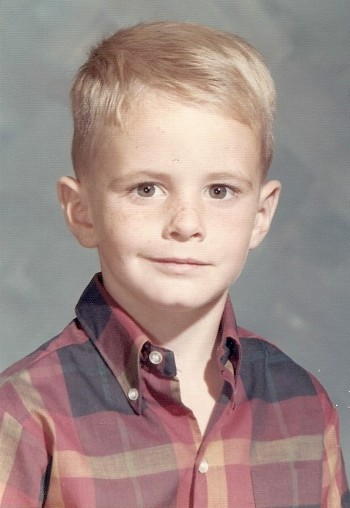 In this original BTB Investigation, we unveil the tragic story of Kirk Murphy, a four-year-old boy who was treated for “cross-gender disturbance” in 1970 by a young grad student by the name of George Rekers. This story is a stark reminder that there are severe and damaging consequences when therapists try to ensure that boys will be boys.
When we first reported on three American anti-gay activists traveling to Kampala for a three-day conference, we had no idea that it would be the first report of a long string of events leading to a proposal to institute the death penalty for LGBT people. But that is exactly what happened. In this report, we review our collection of more than 500 posts to tell the story of one nation’s embrace of hatred toward gay people. This report will be updated continuously as events continue to unfold. Check here for the latest updates.
In 2005, the Southern Poverty Law Center wrote that “[Paul] Cameron’s ‘science’ echoes Nazi Germany.” What the SPLC didn”t know was Cameron doesn’t just “echo” Nazi Germany. He quoted extensively from one of the Final Solution’s architects. This puts his fascination with quarantines, mandatory tattoos, and extermination being a “plausible idea” in a whole new and deeply disturbing light.
On February 10, I attended an all-day “Love Won Out” ex-gay conference in Phoenix, put on by Focus on the Family and Exodus International. In this series of reports, I talk about what I learned there: the people who go to these conferences, the things that they hear, and what this all means for them, their families and for the rest of us.
Prologue: Why I Went To “Love Won Out”
Part 1: What’s Love Got To Do With It?
Part 2: Parents Struggle With “No Exceptions”
Part 3: A Whole New Dialect
Part 4: It Depends On How The Meaning of the Word "Change" Changes
Part 5: A Candid Explanation For "Change"
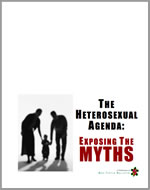 At last, the truth can now be told.
Using the same research methods employed by most anti-gay political pressure groups, we examine the statistics and the case studies that dispel many of the myths about heterosexuality. Download your copy today!
And don‘t miss our companion report, How To Write An Anti-Gay Tract In Fifteen Easy Steps.
 Anti-gay activists often charge that gay men and women pose a threat to children. In this report, we explore the supposed connection between homosexuality and child sexual abuse, the conclusions reached by the most knowledgeable professionals in the field, and how anti-gay activists continue to ignore their findings. This has tremendous consequences, not just for gay men and women, but more importantly for the safety of all our children.
Anti-gay activists often cite the “Dutch Study” to claim that gay unions last only about 1½ years and that the these men have an average of eight additional partners per year outside of their steady relationship. In this report, we will take you step by step into the study to see whether the claims are true.
Tony Perkins’ Family Research Council submitted an Amicus Brief to the Maryland Court of Appeals as that court prepared to consider the issue of gay marriage. We examine just one small section of that brief to reveal the junk science and fraudulent claims of the Family “Research” Council.
 The FBI’s annual Hate Crime Statistics aren’t as complete as they ought to be, and their report for 2004 was no exception. In fact, their most recent report has quite a few glaring holes. Holes big enough for Daniel Fetty to fall through.
“Google” is a trademark of Google Inc.
© Box Turtle Bulletin. All Rights Reserved.
 Absolutely shocking!
 Posts
Posts  Posts via daily email: