Box Turtle Bulletin
 News and commentary about the anti-gay lobby
“Now you must raise your children up in a world where that union of man and box turtle is on the same legal footing as man and wife…”
News and commentary about the anti-gay lobbySeptember 14th, 2007
Dr. Warren Throckmorton is reporting some of the findings from the Yarhouse and Jones book. It appears that the study was over four years and included 98 people who were referred by various Exodus ministries.
and 25 people discontinued participation in the study during that time. The study also reports:
Assuming that these are percentages of the 73 participants who made it to the fourth year, this would break out as follows:
With four people left unaccounted for.
Try as I might, I can’t get these two findings to reconcile. Did 33 people report a change in the positive direction, or did 28? Did 8 people identify as gay or did 6?
We will have to wait for Jim’s analysis of the book for better answers. At present, we can only conclude that, at best:
Perhaps eleven percent of an nonrepresentative sample of 98 highly motivated gay people who went through Exodus programs reported that after four years there was “substantial reduction in homosexual desire and addition of heterosexual attraction and functioning”.
Christianity Today provides further clarification on those eleven successes.
Most of the individuals who reported that they were heterosexual at Time 3 did not report themselves to be without experience of homosexual arousal, and did not report heterosexual orientation to be unequivocal and uncomplicated. … We believe the individuals who presented themselves as heterosexual success stories at Time 3 are heterosexual in some meaningful but complicated sense of the term.
These sound less like Mom and Dad heterosexuals and more like Larry Craig heterosexuals. In other words, the number of individuals who went from plain old gay to plain old straight: zero. Not an overwhelming success story, I’m inclined to think.
September 14th, 2007
The results of Stanton Jones’ and Mark Yarhouse’s Exodus study were released yesterday. I have a synopsis of that study that I’m reviewing now. Short take: The methodology seems to be pretty good, (I’m especially happy to see them use standardized measures for sexuality, something that Spitzer didn’t do).
The greatest weakness is its small sample size, and I’m concerned about the cohorts that they added to the study to try to beef it up. They originally wanted to study Exodus participants who were in their first year of attending an Exodus member ministry, but when they couldn’t find enough subjects they added a cohort of strugglers who had been in the ministry for one to three years. I don’t think there’s anything nefarious going on there, but so far I can’t sort out how those cohorts affected the results. I think that for what’s supposed to be a longitudinal study, this is critically important. I also question their claims that their sample is representative of Exodus participants. So far as I can tell, they fail to justify that claim.
These are just first quick impressions from the synopsis. I’ll have more for tomorrow morning late tomorrow afternoon. The study itself is a 375-page book. I’m trying to obtain an advance copy, and when I do it will obviously take a great deal of time to go through it.
September 14th, 2007
 It’s been more than three years since 18-year-old Scotty Joe Weaver’s burned body was found at the side of a rural Alabama road. He had been beaten, strangled, cut, burned and robbed of between $65 and $80. While robbery was first thought to be the main motivation, Baldwin County District Attorney concluded that the crime was actually a hate crime.
Robert Porter, 18, Nichole Bryars Kelsay, 18, and Christopher Gaines, 20 were arrested and charged with capital murder. Gaines and Kelsay had been Scotty Joe’s roommates. Last May, Gaines pleaded guilty to capital murder, avoiding the death penalty. Last week, Porter entered a guilty plea and received two consecutive life sentences. According to his lawyer, he will be eligible for parole in fifteen years.
This past Wednesday, lifelong “friend” Nicole Kelsey pleaded guilty to conspiracy to commit murder and was sentenced to 20 years. The case however still leaves many questions unanswered:
For the first time since the ordeal began Martha Weaver addressed the court and specifically Kelsay. Afterwards her questions were still unanswered. “Why did she do it? Why did she plot to hurt him like that? Because he done nothing to her. He always tried to help her. He loved her more than anything.”
The three people responsible for Scottie Weaver’s murder have now all pleaded guilty. The legal case is over. But it will never be over for Martha Weaver. “It won’t never go away cause I don’t have my baby no more. Cause of them, they took him away from me.”
Alabama doesn’t have a hate crime law covering sexual orientation. Scotty Joe Weaver’s murder was not included in the FBI’s hate crime statistics for 2004, representing another example of the gaps in the FBI’s hate crime reporting program.
September 13th, 2007
Thanks to GoodAsYou for getting it up so quick, in two parts.
September 13th, 2007
So today is when Stanton L. Jones and Mark Yarhouse are set to release the results of their ex-gay study in Nashville at the American Association of Christian Counselors World Conference. The study itself, Ex-Gays? A Longitudinal Study of Religiously Mediated Change in Sexual Orientation, will be published in book form by InterVarsity Press, but won’t be publicly available until October 10. This study will reportedly will show whether a significant percentage of gays can change their sexual orientation through religious-based counseling.
Since this study went to a commercial Christian publisher instead of a peer-reviewed journal, we have no a priori assurance that it has been vetted by qualified professionals. We can’t rely on IVP Press to to that vetting; they’ve also agreed to publish Richard Cohen’s forthcoming book despite his many embarrassments to the ex-gay movement. And we can’t rely on George Rekers, who praised the study in the IVP press release. He was similarly impressed with Paul Cameron’s Research.
So until we’re able to obtain a copy to evaluate for ourselves, it’ll be difficult to judge its methodology or conclusions. But a glimpse into Jones’ and Yarhouse’s previous collaborations might give us an idea of what to look for.
Jones and Yarhouse have collaborated at least three times before. They wrote “The Use, Misuse and Abuse of Science in the Ecclesiastical Homosexuality Debates,” which appeared in the 2000 anthology Homosexuality, Science, and the “Plain Sense” of Scripture (edited by David L Balch and published by Eerdmans). That chapter was based largely on an earlier article they wrote for the Christian Scholar’s Review in 1997 titled “Science and the Ecclesiastical Homosexuality Debates.” They also contributed a chapter titled “The Homosexual Client” in the 1997 anthology Christian Counseling Ethics (edited by R.K. Sanders and published by InterVarsity).
In “The Use, Misuse and Abuse of Science,” Jones and Yarhouse avoid most of the pitfalls which characterize much of the anti-gay cannon. The tone is considerably more moderate than most of the literature. There’s virtually no demonizing or name-calling, they stick to the more reputable researchers and their findings (Paul Cameron need not apply), they portray pro-gay arguments with reasonable accuracy and avoid the typical strawman arguments that are all too common elsewhere.
But “The Use, Misuse and Abuse of Science” is not an unbiased chapter, and I don’t think Jones and Yarhouse would pretend otherwise. When Homosexuality, Science, and the “Plain Sense” of Scripture” was released in 2000, they commented:
We (Stan and Mark) have watched for years as the supposed “scientific evidence” has been used in the ethical/moral debates of the various Christian denominations over the divisive topic of homosexuality. The majority of the time, the “evidence” has been used against the traditional moral position that sees homosexual behavior as sin.
Their examples of “misuse and abuse” of science only extended to the pro-gay side of the debates. They were strangely silent on the many ways silence on the many countless ways in which science is widely abused by the anti-gay side — abuses so widespread that debunking them can take up several entire web sites. (Ahem!)
In “The Use, Misuse and Abuse of Science,” Jones and Yarhouse undertook four specific areas for review. The first topic for review was of studies determining the the prevalence of homosexuality. This is an important point in anti-gay circles, with anti-gay advocates prefering much lower prevalence figures for many reasons. In simple terms, the lower the number, the less “normal” homosexuality becomes. They especially don’t like Kinsey’s famous ten-percent statistic — a statistic which most of the more prominent pro-gay advocates have abandoned quite some time ago.
Jones and Yarhouse perform a thorough debinking of Kinsey’s statistic, and in truth most of those criticisms are perfectly valid. For one, Kinsey didn’t use probability sampling techniques. He also was doing something that had never been done before: undertaking a wide-ranging survey of American attitudes about sexuality. Begun in the 1930’s, his research was groundbreaking. But as is the case with most pioneers with no prior precedence to guide them, “mistakes were made.” Kinsey was certainly no exception.
Jones and Yarhouse then reviewed a half dozen surveys which were published before 1995, all with low prevalence figures. But they didn’t discuss the many factors which contribute to low numbers. Homosexuality then, even moreso than now, was highly stigmatized (AIDS was in full rage, “Don’t Ask Don’t Tell” had been written into law by a Democratically-controlled Congress in 1993, DOMA passed both houses of Congress with wide bipartisan support in 1996.). Also, because of small sample sizes, margins of error were often wide, and refusal rates — the percentage of people who refused to participate for whatever reason — hovered in the 20-35% range. That’s why responsible researchers routinely caution that results reflect the low range for homosexuality.
But not Jones and Yarhouse. True to form, they chose a low-ball figure:
So when the genders are combined, homosexuality almost certainly characterizes less than 3 percent of the population, and the correct percentage combining men and women might be lower even than 2 percent.
The second area Jones and Yarhouse reviewed was the several biological and environmental theories for the causes of homosexuality. Again, no surprises here. The biological theories were dissected in great detail and largely dismissed for their obvious weaknesses. And in truth, the state of research as of 2000 was indeed not terribly strong — especially if one were to assume that there will ever be a single cause for something as complex as human sexuality, an assumption that is essential in order for their grounds for dismissal to be taken seriously. (Ironically, it is also an assumption they disavow just a little later in the chapter.)
In contrast, Jones and Yarhouse were rather protective of psychological theories — distant father, absent parent, molestation, you get the idea. While they expended a great deal of effort to debunk each of the major biological theories, their review of environmental theories was cursory and circumspect at best. They acknowledged that there has been very little recent study on environmental causes, but chalked that up for “enthusiasm for biological explanations,” concluding:
Though the substantive body of psychological causation research is aging and not being regularly renewed, it has never been refuted and still holds promise for understanding part of the causal puzzle of homosexuality.
They do however note that there may be an interplay between biological and experiential factors, and that “the complex factors which results in the orientation toward homosexuality probably differs from person to person.” But even if biology plays a role, they conclude:
There appears to be a variety of factors which can provide a push in the direction of homosexuality for some persons, but there is no evidence that this “push” renders human choice utterly irrelevant. …
One study of the correlations between the television viewing of adopted children and their adoptive and biological parents produce evidence of “significant genetic influence on individual differences in children’s television viewing.” … All of us would reject the notion that our genes make us sit for a certain number of hours in front of a television screen, but we may have a predisposition (sedentary tendencies?) which would make the choice to view television appealing to varying degrees.
From there, they moved on to the question, “Is homosexuality a pathology?” Here they focused on personal distress (“Contemporary research continues to suggest high levels of distress in the homosexual population even if that conclusion is usually not stated.”) and maladaptiveness (citing several non-representative studies for promiscuity statistics to suggest gay men and women cannot form monogamous relationships, “an essential adaptive capacity.”) They conclude:
The evidence cited above fails far short of a convincing case that homosexuality in itself constitutes a psychopathological condition. The evidence also suggests that one would be on shaky grounds in proclaiming that there is no evidence that homosexuality is anything other than an healthy, normal lifestyle variant.
And finally — and the point that is most relevant for their newest ex-gay study — they ask “is change to heterosexuality impossible for the homosexual?” Remember, this was before Robert Spitzer’s ex-gay study, “Can some gay men and lesbians change their sexual orientation?” appeared in the October 2003 issue of the Archives of Sexual Behavior. So at this point, they had little to go on. But I did notice a very interesting footnote:
111. For a reasonably complete review of existing “conversion therapy” studies, see J. Nicolosi, Reparative Therapy of Male Homosexuality (New York: Jason Aronson, 1991). Critics are right to note that many of these studies lack methodological rigor and are basically compilations of independent clinical interventions. Reported success rates have hovered in the 33 to 50 percent range. [Emphasis mine]
There it is. The 30-to-50 percent range we’ve been hearing about. Or, according to the much bigger picture, the 50-to-70 percent failure rate.
Jones and Yarhouse however did close their discussion of change by noting:
It is troubling that the many Christian ministries which attempt to provide opportunities for growth and healing for the homosexual person rarely if ever study and report their success rates.
Now with their newly announced ex-gay study, it looks like they are trying to address that deficiency. But as I said, until we get a copy of the study and can evaluate it ourselves, I think skepticism is in order based on Jones and Yarhouse’s previous collaborations. While “The Use, Misuse and Abuse of Science” certainly doesn’t fall into the usual traps of egregious exploitation of scientific research, neither does it rise to being a dispassionate review of the scientific literature.
“The Use, Misuse and Abuse of Science” has become an influential resource among anti-gay activists. Several speakers at Love Won Out and the Exodus Freedom Conference referred to this chapter specifically when they want to debunk studies on the prevalence of homosexuality or the possible biological contributions to homosexuality. The book was also sold at those conferences and was highly recommended by several speakers and participants.
The results from Ex-Gays? A Longitudinal Study of Religiously Mediated Change in Sexual Orientation will be released today during a press conference at the American Association of Christian Counselors World Conference in Nashville, Tennessee. Exodus will be holding their regional conference in Nashville that same weekend. That’s quite an audience clamoring for this book. But whenever a researcher bypasses the peer-review process and has a book to sell to an eagerly waiting customer base, skepticism is warranted.
September 12th, 2007
 Jenna Bush, daughter of the President, has penned Ana’s Story, a book for youth based on the life of a young woman in Latin America. The AP reports that it is better than might be expected:
Ana has a story worth telling.
Her life has been a struggle with poverty, abuse and prejudice. Her mother and aunt were raped by their stepfather, who infected them with HIV. Ana’s mother, father and infant sister died of AIDS before she finished sixth grade. Only her other younger sister, Isabel, escaped the disease.
Ana learns to keep her illness quiet at a young age.
“Life’s not fair,” her grandmother warns her. “If you tell, you’ll be treated badly. People will call you bad, ugly names. They will be afraid of you.”
If Bush’s book allows young people to become more aware of the tragic impact this disease has on our world then it is indeed a welcome addition.
September 12th, 2007
GLSEN has issued a report on the measurable consequences of having a Gay-Straight Alliance on school campuses. Not surprisingly, there are significant benefits to gay students, including:
· Students in schools with GSAs are less likely to hear homophobic remarks such as “faggot” or “dyke” in school on a daily basis than students without a GSA (57% compared to 75%).
· LGBT students in schools with GSAs are less likely to miss school because they feel unsafe compared to other students: a quarter (26%) of students in schools with GSAs missed school in the past month because they felt unsafe compared to a third (32%) of students at schools without GSAs.
· Students in schools with a GSA are more likely to report that school faculty, staff and administrators are supportive of lesbian, gay and bisexual students (52% compared to 32%).
Check out the report for yourself.
September 11th, 2007
Says the Colorado Springs Gazette:
Focus on the Family announced Monday that it is laying off 30 employees and reassigning 15 others.
It also announced that founder James Dobson had been cleared of accusations that he jeopardized the group’s nonprofit status by endorsing Republican candidates.
Most of the layoffs are in the organization’s Constituent Response Services department that answers mail and telephone requests.
A drop in projected revenue played a part in the layoffs, and the growth of e-mail and Internet-based communications is behind the reassignments, said Gary Schneeberger, vice president of communications.
Farther down in the article the IRS’s ruling is explained:
The IRS ruled that Dobson was acting as an individual and not on behalf of Focus in his endorsement of political candidates.
Hat tip Newspeak
September 10th, 2007
What is it with men with the same name as Texas cities?
From August 8th’s Sydney Morning Herald (via Religionnewsblog) comes an old story that seems to be lifted from Today’s headlines:
Frank Houston was a charismatic preacher and a sick man. He won famous souls for Hillsong – jockey Darren Beadman was one of his scalps – and sexually abused young men.
He was about 60 when he undertook to cure 23-year-old Peter Laughton’s homosexuality. “My counselling sessions by the senior minister were nothing more than sexual abuse disguised in the form of the need of a father’s love and discipline,” Laughton says. “Through my naivety, I enjoyed the naked beatings, the eternal bum caresses and masturbating into bottles, among other things.”
September 10th, 2007
David Roberts at Ex-Gay Watch has heard some scuttlebutt about the recently announced ex-gay study to be released Sept 13:
We do not yet have anything to review, so we can only speculate on the methodology and validity of the information gathered. However, from what we have heard it seems likely that claims of 30-50% “change” will be made.
At least that’s the way the results will likely be presented by Exodus. In fact, this has been a common claim for years. But it seems odd to me to focus on the smaller numbers when the bigger story is that 50%-70% didn’t “change.” How much of their experiences will this study cover?
September 9th, 2007
InterVarsity Press issued this press release, announcing the Sept 13 release of a study by Stanton L. Jones (Wheaton College) and Mark A. Yarhouse (Regent University). Titled “Ex-Gays? A Longitudinal Study of Religiously Mediated Change in Sexual Orientation,“ the study is intended to address two questions: can people change, and is trying to change harmful?
When Robert Spitzer’s ex-gay study, “Can some gay men and lesbians change their sexual orientation?” appeared in the October 2003 issue of the Archives of Sexual Behavior, the journal took the highly unusual step of publishing twenty-six peer review commentaries, both critical and laudatory. Among the commentaries was Mark Yarhouse’s “How Spitzer’s study gives a voice to the disenfranchised within a minority group.” He notes a few of the limitations of Spitzer’s study and muses on what a better constructed study might look like:
There is a need for studies with improved methodology. This would include a prospective longitudinal design in which participants provide information on sexual behavior, attractions, fantasy, and so on, prior to or in the early stages of therapy, and then tracked over tie, so that something as potentially unreliable as memory recall would not play so prominent a role in studies that touch on such a controversial topic.
I would also suggest another set of data: follow-up on those who drop out of ex-gay ministries, and their post-therapeutic experiences and perspectives. Yarhouse wrote another paper titled, “An Inclusive Response to LGB and Conservative Religious Persons: The Case of Same-Sex Attraction and Behavior”, which appeared in the June 2002 issue of Professional Psychology: Research and Practice. In that paper, he recognized the existence of “ex-ex-gays”:
A similar tension exists when we consider “ex-ex-gays.” They are individuals who once lived an LGB lifestyle, later attempted to change their behavior or attractions, and still later returned to living an LGB lifestyle. From a conservative religious perspective, ex-ex-gays may be the result of poor therapeutic technique, insufficient client commitment or motivation, moral or spiritual failure, or failure of ministries to offer realistic expectations of change. This last consideration is particularly important. It might be that conservative religious persons hold out expectations for change that are too high (i.e., that a person would be free from every vestige of same-sex desire and would be happy and fulfilled in marriage). From this perspective, ex-ex-gays are discouraged, sometimes angry, about their experiences within religion-based ministries.
Yarhouse continues:
Gay-affirmative theorists tend to see ex-ex-gays as casualties of professional interventions and religious ministries (Haldeman, 1994). Gay-affirmative theorists propose that ex-ex-gays are the result of the predictable failure of sexual reorientation therapy and religion-based ministries to accomplish what they purport to accomplish. According to Haldeman, some question whether these proponents of reorientation and reparative therapies are not disturbed themselves, preying on vulnerable persons who are hoping against hope to experience change.
Again, is there merit to both accounts? Is it possible that some people are misled about what reorientation and reparative therapy can offer? It is possible that some people do hold expectations for change that are too high. Whether the individual is freely seeking changes for personally felt reasons or is being taken to a program for change by a third party is also a factor in relation to this topic. All of this depends on several factors, including what sexual orientation is, whether it is immutable, and what evidence exists for the effectiveness of reorientation and reparative therapies.
Having talked to a number of ex-ex-gays myself, I think this discussion of their perspectives are highly over-simplistic. While some may have held a number of unrealistic expectations — expectations that are often promoted by ex-gay ministries themselves — most whom I talked to had more realistic expectations. They just found the prospect of living with those expectations unrealistic.
When discussing possible harms of attempting to change, it will be essential for this study to also follow the experiences of those who drop out of ex-gay ministries, and to talk to ex-gay survivors directly.
Jones and Yarhouse have collaborated before. They wrote “The Use, Misuse and Abuse of Science in the Ecclesiastical Homosexuality Debates,” which appeared in the 2000 anthology Homosexuality, Science, and the “Plain Sense” of Scripture” (edited by David L Balch and published by Eerdmans). This article, which largely limits its focus on the “misuse and abuse” by the gay-affirming side rather than the anti-gay side, clearly shows their biases in discussing whether homosexuality is a pathology and in dealing with the possible biological and environmental causes of homosexuality. I’ll have more on this later.
This latest study will be released during a press conference at the American Association of Christian Counselors World Conference on September 13 in Nashville, Tennessee. And what a coincidence. Exodus will be holding their regional conference in Nashville that same weekend. Gee, what are the odds?
September 9th, 2007
 When InterVarsity Press issued this press release announcing upcoming release of “Ex-Gays? A Longitudinal Study of Religiously Mediated Change in Sexual Orientation,“ by Stanton L. Jones and Mark A. Yarhouse, they included this endorsement:
George A. Rekers, Professor of Neuropsychiatry and Behavioral Science Emeritus at the University of South Carolina School of Medicine, states that the study “meets the high research standards set by the American Psychological Association that individuals be validly assessed, followed and reported over time with a prospective, longitudinal outcome research design.”
I would question Rekers’ ability to recognize studies which “meets the high research standards set by the APA.” In 2002, he held one of Paul Cameron’s studies in pretty high regard:
In the study of homosexual parenting with the best research methodology to date, Cameron and Cameron obtained a random sample by a one-wave, systematic cluster sampling of six U.S. metropolitan areas… [emphasis mine]
I reviewed that study that impressed Rekers so much here.
September 8th, 2007
Ed Brayton, at Dispatches from the Culture Wars, passes on this report from UPI (a report that is no longer available at the UPI web site):
The Anglican Bishop of Uyo, Rt. Rev. Isaac Orama, has condemned the activities of homosexuals and lesbians, and described those engaged in them as “insane people”.
“It is scaring that any one should be involved in a thing like that and I want to say that they will not escape the wrath of God,” he said. Orama told the News Agency of Nigeria (NAN) today in Uyo, that the practice, which has worsened over the years, was “unbiblical and against God’s purpose for creating man”.
“Homosexuality and lesbianism are inhuman. Those who practice them are insane, satanic and are not fit to live because they are rebels to God’s purpose for man,” the Bishop said. [Emphasis mine]
Changing Attitude Nigeria (CAN) responded to this statement, and notes that Bishop Orama “was recently ordained as a bishop. He is one of Archbishop Peter Akinola’s newly appointed bishops, carefully chosen to support the Archbishop’s own agenda.” Davis Mac-Iyalla, director of CAN, knows well the dangers of being openly gay in Nigeria, and the particular hatred the Anglican Church in Nigeria harbors towards gays and lesbians:
In December 2005 following the first General Meeting held by Changing Attitude Nigeria in Abuja, the Church of Nigeria, (Anglican Communion) became aware of his presence, a gay Nigerian Anglican.
The Rev. Akintunde Popoola, Director of Communication for the Nigerian Church, published a disclaimer on the church web site designed to destroy Davis’s reputation. Canon Popoola denied that Davis exists, denied he is an Anglican, denied he is gay, accused him of theft, accused him of falsely planning to marry a bishop’s daughter, accused him of soliciting money from foreigners under false pretences, and then posted to numerous Anglican websites denouncing Davis.
… When Bishop Ugede died unexpectedly, Davis was dismissed as principal of the Diocesan School because he was gay. Since founding CAN he has been falsely arrested after printed materials were found in his car, beaten and held for some days in a police cell. He has received death threats, one delivered directly to his door last December, been forced to flee his home and become estranged from his family. Whatever Christians think about the morality of homosexual behaviour, no person should be treated in the way Davis has been treated by his own Church.
And yet these are exactly the sort of Christians whom American conservatives are rushing align themselves. And this sort of violence is officially sanctioned in Nigeria, where the criminal code penalizes consensual homosexual conduct between adults with 14 years’ imprisonment. Shari’a penal codes in northern Nigeria provides for the death penalty by stoning.
But as draconian as these laws are, they don’t satisfy Anglican Archbishop Peter J. Akinola. He is head of the Christian Association of Nigeria (CAN), which calls for speedy passage of a new bill that is before the Nigerian parliament. That bill, according to Human Rights Watch:
The bill is entitled “Same Sex Marriage (Prohibition) Act 2006,” but goes much further: it would attack all lesbian and gay individuals, families and human rights. The bill would provide for five years’ imprisonment to anyone who “goes through the ceremony of marriage with a person of the same sex,” “performs, witnesses, aids or abets the ceremony of same sex marriage” or “is involved in the registration of gay clubs, societies and organizations, sustenance, procession or meetings, publicity and public show of same sex amorous relationship directly or indirectly in public and in private.” Any priest or cleric aiding or abetting such a union could be subject to the five-year prison term. The law would also prohibit adoption of children by lesbian or gay couples or individuals.
The ban on gay clubs, societies, organizations, as well as a ban on any display of affection “in public and in private” is particularly egregious. In a supposedly democratic Nigeria, gays and lesbians would be forbidden from advocating on their own behalves. By outlawing protests, the government hopes it will be able to suppress all future dialog or discussions affecting gays and lesbians in that country. Nigeria was expected to take up the bill last spring, but it appears to have stalled once again.
Archbishop Akinola has publicly endorsed this legislation for Nigeria. He has also lead a worldwide revolt of conservative Anglicans against the elevation of the openly gay Rev. Gene Robinson as bishop of New Hampshire. On May 10th of this year, Akinola traveled to Virginia to install Martyn Minns as bishop of the Convocation of Anglicans in North America (CANA), an organization that Akinola established with conservative American Episcopalians. In doing so, he defied Archbishop of Canterbury Rowan Williams, head of the worldwide Anglican Communion, and Presiding Bishop Katharine Jefferts Schori, leader of the U.S. Episcopal Church.
The idea that many extremist anti-gay activists in this country would publicly align themselves with someone who has suggested the execution of gays and lesbians isn’t new. It is however new and disturbing to see an entire mainstream church movement move in this direction. But those who are eager to place themselves under the spiritual guidance of bishops like Akinola and Orama need to take a hard look at these men and their public pronouncements.
Update: The Living Church Foundation reports that Archbishop of Canterbury Rowan Williams denounced Orama’s comments and demanded an explanation. Akinola’s spokesman, Archdeacon Akintunde Popoola said the quote was false, and that the reporter apologized and promised a retraction.
I believe the Living Church’s headline, (“Reporter Apologizes for Misquoting Nigerian Bishop”) is misleading. We only have Popoola saying that the reporter apologized; we haven’t heard from the reporter himself. It’s important to keep in mind that Popoola also was the one who made numerous false allegations about Davis Mac-Iyalla, so a grain of salt is in order here absent further confirmation.
Meanwhile, UPI sent an email to the conservative Anglican website Standing Firm, saying that the report, which originated from the News Agency of Nigeria (NAN), was pulled solely on Popoola’s statement, adding “You would have to contact NAN as to whether the information about the retraction is true.” Maybe they recognize the problems with Popoola’s credibility also. Like I said, we haven’t heard from the reporter or NAN. By the way, we also haven’t heard from Bishop Orama either. If anyone learns anything more, please include appropriate links in the comments or send them to me directly via e-mail.
A Commentary
September 7th, 2007
 In 2005 the California legislature passed a bill removing the requirement that marriage only be recognized between persons of the opposite sex. The bill was vetoed by Governor Arnold Schwarzenegger.
Although some activists accused the Governor of appeasing anti-gay factions within his party, I found his arguments to have some merit. The Governor pointed to a provision in law that was created by means of an initiative in 2000 that restricts marriage to only a man and a woman. A proposition cannot be overturned by the legislature.
At debate is exactly what the proposition meant and whether it modifies only marriages in others states or also includes marriages in California. The law prior to the initiative did limit marriage in California to a man and a woman. But it did not specifically exclude same-sex marriages in other states. Thus the proposition added a provision to other-state marriage which would restrict recognition to opposite-sex couples.
Those who favor same sex marriage point to the location of the code modified and argue that Prop 22 only applies to out of state marriage. Those who oppose same-sex marriage argue that the intent of the voters was to ban gay marriage altogether.
Meanwhile there is a case before the California Supreme Court which argues that a ban on same-sex marriage is contrary to the protections of the California Constitution. California’s current domestic partnership laws are indistinguishable from marriage, other than by name.
Schwarzenegger’s position has been fairly consistent. He has no personal objection to same-sex marriage – and will oppose any efforts to retreat from current protections – but is unwilling to sign legislation removing the gender requirements because he believes such a change in marriage law must come from either the courts or the voters overturning Prop 22: if a ban on same-sex marriage is unconstitutional, then the law isn’t needed; if a ban is allowed constitutionally, then the legislature still cannot overturn a vote of the people so therefor it isn’t adequate
“If the ban of same-sex marriage is unconstitutional this bill is not necessary,” he said. “If the ban is constitutional this bill is ineffective.”
The California State Legislature has just voted to send an identical bill back to the Governor. He is expected to veto it.
Ultimately this is little more than symbolic. If signed, the bill will be challenged in court before the ink is dry and will simply be part of the decision that is already in front of the court, a decision that already includes challenges in favor and opposed to Proposition 22. Same-sex marriage will not be advanced or delayed a single day whether or not this bill is signed.
I truly wish that Governor Schwarzenegger would take a symbolic step for equality and sign the bill. It would make a statement that California’s government sees its citizens equally. And I think the Governor has adequate polling to allow him to argue that the will of the people has changed since 2000.
But I suspect he’ll veto the bill. And the community will make a few moderately disapproving statements to the press… and then we’ll all go back to waiting for the Supreme Court to announce their decision.
A commentary
September 7th, 2007
Got that?
Craig Faunch and Ian Wathey of Wakefield, England were one of the first gay couples to be approved to serve as foster parents in the U.K., taking in 18 children in only 15 months. And right away, there were problems:
With no previous convictions, they came across as respectable men who simply wanted to help boys with a variety of problems.
In reality, they were paedophiles, who repeatedly abused the children in their care.
Even when the mother of two of the children reported her suspicions to the council, officials accepted the men’s explanations and did nothing.
Instead of banning children from staying with Faunch and Wathey, they sent youngsters with more serious problems to them. Between them, the couple abused four boys aged between eight and 14.
In a scathing report published yesterday, Wakefield Metropolitan District Council was condemned for treating the men as “trophy carers”.
…
“It was clear that a number of staff were afraid of being thought homophobic.
“The fear of being discriminatory led them to fail to discriminate between the appropriate and the abusive.”
Good Lord, where to begin? There are scumbags in every walk of life; gays aren’t immune to that phenomenon. I’ve said many times that there is no connection between homosexuality and child sexual abuse. But that certainly doesn’t mean that there aren’t pedophiles who are also gay. It happens, proportionally about as often as straights abuse kids.
That’s why investigating credible allegations of inappropriate behavior with underage children is not homophobic; it’s exercising proper responsibility. The idea that conducting an investigation might be “homophobic” is ludicrous, whether we’re talking about foster parents or Senators.
Sure, we’ve seen where anti-gay hysteria has led to wrongful convictions, and yes, those investigations and prosecutions were driven by homophobia. But it’s pretty easy to avoid that: conduct a proper investigation which doesn’t make assumptions based on the alleged perpetrator’s sexuality. That’s really not difficult to do.
Investigators should not let personal assumptions convict someone without sufficient evidence, nor should fear of being branded “homophobic” deter an investigation and risk leaving vulnerable children exposed. It’s no more homophobic to investigate credible claims of sexual abuse by gays than it is heterophobic to investigate straights. But refusing to investigate out of fear of being labeled homophobic is both patronizing and cowardly, and it implies that they are afraid that if they look too closely they may provide evidence that there is something to the stereotype.
But guess what? Just because it’s a stereotype doesn’t mean it can’t be true in particular instances. There really are Whites who can’t jump and Appalachians who can’t read. And in this case, trying to avoid a stereotype ended up being criminally negligent. Just ask the kids who were put into Faunch’s and Wathey’s care after the first complaints surfaced.
Let’s be clear: It is not gay bashing or homophobic to investigate allegations of child sexual abuse — or any other serious claims of wrongdoing for that matter. So let’s put an end to that excuse, shall we?
Featured Reports
 In this original BTB Investigation, we unveil the tragic story of Kirk Murphy, a four-year-old boy who was treated for “cross-gender disturbance” in 1970 by a young grad student by the name of George Rekers. This story is a stark reminder that there are severe and damaging consequences when therapists try to ensure that boys will be boys.
When we first reported on three American anti-gay activists traveling to Kampala for a three-day conference, we had no idea that it would be the first report of a long string of events leading to a proposal to institute the death penalty for LGBT people. But that is exactly what happened. In this report, we review our collection of more than 500 posts to tell the story of one nation’s embrace of hatred toward gay people. This report will be updated continuously as events continue to unfold. Check here for the latest updates.
In 2005, the Southern Poverty Law Center wrote that “[Paul] Cameron’s ‘science’ echoes Nazi Germany.” What the SPLC didn”t know was Cameron doesn’t just “echo” Nazi Germany. He quoted extensively from one of the Final Solution’s architects. This puts his fascination with quarantines, mandatory tattoos, and extermination being a “plausible idea” in a whole new and deeply disturbing light.
On February 10, I attended an all-day “Love Won Out” ex-gay conference in Phoenix, put on by Focus on the Family and Exodus International. In this series of reports, I talk about what I learned there: the people who go to these conferences, the things that they hear, and what this all means for them, their families and for the rest of us.
Prologue: Why I Went To “Love Won Out”
Part 1: What’s Love Got To Do With It?
Part 2: Parents Struggle With “No Exceptions”
Part 3: A Whole New Dialect
Part 4: It Depends On How The Meaning of the Word "Change" Changes
Part 5: A Candid Explanation For "Change"
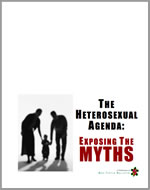 At last, the truth can now be told.
Using the same research methods employed by most anti-gay political pressure groups, we examine the statistics and the case studies that dispel many of the myths about heterosexuality. Download your copy today!
And don‘t miss our companion report, How To Write An Anti-Gay Tract In Fifteen Easy Steps.
 Anti-gay activists often charge that gay men and women pose a threat to children. In this report, we explore the supposed connection between homosexuality and child sexual abuse, the conclusions reached by the most knowledgeable professionals in the field, and how anti-gay activists continue to ignore their findings. This has tremendous consequences, not just for gay men and women, but more importantly for the safety of all our children.
Anti-gay activists often cite the “Dutch Study” to claim that gay unions last only about 1½ years and that the these men have an average of eight additional partners per year outside of their steady relationship. In this report, we will take you step by step into the study to see whether the claims are true.
Tony Perkins’ Family Research Council submitted an Amicus Brief to the Maryland Court of Appeals as that court prepared to consider the issue of gay marriage. We examine just one small section of that brief to reveal the junk science and fraudulent claims of the Family “Research” Council.
 The FBI’s annual Hate Crime Statistics aren’t as complete as they ought to be, and their report for 2004 was no exception. In fact, their most recent report has quite a few glaring holes. Holes big enough for Daniel Fetty to fall through.
“Google” is a trademark of Google Inc.
© Box Turtle Bulletin. All Rights Reserved.
 Posts
Posts  Posts via daily email: