Box Turtle Bulletin
 News and commentary about the anti-gay lobby
“Now you must raise your children up in a world where that union of man and box turtle is on the same legal footing as man and wife…”
News and commentary about the anti-gay lobbyPosts Tagged As: Daily Agenda
February 17th, 2013
TODAY’S AGENDA:
Events this weekend: Arizona Gay Rodeo, Laveen, AZ; Sydney Mardis Gras, Sydney, NSW.
TODAY IN HISTORY:
Laredo D.A. Defends City’s Reputation: 1953. The District Attorney for Laredo, Texas, defended his fair city’s reputation against allegations made by a Mexican newspaper in Nuevo Laredo, just a cross the border, that there were homosexual activities taking place on the American side of the line. D.A. James Kazen was responding to a series of articles by El Manaña, a morning daily with wide circulation in both communities, which claimed that many prominent citizens of Laredo were involved in homosexual activities, and promised to run a list of names in a future article. Kazen denounced the stories as “wholly untrue,” and successfully appealed to Judge R.D. Wright to reconvene a grand jury to investigate the reports. Kazen did acknowledge that there were homosexuals on the streets of Laredo — but only four, and two of them were outsiders who had only recently moved to town.
“Chicken And Bulls” Blackmail Ring Busted: 1966. A massive, multi-state blackmail ring stretching from Chicago to New York To North Carolina was broken with the arrest of nine extortionists, with eight more being sought. As The New York Times reported, the gang employed “chickens” (including college students and at least one bodybuilder) who posed as young gay men who would allow themselves to be picked up by other gay men, usually travelling businessmen, to go back to the hotel. Once there, the “chicken” would beat and rob their victims and leave. A few hours later, other men — the “bulls” — posing as policemen would arrive at the hotel for another shakedown. Saying that they had arrested a homosexual prostitute with the victim’s wallet in his possession, the “police” needed to victim to go to the station to make a statement. Fearing exposure, the victim would often offer a bribe to the “police” to make the whole problem go away. In another version of the shakedown, “police” would burst into the hotel room just when the men were in a compromising state of undress, and the shakedown would begin with the threat of arrest.
The gang’s success hinged on several factors: homosexuality was illegal everywhere except Illinois, and even there the mere threat of being publicly exposed was enough to induce the victim to do just about anything to avoid having his reputation, career and family life ruined. The ring’s longevity — it would later be revealed that it had been in operation for about a decade — was further aided by the fact that none of the victims went to the police. And why would they? They already thought they were dealing with the police. Actual police corruption was so rampant, with many of them operating their own blackmail schemes using many of the same tactics, victims had no way to tell the fake cops from the real.
To further add to the confusion, some members of the gang actually had police connections, allowing the gang to imitate police officers with a great deal of precision. John J. Pyne, the ringleader of the gang, was a retired Chicago policeman. In his home, the FBI found police badges and identification papers for almost every state, along with a variety of blank arrest warrants, charge sheets and extradition forms from several jurisdictions. As the investigation and trials unfolded over the next two years, investigators would learn that millions of dollars were extorted from over a thousand victims. The victims themselves were no lo-lifes. They included university deans, professors, military officers (including a navy admiral and two generals), several well-known actors, TV personalities (including, it’s been said, Liberace, who refused to testify before a grand jury for fear of ruining his career), and at least one U.S. Congressman. Their boldness knew no limits. Twice, they confronted Rep. Peter Frelinghuysen (R-NJ) in his Capitol Hill office, took him to a private plane to fly to New Jersey, and brought him directly to a bank where he paid a total of $50,000. They pulled a prominent surgeon out of an operating room, forcing his colleague to finish the surgery. They even went into the Pentagon and escorted Admiral William Church out of the building and to a bank where he handed over $5,000. Church later committed suicide to avoid testifying before a grand jury against his blackmailers.
Church’s suicide (and Liberace’s reticence) was indicative of the greatest problem that the FBI and New York Police Department faced in trying to break the case: almost none of the victims were willing to talk to police, let alone testify. If there is a silver lining in the whole affair, is is probably the fact that investigators had to figure out how to set aside their own prejudices, and through persistence and discretion, build a foundation of trust between themselves and the victims. The Mattachine Society was enlisted as a go-between so that victims might feel less exposed. Some judges, where they could, allowed victims to testify anonymously, or allowed victims to testify about the blackmail without going into any sexual details. These accommodations were a complete turnaround from the way law enforcement and the courts had dealt with gay people during the Lavender Scare of the 1950s. Press coverage was also markedly different. With the roster of victims including the cream of society, it was much easier to portray them with considerable sympathy. As one law enforcement official told The Times, “Extortion of money from well known persons who are homosexual or bisexual is a persistent problem. We want to alert these people who come from all walks of life that such extortion schemes exist and we want to impress upon them also that New York City detectives are no part of this disgusting racket.”
Over the next two years, various members of the ring were tried, with most found guilty and sent to prison. Pyne was sentenced to two consecutive 20-year federal prison terms. Weightlifter John Fellabaum, a ringleader who posed as a musclebound “chicken,” angered the judge when he forced a witness, an antiques dealer from Maine, to take the stand and publicly out himself, after which Fellabaum immediately changed his plea to guilty. The judge was outraged. “I have been sentencing people for twenty-seven years and it has been a a long time since I have come upon a case that was so revolting as your case. I think you are so steeped in filth that as I read the report I cringed, and my flesh crept as I read the depth of inequity to which you allowed yourself to sink.”
[Sources: William McGowan. “The Chicken and the Bulls” Slate (July 11, 2012). Available online here.
Angus McLaren. Sexual Blackmail: A Modern History
If you know of something that belongs on the agenda, please send it here. Don’t forget to include the basics: who, what, when, where, and URL (if available).
And feel free to consider this your open thread for the day. What’s happening in your world?
February 16th, 2013
TODAY’S AGENDA:
Events this weekend: Arizona Gay Rodeo, Laveen, AZ; Sydney Mardis Gras, Sydney, NSW.

TODAY’S BIRTHDAY:
Katharine Cornell: 1893. She shared the title of “The First Lady of the Theatre” with Helen Hayes; as good friends and colleagues, they each deferred the title to each other. While Hayes is probably more well known today, Cornell’s own acting and contributions to the theater are legendary. Part of her success can be attributed to her collaboration with her husband, Guthrie McClintic, a successful director and producer. Their marriage was both professional and one of convenience: Cornell was lesbian and McClintic was gay. She was a member of New York’s “sewing circles, with relationships with Tallulah Bankhead and Mercedes de Acosta, among others. Meanwhile, McClinctic directed Cornell in every play since their marriage.
Cornell’s acclaimed Broadway roles include the title character of George Bernard Shaw’s Candide, Countess Ellen Olenska in The Age of Innocence, the poet Elizabeth Barrett Browning in The Barretts of Wimpole Street — and that’s just before the Great Depression. Her career continued unabated through the 1950s. Her appearance in the title role of 1936’s St. Joan won her a bevy of honorary degrees from several colleges and universities, and she won a Tony Award for Best Actress for Antony and Cleopatra in 1947. After McClintic died in 1961, Cornell decided to retire rather than work with another director. She restored the 300-year-old Association Hall on Martha’s Vineyard, which was later rename the Katharine Cornell Theater. She died of pneumonia in 1974, and was buried next to the theater named in her honor.
If you know of something that belongs on the agenda, please send it here. Don’t forget to include the basics: who, what, when, where, and URL (if available).
And feel free to consider this your open thread for the day. What’s happening in your world?
February 15th, 2013
TODAY’S AGENDA:
Events this weekend: Arizona Gay Rodeo, Laveen, AZ; Sydney Mardis Gras, Sydney, NSW.
TODAY IN HISTORY:
Michael Swift’s “The Gay Revolutionary”: 1987. Think back to what the beginning of 1987 was like. AIDS was ravaging the gay community, with nearly 25,000 dead and AZT, the first U.S. government-approved treatment for HIV therapy, wouldn’t become FDA approved for another month. The year would be the year of the cri de coeur, with ACT-Up’s formation that year being the most visible manifestation of the growing anger over the apparent indifference on the part of public officials in New York City and Washington, D.C., as well as the overt hostility that the epidemic engendered in much of conservative Christianity.
Another cry rang out from Boston, although it was little noticed at the time. Just another crazy essay from the often-provocative Gay Community News. This one, written under the byline of Michael Swift was printed and then soon forgotten, until two years later when Rep. William Dannemeyer (R-CA) read it into the Congressional Record:
We shall sodomize your sons, emblems of your feeble masculinity, of your shallow dreams and vulgar lies. We shall seduce them in your schools, in your dormitories, in your gymnasiums, in your locker rooms, in your sports arenas, in your seminaries, in your youth groups, in your movie theater bathrooms, in your army bunkhouses, in your truck stops, in your all male clubs, in your houses of Congress, wherever men are with men together. Your sons shall become our minions and do our bidding. They will be recast in our image. They will come to crave and adore us.
…All laws banning homosexual activity will be revoked. Instead, legislation shall be passed which engenders love between men.
All homosexuals must stand together as brothers; we must be united artistically, philosophically, socially, politically and financially. We will triumph only when we present a common face to the vicious heterosexual enemy.
If you dare to cry faggot, fairy, queer, at us, we will stab you in your cowardly hearts and defile your dead, puny bodies.
…We shall be victorious because we are fueled with the ferocious bitterness of the oppressed who have been forced to play seemingly bit parts in your dumb, heterosexual shows throughout the ages. We too are capable of firing guns and manning the barricades of the ultimate revolution.
Tremble, hetero swine, when we appear before you without our masks.
From there, the essay became the anti-gay establishment’s favorite example of the so-called “homosexual agenda.” Lou Sheldon’s Traditional Values Coalition put out a notorious video, “Gay Rights, Special Rights,” which repeated passages from the so-called manifesto and paired it with ominous music and pictures of children. In the 2001 book, Bringing Up Boys, Focus on the Family’s James Dobson cited Swift’s essay (retitling it “Goals of the Homosexual Movement”) as evidence that parents must protect their children from homosexuals. “Guard them night and day when they are young,” he wrote. “Don’t send them into a public bathroom alone.” In more recent years, the so-called manifesto has gone international — from Latvia and Russia, to Uganda and Jamaica — and it still re-emerges from time to time here at home.
But every time the essay is repeated by anti-gay extremists, they always carefully omit a vitally important component of the piece, just as that component was skipped when Dannemeyer read it into the Congressional Record. And for the essay to serve their purpose, it’s critical this crucial piece be left out, because it’s impossible to understand the true nature of the essay without it. That piece that they always leave out is this, the prologue:
This essay is an outré, madness, a tragic, cruel fantasy, an eruption of inner rage, on how the oppressed desperately dream of being the oppressor.
The name of the essay’s author, Michael Swift, should also be a clue. Nobody knows who the real author is, but the essayist clearly took his cue from the famous satirist Jonathan Swift, whose 1729 essay A Modest Proposal — in which the other Swift suggested that the easiest way to ease the crushing poverty in Ireland was for the Irish to sell their plentiful babies as a food delicacy for the rich — created a wave of outrage in England for the way that he savaged the condescending attitudes of those behind many of the illogical solutions that had been proposed at that time.
The 20th-century Swift’s essay, similarly, satirized the attitudes behind some of the worst homophobic expressions that were then being unleashed in 1987, by perfectly mimicking how those homophobes imagined the worst of the “militant homosexuals.” He mimicked their prejudices so well that they took it as a genuine manifesto, and it’s that accomplishment which makes it, I think, a perfect satire. But it’s also ironic that whose whose attitudes Michael Swift satirized so well found such a nearly perfect weapon in that very same essay. Michael Bronski, who had been a features writer for Gay Community News when the first essay ran, later developed second thoughts about it. In 2003, Bronski said, “We printed it thinking that it was sort of funny. It’s been picked up by all these lunatic right-wing fringe people. In retrospect, it’s caused so much… it keeps getting quoted as being serious by people on the right and it simply was making a political point, using humor. I personally would, knowing how much it’s been misrepresented, I would think twice about printing it then.”

TODAY’S BIRTHDAY:
Edwin Cameron: 1953. As far as closets go, the outspoken Justice on South Africa’s Constitutional Court has obliterated the biggest ones: he’s gay and he’s HIV-positive. Justice Cameron was a human rights lawyer during Africa’s Apartheid years in the 1980s, where he co-drafted the Charter of Rights on AIDS and HIV, co-founded the AIDS Consortium, and was the first director of the LAIDS Law Project. As Apartheid crumbled, he worked to safeguard human rights, including the rights of LGBT people, in the new Constitution of South Africa.
In 1994, President Nelson Mandela appointed him an Acting Judge of the High Court, an appointment that became permanent in 1995. By then, he had long been out of the gay closet, but in in 1998, after a poor black woman living in a township in Durban went on the radio to talk about having AIDS and was killed three weeks later, he decided it was time to come out of the HIV closet. “I thought if [this woman], without any protection, living in a township, not behind a palisade like I do in my middle-class suburb in Johannesburg, not with the income of a judge, not with the constitutional protection… I thought that I should speak out…”
In 1999, he became an Active Justice on the Constitutional Court before being appointed to the Supreme Court of Appeal in 2000. In 2009, he was made a permanent Justice of the Constitutional Court by President Kgalema Motlanthe.
If you know of something that belongs on the agenda, please send it here. Don’t forget to include the basics: who, what, when, where, and URL (if available).
And feel free to consider this your open thread for the day. What’s happening in your world?
February 14th, 2013
 Today is the traditional Feast Day of St. Valentine. Which Valentine is anybody’s guess. One tradition, as laid out in Legenda Aurea, has it that the day commemorates Valentine the Presbyter (also known as Valentine of Rome), although very little is known if him. Pope Gelasius I in 496 included him as among those “whose names are justly reverenced among me, but whose acts are known only to God.” It is said that he was martyred in about 269 during the reign of Claudius II, after having been arrested and imprisoned for marrying Christian couples who were then under persecution in Rome at a time when Christians were seen as a grave threat to civilization, to all the traditions that made the nation great, and to the natural order of things. But there is no written record of his being associated with romantic love until Geoffrey Chaucer wrote Parlement of Foules in 1382:
For this was on seynt Volantynys day
Whan euery bryd comyth there to chese his make.
(For this was Saint Valentine’s Day
when every bird comes there to choose his mate)
When the notoriously romantic Victorians got hold of St. Valentine’s Day in the nineteenth century, all hell broke loose on the love-dovey front, and it hasn’t let up since then.
TODAY’S AGENDA:
Events this weekend: Arizona Gay Rodeo, Laveen, AZ; Sydney Mardis Gras, Sydney, NSW.
TODAY IN HISTORY:
San Francisco Establishes Domestic Partnership Registry: 1991. The idea had been tossed around since 1979, when gay rights activist Tom Brougham proposed a new category of relationship called “domestic partnership.” His cause was taken up in 1982 by San Francisco Supervisor Harry Britt, who had taken the seat of slain Supervisor Harvey Milk. Britt’s bill authorizing domestic partnerships was vetoed that year by Mayor Dianne Feinstein, It would be passed again in 1989, but that law was repealed by a voter initiative in 1990. Fortunately, that same year city voters approved Proposition K which established a modified version of domestic partnerships which allowed same-sex and opposite-sex couples to register. Fittingly, on February 14, 1991, the brand new registry was established in San Francisco allowing partners to register. San Francisco however wasn’t the first city to provide domestic partnerships. That honor went to West Hollywood in 1985.
If you know of something that belongs on the agenda, please send it here. Don’t forget to include the basics: who, what, when, where, and URL (if available).
And feel free to consider this your open thread for the day. What’s happening in your world?
February 12th, 2013

TODAY IN HISTORY:
Premiere of “Making Love”: 1982. Starring Michael Ontkean, Charlie’s Angels star Kate Jackson, and Harry Hamlin, Making Love opened in theaters as the first mainstream film to tackle homosexuality in a nonjudgemental way. That’s not to say that the story wasn’t without drama when Zach (Ontkean) and Claire (Jackson) dealt with a crumbling marriage as Zach struggled to deal with his attractions to other men. When he meets gay novelist Bart McGuire (Hamlin), their professional relationship (Zach was a doctor, Bart a patient who was in for a check-up) turned into a lunch date, then a dinner date, and then a full-fledged relationship, which over time, ends in a divorce for Zach and Claire. Claire handles the news badly, but over time comes to understand that gay people can live happy lives. The film’s happily-ever-after ending had the feel of a made-for-TV movie which critics hated. Gay critics, however, were overjoyed that the film was a positive portrayal where the gay characters didn’t all die in the end.
In real life however, the film demonstrated one significant difficulty in making mainstream movies about gay men: it seemed to confirm the fear that taking such a role would be career killers. Tom Berenger, Michael Douglas, Harrison Ford, William Hurt and Peter Strauss were all approached to play Zach; they all turned the role down. After the film’s release Ontkean and Hamlin had trouble living the film down. Hamlin’s promising career stalled for the next four years until he landed a role in NBC’s L.A. Law. Ontkean tried to prevent clips of his role from appearing in Vito Russo’s 1996 documentary The Celluloid Closet.

SF Mayor Grants Same-Sex Marriages: 2004. It was a stunning announcement, when San Francisco Mayor Gavin Newsom declared that the California Constitution’s equal protection clause gave him the authority to issue marriage licenses to same-sex couples. Between February 12 and March 11, 2004, an estimated 4,000 joyous couples lined up at City Hall to take part in what was quickly dubbed “The Winter of Love.” But the weddings came to an abrupt halt when the California Supreme Court declared that the mayor lacked the authority to bypass state law. All of those marriage licenses were voided, and same-sex marriage would remain unavailable until 2008 when the state Supreme Court found that “equal respect and dignity” of marriage is a “basic civil right” for all couples in California, gay or straight. That finding was overturned by Prop 8 in 2008, which itself was ruled unconstitutional in 2010. That ruling was upheld by a three-judge panel of the Ninth Circuit Court of Appeals last week. But a stay against the resumption of marriages remains while the case continues is long journey to an expected U.S. Supreme Court ruling in June.
If you know of something that belongs on the agenda, please send it here. Don’t forget to include the basics: who, what, when, where, and URL (if available).
And feel free to consider this your open thread for the day. What’s happening in your world?
February 11th, 2013


Time magazine, Feb 9,1976.
TODAY IN HISTORY:
Newspapers Pull “Doonesbury” Over Gay Character: 1976. Garry Trudeau’s Doonesbury, which had been in syndication for little over five years, had gained a reputation for taking on a host of controversial subjects: sex, drugs, the Vietnam War, race, women’s lib, Watergate, you name it. In 1975, Trudeau won a Pulitzer for Editorial Cartooning, making Doonesbury the first regular comic strip to be so honored. Trudeau was, you might say, the Jon Stewart of his day. President Gerald Ford, who was often skewered in Doonesbury, remarked, “There are only three major vehicles to keep us informed as to what is going on in Washington—the electronic media, the print media and Doonesbury, and not necessarily in that order.” On February 9, 1976, Time magazine put the cast of Doonesbury on its front cover, and noting, “The panels are so volatile that half a dozen editors regularly run the strip on the editorial page.”
As if to prove that volatility, newspaper editors across the country were confronted with what to do with that day’s latest Donnesbury installment. The strip for that day was, by today’s standards, pretty innocuous: a simple conversation between Walden College law student Joanie Caucus and classmate Andy Lippincott, with whom Joanie has developed a crush. Andy sits down with her and explains the situation: he’s gay. That panel sent dozens of newspaper editors over the cliff. At least three major newspapers — The Columbus (Ohio) Citizen-Journal, The Cleveland Press and The Houston Post — and an unknown number of smaller ones suspended the strip. Thomas Boardmen of The Cleveland Press tried to put a thoughtful, but ultimately self-contradictory spin on their decision: “The subject of homosexuality is one of the most important issues facing our society today and it deserves special treatment. We are not shying away from it but we do not believe that it is proper for the comic page.”
Charles Egger, editor of the Citizen-Journal said simply, “We felt the subject matter was not appropriate for the comic page.” After the Citizen-Journal’s switchboard was flooded with thousands of complaints, it offered to mail copies of the deleted strip to those who requested it. In Houston, The Post editors also called the strip “inappropriate on a comic page,” but a local radio station responded by reading it over the air, as did member of the Gay Activist Alliance at the University of Houston when anyone called their office number. “We’ve been getting about 50 calls a day,” said an unnamed GAA spokesman. All three papers resumed publishing the strip by the following Monday.

TODAY’S BIRTHDAY:
Tammy Baldwin: 1962. Her political career began in 1986 when she won a seat to the Dane County (Madison, Wisconsin) Board of Supervisors. In 1992, she won a a race for the Wisconsin State Assembly by defeating two other candidates while garnering 59% of the vote. She was one of only six openly gay politicians nationwide to win a general election that year, and she was the first openly lesbian Assembly member. When Congressman Scott Klug announced his retirement in 1998, Baldwin ran for that seat and won, making her the first woman to be sent to Congress from Wisconsin, and the first person to enter Congress as an openly gay representative. She would go on to represent the 2nd District for seven terms. This year, she became the first openly gay Senator when she defeated former Gov. Tommy Thompson to represent Wisconsin in the U.S. Senate.
If you know of something that belongs on the agenda, please send it here. Don’t forget to include the basics: who, what, when, where, and URL (if available).
And feel free to consider this your open thread for the day. What’s happening in your world?
February 10th, 2013
TODAY’S AGENDA:
Events This Weekend: Cologne Street Carnival, Cologne, Mardi Gras, New Orleans, LA; Germany; Sydney Mardis Gras, Sydney, NSW; Sitges Carnival, Sitges, Spain; GayWhistler Winter Pride, Whistler, BC.

Post cards by J.C. Leyendecker, 1900.
THIS MONTH IN HISTORY:
A New Homosexual Trait?: 1920. That’s the question that Dr. Walter Courtenay Rivers sought to explore in the February, 1920 issue of Medical Review of Reviews:
A sexuological brochure published in 1913 brought me some correspondence both home and foreign. Among the writers of these letters was an English public school ‘coach,’ whom later I met. I then found that altho he had written he was glad my book had appeared, he was an invert himself; not only that, but a member of a homosexual coterie; and besides, one who physically indulged his abnormality. Upon which I felt that his acquaintance and correspondence were too potentially compromising for my as yet extremely slight scientific name. I asked him to send his ‘case’ to Dr HAVELOCK ELLIS (to whom I wrote about him also), and declined further communication with regret, for of course clinical experience is the only road to discovery. However, one clue I did get. He kept a large cat of which he seemed very fond, and he remarked that many of his friends had the same taste in pets.
The “brochure” that Rivers mentioned was a booklet published in 1913, titled Walt Whitman’s Anomaly, which explores exactly what its title implied: that Walt Whitman was a sexual invert or, in the still-newfangled terminology of the medical literature, a homosexual. Rivers was undoubtedly surprised by his “coach’s” interest in the book, as its sale was “restricted to members of the legal and medical professions. This was quite common at a time when anything which might be remotely construed as non-condemning of the “abominable vice” was routinely banned as obscene. Havelock Ellis’s early works were not immune from such official attentions (see Feb 2). And so Rivers’s nervousness over merely maintaining a correspondence with an invert was neither out of the ordinary nor out of line.
And yet, Rivers’s articles and writings were among a growing body of literature which was just beginning to try to figure out who these homosexuals were that they kept encountering. Given how little was really known about gay people, coupled with reluctance of the overwhelming majority of gay people to make themselves known, every tiny clue took in a huge significance. Including cats.
Since [Magnus] HIRSCHFELD’S (see May 14) exhaustive work does not mention such a trait, the matter seemed worth inquiry, and it is attacked here in the following way: First I have taken HIRSCFIELD’S list of eminent men who were of inverted disposition, and looked for record of their affection’ for cats as pets; secondly I have taken eminent persons who are stated to have been cat lovers, and looked for evidence of inversion in them.
Rivers encountered several difficulties in the first approach; Hirschfeld’s list went back into antiquity; Hirschfeld didn’t see pet ownership as an important detail to record, some names on Hirshfeld’s list weren’t prominent enough for such details to survive. But Rivers did find four worth mentioning: the 18th-century art historian and Member of Parliament Horace Walpole, the English poet Edward Fitzgerald, the French poet Charles Baudelaire, and the English essayist Walter Pater, for whom Rivers provided the following evidence of homosexuality:
The evidence of PATER’S inverted disposition might first be briefly given. He never smoked and never married; he was entirely averse to outdoor games altho not physically weak; he wore always a green tie; his works show passim a special sensibility to young male beauty.
But about their cats:
Four out of thirty-one is a proportion of one in eight. Is one out of every eight men, or, for the matter of that, one out of every eight distinguished men, devoted to cats? I imagine most people would say no. Some men, and particularly distinguished men, have notoriously a horror of them. These four, by the way, were all writers, and HAVELOCK ELLIS states that inversion is particularly frequent amongst authors. They were also pretty exclusively homosexual; there is no evidence of a bisexual disposition
Rivers then compiled his list of known cat-lovers in history “taking only those who have been dead some time” — undoubtedly to avoid impugning the reputation of a living person and opening himself up to charges of libel. Rivers then lists them:
Pope GREGORY the GREAT, HOKUSAI, TASSO, A. DE MUSSET, PAUL DE KOCK, PETRARCH, COWPER, WORDSWORTH, LISTON the SURGEON, RICHELIEU, CIIATEAUBRIAND, T. GAUTIER, DR. JOHNSON, SIR WALTER SCOTT, DUMAS the ELDER, SHELLEY, JEREMY BENTHAM.
Of how many of these may inversion be deemed a likely characteristic?
The quest now is much more difficult. To begin with, of none can we expect the trait looked for to be recorded outright. It will be a matter of inferring its presence from other, and commonly associated, characteristics, such as friendship enthusiasm, feminine tastes, aversion to women, physical stigmata of degeneration, and so forth; while even these may easily escape biographical mention. Again, bisexuality, physical attraction to men and women both, may mask inversion. Perhaps for these reasons, none of these cat lovers figure in HIRSCHFELD’S list of eminent inverts already spoken of.
You will notice Rivers’s referring to “physical stigmata of degeneration,” a reference to degeneracy theory that I’ve mentioned elsewhere in these historical notes (see, for example, Sept 3, Jan 25, Feb 7). It was a medical axiom in those days that homosexuality, along with many other physical and mental ailments, were the result of evolution gone wrong. Before the industrial era, natural selection meant that the fittest survived. But modern society was now allowing all sorts of lesser-fit people to survive and breed, resulting in a kind of reversal of evolution — they called it “de-generation” — in which mankind was de-evolving or “degenerating” to a more primitive, less advanced state. The theory further held that degeneracy was not only imprinted on the brain, but the “physical stigmata” or signs of the degeneracy could also be found on the body as well, whether it was a physical abnormality, or the shape of the head, the cut of the brow, the width of the nose — you can see racially where this went, can’t you?
At any rate, River’s struck two from his list immediately as not being gay, and concluded that only three were definitely gay. Three of seventeen now brings the ratio to somewhere closer to one in five. Clearly, he thought, he was onto something. But why cats?
And there is something else relevant to cats which is also relevant to our subject, and that is the close association in the human mind of cats with femininity. One always associates cats with the woman’s world, and of course male inverts are very often of feminine tastes. The former proposition seems the truer and profounder the more one tests it…
A good many readers, perhaps, will agree that fondness for cats does, on the whole, seem entitled to a place among male homosexual characteristics. If it be, then the reason is that it is a woman’s taste. My subject aforesaid, the public school coach, had his cat beside him when pouring out tea; which he did, if not, like COMPTON MACKENZIE’S inverted author WILMOT dispensing similar hospitality. See Sinister Street Vol 1. ‘with a myriad mincing gestures,’ still with quite unmasculine competence, gusto and deliberation; he sucked sweets, smoked only cigarettes. Indeed the tale of male homosexual traits has probably not yet been given anywhere with anything like completeness. For the heart of the inverted man seems always reaching out after something womanish in order to adopt it; or else recoiling from something that reminds him he is bodily a man. Of that unfortunate being it might almost be said:
Femina est: nihil feminitatis a se alienum putat.
I think we can conduct a survey that is as scientific as anything Rivers accomplished. I’m generally a cat person myself — I like their independence — but we have two lovable dogs in the Burroway household: Twister, a bossy Beagle mix, and Buster, a purebred feral dog who looks exactly like the wild dogs seen on the nearby Indian reservation. What about you?
[Source: W.C. Rivers. “A new male homosexual trait?” Medical Review of Reviews 26, no. 2 (February 1920): 55-60. Available online via Google Books here.]
If you know of something that belongs on the agenda, please send it here. Don’t forget to include the basics: who, what, when, where, and URL (if available).
And feel free to consider this your open thread for the day. What’s happening in your world?
February 9th, 2013
TODAY’S AGENDA:
Events This Weekend: Cologne Street Carnival, Cologne, Mardi Gras, New Orleans, LA; Germany; Sydney Mardis Gras, Sydney, NSW; Sitges Carnival, Sitges, Spain; GayWhistler Winter Pride, Whistler, BC.
TODAY IN HISTORY:
AIDS Employment Discrimination Declared Illegal in California: 1987. In the first such case in the nation, the California Fair Employment and Housing Commission unanimously ordered that the defense contractor Raytheon pay damages of about $6,000 to a Santa Barbara employee who was denied reinstatement to work following hospitalization due to an AIDS-related illness. John Chadbourne was given medical leave in December 19983 when he was hospitalized with pneumonia. He was diagnosed with AIDS one month later. He recovered from pneumonia and his doctor said he healthy enough to return to work, but his employer would not reinstate him without assurances that other employees would not be endangered. Instead, Raytheon kept him on medical leave, which meant that he retained his benefits (including medical insurance), but was living on significantly reduced income from his disability insurance. The Commission ruled that AIDS is a disability under the law and employers may not discriminate against people with AIDS who are able to work. With that ruling, Chadbourne was vindicated — or at least his estate was. Chadbourne died in January 1985, two years before the Commission’s ruling.
Raytheon went on to significantly improve its policies toward LGBT people and people with AIDS, becoming the first defense contractor to earn a 100% rating on the Human Rights Campaign’s Corporate Equality Index in 2005.

TODAY’S BIRTHDAY’S:
Amy Lowell: 1874. Her pedigree was impeccable: her family were those Lowells, of Brookline, Massachusetts. Her brother, Lawrence, was president of Harvard; another brother, Percival, was a renowned mathematician and astronomer, founder of the Lowell Observatory in Flagstaff, Arizona, and who began the effort which led to the discovery of Pluto fourteen years after his death. Amy, born and reared at Seveneies, the ten-acre family estate, was the baby of the family. Befitting a daughter of a fine Episcopalian family of New England, she was first tutored at home, then attended the best private schools in Boston when she was not touring Europe with her family. At seventeen, her family decided that attending college was not a proper activity for a young woman, so she ensconced herself in the family’s 7,000-volume library at Seveneis and taught herself literature.
In 1902, on one of her many tours of Europe, she was inspired to take up poetry. In 1910, her work began appearing in Atlantic Monthly, and her first published collection, A Dome of Many-Coloured Glass, was published two years later. At about that time, she and actress Ada Dwyer Russell entered what was then known as a “Boston Marriage,” and they remained together for the rest of Lowell’s life. It is believed that Russell is the subject of Lowell’s love poems in ‘Two Speak Together’, from Pictures of the Floating World.
During one of the couple’s European tours, they met the Imagist poet Ezra Pound. Lowell embraced the Imagist style, so named by the precise use of visual images to convey a clarity of expression. It was also marked by free verse, where, according to Lowell, “one must abandon all desire to find in it the even rhythm of metrical feet. One must allow the lines to flow as they will when read aloud by an intelligent reader.” Then an Anglo-American movement, Lowell’s contribution to the style was in what she called “polyphonic prose,” in which the very written structure of the poetry was broken down and rendered as prose, which was then sometimes intermixed with structured verse. Her embrace and promotion of Imagist Poetry was so intense that it actually had the effect of driving a wedge between Pound and the Imagists, who he began derisively calling “Amygists.” His criticism of Lowell became pointedly personal. Referring to her short stature, her glandular-induced weight problems (and, undoubtedly, put off by her habit of smoking cigars), Pound referred to her as the “hippo-poetess” among his friends and accused her of hijacking the movement.
While Lowell remained dedicated to modern poetry, she was also a fan of historical poets as well. In Fir-Flower Tablets, she produced prose-poetry re-workings of the literal translations of ancient Chinese poetry, and she wrote several critical works about French literature. When she died in 1925 of a brain hemorrhage at Seveneies, she left behind an uncompleted two-volume biography of John Keats, with whom she undoubtedly felt a kinship. “The stigma of oddness,” she wrote of him, “is the price a myopic world always exacts of genius.” Her own genius was recognized posthumously with a 1926 Pulitzer Prize for Poetry for What’s O’Clock.

Holly Johnson: 1960. When the Liverpool-based band Frankie Goes to Hollywood released its first single “Relax,” with Holly Johnson on vocals, in October 1983, it took a slow three months before it hit the top of the UK singles chart. It’s rise to number one was helped along, ironically, by BBC 1 disk jockey Mike Read, who happened to notice what he called the “overtly sexual” nature of record sleeve and the printed lyrics as the single was playing. He unceremoniously lifted the tonearm, live on air, and denounced it as “obscene.” The BBC followed that with an on-air ban on all of its radio and television outlets (with the narrow exception of its top-40 countdown show). Until then, “Relax” had been a middling top-40 dance hit, but within two weeks it hit number one and remained there for the next five. It became the seventh best selling single in UK single’s history, and the temporarily ubiquitous “Frankie Say” T-shirts became not just a musical statement but a political one as well. The Beeb finally relented and lifted its ban at the end if 1984, just as a re-worked version of “Relax” was enjoying a second bout of popularity with the release of the band’s album Welcome to the Pleasuredome.
Johnson left Frankie in 1987 over differences in the group’s musical direction. After a bitter contract dispute, Johnson was finally able to start a solo career in 1989. His first album, Blast, met with some critical and commercial success, but his 1991 album Dreams That Money Can’t Buy tanked. That hear, he learned he was HIV-positive and withdrew from public life. In the 1990s, he re-emerged as an occasional singer and, mainly, as a painter, with shows at the Tate Liverpool and the Royal Academy.
If you know of something that belongs on the agenda, please send it here. Don’t forget to include the basics: who, what, when, where, and URL (if available).
And feel free to consider this your open thread for the day. What’s happening in your world?
February 8th, 2013
TODAY’S AGENDA:
Events This Weekend: Cologne Street Carnival, Cologne, Mardi Gras, New Orleans, LA; Germany; Sydney Mardis Gras, Sydney, NSW; Sitges Carnival, Sitges, Spain; GayWhistler Winter Pride, Whistler, BC.
TODAY IN HISTORY:
Modesto Police Round Up Gay Men: 1957. The headline in the local paper read “Modesto Sex Gang Smashed.” That “gang” consisted of a group of local gay men, and the paper played it up for all it was worth while probably ruining a few lives in the process:
A police crackdown on an alleged homosexual ring known as the “Lavender Gang” was revealed today with the arrest of two Modestoans, including a former department store manager.
Police Chief James Neel announced 15 to 20 persons, including some bay area, Salinas and Merced residents, are believed to be members of the ring. He said more arrests were planned.
Charged with lewd and lascivious conduct is Elmer J. Kreuger, 55, who resigned from his managerial post Saturday after being employed by the chain store for 24 years.
Accused of sodomy as well as lewd and lascivious conduct is William Howard Moore, 26, office worker for a diary products distribution firm. … The chief reported Moore admitted he had associated with known homosexuals in Modesto and the bay area and had hosted all male parties.
If you know of something that belongs on the agenda, please send it here. Don’t forget to include the basics: who, what, when, where, and URL (if available).
And feel free to consider this your open thread for the day. What’s happening in your world?
February 7th, 2013
TODAY’S AGENDA:
National Black HIV/AIDS Awareness Day. Today marks the 13th year for National Black HIV/AIDS Awareness Day, a national HIV testing and treatment community mobilization initiative targeted at the African-American community regardless of sexual orientation. There are four specific focal points: education, testing, involvement, and treatment. Educationally, the focus is educate African-Americans about the basics of HIV/AIDS in their local communities. Testing is at the core of this initiative, as it is hoped that Blacks will mark February 7th of every year as their annual or biannual day to get tested for HIV. Of the nearly 50,000 Americans who test positive for HIV each year, about 20,000 of them are African-Americans, making the Black community’s burden disproportionately high. Health Black Communities, Inc., is the lead organization spearheading events for the day. Click here to learn about events near you.
Events This Weekend: Cologne Street Carnival, Cologne, Mardi Gras, New Orleans, LA; Germany; Sydney Mardis Gras, Sydney, NSW; Sitges Carnival, Sitges, Spain; GayWhistler Winter Pride, Whistler, BC.

Charles H. Hughes
THIS MONTH IN HISTORY:
Gay Man Seeks Castration To Cure His Homosexuality: 1904. “How often is there delivered from the womb of some noble and grand woman — some little soul, scarred in such manner that stigmatizes its after life and brings a stain so deeply colored as to stamp it in the eyes of the world a ‘social outcast and criminal.'” So begins Dr. Charles H. Hughes’s article in the February 1904 edition of the journal Alienist and Neurologst. (An “alienist” is an archaic nineteenth century term for what today we would call a psychologist or psychiatrist.) Medical journals at the turn of the last century had a very different editorial tone than they do today, with morality holding as much or greater sway over scientific evidence the vast majority of the articles published, particularly where sexual matters were concerned. The scientific method, clearly, had yet to make may inroads into the mental health professions.
Those lines, which opened an article by Hughes of a “homosexualist’s self-description,” were actually penned by the “homosexualist” himself — the word “homosexuality” having only entered the English language ten years earlier(see May 5), and English speakers were still sorting out the word’s usage and derivatives. This particular person, “a gentleman degenerate” of thirty-nine years of age, was an American of Irish ancestry whose father graduated “from one of the old world’s best colleges” before fighting on the losing side in the 1848 Irish rebellion, fleeing to the U.S., marrying, starting a family, and dying young of either “epilepsy or apoplexy.” That the man’s father had epilepsy was considered significant, as Hughes saw it as evidence of inherited degeneracy. That diagnosis was based on Degeneracy theory, a derivation from Darwin’s theory of evolution, which postulated that thanks to the conveniences of modern society and its advances in medicine and hygiene, modern man was increasingly imune from the natural “culling of the herd”. And because modern man was no longer being culled by natural forces, the human race was actually experiencing a devolution — or “de-generation” — into a more primitive state. Because the letter writer’s father had epilepsy, Hughes concluded that the son’s homosexuality was an expression of a congenital degeneracy inherited from his father.
With the father’s early demise, his wife was left to raise an unspecified number of children. One of those boys, the letter writer, wrote of himself in the third person to Dr. Hughes, and described himself as:
“a regular ‘girl boy’ as he was called, always afraid to tell a fib — never using bad language, never smoking nor chewing, thoroughly honest, shunning the girls and always having some boy friend he fancied for his good looks and endeavoring to show him some kindness in the way of making him presents — never cared for an ugly boy — in fact did not know why he particularly cared for any, always studious, receiving high honors at school for thoroughness in his studies and exemplary deportment. The child mind not understanding the features of certain matters recalls his desire to bunk with any gentleman who might be the guest of his father, and to them, no doubt revelations were made, but naturally ascribed to childish innocence. I felt myself growing stronger in this way. In other words showing a preference for such society and ignoring girls — yet being timid in the presence of both male and female — was frequently twitted about it.”
As the writer grew older, his attractions toward other men grew, along with the horror of knowing that he would never be able to fit in with society as a homosexual. He also lamented the loneliness that being gay brought him in a society with few social opportunities for people like him:
“Haunting the parks, seaside resorts and other localities, a lonely man afflicted, no hope of cure as intimated by physicians and neurologists, this being repeated to me in all localities, large cities and small towns. …
“Twenty-five years of this misery is a long time for such torture, yet the struggle goes on. If the wishes of this lonely man were realized, and he trusts it may not be long before he may find the surroundings illumined and he be enabled to step into the sunlight — a clean and wholesome man — or in the absence of such bliss — his mother’s arm be extended down from the region beyond into which he may be embraced and find that rest which may be emblemized as eternal.”
The image of his mother’s arms extending from “the region beyond” refers to the fact that she died fifteen years earlier, when the letter writer was twenty-four years old. In other words, it was an expression of the writer’s own yearning for death, as perhaps the only way out of his predicament. Hughes tried surgery:
In this case an operation was performed on the filaments of the pudic nerve supplying to testes, but the morbid inclination still persists, notwithstanding the operation and a course of chologogues, antiseptic intestinal treatment and full bromism.
Damaging the pudic nerve would have resulted in blocking the sensations of orgasm. In animals, it was known that this type of operation would have also resulted in a loss of erections. But as Hughes discovered, this operation did little to alter his patient’s sexual attractions. “The case appears to be in the head and not in the genitals,” Hughes concluded, and urged his patient to “do as other men have to do and do do, keep his passionate impulses in abeyance to the higher purposes of his nature and the nobler ambitions of life.” The patient wrote back:
“What you claim to be accomplished through efforts on my part is impossible — of course you will dispute this. Were our positions reversed for a month, you could understand. If the difficulty is with the head, all I have to say is that it has centered there with such vigor and tenacity that it would appear to me that the elimination of the trouble in one center has been doubly concentrated in another.”
By this point, the writer was getting desperate. His employer found out about his condition and fired him. “I will be upon the streets next week — to go where — the Lord only knows.” He against asked Hughes again whether he thought castration would help. “If so,” he wrote,” I will go into a charity hospital and have it done.” Several months later, in January of 1904, the patient wrote again, this time announcing that he decided to commit himself to a sanitarium, although he was still, in his desperation, weighing the option of a full castration:
“I am now convinced that from an experience in St. Louis during my last visit (an experience without consumation) that there is absolutely no avenue of escape from my trouble but to be placed under restraint, and if I can get back to St. Louis it is my intention to place myself in the hands of the authorities irrespective of the consequences, as I am certain to get into trouble, and I can not stand this thing any longer. I know just what Dr. —— and yourself would suggest, yet from the statement of other physicians — the trouble is of the head and there would be no certainty that the operation in question (castration) would be successful. You well know the debilitating experiences through which I passed after the first surgical work. I jumped on a train in St. Louis last night and followed a party clean through to South McAlester. I was expected back at the hospital that night. I spent all my money…
“I came very near getting in serious trouble on the trip. If I am compelled to pass through another surgical opeartion it will have to be at the city hospital. … I fell terribly over this, as I promised Dr. —— I would conduct myself with decorum. If the remedy he suggested is a sure cure, then I will have to accept it.”
[Source: Charles H. Hughes. “The gentleman degenerate: A homosexualist’s self-description and self-applied title. Pudic nerve section fails therapeutically.” Alienist and Neurologist 25, no. 1 (February 1904): 62-70. Available online via Google Books here.]
If you know of something that belongs on the agenda, please send it here. Don’t forget to include the basics: who, what, when, where, and URL (if available).
And feel free to consider this your open thread for the day. What’s happening in your world?
February 6th, 2013

Boy Scout Handbook, 2nd ed. (1914-1916), with cover art by the famous gay illustrator J.C. Leyendecker.
TODAY’S AGENDA:
Boy Scouts of America Concludes Annual Board Meeting: Irving, TX. The Boy Scouts of America’s annual governing board meeting winds up for the last of its scheduled three day get-together today. The big item remaining on the agenda is the proposed elimination of the Boy Scout’s ban on gay scouts and scout leaders, and replacing it with a policy which will allow local troops to decide for themselves whether to discriminate against gay people. Anti-gay activists have been working overtime in trying to defeat the proposal. One group, Texas Values, has scheduled a 10:00 a.m. prayer vigil and rally at the BSA’s national headquarters in Irving. On Monday, former gay scouts and leaders hand-delivered 1.4 million petition signatures urging the organization to lift its ban. We’ll find out what the board decides sometime today.
Events This Weekend: Cologne Street Carnival, Cologne, Mardi Gras, New Orleans, LA; Germany; Sydney Mardis Gras, Sydney, NSW; Sitges Carnival, Sitges, Spain; GayWhistler Winter Pride, Whistler, BC.
TODAY IN HISTORY:
Reagan Orders AIDS Report: 1986. In a message sent to Congress two days after the State of the Union Address, President Ronald Reagan made his second public mention of AIDS:
We will continue, as a high priority, the fight against Acquired Immune Deficiency Syndrome (AIDS). An unprecedented research effort is underway to deal with this major epidemic public health threat. The number of AIDS cases is expected to increase. While there are hopes for drugs and vaccines against AIDS, none is immediately at hand. Consequently, efforts should focus on prevention, to inform and to lower risks of further transmission of the AIDS virus. To this end, I am asking the Surgeon General to prepare a report to the American people on AIDS.
Reagan’s first mention of AIDS was during a news conference five months earlier (see Sep 17). That last sentence in the report to Congress came as a surprise to Surgeon General C. Everett Koop. As he wrote in Koop: The Memoirs of America’s Family Doctor

TODAY’S BIRTHDAY:
Ramón Novarro: 1899. The Mexican leading man was hailed as the next male sex symbol after Rudolph Valentino died. His first major success was in the 1923 silent film Scaramouche, but his greatest fame came with 1925’s Ben-Hur. His transition to talkies was mildly successful, but not enough for MGM to renew his contract in 1935. Besides, MGM feared trouble: Novarro had already rejected Louis B. Mayer’s demand that he enter into a “lavender marriage.” From 1935, Novarro worked only sporadically in films and television, but fortunately he made some wise investments in real estate early in his career. He was murdered in 1968 by two brothers who he solicited for sex, but who beat him mercilessly in an attempt to get him to reveal where he kept his money. They left with $20, leaving Novarro to choke to death on his own blood.
If you know of something that belongs on the agenda, please send it here. Don’t forget to include the basics: who, what, when, where, and URL (if available).
And feel free to consider this your open thread for the day. What’s happening in your world?
February 5th, 2013
TODAY’S AGENDA:
Fundraising Campaign for Jamaica Anti-Gay Violence Documentary: Kickstarter. Micah Fink is a documentary filmmaker whose credits include PBS, National Geographic, CNN, and HBO, among others. For the past four years, he’s been working on a documentary, titled, An Abominable Crime: Anti-Gay Violence in Jamaica, which centers on two gay Jamaicans who were forced by homophobic violence to flee their homeland:
Since filming started in 2009, five characters in have fled Jamaica after dealing with gunfire, mob violence, and death threats. The film is being partly supported by the Pulitzer Center of Crisis Reporting, a non-profit organization which will support the film’s distribution and screenings on college campuses. To complete the film itself, a Kickstarter campaign was launched to raise another $35,000 by March 2. For more information and to contribute, please click here.
British Parliament to Debate Same-Sex Marriage Bill: London, UK. British MPs will take up debate on the Marriage (Same Sex Couples) Bill in the House of Commons today when the Bill comes up for its Second Reading. The text of the Bill as it stands today is here. This bill would apply to England and Wales Only. The Scottish Parliament is working on a separate bill, but there is no movement on marriage quality in Northern Ireland. The debate, which is scheduled to last for up to seven hours, starts today sometime after 12:30 UTC (7:30 a.m. EST). It will be carried live on BBC Parliament as well as on a television feed from the Parliament’s own web site.
Once the Second Reading is complete, the Bill goes to committee stage, where each clause and any amendments to the Bill may be debated. Once the committee stage is completed, the bill will return to the House floor for final debate and Third Reading. From then it goes to the House of Lords for its three Readings before being granted Royal Assent from the Queen.
Illinois Marriage Bill May Be Brought Up In Senate Committee: Springfield, IL. Reports are circulating that a bill granting marriage equality to Illinois same-sex couples is expected to go before a state Senate Executive Committee meeting today when it meets at 1:00 p.m. The bill, SB 110, could see a floor vote on Valentine’s Day.

TODAY IN HISTORY:
Rep. Jon Hinson Arrested on Sodomy Charge: 1981. The closet can be a crazy place. When Rep. Jon Hinson (R-MS) was running for re-election to a second term in 1980, he admitted that in 1976, while he was working as a Congressional aide, he had been arrested for exposing himself to an undercover policeman at the Iwo Jima Memorial in Arlington National Cemetery. At that same news conference, Hinson also revealed that he was one of the survivors of a 1977 fire that broke out at Cinema Follies, a gay club in Washington’s seedy Southeast. That fire killed nine people. “I must be totally frank and tell you that both of these incidents were in areas frequented by some of Washington’s homosexual community,” he told stunned reporters. But he vowed to stay with his wife and denied that he was gay, blaming those incidents on heavy drinking, which he said that he had now gotten under control. Mississippi’s Republican party rallied around the Congressman and he was elected to a second term.
But just barely a month into that second term, Hinson was in trouble again. Hinson was arrested, along with another man, for having sex in a public men’s room in the Longworth House Office building. Hinson and the other man were arrested on charges of sodomy, a felony which carried a maximum penalty of ten years in prison. The charge was reduced to attempted sodomy, a misdemeanor — then a standard practice in D.C. — to which Hinson entered a plea of not guilty and promptly checked himself into a hospital for “mental and physical fatigue.” He finally yielded to calls for his resignation in April and later changed his plea to no contest, for which he was given a 30-day suspended sentence and one year’s probation.
Soon after, Hinson finally came out as gay. He helped organize Virginians for Justice — by then he decided to remain in Fairfax, Virginia rather than return to Mississippi — and became something of a local gay rights activist as a founding member of the Fairfax Lesbian and Gay Citizens Association. Hinson died in 1995 from complications of AIDS.

TODAY’S BIRTHDAY:
William S. Burroughs: 1914. A canonical figure of the Beat Generation, the novelist, poet, and spoken word performer’s best known work is his third novel, Naked Lunch
If there was a secret to Burroughs’s art, it was this: He simply put his chaotic life to paper. A longtime heroin addict, he and his wife fled to Mexico in 1950 after Louisiana police discovered letters between himself and Allen Ginsberg discussing a drug delivery. While there, he shot and killed his wife while playing “William Tell” at a party. He was eventually able to avoid imprisonment after witnesses testified that the gun went off accidentally. For the several decades, he was in and out of drug rehab and financially destitute much of the time before finally kicking the habit, temporarily, in the mid-1970s. It was at about that time when friends hit on the idea of booking him to read from his works in bookstores and other small performance spaces. His career as a performance artist was launched, which also revived his literary career. He went on to collaborate with Laurie Anderson, Throbbing Gristle, Kurt Cobain, Ministry, and Sonic Youth. He also appeared in Gus Van Sant’s 1989 film Drugstore Cowboy. He died in 1997 following a heart attack.
If you know of something that belongs on the agenda, please send it here. Don’t forget to include the basics: who, what, when, where, and URL (if available).
And feel free to consider this your open thread for the day. What’s happening in your world?
February 3rd, 2013
TODAY’S AGENDA:
Events This Weekend: Winter Pride, Killington, VT; Midsumma, Melbourne, VIC; Rainbow Reykjavik Winter Festival, Reykjavik, Iceland; Regenbogenball (Rainbow Ball), Vienna, Austria; Gay Whistler, Whistler, BC.

Portriat of Gertrude Stein by Pablo Piccaso
TODAY’S BIRTHDAY:
Gertrude Stein: 1874. I guess you could say she was a bon vivant’s bon vivant. She would say a “rose is a rose is a rose is a rose.” She was, in any case, the embodiment of a life of art, and the art of life. The novelist, poet, and art collected literally defined — and named — the “Lost Generation” of illuminati who frequented the Parisian salons of the early twentieth century. Her art collection was particularly bold, including works by Renoir, Mattise, Picasso, Gauguin, Cézanne, Toulouse-Lautrec, and many other notable impressionists, post-impressionists and other contemporary artists. In 1903, she wrote one of the first personal coming-out stories in her autobiography QED, although it wasn’t published until 1950, four years after her death. Her longtime relationship with Alice Toklas however was nobody’s secret. They met in 1907 and remained together for the rest of Stein’s life. Ernest Hemingway, who himself was among the glitterati at Stein and Toklas’s salons, wrote of Toklas as Stein’s wife, and remarked that when Hemingway and his wife visited, Stein and Hemmingway would visit together and leave the “wives” to chat with each other.
If the pre-war year brought out the best of Stein’s contributions to the arts, her politics during World War II brought out the worst. Her politics always included progressive feminism and anti-patriarchal ideals, but she was also, simultaneously, stridently conservative and reactionary. She hated F.D.R. and publicly supported Generalissimo Francisco Franco during the Spanish Civil War. In 1934, she said in a New Yorker interview that Hitler deserved the Nobel Peace Prize. When Hitler invaded France, she became a supporter of the Vichy leader Philippe Pétain. When she agreed to translate Pétain’s speeches into English, she wrote an introduction comparing him to George Washington. All this, despite Stein’s Jewish parentage. Some have defended her support for Vichy France as a tactic to preserve her own life, yet Stein continued to praise Pétain after the war.
That praise however didn’t last long. Stein died in 1946 from stomach cancer at the age of 72. Toklas survived her by another twenty-one years. They are buried next to each other in Père Lachaise Cemetery in Paris.

Nathan Lane: 1956. He’s been in a few films and television shows, but he’s mainly known for his work on Broadway, with roles in The Producers, Guys and Dolls, and A Funny Thing Happened on the Way to the Forum. His big break though was in film, playing opposite Robin Williams in The Birdcage. He also reprised his Broadway role for the film version of The Producers. When Lane came out to his mother at age 21, she responded, “I’d rather you were dead.” Lane replied, “I knew you’d understand.” When a reporter asked if he was gay, Lane said, “I’m 40, single and work a lot in the musical theater. You do the math.”
If you know of something that belongs on the agenda, please send it here. Don’t forget to include the basics: who, what, when, where, and URL (if available).
And feel free to consider this your open thread for the day. What’s happening in your world?
February 2nd, 2013
TODAY’S AGENDA:
Events This Weekend: Winter Pride, Killington, VT; Midsumma, Melbourne, VIC; Rainbow Reykjavik Winter Festival, Reykjavik, Iceland; Regenbogenball (Rainbow Ball), Vienna, Austria; Gay Whistler, Whistler, BC.
THIS MONTH IN HISTORY:
Why Should It Be a Crime To Dress As You Please?: 1884. The following letter to the editor appeared in the February 1884 edition of the journal Alienist and Neurologist (an alienist is an archaic term for a psychiatrist). The letter was notable for two reasons. Nearly all letters to the editor were routinely signed, but this one is kept anonymous. And it is also a very rare early example of an American writer, apparently a professional, asking whether those who don’t conform to the rigid gender roles of the day should be left alone (or at least relatively alone) and not treated as a criminal:
MR. EDITOR: — Will you kindly permit me to say a few words about Sexual Perversion, in reply to Dr. Rice’s paper. The latter says that it has but little forensic interest in this country, and I beg to differ with him. In the first place, it is quite generally admitted that lunatics and maniacs are not responsible, and irresponsible people are not to be punished for a thing that they cannot help doing.
When a man dons female attire, or vice versa, he either has an object or he has none. If he has an object, it may be good, bad or indifferent. If it is to conceal past crime, or as an aid to future crime, it is bad, and deserves punishment. If he seeks the disguise to enable him to ferret out a crime, the object is praiseworthy, — detectives are allowed it. In the third case, it must be said that the sole object is pleasure or satisfaction of some sort. Crime may be a pleasure to some, but if we exclude all evil intent, is it not harmless? Another case that resembles, sometimes one and sometimes another of the above, is when it is done for a livelihood; women give this as an excuse, a plea to be allowed men’s dress; men rarely.
Quite a large number of cases are occurring in all large cities, of persons arrested for dressing like the opposite sex. But few are criminals; many are highly respectable and honorable. Should they be punished as criminals? If the object is good, No! If bad, Yes! If neither, what then?
It is self-evident that no sane man will take the pains and go to the expense of obtaining a full set of female attire, and persist in the practice of wearing it until he becomes expert in its uses, initiating himself into all the mysteries of a lady’s toilet, submitting voluntarily to the tortures of tight corsets and high-heeled boots and false hair, hoops, pull-backs and frizzes, unless impelled thereto by some motive stronger than mere mischief. There can be no doubt in my mind that such a miserable being deserves pity rather than punishment. There have been several arrests in this city within five or six years for wearing female attire, and I believe nearly all the victims belonged to that innocent class, since no other object or purpose was ever proved against them.
Why should it be a crime, to dress as you please? The dress itself inflicts punishment enough on its wearer. No one but the wearer is injured, nor need others be any the wiser for it. Certain it is that many of these poor people have suffered severe punishment at the hands of our judges, and with no one bold enough to defend them.
Is it not sad enough that they must suffer daily between two fires — love of this dress, and fear of punishment, which they have known to be swift and certain? Would the world be any the worse for allowing them this little modicum of comfort, the only pleasure they have in life, under proper restrictions? What these restrictions should be I am not prepared to say. Perhaps an asylum or retreat might be provided, where they could resort when these paroxysms came on, and there enjoy (?) in seclusion from the public eye, where the law could not reach them, such indulgences as might be deemed proper, or compelled to follow these practices until they were thoroughly cured of such desires. I know of one case, at least, that would be benefited, perhaps cured, by suitable treatment of this sort. I should be glad to hear the opinion of those of greater experience than myself.
E.J.H.
[Source: E.J.H. (Anonymous) “Correspondence.” Alienist and Neurologist 5 no. 2 (February 1884): 351-352. All italics and parentheticals in the original.]

TODAY’S BIRTHDAY:
Havelock Ellis: 1859.When it came time to chose a career, he chose an unorthodox one for a Victorian Englishman: that of a sexologist. To prepare, he studied to be a physician. When he joined the Fellowship of the New Life, a social group influenced by Emerson and Thoreau, he met Edward Carpenter, whose unabashed homosexuality must surely have been a great influence on him. Another influence: his wife, women’s rights activist Edith Lees, who was openly lesbian, and who insisted on an open marriage, an arrangement to which he readily agreed although he himself was impotent until the age of 60. When in 1896 he co-authored the first installment of his six-volume Studies on the Psychology of Sex, that volume, titled Sexual Inversion became the first English medical textbook on homosexuality. He originally published it in German, and then translated it into English in 1897 in a bid to avoid British censors. German scholars, by then, had already written several influential works on homosexuality, making German the de facto language of sexology. It was thought that by translating a German work, censors might look the other way as they had for other publications of continental origin. They didn’t. A bookseller was prosecuted for stocking Sexual Inversion, but the charges were eventually thrown out.
Ellis can claim several firsts. He was the first to study what we today recognize as transgender identities as a distinct phenomenon from homosexuality. He is also credited for creating the ideas of narcissism and autoeroticism, concepts which were later adopted by psychoanalysis. He is also often credited for introducing the word “homosexual” into the English language, but in fact he hated the word. Made up of a mixture of Greek and Latin roots, he complained, “‘Homosexual’ is a barbarously hybrid word, and I claim no responsibility for it.” He wrote instead about “sexual inversion,” and in ways that no major English writer had done before: as an objective field of study without characterizing it as a disease, immorality or a crime.
If you know of something that belongs on the agenda, please send it here. Don’t forget to include the basics: who, what, when, where, and URL (if available).
And feel free to consider this your open thread for the day. What’s happening in your world?
February 1st, 2013
TODAY’S AGENDA:
Events This Weekend: Winter Pride, Killington, VT; Midsumma, Melbourne, VIC; Rainbow Reykjavik Winter Festival, Reykjavik, Iceland; Regenbogenball (Rainbow Ball), Vienna, Austria; Gay Whistler, Whistler, BC.
TODAY IN HISTORY:
Los Angeles Police “Purity Squad” Raids Private Party: 1920. Angelinos awoke to an odd story in that day’s Los Angeles Times:
Twenty Los Angeles men, some said the be prominent in social and business circles, were arrested last night by the police at a stag party in the home of Former Mayor Harper and were booked on the charge of social vagrancy.
Seven of the men, including the host, Joseph Harper, 24 years old, are alleged by the officers making the raid to have been gowned in feminine apparel.
The house, at 1128 West Twenty-eights street, was surrounded when the gaiety was at its height.
Just after the police had raided the residence, Ex-Mayor Harper and Mrs. Harper arrived home. They had returned, unexpectedly, from a trip to Bakersfield. Mrs. Harper was prostrated by the incident and became hysterical. Mr. Harper also was overcome with emotion.
…According to Police Sergeant Gifford and the officers of the “purity squad” who conducted the raid, a degenerate orgy was in progress when they entered the house.
Two naval petty officers and two unlisted sailors, whose names were withheld by the police were at the “party” in uniform, it is said.
The four naval personnel were the only ones accorded the courtesy of their names not being released to the press. For everyone else, The Times dutifully noted in the next two paragraphs party-goers’ names, addresses and occupations, with the first paragraph listing the six who were “all taking ‘female’ parts in the party,” and the second listing those who “remained in male attire.” The following day, The Times carried a much more lengthy account:
Two of the score of prisoners were released on bail yesterday, eight of them were ordered held without bail after they failed to pass the medical quarantine examination, and the other ten are being held in various tanks and cells, some still awaiting masculine clothes to take the place of the feminine finery which Purity Squad officers unceremoniously removed from them in the jail.
The ever-diligent Times then went on to list the names, addresses and occupations of everyone who “failed to pass the medical examination for infectious disease,” those who were released on bail, and those who remained in jail. Former Mayer Harper, whose son was released on a $500 bond, told reporters: “I believe absolutely in my son’s innocence. I wouldn’t say that the police are misrepresenting the facts, but I reserve for myself a few opinions along that line.” The Times, having gotten that quick statement out of the way, then went on to describe some of the more titillating details:
Central Police Station buzzed with activity all through the night and the day yesterday. Early in the morning, after Jailer Shand arrived, he and his assistants went upstairs to the big tank and began stripping eight of the “guests” of the female attire in which they had draped themselves.
The dresses, some of them very costly and elaborate, were unceremoniously packed into suit cases and marked as evidence. Some of the men were supplied with bathrobes and others had to content themselves with jail blankets.
The arresting officers yesterday related the details of the raid and the evidence they assert they have to substantiate their charges. News that the party was to take place Saturday night was received about two weeks ago, they stated. At that time, the officers say, there was another party at which some of the men arrested Saturday were present.
Arrangements were made to have some of the officers in the house. While the scheme of the operation was not disclosed, it was whispered yesterday that at least one of the purity squad’s experts was under a bed in one of the rooms, another one was among the original members of the party wearing a uniform, and a third member managed to get into the house at the last hour. The officers say liquor was served int he shape of punch, and that there was music and much hilarity.
In an odd turn two months later, the charges in the Harper raid were dropped due to “confusion” and the fact that an “important witness is said to have disappeared.”

TODAY’S BIRTHDAY:
Langston Hughes: 1902. He was one of the innovators of a new form of poetry: jazz poetry. Born in Joplin, Missouri, he moved to New York City to attend Columbia, but was more interested in the goings-on in Harlem. He traveled throughout the world, and while his writings reflect those travels, he remained rooted in the experience of the Harlem Renaissance. His 1934 collection of short stories, The Ways of White Folks
Featured Reports
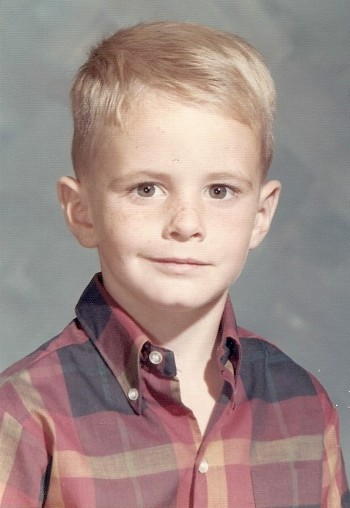 In this original BTB Investigation, we unveil the tragic story of Kirk Murphy, a four-year-old boy who was treated for “cross-gender disturbance” in 1970 by a young grad student by the name of George Rekers. This story is a stark reminder that there are severe and damaging consequences when therapists try to ensure that boys will be boys.
When we first reported on three American anti-gay activists traveling to Kampala for a three-day conference, we had no idea that it would be the first report of a long string of events leading to a proposal to institute the death penalty for LGBT people. But that is exactly what happened. In this report, we review our collection of more than 500 posts to tell the story of one nation’s embrace of hatred toward gay people. This report will be updated continuously as events continue to unfold. Check here for the latest updates.
In 2005, the Southern Poverty Law Center wrote that “[Paul] Cameron’s ‘science’ echoes Nazi Germany.” What the SPLC didn”t know was Cameron doesn’t just “echo” Nazi Germany. He quoted extensively from one of the Final Solution’s architects. This puts his fascination with quarantines, mandatory tattoos, and extermination being a “plausible idea” in a whole new and deeply disturbing light.
On February 10, I attended an all-day “Love Won Out” ex-gay conference in Phoenix, put on by Focus on the Family and Exodus International. In this series of reports, I talk about what I learned there: the people who go to these conferences, the things that they hear, and what this all means for them, their families and for the rest of us.
Prologue: Why I Went To “Love Won Out”
Part 1: What’s Love Got To Do With It?
Part 2: Parents Struggle With “No Exceptions”
Part 3: A Whole New Dialect
Part 4: It Depends On How The Meaning of the Word "Change" Changes
Part 5: A Candid Explanation For "Change"
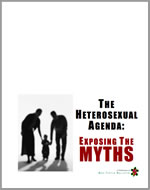 At last, the truth can now be told.
Using the same research methods employed by most anti-gay political pressure groups, we examine the statistics and the case studies that dispel many of the myths about heterosexuality. Download your copy today!
And don‘t miss our companion report, How To Write An Anti-Gay Tract In Fifteen Easy Steps.
 Anti-gay activists often charge that gay men and women pose a threat to children. In this report, we explore the supposed connection between homosexuality and child sexual abuse, the conclusions reached by the most knowledgeable professionals in the field, and how anti-gay activists continue to ignore their findings. This has tremendous consequences, not just for gay men and women, but more importantly for the safety of all our children.
Anti-gay activists often cite the “Dutch Study” to claim that gay unions last only about 1½ years and that the these men have an average of eight additional partners per year outside of their steady relationship. In this report, we will take you step by step into the study to see whether the claims are true.
Tony Perkins’ Family Research Council submitted an Amicus Brief to the Maryland Court of Appeals as that court prepared to consider the issue of gay marriage. We examine just one small section of that brief to reveal the junk science and fraudulent claims of the Family “Research” Council.
 The FBI’s annual Hate Crime Statistics aren’t as complete as they ought to be, and their report for 2004 was no exception. In fact, their most recent report has quite a few glaring holes. Holes big enough for Daniel Fetty to fall through.
“Google” is a trademark of Google Inc.
© Box Turtle Bulletin. All Rights Reserved.
 Posts
Posts  Posts via daily email: