Box Turtle Bulletin
 News and commentary about the anti-gay lobby
“Now you must raise your children up in a world where that union of man and box turtle is on the same legal footing as man and wife…”
News and commentary about the anti-gay lobbyMay 20th, 2014

Anti-gay activists like to pretend that the only way marriage equality is obtained is through the machinations of radical militant activist judges who impose their leftist agenda against the will of the people. So it’s always nice to know a little about who these judges are and how they came to hold their position.
Judge John E. Jones III, whose ruling found that Pennsylvania’s ban on same-sex marriage (legislative, not a constitutional amendment) is in violation of the US Constitution, is a bit hard to sell as a radical militant activist with a leftist agenda. But he’s certainly had that accusation thrown at him before, when he found that intelligent design could not be part of a school curriculum.
Before Jones became a jurist, re ran for Congress for the Sixth Congressional District seat and then, when unsuccessful, was co-chair of the transition team for Governor-elect Tom Ridge. He considered a run for Governor in 2001. As a Republican.
Jones was appointed by President George W. Bush as federal judge on the United States District Court for the Middle District of Pennsylvania in February 2002 and was unanimously confirmed by the United States Senate on July 30, 2002.
May 20th, 2014
Pennsylvania has become the latest state in which a Federal judge has ruled that marriage bans which exclude same-sex couples are in violation of the US Constitution. As of yet, there is no stay on the ruling. (WaPo)
In the wake of last June’s Supreme Court decision striking down part of the federal Defense of Marriage Act, U.S. District Court Judge John Jones III said the commonwealth’s state version of the law was unconstitutional. The suit was brought on behalf of 23 plaintiffs by the American Civil Liberties Union.
“[W]e hold that Pennsylvania’s Marriage Laws violate both the Due Process and Equal Protection Clauses of the Fourteenth Amendment to the United States Constitution,” Jones wrote in his ruling, uploaded by equalitycasefiles.org.
Pennsylvania Attorney General Kathleen Kane (D) had refused to defend the law, so attorneys for the Office of General Counsel, which reports to Gov. Tom Corbett (R), stood in for the state.
At present, including Oregon and Pennsylvania, there are 19 states and the District of Columbia in which same sex couples may marry. There are an additional nine states in which a marriage ban has been found to be unconstitutional but in which the ruling has been stayed on appeal.
It’s election day (primary) in Pennsylvania and Governor Tom Corbett has yet to comment on the decision. His history with the case has been one of embarrassment, including his rejection of the arguments made by his legal team. I’m certain that he’s hoping that the election results will allow him to keep as low a profile on the ruling as possible.
I expect an appeal, but would not be shocked by “the courts have spoken”.
May 20th, 2014
TODAY’S AGENDA:
 Another Possible Ruling on a State’s Marriage Equality Ban: Harrisburg, PA. There are at least five separate lawsuits pending in federal courts challenging Pennsylvania’s law banning same-sex marriage. One of those lawsuits was brought by the ACLU on behalf of 21 Pennsylvanians in Harrisburg. Both the ACLU and the Commonwealth of Pennsylvania agreed to forgo a trial and asked the judge to issue a summary judgment based solely on the submitted briefs. Federal District Judge Judge John E. Jones III is expected to issue his ruling sometime today. The ACLU has organized six Decision Day Rallies later today, which they hope will be in celebration for marriage equality. Those rallies are set to take place in Philadelphia, Pittsburgh, Erie and at the Capitol Steps in Harrisburg.
TODAY’S AGENDA is brought to you by:

From The Blade (Washington), June 1976, page 9.
Three gay bars and a restaurant managed to squeeze themselves into a single building just off of Philly’s tony Rittenhouse Square. The main bar, 247, opened on the ground floor in 1971 and remained in business until 1996. The building today is the site of an Irish pub.

L-R: Luc Montagnier and Robert Gallo
TODAY IN HISTORY:
30 YEARS AGO: AIDS Virus Identified: 1983. In a paper published in the US journal Science, a team from France’s Pasteur Institute, led by Luc Montagnier, described a suspect virus which had been isolated in a patient who had died of AIDS. Montagnier’s groundbreaking work led to the determination by US researcher Robert Gallo in 1984 that the virus was indeed the cause of AIDS. Gallo named his virus HTLV-III, and promptly claimed credit for discovering the virus. But the rest of the world began calling it the Human Immunodeficiency Virus, or HIV. A three year acrimonious spat between Gallo and Montagnier ensued over who was the first to discover it. The dispute was finally settled after intensive negotiations resulting in both parties being awarded credit, and everyone lived happily ever after. As it were.

Photo of an Amendment 2 Protest from the Nov. 11, 1992 issue of Out Front.
Romer v. Evans: 1996. On this date, the U.S. Supreme Court handed down the landmark decision striking down Colorado’s Amendment 2 to the state constitution which would have disenfranchised that state’s LGBT citizens from the right to petition their state and local governments for laws banning discrimination. Justice Anthony Kennedy, writing for the majority, rejected Amendment 2 supporter’s arguments that the ban on anti-discrimination laws were meant solely to deny LGBT people “special rights”:
[W]e cannot accept the view that Amendment 2’s prohibition on specific legal protections does no more than deprive homosexuals of special rights. To the contrary, the amendment imposes a special disability upon those persons alone. Homosexuals are forbidden the safeguards that others enjoy or may seek without constraint. They can obtain specific protection against discrimination only by enlisting the citizenry of Colorado to amend the State Constitution or perhaps, on the State’s view, by trying to pass helpful laws of general applicability. This is so no matter how local or discrete the harm, no matter how public and widespread the injury. We find nothing special in the protections Amendment 2 withholds. These are protections taken for granted by most people either because they already have them or do not need them; these are protections against exclusion from an almost limitless number of transactions and endeavors that constitute ordinary civic life in a free society.
…(Amendment 2) is at once too narrow and too broad. It identifies persons by a single trait and then denies them protection across the board. The resulting disqualification of a class of persons from the right to seek specific protection from the law is unprecedented in our jurisprudence. …We must conclude that Amendment 2 classifies homosexuals not to further a proper legislative end but to make them unequal to everyone else. This Colorado cannot do. A State cannot so deem a class of persons a stranger to its laws. Amendment 2 violates the Equal Protection Clause, and the judgment of the Supreme Court of Colorado is affirmed.
Justices John Paul Stevens, Sandra Day O’Connor, David Souter, Ruth Bader Ginsburg, and Stephen Breyer joined Kennedy in the majority opinion.
Dissenting Justice Antonin Scalia, joined by Chief Justice William H. Rehnquist and Justice Clarence Thomas, considered Colorado’s attempt to disenfranchise an entire class of people “unimpeachable under any constitutional doctrine hitherto pronounced.” Pointing to the Bowers v Hardwick, the 1986 Supreme Court Decision which declared that sodomy laws were constitutional, Scalia wrote, “If it is rational to criminalize the conduct, surely it is rational to deny special favor and protection to those with a self-avowed tendency or desire to engage in the conduct.” Seven years later, the Court would correct that contradiction in Lawrence v Texas, which finally struck down anti-sodomy laws in the 13 states where such laws were still in effect.

TODAY’S BIRTHDAYS:
Cher: 1946. She started out as one-half of the husband-and-wife singing duo Sonny & Cher with their 1965 hit, “I Got You Babe.” After a string of hits and a popular television series, their marriage ended and Cher’s solo singing career took off. She also became an Academy Award winning actress, winning a Best Actress award for her role in 1987’s Moonstruck. In 2002, Cher began her Farewell Tour, after which she said she would retire from show business. The tour lasted three years, and at some point she re-named it the “Never Can Say Goodbye” Tour. But in 2005, she finally retired the show and retired herself. Then she retired from retirement in February 2008 for a show at Caesars Palace in Las Vegas which lasted until February 2011. A recent single from the 2010 Burlesque soundtrack is fitting: “You Haven’t Seen The Last Of Me

If you know of something that belongs on the agenda, please send it here. Don’t forget to include the basics: who, what, when, where, and URL (if available).
And feel free to consider this your open thread for the day. What’s happening in your world?
May 19th, 2014
Tomorrow is election day in Arkansas and the judge who found the marriage ban to be unconstitutional will be on the ballot. But not to worry, he’s going to be reelected. (Houston Chronicle)
A Pulaski County circuit judge recently tossed out Arkansas’ 10-year-old ban on gay marriage, and the state Supreme Court subsequently put the judge’s ruling on hold, but there’s no way for voters to take out their frustrations at the polls this year. Circuit Judge Chris Piazza, who made the ruling, didn’t draw an opponent this year and will be re-elected to a 6-year term Tuesday.
The National Organization for Marriage is calling demanding “Governor Mike Beebe to call a special legislative session so that lawmakers can impeach Piazza and remove him from office”. Beebe has already dismissed that notion.
May 19th, 2014
Last week, Judge McShane denied the effort by the National Organization for Marriage to intervene in the trial over that state’s ban on same-sex marriage. They appealed that decision to the Ninth Circuit Court of Appeals, along with a request for an emergency stay on Judge McShane’s decision, should it be that the ban is unconstitutional.
Today the Ninth gave their reply: “Appellant’s emergency motion to stay district court proceedings pending appeal is denied.”
This has not been NOM’s happy day.
May 19th, 2014
Where will this all lead? I know that many suggest we are going down a slippery slope that will have no moral boundaries. To those who truly harbor such fears, I can only say this: Let us look less to the sky to see what might fall; rather, let us look to each other … and rise.
— Federal District Judge Michael McShane, in today’s ruling striking down Oregon’s ban on same-sex marriage.
As of noon today Pacific Time, Oregon has become the eighteenth state, in addition the the District of Columbia, to provide marriage equality for same-sex couples. With this ruling 39.5% of the total U.S. population lives in marriage equality states.
Judge McShane’s ruling follows much of the same logic we’ve seen in twelve other federal court decisions over the past year: “Because Oregon’s marriage laws discriminate on the basis of sexual orientation without a rational relationship to any legitimate government interest, the laws violate the Equal Protection Clause of the Fourteenth Amendment to the United States Constitution.” McShane declined follow the Ninth District Court Appeals decision to apply heightened scrutiny where sexual orientation is concerned, saying “That is unnecessary here, as the state’s marriage laws cannot withstand even the most relaxed level of scrutiny.”
His order is effective immediately.
Unlike the other marriage cases before federal courts, there as no one in Oregon to defend the state’s marriage ban. Oregon Attorney General Ellen Rosenblum announced last February that she would not defend the marriage ban, as did attorneys for Multnomah County, who were named as a defendant in the lawsuit. the National Organization for Marriage sought to intervene in the lawsuit, but Judge McShane rejected the organization’s request last week, saying that “The attorney general is answerable to voters. NOM is not.”
With no one defending Oregon’s marraige ban, it’s hard to find anything new in Judge McShane’s decision that hasn’t already been covered before. In fact, its a rather odd read. Because there were no arguments put forth by defendants in defending the ban, McShane’s attempt to argue against such arguments here are rather hypothetical and not based on the court record. And since state and county officials have already said that they have no plans to appeal the decision, McShane’s ruling will remain strictly an Oregon matter, and will likely have little bearing on case law as the other cases move their way through the appeals process. So I guess one can argue that the Oregon decision is relatively unimportant in the greater scheme of things, I have a feeling that many thousands of same-sex couples in Oregon today would be justified in strongly disagreeing with that.
May 19th, 2014
From the Bangor Daily News
Maine ethics investigators are recommending more than $50,000 in fines for a national anti-gay-marriage organization for failing to register and disclose its activities in Maine’s 2009 same-sex marriage referendum.
That year, an effort to legalize same-sex marriage — approved by the Legislature and signed by then-Gov. John Baldacci — was repealed at the ballot box with 53 percent of the vote.
National Organization for Marriage was the largest contributor to the ’09 anti-gay-marriage campaign, and dumped roughly $2 million into the state. That money was integral in defeating the fledgling marriage equality law.
The Ethics Commission will decide later this month whether to accept the recommendation of the reviewers and to assess the fine.
May 19th, 2014
TODAY’S AGENDA:
 Oregon Marriage Decision Expected: Portland, OR. Federal District Judge Michael J. McShane issued a heads up last Friday saying he intends to issue an opinion on pending motions for summary judgment today in a lawsuit challenging Oregon’s ban on same-sex marriage. Right now, there isn’t anyone in the court room to defend the ban. Oregon Attorney General Ellen Rosenblum had previously announced that she wouldn’t defend it, and Judge McShane last week denied the National Organization for Marriage’s request to defend the statute, saying “The attorney general is answerable to voters. NOM is not.” County Clerks have been preparing for what appears to be a strong likelihood that Judge will strike down the ban. Oregon law requires a three-day waiting period between getting a license and getting hitched, but some county clerks have already indicated that they may wave the requirement. Judge McShane’s ruling is expected at noon P.D.T. If his ruling goes as expected, you will likely see marriage licenses going out immediately after.
TODAY’S AGENDA is brought to you by:

From NW Fountain, May 1979, page 15.
In 1964, San Francisco drag performer and LGBT rights activist José Sarria proclaimed himself “Her Royal Majesty, Empress of San Francisco, José I, The Widow Norton,” and established a national Imperial Court System which raised millions of dollars for charity (see Dec 12). But when the high camp movement reached Portland, Oregon, they discovered that a similar Court had already been well established six years earlier. Bartender Duane Frye, who worked at the Half Moon Tavern, remembered:
Queen Eugenie I, Mother Superior of Transylvania. From William Holman’s “A Gay History: Let It Be Forgotten,” Northwest Gay News, June 1977, section 2, page 3. The caption adds: “This photo, taken inside the old Half Moon Tavern, is the only known photo taken inside that venerable establishment.”
Sometime around 1958… the first Queen Eugenie I (alias Sam) was self-proclaimed in the Court of Transylvania. This mythical court allowed for a whole plethora of other regal titles to come about including a Lord High Sheriff, and a number of other drag queens including Sr. Mary Wanna (Michael Patrick Dillon, who later got caught in a 1963-1964 sex scandal; see the Oregonian, Oct. 25, 1963, p. 26; Mar. 25, 1964, p. 13). In the back of the bar was erected a throne for the Queen (who would later become known as Empresses). An unbroken line of succession was created to the present day—with the earliest Empresses declared by someone (but who knows who?), and later by community-wide elections held in the city’s bars.
The Half Moon Tavern first opened in 1939 downtown at 72 SW Morrison Street near the Willamette River, although it’s not clear when it became a gay bar. It was probably a popular gay watering hole by 1952 when two male patrons were assaulted by a visitor in what the papers described as an “unprovoked attack.” In 1960, the Half Moon moved a block away to 124 SW Yamhill Street and remained in business through at least the 1980s. In addition to the Court of Transylvania, the Half Moon sponsored an LGBT bowling team. The original Morrison Street location was razed and replaced with a mid-century modern hotel. The Yamhill Street building still stands and today houses a yoga studio.

TODAY IN HISTORY:
Oscar Wilde Released from Prison: 1897. This date in history ended a two-year ordeal for Oscar Wilde, which began in 1895 when he was denounced as a homosexual by the Marquess of Queensberry. Wilde, who was involved with the marquess’ son, Alfred Douglass, sued the Marquess for libel but lost the case when evidence supported the marquess’ allegations (see Apr 5). Because homosexual behavior among men was still considered a crime in England, that evidence led to Wilde’s arrest. His first trial resulted in a hung jury, but a second jury in 1895 sentenced him to two years of hard labor (see May 25). Wilde was imprisoned in Pentonville and then Wandsworth prisons in London. The regime consisted of “hard labour, hard fare and a hard bed.” Ill with dysentery and weakened from hunger, Wilde collapsed during Chapel, bursting his right ear drum. He spent two months in the infirmary, and his health never fully recovered.
He was later transferred to Reading prison, where he wrote a 50,000 word letter to Douglass. He wasn’t allowed to send the letter, but he was permitted to take it with him when he was released. The letter, since named De Profundis was published in 1962’s Complete Letters of Oscar Wilde. It reads, it part:
When first I was put into prison some people advised me to try and forget who I was. It was ruinous advice. It is only by realising what I am that I have found comfort of any kind. Now I am advised by others to try on my release to forget that I have ever been in a prison at all. I know that would be equally fatal. It would mean that I would always be haunted by an intolerable sense of disgrace, and that those things that are meant for me as much as for anybody else – the beauty of the sun and moon, the pageant of the seasons, the music of daybreak and the silence of great nights, the rain falling through the leaves, or the dew creeping over the grass and making it silver – would all be tainted for me, and lose their healing power, and their power of communicating joy. To regret one’s own experiences is to arrest one’s own development. To deny one’s own experiences is to put a lie into the lips of one’s own life. It is no less than a denial of the soul.

DC Police Estimate 3750 “Sex Perverts” in Federal Government: 1950. The following United Press article appeared in newspapers nationwide:
3750 Perverts Listed on Payroll
Senate Republican Leader Kenneth S. Wherry said today that Washington police estimate there are 3750 sex perverts in the Government here.
In a report to a Senate Appropriations Subcommittee, Senator Wherry said police authorities testified that 300 to 400 State Department employees are “suspected or allegedly homosexual.”
The Nebraskan also said that Washington police reported they have uncovered “what purported to be a plan of Communists to sabotage and damage” Washington in case of war with Russia; that a Red Fifth Column is using sex degenerates for subversive purposes; and that “there are 1000 bad security risks” in Washington.
The report gave no details on the purported plot to sabotage Washington.
The New York Times had a more in-depth account, which revealed that Washington Police Lieutenant Roy Blick testified that his estimate of 300 to 400 gays employees in the State Department was based on “a quick guess”:
This, he said at one point, was a “quick guess,” in the sense that it was based upon his experience that arrested persons not connected with the State Department would sometimes say: “Why don’t you go get so-and-so and so-and-so? They all belong to the same clique.”
“By doing that,” Lieutenant Blick added, “their names were put on the list and they were catalogued as such, as the suspect of being such.”
Springfield, OR, Voters Approve Anti-Gay Ordinance: 1992. About three years earlier, Vietnam vet, ex-hippie and born-again Christian by the name of Lon Mabon had formed the Oregon Citizens Alliance (OCA) with support from the Oregon branch of Pat Roberston’s Christian Coalition. By 1991, budding firebrand Scott Lively joined the group, where he had quickly earned his reputation for being a loose canon. In October of that year, the photographer Catherine Stauffer attended a church meeting where the OCA was previewing a videotape it had cobbled together in preparation for a campaign in support of a series of local anti-gay ballot measures across the state. Lively forcefully ejected Stauffer from the meeting by physically throwing her against the wall and dragging her across the floor. She sued Lively and OCA. The jury determined that Lively was guilty of using unreasonable force and awarded Stauffer $20,000.
What the OCA was preparing was a series of local ballot measures that would prohibit “promoting, encouraging or facilitating homosexuality, pedophilia, sadism or masochism” — restrictions which would, in addition to equating homosexuality with pedophilia, determine such basic community issues as which books could be accepted into the local library and which groups could access city facilities, including streets and parks. They would also institute a double standard: for example, OCA would be allowed to hold meetings in city buildings, while Parents and Friends of Lesbians and Gays (PFLAG) would not.
Those ballot measures found their first success in Springfield, a more conservative working-class suburb of Eugene, where voters approved a proposed city charter amendment, Ballot Measure 20-80, by a 54-46 margin. City Councilman Ralf Walters, was elated. “What this means is that Springfielders have shown their commitment to traditional family values. They want to maintain Springfield as a terrific place to raise a family, and they don’t want their leaders and public institutions to promote as an alternative lifestyle.”
But Mayor Bill Morrisette, an outspoken opponent of the measure, was more cautious. “I think there’s more to the city of Springfield than this particular question of sexual orientation. It certainly would be a mistake for the OCA to think if they win this that they’ve got a lock on the city.” Planning Commission member Tom Atkinson, who helped lead the opposition, said the vote “does stamp Springfield with Hate City USA. I just don’t believe that it’s true about Springfield. The low turnout really makes me believe the real will of the people of Springfield was not expressed tonight.”
Even though a similar vote in Corvallis failed by a wide margin, OCA’s Scott Lively saw the Springfield vote as a prophetic omen for future ballot measures in the state. “The votes in Springfield — and Corvallis, too, even though it failed there — vindicate our position that traditional family values are shared by a large number of people in this state. The attempt by the opposition to equate the simple ‘no special rights’ message with hatred and bigotry was a lie, and the people of Springfield proved it.”
OCA’s victory in Springfield gave Mabon and Lively all the encouragement they needed to propose a state constitutional amendment with language that was very similar to the Springfield measure. They saw Springfield as their testing ground, but it would also prove to be their high water mark. Following a nasty state-wide campaign led by Mabon, Lively and the OCA, Measure 9 was defeated by voters just nine months later (see Nov 2). Meanwhile, Springfield’s new law was challenged in court, and in 1995 the Oregon Court of Appeals ruled that a state law passed in 1993 pre-empted local governments on gay rights issues.
[Sources: Jim Burroway. “Lively’s Lies: A Profile of Scott Lively.” Political Research Associates (March 1, 2011). Available online here.
Ann Portal. “Voters approve anti-gay measure.” Eugene Register-Guard (May 20, 1992): 1A. Available online here.
Randi Bjornstad. “OCA issue hinged on ‘special rights’.” Eugene Register-Guard (May 21, 1992): 1A. Available online here.
Paul Neville. “Appeals court deals setback to gay rights foes.” Eugene Register-Guard (April 13, 1995): 1A. Available online here.]

TODAY’S BIRTHDAY:
Peter Wildeblood: 1923-1999. In 1954, Peter Wildeblood was a diplomatic correspondent for London’s Daily Mail in 1953, when he was sentenced to 18 months’ imprisonment for homosexual offenses. In essence, he was convicted of refusing to be ashamed. Wildeblood has one of four men caught up in the so-called “Montagu Case,” named for Lord Montagu (see Oct 20), whose beach house was raided by police on a tip that a homosexual orgy was taking place. Montagu had offered Wildeblood the use of the beach house, and Wildeblood in turn invited two friends from the RAF, his lover Edward McNally and John Reynolds. Montagu’s cousin, Michael Pitt-Rivers, had also joined the group.
Wildeblood later said that the whole affair had been “extremely dull,” while Montague elaborated, “We had some drinks, we danced, we kissed, that’s all. But McNally and Reynolds turned Queen’s Evidence and claimed that “abandoned behavior” had occurred. Wideblood was charged with “conspiracy to incite certain male persons to commit serious offences with male persons,” among other charges, and was sentenced to eighteen months’ imprisonment.
After his release, Wildeblood considered his battle only half over. Just as he proclaimed his homosexuality during his trial, he published his audacious, ground-breaking memoir Against the Law, which revealed his experiences during his arrest and trial, and the appalling conditions of his imprisonment. He also described being on the receiving end of popular scorn when news of his arrest hit the papers:
That night, a woman spat at me. She was a respectable looking, middle-aged, tweedy person wearing a sensible felt hat. She was standing on the pavement as the car went by. I saw her suck in her cheeks, and the next moment a big blob of spit was running down the windscreen.
This shocked me very much. The woman did not look eccentric or evil; in fact she looked very much like the country gentlewomen with whom my mother used to take coffee when she has finished her shopping on Saturday mornings. She looked thoroughly ordinary, to me. But what did I look like to her? Evidently, I was a monster.
The following year, Wildeblood came out with another book, A Way of Life, which included twelve essays describing various gay people he had come in contact with. This helped to put a human face on the hitherto faceless “homosexuals.” Wildeblood’s two books also helped to inform the Wolfenden Report, which in 1957 recommended the decriminalization of homosexual acts in Britain. But those recommendations wouldn’t be acted upon for another ten years (see Jul 28).
Wildeblood went on to become a television producer and writer, first for Granada Television, and then CBC Toronto. He became a Canadian citizen in the 1980s, and died in Victoria, British Columbia in 1999.

Mike McConnell: 1942. Growing up gay in Oklahoma wasn’t easy, but the experience quickly made Mike realize that people like him were, at best, second-class citizens. While attending the University of Oklahoma, his friend, Joe Clem, was also gay and rather cautiously open about it, even among his frat brothers. During one bout of drinking, those so-called “brothers” became enraged with Clem being a “faggot,” beat the crap out of him, and drove him out to a deserted road outside Norman and dumped him there. Clem eventually made his was back to Norman, but didn’t dare call the police.

Mike McConnell, with Jack Baker, ca 1970. Photo by Kay Lahusen (see Jan 5).
McConnell met Jack Baker at a barn party in 1966 outside of Norman. McConnell was completing his Masters degree in Library Science, and Baker was working as a field engineer in Oklahoma City. Both were 24, and they hit it off. McConnell told Jack his views that gay people were entitled to the same rights as any other Americans. Six months later, Baker proposed to McConnell, and McConnell accepted, on one condition: that they would find a way to marry legally.
In 1969, Baker moved to Minneapolis to study law at the University of Minnesota. Six months later, McConnell was offered a job at the University’s library. Three weeks after McConnell moved to Minneapolis, the pair went to the Hennepin County Courthouse in downtown Minneapolis to apply for a marriage license (see May 18) Their application was denied. Not only that, but a month later, the university’s Board of Regents voted to withdraw its job offer to McConnell.
Those events launched two separate lawsuits: Baker v. Nelson challenged Hennepin County’s denial of their marriage license, and McConnell v. Anderson challenged the University’s withdrawal of McConnell’s job offer. Baker v. Nelson worked its way up the Minnesota state courts, with courts ruling against Baker and McConnell every step of the way. The case eventually made it to the Minnesota Supreme Court in October 1981, which also ruled against them. The U.S. Supreme Court then dismissed an appeal “for want of a substantial federal question,” and Baker v. Nelson was treated as though it were an established precedent for the next several decades.
McConnell’s lawsuit against the University went little better. He got an early victory when the Federal District Judge issued an injunction against the University. He called the couple’s attempt at getting married “rather bizarre,” but found that even a “homosexual is after all a human being and a citizen… He is as much entitled to the protection and benefits of the laws… as others.” But McConnell never did get his job at the University. The judge stayed his injunction pending appeal, the Eight Circuit overturned the lower court’s ruling, and the Supreme Court refused to consider the case.
While the cases were winding their way thought the courts, McConnell and Baker continued to pursue legal recognition of their relationship through other means. McConnell legally adopted Baker in August 1971, which allowed them at least some of the benefits of marriage (inheritance, medical decision-making, even reduced tuition for Baker). A month later, they managed to obtain a marriage license from a clerk in Blue Earth County, Minnesota and were married by a Methodist minister. That license was never officially revoked, and makes them the first lawfully wedded same-sex couple in the United States, even if they weren’t able to get the state or federal government to recognize their marriage.
McConnell later found work in the Hennepin County Library system, and continued working there for the next thirty-seven years before retiring in 2010 as a Coordinating Librarian. In 2012, University of Minnesota president Erik Kaler formally apologized to McConnell fir his treatment forty-two years earlier. They are still living together as a married couple in the suburbs of south Minneapolis, quietly and well out of the spotlight.
If you know of something that belongs on the agenda, please send it here. Don’t forget to include the basics: who, what, when, where, and URL (if available).
And feel free to consider this your open thread for the day. What’s happening in your world?
May 18th, 2014
TODAY’S AGENDA:
Pride Celebrations This Weekend: Chisinau, Moldova; Kraków, Poland; Long Beach, CA; New Hope, PA; São Paulo, Brazil.
AIDS Walks This Weekend: Minneapolis, MN; New York, NY.
Other Events This Weekend: Harvey Milk Day Events, various cities and dates; Bearcelona, Barcelona, Spain; Brighton Heroes Run, Brighton, UK; Bear Watch, Galveston, TX; Saints and Sinners Literary Festival, New Orleans, LA.
TODAY’S AGENDA is brought to you by:

From GPU News, July 1973, page 22.
The Noble Roman opened in 1970 on St. Paul’s Grand Avenue, in a space that had been a supper club. It became a gay bar somewhat by accident: “The Roman was particularly popular because its heterosexual owner was overwhelmingly concerned with profit; she left event planning and day-to-day management to the all-gay staff. [Mary] Kester’s lax attitude permitted the bar’s popular free stage—the venue hosted innumerable drag acts, politely-received ventriloquism shows, and musical numbers. …The owner’s carefree management style had positive and negative effects on the community. The Noble Roman was an early site of faux gay weddings, and drag queens received a small stipend for their Sunday performances on its free stage. When it came to paying bills, her ownership was detrimental—the bar closed several times due to mortgage truancy.” Kester sold the bar in 1976 and the new owners turned it back into a straight establishment. The address today is now home to a restaurant called the Wild Onion.

Mike McConnell and Jack Baker applying for a marriage license in Minneapolis.
TODAY IN HISTORY:
Marriage In Minnesota: 1970. Mike McConnell met Jack Baker in 1966 on a blind date at a Halloween party in Oklahoma where they were both 24-year-old grad students. On Baker’s 25th birthday, they became “betrothed,” as they put it, in a private ceremony, and moved in together. They moved to Kansas City, Missouri, and that’s when they met activists Barbara Gittings and Frank Kameny. “That’s what lit our fires of pride,” recalled McConnell. “These fine people were willing to say, ‘Look, I’m as good as anybody else.’ That’s all I needed to hear.”
In April, 1970. McConnell accepted a job at the University of Minnesota’s library and Baker enrolled as a first year law student. Three weeks later, on this date in 1970, the couple applied for a marriage license in Minneapolis. Their presence caused a minor stir among nervous office workers. Baker told them, “If there’s any legal hassle, we’re prepared to take it all the way to the Supreme Court. This is not a gimmick.” There were legal hassles. Not only were the denied a license, but the university fired McConnell when news of their application hit the papers. A federal judge blocked McConnell’s firing. He called the episode “rather bizarre, but concluded that “An [sic] homosexual is after all a human being and a citizen…. He is as much entitled to the protection and benefits of the laws… as others.” Unfortunately, that decision was reversed on appeal, and the U.S. Supreme Court refused to take up the case.
Meanwhile a state judge, ruling on the marriage case itself, sided with county officials and ordered them not to issue a license. While McConnell and Baker appealed that decision, McConnell legally adopted Baker in August 1971, which allowed them at least some of the benefits of marriage (inheritance, medical decision-making, even reduced tuition for Baker). Later that same year, they managed to obtain a marriage license from a clerk in Blue Earth County, Minnesota and were married by a Methodist minister. But in October, the Minnesota Supreme Court ruled in Baker v. Nelson that state law prohibits same-sex marriage, the U.S. Supreme Court dismissed an appeal “for want of a substantial federal question,” Baker v. Nelson became an established precedent.
In 2012, Minnesotans defeated a proposed constitutional amendment, placed on the ballot by a Republican-controlled legislature that would have permanently barred same-sex marriages in the state. Voters also elected a Democratic-Farm-Labor (DFL, the state Democratic party’s name in Minnesota) majority in both houses of the legislature. Elections have consequences, and the new legislature passed a marriage equality bill in 2013, which Gov. Mark Dayton (DFL) quickly signed into law. That law went into effect on August 1. Baker and McConnell weren’t among those to line up for marriage licenses that day. As far as they were concerned, the license they obtained in Blue Earth County was still valid and they saw no need for another one. They still live a quiet life together, well out of the spotlight, in Minneapolis.
[Source: Joyce Murdoch and Deb Price. Courting Justice: Gay Men And Lesbians V. The Supreme Court

Therapist Warns of Homosexual Epidemic: 1970. New York psychiatrist Charles Socarides warned the nation’s physicians in the May 18, 1970 edition of the Journal of the American Medical Association, that “Homosexuality is a medical disorder which has reached epidemiologic proportions; its frequency of incidence surpasses that of the recognized major illnesses in the nation.” Socarides, who had appeared three years earlier on the infamous CBS documentary “The Homosexuals” (see Mar 7), had become a nationally-recognized authority on the so-called “disease” of homosexuality and its cure, and so his article in the AMA’s prestigious journal carried considerable weight. Socarides chided his fellow physicians for not taking the new epidemic seriously:
Attempts to obfuscate the fact that homosexuality is a medical problem have not been met head on by those most qualified to clarify the situation. Only in the consultation room does the homosexual reveal himself and his world. No other data, statistics, or statements can be accepted as setting forth the true nature of homosexuality. All other sources may be heavily weighted by face-saving devices or rationalizations or, if they issue from lay bodies, lack the scientific and medical background to support their views. The best that can be said for the well-intentioned but unqualified observer is that he is misguided because he does not have and can not apply those techniques which would make it possible to discern the deep underlying clinical disorder or to evaluate the emotional patterns and interpersonal events in the life of a homosexual.
Socarides distinguished between two types of homosexuals: the “obligatory” and the “episodic.” Only the former were true homosexuals as he put it. “The latter is characterized by isolated homosexual acts without the stereotypy, the compulsivity, of the former.” As for the former:
There is a high incidence of paranoia or paranoid-like symptomatology in overt homosexuals. This is related to the medical fact that overt obligatory homosexuality is either a fixation or regression to the earliest stages of ego development. As a result, archaic and primitive mental mechanisms belonging to the earliest stages of life characterize the homosexual’s behavior. Also, homosexuality, obligatory or not, can be seen in the schizophrenic in his frantic attempt to establish some vestige of object relations as an expression of the fragmented and disorganized psychic apparatus with which he has to struggle.
Socarides argued that because homosexuals were suffering from a mental illness, they should not be penalized legally for consensual activities “so long as it is not accompanied by antisocial or criminal behavior.” Despite increasing calls to decriminalize homosexuality, homosexual behavior was still criminalized in every state except Illinois (see Jul 28). Socarides cautioned that ” any change in the legal code should be accompanied by a clearcut statement as to the nature of obligatory homosexuality, its diagnosis as a form of mental illness, and a universal declaration of support for its treatment by qualified medical practitioners.” And only those “qualified medical practitioners,” he concluded, were qualified to pass judgment whether gay people were sick:
It is vitally important to realize this fundamental point: the diagnosis of homosexuality can not be self-made, imposed by jurists, articulated by clergy, or speculated about by social scientists. … If the homosexual is to be granted his human right as a medical patient, issues which becloud his status should be clarified. Above all, the homosexual must be recognized as an individual who presents a medical problem.
The whole issue of homosexuality must be transformed into one more scientific challenge to medicine which has time and again been able to alleviate the plaguing illnesses of man. With this respected leadership on the part of the physician, we will see a surge of support for the study and treatment of the disorder by all the techniques and knowledge available through the great resources and medical talent of the United States.
[Source: Charles W. Socarides. “Homosexuality and medicine.” Journal of the American Medical Association 212, no. 7 (May 18, 1970): 1199-1202.]

First Published Report Of New “Exotic” Disease Among New York Gays: 1981. June 5, 1981 is typically cited as the date of the first published report on a new disease which would become known as AIDS, when the Centers for Disease Control and Prevention published a notice concerning five previously healthy gay men in Los Angeles who died from rare infections which were normally easily curable (See Jun 5). But the first published report actually appeared in a New York gay newspaper a month earlier, tucked inside an issue of the New York Native on page seven. Dr. Lawrence Mass, who wrote a regular health column for the small weekly, had heard rumors of several new exotic diseases striking down gay men in Gotham. Some were coming down with a rare kind of a skin cancer that had previously only affected older Jewish or Mediterranean men. Others were stricken with a rare form of pneumonia which typically only appeared in people with severely suppressed immune systems such as cancer patients undergoing chemotherapy and transplant recipients. There were also a host of other odd diseases that gay men were coming down with, but so far nobody had figured out that there might be a single cause to link them all together.
After Mass was assured by the Centers for Disease Control in Atlanta that there was no evidence of an emerging “gay cancer,” Mass wrote an article titled, “Disease Rumors Largely Unfounded,” which began:
Last week there were rumors that an exotic new disease had hit the gay community in New York. Here are the facts. From the New York City Department of Health, Dr. Steve Phillips explained that the rumors are for the most part unfounded. Each year, approximately 12 to 24 cases of infection with a protozoa-like organism, pneumocystis carinii, are reported in the New York City area. The organism is not exotic; in fact, it’s ubiquitous. But most of us have a natural or easily acquired immunity.
“What’s unusual about the cases reported this year,” Mass explained, “is that eleven of them were not obviously compromised hosts. The possibility there exists that a new, more virulent strain of the organism may have been ‘community acquired.'” But Mass reported that there was not enough evidence (yet) to make a clear connection between the new disease and the gay community.
It wouldn’t be long before that link was made. Chroniclers of the AIDS crisis now recognize Dr. Mass as being the first to write about the emerging epidemic in print. Dr. Mass went on the help found the Gay Men’s Health Crisis, and was the principle author of the organization’s Medical Answers About AIDS through four revisions spanning ten years.

Papa Choux’s defiant ad stating they “will never allow this charade.” (Click to enlarge.)
30 YEARS AGO: CA Supreme Court Upholds Anti-Discrimination Decision for Lesbians Denied Restaurant Seating: 1984. On January 13, 1983, Zandra Rolon and Deborah Johnson made dinner reservations at Papa Choux, a very elegant Los Angeles restaurant. They specifically reserved a “Romantic Booth” in the restaurant’s Intimate Room, which featured sheer curtains around the booths, strolling violinists, and a measure of privacy. When they arrived for dinner, they were seated at the reserved booth, at first, but then they were told that they had to move. The manager told them, falsely, that a city ordinance prohibited such seating.
The couple filed suit, and were represented by civil rights attorney Gloria Allred, who told reporters, “We intend to end this dinner discrimination and give Papa Choux’s their just desserts.” Papa Chou’s owner, Seymour Jacoby, countered with a newspaper ad declaring that “Papa Choux’s will never allow this charade. It would certainly make a mockery of true romantic dining.” But Rolon and Johnson won, and the case was upheld on appeal.
On May 18, 1984, the California denied the restaurant’s request for a hearing, and Jacoby took out another ad saying that “true romantic dining died on this date.” Allred countered, “This is not the death of romance. It is the death of discrimination.” A few days later, about 100 or so bar customers gathered for a “wake” as the restaurant closed its six curtained booths.
 TODAY’S BIRTHDAYS:
Patrick Dennis: 1921-1976. The name given him at birth was Edward Everett Tanner II, but his father had already begun calling him Pat before he was born, and so Pat he remained throughout childhood. When he published his 1955 novel, Auntie Mame: An Irreverent Escapade
Dennis married in 1948 and had two children. He struggled with his bisexuality and was said to have been a fixture in Greenwich Village. He tried to commit suicide at one point, and after years of leading a double life, he decided to leave his family after he had fallen in love with another man. By the 1970s, his novels fell out of favor and out of print. His caviar tastes and extravagant nature, not unlike those of his quasi-fictional Mame, soon had him flat broke. He began a second career as a butler, and a rather anonymous one at that, having reverted back to using his real surname. He worked at the estate of Ray Kroc, founder of McDonalds, where it is said that his employers had no idea who he really was. He died in at age 55 of pancreatic cancer.

Top: Don Bachardy and Christopher Isherwood. Bottom: Isherwood sitting for Bachardy
80 YEARS AGO: Don Bachardy: 1934. He met the famous writer, Christopher Isherwood (see Aug 26), on Valentine’s day when he was eighteen and Isherwood was 48, and they remained together as partners until Isherwood’s death in 1986. Bachardy still lives in the house they shared together in Santa Monica. It’s a shame that virtually every biography about Bachardy starts with that association with the acclaimed author because he is a talented painter in his own right. He studied at the Chouinard Art Institute in Los Angeles and the Slade School of Art in London. His first one-man exhibition was held in 1961 at London’s Redfern Gallery. Most of his work is portraiture, and several of his sketches appeared in Isherwood’s novels.
If Bachardy was sometimes overshadowed by his relationship with Isherwood, he seems to have come to terms with it. But it did pose problems between them earlier in their relationship. During a particularly difficult period when Bachardy was studying in London, they almost broke up. Isherwood imagined what it would be like to live without Bachardy, and wrote A Single Man in which Bachardy’s character was already dead before the novel began. If you know the novel’s story, the result is not a happy one.
But they did remain together, and were life-long collaborators as artists and as a couple, sharing in each other’s successes. As Bacardy explained in the 2007 documentary Chris & Don. A Love Story:
I don’t take any credit for what’s happened to me in my life. It all seems fate — my destiny and Chris’s destiny. We were actually exactly what the other wanted and needed, whether we knew it or not. Well, Chris knew it. I didn’t for a long time …. I know that Chris would agree that the last ten years or so were our best — not the early years when we were younger and beautiful, but the later years when we really just enjoyed each other’s company and worked together in a variety of ways. It all just enhanced our basic unity — unity with each other, our harmony.
They continued collaborating, even as Isherwood was dying of cancer, when Bachardy would sketch him every single day, sometimes nine or ten times. “Chris was in a lot of pain towards the end,” he told The Sunday Times. “But he had sat for me so often over the years, and I knew this was something we could still do together. Each day, I could be with him intensely for hours on end.” On the day he died, Bachardy kept working on a sketch, a sketch of the man’s body with whom he had spent his entire adult life. “Chris would have been proud of me,” he said in the documentary. “He’d have said ‘that’s what an artist would do.’ And that’s what an artist did.”
[Source: Chris Freeman. “Lives in Art: Isherwood and Bachardy.” The Gay & Lesbian Review Worldwide 15, n0. 5 (September-October 2008) 30-33.]
If you know of something that belongs on the agenda, please send it here. Don’t forget to include the basics: who, what, when, where, and URL (if available).
And feel free to consider this your open thread for the day. What’s happening in your world?
May 17th, 2014
TODAY’S AGENDA:
Pride Celebrations This Weekend: Brussels, Belgium; Chisinau, Moldova; Eilat, Israel; Kraków, Poland; Long Beach, CA; New Hope, PA; São Paulo, Brazil; Springfield, IL.
AIDS Walks This Weekend: Minneapolis, MN; New York, NY; Poughkeepsie, NY.
Other Events This Weekend: Harvey Milk Day Events, various cities and dates; Bearcelona, Barcelona, Spain; Brighton Heroes Run, Brighton, UK; Bear Watch, Galveston, TX; Saints and Sinners Literary Festival, New Orleans, LA.
TODAY’S AGENDA is brought to you by:

From Wilde Side, September 1, 1976, page 22.
During its heyday, this Boston club had something for everyone: a jazz club, a cruise bar, one dance floor for rockers, another for disco, and a roof top deck with food and a view of Fenway Park. The club closed in 1988 after about fifteen years in business in the aftermath of a police bribery scandal. Documentary filmmaker Vincent-Louis Apruzzese said: “It was a big story at the time, and is probably the reason it closed. The owner videotaped policemen taking bribes at the club. I asked for the footage, and it does exist, but is in court records now.” The 1270, for some, was literally a life saver, providing refuge for gays and lesbians from the occasional gay-bashing baseball fans leaving Fenway. Today, it’s the gentrified Baseball Tavern, catering to Red Sox fans and tourists.

TODAY IN HISTORY:
Gays Cured Worldwide: 1990. It’s amazing that it took so long, but the World Health Organization finally removed homosexuality from the tenth edition of the International Statistical Classification of Diseases and Related Health Problems (also known as ICD-10). It took the WHO nearly seventeen years to catch up with the American Psychiatric Association, and when they did they followed the APA’s same cautious approach by including the diagnosis of “Ego-Dystonic Sexual Orientation,” for those who were troubled by their homosexuality. That diagnosis served as a loophole allowing therapists to continue to try to “cure” gay people of a mental disorder that no longer existed. The APA removed that diagnosis from its list of mental disorders in 1987. It is still in the WHO’s list of disorders.

10 YEARS AGO: Massachusetts Becomes First State With Marriage Equality: 2004. Six months earlier, the Massachusetts Supreme Judicial Court, in a 4-3 ruling, found that the state could not bar same-sex couples from marrying and gave the legislature 180 days to “take such action as it may deem appropriate” before issuing licenses to gay couples (See Nov 18). The state Senate responded by asking whether civil unions would suffice, but the four justice who made up the majority of the original decision wrote, “”The dissimilitude between the terms ‘civil marriage’ and ‘civil union’ is not innocuous; it is a considered choice of language that reflects a demonstrable assigning of same-sex, largely homosexual, couples to second-class status.”
Republican Gov. Mitt Romney issued a statement supporting an amendment to the state constitution which would have banned both same-sex marriage and civil unions (reversing a 2002 campaign promise that he had made to gain the endorsement of the Log Cabin Club of Massachusetts) but the legislature narrowly defeated it. The second proposal, a compromise amendment which would have banned marriage equality only,” mustered enough support, with Romney’s reluctant support (he still preferred the first proposal) to be held for a second vote a year later (proposed constitutional amendments require 25% support in two consecutive years before being passed on to voters). Meanwhile, the legislature took no action to implement the court’s decision.
On May 17, the day the court’s decision was due to go into effect, Gov. Romney cited a 1913 law prohibiting non-residents from marrying in Massachusetts if the marriage would not be valid in their home state, and instructed town clerks to deny marriage licenses to out-of-state gay couples. The 1913 law, which had been enacted to block interracial marriages for out-of-state couples subject to Jim Crow laws in their home states, hadn’t been enforced in decades.
When the compromise proposed constitutional amendment came up for a second vote in 2005, Gov. Romney withdrew his support, saying that it confused voters who wanted to ban both same-sex marriage and civil unions. The measure lost the necessary support in the legislature. Romney then backed a revival of the first proposed amendment which would have banned marriage and civil unions both, but that proposal failed to gain the necessary 25% support in the state legislature in 2006. Romney left office in 2007, and the so-called “1913 law” was repealed in 2008. In the past ten years, the sky has not fallen, civilization did not collapse, and Massachusetts continues to enjoy the lowest divorce rate in nation.

10 YEARS AGO: IOC Allows Trans People To Compete In Assigned Gender: 2004. The International Olympic Committee ruled that post-operative transgender people will be able to compete in events in Athens according to their self-identified gender, provided the new gender is legally recognized and the athlete is two years into post-operative hormonal therapy. IOC Medical Commission Chairman Arne Ljungqvist announced the rule change in response to the increasing numbers of transgender athletes attempting to qualify for Olympic competition. “Although individuals who undergo sex reassignment usually have personal problems that make sports competition an unlikely activity for them, there are some for whom participation in sport is important,” he said. The IOC’s rule change came about after it become apparent that case-by-case evaluations were insufficient. Transgender advocates criticized the post-operative requirements, noting that many athletes cannot afford the surgeries where national or private health insurance doesn’t cover it.

TODAY’S BIRTHDAYS:
Howard Ashman: 1950-1991. Playwright and lyricists, Ashman first achieved acclaim for his collaboration with Alan Menken on Little Shop of Horrors. That collaboration put the songwriting duo on a course for greater hits to come. In 1986, Ashman wrote the screenplay for the film adaptation and wrote the lyrics for two new songs, “Some Fun Now” and “Mean Green Mother From Outer Space.” The latter of two received an Academy Award nomination. In 1989, he was co-producer, lyricist and occasional writer for Disney’s The Little Mermaid. It was his idea to give Sebastian the Crab a Jamaican accent, and the calypso song, “Under the Sea,” earned Ashman and Menkin the 1989 Oscar for Best Original Song. Asman died in 1991 of complications from AIDS shortly after completing work on the Disney films Beauty and the Beast and before he could complete Aladdin. Ashman was posthumously named a Disney Legend in 2001, and Beauty and the Beast is dedicated to him. Ashman was survived by his partner, architect William Lauch.

Annise Parker: 1956. The Houston native had worked for over 20 years in the oil and gas industry as a software analyst, but she was never far from public service. In 1986, she was president of the Houston GLBT Political Caucus, which is the South’s oldest LGBT organization. Taking the position at the height of the AIDS scare was daunting “It was a scary, very different time,” she said. “The two most visible lesbian activists in Houston were myself and Sue Lovell (who later became a City Council member). We had regular death threats, our tires slashed, vandalism.”
But the narrow focus of LGBT politics wasn’t a good fit for her. “I was bored with gay stuff,” she said. “I threw myself just as hard into 10 years of neighborhood activism.” That neighborhood activism led to her becoming president of the Neartown Association in 1995, and in 1997 she won an at-large seat on Houston’s City council, making her the first openly gay individual elected to citywide office in Houston. In 2003, she won her bid to become city controller, the second highest office in city government. But her greatest triumph came in 2009, when she overcame blistering attacks from anti-gay groups to win the race to become Houston’s mayor on December 12, 2009. When she assumed office on January 2, 2010, Houston became the largest U.S. city to have an openly gay mayor.
If you know of something that belongs on the agenda, please send it here. Don’t forget to include the basics: who, what, when, where, and URL (if available).
And feel free to consider this your open thread for the day. What’s happening in your world?
May 16th, 2014
In a simple one-sentence order, the Arkansas State Supreme Court has brought same-sex marriages in the state to a halt:
State Defendants-Appelants’ petition for emergency stay and separate White, Washington, Lonoke and Conway County appellants’ expedited motion for stay are granted.
The Arkansas Time blog describes what lies ahead:
Piazza’s decision will now go through the appeal process. A record of the lower court case must be prepared. A briefing schedule must be set and probably oral arguments. The court takes a two-month recess each summer. Even with an expedited schedule, it’s uncertain if the case can be decided this calendar year, when two of the current justices — Cliff Hoofman and Donald Corbin — will be replaced by Rhonda Wood and the winner of a race between Judge Robin Wynne and Tim Cullen. Typical there’s about 2.5 months for briefing after a record and transcript is completed. Part of this record has already been completed and it’s not an extensive record. It conceivably could be completed by fall.
In other words, this may kick things down the road to 2015 or so.
May 16th, 2014
The New York Times reports that the CDC is now advocating the drug regimen commonly known as PrEP:
Federal health officials recommended Wednesday that hundreds of thousands of Americans at risk for AIDS take a daily pill that has been shown to prevent infection with the virus that causes it.
If broadly followed, the advice could transform AIDS prevention in the United States — from reliance on condoms, which are effective but unpopular with many men, to a regimen that relies on an antiretroviral drug.
It would mean a 50-fold increase in the number of prescriptions for the drug, Truvada — to 500,000 a year from fewer than 10,000. The drug costs $13,000 a year, and most insurers already cover it.
Aaron Hicklin of Out picked up the thread, summarizing some of the thinking behind the CDC’s new stance:
Although doctors advise patients to take the PrEP pill, Truvada, in conjunction with condoms, the move is an acknowledgement that after decades of public health education, condom use is in sharp decline among gay men. A C.D.C survey last November showed that the number of gay men reporting unprotected sex had risen nearly 20 percent from 2005 to 2011. Given the stigma around admitting to unprotected sex, that figure is probably much higher. Now, the hope is that by encouraging gay men who have unprotected sex to take Truvada, the number of new infections will continue to fall as scientists continue to hunt for a cure.
Even though PrEP as a regimen is not exactly new, Tim Murphy’s piece in Out last September rekindled what’s now a vigorous debate among gay men about whether or not PrEP should be offered more widely. Box Turtle’s last post about PrEP, here, is now at a healthy 69 comments (yup) with two main threads emerging. One side, now joined by the CDC, essentially says that the status quo focusing on condoms isn’t working and a new model which recommends both PrEP and condoms is needed. The opposing view, shared by Michael Weinstein of the AIDS Healthcare Foundation, worries that advocating that gay men get on PrEP will not only lead to an explosion of other STDs but also to higher rates of HIV because gay men won’t take the pill as directed and will use it instead as an excuse for unprotected sex:
“If something comes along that’s better than condoms, I’m all for it, but Truvada is not that,” said Michael Weinstein, president of the AIDS Healthcare Foundation. “Let’s be honest: It’s a party drug.”
Some of the concerns have been more directly pragmatic – many assume PrEP is too expensive and, also, many clinicians either haven’t been on board or haven’t been well-informed. Back to today’s story in the NY Times:
Advocates said there were several reasons there had been little clamor for the drug regimen. First, while many doctors prescribe statins as prophylaxis against heart attacks, for example, only AIDS specialists are likely to prescribe AIDS drugs as prophylaxis. But uninfected gay men have no reason to see AIDS specialists, and usually see general practitioners if they see doctors at all.
Also, Truvada is expensive. However, private insurers and state Medicaid programs have thus far generally covered such prescriptions, and Gilead has a program covering co-pays and giving Truvada to the uninsured.
While many in the gay community still share Weinstein’s fears, the CDC’s new position is getting a lot of heavy-hitting support – today, 69 HIV/AIDS groups cheered the CDC’s new guidelines calling them “a powerful additional tool in the AIDS response.”
May 16th, 2014
TODAY’S AGENDA:
Pride Celebrations This Weekend: Brussels, Belgium; Chisinau, Moldova; Eilat, Israel; Kraków, Poland; Long Beach, CA; New Hope, PA; São Paulo, Brazil; Springfield, IL.
AIDS Walks This Weekend: Minneapolis, MN; New York, NY; Poughkeepsie, NY.
Other Events This Weekend: Harvey Milk Day Events, various cities and dates; Bearcelona, Barcelona, Spain; Brighton Heroes Run, Brighton, UK; Bear Watch, Galveston, TX; Saints and Sinners Literary Festival, New Orleans, LA.
TODAY’S AGENDA is brought to you by:

From Arizona Gay News, May 5, 1977, page 3. Available online here (PDF: 449KB/12 pages).
Tucson’s Front Runner opened in 1977 in the space that had previously been another gay bar, Lucky Pierre’s. The new owners bought the old business, closed it down, and renovated the building into a discotheque featuring a sound system that “has just arrived in time from New York with two direct drive turntables, mixer, tape deck and the best in sound Cerwin Vega speakers.” Early plans included a special promotion called the “weekend workout” from noon to 5 p.m.: anyone wearing cutoffs, shorts or body shirt could get draft beer for 35¢ and bottle beer for 60¢. Today it’s just a generic, nondescript commercial building that’s just sitting there wondering where the party went.
TODAY IN HISTORY:
“Homosexual Coed Tries to End Life”: 1950. That was the headline of a brief United Press article, datelined May 16 in Seattle:
A 25-year-old University of Washington co-ed, who police said admitted being a homosexual for the last eight years, was in jail today after threatening to kill herself.
The pretty coed, whose name police refused to divulge, telephoned the police department late yesterday and told officer Kenneth Dahl she had a high-powered 30.06 rifle “and I’m going to use it.”
“I haven’t anything else to live for,” she sobbed hysterically.
Dahl persuaded her to give him her address and he would try to help her out of her trouble. Meanwhile, four prowl cars were sent speeding to the rooming house district adjacent to the university campus. In the basement of one of the houses officers found the woman with the rifle she had taken from a locker.
Detective L.W. Webb said she begged to be locked up. She said she just “gave up” and after quitting school last week decided she might as well kill herself. The woman told officers she had wanted to become a social worker but every time she applied she was turned down because of her affliction. She said she was from Los Angeles and that she had been studying zoology at the university before she quit.
Webb said the girl would be examined by a psychiatrist today and “probably be committed to a mental institution.”

Tamara de Lempicka (top) and “Auto-Portrait (Tamara in the Green Bugatti),” 1925 (bottom)
TODAY’S BIRTHDAYS:
Tamara de Lempicka: 1898-1980. The Polish Art Deco painter known as “la belle Polonaise,” she personified the glamor of the Great Gatsby society of the interwar years. In 1978, The New York Times called her the “Steel-eyed goddess of the automobile age.” Her famous self-portrait, Auto-Portrait (Tamara in the Green Bugatti) portrayed a woman who was utterly free, independent, and self-assured. Automobiles provided women with a freedom and mobility that they had never known before, and the portrait’s depiction of a 400 horsepower Bugatti added raw speed and power to the mix.
During the roaring twenties, Tamara lived the bohemian life in Paris, hanging out with Pablo Picasso, Jean Cocteau, and André Gide. She was famously, infamously bisexual, and she scandalized society with her very public affairs. She reveled in her notoriety. “I live on the fringe of society,” she announced, “and the rules of normal society have no currency for those on the fringe.”
In 1928, she was commissioned to paint a portrait of the mistress of Baron Raoul Kuffner. By the time she was finished, she replaced the mistress’s position, and eventually became Kuffner’s wife in 1933. In 1939, the couple took an “extended vacation” to America, and ended up staying through the Second World War, where she became a favorite in Hollywood. But by the time the War ended, her style was no longer popular. She switched from using a brush to a pallet knife, but critics savaged her work. She retired from active painting in 1962, determined never to show her work again.
In subsequent years, she not only complained that the paints and materials were now inferior to the “old days,” but that people in the 1970s lacked the qualities and “breeding” that inspired her art. After her husband died, she moved to Cuernavaca, Mexico in 1978 to rejoin the society of aging artists and aristocrats. By then, the art world was rediscovering the Art Deco era and her paintings were rediscovered and became highly sought after. She died in 1980, and her ashes were scattered over the volcano Popocatepetl.

Top: Liberace’s signed photo to his mother. He was always Walter to her. Bottom: Liberace’s transparent closet.
95YEARS AGO: Liberace: 1919-1987. Born Wladziu Valentino Liberace, he was known as Lee to his friends, Walter to his family, and Liberace to everyone else. His father, a french horn player, loved music but his mother saw it as an unfordable luxury. His father prevailed, taking his children to concerts and insisting on excellence in their music lessons. Liberace later recalled, “My dad’s love and respect for music created in him a deep determination to give as his legacy to the world, a family of musicians dedicated to the advancement of the art.”
On “Mr. Showmanship’s” terms, the advancement of the art took on an entirely new meaning. The word “synonymous” doesn’t do justice to the connection between Liberace’s name and flamboyance. He raised eyebrows by wearing a relatively simple white tuxedo at the Hollywood Bowl in 1952, and he continued to wear it so he could be easily seen in darkened concert halls. But it didn’t take long before that gave way to sequined jackets, then entire rhinestone-encrusted, fur-trimmed monstrosities that were “just one tuck short of drag,” as he put it. In the 1950’s he installed a Plexiglas lid on his piano so as to not obstruct the view; by the 1960s his pianos were often encrusted with jewels and mirrors. And then there was the candelabrum. Always the rococo candelabrum. His entrances at the start of his Las Vegas shows were legendary. Sometimes he’d step out of a sequined limousine that rolled onto stage (driven by his very young and handsome lover, Scott Thorson), sometimes he flew in by invisible wires. After making a grand runway walk, he’d hold out his arms to show off his outfit and yet, “I hope you like it! You paid for it!” The audience roared back their approval.
He was as out as any closeted gay man could possible be, and as closeted as every fearful performer was determined to be. But the difference between Liberace and everyone else is that, his verbal denials aside — he even sued London’s Daily Mirror in 1956 when they questioned his sexuality in print and, incredibly, won! — he didn’t otherwise put a lot of effort into trying to fool his audience while on stage. Art critic Dave Hickey, in his essay “A Rhinestone as Big As The Ritz,”
He never came out of the closet; he lived in it like the grand hypocrite that he was, and died in it, of a disease he refused to acknowledge. But neither, in fact, did Wilde come out of it, and he, along with Swineburn and their Belle Époque cronies, probably invented the closet as a mode of subversive public/private existence. Nor did Noel Coward come out of it. He tricked it up with the smoke and mirrors of leisure-class ennui and cloaked it in public-school double entendre. What Liberace did do, however, was Americanize the closet, democratize it, fit it out with transparent walls, and take it up on stage and demand our complicity in his “open secret.” …”A bit like cousin Ed, ain’t he,” my grandfather said. Getting it but not saying it.

Scott Thorson and Liberace
In 1982, Thorson, by then Liberace’s 24-year-old lover of five years, sued Liberace for $113 million in palimony after they broke up. The lawsuit made for sensation headlines, but Thorson wound up settling for a pittance. Liberace’s closet remained sealed right up until he died in 1987. The official cause of death was cardiac arrest due to congestive heart failure brought on by sub-acute encephalopathy. Before he died, Hank Greenspun, publisher of the Las Vegas Sun, wrote in a front-page story that he had known Liberace for 40 years and that he, Greenspun, had the medical records, laboratory reports and other documentation to prove that Liberace had AIDS. Liberace and his handlers continued to deny the reports. After Liberace’s death, Thorson published a tell-all book, Behind the Candelabra: My Life With Liberace
If you know of something that belongs on the agenda, please send it here. Don’t forget to include the basics: who, what, when, where, and URL (if available).
And feel free to consider this your open thread for the day. What’s happening in your world?
May 15th, 2014
The Ninth Circuit Court of Appeals has issued a temporary stay of a lower court’s ruling that found Idaho’s ban on same-sex marriages unconstitutional. The lower courts ruling was set to go into effect on Friday at 9:00 a.m., but Gov. Butch Otter filed an emergency request with the Ninth Circuit asking for a stay until the pending appeal is completed. The Ninth Circuit has partially granted that request:
In a one-sentence order, a three-judge panel of the 9th Circuit Court of Appeals wrote, “The district court’s May 13, 2014 order is temporarily stayed pending this court’s disposition of appellants’ emergency motions for a stay pending appeal.”
In other words, the three-panel court (consisting of Judges Edward Leavy, Consuelo Callahan, and Andrew Hurwitz) have decided to issue a temporary stay to give them time to decide whether to keep the stay in place throughout the appeals process.
May 15th, 2014
Yesterday the Arkansas Supreme Court chose not to stay the decision by Judge Chris Piazza in which he found that the state constitutional amendment banning same-sex marriage was in contradiction with other provisions of the state constitution. However, then noted that his temporary order only addressed the amendment and not the legislator-passed state law.
Today Judge Piazza clarified that when he found anti-gay marriage bans unconstitutional, he really did mean all of them. (AP)
A day after the state Supreme Court effectively halted gay marriages in the state, Pulaski County Circuit Judge Chris Piazza expanded his ruling striking down a constitutional ban to also include the prohibition on clerks issuing same-sex marriage licenses. Justices had ruled Wednesday that Piazza’s decision on the gay marriage ban did not change that license law.
Piazza also rejected a request to suspend his ruling, saying there’s no evidence the state would be harmed by allowing gay marriages to continue.
So marriages in certain counties in Arkansas will resume.
Of course, now that he has issued his final ruling, the state Supremes may decide to place a stay on the ruling until they consider the appeal. Frankly, I’ll be surprised if they don’t; but should they choose not to, it will basically mean that the marriage question is over in that state.
Featured Reports
 In this original BTB Investigation, we unveil the tragic story of Kirk Murphy, a four-year-old boy who was treated for “cross-gender disturbance” in 1970 by a young grad student by the name of George Rekers. This story is a stark reminder that there are severe and damaging consequences when therapists try to ensure that boys will be boys.
When we first reported on three American anti-gay activists traveling to Kampala for a three-day conference, we had no idea that it would be the first report of a long string of events leading to a proposal to institute the death penalty for LGBT people. But that is exactly what happened. In this report, we review our collection of more than 500 posts to tell the story of one nation’s embrace of hatred toward gay people. This report will be updated continuously as events continue to unfold. Check here for the latest updates.
In 2005, the Southern Poverty Law Center wrote that “[Paul] Cameron’s ‘science’ echoes Nazi Germany.” What the SPLC didn”t know was Cameron doesn’t just “echo” Nazi Germany. He quoted extensively from one of the Final Solution’s architects. This puts his fascination with quarantines, mandatory tattoos, and extermination being a “plausible idea” in a whole new and deeply disturbing light.
On February 10, I attended an all-day “Love Won Out” ex-gay conference in Phoenix, put on by Focus on the Family and Exodus International. In this series of reports, I talk about what I learned there: the people who go to these conferences, the things that they hear, and what this all means for them, their families and for the rest of us.
Prologue: Why I Went To “Love Won Out”
Part 1: What’s Love Got To Do With It?
Part 2: Parents Struggle With “No Exceptions”
Part 3: A Whole New Dialect
Part 4: It Depends On How The Meaning of the Word "Change" Changes
Part 5: A Candid Explanation For "Change"
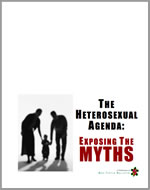 At last, the truth can now be told.
Using the same research methods employed by most anti-gay political pressure groups, we examine the statistics and the case studies that dispel many of the myths about heterosexuality. Download your copy today!
And don‘t miss our companion report, How To Write An Anti-Gay Tract In Fifteen Easy Steps.
 Anti-gay activists often charge that gay men and women pose a threat to children. In this report, we explore the supposed connection between homosexuality and child sexual abuse, the conclusions reached by the most knowledgeable professionals in the field, and how anti-gay activists continue to ignore their findings. This has tremendous consequences, not just for gay men and women, but more importantly for the safety of all our children.
Anti-gay activists often cite the “Dutch Study” to claim that gay unions last only about 1½ years and that the these men have an average of eight additional partners per year outside of their steady relationship. In this report, we will take you step by step into the study to see whether the claims are true.
Tony Perkins’ Family Research Council submitted an Amicus Brief to the Maryland Court of Appeals as that court prepared to consider the issue of gay marriage. We examine just one small section of that brief to reveal the junk science and fraudulent claims of the Family “Research” Council.
 The FBI’s annual Hate Crime Statistics aren’t as complete as they ought to be, and their report for 2004 was no exception. In fact, their most recent report has quite a few glaring holes. Holes big enough for Daniel Fetty to fall through.
“Google” is a trademark of Google Inc.
© Box Turtle Bulletin. All Rights Reserved.

 Posts
Posts  Posts via daily email: