Box Turtle Bulletin
 News and commentary about the anti-gay lobby
“Now you must raise your children up in a world where that union of man and box turtle is on the same legal footing as man and wife…”
News and commentary about the anti-gay lobbyMay 10th, 2014

They took place in scenic Eureka Springs, Arkansas, which is both a gay-friendly enclave (it’s “the Gay Capital of the Ozarks“) and a popular wedding destination. From Freedom to Marry:
The first couple to receive a marriage license was Kristin Seaton and Jennifer Rambo (right, photo by Kendall Wright), who have been together for more than four years. The couple’s witness was Cheryl Maples (center), who filed the Wright v. Arkansas challenge last summer and has worked tirelessly to win marriage in the state.
The couple drove up to Eureka Springs from Little Rock when they learned the Pulaski County courthouse wouldn’t be open today. The AP has more:
Seaton and Rambo slept in their Ford Focus after arriving at 2 a.m. Saturday, waking up every 30 minutes to make sure they were at the head of the line. The moment they saw another couple pull up, Seaton and Rambo bolted to the courthouse.
“I don’t think I ran that fast,” Rambo said.
The Carroll County Courthouse was the only one scheduled to open today for regular hours, and it’s due to close at 1:00 p.m. CDT. Here’s the scene when it opened:

As for the other counties in Arkansas:
The executive director of the Association of Arkansas Counties says county clerks are scrambling to prepare for same-sex couples seeking marriage licenses after the state’s ban on gay marriages was overturned.
Chris Villines says he and his staff will spend Saturday talking with county clerks and attorneys about the ramifications of Pulaski County Circuit Court Judge Chris Piazza’s ruling Friday that the state’s ban on same-sex marriage is unconstitutional.
…Villines says he expects most clerks to be able to issue same-sex marriage licenses starting Monday.
That’s if the decision isn’t stayed before then.
May 10th, 2014
TODAY’S AGENDA:
 A Rush to the Clerk’s Office?: Arkansas. Maybe. Pulaski County (Little Rock, AK) Circuit Court Judge Christopher Piazza ruled yesterday that the state’s ban on same-sex marriage violated the Equal Protection clause of the U.S. Constitution. The state Attorney General’s office has filed a request to stay the ruling pending an appeal to the state Supreme Court. But until that stay is granted, same-sex marriage is perfectly legal, even though most of the state’s county clerk offices will remain closed until Monday. There is one exception though: the Carroll County Clerk’s Office, located in the tiny gay enclave of Eureka Springs in the northwest corner of the state, will be open today from 9:00 a.m. to 1:00 p.m. There are no blood tests, and no waiting periods And with Eureka Springs being just a short drive from Missouri, Oklahoma and Kansas, there’s no residency requirements.
Pride Celebrations This Weekend: Darwin, NT; Kraków, Poland; New Hope, PA; São Paulo, Brazil; Tallahassee, FL.
AIDS Walks This Weekend: Buffalo, NY; Des Moines, IA.
Other Events This Weekend: Purple Party, Dallas, TX; BeachBear Weekend, Ft. Lauderdale, FL; Houston Splash, Houston, TX; Big Horn Rodeo, Las Vegas, NV; Miami Gay and Lesbian Film Festival, Miami, FL.
TODAY’S AGENDA is brought to you by:

From GPU News, April 1973, page 17.
Rodney Scheel was only 21 when he opened his first gay bar in Madison, Wisconsin in December 1972, which went through “its share of experimental phases- bar, restaurant, piano bar, dance club, and home-away-from-home for many of the newly-liberated Gay men and Lesbians and their friends of that era.” The Back Door, located just across the railroad tracks from the University of Wisconsin, remained in business until 1979. Scheel would go on to found a number of gay bars in Madison, including the popular leather/levi bar Rod’s at the Hotel Washington. The area where the Back Door once stood has been redeveloped into student housing.

TODAY IN HISTORY:
Book Burning in Berlin: 1933. After raiding the Institute for Sexual Research and looted its vast library and archives (see May 6), the Nazi-affiliated German Student Association (Deutsche Studentenschaft) proclaimed a nationwide “Action against the Un-German Spirit”, which culminated in the “cleansing” (“Säuberung”) by fire on May 10, 1933 of an estimated 25,000 volumes of “un-German” books. Book burnings took place throughout Germany, and the bulk of the books burned in Berlin came from the ISR. About 40,000 people watched in the Opernplatz as propaganda chief Joseph Goebbels declared “No to decadence and moral corruption!” LGBT advocacy, which had developed as a strong scientific and social institution in Germany over the past several decades, was shut down virtually overnight.

TODAY’S BIRTHDAY:
Max Lorenz: 1901-1975. The Düsseldorf native’s powerful performances as a heroic tenor (heldentenor, in German) in Wagner’s operas is probably what saved his life in Nazi Germany — or at the very least, the life of his Jewish wife, whom he married in 1932 despite his homosexuality. The very next year, he established his dominance at the Bayreuth Festival, the annual Wagner festival began by Richard Wagner himself, just as the Nazis came to power. Later, when Lorenz was caught “in flagrante” with a young man at Bayreuth, Hitler forbade his future performances at the prestigious festival. Winifred Wagner, the festival’s director, answered that she would would close the festival because without Lorenz, “Bayreuth can’t be done.” Such was Hitler’s love for Wagner’s operas that he backed down and let Lorenz perform. In 1943, when the SS stormed Lorenz’s home while he was away to take his wife and mother-in-law off to the concentration camps, Hermann Göring personally intervened and placed the entire family under his personal protection.
Lorenz’s career lasted almost three decades. He was particularly renowned for his performances as Siegfried (in Siegfried and Götterdämmerung), Tristan (in Tristan und Isolde) and as Walther (in Die Meistersinger von Nürnberg) After the war, Lorenz became an Austrian citizen, but his reputation was sullied by the assumption that he had been a Nazi. He died in Salzburg in 1975.

Steve Gunderson: 1951. The first openly gay Republican to serve in Congress, the Wisconsin representative was outed on the floor of the House of Representatives by a fellow Republican, the virulently anti-gay Rep. Bob Dornan of California. The confrontation occurred during a debate on a measure that would have prohibited any school which received federal funding from “promoting homosexuality as a positive lifestyle.” Gunderson objected to some of the defects in how the measure was written, saying it “has the effect of prohibiting school counseling and guidance. It has the effect of prohibiting AIDS education.”
Dornan rose to object, saying that Gunderson has “a revolving door on his closet. He’s on, he’s out, he’s in, he’s out, he’s in. I guess you’re out because you went up and spoke to a huge homosexual dinner, Mr. Gunderson.” Dornan later complained to reporters, “We have a rep on our side who is a homo who goes in and out of the closet. I have just had it with him saying he takes second place to no one in this House … (in) upholding Christian principles.”
That “homosexual dinner” was the annual Human Rights Campaign Fund dinner in Baltimore two weeks earlier, where Gunderson told the gathering about the beach house in Rehoboth that he shared with “Rob” and “our two dogs.” Gunderson also talked about how he and Rob had been touched by the AIDS crisis in the past year. “Two of our closest friends died from AIDS, and while for Rob and I this was the first personal loss from this tragic disease, it makes its impact no less painful to each of us. He also urged gays and lesbians to come out of the closet, saying that “unless a son or brother is gay, a daughter or sister is lesbian, most families will not encounter challenges to their traditional values.”
Despite Gunderson’s urging that more gays and lesbians come out of the closet, Gunderson refused to confirm or deny his sexuality to reporters in the immediate aftermath of Dornan’s outburst, saying that he wouldn’t dignify Dornan’s comments with a response. But in 1994, refusing to deny it was all that was really needed. Rep. Barny Frank (D-MA) sympathized somewhat: “This is not an easy situation he finds himself in. In a perfect world none of this would be necessary.”
Gunderson won re-election later that year, and he became the lone Republican to vote against the Defense of Marriage Act two years later. He chose not to seek re-election in 1996. In January 2010, Gunderson was appointed by President Barack Obama to the President’s Commission on White House Fellows. He is currently the President and CEO of the Council on Foundations, a Washington, DC-based nonprofit membership association of approximately 2,000 grantmaking foundations and corporations.

Michele Van Gorp: 1977. Born in Warren, Michigan, Michele Van Gorp played women’s collegiate basketball at Purdue University for her freshman and sophomore years, then transferred to Duke University, where she led Duke to the school’s first NCAA final for women’s basketball. She was drafted into the Women’s National Basketball Association (WNBA) in 1999. After playing for a year with the Portland Fire, she was traded to the Minnesota Lynx, where she gained a reputation as one of the league’s toughest defenders.
Van Gorp was the only open lesbian in the WNBA from 2002 (when Sue Wicks retired) until 2005, when Sheryl Swoopes and Latasha Byears came out. She missed much of the 2004 season due to a stress fracture in her left foot, and she ended up retiring from the WNBA in 2005. She is currently back at her alma mater, working with the Duke women’s basketball program.
If you know of something that belongs on the agenda, please send it here. Don’t forget to include the basics: who, what, when, where, and URL (if available).
And feel free to consider this your open thread for the day. What’s happening in your world?
May 9th, 2014
Pulaski County Circuit Court Judge Christopher Piazza has ruled that Arkansas’ laws and constitutional amendment banning marriage for same-sex couples violates the U.S. Constitution. In reaching his conclusion, Judge Piazza found that “same-sex couples fulfill all four factors to be considered a suspect or quasi-suspect classification,” but ultimately he decided it didn’t matter:
Regardless of the level of review required, Arkansas’s marriage laws discriminate against same-sex couples in violation of the Equal Protection Clause because they do not advance any conceivable legitimate state interest necessary to support even a rational basis review. Under this standard, the laws must proscribe conduct in a manner that is rationally related to the achievement of a legitimate governmental purpose. See Vance v. Bradley,440 U.S. 93,97 (L979). “[S]ome objectives … are not legitimate state interests” and, even when a law is justified by an ostensibly legitimate purpose, “[t]he State may not rely on a classification whose relationship to an asserted goal is so attenuated as to render the distinction arbitrary or irrational .” Cleburne,473 U.S. at 44647.
At the most basic level, by requiring that classifications be justified by an independent and legitimate purpose, the Equal Protection Clause prohibits classifications from being drawn for “the purpose of disadvantaging the group burdened by the law.” Romer, 517 U.S. at 633; see also United States v. Windsor, 570 U.S. —, 133 S.Ct. 2675 (2013); Cleburne, 473 U.S. at 450; Rational basis review is a deferential standard, but it “is not a toothless one”. Mathews v. Lucas, 427 U.5.495,510 (1976).
The Supreme Court invoked this principle most recently in Windsor when it held that the principal provision of the federal Defense of Marriage Act (“DOMA”) violated equal protection guarantees because the “purpose and practical effect of the law … [was] to impose a disadvantage, a separate status, and so a stigma upon all who enter into same-sex marriages.” Windsor,570 U.S. —, 133 S.Ct. at 2693. The case at bar and many around the country have since challenged state laws that ban same-sex marriage as a result of that decision.
As you can see, last year’s Windsor v. U.S. Supreme Court decision striking down portions of the Defense of Marriage Act continues to reverberate through the many challenges of state marriage bans across the country. This case is no different, as Judge Piazza quoted extensively from the Windsor opinion. He also quotes from a statement Mildred Loving made for the 40th anniversary of Loving v. Virginia, the 1967 U.S. Supreme Court decision which struck down anti-miscegenation laws throughout the country.
Judge Piazza also pointed out that the state’s constitutional amendment banning same-sex marriage, which Arkansas voters passed in 2004 with 75% of the vote, is inconsistent with the rest of the state constitution, which he called “a dangerous precedent”:
Article 2, § 2 of the Arkansas Constitution guarantees Arkansans certain inherent and inalienable rights, including the enjoyment of life and liberty and the pursuit of happiness.
All men are created equally free and independent, and have certain inherent and inalienable rights, amongst which are those of enjoying and defending life and liberty; of acquiring, possessing, and protecting property, and reputation; and of pursuing their own happiness, To secure these rights governments are instituted among men, deriving their just powers from the consent of the governed.
ARK. Const., art 2, § 2.
In this case, Article 2 § 2 was left intact by the voters, but in Amendment 83 they singled out sarne-sex couples for the purpose of disparate treatment. This is an unconstitutional attempt to narrow the definition of equalrty. The exclusion of a minority for no rational reason is a dangerous precedent.
Furthermore, the fact that Amendment 83 was popular with voters does not protect it from constitutional scrutiny as to federal rights. “The very purpose of a Bill of Rights was to withdraw certain subjects from the vicissitudes of political controversy, to place them beyond the reach of majorities and officials and to establish them as legal principles to be applied by the courts.” W.Va. State Bd. of Educ. v. Barnette, 319 U.S. 624,638 (1943). The Constitution guarantees that all citizens have certain fundamental rights. These rights vest in every person over whom the Constitution has authority and, because they are so important, an individual’s fundamental rights “may not be submitted to vote; they depend on the outcome of no elections.” Id. at 638.
Judge Piazza turned away the state’s arguments against same-sex marriage: that the ban is necessary to promote procreation, that it is a federalism issue, that the voters have a right to uphold tradition. And he also anticipated the complaints about activist judges: “The court is not unmindful of the criticism that judges should not be super legislators. However, the issue at hand is the fundamental right to marry being denied to an unpopular minority. Our judiciary has failed such groups in the past.” He then went into the 110-year history from the 1856 Dredd Scott decision, which held that even a former slave had “no rights or priveleges” of citizenship, to the 1967 Loving decision which recognized that, regardless of racial differences, “the freedom to marry has long been recognized as one of the vital personal rights essential to the orderly pursuit of happiness by free men.” Drawing on the Loving example, Judge Piazza concluded:
THEREFORE, THIS COURT HEREBY FINDS the Arkansas constitutional and legislative ban on s{Lme-sex marriage through Act 144 of 1997 and Amendment 83 is unconstitutional.
It has been over forty years since Mildred Loving was given the right to marry the person of her choice. The hatred and fears have long since vanished and she and her husband lived full lives together; so it will be for the same-sex couples. It is time to let that beacon of freedom shine brighter on all our brothers and sisters. We will be stronger for it.
Judge Piazza’s order came without a stay. But with it coming down after clerk offices around the state closed for the weekend, marriages may not be available until Monday. Attorney General Dustin McDaniel’s office has announced that they will ask for a stay and they intend to appeal. McDaniel said last week that he supports marriage equality, becoming the first state-wide office holder to do so. He also said however that his office would continue defending the state’s marriage ban in court.
May 9th, 2014
StraightGrandmother posted an update on her condition as a comment to a thread, but as many of you might not see it, I’ll reprint it here:
I can’t find the sweet article where so many of you wished me well on my hip replacement. Your kind thoughts are appreciated.
I wish I could say it went well, but it didn’t. Today is day 10 and the first relatively pain free day. The surgeon was great, did a fine job. But the nursing and patient support staff not so much, shall we say. It’s all a horrid story I would at this point rather not share the details of. Well one, I stiff armed the nurses aid who insisted on rolling me over on my incision the day after surgery, the day which they gave me NO PAIN MEDICATION, the day after my surgery. Nurses aid now claiming workmanship comp, but I did NOT get rolled over. When I say “No” I really mean it.
Today is the BEST day, my primary care stepped in and prescribed me proper pain meds which I took this afternoon, so bottom line I’m better. And I hope every day better. I haven’t decided if I should take the Xanax the Primary care prescribed for me to take tonight. It was a completely traumatizing ordeal. But now, after 10 days, now I have hope and manageable pain.
We’re wishing you the best, SGM. Hope things continue to improve.
May 9th, 2014

A BTB reader in Brazil passes along this fascinating tidbit: the Justice and Peace Commission of the São Paulo Archdiocese has issued a surprisingly supportive statement in advance of the city’s Pride celebration that’s taking place this week. The statement, which was released on April 30 and citing the Second Vatican Council, states, in part:
…[W]e can not remain silent in the face of the reality that is lived by this population: they are the target of prejudice and victims of the systematic violation of their Fundamental Rights, such as those to health, education, work, housing and culture, among others. Besides all this, they face every day an unbearable level of physical and verbal violence, building up to murders which are true crimes of hatred.
Given this, we invite all people of good will, and in particular, all Christians, to reflect on this profoundly unjust reality as lived by LGBT people, and, guided by the supreme principle of Human Dignity, to dedicate themselves actively to overcoming it.
The Justice and Peace Commission’s director told Estadão (via Google Translate, with some cleanups):
The director of the Justice and Peace Commission of the Archdiocese, Geraldo Magela Tardelli, said this is the first time that the commission wrote “formally” in favor of homosexuals. “The committee has a mission, according to Cardinal Paulo Evaristo Ars: ‘we have to give voice to those who have no voice.’ Right now, what we are finding is that there is an increase of violence against homosexuals, so we can not overlook. regarding this violation of human rights,” said the director.
According to him, the realization of the Gay Parade ordered the disclosure of the note.”We think this was the right time to put this note in circulation. We, the Church, are engaged in defending human rights and are not siding with its violation, regardless of color and sexual orientation of people,” said Tardelli.
The full statement is here:
Note from the Justice and Peace Commission of the Archdiocese of São Paulo
Faithful to its mission of announcing and defending the Gospel and civilizing values of Human Rights, the Justice and Peace Commission of São Paulo (CJPSP) wishes to make a public statement on the occasion of the 18th LGBT Pride Parade which is to take place on the Avenida Paulista next Sunday, 4th May 2014.
We base ourselves on the Pastoral Constitution Gaudium et Spes, approved at the 2nd Vatican Council which says “The joys and the hopes, the griefs and the anxieties of the people of this age, especially those who are poor or in any way afflicted, these are the joys and hopes, the griefs and anxieties of the followers of Christ. Indeed, nothing genuinely human fails to raise an echo in their hearts.”
Therefore the defense of the dignity, the citizenship and the safety of LGBT (Lesbian, Gay, Bisexual, Transvestite and Transgender) people is indispensable in the building of a fraternal and just society. For this reason we can not remain silent in the face of the reality that is lived by this population: they are the target of prejudice and victims of the systematic violation of their Fundamental Rights, such as those to health, education, work, housing and culture, among others. Besides all this, they face every day an unbearable level of physical and verbal violence, building up to murders which are true crimes of hatred.
Given this, we invite all people of good will, and in particular, all Christians, to reflect on this profoundly unjust reality as lived by LGBT people, and, guided by the supreme principle of Human Dignity, to dedicate themselves actively to overcoming it.
São Paulo, 30th April 2014
Human Rights Commission of São Paulo
[Special thanks to BTB reader James]
May 9th, 2014
TODAY’S AGENDA:
Pride Celebrations This Weekend: Darwin, NT; Kraków, Poland; New Hope, PA; São Paulo, Brazil; Tallahassee, FL.
AIDS Walks This Weekend: Buffalo, NY; Des Moines, IA.
Other Events This Weekend: Purple Party, Dallas, TX; BeachBear Weekend, Ft. Lauderdale, FL; Houston Splash, Houston, TX; Big Horn Rodeo, Las Vegas, NV; Miami Gay and Lesbian Film Festival, Miami, FL.
TODAY’S AGENDA is brought to you by:

From The Los Angeles Advocate, July 1968, page 19.
There was a rather tight cluster of gay bars in Los Angeles’ Silver Lake neighborhood, where Santa Monica Blvd joins up with Sunset. Connie’s Place was just up the block a little ways (see the ad for Mar 26), and several other gay bars extended for at least two blocks down Sunset. I haven’t been able to find anything about the Joker Inn — when it opened, when it closed, or what kind of clientele it attracted. The bar is gone, but gay men are still turning up at the address which is part of the larger adult bookstore Circus of Books.
TODAY IN HISTORY:
Three Hanged for Sodomy: 1726. In July of 1725, Gabriel Lawrence, 43 and “a Papist” — that alone was also a crime in 18th century England — was indicted “for committing, with Thomas Newton, aged 30 years, the heinous and detestable sin of Sodomy, not to be named among Christians.” He was among 40 who were arrested at the famous “molly house” of Margaret Clap, a “place of rendezvous for Sodomites.” Newton, who testified against the defendants in exchange for immunity, described the place: “For the more convenient establishment of her customers, she had provided beds in every room of the house. She usually had 30 or 40 of such Persons there every Night, but more especially on a Sunday. I was conducted up one pair of Stairs, and by the Perswasions of Bavidge (who was present all the Time) I suffer’d the Prisoner to commit the said Crime. He has attempted the same since that Time, but I never would permit him any more.” Newton testified against Lawrence, taking upon himself the role of innocent victim even though he, too, was at the “molly house” and arrested.
Newton claimed that he didn’t know that Claps’s establishment was a molly house. He must have been pretty dumb, because he apparently spent a lot of time there. He not only testified against Lawrence, but also against two others at the house: William Griffin, 43, and Thomas Wright, 32, who “often fetched me to oblige company that way.” All three defendants were found guilty and sentenced to death. On May 9, 1726, Lawrence, Griffin, and Wright were hanged at the infamous gallows known as “the Tyburn Tree,” not far from the present-day location of the Marble Arch. Margaret Clapp was fined, made to stand at the pillory at Smithfield, and sent to prison for two years.
[Sources: Ian McCormick. Secret Sexualities: A Sourcebook of 17th and 18th Century Writings
“Trial of Gabriel Lawrence.” Old Bailey Proceedings Online (April 1726): record t17260420-64.
Historian Rictor Norton has also posted trial records for Lawrence, Griffin and Wright at his web site.]

Ignorance Is Bliss: 1870. Dressed as Lady Stella Clinton and Miss Fanny Winifred Park, Ernest Boulton, 22, and Frederick William Park, 23 both scandalized and titillated Londoners when they attended a performance at the Strand Theatre and were arrested by police. A search of their homes turned up more than a dozen dresses, petticoats, bodices and bonnets. Their landlady described their dresses as very extreme. They were charged with conspiracy to commit sodomy.
The two defendants appeared in court in drag. The whole thing baffled the Attorney General, who testified on May 9, 1871 that the lack of detailed British knowledge on the topic was actually one of the country’s virtues. He thought it “fortunate [that] there is little learning or knowledge upon this subject in this country; there are other countries in which I am told learned treatises are written as to the appearance to be expected in such cases. Fortunately Doctors in England know very little about these matters.” Ignorance reigned, and it was to Boulton and Park’s benefit. Sure, they dressed funny, engaged in “disgraceful behaviour,” and wrote piles of letters describing their exploits — an entire day was spent reading them into the record — but none of that counted as evidence of a conspiracy to commit sodomy. And since wearing dresses itself wasn’t against the law, the jury found them not guilty.
[Source: Ivan Crozier. “Nineteenth-Century British psychiatric writings about homosexuality before Havelock Ellis: The missing story.” Journal of the History of Medicine and Allied Sciences 68, no. 1 (Jan 2008): 65-102.]

Wichita Voters Repeal Gay Rights Ordinance: 1978. Anita Bryant’s success in defeating a gay rights ordinance in Miami at the ballot box the year before (see Jun 7) inspired voters in St. Paul to repeal their ordinance the following spring by more than a two-to-one margin (see Apr 25). Two weeks later, the fight moved to Wichita, Kansas, where an ordinance banning discrimination in housing, employment and public accommodations due to “sexual or affectional preferences” was the subject of a special repeal election. After Miami voters repealed their anti-discrimination ordinance, Wichita organizers quickly gathered 31,000 signatures, more than three times the needed number, to place the ordinance up for a vote. The City Council decided to short-cut the process, and in a 3-2 vote agreed to place the issue on the ballot for a special May 9 election.
Rev. Richard A. Angwin, who headed the St. Paul repeal effort, traveled to Wichita fresh off of his St. Paul victory and told a Wichita audience that the Minnesota vote proved that “from the conservative Bible-belt of Dade County, Florida, to the liberal progressive north of Minnesota, that the American people are not willing to accept homosexuality as a legitimate intrusion into human rights ordinances.” He also argued that gay people were second-class citizens. “I think anyone who is immoral is a second-class citizen,” he said. “But I don’t say it out of hatred. I love the murderer, but I’m still going to limit his behavior in society.”
Wichita voters apparently agreed. They repealed Wichita’s anti-discrimination ordinance by a nearly five-to-one margin: 47,246 to 10,005. Forty-four percent of the city’s 128,888 registered voters turned out, making it the largest turnout for a city election in a decade. Rev. Ron Adrian, president of Concerned Citizens for Community Standards which campaigned for the repeal, was elated. He had only expected a two-to-one victory margin. “I think God’s using this vote to openly rebuke the pro-homosexual forces,” he said.
Robert Lewis, co-director of the Homophile Alliance, was initially bitter about the results. “Obviously there are a lot of bigots in Wichita,” he told reporters. But later, after cooling off at a local gay bar, Lewis put a better face on the defeat. “It’s like a New Year’s Eve party here. You would never know gay rights had been defeated. Gay people in Wichita are feeling much better about themselves as a result of this campaign.”
Two days later, it was revealed that Miami-based Protect America’s Children, which was linked to another tax exempt organization called “Anita Bryant Ministries,” had poured $20,000 into the Wichita and St. Paul battles. At $74,000 in today’s dollars, it represented big money for city elections in 1978. Their next target was a special election in Eugene, Oregon, to repeal its gay rights ordinance, scheduled for May 23.

Dana Goes International: 1998. The music world is shocked when judges at that year’s Eurovision Song Contest in Birmingham, England choose openly MtF Dana International as their champion. Ultra-Orthodox Jews and Israeli conservatives were shocked and demanded that next year’s telecast not be held in the winning country, as tradition holds, due to the “shame” of her being transsexual. Dana countered, “My victory proves God is on my side. I want to send my critics a message of forgiveness and say to them: try to accept me and the kind of life I lead. I am what I am and this does not mean I don’t believe in God, and I am part of the Jewish Nation.”
Here is how Dana International’s win looked on German television:

President Barack Obama Announces Support for Marriage Equality: 2012. Through much of his presidency, Barack Obama had long opposed the abolition of same-sex marriages via state and federal constitutional amendments, and during his 2008 primary campaign against then-Sen. Hillary Clinton, he distinguished his position from hers by calling for the full repeal of the Defense of Marriage Act in its entirety. (Her position was to repeal the provision barring federal recognition of same-sex marriages while keeping Section 2, which allows states to ignore other states’ marriages.) In 2011, his Justice Department announced that they would no longer defend DOMA in Federal Court, arguing that heightened scrutiny was called for in examining the law’s constitutionality, and that DOMA fails under that standard. But on the critical question of whether Obama supported same-sex marriage itself, he famously said that he was “still evolving” on the issue.
That evolution was completed when, during an interview with ABC News, Obama revealed that he now supported the rights of same-sex couples to marry”
I have to tell you that over the course of several years as I have talked to friends and family and neighbors when I think about members of my own staff who are in incredibly committed monogamous relationships, same-sex relationships, who are raising kids together, when I think about those soldiers or airmen or marines or sailors who are out there fighting on my behalf and yet feel constrained, even now that Don’t Ask Don’t Tell is gone, because they are not able to commit themselves in a marriage, at a certain point I’ve just concluded that for me personally it is important for me to go ahead and affirm that I think same sex couples should be able to get married.
Obama’s announcement came three days after Vice President Joe Biden told David Gregory on NBC’s Meet the Press that he was “absolutely comfortable with the fact that men marrying men, women marrying women and heterosexual men and women marrying one another are entitled to the same exact rights.”
Obama’s announcement made him the first sitting President to announce his support for marriage equality for same-sex couples. Conventional wisdom had held that such a position would be political suicide for national office, but Obama proved that wrong in November when he became the first presidential candidate to win an election on a platform calling for marriage equality. That same election also saw voters in three states — Maryland, Maine and Washington — make history by approving same-sex marriage at the ballot box, and voters in Minnesota turned back an attempt to write discrimination into its state constitution for only the second time in history. In the year following Obama’s announcement, the number of states providing marriage equality nearly doubled from six to eleven, after legislators in Rhode Island and Delaware passed legislation legalizing same-sex marriages.

TODAY’S BIRTHDAY:
80 YEARS AGO: Alan Bennett: 1934. The English performer and playwright is best known for The Madness of George III and the film adaptation, The Madness of King George. He received an Academy Award nomination for the screenplay. In August 1960, he achieved instant fame as a comedy actor at the Edinburgh Festival by appearing in a satirical review with Dudley Moore, Jonathan Miller and Peter Cook. His first play, Forty Years On, debuted in 1968. His critically acclaimed The History Boys won three Lawrence Olivier Awards in 2005 and Six Tony Awards on Broadway in 2006. His memoir, Untold Stories
If you know of something that belongs on the agenda, please send it here. Don’t forget to include the basics: who, what, when, where, and URL (if available).
And feel free to consider this your open thread for the day. What’s happening in your world?
May 8th, 2014
When U.S. District Court Judge Bernard Friedmam declared Michigan’s same-sex marriage ban unconstitutional last March, he spilled considerable ink all over the state’s expert witness, Mark Regnerus, whose discredited Witherspoon-funded “study” purported to show that children of gay couples fared worse than other children. The problem was — and this came out in the cross-examination of the state’s star witness — the study included only two children who were actually raised by gay parents, and Regnerus admitted that they came out “Pretty good.” In his written opinion, Judge Friedman blasted “his 2012 ‘study’ (which) was hastily concocted at the behest of a third-party funder” as “flawed on its face.”
Michigan Attorney General Bill Schuette appealed the decision, and in a brief filed with the Sixth District Court of Appeals, he quietly omitted all references to Regnerus’s bogus study, and argued instead that same-sex marriage should be banned not because experts believe that same-sex parents are bad parents, but because voters believe it:
In preserving marriage as between a man and a woman, a reasonable voter might have thought that it is beneficial when children are raised in a home with both a mom and a dad. Another reasonable voter might have thought that this definition encourages those couples with the inherent ability to have children (i.e., opposite-sex couples) to enter into a committed, exclusive relationship, for the benefit of any children they might have. …
This appeal is not about approval or disapproval of same-sex relationships or sexual orientation. Nor is this appeal about a gay or lesbian individual’s ability to be a parent. This case is not about single moms’ and dads’ ability to raise children. As a society, we wish that all children had loving parents, no matter what their sexual orientation may be.
Because Judge Friedman wrote that he could not find that Michigan voters acted out of animus when approving the state’s constitutional amendment outlawing same-sex marriage, Schuette’s brief takes as its central argument that striking down the constitutional amendment “demeans democracy,” and cites Justice Anthony Kennedy’s opinion in a Supreme Court ruling (Schuette vs BAMN) upholding Michigan’s ban on affirmative action. Singling out Kennedy this way is noteworthy. With Kennedy considered the potential swing vote in any upcoming Supreme Court ruling on marriage equality, this brief was more or less written to Kennedy, rather than to the judges at the Sixth District Court of Appeals:
Justice Kennedy’s admonition on this point in Schuette is worth repeating: “It is demeaning to the democratic process to presume that the voters are not capable of deciding an issue of this sensitivity on decent and rational grounds.” 572 U.S. __, slip op. 17. To put this in perspective, more than 45 million American voters across the country have voted to retain the definition of marriage as between one man and one woman. Respect for the dignity of these millions of voters, who must be presumed to be “decent and rational,” should make courts reluctant to conclude that support for maintaining the definition of marriage is irrational. After all, a decision by this Court that there is no rational basis for Michigan’s voters to have defined marriage as they did necessarily means that not only Michigan’s voters, but more than 42 million other American citizens who have voted the same way, did not have among them a single conceivable rational basis for their votes.
But they’re still not ready to give up their straight-parents-are-the-best argument. They’re just pinning it on voters, and not the experts:
The only question at issue, then, is whether any conceivable reason supports the people’s decision to retain the definition of marriage. Under the governing standards for rational-basis review, the people’s decision must be given the benefit of the doubt—it must be upheld if their policy choice is at least debatable, and even if it is under-inclusive or over-inclusive (or both).
Defining marriage as between one man and one woman satisfies this test. The State has a legitimate interest in marriage precisely because of marriage’s inherent connection to children. The vast majority of children born in Michigan (and the United States and the world) are born as a result of the sexual union of a man and a woman. Promoting marriage as between a man and a woman thus recognizes that every child should have the opportunity to know and have a relationship with his or her biological mother and father, and it increases the likelihood that the most common type of procreation will occur in a long-term, committed relationship. It was reasonable for Michigan voters to think that this is a beneficial setting for children, and thus to link marriage to procreation—the biological fact that every child has a mother and a father.
Michigan isn’t the only state to drop Regnerus like a hot potato. Two weeks after his study went down in flames in the Michigan case, attorneys for the Utah Attorney General’s office filed a special “Supplemental Authority clarifying position re: Regnerus study” with the Tenth Circuit Court of Appeals in Denver, in which the state disavowed its own citing of the Regnerus study in the original appeals brief filed in February. It looks like the word has gone out: Regnerus’s study is radioactive and the nearly $800,000 spent on it was wasted — unless you count its influence in Russia as a success.
May 8th, 2014
TODAY’S AGENDA:
Pride Celebrations This Weekend: Darwin, NT; Kraków, Poland; New Hope, PA; São Paulo, Brazil; Tallahassee, FL.
AIDS Walks This Weekend: Buffalo, NY; Des Moines, IA.
Other Events This Weekend: Purple Party, Dallas, TX; BeachBear Weekend, Ft. Lauderdale, FL; Houston Splash, Houston, TX; Big Horn Rodeo, Las Vegas, NV; Miami Gay and Lesbian Film Festival, Miami, FL.
TODAY’S AGENDA is brought to you by:

From Christopher Street, June 1977, page 47.

TODAY’S BIRTHDAYS:
Tom of Finland: 1920-1991. Born Touko Laaksonen, Tom of Finland was famous for his stylized homoerotic and fetish art. Over a forty year career, he produced some 3,500 drawings in his unique exaggerated style. If Barbie dolls proportions represent an anatomically impossible ideal for women, Tom of Finland’s hypermasculine characters were portrayed in similarly fantastical idealizations of manly men, although Tom didn’t see it that way. “All my drawings are grounded in reality,” he said. “I use models, whom I initially photograph and then later refer to when I draw. People complain that I exaggerate. My fantasies often take over, of course, but I want to offer the viewer something that he can’t get in a photograph.”
His style was partly influenced by beefcake and physique magazines which skirted on the edges of U.S. censorship codes in the 1950s and 1960s. But as the codes were struck down in the 1960s over First Amendment issues, his drawings became more explicit and more overtly sexual. They became the definitive style guide for leathermen through his portrayal of policemen, lumberjacks, sailors and bikers, and they’ve inspired such artists as Robert Mapplethorpe (see Nov 4), Freddie Mercury (see Sep 5) and the Village People.
 He died of a stroke brought on by emphysema on November 7, 1991. Several examples of his “dirty drawings ” — his unabashed description for them — have been acquired by New York’s Museum of Modern Art. This past winter, works by Tom of Finland and “physique” photographer Bob Mizer (see Mar 27) were featured in a special exhibit at the Los Angeles Museum of Contemporary Art. On September 8 of this year, his native Finland will honor him with a set of postage stamps which have been described as ” considerably more erotic than those usually seen on any nation’s envelopes.” A documentary film of his life is in the works and is slated for a 2015 release.

Darren Hayes: 1972. The singer-songwriter was the front man of Savage Garden. Their 1997 album by the same name peaked at #1 in Australia, #2 in the U.K., #3 in the U.S. Their biggest American hit was “Truly Madly Deeply.” Their follow-up album yielded another #1 hit in the U.S. with “I Knew I Loved You.” In 2002, he launched his solo career, and by 2005 it was clear that Savage Garden was through.
Hayes married his “childhood sweetheart” in 1997. They divorced in 2000 after he told her that he was gay. After years of public speculation about his sexuality, Hayes came out on July 18, 2006, when he announced that he had entered a civil partnership with his boyfriend, Richard Cullen, a month earlier. In April, 2007, he told The Advocate, “First of all, it took me a long time to even accept that I was gay. And then it took me a long time to be happy that I was gay.” That summer he headlined London’s Gay Pride at Trafalgar Square. You can see his video for “It Gets Better” here. His fourth solo album, Secret Codes and Battleships, was released in 2011. He and Cullen upgraded their partnership in 2013 to full marriage soon after same-sex marriage resumed in California.
If you know of something that belongs on the agenda, please send it here. Don’t forget to include the basics: who, what, when, where, and URL (if available).
And feel free to consider this your open thread for the day. What’s happening in your world?
May 7th, 2014
I was (and still am) disturbed by the pressure for Eich’s resignation and yet am thrilled that HGTV has decided not to air a show on flipping houses with the Benham twins.
I clearly do not have all the answers.
I’m tempted to write more on this. Few things are more intellectually stimulating than finding what looks to be a contradiction in your own thoughts and feelings — but that doesn’t mean other people will be as enthralled. And I don’t want to turn this blog into All-Eich-All-the-Time. Let me know if there’s interest and I’ll go there.
May 7th, 2014
 John Abdallah Wambere, who goes by the nickname “Long Jones,” filed for asylum in the U.S. yesterday, saying that if he were to return to Uganda, he would face persecution and potential prosecution under the country’s Anti-Homosexuality Act which President Yoweri Museveni signed into law in February. He is a longtime gay activist who cof-founded Spectrum Uganda fourteen years ago. He appeared at a press conference in Boston with attorneys from Gay and Lesbian Advocates and Defenders (GLAD) to discuss his decision:
“This has been a very, very difficult decision for me,” said Wambere in a statement to the media. “I have devoted my life to working for LGBTI people in Uganda, and it gives me great pain not to be with my community, allies, and friends while they are under increasing attack. But in my heart, I know it is my only option, and that I would be of no use to my community in jail.”

Inside spread of Red Pepper, dated Saturday, March 1. Wambere’s photo appeared at top left. (Click to enlarge.)
Just a week after the Anti-Homosexuality Act was signed into law, the Ugandan tabloid Red Pepper launched yet another anti-gay vigilante campaign. Wambere’s photo appeared in the tabloid’s March 1 edition under a headline touting “Ugandan Homos Cabinet List Leaks.” GLAD explains what has happened to him since February:
As a co-founder of the LGBTI rights group Spectrum Uganda Initiatives, John knew he was in danger. His photo and name had been plastered on the front page of Ugandan newspapers, outing him as gay under headlines like “Men of Shame Exposed”. Clients had been fleeing his travel agency till his business dropped off to nothing. He had been questioned by relatives and shunned by neighbors. He endured the murder of his friend David Kato. He had been evicted, repeatedly arrested, harassed on the street by strangers, and received threatening anonymous phone calls.
Wambere appeared in the documentary Call Me Kuchu, which portrays the hardships experienced by LGBT Ugandans, including the brutal murder of LGBT activist David Kato in January 2011. He also appeared in the 2010 Current TV documentary Missionaries of Hate.
May 7th, 2014
TODAY’S AGENDA:
Pride Celebrations This Weekend: Darwin, NT; Kraków, Poland; New Hope, PA; São Paulo, Brazil; Tallahassee, FL.
AIDS Walks This Weekend: Buffalo, NY; Des Moines, IA.
Other Events This Weekend: Purple Party, Dallas, TX; BeachBear Weekend, Ft. Lauderdale, FL; Houston Splash, Houston, TX; Big Horn Rodeo, Las Vegas, NV; Miami Gay and Lesbian Film Festival, Miami, FL.
TODAY’S AGENDA is brought to you by:

From Vector, July 1974, page 7.

Free Speech demonstration at UC Berkeley, 1964.
TODAY IN HISTORY:
CA Senate Committee Calls UC Berkeley Hotbed of Communists and Homosexuals: 1966. Major bursts of anti-war demonstration on most American college campuses were still in their infancy, but already the “Free Speech Movement” had planted its foothold at the University of California at Berkeley. Following demonstrations and sit-ins against a campus-wide ban on political activity in the fall of 1964, UC Berkeley president Clark Kerr rescinded the ban when classes resumed following Christmas break in 1965. This led state legislators to charge that because of Kerr’s accommodation of the student’s First Amendment rights, the campus was now “seething with Communists and homosexuals,” according to a report released by the State Senate Committee on Un-American Activities. According to an Associated Press report:
The five-member committee accused Ker of a “hostile attitude” toward its work, and said he not only didn’t help in seeking out communist activities on campus “but actual took steps that tended to prevent its being given.”
…To back up its charge that homosexuality is rampant at Berkeley, the committee cited a story in the Daily Californian, the student newspaper, which reported that 2700 of the school’s 27,000 students were homosexual.
Jim Branson, editor of the campus newspaper, said that the statistics was provided by Harold Call (see Sep 20), president of the Mattachine Society of San Francisco, a group devote to protecting the rights of homosexuals.
The committee charged that under Kerr, “the campus sank to a new low,” and reported campus dances with lewd themes and blatant promiscuity and the presentation of “disgusting, debased spectacles.”
The committee held Kerr responsible for allowing “left-wing domination of the campus scene.” Kerr, in turn, said that the university “by its nature is dedicated to freedom in a society. It can become, consequently, an arena for dissent.” He also told reporters that for four years he had been asking the committee to provide the names of Communists connected with the university, but the committee failed to respond.
The Berkeley campus would continue to be a lightning rod, both for left-wing political dissent and for right-wing discontent. It also became a topic of the 1966 gubernatorial campaign when then-actor Ronald Reagan, in his first run for public office, called for Kerr’s dismissal on May 12. Later that fall, Reagan announced that if he were elected governor, he would appoint former CIA director John McCone to investigate campus unrest at Berkeley. On January 20, 1967, during Gov. Reagan’s first meeting with the UC Board of Regents, the board fired Kerr as U.C. President.

Jesse Helms Rails Against “Militant-Activist-Mean Lesbian”: 1993. But of course, in Helms’s imagination what other kind of lesbian was there? President Bill Clinton had nominated Roberta Achtenberg, a San Francisco civil rights lawyer, as Assistant Secretary for Housing and Urban Development. As San Francisco City Supervisor, she supported efforts to bar the Boy Scouts from using the city’s school facilities because of its exclusion of gays scouts and leaders. Helms blew his stack over that. “She’s not your garden-variety lesbian,” he told the Associated Press. “She’s a militant-activist-mean lesbian, working her whole career to advance the homosexual agenda. Now you think I’m going to sit still and let her be confirmed by the Senate? . . . If you want to call me a bigot, go ahead.”
Helms was a bigot, but Achtenberg was confirmed. She remained on the job until 1995 when she left to run against Willie Brown for mayor of San Francisco. Obviously, she didn’t make it. Achtenberg is currently serving on the U.S. Commission on Civil Rights. Helms is currently dead.

TODAY’S BIRTHDAY:
Pyotr Ilyich Tchaikovsky: 1840-1893. The great Russian composer’s brother, Modeste, was comfortable with being gay, but Pyotr was not, at least not until much later in life. But he had to undergo a short, disastrous marriage before he arrived at the conclusion that his sexual orientation was insurmountable. Meanwhile, he became Russia’s most celebrated composer, with Swan Lake, Eugene Onegin, The Nutcracker, and his Fourth Symphony and Sixth Symphony (Pathétique) probably his finest works. He composed the 1812 Overture to celebrate Russia’s defeat of Napoleon at the outskirts of Moscow. Tchaikovsky confessed that the work, complete with live canon shots, would be “very loud and noisy, but I wrote it with no warm feeling of love, and therefore there will probably be no artistic merits in it.” He warned one Russian conductor, “I shan’t be at all surprised and offended if you find that it is in a style unsuitable for symphony concerts.” The 1812 Overture, it turned out, became one of his most popular works.
His death in 1893 was attributed to cholera, although there have been a persistent legend that his died by suicide. One story has it that a sentence of suicide was imposed in a “court of honor” by Tchaikovsky’s fellow alumni of the St. Petersburg Imperial School of Jurisprudence because of his homosexuality. Another has it that his suicide was ordered by Tsar Alexander III himself. There doesn’t appear to be much evidence for either theory. But against the backdrop of those unfounded rumors, many have taken Pathétique, which Tchaikovsky premiered just a few days before his death, as his final statement. According to an eyewitness at the premiere:
Tchaikovsky began conducting with the baton held tightly in his fist … in his usual manner. But when the final sounds of the symphony had died away and Tchaikovsky slowly lowered the baton, there was dead silence in the audience. Instead of applause, stifled sobs came from various parts of the hall. The audience was stunned and Tchaikovsky stood there, motionless, his head bowed.
Some have come to regard Pathétique as Tchaikovsky’s requiem, with its second performance coming three weeks later at his memorial concert in St. Petersburg.
If you know of something that belongs on the agenda, please send it here. Don’t forget to include the basics: who, what, when, where, and URL (if available).
And feel free to consider this your open thread for the day. What’s happening in your world?
May 6th, 2014
The National Organization for Marriage is coming to Virginia to hold a rally. Well, I assume a few people will, though NOM rallies are mostly known for drawing embarrassingly small crowds.
So if there is anyone who will be in Richmond, VA, next Tuesday and has a moment to take a picture of their rally, please send us the pics.

Oh, and hey, now we know why the stick figures in their logo have their hands up. I always figured they were just playing the airplane game.
May 6th, 2014

Before there was controversy around Mozilla’s appointment of Brendan Eich to the position of CEO, there was Angela McCaskill. She too found controversy with her name attached to a public campaign to take away same-sex marriage rights, Maryland’s Question 6.
In some ways the situations were similar.
Like Eich, McCaskill held a high-level position at a well-known organization. She too refused to specifically state her personal views. And both had associates and underlings who were offended by their action.
But there were also differences.
McCaskill’s position as Chief Diversity Officer at Gallaudet, a Washington, D.C. university for deaf and hard of hearing students, required that she work as an advocate for gay students. She did not give to the campaign – that we know of – but publicly signed a petition to bring the right to marry to a vote after a fiery sermon from her pastor denouncing same-sex marriage. And while Eich resigned, McCaskell was put on a paid suspension before being eventually reinstated (McCaskell’s attorney insists that she was demoted and that she has less access to the Dean.)
There was also one more significant difference. The organizers of the campaign for legal same-sex marriage, along with the Governor and other supporters, called for Gallaudet to reinstate McCaskill and insisted that her support of the vote was a free speech issue.
We strongly disagree with the decision to put the chief diversity officer on leave and hope she is reinstated immediately,” Levin said in his statement. “Everyone is entitled to free speech and to their own opinion about Question 6, which is about treating everyone fairly and equally under the law.”
Here at Box Turtle Bulletin, Jim Burroway denounced the school’s action and hoped for resolution.
Gallaudet students and faculty have a right to ask McCaskill some very hard questions. McCaskill owes them, as their Diversity Officer, honest answers and probably an apology, depending on her explanations. What she did deserves scrutiny. But an undeniable and fundamental feature of anything resembling diversity, it seems to me, must include dialogue and conversation, especially when these situations arise in an academic setting and especially in McCaskill’s case where she has established a strong track record in supporting the campus’s LGBT population. Hurwitz’s rash action has clumsily blocked all of that.
I agreed in principle with Jim that McCaskill had a right to her political opinions, but felt that the school may have been judicious in creating a cooling off period.
I think it is in the best interest of Gallaudet – and gay students, and Dr. McCaskill – that she relinquish diversity duties until after the election and things cool off and that her path forward be determined at that time. If marriage equality passes she will have an excellent pathway to putting this behind her. If not, it may be more difficult to regain the trust of gay students who will feel that society has chosen yet another realm in which to reject, deny, and alienate them and may be less ready to trust someone who played a part in making that happen.
McCaskill certainly didn’t contribute to any cooling off. She held a press conference denouncing her employer as being intolerant and allowed her story to be used as an attack ad on supporters of equality (her attorney said she’d rather the ad not run but she did not denounce it or criticize those who ran it).
As time went on and McCaskill became ever more the victim (never, to my knowledge, acknowledging that the supporters of same-sex marriage had come to her defense), I became concerned whether she had either the capacity or the will to fulfill her tasks as advocate for gay students.
And, after her reinstatement in January 2013, it seems that she made little to no effort to address the concerns of gay students at Gallaudet.
In March she slipped into the back of an LGBT event at the school, leaving students feeling dismayed and awkward. (deafqueer)
“I don’t understand why she came,” one Gallaudet student told Planet DeafQueer. “There has been no apology and no dialogue. Does she think we’re just going to forget and move on?”
CNAAnother student told Planet DeafQueer that he was pissed off. “She shouldn’t have been there,” he said. “Not until she makes amends. I felt like she was invading my space.”
She followed the meeting with a letter to the school in which she phrased the situation thusly:
In late October, I exercised my right to sign a petition which resulted in a wide range of feelings, concerns, and reactions across campus.
The letter did not speak at all about or to the gay Gallaudet students, causing students to express more dismay.
I don’t know much of her efforts since that time of reconciliation. None have been reported. I hope that either Dr. McCaskill steps up to this task or that alternate support has been established for them in the department, as reasons remain to question her devotion to their advocacy.
Though she was reinstated to her position, McCaskill sued the school for a gamut of discrimination claims, including discrimination based on race, religion, sexual orientation, marital status and political affiliation. She also sued for defamation and negligent hiring.
In addition, she sued the coworker who discovered her name on the petition, and the coworker’s partner, saying that they criticized her religion, defamed her as “anti-gay” and that consequently the school “intentionally or negligently caused her emotional distress.”
Now the judge has tossed out McCaskill’s case. Well, to the extent she made one. (Courthouse News)
U.S. District Judge James Boasberg dismissed McCaskill’s complaint in its entirety for failure to state a claim.
“It is difficult to make out precisely what protected activity plaintiff thinks prompted her suspension and demotion,” the April 14 ruling states. “In her complaint, she alleges that defendant violated the [District of Columbia Human Rights Act] by retaliating against her ‘on account of her exercising or enjoying her right to be free from unlawful discrimination.’ At first, one might think plaintiff is claiming that she faced retaliation for complaining that she had been discriminated against. In the next paragraph of her complaint, however, McCaskill alleges that the ‘protected activity’ in which she was engaged was ‘signing [the] legislative initiative’ and ‘expressing herself as a married, heterosexual, African-American, Christian woman/voter, who, through prayer and worship, searched for a means to enlighten Maryland voters on the issue of same-sex marriage in such a way to foster discourse, tolerance, and respect for the democratic process.'”
The judge concluded: “This, quite simply, is not the sort of ‘protected activity’ contemplated by the statute.”
Boasberg also dismissed McCaskill’s claim of a hostile work environment, stating that McCaskill – who said in her complaint that Bienvenu threatened her “with her sign-voice elevated” – “offered no facts to support the contention that such alleged mistreatment was due to her membership in any protected class.”
Her attorney has said that he may refile.
May 6th, 2014
What should we call perpetrators of hate crimes? “Hate criminals” hasn’t caught on. “Perpetrator of a hate crimes” is a mouthful. So what’s an alternative?
I vote for “terrorist.” Or, if you prefer, “domestic terrorist.” It’s blunt. And it has legal justification.
I’ve spent too much time on message boards correcting our opponents’ understanding of hate crime legislation and explaining that bias crimes don’t just affect the immediate victim, but intimidate victimize an entire class of people. I’ve had the best luck with anti-gay conservatives by laying out a scenario where someone is targeting elderly women on their way home from church. A pattern like that, or even a single attack backed up with some graffiti, could intimidate a whole community of elderly women from attending services. That expanded group of victims is why hate crime legislation — which doesn’t actually make anything illegal — is justified in giving heavier penalties to traditional crimes when they’re committed out of bias.
That’s where domestic terrorism comes in. It has a legal definition in the US:
(5) the term “domestic terrorism” means activities that—
(A) involve acts dangerous to human life that are a violation of the criminal laws of the United States or of any State;
(B) appear to be intended—
(i) to intimidate or coerce a civilian population;
(ii) to influence the policy of a government by intimidation or coercion; or
(iii) to affect the conduct of a government by mass destruction, assassination, or kidnapping; and(C) occur primarily within the territorial jurisdiction of the United States.
(A) applies. (C) applies. And (B)(i) is exactly what we’ve been talking about. (The “or” at the end of (ii) indicates that any of those subbullets are sufficient.)
This works for the man who tried to burn down a bar full of gay patrons — even if, mind-bogglingly, he’s been charged with neither a hate crime or terrorism. And it works for those vandalize homes with graffiti saying, “You are not welcome here,” and “We cannot coexist with Third World scum.”
“Terrorist” (or, as W would say, “trrrrrist”) is a word conservatives love. But just as they’ve co-opted much of our language, I feel comfortable doing the same to them. Every time one of our opponents makes a mocking comment about hate crimes, I’ll have no trouble doubling down and calling these “perpetrators” exactly the name they deserve. Terrorists they are, and terrorists they should be called.
May 6th, 2014

Totally straight in 1998.
A man of many lives, John Paulk’s first adult life began as “a prostitute, a female impersonator named Candi and an alcoholic who tried to kill himself.” At least that’s what he was saying in 1993 to fellow evangelical ex-gay audiences that love a good redemption story. His story included marrying his wife Anne, a self-professed ex-lesbian, having children, moving to Colorado Springs, and eventually becoming the head of Focus On the Family’s Gender and Homosexuality Division, and chairman of the Board of Exodus International. In 1998, he helped to found Love Won Out, a traveling ex-gay roadshow and infomercial conducted jointly by Focus and Exodus. At its height, Love Won Out staged a half a dozen conferences per year in cities across North American drawing audiences of two thousand or more. That same year, he and Anne landed on the cover of Newsweek as part of a larger billboard, newspaper, magazine and television advertising campaign promising “change is possible.”
John Paul is again in Newsweek, but sixteen years later his story is very different:
In front of the crowds and cameras, Paulk was the image of certainty. But backstage, he was faltering. More than that, he knew he was lying.
“It’s funny, for those of us that worked in it, behind closed doors, we knew we hadn’t really changed,” he says. “Our situations had changed—we had gotten married, and some of us had children, so our roles had changed. I was a husband and father; that was my identity. And the homosexuality had been tamped down. But you can only push it down for so long, and it would eke its way out every so often.”
…”I would be in hotel rooms, and I would be on my face sobbing and crying on the bed,” he says. “I felt like a liar and a hypocrite. Having to go out and give hope to these people. I was in despair knowing that what I was telling them was not entirely honest. I couldn’t do it anymore.”
In 2000, he walked into a Washington D.C. gay bar — “not looking for sex, which is what people thought — but because I was missing my community” — where he was spotted and photographed by Wayne Besen. That got him removed as Exodus chairman, but he remained on the board, kept his job at Focus, and he continued to be the featured speaker at Love One Out for another three years. In 2003, he left Focus, moved his family to Portland, started a catering business, and dropped out of the ex-gay world, although his wife continued to write books and appear on the ex-gay speaking circuit.
 In 2013, John Paulk renounced his prior association with the ex-gay movement, and followed that a week later with a formal apology to the “countless people were harmed by things I said and did in the past. …I am truly, truly sorry for the pain I have caused. From the bottom of my heart I wish I could take back my words and actions that caused anger, depression, guilt and hopelessness. In their place I want to extend love, hope, tenderness, joy and the truth that gay people are loved by God.” Newsweek fills out that point:
The tragedy that Paulk lives with to this day is that organizations like JONAH often specifically target minors, with summer camps and teen programs. “For 25 years I felt guilty and filled with self-loathing, trying to reject this part about myself. I’m culpable — I spread the message that my sexuality had changed, and I used my marriage as proof of that,” Paulk says.
That marriage ended last summer. Anne Paulk remains active in the ex-gay movement, after having helped to found a break-away group of former Exodus ministries following Exodus president Alan Chambers’s acknowledgment that change in sexual orientation was not possible and banned reparative therapy. She is now the executive director of that dissident group, Restored Hope Network.
John Paulk is the latest in a line of former ex-gay leaders who have left the fold and issued formal apologies. In 2007, three former ex-gay leaders — Exodus co-founder Michael Bussee, Exodus ministry leader Darlene Bogle, and British former ex-gay leader Jeremy Marks — issued a joint apology to those “who believed our message that there is something inherently wrong with being gay, lesbian, bisexual, or transgender.” In 2011, John Smid, who used to operate the Memphis-based live-in ex-gay ministry Love In Action (since renamed Restoration Path), issued a formal apology, renounced his previous work at Love In Action, and now lives as an openly gay man in Texas. As for Exodus, Chambers apologized for “the trauma that I have caused” and disbanded Exodus last summer. Exodus’s former vice president Randy Thomas issued his own formal apology a month later.
Featured Reports
 In this original BTB Investigation, we unveil the tragic story of Kirk Murphy, a four-year-old boy who was treated for “cross-gender disturbance” in 1970 by a young grad student by the name of George Rekers. This story is a stark reminder that there are severe and damaging consequences when therapists try to ensure that boys will be boys.
When we first reported on three American anti-gay activists traveling to Kampala for a three-day conference, we had no idea that it would be the first report of a long string of events leading to a proposal to institute the death penalty for LGBT people. But that is exactly what happened. In this report, we review our collection of more than 500 posts to tell the story of one nation’s embrace of hatred toward gay people. This report will be updated continuously as events continue to unfold. Check here for the latest updates.
In 2005, the Southern Poverty Law Center wrote that “[Paul] Cameron’s ‘science’ echoes Nazi Germany.” What the SPLC didn”t know was Cameron doesn’t just “echo” Nazi Germany. He quoted extensively from one of the Final Solution’s architects. This puts his fascination with quarantines, mandatory tattoos, and extermination being a “plausible idea” in a whole new and deeply disturbing light.
On February 10, I attended an all-day “Love Won Out” ex-gay conference in Phoenix, put on by Focus on the Family and Exodus International. In this series of reports, I talk about what I learned there: the people who go to these conferences, the things that they hear, and what this all means for them, their families and for the rest of us.
Prologue: Why I Went To “Love Won Out”
Part 1: What’s Love Got To Do With It?
Part 2: Parents Struggle With “No Exceptions”
Part 3: A Whole New Dialect
Part 4: It Depends On How The Meaning of the Word "Change" Changes
Part 5: A Candid Explanation For "Change"
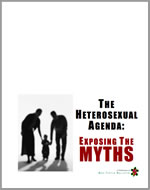 At last, the truth can now be told.
Using the same research methods employed by most anti-gay political pressure groups, we examine the statistics and the case studies that dispel many of the myths about heterosexuality. Download your copy today!
And don‘t miss our companion report, How To Write An Anti-Gay Tract In Fifteen Easy Steps.
 Anti-gay activists often charge that gay men and women pose a threat to children. In this report, we explore the supposed connection between homosexuality and child sexual abuse, the conclusions reached by the most knowledgeable professionals in the field, and how anti-gay activists continue to ignore their findings. This has tremendous consequences, not just for gay men and women, but more importantly for the safety of all our children.
Anti-gay activists often cite the “Dutch Study” to claim that gay unions last only about 1½ years and that the these men have an average of eight additional partners per year outside of their steady relationship. In this report, we will take you step by step into the study to see whether the claims are true.
Tony Perkins’ Family Research Council submitted an Amicus Brief to the Maryland Court of Appeals as that court prepared to consider the issue of gay marriage. We examine just one small section of that brief to reveal the junk science and fraudulent claims of the Family “Research” Council.
 The FBI’s annual Hate Crime Statistics aren’t as complete as they ought to be, and their report for 2004 was no exception. In fact, their most recent report has quite a few glaring holes. Holes big enough for Daniel Fetty to fall through.
“Google” is a trademark of Google Inc.
© Box Turtle Bulletin. All Rights Reserved.

 Posts
Posts  Posts via daily email: