Box Turtle Bulletin
 News and commentary about the anti-gay lobby
“Now you must raise your children up in a world where that union of man and box turtle is on the same legal footing as man and wife…”
News and commentary about the anti-gay lobbyApril 9th, 2014
TODAY’S AGENDA:
Events This Weekend: Women’s Fest 2014, Camp Rehoboth, DE; Virgin London Marathon, London UK; Miami Beach Pride, Miami Beach, FL.
TODAY’S AGENDA is brought to you by:

From The Rose (a Southern California gay bar guide), September 9, 1980, page 29.
West Coast Production Company opened on Veteran’s Day of 1977, in an old building a few blocks from San Diego’s first disco, the Ball Express. The DJs at WCPC quickly outclassed the competition, with WCPC gaining a reputation for breaking much of the disco music in the late 1970s. WCPC weathered the changing tastes in music through the 1980s, but by 1996 the club had run its course.

TODAY IN HISTORY:
Freud’s Letter to a Concerned Mother: 1935. At the turn of the twentieth century, the most common opinion about homosexuality among psychiatrists was that it was the result of natural degeneracy, which was a kind of a theory of evolution in reverse. (for more detailed descriptions of Degeneracy Theory, see Sep 3, Dec 27 or Feb 7). But Sigmund Freud challenged that prevailing theory early in his career. In his Three Essays on the Theory of Sexuality, Freud argued that if degeneracy theory were a valid explanation, it would mean that gay people who have to exhibit not many different behaviors from the norm, but their “efficient functioning” would have to be limited as well. Freud however found gay men and women who exhibited no other behavioral problems, and rather than exhibit unimpaired functioning but many were “indeed distinguished by specially high intellectual development and ethical culture.” If gay people were truly the product of degeneracy, none of his observations would make sense.
In 1935, Freud outlined some of these beliefs again in a letter which is often described as being to “an American mother” The letter has been so described perhaps because it was sent anonymously to the American sexologist Dr. Alfred Kinsey from “a grateful mother.” We don’t actually know who that mother was. Kinsey, in turn, shared it with the American Journal of Psychiatry, where it appeared in the April 1951 edition. The handwritten letter reads as follows:
April 9th, 1935.
Dear Mrs. ——
I gather from your letter that your son is a homosexual. I am most impressed by the fact that you do not mention this term yourself in your information about him. May I question you, why you avoid it? Homosexuality is assuredly no advantage but it is nothing to be ashamed of, no vice, no degradation, it cannot be classified as an illness; we consider it to be a variation of the sexual function produced by a certain arrest of sexual development. Many highly respectable individuals of ancient and modern times have been homosexuals, several of the greatest men among them. (Plato, Michelangelo, Leonardo da Vinci, etc.) It is a great injustice to persecute homosexuality as a crime and cruelty too. If you do not believe me, read the books of Havelock Ellis.
By asking me if I can help, you mean, I suppose, if I can abolish homosexuality and make normal heterosexuality take its place. The answer is, in a general way, we cannot promise to achieve it. In a certain number of cases we succeed in developing the blighted germs of heterosexual tendencies which are present in every homosexual, in the majority of cases it is no more possible. It is a question of the quality and the age of the individual. The result of treatment cannot be predicted.
What analysis can do for your son runs in a different line. If he is unhappy, neurotic, torn by conflicts, inhibited in his social life, analysis may bring him harmony, peace of mind, full efficiency, whether he remains a homosexual or gets changed. If you make up your mind he should have analysis with me — I don’t expect you will –, he has to come over to Vienna. I have no intention of leaving here. However, don’t neglect to give me your answer.
Sincerely yours with kind wishes,
Freud.P. S. I did not find it difficult to read your handwriting. Hope you will not find my writing and my English a harder task.
It would take another four decades before the American Psychiatric Association would finally catch up with Freud’s finding that homosexuality “cannot be classified as an illness.”
[Sources: Sigmund Freud. Three Essays On The Theory Of Sexuality
Sigmund Freud. “Letter (to an American mother, 1935)” American Journal of Psychiatry 107, no. 10 (April 1951): 786-787.]
55 YEARS AGO: Daily Express Calls for Homosexual Purge from London’s Theaters: 1959. Under the ownership of Canadian-born Max Aitken (who, in 1917, became the first Lord Beaverbrook when he was granted a peerage), London’s Daily Express had long enjoyed a reputation for both forming and reflecting the prejudices and outrages of its conservative and working class readers. Following World War II, the Express newspapers enjoyed the world’s largest circulation and Beaverbrook was known as “the first Baron of Fleet Street.” In 1959, author and historian John Deane Potter took to the pages of the Daily Express to warn its readers about a terrible menace in London’s theater district:
I read with dismay the news yesterday that a 31-year-old South African called John Cranko was fined £10 at Marlborough-street police court.
It was not the fine. It was the man and the offence. Because he pleaded guilty to a crime which has become known as the West Side vice.
Cranko is the latest on the list of famous stage names who have been found guilty of this squalid behaviour. He is a talented man of the theatre. He was the co-author of the spectacularly successful review “Cranks.”
The private lives of people, whether they are a brilliant ballet designer and author like Cranko, or an ordinary office worker on the 6.15, should, according to the Wolfenden Report, be their own business. But this question is public business.
It has become a sour commonplace in the West End theatre that unless you are a member of an unpleasant freemasonry your chances of success are often lessened.
For the theatre is far too full of people belonging to a secret brotherhood.
Most of them are not tortured misfits. They do not want psychiatric treatment or cures.
They live complacently in their own remote world, with its shrill enthusiasms.
But they are evil. For two reasons.
One is their PERSONAL POWER.
Corruption is an outmoded word that used to be thundered with hellfire vigour from Victorian pulpits. Now this West End weakness is the subject of sophisticated wit.
Their chi-chi world may seem remote from the normal theatregoer. Except for this.
If your son wants to go on the stage — what will his future be? It is a shivering thought.
So many talented young men have said to me: “It is no good in the theatre unless you are camp. You must be queer to get on.”
Those are just two expressions from the cryptic slang they use to describe the social disease from which they suffer.
The boy, whatever his talents, may become bitter and frustrated.
Or worse. He does not have to travel far along the corridors of the West End back-stage to meet the smooth, unspoken. proposition. He may, through ambition, try to play along with it. And, make no mistake, many of these men take pleasure in corrupting the young.
Danger number two is their PROFESSIONAL POWER.
Some of the stuff they produce is beautiful, witty, and clever. But too often they try to foist upon the public a false set of values.
What is often received with trills of praise by the closed West End set remains puzzling to the formal mind of the average theatregoer who is unaware of the lace-like intricacies of the decor or the obscure oddities of the plot.
And the theatre has an expensive flop on its hands.
No one likes to indulge in a Jehovah-like loftiness about other people’s lives.
But I repeat: these are evil men. They have spun their web through the West End today until it is a simmering scandal.
I say they should be driven from their positions of theatrical power.
[Source: John Deane Potter. “Isn’t It About Time Someone Said This… Plainly and Frankly” The (London) Daily Express (April 9, 1959). As reprinted in The Mattachine Review 5, no. 6 (June 1959): 21.]
40 YEARS AGO: APA Membership Affirms Decision To Remove Homosexuality From DSM-II: 1974. When the American Psychiatric Association’s board of trustees ratified the Nomenclature Committee’s recommendation to remove homosexuality from the second edition of the Diagnostics and Statistics Manual (DSM-II, the APA’s official list of mental disorders — see Dec 15), the faction within the APA opposing the move, led by Charles Socarides, vowed to overturn the board’s decision and return the nation’s gays and lesbians to the ranks of the mentally ill. Socarides’s Ad Hock Committee Against the Deletion of Homosexuality from DSM-II moved quickly to put the board’s decision to a vote of the membership. This demand was most remarkable: having lost the scientific argument, the dissident committee turned to the organization’s by-laws — which were intended to democratize the APA’s policy decisions — and turn it into a referendum on a scientific finding. In other words, they wanted to put facts up for a vote.
The APA board was appalled at the thought of asking the membership to vote on a scientific finding, but the wording of the bylaws left them no choice. The day after board’s decision to delete homosexuality from the DSM they set a date for the referendum. Ballots were mailed out to the membership, and the controversy was hotly debated in the APA’s publication Psychiatry News. On April 9, 1974, the APA released the results:
| Result | ||
|---|---|---|
| Favoring the board’s decision | 5,854 | 58% |
| Opposing the board’s decision | 3,810 | 37% |
| Abstaining | 367 | 3% |
| Invalid votes | 9 | <1% |
| Not voting on this issue | 51 | <1% |
| TOTAL | 10,091 | |
Socarides and others were never able to reconcile themselves to the APA’s decision. In 1992, Socarides joined Benjamin Kaufman and Joseph Nicolosi in founding the National Association for Research and Therapy of Homosexuality (NARTH), which continues to argue that homosexuality is pathological and can be cured, against all scientific evidence to the contrary.
[Source: Ronald Bayer. Homosexuality and American Psychiatry: The Politics of Diagnosis

TODAY’S BIRTHDAY:
Cynthia Nixon: 1966. Daughter of actress Anne Knoll and radio journalist Walter E. Nixon, Cynthia Nixon already was in two simultaneous hit Broadway plays while also a freshman at Barnard College in 1984. Her roles were short and the two theaters were just two blocks from each other, close enough that she could run from one to the other in time to get dressed and deliver her performances. She had minor roles in a number of films and made-for-TV movies before landing her first major supporting part in 1986’s The Manhattan Project. But of course, her best-known role was that of Miranda Hobbes in HBO’s Sex and the City, which ran from 1998 to 2004 and spawned two moves, one okay and one awful. In 2006, she won a Tony for Best Actress in the Pulitzer Prize-winning drama Rabbit Hole and she won a 2008 Emmy for a guest appearance in an episode of Law & Order: Special Victims Unit. In 2009, she shared a Grammy, with Beau Bridges and Blair Underwood for Best Spoken Word Album for the audio CD of Al Gore’s An Inconvenient Truth.
But perhaps her most important prize came in May of 2012 when she married her partner, Christine Marinoni after a three year engagement. When she came out in 2007, Nixon, who had been previously married to photographer Danny Mozes, said “I don’t really feel I’ve changed. I’d been with men all my life, and I’d never fallen in love with a woman. But when I did, it didn’t seem so strange. I’m just a woman in love with another woman.”
If you know of something that belongs on the agenda, please send it here. Don’t forget to include the basics: who, what, when, where, and URL (if available).
And feel free to consider this your open thread for the day. What’s happening in your world?
April 8th, 2014
You may not have thought of Alan Simpson in years. You may not even recognize the name. But if you live in Wyoming, there’s a good chance that you’ve voted for Simpson or one of his relatives.
Simpson’s father, Milward Simpson, was Montana Governor from 1955 to 1959 and US Senator from the state from 1962 to 1967. Peter Simpson, Alan’s brother, served in the state House of Representatives from 1981 to 1984 and ran for Governor in 1986. And his son, Colin Simpson, served in the state House of Representatives from 1999 to 2010 (two years of which he was Speaker) and ran for Governor in 2010.
Alan himself served in the Wyoming House from 1965 to 1977 before going on to represent the state in the US Senate from 1979 to 1997 and was on the short list for 1988 Veep consideration. Most recently he served, at President Obama’s request, with Erskine Bowles as co-chair of the National Commission on Fiscal Responsibility and Reform.
Today he became the face of the marriage equality movement in the state. The following ad is playing on stations in Wyoming.
Simpson has long been a supporter of our community. In 2001 he helped create Republican Unity Coalition, an organization designed to make the GOP more inclusive and to counter hostile voices in the party. At his request, President Gerald Ford joined the group, becoming the only US President – to date – to join a gay advocacy group.
No doubt other Republicans will try and counter this message. But Simpson’s advocacy stands a strong chance of swaying opinion.
April 8th, 2014
 Mother Jones reports that OKCupid CEO Sam Yagen donated $500 an anti-gay Utah GOP Congressman’s election campaign:
OkCupid’s co-founder and CEO Sam Yagan once donated to an anti-gay candidate. (Yagan is also CEO of Match.com.) Specifically, Yagan donated $500 to Rep. Chris Cannon (R-Utah) in 2004, reports Uncrunched. During his time as congressman from 1997 to 2009, Cannon voted for a constitutional amendment banning same-sex marriage, against a ban on sexual-orientation based job discrimination, and for prohibition of gay adoptions.
…Of course, it’s been a decade since Yagan’s donation to Cannon, and a decade or more since many of Cannon’s votes on gay rights. It’s possible that Cannon’s opinions have shifted, or maybe his votes were more politics than ideology; a tactic by the Mormon Rep. to satisfy his Utah constituency. It’s also quite possible that Yagan’s politics have changed since 2004: He donated to Barack Obama’s campaign in 2007 and 2008. Perhaps even Firefox’s Eich has rethought LGBT equality since his 2008 donation. But OkCupid didn’t include any such nuance in its take-down of Firefox. Combine that with the fact that the company helped force out one tech CEO for something its own CEO also did, and its action last week starts to look more like a PR stunt than an impassioned act of protest.
April 8th, 2014
Last week, we briefly mentioned reports coming out of Uganda that police had raided the Makerere University Walter Reed Project, a U.S.-funded joint project with the university and the U.S. military’s HIV research program. NTVUganda reports more on the raid above, which comes as a direct consequence of the enactment of the Anti-Homosexuality Act. One of the provisions of the act criminalizes “promotion” of homosexuality and another provision criminalizes “aiding and abetting” homosexuality. The U.S. State Department has responded by suspending the program:
We are deeply concerned that a U.S.-funded health clinic and medical research facility, the Makerere University Walter Reed Project (MUWRP), was raided by Ugandan authorities on April 3, leading to the arrest of one of the facility’s employees, allegedly for conducting “unethical research” and “recruiting homosexuals.” While that individual was subsequently released, this incident significantly heightens our concerns about respect for civil society and the rule of law in Uganda, and for the safety of LGBT individuals.
The MUWRP is engaged in efforts to improve public health and save lives. The Ugandan government is responsible for protecting all of its people, and attacks and intimidation of health care workers are unacceptable. The safety of health workers must be respected. We have temporarily suspended the operations of MUWRP to ensure the safety of staff and beneficiaries, and the integrity of the program.
This suspension comes just three weeks after the Obama Administration announced an increase in military advisers, special forces and aircraft to Uganda to aid in its battle against the insurgency led by Joseph Kony and his Lord’s Liberation Army.
April 8th, 2014
TODAY’S AGENDA is brought to you by:

From Just Us, 1975, page 36.
Lost and Found got off to a rough start when it opened in 1971: its unannounced admissions policy appeared to have excluded African-Americans, women, and people in drag. After several months of picketing and negotiations with a group calling themselves the Committee for Open Gay Bars, the owners relented and Lost and Found would become legendary for its spectacular drag shows. Lost and Found lasted for the next 27 years, with a two year period beginning in 1991 when it temporarily adopted the name Quorum. Lost and Found closed in 1998. Since then, the entire block has been razed and redeveloped into condos.

TODAY’S BIRTHDAY:
Michael Bennett: 1943-1987. He was something of a dancing prodigy, dropping out of high school at age sixteen to join a touring company of West Side Story. His Broadway debut was in Subways Are for Sleeping (1961). But by the mid-1960s, he decided to focus more on choreography than dancing. The first two shows he choreographed were commercial failures: A Joyful Noise (1966), and Henry, Sweet Henry (1967). His first success as choreographer came with the Bacharach and David musical Promises, Promises (1968), which he followed with Coco (1969), and Sondheim and Prince’s Company (1970) and Follies (1971), which won him two Tonys. In 1973, he took over the troubled musical Seesaw, but only after demanding complete directorial and choreographic control. The producers agreed, and he replaced both the show’s director and choreographer and claimed a writing credit as well. Seesaw won him a Tony for best choreographer.
Bennett’s next project would be his most ambitious. He decided to do a show about the lives of dancers. But instead of commissioning a script, he spent the next hear conducting hundreds of hours of taped interviews with Broadway dancers. A Chorus Line debuted off-Broadway in May 1975, and moved to Broadway’s Shubert Theater on July 25, and stayed there for the next fifteen years. The musical won nine Tonys, all eight Drama Desk Awards for which it was nominated, and a Pulitzer. Bennett would come to regard A Chorus Line as something of a mixed blessing, as the many international companies demanded so much of his time.
While Bennett would go on to have several more critical and commercial successes, but A Chorus Line would always be the high water mark. His next musical, Ballroom (1978), was a commercial failure despite earning eight Tony nominations. Bennett won for Best Choreography, the only Tony that Ballroom won. He had another hit with Dreamgirls (1981, and another Tony for Bennett’s choreography).
Bennett was bisexual, with numerous affairs with both men and women throughout his life. He had a long and stormy relationship with dancer/singer/actress Donna McKechnie, for whom he created the lead role in A Chorus Line. They married in 1976, divorced four months later, and remained close friends until his death. He had an affair with Sabine Cassel, who was then the wife of French actor Jean-Pierre Cassel, but that relationship soured. He was also linked with choreographer Larry Fuller, dancer Scott Pearson, and Gene Pruitt, who lived with Bennett for the last eight months of his life in Tucson, Arizona, where he went for treatment for AIDS and where he died on July 2, 1987 at the age of forty-four.

Sean Kennedy: 1987-2007. He would have been twenty-seven today if he hadn’t been killed on May 16, 2007 at about 3:45 a.m. as he left a local bar in Greenville, South Carolina. According to local news reports, Stephen Andrew Moller got out his his car, walked up to Sean, called him a faggot, and punched him hard enough to break several facial bones. When Sean fell, his head hit the pavement so hard that his brain separated from his brain stem. Fifteen minutes later, one of Sean’s friends received a voice mail from Moller:
Hey. (laughter) Whoa stop. (laughter) Hey, I was just wondering how your boyfriend’s feeling right about now. (laughter) (??) knocked the fuck out. (laughter). The fucking faggot. He ought to never stick his mother-fucking nose (??) Where are you going? Just a minute. (laughter). Yea boy, your boy is knocked out, man. The motherfucker. Tell him he owes me $500.00 for breaking my goddamn hand on his teeth that fucking bitch.
Greenville County sheriff’s office arrested Moller as part of a homicide investigation; his arrest warrant described the act as “a result of the defendant not liking the sexual identity of the victim.” But by the time the case reached the grand jury in October, the indictment was reduced to involuntary manslaughter, for which South Carolina law set the maximum penalty at five years. Moller’s attorney argued that Moller “had no idea (Sean) was gay until after the fact. It’s just a freak incident that should never have happened.”
As part of a plea deal, Moller was sentenced to three years, minus seven months for time served. After getting his GED, Moller’s sentenced was reduced again and he was released after just 13 months, his goddamn hand having healed quite nicely in the meantime.
If you know of something that belongs on the agenda, please send it here. Don’t forget to include the basics: who, what, when, where, and URL (if available).
And feel free to consider this your open thread for the day. What’s happening in your world?
April 7th, 2014
The U.S. Supreme Court today announced that it will not take up the the appeal by Elane Photography, a New Mexico photographer who was found to have violated the state’s anti-discrimination law by refusing to photograph a same-sex wedding.
In the Order Paper published online this morning (PDF: 93KB/8 pages), Elane Photography v. Vanessa Willock is listed, without comment, as among cases in which certiorari was denied.
In 2006, Elaine Huguenin, who runs Elane Photography (the different spelling is intentional), refused to photograph a same-sex commitment ceremony for a lesbian couple. The couple, Vanessa Willock and Misti Collinsworth, hired another photographer and filed a complaint with the state’s Human Rights Division, which set up a commission to examine the complaint. In February 2008, the commission ruled that Elane Photography had violated the state’s Human Rights Act by discriminating against the couple on the basis of sexual orientation. Huguenin turned to the courts, which have backed the state’s Human Rights Division ruling.
April 7th, 2014
TODAY’S AGENDA is brought to you by:

From GPU News, March 1973, page 18.
Here’s another one that’s gone without a trace. The address today is nothing more than a small, narrow parking lot next to a Dollar Store in Chicago’s Little India.

TODAY’S BIRTHDAYS:
Pearl M. Hart: 1890-1975. She was born as Pearly Minne Harchovsky in Traverse City, Michigan, the youngest of five children of Orthodox Jewish émigrés from Russia, and the only child in the family born in the U.S. The family moved to Chicago’s near west side when her rabbi father took a job as a kosher inspector for Jewish butchers. Her passion for social justice began when she left school at fourteen to work in a garment factory to help support the family, and quickly became a leader in the adult/male dominated union. A few years later she began attending classes at the John Marshall Law School, changed her name to Hart, and in 1914, was admitted to the Illinois Bar.
In 1915, she became among the first women adult probation officers in Chicago. Her early interest was in the needs of children, and she set about drafting legislation, serving on committees and speaking to audiences to reform the juvenile court system. Her attention to children led her to notice the problems of women who were passing through the legal system, many of them charged with prostitution. In 1933, she volunteered to serve as the first public defender in the morals court. Before then, women defendants typically couldn’t afford lawyers, and the court’s conviction rate was about ninety percent. Hart reversed that trend after only four months when the conviction rate plummeted to ten percent.
In the 1950s McCarthy era, Hart turned her attention to those who were being accused of subversion against the U.S. government, mostly in defending foreign-born clients who were facing deportation for allegedly working for so-called subversive organizations. One client, George Witkovich, who had received a deportation order, appeared at an immigration hearing and, on Hart’s advice, refused to answer questions about activities and affiliations on the grounds that they were irrelevant to whether he should be deported. The U.S. government sued, she counter-sued, and the court cases led eventually to a 1957 U.S. Supreme Court victory in U.S. v. Witkovich, which held that even non-citizens were protected by the constitutional rights of free association and free speech.
Hart also defended another class of so-called subversive — the sexual kind. Her clients included hundreds of gay men who were arrested for soliciting, or who were entrapped or rounded up in bar raids. Many of the arrests were little more than shakedown operations conducted by the notoriously corrupt Chicago police, and it was common knowledge that bribes paid to the right person would result in the charges being dropped. Hart steadfastly refused to get involved in bribery, and instead demanded jury trials, which also tended to have the same effect. That earned her the nickname of the “Guardian Angel of Chicago’s Gay Community.”
 In 1965, she co-founded Mattachine Midwest, a Chicago-based gay rights group, and served as its legal counsel. Most of Mattachine Midwest’s job, according to president Jim Bradford, was “making the police behave.” In a May 1969 speech to the Mattachine membership she urged a “more aggressive” public posture on gay rights, two months before Stonewall.
Throughout her life, Hart remained very circumspect about her private life. She never publicly identified as a lesbian, although she had two long-term relationships. The first was with actress and singer J. Blossom Churan. They met at around 1920 and moved in together a few years later after Hart’s parents died. Churan was Hart’s first great love, but by the 1940s, Churan was bored and began an affair with a physician, Bertha Isaacs. Rather than lose Churan to Isaacs, Hart invited Isaacs to move in with the two of them, and all three lived together until Churan’s death in 1973.
Hart’s second major relationship was with pulp fiction writer and poet Valerie Taylor (see Sep 7). They met in 1961, and became close in 1963. Taylor took an apartment around the corner from Hart’s home and, as she put it, accepted the “neurotic situation” at the Hart residence. Taylor was devoted to Hart for the rest of Hart’s life. But as Hart lay dying of pancreatic cancer in 1975, Taylor was denied entrance to Hart’s hospital room thanks to the hospital’s families-only policy. By the time a friend intervened, Hart was already in a coma.
In 1981, the Midwest Gay and Lesbian Archive and Library changed its name to the Henry Gerber-Pearl M. Hart Library. Hart was inducted in the Chicago Gay and Lesbian Hall of Fame in 1992 and her home was marked with a Chicago Tribute Marker of Distinction in 2001.
Before she died, Hart had expressed her one regret in life: that she had no sons or grandsons to say kaddish for her. The Mattachine Midwest president reminded her that grateful members of that organization were her sons and grandsons, and they would gladly say kaddish. In 1991, Taylor published her last poem dedicated to the love of her life:
Kaddish
March 22
I light yahrzeit candles,
dust your photograph
that watches over my bed
and remember your touch.You are an institution now,
a library,
a scholarship for women lawyers.As long as I breath
you are a living woman
moving through my mind.
[Sources: Karen C. Sendziak. “Pearl M. Hart (1890-1975).” In Vern L. Bullough’s Before Stonewall: Activists for Gay and Lesbian Rights in Historical Context
Marie J. Kuda. “Legal Pioneer: Pearl M. Hart, 1890-1975.” In Tracy Baim’s Out and Proud in Chicago: An Overview of the City’s Gay Community

Harry Hay: 1912-2002. Hay was more than just a co-founder of the Mattachine Foundation (see Nov 11; renamed Mattachine Society two years later) which became the first successful organization of gay men (and, to a much lesser extent, lesbians). It wasn’t the first such organization designed to bring gay people together. That distinction went to the short-lived Chicago Society for Human Rights, which didn’t last a year (See Dec 10). But Hay was a curious and tenuous link between the Chicago group and the Mattachines when, in 1930, at the age of 17:
I enticed an “older” gentleman (he must have been at least 33 ) to “bring me out” by finagling his picking me up in Los Angeles’s notorious Pershing Square. Poor guy–he was appalled to discover, subsequently, that I was both a virgin and jailbait. Champ Simmons didn’t really turn me on, but he was a very decent human being; he was gentle and kind and taught me a great deal.
…Champ, the guy I seduced into picking me up and bringing me out into the gay world, had himself been brought out by a guy who was a member of that Chicago group. So I first heard about that group only a few years after its sad end. My impression was that the society was primarily a social thing. But just the idea of gay people getting together at all, in more than a daisy chain, was an eye-opener of an idea. Champ passed it on to me as if it were too dangerous; the failure of the Chicago group should be a direct warning to anybody trying to do anything like that again.
Hay wasn’t put off by dangerous ideas, a propensity which would always mark him as a controversial figure throughout his life. He joined the Communist Party in 1934, and remained a member until the early 1950s. He also became active in theater, where he briefly became the lover of actor Will Greer. In 1938, he married at the urging of his therapist and party members. He and his wife adopted two daughters, but the couple divorced in 1951.
In 1948, Hay went to a party at USC with several other gay men who supported the presidential campaign of Progressive Party candidate Henry Wallace. It was at that party that Hay conceived of organizing a gay activist group. His first efforts to found the “Bachelors for Wallace” failed, but Hay stuck with the idea of creating an organization specifically for gay people. Finally, on November 11, 1950, Hay and several others met at Hay’s home for the first meeting of “The Society of Fools”, which later became the Mattachine Foundation, named after the Medieval French secret societies of masked men whose anonymity allowed them to criticize the ruling monarchs. As the Mattachines got off the ground, Hay left the Communist Party, which didn’t allow gays to be members.
By 1953, Mattachine grew to over 2,000 members in Southern California. And also by 1953, Sen. Joseph McCarthy’s red and pink scares were in full swing. With homosexuality being equated with subversion and treason, many Mattachine members became concerned about the communist connections of some of Mattachine’s founders, principally, Hay. They were also concerned that the Mattachine Foundation was being too public and too “radical” in advocating for gay people. When Hal Call and other Mattachine members from San Francisco sought to amend the Mattachine’s constitution to oppose “subversive elements” and to affirm that members were loyal to the U.S., Hay resigned, he said later, to save the organization from investigations related to the Red Scare. (In 1955, Hay would, in fact, be called to testify before the House Un-American Activities Committee.) The Foundation then re-organized itself into the Mattachine Society, elected publicly named directors for the first time, disavowed its prior links with Hay, and reassured the public that the organization had no interest in changing the nation’s sodomy laws.
In the 1960s, Hay and his partner, John Burnside, became involved again with gay activism, helping to found the North American Conference of Homophile Organizations (NACHO), the Los Angeles chapter of the Gay Liberation Front, and, in 1979, a gay spirituality movement called the Radical Fairies. It was during this time when his opposition to assimilationist attitudes within the gay community really began to stand out:
“We pulled ugly green frog skin of heterosexual conformity over us, and that’s how we got through school with a full set of teeth,” Hay once explained. “We know how to live through their eyes. We can always play their games, but are we denying ourselves by doing this? If you’re going to carry the skin of conformity over you, you are going to suppress the beautiful prince or princess within you.”

Harry Hay (left), with John Burnside
Hay’s concept of homosexuality, it could be said, was more of a nineteenth century conception than a twentieth century one. He was enamored with the concepts of androgyny, with some of his ideas being similar to the nineteenth-century formulation of homosexuality being a “third sex.” He was influenced by Edward Carpenter, who wrote of gay people as a distinct, well-defined group with its own unique ideals that set if apart from society. Carpenter also wrote of “Greek love” and its pederastic ideals. This perhaps explains how Hay’s radical and anti-assimilationist politics could reach its most controversial limits when, in the early 1980s, he protested NAMBLA’s exclusion from LGBT organizations and activities. He was forcibly removed from the Los Angeles pride parade in 1986 when he showed up with a sign reading “NAMBLA walks with me.” Even some of Hay’s most dedicated supporters and closest friends couldn’t abide this stance. The majority of the gay community had grown, matured, and move in directions that Hays couldn’t accept.

This is perhaps the most difficult aspect of Hay’s legacy that we are left to grapple with. And yet, without Hay’s extremely radical idea — radical for 1950 — that gay people should come together from out of the shadows and begin to ask for simple things like the freedom to gather in bars or not to be arrested or not to have their newsletters and magazines confiscated by the post office, it’s hard to know how long the fruition of a far more radical idea would have been delayed — the extremely radical, impossible-to-fathom-in-1950 idea that gays and lesbians could assimilate, that they could become police officers, run businesses, publish newspapers, serve in the military, run for office, marry, raise children, join PTAs and churches and car pools and homeowners associations and march openly in parades down the middle of public streets in June, and do all of those things without hiding or retreating back into the closet. If Hay saw himself as the sworn enemy of assimilation, his pioneering efforts in 1950 were ultimately what made that assimilation possible. And for that, I think that perhaps the late Paul Varnell put it best:
Hay may have been wrong about almost everything. But in the end we do not insist that founders have the right answers, not even ask the right questions. We can honor them as founders and leave it at that.

Janis Ian: 1951. She was only thirteen when she wrote her first hit single, “Society’s Child.” The song’s subject, about a young girl’s interracial romance, was way too controversial for radio stations to touch when it was first released in 1964. Re-released again, and then again, the third time proved to be the charm in 1967 when “Society’s Child finally made it to number fourteen on Billboard’s Hot 100. She was on the verge of being a one-hit wonder when “At Seventeen” was released in 1975. It hit number one on Billboard’s Adult Contemporary charts, dragged her album, Between the Lines to the number one spot on Billboard’s Album chart, and earned her a Grammy for Best Pop Vocal. She performed “At Seventeen” as the very first musical guest for Saturday Night Live’s debut that year. Thanks to the lyric, “To those of us who knew the pain / of valentines that never came,” she reportedly received over four hundred Valentine cards on Valentine’s Day 1977.
Ian’s career since then has been considerably more low-keyed, although she has never stopped recording and touring. In 1993, her album Breaking Silence broke several silences, including the silence of her closet. She married Patricia Snyder in 2003. In 2008, Ian published her autobiography, Society’s Child

If you know of something that belongs on the agenda, please send it here. Don’t forget to include the basics: who, what, when, where, and URL (if available).
And feel free to consider this your open thread for the day. What’s happening in your world?
April 6th, 2014
TODAY’S AGENDA:
Events This Weekend: Brighton Marathon, Brighton, UK; Belgian LGBT Film Festival, Brussels, Belgium; Spring Diversity, Eureka Springs, AR; Sunshine Stampede Gay Rodeo, Ft. Lauderdale, FL; Dinah Shore Weekend, Palm Springs, CA; Phoenix Pride, Phoenix, AZ.
TODAY’S AGENDA is brought to you by:

From Northwest Gay Review, May 1974, page 2.
Steve Suss bought Portland, Oregon’s Focal Point in 1971. Before then, it had been the Fiddler’s Three, Roman’s Tavern, and Somebody’s Place. Suss also owned the adjoining Embers, which backed up to Focal Point. His disco, Castaway’s Lounge, was just two blocks away to the south. The Focal Point/Embers block has been razed and redeveloped, and Castaways is now a seafood restaurant.
TODAY IN HISTORY:
Study of 100 Homosexuals: 1957. There had been a string of high profile arrests of very prominent and well-known men in Britain in the early 1950s, including Lord Montagu (see Oct 20), his cousin, Maj. Michael Pitt-Rivers, and journalist Peter Wildeblood (see May 19), all of whom had been charged and convicted of homosexual offenses. Their arrests opened the debate over whether homosexual acts between consenting adults should remain criminalized. In 1954, the Home Secretary, David Maxwell-Fyfe, convened a committee to study the issue under the leadership of Lord John Wolfenden, and they would study the question for the next three years. The multi-disciplined committee, which included theologians, psychiatrists, educators, judges, lawyers, and several other leading figures, was tasked with reviewing the medical, legal, and moral aspects of homosexuality (along with prostitution, as laws forbidding it were also open for discussion.)
One of the psychiatrists on that committee was Dr. Desmond Curran of the Department of Psychiatry at St. George’s Hospital in London. Curran and fellow researcher Dr. Denis Parr, took on the task of preparing a study of 100 gay men, which appeared in the April 6, 1957 edition of the British Medical Journal titled “Homosexuality: An Analysis of 100 Male Cases Seen in Private Practice.”
The men described in this paper were referred to the authors for evaluation and treatment for the following reasons:
The authors noted that homosexuality was a criminal offense in Britain in three very distinct ways. The crime of “buggery,” which was generally interpreted as penetrative anal intercourse, carried a maximum penalty of life imprisonment. The crimes of “indecent assault” and “gross indecency” provided maximum penalties of ten years and two years respectively. “Indecent assault” generally was used for sexual behavior with minors under the age of 16, while “gross indecency” was any contact or exposure of genitalia for sexual excitement.
One problem with the published research on gay men was that virtually all of it was based on clinical or criminal populations, which Curran and Parr acknowledged would not necessarily be representative of the general population of gay men. In their report, they acknowledged that their sample would likely exhibit higher rates of psychiatric problems or criminal recidivism. But when they looked into the files of these 100 men who had been referred to their practice, the authors observed:
…[I]n spite of the probability that any group of homosexuals referred to a psychiatrist might be expected to be heavily weighted in the direction of psychiatric abnormality, no fewer than 51 % were considered to be free from gross personality disorder, neurosis, or psychosis during their adult lives. Only one was certifiably defective and none certifiably insane. They included a number of important and talented individuals of high integrity, successful, efficient, and respected members of the community. Only two had been on any criminal charge other than homosexuality. Very few showed the traditional “pansy” picture of homosexuals; indeed, only 21 were noted to have at all obvious homosexual personality traits, only one of these being a paedophiliac.
As for the treatment programs the men underwent:
The objects of treatment can be arbitrarily divided under four main headings : (1) change in direction of the sex urge, (2) greater continence, (3) greater discretion, and (4) better adaptation to the sexual problem and to life in general.
The authors don’t go into much detail of what kind of treatment the men underwent, saying simply that “treatment consists in a mixture of physical, psychological, social, and environmental measures, in varying proportions according to the case.” In general, it appears to have been confined to psychotherapy or simple counseling, although in some cases the “prescription of medications or environmental adjustments” were noted. As for the attempts at changing sexual orientation, the results weren’t very encouraging:
Of the 59 patients about whom sufficient information was available, 9 (or roughly 1 in 6) reported less intense homosexual feelings, or increased capacity for heterosexual arousal, 3 became more homosexual in preference than when first seen, and no change, even of a minor order, was found in the sexual orientations of the other 47. When a change was found it often amounted only to a slight alteration in the balance of masturbatory fantasies.
Eight of the nine who claimed a “slight alteration” toward heterosexuality were classified as bisexual or “predominately” homosexual (as distinct from “100% homosexual”). What isn’t stated in the article is how many of those who claimed to have experience a “slight alteration” were among the thirty men who faced criminal charges. This would be important; the authors noted elsewhere in their paper that those who were criminally charged had “come in the hope of establishing medical reasons for mitigating the rigours of the law.”
Since the prospect of “slight alteration” of homosexuality was minimal, the only other question remaining was whether there was anything intrinsically wrong with being gay. Curran and Parr found little evidence for it:
Only half the patients showed significant psychiatric abnormality other than their sexual deviation, and such associated abnormalities were often slight. Moreover, many of these abnormalities were explicable as a reaction to the difficulties of being homosexual. Symptomatic homosexuality was rare. If homosexuality is a disease (as has often been suggested), it is in a vast number of cases monosymptomatic, non-progressive, and compatible with subjective well-being and objective efficiency. In our series, both practising and non-practising homosexuals were on the whole successful and valuable members of society, quite unlike the popular conception of such persons as vicious, criminal, effete, or depraved. Only one-fifth were at all obviously ” pansy,” and we found no reason to regard most of the patients as physically, intellectually, or emotionally immature (unless the basic criterion for ” immaturity” is that of being homosexual-a circular argument).
This study, among others, would find its way into the Wolfenden Report later that year, which recommended that “homosexual behaviour between consenting adults in private should no longer be a criminal offence” (see Sep 4). It would take Parliament another ten years to act on that recommendation.
[Source: Desmond Curran and Denis Parr. “Homosexuality: An analysis of 100 male cases seen in private practice.” British Medical Journal 1, no. 5022 (April 6, 1957): 797-801. Available online for free at PubMed Central.]
TODAY’S BIRTHDAY:
Rob Epstein: 1955. He was nineteen years old when he answered an ad in a San Francisco alt-weekly for “a non-sexist person to work on a documentary film on gay life.” That led to his becoming the youngest filmmaker in the six-member collective, the Mariposa Film Group, which The collective produced the landmark 1977 documentary Word Is Out: Stories of Some of Our Lives
After the success of Word Is Out, Epstein started off on his own solo filmmaking career. He began working on a documentary about Proposition 6, also known as the Brigg’s Initiative, which would have banned gays and lesbians from teaching in California’s public schools (see Nov 7). Epstein planned to center his documentary on San Francisco Supervisor Harvey Milk’s efforts to defeat the measure. But when Milk was assassinated just three weeks later (see Nov 27), Epstein decided to make the documentary about Milk himself. With narration by actor Harvey Firestein, The Times of Harvey Milk
AIDS was the focal point for his next two projects: The AIDS Show: Artists Involved with Death and Survival (1986) for PBS, and Common Threads: Stories from the Quilt
In 1995, he and Friedman wrote and directed The Celluloid Closet


If you know of something that belongs on the agenda, please send it here. Don’t forget to include the basics: who, what, when, where, and URL (if available).
And feel free to consider this your open thread for the day. What’s happening in your world?
April 5th, 2014
TODAY’S AGENDA:
Events This Weekend: AIDS Walk, Belmont, NC; Brighton Marathon, Brighton, UK; Belgian LGBT Film Festival, Brussels, Belgium; Spring Diversity, Eureka Springs, AR; Sunshine Stampede Gay Rodeo, Ft. Lauderdale, FL; Dinah Shore Weekend, Palm Springs, CA; Phoenix Pride, Phoenix, AZ.
TODAY’S AGENDA is brought to you by:

From The Voice (Southern California edition), January 15, 1981, page 28.
For four decades since the 1960s, 3175 India Street in San Diego has seen four gay bars come and go. San Diego’s Gay and Lesbian Times gave this rundown when the last bar closed in 2006:
Throughout it final days, the bar touted banners that read: “Six Degrees… proud to be part of 40 years of gay history at 3175 India St,” and on Aug. 30, the last drink was served, the final dance was danced and the last goodbye was said. The bar Six Degrees has closed it doors forever.
According to Darla Marcus, Six Degrees manager and bartender of seven years, four different gay or lesbian bars have called this location home. The bar originally opened as The Swing and then became A Different Drum after a change in ownership. Both of these venues were predominately patronized by gay males. Changing hands again, the bar became the well-known Club Bombay, which is when it became a lesbian hangout. Five years ago, the club was sold one more time to two of the bartenders and a regular customer and was given its final name, Six Degrees.
The Mission Hills location has been renovated into the very chic Starlight restaurant and bar.

TODAY IN HISTORY:
Oscar Wilde Loses Criminal Libel Case: 1895. It had already been a bad year for the acclaimed author, and the year was barely a quarter of the way through. In February, Wilde was dining at the Albermarle Club when the Marquess of Queensbury left a calling card with the porter. It read, “For Oscar Wilde posing as a somdomite.” The misspelling may have been the product of Queensbury’s rage over the relationship between his son Lord Alfred “Bosie” Douglas and Wilde. Bosie refused to end it despite Queensbury’s arguments and threats, including the threat to publicly expose Wilde, which he accomplished with that calling card. Friends urged Wilde to ignore it, but Wilde felt that such an insult required a vigorous response, namely a lawsuit against Queensbury for criminal libel. No response, he reasoned, it would be tantamount to admitting the truth, something that Wilde knew would be disastrous not only to his reputation and career, but also to his very freedom. Homosexuality was a criminal offense.
Unfortunately, Wilde’s libel case collapsed on the second day of the sensational trial, when Wilde took the stand and Queensbury’s lawyer asked whether he had ever kissed a young man named Walter Grainger. Wilde replied, “Oh, dear no. He was a peculiarly plain boy. He was, unfortunately, extremely ugly. I pitied him for it.” Queesnbury’s lawyer pounced on Wilde’s reason for not kissing Grainger: it wasn’t that Wilde didn’t like kissing men, but that he didn’t want to kiss this particular “ugly” man. That was on April 4. The next day, Queensbury’s lawyer announced that he planned to call several male prostitutes to testify against Wilde. Wilde’s lawyer, after conferring with Wilde, asked the court to drop the charges and return a verdict of “not guilty” against Queensbury. But if Queensbury was not guilty of libel when he accused Wilde of “posing as a sodomite,” then that meant under English law that Queensbury’s statement, as the judge announced, “is true in fact and substance, and that the publication is for the public benefit.”
With that verdict as evidence, Wilde was arrested and charged with gross indecency the very next day, April 6. The first trial ended in a hung jury, but the second resulted in a guilty verdict and a sentence of two years at hard labor, the maximum sentence allowed by law.

TODAY’S BIRTHDAY:
85 YEARS AGO: Nigel Hawthorne: 1929-2001. British audiences (and fans of British sitcoms) will known him best as Sir Humphrey Appleby, a permanent secretary in Yes, Minister (1980-1984) and a cabinet secretary in the follow-up Yes, Prime, Minister (1986-1988), for which he won four BAFTAs. That acclaim was long in coming. He spent much of the previous three decades playing various roles as a character actor on stage, film and television. But after his successful run on the two sitcoms, Hawthorne’s career truly came onto its own, with a 1991 Tony for Best Actor for the Broadway production of Shadowlands, and his portrayal of the king in Alan Bennett’s stage play The Madness of George III. Three years later, he appeared in the title role again for the film version (which was renamed The Madness of King George), for which he won another BAFTA and was nominated for an Academy Award for Best Actor.
Amid the publicity surrounding his Academy Award nomination, Hawthorne granted an interview with The Advocate, in which he discussed, among quite a lot of things, his private life and his relationship with his longtime partner since 1979, Trevor Bentham. Hawthorne later said that he asked The Advocate to respect his privacy, and was surprised and upset to find The Advocate describe him as “the first openly gay actor to be nominated for a Best Actor Award.” Hawthorne described the outing as traumatic, but he nevertheless attended the Oscar ceremony with his partner and began speaking about being gay in interviews from then on. He also portrayed a gay character in 1998’s The Object of My Affection, and was knighted by Queen Elizabeth II in 1999. After battling pancreatic cancer for two years, he died of a heart attack in 2001.
If you know of something that belongs on the agenda, please send it here. Don’t forget to include the basics: who, what, when, where, and URL (if available).
And feel free to consider this your open thread for the day. What’s happening in your world?
April 4th, 2014
Go read this op-ed (NewsTribune)
I slept with a gay man for six months in Afghanistan.
No one asked. He did not tell.
In 2005, I and 200 Marines in my squadron deployed to Afghanistan to support the global war on terrorism. We were stationed at Bagram air base, a deep bowl surrounded by snowcapped mountains, where it rained and snowed while the sun beamed, prompting one Marine to remark, “Welcome to Afghanistan, the only place on Earth where you get all four seasons and a rocket in the same day.”
…
April 4th, 2014
In December, Federal Judge Timothy Black ruled that if you were a resident of Ohio and if you were legally married to someone of the same sex by another state, the state had to recognize that marriage for purposes of death certificates. We noted at that time that this was a very narrow ruling.
Now the plaintiffs have gone back to Judge Black and requested that he expand his ruling to all state functions, and he has agreed. (ABC)
Judge Timothy Black announced his intentions in federal court in Cincinnati following final arguments in a lawsuit that challenged the constitutionality of the marriage ban.
“I intend to issue a declaration that Ohio’s recognition bans, that have been relied upon to deny legal recognition to same-sex couples validly entered in other states where legal, violates the rights secured by the 14th Amendment to the U.S. Constitution,” Black said. “(They’re) denied their fundamental right to marry a person of their choosing and the right to remain married.”
Black said he’ll issue the ruling April 14. The civil rights attorneys who filed the February lawsuit did not ask Black to order the state to perform gay marriages, and he did not say he would do so.
Ohio State Attorney General Mike DeWine (R) has announced that he will appeal the ruling to the Sixth Circuit Court of Appeals.
April 4th, 2014
 What is the statute of limitations for donating to support Prop 8 before that individual can no longer be fired from his job? I’m asking because this might be important information for those who employ some 101,894 people who did just that. We now know that the offense is still prosecutable after six years. Should we not be allowed to fire them after eight years? Twelve? Twenty?
Also, there were 1,120,801 people who signed the petition to put Prop 8 on the ballot. Can we fire them? Or should we let that slide? It’s too bad the ballot was secret. There were 7,001,084 people we could fire in California alone. That doesn’t even begin to take into account the thirty-three other states where many millions more contributors, petition signers and voters tried, often successfully, to prevent their gay and lesbian neighbors from marrying.
We’ve had a banner two years. Isn’t it time we were more magnanimous? I guess not. Mozilla’s former CEO, Brendan Eich got what was coming to him this week when it was revealed that he had exercised his First Amendment right to support Prop 8 to the tune of $1,000 six years ago. Firefox users and Mozilla employees began criticizing Eich’s elevation to CEO from chief technical officer, and dating site OKCupid put up a special landing page for Firefox users urging them to dump their browser.
Boycotts, I can understand, at least on a personal level. While I can’t think of a single boycott that was decisive in changing a company’s behavior, we all make personal decisions based on a variety of factors about where we spend our money and the products we use every day. I avoid Walmart, Exxon/Mobil and Chick-fil-A, and we’ve rediscovered the simple, childlike joy of graham crackers in our house.
But at a time when we are demanding passage of the Employment Non-Discrmination Act so that companies can’t just up and fire LGBT employees because they don’t agree with them — as they can now in about two-thirds of our states — we need to think very long and hard about whether we should demand someone be removed from his job for exercising his constitutional rights as part of the cornerstone of our democracy: a free and fair election.
We say that LGBT people shouldn’t be fired for something that has nothing to do with their job performance. I think that principle is good enough to apply to everyone, including Eich. And there is no evidence that I can find that his donation affected his ability to do the job he was hired to do. Eich made his donation out of his own pocket. He didn’t do it on behalf of Mozilla, he didn’t do it with Mozilla funds or through a foundation sponsored by Mozilla. And he certainly didn’t own Mozilla, which is a non-profit organization. It was his own dime on his own time.
As for Mozilla, it has inclusive policies that provide protections for LGBT employees and collaborators and offers health benefits to same-sex couples. Eich pledged to work “with LGBT communities and allies, to listen and learn what does and doesn’t make Mozilla supportive and welcoming,” and reiterated his support for the company’s policies “and the spirit that underlies all of these. …I can only ask for your support to have the time to ‘show, not tell’; and in the meantime express my sorrow at having caused pain.”
Mozilla describes itself as “an open source project governed as a meritocracy.” Eich had been with Mozilla since the very beginning and developed the ubiquitous Javascript that powers much of the web today. If meritocracy means anything at any company, it should certainly mean something to the company’s most visible job at the very top. But Eich was caught in an impossible quagmire that had nothing to do with merit. In the name of tolerance, he learned that we don’t have to tolerate his opinions, opinions which he kept private and away from the workplace.
Which means that everyone who has had to endure corporate diversity training now has the same lesson lodged in their heads. Until now, they had been told that they can do whatever they want and believe whatever they want outside the workplace, but when they crossed the company’s threshold, they had to treat their fellow workers with dignity and respect, and to respect and encourage diversity in the workforce. They’ve now learned that it was all a lie. We do care about what they do outside of work and we can demand their ouster if we don’t like it. Eich learned that lesson the hard way and resigned yesterday. I can’t think of a better way to encourage even more cynicism toward company diversity programs than that.
And on a more personal note, I’ll be avoiding the word “tolerance” along with Walmart and Exxon/Mobil from now on. When a word has no meaning, there’s no reason to use it.
April 4th, 2014
TODAY’S AGENDA:
Events This Weekend: AIDS Walk, Belmont, NC; Brighton Marathon, Brighton, UK; Belgian LGBT Film Festival, Brussels, Belgium; Spring Diversity, Eureka Springs, AR; Sunshine Stampede Gay Rodeo, Ft. Lauderdale, FL; Dinah Shore Weekend, Palm Springs, CA; Phoenix Pride, Phoenix, AZ.
TODAY’S AGENDA is brought to you by:

From Christopher Street, June 1977, page 42.

TODAY IN HISTORY:
Anita Bryant Suggests Sending Gays To Prison For 20 Years: 1978. Newspapers across the country got a bit of a tease from Playboy, which released a couple of tantalizing tidbits from an interview with anti-gay activist Anita Bryant that would appear in its May issue. A small preview released to the wire services quoted Bryant as suggesting that sending gay people to prison for 20 years “might make them think twice, especially the young ones. Any time you water down the law, it just makes it easier for immorality to be tolerated.”
She went on: “Why make it easier for them? I think it only helps to condone it and make it easier for kids who wouldn’t be so concerned if it was a misdemeanor, whereas a felony might make them think twice, especially the younger ones.” When asked whether prison life might not be conducive to homosexuality, she answered, “They’ll have plenty of time to think. Just because prisons are corrupt and not doing the right thing in rehabilitation because they don’t have enough emphasis on spiritual emphasis doesn’t mean there should not be a strong punishment for that.”

TODAY’S BIRTHDAY:
Anthony Perkins: 1932-1992. Best known for his role as the sexually-conflicted Norman Bates in the Alfred Hitchcock classic Psycho, Perkins’s own sexuality was the subject of rumors throughout his career. He shared a long-term relationship with fellow 1950s teen idol Tab Hunter (See Jul 11. Hunter discussed their time together in his 2005 memoir Tab Hunter Confidential) 

Graham Norton: 1963. The Irish comic’s 1992 stand up comedy performance at the Edinburgh Festival Fringe as a tea-towel clad Mother Teresa caught the attention of Scottish Television, which, bizzarely, mistook him for the real Mother Teresa. Soon he was appearing on BBC radio, then as a stand-in late night talk show host for Channel 5, before eventually taking his openly-camp act to Channel 4 for his own weekly talk show, So Graham Norton, then V Graham Norton. In 2004, he tried to take his show to America, with The Graham Norton Effect on Comedy Central, but the controversy over Janet Jackson’s “wardrobe malfunction” at the Super Bowl that year soured Norton on bringing his raunchy, innuendo-laden comedy to the U.S. He returned to Britain in 2005, and landed several gigs on the Beeb. He has also regularly hosted the British Academy Television Awards, several British reality/game shows as well as the Eurovision Song Contest. In 2007, he returned to weekly late-night talk with The Graham Norton Show on BBC 2, which moved to BBC 1 in 2009. Series 15 begins tonight at 10:35 on BBC 1, with Russell Crowe, Cameron Diaz, Richard Ayoade, and Kylie Minogue. It will air on BBC America next Saturday, April 12, at 11:00 p.m. Eastern. It airs on BBC Canada on Wednesdays at 11:00 Eastern, and on Network Ten in Australia Sunday nights at 9:30.
If you know of something that belongs on the agenda, please send it here. Don’t forget to include the basics: who, what, when, where, and URL (if available).
And feel free to consider this your open thread for the day. What’s happening in your world?
April 3rd, 2014
After Honey Maid’s delightful commercial about the wholesomeness of non-traditional families, they got some feedback.
Here is their response.
You will buy Honey Maid graham crackers after you see this. I don’t care if you hate graham crackers, you will find yourself at the grocery store with Honey Maid in your basket.
April 3rd, 2014
LGBT advocates in Uganda are split over the question of foreign aid cuts in response to the country’s adoption of the draconian Anti-Homosexuality Act. Many have argued that any actions taken against Uganda should be aimed at addressing the much larger human rights problems in what is increasingly becoming a one-party kleptocracy. Sexual Minorities Uganda executive director Frank Mugisha and others have cautioned against aid cuts:
“We can’t afford to create new victims,” (Mugisha) said on Twitter this week. “We should go after the crazy politicians! Not innocent Ugandans.”
…Edwin Sesange, director of the African LGBTI Out and Proud Diamond Group, said in a Gay Star News comment piece: ‘Aid in various forms helps all ordinary Ugandans, including LGBTI people who we are campaigning for. “Therefore the consequences of not being able to access those services financed by foreign aid will directly impact gay, lesbian, trans and bi Ugandans wellbeing. Our parents, sisters, brothers, friends and other relatives will also become victims. By contrast, most proponents of homophobia in Uganda can afford luxurious lives without depending on some foreign aid funded projects.”
He added: Politicians and the anti-gay vigilantes are using this threat from developed countries as a way of convincing people the west is using foreign aid and its influence to spread homosexuality to Uganda. We need to change this argument such people can understand the role of the western countries has is fighting homophobia, not making people gay. Western leaders need to assess the risks of their strategies before LGBTI people pay the consequences.”
Meanwhile, Ugandan critics question why the West is ignoring the protracted government-sponsored violence against opposition leaders and their supporters and focusing all of their attention on the LGBT population. This is the best way to understand the situation on the ground that the European Union Ambassador to Uganda Kristian Schmidt is trying to address in this interview with NTV Uganda yesterday.
Europe is not here to exchange money for African values. This is not the nature of our partnership. Our partnership is one of equal partners where what we do in the area of development cooperation is discussed and agreed with our Ugandan partners.
The discussion that we have on human rights are not conditional, and that’s why it’s important to note that we are not threatening. We didn’t threaten with aid cuts during the process of legislative adoption of the bill. This is not how Europe operates.
J. Lester Feder at Buzzfeed has more on the assurances Ambassador Schmidt says that he is seeking from the Uganda Government:
During an interview in his office in the Ugandan capital on Wednesday, Schmidt would not specify what assurances the E.U. sought from the five cabinet officials he met with behind closed doors last week. But, he said, he was “very” satisfied with the conversation and expected to resume the discussion after Ugandan officials returned from a summit between E.U. leaders and African leaders being held this week in Brussels.
“I am satisfied with the fact that … there were five ministers [in the meeting] … ready to give us assurances, that the law wouldn’t mean violations of privacy, freedom of expression, freedom of assembly, [and] the way medical care will be extended in facilities that are already caring for men who have sex with men,” Schmidt said. And while the E.U. believes the “law is discriminatory from A to Z and it has to be repealed,” he said, “there are ways to limit the damage. I want to keep working on that [through dialogue].”
…”We do not try to buy African acceptance for European or universal values through our development cooperation,” he said. “Because what happens when you try to do that, you get the [backlash] that we’re seeing…. It’s not productive to present it as a trade off.”
It’s hard to see what meaningful assurances government could offer when arrests like these are continuing across Uganda and suspects are being paraded before TV cameras:
Two men suspected of engaging in homosexuality acts have been arrested in Oyam. Oyam District Police Commander, Najibu Waiswa says 22-year-old Maurice Okello and his alleged partner, 18-year-old Anthony Oluku were caught red handed. Police claims the two admitted to having been involved in acts of homosexuality.
Meanwhile, Frank Mugisha is tweeting this morning that police have raided an NGO at Makarere University which receives PEPFAR funds from the US over services it provides to LGBT people:


Featured Reports
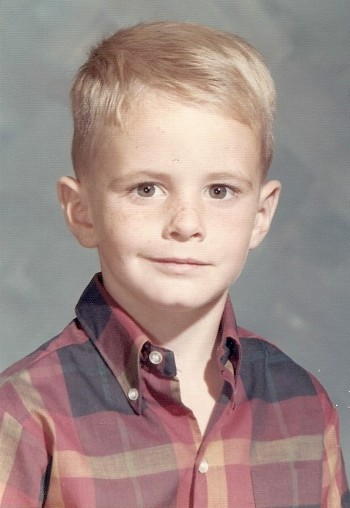 In this original BTB Investigation, we unveil the tragic story of Kirk Murphy, a four-year-old boy who was treated for “cross-gender disturbance” in 1970 by a young grad student by the name of George Rekers. This story is a stark reminder that there are severe and damaging consequences when therapists try to ensure that boys will be boys.
When we first reported on three American anti-gay activists traveling to Kampala for a three-day conference, we had no idea that it would be the first report of a long string of events leading to a proposal to institute the death penalty for LGBT people. But that is exactly what happened. In this report, we review our collection of more than 500 posts to tell the story of one nation’s embrace of hatred toward gay people. This report will be updated continuously as events continue to unfold. Check here for the latest updates.
In 2005, the Southern Poverty Law Center wrote that “[Paul] Cameron’s ‘science’ echoes Nazi Germany.” What the SPLC didn”t know was Cameron doesn’t just “echo” Nazi Germany. He quoted extensively from one of the Final Solution’s architects. This puts his fascination with quarantines, mandatory tattoos, and extermination being a “plausible idea” in a whole new and deeply disturbing light.
On February 10, I attended an all-day “Love Won Out” ex-gay conference in Phoenix, put on by Focus on the Family and Exodus International. In this series of reports, I talk about what I learned there: the people who go to these conferences, the things that they hear, and what this all means for them, their families and for the rest of us.
Prologue: Why I Went To “Love Won Out”
Part 1: What’s Love Got To Do With It?
Part 2: Parents Struggle With “No Exceptions”
Part 3: A Whole New Dialect
Part 4: It Depends On How The Meaning of the Word "Change" Changes
Part 5: A Candid Explanation For "Change"
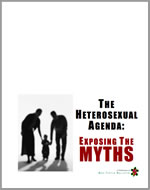 At last, the truth can now be told.
Using the same research methods employed by most anti-gay political pressure groups, we examine the statistics and the case studies that dispel many of the myths about heterosexuality. Download your copy today!
And don‘t miss our companion report, How To Write An Anti-Gay Tract In Fifteen Easy Steps.
 Anti-gay activists often charge that gay men and women pose a threat to children. In this report, we explore the supposed connection between homosexuality and child sexual abuse, the conclusions reached by the most knowledgeable professionals in the field, and how anti-gay activists continue to ignore their findings. This has tremendous consequences, not just for gay men and women, but more importantly for the safety of all our children.
Anti-gay activists often cite the “Dutch Study” to claim that gay unions last only about 1½ years and that the these men have an average of eight additional partners per year outside of their steady relationship. In this report, we will take you step by step into the study to see whether the claims are true.
Tony Perkins’ Family Research Council submitted an Amicus Brief to the Maryland Court of Appeals as that court prepared to consider the issue of gay marriage. We examine just one small section of that brief to reveal the junk science and fraudulent claims of the Family “Research” Council.
 The FBI’s annual Hate Crime Statistics aren’t as complete as they ought to be, and their report for 2004 was no exception. In fact, their most recent report has quite a few glaring holes. Holes big enough for Daniel Fetty to fall through.
“Google” is a trademark of Google Inc.
© Box Turtle Bulletin. All Rights Reserved.
 Posts
Posts  Posts via daily email: