Box Turtle Bulletin
 News and commentary about the anti-gay lobby
“Now you must raise your children up in a world where that union of man and box turtle is on the same legal footing as man and wife…”
News and commentary about the anti-gay lobbyNovember 18th, 2013
 One of the more contentious battleground over religious acceptance of same-sex marriage is within the United Methodist Church.
Unlike many other denominations, the UMC is not an American denomination; rather it is a global church with about a third of it’s membership outside the US. Ever four years, a convention of representatives meets to set it’s doctrines and policies and the issue of gay Methodists, pastors, and marriage are regularly debated. And while many Methodists are fiercely supportive of our rights, both civil and religious, the delegates from Africa and Asia uniformly oppose any movement towards acceptance.
In 2012, with 39% of delegates from outside the US, the church again confirmed the position that “homosexuality is incompatible with Christian teaching” and during scheduled ‘holy conversations’ on the subject, a number of participants felt that they were bullied and derided by those who oppose inclusion.
After the convention, the many within the church in the US began a stage of discontent. Several regional conferences express dissatisfaction with the decision, and in Washington and Minnesota they encouraged voters to support marriage equality on the ballot.
Many others, supported by retired Bishop Melvin Talbert, are rebelling against the rules. In Pennsylvania, over 30 UMC ministers pledged to defy the Methodist Book of Discipline and to jointly officiate at a same-sex wedding. They are making the stand in support of a fellow Pennsylvania minister, Frank Schaefer, who went on trial today.
Six years ago Schaefer’s son Tim asked him to officiate at his wedding. Schaefer agreed and for six years no one complained. Then a few weeks before the statute of limitations ran, a congregant who was “dismayed and shocked” to learn about the event pressed charges. (yahoo)
A United Methodist minister who officiated at his son’s same-sex wedding pleaded not guilty Monday to charges that he broke his pastoral vows.
The Rev. Frank Schaefer of Lebanon entered his plea at the beginning of a high-profile church trial in southeastern Pennsylvania that is rekindling debate over the denomination’s policy on gay marriage.
Schaefer contends that the Methodist Book of Discipline also directs pastors to address the needs of their flock, including gay members and that this was an act of love, not of rebellion.
This trial is being closely watched both within and without the church, including by several other ministers who are also up for trial.
Depending on the outcome of this trial – and others – the United Methodist Church could be in for some tumultuous years. The church is growing rapidly in Africa and the Philippines while it is decreasing in the United States. While support is growing locally, the delegation is increasingly from parts of the world where gays are treated with open contempt, allowing the anti-gay minority in the US to punish those who stand up for justice and mercy.
November 18th, 2013

As I’m sure you’ve noticed, I haven’t been blogging lately. Last week our family has suffered a terrible tragedy. Twister, our half-beagle/half something similar, was bitten by a rattlesnake on Monday. We took him to the veterinary emergency room and was given a vial of antivenom. Typically, under these circumstances the prognosis is good and he improved Tuesday morning, but then stalled out by Tuesday night — not improving, not deteriorating dramatically, although his platelet count was slowly declining. We gave him another vial of antivenom late Tuesday night.

Twister and me, stretched out for an after-breakfast nap early Wednesday morning.
The vet’s main concern was actually that he wasn’t eating. So on Wednesday morning I laid in the floor with him and was able to coax him to eat about three-fourths of his breakfast, which the vet was very happy to see. His platelets were still unstable, but his coagulation, while not back in the normal range, wasn’t deteriorating.
At 5:00 on Wednesday — this would be soon after I quickly posted about Hawaii’s marriage news — I talked with the vet over the phone and her main worry still was that he wasn’t eating and that his numbers weren’t improving. Getting him to eat seemed to be the key. She agreed that it would be a good idea of we brought him home where I was sure Chris and I could get him to eat. She would give us pain meds and a list of things to watch for and if there were problems we could still take him to the emergency room again. But in the hour it took to get there — we stopped at Walgreens on the way to stock up on supplies — Twister took a sudden and dramatic turn for the worse. The vet met us and said that his heart was damaged and giving out. We asked to be with him, and she said she’d bring him to the visiting room so we could spend as much time with him as we wanted. But not even a minute later she returned to say that he was too unstable to move.
So we went back to the intensive care area and said our goodbyes. At first, I thought Twister was unconscious, but at one point he raised his head and saw us, and knew we were there, he then lowered his head and closed his eyes. We pet him and told him we loved him. It was clear that he didn’t have much time at all. We gave the signal and he was gone.

Me and Twister, 2008
Chris and I are absolutely devastated. We had gone to the vet expecting to bring him home — I had already made arrangements to take the next day off thinking that I’d be taking care of him — but that just wasn’t in the cards. I find myself in shock over the tragedy, and surprised by how much grief we are experiencing. I know that people without children often treat their pets like substitute kids, but I always thought that we were smarter than that. I never once thought of Twister as a substitute child, nor do I want to in any way compare our grief to that of a parent’s. But somehow it happened: Twister was deeply loved and now he is gone and Chris and I are really having a very hard time right now. I have to go back to my father’s death when I was 22 to recall a grief this massive and dark.
All of this is to say that I don’t know how much blogging I’ll be doing for a while. I’ll keep the Agendas going, but beyond that I’m not sure when I’ll return. I will be back, but I just can’t say when.
November 18th, 2013

Julie and Hillary Goodridge
TODAY IN HISTORY:
10 YEARS AGO: Massachusetts Supreme Court Rules In Favor of Marriage Equality: 2003. It’s been ten years since the Bay State became the first in the nation to provide marriage equality for same-sex couples, and the sky still hasn’t fallen. Massachusetts still has the lowest divorce rate in the nation, and school children are still not being subjected to live gay sex demonstrations as part of their state-mandated curriculum. But gay couples can marry, and that was due to the Massachusetts Supreme Judicial Court decision in 2003, which became the first state supreme court to rule that same-sex couples had constitutional right to marry.
In Goodridge v. Department of Public Health, the court ruled 4-3 that the state could not “deny the protections, benefits and obligations conferred by civil marriage to two individuals of the same sex who wish to marry.” The court gave the state legislature 180 days to “take any such action as it may deem appropriate” to begin issuing marriage licenses to same-sex couples. Liberty Counsel tried to get the Federal Courts involved, but those efforts failed when the judge denied their request, the First Circuit Court of Appeals backed him up, and the Supreme Court declined to hear the case. After a long drawn-out battle in which the Massachusetts high court ruled in response to a question from the state Senate that civil unions would not satisfy the court’s ruling, the legislature ended up taking no action, neither blocking nor implementing the Goodridge decision. The state began marrying same-sex couples on May 17, 2004.
Since then, marriage equality has spread to fourteen states, the District of Columbia, eight counties in New Mexico and eight Indian tribes. The number of states is now poised to grow by two, with Hawaii becoming marriage equality paradise on December 2 and Illinois joining the list next June.
If you know of something that belongs on the Agenda, please send it here. Don’t forget to include the basics: who, what, when, where, and URL (if available).
And feel free to consider this your open thread for the day. What’s happening in your world?
November 17th, 2013
TODAY’S AGENDA:
Events this weekend: Pride, Darwin, NT; Mazipatra Queer Film Festival, Prague/Brno, Czech Republic International Gay Rodeo Convention, San Diego, CA.

TODAY IN HISTORY:
The Arrest of “The 41” in Mexico City: 1901. Getting to the bottom of what actually happened is tricky business. The only accounts of the raid conducted by Mexico City’s police on a private party come from a decidedly unapproving and often sensational press. We know virtually nothing of those who were arrested; we barely know some of the names. Their story was never told: they were never interviewed, and as far as I can tell there is not a single quote which can be reliably attributed to any of them. Whatever we may know of the scandal was clouded further by fictional accounts — the 41, as they were simply known, became the subject of a popular novel in 1906. But one thing is certain: the “Ball of the 41” became the scandal of the year, inspiring more than a month of headlines, sermons, editorials, and even a few corridos.
Only a few details are solid. In the very early morning hours of November 17, 1901, police raided a private party and arrested forty-one men, nineteen of them were dressed as women. The one in drag were publicly humiliated by being forced to sweep the streets — “women’s work.” The 41 were taken to an army barracks and inducted into the Mexican army. At least some of them were then put on a train to Veracruz, sent by ship to the Yucatán, and made to serve in the army as it was putting down a Mayan insurgency.
Those appear to be the bare facts, which, of course, weren’t enough to satisfy the nation’s newspapers. Here is how El Popular reported the story on November 20:
Last Sunday night, the police of the Eighth Precinct were informed that in the house located at number 4 La Paaz Street, a ball was being held without the corresponding permit. They immediately moved in to surprise the culprits, and after having encountered numerous difficulties in trying to get the partygoers to open up, the police broke into the house’s patio where they found 42 individuals who were dancing to the excessively loud music of a local street band.
When they noted the presence of the police, some of those who were dressed in women’s clothing attempted to flee in order to change out of the clothes of the opposite six; but as the police understood the gravity of the situation, they did not allow anyone to leave, and all 42 including those still dressed as women were taken to the station from which they were then sent to Belem Prison, charged with attacks on morality, and put at the disposition of the District Governor.
As a complement to the previous report, we will say that among those individuals dressed as women, several were recognized as dandies who are seen daily on Plateros Street.
These men wore elegant ladies’ gowns, wigs, false breasts, earrings, embroidered shoes, and a great deal of eye makeup and rouge on their faces.
Once the news hit the boulevards, all kinds of commentaries were made, and the conduct of those individuals was censured.
We will not provide our readers with further details because they are summarily disgusting.
It was said that many of those arrested came from highly respected families with ties to the government of dictator Porfirio DÃaz. Some of the earliest newspaper reports, like this one, had it that 42 were arrested. That number later dropped to 41, which generated even more rumors. One had it that the elderly lady who owned the house was one of those arrested, and she was later released. Other, more sinister rumors had it that one of those arrested was one of DÃaz’s nephews.
El Popular may have been reluctant to provide details, but in subsequent days it was happy to imagine the scene for its readers:
If only we had seen them in their resplendent hairdos, their fake cleavage, with their shiny sparkling earrings, with their falsies like the ones worn by anemic bimbos, with their corseted waists, their dancing-girl skirts like inverted tulips, their butterfly tights, their shoes fringed with crimped gold thread and colored glass beads, and all of them bedaubed in white powder and rouge, prancing about in the fandango with their perfumed and curly mustaches.
On November 23, El PaÃs published this account of one group of prisoners being transferred to the train bound for Veracruz:
The men-only ball that was raided by the police continues provoking talk in all social circles, by virtue of the fact that many of those detained are perfectly well known, since among them are men who stroll day after day down the boulevards showing off their stylish and perfectly tailored suits and wearing sumptuous jewels.
As we stated in yesterday’s issue, 12 of those captured in the house on the fourth block of La Paz were sent to Veracruz along with seven thieves who were also conscripted into the armed services.
At 5:30 in the morning, the hour at which attendance is taken in the 24th Battalion (that is being remitted to the port of Veracruz), those called on first were the 12 individuals who had been at the famed ball, and after number 13, who was a pelado [a term for a rough, lower-class urban Mexican] was called, he replied on hearing his name, “Present, my Captain,but let me go on record as saying that I am being conscripted as a thief; but I’m not one of them,” and he pointed to the group of dancers.
This provoked the laughter of those present, because not even a thief was willing to be confused with the perfumed boys, as they are called by the soldiers from the barracks
A very amusing scene developed in the the barracks of the 24th Battalion when the repugnant ones arrived wearing their magniï¬cent overcoats, along with hats and ï¬ne patent-leather shoes. The captain of the recruits made them all strip without delay, and then handed out the rough but honorable articles of clothing that are given to recruits.
With tears in their eyes, they stripped off all their clothes, some of them begging that they be allowed at least to keep their ï¬ne silk undergarments, a request that the captain denied, since, he told them, there they were just the same as everyone else. He didn’t even allow them to keep their socks, and they all began to cry as they put on the shoes that would replace their lovely patent leather ladies’ shoes.
The government paper, El Imparcial, took plains to deny that the army was foolish enough to send any girly-men to the front lines:
All of the prisoners have been sent to Yucatán, but not — as it has been said — to join the ranks of the valiant soldiers taking part in the campaign; they will be employed instead on such tasks as digging trenches, opening breaches, and raising temporary fortifications.
As you have undoubtedly noticed, it was the men in drag who occupied the attention of the press; through their manner of dress, they particularly transgressed the limits of what was tolerable in Mexican society. This brings up the two ways in which homosexuality has traditionally been viewed in Mexico: There are homosexuals, and then there are homosexuals. There are men who are attracted to other men (we understand this homosexuality as a sexual orientation), and there are men who, while identifying as men, are effeminate and, more specifically, adopted the “passive” role (a further transgression of the male gender role.) The second group, it might be said, are the real homosexuals according to traditional society; it was possible (and still is in some rural areas) for one man to have sex with another man and still be regarded as straight, as long as he is the one who retains his claim to masculinity by being the chingón (the one who does the deed) and not the chingado (the one to whom the deed is done), who has effectively surrendered his claims to masculinity.
As long as there was at least some measure of deniability that one had surrendered their masculinity, then that masculinity (and hence, heterosexuality) remained intact in many peoples’ eyes. But deniability was crucial. A few newspapers tried to argue that the twenty-one how weren’t in drag were had been “tricked,” leaving readers to try to imagine who those “tricked” men couldn’t have known who they were dancing with. Other accounts, of course, found that impossible to believe. And it appears that it was that lack of deniability which ultimately doomed everyone to the same fate. While those who were in drag were the most remarked-upon players in the scandal, the whole affair today is known as the “the 41,” not just the nineteen.
Today, the number 41 has become slang for homosexuality or, more specifically, “faggot” or maricón. Some of the early LGBT advocacy groups in Mexico incorporated the number into their names, just as many similar groups in the U.S. have leveraged “Stonewall” as a shorthand for the struggle for gay rights.
[Sources: Robert McKee Irwin. “The Famous 41: The scandalous birth of modern Mexican homosexuality.” GLQ: A Journal of Lesbian and Gay Studies 6, no. 3 (2000): 353-376.
Robert McKee Irwin, Edward J. McCaughan, Michelle Rocio Nasser. The Famous 41: Sexuality and Social Control in Mexico, 1901

TODAY’S BIRTHDAY:
Rock Hudson: 1925-1985. In 1960, The Saturday Evening Post’s Pete Martin interviewed him in 1960 and asked the question that far more people were asking that we might realize:
“…Somewhere during this interview I have to write at least one paragraph in which I say that you were married and that you are not married any more. I’ll tell you this before you begin: I’ve read that your marriage was ‘made,’ not by you but by the same agent who is reported to have made a star of you.”
“I’m sure you did read that,” he said. “I read it too, and it made me feel like an idiot. She was my agent’s secretary. I met her in a supermarket. She introduced herself. Naturally I had talked to her many times on the phone. For a while we had a lot of trouble getting together. Either I had a date or she had one. We went together for a year and were married. But it didn’t work out. We stayed married only a couple of years. Last summer our divorce was final. Now I’m single again.”
…I said, “I’m interested in your present reaction to dames. You do date, don’t you?”
“Certainly,” he said. Only my dates don’t get into print. To get a date into print you have to appear in a public place like a night club. I don’t like night clubs.”
“What’s your idea of a date?”
“To take a girl for a sail or meet her at my house or somebody else’s house. What am I supposed to prove? There are times when I almost wish I made the scandal sheets.”
Even in 1960, the interest in Hudson’s love life went a bit beyond that experienced by other male sex symbols. What other subtext could possibly explain the question about whether his marriage to Phyllis Gates was “made” or not? Martin’s question came exceptionally close to exposing the secret that just about everyone in Hollywood knew, that Hudson’s agent, Henry Willson (see Jul 31), had prevailed on Hudson to marry Willson’s secretary after Hudson narrowly escaped having his secret exposed in Confidential magazine in 1955. The couple divorced in 1958, and Hudson never married again. His secret remained well-protected outside of Hollywood, even if gays in L.A. didn’t always respect it. Los Angeles-based ONE magazine, in a laudatory review of a book acknowledging Michelangelo’s homosexuality, suggested the book would make a great movie starring Rock Hudson. “That would be casting with a twist. Or two,” ONE commented with characteristic snark.
Hudson was just one product from Willson’s “Adonis factory,” so named for Willson’s uncanny ability to find (and often, bed) some of Hollywood’s hotest male stars. Willson took a not-so-smart Roy Fitzgerald out of the truck he was driving, fixed his teeth and his bad grammar, taught him to lower his voice and lose his sibilant lisp, along with how to move, shake hands, sit, dance, sing, ride horses, and even act. It took Hudson thirty eight takes before he could successfully deliver his only line in Warner Brother’s Fighter Squadron in 1948.
He got better from there. He received good reviews for his role in 1954’s Magnificant Obsession opposite Jane Wyman, and his popularity went through the roof with the 1956 release of Giant, which also featured Elizabeth Taylor and James Dean. In the 1960s, he turned to romantic comedies, including three with Dorris Day: Pillow Talk, Lover Come Back, and Send Me No Flowers. As the sixties wore on, film offers declined and Hudson began transitioning to television. From 1971 to 1977, he played police commissioner Stewart McMillan in McMillan & Wife (“wife” was played by Susan Saint James).
In November 1981, Hudson suffered a serious heart attack, followed by quintuple bypass surgery. That didn’t surprise anyone because of his heavy drinking and smoking, but his unusually long recovery did. He remained in ill health while filming The Ambassador in 1983-1984, and health problems followed while filming the made-for-TV movie The Vegas Strip Wars in 1984. When he began appearing in a recurring role in the primetime soap Dynasty with his gaunt appearance, deteriorating speech and failing memory — he could no longer memorize his lines — rumors began to fly. First it was cancer, this publicists said, but others were whispering AIDS.
In July 1985, Hudson appearance on Doris Day’s talk show became instant news, thanks to his shocking appearance and incoherant speech. The following week, Hudson flew to Paris and checked into the hospital at the Pasteur Institute. The official version, at first, was that Hudson was “tired” and that a diagnosis wasn’t yet available. But reporters didn’t fail to notice that the Pasteur Institute was one of the world’s leading research institutions on AIDS and the destination for hundreds of American AIDS patients seeking treatments that were unavailable in the U.S, as you can see in this report:
Hudson’s publicists soon acknowledged most of what everyone else suspected: that Hudson was in Paris for experimental treatment for AIDS, which he attributed to multiple blood transfusions when he underwent bypass surgery. But even that story didn’t hold for long. People magazine published a story about Hudson’s disease, and featured comments from Angie Dickinson, Robert Stack, Joan Rivers, and Mamie van Doren, who said they knew about his homosexuality and supported him. His death on October 2, 1985, galvanized Hollywood, especially his life-long friend Elizabeth Taylor, who made AIDS fundraising not just a fashionable cause, but an urgent one for a nation that was still very uncomfortable about discussing the disease.
[Sources: Robert Hofler. The Man Who Invented Rock Hudson: The Pretty Boys and Dirty Deals of Henry Willson
Peter Martin. “I call on Rock Hudson.” The Saturday Evening Post 233, no. 4 (July 23, 1960): 16ff.
Sal McIntire. “Tangents: Gutsy Scholar with a Shovel.” ONE 10, no. 11 (November 1962): 15-16.]
If you know of something that belongs on the Agenda, please send it here. Don’t forget to include the basics: who, what, when, where, and URL (if available).
And feel free to consider this your open thread for the day. What’s happening in your world?
November 16th, 2013
TODAY’S AGENDA:
Events this weekend: Pride, Darwin, NT; Mazipatra Queer Film Festival, Prague/Brno, Czech Republic International Gay Rodeo Convention, San Diego, CA.

TODAY’S BIRTHDAY:
Paula Vogel: 1951. “I only write about things that directly impact my life.” Vogel says. “If people get upset, it’s because the play is working.” It certainly worked for How I Learned to Drive, which explores control and manipulation through the issues of misogyny, pedophilia and incest through the relatively simple metaphor of driving. She won the 1998 Pulitzer Prize for Drama for it.
Her first major play, The Baltimore Waltz was a comedy about AIDS, in 1990, when AIDS still couldn’t be joked about much. Hot’N Throbbing (1994) looks at the intersection of porn and domestic violence, while The Mineola Twins (1999) portrays women’s experience over the previous thirty years through the eyes of identical twins. The plays are deadly serious, though many of them are also comedies or at least incorporate comedy in them. They are also, as theater theorist Jill Dolan wrote, “at once creative, highly imaginative, and brutally honest.”
Vogel says that her family, especially her brother who died of AIDS in 1988, play a very important role in her plays. “In every play, there are a couple of places where I send a message to my late brother Carl. Just a little something in the atmosphere of every play to try and change the homophobia in our world.” She is also a teacher, having led the graduate playwriting program at Brown University. In 2004, she married Brown University professor and researcher Anne Fausto-Sterling in Massachusetts. In 2008, she left Brown to chair the playwriting department at Yale. She stepped down from that position in 2012.

Glenn Burke: 1952-1995. He was known as “the guy who invented the high five,” when in a game in 1977, Burke was standing on deck as fellow Dodger Dusty Baker was rounding third and headed for home after hitting a home run. As Baker crossed home plate, Burke raised his had. Baker responded by raising his also, and when the two slapped hands, history was made. Believe it or not. And to make the scene complete, Burke then stepped up to the plate and hit a home run of his own.
Burke made another kind of history, after a fashion: he is believed to be the first gay ballplayer who was out to his team mates. According to his 1995 autobiography, Out at Home
In 1982, Burke became the first former professional league player to come out as gay. He was a hero in his adopted community in San Francisco’s Castro, but without baseball his life soon spiraled downhill. He struggled with drug addiction, and for a while became homeless. He spent several months in prison for grand theft and possession of a controlled substance. His final months were spent with his sister before succumbing to AIDS in 1995 at the age of 42.
If you know of something that belongs on the Agenda, please send it here. Don’t forget to include the basics: who, what, when, where, and URL (if available).
And feel free to consider this your open thread for the day. What’s happening in your world?
November 15th, 2013
TODAY’S AGENDA:
Events this weekend: Pride, Darwin, NT; Mazipatra Queer Film Festival, Prague/Brno, Czech Republic International Gay Rodeo Convention, San Diego, CA.

Frank Kameny (center) marching with members of the Washington Mattachine Society in 1970.
TODAY IN HISTORY:
First Official Meeting of the Washington Mattachine Society: 1961. On this date in history, gay rights pioneer Frank Kameny and several others held the first official meeting of the Washington Mattachine Society. The Washington Mattachines, unlike other Mattachine Societies elsewhere in the country, brought a new, aggressive approach to the fight for gay rights. Frank Kameny later reflected on the society’s founding in an essay he contributed to Eric Marcus’s Making History: The Struggle for Gay and Lesbian Equal Rights : 1945-1990 : An Oral History
Meanwhile, other things were going on with Mattachine. The national structure of Mattachine collapsed in March of that year. The San Francisco Mattachine had cut loose all the other affiliates and wished them well, urging them to change their names and to keep on working. The Denver group became The Neighbors and disappeared. The New York group retained its name and incorporated as a nose-thumbing gesture to San Francisco. It be came the Mattachine Society, Incorporated, of New York versus the Mattachine Society in San Francisco. It was all very petty.
…That following November, on November 15, 1961, we had our first official meeting of the Washington Mattachine. I was the organizer and founder. We did all the things that an organization does when it gets going. We took out a back account, got a post-office box, wrote our constitution, elected our officers, set up our meeting structure, and chose a name. I opted against using the Mattachine name, but I was outvoted. I wanted something that was more explicit and expressive, but wouldn’t have used the word gay then. While it was an in-group word, it hadn’t yet gone public.
Now the movement of those days was very unassertive, apologetic, and defensive. I don’t say this critically, and not necessarily derogatorily, but it was a different era. First of all, up to this time, homosexuality had never been publicly discussed. Let me give you an illustration of that. As you’re aware, the question of queers int he government was very much part of the grist of the mill for McCarthy in his hearings in the early 1950s. When McCarthy was riding high, I was still in graduate school at Harvard. I read the Boston Herald every day. I read the New York Times every Sunday. I listened to the radio all the time. I read Time magazine weekly. Yet I did not learn until somewhere around 1958 or 1959 that homosexuality had been a theme of those hearings because it was not widely reported.: the word homosexual was not fit to print or discuss or be heard. Virtually from one end of the decade to the other, outside the medical books, there was nothing anywhere on the subject. It was blanked out, blacked out. It wasn’t there!
Because there was no publicity, there was no way of getting to people. The people in the small movement at that time were only talking to themselves. There was absolutely nothing whatsoever that anybody heard at that time, anywhere that was other than negative! Nothing! We were sick; we were sinners; we were perverts. And so the movement, predictably, in retrospect, did not take strong positions. It gave a hearing to everybody, saying, “As long as it deals with homosexuality, all views must be heard, even those that are the most harshly and viciously condemnatory to homosexuals. We have to defer to the experts.” My answer to that was, “Drivel! We are the experts on ourselves, and we will tell the experts they have nothing to tell us!” Giving all views a fair hearing didn’t suit my personality. And the Mattachine Society of Washington was formed around my personality.
So we at the Washington Mattachine characterized ourselves within the movement as an activist militant organization. Those were very dirty words in those days in the movement, such as it was. You weren’t supposed to be militant. And we were, both in our actions and our goals. Our statement of purposes set out our goals, which were generally to achieve equality for homosexuals and homosexuality against heterosexuals and heterosexuality. Equality was the primary issue.
If you know of something that belongs on the Agenda, please send it here. Don’t forget to include the basics: who, what, when, where, and URL (if available).
As always, please consider this your open thread for the day.
November 14th, 2013
TODAY’S AGENDA:
Events this weekend: Pride, Darwin, NT; Mazipatra Queer Film Festival, Prague/Brno, Czech Republic International Gay Rodeo Convention, San Diego, CA.

TODAY’S BIRTHDAY:
Adolf Brand: 1874-1945. The German editor, photographer, poet, anarchist and activist was born not quite a century before his time. Beginning in 1896, he published Der Eigene (There is no good English equivalent; Der Eigene is often translated as The Unique, The Special One, or The Self-Owned), the world’s first gay journal. The first issue declared, “This journal is dedicated to eigen people, such people as are proud of their Eigenheit and wish to maintain it at any price.” The phrase “Eigen people” may have meant anarchists, at least at first; Brand’s journal was more of an anarchist journal than a pro-gay one, reflecting Brand’s own anarchist views at the time. But Der Eigene became explicitly homosexual in 1898, and remained so until 1932.
Brand’s brand of gay activism was revolutionary. In contrast to the better known activism of Magnus Hirschfeld (see May 14), Brand angrily rejected the medical model and scientific approach of Germany’s sexologists, saying that their research “took away all beauty from eroticism.” Brand established the Gemeinschaft der Eigenen (Community of Eigens) in 1903 as a counterweight to Hirschfeld’s Scientific-Humanitarian Committee. It also served a secondary purpose. With Der Eigene under constant threat of prosecution for obscenity — Brand successfully fought off charges in court that same year — Gemeinschaft der Eigenen became a kind of a closed readers’ circle, with Der Eigene becoming a private in-house publication. In 1905, when Der Eigene was officially recognized as an “artistic journal,” it became somewhat less vulnerable to censors and could be circulated more freely.
 Brand’s militancy led him to conduct what was perhaps the world’s first “outing” campaign. In 1907, just as the massive Harden-Eulenburg affair was scandalizing the German political establishment, Brand published a pamphlet accusing German Chancellor Prince Bernhard von Bülow of having a homosexual relationship with Privy Councilor Max Scheefer and was therefore morally obligated to oppose Germany’s Paragraph 175, which outlawed homosexual relatinships between men. According to Brand, Bülow and Scheefer were seen kissing at all-male parties hosted by the Phillip, Prince of Eulenburg. Bülow sued Brand for criminal libel, and Brand was sentenced to eighteen months in prison.
Brand served two years in the German army during World War I, during which he married Elise Behrendt, a nurse who apparently loved him despite his homosexuality. After the war, Der Eigene was overshadowed by other gay publications during the relatively gay-friendly atmosphere of the Weimar era. In many ways, Brand’s brand of activism was out of step with 1920s Germany. Brand’s embrace of pederasty, extramarital bisexuality, and the supposed superiority of “friend-love” as the pinacle of masculinity were rejected in favor of Hirschfeld’s view that homosexuality was an inborn analogue to heterosexuality.
Brand’s elevation of manly friendship and the glorification of the nude body has led to accusations that Brand was himself a proto-faschist. Certainly, it’s easy to see parallels between Brand’s promotion of male bonding with the Nazis’ ideals of national manliness, but Brand himself, ever the anarchist, saw the dangers that Nazism posed. He wrote in 1931 that the Nazis “already had the hangman’s rope in their pockets.”
Der Eigene was shut down in 1932 just as the Nazis were coming into power. The police raided his home several times, seizing his books, journals, and photographs. He was never arrested, but he was financially ruined. “I have been plundered of everything,” he wrote to the Sexological Society in London. “I have nothing left to sell and am financially ruined. I no longer know from what I and mine can continue to live. For my whole life’s work is now destroyed. And most of my followers don’t have even the courage to write me a letter, not to mention support my work with any kind of payment.” Brand fell on hard times and was forced to sell his home. He and his wife moved to a one room flat, where they were both killed during alllied bombing on February 2, 1945.
[Source: Hubert Kennedy. “Adolf Brand.” GLBTQ.com (undated).]

Aaron Copland: 1900-1990. Born in Brooklyn to Lithuanian Jewish parents, Copland composed some of the most quintessentially American classical music. Appalachian Spring celebrated American pioneers; Billy the Kid set the open prairie to music; Rodeo sells beef on television (“It’s what’s for dinner”); and Fanfare for the Common Man was, briefly, the theme music for Rick Perry’s ill-fated presidential run, which was ironic that a rabidly anti-gay politician would turn to such patriotic music that was composed by a relatively openly gay man.
Copland’s childhood was a rather typical one for an immigrant family in New York City. His father, who had no musical interest, owned a small department store. It was his mother, brothers and sisters — he was the youngest of five — who were musically inclined. His oldest brother played violin, and a sister gave him his first piano lessons and exposed him to opera. From the age of thirteen, he began formal music lessons. By age fifteen, he decided to become a composer. From 1921 to 1924, Copland went to Paris for further study at the Fontainebleau School of Music. In 1925, he returned to the U.S., and with two Guggenheim Fellowships in 1925 and 1926, he was able to rent a studio apartment where he lived for the next thirty years. He met Alfreid Stieglitz, who introduced him to many of the leading artists of the day: Paul Strand, Ansel Adams, Georgia O’Keefe, and Walker Evans, whose photos inspired Copland’s opera The Tender Land.
Stieglitz’s determination that American artists should reflect “the ideas of American Democracy” had a profound effect on Copland. It also represent a severe challenge. American classical music composers looked to Europe as a model for music composition. All that American had was popular music, folk music and jazz. The challenge for Copland was to show how these so-called “lower” forms of music could be in integral part of classical music. He joined five other like-minded composers to form what was called the “commando unit,” who collaborated in joint concerts to promote their new approach.
Once the depression hit, Copland expanded his horizons again through travels to Europe, Africa and Mexico. When Hitler and Mussolini attacked Spain in 1936, Copland, along with many other artists, were sympathetic to the Spanish Republicans, and many of them had joined the Communist Party. Copland himself didn’t join — he was committed to his refusal to join any party — but he did sympathize with leftist political movements, including his support for the Communist Party USA ticket during the 1936 presidential election, and for Henry A. Wallace’s presidential bid on the Progressive Party ticket in 1948.
This period of political turmoil coincided with some of Copland’s most famous work. In 1939, he completed his first two Hollywood film scores, for Of Mice and Men and Our Town. That same year, he debuted his highly successful ballet Billy the Kid. He followed that with two more acclaimed ballets, Rodeo (1942) and Appalachian Spring (1944), which featured the melody of an old Shaker hymn, “Simple Gifts.” A Lincoln Portrait and Fanfare for the Common Man, both debuted in 1942 as American was entering World War II, have become American patriotic standards.
But the McCarthy era of the 1950s proved difficult. A Lincoln Portrait had been on the program for Eisenhower’s 1953 inaugural concert, but it was withdrawn over controversy over Copland’s earlier sympathies with leftist politics. That same year, he was called to testify before Congress, where he insisted that he had never joined the Communist Party. Ignored during the controversy was Copland’s deeply patriotic music, a neglect which outraged many American musicians.
During the 1950s, Copland’s pace in composition fell off as new avant garde musical trends became fashionable in the music world. But he continued to influence other American composers, most principally his friend and student, protégé Leonard Bernstein. By the 1960s, Copland had more or less given up composing and took up conducting. He wasn’t crazy about the idea, but, as he said, “It was exactly as if someone had simply turned off a faucet.” This career change saw him conducting some of American’s great orchestras recording a major part of his canon for posterity. His health deteriorated through the 1980s and he died in 1990 from Alzheimer’s and resipitory failure.

Albrecht Becker, abt 1930.
Albrecht Becker: 1906-2002. Albrecht Becker was an actor and production designer who lived with his parter of ten yeas in Würzburg in Bavaria. In 1935, he came under the notice of the Gestapo when they were investigating another Würzburg resident, Dr. Leopold Obermayer, a Swiss national who was both Jewish and gay. During the course of the Gestapo’s investigation, they found several photos of young men, including Albert Becker, in Obermeyer’s possession. Obermeyer was sent to Manthausen concentration camp, where he ultimately perished. Becker was also tried under Germany’s notorious Paragraph 175 and sentenced to a three year term in Nürnburg Prison. In 1940, he joined the German army and sent directly to the Eastern front where soldiers weren’t expected to survive.
But survive he did, and he was able to return to Germany and work in the film industry after the war. He became an internationally recognized photographer, production designer and actor for German television. His story is one of six personal histories recounted in the 2000 documentary, Paragraph 175,
If you know of something that belongs on the Agenda, please send it here. Don’t forget to include the basics: who, what, when, where, and URL (if available).
As always, please consider this your open thread for the day.
November 13th, 2013
Gov. Neil Abercrombie today signed the marriage equality bill into law this morning, describing the law as part of Hawaii’s “legacy of aloha.”
At a signing ceremony at the Hawai’i Convention Center’s Liliu Theater, the governor told dozens of invited guests and state lawmakers that the marriage equality bill was the “epitome of the First Amendment in action.”
Hawaii is the 15th state plus the District of Columbia to allow gay marriage. Illinois is expected to become the 16th state later this month when Gov. Pat Quinn signs a marriage equality bill into law in Chicago.
Gay couples can get married in Hawaii as soon as Dec. 2. Clergy can refuse to perform gay weddings. Churches and other religious organizations can deny goods, services and facilities for gay weddings and receptions if it violates religious beliefs.
I understand that the beach, the palm trees, and the tropical forest have already announced that they have no religious objections. Poi is on board, as is the ukulele and luau.
November 13th, 2013
 In a private, invitation-only ceremony at the Hawai’i Convetion Center, Gov. Neil Abercrimbit signed into law a bill granting marriage equality to Hawaii’s same-sex couples:
“In Hawaii, we believe in fairness, justice and human equality,” Abercrombie said Tuesday after the state Senate passed the gay marriage bill. “Today, we celebrate our diversity defining us rather than dividing us.”
 Gov. Abercrombie also read from the First Amendment to the U.S. Constitution and called the marriage equality bill “the epitome of the First Amendment in action.” The Honolulu Star-Advertiser, which normally has its articles behind a paywall, provided a public article with more details about today’s ceremony“:
Abercrombie signed the bill into law today with a koa pen, which he said he would give to Steven Levinson, the former state Supreme Court associate justice who wrote the landmark 1993 opinion on same-sex marriage.
Levinson’s opinion on behalf of a splintered Hawaii Supreme Court cleared the way for Hawaii to be the first state in the country to legalize same-sex marriages, a radical idea at the time. It produced a backlash nationally, with Congress in 1996 passing the Defense of Marriage Act that prohibited federal benefits from going to same-sex married couples.
In Hawaii, the state Legislature adopted a measure in 1994 reserving marriage between a man and a woman; voters then passed an amendment in 1998 that states, “The Legislature shall have the power to reserve marriage to opposite-sex couples.”
When the law goes into effect on December 2, Hawaii will become the fifteenth state, in addition to the District of Columbia, eight counties in New Mexico and seven Native American tribes, to provide marriage equality. Illinois, which had been slated to become number fifteen, will now slide to a tentative sixteenth when same-sex marriages become legal there next June. Illinois Gov. Pat Quinn is scheduled to sign that state’s marriage equality bill into law in a ceremony scheduled for November 20.
November 13th, 2013
TODAY’S AGENDA:
Events this weekend: Pride, Darwin, NT; Mazipatra Queer Film Festival, Prague/Brno, Czech Republic International Gay Rodeo Convention, San Diego, CA.
THIS MONTH IN HISTORY:
Marriages Between Women: 1902. The November 1902 issue of the journal Alienist and Neurologist (“Alienist” was a nineteenth century term for psychiatrist) included this brief notice:
MARRIAGES BETWEEN WOMEN.– Two recent cases of marriages between women have been disclosed by the death of the alleged “husband”. (“George” Greene, a well- known citizen of Ettrick, Va.,) who died at the age of 75. The wife called in assistance to prepare the body, when deceased was discovered to be a woman. “He” had been born in England, but came to the United States when a child. “He” early exhibited proclivities for male attire to which the family soon became accustomed. “He” worked for several years as a man and married (at the age of 40) a widow. The couple maintained their relationship without discovery until Greene’s death, at the age of 75.
“William” C. Howard died in Canandaigua, New York, at the age of 50. The refusal of the “widow” and “children” to permit an undertaker to prepare the body for burial led to a coroner’s inquest, which disclosed the fact that “William” was a woman. “William” had early manifested male proclivities. “His” family had been unable to induce “him” to adopt female attire. When a girl on “his” father’s farm “he” donned male attire and took up masculine occupation, taking care of horses and cattle and doing chores. The family ceased to remonstrate with her, at length growing accustomed to her male attire and often joking about the attentions she paid her own sex. She escorted girls to parties and spent money on them freely. Finally she “married” a woman named Dwyer and later adopted two children. The couple took a farm near Canandaigua and settled down quietly.
There was nothing especially feminine in either Greene or Howard; while Howard’s ancestral family knew the real condition of things, they do not seem to have looked upon the relationship as at all abnormal. This would appear to indicate that the relatives of inverts have a certain tolerance for homosexuality. The influence of training at the indifferent periods in the development of homosexuality is suggested by the Howard case. The donning of male attire for convenient purposes may have stimulated a potential inversion previously latent.
[Source: Charles H. Hughes. “Marriages between women.” Alienist and Neurologist 23, no. 4 (November 1902): 498-500.]
If you know of something that belongs on the Agenda, please send it here. Don’t forget to include the basics: who, what, when, where, and URL (if available).
As always, please consider this your open thread for the day.
November 12th, 2013
The state Senate passed a bill Tuesday legalizing gay marriage, putting Hawaii a signature away from becoming a same-sex wedding destination.
Gov. Neil Abercrombie, who called lawmakers to a special session for the bill and has vocally supported gay marriage, has said he would sign the measure. It will allow thousands of gay couples living in Hawaii and even more tourists to marry in the state starting Dec. 2.
Senators passed the bill 19-4 with two lawmakers excused. Cheers erupted inside and outside the gallery when the vote was taken, with a smattering of boos.
November 12th, 2013
 With all the recent noise coming out of Russia these days on gay rights (or the lack thereof) it’s easy to lose sight of why Putin has gone along with the anti-gay legislation when it has only caused problems for him in the West. If Sochi is all about projecting a vision of Russia as a nation worthy of investment and a leader in world affairs, why risk letting the “gay problem” overwhelm the message?
This Buzzfeed piece by J. Lester Feder is a good introduction, although the title is misleading. What Feder documents is how existing anti-gay sentiment is being used by pro-Russian forces within former Soviet bloc countries to tie those countries closer to Russia and, more importantly, steer them away from the EU and into Putin’s “Customs Union” instead — not a very prosaic name, that — sounds a bit like the Trade Federation in Star Wars. A more straightforward name like “Russian Union” might remind everyone of that Soviet one they had 20 years ago.
What many Western gay rights activists too often miss is that anti-gay sentiment is not being created or fomented by Putin or the anti-western, pro-Russian crowd. Anti-gay sentiment already exists, at about the same levels it existed here in the US 50 or 60 years ago. The comparisons to Hitler and the Nazis are also inept — unlike Hitler whose party platform identified Jews as the problem from the get go, anti-gay legislation in Russia has been grass roots and Putin merely stood by while it spread from oblast to oblast in the early 2000s. It was only this past June that a federal law was finally passed, only 9 months after the New York Times was reporting massive anti-Putin marches in Moscow – that is to say, these anti-Putin protests created a little spark in Putin’s eye and, 9 months later, a federal anti-gay law was born.
Fast forward to the present — Putin’s imperial designs on his neighbors suddenly tie in very, very well with federal anti-gay legislation. To its neighbors, Russia is suddenly a bastion of morality and also the seat of the glorious Winter Olympics, a brave, proud country that can save Ukrainians and other slavic nations from the pedophile values of the West. Or, as the group Ukrainian Choice, a local grass roots anti-Western group, put it — “Association with EU means same-sex marriage” (via the same Buzzfeed article linked above.)
 Putin wants to draw his neighbors into as close a replica as possible of the former Soviet Union or, if he had his choice, one country called Russia that stretches from Riga in the north to Odessa in the south. The fear in slavic countries of the imposition of “Western” values, specifically gay marriage, is already very strong, so suddenly what seems like problematic social legislation to the West seems like the cause of the moral and the just to many in these former Soviet blocs.
Sochi is going to be a balancing act for Putin but one that ultimately plays into his imperial wet dreams — his neighbors will be watching as every bit of Western noise against the new anti-gay law is answered with a smile and a pledge that Russia does not violate human rights. Many of Russia’s neighbors will agree — to too many, “gay” is not an inherent human condition but rather the actions of sick perverted individuals hoping to prey on their children. Father Putin is not about to let that happen.
November 12th, 2013

The November 1954 issue of ONE.
TODAY IN HISTORY:
Miami’s Anti-Gay Mayor Writes To Gay Magazine: 1954. Miami’s witch hunt against gay people wasn’t just the subject of headlines in South Florida (see Aug 3, Aug 11, Aug 12, Aug 13 (twice that day), Aug 14,Aug 26, Aug 31, Sep 1, Sep 2, Sep 7, Sep 15, Sep 19, Oct 6 and Oct 20). ONE magazine, the pioneering Los Angeles-based gay magazine was paying close attention and relaying events to its national audience. In its November 1954 cover story, Jim Kepner (writing as Lyn Pederson) brought ONE’s readers up to date with a complete chronology beginning with the murder of a 27-year-old Eastern Airlines flight attendant, William T. Simpson and the police’s discovery of a gay community with a “nominal head of the colony — a queen” (see Aug 3). Kepner mocked the investigation: “Pulling two and twaddle together, detectives guessed if Simpson hadn’t been the queen, perhaps he’d been a sort of royal pretender, killed by his rival.” But after recounting all of the events that followed, Kepner warned that what was happening in Miami was no laughing matter:
The Miami story illustrates what trumped up hysteria can do in a few weeks to any city in the United States. Corrupt politicians and opportunistic demagogues can endanger any community that permits itself to be herded into pogrom. …And one begins to realize that by all the requirements, the fantastically large minority of homosexuals is perhaps the top candidate for any new and large scale witch hunt In America.
Now that homosexuality has become mentionable in polite society, the social balance can be seen quickly shifting as society tries to decide what new attitude it must take to the problem. It seems certain to this author that the shift will be fast, and the new attitude drastic, and that it will determine in large part the extent to which this nation remains a free and open society.
If Miami had caught the attention of ONE, it can also be said that ONE also caught Miami’s attention as well. The Miami News published a front-page article in August on “how Los Angeles handles its 150,000 perverts.”: “In California the homosexuals have… established their own magazine and are constantly crusading for recognition as a ‘normal’ group.” On November 4, ONE wrote a letter to Miami Mayor Abe Aronovitz, who was leading the anti-gay witch hunt. We don’t know what that letter said, but Aronovitz replied on November 12. Based on the Mayor’s reply, it appears that at least one of ONE’s objectives was to take Aronovitz to task for his proposal to try to shut down the city’s gay bars (see Sep 15, Sep 19, Oct 6 and Oct 20). Whatever other objections ONE may have raised, Aronovitz’s reply remained limited to just that one item. That reply was printed in ONE’s January 1955 issue:
Mayor Aronovitz’s letter and ONE’s response (ONE, January 1955, page 36).
November 12, 1954.
One, Inc .
232 South Hill Street
Los Angeles 12 , CaliforniaAttn: Mr. Marvin Cutler , Secretary
Bureau of Public InformationGentlemen:
In reply to your letter of November 9th, this is to advise that I have never advocated harassing homosexuals or other deviates. I have always insisted that the lowest form of human being is the individual who while operating a public business violates many laws and caters to homosexuals for the purpose of taking advantage of other human beings.
Miami is not required to provide a haven for the homosexuals and deviates of the nation and therefore, if you will keep informing the nation of this fact, I will be much obliged.
Yours very truly,
(signed)
Abe Aronowitz,
Mayor
ONE recounted several statements that Aroniwitz had uttered over the past several months and concluded, “The editors of ONE feel that the above statement by the Mayor of Miami is slightly at odds with statements attributed to him by the MIAMI DAILY NEWS.” As for providing a haven for the homosexuals of the nation, ONE curtly observed: “Editorially, we might also point out to the Mayor of Miami that it is quite possible that some of the homosexuals in Miami might have been born there.”
[Sources: Lyn Pedersen. “Miami Hurricane.” ONE 2, no. 11 (November 1954): 4-8.
Unsigned. Letter from Mayor Abe Aronowitz. ONE 3, no. 1 (January 1955): 36.]

Gay Liberation Front Protests Time Magazine: 1969. The cover story of Time magazine two weeks earlier (see Oct 31)) continued to weigh heavily on the minds of New York’s gay activists. The article said a few nice things about gays — it included a few comments from New York Mattachine member Dick Leitsch and Washington Mattachine founder Frank Kameny to represent gay people. But it also included quotes by Dr. Charles Socarides and a man he claimed to have cured. (Socarides would go on to co-found NARTH in 1993.) Those views and the article might have been acceptable if it had appeared just a year earlier, but in November of 1969, just four months after the Stonewall Rebellion, members of the Gay Liberation Front saw no need to sit by while so-called “experts” cast judgments on their mental health and moral beliefs. Many in GLF were particularly angry because they had cooperated with the writer, only to find the article emphasizing the old tired stereotypes, particularly of gay men.
On November 12, members of the Gay Liberation Front and the Daughters of Bilitis picketed the Time-Life building and handed out leaflets to passers-by. They read, “In characteristic tight-assed fashion, Time has attempted to dictate sexual boundaries for the American public and to define what is healthy, moral, fun, and good on the basis of its own narrow, out-dated, warped, perverted, and repressed sexual bias.” But due partly to the cold and snowy weather, the protest didn’t attract much attention, save for some jeers from construction workers across the street and a very brief mention during the eleven o’clock news on the ABC affiliate.
[Source: Edward Alwood. Straight News: Gays, Lesbians and the News Media

The most feared Man on Capitol Hill.
TODAY’S BIRTHDAY:
50 YEARS AGO: Mike Rogers: 1963. “The Most Feared Man On Capitol Hill” is known for his ability to snoop out closeted anti-gay politicians and expose them long before the mainstream media catches on. Rogers’s targets have included Virginia Congressman Edward Schrock, Idaho Senator Larry Craig, and former RNC chair Ken Mehlman. Some have criticized him for it, but he says what others call “outing” he calls “reporting.” In 2009, Rogers appeared on a local Washington, D.C. news program with host Doug McKelway, who criticized Rogers and said that he would like to “take you (Rogers) outside and punch you across the face.” Rogers demanded an apology, but never got one. Ask him his favorite movie, and he will answer Outrage, the 2009 documentary by Kirby Dick which discusses the hypocrisy of closeted politicians who work against the gay community.
If you know of something that belongs on the Agenda, please send it here. Don’t forget to include the basics: who, what, when, where, and URL (if available).
As always, please consider this your open thread for the day.
November 11th, 2013
 Darn that Pope Francis, he’s at it again!! Trying to cause trouble for the American Bishops and other lovers of theocracy and autocratic doctrine.
Earlier this year he stuck his nose in the fine running machine of Catholic hierarchy and caused a big stink by suggesting that the Church’s sole purpose actually wasn’t to oppose gay marriage, contraception, and abortion. As if he really didn’t know that these three issues are the single most important concerns to the lay Catholics who go to sleep at night and wake up in the morning terrified that through these evils the population may have shrunk overnight to an unsustainable low.
And now he’s gone off the deep end. His representative to the American Catholic Bishops suggested that Bishops not live lives of opulence and privilege. Come on!! They aren’t called ‘Princes of the Church’ for nothing, you know.
And then (oh the temerity), he said that the church should be pastoral and ministerial rather than dictatorial and dogmatic. (Star-Telegram)
The Vatican ambassador to the U.S., addressing American bishops at their first national meeting since Pope Francis was elected, said Monday they should not “follow a particular ideology” and should make Roman Catholics feel more welcome in church.
Archbishop Carlo Maria Vigano noted the challenges from broader society to Christian teaching. He cautioned that the bishops’ witness to faith would be undermined if they failed to live simply. Francis, in office for eight months, has captured attention for eschewing some of the pomp of the papacy, including his decision to live in the Vatican hotel and his use of an economy car.
“There has to be a noticeable lifestyle characterized by simplicity and holiness of life. This is a sure way to bring our people to an awareness of the truth of our message,” said Vigano, the apostolic nuncio based in Washington.
“The Holy Father wants bishops in tune with their people,” Vigano said, noting that he visited the pope in June. “He made a special point of saying that he wants pastoral bishops, not bishops who profess or follow a particular ideology.”
Just who does this guy think he is, anyway?
But don’t be discouraged or lose hope. The American Bishops are well skilled at creative postulation and I’m certain they will find a way to make the statement become an endorsement of their latest extremely important anti-gay campaign and truly necessary ten-digit shoe budget.
November 11th, 2013

World War I Navy recruitment poster attributed to P.N. Leyendecker (Click to enlarge.)
Today is Veterans Day, the day set aside to honor all armed forces veterans — all of them, including LGBT veterans. The chosen date, November 11, marks the date and time of the armistice which ended the Great War, 11/11 at 11:00 a.m. The date was originally known as Armistice day in 1919 when President Woodrow Wilson proclaimed:
To us in America, the reflections of Armistice Day will be filled with solemn pride in the heroism of those who died in the country’s service and with gratitude for the victory, both because of the thing from which it has freed us and because of the opportunity it has given America to show her sympathy with peace and justice in the councils of the nations.

An advertisement for Cannon Towels during World War II. (Click to enlarge.)
In 1938, Congress made Armistice day a permanent annual holiday as “a day to be dedicated to the cause of world peace and to be thereafter celebrated and known as ‘Armistice Day’.” After the end of the Second World War, Armistice day was expanded to honor all veterans, not just those of World War I. Congress officially changed the name of Armistice day in 1954 to Veterans Day.
Many other countries continue to observe this date as either Armistice Day or Remembrance Day, where observances combine the recognition of living veterans with commemorations of those who died (more akin to our observance of Memorial Day in late May). In many British Commonwealth countries, Remembrance Day is also known as Poppies Day, after the red poppies in the poem “In Flanders Fields” which bloomed on some of the worst battlefields of Flanders. The poppies’ brilliant red color is symbolic of the blood that was spilled.
TODAY IN HISTORY:
Woman Who Posed As Man 60 Years, Dead: 1907. That was the headline in The Trinidad (Colorado) Advertiser above this news item:
Katherine Vosbaugh, who for sixty years posed as a man, wearing male garb, living the rough life of the pioneers in the Southwest and who even “married” another woman, died yesterday morning at the San Raphael Hospital in this city, where she had been a county charge since he secret of her life was discovered by Dr. T.J. Forham, of this city two years ago.
Born nearly four-score years ago in France of a good family, this remarkable woman donned male garb when but a slip of a girl, came to America and worked as a bank clerk, bookkeeper, restauranteur, cook, and sheep herder for over half a century without her sex being known.
In July, two years ago, “Frenchy,” a cook and sheep herder on the Sam Brown ranch, near this city, was taken with pneumonia and brought to the hospital where her secret was revealed. Even then, this strange woman refused to wear skirts. Clad in regulation man’s attire, she has since worked about the hospital and was known by the nickname of “Grandpa.”
Katherine Vosbaugh was left an orphan at the age of twenty years. Her father, a well educated man of considerable means, gave her an excellent business education. At her death she was an expert accountant and spoke her native tongue, English, German, and Hungarian. Her only motive in assuming the disguise at first seems to have been to enable her more easily to secure employment.
She worked in several cities all over the country before settling at Joplin, Mo., where she worked for fifteen years as a bank clerk, and it was in this city where she married. The name of her “wife” was never learned, but the ceremony seems to have taken place for the purpose of saving the woman’s good name. A few months after the marriage a child was born to the wife, which died after a few months.
Shortly after the death of the child the two women came to this city and opened a restaurant on Commercial street. Here she was known as “Frenchy” and the establishment was one of the most popular restaurants in the Southwest.
What became of “Frenchy’s” wife is not known. She drifted away and her “husband” refused until the time of her death to reveal the woman’s name.
After leaving here the woman secured a position as cook on a big sheep ranch near Trinche ranch. The eccentricities of youth became more pronounced as she grew older and more and more she came to look like a man. For years she lived with men on the ranch, cooking for them, assisting them in the ranch work, and sleeping in the same rooms, but her secret was never suspected.
Two years and four months ago she was stricken with pneumonia, and it was then that her secret was discovered. Since then she failed rapidly in body and mind and her death was due to a general breakdown.
Two days later, another story appeared in local papers:
Woman Laid to Rest in Attire of Man
Trinidad, Colo., Nov 13 — In compliance with a request made a few days before her death, the remains of Katherine Vosbaugh, who for sixty years wore male attire without her sex being discovered, were laid to rest yesterday in the Catholic cemetery garbed in male attire. Two sisters of charity and two strange women were the only attendants at the simple services held i the chapel of the undertaking company.
[Source: Jonathan Ned Katz. Gay/Lesbian Almanac (New York: Harper & Row, 1983), pages 323-324.]

An exceptionally rare photo of early members of the Mattachine Foundation. Pictured are Harry Hay (upper left, Apr 7), then (l-r) Konrad Stevens, Dale Jennings (Oct 21), Rudi Gernreich, Stan Witt, Bob Hull (May 31), Chuck Rowland (in glasses, Aug 24), Paul Bernard. Photo by James Gruber (Aug 21). (Click to enlarge.)
First Meeting of the “Society of Fools” (Mattachine Foundation): 1950. Harry Hay (see Apr 7) had been kicking around the idea for several years. In 1948, he attended a party near the University of Southern California attended by gay men who supported the presidential campaign of Progressive Party candidate Henry Wallace. Sometime during the evening, a discussion ensued of Alfred Kinsey’s Sexual Behavior in the Human Male, which had been published earlier that year (see Jan 5). Someone brought up the Kinsey statistic that said that 37% had experienced at least one homosexual encounter and that 10% were more or less gay. To Harry, who had cut his teeth as a Communist and labor organizer, this seemed like an extraordinarily large number of people just waiting to be organized. That night, he he began drafting a five-page proposal, “The Call,” which envisioned an organization for the “androgynes of the world.” His first effort, Bachelors for Wallace, didn’t get anywhere. His second attempt, to form a Kinsey discussion group, also fizzled.
But the third time was the charm. Hay continued revising “The Call,” which by 1950 envisioned an International Bachelors Fraternal orders for Peace and Social Dignity:
We, the androgynes of the world, have formed this responsible corporate body to demonstrate by our efforts that our psychology and psychological handicaps need be no deterrent in integrating 10 percent of the world’s population toward the constructive social progress of mankind.
In July, 1950, Hay met Rudi Gernreich, a professional dancer from Austria, who read “The Call” and told Hay, “It’s the most dangerous thing I’ve ever seen and I’m with you one hundred percent.” After another organizing failure when they distributed sixty copies of “The Call” at a gay beach below the Palisades, Gernreich encouraged Hay to approach Bob Hull (see May 31), a student in Gernreich’s music class, and Hull’s friend and former lover, Chuck Rowland (see Aug 24). Hull also shared the idea with his then-current boyfriend, Dale Jennings (see Oct 21).
On November 11, the five met at Hay’s home on Red Hill in Silver Lake and formed the “Society of Fools,” with lofty ambitions. Hay’s forward-thinking contribution was to envision the group as a means of unifying “an oppressed cultural minority.” To Hay, being gay was more than just having sex. It was a way of life, with unique cultural aspects akin to an ethnic minority. Not everyone saw things that way. Jennings, for example, opposed the idea, contending that gay people were just exactly like everyone else except for who they wanted to have sex with. There was nothing special about being gay itself, and the issue wasn’t cultural liberation for gay people. For him, the real issue was sexual freedom for everyone regardless of whether they were gay or straight. This controversy would carry on for much of the next two decades. But the real underlying importance of the new group, as Rowland later explained, went much deeper.
“To me, the gay culture idea was the cornerstone of the Mattachine. …we wanted to change the laws, and that was and is a worthy objective. But changing laws laws is almost meaningless unless one changes the hearts of men, both homosexual and heterosexual, and the heart change is, to me, what the Mattachine was all about.”
The new society, initially, was in danger of going the way of the earlier attempts at organizing as they struggled to find new members. People would show up for a meeting but fail to return. April of 1951 would bring a turnabout in the young group’s fortunes when Konrad Stevens and James Gruber (see Aug 21) joined and brought with them a new sense of urgency. Gruber also suggested the group rename itself the Mattachine Foundation, in honor of the medieval masque troops known as “matachines” (originally spelled with one “t”), whose role it was to stand up and speak truth to power without regard to direct consequences. Hay loved the idea, Jennings scoffed and thought it was silly, but the group decided to accept Gruber’s suggestion, and for the next three years, they were the Mattachine Foundation.
[Sources: James T. Sears: Behind the Mask of the Mattachine: The Hal Call Chronicles and the Early Movement for Homosexual Emancipation
C. Todd White. Pre-Gay L.A.: A Social History of the Movement for Homosexual Rights
Six Year Old Child Has An Odd Trait: 1960. That headline was given for a column titled “Child Care” by Dr. Milton I. Levine and Jean H. Seligmann, in which a mother writes in about her cross-dressing son. Naturally, it’s the parents’ fault:
(Q) “My son is 6 year old and has a peculiar trait which has me very worried. He likes to dress up on girls’ or women’s clothing. I have two older daughters aged 9½ and 11 and he loves to wear their clothes whenever he gets the chance. He says theirs are much nicer than his. One day I found him in one of my dresses walking around in my high-heeled shoes. I am terribly frightened that he may be abnormal when he is older. What can I do? He seems normal otherwise and plays equally well with both boys and girls. He sees his father a little in the evenings and his father is home every weekend.”
Mrs. T.R.D.
(A) The desire to dress in the clothes of the opposite sex is fairly common in young children, but is a tendency which should not be encouraged. Sometimes this activity continues on into adult life when it becomes more and more difficult to change.
Although a child or adult prefers the clothes of the opposite sex, this does not necessarily mean that the person is a homosexual. As a mater of fact, in the vast majority of cases studied these children grew up with normal sex desires. But undoubtedly there are some who do become homosexual.
We do not know enough about your home environment or the manner in which your son has been brought up to say just why he likes to dress in female attire, but there are a number of possible causes. Sometimes boys feel their parents really wanted a girl and they try to act or look like one. Boys who live in a home atmosphere which is largely feminine may want to dress like women. (We know of instances where boys have been allowed to dress like girls without any objection from their parents.) If a boy is too close to his mother, or if he hasn’t enough contact with his father, he may want to dress like a woman to be like his mother.
Be sure your son feels the importance of being a boy. He should know that both you and his father wanted a son and are happy he is a boy. He should be discouraged from wearing girls’ clothes but not teased or laughed at. He should get a great deal more attention from his father who should encourage him in male interests. He should look more and more to his father as his model.
If you know of something that belongs on the Agenda, please send it here. Don’t forget to include the basics: who, what, when, where, and URL (if available).
And feel free to consider this your open thread for the day. What’s happening in your world?
Featured Reports
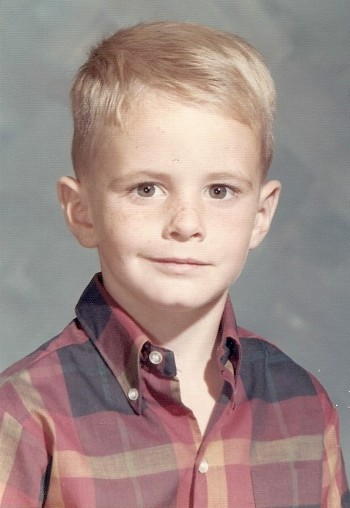 In this original BTB Investigation, we unveil the tragic story of Kirk Murphy, a four-year-old boy who was treated for “cross-gender disturbance” in 1970 by a young grad student by the name of George Rekers. This story is a stark reminder that there are severe and damaging consequences when therapists try to ensure that boys will be boys.
When we first reported on three American anti-gay activists traveling to Kampala for a three-day conference, we had no idea that it would be the first report of a long string of events leading to a proposal to institute the death penalty for LGBT people. But that is exactly what happened. In this report, we review our collection of more than 500 posts to tell the story of one nation’s embrace of hatred toward gay people. This report will be updated continuously as events continue to unfold. Check here for the latest updates.
In 2005, the Southern Poverty Law Center wrote that “[Paul] Cameron’s ‘science’ echoes Nazi Germany.” What the SPLC didn”t know was Cameron doesn’t just “echo” Nazi Germany. He quoted extensively from one of the Final Solution’s architects. This puts his fascination with quarantines, mandatory tattoos, and extermination being a “plausible idea” in a whole new and deeply disturbing light.
On February 10, I attended an all-day “Love Won Out” ex-gay conference in Phoenix, put on by Focus on the Family and Exodus International. In this series of reports, I talk about what I learned there: the people who go to these conferences, the things that they hear, and what this all means for them, their families and for the rest of us.
Prologue: Why I Went To “Love Won Out”
Part 1: What’s Love Got To Do With It?
Part 2: Parents Struggle With “No Exceptions”
Part 3: A Whole New Dialect
Part 4: It Depends On How The Meaning of the Word "Change" Changes
Part 5: A Candid Explanation For "Change"
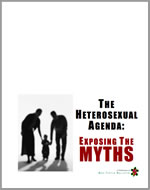 At last, the truth can now be told.
Using the same research methods employed by most anti-gay political pressure groups, we examine the statistics and the case studies that dispel many of the myths about heterosexuality. Download your copy today!
And don‘t miss our companion report, How To Write An Anti-Gay Tract In Fifteen Easy Steps.
 Anti-gay activists often charge that gay men and women pose a threat to children. In this report, we explore the supposed connection between homosexuality and child sexual abuse, the conclusions reached by the most knowledgeable professionals in the field, and how anti-gay activists continue to ignore their findings. This has tremendous consequences, not just for gay men and women, but more importantly for the safety of all our children.
Anti-gay activists often cite the “Dutch Study” to claim that gay unions last only about 1½ years and that the these men have an average of eight additional partners per year outside of their steady relationship. In this report, we will take you step by step into the study to see whether the claims are true.
Tony Perkins’ Family Research Council submitted an Amicus Brief to the Maryland Court of Appeals as that court prepared to consider the issue of gay marriage. We examine just one small section of that brief to reveal the junk science and fraudulent claims of the Family “Research” Council.
 The FBI’s annual Hate Crime Statistics aren’t as complete as they ought to be, and their report for 2004 was no exception. In fact, their most recent report has quite a few glaring holes. Holes big enough for Daniel Fetty to fall through.
“Google” is a trademark of Google Inc.
© Box Turtle Bulletin. All Rights Reserved.


 Posts
Posts  Posts via daily email: