Box Turtle Bulletin
 News and commentary about the anti-gay lobby
“Now you must raise your children up in a world where that union of man and box turtle is on the same legal footing as man and wife…”
News and commentary about the anti-gay lobbyOctober 1st, 2013

TODAY IN HISTORY:
Denmark Begins Registering Partnerships: 1989. Axil and Eigil Axgil made world history when they became the first gay couple to enter into a Registered Partnership in Copenhagen, after 40 years together. The Axgils, who had been living under the same surname (an amalgamation of their given names) for 32 years, were among ten couples registered that day when Denmark became the first country in the world to provide legal recognition for same-sex couples.
While the new law provided many of the rights and obligations of marriage, Registered Partnerships remained a second class institution by omitting adoption rights, artificial insemination availability, or religious wedding ceremonies in state-run Lutheran Churches. In 1996, Registered Partnerships were extended to Greenland. Several bills which would provide full marriage equality have been debated in the Folketing over the past several years, with the most recent bill being rejected by the ruling coalition in June 2010, but the Folketing did decide to extend adoption rights to Registered Partnerships a month later.
In July of 2012, the Folketing approved a bill legalizing same-sex marriage by a vote of 85-24. The law took effect on July 15. Axil and Eigil didn’t live to see full marriage equality in Denmark; Eigel passed away in 1995 and Axel joined him in 2011.

TODAY’S BIRTHDAY:
George Cecil Ives: 1867. The Sacred Band of Thebes, the army of ancient Thebans instituted in 387 B.C., was an elite force of 150 pairs of male lovers. The theory went that soldiers would fight harder and better if they were defending a lover. The Sacred Band met its end fifty years later when the rest of the Theban army fled the forces of Philip II of Macedonia at the battle of Chaeronea. The Sacred Band, instead of fleeing, fought to its death. And so when, in 1897, the German-English poet, writer, and early gay-rights campaigner decided to found a secret society for gay men, he named it the Order of Chaeronea in honor of the brave Sacred Band.
George Ives was already well connected with England’s gay scene, having probably had a brief fling with Oscar Wilde followed, later, with a brief affair with Lord Alfred Douglas. Wilde’s sensational run-in with the law, which dominated the papers of London in 1895, undoubtedly had an affect on Ives. After Wilde was released from prison, he wrote Ives, that he believed that a more humanitarian climate may slowly emerge. “I have no doubt we shall win, but the road is long, and red with monstrous martyrdoms,” Wilde wrote. “Nothing but the repeal of the Criminal Law Amendment Act would do any good.” Ives was ready to take on the work of changing society and laying the grounds for repeal, but he couldn’t convince Wilde to join him in what he called the “Cause.” Wilde, his health broken from two years at hard labor, had already given his measure of martyrdom. We don’t know how many other people Ives managed to enlist into the “Cause,” but we do know that some of the members included the Uranian poets Charles Kains Jackson and John Gambril Nicholson, the Rev. Samuel Elsworth Cottam (an Anglican priest who published a gay magazine called Chameleon), and the eccentric Catholic priest and occult expert Montague Summers.
Ives’s Order was influenced greatly by the Aesthetic movement — of which Wilde was but one very visible proponent — which mixed philosophy, idealism and art as part of what Wilde’s biographer, Neil McKenna, described as “a new gospel of Beauty.” Members of the Order of Chaeronea observed an elaborate system of rituals, ceremonies, seals, codes, passwords, and a calendar dating from the year of the Battle of Cheronea (1897 was written as C2235). New members swore that “you will never vex or persecute lovers,” and that “all real love shall be to you as sanctuary.”
In 1914, Ives co-founded the British Society for the Study of Sex Psychology with Edward Carpenter and Magnus Hirschfeld, to promote the scientific study of sex and with it a more rational attitude toward sexual matters. Ives was very interested in the penal reform movement, and wrote several articles and lectures on the subject. When he died in 1950, he left behind a large archive covering his lfie and work, including 122 volumes of diaries 45 volumes of scrapbooks, the latter consisting of clippings on such topics as sensational crimes, penal methods, cross-dressing, homosexuality and cricket scores. His diaries have been a treasure trove of information for historians examining the early gay rights movement in England. His papers were purchased in 1977 by the Harry Ransom Research Center at the University of Texas at Austin.
If you know of something that belongs on the agenda, please send it here. Don’t forget to include the basics: who, what, when, where, and URL (if available).
And feel free to consider this your open thread for the day. What’s happening in your world?
September 30th, 2013

TODAY’S BIRTHDAY:
Truman Capote: 1924. He taught himself to read and write before he entered his first year at school. When he was about ten years old, he submitted his first short story, “Old Mrs. Busybody,” to the Mobile Press Register for a children’s writing contest. Capote later remembered, “I began writing really sort of seriously when I was about 11. I say seriously in the sense that like other kids go home and practice the violin or the piano or whatever, I used to go home from school every day, and I would write for about three hours. I was obsessed by it.” He remained the lifelong friend of author Harper Lee, who was a neighbor in Monroeville, Alabama. “Her father was a lawyer,” he remembered, “and she and I used to go to trials all the time as children. We went to the trials instead of going to the movies.” Those trials not only influenced Lee’s book, To Kill a Mockingbird, but also helped lead to Capote’s greatest literary triumph, In Cold Blood.

Truman Capote in 1948, contemplating some outrage against conventional morality, no doubt.
His first novel however, was autobiographical; 1948’s Other Voices, Other Rooms
He remained busy for the next decade, adapting novels for Broadway and churning out articles for The New Yorker. Then he struck gold again in 1958 with his collection, Breakfast at Tiffany’s: A Short Novel and Three Stories

He loved the limelight, although it did take its toll. In the 1970s, he sank into drug and alcohol abuse, which got in the way of working on his epic novel, Answered Prayers. He bragged about it often, but years went by without any sign of the work. He finally adapted portions of it for a series of short stories in Esquire. The second of those stories, “La Côte Basque 1965,” would make him personal non grata among the Jet Set, with its salacious details of the personal lives of William S. Paley and Babe Paley, who had been among his close society friends. It was seen as a betrayal of confidences among Capote’s friends, and two more short stories resulted in Capote’s being cut off from the high society he craved. He died in 1984 of liver cancer at the home of Joane Carson, the ex-wife of TV host Johnny Carson. His royalties continued to support his partner Jack Dunphy until his death, and then went toward establishing a literary prize in honor of Newton Arvin, a former boyfriend, author and professor whose life was ruined when he was fired from Smith College for being gay.

The Velvet Voice
Johnny Mathis: 1935. Chances are the last time you heard one of his songs was on television or in film, where his music is capable of setting just the right mood or sense of nostalgia. While he is frequently described as a romantic singer, his first love was jazz. It was during a performance at The Blackhawk club in San Francisco that he caught the attention of Columbia Records’ jazz producer George Avakian, who sent a telegram to the head office, “Have found phenomenal 19-year-old boy who could go all the way. Send blank contracts.” While Mathis enjoyed singing, the opportunity posed something of a dilemma for the San Francisco State College student: the track and field star was about to try out for the 1956 Olympics in Melbourne, Australia. He had to decide: the Olympics or a recording session. It was one or the other; it couldn’t be both. After consulting with his father, Mathis chose the recording career.
His first album Johnny Mathis: A New Sound In Popular Song, was a jazz album. It didn’t sell well. His second album, produced by Mitch Miller, focused on soft, romantic ballads backed by the Ray Conniff Orchestra. That would prove to be the signature Mathis sound. In Late 1956, he recorded his two most popular songs, “Wonderful! Wonderful!” and “It’s Not For Me To Say,” followed soon by “Chances Are,” which hit Number 1 on the Billboard chart. By by the end of the 1950s, hit singles were no longer his forte; his strength was as an album artist. Heavenly, released in1959, hit #1 in the Billboard album chart and went multi-platinum. A year earlier, he released Johnny’s Greatest Hits, the first ever Greatest Hits album in music history, spent 491 consecutive weeks on the Billboard top 100 album charts, earning him a spot in the Guinness Book of World Records.. At one point, he had five albums on the Billboard charts simultaneously. His last #1 single was 1978’s “Too Much, Too Little, Too Late,” a duet he recorded with Deniece Williams.
Mathis, who never married, managed to keep his personal life out of the public eye. Maybe the fact that he had been an Olympic-calibre athlete helped to keep some of the rumors at bay. Nevertheless, the rumors were out there, which he acknowledged in a 1982 interview with Us Magazine, where he was quoted as saying “Homosexuality is a way of life that I’ve grown accustomed to.” But when he started receiving death threats because of that interview, he prevailed on Us Magazine to retract the statement. In 2006, Mathis again acknowledged his sexuality, saying that his reticence on the topic was “generational.”
http://www.youtube.com/watch?v=Cd3pDM2f6Y8If you know of something that belongs on the agenda, please send it here. Don’t forget to include the basics: who, what, when, where, and URL (if available).
And feel free to consider this your open thread for the day. What’s happening in your world?
September 29th, 2013
TODAY’S AGENDA:
Pride Celebrations This Weekend: Belgrade, Serbia (cancelled!); Willemstad, Curaçao.
AIDS Walks This Weekend: Ann Arbor/Ypsilanti, MI;Lansing/East Lansing, MI; San Diego, CA.
Other Events This Weekend: Folsom Street Fair, San Francisco, CA.

TODAY IN HISTORY:
New York TV Station Airs “Homosexuality, A Psychological Approach”: 1956. The pioneering WRCA-TV (now WNBC) aired an award-winning weekly panel discussion program called “The Open Mind,” hosted by Richard Heffner. It is probably the longest running program still on the air today with its original host, now for American Public Television. In August, Heffner hosted the first televised discussion on the East Coast on homosexuality (see Aug 4). Despite the obvious prejudices, the program was relatively evenhanded and balanced — as balanced as a program like this could be where people were talking about another group of people who weren’t in the room. Heffner opened this program with a re-cap of the previous program, and the response that it generated
Our panel tried to distinguish between that homosexual activity which harms society and that which does not. And the point was made that our legal attitude towards homosexuality often does not reflect medical opinion, for the law frequently considers it a crime, a crime to be punished rather than a problem to be treated. Now, of course, we touched on many other aspects of homosexuality as well. And from your response to our program it was obvious that a good many of you felt precisely as we did; that we have here a problem that affects us all; affects us as parents and as good citizens concerned with our nation’s mental health. And that his problem should and can be discussed openly and freely. Many of your letter contained questions concerning the cause of homosexuality, its origins, particularly in childhood, its treatment, and the preventative measures that can be taken by the parent.
What’s most fascinating about this program is how closely the discussion mimics the messaging coming out of the ex-gay movement today, nearly than sixty years later. It is as though the ex-gay movement is frozen in time to an earlier era, free from the nettlesome knowledge that the mental health professions have picked up in the intervening six decades.
And what did the mental health professions believe before the subsequent six decodes of research? To answer that, this program’s panel consisted of Dr. Philip Polatin of the New York Psychiatric Institute, and Dr. Harry Bakwin, President of the American Academy of Pediatrics, who had written extensively about psychological issues in children, including, if not altogether accurately, homosexuality (“The condition occurs in white children of all nationalities but is rare in the Negro,” he would write a year later.) In response to the question of how homosexuals became homosexuals. Bakwin opened which what he called the “constitutional cause”:
There is a small but quite definite group of children in whom I think this is an inborn deviation. These children, from the earliest childhood, boys particularly, dress up on the clothes of the opposite sex. They posture like members of the opposite sex. They experiment with cosmetics. You know, we see these as children, but we don’t know what becomes of them as adults. These are termed by the psychiatrist “transvestites”. And the psychiatrist doesn’t consider the transvestite and the homosexual as necessarily the same.
Apparently knowing that Polatin didn’t care much for the idea of inborn homosexuality, Bakwin threw the question over to Polatin, who acknolweged that “we have an entirely different view”:
We don’t in any way ignore the possible factor of the constitutional element, but we, working with homosexuals or other sexual deviates, find that the early parent-child relationship bears a greater relationship to the development to this condition than other factors. For example, we find that one of the most common expressions of difficulty is the aggressive, dominant, controlling mother and a very passive, meek, compliant father. So that the boy, in the development of his psychological life, identifies with a parent of the opposite sex rather than with a parent of the same sex. Because we know that in the course of psychological growth there is the normal period of what we call “the latency period” or “the homosexual period” between the ages of about six and 12, in which little boys play with each other. They play the Hardy Boys game. They have games in groups. And little girls play together themselves. And they indulge in feminine activities, playing with dolls and with cooking utensils and they want to help mother. In other words, gradually they are beginning to identify themselves with the parent of the same sex, so that at the age of puberty when there is a tremendous psychological and physiological upheaval, they now become men if they are boys, and they now become women if they are girls, and then they can go out like father did or like mother did into the world and seek for themselves a mate on a heterosexual level. The homosexual has somehow or other become fixed or limited in his development at the immature level of psychological growth.
Heffner turned the question back to “constitutional” homosexuality (“and by that you mean congenital,” Heffner clarified). Polatin agreed that it may be possible but considered it rare. Bakwin placed a bit more emphasis on genetic possibilities, but even he preferred to emphasize “other factors,” which he likened to the “soil” in which a child’s sexuality takes root:
BAKWIN: I would emphasize other factors. I think the soil is different. Of course the parental reaction to different children is different. Parents are different toward their children just as they’re different toward their friends. And I don’t think that’s generally appreciated. A certain objectivity. And so it isn’t the same parent for each child. However, I think also the soil is different. And I think there is a difference in susceptibility of different individuals toward this deviation. Now, I think given this soil, given an unhappy home, given a child who is exposed to an aggressive adult, that under those circumstances if the adult is of the same sex, this child may fall prey to this particular deviation. This was brought out in a very interesting study by Greco and Wright some years ago. They studied a group of homosexual boys and also studied a group of control children. And they found that in these homosexual boys that had commonly been exposed to an experience during a period when they were unhappy, to a sex experience with an individual of the same sex in whom they had faith, in whom they had confidence. And I think it’s sort of a non-specific unhappiness, plus the chance meeting with some aggressive adult of the same sex, that plays a major role.
POLATIN: Yes.
BAKWIN: And the difference in the soil, and there’s a difference in susceptibility.
POLATIN: Yes. Well, that’s just it. I want to emphasize that. I think what Dr. Bakwin says is correct, that many homosexuals have been seduced, so to speak, in the pre-adolescent phase. But often when we study these people the soil has been right. Because we know many perfectly healthy, well-integrated, mature people who have been seduced in the pre-adolescent phase and who somehow or other have come through it unscathed and unscarred and function perfectly well. So that he soil is different in these people who are exposed to older homosexual fantasy.
HEFFNER: Well, are you putting your emphasis, Dr. Bakwin, on some traumatic experience, some single experience?
BAKWIN: Usually not a single experience. Usually repeated experiences, according to the studies and the literature.
HEFFNER: And something outside of the individual rather than inside?
BAKWIN: No, I would say first a fertile soil. Second, unhappy surroundings. And third, the chance meeting with an aggressive adult.
The topic soon turned to prevention. Bakwin’s advise was fairly general: just make sure the child has “a happy home.” Also:
I think if a child shows homosexual tendencies that he should go, if he’s a boy, say, to a coeducational school. I don’t think he should be sent to a school simply for boys. I think he’s much better off when exposed to members of the opposite sex. I don’t know what else one can do.
Polatin, on the other hand, was full of suggestions:
The father cannot shirk his responsibilities. He should take the boy with him fishing, tennis, all the activities which a man indulges in. The Boy Scouts, the minister, the priest, the rabbi play a role in this process of identification with the male, with a man. And a girl, too. The mother must take an active role with this little girl because she has to be a woman. And to permit the little child to be with her when she is cooking or baking or cleaning and have the little child participate. I’ve heard so many children who say, “I was never permitted to do any housework. My mother treated me like a queen. I wasn’t permitted to engage in any of these activities, and I miss it”. So that these are important.
For a fascinating look at how 1950s television handled the topic, you can see the entire half-hour program and transcript in the Open Mind’s archives here.
If you know of something that belongs on the agenda, please send it here. Don’t forget to include the basics: who, what, when, where, and URL (if available).
And feel free to consider this your open thread for the day. What’s happening in your world?
September 28th, 2013
 Frank Bruni’s New York Times op-ed on rural Pennsylvania GOP Representative Mike Fleck:
At the end of last year, he announced that his marriage of 10 years was over. And that he’s gay.
Plenty of people figured that he’d exit state politics after that. But on Monday he’ll announce his campaign for a fifth term. This time, it will almost certainly be a campaign, with rivals and an uncertain outcome, hinging on whether he can persuade his constituents that he’s the same politician they embraced before, the same man, apart from a reality owned up to, a truth embraced.
Their acceptance or rejection of that will be an unusually clear-cut referendum on attitudes about homosexuality in rural America, or at least in this verdant stretch of the heartland about 75 miles west of the state capital of Harrisburg. Fleck, 40, hasn’t changed his position on issues like gun control, of which he’s skeptical. (He owns a pistol, two rifles, one muzzleloader and 10 other firearms.) He didn’t come out of the closet in a swirl of scandal. There was no news about an intern, no talk of an affair. He just came out, because his marriage had unraveled, because the toll of staying in was too steep and because he saw an opportunity to challenge the bigotry in his community by presenting its residents with something that he certainly never saw when he was growing up here, an openly gay man who doesn’t conform to the sorts of stereotypes that are especially prevalent far away from metropolitan areas.
September 28th, 2013
Now Guido Barilla has released a video in which he non-apologizes for about the fourth time.
In case you need a transcript, it’s something like this:
Me. Me me me. Good guy, me. Me. Me. Always respectful me. Me. Me me me me me me. The reaction to me has made me unhappy me me. I’ll be listening to me me me and me and some good family groups. Oh, and also some of the people who are mad at me. Me.
September 28th, 2013
TODAY’S AGENDA:
Pride Celebrations This Weekend: Belgrade, Serbia (cancelled!); Columbia, SC; Cottonwood/Sedona, AZ; Johannesburg, South Africa; Moab, UT; Richmond, VA; Willemstad, Curaçao.
AIDS Walks This Weekend: Ann Arbor/Ypsilanti, MI; Chicago, IL; Indianapolis, IN; Jackson, MI; Jacksonville, FL; Lansing/East Lansing, MI; Mt. Pleasant, MI; San Diego, CA; Seattle, WA; Wilmington/Rehoboth, DE.
Other Events This Weekend: Queer Lisboa 17 Film Festival, Lisbon, Portugal; Folsom Street Fair, San Francisco, CA.
TODAY IN HISTORY:
A Same-Sex Marriage in Nevada: 1877. The LGBT acronym that we often toss about reflects the fact that we today understand ourselves as though we were measured along two distinct axis. The first axis (the L/G/B one) speaks of the gender of those to whom we are attracted; this defines us as gay, straight, or somewhere in between. The second axis (often lamented as the silent “T” by transgender advocates), describes how we see ourselves: we are male or female, and for most of us (cisgenders) our self-understanding of our gender matches our bodily appearance; for a few (transgenders), it doesn’t. Taken together, these two sets of descriptions — of one’s sexual orientation and gender identity as separate categories — have been adequate for most of us to describe who we are as sexual beings.
But notice what those descriptions do: they also describe states of being rather than things we’re doing. And this is a very modern way of thinking. Until very recently, one was much more defined — and one’s available life choices were much more restricted — according to one’s gender role, which defined who one is according to what one does and vice versa. And until fairly recently, it was madness to consider that the two could be seperable. And so gender roles went like this: the male gender role meant that men wore men’s clothing and cut their hair, they left the home every day to make a living, and they loved and/or married women. The female gender role meant that women kept the house, did the cooking, raised the children, wore dresses and petticoats, and they loved and/or married men.
Because there was no option to separate out one’s sexual orientation, gender identity, or career aspirations from one’s gender role, it gets very complicated when we try to assign historical figures into today’s modern categories. There are countless stories of women who, in order to pursue career paths that would be closed to them (and this would include just about everything besides teaching, nursing and domestic work), take on the male gender role simply because they couldn’t do what they wanted to do as women (see July 25 for one possible example). We have far fewer examples of men taking the female gender role for similar reasons, but that is probably because there were far fewer career restrictions for men. But we also find examples of both men and women adopting the opposite gender role when entering what would otherwise be a same-sex relationship. Not everyone did this, but when they did, their examples are much trickier to understand: are we seeing a straight relationship with a transgender person, or are we seeing a gay or lesbian relationship where one adopts an opposite gender role in order to facilitate the relationship?
Today’s story illustrates that very question. On September 28, 1877, Sarah Maud Pollard, as Samuel M. Pollard, married Marancy Hughes in Tuscarora, Elko County, Nevada Territory. My friend Homer Thiel, a Tucson archaeologist and historian, wrote about that marriage in a guest post a few years ago:
Sarah Pollard was born in 1846 in New York, the daughter of a middle class merchant family. After working in a shoe factory in Massachusetts and sewing shirts in New York, she headed west to Colorado in the 1870s. She caused a stir because of her masculine appearance. Around 1876 she moved to Nevada and took up wearing male clothing in order to find work and she started calling herself “Sam.” She met young Marancy Hughes, born in 1861 in Missouri, and actively courted her. Hughes’ family hated Pollard and the couple eloped on September 28, 1877.
New Orleans Times-Picayune article about the Pollard marriage, June 23, 1878. (Click to enlarge.)
They were happily married for six months, and then Marancy broke the secret. The small silver-mining town of Tuscarora, Nevada was transfixed by the story. The matter ended up in court and after Marancy testified, a dramatic re-union took place. Stories about the troubled marriage were carried in newspapers across the country (even appearing in a New Zealand paper). The couple broke up two more times, before Marancy moved on to a marriage with a man in 1880.
Pollard’s story appears to have had a happy ending:
Sarah moved to Minnesota to start a new life by 1883, working by herself on a farm. The story of her successful farming career again made national newspapers, which noted she wore a bloomers-type outfit while plowing. By the 1890s she had met a woman named Helen Stoddard, a schoolteacher who was born in 1864 in Vermont. In later census records Helen was listed as her partner or companion. Sarah died in 1929, and Helen paid for her arrangements at a local funeral home, the owners puzzling over the relationship of the two women.
If all we knew about Pollard was restricted to the events in Nevada, we would be left with an open question: Was she lesbian or was he transgender? But as the second half of the story reveals, the question itself was mistaken. What she did in Nevada was adopt a male gender role which allowed her to do male things: make a living and marry a woman. But a decade later, the evidence strongly suggests that she decided to forget about gender roles and just live — she farmed (a man’s job), wore bloomers while plowing (a woman’s garment; pants would have been much more practical), presented herself with a female name, and became a partner to a female schoolteacher — with Helen apparently maintaining a more traditionally female gender role but with Sarah’s gender role being flexible. No wonder the funeral home’s owners were puzzled by the relationship.
55 YEARS AGO: Three Tulane Students “Role A Queer”: 1958. It was in the wee hours of Saturday morning when three bored Tulane University Students decided to go to the French Quarter to “roll a queer,” the popular term in those days for picking out a fag, beating him up, and taking his money. They went to Cafe Lafitte In Exile, where they met Fernando Rios, a twenty-six year old tour guide from Mexico City. John S. Farrell, 20 and the group’s ringleader, met up with Rios in an alley, while the other two students, David Drennan, 19, and Alberto Calvo, 20, hid at the alley’s entrace to prevent an escape. Farrell later claimed that Rios “made an indecent proposal,” although other witnesses said Rios refused Farrell’s advances and tried to hail a cab. Either way, Farrell, hit Rios, took his wallet, and left Rios in the gutter. Rios died without regaining consciousness. Docters testified that both his eyes were blackened, there were severe bruises and fractures on his skull, nose and mouth, and he had received a bruising blow to his liver.
Meanwhile, the three students went to Calvo’s room and proceeded to brag to Calvo’s roommate, George Meyer. The four then burned the contents of Rios’s wallet, except for the $40 dollars they found. (That would be about $325 today.)
The next day, reports of Rios’s death was in the papers and on the radio, and thanks to the trio’s bragging, word of their adventures spread around campus. They decided that they had no choice but to turn themselves into police, but they did so with two caveats: they would claim that Rios propositioned them, and they would claim that they didn’t plan to rob him. The second point was key because Louisiana law defined murder as either the intentional killing of a person, or the unintentional killing of someone while robbing them. So their story went like this: Rios came on to Farrel, Farrell just decked him. No robbery, no murder. As for how they ended up with Rio’s $40, they had a story for that. As an afterthought, Ferrell went back later and got the wallet. So now the robbery took place in a separate incident after Rios was assaulted, not during it. Their lawyer even told the jury that when Farrell found out Rios had died, he was so contrite that he had left the stolen money in a church’s poor box. “The three boys are guilty of nothing worse than bad conduct,” the lawyer said.
The combination of a 1958 version of the gay panic defense, combined with full-blown animosity toward Rio’s perceived sexuality (there was no evidence presented during the trial to suggest that Rios was actually gay) and nationality (the Mexican government, controversially, retained an attorney to witness the proceedings) had its desired effect on the jury. The twelve white men found all three defendants not guilty. When ONE magazine reported the lamentable details to its readers, it asked,
How many more times must the innocent die and the guilty go free before the unsubstantiated claim of an “indecent proposal” ceases to be on alibi for robbery and murder?
[Source: “Dal McIntire” (pseudonym). “Tangents: News and Reviews.” ONE 7, no. 3 (March 1959): 13-15.]
US Civil Service Refuses To Meet With Washington Mattachine Society: 1962. Frank Kameny and Jack Nicholes founded the Mattachine Society of Washington, D.C., in 1961, soon after Kameny’s appeal of his 1957 firing by the U.S. Army’s Map Service was rejected by the U.S. Supreme Court. The federal government’s ban on employment of gays and lesbians was firmly in place, but Kameny didn’t let a small thing like the Supreme Court stop him from demanding the lifting of the ban. In 1962, the MSW requested a meeting with the U.S. Civil Service Commission to discuss the federal employment ban, but in a letter dated September 28, 1962, they were turned down cold:
UNITED STATES· CIVIL SERVICE COMMISSION
Washington 25, D.C.
Sep 28 1962
Mr. Bruce Schuyler, Secretary
The Mattachine Society of Washington
P. O. Box 1032
Washington 1, D.C.Dear Mr. Schuyler:
Your letter of August 28, 1962 and attachments relating to the purposes of the Mattachine Society of Washington have been read with interest. It is the established policy of the civil Service commission that homosexuals are not suitable for appointment to or retention in positions in the Federal service. There would be no useful purpose served in meeting with representatives of your Society.
Sincerely yours,
(signed)
John W. Macy, Jr.
Chairman
Lifting the ban would remain one of MSW’s highest priorities for the next thirteen years. When MSW began picketting for gay rights in 1965, the Civil Service Commission was one of their targets (see Jun 26). But it would take another ten years before the Civil Service Commission would finally end the ban (see Jul 3). In 2009, Frank Kameny received a formal apology from the openly gay director of the Office of Personnel Management, the modern-day successor to the Civil Service Commission.
If you know of something that belongs on the agenda, please send it here. Don’t forget to include the basics: who, what, when, where, and URL (if available).
And feel free to consider this your open thread for the day. What’s happening in your world?
September 27th, 2013
For the fourth time in the past five years, Serbian authorities have caved to threats from far-right anti-gay organizations and banned the Belgrade Gay Pride parade that was sheduled for Saturday. Authorities also banned rival rallies that had been scheduled for the same day. According to Balkan Insight:
“No one should question the political orientation of the state and whether the constitutionally guaranteed rights are respected, the only limitation are security reasons,” Serbian Prime Minister Ivica Dacic told Serbian public service broadcaster RTS on Friday evening.
…The ban comes after Serbian police union had asked the government to ensure protection for all participants at Saturday’s Pride Parade, criticising officials for their apparent ambiguity about whether it should take place or not.
I think that ambiguity has been sufficiently answered. As to questioning the “political orientation” of the state’s commitments to constitutionally guaranteed rights, it would probably be helpful if the Serbian government actually stopped providing ample reasons for raising those questions in the first place.
Belgrade’s B92 reports that 6,500 police officers had already been lined up to ensure security over the weekend, which it described as “the largest deployment of the police in the history of Belgrade.” But that wasn’t enough to satisfy the Bureau for the Coordination of Security Services, which announced the cancellation. The bureau’s announcement came as a surprise to Pride organizers:
Belgrade Pride Organizing Committee member Goran Miletić told B92 earlier that he hoped today’s meeting of the Bureau was of a technical nature and that its participants would discuss security issues, rather than consider banning the march.
He also stated that while the parade “is not listed as a condition for the EU” a decision not to allow it “would have severe consequences, because it would violate the fundamental right to freedom of assembly.”
Serb authorities banned Belgrade Pride marches in 2009, 2011 and 2012. About a thousand people turned out for Pride in 2010 under heavy police protection. Organizers and participants praised Belgrade police for exemplary protection throughout the march. After the march ended and participants were safely escorted out of the area, riots broke out across Belgrade. Serbian President Boris Tadic at that time condemned the violence and vowed that “Serbia will guarantee human rights for all its citizens, regardless of the differences among them, and no attempts to revoke these freedoms with violence will be allowed.” That was the last time those freedoms were allowed to be expressed by LGBT Serbs.
September 27th, 2013
September 27th, 2013
In 2006, the New Jersey Supreme Court ruled that the state must offer the same rights and obligations to same sex couples that it offered to opposite sex couples. However, they allowed the legislature to create civil unions rather than marriage. However, when the US Supreme Court ruled that DOMA3 was unconstitutional, this changed the situation. Currently, the State of New Jersey offers two forms of couple recognition; heterosexuals get a type recognized by the Federal Government, while gays get a type that does not have federal recognition.
Today Superior Court Judge Mary Jacobson ruled – in summary judgment – that New Jersey must offer marriage licenses to same sex couples. (NBC)
“The ineligibility of same-sex couples for federal benefits is currently harming same-sex couples in New Jersey in a wide range of contexts,” the judge said.
“Same-sex couples must be allowed to marry in order to obtain equal protection of the law under the New Jersey Constitution,” she wrote.
The ruling does not mean that same-sex marriages will begin immediately in New Jersey. The state has until Oct. 21 to either appeal or start the process to allow gay marriages.
Now it will fall upon Governor Chris Christie to decide whether to appeal the decision. While Christie has stated opposition to same-sex marriage (he favors civil unions), the voters in the state overwhelmingly support marriage equality.
At present, Christie’s position hasn’t hurt him and he holds a double-digit lead in polls for reelection. But this could go in several directions. If he appeals, it could serve as a reminder to the voters that he does not share their values. I doubt it would seriously hurt his chances for reelection, but it could hurt him in future contests.
Or, he could see this as an opportunity to do nothing and have a potentially troublesome issue go away. It seems increasingly likely that his marriage veto could be overturned with Republican support and Christie may prefer that his authority not appear to be challenged.
UPDATE: Christie has released a statement (Politico)
In a statement about an hour after the ruling, Christie’s press secretary said “Governor Christie has always maintained that he would abide by the will of the voters on the issue of marriage equality and called for it to be on the ballot this Election Day. Since the legislature refused to allow the people to decide expeditiously, we will let the Supreme Court make this constitutional determination.”
That sounds to me like he’ll be making an appeal.
September 27th, 2013
 Dozens of world leaders are in New York right now for the United Nations General Assembly’s annual General Debate. Gambian President Yahya Jammeh is there, and today he used his allotted time to accuse LGBT people of being one of the three “biggest threats to human existence,” along with greed and obsession with world domination. Together, Jammeh said they “are more deadly than all natural disasters put together.”
Jammeh, who came to power in 1994 following a military coup, has developed a reputation for being notoriously anti-gay. In 2008, he threatened to “cut off the head” of any homosexual he found in his country and promised to introduce legislation that would be “stricter than those in Iran.” He didn’t follow through on that last threat. Homosexuality is currently a felony under Gambian law and carries a penalty of fourteen years in prison.
September 27th, 2013
 On their Facebook page, pasta maker Ronzoni quietly differentiated themselves from Barilla:
Just like pasta, we believe families come in all different shapes, sizes, colors and orientations. We feel it is important to represent diversity in our advertising and will continue to do so in the future.
September 27th, 2013
TODAY’S AGENDA:
Pride Celebrations This Weekend: Belgrade, Serbia; Columbia, SC; Cottonwood/Sedona, AZ; Johannesburg, South Africa; Moab, UT; Richmond, VA; Willemstad, Curaçao.
AIDS Walks This Weekend: Ann Arbor/Ypsilanti, MI; Chicago, IL; Indianapolis, IN; Jackson, MI; Jacksonville, FL; Lansing/East Lansing, MI; Mt. Pleasant, MI; San Diego, CA; Seattle, WA; Wilmington/Rehoboth, DE.
Other Events This Weekend: Queer Lisboa 17 Film Festival, Lisbon, Portugal; Folsom Street Fair, San Francisco, CA.

TODAY IN HISTORY:
Six men pilloried in London for Homosexuality: 1810. In early 19th century Britain, the penalty for homosexuality was death. If a judge felt lenient, he might instead sentence the accused to stand time at the pillory. The September 27, 1810 entry in the Annual Register describes the pillorying of six members of what we might describe today as a gay hangout known as the Vere Street Club. That description goes like this:
Such was the degree of popular indignation excited against these wretches, and such the general eagerness to witness their punishment, that, by ten in the morning, the chief avenues from Clerkenwell Prison and Newgate to the place of punishment were crowded with people; and the multitude assembled in the Haymarket, and all its immediate vicinity, was so great as to render the streets impassible. All the windows and even the very roofs of the houses were crowded with persons of both sexes; and every coach, waggon, hay-cart, dray, and other vehicles which blocked up great part of the street, were crowded with spectators.
The Sheriffs, attended by two City Marshals, with an immense number of constables, accompanied the procession of the Prisoners from Newgate, whence they set out in the transport caravan, and proceeded through Fleet-street and the Strand; and the Prisoners were hooted and pelted the whole way by the populace. At one o- clock four of the culprits were fixed in the pillory, erected for and accommodated to the occasion, with two additional wings, one being allotted for each criminal; and immediately a new torrent of popular vengeance poured upon them from all sides. The day being fine, the streets were dry and free from mud, but the dfect was speedily and amply supplied by the butchers of St. James’s-market. Numerous escorts of whom constantly supplied the party of attack, chiefly consisting of women, with tubs of blood, garbage, and ordure from their slaughter-houses, and with this ammunition, plentifully diversified with dead cats, turnips, potatoes, addled eggs, and other missiles, the criminals were incessantly pelted to the last moment. They walked perpetually round during their hour [the pillory swivelled on a fixed axis]; and although from the four wings of the machine they had some shelter, they were completely encrusted with filth.
Two wings of the Pillory were then taken off to place Cooke and Amos in the two remaining ones, and although they came in only for the second course, they had no reason to complain of short allowance, for they received even a more severe discipline than their predecessors. On their being taken down and replaced in the caravan, they lay flat in the vehicle; but the vengeance of the crowd still pursued them back to Newgate, and the caravan was so filled with mud and ordure as completely to cover them.
No interference from the Sheriffs and Police officers could refrain the popular rage; but notwithstanding the immensity of the multitude, no accident of any note occurred.
The six men were relatively lucky. Depending on the ferocity of the crowd, death at the pillory wasn’t out of the question. The pillory was formally abolished in England in 1837.

Rev. Ray Broshears, Lavender Panthers organizer.
40 YEARS AGO: Rolling Stone Reports on San Francisco’s “Lavender Panthers”: 1973. San Francisco in 1973 may have been seen as a tolerant haven for gay people, but that’s was only relatively speaking when compared to much of the rest of the country. For all of its “tolerance,” more than 60 anti-gay assaults and beatings had occurred over the past summer, with two dozen since August 1. Rev. Ray Broshears, a gay Pentecostal evangelist told Rolling Stone about one horrific crime the previous January:
“One of our own [Gay Activist Alliance] members was murdered early this year,” he says. “This boy was beaten and his unconscious body placed on the Sunset Tunnel streetcar tracks. He was left to be hit by a train.” Police records acknowledge that 19-year-old David Hart Winters was struck and killed by a streetcar late one night last January. The coroner’s report shows that he had been beaten before his death.”
Broshears himself was severely beaten by four teenagers outside his church, leaving him with partial nerve control loss in his left arm. That beating occurred on the Fourth of July, after he had called the police to complain about some teenagers who were setting off fireworks in a lot next door. Rather than deal with the problem, police simply told the youths who had ratted them out. Police were so indifferent, or worse — often accusing assault victims of sexually soliciting or provoking their attackers. Consequently, most victims didn’t bother to file a report. Add to that, three gay-affirming churches and two gay bars had burned over the summer, with arson either suspected or determined in all of those cases. So Broshears formed the Lavendar Panthers and took to streets:
Each evening, several of the Panthers (on a rotating schedule) drive the group’s VW bus to parts of the city that sport a concentration of gay bars, restaurants, baths and clubs. They concentrate on the popular Upper Market-Castro Street area, where most of the beatings have taken place. …
“When we spot trouble, we all jump out of the van and run toward the attackers, blowing police whistles and shouting. Usually, we startle the attackers enough that they take off,” explains one patrol member. “In a couple of situations, we’ve had to hit them over the head and show them a taste of their own medicine. The fact that we’re gay doesn’t mean we can’t and won’t fight back.”
The Lavender Panthers conducted self-defense martial-arts workshops and firearms training, distributed police whistles so people could sound an alarm if they were attacked or saw one in progress, and recommended that gay people carry cans of red spray paint to use as mace. The Lavender Panthers maintained their patrols in San Francisco for about a year before disbanding.
Two weeks after the Rolling Stone article appeared, TIME magazine published its own write-up.
[Source: Bill Sievert. “Lavender Panthers Protect Gays.” Rolling Stone (September 27, 1973): 7.]
If you know of something that belongs on the agenda, please send it here. Don’t forget to include the basics: who, what, when, where, and URL (if available).
And feel free to consider this your open thread for the day. What’s happening in your world?
September 26th, 2013
Some of our opponents argue that the First Amendment guarantee of religious freedom means that individuals and groups who oppose same-sex marriage must be exempt from laws requiring them to recognized same-sex marriages as marriages.
Could anyone provide me with links to the very best arguments for that view?
Sometimes it’s fun to point out our opponents’ silliest arguments, but that’s not what I’m looking for here. I want to examine the reasoning from the most serious and intelligent folks on the other side.
Much thanks.
September 26th, 2013
Guido Barilla, whose firm has almost half the Italian pasta market and a quarter of that in the US, told Italy’s La Zanzara radio show last night: “I would never do an advert with a homosexual family…if the gays don’t like it they can go an eat another brand.
“For us the concept of the sacred family remains one of the fundamental values of the company.”
He added: “Everyone has the right to do what they want without disturbing those around them”. But then the pasta magnate upped the ante by attacking gay adoption. “I have no respect for adoption by gay families because this concerns a person who is not able to choose,” he said.
Oh, and after the obvious shocked and disgusted response, “I’m sorry if my comments on La Zanzara have created misunderstanding or polemic, or if I’ve offended anyone.”
No, no misunderstanding. It’s clear. You’re an asshat and I’ll accept your invitation to buy other brands (or, better yet, make my own pasta).
September 26th, 2013
According to the Associated Press:
The International Olympic Committee has dismissed concerns over Russia’s law banning gay propaganda, saying it doesn’t violate the Olympic charter’s anti-discrimination clause, and pronounced Russia ready to host the 2014 Winter Games.
Jean-Claude Killy, chairman of the IOC Coordination Commission, gave his stamp of approval during a news conference Thursday at the conclusion of the commission’s 10th and final visit to Sochi before the games, which begin on Feb. 7.
…Killy said the commission deliberated for several days and concluded “the IOC doesn’t have the right to discuss the laws that are in place in the country hosting the games, so unless the charter is violated we are fully satisfied.”
This comes despite several contradictory statements by Russian officials about how Russia’s so-called “anti-propaganda” law would impact Olympic athletes and visitors. Earlier this month, the head of the Sochi Olympics asked the IOC to somehow make the rest of the world shut up about the draconian law. The IOC’s response then was to do Russia’s bidding, and ask athletes to keep quiet in Sochi like good Russian citizens. None of this was ever in any doubt, not with the real bottom line being:
Killy said the IOC commission was pleased with the ongoing construction ahead of the games, which with a total cost of $51 billion will be the most expensive Olympics in history.
Featured Reports
 In this original BTB Investigation, we unveil the tragic story of Kirk Murphy, a four-year-old boy who was treated for “cross-gender disturbance” in 1970 by a young grad student by the name of George Rekers. This story is a stark reminder that there are severe and damaging consequences when therapists try to ensure that boys will be boys.
When we first reported on three American anti-gay activists traveling to Kampala for a three-day conference, we had no idea that it would be the first report of a long string of events leading to a proposal to institute the death penalty for LGBT people. But that is exactly what happened. In this report, we review our collection of more than 500 posts to tell the story of one nation’s embrace of hatred toward gay people. This report will be updated continuously as events continue to unfold. Check here for the latest updates.
In 2005, the Southern Poverty Law Center wrote that “[Paul] Cameron’s ‘science’ echoes Nazi Germany.” What the SPLC didn”t know was Cameron doesn’t just “echo” Nazi Germany. He quoted extensively from one of the Final Solution’s architects. This puts his fascination with quarantines, mandatory tattoos, and extermination being a “plausible idea” in a whole new and deeply disturbing light.
On February 10, I attended an all-day “Love Won Out” ex-gay conference in Phoenix, put on by Focus on the Family and Exodus International. In this series of reports, I talk about what I learned there: the people who go to these conferences, the things that they hear, and what this all means for them, their families and for the rest of us.
Prologue: Why I Went To “Love Won Out”
Part 1: What’s Love Got To Do With It?
Part 2: Parents Struggle With “No Exceptions”
Part 3: A Whole New Dialect
Part 4: It Depends On How The Meaning of the Word "Change" Changes
Part 5: A Candid Explanation For "Change"
 At last, the truth can now be told.
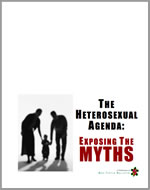
Using the same research methods employed by most anti-gay political pressure groups, we examine the statistics and the case studies that dispel many of the myths about heterosexuality. Download your copy today!
And don‘t miss our companion report, How To Write An Anti-Gay Tract In Fifteen Easy Steps.
 Anti-gay activists often charge that gay men and women pose a threat to children. In this report, we explore the supposed connection between homosexuality and child sexual abuse, the conclusions reached by the most knowledgeable professionals in the field, and how anti-gay activists continue to ignore their findings. This has tremendous consequences, not just for gay men and women, but more importantly for the safety of all our children.
Anti-gay activists often cite the “Dutch Study” to claim that gay unions last only about 1½ years and that the these men have an average of eight additional partners per year outside of their steady relationship. In this report, we will take you step by step into the study to see whether the claims are true.
Tony Perkins’ Family Research Council submitted an Amicus Brief to the Maryland Court of Appeals as that court prepared to consider the issue of gay marriage. We examine just one small section of that brief to reveal the junk science and fraudulent claims of the Family “Research” Council.
 The FBI’s annual Hate Crime Statistics aren’t as complete as they ought to be, and their report for 2004 was no exception. In fact, their most recent report has quite a few glaring holes. Holes big enough for Daniel Fetty to fall through.
“Google” is a trademark of Google Inc.
© Box Turtle Bulletin. All Rights Reserved.


 Posts
Posts  Posts via daily email: