Box Turtle Bulletin
 News and commentary about the anti-gay lobby
“Now you must raise your children up in a world where that union of man and box turtle is on the same legal footing as man and wife…”
News and commentary about the anti-gay lobbyAugust 28th, 2013
If you tried watching the YouTube clip this morning put up yesterday by Right Wing Watch in which Pat Robertson claimed that gays in San Francisco were walking around wearing rings that will cut you and infect you with AIDS if you shake hands with them, you’ll see a notice that the video has been removed “due to a copyright claim by CBNOnline+vid.” Funny how that’s the only clip that CBN objects to. That’s why I painstakingly transcribed the clip for posterity. You’re welcome. Meanwhile, in a statement emailed to Joe Jervis, Robertson is doubling down on the claim:
“In my own experience, our organization sponsored a meeting years ago in San Francisco where trained security officers warned me about shaking hands because, in those days, certain AIDS-infected activists were deliberately trying to infect people like me by virtue of rings which would cut fingers and transfer blood.
“I regret that my remarks had been misunderstood, but this often happens because people do not listen to the context of remarks which are being said. In no wise (sic) were my remarks meant as an indictment of the homosexual community or, for that fact, to those infected with this dreadful disease.”
Robertson indicted gays of using special jewelry specifically designed to spread AIDS, but that wasn’t an indictment. Got that?
August 28th, 2013
Taos County on Tuesday became the sixth and latest county in New Mexico to allow marriage between same-sex couples.
State District Judge Jeff McElroy ruled Tuesday that Taos County Clerk Anna Martinez must issue a gay couple a marriage license or present a legal argument why she should not.
But we do finally have some word from the GOP legislators fleshing out their plans. They’ve gone from unspecified vague to specifically vague.
Paul Becht, the Albuquerque lawyer for the GOP legislators, said it’s uncertain when and where their lawsuit will be filed. With more counties starting to issue licenses, Becht said, he’s trying to determine where best to file a lawsuit “so we’re not getting scattered results all over the place.”
August 28th, 2013

“This is not time to engage in the luxury of cooling off or to take the tranquilizing drug of gradualism. Now is the time to make real the promises of democracy. Now is the time to rise from the dark and desolate valley of segregation to the sunlit path of racial justice. Now is the time to lift our nation from the quicksands of racial injustice to the solid rock of brotherhood.” — Dr. Martin Luther King, Jr., “I Have a Dream,” August 28, 1963.
“Moreover, I am cognizant of the interrelatedness of all communities and states. I cannot sit idly by in Atlanta and not be concerned about what happens in Birmingham. Injustice anywhere is a threat to justice everywhere. We are caught in an inescapable network of mutuality, tied in a single garment of destiny. Whatever affects one directly, affects all indirectly. Never again can we afford to live with the narrow, provincial “outside agitator” idea. Anyone who lives inside the United States can never be considered an outsider anywhere within its bounds.” — Dr. Martin Luther King, Jr., Letter from a Birmingham Jail, April 16, 1963.
“I still hear people say that I should not be talking about the rights of lesbian and gay people. … But I hasten to remind them that Martin Luther King Jr. said, ‘Injustice anywhere is a threat to justice everywhere.’ I appeal to everyone who believes in Martin Luther King Jr.’s dream, to make room at the table of brotherhood and sisterhood for lesbian and gay people.” — Coretta Scott King, 2003.
“What I know, for sure, is that dad was beyond the average person in terms of what he chose to embrace and accept. One of the most significant persons — the most significant person in fact — who helped to organize the March on Washington was Mr. Bayard Rustin. And Mr. Bayard Rustin was openly gay. The point is, if dad had problems with gays I don’t think he would have embraced someone in a such a significant role. I think that as he worked to advocate for civil and human rights, he was talking for everyone, not just for people of color. That’s where my mom was throughout her life.” — Martin Luther King III, 2013.
“Today, blacks are no longer the litmus paper or the barometer of social change. Blacks are in every segment of society and there are laws that help to protect them from racial discrimination. The new “niggers” are gays. No person who hopes to get politically elected, even in the deep South, not even Governor Wallace, would dare to stand in the schoolhouse door to keep blacks out. Nobody would dare openly and publicly to argue that blacks should not have the right to use public accommodation. Nobody would dare say any number of things about blacks that they are perfectly prepared to say about gay people. It is in this sense that gay people are the new barometer for social change. … The barometer for social change is measured by selecting the group which is most mistreated. … The question of social change should be framed with the most vulnerable group in mind: gay people.” — Bayard Rustin, “The New Niggers Are Gays,” 1986.

Bayard Rustin, in front of the March’s organizational headquarters in Harlem.
50 YEARS AGO: A Gay Black Man Organizes the Most Successful March in U.S. History: 1963. When the late civil rights leader James Farmer organized the Freedom Rides in 1961, he carefully vetted the riders before he allowed them to board those buses: “We had to screen them very carefully because we knew that if they found anything to throw at us, they would throw it. We checked for Communists, homosexuals, drug addicts.” Bayard Rustin (see Mar 17) was two for three: arrested on a morals charge in 1953 and, for a few years before 1941, a member of the Young Communist League where he was an organizer for desegregation issues. But instead of being drug addict, he his third strike came from having been a conscientious objector during World War II due to his pacifist Quaker beliefs. But it was while he was jailed as a conscientious objector that Bayard truly understood the power of non-violent direct action. So he no more hid his “draft dodger” status than he did his sexuality or his prior political and civil rights activities. After all, he had already been working for racial justice and desegregation for a decade while a young Martin Luther King, Jr., was still an undergrad at Morehouse.
Rustin’s organizational skills were formidable, and they were put to their greatest test in 1963 when he organized the March on Washington for Jobs and Freedom. But in a movement dominated by preachers, Rustin’s sexuality was a particular sore point. Already, they had insisted that A. Philip Randolph be given the honor of organizing the march, but Randolph, knowing that only Rustin could truly pull it all together, insisted on making Rustin his official deputy. But that wasn’t enough for some who, at a meeting in Harlem in July 1963, insisted that Rustin be taken off of the organizing team:
Roy Wilkins of the NAACP, was candid. “I don’t want you leading that march on Washington, because you know I don’t give a damn about what they say, but publicly I don’t want to have to defend the draft dodging,” he said. “I know you’re a Quaker, but that’s not what I’ll have to defend. I’ll have to defend draft dodging. I’ll have to defend promiscuity. The question is never going to be homosexuality, it’s going to be promiscuity and I can’t defend that. And the fact is that you were a member of the Young Communist League. And I don’t care what you say, I can’t defend that.”

Dr. Martin Luther King, Jr. and Bayard Rustin, 1963.
Wilkins and the others lost the argument; Dr. Martin Luther King, Jr., kept Rustin as lead organizer. A month before the historic march on that hot, humid August day in 1963, Sen. Strom Thurmond tried to derail it by going to the Senate floor to blast its organizer as “a “Communist, draft-dodger and homosexual” — those big three things that everyone feared. But the organizers got a break: because it was Thurmond doing the blasting, the fallout was minimal. The March on Washington was wildly successful, partly because it was a springboard for the passage of the Civil Rights Act, mainly for the way Dr. King’s speech forever crystalized the essence of the civil rights movement in the minds of all Americans. The march was successful in so many other important ways, too, and in one key minor way: it became the template for so many other marches on Washington for so many other causes, including five for gay rights (1979, 1987, 1993, 2000 and 2009). Rustin, who died in 1987, will be honored this year with the Presidential Medal of Freedom, which will be bestowed by the first African-American President and the first American President to support LGBT equality.
TODAY’S AGENDA:
Pride Celebrations This Weekend: Atlanta, GA (Black Pride); Calgary, AB; Cardiff, UK; Duluth, MN; Grimsby, UK; Leicester, UK; Oakland, CA; Reading, UK; Sunderland, UK.
Other Events This Weekend: Splash Days, Austin, TX; Burning Man, Black Rock City, NV; Show-Me State Rodeo, Cleveland, MO; AIDS Walk, Ft. McMurray AB; Three Cities Cycle for Terrence Higgins Trust, London/Amsterdam/Brussels; Southern Decadence, New Orleans, LA; Queenstown Gay Ski Week, Queenstown, NZ.

San Francisco’s Black Cat Cafe at 710 Montgomery St.
TODAY IN HISTORY:
California Gay Bars Given Very Brief Reprieve: 1951. The Black Cat Cafe was one of San Francisco’s more enduring institutions. Opened originally after the 1906 San Francisco earthquake, the dance hall and host of raunchy vaudeville-style acts came under police scrutiny as it earned a reputation as a center of prostitution. It closed during the Prohibition era, but was re-opened again in 1933 by the same owners when the booze started flowing again. After World War II, the Black Cat became a watering hole for the Beat crowd and for a growing gay clientele, and by the 1950s, the bar was placed on the Armed Forces Disciplinary Control Board’s list of forbidden establishments for military personnel. The bar had also been the target of a steady stream of police harassment. In 1951, the cafe’s owner, Sol Stoumen, was charged with “keeping a disorderly house” and the State Board of Equalization, which was then responsible for regulating the sale of alcohol, suspended the Black Cat’s liquor license indefinitely. Stouman sued, and on August 28, 1951, the California Supreme Court ruled in Stoumen v. Reilly that “something more must be shown that many of his patrons were homosexuals” before the bar could be closed down.

The Black Cat Cafe is now an upscale tapas bar.
The case is one of the earliest legal affirmations of gay rights, but there was a clause in that ruling that made it an extraordinarily limited one. The court added that the bar could be closed with “proof of the commission of illegal or immoral acts on the premises.” Because homosexuality was illegal in California (along with every other state and territory), the state still had broad powers to act against gay establishments. It just needed the proper legislation to do so. Three years later, the California Department of Alcoholic Beverage Control (CABC) was established via a constitutional amendment, and the California Assembly passed legislation authorizing it to shut down any “resort [for] sexual perverts.”
The Black Cat continued to be the target of raids and mass arrests until 1963, when the CABC revoked its liquor license right before its annual Halloween party. Stouman was already in debt from past legal battles and could no longer afford to keep fighting. The Black Cat limped along a few months more as a non-alcoholic venue before closing down permanently in February of 1964.
Gay Rights Picket at the State Department: 1965. The historic year of organized gay rights protests continued as the Mattachine Society of Washington, D.C., organized another of its pickets, this time in front of the State Department. Earlier pickets that year had targeted the White House (see Apr 17, May 29), the U.N. (see Apr 18), the Civil Service Commission (see Jun 26), Philadelphia’s Independence Hall (see Jul 4), and the Pentagon (see Jul 31). This time, fourteen people turned out to picket the State Department in protest over the department’s prohibition on hiring gay people or granting them security clearances. Some of the signs they carried read, “Sexual Conduct is Irrelevant to State Department Employees” and “Governor Wallace Met with Negroes, Our Government Won’t Meet with Us.”
The Mattachine Society circulated a press release two days earlier to announce the protest, explaining that “the State Department remains the last resolute bastion of McCarthyism in our government.” The announcement also promised that “the demonstration is expected to be orderly, dignified, and fully lawful.” The day before the appointed day, reporters asked Secretary of State Dean Rusk about the upcoming picket during a news conference. Rusk explained department policy:
“I understand that we are being picketed by a group of homosexuals. The policy of the Department is that we do not employ homosexuals knowingly, and that if we discover homosexuals in our department we discharge them. This does not have to do with medical or humane considerations. It has to do with the fact that the Department of State is a department that is concerned with the security of the United States, and that we have to exact standards of conduct that are far higher than the conduct of the general society in which we operate. This has to do with problems of blackmail and problems of personal instability and all sorts of things. So that I don’t think that we can give any comfort to those who might be tempted to picket us tomorrow.”
Thanks to Rusk’s comments, there was somewhat greater press interest in this protest compared to the previous ones. Reporters from CBS, Agence France-Presse and the Kansas City Star were there, and a story ran the next day in the Washington Post.
[Sources: “Rusk Probed on Picketing.” The Ladder (October 1965): 18.
Marcia M. Gallo. Different Daughters: A History of the Daughters of Bilitis and the Rise of the Lesbian Rights Movement

TODAY’S BIRTHDAY:
Karl Heinrich Ulrichs: 1825. If anyone can claim the mantle of being the very first gay rights advocate of the modern age, the native of the Kingdom of Hanover, Karl Heinrich Ulrichs, has as good a claim as any. When he was very little, he remembered wanting to be a girl and preferring to play with girls, but as often happens (though not always) when a very young boy like him hits puberty, his leanings moved toward homosexuality rather than a transgender identity. He went on to study law and theology at Göttingen University and history at Berlin University. He became a legal adviser for a district court in Hanover, but was dismissed when his homosexuality became known. That led him to declare himself, openly, an Urning. A word he coined in the 1860’s, he described the Urning as a “male-bodied person with a female psyche” who is sexually attracted to men and not women. He also coined Urningin for a “female-bodied person with a male psyche,” and Urningthum came to mean homosexuality itself.
Ulrichs devised an entire system of classification based on different combinations of attractions and gender roles, and more importantly, he set about to develop a robust argument for the legalization of homosexuality. Between 1864 and 1880, he published a series of twelve tracts which he collectively called, Research on the Riddle of Man-Manly Love
The Urning, too, is a person. He, too, therefore, has inalienable rights. His sexual orientation is a right established by nature. Legislators have no right to veto nature; no right to persecute nature in the course of its work; no right to torture living creatures who are subject to those drives nature gave them.
The Urning is also a citizen. He, too, has civil rights; and according to these rights, the state has certain duties to fulfill as well. The state does not have the right to act on whimsy or for the sheer love of persecution. The state is not authorized, as in the past, to treat Urnings as outside the pale of the law.
…. Uranian love is in any instance no real crime. All indications of such are lacking. It is not even shameful, decadent or wicked, simply because it is the fulfillment of a law of nature. It is reckoned as one of the many imagined crimes that have defaced Europe’s law books to the shame of civilized people. To criminalize it appears, therefore, to be an injustice officially perpetrated. Just because Urnings are unfortunate enough to be a small minority, no damage can be done to their inalienable rights and to their civil rights. The law of liberty in the constitutional state also has to consider its minorities.
By 1879, Ulrichs decided that he had done all he could do in Germany and went into self-imposed exile in Italy. He later wrote, “Until my dying day I will look back with pride that I found the courage to come face to face in battle against the spectre which for time immemorial has been injecting poison into me and into men of my nature. Many have been driven to suicide because all their happiness in life was tainted. Indeed, I am proud that I found the courage to deal the initial blow to the hydra of public contempt.”
 Nancy Kulp: 1921. Her name is not exactly a household name today, but her character from The Beverly Hillbillies, Miss Jane Hathaway, lives on in re-runs. Kulp began life as a journalist for The Miami Beach Tropics, writing celebrity profiles while studying English and French at the University of Miami. In 1944, she left academic life to enlist in the U.S. Naval Reserves and served in World War II as a member of the WAVES (Women Accepted for Volunteer Emergency Service), where she was highly decorated. She married relatively late for her time (at the age of thirty) and divorced ten years later.
Shortly after she married, she moved to Hollywood and began her career as an actress, appearing in several movies including Shane, A Star Is Born, The Three Faces of Eve, and The Parent Trap. Her characters were what we today would call a geek. On television, she inevitably played the spinster. One reviewer called her the homeliest girl in television and said she had the “face of a shriveled balloon, the figure of a string of spaghetti and the voice of a bullfrog in mating season.” But her straitlaced approach to comedy made her an ideal “straight man,” so to speak, for the other zanier characters around her.
In 1984, she went home to Port Royal, Pennsylvania and ran for Congress as a Democrat. To her great dismay, her opponent, Bud Shuster, picked up the endorsement of Beverly Hillbillies costar Buddy Ebsen, who recorded a radio commercial denouncing her as “too liberal.” Kulp lost, picking up only a third of the vote.
In a 1989 interview, Kulp finally came out as a lesbian in an interview: “As long as you reproduce my reply word for word, and the question, you may use it… I’d appreciate it if you’d let me phrase the question. There is more than one way. Here’s how I would ask it: ‘Do you think that opposites attract?’ My own reply would be that I’m the other sort – I find that birds of a feather flock together. That answers your question.” She died in 1991 of cancer.
If you know of something that belongs on the agenda, please send it here. Don’t forget to include the basics: who, what, when, where, and URL (if available).
And feel free to consider this your open thread for the day. What’s happening in your world?
August 27th, 2013
Did you know?
Terry Meeuwsen: This is Mary, who says, “My Sunday school was asked to give transportatin for a man from a nursing home to Sunday services because ‘his elderly father could not drive anymore.’ I drove him 20 plus times over several months. I found out 2 weeks ago he is dying of AIDS. I think those driving him should have been told his diagnosis in a private way. A few people in church knew; I did not know. I feel deceived — what if we had had an accident? Did someone have a moral obligation to tell the drivers the truth? I haven’t been back to church since I found out. I’m going somewhere else until I sort this out. — Mary.”
Pat Robertson: You know, I must confess I don’t know all of the ramifications of infection with AIDS. I used to think it was transmitted by saliva and other things. Now they say it may be sexual contact, so… What do you want to say if you’re driving an elderly man whose got AIDS? Don’t have sex with them. But that’s a little too simplistic. I don’t necessarily think … you didn’t get AIDS, so unless there’s a cut or some bodily fluid transmission, I think you’re not going to catch it. But it’s a horrible thing and I don’t know what to say.
There are laws now, I think the homosexual community has put these draconian laws on the books that prohibit people from discussing this particular affliction, you can tell somebody you had a heart attack, you can tell them they’ve got high blood pressure, but you can’t tell anybody you about AIDS. … So you didn’t catch anything so keep going to church and praise the Lord. You got any thoughts on that one?
Meeuwsen: Well, you know I think you were doing a good thing by transporting this man. I have known many people with AIDS and have never felt fearful of a scenario like this. I guess I think even if you have had a car accident …
Robertson: You know what they do in San Francisco, some in the gay community there they want to get people so if they got the stuff they’ll have a ring, you shake hands, and the ring’s got a little thing where you cut your finger?
Meeuwsen: Really?
Robertson: Yeah, really. I mean it’s that kind of vicious stuff, which would be the equivalent of murder. But anyhow, for that one, you go back to your church, you’re fine.
[via Right Wing Watch]
August 27th, 2013
 On the website of Senator William Sharer – New Mexico’s equality opponent in chief – the Farmington Republican shares his views on marriage and history.
Archeology shows the importance of the family unit working together as the first and most basic unit of human cooperation. There is overwhelming evidence that the unit of ‘mom, dad and children’ has been encouraged from the earliest pre-written record. The union between one man and one woman was the first and most lasting definition of marriage.
…
Alexander the Great’s – View of MarriageAlexander the Great (356-323 BC) married a Bactrian woman – modern day Afghanistan. Alexander may have engaged in homosexual activity, but he married a woman.
He directed his officers to stop “whoring” around and find a local woman to marry.
WHY?
BECAUSE
“It is only through blood relations that hatred and war will end”. In other words, Alexander the Great thought that marriage was about creating and raising the next generation.
This is the reason for Marriage –
The creation and raising of children who have the best chance to grow to be peaceful, responsible citizens.
 Well… not exactly. Actually Alexander didn’t “marry a woman”. He married three, Roxana (the Bactrian woman he references), Stateira (daughter of Darius III) and Parysatis (daughter of Artaxerxes III). And though he did father a child, it wasn’t born until after Alexander’s death.
Using Sharer’s example of Alexander, perhaps we can deduce that he really meant to say that “There is overwhelming evidence that the unit of ‘mom, dad, fetus, and dad’s two other wives’ has been encouraged from the earliest pre-written record.”
How do truly stupid people get elected?
August 27th, 2013
 Marriage is breaking out all over New Mexico (kob.com)
Following the actions of three other counties in the state, the Valencia and San Miguel County clerks have decided to issue marriage licenses to gay couples.
San Miguel County Clerk Melanie Rivera confirmed she ordered new licenses from the printer, but said she is now issuing “Spouse and Spouse” licenses that have been manually altered starting on Tuesday.
According to Valencia County Clerk Peggy Carabajal, paper stock for the licenses have already been ordered. They plan to change software to print “Spouse and Spouse” instead of “Bride and Groom” as soon as the paper arrives tomorrow morning.
As best I can find, Sen. William Sharer (R – Farmington) has not yet filed his lawsuit to stop the progression of equality in the state. Maybe he’s so busy amending the filing to add new counties that he hasn’t time to get it to court.
But he’d best get his hurry-up boots on if he plans on doing so while he still has a chance; once a movement reaches certain momentum it can be hard to stop.
August 27th, 2013

Tchaikovsky is known to have had several male lovers.
It seems like a good time to take a look back at what life’s been like for gays in Russia historically. Kevin Moss of Middlebury College has a great page documenting the history of being gay in Russia, as does Wikipedia. Here’s a brief outline of what that history looks like:

Mikhail Kuzhmin, author of “Wings
December frosts the rosy sky,
Black the rooms of this unheated house;
And we, . . .
We read the Bible and we wait
We wait. And do we know what for?
Can it be for a redeeming hand? (1920)
Even without anti-sodomy laws, the Bolsheviks were never very comfortable with human sexuality and much of the literature of the time treated homosexuality as an illness that science could possibly cure; however, criminalizing sodomy was seen by the Bolsheviks as backward and bourgeois and allowed only in “lesser” republics like Turkmenistan and Uzbekistan. Finally Stalin, in 1933, approved Article 121 as part of his (Putin-like) return to “family” values, outlawing muzhelozhstvo coupled with a 5 year sentence, or worse.

“верните народу” / “Return to the People” — sign outlining Article 121 and its punishment of sodomy and the fight against pederasty.

A “pleshka” near the outer walls of the Kremlin
Most of us are fairly familiar with the well-publicized goings on in Russia since the passage of this new law — gays, lesbians, and transgender people beaten in the streets, outspoken gay people fired from their jobs, adoption rights taken away, etc. This new law goes farther than any law before in Russian history and is much savvier than the bans in the past of simple muzhelozhstvo — the new law sets the terms of the conversation determining that any discussion of gays necessarily includes a discussion of pedophiles and the protection of children while, because sodomy is not explicitly banned, the Russian government can maintain that there is no discrimination against gay people per se.
August 27th, 2013

TODAY’S BIRTHDAY:
Tom Ford: 1961. He definitely has a flair for making his own way. After studying architecture at Parsons The New School for Design, he got his first fashion design job in 1986 with American Designer Cathy Hardwick — through knowing what to say as well as what not to say. He told her that he attended The New School’s Parson division, but he didn’t bother to mention that he wasn’t an alumnus of its prestigious fashion design program. And he knew the right answer when she asked what designers he admired: Armani and Chanel. Hardwick recalled, “Months later I asked him why he said that, and he said, ‘Because you were wearing something Armani.’ Is it any wonder he got the job?”
Two years later, he moved to Perry Ellis, but he still wanted to get away from American design firms. Meanwhile, his partner, journalist Richard Buckley, had recently recovered from cancer, and the two were looking for for a drastic change of scenery. As luck would have it, Gucci was struggling and needed to overhaul its women’s ready-to-wear lines, but no major designer would come near the nearly-bankrupt firm. Ford and Buckley moved to Milan and Ford took over the women’s ready-to-wear line, and was quickly placed in charge of menswear and shoes. By 1992, he was also responsible for fragrances, image, advertising and store design, and the following year he was overseeing eleven product lines. Between 1995 and 1996, sales at Gucci nearly doubled and the company went public. When Gucci bought Yves Saint Laurent in 2000, Ford became its creative directer as well.
By 2004, Gucci was valued at $10 billion, but Ford and Gucci’s management fell into disagreements over artistic control of the group. That’s often the reason given for Ford to cash in his chips to leave Gucci. But it also marks a significant departure in Ford’s creative life as well. In March of 2005, he announced that he was opening his own film production company, and he made his directorial debut with 2009’s A Single Man
If you know of something that belongs on the agenda, please send it here. Don’t forget to include the basics: who, what, when, where, and URL (if available).
And feel free to consider this your open thread for the day. What’s happening in your world?
August 27th, 2013
Alan Chambers sat down with RELEVANT Magazine’s Eddie Kaufholz to talk about where Exodus went wrong. I think there are some very important nuggets here, particularly where he describes Exodus’s embrace of the “change is possible” message as being the only one that was acceptable to the church:
But it was the thing we found the most support in from the church. We’re a group of people who were ostracized and marginalized, mostly people from the church, who were looking for who were looking for support and affirmation and encouragement. And the support and the affirmation and the encouragement and the promotion that we got from the church was, “Change is possible. You run with that message and we’ll support you.”
It’s neat and it’s tidy so we ran with it. That’s not to say it wasn’t true in our lives. But the reason it didn’t work is because they promoted my story as the story. We promoted marriage and heterosexuality and “wholeness” and “change,” ambiguously, as the message of Exodus and the message of Jesus for gay people.
August 26th, 2013
 The number of New Mexico counties offering marriage equality has grown to three. (Star Tribune)
An Albuquerque judge on Monday ordered the clerk of New Mexico’s most populous county to join two other counties in the state in issuing marriage licenses for gay and lesbian couples.
State District Judge Alan Malott ruled that New Mexico’s constitution prohibits discrimination on the basis of sexual orientation.
(The ruling covered both Santa Fe County and Bernalillo County, home of Albuquerque. However Santa Fe has been complying with a separate judicial ruling requiring equality since Friday).
Predictably, Sen. Bill Sharer, who is leading a group of GOP lawmakers to fight the issuance of marriage licenses to same-sex couples, was furious. (koat)
“It is up the New Mexico State Legislature, with the consent of the Governor of New Mexico, to make laws and for county clerks and district court judges to abide by them. They do not make the laws. It is inexplicable how a district court just today discovered a new definition of marriage in our laws, when our marriage law has not been changed in over a century,” Sharer said in a statement.
But there’s more than a little irony in Sharer’s statement. Despite what he pretends, the New Mexico State Legislature has no law requiring that clerks discriminate against same-sex couples. There is no “new definition”. The marriage law in New Mexico is not defined to require a man and a woman.
It is true that until fairly recently no one in New Mexico fathomed same-sex couples marrying. But what do you do when an unexpected situation seeks to avail itself of civil law?
Sharer seems to hold an opinion about the role of government that flies in the face of his party’s rhetoric. While most Republicans would claim to believe that freedom is held by the people and that if ‘there ain’t no law against it’ then citizens are free to pursue happiness as they wish. Sharer, on the other hand, seems to believe that the government holds all rights and doles out freedoms according to its whim. He seems to be claiming that unless he and his fellow legislators specifically say you can do something, then it’s against the law.
UPDATE: Doña Ana, Sante Fe, and Bernalillo Counties are the states three most populated. Between them, nearly half of the state’s residents live in a county in which equality is being honored.
August 26th, 2013
TODAY IN HISTORY:
Miami Mayor Calls for Anti-Gay Crackdown: 1954. As pressure mounted in the press over the growing anti-gay hysteria that had swept the Miami area following the murder of an Eastern Airlines flight attendant (see Aug 3, Aug 11, Aug 12, Aug 13 (twice that day), Aug 14). Mayor Abe Abronovitz seized the moment when city manager E.A. Evans and police chief Walter Headley were both out of town on vacation to blast them for “coddling homosexuals” in the city. Abronovitz said he would give Evans just one week from the time he returns from vacation to “clean out certain pervert nests in Miami proper.” Criticizing the chief’s policy of allowing gay men to gather in certain bars “so police can watch them,” Abromovitz added, “I firmly believe it is a disgrace to have a place on Biscayne Boulevard whose business caters to the disturbed mind which enjoys seeing a bunch of fairies perform where the sky seems the limit.”

Richard Tafel and Robert Dole: He’s just not that into you.
GOP Presidential Candidate Returns Donation from Log Cabin Republicans: 1995. Richard L. Tafel, president of LCR, received a letter from John A. Moran, the finance director for the presidential campaign of Sen. Bob Dole. The letter read: “Per our discussion, I am attaching a list of upcoming Dole for President fund-raising events. Senator Dole and I would appreciate any assistance you could give us in turning out your members at each event. I am looking forward to working with you. With all good wishes. Cordially, John.” The letter seemed to vindicate Tafel’s hard work in getting LCR recognized as a valuable partner in electing a Republican to unseat President Bill Clinton. With Dole, Tafel thought he had someone he could work with. Campaign officials were soliciting his support, and he prominently wore a Log Cabin lapel button as he discussed AIDS police with Sen. Dole during a fundraiser.
And so Tafel donated $1,000 to the Dole campaign to support his quest for the Republican nomination. But after a devastating showing at the Iowa Straw Poll — Dole was expected to win handily, but ended up tying with his arch-conservative rival Texas Sen. Phil Gramm — Dole’s front-runner status in the Republican field looked to be in jeopardy. And so in August, the Dole campaign decided to tack right, hard. And as part of that direction, they publicly returned LCR’s donation. Tafel was furious, and made Moran’s letter available to the New York Times. Nelson Warfield, Dole’s spokesman, said they the only reason they accepted the money in the first place was because of “a financial screw up.” He also accused the LCR of making the donation for publicity, saying, “They’re struggling for credibility.” Dole himself tried to appear insulated from his own campaign’s actions, telling ABC News, “I don’t agree with (LCR’s) agenda — I assume that’s why it was returned.” Campaign manager Scott Reed put the donation in a broader context: “We need to be seen as a consistent conservative — and we will be that.”
Dole captured the GOP nomination after his hard turn to the right, but this episode exposed the growing fissure between the party’s conservative and moderate wings. Critics asked why Dole’s campaign returned LCR’s donation “for ideological reasons” — the campaign had acknowledged that the action was the first take solely for that reason — but kept other donations from, for example, Hollywood producers who Dole sharply criticized three months earlier. Rep Steve Gunderson, (R-WI), then the only openly gay GOP Congressman, issued a letter to Dole asking, “Are you rejecting support of anyone who happens to be gay? If this is so, do you intend to now reject my support and request those on your staff who happen to be gay to resign?”
As the weeks wore on, the the issue died in the press, the internecine battles threatened to drive moderates from the party. On October 18, just as his campaign staff had hoped the furor was safely behind them, Dole reignited the controversy again when he publicly reversed the decision. One unnamed Republican said to be close to Dole told The New York Times that the campaign had acted without Dole’s knowledge in returning the check. “Dole absolutely opposed giving it back,” he said. “He was angry about it. The campaign did it without checking with him.” But now it was the conservative wing’s turn to be angry. Gary Bauer, president of the Family Research Council, warned, “When a politician takes money from a group, he or she legitimizes that group’s agenda.” His rivals for the GOP nomination said that the reversal showed that Dole “lacked conviction.” Dole ended up winning the GOP nomination, but his support from the conservative win was lackluster during the general election campaign as President Bill Clinton won his bid for a second term.

TODAY’S BIRTHDAY:
Christopher Isherwood: 1904. Born in North West England to a Lieutenant-Colonel in the British Army, young Christopher moved around a lot as his father was stationed in various towns around England. But after his father was killed in the First World War, Christopher and his mother and brother settled at Wyberslegh. As Christopher grew to adulthood, his life appeared to have taken on some of the wanderings of his father: He studied at Cambridge, but dropped out in 1925. He studied medicine at King’s College London in 1928, but left in 1929 when he followed a friend to Berlin. There, he discovered the thriving gay scene in the Wiemar Republic, and Isherwood thrived there. He had done some writing in England, but in Germany he came into contact with several other writers, including E.M.Forster who became his mentor.
Isherwood wrote several novels throughout the 1930’s, including The Memorial
On Valentine’s day at the age of 48, he met nineteen-year-old Don Bachardy, and the two of them began a partnership that lasted until the end of Isherwood’s life. The differences in ages raised quite a few eyebrows among their circle of friends. They had their differences and difficulties, including separations and affairs, but in the end they remained devoted to each other. Their relationship spawned Isherwoods greatest literary triumph, 1964’s A Single Man
If you know of something that belongs on the agenda, please send it here. Don’t forget to include the basics: who, what, when, where, and URL (if available).
And feel free to consider this your open thread for the day. What’s happening in your world?
August 25th, 2013
TODAY’S AGENDA:
Pride Celebrations This Weekend: Charlotte, NC; hico, CA; Copenhagen, Denmark; Foyle (Derry/Londonderry), Northern Ireland; Galway, Ireland; Manchester, UK; Ottawa, ON; Toledo, OH; Ventura, CA.
Other Events This Weekend: Big Bear Adventure Weekend, Big Bear Lake, CA; SHOUT LGBTQ Film Festival, Birmingham, AL; Windy City Rodeo, Crete, IL; Camp Camp, Portland ME; AIDS Red Ribbon Ride, Rochester, NY; Vancouver Queer Film Festival, Vancouver, BC.

TODAY’S BIRTHDAY:
95 YEARS AGO: Leonard Bernstein: 1918. When he died only five days after announcing his retirement in 1990, the New York Times lionized him as “one of the most prodigiously talented and successful musicians in American history.” He became instantly famous in 1943 when he stepped in at the last minute — unrehearsed — to conduct the New York Philharmonic when conductor Bruno Walter fell ill. That concert at Carnegie Hall was nationally broadcast, and it led to guest conductor engagements around the country. In 1947 he conducted a complete Boston Symphony concert in Carnegie Hall, the first time that orchestra had allowed a guest to do so in 22 years. In 1953 he became the first American-born conductor to conduct an opera at Milan’s famed La Scala. When he was named the New York Philharmonic’s musical director in 1958, he became the youngest person to fill that role in the orchestra’s history.
Bernstein was also the first conductor to give numerous television lectures on classical music, starting in 1954, continuing until his death. Meanwhile, he also achieved popular success with his many compositions, including three symphonies, ballets and operas; his Mass; and music for such Broadway hits as Candide, On the Town, and most famously, West Side Story.

Bernstein conducting the Boston Symphony at Tanglewood, 1970.
Bernstein was known for both his punishing schedule and his highly animated conducting style. One legendary story has it that at his first rehearsal as guest conductor for the St. Louis Symphony, his initial downbeat was so dramatic that the startled musicians simply stared in amazement and made no sound. In 1982 Bernstein fell off the podium while conducting the Houston Symphony, and he did it again in 1984 while leading the Vienna Philharmonic in Chicago.
Bernstein married Chilean actress Felicia Montealegre Cohn in 1951 and together they had three children. After 25 years, they had a “trial separation,” although they continued to appear together at his performances. She died in 1978. Bernstein’s homosexuality, often rumored throughout his life, became public knowledge with the 1987 publication of Joan Peyser’s Bernstein: A Biography. Arthur Laurents, Bernstein’s collaborator in West Side Story, said simply that Bernstein was “a gay man who got married. He wasn’t conflicted about it at all. He was just gay.”
If you know of something that belongs on the agenda, please send it here. Don’t forget to include the basics: who, what, when, where, and URL (if available).
And feel free to consider this your open thread for the day. What’s happening in your world?
August 24th, 2013
 You may recall John Bolton from his stint as ambassador to the United Nations in 2005 and 2006. You might know him from his op-ed pieces in the Wall Street Journal. But you probably best know him as that guy with the mustache.
Bolton is an unquestionable conservative, a national security hawk, a Republican that could never be called a RINO (“Republican in name only”), and a darling of a large faction on the right. He may also be a candidate for nomination of the Republican Party in 2016.
And if you are a regular Turtler, you may recall that we have known for some time that John Bolton supports marriage equality. But many of those who watch him on Fox News – and most of those who would never watch Fox News – probably do not.
They are now discovering this to be so. (Daily Beast)
However, in an interview with Robert Costa of National Review, Bolton let slip a surprising bit of information; he’s for gay marriage. He said “On gay marriage, I support it, at both the state level and the federal level. Gay marriage is something I’ve thought about at length as I’ve looked at my future. I concluded, a couple years ago, that I think it should be permissible and treated the same at both levels.”
This is of value to our community. The more that run of the mill Republicans and conservatives hear of prominent leaders in their community who endorse equality, the easier it will be for them to do so.
And it will be interesting if Bolton runs. Undoubtedly one candidate or another will make marriage part of the campaign, and his views during debates will challenge presumptions in the room.
August 24th, 2013
TODAY’S AGENDA:
Pride Celebrations This Weekend: Charlotte, NC; Cornwall, UK; Chico, CA; Copenhagen, Denmark; Foyle (Derry/Londonderry), Northern Ireland; Galway, Ireland; Lansing, MI; Manchester, UK; Moncton, NB; Ottawa, ON; Toledo, OH; Ventura, CA.
Other Events This Weekend: Big Bear Adventure Weekend, Big Bear Lake, CA; SHOUT LGBTQ Film Festival, Birmingham, AL; Windy City Rodeo, Crete, IL; Camp Camp, Portland ME; Provincetown Carnival, Provincetown, MA; AIDS Red Ribbon Ride, Rochester, NY; Vancouver Queer Film Festival, Vancouver, BC.

Homosexuals are fit to print.
TODAY IN HISTORY:
New York Times’s “Homosexuals In Revolt”: 1970. On June 28, 1969, the patrons of the Stonewall Inn erupted in revolt when New York City police tried to raid the bar. The New York Times, the city’s newspaper of record, published nary a word about it. But more than a year later, the Grey Lady finally found that the explosion of new gay organizations, along with the successful Gay Pride march and a large gathering in Central Park marking the one-year anniversary of Stonewall a few months earlier, was all too much to ignore. And so on August 24, 1970, the Times printed an exhaustive and (for 1970) relatively balanced exploration of the dynamic shifts that had just occurred within the gay community over the past year, namely its new-found pride and emerging sense of self worth. Of course, not everyone thought those new dynamics were positive:
This new attitude has its critics, both among “straights” and among homosexuals. Many doctors believe that, while homosexuals have full legal rights, “gay is not necessarily “good.” Dr. Lionel Ovesey, ad professor of clinical psychiatry at Columbia College of Physicians and Surgeons, said: “Homosexuality is a psychiatric or emotional illness. I think it’s a good thing of someone can be cured of it because it’s so difficult for a homosexual to find happiness in our society. It’s possible that this movement could consolidate the illness in some people, especially among young people who are still teetering on the brink.”
Having gotten that out of the way early on however, the rest of the Times article focused mainly on the the emergence of a new attitude and commitment to equality among younger people, in contrast to the timidity that was still common among the older generation. The youth, who were organizing gay advocacy and social groups at an astonishing pace across the country, were inspired particularly by the civil rights movement as well as the women’s movement:
“We are all fighting for equal rights as human beings,” explained (New York Mattachine Society president Michael) Kotis, who had a picture of the Rev. Dr. Martin Luther King Jr. above his desk in the society’s cramped offices on West End Avenue. “The philosophical ideals on which this country was founded have yet to be realized. We owe a great debt to the blacks — they were the pioneers.”

Gays and lesbians were up against a lot of history however, and they were also up against a lot of internalized shame and guilt — even among some of the brave new activists:
“The first job we have to do is to decondition ourselves, to undo that self-contempt we have,” said Don Kilhefner, a graduate student who started a Gay Liberation branch at the University of California at Los Angeles. “We’ve gone through the same kind of conditioning blacks have gone through. We believe the myth society tells about us, consciously or unconsciously.”
“Homosexuality is not an illness; it’s a way of expressing love for someone of the same sex, and any form of love is beautiful and valid,” said Karla, a leader of the Lavender Menace, a lesbian organization in New York, who would not give her full name.
The article went on to discuss some of the discrimination that gay people face, particularly in employment where people were routinely fired if their employers found out they were gay. At that point, the article circled back around to Karla:
As a result, people like Karla, despite her devotion to the movement, are still afraid. “I still face the possibility that I might have to make it in the ‘straight’ world,” she said, in explaining why she would not give her full name. “And there are a lot of things you still can’t do if they know you’re ‘gay’.” In answer to these problems, “gay” organizations provide legal counsel, offer advice on job hunting, and lobby for legislative reforms.
There is much that feels antiquated when reading this article more than forty years later, but there is also much that feels familiar, particularly the tensions between the more established gay rights groups who feared pushing too hard and provoking a backlash (and who, quite visibly in this article, called themselves “homosexuals”), and the younger, more active members of the community who were impatient for change and were more willing to take their complaints to the street — and to proclaim themselves gay:
There are sharp disagreements within the homosexual community. People such as Michael Brown of Gay Liberation in New York identify with a broader radical movement. “The older groups are oriented toward getting accepted by the Establishment,” he said, “but what the Establishment has to offer is not worth my time. …”
On the other side are organizations such as the Tangent Group in Los Angeles, headed by a brisk, middle aged man named Don Slater. He agreed that homosexuals should have pride in themselves, but he added: “People should stop thinking of homosexuals as a class. They’re not. We have spent 20 years convincing people that homosexuals are no different than anyone else, and here these kids come along and reinforce what society’s thought all along — that they’re ‘queer.’ ‘Gay’ is good! To hell with that. Individuals are good.”
The parameters of the argument have changed quite a bit in the past forty years, but the fundamental discussion continues: assimilation vs. queer identity, the establishment vs. the grassroots, Gay, Inc. vs. Act-Up. Some things may never change.

25 YEARS AGO: Canada’s Largest Protestant Church Accepts Gay Ordination: 1988. The governing council of the United Church of Canada voted at a meeting in Victoria, British Columbia, to allow gay men and women to be ordained into the clergy. The church, which was formed in 1925 from a merger of Canada’s Presbyterian, Methodist and Congregational churches, decreed: “All persons regardless of their sexual orientation, who profess faith in Jesus Christ and obedience to Him, are welcome to be or become members of the United Church. All members of the church are eligible to be considered for the ministry.”
The 205-160 vote followed months of heated debate, during which a quarter of the church’s ministers and 30,000 of its 860,000 members signed a declaration opposing the move. Over the next four years, membership fell by 78,000 as some congregations split and a few others left the denomination altogether.

TODAY’S BIRTHDAY:
Chuck Rowland: 1917. His tiny hometown of Gary, South Dakota, straddling the state line with Minnesota, may have been off the beaten path, but the town’s only newsstand was located in his father’s drugstore, providing young Chuck with a window to a much larger world. He vividely remembered that day when he snatched a copy of Sexology magazine, and read “that if one was homosexual, he shouldn’t feel strange or odd, that there were millions of us, that there was nothing wrong with it.” Rowland knew very early that he was gay, from the time he was ten years old and fell in love with another boy. “As soon as I read that there were millions of us, I said to myself, Well, it’s perfectly obvious that what we have to do is organize, and why don’t we identify with other minorities, such as the blacks and the Jews? I had never known a black, but I did know one Jew in our town. Obviously, it had to be an organization that worked with other minorities, so we would wield tremendous strength.” Organizing would become Rowland’s greatest contribution to the early gay rights movement.
In the late 1930s, Rowland went to the University of Minnesota, where he met Bob Hull (see May 31), and the two became lovers, briefly, then lifelong friends. Rowland was drafted into the Army, but due to a severe injury, he stayed stateside and, “frankly, I had a ball.” After his discharge in 1946, he became an organizer for the New York-based American Veterans Committee, a liberal veterans group. Rowland also became friends with a young man whose parents had been Communists. Rowland decided to join, and he became head of a youth group called the American Youth for Democracy in the Dakotas and Minnesota, but he left in 1948, “not because I disagreed with anything, but because I just wanted out. Joining the Communist Party is very much like joining a monastery or becoming a priest. It is total dedication, twenty-four hours a day, 365 days a year.”
That year, Rowland moved to Los Angeles to start a new life. Hull moved there soon after, where the two of them met Harry Hay (see Apr 7), who was already kicking around with the idea of starting an organization for homosexuals. Rowland and Hull, along with Dale Jennings (see Oct 21), met with Hay and Hay’s lover, Rudi Gernreich, and in November of 1950 they formed what would become the Mattachine Foundation. Rowland’s track record for organizing proved to be an important asset to the fledgling group. Given the fearful political climate of the McCarthy era, Mattachine meetings were held in secret, with members using aliases and the leadership known only as “The Fifth Order.” Taking a cue from the Communist party, each discussion group or chapter was operated autonomously with loose coordination, so that if police were to raid and arrest one chapter, it wouldn’t endanger the others.
That worked for a while. But by 1953, Mattachine had grown to over 2,000 members, thanks in part to the publicity over Dale Jennings’s acquittal of trumped up charges for soliciting a police officer. Mattachine raised its profile during the trial: raising money, hiring a lawyer, and generating quite a bit of publicity along the way. But the flood of new members brought pressure to change the Foundation. In particular, they demanded the secrecy surrounding the leadership’s identities be abandoned and the organization cleared of Communists. Many of them also demanded that the Foundation become less “activist,” an ironic stance given that Mattachine’s activism in the Jennings case was what brought to the organization to the newer members’ attention in the first place.
The group also split over a far more fundamental disagreement: over the nature of homosexuality itself. Were they a distinct cultural minority seeking recognition, or were they exactly like heterosexuals in every way except one? The latter “integrationist” model was sought by many (though certainly not all) of the more “conservative” members, who also demanded transparency, the ejection of former Communists, and a non-confrontational approach to public activism. A Constitutional Convention was called to try to reconcile the many emerging fault lines and come up with a new organizational structure that everyone could agree on (see Apr 11). Rowland gave a speech which blasted through the wall of secrecy of the group’s leadership. “You will want to know something about the beginnings of the Mattachine Society, how the Fifth Order happened to be. … I think it is reasonable that you should ask this and important that you understand it,” he said. He then introduced the leadership to the rank-and-file. That satisfied one of the conservatives’ demands. But he also declared his unwavering belief that homosexuals were a unique, valuable segment of society, and if they could only see themselves as such, and with pride, only then could the effect change in society. “The time will come when we will march arm in arm, ten abreast down Hollywood Boulevard proclaiming our pride in our homosexuality.” The newer members found that idea far too radical and confrontational — and downright “communistic.”
Rowland proposed a new constitution, organizing the Mattachine Foundation as a group of autonomous clubs governed by a committee and an annual convention. His draft constitution was rejected and the convention decided to suspend its meeting due to a lack of consensus. During a second meeting called for May, Rowland, Hull and Hay resigned their leadership positions, the remaining members declared the Mattachine Foundation disbanded, and announced the formation of the newly reconstituted Mattachine Society with a centralized organizational structure and a disavowal of activism.
Rowland tried to remain active in the new Society, in a chapter that was intended to take on legal cases. But an attorney for the new Society charged that “the very existence of a Legal Chapter, if publicized to society at large, would intimidate and anger heterosexual society.” At the next convention in November, Rowland was branded a Communist, his credentials were revoked and he was out of the group.
Meanwhile, a group of disaffected Mattachine members had founded ONE, Inc. (see Oct 15), which was originally formed solely to publish ONE magazine, but which found itself fielding questions and requests for help from gay men and women who were showing up at its tiny Los Angeles office. Rowland became director of ONE’s social services division, providing job placement and counseling services for nearly 100 people in 1955 alone. The following year, Rowland decided to found a church, the Church of One Brotherhood, using the name he lifted from ONE. The church launched a burst of activity in social work, activism and advocacy before flaming out in 1958.
Sometime later, Rowland suffered alcoholism, a nervous breakdown, a failed business partnership, debt, and eviction. When Hill committed suicide in 1962, Rowland moved to Iowa, where he somehow managed to become a high school teacher. He then earned his master’s degree in theater in 1968 and chaired a theater arts department at a Minnesota college. On retiring in 1982, Rowland returned to Los Angeles to form Celebration Theatre, “the only theatre in Los Angeles dedicated exclusively to productions of gay and lesbian plays.” In March of 1990, Rowland was hospitalized with prostate cancer, which was deemed to be terminal. He moved to Duluth, living in an apartment donated by a former student, and spent the remainder of his days among students and relatives. He died on December 20, 1990.
 Stephen Fry: 1957. Fry never really had an official coming out moment in his professional life. When he was asked when he first acknowledged his sexuality, Fry joked, “I suppose it all began when I came out of the womb. I looked back up at my mother and thought to myself: ‘That’s the last time I’m going up one of those.'” His early interests included being expelled from two schools and spending three months in prison for credit card fraud. But once he got that behind him, he earned a scholarship to Queen’s College at Cambridge University and was awarded a degree in English literature. While at Cambridge, he joined the Cambridge Footlights, an amateur theatrical club, where he met his best friend and comedy co-conspirator Hugh Laurie.
After a Cambridge Footlights Review in which Fry appeared was broadcast on television in 1982, Fry and Laurie were signed to two comedy series for Granada Television. In 1983, the duo moved to the BBC. Their first show, a science fiction mocumentary, flopped and was cancelled after only one episode. Their next project, the sketch comedy A But of Fry & Laurie, was considerably more successful, running for four seasons between 1986 and 1995. Fry also appeared in several episodes of the Rowan Atkinson’s Blackadder series.
Beginning in 1992, Fry began appearing in several BBC dramas, and in in 2005 he added documentaries to his many projects. He explored his bipolar disorder in the Emmy Award-winning Stephen Fry: The Secret Life of the Manic Depressive in 2006, and that same year he delved into his genealogy in an episode of Why Do You Think You Are? His six part 2008 series Stephen Fry in America 


Fry’s interests seems to know no bounds. He’s appeared in London’s West End, published four novels and several non-fiction works, sits on the board of directors of the Norwich City Football Club, and is an active blogger podcaster, vlogger, and Twitterer. (One stray Fry tweet linking to BTB resulted in the highest single-hour traffic in the web site’s history.) He flies his own biplane, and is a member of the Noel Coward Society, the Oscar Wilde Society, the Sherlock Holmes Society — and he was was voted pipe-smoker of the year in 2003.
He is also an advocate for mental health, based on his own struggles with bipolar disorder and thoughts of suicide. In 2013, he revealed that while filming abroad for a BBC documentary, “I took a huge number of pills and a huge [amount] of vodka.” The mixture made him convulse so much that he broke four ribs. “It was a close-run thing,” he said. “Fortunately, the producer I was filming with at the time came into the hotel room and I was found in a sort of unconscious state and taken back to England and looked after.”
That documentary Fry was filming, “Stephen Fry: Out There,” shows him confronting anti-gay campaigners in Russia, Uganda and elsewhere around the world, as well as ex-gay movement leaders in the United States. The two-parter will air on BBC later this year.
If you know of something that belongs on the agenda, please send it here. Don’t forget to include the basics: who, what, when, where, and URL (if available).
And feel free to consider this your open thread for the day. What’s happening in your world?
August 23rd, 2013
When Doña Ana County, New Mexico, Clerk Lynn Ellins began issuing licenses to same-sex couples in Las Cruces on Wednesday, the state’s Attorney General Gary King responded by saying that he would not intervene to halt the Doña Ana County marriages. But a group of Republican lawmakers have now vowed to pursue a legal challenge. Sen. William Sharer (R-Farmington) announced that he would file a lawsuit by the end of the week:
“It has to do with a county clerk cannot make law. That is the Legislature’s job,” said Sharer, who sponsored a constitutional amendment in 2011 to define marriage as between a man and woman.
He said more than two dozen GOP lawmakers have agreed to join the lawsuit. It likely will be filed with the state Supreme Court, but Sharer said lawyers were trying to decide the best legal strategy.
Featured Reports
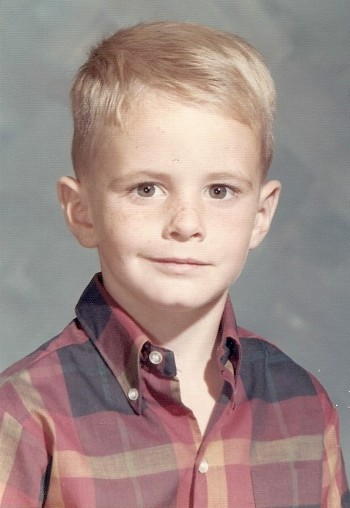 In this original BTB Investigation, we unveil the tragic story of Kirk Murphy, a four-year-old boy who was treated for “cross-gender disturbance” in 1970 by a young grad student by the name of George Rekers. This story is a stark reminder that there are severe and damaging consequences when therapists try to ensure that boys will be boys.
When we first reported on three American anti-gay activists traveling to Kampala for a three-day conference, we had no idea that it would be the first report of a long string of events leading to a proposal to institute the death penalty for LGBT people. But that is exactly what happened. In this report, we review our collection of more than 500 posts to tell the story of one nation’s embrace of hatred toward gay people. This report will be updated continuously as events continue to unfold. Check here for the latest updates.
In 2005, the Southern Poverty Law Center wrote that “[Paul] Cameron’s ‘science’ echoes Nazi Germany.” What the SPLC didn”t know was Cameron doesn’t just “echo” Nazi Germany. He quoted extensively from one of the Final Solution’s architects. This puts his fascination with quarantines, mandatory tattoos, and extermination being a “plausible idea” in a whole new and deeply disturbing light.
On February 10, I attended an all-day “Love Won Out” ex-gay conference in Phoenix, put on by Focus on the Family and Exodus International. In this series of reports, I talk about what I learned there: the people who go to these conferences, the things that they hear, and what this all means for them, their families and for the rest of us.
Prologue: Why I Went To “Love Won Out”
Part 1: What’s Love Got To Do With It?
Part 2: Parents Struggle With “No Exceptions”
Part 3: A Whole New Dialect
Part 4: It Depends On How The Meaning of the Word "Change" Changes
Part 5: A Candid Explanation For "Change"
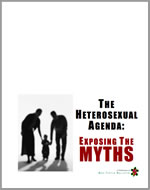 At last, the truth can now be told.
Using the same research methods employed by most anti-gay political pressure groups, we examine the statistics and the case studies that dispel many of the myths about heterosexuality. Download your copy today!
And don‘t miss our companion report, How To Write An Anti-Gay Tract In Fifteen Easy Steps.
 Anti-gay activists often charge that gay men and women pose a threat to children. In this report, we explore the supposed connection between homosexuality and child sexual abuse, the conclusions reached by the most knowledgeable professionals in the field, and how anti-gay activists continue to ignore their findings. This has tremendous consequences, not just for gay men and women, but more importantly for the safety of all our children.
Anti-gay activists often cite the “Dutch Study” to claim that gay unions last only about 1½ years and that the these men have an average of eight additional partners per year outside of their steady relationship. In this report, we will take you step by step into the study to see whether the claims are true.
Tony Perkins’ Family Research Council submitted an Amicus Brief to the Maryland Court of Appeals as that court prepared to consider the issue of gay marriage. We examine just one small section of that brief to reveal the junk science and fraudulent claims of the Family “Research” Council.
 The FBI’s annual Hate Crime Statistics aren’t as complete as they ought to be, and their report for 2004 was no exception. In fact, their most recent report has quite a few glaring holes. Holes big enough for Daniel Fetty to fall through.
“Google” is a trademark of Google Inc.
© Box Turtle Bulletin. All Rights Reserved.

 Posts
Posts  Posts via daily email: