Box Turtle Bulletin
 News and commentary about the anti-gay lobby
“Now you must raise your children up in a world where that union of man and box turtle is on the same legal footing as man and wife…”
News and commentary about the anti-gay lobbyDecember 11th, 2012
In 2009 I was concerned about the election of Kasim Reed as Atlanta Mayor. He had stated his position on marriage to be one of opposition and, upon election, found that “the voters have spoken”. He had “religious beliefs”. Coming so soon after a raid on an Atlanta gay bar, this was concerning.
At some point in 2010, I began to warm slightly to Reed. His public support for HIV testing was, I believe, helpful and useful. And he has made attempts to connect with the community in the period since.
Yet, when President Obama came out in support of equality, Reed found himself unready. He had “personal beliefs“.
But those beliefs have become increasingly difficult to maintain while seeking advancement in Democratic Party politics. As James Richardson noted last June:
Eleven words. That was all it took to rock Reed’s almost-assured contender status for that inevitable statewide bid: “I think same sex couples should be able to get married.”
But Maine and Washington and Maryland (Maryland!) has voted for equality, and now Mayor Reed has joined the evolution:
Mayor Kasim Reed today announced his support for marriage equality by signing a resolution sponsored by Councilman Alex Wan and passed by the City Council on Dec. 3, 2012. The resolution supports the city’s lesbian, gay, transgender and bisexual community by endorsing marriage equality for same-sex couples.
“Today marks an important day as I announce my support for marriage equality,” said Mayor Reed. “It is well known that I have gone through a good bit of reflection on this issue, but listening to the stories of so many people that I know and care about has strengthened my belief that marriage is a fundamental right for everyone. Loving couples, regardless of their sexual orientation, should have the right to marry whomever they want. By signing this resolution, I pledge my support to marriage equality for same-sex couples, consistent with equal protection under the law provided under the Fourteenth Amendment of the United States Constitution.”
And his support is welcomed.
December 11th, 2012
 Okay, that’s not news. It’s not even all that interesting.
Unless you consider that a Supreme Court justice is so extremely biased against one segment of the US population that he is incapable of viewing them as having rights at all.
Antonin Scalia was at Princeton (he has a new book to push) where he was introduced by anti-gay activist Robert George:
When questioned by Duncan Hosie ’16, who identified as gay, on his dissent in Lawrence v. Texas — which struck down a Texas anti-sodomy law — Scalia stood behind his decision. Hosie questioned Scalia’s comparison between having a moral objection to sodomy and having a moral objection toward things like bestiality or murder. Scalia defended his comparison as a form of argument.
“If we cannot have moral feelings against homosexuality, can we have it against murder? Can we have it against these other things?” Scalia asked, explaining his dissent. “It’s a reduction to the absurd … I don’t think it’s necessary but I think it’s effective,” Scalia said, adding dryly, “I’m surprised you weren’t persuaded.”
But the thing about “reductio ad absurdum” is that it is but a hairs breadth from a strawman argument, an argument that argues against what is falsely presented as the opponents position.
At no point have supporters of marriage argued that no moral feelings should be considered. Rather, we assert that not all moral feelings are comparable. For example, it is perfectly possible to have moral feelings against murder (which does actual harm to actual people) and to still find that moral feelings against other people’s religions are not an acceptable basis for law.
A better comparison would have been “If we cannot have moral feelings against homosexuality, can we have it against Catholicism?” But being the Pope’s proxy on the Supreme Court, I dare say that Scalia does not see anti-Catholic sentiment in the same light as anti-gay sentiment.
So, if there were any question, we have our answer. Tony will be voting against us on the rights of gay people to marriage. Or the right of gay people to adoption. Or the right of gay people to inheritance tax equality. Or the right of gay people to to eat oatmeal if it were to appear before him.
Because of his moral objections to murder, you see.
(Do you ever get the feeling that his grandchildren will change their names?)
UPDATE: Log Cabin does a good job analyzing the impact of Scalia’s views.
December 11th, 2012
It seems that you have epi-marks on your genes. And those epi-marks control how your genes operate. And while they are not supposed to be passed on to your kids, sometimes they are.
And that’s why you’re gay. Or something. (USNews)
Long thought to have some sort of hereditary link, a group of scientists suggested Tuesday that homosexuality is linked to epi-marks — extra layers of information that control how certain genes are expressed. These epi-marks are usually, but not always, “erased” between generations. In homosexuals, these epi-marks aren’t erased — they’re passed from father-to-daughter or mother-to-son, explains William Rice, an evolutionary biologist at the University of California Santa Barbara and lead author of the study.
…
Rice and his team created a mathematical model that explains why homosexuality is passed through epi-marks, not genetics. Evolutionarily speaking, if homosexuality was solely a genetic trait, scientists would expect the trait to eventually disappear because homosexuals wouldn’t be expected to reproduce. But because these epi-marks provide an evolutionary advantage for the parents of homosexuals: They protect fathers of homosexuals from underexposure to testosterone and mothers of homosexuals from overexposure to testosterone while they are in gestation.
This is all a theoretical model which has yet to be tested by studies. But it undoubtedly will. And if it proves out, this could be the end of the “choice” debate – and also may prove to be an unhandy response to those who might be tempted to eugenically control for orientation.
Meanwhile, I’m sticking with my old standby theory: orientation is caused by Gerber’s Strained Peas. And as no one has yet proven me wrong, I’ll just sit here and smirk.
December 11th, 2012
Today is full of marvels and wonders. And while this could be a common thing to those who follow the Supreme Court, I’ve not heard of it before: (Scotusblog)
The Supreme Court on Tuesday chose a Harvard professor of constitutional law, Vicki C. Jackson, to argue that the Court does not have the authority to rule on the constitutionality of the federal Defense of Marriage Act. She will file a brief and appear to argue the two procedural issues that the Court itself had raised in agreeing last Friday to consider DOMA’s validity.
Jackson, who joined the Harvard faculty last year after several years at the Georgetown University Law Center, will contend that the executive branch’s agreement with a lower court that DOMA is invalid takes away the Justices’ authority to rule on DOMA, and that the House of Representatives’ Republican leaders do not have a right to appear in the case under Article III of the Constitution. The professor will appear in the case as an amicus to make only those points, not to join in the debate over the constitutionality of DOMA, which the Court also will be considering.
It seems that none of the parties are holding that position, and they want to consider the best argument.
December 11th, 2012
The Chamber of Deputies, the lower house of Uruguay’s legislature, is slated to vote on marriage equality today. The bill is expected to pass and we’ll notify you when we know more.
December 11th, 2012
Because Cambodia is relatively tolerant when it comes to homosexuality, gay rights haven’t been much of a hot topic there. But Prime Minister Hun Sen yesterday decided to weigh in during a meeting with local villagers in southern Cambodia to address anti-gay discrimination:
“There are gays and lesbians in every country, so there should be no discrimination against them just because of their destiny,” he said.
… However, he appealed to society to show respect for gay people, saying “Most of them are good people and are not doing alcohol, drugs or racing vehicles.”
On a more serious (and positive) note, this is a bit of a reversal for the Prime Minister. In 2007, he announced that he was disinheriting his adopted daughter because she had a lesbian partner. I guess Hun Sen is like parents everywhere: all he needed was a little time. That’s the power of coming out.
December 11th, 2012
The FBI has released its annual Hate Crime Statistics for 2011 this morning, and those numbers contain some good news and some bad news. The good news is that hate crime offenses overall have gone down in 2011 when compared to 2010. The bad news is that hate crimes based on sexual orientation have actually gone up during the same period.
The FBI collects three sets of hate crime statistics: hate crime incidents, offenses, and victims. According to the FBI’s definition, an incident represents a single occurrence of one or more hate crime offenses (each offense being an assault, a robbery, an act of vandalism, etc.) against one or more victims. The statistics for 2011 look like this (with 2010 data in parentheses):
| Total Hate Crime Incidents, 2011 (2010) |
Total Hate Crime Offenses, 2011 (2010) |
Total Hate Crime Victims, 2011 (2010) |
|
|---|---|---|---|
| Race | 2,917 (3,135) |
3,465 (3,725) |
3,645 (3,949) |
| Religion | 1,233 (1,322) |
1,318 (1,409) |
1,480 (1,522) |
| Sexual Orientation | 1,293 (1,277) |
1,508 (1,470) |
1,572 (1,528) |
| Ethnicity | 720 (847) |
891 (1040) |
939 (1,122) |
| Disability | 53 (43) |
58 (46) |
61 (48) |
| TOTAL | 6,222 (6,628) |
7,254 (7,699) |
7,713 (8,208) |
| Totals don’t add up due to additional multi-category hate crime incidents, offenses and victims. |
|||
One argument against hate crimes as a category claims that the distinction singles out minority populations for special treatment. But a quick look at the FBI’s Hate Crime Statistics shows that not to be the case. Among the 2,917 incidents in 2011 based on race, 577 were anti-white. Anti-Protestant hate crime incidents made up 49 of the 1,233 religious based hate crime incidents, and 17 anti-heterosexual hate crime incidents were among the 1,508 based on sexual orientation.
Hate crime offenses based on sexual orientation continue to be the most physically violent. This year, three of the four murders counted in the FBI’s Hate Crime Statistics were anti-gay male murders (the other was anti-black). When you look at physically violent hate crimes against persons (murder and non-negligent manslaughter, forcible rape, and aggravated and simple assault) as a percentage of all hate crimes for each protected category, half of all hate crimes based on sexual orientation are personally violent ones:
| Total Hate Crime Offenses, 2011 | Violent Crimes, percentage of total | ||
|---|---|---|---|
| Race | 3,465 | 1,226 | 35% |
| Religion | 1,318 | 144 | 11% |
| Sexual Orientation | 1,508 | 748 | 50% |
| Ethnicity | 891 | 355 | 40% |
| Disability | 58 | 24 | 41% |
| TOTAL | 7,254 | 2,501 | 34% |
| Totals don’t add up due to additional multi-category hate crime offenses. |
|||
December 11th, 2012

TODAY IN HISTORY:
Gay Rights Advocate Interrupts CBS Evening News Broadcast: 1973. Among the issues that gay rights advocates faced in the early 1970s was the way gay people continued to be portrayed in the press and on television — if they bothered to cover gay issues at all. The New York Times, which was supposedly the newspaper of record for the city, had never even bothered to mention the Stonewall uprising four years earlier until several months later. To call attention to the problem, Mark Segal of the Philadelphia-based Gay Raiders posed as a reporter for the Camden State Community College newspaper and called CBS asking permission to watch the broadcast of the CBC Evening News with the legendary Walter Cronkite from inside the studio. The network agreed, and so on December 11, 1973, he briefly interrupted the broadcast about halfway through by running up in front of the camera with a yellow sign reading “Gays Protest CBS Prejudice.”:
“I sat on Cronkite’s desk directly in front of him and held up the sign while the technicians furiously ran after me and wrestled me to the floor and wrapped me in wire — on camera,” (Segal) recalled in an interview. “The network went black while they took us out of the studio.”
Ever the professional, Cronkite reported on the event. “Well, a rather interesting development in the studio here — a protest demonstration right in the middle of the CBS News studio,” Cronkite told viewers. He later explained: “The young man was identified as a member of something called Gay Raiders, an organization protesting alleged defamation of homosexuals on entertainment programs.” Segal was charged with trespassing.
The “zap” payed off. After Segal’s trial for trespassing in which his attorneys subpoenaed Cronkite the testify, the news anchor began to take an interest in Segal’s grievance. He arranged a meeting at CBS where Segal could air his complaints to management, and Cronkite’s broadcast on May 6, 1974 featured a segment on gay rights, reporting on the ten cities throughout the country that had passed legal protections for gay people.
Segal went on to become publisher of Philadelphia Gay News, and remembered his friendship with Walter Cronkite days after his passing in 2009:
“He was the kind of man who believed in human rights for everyone,” Segal said of Cronkite. “I am amazed and humbled by his willingness to reach out to me. He was a bridge between the gay movement and major media. We remained friends, and it was a privilege knowing him.”
American Psychiatric Association Rejects Ex-Gay Therapy: 1998. The American Psychiatric Association’s board unanimously rejected therapy aimed solely at changing gay people straight, saying it can cause depression, anxiety and self-destructive behavior. Dr, Nada Stotland, head of the APA’s joint committee on public affairs, said, “The very existence of therapy that is supposed to change people’s sexuality, even for people who don’t take it, is harmful because it implies that they have a disease. There is evidence that the belief itself can trigger depression and anxiety.”
The APA’s move was, in part, a response to a massive nationwide push by Focus On the Family and Exodus International to publicize the ex-gay movement, complete with a Newsweek cover the prior August featuring ex-gay spokesman John Paulk and his ex-lesbian wife Anne. Paulk who was the so-called gender specialist at Focus On the Family and organizer of the Love Won Out ex-gay roadshows, denounced the APA’s move. “This makes it more difficult for clients who want to be treated for unwanted homosexuality,” Paulk complained. “Furthermore, no scientific study has given conclusive evidence that homosexuality cannot be successfully treated.” Less than two years later, Paulk himself would be found in a Washington, D.C. gay bar flirting with patrons (see Sep 19).
The 1998 APA statement, along with a 2000 follow-on statement, can be found here.
If you know of something that belongs on the Agenda, please send it here. Don’t forget to include the basics: who, what, when, where, and URL (if available).
As always, please consider this your open thread for the day.
December 10th, 2012

From James Gurney’s charming children’s book Dinotopia, which has nothing to do with Pat Robertson or young earth creationists.
From our dear dear friends at the American Family Association:
On a broadcast of The 700 Club late last month, Pat Robertson disputed the belief that the earth is about 6,000 years old, suggesting billions instead.
“I know people will probably try to lynch me when I say this,” he stated, “but Bishop Ussher — God bless him — wasn’t inspired by the Lord when he said it all took 6,000 years. It just didn’t …. There was a time that [dinosaurs] were on the earth and it was before the time of the Bible. So don’t try to cover it up and make like everything was 6,000 years. That’s not the Bible.”
Well! I declare!
Can’t he read the simple English in which the Bible was written? It’s right there in black and white, to be taken literally and exactly!
My oh my!
But not to worry:
Moreover, the AIG researcher notes that Robertson’s claim that dinosaurs existed before biblical times is illogical, because there is no pre-biblical time; the Bible starts with the creation of the world.
Nuff said.
December 10th, 2012
The French legislature is scheduled to vote on the marriage bill on January 29th. Of course they’ve had previous schedules so we’ll see how that goes. But, in any case, let’s keep this date as a possible day of interest.
A Commentary
December 10th, 2012
Some on-site discussion about the standing decision suggests that we revisit this issue. Here’s the background:
When Perry v. Schwarzenegger was decided for the plaintiffs (overturning Proposition 8), the Governor and Attorney General accepted the decision. They did not do so as Arnold and Jerry, but as the democratically elected representatives of the people of the State of California.
This put two democratic decisions at conflict: the people elected Schwarzenegger and Brown to act on their behalf, and the people voted for Proposition 8. But the elected representatives were choosing not to fully support the proposition for which the people voted.
This presented a problem for the Ninth Circuit Court of Appeals. Precedent suggested that unless the state had a provision for appointing an appellant other than the named defense, then there was no standing for appeal. Yet those who supported the Proposition were arguing that politicians were defying democracy.
The Ninth Circuit punted. They asked the California Supreme Court whether California law had a provision by which someone other than an elected representative could represent the state.
The California Supreme Court were worried that the will of the people in a direct vote might be somehow thwarted by their elected representative choosing not to appeal the court’s ruling. They saw this in terms of a greater threat: that politicians would torpedo voter initiated controls on their elected officials thus neutering the whole initiative process.
Neither the Governor, the Attorney General, nor any other executive or legislative official has the authority to veto or invalidate an initiative measure that has been approved by the voters. It would exalt form over substance to interpret California law in a manner that would permit these public officials to indirectly achieve such a result by denying the official initiative proponents the authority to step in to assert the state’s interest in the validity of the measure or to appeal a lower court judgment invalidating the measure when those public officials decline to assert that interest or to appeal an adverse judgment.
But, as I see it, their ruling has four possible flaws.
First, if there is such a thing as “legislating from the bench”, this is it. They did not point to any statutes, code, or even the legislative will behind such. Rather they found “logic” and “reason” to be the factors under consideration. This was entirely an outcome driven conclusion.
Second, their decision can be seen as a stretch. It does seem reasonable to state that an initiative supported by popular vote must have a defense. But to say that an initiative stands apart from any other state interest and deserves appeal, whether with the support or opposition of an elected official, seems to be an answer that was driven too specifically by the emotions and through the prism of this very controversial moment.
Suppose that the voters of California supported an initiative that was endorsed by the Governor and Attorney General. And suppose that they fiercely defended the initiative in federal court only to be informed, in no uncertain terms and with unquestionable precedent and the weight of legal consensus, that the initiative was a violation of the US Constitution. Do they then have no right to accept the ruling? This ruling would suggest that no party ever has the right to any decision other than in favor of appeal.
The third possible flaw with the California ruling was that it was based on the presumption that the people of the state wanted the proposition to be supported on appeal. In protecting the will of the people, it presupposes the will of the people.
It might seem logical that the people want endless appeals. After all, they voted for this initiative. But that is not by necessity always true. It is also possible that the people of the state of California voted against same-sex marriage but, upon finding that it violated the US Constitution, accepted that decision and wished to move on with their lives.
Fourth, and perhaps the most questionable, is that the California Supreme Court selected who would be assigned standing in cases of this nature. Without any legislative or constitutional language suggesting that proponents – as opposed to an advocate or elected official or anyone at all – had some special advantage, the court just pointed and said “them”.
There is logic to the selection, up to a point. After all, as proponents for the bill, they might in this case be assumed to be best equipped to defend it.
However, this is a wild assumption. I’ve known a number of initiatives that received support from voters but whose proponents were loons. Sometimes the people can endorse an idea without for a moment endorsing the person who proposes it. And if there was a group less representative of the voters of California than the proponents of Proposition 8, I’d be hard pressed to find them.
But, nevertheless, the Ninth Circuit leaped on the opportunity not to make that decision and accepted the guidance of the California Supreme Court. Who better to direct as to who would represent the state?
But that does not mean that the Supreme Court of the United States will go along with that decision. Just as the California Supremes found a necessity of protecting the rights of the people from their elected representatives, the US Supremes may feel a need to protect the rights of the people from their unelected judiciary’s creative finding.
Or the SCOTUS may find that states may assign such lunatics as they like to their defense and through whichever means they prefer. At this point we don’t know.
But the decision to accept Perry AND to discuss standing indicates that the court wishes to rule on the matter one way or the other. And this ruling will greatly clear up what is an increasingly unclear area of federal law.
December 10th, 2012
 Prime Minister David Cameron has announced that the anticipated legislation legalizing same-sex marriage will be set out next week and will include a clause to allow for church weddings.
I’m a massive supporter of marriage and I don’t want gay people to be excluded from a great institution.
“But let me be absolutely 100 per cent clear – if there is any church or any synagogue or any mosque that doesn’t want to have a gay marriage it will not, absolutely must not, be forced to hold it.
This is expected to face opposition from the Anglican Church and the Catholic Church along with conservative members of his own party. It had been the government’s intent to allow same-sex marriages only in civil settings (much like civil unions) but protest by Quakers, Unitarians and Liberal Jews led to the “opt-in” provision.
The legislation is expected to be considered before the end of 2013.
December 10th, 2012

Charter for the Society for Human Rights, 1924.
TODAY IN HISTORY:
First American Gay Rights Group Founded: 1924. Pro-gay activism in the U.S goes back a very long way, far longer than most realize. Henry Gerber, a Bavarian immigrant to Chicago, served in the U.S. Army’s occupation of Germany following World War I, where he came in contact with the growing German gay rights movement. He read up on German homophile magazines and came in contact with Magnus Hirschfeld’s Scientific-Humanitarian Committee, the first organization in the world working to advance gay rights. When Gerber returned to the U.S. he founded the Society for Human Rights (SHR) in 1924. With an African-American clergyman named John T. Graves as president, SHR is believed to be America’s first gay rights organization. Gerber also founded Friendship and Freedom, the first known American gay publication.
When the state of Illinois granted a charter on December 10, 1924, the Society became the first documented gay organization in America. To gain the charter, they deliberately kept the Society’s mission vague, omitting any mention of homosexuality in their application. Still, they were surprised that no one from the state investigated before issuing the charter. According to the charter, the Society’s objective was:
to promote and to protect the interests of people who by reasons of mental and physical abnormalities are abused and hindered in the legal pursuit of happiness which is guaranteed them by the Declaration of Independence, and to combat the public prejudices against them by dissemination of facts according to modern science among intellectuals of mature age. The Society stands only for law and order; it is in harmony with any and all general laws insofar as they protect the rights of others, and does in no manner recommend any acts in violation of present, laws nor advocate any matter inimical to the public welfare.

Henry Gerber
Gerber had a great deal of difficulty getting SHR off the ground. The Rev. John T. Graves, and African-American preacher, was the only clergyman willing to join, and he signed on as president. Gerber, who was the group’s secretary, tried to interest physicians, sex educators, and sexual freedom advocates. “The most difficult task was to get men of good reputation to back up the Society,” he later recalled, but “they usually refused to endanger their reputations .. The only support I got was from poor people (who) were illiterate and penniless.” One of his problems, he discovered, was that “most people only join clubs which already have members.” Fewer still were willing to receive the SHR’s newsletter, Freedom and Friendship, which only lasted for two issues. Gerber ended up bearing most of the work and all of the costs for SHR. In 1962, he reflected on those difficulties:
I realized that homosexuals themselves needed nearly as much attention as the laws pertaining to their acts… The first difficulty was in rounding up enough members and contributors so the work could go forward. The average homosexual, I found, was ignorant concerning himself. Others were fearful. Still others were frantic or depraved. Some were blasé.
Many homosexuals told me that their search for forbidden fruit was the real spice of life. With this argument they rejected our aims. We wondered how we could accomplish anything with such resistance from our own people.
With those difficulties, it isn’t any wonder that SHR didn’t last very long. But the final nail in the group’s coffin was hammered when the wife of the group’s vice president denounced Gerber and his associates to police as “degenerates.” In July, 1925, police arrested Gerber, Graves and two others while the Chicago Examiner reported the story under the headline, “Strange Sex Cult Exposed.” Gerber was tried three times, but the charges were eventually dismissed because he was arrested without a warrant. He was nevertheless ruined, jobless and drained of his life savings, and SHR was no more. Gerber continued writing about gay rights, sometimes under his own name and sometimes under a pseudonym. In 1962, he wrote a detailed history of SHR for ONE Magazine (major portions of that account can be found here.) He died on New Year’s Eve in 1972 at the age of 80, having lived long enough to see gay rights advocacy take on a new vibrancy in the 1950s and 1960s, culminating in an explosion of advocacy and pride after the Stonewall Rebellion of 1969.
[Source: Jim Kepner and Stephen O. Murray. “Henry Gerber (1895-1972): Grandfather of the American Gay Movement.” in Vern L. Bulllough’s (ed.) Before Stonewall: Activists for Gay and Lesbian Rights in Historical Context
AIDS Transmission Linked to Blood: 1982. Ever since the Centers for Disease Control and Prevention first began to track a new disease that would be known as AIDS in the summer of 1981 (See June 5), doctors and epidemiologists were scrambling to try to figure out how this disease was transmitted. Some believed it was the result of heavy drug use, some believed that it was somehow blood-borne, and some just thought it was some sort of natural breakdown of the immune system among “promiscuous homosexuals” who had too many sexually transmitted diseases over their lifetime. That last explanation didn’t do a very good job at explaining why AIDS was showing up among Haitians and hemophiliacs, but when you have homosexuals available for an ready target, it’s easy to ignore the pieces that don’t entirely fit the theory.
The CDC was finally able to shed some light on the controversy in the December 10, 1982 edition of the Morbidity and Mortality Weekly Report. That week’s MMWR carried a report of a 20-month old infant in San Francisco who developed all of the hallmark opportunistic infections associated with AIDS. The infant was delivered by C-section in March 3, 1981, and was given several blood transfusions over a four-day period, followed by more transfusions and other blood products during the one-month hospitalization that followed. Six months later, he began developing infections that continued through the next year. MMWR reported, “The parents and brother of the infant are in good health. The parents are heterosexual non-Haitians and do not have a history of intravenous drug abuse. The infant had no known personal contact with an AIDS patient.” But further investigation revealed that one of the nineteen donors who gave blood that was given to the infant during that first month was found to have AIDS:
The donor, a 48-year-old white male resident of San Francisco, was in apparently good health when he donated blood on March 10, 1981. Platelets derived from this blood were given to the infant on March 11. Eight months later, the donor complained of fatigue and decreased appetite. On examination, he had right axillary lymphadenopathy, and cotton-wool spots were seen in the retina of the left eye. During the next month, December 1981, he developed fever and severe tachypnea and was hospitalized with biopsy-proven Pneumocystis carinii pneumonia. … He died in August 1982.”
The CDC concluded:
The etiology of AIDS remains unknown, but its reported occurrence among homosexual men, intravenous drug abusers, and persons with hemophilia A suggests it may be caused by an infectious agent transmitted sexually or through exposure to blood or blood products. If the infant’s illness described in this report is AIDS, its occurrence following receipt of blood products from a known AIDS case adds support to the infectious-agent hypothesis.
…This report and continuing reports of AIDS among persons with hemophilia A raise serious questions about the possible transmission of AIDS through blood and blood products. The Assistant Secretary for Health is convening an advisory committee to address these questions.
If you know of something that belongs on the Agenda, please send it here. Don’t forget to include the basics: who, what, when, where, and URL (if available).
As always, please consider this your open thread for the day.
December 9th, 2012
TODAY’S AGENDA:
Same-Sex Marriages Begin: Washington. On Thursday, LGBT couples flooded county auditors offices across the state to take out marriage licenses under a new law that was approved by voters last month. Today, after the three day mandatory waiting period, those couples will begin marrying. Seattle City Hall has been transformed into a massive wedding chapel, and it will open for several hours today with several judges donating their time to marry couples. More than 140 couples have signed up for slots and those weddings will begin at 10:00 a.m. In Olympia, four local judges made themselves available to perform wedding ceremonies beginning just after midnight at the Thurston County courthouse. Former Air Force flight nurse Maj. Margaret Witt, who successfully challenged “Don’t Ask, Don’t Tell,” will marry, and so will retired nurse, Army Col. Grethe Cammermeyer in Langley. They will be joined by nine other couples who will also get married there, right before an annual Christmas party that will double as a wedding reception. Voters in Maryland and Maine also approved marriage equality laws during last months elections. Maine’s same-sex couples will be allowed to marry beginning on December 29, while Maryland’s new marriage equality law goes into effect on January 1.
Other vents This Weekend: Mad Bear, Madrid, Spain.

TODAY IN HISTORY:
Gall Bladder Problems Are For Sissies: 1927. Dr. William A. Evans’s column, “How to Keep Well” was the first syndicated health column in the U.S. In 1927, he reviewed (or, more accurately, mocked) the theories of a “Dr. Draper,” who theorized that we were born with whatever fatal diseases that would eventually do us in in the end. “His opinion,” wrote Evans, “is that if you are born to die of gall stones you’ll die of gall stones whether it comes to pass or not.” Dr. Draper also believed that certain shapes and contours of the body and head could be used to identify certain diseases. Draper soon discarded that theory in favor of one in which, as Evans described it, held that “the mental makeup, the character, personality, that he would have us believe is the background for certain diseases.” Evans continued:
Up to now he is working principally with gall stones and gall bladder infections, on the one hand, and ulcer of the stomach on the other. He finds that people who are prone to have stomach ulcers have a mental makeup in which there is great fearfulness. They have but little stability of mood. They make quick adjustments to change in environment. They are ideal opportunities. They are mental sprinters with little endurance. However, after exhaustion they are quickly rehabilitated by food, by short periods of rest and by relief from anxiety. They have heterosexual urges.
On the other hand, the people who are prone to gall bladder disease have great stability of mood, they are phlegmatic, and they have slow reactivity. They have but little fearfulness. They are placid, calm and not given to worries, fears or anxieties. They have more tendency to homosexual urges.
Science!

Minnesota State Sen. Allan Spear at a gay rights rally in 1981.
Minnesota State Senator Comes Out: 1974. Democrats sailed into state offices in 1974 in the wake of President Nixon’s resignation due to the Watergate scandal. But State Senator Allan Spear, who had entered the state legislature in 1972 and therefore wasn’t up for re-election that year, was more interested in another election that was taking place half a country away. That year, Elaine Noble would become the first openly gay person to be elected to a state legislature when she won her seat in the Massachusetts House of Representatives (see Nov 5). “I had not yet met Elaine,” Spear later wrote, “but her example inspired me. If I did come out, I would have company, even though she would be a thousand miles away.”
Shortly after that election, Spear went to New York to speak at a gay conference. There, he met with Dr. Howard Brown, who had founded the National Gay Task Force in 1973 (see Oct 15). “In fact,” he wrote, “the most rewarding part of the weekend was seeing Howard again and having long discussions with him and some of his friends. In the struggle that was going on in my own mind about coming out, nothing was more encouraging than seeing stable, successful professional gay men who were open about their sexuality.”
Spear had already decided that it was best to come out under his own terms rather than have his sexuality brought out in circumstances which were not under his control. He had been in the state Senate long enough to establish a reputation fro being a multi-issue legislator, and his re-election was far-enough off in the future that he felt that it wouldn’t dominate the campaign when the time came. But most importantly, he was ready. “I had crossed the barrier with my parents a year before. Now my friendship with Howard Brown and the example of Elaine Noble had convinced me that I would not be marginalized by coming out. … I picked up the phone and called Deborah Howell at the Minneapolis Star. We made an appointment for lunch at a downtown Minneapolis restaurant called the Normandy Village on December 5.”
 Four days later, the Star ran with a front page headline just under the fold reading “State Sen. Allan Spear Declares He’s Homosexual.” Spear was pleased to see that the story was a positive one. “The telephone rang all afternoon and evening. I received only one hostile call, from an elderly constituent who had voted for me and now felt hurt and betrayed. Otherwise the calls were wholly supportive — many from friends, of course, but others from people I didn’t know, both gay and straight, who congratulated me for my courage and wished me the best. The next day, I started receiving letters and telegrams from all over the country.”
Spear would go on to serve 28 years in the state Senate before retiring in 2000 as Senate President. In 1993 he was instrumental in passing the Minnesota Human Rights Act, which provided anti-discrimination protections in education, employment, and housing for LGBT Minnesotans. That project took twenty years to accomplish, but he finally did it with bipartisan support. Sen. Spear died in 2008, and his autobiography, Crossing the Barriers
TODAY’S BIRTHDAY:
 Ronnie Paris, Jr.: 2001. He was only three years old when he died on January 28, 2005 at the hands of his father. The abuse had been going on for a very long time. In 2002, the Florida Department of Children and Family Services removed Ronnie from his home and placed him in protective custody after he had been admitted to the hospital for malnourishment and a broken arm. On December 14, five days after this third birthday, he was returned to his parents. Just a month later on January 22, he slipped into a coma while sleeping on the couch of a family friend as his parents attended a Bible study. He died six days later from brain injuries. His mother later told detectives that her husband, Ronnie Paris, Sr., had repeatedly beaten his son, slammed him into walls, and forced him to participate in father-son boxing matches until he would shake, cry, and wet himself. Ronnie’s father did all this because he though his son was gay, so he beat him to keep Ronnie from growing up “soft.” Ronnie Paris, Sr. was convicted of second degree manslaughter and aggravated child abuse and was sentenced to 30 years in prison. If Ronnie, Jr., were alive today, he would be eleven years old.
If you know of something that belongs on the Agenda, please send it here. Don’t forget to include the basics: who, what, when, where, and URL (if available).
As always, please consider this your open thread for the day.
December 8th, 2012

Tonight is the first night of the Festival of Lights.
Featured Reports
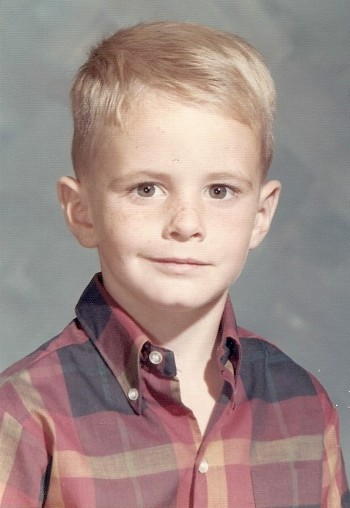 In this original BTB Investigation, we unveil the tragic story of Kirk Murphy, a four-year-old boy who was treated for “cross-gender disturbance” in 1970 by a young grad student by the name of George Rekers. This story is a stark reminder that there are severe and damaging consequences when therapists try to ensure that boys will be boys.
When we first reported on three American anti-gay activists traveling to Kampala for a three-day conference, we had no idea that it would be the first report of a long string of events leading to a proposal to institute the death penalty for LGBT people. But that is exactly what happened. In this report, we review our collection of more than 500 posts to tell the story of one nation’s embrace of hatred toward gay people. This report will be updated continuously as events continue to unfold. Check here for the latest updates.
In 2005, the Southern Poverty Law Center wrote that “[Paul] Cameron’s ‘science’ echoes Nazi Germany.” What the SPLC didn”t know was Cameron doesn’t just “echo” Nazi Germany. He quoted extensively from one of the Final Solution’s architects. This puts his fascination with quarantines, mandatory tattoos, and extermination being a “plausible idea” in a whole new and deeply disturbing light.
On February 10, I attended an all-day “Love Won Out” ex-gay conference in Phoenix, put on by Focus on the Family and Exodus International. In this series of reports, I talk about what I learned there: the people who go to these conferences, the things that they hear, and what this all means for them, their families and for the rest of us.
Prologue: Why I Went To “Love Won Out”
Part 1: What’s Love Got To Do With It?
Part 2: Parents Struggle With “No Exceptions”
Part 3: A Whole New Dialect
Part 4: It Depends On How The Meaning of the Word "Change" Changes
Part 5: A Candid Explanation For "Change"
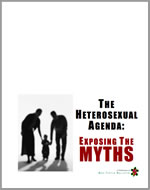 At last, the truth can now be told.
Using the same research methods employed by most anti-gay political pressure groups, we examine the statistics and the case studies that dispel many of the myths about heterosexuality. Download your copy today!
And don‘t miss our companion report, How To Write An Anti-Gay Tract In Fifteen Easy Steps.
 Anti-gay activists often charge that gay men and women pose a threat to children. In this report, we explore the supposed connection between homosexuality and child sexual abuse, the conclusions reached by the most knowledgeable professionals in the field, and how anti-gay activists continue to ignore their findings. This has tremendous consequences, not just for gay men and women, but more importantly for the safety of all our children.
Anti-gay activists often cite the “Dutch Study” to claim that gay unions last only about 1½ years and that the these men have an average of eight additional partners per year outside of their steady relationship. In this report, we will take you step by step into the study to see whether the claims are true.
Tony Perkins’ Family Research Council submitted an Amicus Brief to the Maryland Court of Appeals as that court prepared to consider the issue of gay marriage. We examine just one small section of that brief to reveal the junk science and fraudulent claims of the Family “Research” Council.
 The FBI’s annual Hate Crime Statistics aren’t as complete as they ought to be, and their report for 2004 was no exception. In fact, their most recent report has quite a few glaring holes. Holes big enough for Daniel Fetty to fall through.
“Google” is a trademark of Google Inc.
© Box Turtle Bulletin. All Rights Reserved.
 Posts
Posts  Posts via daily email: