Box Turtle Bulletin
 News and commentary about the anti-gay lobby
“Now you must raise your children up in a world where that union of man and box turtle is on the same legal footing as man and wife…”
News and commentary about the anti-gay lobbyDecember 8th, 2012
 Tonight at sundown marks the start of the first day of Hanukkah. The story behind the eight days of Hanukkah is pretty cool: after the forces of Antiochus IV had been driven from the Temple, the Maccabees discovered that all of the ritual olive oil used to light the Temple menorah had been profaned — all except for one container that was still sealed by the High Priest. It had enough oil to keep the menorah lit for only one day, which meant that it would have run out before they could press and prepare more oil in a process that took eight days. But miraculously, that one-day supply lasted all eight days, and the light never went out.
Cool story. Just about as cool as the Christmas story. And one way you know that its coolness is approaching Christmassy coolness is the way Hanukkah merchandise is becoming just as commercialized and tacky as Christmas tchotchkes (which, by the way, is a really cool Yiddish word). I used to think it looked kinda patronizing whenever we’d walk into a Crate and Barrel festooned with Christmas stuff and see that one tiny little corner set aside for a Hanukkah display. “Oh look,” I’d say to my partner in my best morning television host voice, “and now we have something for our Jewish friends.” But now Hanukkah has gone all steampunk, and that just takes its coolness to a whole ‘nother level.
Of course, the jury still out as to which level that actually is.
Happy Hanukkah!
TODAY’S AGENDA:
Events This Weekend: Mad Bear, Madrid, Spain; Pride Manila, Manila, Philippines.
THIS MONTH IN HISTORY:
Aversion Therapy of Homosexuality: 1969. Doctors had been using painful jolts of electricity to try to torture homosexuality out of people since 1935 (see Mar 15 and Sep 6), and when Behavioral Therapy became one of the more dominant forms of therapy in the 1960’s, gay people were getting shocked right and left. In 1969, The British Journal of Psychiatry published a paper by John Bancroft of Maudsley Hospital, a psychiatric facility in South London, titled “Aversion Therapy of Homosexuality: A Pilot Study of 10 cases.” The purpose of the paper was to provide a longer-term follow-up of the first ten cases of a larger group of 40, with “the minimum follow-up period being one year.”
The treatment went like this: first, the patient’s penis was attached to a sensitive measurement device to detect any changes in its girth. Then:
In method A, the patient was asked to produce erotic homosexual fantasies whilst looking at photographs of males. Painful electric shocks were delivered to his arm whenever an erection developed up to a certain level. (In most cases the level used represented an increase in the circumference of the penis of approximately 0.6 mm. This reflects a change of which the subject is not usually aware but which is reliable and distinguishable from artifact.) Following this initial shock, further shocks were given at 15 second intervals unless the erectile response was falling or was once again below the threshold level. A minimum of 5 shocks was given in any one trial.
If the threshold level of erection was not reached by the end of 5 minutes, the trial was ended and a new trial was started with different photographs. On the average, 12 such trials were given in each session.
In addition each session included two further types of trial; one homosexual trial with no threat of shock, and 3 heterosexual trials when photographs of females were used and the patient encouraged to produce heterosexual fantasies. These heterosexual trials were included for two reasons. Firstly to allow discrimination between homosexual and heterosexual erections and so avoid any suppression of homosexual erections generalizing to both. Secondly it was hoped that either by a practice effect or by an “anxiety relief” effect (due to withdrawal of the threat of shock) the heterosexual responses might be reinforced.
In the last three patients an alternative method was used in the last part of treatment (Method B). In this method, the patient was asked to produce specific homosexual fantasies without the use of photographs, and to signal as soon as he had the image clearly in his mind. He was then shocked. In this second method, therefore the noxious stimulus was not contingent upon the erectile response but upon the fantasy.
Before or after the sessions, the patients were asked to describe any sexual activity they had participated in, as well as their masturbatory fantasies. The answers to those questions determined whether they passed or failed. How very scientific, don’t you think? But what’s most revealing is how Bancroft described the treatment effects for each of the ten patients. Each description is worth looking at:
Patient A: He was a 36 year old artist “of good personality” who , aside from a few dalliances, was “clearly heterosexual in his outlook.” He was married, but had frequent flings on the side. He volunteered for aversion therapy after reading about it in a newspaper article. “After 30 sessions he was initiating homosexual encounters but finding himself impotent. This had never happened before. Treatment was stopped after 45 sessions when he felt he could control the urges.” But on follow-up, he gradually returned “to his previous pattern. He was given a further course of treatment using method B; this gave him greater control but only whilst the treatment was continuing. Three and a half years after treatment homosexual encounters continue but the frequency is less than before treatment, the urges are less strong, and he is getting less pleasure from them.”
Patient B: A 28-year-old postal worker who “came for treatment because he was frightened by a police charge.” After 21 sessions, “he was starting to masturbate with heterosexual fantasies, but he expressed the following difficulty which was never completely overcome… ‘whenver I start to think of the vagina a penis comes into my mind — as though there was some kind of block.’ Treatment stopped after 39 sessions. Although he had started to find women attractive and to masturbate with heterosexual fantasies for the first time in his life, his homosexual interest had never been significantly reduced and had remained prepotent. … After four months homosexual urges became stronger and heterosexual fantasies difficult. After 6 months he resumed homosexual activities. Soon he was back to his normal pattern.”
Patient C: A 37-year-old zoologist who volunteered because “he wanted to become heterosexual.”After 12 sessions he was experiencing ‘pangs’ of anxiety on seeing attractive males in the street. By this stage he was beginning to masturbate with heterosexual fantasies. After 15 sessions he started to feel some anxiety during the female trials and a little later was noting ‘pangs’ of anxiety on seeing sexually threatening females as well as attractive males. This conditioned anxiety became more obvious and treatment was stopped after 35 sessions… For 2½ years he has maintained this conditioned ‘phobic’ anxiety to potentially attractive males, experiencing a ‘pang’ of discomfort in the chest when seeing them. On two or three occasions homosexual advances have been made to him and these have provoked intense anxiety and avoidance. …Two and a half years after treatment his homosexual interest is much reduced and he has no desire to make any homosexual contacts. He is once again using homosexual fantasies during masturbation but heterosexual fantasies occur some of the time.”
Patient D: A 22-year-old “with no settled employment, with an abnormal personality … [and who] also suffered from epilepsy.” “He showed inconsistent and varied responses during treatment and was an unreliable witness. There was slight improvement in the first half of treatment but the second half resulted in a hostile, negativistic and destructive attitude together with some depression of mood. He made a suicidal gesture and his first ever homosexual advance during this stage. Treatment was stopped after 36 sessions with no apparent benefit having been achieved.” After treatment, “he appeared much more accepting of his homosexuality.” But his sexual functioning was disturbed, possibly because of the effects of treatment: “He found little pleasure and was unable to reach orgasm. Nine months after treatment he was playing a passive role in buggery, but with no sexual arousal on his part. Two years after treatment he was much more settled and was having an affair with an elderly man in which sexual activity was getting less and less frequent. He still failed to achieve orgasm during these encounters…”
Patient E: A 36-year-old actor “of athletic build.” Despite heing “actively homosexual,” he met and married a woman and subsequently became “almost impotent,” and for the year before undergoing treatment, he had been suffering from “intrusive homosexual fantasies [which] were still strong and frequent” along with “marked pervasive anxiety.” After 12 sessions, he began having intercourse with his wife “with slight enjoyment.” But after 32 sessions, “both heterosexual and homosexual responses were declining again. At this stage, homosexual fantasies provoked disinterest rather than anxiety, whereas heterosexual fantasies, especially involving his wife, provoked some anxiety.” On follow-up things only got worse. “Ten months after treatment, his relationship with his wife deteriorated again, his anxiety increased and he became completely imporent. One month later homosexual fantasies returned. He expressed anger at the treatment and the therapist and discontinued treatment.”
Patient F: A 47-year-old Scot who sought treatment for many years to become heterosexual. He had previously tried psychotherapy (including psychotherapy with LSD), and two previous, unsuccessful attempts at electric shock aversion therapy. So this was a guy who knew what he was getting into. “He reported relief at the start of female trials after only 2 sessions. After 8 sessions he started to produce strong erections to heterosexual fantasies. From then on the pattern was of fluctuating heterosexual interest. Homosexual interest and responses were reduced early in treatment, but showed a slight increase in the second half. Treatment was stopped after 35 sessions. At this stage he felt ‘really heterosexual now’ and had only occasional slight homosexual interest.” But his “really heterosexual” feelings proved elusive. He dated a woman, but when they broke up he was depressed for two to three weeks and “his homosexual interest increased and he had two homosexual experiences. Fifteen months after treatment, following a second severe but short lived depressive episode he is showing more homosexual interest again, but retains some heterosexual interest and has certainly not regained his previous ‘heterophobia’.”
Patient G: A 27-year-old clerical worker who had almost no heterosexual experience or feelings. “After 9 sessions he was finding heterosexual fantasies easier and after 12 sessions he was reporting an intense interest in women. Though fluctuating in intensity, heterosexual responses and interest continued for the rest of treatment. His homosexual interest and responses were slightly reduced during the middle stages of treatment but after 17 sessions they increased again. Treatment was stopped after 32 sessions, when his homosexual interest was much the same as before treatment, but he now found women strongly attractive.”
“Following treatment he became depressed, his homosexual urges became more marked and his heterosexual interest lessened. He remained depressed for the next five months. Then, following a minor rejection by a homosexual friend, he was admitted to hospital having been found wandering the streets at night removing some of his clothing. He showed no further evidence of psychotic behaviour. For the first month in hospital he remained isolated and mildly depressed. He was then started on diazepam and showed a marked change. He became more cheerful and confident and started a relationship with a female patient which continued after they both left hospital. At first he showed some degree of impotence, but he has had a satisfactory sexual relationship with her since. Fifteen months after aversion he enjoys regular sexual intercourse and has had no homosexual inclinations at all.
Patient H: A 24-year-old teacher who, despite strong attractions, had had little homosexual experience. While had had had several girlfriends, he found them “only slightly arousing.” “After 7 sessions he started to produce increasingly strong heterosexual responses associated with aggressive fantasies. After 15 sessions heterosexual images were beginning to intrude into his homosexual masturbation fantasies and a little later he masturbated with exclusively heterosexual fantasies for the first time. By this stage his homosexual interest was less strong and he had become unable to reach orgasm using homosexual fantasies. His homosexual responses in treatment continued as strong, however.” Following treatment, he began dating a girl, but the relationship never progressed beyond kissing. It ended after three months. “Six months after treatment, he made his first homosexual contact. One year after treatment he is energetically pursuing homosexual relationships but he avoids reaching orgasm himself, and if possible prevents his partner from doing so.”
Patient I: A 29-year-old policeman, married since 21, and with two children. When he first married, he “obtained slight pleasure from sexual intercourse but this steadily waned.” He began a three year affair with another man “and is not promiscuous,” during which time he became “mostly impotent with his wife.” He volunteered for treatment to try to save his marriage, but the treatment proved futile. “Little impression was made on either his homosexual or heterosexual responses. There was some reduction in homosexual urges after 5 sessions but he avoided using his ‘affair’ in his homosexual fantasies and was clearly resisting any attempt to destroy his feelings for him. He reported little anxiety during treatment but he was generally non-communicative and difficult to assess. After 20 sessions the treatment was changed to Method B. He was urged to use fantasies involving his ‘affair’. After only one further session it became clear that he did not really want the treatment to work. The treatment was therefore discontinued.” On follow-up, “he returned to his previous homosexual relationship with considerable pleasure and continued a reasonably friendly though sexless relationship with his wife.”
Patient J: A 27-year-old “of average intelligence” who, while never having had any heterosexual interest, he “could never contemplate an overt homosexual relationship because of guilt.” “He had 15 sessions of method A and 15 sessions of Method B. His responses were inconsistent. During Method A he was usually unable to concentrate on his fantasies for fear of the shock, even when very low levels were used. Occasionally, however, he responded easily. With Method B the same inconsistency occurred. At the end of treatment there was no evidence of change in his homosexuality, and the only change heterosexually was that he had lost his revulsion and was now able to sustain heterosexual fantasies more easily. … “In the first three months (after treatment), he experienced more interest in females. He mixed more with them socially, and kissed a girl for the first time. This did not, however, result in any sexual arousal. His homosexual fantasies continued as strongly as before. Ten months after treatment there is no further progress.
As you can see, there were precious few success stories — and you would have to find some rather expansive definition of “success” to find them. Patient G, according to Bancroft, was the only one to show “no homosexual inclinations at all.” But one has to wonder what priced he paid. Later in the article, Patient G was among four who showed moderate or high anxiety during treatment, and he “expressed some slight aggression toward the therapist on 3 or 4 occasions.” He also “became depressed soon after treatment and remained so, in spite of anti-depressant drugs, until admission to hospital 5 months later.” Bancroft attributed his subsequent improvement not to his lady friend, but to the use of Diazepam.
Overall, Bancroft found the results disappointing, but he felt it was important to press on:
Methods of behaviour modification such as these are in their infancy and a considerable amount of further research is needed before such techniques can be advocated for general use. But the benefits to be gained from such research may be considerable. They will include increased understanding of behaviour modification in general, as well as a greater understanding of the behaviours to be modified.
The Rest Of The Story
I would love to know what happened to those ten patients since their treatment ended in the mid-1960s, but nearly fifty years on we may never find out. But we do know that Bancroft would continue investigating methods for changing sexual orientation through the 1960s and the first part of the 1970s. But as the mental health professions changed its view of homosexuality, and as behavior therapists in particular began to abandon their punitive approaches to behavioral modification, Bancroft tried to move with the times, although he did so reluctantly. In 1975 — by then he was Dr. John Bancroft at the Department of Psychiatry at Oxford University — he wrote the following:
I accept that homosexuality is not an illness but an alternative sexual life style which may be and often is compatible with normal health, and with those interpersonal and social values that we hold most high. If that is so then the social stigma associated with homosexuality, the repression that stems from it and the guilt and suffering that often result are undesirable and unjust. When we consider the part that the medical profession has played in the past in fostering these negative and unjust social attitudes it is clear that it has a responsibility now and in the future actively to encourage a more positive and less repressive climate of opinion.
Good start, right? But the balance of his 1975 article was somewhat more ambivalent. He defended aversion therapy against those who denounced its coercive nature, considering it little more than a public relations problem. He defended therapies — including aversion therapies — to change sexual orientation if a patient said he wanted it. “Homosexuals are subjected to many types of oppression: one of the most hostile can be the attitude, ‘You are a homosexual — you must learn to accept it’.”
But in the decades since, Bancroft has had the occasion to reconsider that position further. When Robert Spitzer published his controversial ex-gay study in the Archives of Sexual Behavior in 2003 (the study that Spitzer renounced and later apologized for earlier this year), Bancroft, now at the Kinsey Institute for Research in Sex, Gender, and Reproduction at Indiana University, was one of some two dozen authors to publish a peer review commentary. In Bancroft’s response, he drew on his own experience in the field:
Times were different then. The Gay Rights Movement was early in its development and it was much more likely than it is today that individuals would seek such change. But on reflection, I realized that, whereas I was genuinely trying to help the individual, in the process I was aligning myself with those who reinforced homophobic attitudes and all the consequences of the stigma that ensued. It did not continue to be a dilemma for me, as my own results gave me no reason to continue to use such simplistic interventions.
And he criticized Spitzer’s study claiming that some people who underwent “reparative” therapy said they changed. He criticized it not only for its many methodological weaknesses, but also for the role it would inevitably play in reinforcing negative attitudes toward gay people:
If there were any grounds for regarding homosexual orientation as a pathology rather than a variant of human sexual expression, then treating the pathology might be justified. I would assert that there are no such grounds, and hence providing treatment on that basis is professionally unethical and, according to my value system, immoral. There is a long and disturbing history of medical practitioners imposing their moral values through their professional practice. The imposition of moral values, explicitly or implicitly, that is, urging someone to undergo change because their current sexual orientation is immoral, should not be regarded as “therapy,” and in any case raises other ethical and moral issues. …[Spitzer’s report] constitutes vigorous reinforcement of homophobia and the social stigma experienced by those with homosexual identities in our society. Together, this results
in widespread suffering for homosexual minorities and, no doubt, for many who are pressured into attempting such change, considerable conflict and unhappiness.
[Sources: John Bancroft. “Aversion therapy of homosexuality: A pilot study of 10 cases.” British Journal of Psychiatry 115, no. 529 (December 1969): 1417-1431.
John Bancroft. “Homosexuality and the medical profession: A behviourist’s view.” Journal of Medical Ethics 1, no. 4 (December 1975): 176-180.
John Bancroft. Peer Comments on Spitzer (2003): “Can sexual orientation change? A long-running saga.” Archives of Sexual Behavior 32, no. 5 (October 2003): 419-421.
For more information on the history of behavioral therapy, see our report, “Blind Man’s Bluff”.]
If you know of something that belongs on the Agenda, please send it here. Don’t forget to include the basics: who, what, when, where, and URL (if available).
As always, please consider this your open thread for the day.
December 7th, 2012

This summer I found this lovely item in HomeGoods which I’m sure would come in handy while celebrating, oh, something or other.
Or, as my friend Dan Rosen told me on Saturday, “This year has gone by so fast. It’s almost Hannukah and I haven’t even started putting up my Christmas decorations.”
December 7th, 2012
The National Organization for (heterosexual only) Marriage has issued a statement in response to the Supreme Court’s decision to grant certiorari on the Prop 8 and DOMA cases.
“We believe that it is significant that the Supreme Court has taken the Prop 8 case,” said John Eastman, NOM’s chairman and former Dean (and current professor) at Chapman University School of Law. “We believe it is a strong signal that the Court will reverse the lower courts and uphold Proposition 8. That is the right outcome based on the law and based on the principle that voters hold the ultimate power over basic policy judgments and their decisions are entitled to respect.”
Eastman quit the Dean position to run for Attorney General. He lost badly with only 34% of the primary vote.
He also opined about DOMA(3)
“We are pleased that the Supreme Court will review lower-court decisions that invalidate the judgment of the U.S. Congress to define marriage as one man and one woman,” Eastman said. “It’s not the job of federal judges to substitute their views for the policy judgments of the people’s duly elected representatives. We believe the U.S. Supreme Court will overturn this exercise in judicial activism and stop federal judges from legislating from the bench on the definition of marriage. We’re confident the Court will uphold DOMA.”
Which makes me wonder what Eastman thinks is the job of federal judges. It also makes me think that he is likely a phenomenally poor predictor of SCOTUS results. Or indisposed to truthfulness.
December 7th, 2012
The pro-government New Vision confirms it:
After a series of debates and disagreement majorly over Clause 9 of the Petroleum (Exploration, Development and Production) Bill 2012. The Oil bill has eventually been passed Friday Afternoon. Details coming soon.
This is a distressing turn of events for many reasons. First, for the Ugandan people, this bill will effectively give President Yoweri Museveni sole discretion to decide who wins and who loses in awarding billions of dollars in valuable oil contracts as Uganda begins developing its newly-discovered oil reserves. Parliament is now out of the loop, with no oversight into how the decisions are made. This of course represents a massive new opening in Uganda’s already notoriously corrupt political culture. In essence, the Ugandan people’s oil will litterally be stolen out from under them.
It’s also distressing because, according to the published Order Papers on the Parliament’s web site, there was no notice that Parliament was even going to meet today. Parliament typically does not meet on Mondays and Fridays. Consequently, just barely half of the House showed up for the vote.
Which is why the Anti-Homosexuality Bill is waiting in the wings. This oil grab has proved hightly unpopular with the media and the general public. Which means that it’s time for that distraction I’ve been warning you about, a distraction that could come as early as next Monday.
December 7th, 2012
The Supreme Court announced that it has agreed to hear U.S. v Windsor, which challenges the constitutionality of Section 3 of the Defense of Marriage Act. The American Civil Liberties Union brought the case on behalf of Edith “Edie” Windsor, who was billed $363,000 in federal estate taxes after her wife died in 2009. The New York couple had married in Canada in 2007, and their marriage was recognized in the state of New York.
According to this afternoon’s Order List that was issued by the Supreme Court (PDF: 48KB/2 pages):
12-307: UNITED STATES V. WINDSOR, EDITH S., ET AL.
The petition for a writ of certiorari is granted. In addition to the question presented by the petition, the parties are directed to brief and argue the following questions: Whether the Executive Branch’s agreement with the court below that DOMA is unconstitutional deprives this Court of jurisdiction to decide this case; and whether the Bipartisan Legal Advisory Group of the United States House of Representatives has Article III standing in this case.
The Bipartisan Legal Advisory Group (BLAG) took over the active defense of DOMA after the Justice Department announced that they did not believe that DOMA could survive a constitutional challenge under heightened scrutiny, the standard by which the Department argued that DOMA should be judged. Both the Federal District Court judge and the Second Circuit Court Appeals agreed with the Justice Department on both accounts: that DOMA should be examined under heightened scrutiny, and that under that level of scrutiny DOMA fails constitutional muster by violating the Equal Protection clause under the Fifth Amendment.
The added question about BLAG’s standing in the case is something of a surprise. As with the Prop 8 case — Timothy Kincaid has more on that here — the court has given itself an escape hatch to rule on standing without having to rule on the merits. As Lyle Denniston at SCOTUSblog explains:
It is obvious now why the Court took as much time as it did: the selection process must have been rather challenging, and the compositon of the final orders equally so. The Court, one might say in summary, has agreed to take up virtually all of the key issues about same-sex marriage, but has given itself a way to avoid final decisions on the merits issues.
The court is expected to hear arguments sometime in March, with a final decision in June.
December 7th, 2012
The Supreme Court of the United States has granted a writ of certiorari to the appellants of Hollingsworth v. Perry, the Proposition 8 case.
On May 15, 2008, the California Supreme Court found that denying same-sex couples equal access to marriage recognition was a violation of the California Constitution. Chief Justice Ronald George wrote a stirring opinion which was inspired, he told reporters, by recollections from a childhood trip through the South and the “No Negro” signs he saw there.
At 5 pm on June 16, 2008, marriage licenses became available to same-sex couples. Marriage was legal in California.
However, an initiative had been circulated and had already qualified for the ballot. And on November 4, 2008, 52.2% of California voters chose to support Proposition 8 and thus cease the issuance of marriage licenses to same-sex couples. This unexpected result led to protests across the globe.
Supporters of equality went back to the California Supreme Court to argue that the proposition was improper under several different theories. The Court did not accept the logic.
But on May 23, 2009, three days before the California Supreme Court found Prop 8 to be valid, the newly created American Foundation for Equal Rights sued in federal court, asserting that Proposition 8 runs counter to protections granted by the US Constitution. And the attorney team behind the challenge was Ted Olson and David Boies, the two attorneys who had argued both sides of the election result dispute between George W Bush and Al Gore.
This federal judge assigned to the case, Judge Vaughn Walker, did something unusual; he ordered that a trial of fact would occur. This meant that attorneys could not simply come into the courtroom and make whatever claims they chose; rather, they would need to provide evidence for their assertions.
The lead plaintiffs were Kristin Perry and Sandra Steir and the lead defendant was Governor Arnold Schwarzenegger (whose defense consisted of “here, your honor”), so the case became Perry v. Schwarzenegger.
Because the Governor and the California Attorney General (currently Governor) Jerry Brown offered no argument in favor of discrimination, supporters of the proposition were granted standing to defend the law.
The case began in January, 2010. After a lengthy trial in which the proponents pulled all but a few witnesses (David Blankenhorn was virtually the only person on the stand for the proponents) and in which the motivations of the supporters of discrimination was the topic of newspapers and television news coverage, on August 4, Judge Walker issued a decision.
An initiative measure adopted by the voters deserves great respect. The considered views and opinions of even the most highly qualified scholars and experts seldom outweigh the determinations of the voters. When challenged, however, the voters’ determinations must find at least some support in evidence. This is especially so when those determinations enact into law classifications of persons. Conjecture, speculation and fears are not enough. Still less will the moral disapprobation of a group or class of citizens suffice, no matter how large the majority that shares that view. The evidence demonstrated beyond serious reckoning that Proposition 8 finds support only in such disapproval. As such, Proposition 8 is beyond the constitutional reach of the voters or their representatives.
At this point the state of California, through its Governor and Attorney General, accepted the ruling of the court. And that would have been that, but the proponents of Prop 8 demanded that the case be appealed. And the Ninth Circuit Court of Appeals ruled that the proponents could have standing to appeal the decision of Judge Walker.
The decision was stayed pending the decision of the Ninth Circuit Court of Appeals.
In December 2011, the Ninth Circuit hear argument about the constitutionality of Proposition 8. And on February 7th of this year, the Ninth Circuit found that indeed Proposition 8 violated the US Contitution, however on a narrower position. The found that having once granted marriage rights equally, a state cannot choose a single demographic from which to withdraw those rights. The left open the bigger picture of whether marriage rights, in and of themselves, cannot be subject to discrimination based on animus.
Again the proponent of discrimination appealed and again the decision was stayed.
Today, the Supreme Court of the United States has announced that it will hear Hollingsworth v. Perry (the current name of the case, reflecting the challengers – headed by Hollingsworth).
FRIDAY, DECEMBER 7, 2012
CERTIORARI GRANTED
12-144
HOLLINGSWORTH, DENNIS, ET AL. V. PERRY, KRISTIN M., ET AL.
The petition for a writ of certiorari is granted. In addition to the question presented by the petition, the parties are directed to brief and argue the following question: Whether petitioners have standing under Article III, §2 of the Constitution in this case.
Many pundits expected a different answer. We thought that the court would allow the ruling of the Ninth Circuit to stand, thus allowing marriage under the unique circumstances in California (rights revoked) and avoid the question of marriage equality until public opinion had solidified.
And that may still be their decision. By questioning standing, they may be signaling that they will find that the Ninth Circuit hearing was not valid and that they have no path through which to even hear the challenge to Judge Walker’s ruling. (If no one other than legally elected representatives of the people had the right to appeal, then there was no appeal).
Argument before the court will be given next year and by June 2013 it is expected that the fate of Proposition 8 will be resolved.
December 7th, 2012
Will marriage equality wreck people’s conception of marriage and destroy society? Our opponents think so. They put the idea in their legal arguments, and I recently mocked Nevada Judge Robert Jones for allowing the possibility in his ruling against us. For the sake of reasoned discourse, though, we ought to take this seriously for a moment and see if it makes any sense.
Judge Jones argued:
Should that institution be expanded to include same-sex couples with the state’s imprimatur, it is conceivable that a meaningful percentage of heterosexual persons would cease to value the civil institution as highly as they previously had and hence enter into it less frequently, opting for purely private ceremonies, if any, whether religious or secular, but in any case without civil sanction, because they no longer wish to be associated with the civil institution as redefined, leading to an increased percentage of out-of-wedlock children, single-parent families, difficulties in property disputes after the dissolution of what amount to common law marriages in a state where such marriages are not recognized, or other unforeseen consequences.
Sounds ridiculous to me, but Jones seems to think plausibility is irrelevant. He also wrote:
The question is whether the State has any conceivable basis, even speculatively, to believe that spouses or prospective spouses might feel this way, for whatever reason…
But that’s not quite right. He references the court case Jackson v Abercrombie to support this notion that any conceivable speculative harm is sufficient for his ruling, but here’s what Jackson says:
Under rational basis review, the state is not required to show that allowing same-sex couples to marry will discourage, through changing societal norms, opposite-sex couples from marrying. Rather, the standard is whether the legislature could rationally speculate that it might.
I added the emphasis. The speculation needs to be rational. In other words, while I could conceivably speculate that marriage equality will rip a hole in the space-time continuum, allowing armed bunnies from another universe to cross over and prevent straights from marrying, that wouldn’t be rational speculation.
So let’s see how rational Judge Jone’ is being. Let’s profile these hypothetical people for whom marriage equality would so devalue the civil institution that they would opt out of it.
First, obviously, they can’t be supporters of same-sex marriage. By definition, these folks won’t have a harsh, life-changing reaction against the passage of marriage equality. The same goes for people who don’t much care about same-sex marriage, pro or con.
That leaves us with the opponents of marriage equality. But do they all fall into Judge Jones’ speculative group? Certainly not.
Think about the larger, more popular, more influential anti-gay churches. They have little incentive to offer “purely private” religious ceremonies “without civil sanction” — if only becaue doing so reduce their secular authority and power, something churches are often loathe to do.
Less cynically, the more thoughtful of these churches would recognize the dangers (helpfully listed by Judge Jones) of “out-of-wedlock children, single-parent families, difficulties in property disputes after the dissolution of what amount to common law marriages” and thus they’d follow their moral obligation to guide congregants away from those dangers and into civil marriage.
Actually, this is also is true for those who put forth non-religious reasons for opposing marriage equality. This same litany of dangers would lead the Maggie Gallaghers and Jennifer Roeback Morses of the world, along with their followers, to marry and to counsel marriage for others.
Who do we have left? Just a virulently anti-gay fringe too irrational to recognize the benefits of civil marriage. But wait — we needn’t even worry about them. After all, we’ve altered marriage laws before: It’s now easy to divorce and just as easy to remarry. So we can split our irrational, anti-gay fringe into two groups:
And that’s it. We’ve eliminated pretty much the entire population from concern. We don’t have to worry about any of the following and their reaction to the passage of same-sex marriage:
I suppose, even after all this, you can find a tiny, tiny segment of the population who will ditch civil marriage if two guys or two gals can get hitched. But will they be a “meaningful percentage” of the population? Rational thinking says no.
That was a nice thought experiment. However, if someone claimed that marriage equality will lead people to stop getting married, I wouldn’t haul out this argument right away. I’d merely take a rational tone with a rational smile and ask the rational question:
“Can you describe these people for me?”
December 7th, 2012
Via the notoriously anti-gay tabloid Red Pepper:
The parliament of Uganda on Friday passed the contentious Petroleum (Exploration, Development, and Production) bill into law bringing to rest the controversy surrounding clause 9 that gives the minister for Energy unrestricted powers to grant or revoke oil licenses.
The bill was passed with 149 Members of Parliament voting in favour while only 39 MPs voted against the bill, an indication that the ruling National Resistance Movement had used its overwhelming majority in the house to its advantage. 188 Members of Parliament were in attendance.
There are 375 members of Parliament, meaning that the 188 members present make up a bare majority of the full House. There is some caution to be had in this report — the Red Pepper is, this very week, publishing a spashy cover story accusing the manager of the national football team of “sodomizing” teammates. And this report would be surprising in that the Parliament didn’t publish an Order Paper today, which seemed to indicate that the body was not due to meet.
But if the story is true, then it means a three things: 1) The rest of the Petroleum Bills are likely now to sail through Parliament, complete Museveni’s power grab, 2) the Anti-Homosexuality Bill is up next, playing its role as the designated diversion away from Museveni’s legalized theft of the country’s oil wealth, and 3) Red Pepper accidentally committed an act of journalism.
I’m still looking for further confirmation. I think it would be wise to take this report with a heaping dose of salt until more reputable news sources weigh in. But I wanted to get this out there in case the story turns out to be true. If it is true, then it’s a huge development that increases the changes that the Anti-Homosexualiy Bill will be passed next week. But if it’s not true, then feel free to entertain yourself with Red Pepper’s latest gay-baiting “scandal.”
December 7th, 2012
The whole amparo thing is still baffling to us gringos. To get caught up, see Timothy’s post on Mexico’s Supreme Court decision on same-sex marriage here, and my followup on what an amparo is here. I’m now hearing that for an amparo to become binding, it will require five consecutive identical decisions in a row in each state in order for the ruling to become binding for that state. My earlier understanding was that it only took five consecutive identical amparo rulings before it became binding nationwide. Based on this new understanding, Oaxaca needs two more amparos in a row before same-sex marriage becomes a done deal. Unless the legislature changes the law first, which this report (Google translate) indicates that process is now on a pretty good track.
Mexico has thirty states, plus the Distrito Federal, where Mexico City is located. Right now, the D.F. is the only place where same-sex couples can go to get married except for the three couples named in the Oaxacan amparos. Those marriages however are recognized nationwide. We learned yesterday that couples were trying to obtain marriage licenses in Toluca in the state of Mexico, with the aim of filing amparos if their request is denied. I haven’t heard the outcome of that attempt yet. The bottom line appears to be this: Mexico is now in a state-by-state process of providing marriage equality, much like the U.S. But since the process is going ahead with the national Supreme Court’s blessing, its possible that there may be somewhat fewer bumps in the road along the way.
December 7th, 2012
As I’ve said before, the question of the hour isn’t “What is the status of the Anti-Homosexuality Bill?” As second in line in the Ugandan Parliament’s order of business, its status is what it always was: it’s on standby as a handy distraction to unite the country once Parliament completes President Yoweri Museveni’s oil grab.
Which means that the real question is “What is the status of the Petroleum Bill?” That’s the bill which, if Museveni gets his way, will place the entirety of nation’s newly discovered oil wealth into just one pair of hands: Museveni’s hand-picked Energy Minister. And with no one looking over his shoulder as he negotiates and signs lucrative oil exploration and drilling licenses, Uganda will enter a whole new era of corruption, the scale of which will make some of the more recent scandals look like round-off errors.
And so what is its status? Well, things are more or less stalled. Parliament typically doesn’t meet on Fridays and Mondays, but human rights observers in Uganda speculated that there might be an exception today, especially since Parliament is expected to break for Christmas on December 14. But no order papers were posted on Parliaments web site this morning, which means that MP’s continue to haggle over the contentious Petroleum Bills. With no new progress this week, Museveni personally intervened yesterday and convened a special meeting of the National Resistance Movement caucus yesterday. He lectured the NRM, his ruling party which makes up more than 70% of Parliament, on his demands to approve a controversial change to Clause 9 which would cut the independent Petroleum Authority out of its oversight role in awarding oil licenses and concentrating that power in the Energy Minister. Museveni even walked his caucus through a mock vote as some kind of a training exercise:
Ruling party MPs turned up in large numbers following a morning caucus meeting addressed by their chairman, President Museveni. Sources said the MPs were whipped into line, held a mock vote in which Mr Museveni’s wishes for the Energy minister to retain near-unilateral powers to grant and revoke licences, and to negotiate agreements, carried the day.
That was how the independent Daily Monitor described the meeting. The pro-government New Vision’s description was somewhat more detailed:
The NRM caucus seating at Parliament has overwhelmingly voted in favour of empowering the Energy minister to grant and revoke licenses to extract oil. Over 130 MPs voted in favour, 7 voted against while 1 abstained.
…According to the Minister of State for Luweero Triangle, Rose Namayanja, who is holding the portfolio of the information minister, Cabinet resolved that the original provisions of Clause 9 of the Bill must be maintained. “We do not want to make a law that is vague. He who hires must have powers to fire,” said Namayanja, adding that Cabinet believes it is not good to make the minister share power of granting and revoking licences with the authority.

The headline this morning in the pro-government New Vision.
But as the NTV report indicates at the top of this post, there are more than 260 NRM caucus members but only about half of them showed up for the caucus meeting. “It is not clear if some boycotted the caucus meeting, only to turn up in the House and oppose the government position,” NTV Television reported. MP Waira Kyewalabye Majegere (NRM-Bunya County East) appeared on NTV to say that he was among those who wanted to be assured of “some checks and balances.” Speaking of the NRM’s 70% majority in Parliament, Majegere said, “We have the numbers, but there is also the issue of convincing the brains. It’s not just a matter of having the numbers.” When the House session resumed after the caucus meeting, dissenting NRM members joined the opposition to block a vote on Clause 9, resulting in the current stalemate.
December 7th, 2012
TODAY’S AGENDA:
 US Supreme Court To Consider Hearing Multiple Marriage Cases: Washington, D.C. The Supreme Court Justices will gather once again this morning for a private conference to decide which of the many marriage-related cases they will hear for this term. Those cases which have been appealed to the Supreme Court include an appeal of Hollingsworth v. Perry, which declared California’s Proposition 8 banning same-sex marriage unconstitutional; a slew of challenges to the Defense of Marriage Act; and Brewer v. Diaz, which challenges Arizona’s move to strip its state employees of their domestic parntnership benefits. The Court last considered hearing those cases during a Conference session last Friday, but no decision was reached.
If the Court decides to accept one of the cases, we may hear about it later this afternoon, but its more likely that no announcements will be made until Monday. If the court has decided to reject a case, then that announcement would typically be made Monday. But rejecting the Prop 8 case, hhich would pave the way for the resumption of same-sex marriages in california, would be so momentous that the justices may need to wait on that announcement until a dissenting opinion is written since its hard to imagine that a decision to reject wouldn’t draw one of those classic Scalia rants that we’ve all come to know so well.
Check out this post for a rundown on some of the complexities that the court faces simply in deciding which case to take. If the Court doesn’t reach a decision this time, we will have to wait until the next Conference, scheduled for January 4.

Click to enlarge.
International Human Rights Rally: Springfield, MA. A small-ish western-Massachusetts city might seem like an odd place to hold an International Human Rights Rally, but Springfield isn’t jsut a typical New England burb. It’s home to Scott Lively, who has done more to set the stage for Uganda’s notorious Anti-Homosexuality Bill than any other single American. He’s so proud of his March 2009 conference that he bragged that it was his “nuclear bomb against the gay agenda in Uganda.” He says he’s against the bill’s death penalty — although he didn’t sound all that convincing when he was asked about it. Just two weeks ago, Lively called the bill’s possibly imminent passage a “huge blessing for Uganda and for me personally.”
Frank Mugisha, Executive Directof of Sexual Minorities Uganda (SMUG)and Robert F. Kennedy Human Rights Award honoree, will join the Stop the Hate and Homophobia in Springfield Coalition for a rally, followed by a potluck dinner and conversation. The rally will take place from 3:00 to 4:0o p.m. at the Springfield Federal Courthouse, where SMUG and the Center for Constitutional Rights is suing Lively for his role in “the decade-long campaign he has waged, in coordination with his Ugandan counterparts, to persecute persons on the basis of their gender and/or sexual orientation and gender identity.” The putluck will take place at the Out Now office at 32 Hampden St. starting at 5:00 p.m. If you have any questions, you can contact Holly at outnow@comcast.net
Events This Weekend: Mad Bear, Madrid, Spain; Pride Manila, Manila, Philippines.
TODAY IN HISTORY:
Pennsylvania Colony Enacts New Sodomy Law: 1682. Sodomy laws seemed to come and go in Pennsylvania. The colony had originally included Sodomy in a long list of offenses which were considered capital crimes, but the first assembly in 1676 held under the proprietorship of William Penn codified Quaker leniency in its law reform when it limited the death penalty to murder. This effectively left Pennsylvania without a sodomy law for the next six years, when the colony instituted this new law:
…if any person shall be Legally Convicted of the unnatural sin of Sodomy or joining with beasts, Such person shall be whipped, and forfeit one third of his or her estate, and work six months in the house of Correction, at hard labour, and for the Second offence, imprisonment, as aforesaid, during life.
This law would remain in effect until 1693, when William Penn fell out of power and was replaced with a Royal governor who repealed most of Penn’s legislation, including the non-capital sodomy law. No new law would be enacted until 1700 (see November 27).
If you know of something that belongs on the Agenda, please send it here. Don’t forget to include the basics: who, what, when, where, and URL (if available).
As always, please consider this your open thread for the day.
December 6th, 2012

Larry Duncan, 56, and Randy Shepherd, 48, have been together for eleven years. Photographer Meryl Schenker took this photo as they applied for a marriage license in the King County Administration Building at about 1:30 a.m. More of Schenker’s photos here.
December 6th, 2012
Sometimes two sentences is all it takes to make you cry.
The couple who received the very first marriage license, though, was Jane Abbott Lighty, 77, and Pete-e Peterson, 85, who have been together over 35 years. They met on a blind date in 1977 and believed they would die before they could legally wed.
December 6th, 2012
From GayStarNews
A bill legalizing gay marriage past the first of four votes amid criticism from conservative groups.
The bill was was approved on Tuesday (4 November) by 10 votes against five senators of the first committee of the Senate responsible for constitutional matters
Passage is not exactly optional. The country’s Supreme Court has ruled that if Congress does not pass by mid-year 2013, then same-sex couples earn the right to civil marriage automatically (which, if there is no companion law change, would likely to an administrative nightmare).
December 6th, 2012
The Chamber of Deputies, the lower house of Uruguay’s legislature, is slated to vote on marriage equality on Tuesday, December 11. Activists report that the vote count predicts a clear victory. The Senate (upper house) is expected to take up the matter next summer.
Uruguay currently offers civil unions to same-sex couples.
Featured Reports
 In this original BTB Investigation, we unveil the tragic story of Kirk Murphy, a four-year-old boy who was treated for “cross-gender disturbance” in 1970 by a young grad student by the name of George Rekers. This story is a stark reminder that there are severe and damaging consequences when therapists try to ensure that boys will be boys.
When we first reported on three American anti-gay activists traveling to Kampala for a three-day conference, we had no idea that it would be the first report of a long string of events leading to a proposal to institute the death penalty for LGBT people. But that is exactly what happened. In this report, we review our collection of more than 500 posts to tell the story of one nation’s embrace of hatred toward gay people. This report will be updated continuously as events continue to unfold. Check here for the latest updates.
In 2005, the Southern Poverty Law Center wrote that “[Paul] Cameron’s ‘science’ echoes Nazi Germany.” What the SPLC didn”t know was Cameron doesn’t just “echo” Nazi Germany. He quoted extensively from one of the Final Solution’s architects. This puts his fascination with quarantines, mandatory tattoos, and extermination being a “plausible idea” in a whole new and deeply disturbing light.
On February 10, I attended an all-day “Love Won Out” ex-gay conference in Phoenix, put on by Focus on the Family and Exodus International. In this series of reports, I talk about what I learned there: the people who go to these conferences, the things that they hear, and what this all means for them, their families and for the rest of us.
Prologue: Why I Went To “Love Won Out”
Part 1: What’s Love Got To Do With It?
Part 2: Parents Struggle With “No Exceptions”
Part 3: A Whole New Dialect
Part 4: It Depends On How The Meaning of the Word "Change" Changes
Part 5: A Candid Explanation For "Change"
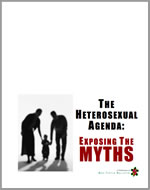 At last, the truth can now be told.
Using the same research methods employed by most anti-gay political pressure groups, we examine the statistics and the case studies that dispel many of the myths about heterosexuality. Download your copy today!
And don‘t miss our companion report, How To Write An Anti-Gay Tract In Fifteen Easy Steps.
 Anti-gay activists often charge that gay men and women pose a threat to children. In this report, we explore the supposed connection between homosexuality and child sexual abuse, the conclusions reached by the most knowledgeable professionals in the field, and how anti-gay activists continue to ignore their findings. This has tremendous consequences, not just for gay men and women, but more importantly for the safety of all our children.
Anti-gay activists often cite the “Dutch Study” to claim that gay unions last only about 1½ years and that the these men have an average of eight additional partners per year outside of their steady relationship. In this report, we will take you step by step into the study to see whether the claims are true.
Tony Perkins’ Family Research Council submitted an Amicus Brief to the Maryland Court of Appeals as that court prepared to consider the issue of gay marriage. We examine just one small section of that brief to reveal the junk science and fraudulent claims of the Family “Research” Council.
 The FBI’s annual Hate Crime Statistics aren’t as complete as they ought to be, and their report for 2004 was no exception. In fact, their most recent report has quite a few glaring holes. Holes big enough for Daniel Fetty to fall through.
“Google” is a trademark of Google Inc.
© Box Turtle Bulletin. All Rights Reserved.
 Posts
Posts  Posts via daily email: