Box Turtle Bulletin
 News and commentary about the anti-gay lobby
“Now you must raise your children up in a world where that union of man and box turtle is on the same legal footing as man and wife…”
News and commentary about the anti-gay lobbyFebruary 22nd, 2012
Presented without commentary


February 22nd, 2012
The Phoenix New Times is running an article about Paul Babeu which, from the perspective of a gay man, I’m not sure exactly how to take. Let me just tell you and you make up your own mind.
In a piece titled “Demands Grow for Full Investigation into Allegations Against Sheriff Paul Babeu”, they move the focus from abuse of power to a discussion of Babeu’s character.
First they quote a primary opponent running as a family values candidate: “Gould said Babeu demonstrated extremely poor judgment by posting explicit photos and information on gay websites, including adam4dam.com.” Then later they speak for themselves:
Babeu dismisses the sexually explicit photos he circulated — including to the gay hookup website adam4adam.com — as none of the public’s business and part of his personal life.
However, the state Code of Ethics for police officers — outlined by the agency that certifies cops in Arizona — declares that “whether on- or off-duty, in uniform or not,” law enforcement officials should conduct themselves in a “manner that will not bring discredit or embarrassment” to their agencies.
 Then they make a comparison:
Babeu no doubt is familiar with the case of fellow ex-Chandler Officer Ronald Dible, who was fired for running a porn website with his wife.
…
The parallel here is that Dible also claimed he could be a law enforcement officer and do whatever he pleased during personal time.
Then they post the “sexually explicit photo” which Babeu “circulated”, it’s him with his shirt off. It’s a “private” photo, which on adam4adam means that it can only be seen by other members of the social media site to whom Babeu unlocks the picture.
Another photo of Babeu in his underwear is published by the paper but this picture appears to be a private photograph that was not posted on the site. It isn’t clear where they got this picture or why it is included.
Like I said, I’m not sure how to take this…
To me it sound like “If you have a gay social media membership and you have a private picture with your shirt off, you bring discredit and embarrassment to your employer, just like a porn producer does.” But others may have a different take on the article.
February 22nd, 2012
Chris Geidner at Metro Weekly has the breaking news that Federal District Court Judge Jeffrey S. White found that Section three of the Defense of Marriage Act is unconstitutional. Karen Golinski is suing the Office of Personnel Management for denying her request for equal health insurance benefits for her wife:
In part, U.S. District Court Judge Jeffrey S. White today found that Section 3 of DOMA violates the equal protection rights of Golinski, finding that heightened scrutiny applies — as urged by the DOJ — and noting that it might not even pass rational basis — the lowest — legal scrutiny:
The Court concludes that, based on the justifications proffered by Congress for its passage of DOMA, the statute fails to satisfy heightened scrutiny and is unconstitutional as applied to Ms. Golinski.
Although the Court finds that DOMA is subject to and fails to satisfy heightened scrutiny, it notes that numerous courts have found that the statute fails even rational basis review.
This finding exceeds the Justice Department’s determination that DOMA, section 3, which prohibits the federal government from recognizing fully-legal same-sex marriages, requires heightened scrutiny and is unconstitutional at that level. Because of the Justice Department’s finding, the Obama administration has stopped defending Section 3 in court. The Bipartisan Legal Advisory Group (BLAG), led by the Republican leadership in the House of Representatives, is defending DOMA in the case.
Judge White, a Bush administration appointee, cited a 2001 US Supreme Court discrimination case in finding that DOMA unconstitutionally discriminates against same-sex couples.
Even though animus is clearly present in its legislative history, the Court, having examined that history, the arguments made in its support, and the effects of the law, is persuaded that something short of animus may have motivated DOMA’s passage:
Prejudice, we are beginning to understand, rises not from malice or hostile animus alone. It may result as well from insensitivity caused by simple want of careful, rational reflection or from some instinctive mechanism to guard against people who appear to be different in some respects from ourselves.
BLAG has the option of appealing the decision to the Ninth Circuit Court of Appeals. Two other similar cases in Massachusetts resulted in DOMA’s Section 3 being declared unconstitutional there. Those cases are now on appeal with the First Circuit Court of Appeals.
February 22nd, 2012
According to AZCentral.com, a special panel will investigate whether Sheriff Paul Babeu violated his public trust by threatening to have ex-boyfriend Jose Orozco deported. Interestingly, it is at Babeu’s request.
The local county prosecutor is a political ally of Babeu so rather than conduct an investigation that will be seen as tainted, they are turning instead to the Public Integrity Task Force, a non-partisan committee of neighboring county prosecutors.
In addition, Babeu has requested that the Arizona State Attorney General Tom Horne open a separate investigation into whether he has abused his power. But because Horne and Babeu have also supported each other in the past, the Solicitor General, Dave Cole, will investigate.
That Babeu is requesting investigation may reflect his confidence in the eventual conclusions (or the conclusion makers). Alternately, it may be a step taken to ensure that the investigators not focus solely on Babeu’s behavior to the exclusion of that of Orozco. He requested that the scope include “allegations of human-rights violations, threatening and intimidating, misuse of public resources, theft of property, theft of identity, fraud and impersonation.”
The latter relates to counter-charges made by Babeu’s attorney
Babeu, who said he had a romantic relationship with Orozco that went sour, accused Orozco of taking control of his campaign websites and Twitter account without permission in September and posting unflattering messages.
Chris DeRose, Babeu’s attorney and campaign manager, sent Orozco a cease-and-desist letter vowing to sue if the messages were not removed and the accounts turned back over. Orozco complied, Babeu said, and the matter was dropped.
A Commentary
February 22nd, 2012
Will conservative Republicans support Sheriff Paul Babeu, now that he is out as a gay man? It’s hard to say.
Some will not. For some, Babeu’s orientation is a deal breaker, a fact that brands him as an enemy, an abomination, and inherently unworthy of public office. But a number of conservatives have already done so and I suspect more will. Some, specifically because he is gay.
Here’s why:
Group identity politics is often born out of discrimination and abuse. Often what establishes commonality, be it as African Americans, as the gay community, or any other minority group, is in reaction to how a group is perceived or treated by others. And often, it is through finding alliance with other groups – a coalition of the mistreated, if you will – that oppressed minorities can find a voice and state their case.
But while this process is empowering, it is also limiting. Because in entering into coalition, one takes on the allies – and the enemies – of those in your coalition. And by tying one’s goals to the goals of another, then each individual is burdened with advancing every goal and convincing every argument.
And even when winning their own argument, it can seem as though one has not. To illustrate my point, let’s look at the relationship between African Americans and the Republican Party.
For a time, the Republican Party was the political home of racists who opposed equality and championed bigotry. And accusations of racism were deserved. But the case for judging a person on the content of their character, hard work, and intellect rather than on the color of their skin is powerful and over time many Republicans ceased to care about race.
But they still didn’t vote for black candidates.
Many who observed this saw it as evidence that nothing changed; Republicans are all racists, always have been, always will be. Actually, many times it was evidence of an entirely different phenomenon. African Americans, as a whole, had adopted a set of positions that made it impossible for Republicans to vote for them.
Now there is nothing inherent to the amount of melanin one has which would dictate one’s views on environmental issues, governmental protection for labor unions, tax policy, distribution of wealth and resources, or immigration policy. Even opinions about education quotas, reparation, and non-discrimination policies are not the consequences of genetic determination.
But with few exceptions, black candidates held views on a range of issues which were strongly tied to Democratic goals and with few exceptions, Republicans voted against them. And were called racists for it.
Charges of racism hurt. People don’t want to think that they hate others for no good reason – whether they do or not. And consequently, whenever an opportunity to prove to others (or themselves) that they were not motivated by racial malice, some Republicans jumped at the chance.
This is, I believe, at heart of the adoration that conservatives hold for Colin Powell and Condoleezza Rice (though both are far more moderate than their admirers). While they are respected for their contributions, they are adored for being “finally someone black who thinks like I do on issues.” And there really is no better explanation for the rise of Herman Cain (before he imploded) than that Tea Party Republicans could support someone who epitomized their good ol’ boy values and simultaneously prove themselves to not be the bigots that they had been portrayed to be.
Is this tokenism? Yes, in the sense that the candidate is advanced in part due to their race. Surely breaking assumptions about Republicans and race contributed significantly to the selection of George W. Bush’s cabinet. But it is not tokenism in the sense that the candidate was unqualified or would have no power and be merely a puppet. JC Watts rose to the position of House Republican Conference Chair and few suggested that either Powell or Rice were not competent or were merely mouthpieces for others.
I am not trying to suggest that there is not continued discomfort between the Republican Party and African Americans. Party leadership is often unwilling to take the necessary steps to appeal to black voters – or candidates- and sometimes appears hesitant to even consider which views are more consistent with the party’s stated ideals. And at times there seems to be a willingness to pander to those many racists still within the party ranks rather than shame them for the dishonorable nature of their positions.
Eventually, race will cease to be partisan. But that will not be before Republicans are willing to oppose bigotry within their ranks and develop concern about how their policies impact subpopulations nor until African Americans let go of affiliations that position them to be in conflict with that party’s perspectives. It has started (and sadly and ironically is currently being helped by shared anti-gay activism) but it has quite a ways to go.
Which brings me back to Paul Babeu.
The Republican Party is home to many homophobes. There are a good many people in that party who would toss out the window the content of one’s character, hard work, and intellect and base their vote solely on sexual orientation. If Ellen Degeneres’ being a lesbian makes her unqualified to push JC Penny products, then there’s no way they would vote for “one of them.”
But there is a mostly-invisible but quite large segment of the Republican Party who chafe at being called bigot and homophobe and would leap at the opportunity to prove their detractors wrong. They may poll as opposed to marriage equality, but some would still vote for a gay person who shared their views on environmental issues, governmental protection for labor unions, tax policy, distribution of wealth and resources, and immigration policy. And they would so precisely because this person was gay, not despite that fact.
I can’t judge at present just how large that group is. Anti-gays are vocal and visible and also quick to claim to represent far more than they do. And polling seems to be specific issue driven leaving Republican gay support in the very broad range of about 75% on military service to about 25% on marriage.
Additionally, Babeu may not be the guy for “see I don’t hate gays” Republicans to rally around. His district may be so very conservative that those type of Republicans are in short supply. That his accuser is a Mexican immigrant could either hurt him or help him but the accusations of political abuse might make him less palatable than a squeaky clean conservative gay man. On the other hand, having illegal immigrant advocacy groups like Respect-Respeto attack him and being the target of the New Times will only increase his standing among many Republicans in Arizona.
So I don’t really think he’ll win his primary. But I’ll not be too surprised if Paul Babeu does far better than conventional wisdom dictates or if he receives more than a little “I never would have expected it from him” conservative support.
February 22nd, 2012
Writing an op-ed in the Washington Times, a newspaper that presents its stories with a decidedly conservative perspective, Log Cabin Executive Director Clarke Cooper presents a notion that may not sit comfortably with many in our community:
Our community’s goals today are fundamentally conservative, and it will take conservative voices, like Paul Babeu’s, to achieve them.
About “conservative voices”, there is no question. Clarke is absolutely correct in noting that Conservatives – such as the readership of Washington Times – are not open to listening to organizations that are in alliance with immigrant rights advocates or labor unions or whose executive directors co-chair Democratic election campaigns.
If such people are to be reached, it will be through those who are not perceived as part of “The Establishment Left” and therefor the enemy, but by those with whom they find agreement on other issues.
But what about the idea that community’s goals today being fundamentally conservative?
I believe that Cooper’s assertion has some merit. While marriage and family and tradition and social assimilation and military service are not the property of any party or ideology, ideas that relate to more structure and increased formality are understood to be conservative in both a general and a political sense. It seems to me that “I should be free to sleep with whomever I want” and “I should be free to marry whomever I want” are in very different places and speak to people in very different ways.
Of course both are aspects of the bigger issue that gay people should be equal, whether that equality applies to sexual freedom or marriage freedom. But most political activists who have been engaging in the battle for equality will acknowledge that there is a marked difference in our community’s immediate goals and objectives.
Of course, Conservatives such as the leaders (though not the attendees) at CPAC, reject the idea that anything gay could possibly have any conservative elements. Which leads to fascinating assertions such as “I don’t really believe homosexuals want to get married, they just want to destroy marriage”.
And of course, some in our community have been subjected to abuse from Conservatives for so long that they will find it challenging to apply the word “conservative” to anything they favor.
But, nevertheless, Cooper’s point is worth considering. What do you think?
February 22nd, 2012
Marriage equality supporters say the votes are there, but Senate rules allow opponents to delay a vote by a day. Debate should begin tomorrow morning, with a final vote either tomorrow night or Friday morning.
February 22nd, 2012
An Albuquerque TV station reports that Antionio Darden, a popular stylist in Santa Fe, is refusing to accept an appointment with his former client, Gov. Susana Martinez:
“The governor’s aides called not too long ago, wanting another appointment to come in,” Darden said. “Because of her stances and her views on this I told her aides no. They called the next day, asking if I’d changed my mind about taking the governor in and I said no again.”
The governor has said she believes marriage should be between a man and a woman, and that does not cut it with Darden.
“I think it’s just equality, dignity for everyone,” the popular hair stylist said. “I think everybody should be allowed the right to be together. My partner and I have been together for 15 years.”
In 2008, an Albuquerque photographer was sued for refusing the photograph the wedding of a lesbian couple. She claimed that being compelled to offer services to the couple violated her religious beliefs. She lost, and was ordered to pay $6,637 for the couple’s attorney fees and costs.
So here’s a discussion waiting to happen: how is it that the photographer was in the wrong but Darden is within his rights? Or vice versa? To be honest, I’m very ambivalent about both cases.
February 22nd, 2012
Human Rights Campaign’s departing honcho Joe Solmonese has been named a national co-chair for the Barack Obama reelection campaign. That’s good. It’s probably a better fit for him than his old job at HRC.
February 22nd, 2012
When the news about Pinal County, Arizona Sheriff Paul Babeu broke over the weekend, the Phoenix News Times ended its story with this item:
Openly gay Tucson state Representative Matt Heinz was one of two Democratic lawmakers who broke ranks with the party in March 2011 and voted to give Babeu $5 million to combat border violence. Other lawmakers opposed the measure, in part, because Babeu’s county is at least 70 miles from the U.S.-Mexico border. The measure finally was pared down to $1.7 million and passed by the Legislature.
About a week after Heinz’s nod to Babeu, the sheriff spent the night at Heinz’s home, text messages that Jose shared with New Times show.
“I’m at Mat Heinz and his boyfriend for dinner & ice cream… we are going out to bar and …. to their house. [Am] staying over,” Babeu texted to Jose at 1:04 a.m. last April 2.
The Village Voice‘s Steven Thrasher took that and ran with it, posing this question on Heinz’s Facebook page:
Rep. Heinz, Steven Thrasher, Village Voice staff writer here. My colleagues at the Phoenix New Times have implied that you and your boyfriend had three-way sex with Sheriff Paul Babeu. Is this true? I am gay and do not think consensual acts of gay sex (or three-way sex) are unethical, wrong, or frankly anyone’s business beyond the parties involved. However, it looks bad for an elected official to have a “sleepover” with a government employee after helping steer $1.7 million in funds their way. As one of just a few openly gay people running for congress at a time of great trial for LGBT Americans, how do you think this looks?
Since when is reporting about an overnight sleepover tantamount to implying thee-way sex? If it is, then somebody’s changed the definition. I don’t recall anyone asking President Obama if he and Michelle had group sex with any of their overnight guests. Maybe democrats get a pass from the lib’ral press.
But wait. I don’t recall President Bush getting the same question about any of their overnight guests either. Not a peep about George, Laura and Sharon Dodson.
And when New York mayor Rudy Giuliani sought refuge in the home of Howard Koppel and Mark Hsiao when his marriage was falling apart, I don’t recall Thrasher asking them whether they had three-way sex either.
So what makes the sleep-over with Babeu, Heinz and Heinz’s boyfriend different? Could it be that all three are gay, and if three gay guys get together, all kinds of freaky sex is guaranteed to break out?
Thrasher excuses his question by saying that he is gay, which just goes to show that not all homophobia is external.
Clause By Clause With Uganda's Anti-Homosexuality Bill
February 22nd, 2012

The proposed Anti-Homosexuality Bill, 2009. (Click to download, PDF: 847KB/16 pages)
Uganda’s proposed Anti-Homosexuality Bill has been re-introduced into Parliament and is currently in the hands of the Legal and Parliamentary Affairs Committee. As the Committee considers what to do with the bill, there has been considerable confusion over what would happen if the bill were to become law. Most of the attention has focused on the bill’s death penalty provision, but even if it were removed, the bill’s other seventeen clauses would still represent a barbaric regression for Uganda’s human rights record. In this series, we will examine the original text of bill’s eighteen clauses to uncover exactly what it includes in its present form.
The memorandum which serves as the preamble to the Anti-Homosexuality Bill makes clear that one of the aims of the bill is to prohibit “the promotion or recognition of such sexual relations in public institutions and other places through or with the support of any Government entity in Uganda or any non governmental organization inside or outside the country.” Clause 13 is where the bill tries to achieve that aim:
13. Promotion of homosexuality.
(1) A person who –(a) participates in production, procuring, marketing, broadcasting, disseminating, publishing pornographic materials for purposes of promoting homosexuality;
(b) funds or sponsors homosexuality or other related activities;
(c) offers premises and other related fixed or movable assets for purposes of homosexuality or promoting homosexuality;
(d) uses electronic devices which include internet, films, mobile phones for purposes of homosexuality or promoting homosexuality and;
(e) who acts as an accomplice or attempts to promote or in any way abets homosexuality and related practices;
commits an offence and is liable on conviction to a line of five thousand currency points or imprisonment of a minimum of five years and a maximum of seven years or both fine and imprisonment.
(2) Where the offender is a corporate body or a business or an association or a non-governmental organization, on conviction its certificate of registration shall be cancelled and the director or proprietor or promoter shall be liable on conviction to imprisonment for seven years.
This bill would thoroughly outlaw any and all advocacy on gay rights in Uganda. Subclause 1.a speaks of “pornographic materials,” implying a limited scope of the bill. But in reality, even the most innocuous depictions or descriptions of LGBT people have been condemned as “pornographic.” The remaining clauses have no similar pretense of restraint. Sublcause 1.b prohibits all funding for LGBT advocacy, 1.c prohibits any property or assets from being used for LGBT advocacy, and 1.d prohibits all electronic media, including the Internet, Emails, SMS text messages, YouTube videos and anything else you can think of that can be used to argue for LGBT rights. This clause bans everything: blog posts, Facebook status updates, even a 140-character Tweet can land the Tweeter in prison for up to seven years.
And in case the bill’s authors forgot anything, subclause 1.e is there as a catch-all for any other possible avenues for advocating on behalf of gay people. This covers any kind of advocacy including, potentially, legal defense for anyone charged under this bill, and even any future parliamentary debate over whether sections of this bill should be amended or repealed. In fact, this clause is redundant with Clause 7 which prohibits “Aiding and Abetting” homosexuality (which the Legal and Parliamentary Affairs Committee recommended deleting in favor of this clause). Which means that all of the dangers that Clause 7 poses to lawyers, health care workers, counsellors, pastors — even beauticians (is making a gay person attractive “aiding and abetting” homosexuality?) — apply to this clause as well.
Subclause 1 provides a sentence of five to seven years imprisonment for an individual, and a fine of 100 million shillings, or about US$42,500 in a country where the per capita annual income is about US$500. Businesses, non-profits and NGO’s aren’t exempt either; the law shuts them down and imprisons their directors or owners for seven years.
In a human rights forum discussing the Anti-Homosexuality Bill held at Makarere University in 2009, law professor Sylvia Tamale describes just some of the dangers Clause 13 poses:
Clause 13 which attempts to outlaw the “Promotion of Homosexuality” is very problematic as it introduces widespread censorship and undermines fundamental freedoms such as the rights to free speech, expression, association and assembly. Under this provision an unscrupulous person aspiring to unseat a member of parliament can easily send the incumbent MP unsolicited material via e-mail or text messaging, implicating the latter as one “promoting homosexuality.” After being framed in that way, it will be very difficult for the victim to shake free of the “stigma.” Secondly, by criminalizing the “funding and sponsoring of homosexuality and related activities,” the bill deals a major blow to Uganda’s public health policies and efforts. Take for example, the Most At Risk Populations’ Initiative (MARPI) introduced by the Ministry of Health in 2008, which targets specific populations in a comprehensive manner to curb the HIV/AIDS scourge. If this bill becomes law, health practitioners as well as those that have put money into this exemplary initiative will automatically be liable to imprisonment for seven years! The clause further undermines civil society activities by threatening the fundamental rights of NGOs and the use of intimidating tactics to shackle their directors and managers.
In addition to the likelihood that Clause 13 could be abused for criminal or political purposes, the provisions in Clause 13 violate Uganda’s constitution (PDF: 460KB/192 pages), which under Chapter 4, Article 29, (Pages 41-42) include:
29. Protection of freedom of conscience, expression, movement, religion, assembly and association.
(1) Every person shall have the right to—(a) freedom of speech and expression which shall include freedom of the press and other media;
(b) freedom of thought, conscience and belief which shall include academic freedom in institutions of learning;
(c) freedom to practise any religion and manifest such practice which shall include the right to belong to and participate in the practices of any religious body or organisation in a manner consistent with this Constitution;
(d) freedom to assemble and to demonstrate together with others peacefully and unarmed and to petition; and
(e) freedom of association which shall include the freedom to form and join associations or unions, including trade unions and political and other civic organisations.
The adoption of this clause would make a mockery of Uganda’s constitution. Nevertheless, the Legal and Parliamentary Affairs Committee recommended retaining Clause 13 in its entirety in the closing days of the Eighth Parliament, and it remained as part of the Anti-Homosexuality Bill when it was reintroduced into the Ninth Parliament.
In the film The Silence of the Lambs, the evil Hannibal Lecter asked detective Clarice Starling what her most painful memory was. She replied with a story about living on a relative’s farm near a slaughterhouse where she tried unsuccessfully to rescue one of the lambs. She was haunted by the screaming the lambs made as they were being slaughtered. Lecter later asks Starling, “Tell me, Clarice, have the lambs stopped screaming?” This clause, as part of a bill designed to legislate LGBT people out of existence, will ensure that no one is allowed to hear them scream.
Clause By Clause With Uganda’s Anti-Homosexuality Bill:
Clauses 1 and 2: Anybody Can Be Gay
Clause 3: Anyone Can Be “Liable To Suffer Death”
Clause 4: Anyone Can “Attempt to Commit Homosexuality”
Clauses 5 and 6: Anyone Can Be A Victim (And Get Out Of Jail Free If You Act Fast)
Clauses 7 and 14: Anyone Can “Aid And Abet”
Clauses 8 to 10: A Handy Menu For “Victims” To Choose From
Clauses 11, 14, 16 and 17: Nowhere To Run, Nowhere To Hide
Clause 12: Till Life Imprisonment Do You Part
Clause 13: The Silencing of the Lambs
Clause 14: The Requirement Isn’t Only To Report Gay People To Police. It’s To Report Everyone.
Clauses 15 and 19: The Establishment Clauses For The Ugandan Inquisition
February 22nd, 2012
TODAY’S AGENDA:
Maryland Senate to Vote on Same-Sex Marriage: Annapolis, MD. After clearing another hurdle yesterday in which the Senate Judiciary Committee rejected two proposed amendments which could have killed the bill, the Maryland Senate is ready to begin debate on a bill provide for marriage equality as early as today. Twenty-four votes are needed for passage, and a similar measure passed last year by twenty-five votes. Opponents acknowledge that Democratic leaders probably have the 29 votes needed to end debate and prevent a filibuster. The bill may go to the governor for his promised signature by the end of the week, but it won’t go into effect until January, 2013. Meanwhile, marriage opponents promise to place a referendum on the ballot overturning the law. Polling shows that such a referendum would be very close.
If you know of something that belongs on the agenda, please send it here. Don’t forget to include the basics: who, what, when, where, and URL (if available).
And feel free to consider this your open thread for the day. What’s happening in your world?
February 21st, 2012
Charles Cooper, the lead attorney for the proponents of Proposition 8, told Metro Weekly that they intend to file a petition before today’s end-of-the-day deadline asking that the Ninth Circuit Court of Appeals reviews the decision handed down by a three-judge panel upholding a lower court’s ruling that Prop 8 is unconstitutional. Once the filing is made, the entire 20-member court will vote on whether to hold an en banc review. If they approve the petition, then Judge Alex Kozinski, the circuit’s chief judge, and 10 randomly selected judges from the circuit will hear the en banc appeal. That will involve more briefs, more hearings and more time, virtually guaranteeing that the case won’t reach the U.S. Supreme Court this year.
February 21st, 2012
Maryland’s Senate Judiciary Committee voted today to send a bill legalizing same-sex marriages to the full Senate, setting up a vote which may take place as early as tomorrow. The same bill narrowly passed the Maryland House of Delegates last Friday. The bill’s supporters believe that it will have an easier time getting passed in the Senate.
Assuming the Senate passes the bill and it goes to Gov. Martin O’Malley’s promised signature, it is widely expected that opponents will succeed in collecting enough signatures for the ballot referendum on the measure.
A commentary
February 21st, 2012
Josh Marshall sees a silver lining in the Paul Bebau story:
But one thing shines through to me as perhaps the most significant part of the whole media storm: You have a hard-right Republican, with intense political ambitions outed as gay and accused of serious abuse of office. He vigorously denies the charges but says, Yeah, I’m gay. And by the way, I support gay marriage and I also think that gays should be able to serve openly in the US military.
Given what was contained in the original story, it’s not like Babeu had a great deal of choice about disclosing his sexuality. But then that hasn’t stopped others from trying. No comical denials (a la Larry Craig), no slinking off into a shamed obscurity (a la too many sad stories to mention). Just, yeah, I’m gay. And I’m still running for office.
That’s a rather slim sliver of a lining. Unlike with Craig, there are photos and screengrabs floating around which blocked the option of comical denials. And so we’re left with Babeu’s temperment which keeps him from “slinking off into a shamed obscurity.” That much is worthy of admiration, but it’s more an act of bravado than a calculated assessment of the political landscape he finds himself in now.
There is a reason Babeu didn’t talk about his personal life before. When a man runs for public office in the most conservative parts of a state that ranks as one of the most conservative states in the country, the assumption will be that the Republican candidate who calls himself a staunch conservative would naturally be against any sort of gay equality. And that assumed position would naturally be a very popular one in a conservative district in a conservative state. It’s true that Babeu hadn’t yet raised any of these issues in either his nascent congressional campaign or in his runs for sheriff (where LGBT issues typically don’t come up). But as long as he doesn’t say anything to the contrary, the default position, as Dan Savage put it, is that “Conservative voters will assume he holds anti-gay political beliefs and they will expect him to vote anti-gay should he be elected to office.”
So when a candidate speaks at CPAC — which this year excluded GOProud because their brand of conservatism can no longer countenance openly gay people supporting gay marriage — and calls himself the only true conservative in a three-man GOP primary, then the assumption, without any explanation to the contrary, is that he naturally holds his audience’s definition of conservatism. Particularly where the audience’s definition of conservatism is not at all difficult to ascertain. Until now, Babeu was running with those assumptions and he did nothing to disabuse them.
Until now, and Babeu’s campaign chair put on a brave face and said these revelations won’t “make a bit of difference” with voters in Congressional District 4. The Boston Herald agrees, and is all kinds of excited that Babeu’s candidacy makes him the fourth openly gay or bi candidate running for Congress in Arizona. They attribute it to Arizona’s “deep libertarian roots,” which I guess writers in Boston might find significant, but Arizona’s “libertarian roots” are highly localized, and they just happen to include the two congressional districts the other three candidates (all Democrats) are running in. (Two are vying for Reps. Jim Kolbe and Garbrielle Giffords’ old seat. The other encompasses Tempe, Chandler, ASU and the gayborhood of North Central Phoenix.)
But the Libertarian swath however doesn’t include CD4. The redrawn map for CD 4 (PDF: 1 pages, 2MB) now starts in the heavily Mormon districts of the East Valley and Gila County, wraps around northwestward to deeply conservative Yavapai County before spreading out west to Yuma, La Paz, and Mohave Counties. The central Arizona districts of CD4 are heavily Mormon and Evangelical. The three western counties, culturally and politically, have much more in common Bakersfield and California’s Imperial Valley than they do with any romantic Western libertarian ideals of live-and-let-live. And all of the counties which make up CD4 are very anti-gay. In 2008, those counties collectively approved Prop 102, Arizona’s constitutional ban on same-sex marriage, with yes vote tallies of about two-thirds verses around one-third against. Something tells me that one-third isn’t made up of very many Republican primary voters.
I’m glad that Babeu’s out and running as a gay Republican who supports marriage equality. I wish he had come out under his own steam and not because he had no other choice. As it is, it’s hard to know whether he would have held these positions anyway or if, like the pre-outing Rep. Jim Kolbe who voted in favor of DOMA, he would have maintained anti-gay stances to protect his political closet. But you have what you have, and he’s probably making the best of the cards that have been dealt him. Unfortunately with the Republican base in central and western Arizona, you also have the voters that you have. And in the game they’re playing Babeu’s playing a dead hand.
Featured Reports
 In this original BTB Investigation, we unveil the tragic story of Kirk Murphy, a four-year-old boy who was treated for “cross-gender disturbance” in 1970 by a young grad student by the name of George Rekers. This story is a stark reminder that there are severe and damaging consequences when therapists try to ensure that boys will be boys.
When we first reported on three American anti-gay activists traveling to Kampala for a three-day conference, we had no idea that it would be the first report of a long string of events leading to a proposal to institute the death penalty for LGBT people. But that is exactly what happened. In this report, we review our collection of more than 500 posts to tell the story of one nation’s embrace of hatred toward gay people. This report will be updated continuously as events continue to unfold. Check here for the latest updates.
In 2005, the Southern Poverty Law Center wrote that “[Paul] Cameron’s ‘science’ echoes Nazi Germany.” What the SPLC didn”t know was Cameron doesn’t just “echo” Nazi Germany. He quoted extensively from one of the Final Solution’s architects. This puts his fascination with quarantines, mandatory tattoos, and extermination being a “plausible idea” in a whole new and deeply disturbing light.
On February 10, I attended an all-day “Love Won Out” ex-gay conference in Phoenix, put on by Focus on the Family and Exodus International. In this series of reports, I talk about what I learned there: the people who go to these conferences, the things that they hear, and what this all means for them, their families and for the rest of us.
Prologue: Why I Went To “Love Won Out”
Part 1: What’s Love Got To Do With It?
Part 2: Parents Struggle With “No Exceptions”
Part 3: A Whole New Dialect
Part 4: It Depends On How The Meaning of the Word "Change" Changes
Part 5: A Candid Explanation For "Change"
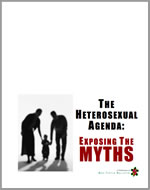 At last, the truth can now be told.
Using the same research methods employed by most anti-gay political pressure groups, we examine the statistics and the case studies that dispel many of the myths about heterosexuality. Download your copy today!
And don‘t miss our companion report, How To Write An Anti-Gay Tract In Fifteen Easy Steps.
 Anti-gay activists often charge that gay men and women pose a threat to children. In this report, we explore the supposed connection between homosexuality and child sexual abuse, the conclusions reached by the most knowledgeable professionals in the field, and how anti-gay activists continue to ignore their findings. This has tremendous consequences, not just for gay men and women, but more importantly for the safety of all our children.
Anti-gay activists often cite the “Dutch Study” to claim that gay unions last only about 1½ years and that the these men have an average of eight additional partners per year outside of their steady relationship. In this report, we will take you step by step into the study to see whether the claims are true.
Tony Perkins’ Family Research Council submitted an Amicus Brief to the Maryland Court of Appeals as that court prepared to consider the issue of gay marriage. We examine just one small section of that brief to reveal the junk science and fraudulent claims of the Family “Research” Council.
 The FBI’s annual Hate Crime Statistics aren’t as complete as they ought to be, and their report for 2004 was no exception. In fact, their most recent report has quite a few glaring holes. Holes big enough for Daniel Fetty to fall through.
“Google” is a trademark of Google Inc.
© Box Turtle Bulletin. All Rights Reserved.
 Posts
Posts  Posts via daily email: