Box Turtle Bulletin
 News and commentary about the anti-gay lobby
“Now you must raise your children up in a world where that union of man and box turtle is on the same legal footing as man and wife…”
News and commentary about the anti-gay lobbySeptember 6th, 2011
TODAY’S AGENDA:
CA Supreme Court to Hear Arguments on Prop 8 Standing: San Francisco. When Federal District Judge Vaughn Walker struck down California’s Proposition 8 as unconstitutional, he did so without the State of California’s defending the proposition. Instead, the Alliance Defense Fund stepped in to unsuccessfully defend Prop 8. However, now that it is appeals time, the Ninth Circuit Court asks the Supreme Court of California for a legal interpretation of that state’s constitution to determine whether which the authors of a proposition could appeal a federal decision if the elected representatives of the state choose not to do so. In other words, does California law allow non-elected persons to step in to enforce a state law by appealing a federal court decision finding the law unconstitutional when the duly elected officials (i.e. the state Attorney General) decides not to do so. Parties for and against Prop 8 will appear today before California’s Supreme Court to flesh out that very question. Oral arguments will be televised on the statewide California Channel public affairs network, and the proceedings get underway at 10:00 a.m. PDT. LGBT advocates will hold a “No Standing for Prop 8” sit-in on the steps of the Supreme Court beginning at 8:00 a.m.

Schematic diagram of Louis William Max's device for inducing a powerful electric shock. (Click to enlarge.)
TODAY IN HISTORY:
First Recorded Case Of Electric Shock Treatment for Homosexuality: 1935. The idea had been floated around for quite a while among therapists practicing a brand new, non-Freudian form of psychology known as Behavioral Therapy. The premise for this form of therapy goes back to Pavlov’s dog, which was trained to salivate whenever it heard a bell ringing. Behavioral Therapy used various systems of rewards and punishments — mostly punishments — to instill desired behavior in their subjects. And therapists were always on the lookout for new, effective forms of punishment. Shocking patients with a dose of electricity was seen as one promising avenue, but improperly administered, electric current could be lethal, as prisons from Sing Sing to San Quentin demonstrated on a regular basis. But in early 1934, that problem was solved. New York University’s Louis William Max introduced a new device that he invented to safely administer a painful electric shock to his patient at a meeting of the New York branch of the American Psychological Association. The following year, Dr. Max traveled to Ann Arbor, Michigan, to present a brief talk before the American Psychological Association’s annual meeting about his attempts to cure homosexuality using his new electric shock device. On Friday, September 6th at 2:00 p.m., the APA convened a panel on Abnormal Psychology at the University of Michigan’s Chemistry Amphitheater (room 165, to be exact), where Dr. Max gave his talk. The transcript of the talk itself is not available, but this brief synopsis appeared the following month in the APA’s Psychological Bulletin:
Breaking Up a Homosexual Fixation by the Conditioned Reaction Technique: A Case Study. Louis Wm. Max, New York University.
A homosexual neurosis in a young man was found upon analysis to be partially fetishistic, the homosexual behavior usually following upon the fetishistic stimulus. An attempt was made to disconnect the emotional aura from this stimulus by means of electric shock, applied in conjunction with the presentation of the stimulus under laboratory conditions. Low shock intensities had little effect but intensities considerably higher than those usually employed.on human subjects in other studies, definitely diminished the emotional value of the stimulus for days after each experimental period. Though the subject reported some backsliding, the ” desensitizing ” effect over a three month period was cumulative. Four months after cessation of the experiment he wrote, ” That terrible neurosis has lost its battle, not completely but 95% of the way.” Advantages and limitations of this technique are discussed. [10 min.]
Behavioral techniques to try to “cure” homosexuality took many forms, from electric shock therapy on adults and adolescents, to so-called “mild swats” on four-year-old boys like Kirk Andrew Murphy who underwent behavioral therapy at the hands of George Rekers. You can learn more about the role of Behavioral Therapy in attempts to “cure” homosexuality in Blind Man’s Bluff, an epilogue to our original investigation, What Are Little Boys Made Of?, about Kirk’s treatment at UCLA under Rekers.
TODAY’S BIRTHDAY:
 Sylvester: 1946. He lived his entire life on the corner of Gay and Black. Born in Los Angeles, he moved to San Francisco where he began performing with the gender-queering troupe known as the Cockettes. He also performed in drag in a musical review of Bessie Smith and Billie Holiday songs. He went on to form several bands before finally latching onto the disco craze in the mid-1970s a solo artist. His second album, Step II, yielded his greatest funk/disco hits, “You Make Me Feel (Mighty Real)” and “Dance (Disco Heat)”. In 1979, he appeared in the film The Rose, starring Bette Midler, and in 1983 his Hi-NRG dance hit “Do You Wanna Funk” appeared in the film Trading Places. During the disco era, he was called “The Queen of Disco,” but as he moved away from disco and toward a more Dance/Funk sound, his record company wanted him to butch things up a bit. Sylvester’s response was to attend meetings in full-on drag. A drag photo shoot that he put together to tweak his record label bosses ended up yielding the cover art for his posthumous release Immortal. His last hit, 1986’s “Someone Like You,” hit number 1 on the U.S. Dance Chart, and came from his only Warner Brother’s album, Mutual Attraction, which featured cover art by Keith Haring. Sylvester is another of the many giant talents consumed by the AIDS epidemic; he died in 1988.
If you know of something that belongs on the agenda, please send it here. PLEASE, don’t forget to include the basics: who, what, when, where, and URL (if available).
September 6th, 2011
 More than a week after Dane Hall was brutally beaten outside a Salt Lake City night club, police finally decided to get around to interviewing him. Attackers stomped on the back of his head, broke his jaw, and knocked out several teeth. The local gay community is rallying around Hall and are trying to raise money to pay his medical bills. Hall has no health insurance and his bills are mounting. That same night, another man, whose identity has been withheld, was also severely beaten. The Salt Lake City Tribune (no link) reports that police, who are refusing to regard the attacks as hate crimes, say that the two assaults appear unrelated. I don’t know which of the two statements in that last sentence I find more disturbing: the idea that it’s not a hate crime, or the idea that more than one roving band of anti-gay attackers were on the loose in Salt Lake City on the same evening.
September 5th, 2011

As I noted in my personal recollection in today’s Daily Agenda, today is Queen frontman Freddie Mercury’s 65th birthday. It’s Labor Day in the United States, so Google is displaying only a discrete American Flag at the bottom of the U.S. edition of Google’s home page. But go to google.co.uk, Google’s search page for Britain where September 5, 2011 is otherwise known as “Monday,” and the page looks rather different. Clicking the Google Doodle plays this video:
September 5th, 2011
I know this isn’t an LGBT-related topic, but is one that has a direct bearing on how we regard each other as Americans and as human beings. Seven years ago, I had a much more personal blog where I posted stuff that a lot of people posted about before there was such a thing as Facebook and Twitter and the incredible shrinking of the American Attention Span. Since today is Labor Day, and because I’ve already alluded to my Appalachian background today, here’s a story that I’ll bet you’ve never heard before, and one that I think should be required learning in every American History class.
The West Virginia Mine Wars
Originally written September 3, 2004
The United States was at war in August, 1921. I’ll bet you didn’t know that. I learned about it some five years ago, and I think it is one of the more fascinating chapters in American history. In today’s election year, political discourse has broken down to an acrimonious level that I haven’t seen in my lifetime. But as bad as it is today, things really have been worse. This story has some very cautionary lessons for today.
The war in question was known as the West Virginia Mine War. Actually, there had been two wars. The first one took place in 1913, but the most dramatic confrontation was in 1921 at the Battle of Blair Mountain.
Today’s conflicts in the Middle East are illuminated against the backdrop of oil. But at the turn of the twentieth century before the dawn of the automobile age, coal was the principal fuel in the United States and the rest of the industrialized world. It ran the factories, steamships and railroads, and it heated the schools, churches and homes. The country’s appetite for coal was insatiable, and we were consuming it as fast as it could be brought out of the ground. Poor white workers and immigrants were brought to West Virginia on the promise of plentiful jobs. And indeed jobs were plentiful, but the conditions in the coal fields made the coal miners virtual slaves.

Miners' company houses, Chaplin, West Virginia (Library of Congress American Memory Project)
A miner who moved his family to West Virginia would have put his family in a company-owned home, paying rent to the company up front. Since the miner didn’t have any money, the company would extend credit so his family could have a roof over their heads. Then he and his family would be given credit at the company store for food and other necessities. When the miner showed up at work, he found that he had to lease his tools and equipment from the company, but again the company would extend credit. From the very first day on the job, the miner was deeply in debt to the company.
The miner would be paid not by the hour, but by the ton of coal he extracted from the mine. His coal car ostensibly held 2,000 pounds of coal, but more commonly held 2,500 pounds. While the miner was supposed to be paid by the ton, he found that he was simply paid by the car load. Furthermore, in a practice known as “cribbing,” his pay would be docked for any slate or rock that the checkweighman found in the car, which was an arbitrary judgment call, subject to the checkweighman’s whims. Cheating was rampant.

Interior of a miner's company-owned house, Scott's Run, West Virginia (Library of Congress American Memory Project)
When payday finally arrived at the end of the month (miners were typically paid monthly), the miner would discover that he was not paid in cash. Instead he was paid in company “scrip” which was accepted only in company-owned stores and other establishments at greatly inflated prices. But that didn’t matter much, because his debts were deducted from his pay, and that nearly always wiped out anything he might have had coming to him.
Unfortunately, the net effect of all of this was that the miner simply went deeper and deeper in debt to the company. And as long as he was in debt, he was legally bonded to the company. There literally was no escape for him.
The doctor was a company employee. So were the school teachers and preachers at the church – which was also company owned. This ensured that even the sermons they heard on Sunday towed the company line.
All of this was perfectly legal. The coal companies had already instituted a weakened state constitution in the 1870’s under which they were able to control the political climate of West Virginia. This allowed them to avoid paying taxes while enjoying tremendous legal advantages in acquiring and exploiting mineral rights.

Miners lifting coal car onto the tracks, miners' company houses in the background, Chaplin, West Virginia (Library of Congress American Memory Project)
The problems the miners faced weren’t just about money. Coal mines were notoriously dangerous. The coal operators refused to invest in even the simplest or cheapest safety equipment because, after all, it was cheaper to just hire another miner than to protect the lives of those who were already there. During the years of the First World War, miners were killed at a greater rate in the mines than American soldiers were on the battlefields of France.
These conditions weren’t limited to miners, but they had it the worst. Many industries paid in scrip and operated company stores and housing. Steelworkers routinely suffered horrible burns because the mills refused to provide simple protective clothing that was available at the time. The death toll was staggering. Railroad workers routinely had missing fingers and hands due to accidents in the rail yards – if they were lucky. Even autoworkers suffered long hours of repetitive motion and, in the case of Ford workers, intrusive company spying in their homes to make sure nobody drank off-hours. Industries throughout the country sought not only cheap, plentiful and compliant labor, but they often sought to exercise control over their employees’ private lives as well.
When miners tried to improve their conditions by joining a union, their families were evicted from their company homes. They were also subject to summary justice by private guards, most of whom were agents of the Baldwin-Feltz Detective Agency. These guards were hired by the coal operators to serve as the de-facto police force, but they often operated like modern-day paramilitary forces that we hear about so often in Latin America. But this wasn’t Columbia or Guatemala. This was in the United States.
The miners couldn’t turn to the local police for protection because they were often under the coal operator’s control as well. For example, the Logan Coal Operators Association paid Logan County Sheriff Don Chafin to beat, arrest, and otherwise harass anyone suspected of attending labor meetings.
â–¡â– â–¡â– â–¡
“There is never peace in West Virginia because there is never justice. Injunctions and guns, like morphia, produce a temporary quiet. Then the pain, agonizing and more severe, comes again.”
— Mother Jones.
Mary Harris Jones was a staunch champion of miners and industrial workers. She started her campaign for workers rights by rallying against the widespread practice of child labor. Later, she became a key figure in union organizing activities, especially in the early days of the United Mine Worker’s Union. She was well into her seventies when she started working to organize the miners in West Virginia, Pennsylvania and Colorado. Her feisty temperament shamed the tough men of the mines into standing up for their rights and their families. This little old Irish widow with a fiery temper became known throughout the labor movement as “Mother Jones”.
She cajoled presidents and captains of industry. She was thrown into jails and vilified by the public press for advancing the cause of coal miners and other workers. And she didn’t hesitate to admonish the union leadership whenever petty squabbles threatened to throw everything into chaos. She was a powerful voice that could not be ignored or silenced. Industrialist and politicians called her “the most dangerous woman in America.”
She was a fearless firebrand who was able to rally the coarse mountain men and give voice to their cause to the outside world. It was puzzling to many that this very old woman could be such an inspiration to these tough men. Women weren’t looked to as leaders in the rough Appalachian mining culture, but they adopted her as “the miner’s angel” nevertheless. She organized relief efforts when the miner’s families were thrown out of their homes and into makeshift camps, and she challenged the miners’ very sense of manhood to go out and fight for their families.
Mother Jones was involved in union activities during the Paint Creek and Cabin Creek strikes in 1920. These strikes lead to further union organizing efforts in Mingo County, which finally reached the small town of Matewan.
On May 19th, Matewan agents of the Baldwin-Feltz agency began evicting hundreds of families of miners who had joined the union. When the mayor and police chief intervened, the company guards tried to arrest the police chief on a bogus warrant. (This goes to show how brazen the private guards were.) Mayor C.C. Testerman stepped in to prevent the illegal arrest but the company guards shot and killed him. More gunfire broke out, and when it was over ten were dead and four were injured.
Police Chief Sid Hatfield was the hero of the day, but the “Matewan Massacre” sparked a low-level guerrilla war through the remainder of 1920 and into 1921, in which over one hundred striking miners were killed. On August 1, 1921, Sid Hatfield and his best friend Ed Chambers were assassinated on the steps of the Welch courthouse by Baldwin-Feltz detectives. They were killed in front of their wives in broad daylight.
All hell broke loose. On August 7, several thousand miners gathered on the lawn of the state capital in Charleston where union leaders called for a march on Logan. They assembled at Lens Creek, just inside the Logan County line on August 20th. Mother Jones, fearing a devastating setback if the miners were defeated in their attempt to take over Logan, tried to convince the miners to turn back, but they refused to follower her advice. Instead, they moved on to Sharples on August 27th after the state police killed two miners in raid there.
The miners organized themselves along military lines – many had served in WWI just a few years earlier. They adopted the red neckerchief as their uniform. Many people today believe that the term “redneck” came from the red neckerchiefs worn by those miners. They advanced by foot, automobile and commandeered trains to the town of Blair at the foot of Blair Mountain, which overlooks the region’s principal town of Logan, home of the hated Sheriff Don Chafin.
Three counties were in open rebellion. The governor placed the state under martial law. On September 1st President Harding called out the U.S Army Air Corps with orders to bomb U.S citizens for the only time in America’s history. The Secretary of War even authorized Brigadier General Billy Mitchell (who later became the father of the U.S. Air Force) to use chemical weapons against the miners. Fortunately, the canvas and birch biplanes were too primitive to carry out the job and no chemical weapons were ever deployed.
Sheriff Don Chafin raised an army of 1200 men to man the barricades along the crest of Blair Mountain. National Guard Colonel William Eubank brought in a few planes to try to bomb the miners. A few bombs were dropped, but no major damage was done.
When federal troops finally arrived from Ft. Thomas, Kentucky on September 3rd, most of the miners decided that it was foolhardy to fight against the much-better equipped army. Confronted with such overwhelming force, they hid their guns in the mountains, removed their neckerchiefs, and went home. By the next day, the Battle of Blair Mountain was over, with at least twelve miners and four of Sheriff Don Chafin’s men dead.
Several hundred miners were tried for treason, murder and other crimes. The miners’ crushing defeat set union activities back in southern West Virginia for the next twelve years, although it did succeed in prompting numerous federal inquiries and nationwide awareness of the conditions in the coal fields. But little changed for the miners until the election of Franklin Delano Roosevelt, when New Deal legislation in 1933 finally outlawed many of the practices of the coal operators and guaranteed the rights of workers to organize.
â–¡â– â–¡â– â–¡
These miners fought hard for the simplest of things: the right to shop wherever they wanted, the right to be paid in cash instead of worthless scrip, the abolition of cribbing, the right to attend a church that was not run by the company, and the right to be furnished – free of charge – their tools and safety equipment. These miners fought for a respectable wage, decent and safe working conditions, freedom from arbitrary and capricious workplace rules, and a measure of dignity in their work and freedom in their lives.
It is easy to believe that unions are no longer necessary, but we must remember the conditions that led to their rise. They fought hard for the freedoms we enjoy, and which we often assume can never be taken away. But no one should ever assume our freedoms are assured. It has been my observation that the industries with the “worst” unions are the industries which have richly earned them the most.
I think it is very appropriate that our summer season is bracketed by two holidays which commemorate those who fought for our freedoms. The summer season begins with Memorial Day, in which we honor the soldiers, sailors and airmen and -women who defended our freedom against foreign enemies. The summer season ends with Labor Day, in which we honor the workers who fought and paid their price for freedom as well. These men and women are heroes, every bit as much as those who served in uniform. The symmetry of the two holidays is very fitting.
For more information on the West Virginia Mine Wars, check out this web site by the Friends of Blair Mountain, dedicated to preserving the historically-significant battlefield.
September 5th, 2011
TODAY’S AGENDA:
Today is Labor Day in the United States, which makes it a long weekend for just about everyone here. There’s not much happening today, but to take advantage of the three day weekend there are still a few celebrations going on.
Pride Celebrations Extended Through Today: Atlanta, Ga (Black Pride) and Duluth, MN.
Also Wrapping Up Today: Burning Man, Black Rock Desert, NV and Southern Decadence, New Orleans, LA.
TODAY’S BIRTHDAY:
 Freddie Mercury: 1946. I was a freshman in high school in my quiet, Appalachian home town when “Bohemian Rhapsody” came screaming out of our radio speakers like an alien from outer space. Nobody was quite sure what to make of it, and nobody wanted to be too enthusiastic about this very flamboyant song. But whenever it came on the radio we always turned it up. And we listened, trying to figure out exactly what it was we were hearing. Queen had already been very popular in the U.K. for several years, but “Bohemian Rhapsody” was our introduction to this new band and we had almost nothing to prepare us for the — well, I’ll say it again — flamboyance of the band’s lead singer. Even the band’s name was provocative. One of my friends bought a Queen teeshirt at a concert clear out in Dayton, but his mother prohibited him from wearing it. It was “too homosexual.” And so was Freddie — maybe. Except he had a girlfriend, as the press went, so maybe he wasn’t. Maybe it was all an act, we told each other and ourselves. You know, a character like David Bowie’s Ziggy Stardust or Alice Cooper any of the members of Kiss. Whatever he was, he flaunted it, as it went in our vernacular, but as long as it was a character he was flaunting, maybe it was okay. It helped that Queen’s follow-on hits — “You’re My Best Friend,” “Someone To Love” — were sufficiently “normal” while unmistakeably Queen to calm things down a bit. By the time News of the World came out and the testosterone-laden “We Will Rock You/We Are The Champions” became my high school’s unofficial anthem the same year that we won the state AA basketball championship, everyone had chilled. Those of us in that town and school who were easily freaked out over the very possibility of homosexuality — including us homosexuals — were well served by our sometimes willful naiveté. Without it, it would have been socially impossible to enjoy the music.
 Freddie was something else. And he hoodwinked all of us who wanted to be hoodwinked, just enough so we could enjoy the music and the spectacle. The hits kept coming: “Fat Bottomed Girls,” Crazy Little Thing Called Love,” “Another One Bites The Dust,” “Under Pressure” (with David Bowie, of course). By the time it dawned on me that he really was gay, I had long since left home and it no longer mattered socially whether I was a fan or not. And by the time it was announced that he had AIDS and would die very shortly, nobody was surprised but everyone was saddened. It seems that there are some people who are too outsized in our world to remain in it for very long, and Freddie was one of them. On November 25, 1991, the day after he died, Britain’s tabloid The Sun carried a very simple headline: “Freddie Is Dead.” It’s hard to believe, but if he had survived he would be sixty-five today.
If you know of something that belongs on the agenda, please send it here. PLEASE, don’t forget to include the basics: who, what, when, where, and URL (if available).
September 4th, 2011
 That’s what Fox News commentator Dr. Keith Ablow is warning parents. Because, you know, you might see a guy who looks like a heavy-set guy dancing with a girl.
Earlier this month, Keith Ablow, who calls himself a psychiatrist, called pedophilia a sexual orientation. The APA disagrees sharply, defining sexual orientation as attractions based on genders, not age groups. According to the APA’s Diagnostic and Statistical Manual, sexual orientation consists of the four broad categories of homosexual, heterosexual, bisexual and asexual. Pedophilia is a paraphilia, not a sexual orientation. Either Ablow is ignorant, or he’s deliberately misleading his audience. Those are the only possibilities here. If in giving him the benefit of the doubt and conclude he’s merely ignorant, then he needs to go back and re-study Sexuality 101, assuming he ever studied it in the first place. But either way, this is what passes for “science” at Fox News.
September 4th, 2011
TODAY’S AGENDA:
Pride Celebrations Today: Atlanta, Ga (Black Pride); Calgary, AB; Columbia, SC; Duluth, MN; Essex, UK; Québec City, QC; Oakland, CA and Scarborough, UK.
Also Today: Burning Man, Black Rock Desert, NV and Southern Decadence, New Orleans, LA.
If you know of something that belongs on the agenda, please send it here. PLEASE, don’t forget to include the basics: who, what, when, where, and URL (if available).
September 3rd, 2011
TODAY’S AGENDA:
Pride Celebrations This Weekend: Atlanta, Ga (Black Pride); Calgary, AB; Cardiff, Wales; Duluth, MN; Essex, UK; Québec City, QC; Leicester, UK; Oakland, CA; Reading, UK and Scarborough, UK.
UPDATE: Late addition: Columbia, SC. My apologies. I wish I had known about it earlier.
Also This Weekend: Burning Man, Black Rock Desert, NV and Southern Decadence, New Orleans, LA.
If you know of something that belongs on the agenda, please send it here. PLEASE, don’t forget to include the basics: who, what, when, where, and URL (if available).
September 2nd, 2011
Ventura County prosecutors announced today that they intend to retry Brandon McInerney after a judge declared a mistrial yesterday. Jurors were unable to decide whether to convict McInerney as an adult of first-degree or second-degree murder, or voluntary manslaughter. McInerney was fifteen when he shot fourteen-year-old Larry King at an Oxnard middle school in 2008. Legal observers believe trying McInerney as an adult made it harder to convict him. Prosecutors say they are considering whether to try him as an adult again:
“We will consider the fact that this was a very significantly split jury. We will consider everything,” said Chief Asst. Dist. Atty. Jim Ellison. “There are obviously very strong reactions on both sides, and we will consider all those in how we proceed.”
…Laurie Levenson, a Loyola law professor and former federal prosecutor, said it was possible that jurors thought the charges were too harsh.
“Jurors felt prosecutors overcharged, and they were clearly not comfortable putting the boy away for life. They probably believed the dynamic between two adolescent boys is not the same as two adults,” Levenson said. “With a hate crime, there is usually an agenda to go after a whole group, and this case as presented was a very personal. This was a shooting but not a traditional cold-blooded killing. It had an emotional complexity, especially one associated with adolescents.”
September 2nd, 2011
This morning NOM points its readers to a blog post by Prof. John Araujo, a distinguished Jesuit law professor. Araujo is commenting on Laurence Tribe, a leading (perhaps the leading) liberal scholar of Constitutional Law:
[Tribe] also derides the use [of] arguments against same-sex marriage that rely on what he labels “pseudo-scientific claims.”
He does not identify the reasoning underlying these claims, but I wonder how he would consider this argument: Let us assume that two planets which have not yet been inhabited by humans are to be colonized by them; on Planet Alpha, heterosexual couples only are assigned; on Planet Beta, only homosexual couples. In one hundred years, will both islands be populated assuming that reproductive technologies are not available to either group? I suggest that Planet Alpha will be; but Planet Beta will not. Why? The basic answer is to be found in the biological complementarity of the heterosexual couple necessary for procreation that is absent in same-sex couple. This is a scientific argument, but perhaps it is, in Tribe’s estimation, counterfeit.
I suspect Tribe would say this isn’t an argument at all. It’s just a long-winded way of saying two members of the same sex can’t conceive a child without outside help. That’s it. Granted, Araujo takes many words and a convoluted path to say it, but he never makes an argument of it — never links to it to a clear point. It’s a kind of pointless pseudo-profundity that reminds me of stoners smoking weed back in college: Read the rest of this entry »
September 2nd, 2011
Memphis-based Love In Action has announced that they have “suspended indefinitely” their residential ex-gay program:
Love In Action’s Residential program has been suspended indefinitely. Simply put, there is a significant need to bring all of LIA under one location for it to be more cost effective. We continue to counsel and grow through our 4-Day Intensives, Hourly Counseling, Conferences, Support Groups, and Church Assistance Program.
LIA refers web visitors to Woodstock, Georgia-based HopeQuest for those interested in an ex-gay residential program.
Love In Action became the focus of international attention in June 2005, when sixteen-year-old Zach Stark announced on his MySpace blog that his parents were sending him away to an ex-gay non-residential youth program after he came out to them. He also posted the program’s rules that he would be forced to live under while locked away in the “therapy” program. Advocates protested for several days outside the main offices of Love In Action. That incident has become the basis for a new documentary film, This is What Love In Action Looks Like.
Love In Action’s residential program maintained group homes throughout Memphis in residential neighborhoods for their charges. Clients were placed three to a bedroom, and shared household duties as part of their treatment program. The program itself was horrendously abusive. As former clients related to me, one important element of their treatment program involved undergoing an exhausted “personal inventory” in which they recount in explicit detail each and every sexual “sin” they have ever committed — whether it was detailed descriptions of sexual acts, or if they had been celibate then detailed descriptions of their sexual fantasies. Over the course of weeks and months, they revisit their personal inventory and add to it anything else that they may remember.
Then during the “Friends and Family Weekend,” friends and family members were invited to come to the Love In Action campus to visit with their “struggling” loved one. They were ushered into a room and are seated on one side, but not before undergoing a counseling session before hand. The clients are then brought into the room and made to stand before their families and friends. They are then ordered to read aloud from their personal inventory — with complete details over their most humiliating sexual act or fantasy. This, they read aloud in front of their parents, friends, siblings — whoever happens to be there for the weekend.
In that counselling session before seeing their loved ones, visitors were advised ahead of time that they will likely hear something very disturbing from their loved one, and that a key component of this “therapy” is that they were not to offer any approval for their client. They couldn’t say, “we love you anyway”, they couldn’t say “we forgive you,” they couldn’t say anything positive. Instead, they were instructed to condemn their loved one, to tell them how disappointed they were, how disgusted they were, and so forth. The effects of this encounter was often devastating to clients and family members alike.
Peterson Toscano, a former LIA client and current ex-gay survivor and gender advocate reacts to today’s news:
I am thrilled that the sun has finally set on this part of the program–one that housed and harassed many of us these past 30 years. While they will continue to offer some limited services, it appears that they have begun to dismantle operations.
What better way to celebrate than you see the new documentary by LIA protester and filmmaker Morgan Jon Fox. This is What Love in Action Looks Like chronicles what happened when a 16 year old boy was forced to attend Love in Action and how his friends responded and ultimately help shut down the youth program back in 2007. Or pop in your DVD of Doin’ Time in the Homo No Mo Halfway Housse, now a HISTORICAL satire of the Love in Action program.
September 2nd, 2011

Health Minister and pastor Christine Ondoa
Christine Joyce Dradidi Ondoa wears two hats. She is a pentecostal preacher at a Life Line Ministry in a Kampala, Uganda, suburb, and she is also the new Health Minister for the Ugandan government:
Asked if she expected to be named a minister, the Mount St. Mary’s Namagunga and Moyo SS alumna, said: “Yes and no”.
“Yes because I knew that I was always meant for good things and knew that God was preparing me for a big task. But I did not know that it was going to come this soon and at this time.”
Ondoa is not without qualifications. She is reportedly a trained pediatrician, and she served previously as the Executive Director of one of Uganda’s three national referral hospitals. However, as Bruce Wilson discovered at Talk To Action, she has some decidedly unorthodox medical opinions. According to the Ugandan news magazine The Observer:
The newly appointed health minister, Dr Christine Ondoa Dradidi, has told The Observer that prayer heals HIV/AIDS, and that she knows three people who were once positive but turned negative after prayer for deliverance.
She, however, said medical workers and the general public should be cautious about people who claim they were healed of HIV.
“I am sure and I have evidence that someone who was positive turned negative after prayers,” Ondoa told The Observer on last week, promising to ask colleagues in Arua hospital, where she once worked, to find the relevant documentation.
As pastor, at Life Line Ministries, she works under the direction of apostle Julius Peter Oyet, who is one of the most influential evangelical leaders in Uganda you’ve never heard of. Oyet was present in the gallery when the Ugandan Parliament first considered the introduction of the Anti-Homosexuality Bill in 2009, and he has been very open about his belief that homosexuality should be a capital offense. Oyet, who is also President of the Ugandan branch of the U.S.-based College of Prayer (or COP, which itself is a ministry of Rev. Fred Hartley’s Lilburn Alliance Church in Atlanta), was made a member of M.P. David Bahati’s staff to lobby Parliament for the bill’s passage. While Bahati is the bill’s author and sponsor, Oyet played a crucial role in its drafting. He reportedly told a documentary filmmaker:
I was there. Id have been part of the brains behind it. We worked on it. We planned who should propose it. It is the Ugandan’s bill. It is the culture of Uganda to keep purity. It is everybody’s voice. I worked with Bahati on this.
Wilson, who was among the first to raise the alarm over role played by the particular branches of Dominionism — you know, the thing that’s supposedly a myth — known as the New Apostolic Reformation and the so-called Seven Mountains Mandate in propelling the draconian Anti-Homosexuality Bill into Uganda’s Parliament, has effectively connected the dots between Ondoa and Oyet, to U.S. evangelical groups headed by Fred Hartley, III and C. Peter Wagner. Wilson points out that one key rhetorical hallmark of these groups is that they refer to homosexuality as a manifestation of “Baal worship.” Wilson also reports that two weeks after the Anti-Homosexuality Bill was introduced in Uganda’s Parliament in October, 2009, Hartley led a two day COP training session in Uganda to “mentor” Bahati and fifty other members of Parliament. Wilson’s report has many more details on the entire movement, tracing its inspiration from Christian Reconstructionist R.J. Rushdoony and Gary North, who advocated bringing back the Old Testament as the basis for civil law, including the mandate to kill gay people.
September 2nd, 2011
TODAY’S AGENDA:
Pride Celebrations This Weekend: Atlanta, Ga (Black Pride); Calgary, AB; Cardiff, Wales; Duluth, MN; Essex, UK; Québec City, QC; Leicester, UK; Oakland, CA; Reading, UK and Scarborough, UK.
Also This Weekend: Burning Man, Black Rock Desert, NV and Southern Decadence, New Orleans, LA.
TODAY’S BIRTHDAY:
 Evelyn Hooker: 1907. Dr. Hooker, the ppsychologist who is widely credited for establishing that gay people are not inherently mentally ill, knew what it meant to overcome long odds. Born the sixth of nine children in North Platte, Nebraska, she had to overcome uncountable barriers to women in academia and psychology throughout the first half of the 20th century. In 1942 while a teacher at UCLA, one of her students introduced her to other members of the gay community and challenged her to study “people like him” — homosexuals who were neither troubled by their homosexuality and who had none of the features commonly associated with mental illness. Among those she came to know was noted author Christopher Isherwood, would rented a guest house from her. “She never treated us like some strange tribe,” he recalled later, “so we told her things we never told anyone before. Hooker quickly became convinced that not only were most gay men socially well-adjusted, and by 1953 — at the peak of the McCarthy period — she decided that this could be proven through psychological testing.
For her groundbreaking study, she gathered two groups of men. The first were members of the local Mattachine Society, and the second were heterosexual men. She administered three sets of psychological tests, and presented the 60 unmarked sets of data to a team of three expert evaluators. The evaluators were unable to tell the difference between the members of the two groups. When her paper “The adjustment of the male overt homosexual” appeared in the March 1957 edition of the Journal of Projective Techniques and Personality Assessment, her results were met with incredulity. It was a well-established orthodoxy in psychology that all gays were mentally ill, and that the disturbances would have been obvious in the test results. But until Hooker’s study was published, there was no scientific data available about nonimprisoned, nonpatient homosexuals. Bur for the first time, Hooker’s peer-reviewed study would prove that there were well-adjusted, normal and healthy gay men — and lots of them. Nevertheless, it would take another decade and a half of many more studies replicating her findings before the American Psychiatric Association would finally remove homosexuality from its list of mental disorders.
In 1991, the American Psychological Association honored Dr. Hooker with its Award for Distinguished Contribution to Psychology in the Public Interest, saying: “Her research, leadership, mentorship, and tireless advocacy for an accurate scientific view of homosexuality for more than three decades has been an outstanding contribution to psychology in the public interest.” She died in 1996.
If you know of something that belongs on the agenda, please send it here. PLEASE, don’t forget to include the basics: who, what, when, where, and URL (if available).
September 1st, 2011

Brandon McInerney (left), Lawrence King (right)
A judge declared a mistrial in the case of Brandon McInerney, who was accused of killing 15-year-old Larry King at their junior high school in 2008. Judge Charles Campbell declared the mistrial after jurors were unable to reach a verdict, deadlocking at 7 to 5 in favor of finding McInerney guilty of voluntary manslaughter. To reach a verdict, the jury would have had to reach a unanimous conclusion. Furthermore, to reach a verdict of manslaughter, they would have had to reach a unanimous decision to find him not guilty of first or second degree murder. The other five voted for either second or first degree murder. The jury had been deliberating since Wednesday.
The mistrial means that prosecution can re-try the case, unless the defense and prosecution reach a plea deal. The Ventura County Star reports:
Previous offers of 25-years to life were rejected by McInerney’s lawyers because the penalty could go up to life in prison. McInerney will remain in juvenile hall while the district attorney weighs its next move.
…Jurors were able to consider first-degree, second-degree and manslaughter charges.
Conviction on a first-degree murder charge would bring a mandatory 50-year sentence, but a manslaughter sentence ranges from four to 11 years, along with a 10-year enhancement for using a gun. First-degree murder is one of premeditation; manslaughter is a homicide committed in the heat of passion.
McInerny was charged with murder, but the his lawyers raised the “gay panic defense,” and coupled it with evidence of an abusive home life. The also accused King of “sexually harassing” McInerny:
The prosecution says it was a calculated murder carried out in part because McInerney was exploring white supremacist ideology and didn’t like homosexuals. Defense attorneys painted a different picture, that of a bright but abused 14-year-old who snapped after being sexually harassed by King.
The Ventura County Star elaborates:
His lawyers put McInerney’s family members on the stand who testified of the abuse that his father, Billy, would exact on McInerney and his two half-brothers. Billy McInerney had drugs and alcohol in his system in 2009 when he fell down, hit his head and died.
Billy would hold Brandon’s brothers down and make Brandon kick them in the face, one brother testified. Billy would punch Brandon in the stomach or the nose when he thought his son was out of line, the brother said.
Billy taught his son to hate gays at a young age and would call them names when they saw them on TV or in the street.
Brandon was on a downward spiral of depression in the months leading up to the shooting, when his father would take him to houses at all hours of the night where Billy would pop pills and drink heavily.
Prosecutors provided evidence that Brandon was a “budding white supremacist who hated King because he was gay and wearing women’s boots and makeup.”
Eliza Byard, Executive Director of the Gay, Lesbian & Straight Education Network (GLSEN), responded to the mistrial:
“The mistrial declared today is hardly a surprise. This was always destined to be a case with little resolution and no winners, whatever the verdict. The central facts remain the same: homophobia killed Larry King and destroyed Brandon McInerney’s life, and adults failed both young men because of their own inability to deal forthrightly and compassionately with the multiple challenges they each faced. The jury’s indecision is a sad reflection of our collective inability to find common ground and invest in a better future for all youth and a culture of respect for all.”
September 1st, 2011
Focus On the Family sees it, but is still in denial. This is from FoF’s CitizenLink:
The telephone survey of 3,000 Millennials, conducted between July 14 and 30, indicates 49 percent of those considering themselves Republicans favor same-sex marriage, compared to 19 percent of Republican seniors and 31 percent of all Republicans. Additionally, 44 percent of white evangelical Millennials favor same-sex marriage, compared to only 12 percent of evangelical seniors and 19 percent of evangelicals overall.
…”It’s important to make sure Christian Millennials understand the importance of a biblical worldview so they can think well about issues of marriage and sexuality,” [Dawn McBane] said. “Our desire is to encourage Millennials to think deeply about issues from a biblical worldview and then challenge them to live out their beliefs in every-day life.”
McBane is directer of Focus On the Family’s Rising Voice project to try to build millennial support for anti-gay positions. Good luck with that.
Featured Reports
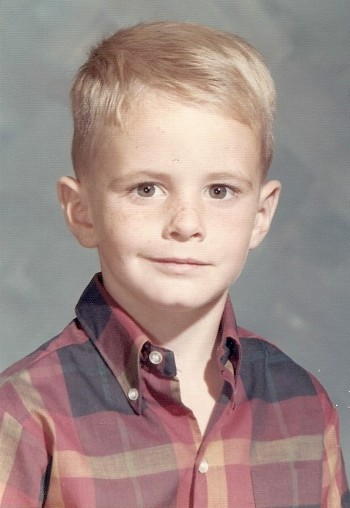 In this original BTB Investigation, we unveil the tragic story of Kirk Murphy, a four-year-old boy who was treated for “cross-gender disturbance” in 1970 by a young grad student by the name of George Rekers. This story is a stark reminder that there are severe and damaging consequences when therapists try to ensure that boys will be boys.
When we first reported on three American anti-gay activists traveling to Kampala for a three-day conference, we had no idea that it would be the first report of a long string of events leading to a proposal to institute the death penalty for LGBT people. But that is exactly what happened. In this report, we review our collection of more than 500 posts to tell the story of one nation’s embrace of hatred toward gay people. This report will be updated continuously as events continue to unfold. Check here for the latest updates.
In 2005, the Southern Poverty Law Center wrote that “[Paul] Cameron’s ‘science’ echoes Nazi Germany.” What the SPLC didn”t know was Cameron doesn’t just “echo” Nazi Germany. He quoted extensively from one of the Final Solution’s architects. This puts his fascination with quarantines, mandatory tattoos, and extermination being a “plausible idea” in a whole new and deeply disturbing light.
On February 10, I attended an all-day “Love Won Out” ex-gay conference in Phoenix, put on by Focus on the Family and Exodus International. In this series of reports, I talk about what I learned there: the people who go to these conferences, the things that they hear, and what this all means for them, their families and for the rest of us.
Prologue: Why I Went To “Love Won Out”
Part 1: What’s Love Got To Do With It?
Part 2: Parents Struggle With “No Exceptions”
Part 3: A Whole New Dialect
Part 4: It Depends On How The Meaning of the Word "Change" Changes
Part 5: A Candid Explanation For "Change"
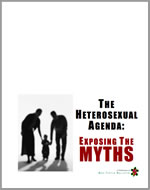 At last, the truth can now be told.
Using the same research methods employed by most anti-gay political pressure groups, we examine the statistics and the case studies that dispel many of the myths about heterosexuality. Download your copy today!
And don‘t miss our companion report, How To Write An Anti-Gay Tract In Fifteen Easy Steps.
 Anti-gay activists often charge that gay men and women pose a threat to children. In this report, we explore the supposed connection between homosexuality and child sexual abuse, the conclusions reached by the most knowledgeable professionals in the field, and how anti-gay activists continue to ignore their findings. This has tremendous consequences, not just for gay men and women, but more importantly for the safety of all our children.
Anti-gay activists often cite the “Dutch Study” to claim that gay unions last only about 1½ years and that the these men have an average of eight additional partners per year outside of their steady relationship. In this report, we will take you step by step into the study to see whether the claims are true.
Tony Perkins’ Family Research Council submitted an Amicus Brief to the Maryland Court of Appeals as that court prepared to consider the issue of gay marriage. We examine just one small section of that brief to reveal the junk science and fraudulent claims of the Family “Research” Council.
 The FBI’s annual Hate Crime Statistics aren’t as complete as they ought to be, and their report for 2004 was no exception. In fact, their most recent report has quite a few glaring holes. Holes big enough for Daniel Fetty to fall through.
“Google” is a trademark of Google Inc.
© Box Turtle Bulletin. All Rights Reserved.
 Posts
Posts  Posts via daily email: