Box Turtle Bulletin
 News and commentary about the anti-gay lobby
“Now you must raise your children up in a world where that union of man and box turtle is on the same legal footing as man and wife…”
News and commentary about the anti-gay lobbyMarch 24th, 2011
[This post is part of a series analyzing Robert George’s widely-read article, “What is Marriage“, which appeared on pages 245-286 of the Harvard Journal of Law and Public Policy. You can view all posts in the series here.]
Pages 257-259 and 262-263: In which George — well, read for yourself. Any summary I write sounds incredibly harsh.
Deceitful honesty
You can lie by telling the truth. You can oversleep, race to work, and burst late into a meeting with an apologetic, “My kid was throwing up.” You just neglect to say this happened last week and has nothing to do with why you’re late today.
You’ve spoken the truth and told a lie. My parents taught me it’s not what you say or don’t say. It’s whether you intend to deceive. You don’t get to shrug off your lie with a disingenuous, “It’s not my fault if they drew the wrong conclusion.”
That’s exactly what happens in this section and it troubles me.  Our mid-level opponents often use studies to denounce same-sex parenting — without mentioning these studies have nothing to do with same-sex parenting. It’s profoundly disturbing when a respected intellect and Princeton professor like Robert George does it.
Essentially, though, in what follows you’ll see him burst in the room and tell us his kid was throwing up. And he’ll never mention that he really just overslept.
Another of George’s harms to society
George worries that legalizing same-sex marriage would undermine:
the idea that the union of husband and wife is (as a rule and ideal) the most appropriate environment for the bearing and rearing of children — an ideal whose values strongly corroborated by the best available social science.
He footnotes this assertion about opposite-sex married parents. That footnote, however, just refers us back 5 pages to his own parenting discussion earlier in the paper, which I previously skipped and promised to come back to.
I hated this section before and I hate it now. It fails a basic test of intellectual honesty, a failure I’ve seen over and over in our opponents. In that section, George writes:
Given the marital relationship’s natural orientation to children, it is not surprising that, according to the best available sociological evidence, children fare best on virtually every indicator of wellbeing when reared by their wedded biological parents. Studies that control for other relevant factors, including poverty and even genetics, suggest that children reared in intact homes fare best on the following indices: [educational achievement, emotional health, and familial and sexual development].
George sins by omission.
What’s the problem? He makes a sneaky switch here. He opens by talking about “wedded biological parents.” His evidence, though, is about “children raised in intact homes.”
You see, these carefully-chosen studies almost always compare kids raised by their wedded biological parents to kids whose parents have divorced — kids who are being raised in single family homes or by a step-parent. For instance, George quotes a study from a “left-leaning research institution”:
[I]t is not simply the presence of two parents, . . . but the presence of two biological parents that seems to support children’s development.
Wow, even a left-leaning institution endorses both biological parents as the ideal! But wait. Those brackets around the first letter suggest he picked up his quote mid-sentence. Here’s a fuller version:
Divorce is linked to academic and behavior problems among children, including depression, antisocial behavior, impulsive/hyperactive behavior, and school behavior problems. Mental health problems linked to marital disruption have also been identified among young adults.
Children growing up with stepparents also have lower levels of well-being than children growing up with biological parents. Thus, it is not simply the presence of two parents, as some have assumed, but the presence of two biological parents that seems to support children’s development.
So this left-leaning institution has compared coupled bio-parents to…divorced parents. And step-parents. Do you see what’s not there? Adoptive parents — same-sex or opposite sex.
Funny what happens appears when you don’t chop up the quote. George also writes:
Recent literature reviews conducted by the Brookings Institution, the Woodrow Wilson School of Public and International Affairs at Princeton University, the Center for Law and Social Policy, and the Institute for American Values corroborate the importance of intact households for children
There it is again — the importance of “intact households.”
Adoptive parents are not stepparents.
This matters. The world includes more than just married bio-parents, single parents, and step-parents. Adoptive parents exist, too — adoptive parents who provide permanent “intact households.” And research indicates that children are much better safer with adoptive parents than with steppparents, so take all that steppparent research and throw it out the window. Research is also out there suggesting that adoptive parents invest more resources and spend more time with their kids than married bio-parents. In fact, during the Prop 8 trial, we heard this exchange between attorney David Boise and the expert witness against marriage equality, David Blankenhorn:
Boise: In fact, the studies show that all other things being equal, two adoptive parents raising a child from birth will do as well as two biological parents raising a child from birth, correct?
Blankenhorn: No, sir, that’s incorrect.
Boise: Well, sir —
Blankenhorn: May I say another word on that, please?
Boies: You will have an opportunity on redirect.
Blankenhorn: Okay. It was a clarifying thing and actually supports something you just said. The studies show that adoptive parents, because of the rigorous screening process that they undertake before becoming adoptive parents, actually on some outcomes outstrip the biological parents in terms of providing protective care for their children.
Yep. In some way adoptive parents can be better than coupled bio-parents.
George is hiding essential information from his readers. He hasn’t established that married bio-parents are the ideal — merely that they tend to be better than fractured homes. That’s not a relevant comparison. Here’s a list of things he might have fruitfully compared:
But no, none of that. He offers no evidence about same-sex parenting at all.
George betrays his most loyal readers.
In fact, if you dig deeper into George’s own primary source you find this:
First, no one can definitively say at this point how children are affected by being reared by same-sex couples. The current research on children reared by them is inconclusive and underdeveloped—we do not yet have any large, long-term, longitudinal studies that can tell us much about how children are affected by being raised in a same-sex household. Yet the larger empirical literature on child well-being suggests that the two sexes bring different talents to the parenting enterprise, and that children benefit from growing up with both biological parents. This strongly suggests that children reared by same-sex parents will experience greater difficulties with their identity, sexuality, attachments to kin, and marital prospects as adults, among other things. But until more research is available, the jury is still out.
Now the American Psychological Association would disagree. But even if you look at nothing but George’s best source, putting aside what it claims is “suggested” and sticking to actual evidence, the most he can assert is that “the best available social science research” has not been able to establish the superiority of either situation. But George glides over that.
You can see why this is troubling. I’ve encountered this evidentiary sleight of hand from less reputable opponents, from talking heads who make good money spreading bigotry and hate, but I don’t expect it from a man of his reputation. How can he damn same-sex parenting with studies that don’t look at same-sex parents? How can just…skip that little fact in his presentation? It’s a betrayal, not just of his own integrity, but of the readers who admire him and count on him for truth.
I’m sure Robert George has an answer for this. He must.
I just wish I knew what it was.
Next: George argues marriage equality is a threat to religious freedom.
March 23rd, 2011
Today the Colorado Senate held a floor debate on SB 172, civil unions. The main opposition came from Senator Kevin Lundberg who we have video of thanks to The Colorado Channel.
We’ve all heard this myth, recognition of gay relationships in Europe (France & Scandinavia) has caused a breakdown in marriage and “the family unit.”
Here’s a video excerpt of Sen Lundberg saying it:
Of course no statistics were cited because there’s no evidence to support it. In fact this very blog has previously done posts addressing the Scandinavian myth here and here, and Slate.com has a fabulous piece here.
The real data tells a very different story, in most Scandinavian countries marriage has been in decline for up to half a century, long before we pesky gays started publicly demanding equality.
In more recent times those countries have started offering various forms of gay relationship recognition and things have changed in a dramatic way, quoting Slate:
Danish heterosexual marriage rates are now the highest they’ve been since the early 1970’s. And the most recent marriage rates in Sweden, Norway, and Iceland are all higher than the rates for the years before the partner laws were passed. Furthermore, in the 1990s, divorce rates in Scandinavia remained basically unchanged.
Now let’s take a look at births outside of marriage in Norway (source). The date civil unions were enacted is shown with a red triangle:

.
How about marriage and divorce rates in the Netherlands? (source) Sorry there’s no red triangle in this one but registered partnerships were enacted in 1998 and full marriage in 2001:

If Senator Lundberg has other data to prove his claim hopefully he’ll present it when the civil unions bill goes for a 3rd reading on the Senate floor tomorrow.
March 23rd, 2011
Today the Colorado Senate held a floor debate on SB 172, civil unions. The main opposition came from Senator Kevin Lundberg who we have video of thanks to The Colorado Channel.
One of the main ideas of heterosexual privilege is never having your family questioned.
Follow the logic if you can (paraphrased)
Here’s the video excerpt:
March 23rd, 2011
 In 1985, seven thousand people, mostly gay men, died of a new disease known as AIDS. Los Angeles, the city where some of the first known AIDS cases were reported, was hit particularly hard. Rock Hudson fell ill and died in October of that year. Elizabeth Taylor was one of the few initially — and critically, perhaps the first straight ally in mainstream American consciousness — to publicly embrace not just her good friend, but to call attention to the epidemic that would devastate an entire community:
Elizabeth Talyor speaking at the 1992 International AIDS Conference in Amsterdam.
“I remember complaining, ‘Why isn’t anybody doing anything? Why isn’t anyone raising money?'” asked Elizabeth. “And it struck me like lightning: ‘Wait a second, I’m not doing anything.'” But she would. Elizabeth Taylor had a plan of action.
“I decided that with my name I could open certain doors, that I was a commodity in myself—and I’m not talking as an actress. I could take the fame I’d resented and tried to get away from for so many years—but you can never get away from it—and use it to do some good. I wanted to retire, but the tabloids wouldn’t let me. So I thought, If you’re going to screw me over, I’ll use you.” Elizabeth’s plan to use the media could only work. They had followed her every move for decades, and by attaching her name to the AIDS crisis, they would have to acknowledge it. Elizabeth Taylor would breakdown the stereotypes associated with the disease and enlighten an ignorant world. AIDS was not a gay man’s disease. AIDS has the potential to affect everyone and no one can hide from it.
Elizabeth helped start the American Foundation for AIDS Research (amfAR), and she established her own Elizabeth Taylor AIDS Foundation (ETAF). By 1999, she had helped to raise an estimated US$50 million to fight the disease. She also made the red AIDS ribbon a fashion requirement in L.A.

Elizabeth Taylor and Rock Hudson in "Giant"
Elizabeth Taylor’s eight marriages to seven husbands was a source of jokes for comedians and late night talk shows, but it’s her monumental body of work on the silver screen will forever cement her legacy as an artist. When she appeared at the age of eleven in 1943’s Lassie Come Home with fellow child star Roddy McDowell, MGM awarded her a contract. One year later, National Velvet rocketed her to national stardom. She somehow managed to navigate the tricky waters from adolescent star to adult star, with her 1950 hit Father Knows Best, with Spencer Tracy and Joan Bennet. She followed that the next year with her acclaimed performance in the classic A Place In The Sun, with Montgomery Clift and Shelly Winters. She appeared in the 1956 epic Giant, with Rock Hudson and James Dean, and earned Academy Award nominations for Best Actress for 1957’s Raintree County opposite Montgomery Clift, 1958’s Cat on a Hot Tin Roof opposite Paul Newman, and 1959’s Suddenly, Last Summer with Montgomery Clift, Katharine Hepburn and Mercedes McCambridge. She won an Academy Award in 1960 for Butterfield 8, and again in 1967 for Who’s Afraid of Virginia Woolf? By the time her smash hit Cleopatra appeared in 1963 with future husband Richard Burton, she was the highest paid actress in Hollywood.
Elizabeth’s talents were entirely natural; she never received professional training. Her beauty was natural as well. One cameraman remarked that she had no bad angle. Her face was flawlessly symmetrical. And her eyes. She had the deepest, velvet blue eyes.
She died this morning in Los Angeles of congestive heart failure after a very long illness. She was 79 when she died. She is much younger than that now.
March 23rd, 2011

…the government’s policies…are a stench in the nostrils of decent people, an offense against morality, an abandonment of reason, an affront to human dignity, an improper restraint upon proper freedom and liberty, a disgrace to any civilized society, and a violation of all that this nation stands for.
LGBT pioneer activist Frank Kameny fired off those words in a petition he filed with the Supreme Court. The petition was to appeal a lower court decision upholding Kameny’s firing from his job as an astronomer for the Army Map Service in 1957 because of his homosexuality. Gay people were prohibited from Federal employment due to a 1953 Executive order by President Eisenhower. The Supreme Court denied his petition to overturn that Executive Order fifty years ago this week.
Kameny’s historic petition has not been available, until now. To mark the fiftieth anniversary of the Supreme Court’s denial of that petition, Petition Denied, Revolution Begun: Frank Kameny Petitions the Supreme Court

Frank Kameny with an original picket from 1965
Kameny went on to co-found the Mattachine Society of Washington, D.C., which in 1963 launched a long campaign to overturn sodomy laws. He participated in the very first picket line in front of the White House on April 17, 1965. He was also an instrumental player in the fight to remove homosexuality from the American Psychological Association’s list of mental disorders. In 1971, he became the first openly gay candidate for the U.S. Congress when he ran for D.C’s non-voting Congressional delegate.
In 2009, the U.S. government officially repudiated Kameny’s firing when John Berry, the openly gay Director of the Office of Personnel Management, delivered a formal apology during a special OPM ceremony in his honor. Upon receiving the apology, Frank Kameny tearfully replied, “Apology accepted.”
Frank Kameny is 85 and is still active in Washington, D.C. His home was designated as a D.C. Historic Landmark by the District of Columbia’s Historic Preservation Review Board in honor of his activism. His papers are now in the Library of Congress, and a collection of original picket signs, a “Gay is Good” button (he invented the phrase), and other memorabilia are a part of the Smithsonian’s collection.
March 22nd, 2011
The app…
 is gone…
 Apple hasn’t made an official announcement, but searching through Apple’s App store for Exodus’s app comes up empty.
Everyone with an iPhone and iPad is still perfectly capable of accessing Exodus’s web site via Safari, so Exodus’s ability to convey their message to everyone with a mobile devices remains intact. And just as every other merchant is free to decide what merchandise they think is appropriate to convey on their premises, Apple is free to determine what apps they wish to make available in their app store. That’s freedom.
March 22nd, 2011
In the early 80’s, it was not at all unusual for the leadership of the College Republicans to be gay, in that “everyone knows but no one says” kinda way. In fact, I’d say it was pretty common (there’s that story about the three leading candidates for national chairman and a hot tub). But in the years since then, the organization had become in many schools little more than the local college voice of social conservatism and religious rigidity.
But young folks just don’t have the appetite for anti-gay malice anymore. They’ve grown up in a post Will and Grace world where Glee rules the airways, and Lady Gaga can influence votes. Now half of Americans support marriage equality and being anti-gay is seen as so distasteful that it can hurt you politically.
And no where is gay support stronger than in younger voters. So it should not be at all surprising that the chairman of the Colorado College Republicans has come out in support of the Colorado’s civil unions bill. Nor should it surprise us much that he’s openly gay and believes that Republican ideals, if followed, would favor gay rights.
But it is a little bit surprising that Troy Ard was elected to the chairmanship unanimously last year. And it is but one tiny sign among many that the war is almost over. Maggie can say whatever she likes about marriage not being an inevitability, but if you can’t get one single College Republican in Focus on the Family’s home state to object to electing the gay guy, then I think we can see where things are going.
March 22nd, 2011
 The last member of the original Mattachine Society has died. (SFGN)
In April of 1951, Gruber and his boyfriend Konrad “Steve” Stevens attended a meeting hosted by a gay advocacy group soon to be known as the Mattachine Society. Soon Gruber and Stevens were invited to join the other founders: Harry Hay, Rudi Gernreich, Chuck Rowland, Bob Hull and Dale Jennings. According to historian John D’Emilio, it was Gruber who suggested the name Mattachine Society for the new group, inspired by Hay’s talk about medieval “mattachines.”
“Gruber and Stevens were the only two of the original seven without strong left-wing ties or sympathies,” wrote the historian John Loughery, “but their physical charm, youth, and eagerness made them highly desirable additions and a speedy and significant difference in attracting new members.” Gruber readily embraced his “newly chosen family,” and brokered a meeting between the Society and Gruber’s famous friends Isherwood and Hooker.
Gruber was 23 when he joined Mattachine and I’m sure he had no idea how this little group of sexual outlaws and political outcasts with quirky personalities and no template to follow would place the first stones in what would be the foundation for a world-wide gay political movement.
March 21st, 2011
 The tiny alpine country of Liechtenstein has made good on its promise to recognize same-sex couples. In a unanimous decision, the parliament approved the establishment of partnerschaftsgesetz, a legal status akin to the registered partnerships in its neighbors, Switzerland and Austria. (Queerblog.it)
By unanimous vote of twenty-one members present, the Parliament of the Principality of Liechtenstein has approved on second reading the law that allows civil unions between same sex. The first steps began in about 2009 when Aurelia Frick, Minister of Justice, announced that it will present a bill to that effect.
The law does not mirror marriage, disallowing adoption or reproductive rights, but does provide parity for inheritance, social security law, in occupational pension plans, the Immigration and Naturalization law, tax law and other public law.
The parliament also amended the bill to bring forward the start date from January 1, 2012 to September 1, 2011. However, within 30 days after the publishing of the law, opponents may subject the law to referendum.
Prior to passage, Catholic Archbishop Wolfgang Haas conservative asserted pressure saying, “the practice of homosexuality is objectively a grave sin” and that recognition of same-sex couples would be a scandal. Catholics and conservatives fought the bill in the public forum through letters to the paper and debate. But while about 80% of Liechtenstein’s residents are affiliated with the Catholic Church, the parliament’s unanimous decision – in a country where legislative representation is about 1 to 1,400 – may suggest little appetite for an *anti-gay referendum.
(much thanks to Jutta Zalud for bringing this to our attention)
* It is worth noting that Switzerland, Liechtenstein’s neighbor with which they are closely politically tied, is the only country to enact partner recognition through referendum, passing a similar registry in 2005 by 58%.
A Commentary
March 19th, 2011
[In this commentary I will use certain replacement characters within some words. This is to minimize the censoring features of website monitors. I want to keep BTB as accessible as possible.]
I am a word-Nazi.
I don’t allow certain words to be used in my home, in my car, or in my company. I refuse to let certain jokes be told or attitudes to be expressed. I have delivered obnoxious little lectures and, on at least one occasion, pulled over and ordered a friend out saying, “I don’t want to be around you right now.” I can be a real killjoy and a total pain in the ass.
I recognize that words come charged with history, context, and implication. So no, words are not “just words” and not all words are equal.
Consider the following sentence: “I believe that all people should be equal under the law, be they young or old, gay or straight, white or a n!gger.” It doesn’t matter that the sentiment is positive. The choice to go with a slur derails any possible good and suggests to the reader that this statement is not really one of inclusion. Or, at least, not in most contexts.
Most of my objections are to words, jokes, and attitudes surrounding race. Don’t say anything in my presence that you would filter out if that racial group were the majority in the room. But while I am more tolerant of gay folks usage of gay related humor, I fight against buying into the pejorative messages that are driven our direction.
And I am not one who believes much in “reclaiming the power” in words. I find that far too often, adopting a slur as our own in reality means conceding the presumptions that were thrown at us and acting as though they are positive instead of negative.
Take the campaign to reclaim “queer”. This word was at one time applied to gay folk as a way of saying, “you are different, you are odd, you are ‘other’ than me, you are outside of acceptable social norms.”
But many of those who have reclaimed this term do not seem, to me, to be countering that claim. Rather, they seem to be adopting it. They say, “yes, we are different, we are odd, we are other, we are unacceptable, and we’re proud of it.”
That might be fine for those who emotionally need an identity as outsider, but it still buys into the outsider mentality. It agrees with our tormentors that our differences are more important than our similarities, a perspective that I do not think is healthy or true.
Also queer has, in many contexts, shifted to mean “anyone other than the bourgeois capitalist conformists” with little attention to sexual orientation; an identity based more on politics than attributes. And, amusingly, a good many queer folk are so tied into their outsider identity that they would exclude some gay people from being queer like them, finding them to be too assimilationist (is there anyone who would consider a GOProud member to be part of the queer community?).
So I find little use in adopting queer as part of my self-identity or my vocabulary. I don’t agree that I am outside of acceptable social norms or believe I should be segregated from society at large. My sexual identity is based primarily on recognition of my own attractions rather than on rejection of someone else’s.
I think that f*ggot is another word with little going for it. Like queer, it is an in-your-face word and can carry shock value, but it carries even more baggage. Unlike queer, which has mostly dropped from common usage, f*ggot is the slur du jour for those who delight in pain.
It has been my personal observation that those gay people who use the word “f*ggot” have not recaptured it from our oppressors. Rather, they – whether consciously or unconsciously – are reflecting their own sense of inadequacy or shame in that word selection. Yes, it can be used in irony, but more often it carries an undertone of worthlessness.
When one angry gay person screams “f*ggot!!” at another, more than a little self-loathing is exposed. (And, on a side note, is there anything more cringe-worthy than hearing a black man referring to a rival as “that n*gger”?)
I choose not to feed my own demons. I choose not to bolster negative social messages or validate the hatred of others. So, for me, f*ggot is a word without value and with more than a little danger and it has no place in my vocabulary.
The word fag I find to be a bit less troublesome. While it is still a slur from those who hate us, there is less emotional baggage attached when used within our community. Yet I think it still carries some value of “lesser than” and thus I don’t find it to be particularly useful.
But while words are important, intent is what should drive our response. And it is on intent that I judge the use of pejorative terms used to refer to gay people.
Some who comment here use the term queer in a way that does not intend to emphasize outsider status or exclude gay people who are not socially segregated, and I cannot apply my observations about the term to their usage. And I am already on record as finding the use of f*ggot in culture to be less important than the purpose of its use.
I’ve heard plenty of our enemies – those who seriously want to harm our lives and our freedoms – use the word “homosexual” in ways that were far more corrosive than had they said f*ggot. I’d far rather accept someone who toss out “homo” or “fag” but with a message of inclusion than read one more rant from the right that uses the polite term “gay community.”
Because while I am a word-Nazi around my friends, it isn’t really the word that I am objecting to, but the reason for the word. There are seldom any good reasons to use slurs, and when a pejorative term is used it mostly means that a mean-spirited thought is behind it. And that is what I find unacceptable.
Blanket policies about words that do not consider context or meaning are ridiculous and counter-productive. And, sadly, I think that in this instance that is where GLAAD has gone.
I agree with GLAAD that incautiously using the term fag – even when by a gay person – can add to an overall atmosphere that is damaging, especially to kids in school. There simply is no disputing that tossing around this word contributes to its social acceptance or that while he may have meant no harm, much harm can result.
I even think that it is within the mission of GLAAD to contact the writer and remind him how language can have consequences and to encourage him to look at the reasons within himself that he chose to go that path. I would hope that they would correct a writer that called something “so gay” when they meant “so pathetic”, even if the writer were gay.
But they should not presume intent or imply that Berk was an insensitive jerk that needed to be slapped down. And they should not have published this effort as a victory or suggested that it is the word itself, and not its intent, is what matters. Rather than participate in a more safe society, they reveal a rigidity to political correctness that is, for all practical purposes, just the mirror image of those anti-gay activists who put the word gay in scare quotes and insist “the correct word is homosexual”.
In writing this, I recalled two experiences that relate to this issue.
A few years ago I was on a cruise ship and overheard one young man talking to his friends. He was telling them that they should go to a particular club on the ship because there were some girls that were attractive and “the guys with them are gay.” At first I thought he was being offensive, using the word “gay” as a put-down. Then I realized what group he was talking about. And, yes, the guys were gay.
The other was a time I was walking on a street in my neighborhood with a friend. Some young man passing on the other side yelled “f*ggots!!.” I turned and shouted back, “yeah!” He kinda paused and shouted again, “f*ggots!!” and I responded with, “Yes. Good guess.” in a slightly impatient tone that implied that he was maybe just a bit slow. He stared, started to respond, closed his mouth, and walked away.
My point being, don’t find offense where it isn’t intended. And when we do reclaim power, reclaim it over our worth as people rather than just over a word.
March 18th, 2011
March 18th, 2011
Following on earlier media reports that Uganda’s Parliament may begin consideration of the draconian Anti-Homosexuality Bill as early as next week, NTV, Uganda’s largest independent television network, has just posted this news report featuring Stephen Tashobya, Chairman of the Legal and Parliamentary Affairs Committee:
After the bill was introduced in October 2009 amid worldwide outrage, it was sent to the Legal and Parliamentary Affairs Committee for further review and report back to Parliament. It has languished quietly in that committee since then. Now that Parliamentary elections are over and Parliament is due back to complete its lame duck session (and only maybe coincidentally while the world’s attention is consumed by events elsewhere in Japan, Libya, Bahrain and Yemen) the bill, which many news outlets erroneously reported to be dead, is again rearing its ugly head.
In this NTV report, committee chairman Tashobya is shown saying:
The Anti-Homosexuality Bill has generated a lot of debate and interest in our population, both for and against. And we are sensitive about that interest.
So we shall put out public notices for all types of people, for even foreigners, let’s have a [unintelligible] to come and appear before the committee and have this matter resolved once and for all.
M.P. David Bahati, the bill’s sponsor, responds:
I’ll be working with my colleagues to talk to other members of Parliament to ensure that this bill is debated and concluded before we close the Eighth Parliament.
We are working with religious leaders, we are working with people in the legal fraternity, we are working with parents and schools…
At this point, the NTV reporter correctly pointed out that if the bill is passed into law in its current form, the provisions barring “promoting homosexuality” would potentially punish even lawyers who defend LGBT people in court. Uganda’s legal fraternity is expected to point out that the proposed law would be completely unfair. To them.
Earlier this week, the U.S. Congress’s House Financial Services Committee passed an amendment with nearly unanimous bipartisan support which calls on the Treasury to make foreign aide contingent on developing nations’ human rights records, including how those nations treat its LGBT citizens. Rep. Barny Frank (D-MA) sponsored the amendment and singled out Uganda as an example of a country that abuses its LGBT citizens. Bahati dismissed that threat:
In my opinion, the future of our children is more important than the money we get from abroad, and the interests of Uganda are more important than the interests of foreigners. We are a soverign state, and nobody should dictate the values we should adopt in our country.
March 18th, 2011

A newly released Washington Post-ABC News poll confirms what other recent polls have shown, that a majority of Americans support marriage equality. That majority remains a slim one when one considers the 3.5 percent margin of error. But five years ago, only 36 percent supported same-sex marriage; today, 53 percent do. That’s a 47 percent increase in a very short amount of time. WaPo notes some significant trends:
In the new Post-ABC poll, the shift has been driven by several political and demographic groups whose support for such unions jumped sharply. Men, who previously were less supportive of same-sex marriage than women, now back it at the same rate. Support among college-educated whites, political independents and people who do not consider themselves religious also rose substantially.
ABC News breaks it down further:
While younger adults and liberals remain at the forefront of support for gay marriage, the new results underscore its expansion. In an ABC/Post poll five and a half years ago, for example, under-30s were the sole age group to give majority support to gay marriage, at 57 percent. Today it’s 68 percent in that group – but also 65 percent among people in their 30s, up a remarkable 23 points from the 2005 level; and 52 percent among those in their 40s, up 17 points.
…Support is up by a striking 23 points among white Catholics, often a swing group and one that’s been ready, in many cases, to disregard church positions on political or social issues. But they have company: Fifty-seven percent of non-evangelical white Protestants now also support gay marriage, up 16 points from its level five years ago. Evangelicals, as noted, remain very broadly opposed. But even in their ranks, support for gay marriage is up by a double-digit margin.
You can see the poll itself here (PDF: 85KB/3 pages). It should be noted that the margin of error for these smaller sample groups would likely be significantly greater than the poll’s overall ±3.5%. The released information does not provide margins of errors for the smaller groups, so we don’t know whether those majorities are significant in themselves, but the trend at least probably is. Especially, this trend:
Support has grown by 17 points among Democrats, but also by 13 points among independents, to a clear majority, 58 percent, in the crucial political center. And it’s 63 percent among moderates, up 21 points.
Opposing marriage equality is a losing political proposition for everyone except the conservative GOP base. Not too long ago, supporting marriage quality was a losing proposition for everyone except the liberal Democratic base.
That’s what made it the definitive wedge issue — it drove a wedge between the crucial moderates and independents from Democratic candidates. Which left the Democratic candidates sputtering that marriage bans were cynical distractions from more important issues facing the country — jobs, the economy, the global war against terrorism, whatever. Those weak arguments are why we got steamrollered in the elections.
Now, we have a president who will defend DOMA only under heightened scrutiny, and Democratic legislators introducing legislation to repeal DOMA in both houses of Congress. And in response, it’s conservative Republicans’ turn to complain that efforts to dismantle DOMA are a cynical distraction. My how times have changed.
Update: Indiana Republicans have seen the writing on the wall, and are abandoning efforts to amend the state constitution to ban marriage equality.
March 17th, 2011
Despite numerous false media reports that Uganda’s draconian Anti-Homosexuality Bill has been shelved, yet another report remind us that it is still very much alive:
The controversial Anti Homosexuality bill is one of several bills that Members of Parliament on the Legal and Parliamentary Affairs committee are set to debate when the House resumes business next week.
…Speaking to the media at Parliament today, the committee chairman, Stephen Tashobya said though the bill has created both local and international concern, it is up to Parliament to pass the bill.
Tashobya says the committee will hold public hearings where stakeholders’ views will be heard and a report made to the House for debate and possible passing before Parliament closes the 8th Parliament.
This is added confirmation from last week’s report from the government-owned New Vision that the bill would be brought up for a vote during Parliament’s lame duck session which begins March 22.
As a reminder, this is what the bill would do if passed in its current form:
On Tuesday, the House Financial Services Committee passed an amendment with nearly unanimous bipartisan support which calls on the Treasury to make foreign aide contingent on developing nations human rights records, including how those nations treat its LGBT citizens. Barny Frank, the amendment’s sponsor, singled out Uganda as an example of a country that abuses its LGBT citizens.
This time last year, the US State Department confirmed that it had repeatedly “reached out to the highest levels” in Uganda, including President Youweri Museveni, to kill the kill-the-gays bill. This was after the White House publicly condemned the bill, and Museveni confirmed that U.S. Secretary of State Hillary Clinton personally discussed the matter with him. This would be a good time for the President and State Department to become involved once again.
March 17th, 2011
 Rev. Keith Ratliff, pastor of the Maple Street Missionary Baptist Church in Des Moines, is the president of the Iowa-Nebraska chapter of the NAACP. He’s also an anti-gay activist who takes his opposition to gay equality so seriously that in last year’s gubernatorial election he endorsed Republican Bob Vander Plaats, who made opposition to equality his signature position.
Ratlif had a few choice things to say this week to a rally organized by Vander Plaats to stir up anti-gay sentiment. (Iowa Independent)
“For the few victories that the gay community is claiming,” Ratliff said, “they have won it mostly based on the hijacking of them trying to parallel themselves on the backs of the civil rights movement, here in America.”
He said their is “no parallel” of what an “insult” it was for them to compare themselves with the civil rights movement.
Ratliff, of the Maple Street Missionary Baptist Church in Des Moines, said not being able to marry a person of the same gender was no where near what it’s like to be denied service in a restaurant or hotel for the color of their skin.
How sad that Ratliff has been subjected to the insult of gay people thinking that they were equal to him. But while it may make me seem uppity, perhaps Mr. Ratliff needs a history lesson.
You see it was in 1965 that the state of Iowa banned racial discrimination in service at restaurants and hotels, but it was perfectly legal to deny gay people those exact same services until four years ago.
And there are more than a few readers who could give personal testimony to experiencing exactly the same treatment to which Ratliff thinks there is “no parallel.” Except they had no recourse. It was perfectly legal.
I don’t pretend that racial discrimination is identical to anti-gay discrimination. There are differences and subtleties that are better discussed by those who have experienced both and I’ve heard good argument why either was painful than the other. Nor do I deceive myself into thinking that racism ended in Iowa in 1965. However, I do know that civil rights are those to which each person is entitled from their government without arbitrary denial and that discrimination is ugly and cruel.
And I know that anti-gay bigotry looks just like all other bigotry: the smirk which says that the most despicable and characterless of the “acceptable” race or gender or religion or orientation will always be better than you based on a scale that has nothing to do with merit and everything to do with unearned presumptions of superiority.
Yet while it is foolish and pointless to pit victims of bigotry against each other as though injustice and indignity against one is acceptable because someone else ‘had it worse’, if Ratliff’s wants to compete in the Oppression Olympics on “not being able to marry” and “being denied service in a restaurant or hotel” then he loses and the gay community takes gold. In our lifetime, we’ve known both.
Featured Reports
 In this original BTB Investigation, we unveil the tragic story of Kirk Murphy, a four-year-old boy who was treated for “cross-gender disturbance” in 1970 by a young grad student by the name of George Rekers. This story is a stark reminder that there are severe and damaging consequences when therapists try to ensure that boys will be boys.
When we first reported on three American anti-gay activists traveling to Kampala for a three-day conference, we had no idea that it would be the first report of a long string of events leading to a proposal to institute the death penalty for LGBT people. But that is exactly what happened. In this report, we review our collection of more than 500 posts to tell the story of one nation’s embrace of hatred toward gay people. This report will be updated continuously as events continue to unfold. Check here for the latest updates.
In 2005, the Southern Poverty Law Center wrote that “[Paul] Cameron’s ‘science’ echoes Nazi Germany.” What the SPLC didn”t know was Cameron doesn’t just “echo” Nazi Germany. He quoted extensively from one of the Final Solution’s architects. This puts his fascination with quarantines, mandatory tattoos, and extermination being a “plausible idea” in a whole new and deeply disturbing light.
On February 10, I attended an all-day “Love Won Out” ex-gay conference in Phoenix, put on by Focus on the Family and Exodus International. In this series of reports, I talk about what I learned there: the people who go to these conferences, the things that they hear, and what this all means for them, their families and for the rest of us.
Prologue: Why I Went To “Love Won Out”
Part 1: What’s Love Got To Do With It?
Part 2: Parents Struggle With “No Exceptions”
Part 3: A Whole New Dialect
Part 4: It Depends On How The Meaning of the Word "Change" Changes
Part 5: A Candid Explanation For "Change"
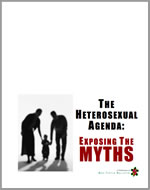 At last, the truth can now be told.
Using the same research methods employed by most anti-gay political pressure groups, we examine the statistics and the case studies that dispel many of the myths about heterosexuality. Download your copy today!
And don‘t miss our companion report, How To Write An Anti-Gay Tract In Fifteen Easy Steps.
 Anti-gay activists often charge that gay men and women pose a threat to children. In this report, we explore the supposed connection between homosexuality and child sexual abuse, the conclusions reached by the most knowledgeable professionals in the field, and how anti-gay activists continue to ignore their findings. This has tremendous consequences, not just for gay men and women, but more importantly for the safety of all our children.
Anti-gay activists often cite the “Dutch Study” to claim that gay unions last only about 1½ years and that the these men have an average of eight additional partners per year outside of their steady relationship. In this report, we will take you step by step into the study to see whether the claims are true.
Tony Perkins’ Family Research Council submitted an Amicus Brief to the Maryland Court of Appeals as that court prepared to consider the issue of gay marriage. We examine just one small section of that brief to reveal the junk science and fraudulent claims of the Family “Research” Council.
 The FBI’s annual Hate Crime Statistics aren’t as complete as they ought to be, and their report for 2004 was no exception. In fact, their most recent report has quite a few glaring holes. Holes big enough for Daniel Fetty to fall through.
“Google” is a trademark of Google Inc.
© Box Turtle Bulletin. All Rights Reserved.

 Posts
Posts  Posts via daily email: