Box Turtle Bulletin
 News and commentary about the anti-gay lobby
“Now you must raise your children up in a world where that union of man and box turtle is on the same legal footing as man and wife…”
News and commentary about the anti-gay lobbyMarch 2nd, 2011
The Ohio Senate just passed a bill that Republican supporters claim is essential to balancing the state’s budget. The bill, which now goes on to the House, limits collective bargaining rights for unions of state and local employees, including police and firefighters. It also includes this indispensable and essential component for balancing the state’s budget:
Sec. 3101.01 of S.B. 5: … A marriage may only be entered into by one man and one woman. Any marriage between persons of the same sex is against the strong public policy of this state. Any marriage between persons of the same sex shall have no legal force or effect in this state and, if attempted to be entered into in this state, is void ab initio and shall not be recognized by this state. The recognition or extension by the state of the specific statutory benefits of a legal marriage to non-marital relationships between persons of the same sex or different sexes is against the strong public policy of this state. Any public act, record or judicial proceeding of this state, as defined in section 9.82 of the Revised Code, that extends the specific statutory benefits of legal marriage to non-marital relationships between persons of the same sex or different sexes is void.
Ohio already passed one of the nation’s most draconian constitutional amendments prohibiting marriage equality in 2004. This bill goes further by stripping LGBT workers (mostly of state universities and a handful of municipalities) of their domestic partnership benefits. It’s a good thing the Tea Party only cares about fiscal matters.
March 2nd, 2011
 That’s the 8-1 decision of the U.S. Supreme Court in the case of Snyder v Phelps (PDF: 248KB/36 pages), an appeal of a five million dollar judgment against the Fred Phelps and the Westboro Baptist Church. The court reversed a lower court decision in favor of the family of Marine Lance Cpl. Matthew Snyder, who was killed in Iraq and whose funeral was picketed by the Phelps clan. The protests included signs with the statements “Thank God for Dead Soldiers” and “Fags Doom Nations.” The Phelps clan regularly protests military funerals to push their message that God hates the U.S. because we’re not executing homosexuals as Leviticus commands.
According to the majority opinion written by Chief Justice John Roberts, Westboro followed all of the legal restrictions imposed on the group, and by noting them, the court appears to have reaffirmed its approval of those restrictions:
Simply put, the church members had the right to be where they were. Westboro alerted local authorities to its funeral protest and fully complied with police guidance on where the picketing could be staged. The picketing was conducted under police supervision some 1,000 feet from the church, out of the sight of those at the church. The protest was not unruly; there was no shouting, profanity, or violence.
…Given that Westboro’s speech was at a public place on a matter of public concern, that speech is entitled to “special protection” under the First Amendment. Such speech cannot be restricted simply because it is upsetting or arouses contempt. “If there is a bedrock principle underlying the First Amendment, it is that the government may not prohibit the expression of an idea simply because society finds the idea itself offensive or disagreeable.” Texas v. Johnson, 491 U. S. 397, 414 (1989). Indeed, “the point of all speech protection . . . is to shield just those choices of content that in someone’s eyes are misguided, or even hurtful.” Hurley v. Irish-American Gay, Lesbian and Bisexual Group of Boston, Inc., 515 U. S. 557, 574 (1995).
Roberts warned that “our holding today is narrow” and is limited by the particular facts before the court. Those facts included that Westboro complied with local laws and did not instigate a public disturbance during their protest. As to the nature of Westboro’s protest:
Westboro believes that America is morally flawed; many Americans might feel the same about Westboro. Westboro’s funeral picketing is certainly hurtful and its contribution to public discourse may be negligible. But Westboro addressed matters of public import on public property, in a peaceful manner, in full compliance with the guidance of local officials. The speech was indeed planned to coincide with Matthew Snyder’s funeral, but did not itself disrupt that funeral, and Westboro’s choice to conduct its picketing at that time and place did not alter the nature of its speech.
Speech is powerful. It can stir people to action, move them to tears of both joy and sorrow, and—as it did here—inflict great pain. On the facts before us, we cannot react to that pain by punishing the speaker. As a Nation we have chosen a different course—to protect even hurtful speech on public issues to ensure that we do not stifle public debate. That choice requires that we shield Westboro from tort liability for its picketing in this case.

The Westboro Baptist clan protesting at Matthew Snyder's funeral
This ruling is important for many reasons. First and foremost, it preserves the primacy of free speech in America, which benefits us all. But from a parochial pro-LGBT narrative, it’s equally important to note that it proves the lie to the multiple instances when anti-gay activists falsely claimed that advances in LGBT equality and protections — whether they come in the form of marriage equality or hate crimes protections — will result in the infringement of religious and speech rights. They never have and, if this ruling is any indication, it reaffirms the fact that they never will. So the next time someone claims that marriage equality will result in pastors being prosecuted for hate speech, make a note of it: Snyder v Phelps.
Justice Samuel Alito dissented, noting that Albert Snyder, the marine’s father who brought the suit citing emotional distress, was not a public figure, but a private individual who simply wanted to bury his son in peace. He argued that the first Amendment does not mean “that they may intentionally inflict severe emotional injury on private persons at a time of intense emotional sensitivity by launching vicious verbal attacks that make no contribution to public debate.” He then listed some of that possible emotional injury:
Other signs would most naturally have been understood as suggesting—falsely—that Matthew was gay. Homosexuality was the theme of many of the signs. There were signs reading “God Hates Fags,” “Semper Fi Fags,” “Fags Doom Nations,” and “Fag Troops.” Id., at 3781–3787. Another placard depicted two men engaging in anal inter-course. A reasonable bystander seeing those signs would have likely concluded that they were meant to suggest that the deceased was a homosexual.
This line of reasoning suggests that Alito thinks being mistaken for “a homosexual” is grounds for emotional distress. Interesting…
There’s something else that’s even more interesting: Alito made a point that the larger court refused to consider.
After the funeral, the Westboro picketers reaffirmed the meaning of their protest. They posted an online account entitled “The Burden of Marine Lance Cpl. Matthew A.Snyder. The Visit of Westboro Baptist Church to Help the Inhabitants of Maryland Connect the Dots!” … Belying any suggestion that they had simply made general comments about homosexuality, the Catholic Church, and the United States military, the “epic” addressed the Snyder family directly…
The larger court did not address the “epic” except in this footnote on page 3:
A few weeks after the funeral, one of the picketers posted a message on Westboro’s Web site discussing the picketing and containing religiously oriented denunciations of the Snyders, interspersed among lengthy Bible quotations. Snyder discovered the posting, referred to by the parties as the “epic,” during an Internet search for his son’s name. The epic is not properly before us and does not factor in our analysis. Although the epic was submitted to the jury and discussed in the courts below, Snyder never mentioned it in his petition for certiorari. See Pet. for Cert. i (“Snyder’s claim arose out of Phelps’ intentional acts at Snyder’s son’s funeral” (emphasis added)); this Court’s Rule 14.1(g)(petition must contain statement “setting out the facts material to consideration of the question presented”). Nor did Snyder respond to the statement in the opposition to certiorari that “[t]hough the epic was asserted as a basis for the claims at trial, the petition . . . appears to be addressing only claims based on the picketing.” Brief in Opposition 9. Snyder devoted only one paragraph in the argument section of his opening merits brief to the epic. Given the foregoing and the fact that an Internet posting may raise distinct issues in this context, we decline to consider the epic in deciding this case.
In other words, the Snyders may have had a claim based not on the protest itself, but on Westboro’s Internet posting that was addressed specifically to the family. But for whatever reason, the family chose not to pursue that claim before the high court. Given the court’s warning about the narrowness of the case based solely on the facts considered by the court, the decision might have been a bit different had the family’s attorney chose to include the “epic” as part of their appeal.
March 2nd, 2011
House Speaker Gordon D. Fox, an openly gay Providence Democrat, says he’s “doing everything in his power” to move the question forward.
He acknowledged that a vote in the House Judiciary Committee could come as soon as March 10, the day that the Senate has scheduled a hearing on the Senate version of the legislation.
“That’s a potential,” Fox said. “The potential’s there but nothing has been set in stone at this point.”
March 2nd, 2011
 There’s something about being caught engaged in sexual improprieties that brings about remorse. Perhaps it is true regret or perhaps it is a desire to look less hypocritical, but it does seem to happen.
And Grant Storms, the New Orleans opponent to Southern Decadence who was caught watching kiddies with his hands in his pants, is no exception. (BeliefNet)
Storms, a self-described “Christian patriot” who has protested New Orleans’ annual Southern Decadence gay pride festival, also apologized to those he had maligned, saying, “I was very mean-spirited at times and I apologize.”
…
Storms also expressed remorse for his protests at the gay festival, which he has said turns the French Quarter into Sodom and Gomorrah.“When I look back, there’s a lot of things I would have done differently. I was so proudful. I was very arrogant,” he said, adding later, “I’ll fess up to my shortcomings, and whatever they say against me, they can say it. They have every right now to say it.”
Well, I guess it is a step in the right direction.
March 2nd, 2011
From the Star-Tribune
By a 31-28 vote, House members voted to accept a stripped-down version of House Bill 74 crafted by a conference committee on Tuesday. Conference committee members tore out all language on the two most contentious issues surrounding the bill – civil unions and court access for same-sex couples.
UPDATE: The bill died in the Senate 16-14
Which means that Wyoming law remains in limbo. Basically, there is no recognition of out-of-state marriages or civil unions, but Wyoming legislature still contains enough libertarian “western Republicans” that anti-gay legislation could not pass this year.
March 2nd, 2011
Tiffany Alston – who had, along with Jill Carter, withheld her vote on marriage equality by not attending the committee – had not been as public or blatant in her extortion issues. And, consequently, had not caught the full brunt of the media’s ire.
But surely she saw the writing on the wall from how Carter fared in the public view. Not only did we express our contempt for Carter, but so did some of the mainstream media. (Baltimore Sun Editorial)
Her action reduces a question about fundamental human rights — legislation she co-sponsored — to petty horse trading. What had been ennobling about the debate over this issue so far had been the sincerity of arguments advanced on both sides, but Ms. Carter has chosen to put political expediency ahead of the interests of thousands of Marylanders and her own avowed beliefs, and she is acting as if that is a virtue. She cheapens the honest and difficult decisions her fellow legislators have made.
Even the coverage that did not exactly excoriate Ms. Carter questioned why she signed on to sponsor a bill if she didn’t think it was all that important.
So Alston has now discovered that she is ready to vote and most analysis assumes that she will support the bill. And some reports say that Carter has resolved her concerns.
But meanwhile another supporter discovered to his amazement that the marriage equality bill is about marriage. (Todd Eberly)
In other development, Del. Melvin Stukes of Baltimore withdrew his sponsorship of the bill explaining that he thought the bill only provided for civil unions and not for civil marriage. In the spirit of full disclosure, I know Del. Stukes and have the utmost respect for him, but the text of the bill has always been clear with regard to legalizing civil marriage.
Eberly also speculates on the cause of the derailing:
So what’s happening in the Maryland House? Why are co-sponsors of the bill flaking out? The most likely explanation is that they sponsored the legislation based on the assumption that it would never pass in the Senate and they would never be called upon to cast a vote in favor of it. Now, there is a very real possibility that the bill will become law and these lawmakers were not prepared for the pressure of actually casting a vote.
It is likely more than a coincidence that the three delegates referenced are African American and represent predominantly African-American constituencies. As reported by the Washington Post, African-American churches and religious leaders have emerged as a strong voice of opposition to the legalization of same-sex marriage (as have Catholic churches and leaders). No doubt Dels. Stukes, Carter, and Alston have been hearing much of that opposition.
Let’s hope that strong supportive voices rise up in Maryland’s African-American community to counter the anti-gay fervor being whipped up by some in the black churches.
March 2nd, 2011
Which means I don’t have to tell you:
According to “Feeling the Future,” a peer-reviewed paper the APA’s Journal of Personality and Social Psychology will publish this month, (Cornell Professor Daryl) Bem has found evidence supporting the existence of precognition. The experiment I’m trying, one of nine Bem cites in his study, asks me to guess which of two curtains hides a photograph. (Some of the images are erotic, some neutral, in an attempt to see if different kinds of photos have different effects.) If mere chance governed each guess, I’d be right 50 percent of the time. Naturally, I’d guess correctly more like 100 percent of the time if you showed me where the photo was before I chose.
But what about if you showed me the photo’s location immediately after I chose? Perhaps, if I had ESP, I could peek into the future and improve my guesswork, even just a little bit. Over seven years, Bem tested more than 1,000 subjects in this very room, and he believes he’s demonstrated that some mysterious force gives humans just the slightest leg up on chance.
Between 1996 and 2000, Professor Bem published a series of papers touting his “Exotic Becomes Erotic” theory of sexual development, in which he posits that:
…biological variables, such as genes, prenatal hormones, and brain neuroanatomy, do not code for sexual orientation per se but for childhood temperaments that influence a child’s preferences for sex-typical or sex-atypical activities and peers. These preferences lead children to feel different from opposite or same-sex peers–to perceive them as dissimilar, unfamiliar, and exotic. This, in turn, produces heightened nonspecific autonomic arousal that subsequently gets eroticized to that same class of dissimilar peers: Exotic becomes erotic.
In other words, Bem’s theory holds that we become attracted to those who are different from ourselves, a theory which leaves masculine gay men’s attractions to effeminate twinks but not to women (or twinks to each other or bears to each other or jocks to each other or lipstick lesbians to each other, etc.) unexplained. Nevertheless, this developmental theory which downplays the possibility of biological forces in favor of peer relationships as a cause for homosexuality — and for which there is precious little clinical evidence for support — found favor with NARTH’s own socially–constructive viewpoints.
On January 27, Bem appeared on Comedy Central’s The Colbert Report to discuss his latest paper on ESP. While amusing on cable television, his paper has generated considerable consternation among psychologists:
Responses to Bem’s paper by the scientific community have ranged from arch disdain to frothing rejection. And in a rebuttal—which, uncommonly, is being published in the same issue of JPSP as Bem’s article—another scientist suggests that not only is this study seriously flawed, but it also foregrounds a crisis in psychology itself.
…To science-writing eminence Douglas Hofstadter, the publication of work like Bem’s has the potential to unleash, and legitimize, other “crackpot ideas.” In the New York Times, the University of Oregon’s Ray Hyman used the words “an embarrassment for the entire field.” Some critics protest that the article can’t explain what mechanism might be behind precognition. (“We almost always have the phenomenon before we have the explanation,” Bem says.) Others just scoff: Why limit yourself to one kind of pseudoscience? As York University’s James Alcock points out in Skeptical Inquirer, that 53 percent might as well be proof of the power of prayer.
“It shouldn’t be difficult to do one proper experiment and not nine crappy experiments,” the University of Amsterdam’s Eric-Jan Wagenmakers tells me. He’s the co-author of the rebuttal that accompanies Bem’s article in JPSP. Wagenmakers uses Bayesian analysis—a statistical method meant to enforce the notion that extraordinary claims require extraordinary evidence—to argue that Bem’s results are indistinguishable from chance. In essence, he explains, 53 percent of a bunch of Cornell sophomores, in unmonitored experiments conducted by a pro-PSI professor, shouldn’t really move the needle, considering how deeply unlikely the existence of precognition actually is. The paper, says Wagenmakers, never should have made it through peer review, and the fact that it did is representative of a larger crisis in the field: The methods and statistics used in psychology, he writes, are “too weak, too malleable, and offer far too many opportunities for researchers to befuddle themselves and their peers.”
But then, you already knew that, didn’t you?
March 1st, 2011
House Bill 74 would ban the recognition of out-of-state same-sex marriages. Wyoming law, which was written before the first same-sex marriages, defines marriage as a contract “between a male and a female person” but also recognizes any valid marriage performed outside the state – a discrepancy which put same-sex marriages in limbo.
HB74 has passed both the Wyoming House and Senate, but in sharply different versions. Both banned the recognition of civil unions, but the Senate provided that state courts could address the dissolution of civil unions from other states and the House specifically banned courts from addressing such couples.
Until a few hours ago, it looked as though this bill might die due to an inability of the committee assigned to work out the discrepancy to reach any conclusion. The Senate had barely passed the bill and the Governor had indicated that he would veto the bill if it did not allow courts to remedy the legal problems of gay couples in a civil union. But the House was insistent that allowing same-sex couples to seek resolution in court was tantamount to giving the state’s sanction to their union.
Finally, the least likely of compromises was reached
But with the Legislature set to adjourn for the year on Thursday, the conference committee took out all language dealing with civil unions and court access.
Conference committee members said the changes bring the bill closer to other states’ Defense of Marriage acts. They also said it was better to have a narrowed bill than no bill at all, and they said it would be up to future Legislatures to tackle the issue of civil unions.
It must now go back to the House and Senate for approval of the revisions.
March 1st, 2011
 Meet Jill Carter. Jill represents Baltimore. She believes that your rights and my rights are less important than her own personal political advancement. She also believes that extortion is an appropriate methodology for getting her way.
Jill Carter is an ideal example of what people find objectionable in politicians. From now on when you hear someone say, “they’re all crooks, out for themselves, and they care nothing about principles or the people,” Jill Carter’s face should come to mind.
Carter had signed on as a sponsor of the marriage equality bill in Maryland. Then she did a vote count and thought, “oh, my vote counts. Without my support gay people can be denied their civil equality, so I’ll use my vote as an extortion tool to get what I want.” (Baltimore Sun)
Carter was one of two delegates supportive of gay marriage who staged a walkout this morning during a specially scheduled vote on the marriage proposal — which has already cleared the Senate and had been expected to make it out of the House committee today.
But Carter said there are “more important, or at least equally important” issues that she would like to see fast-tracked in the way that, in her view, gay marriage has been. And she said that until she hears from House leadership, she does not plan to cast a committee vote in favor of the Civil Marriage Protection Act.
She is a critical vote: The House Judiciary Committee contains only exactly enough “yes” votes to get the same-sex marriage proposal out of committee and to the House floor for debate by the entire 141-member chamber.
What a really nasty piece of work.
A CommentaryA Commentary
March 1st, 2011
 Drag is fun. It is a cultural entertainment, a social commentary, a challenge to presumptions, and a cherished tradition within the gay community. It’s been around for a very long time, and likely is here to stay.
And, if crafted carefully, drag can be a unique tool to transmit a message addressing issues surrounding gender assumptions and social expectations (though this needs to be well thought out, lest it contradict or diminish the goals of transgender people).
But drag has nothing to do with marriage or our community’s quest for marriage equality. In fact, when it comes to marriage, the last thing we want is for those who are listening to our legitimate grievances to start thinking that gay people are just ‘men who like to parade around in women’s clothes’ or that we don’t take our own inequalities and indignities seriously.
Which is why it was really incredibly stupid and counterproductive for Queer Rising – an organization of queer activists and “drag queen activists” – to block the intersection of Manhattan’s 42nd Street and Sixth Avenue this morning with a banner protesting marriage inequality in fright wigs and faux fur. This protest was a lot less about marriage than it was about “look at me!”
And now our community has to deal with news stories like “Drag Queens’ Gay Marriage Rally Halts Midtown Traffic.”
Was that what the message supposed to be? Because that’s exactly what happened and I can hardly fault a newsource for being accurate.
Upper West Side drag queen Honey LaBronx, who wore a curled auburn wig and sparkly purple eye shadow, said she was nervous about the prospect of being arrested for the first time. LaBronx, whose real name is Ben Strothmann, said this was one concrete action she could take in support of the gay marriage cause.
“I’m hoping they can see how serious we are about this,” LaBronx said, before the group marched from Grand Central Terminal.
Serious? Really? You want morning commuters to take you serious in your purple eye-shadow and stiletto heels?
Instead, perhaps it is you who should be taking our community and our rights seriously.
March 1st, 2011
 Yesterday, Peter Gomes died.
As minister of Memorial Church of Harvard University since 1970, Peter Gomes held a pulpit of prestige. An international preacher, Gomes was highly respected and his influence ranged from discussing theology with the Queen Mum to offering prayers and sermons at the inaugurals of Presidents Ronald Reagan and George H. W. Bush. Every Harvard alumnus for the past 40 years has started and ended their education with his advice.
But for me, Gomes will be remembered as the author of The Good Book: Reading the Bible with Mind and Heart, a book which allowed me to look at some of my presumptions and question my own interaction with faith. The premise of this work, which really isn’t all that surprising, is that few Christians have much working knowledge of the Bible, know how to read it, or feel confident to understand what it says. Instead they opt for a deification of the image of the Bible rather than attempting to apply the truths found in its contents.
And it was demystifying the Bible and shaking up Christianity’s comfortable assumptions that consumed the past few decades of his life. Although a life-long Republican of the Massachusetts variety (until a recent registration change to support Deval Patrick), he viewed Jesus as a social revolutionary whose gospel would not be much welcomed in today’s established Christianity and deplored the way in which Scriptural literalism could be text proofed to support just about any social injustice.
In 1991 Gomes came out as gay, (NY Times)
Then, in 1991, he appeared before an angry crowd of students, faculty members and administrators protesting homophobic articles in a conservative campus magazine whose distribution had led to a spate of harassment and slurs against gay men and lesbians on campus. Mr. Gomes, putting his reputation and career on the line, announced that he was “a Christian who happens as well to be gay.”
When the cheers faded, there were expressions of surprise from the Establishment, and a few calls for his resignation, which were ignored. The announcement changed little in Mr. Gomes’s private life; he had never married and said he was celibate by choice. But it was a turning point for him professionally.
“I now have an unambiguous vocation — a mission — to address the religious causes and roots of homophobia,” he told The Washington Post months later. “I will devote the rest of my life to addressing the ‘religious case’ against gays.”
Gomes was not hesitant to tie the ‘religious objection to homosexuality’ as preached in American Christianity to the actual mistreatment of homosexual persons as experienced in America. (The Good Book)
Although most contemporary Christians who have moral reservations about homosexuality, and who find affirmation for those reservations in the Bible, do not resort to physical violence and intimidation, they nevertheless contribute to the maintenance of a cultural environment in which less scrupulous opponents of homosexuality are given the sanction of the Bible to feed their prejudice and, in certain cases, cultural “permission” to act with violence upon those prejudices.
As an American Baptist preacher from a very young age, Gomes took the Bible seriously. He took his religion seriously. And it was through his faith, not in spite of it, that he spoke out for tolerance, for understanding, for inclusion, for treating your neighbor like yourself even when you really truly don’t want to, and for adhering to a meaningful thoughtful Christianity rather than a superstitious set of rites, rules and prejudices.
The religious community and the gay community have both lost a guiding light and a powerful advocate.
February 28th, 2011
[This post is part of a series analyzing Robert George’s widely-read article, “What is Marriage“, which appeared on pages 245-286 of the Harvard Journal of Law and Public Policy. You can view all posts in the series here.]
Page 259: In which George accidentally argues it’s okay for the government only to recognize the marriages of dead people (yes! yes, he does!).
Robert George, having “proven” that marriage can only exist between a man and a woman, and that it has an essential orientation to children, now turns his attention for some reason to what he calls “marital norms”:
Finally, unions that are consummated by the generative act [*], and that are thus oriented to having and rearing children, can make better sense of the other norms that shape marriage as we have known it.
George makes three mistakes he’s made before.
The conjugal view of marriage explains the norms that have arisen around the conjugal view of marriage, which suggests the conjugal view is correct. Why? Because it explains the norms…
And so on, around and around, with no starting point. One might as well argue that segregationist ideas were able to explain the norms of segregation, which suggests that segregationist ideas were correct. Why? Because they explain the norms, etc.
Think of it this way: if marital norms continue changing to include two adults of any gender, will George revise his theory to include them? If so, then he’ll have to adopt the revisionist view he detests. If not, then marital norms are irrelevant to his discussion.
What are those “norms”?
Of course, those of us who are more empirical do care about these norms, so let’s take a look. George talks about two: permanence and exclusivity.
And we’re in trouble already. Western culture grew out of two traditions: the Judeo-Christian and the Greco-Roman. Both have allowed divorce. The Old Testament is full of guidelines for ending a marriage, and while Jesus strenuously opposed divorce, that hasn’t kept Protestant culture from permitting it.
As for exclusivity — throughout western history that expectation has applied mainly to women. Men could have multiple wives, concubines, and literal sex slaves.
George’s norms depend on the time and place you’re looking at. You can believe they have value and still recognize that George hasn’t grounded them in principled reasoning.
On permanence
George writes:
For if bodily union is essential to marriage, we can understand why marriage is incomplete and can be dissolved if not consummated, and why it should be, like the union of organs into one healthy whole, total and lasting for the life of the parts (“till death do us part”). That is, the comprehensiveness of the union across the dimensions of each spouse’s being calls for a temporal comprehensiveness, too: through time (hence permanence) and at each time (hence exclusivity).
First, toss out the first half of that first sentence. Marriage cannot always be dissolved if not consummated. From the American Bar Association:
Most states consider a couple to be married when the ceremony ends. Lack of subsequent sexual relations does not automatically affect the validity of the marriage, although in some states non-consummation could be a basis for having the marriage annulled.
Some states. What about the others? Looks like George is picking and choosing his norms.
Now to the rest of George’s paragraph: a comprehensive union requires comprehensiveness across time.
Does it? We can’t know and George can’t prove it. First, because he never proved that a “real” marriage must be a “comprehensive union.” He just said that most people acknowledge it to be so. But, as we’ve established (over and over), what most people acknowledge is irrelevant in George’s logic.
Second, even if you accept the notion of comprehensiveness (as I’m inclined to), George never defined the term clearly enough to draw logical conclusions. He has said that comprehensive doesn’t have to mean all-encompassing, so that takes “permanence” off the table, even by George’s own reasoning.
No one’s married until someone dies!
Now this next bit is a favorite of mine. Let’s see where George’s premises can take us:
The state is justified in recognizing only the unions of dead people as marriages.
Because, after all, until then, the state can’t be sure they are “real.”
I love that. I have to admit it. It tickles me and I find it delicious. To escape this, George has to abandon one of his beliefs. I have no idea which one, but I can’t wait.
By the way, I have to wonder what George thinks of a couple with children who continues living together, but not comprehensively. That is, they stop having sex, or lose their emotionally intimacy, or separate their finances as much as they can, or simply barely speak to one another.
If their union is no longer comprehensive, are they still really married? And if “real” marriage requires permanent, continual comprehensiveness (“through time” and “at each time,” in George’s words) is the government justified in saying they were never really married?
Also, George (as a Catholic natural philosopher) is devoting his life to creating a reason-based justification for Catholic doctrine. But here’s a conflict. If two Catholics are married by a priest and have sex, the Church sees them as permanently married (with few exceptions). How does that fit with George’s requirement for permanent, continual comprehensiveness? It seems to say a man and wife could just shake hands and part ways, and thus no longer be “really” married.
I can only wonder.
Sorry.
I know I promised you polygamy and incest, but that would make this entry awful long and I’m already late with it. It’s coming, though.
Next time: Polygamy, incest, and the failure of George’s definition of marriage.
* We’ve been through George’s abuse of this term many times. Check here if you don’t recall.
February 28th, 2011
Grant Storms, a locally famous New Orleans preacher who has loudly protesting the annual Southern Decadence festival, is in a bit of a pickle:
Storms told deputies that he was merely having lunch at Lafreniere Park, 3000 Downs Blvd., in his van when he decided to relieve himself using a bottle instead of using the restroom, an incident report said. But two witnesses said they saw Storms through the open windows of his van masturbating himself while watching children on the playground, the report said.
Bond for Storms was set at $5,000, but he was released from jail due to overcrowding.
In 2003, Storms tried to organize a counter-parade during that year’s Southern Decadence, which is held every year on Labor Day in the French Quarter. The effort backfired when business owners, annoyed by his loud bullhorn, convinced the city council to ban bullhorns and other amplified devices during protests. Storms’s counter-protest was intended to warn the general public about rampant public sex in the French Quarter. Not everyone saw that as a reason to stay away. One bar owner in 2003 responded, “This is basically a gay Mardi Gras. Thank you for the exposure is what I’m going to stay. Instead of 110,000 people, we’ll have 210,000 people.”
Storms faces a fine of between $1000 and $2500 or a jail sentence of between six months and two years. I wonder if his left hand knew what his right hand was doing…
February 28th, 2011
After a proposed constitutional amendment overwhelmingly passed the state Senate, it went on to die in the House:
The Wyoming House adjourned Friday without taking action on a same-sex marriage bill that had already passed the state Senate. The bill failed to meet a procedural deadline that would have kept the bill alive.
It’s still unclear whether a separate bill banning recognition of out-of-state same-sex marriages will clear the House. The snag is over whether they will allow Wyoming Courts to dissolve civil unions performed in other states.
February 28th, 2011
“It was just awful—they smashed through our living room window, one of them said ‘I’ve had my eye on you, Roger,’ and then they dragged my husband off kicking and screaming,” said Cleveland-area homemaker Rita Ellington, one of the latest victims whose defenseless marriage was overrun by the hordes of battle-ready gays…
The Onion has the scoop.
Featured Reports
 In this original BTB Investigation, we unveil the tragic story of Kirk Murphy, a four-year-old boy who was treated for “cross-gender disturbance” in 1970 by a young grad student by the name of George Rekers. This story is a stark reminder that there are severe and damaging consequences when therapists try to ensure that boys will be boys.
When we first reported on three American anti-gay activists traveling to Kampala for a three-day conference, we had no idea that it would be the first report of a long string of events leading to a proposal to institute the death penalty for LGBT people. But that is exactly what happened. In this report, we review our collection of more than 500 posts to tell the story of one nation’s embrace of hatred toward gay people. This report will be updated continuously as events continue to unfold. Check here for the latest updates.
In 2005, the Southern Poverty Law Center wrote that “[Paul] Cameron’s ‘science’ echoes Nazi Germany.” What the SPLC didn”t know was Cameron doesn’t just “echo” Nazi Germany. He quoted extensively from one of the Final Solution’s architects. This puts his fascination with quarantines, mandatory tattoos, and extermination being a “plausible idea” in a whole new and deeply disturbing light.
On February 10, I attended an all-day “Love Won Out” ex-gay conference in Phoenix, put on by Focus on the Family and Exodus International. In this series of reports, I talk about what I learned there: the people who go to these conferences, the things that they hear, and what this all means for them, their families and for the rest of us.
Prologue: Why I Went To “Love Won Out”
Part 1: What’s Love Got To Do With It?
Part 2: Parents Struggle With “No Exceptions”
Part 3: A Whole New Dialect
Part 4: It Depends On How The Meaning of the Word "Change" Changes
Part 5: A Candid Explanation For "Change"
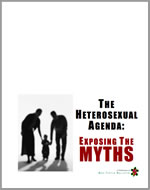 At last, the truth can now be told.
Using the same research methods employed by most anti-gay political pressure groups, we examine the statistics and the case studies that dispel many of the myths about heterosexuality. Download your copy today!
And don‘t miss our companion report, How To Write An Anti-Gay Tract In Fifteen Easy Steps.
 Anti-gay activists often charge that gay men and women pose a threat to children. In this report, we explore the supposed connection between homosexuality and child sexual abuse, the conclusions reached by the most knowledgeable professionals in the field, and how anti-gay activists continue to ignore their findings. This has tremendous consequences, not just for gay men and women, but more importantly for the safety of all our children.
Anti-gay activists often cite the “Dutch Study” to claim that gay unions last only about 1½ years and that the these men have an average of eight additional partners per year outside of their steady relationship. In this report, we will take you step by step into the study to see whether the claims are true.
Tony Perkins’ Family Research Council submitted an Amicus Brief to the Maryland Court of Appeals as that court prepared to consider the issue of gay marriage. We examine just one small section of that brief to reveal the junk science and fraudulent claims of the Family “Research” Council.
 The FBI’s annual Hate Crime Statistics aren’t as complete as they ought to be, and their report for 2004 was no exception. In fact, their most recent report has quite a few glaring holes. Holes big enough for Daniel Fetty to fall through.
“Google” is a trademark of Google Inc.
© Box Turtle Bulletin. All Rights Reserved.
 Posts
Posts  Posts via daily email: