Box Turtle Bulletin
 News and commentary about the anti-gay lobby
“Now you must raise your children up in a world where that union of man and box turtle is on the same legal footing as man and wife…”
News and commentary about the anti-gay lobbyFebruary 15th, 2011
Here’s the top 3 highlights from today:

Jess Woodrum, volunteers from One Colorado and legislative sponsors stand on the steps of the capitol building with over 1,000 "links of love" Valentines that were later presented to legislators.
It’s currently 1am and I’ve been going non-stop all day so I’m going to hold off on analysis of the full bill wording and wait for someone more legal minded take it on. However One Colorado’s press event today was damn good theater. I’ve been shooting video of most of their public events so here’s the event summarized in a 2min30sec video:
For our Colorado readers, One Colorado is asking that you take a minute and click here to email your legislator in support of civil unions.
Later in the afternoon the Colorado chapter of Marriage Equality USA held a direct action at the county clerk and recorder’s office where numerous same-sex couples would apply for and be denied marriage licenses. Around 4pm the media arrived and local activist couple and life partners Kate and Sheila (who have a history of getting arrested at the clerk’s office) applied for and were denied a license. To illustrate the arbitrary nature of our state’s marriage laws Kate grabbed a gay man near her and declared that she would therefore obtain a license with him.
However getting a license is harder than we activists had planned. Kate’s first groom-to-be forgot his ID, a requirement for a license. Kate then found a second groom-to-be who had actually been married earlier in life and since he was unable to recall his exact divorce date for the application he wouldn’t work either.
Standing at the clerk and recorder’s counter that’s when Kate turned around and asked if anyone in the assembled crowd would marry her. There was no reply so I volunteered myself.

Kate Burns and I pose with our valid Colorado marriage license. Well, valid for 30 days. We probably won't be solemnizing or mailing it in. That amazingly gaudy backdrop was set up by the Denver County clerk and recorder's office.
February 13th, 2011
Male is currently charged with filing a false police report in a conspiracy to accuse a rival, more wealthy megachurch pastor of sodomy.
The special airs Monday evening at 9:00 p.m. on BBC3.
February 12th, 2011
[This post is part of a series analyzing Robert George’s widely-read article, “What is Marriage“, which appeared on pages 245-286 of the Harvard Journal of Law and Public Policy. You can view all posts in the series here.]
Pages 247-250: In which Robert George explains the structure of his article and makes a claim so outrageous it undermines his basic credibility.
George previews the rest of the article.
George splits his article into two parts.
Part I:
As for Part II:
But many who accept (or at least grant) our core argument may have lingering questions about the justice or consequences of implementing it. Part II considers all of the serious concerns that are not treated earlier…
All of them? Really? It takes a certain intellectual arrogance to claim with such certainty that you’ve even identified all the serious concerns around an issue, much less dealt with them.
Anyway.
George wanders off track.
At this point, we might reasonably expect Robert George to start explaining his answer to What is marriage. Instead, he detours into bans on interracial vs. same-sex marriage:
Revisionists today miss this central question — what is marriage? — most obviously when they equate traditional marriage laws with laws banning interracial marriage. They argue that people cannot control their sexual orientation any more than they can control the color of their skin. In both cases, they argue, there is no rational basis for treating relationships differently, because the freedom to marry the person one loves is a fundamental right. The state discriminates against homosexuals by interfering with this basic right, thus denying them the equal protection of the laws.
But the analogy fails: antimiscegenation was about whom to allow to marry, not what marriage was essentially about; and sex, unlike race, is rationally relevant to the latter question. Because every law makes distinctions, there is nothing unjustly discriminatory in marriage law’s reliance on genuinely relevant distinctions.
But — no! Antimiscegenation was not about whom to allow to marry. Whites could marry; so could non-whites. Antimiscegenation was about whom one is allowed to marry. Just like bans on same-sex marriage.
According to George, race isn’t rationally relevant to what marriage is about, while sex is (actually, I don’t know whether by “sex” he means gender, or sexual activity, or both). But he still hasn’t proven that his procreative/conjugal view of marriage is the only permissible view: until he achieves his own goal of establishing what marriage is, he can’t make claims about what’s rationally relevant to it. And so once again we him sneaking his unproven conclusion into his argument.
George tries sneaking in it in again.
George continues: Read the rest of this entry »
February 12th, 2011
My mother was in town for the past two weeks helping me celebrate my 50th. My partner and I dropped her off at the airport this morning for her return back to Ohio, and we then went to a bookstore for coffee. That’s where I saw this very moving and poingant obituary in this week’s The Economist for David Kato:
Young men continued to mill around his house. One of them was a thief well known in the area: a rough part of town, with 15 iron-bar attacks in two months. Police assumed that when Mr Kato was bludgeoned to death with a hammer, on the afternoon of January 26th, he was just another victim in the series. Gay groups blamed the tabloids for incitement. Neighbours, hanging about, noticed with surprise that his blood on the walls looked much the same as theirs.
February 11th, 2011
BBC Radio 1 DJ Scott Mills was in Uganda recently filming a show called “The World’s Worst Place to be Gay?” where he met with M.P. David Bahati, the sponsor of the draconian Anti-Homosexuality Bill (a.k.a. the “Kill the Gays” Bill) that is still before that nation’s Parliament. During Mills’s encounter with Bahati, Mills confessed that he was gay. That’s when, according to Mills, Bahati “went mental“:
He explained: “He was scary. He ordered us to cut the cameras then brought a security guard. We ran off and he rang one of our guys saying, ‘Where are they staying? What are the registration plates? I want them arrested. They won’t get far’.”
Fortunately Scott’s colleague lied about their location, and armed police arrived at the Sheraton – where they had been falsely told the team were staying. The DJ continued: “I’d heard horror stories about people getting arrested and roughed up and who knows what. I was scared.”
On a lighter note, Mills learned that some people turn to traditional healers in their desperate attempt to become straight. So Mills decided to give it a try.
It looks to be about as effective as therapies from NARTH or Exodus.
The program airs in Britain on BBC3 on Monday at 9:00 p.m. There’s no word on whether the program will be available on the web internationally.
February 10th, 2011
[This post is part of a series analyzing Robert George’s widely-read article, “What is Marriage“, which appeared on pages 245-286 of the Harvard Journal of Law and Public Policy. You can view all posts in the series here.]
Page 246: In which Robert George sets up the argument in a way we cannot accept.
George tries to sneak his conclusion into his reasoning.
Robert George opens his article by making a fundamental distinction — one that we should not let him make. He writes:
What is marriage?
Consider two competing views:
Conjugal View: Marriage is the union of a man and a woman who make a permanent and exclusive commitment to each other of the type that is naturally (inherently) fulfilled by bearing and rearing children together. The spouses seal (consummate) and renew their union by conjugal acts—acts that constitute the behavioral part of the process of reproduction, thus uniting them as a reproductive unit. Marriage is valuable in itself, but its inherent orientation to the bearing and rearing of children contributes to its distinctive structure, including norms of monogamy and fidelity. This link to the welfare of children also helps explain why marriage is important to the common good and why the state should recognize and regulate it.
Revisionist View: Marriage is the union of two people (whether of the same sex or of opposite sexes) who commit to romantically loving and caring for each other and to sharing the burdens and benefits of domestic life. It is essentially a union of hearts and minds, enhanced by whatever forms of sexual intimacy both partners find agreeable. The state should recognize and regulate marriage because it has an interest in stable romantic partnerships and in the concrete needs of spouses and any children they may choose to rear.
In the last entry, I took issue with George’s opening sentence, and now I take issue with his second: why are these views competing views? The “revisionist” view can contain and include the “conjugal” view. As he describes them, instead of being mutually exclusive:

Figure 1: Competing views
…they look like this:

Figure 2: Compatible views
Do you see what George has done here? There’s only one way these views are “competing,” and that’s if the conjugal view is the only correct view, and anything falling outside it isn’t “real marriage.” But that’s the very thing he’s setting out to prove! In other words, he’s asking you to accept his conclusion even before he makes his argument. In fact, he’s sneaking his conclusion into the very beginning of his argument. We call that circular reasoning. Read the rest of this entry »
February 9th, 2011

Front cover of the Oct 2, 2010 edition of Rolling Stone, featuring a photo of David Kato (left) and Bishop Christopher Senyonjo (right). (Click to enlarge.)
Retired bishop Christopher Senyonjo was the second person (along with murdered LGBT advocate David Kato) whose photograph was featured on the front page of the Ugandan tabloid Rolling Stone (no relation to the U.S. publication by the same name) under the headline tagged with “Hang Them!”
Following Kato’s murder, Bishop Senyonjo was among the mourners who attended David’s funeral, which was marred by the homophobic rantings of an Anglican priest. According to a statement sent by Rev. Canon Albert Ogle of the St. Paul Foundation for International Reconciliation, Bishop Christopher “walked with the mourners, said the blessing and comforted the community at the graveside.”
Today, the bishop has issued his first public statement on Kato’s murder, in the form of an open letter to Archbishop Rowan Williams, head of the worldwide Anglican Communion, and to the bishops of the communion. In the letter, Bishop Senyonjo calls on the Anglican Church to be more aggressive in the protection of human rights, particularly in Africa where the church has expressed support for certain aspects of that draconian Anti-Homosexuality Bill. Bishop Senyonjo wrote:
If Anglicans in one country dehumanize, persecute and imprison minorities, we must be true to the Gospel and challenge such assaults on basic human rights. The key to our ministry must be to educate our people and encourage LGBT people to tell their stories and the impact of homophobia in their lives. Listening to the stories of LGBT people was the beginning of my own transformation.
Bishop Senyonjo retired ten years ago, and opened a counseling center in Kampala where he began to encounter LGBT people who went to him for help. Working with those clients led him to become an advocate for the LGBT community, a move that brought with it serious consequences for the bishop and his family. The bishop received several death threats, and he had to leave the country in 2001 for six months for his own safety. But after considering whether he should apply for political asylum in the United States, Bishop Senyonjo decided that his work was needed in Uganda. And that has become the basis of his ministry since then. As the bishop wrote in today’s letter:
Many African countries imprison LGBT people because of who they are. As a bishop in the midst of those countries, I am now a shepherd caring for the lost sheep that are persecuted by the Church and threatened by a pending anti-homosexual draconian bill in Uganda. I preach the new covenant of Jesus Christ sealed in love as we read in John 15:12. This is the heart of the Gospel-the Good News. This sacrifice of Love is mocked when sister churches tolerate or promote the violation of basic human rights. Life and liberty are at risk and we must hold each other accountable. A loving Anglican Communion should not keep quiet when the Rolling Stone tabloid in Uganda openly supports the “hanging of the homos,” including a fellow bishop who pleads for their inclusion and non-discrimination! Silence has the power to kill. We have witnessed its destruction this past week in the tragic and cruel murder of David Kato.

L-R: Rev. Canon Albert Ogle, Bishop Christopher Senyonjo, Jim Burroway
Last year, I had the pleasure of meeting with the bishop and speaking with him when he was on tour in Southern California. You can read about that here, here and here. He and others in Uganda are trying to raise funds for safe houses and attorneys. Donations can be made via the U.S.-based St. Paul’s Foundation for International Reconciliation, which is working closely with Bishop Christopher’s St. Paul’s Centre for Equality and Reconciliation.
February 9th, 2011
Uganda’s Media Centre, which acts as the official press office of the Ugandan government, has issued an official statement on its “investigation” of the motives behind LGBT Advocate David Kato’s murder. The details from the statement match very closely a conspiracy theory posted by the managing editor of a Ugandan tabloid which conducted a “Hang Them!” campaign last October featuring Kato’s picture on the front cover.
According to the official statement, Enock Nsubuga purportedly confessed to murdering Kato because Kato refused to pay Nsubuga for sex. The Police Inspector General, Maj. Gen. Kale Kayihura says their “investigation” presents “no indications that the deceased’ campaign against Homosexuality Bill, that is before Parliament was a contributing factor to his death. The police has not received any information pointing to a hate crime apart from speculation from the public.” He also warned against public vigilante campaigns in Ugandan media and denounced the recent “Hang them!” campaign waged by the tabloid Rolling Stone (no relation to the U.S. publication by the same name) that was waged last fall. He also cautioned against inflammatory statements by clergy.
Kayihura’s statement indicates that Nsubuga was arrested on February 2, which is nearly a full week after Rolling Stone managing editor Giles Muhame posted a nearly identical conspiracy theory surrounding Kato’s death on Facebook. Muhame named “Eden” Nsubuga as the “DESPERATE prisoner whom (Kato) attempted to force into a cruel sex bang.” Muhame also alledged that “the embassies have been giving Kato dollars which he has been flashing around to seduce young boys” and that “it’s estimated he sodomized about 300 boys in his regime as ;king of sodomy honchos’ in the country.”
Ugandan officials came up with their similar explanation for Kato’s murder — which just happens to match Muhame’s outrageous theories — before they even brought Nsubuga in for questioning, which raises several red flags as to the integrity of the police investigation. Corruption runs rampant in Uganda, and the police are generally reviled both for their corruption and incompetence. In 2010, Uganda was ranked at number 127 out of 178 countries by Transparency International, a ranking that placed Uganda below Egypt, Kazakhstan and Mexico.
Front cover of the Oct 2, 2010 edition of Rolling Stone, featuring a photo of David Kato (left) and Bishop Christopher Senyonjo (right). (Click to enlarge.)
Last October, Kato’s face was emblazoned on the front page of the Ugandan Tabloid Rolling Stone. The story on the inside pages featured the headline, “Hang them: They Are After Our Kids!” David Kato, who was a spokesperson for Sexual Minorities Uganda (SMUG), was one of the plaintiffs (or applicants) in the successful lawsuit seeking a permanent injunction against the Rolling Stone, preventing the further revelations of names, employers and residences of private LGBT people in Uganda.
It is unclear who provided the funds for Rolling Stone to publish. The 24-page publication contained almost no advertising. In the November 1, edition, Managing editor Giles Muhame taunted in an editorial, “I wish you knew who is behind us!! You would stop barking.” There are several indications that anti-gay pastor Martin Ssempa is, at the very least, behind several of the stories published in the paper. Muhame and advertising manager Cliff Abenaitwe both attend Ssempa’s Makerere Community Church.
Official endorsement of Muhame’s conspiracy theory neatly solves several problems for the Ugandan government. First, it gives them an explanation that allows them to defend the country against charges of endorsing violent homophobia against its LGBT citizens. It is also an explanation that allows Nsubuga to walk free whether he is innocent or guilty. If Nsubuga really is guilty, then the police have pre-manufactured a defense for him which, in Uganda’s courts, is not only a virtual guarantee that he will walk away free, but he will be deemed a hero. And worse, if Nsubuga is actually innocent, his role as scapegoat for Kato’s murder will leave him relatively unscathed: he will still walk free and so will the real killer. Everybody’s off the hook, and everyone wins. Except justice.
A multi-part video interview series with Michael Bussee, co-founder of Exodus International turned critic.
February 9th, 2011
One of my favorite ex-gay topics to talk about is how people fool themselves into believing that their sexual orientation and attractions are actually changing (I spoke about my own experience here). In ex-gay speak it’s often called the “honeymoon period.”
In today’s video Exodus International co-founder Michael Bussee talks about his own honeymoon period and how he wasn’t simply experiencing it as participant but ministry leader. Michael explains how he mistook that initial excitement for actual change. For Michael and many ex-gays he lead, such an intense focus on spirituality begins to take precedence over one’s own sexuality and he explains how he mistook that diminished libido for change and not simply repression (his word). And as with many ex-gays, meeting other struggling gay Christians for the first time is the first step in their greater coming out process.
[full transcript after the jump]
February 8th, 2011
[This post is part of a series analyzing Robert George’s widely-read article, “What is Marriage”, which appeared on pages 245-286 of the Harvard Journal of Law and Public Policy. You can view all posts in the series here.]
Page 246 (the article’s first page): In which Robert George asks his basic question, and we consider two different ways of addressing it.
What is “What is marriage?”
Should the government recognize same-sex marriage?
Professor Robert George believes the only way to settle this is to address a broader question, What is marriage? He thinks proponents of marriage equality shy away from giving a clear answer: We appeal to equality, fairness, and non-discrimination without defining the thing we want society to be fair about. This vagueness, he claims, gives our flawed arguments an “appealing simplicity” (something you’ll find his own reasoning lacks).
George, on the other hand, thinks he begins at the beginning by asking, “What is marriage?” I don’t think he’s right. We actually have to step back further and ask, “How should we approach this question, What is marriage?” The step back is essential. Otherwise we’re letting him set the terms of engagement and dealing with him on his own turf, even if it might not be the appropriate turf at all.
To explore this we’ll visit ancient Greece and spend some time with Plato and Aristotle.
Plato went back to the basics.
Plato was the one of first great western philosophers to investigate how we know what we know. In his time, Greek civil and moral life was a mess. Earlier philosophers had gotten mired in paradox. Basic questions baffled them, like the nature of change: how can a thing change (an acorn into a tree, or a baby into a woman) and yet still be the same thing? Philosophers like Parmenides and Zeno seemed to prove change was impossible, while others, like Heraclitus, showed reality was nothing but change.
These contradictions pointed out the difficulty (perhaps the impossibility) of knowing anything about the world. Reason failed, and objective knowledge was a myth. That ruled out moral truth, too: The universe is unknowable, morality is arbitrary, and you may as well devote your life to pleasure and power.
Plato wanted to create moral individuals and a just society, so he had to develop a theory of knowledge. He had to prove concepts like truth, goodness, and honor weren’t just empty words, but real things, things we can know and talk about in a meaningful way.
Plato did this by arguing that there are two realms: the realm we live in, and a realm of higher, unseen-but-real things.
You’ve never seen a triangle.
Think about a triangle. Easy enough. But that’s surprising, because you’ve never seen a triangle — just pictures of them. The sides of a real triangle are perfectly straight line segments. Every “triangle” you’ve seen has sides that aren’t perfectly straight, that vary in thickness, that are a bit jagged if you look closely enough.
Yet you recognize a picture of triangle when you see it. That’s because in your head you have an idea of a triangle — you understand the form of a triangle. And when it comes to Plato, form doesn’t just mean shape; it goes way beyond that to mean the ultimate and perfect version of something.
So now think about a horse. Plato would say humans understand the form of a horse, too. That’s how even a child can see that two very different animals are both horses. And just as some triangles are drawn better than others, some horses are stronger or faster than others; they better fit the form of a horse.
Go up another level of abstraction and there are forms for goodness, truth, honor, justice. We may have trouble defining them, we may never encounter a perfect example, but we know them when we see them, because the forms are in our heads. But not just in our heads. Plato thought forms were real — more real, in fact, than the world we live in, because they exist in a higher realm: the Realm of Forms.
Are you kidding me?
Read the rest of this entry »
A multi-part video interview series with Michael Bussee, co-founder of Exodus International turned critic.
February 7th, 2011
Exodus turns 35 this year and Focus On The Family has a brief but glowing article that totally glosses over all the tragedies Exodus, it’s leaders, and followers have experienced during that time.
In today’s video Exodus International co-founder Michael Bussee explains how Exodus has changed over time — in his view Exodus’ foray into anti-gay political activism has been it’s biggest mistake.
[full transcript after the jump]
February 7th, 2011
 Utah State Rep. LaVar Christensen (R-Draper) is upset that so many local Utah cities have passed ordinances prohibiting discrimination against LGBT residents in housing and employment. The statutes already exempt religious organizations, but Christensen thinks that doesn’t go far enough. he wants to exempt Utah’s individuals from prosecutions because of their religious beliefs.
Christensen apparently is a big believer in religious freedom. A huge believer, and he wrote his bill so broadly that it opens the door toward protection of polygamy as well, among other possibilities:
Marina Lowe, the legislative and policy counsel for The American Civil Liberties Union, said the bill is so broad it could permit many types of discrimination. “The possibilities are limitless,” Lowe said. For example, a landlord could refuse to rent to a gay couple or a doctor could refuse to treat a woman who is pregnant out of wedlock.
…Civil rights attorney Brian Barnard said the law could provide a defense for the violation of a variety of laws in the name of faith. “Polygamy is the one that comes to mind, but there are other religious practices,” Barnard said. “Peyote, for example, and the other one is churches, like the Episcopal church, that give wine to minors during the sacrament.”
February 7th, 2011
 Remember the mom who let her five-year-old son dress as the Scooby-Doo character Daphne for Halloween? The mother, identified only as “Sarah”, got a lot of flack over it from other moms at her son’s school. That was three months ago and the controversy still hasn’t died down. This time it’s Sarah’s church getting into the act, accusing her of “libel and slander” — even though Sarah only named the other moms as mother’s A, B, and C. ABC News has this update:
(On January 26), Sarah said she was called in for another meeting, in which the pastor told her she needed to apologize to the mothers whose comments she had mentioned in “My Son Is Gay.” She said the pastor also accused Sarah of “libel and slander, and told her that she “had taken offense [from the women] where none was intended.”
The pastor offered Sarah four steps to restore her relationships with the mothers, including writing an apology, taking down the blog post and perhaps taking down the entire blog. “I was told not to take Communion and that I may have my membership revoked if I didn’t reconcile,” Sarah said.
After Sarah complained to church elders, her pastor called back and said that he would reconsider the withholding of communion. Sarah, who says she has no idea whether her son will grow up to be gay or not (I mean, really, all of this over a Halloween costume!), responded to her church on Monday:
I cannot tell you the betrayal I feel. The church, or at the very least Pastor is trying to bully me into shutting up, and I find that so disheartening. I am floored by the fact that they’ve gone to so much trouble regarding a post that discusses love and tolerance that was posted 3 months ago. I am shocked that they do not see the hypocrisy of what they are saying to me. I am in complete disbelief that this has been handled in the way it has. I have never felt less welcome in a church.
This is not the church that I grew up in. This is not the God that I know.
And again I say to you that bullying is not okay, even if you wrap it in a bow and call it ‘spiritual care.’
February 7th, 2011
Last month, Minnesota governor and prospective GOP presidential candidate Tim Pawlenty made waves when he went on a radio program hosted by American Family Association’s Bryan Fischer — yes, that Bryan Fischer — to say that if he were elected president, Pawlenty would reinstate “Don’t Ask, Don’t Tell.” Today, Pawlenty is doubling down on that statement:
http://www.youtube.com/watch?v=W5AptlIs6hM&feature=player_embeddedAppearing at the Family Leader’s Presidential Lecture Series in Iowa, which ThinkProgress attended, Pawlenty reiterated his argument for why the policy should not have been repealed and then, when pushed, agreed with ThinkProgress that taking away the funding “would be a reasonable step”:
ThinkProgress notes that just three days ago, Bryan Fischer also called on Congress to de-fund DADT’s repeal.
February 7th, 2011
Over the next few weeks I’ll publish a series of posts analyzing Robert George’s article, “What is Marriage?”
Robert George authored The Manhattan Declaration and is the Founding Chairman of Maggie Gallagher’s National Organization for Marriage, but don’t let that fool you. He’s an intellectual heavyweight, the McCormick Professor of Jurisprudence at Princeton University. A recent profile in the New York Times dubbed him America’s “most influential conservative Christian thinker,” and described his reputation:
Karl Rove told me he considers George a rising star on the right and a leading voice in persuading President George W. Bush to restrict embryonic stem-cell research. Supreme Court Justice Antonin Scalia told me he numbers George among the most-talked-about thinkers in conservative legal circles. And Newt Gingrich called him “an important and growing influence” on the conservative movement, especially on matters like abortion and marriage…
George has assumed his mantle as the reigning brain of the Christian right.
George published “What is Marriage” in the Harvard Journal of Law and Public Policy. It’s been hailed as “a definitive defense of the institution of traditional marriage. Just two months after its publication, it’s become the most downloaded paper of the past year at the Social Science Research Network.
The article’s over 40 pages long, and my analysis will match that easily. I’ll post it in chunks every two or three days.
Blogging is inherently presumptuous: Look at me! I wrote this! You should read it! But it feels especially presumptuous asking people to read a long, multi-part rebuttal to an academic article. I hope you’ll do it anyway, for several reasons.
So that starts tomorrow. In the meantime, you can download George’s article here if you want a head start.
Featured Reports
 In this original BTB Investigation, we unveil the tragic story of Kirk Murphy, a four-year-old boy who was treated for “cross-gender disturbance” in 1970 by a young grad student by the name of George Rekers. This story is a stark reminder that there are severe and damaging consequences when therapists try to ensure that boys will be boys.
When we first reported on three American anti-gay activists traveling to Kampala for a three-day conference, we had no idea that it would be the first report of a long string of events leading to a proposal to institute the death penalty for LGBT people. But that is exactly what happened. In this report, we review our collection of more than 500 posts to tell the story of one nation’s embrace of hatred toward gay people. This report will be updated continuously as events continue to unfold. Check here for the latest updates.
In 2005, the Southern Poverty Law Center wrote that “[Paul] Cameron’s ‘science’ echoes Nazi Germany.” What the SPLC didn”t know was Cameron doesn’t just “echo” Nazi Germany. He quoted extensively from one of the Final Solution’s architects. This puts his fascination with quarantines, mandatory tattoos, and extermination being a “plausible idea” in a whole new and deeply disturbing light.
On February 10, I attended an all-day “Love Won Out” ex-gay conference in Phoenix, put on by Focus on the Family and Exodus International. In this series of reports, I talk about what I learned there: the people who go to these conferences, the things that they hear, and what this all means for them, their families and for the rest of us.
Prologue: Why I Went To “Love Won Out”
Part 1: What’s Love Got To Do With It?
Part 2: Parents Struggle With “No Exceptions”
Part 3: A Whole New Dialect
Part 4: It Depends On How The Meaning of the Word "Change" Changes
Part 5: A Candid Explanation For "Change"
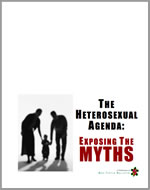 At last, the truth can now be told.
Using the same research methods employed by most anti-gay political pressure groups, we examine the statistics and the case studies that dispel many of the myths about heterosexuality. Download your copy today!
And don‘t miss our companion report, How To Write An Anti-Gay Tract In Fifteen Easy Steps.
 Anti-gay activists often charge that gay men and women pose a threat to children. In this report, we explore the supposed connection between homosexuality and child sexual abuse, the conclusions reached by the most knowledgeable professionals in the field, and how anti-gay activists continue to ignore their findings. This has tremendous consequences, not just for gay men and women, but more importantly for the safety of all our children.
Anti-gay activists often cite the “Dutch Study” to claim that gay unions last only about 1½ years and that the these men have an average of eight additional partners per year outside of their steady relationship. In this report, we will take you step by step into the study to see whether the claims are true.
Tony Perkins’ Family Research Council submitted an Amicus Brief to the Maryland Court of Appeals as that court prepared to consider the issue of gay marriage. We examine just one small section of that brief to reveal the junk science and fraudulent claims of the Family “Research” Council.
 The FBI’s annual Hate Crime Statistics aren’t as complete as they ought to be, and their report for 2004 was no exception. In fact, their most recent report has quite a few glaring holes. Holes big enough for Daniel Fetty to fall through.
“Google” is a trademark of Google Inc.
© Box Turtle Bulletin. All Rights Reserved.
 Posts
Posts  Posts via daily email: