Box Turtle Bulletin
 News and commentary about the anti-gay lobby
“Now you must raise your children up in a world where that union of man and box turtle is on the same legal footing as man and wife…”
News and commentary about the anti-gay lobbyNovember 30th, 2010
 Nature.com brings us this fascinating news:
American white ibises (Eudocimus albus) from south Florida that consumed methylmercury (MeHg), the most toxic and easily absorbed form of mercury found in the environment, were more likely to engage in same-sex pairings — a phenomenon unknown in wild populations of this species with no exposure to the pollutant.
Now if only we knew what causes homophobia in loons.
November 30th, 2010
 Utah representative Jason Chaffetz is one of my favorite legislators. Not because I ever agree with him, but because he’s such a loon that he makes for fun blogging.
Chaffetz is the buffoon who, upon the fifth state enacting civil marriage said, “The trend is still 45 states don’t.”
He’s the fumbling, bumbling fellow who was charged with making sure that the District of Columbia’s marriage law was blocked by Congress. Ah, Utah 3rd District, you surely must be proud.
And, consistent with his method of legislating, Chaffetz has now responded to the DADT report. Or, not exactly to the report…
Chaffetz, who has not yet read the study, said he is “still opposed to such a dramatic alteration in the midst of active war.”
Still opposed, based on, oh, nothing. There ya go, Chaffetz, that’s the ignorant lout with an uninformed opinion that we all know and love.
November 30th, 2010
It appears that they did have the votes in the Illinois House of Representatives, after all, and with some one to spare. From Progress Illinois,
UPDATE 12 (6:28 p.m.): And there it is! The civil unions bill passes by a 61-52 margin! Two voted present and three did not vote. Now onto the Senate, where it’s expected to be approved quickly.
The bill passes with bipartisan support (my quick count includes six Republicans voting for civil unions). The bill needed 60 votes to pass.
Today is definitely a day worth celebrating.
November 30th, 2010
You have the DADT Report’s recommendations, and you have its findings. Now is the time to call your Senator and make sure he or she knows what you know. The Capital switchboard number is (202) 224-3121. These Senators especially need to hear from you:
And don’t forget to call your own home state senators as well.
November 30th, 2010
The Defense Department’s comprehensive review on implementing an end to “Don’t Ask, Don’t Tell” was released today, and its hard to imagine a more ringing endorsement for the policy’s demise. Timothy has already reviewed the report’s recommendations. Clearly the Defense of Marriage Act with its impact on important domestic arrangements remains the greatest single obstacle to achieving full equality for LGBT service members, as it is for the rest of society. But as for the repeal of DADT itself, here is the money quote you’ve all been waiting for (PDF: 8,847KB/267 pages):
Based on all we saw and heard, our assessment is that, when coupled with the prompt implementation of the recommendations we offer below, the risk of repeal of Don’t Ask, Don’t Tell to overall military effectiveness is low. We conclude that, while a repeal of Don’t Ask, Don’t Tell will likely, in the short term, bring about some limited and isolated disruption to unit cohesion and retention, we do not believe this disruption will be widespread or long-lasting, and can be adequately addressed by the recommendations we offer below. Longer term, with a continued and sustained commitment to core values of leadership, professionalism, and respect for all, we are convinced that the U.S. military can adjust and accommodate this change, just as it has others in history.
But if anyone decides to forget to read the report (I’m looking at you, Sen. McCain), Defense Secretary Robert M. Gates backed up the report with a statement urging the Senate to repeal DADT this year. Navy Adm. Mike Mullen, chairman of the Joint Chiefs of Staff, called the report’s findings and recommendations “solid, defensible conclusions.”
More significantly, I think, is this warning that Mullins directed toward the holdouts in the Senate:
Mullen added that the implementation of a repeal of the law would not be without its challenges, and that he supports the process taking place through the Congress instead of the court system. “We can best address those challenges by having it within our power and our prerogative to manage the implementation process ourselves,” he said.
This would suggest that the Pentagon sees DADT as indefensible in the courts, which presents a serious challenge to the Republican opposition in the Senate: Do you want to do this the easy way or the hard way?
Some of the report’s key findings include:
The report also found that when units in war zones were questioned about whether they thought lifting DADT would hurt unit cohesion, a higher percentage thought that it would, relative to units that were not in war zones. But the report made a key distinction between those predictions and the perceptions of those serving in war zones who had actually had the experience of serving known or suspected LGBT service members:
However, while a higher percentage of Service members in warfighting units predict negative effects of repeal, the percentage distinctions between warfighting units and the entire military are almost non-existent when asked about the actual experience of serving in a unit with someone believed to be gay. For example, when those in the overall military were asked about the experience of working with someone they believed to be gay or lesbian, 92% stated that their unit’s “ability to work together,” was “very good, “good” or “neither good nor poor.” Meanwhile, in response to the same question, the percentage is 89% for those in Army combat arms units and 84% for those in Marine combat arms units—all very high percentages.19 Anecdotally, we heard much the same. As one special operations force warfighter told us, “We have a gay guy [in the unit]. He’s big, he’s mean, and he kills lots of bad guys. No one cared that he was gay.”
The report also contains a key history lesson, noting that the challenges in eliminating racial segregation in the armed forces in the midst of the cold war and rising tensions in the Korean peninsula were much, much greater.
In the late 1940s and early 1950s, our military took on the racial integration of its ranks, before the country at large had done so. Our military then was many times larger than it is today, had just returned from World War II, and was in the midst of Cold War tensions and the Korean War. By our assessment, the resistance to change at that time was far more intense: surveys of the military revealed opposition to racial integration of the Services at levels as high as 80–90%. Some of our best-known and most-revered military leaders from the World War II-era voiced opposition to the integration of blacks into the military, making strikingly similar predictions of the negative impact on unit cohesion. But by 1953, 95% of all African-American soldiers were serving in racially integrated units, while public buses in Montgomery, Alabama and other cities were still racially segregated.
The report noted that the survey’s questionnaire was not intended to answer the question of whether “Don’t Ask, Don’t Tell” should be repealed, but how. The report said that asking whether the policy should be repealed “would, in effect, have been a referendum, and it is not the Department of Defense’s practice to make military policy decisions by a referendum of Service members.”
As I said, it’s hard to imaging a more compelling case for DADT’s repeal if it had been written by Servicemembers United themselves. The Senate now has a stark choice: Either allow DADT to die an orderly death according to the Pentagon’s implementation plan, or risk throwing it open to the chaos of an immediate injunction from the courts. If they really were interested in combat readiness and unit cohesion, the answer should be obvious.
November 30th, 2010
Rumors and reports suggest that the Illinois legislature could vote on a civil unions bill as early as today. The real battle will be in the House, where vote count is uncertain.
Meanwhile, a Senate committee advanced the bill in that chamber.
A push to legalize civil unions for same-sex couples in Illinois cleared a small hurdle today at the Capitol.
An Illinois Senate committee advanced the measure 6-2 along party lines.
November 30th, 2010
The Pentagon has released the report of its survey of servicemembers and their families. You can find it here (pdf – 267 pages).
We’ll discuss the findings separately, but here are my impressions about the recommendations:
This Report is welcomed. It will probably contribute positively to the repeal of DADT. But it is far from an endorsement of equal treatment for gay people.
The objective of this Report seems to be to find a way to accommodate gay servicemembers while simultaneously making sure not to equate gay relationships to those of heterosexuals. The presumption from the outset is that heterosexuals are justified in seeing homosexuality as inferior, but that the Military can find ways to tolerate this peculiarity. Parts of it read a bit like a conversion from “Don’t Ask, Don’t Tell” to “We’d rather not hear, so don’t bother telling”.
Or, at least in terms of pragmatic application, it accepts those parameters as reasonable.
Motivating many of our recommendations is the conclusion, based on our numerous engagements with the force, that repeal would work best if it is accompanied by a message and policies that promote fair and equal treatment of all Service members, minimize differences among Service members based on sexual orientation, and disabuse Service members of any notion that, with repeal, gay and lesbian Service members will be afforded some type of special treatment.
By “special treatment”, they mean equal treatment.
1. The recommendation of the Report is not that the repeal be treated in a manner similar to that of the integration of race. Rather, special deference should be given to those who object to equal treatment:
Throughout the force, rightly or wrongly, we heard both subtle and overt resentment toward “protected groups” of people and the possibility that gay men and lesbians could, with repeal, suddenly be elevated to a special status.
…
Therefore, in the event of repeal, we do not recommend that the Department of Defense place sexual orientation alongside race, color, religion, sex, and national origin as a class eligible for various diversity programs, tracking initiatives, and the Military Equal Opportunity program complaint resolution processes. Instead, the Department of Defense should make clear that sexual orientation may not, in and of itself, be a factor in accession, promotion, or other personnel decision-making. Gay and lesbian Service members, like all Service members, would be evaluated only on individual merit, fitness, and capability. Likewise, the Department of Defense should make clear that harassment or abuse based on sexual orientation is unacceptable and that all Service members are to treat one another with dignity and respect regardless of sexual orientation. Complaints regarding discrimination, harassment, or abuse based on sexual orientation would be dealt with through existing mechanisms available for complaints not involving race, color, sex, religion, or national origin—namely, the chain of command, the Inspector General, and other means as may be determined by the Services.
As we’ve seen with anti-bullying campaigns that exclude a “sexual orientation” category, this will be likely seen as an indication that the Military does not consider discrimination against gay people to be as insidious as that based on race or religion. It will invite continued discrimination.
2. The study opposes any collection or retention of data for tracking whether the integration of gay people into the military is effective.
We recommend against creating a data category for Service member sexual orientation; in the event Don’t Ask, Don’t Tell is repealed, we recommend that the Department of Defense continue the practice of not asking Service members or recruits to identify their sexual orientation.
3. However, the Report sees no necessity to revise policies to address the fears about “homosexual behavior”:
We believe it is not necessary to set forth an extensive set of new or revised standards of conduct in the event of repeal. Concerns for standards in the event of repeal can be adequately addressed through training and education about how already existing standards of conduct continue to apply to all Service members, regardless of sexual orientation, in a post-repeal environment.
We do recommend, however, that the Department of Defense issue generalized guidance to the Services that all standards of personal and professional conduct must apply uniformly without regard to sexual orientation. We also recommend that the Department of Defense instruct the Services to review their current standards of personal and professional conduct to ensure that they are neutral in terms of sexual orientation and provide adequate guidance to the extent each Service considers appropriate on unprofessional relationships, harassment, public displays of affection, and dress and appearance. Part of the education process should include a reminder to commanders about the tools they already have in hand to remedy and punish inappropriate conduct that may arise in a post-repeal environment.
4. Nor do they recommend any changes in their chaplain policies. If atheists, Christians, Jews, and Muslims can serve together peaceably, so too can those of varying view about homosexuality and sin.
5. Article 125, which bans “sodomy”, should be repealed:
Article 125 of the UCMJ treats all acts of sodomy, heterosexual, homosexual, consensual, or otherwise, as punishable conduct. In Lawrence v. Texas, the Supreme Court held that private consensual sodomy between adults cannot be considered a crime. The U.S. Court of Appeals for the Armed Forces reached a similar conclusion in the military context in the case United States v. Marcum. In light of these decisions, we recommend that Article 125 be repealed or amended to the extent it prohibits consensual sodomy between adults, regardless of sexual orientation. The other prohibitions considered punishable under Article 125, including forcible sodomy, sodomy with minors and sodomy that is demonstrated to be “service discrediting” (e.g., in public or between a superior and subordinate), should remain on the books.
6. While soldiers (and civilian anti-gay activists) were quite concerned about sharing rooms with, gasp, a homosexual, 38% of them think that they already have. The Report takes a somewhat pragmatic approach.
Accordingly, we recommend that the Department of Defense expressly prohibit berthing or billeting assignments based on sexual orientation, except that commanders should retain the authority to alter berthing or billeting assignments on an individualized, case-by-case basis, in the interest of maintaining morale, good order, and discipline, and consistent with performance of mission.
In other words, don’t segregate. But if it’s going to cause havoc for Billy Bob to have to room with the gay guy, then assign him to someone who isn’t a raging homophobe. And, from what the rest of the Report suggests, it shouldn’t be that much of a problem most of the time.
7. The Report completely dismisses the Oh Noes! There’s a Ghey! in my Shower! fears:
Here again, we are convinced that separate bathroom facilities would do more harm than good to unit cohesion and would be impracticable to administer and enforce. Concerns about showers and bathrooms are based on a stereotype—that gay men and lesbians will behave in an inappropriate or predatory manner in these situations. As one gay former Service member told us, to fit in, co-exist, and conform to social norms, gay men have learned to avoid making heterosexuals feel uncomfortable or threatened in situation such as this. The reality is that people of different sexual orientation use shower and bathroom facilities together every day in hundreds of thousands of college dorms, college and high school gyms, professional sports locker rooms, police and fire stations, and athletic clubs.
Accordingly, we recommend the Department of Defense expressly prohibit the designation of separate facilities based on sexual orientation, except that commanders retain the authority to adjudicate requests for accommodation of privacy concerns on an individualized, case-by-case basis in the interest of maintaining morale, good order, and discipline, and consistent with performance of mission. It should also be recognized that commanders already have the tools—from counseling, to non-judicial punishment, to UCMJ prosecution—to deal with misbehavior in both living quarters and bathing situations, whether the person who engages in the misconduct is gay or straight.
8. Because of the Defense of Marriage act, the Report recommends that the relationships of gay people be considered much like they would a cousin or bowling buddy. In those instances where a servicemember can include a non-spouse as a beneficiary (for example, life insurance) the Military should advise gay member of that right, but otherwise federal law restricts it from changing anything.
That the Department of Defense and the Services not, at this time, revise their regulations to specifically add same-sex committed relationships to the definition of “dependent,” “family members,” or other similar term in those regulations, for purposes of extending benefits eligibility, but that this particular issue be revisited as part of a follow-on review of the implementation of a repeal of Don’t Ask, Don’t Tell.
For some benefits, such as access to legal services, they see two possible approaches: “leave to the Service member the freedom to designate his or her “dependents,” “family members,” or similar term; or, revise these definitions to specifically mention a committed, same-sex relationship, and require some type of proof of that committed relationship.”
It keeping with its general concession to the superiority of heterosexuality, the recommend that same sex couples not be treated as a relationship but as a designee.
Our recommendation is that the Department of Defense and the Services review benefits in this category and assess whether they can be extended to same-sex partners in accordance with the former approach—that is, to refashion the benefit to become a “member-designated” one. Where it is legally permissible to do so under current statutory definitions, and where justified by policy, fiscal, and feasibility considerations, DoD should redefine the eligibility criteria for benefits in this category to allow Service members—gay or straight—to designate a beneficiary of their choosing, which could be a same-sex partner.
Or, of course, a bowling partner.
But as for the biggie, Military housing, gay servicemembers don’t deserve this benefit.
We do not, however, recommend that military family housing be included in the benefits eligible for this member-designated approach. Permitting a Service member to qualify for military family housing, simply by designating whomever he chooses as a “dependent,” is problematic. Military family housing is a limited resource and complicated to administer, and such a system would create occasions for abuse and unfairness.
Also, we do not, at this time, recommend that the Department of Defense and the Services revise their regulations to specifically add same-sex committed relationships to the definition of “dependent,” “family member,” or other similar term, for purposes of extending benefits eligibility. We realize this is different from the direction the Federal government is taking for civilian employees to address the disparity in benefits available to married opposite-sex relationships and committed same-sex relationships. However, we believe that, in the short-term, immediately following a repeal of Don’t Ask, Don’t Tell, our recommended approach is justified in the military context, for several reasons.
Because, you see, allowing legally married gay couples (whose marriage is ignored by the Federal Government) to have housing rights would be unfair to heterosexual couples who are legally allowed to marry but choose not to. Cuz they’re both “unmarried” couples in the eyes of the Feds.
And straight servicemembers would resent it if gay people were treated equally.
In addition, benefits play a much larger role in day-to-day military life, than in Federal civilian agencies. For the military, “benefits” cover many aspects of day-to-day life, including on-base housing, housing allowances, family support programs, and commissary and base exchange shopping privileges, and provide other valuable forms of assistance, like family separations allowances, space-available travel, and relocation assistance. We know from our numerous engagements of the force that resentment at perceived inequities runs deep in military families.
9. For duty assignments, the Report recommends a similar “not a real couple, but maybe we’ll be nice” approach:
As it relates to the treatment of Service members with committed same-sex partners, the topic of duty assignments—both for overseas assignments and for co-location of dual military couples—presents many of the same issues discussed in the previous section on benefits. As such, our recommendation and the reasons for it are similar. In short, we recommend that the Department of Defense and the Services not, at this time, rewrite their regulations to specifically accommodate same-sex committed relationships for purposes of duty assignments. However, gay and lesbian Service members in committed relationships— with either a civilian or a military partner—should be able to make an individualized, hardship-based request for accommodation in assignment.
10. The Report dismisses concerns about an increased risk of HIV in the blood supply. Interestingly, it does so based on a source I’d not considered:
The Surgeons General of each of the military departments have drafted and signed a joint letter to the Working Group stating that:
“The repeal of 10 U.S.C. § 654 will not affect the medical readiness of the Armed Forces. Further, repeal of Don’t Ask, Don’t Tell will not require a change to any medical policies. The Department of Defense has policies and procedures to protect the health of the force to include the prevention of diseases such as human immunodeficiency virus (HIV) transmission.”
11. The Report supports reenlistment of those dismissed under DADT:
In the event of repeal, we recommend that the Department of Defense issue guidance to the Services permitting Service members previously separated on the basis of homosexual conduct to be considered for re-entry, assuming they qualify in all other respects.
12. The Report recommends that those who would rather quit than work with a gay person not be accommodated in their bigotry. And as for the mad rush of good Southern boys refusing to reenlist with Teh Gheys, they find it not very likely: “the Working Group expects recruiting and retention expenses related to repeal to be negligible.”
There is much to be applauded in this report. And there is also clearly a ways we have yet to go to be considered real people with worth and value equal to heterosexuals.
(p.s. In looking back on earlier concerns, the recommendations in this Report have proven to be far better than I expected)
November 29th, 2010
As we reported earlier today, the Ninth Circuit Court of Appeals has announced the panel of judges that will will hear an appeal to Judge Walker’s decision in Perry v. Schwarzenegger that Proposition 8 is in violation of the US Constitution. That panel will consist of Judges Stephen Roy Reinhardt, Michael Daly Hawkins, and Norman Randy Smith. Many believe that the panel will be inclined to uphold Judge Walker’s decision. Focus On the Family went so far as to call the panel “stacked against marriage protection.”
The Ninth Circuit however is just a way-station on the way to the ultimate stop, the Supreme Court. Orin Kerr, posting on the Volokh Conspiracy, worries about Judge Reinhardt’s presence on the panel:
Reinhardt writes like there is no Supreme Court, and as a result his opinions have a remarkable ability to annoy the Justices. In return, the Supreme Court loves to reverse Reinhardt. They love to reverse opinions he signs, and they love to reverse opinions he participates in.
November 29th, 2010
[Update: A couple of eagle-eyed commenters noticed something we all should have caught. This post has been revised accordingly. I love BTB readers.]
The Family “Research” Council’s Tony Perkins appeared on Chris Matthew’s Hardball on MSNBC today to demonstrate his outrage over the Southern Poverty Law Center’s adding his organization to their very small list of anti-gay hate groups.
SPLC’s Mark Potok explained that the FRC earned its Hate Group designation due to the FRC’s persistent acts in demonizing LGBT Americans with false research and statistics. Perkins then set out to defend his group by demonizing LGBT Americans with false research in statistics:
If you go back to the Archives of Sexual Behavior, a peer-reviewed reviewed journal, that stated that in self-identified… 86% of men, homosexual men, or who engage… or men who engage in molestation of children, 86% of them identified as homosexual or bisexual. That study has not been refuted.
The study was not “refuted,” in Perkins’ terminology, simply because the finding was not considered to be significant, not even by its authors. The study, “Behavior patterns of child molesters” by W.D. Erickson, N.H. Walbek, and R.K. Seely which appeared more than twenty years ago (1988, to be exact), didn’t set out to determine the sexual orientation of child molesters. The study, of 229 convicted child molesters in Minnesota, (which, by the way, was never intended to be nationally representative in any way) was focused on the types of sexual contact the men engaged in with their victims — vaginal or anal penetration, oral contact, and so forth. In this particular sample, 63 victims were male, and 166 victims were female.
But the “finding” that Perkins and company found so exciting is encapsulated in just one sentence: “Eighty-six percent of offenders against males described themselves as homosexual or bisexual.” (emphasis mine.)
That’s right, one lone sentence out of a ten page document, buried deeply within the text. [Update: — and Perkins completely misquoted it. Perkins said that 86% of men who abused children — without regard to gender — said they were gay or bisexual, a claim that the authors specifically did not make.]
The authors themselves didn’t see it as a significant finding, and there are other good reasons for it. The authors didn’t delve into the adult relationship makeup of these offenders, nor did they disclose what criteria the offenders used in their self-labeling. The authors also didn’t try to investigate whether there was any validity to their self-labeling.
And this, too, is important, because child sexual abuse experts understand that abusers often have little to no sexual attraction to other adults of any gender, which means that in clinical terms they are actually pedophiles rather than homosexual or bisexual. And while many pedophiles will identify themselves using the language of heterosexual/homosexual/bisexual, their crimes are no more relevant to LGBT equality than the prevalence of heterosexuals among rapists are relevant to straight people.
This study did not investigate sexual orientation. It did set out to answer the questions that the investigators sought to answer, which was what kind of sexual contact did offenders initiate with their victims? FRC, however, took a single sentence from a study that did not try to investigate the sexual orientation of offenders, and amplified a throw-away line as though it were the entire study’s reason for being. And because it didn’t investigate sexual orientation, it’s illegitimate to to amplify one lone throw-away sentence into “overwhelming scientific evidence” — those are Tony Perkin’s words — that gays are a threat to children.
The reason the FRC is legitimately a part of the SPLC’s list of hate groups is their penchant for taking one line from a study out of context, and present that single sentence as being somehow more significant than the tons of studies that experts in the field of child sexual abuse have conducted through the ages. We have summarized many of those findings in our report, Testing the Premise: Are Gays a Threat To Our Children? Interestingly, that report was prompted, in part, by a specious tract put out by the FRC a few years earlier. That specific tract has been withdrawn, but not because they woke up and realized their so-called “research” was bogus. They still hold to their false linkages between homosexuality and child sexual abuse here and, more significantly, here (PDF: 312KB/22 pages).
Oh, and nice touch there, when Tony Perkins adds, “If you look at the American College of Pediatricians, they say the research is overwhelming that homosexuality poses a risk to children.”
The American College of Pediatricians is a rump political group formed in 2002 in response to the much, much larger American Academy of Pediatrics’ statement in support for LGBT parental rights. The AAP is made up of some 60,000 members who know more than just about anyone what’s best for children. The American College of Pediatricians, on the other hand, is made up of a couple hundred dissenters who, by judging from their web site, are mainly concerned with homosexuality more than the plethora of childhood health issues that your average pediatrician is much more likely to care about.
When the SPLC announced that they were adding the FRC to their small list of anti-gay hate groups, they cited the FRC’s “propagation of known falsehoods — claims about LGBT people that have been thoroughly discredited by scientific authorities — and repeated, groundless name-calling.” Tony Perkins responded by providing convincing proof of the SPLC’s allegations. And he did it with the slightest hint of embarrassment.
November 29th, 2010
The 2010 election has changed the dynamic in a few states and presents both opportunities and challenges for supporters of marriage equality. Here are how I see the current landscape:
Hawaii – Neil Abercrombie, the newly elected governor of Hawaii, is a strong advocate for civil unions. Earlier this year the legislature overwhelmingly approved a civil unions bill and such a bill is likely to be presented again.
Illinois – it is expected that the state legislature will vote this week on a civil unions bill during a lame-duck session. There is adequate support in the Senate, but the House vote is uncertain. Should it pass, Governor Pat Quinn, a strong supporter who was just reelected, will sign the bill. This bill seems to be taking on the impression of a Catholic v. Protestant fight, with NOM and the Catholic Bishop serving as the public face in opposition to civil unions, while a great many Protestants ministers have endorsed the bill.
Minnesota – Mark Dayton holds a lead in the governor’s election over anti-gay Tom Emmer, but the election will not be determined until a recount is completed. Republicans took control of both houses of legislature, so no pro-equality bills are expected; but if Dayton is confirmed there also will be no anti-equality bills either.
The one concern might be that Republicans could try and put a constitutional amendment on the 2012 ballot that bans both marriage and civil unions. While that may seem like a great idea to anti-gay activists, Emmer ran a homophobic campaign designed to appeal to those who oppose marriage equality and it does not appear to have been successful. I think it likely that an anti-marriage amendment would pass, but anti-civil unions may be too much, and it is becoming increasingly more risky for anti-gays to make such assumptions. Additionally, attitudes can change dramatically in the next two years.
Meanwhile, three couples are suing the state claiming that laws restricting marriage to opposite-sex couples violate the state constitution. Today, a judge rejected the request of the Minnesota Family Counsel to intervene:
“The Council’s alleged injuries would occur solely due to its sincerely-held belief that principles rooted in its interpretations of religious texts are best for the well-being of children and families, and that marriage only between one man and one woman accords with these principles,” wrote Minnesota Fourth District Court Judge Mary S. DuFrense (PDF). “The Court certainly understands that the Council feels strongly about the social issue of same-sex marriage. Strong feelings, however, do not establish a legal interest in a lawsuit.”
Iowa – after three Supreme Court Justices were denied confirmation, anti-gay activists were celebrating. But as the Senate majority leader has committed to blocking any changes to the Iowa constitution, it is unlikely that marriage will be reversed.
New Hampshire – NOM is crowing that anti-marriage activists have taken over both houses. However, my analysis suggests that any reversal of marriage equality is unlikely. While Republicans took a veto-proof majority, a significant number have already voted against any repeal of the law.
Maine – Republican Paul LePage was elected governor, effectively eliminating any forward movement on marriage equality. However LePage supports the current domestic partnership laws so things will remain status quo for a while.
New York – this one is a big question mark. Incoming Governor Cuomo has promised to get marriage legalized. And after the last vote, state legislators have discovered that “things as they are” may well be the most dangerous position to hold; gay activists refused to play the “any Democrat is better than a Republican” game and set their sites on defeating anti-marriage votes.
Going by last year’s vote count, the current best case scenario is that we are three votes shy of what we need (there are still some undecided elections). However, this time our side is taking to the airwaves to drum up public support, and polls show that New Yorkers support marriage equality. What was a party-line vote last year may well be viewed this year in terms of tolerance and New York values and there may be an entirely different dynamic.
Rhode Island – Former-Republican Lincoln Chafee, who ran as an Independent, beat both the Democrat and the Republican candidates to take governor of the tiny state. And one of his first actions was to inform NOM that their opinion on marriage was not of any value to him. Rhode Islanders support marriage equality, and with Chafee’s backing there is a good chance that RI will be the next marriage state.
Maryland – another contender for next marriage state, Maryland did not suffer party reversal. A plurality of voter support marriage equality, and gay State Sen. Richard Madaleno is guardedly optimistic that marriage will be voted in, perhaps as early as January.
His optimism stems from a number of developments on Election Day 2010, some of which ran absolutely counter to national trends. In the Maryland Senate, Democrats actually expanded their majority to a 35-12 advantage over Republicans. And some Democrats who lost their seats did so in primary fights with more progressive challengers, many of whom vowed to be even stronger champions for marriage equality.
And, of course, all of the above could be impacted by Perry v. Schwarzenegger should the courts find that marriage laws which restrict gay people from participation are contrary to the Due Process or Equal Protections clauses of the 14th Amendement.
November 29th, 2010

The Pew Forum released a poll today which continues to document the public’s support for repealing Don’t Ask, Don’t Tell.
As the Pentagon prepares to release its highly anticipated survey of military personnel about the “Don’t Ask, Don’t Tell” policy, most Americans (58%) say they favor allowing homosexuals to serve openly in the armed forces. Fewer than half that number (27%) oppose allowing gays and lesbians to serve openly.
That is a fairly static statistic, with little change over the past five years. And, as has been the case for years, support for repeal is broad with strong Democrat support and nearly as many Republicans favoring repeal as opposing it.
It is sad to see politicians pandering to a subset of a demographic to continue discrimination that is not wanted by the American people.
November 29th, 2010
Next Monday at 10:00 am, a panel from the Ninth Circuit Court of Appeals will hear an appeal to Judge Walker’s decision in Perry v. Schwarzenegger that Proposition 8 is in violation of the US Constitution. That panel will consist of Judges Stephen Roy Reinhardt, Michael Daly Hawkins, and Norman Randy Smith.
The general consensus (from supporters and opponents of marriage equality) is that Reinhardt and Hawkins are likely to be sympathetic to the merits of the case, while Smith – a Republican whose entire education has been in Mormon institutions – may be less inclined to find that gay people are a class of people who were, in this instance, targeted for unconstitutional discrimination by (among others) the church to which he belongs.
The trial proceedings have also been amended. The first hour will be as previously announced, but the second hour will be:
November 28th, 2010
Remember when Sen. John McCain was the champion of military leadership, when the Defense Secretary of Chairman of the Joint Chiefs of Staff of most any administration knew they had a friend in the Senate?
Well, until Mullen and Gates wanted to repeal Don’t Ask, Don’t Tell. Then McCain stood for the Service Chiefs, seeking to protect their concerns from the politics of Washington.
Well now that it seems that at least a few of the Service Chiefs will be content with the Survey, McCain has found someone new to defend.
Now I have great respect for the Secretary of Defense and I have great respect for the Chairman of the Joint Chiefs of Staff. I have great respect for the Service Chiefs and I have great respect for the men and women who are serving, particularly the sergeants and chief petty officers, who are the ones who make the military work.
Once John McCain was seen as a defender in Congress of those who fight to defend us on the battlefield. He held disdain for those who claimed to “support our troops, but not the military leaders” and who sought to second guess the goals and plans of the Pentagon.
And his support for DADT was, in that context, consistent. His opposition to open service was a deference to military leadership and was presented as patriotic.
But as more and more in the military family are coming to see this policy as unnecessarily exclusionary and cruel, McCain is finding fewer and fewer soldiers to defend. And before it’s over – likely before the year is out – McCain will find himself, for the first time in his political career, as the enemy of the Military, seeking to oppose the plans and goals of the military leadership.
November 25th, 2010
As you all know, there are no homosexuals, there is only sinful homosexual behavior. And I’m afraid I’m at it again.
Will and I are going to his parents’ house for Thanksgiving, and last night I made a sweet potato/apricot dish for the family. All because Will is my homosexual life partner. But there’s hope: some denominations tell me if I just pray hard enough, God will deliver me from making sinful homosexual casseroles.
In the meantime here’s the recipe (too late for your Thanksgiving, I know, but I recommend it for Christmas!). Read the rest of this entry »
November 24th, 2010
I’m coining a new fallacy: Argument by aside.
Argument by aside: issuing a torrent of words to rebut your opponent, but hiding their key point by mentioning it only as an offhand comment or aside, and then continuing as if it had never been said.
This fallacy gives the illusion of: I brought up their point so you can assume I rebutted their point — even though no rebuttal took place.
I know what you’re thinking:
How lame!
What a ridiculous thing to attempt!
They must think their listeners are idiots!
Ah, but watch this clip from the American Family Association, decrying Obama’s order that hospitals receiving Medicare or Medicaid funds must allow visits by same-sex domestic partners (start at 2:41 and watch for about 40 seconds):
http://www.youtube.com/watch?v=cqdQn8lSFYYDid you miss it? Here it is again, with the Argument by Aside in bold:
This is a strange kind of ruling or policy, because I’ve never been — I’ve been in the ministry since 1982 in one form or another, and so in those 28 years, I’ve served in or with churches in Arizona and in Mississippi and Arkansas and I have never been to a hospital where I was prohibited, or where anyone even stopped me, and said, “Are you a family member? Only family members are allowed to in to see –” Now, sometimes in ICU units they’re much stricter, but this is a policy without a problem.
ICU, of course, stands for intensive care unit. And here’s the point:
The more intense the care, the more intensely I care about being with my partner!
My gosh. They’ve actually named the problem — they’ve stated it clearly as an aside — and in the same breath claimed the problem doesn’t exist.
So, you know: How lame. What a ridiculous thing to attempt. They must think their listeners are idiots. Seriously.
Here’s an aside of my own (hopefully not fallacious): Is anyone else repeatedly embarrassed by the intellectual stature of our opponents?
Featured Reports
 In this original BTB Investigation, we unveil the tragic story of Kirk Murphy, a four-year-old boy who was treated for “cross-gender disturbance” in 1970 by a young grad student by the name of George Rekers. This story is a stark reminder that there are severe and damaging consequences when therapists try to ensure that boys will be boys.
When we first reported on three American anti-gay activists traveling to Kampala for a three-day conference, we had no idea that it would be the first report of a long string of events leading to a proposal to institute the death penalty for LGBT people. But that is exactly what happened. In this report, we review our collection of more than 500 posts to tell the story of one nation’s embrace of hatred toward gay people. This report will be updated continuously as events continue to unfold. Check here for the latest updates.
In 2005, the Southern Poverty Law Center wrote that “[Paul] Cameron’s ‘science’ echoes Nazi Germany.” What the SPLC didn”t know was Cameron doesn’t just “echo” Nazi Germany. He quoted extensively from one of the Final Solution’s architects. This puts his fascination with quarantines, mandatory tattoos, and extermination being a “plausible idea” in a whole new and deeply disturbing light.
On February 10, I attended an all-day “Love Won Out” ex-gay conference in Phoenix, put on by Focus on the Family and Exodus International. In this series of reports, I talk about what I learned there: the people who go to these conferences, the things that they hear, and what this all means for them, their families and for the rest of us.
Prologue: Why I Went To “Love Won Out”
Part 1: What’s Love Got To Do With It?
Part 2: Parents Struggle With “No Exceptions”
Part 3: A Whole New Dialect
Part 4: It Depends On How The Meaning of the Word "Change" Changes
Part 5: A Candid Explanation For "Change"
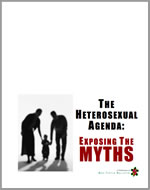 At last, the truth can now be told.
Using the same research methods employed by most anti-gay political pressure groups, we examine the statistics and the case studies that dispel many of the myths about heterosexuality. Download your copy today!
And don‘t miss our companion report, How To Write An Anti-Gay Tract In Fifteen Easy Steps.
 Anti-gay activists often charge that gay men and women pose a threat to children. In this report, we explore the supposed connection between homosexuality and child sexual abuse, the conclusions reached by the most knowledgeable professionals in the field, and how anti-gay activists continue to ignore their findings. This has tremendous consequences, not just for gay men and women, but more importantly for the safety of all our children.
Anti-gay activists often cite the “Dutch Study” to claim that gay unions last only about 1½ years and that the these men have an average of eight additional partners per year outside of their steady relationship. In this report, we will take you step by step into the study to see whether the claims are true.
Tony Perkins’ Family Research Council submitted an Amicus Brief to the Maryland Court of Appeals as that court prepared to consider the issue of gay marriage. We examine just one small section of that brief to reveal the junk science and fraudulent claims of the Family “Research” Council.
 The FBI’s annual Hate Crime Statistics aren’t as complete as they ought to be, and their report for 2004 was no exception. In fact, their most recent report has quite a few glaring holes. Holes big enough for Daniel Fetty to fall through.
“Google” is a trademark of Google Inc.
© Box Turtle Bulletin. All Rights Reserved.
 Posts
Posts  Posts via daily email: