Box Turtle Bulletin
 News and commentary about the anti-gay lobby
“Now you must raise your children up in a world where that union of man and box turtle is on the same legal footing as man and wife…”
News and commentary about the anti-gay lobbyMay 25th, 2010
According to multiple news reports, Zimbabwean police have arrested two employees of the country’s only LGBT advocacy group, Gays and Lesbians of Zimbabwe (GALZ). Local news reports already show us how the Zimbabwean government under President Robert Mugabe wants the world to see the arrests:
The police arrested two GALZ employees Ellen Chademana and Ignatius Muhambi, who were detained at Harare Central Police Station on Friday and were still in police custody Saturday.
The police accused GALZ of contravening Section 157 (1) of the Criminal Law (Codification and Reform) Act Chapter 9:23 and Section 32 (1) of the Censorship and Entertainment Control Act Chapter 10:04 by allegedly keeping pornographic material and dangerous drugs.
As of Saturday, police had still refused to allow the two advocates access to lawyers. Chademana is diabetic and there are concerns for her health.
Pink News reports that the two are still in police custody. They were expected to be released on bail today, but new charges were leveled against them in court for “undermining the authority of the President,” according to their attorney, David Hofisi:
He added: “There was a plaque on the wall of the GALZ office with a declaration by Willy Brown Jnr, the [former] mayor of San Francisco, which denounced President Mugabe for his opposition to homosexuality. . . It also praised GALZ for its work.”
Apparently, that was the basis for the newest charge.
President Robert Mugabe’s government has a history of harassing lesbians and gays. He has attacked homosexuality as foreign to African culture, and famously described LGBT people as “worse than dogs and pigs.” Mugabe and opposition leader Morgan Tsvangirai, who is the current Prime Minister under a contentious power-sharing agreement, have both rejected proposals to protect LGBT people in a new constitution that is currently being drafted.
May 25th, 2010
There has been, perhaps, a bit of confusion about the action currently agreed upon by the Obama Administration and Congress to reverse Don’t Ask, Don’t Tell. While the proposed language does not prohibit discrimination against gay people in the Military, it does remove the justification which allows discrimination.
The Military has long considered itself outside of the social contract that provides constitutional protections to civilians. And the legislative, executive, and judicial branches have confirmed this thinking. But while court systems are willing to carve out exceptions for the Military, it still does answer to Congress and the Constitution is presumed to be in effect except where otherwise stated.
It is likely that the removal of the ban on gay soldiers – whether closeted or not – will be treated as a de facto ban on an anti-gay discrimination policy and that any attempts by either a future administration or a military branch to blatantly and proactively institute a policy of discrimination based on sexual orientation without congressional authorization would be slapped down in court.
However, non-policy discrimination is not forbidden in this law. So any particular officer could use sexual orientation as their own reason to block advancement or dole out abuse and it would be up to each administration to determine if such behavior was acceptable. While policies will likely we implemented by this administration – and are not likely to be officially revoked – ignoring policy is not without precedent, and without direction from Congress, any victim of discrimination has little recourse.
But even without assurances of non-discrimination, it is essential that the current language be removed. Because what my nation currently has to say about me is outrageously offensive.
After the jump is the language of the law
Read the rest of this entry »
May 25th, 2010

L-R: Rev. Canon Albert Ogle, Bishop Christopher Senyonjo, Jim Burroway
Yesterday I introduced you to the Rt. Rev. Christopher Senyonjo, who I had the pleasure of meeting a little more than a week ago. The retired Church of Uganda Bishop of the West Buganda diocese is a tireless straight ally and LGBT advocate, and he is now in his third week of a six-week speaking tour in the U.S.
Uganda’s LGBT community has paid a heavy price in its battle for equality. They have endured threats to their personal safety, some have been forcibly outed in the news media, many have lost their jobs and have been disowned by their families. We’ve covered much of that ground before. Today, you will come to know the heavy price that awaits straight allies like Bishop Christopher when they come to the defense of LGBT people.
About thirty of us had gathered in the home of Ed and Scott for a private fundraiser and question-and-answer session for Bishop Christopher. Rev. Canon Albert Ogle, who is facilitating Bishop Christopher’s tour, led the Q&A session. Yesterday, I recounted how Bishop Christopher happened to become an advocate for LGBT people. Unsurprisingly, when his superiors in the Church of Uganda discovered the nature of Bishop Christopher’s new found ministry, they made their displeasure known. Bishop Christopher said:
So I’ve come to this [becoming an advocate] since 2001 when some young people came and we formed what we call Integrity Uganda. But my church didn’t like this. In fact, they said, “No, no, no, no… You shouldn’t support such a group. What you should be is just ask these people to be converted. And if they are not converted, well you are just leading them nowhere.”
But I said, “I know these people and what they are. In spite of not being converted, they should be accepted.”
And I was told, “If you don’t change that attitude and you don’t condemn them, you are no longer going to work with us as a church in the service.”
I accepted, because I knew the truth and I felt I couldn’t compromise on this truth, which I am sure is right and I’ve remained convinced in spite of a lot of suffering which I may not enumerate one by one.
Well, we wouldn’t let him get by without enumerating just a little of what he experienced, so he indulged us.
In the Anglican Church (as is the case with all lower-case “episcopal” churches such as the Roman Catholic Church, the Orthodox Christian churches, etc.), a retired bishop is still a bishop. He just no longer carries the responsibility of the day-to-day administration and care of a diocese. Retired bishops however are often called upon to conduct services, co-consecrate fellow bishops, conduct confirmations, and so forth. But because Bishop Christopher’s refusal to condemn his LGBT clients, he was barred from performing any official function inside of an Anglican Church in Uganda or on behalf of the Church. (Which explains why Bishop Christopher was beaming so broadly when I met him after having participated as a co-consecrating bishop for the Rt. Rev. Mary Glasspool just a few hours earlier.)
What’s more, after thirty-four years of service in the Church of Uganda,
My pension was stopped, and of course, I will say I was marginalized as they marginalize the homosexuals, the LGBT people. I’m regarded as the same way as a marginalized person, not respected. It is not easy.
But that was just the beginning of his problems:
In 2001, I was here in the United States, and really that’s when my church knew [learned] that I was counseling the LGBT people and they said they would no longer work with me. There were so many threats – If you read the papers at that time, Monitor, the other paper… I think it’s New Vision, Bukedde Uganda… if you read, you will find a lot of things said against me. Actually my wife was not with me and I was advised by many people that there were so many threats, it was not safe for me to go back to Uganda. So I had to find friends to stay with in Washington, D.C. for six months…
But after pondering on this matter – should I file for asylum, seek for asylum here? — I felt my family is in Uganda, my wife is in Uganda [and each time he says “Uganda,” he draws it out the way people who love their homeland do]. I didn’t think that I should ask them to come over, and I didn’t really see what I had done. Of course the law was not as clear as it might be if [the proposed Anti-Homosexuality Bill] is passed. Because if it was as it is [proposed], secondly, when I went back to Uganda I might have been arrested or something. But apart from people and what they were saying and the threats, there was no such law. It is there, but a bit mild against homosexuality. I hadn’t done really anything.
After six months, Bishop Christopher felt it was safe enough to his home in Uganda. But the harassment continued:
I remember one time I was talking with a gentleman and I said why these people should be respected and recognized as human beings. He said, “How can you recognize these people? God doesn’t love them.”
I said, “I believe also these people are created by God.”
But that man – he knew me and I knew him – he give me a slap. And I wondered… but I couldn’t return anything. What I do when such things happen, I neglect what happens. I just walk away. Because that’s what I think is the best way, not just to return a kind of angry reaction. If you do it, it can make things worse.
It has also taken a toll on his family, but they have remained supportive:
They’re worried. There was a time of course when I didn’t go back, my wife was saying, “Don’t come back, it is too dangerous.” So I stayed here for about six months. God willing, one day, Albert was saying I should come along with my wife and so she sees [America]… I’ve been here before but … she has been a wonderful help to me. It hasn’t been easy for her. But she said, “If this is really your call, I cannot stop you.”
I have a daughter too. One day I was in Colorado, Denver… And I was speaking to her. It was hard. She said, “Dad, if you really believe that’s what God wants you to do, then do it.” I sometimes talk as though she’s there. “Dad, your voice was a voice from God.”
So, these people have been supporting me in the way I have explained. They love me. I love them. But serving humanity surpasses other things.
Because of the backlash that the Bishop suffered, it allowed him to walk in the shoes of those who were marginalized. In the eyes of Ugandan society, Bishop Christopher became one of “them,” which only spurred him to greater efforts to try to improve the lives of LGBT people there:
Well what it is like [for LGBT people], many have lost their jobs because if someone discovers you are an LGBT person, you couldn’t keep you’re job. And many find it difficult to tell the parents. The parents, many of them, for whatever reason many of them are not happy with the children who come out as LGBT people. So it is really hard for these people.
And because of this, we’ve been trying in our group to start what we call self-help United Uganda, to sort of start their own employment, to have their own employment. They can employ themselves. For instance, there is one young man who grows sugar cane and sells it. Some start restaurants or become cobblers (shoe repair) so they can survive. In fact, this has been a great help.
Until recently, when we were just starting, we had this, what we call “financial recession.” Some of the help we were getting to start this was curtailed. But I believe that if we could do this, many people who have lost their jobs, who cannot be employed because of their coming out and because of this orientation, could be able to survive and get some kind of employment.

Bishop Christopher Senyonjo (center) meeting with a group in his office near Kampala (From the video, "Voices of Witness Africa")
Bishop Christopher’s group also works to provide rooms or shelter for those who were kicked out of their homes, either by their landlords or their families. But providing these services in such a difficult climate for LGBT people calls for great care and discernment. Bishop Christopher offered this parable to describe how he navigates the roiling homophobia in Uganda:
We have been what we call, “Be wise as a serpent.” You see, one person talked to me about the serpent. The serpent, there is a time for the serpent is very quiet. There may be a some time a serpent in the corner there. [He points to a corner of the room.] But if you don’t disturb it, it may just be quiet. You may not know it is there. Right? And so there is a time of keeping quiet. Then the serpent, you may find another time, it [he gestures forcefully] — running out, just to rushing out. “Oh! There has been a serpent, a snake here!” Eh? It rushes out!
There’s a time of running away. Then there’s a time when the serpent may attack. But, it’s so hard to know what to do at different times. You need the Grace of God to help you.
Through his work, Bishop Christopher remains both determined and optimistic:
Well I think this is what we should really discuss, because I think we shouldn’t despair. When you despair, you are already defeated. But we can do something. One think I say is solidarity. When your friend is suffering, say “what can I do to help?” Right? For instance, there are times when it will be necessary to be helped out. Supposing the bill passed. There will be many refugees. But this will not be forever. You know, even if we don’t, they are what we call martyrs. People are killed because of what they believe. But some run away, others are killed. Those who run away live to fight another day. So I think we shouldn’t despair.
Things are changing. The world is becoming one. One thing we share, it gives me hope, is the Internet. The Internet! You know what goes on in Uganda, you know it just at that moment and you can respond. The influence is there.
Several days later on May 21, Bishop Christoper spoke at a Harvey Milk Day breakfast in San Diego before approximately a thousand people. I wasn’t there, but I understand that his talk was a huge success. I talked to him by phone later that morning, and he returned to the theme of sacrifice and why he remained optimistic:
Even in the history of the Church or of the world, some people run away and live to fight. Others become martyrs and die for their beliefs. Even today, I’ve been thinking of Harvey Milk. He stood for what he knew was right. The truth for which he died will never die.
Tomorrow, I will cover Bishop Christopher’s observations of the March 2009 conference by three American anti-gay activists which set the stage for the Anti-Homosexuality Bill.
(See also part 1 and part 3 of our talk with Bishop Senyonjo.)
May 25th, 2010
…the better these numbers look:

According to a recent Gallup poll, the percentage of Americans who believe that gays and lesbians are “morally acceptable” is at an all-time high. At 52% viewing gay people favorably against 43% disproving, this is the first time that a clear majority of Americans see gays as good since this polling began in 2001. And in even better news, this year marks the first time in which that spread blew the doors off the ±4% margin of error.
A multi-part video interview series with Michael Bussee, co-founder of Exodus International turned critic.
May 25th, 2010
Leading up to now we’ve had videos discussing Michael’s fear of the gay community and fears about what would happen if he left Exodus.
Today Michael talks about what actually happened when he finally did renounce Exodus and came out as a gay man. What did Michael’s church do? What did his relatives do? What did his wife do? What did his fellow leaders at Exodus do?
One person in Michael’s life even graphically warned him of the flames of hell that await him.
Lastly Michael closes with a warning that even today people still fear the consequences and rejection when they try to leave Exodus.
(transcript after the jump)
May 25th, 2010

Scott Lively calls Uganda's bill "the lesser of two evils."
Wednesday night’s premiere of the Vanguard documentary “Missionaries of Hate” represents the most complete video record so far of the past year’s anti-gay turmoil in Uganda that began when three American Evangelical held an anti-gay conference in Kampala in March, 2009. That conference set the stage for a long, drawn-out anti-gay convulsion that rocked the nation and ultimately led to the introduction of the draconian Anti-Homosexuality Bill into Parliament.
Reporter Mariana van Zeller interviewed most of the key players in the drama that we’ve been following closely for the past year, including the bill’s sponsor MP David Bahati, Ugandan pentecostal pastor Martin Ssempa, and many LGBT people who were most directly affected by the conference and its aftermath. But for me, the most riveting interview came near the end of the program when Mariana sat down with Scott Lively:
van Zeller: Do you then support the rest of the bill if you remove the death penalty part of it?
Lively: I would not have written the bill this way. But what it comes down to is a question of lesser of two evils. What is the lesser of two evils here? To allow the American and European gay activists to continue to do to that country what they’ve done here? Or to have a law that may be overly harsh in some regards? I think the lesser of two evils is for the bill to go through.
Maybe this explains why Lively has decided to go on the offensive, so to speak.
Lively also admits that he knew they wanted to introduce a “strengthened” anti-homosexuality bill before he conducted his anti-gay conference in Kampala alongside Exodus International board member Don Schmierer and International Healing Foundation’s Caleb Brundidge. He says however that he didn’t know what the new bill would contain. The earliest draft of the bill that we have been able to find was one dated April 20, about six weeks after the conference. The Anti-Homosexuality Bill was introduced into Parliament on October 15.

Reporter Mariana van Zeller with pastor Martin Ssempa.
One of the producers provided me with a preview of the documentary, and apart from a very few minor quibbles I cannot recall any other report in print or video which delves so completely and thoroughly into the aftermath of the infamous March 2009 anti-gay conference. Martin Ssempa’s bombastic presence looms large in the documentary, where we learn that his much-mocked predilection for showing gay porn was far more widespread than first reported. In fact, I lost count of the number of times he brought out his trusty laptop. We also see brief interviews with MP David Bahati who introduced the bill into Parliament (He believes that God chose Uganda for this battle), and we see footage of Lou Engle’s rally earlier this month on a sports field at Makarere University.
But most importantly, we see the effects of the bill through the eyes of LGBT people living in Uganda, some of whom were outed in the newspapers, experienced death threats, were arrested by police and beaten, and driven from their homes by their neighbors. Almost all of them remember the March 5-7 conference as the key instigator of the anti-gay hysteria that swept the nation last year. Referring to the three American evangelicals who lead that conference, Julius Kaggwa asked aloud, “I wonder if they are aware of just how much damage their visit caused?”
Whether they have been aware of it up until now, this documentary will leave no doubts about their culpability from today forward.
“Missionaries of Hate” airs Wednesday on Current TV at 10:00 EST.
Update: A preview of “Missionaries of Hate” is also available on Hulu.
May 24th, 2010
It’s beginning to look like the stars are aligning. “Don’t Ask, Don’t Tell” may well be meeting its long-awaited end. In a deal worked out between the President and Congressional legislators, the Administration green-lighted a proposal to place the repeal of the ban on LGBT people serving openly in the military in this year’s Defense Authorization bill. This represents perfect symmetry, as it was under an amendment to the Defense Authorization Bill of 1993 that “Don’t Ask, Don’t Tell” became law.
Under the proposed amendment, DADT would be repealed this year, but the current policy would remain in place temporarily until two conditions are met: 1) the completion of the Pentagon’s review on how it will implement the repeal of DADT (which is due in December), and 2) certification from President Barack Obama, Defense secretary Robert Gates, and Joint Chiefs chair Adm. Mike Mullen that repealing DADT will not have a negative impact on military readiness, effectiveness, unit cohesion and recruiting, and that the military has the necessary regulations ready to go.
The amendment does not add a non-discrimination policy, but instead returns the authority for such regulations back to the Pentagon. The full text of the proposed amendment is available here (PDF: 28 KB/5 pages).
According to Stars and Stripes, Adm. Mike Mullen has already signed onto the deal.
The Defense Authorization Bill has already been passed out of committee in the House without DADT repeal language. It is expected to be voted on next week. The bill is still in the Senate Armed Services Committee, where the amendment is expected to be added. The language to repeal DADT would either have to be added to the House version of the bill before it is voted on next week, or the amendment would have to make it through the reconciliation process between the two Houses following its passage in the Senate.
May 24th, 2010
David Blankenhorn, the key witness for the supporters of Proposition 8 in Perry v. Schwarzenegger, is incensed over news reports that suggest that he relied on the claims of newly-disgraced Dr. George Rekers. He has written the following letter to the NY Times editor.
To the Editor:
“Scandal Stirs Legal Questions in Anti-Gay Cases” (news article, May 19) and “A Heaven-Sent Rent Boy,” by Frank Rich (column, May 16), suggest that my expert testimony in the California Proposition 8 trial on same-sex marriage was influenced by the writings of George Rekers, a psychologist and Baptist minister.
My expert report to the court — which was written entirely by me, includes a list of scholarly sources and is available for anyone to read — includes no mention of Mr. Rekers. And for good reason: I have never met Mr. Rekers or read any of his writings.
I recently learned that a separate, lawyer-generated document submitted to the court apparently does list an article by Mr. Rekers in connection with my testimony, but that document, on this point, is in error.
This matter is particularly important to me, since in my report to the court, as well as in my testimony on the stand, I clearly and emphatically rejected the anti-gay views that Mr. Rekers has apparently expressed.
David Blankenhorn
President
Institute for American Values
New York, May 19, 2010
May 24th, 2010
Gallup, in their annual survey of support and opposition for same-sex marriage have found that support is back up to about 44% and opposition is down to 53%. These are not out of the range of findings for the past six years but are slightly more positive than the last two surveys.
Here’s what to glean from the findings:
This study only looks at marriage. When you add in the civil union option, we have about two thirds support.
May 24th, 2010
The Family Research Council, an avid anti-gay activist group, has released a new ‘study’ which purports to inform about the factors contributing to the sexual orientation of lesbians.
Women (aged 14-44) who have not had a homosexual sexual partner in the past year are more likely to worship at least weekly and to have grown up in intact families than those who have had a homosexual sexual partner in the past year. According to the National Survey of Family Growth (NSFG), 2.1 percent of women who grew up in intact married families and attend religious services at least weekly have had a homosexual sexual partner in the year prior to being asked, followed by women who grew up in other family structures and worship at least weekly (4.6 percent), those who grew up in intact married families and never worship (7.3 percent), and those who grew up in other family structures and never worship (9.5 percent).
The database selected was the National Survey of Family Growth conducted by the CDC in 2002-03 (and includes women aged 15-44). The CDC provides an easily readable abstract of sexual behavior of Americans and shines some light on FRC’s claims.
Let’s look first at FRC’s discoveries about women and church attendance. I wasn’t able to locate the NSFG stats on church attendance, but I’ll assume that they didn’t just make them up:

Let’s stop for a second to chuckle about the astonishing discovery that lesbians are less likely to currently attend church. Oh, gee, gosh, why ever could that be?
The FRC seems to think that going to church chases the gay away, that women who go to church are less likely to catch the lesbian bug, but I think that they have the cart before the horse. The answer is found in their own “related insights”:
Michele Dillon of Yale University reported that 44 percent of frequent Catholic church attendees “said that sexual relations between two adults of the same sex were wrong,” compared to 10 percent “of those who attended occasionally or never.”
I don’t find it particularly surprising that lesbians avoid the place where they are four times as likely to have “good Christians” actively seeking to make their life miserable. I’m just surprised FRC thinks anyone is so foolish as to see this from the opposite direction.
But I was surprised at a few facts.
For example, I didn’t know that over half of frequent Catholic church attendees don’t find sexual relations between two adults of the same sex to be wrong. That’s encouraging, and that was from a 1996 report.
And I also didn’t know that nearly 3% of all women who attend church weekly or monthly have had a same-sex relationship in the past year. That’s pretty impressive. As we’ll see later, that’s nearly three quarters of all lesbians, a much higher percentage than I would have guessed.
But let’s look at the more serious claim, that family structure can influence eventual orientation. Or, as FRC put it, (Catholic News Agency)
“This research further undermines the claim that homosexuality is largely genetic or biological in origin,” said Dr. Patrick F. Fagan, director of the Marriage and Religion Research Institute at Family Research Council, and co-author of the study.
“It is clear that social factors have a significant impact on whether a woman chooses to engage in homosexual relationships,” he noted.
Let’s address, for a moment, the nonsensical language equating homosexuality and “chooses to engage”.
Supposing that there was an identifiable link between childhood family structure and “whether a woman chooses to engage in homosexual relationships”, this would not automatically say something about her sexual orientation. It might tell us something about how she responds to her attractions, desires, or longings, but it would not inform us about whether they were there.
And the FRC knows full well that it is being deceptive on this issue. No credible scientist, activist, theorist or blogger has ever claimed that how one responds to one’s attractions – that is, “whether one chooses” – is genetic or biological. When discussing homosexuality, we are discussing attractions, not choices and FRC demonstrates their inherent dishonesty by seeking to conflate these separate issues.
But let’s see if a causal relationship between family structure and same-sex female relationships can be found in the NSFG data. I’ve not recalculated FRC’s percentages, but here is their graph:

FRC sees this as two demographics, married intact (the good families) and all the rest (the bad families). But, they don’t present the data in a way that is informative.
Looking at this graph one might think that each category has equal weight and is statistically valid. And one might also assume that having been raised in a married, always intact family greatly reduced the odds of a woman “choosing to engage in homosexual relationships.” But what FRC convenient forgets to mention is what the NSFG reports as the total percentage of women who actually have had a same-sex relationship in the past year: 4.4%.
In other words, FRC is seeing significance and relevance in reporting that there was 0.4% fewer women who had same-sex relationships from “good” families than from the population as a whole.
Zero point four percent.
Now I’m not sure how FRC got to their numbers. Either the cohabiting step-family category was so small a sub-sample as to have little influence on the population as a whole or they had a little problem with their excel schedule. But in any case, four tenths of one percent variance certainly does not demonstrate a correlation, much less a causation.
And if FRC cared in the slightest about honesty, integrity, or truth they would feel shame and retract their statement. But I think there’s about a 0.4% chance of that happening.
May 24th, 2010
That’s a riff on the title for Mariana van Zeller’s article on the Huffington Post today, in which she gives us a tantalizing glimpse into her new documentary which will premiere tomorrow evening on Current TV. That documentary, “Missionaries of Hate,” explores the aftermath of the anti-gay conference by three American evangelicals last year that set the stage for the draconian Homosexuality Bill that was introduced into Uganda’s Parliament.
I know that homosexuals cannot biologically reproduce children,” [Anita] Bryant said in 1977. “Therefore, they must recruit our children.”
More than 30 years later, our cameras were rolling as Ugandan pastor Martin Ssempa brought a young woman to a press conference to testify about how she had been allegedly recruited to be a lesbian. “American money…is being used to seduce our children into homosexuality,” Ssempa said. “This bill is in response and desire to protect our children.”
…It’s been more than three decades since Harvey Milk’s assassination, but the battle he led continues and is now open on new fronts. “I believe that the Christian fundamentalists in the US have found fertile ground in Africa to fight their battles,” [Dean of Law at Uganda’s Makarere University Sylvia] Tamale told us. “Obviously they are not making a lot of the headway in the U.S., and they can very easily find allies here to fight their wars on the continent.”
The documentary, “Missionaries of Hate,” will premiere on Current TV Wednesday evening at 10:00 EST. Bishop Christopher Senyonjo, who I introduced you to this morning, was also interviewed for the documentary. I will have more on the documentary as well as Bishop Senyonjo’s observations about that conference — which he attended — Wednesday morning. Meanwhile, here’s the trailer:
May 24th, 2010
This morning President Obama, Congressional leaders, Pentagon leaders, and gay rights groups had various meetings to discuss Don’t Ask, Don’t Tell. I wish that I could report that the President has whole-heartedly given his endorsement to the Congressional effort to overturn the discriminatory policy this week.
But unfortunately, it appears that Obama called in Congress to get concessions that will delay implementation of the change in policy and which will not actually overturn the ban but simply return the decision about implementation to the Pentagon. (Washington Post)
Any repeal would take effect only after President Obama, Defense Secretary Robert Gates and Joint Chiefs of Staff Chairman Adm. Mike Mullen review the Pentagon study and certify that the new law can be implemented without a negative impact on military readiness, recruitment and retention, according to the sources.
This may be the best we can get. Should the President oppose the effort to lift the ban on open service in the Military, or even fail to signal acceptance of the change, this could trigger defeat. The vote count is very close.
It is important that the vote occur before any change in Congressional membership. It is very possible that one or both houses of Congress could be turned over to Republican control, and it is unlikely that Republican Party leadership would bring the bill to a vote regardless of the conclusions of the study.
And while I would prefer that Congress tell the Military that is will not discriminate on the basis of sexual orientation whether it finds that restriction to be minorly inconvenient or not, that may not be an option.
UPDATE: The NY Times confirms the details:
Under the deal, lawmakers could vote soon to repeal the contentious 17-year-old policy, which bars gay men and lesbians from serving openly in the armed services; the House Democratic leaders are considering taking up the measure as soon as this week. But the policy would not change until sometime after Dec. 1, when the Pentagon completes a review of its readiness to deal with the new policy. President Obama would also be required to certify that repeal would not harm military readiness.
…
In a letter to Mr. Obama on Monday evening, Mr. Murphy, Mr. Lieberman and Senator Carl M. Levin, the Armed Services Committee chairman, asked the White House for its “official views” on the proposal.But Capitol Hill aides said the letter was pro forma; Mr. Obama’s budget director, Peter R. Orszag, quickly replied with the White House’s assent.
It is encouraging to know that when backed into a corner without any way of saving face, the President is our fierce advocate. But hey, I’ll take it and be happy.
May 24th, 2010
 It has been nearly 20 years since Hawaii sent a Republican to Congress. But, due to multiple Democrats running for a mid-term replacement, Charles Djou, a Republican Honolulu City Council member, will be representing the residents of President Obama’s birthplace (His 40% was more than either of the two Democratic candidates).
Djou is a bit of a mixed bag for our community.
He has spoken against Hawaii’s newly passed Civil Unions bill and supports DOMA. However, that appears to be tempered by some pro-gay positions which earned him an endorsement by Log Cabin Republicans.
“Log Cabin Republicans is proud to have endorsed the candidacy of Charles Djou for Congress. His commitment to repeal ‘Don’t Ask, Don’t Tell’, supporting the Employment Non-Discrimination Act, increased HIV/AIDS research initiatives and equality in domestic partnership benefits on the federal level show that a common-sense Republican can truly win the day, even in President Obama’s hometown.”
I am not certain exactly what Log Cabin means by “equality in domestic partnership benefits on the federal level”, but that may relate to a bill by Sen. Lieberman which seeks to extend “fringe benefits” to the partners of gay federal employees. That vote is expected soon, perhaps this week.
Djou will have to run again in November, this time in a partisan race against whichever Democratic candidate wins the primary. But he may well have to take a stand on a number of issues that impact our community in the meanwhile.
As Djou is an Army Reserve captain and I hope that this will lend credibility among Republican legislators when he asserts that DADT is both unnecessary and ineffective.
May 24th, 2010
After laying low for a while amid news reports that Ugandan leaders may quietly drop the draconian Anti-Homosexuality BIll, it appears that Holocaust revisionist Scott Lively has decided become a pitchman for the bill’s passage, albeit in a slightly altered form.
Grove City College professor Warren Throckmorton discovered via an email sent to supporters that Scott Lively has decided to “get off defense and counter-attack the false witnesses with hard facts about Uganda.” Toward that aim, Lively yesterday posted a letter on his web site dated March, 2010, addressed to Edward Ssekandi, the speaker of Uganda’s Parliament. In that letter, Lively urges the prompt passage of the Anti-Homosexuality Bill with some minor modifications. Lively suggests that the death penalty be dropped from the Anti-Homosexuality Bill, but as Dr. Throckmorton notes, Lively’s position “sound(s) pragmatic rather than principled.” Lively writes:
First and foremost, the inclusion of capital punishment for what you have classed as “aggravated homosexuality” is, in my view, a disproportionately harsh penalty. You may not be aware that capital punishment has been banned in numerous countries, even for the most extreme cases of aggravated murder. This is held as such an important policy that these nations will often refuse to extradite criminals to their home countries (including the United States) if there is any possibility that they will be subject to capital punishment there. Advocating the “death penalty” for “mere” sexual crimes evokes such a severe negative reaction in most Western nations that all other aspects of the law, and the rationale for drafting it is ignored, and very “gay” movement we seek to oppose is strengthened by public sympathy they would not otherwise enjoy.
Conversely, if the “death penalty” provision were removed, it would take the wind out of the sails of their current campaign against the bill. With so much of the international opposition rooted in the idea that this is a “Kill the Gays” law, the removal of this provision would represent enough of a concession on your part that a great many of the people who are now siding with the homosexual movement out of sympathy would consider the matter resolved. The “gay” activists and their political allies will, of course, continue to attack the bill, but from a much weaker position.
Lively also argues that the provision requiring individuals to report gay people to police should be dropped as well. “it is too vague,” he writes, “and because it targets people who may live as homosexuals in their private lives, but who do not seek to recruit others or legitimize their lifestyle in the larger society.” He argues instead that they should enact a “provision along the lines of child abuse reporting requirements in the U.S.”, but with the cut-off age for reporting being extended to the age of twenty-five, which is well into adulthood:
I believe you could easily adapt this model to your purposes by imposing this same reporting requirement on anyone with knowledge of homosexuals who involve themselves with anyone under a certain age. If, for example, you encompassed all youths under the age of twenty-five within this shield of protection, you would stop virtually all “gay” recruitment in your country, since normal young men and women are usually firmly set in their heterosexual identity by their mid-twenties.
Lively also argues that the bill should encourage “rehabilitation,” which, given the already draconian lifetime imprisonment penalties under current Ugandan law for homosexuality, would amount to coercing LGBT people into unproven and harmful conversion therapies.
Individual leaders at Exodus International, North America’s largest ex-gay organization whose board member, Don Schmierer, spoke the March 5-7, 2010 conference in Kampala alongside Scott Lively prior to the introduction of the Anti-Homosexuality Bill, have come out against forced therapy schemes, although to date we are still unable to find an official Exodus International position statement on its web site.
Officials with The National Association for the Research and Therapy of Homosexuality (NARTH), the so-called “secular” arm of the ex-gay movement, have also come out against coerced therapy schemes, although at this time I also cannot find a position to that effect on NARTH’s web site either. Because Lively refers to both organizations as “experts” in ex-gay matters, I believe, once again, that it is essential for Exodus and NARTH to place such statements on their web sites, since this is most certainly not the first time this issue has arisen.
Lively’s letter to Speaker Ssekandi does not appear to have reached the speaker directly, and the only reply that Lively posts on his web site comes from MP Charles Tuhaise, who received a copy of Lively’s letter via Ugandan pentecostal pastor Martin Ssempa. Tuhaise says that dropping the death penalty may be considered, but rejects Lively’s other suggestions, labelling them as part of the same failed strategy which allowed pornography to “[break] barriers in Western society and became insidious.” Tuhaise continues, “It’s like the proverbial ‘Camel and herdsman story’. Today it is a foot in the hut, tomorrow it is a leg in the hut, next day its the head in the hut; before long, the herdsman is tossed out of the hut.”
Tuhaise says, “Ultimately, I see no way out in taking a stand and paying the price,” and comments Luively for having “stood up to homosexual intimidation for so long as a lone voice.”
May 24th, 2010

This is an important week in the efforts to repeal “Don’t Ask, Don’t Tell.” The Washington Post reports that the Senate Armed Services Committee is expected to vote sometime this week on an amendment to the annual defense spending authorization bill that would end the military’s ban on gay people serving openly. The Advocate reports that a deal may be in the works between the White House and Capital Hill on this very strategy. The Servicememeber’s Legal Defense Network sees this as a perfect method for ending DADT, since this very same mechanism was used to make DADT the law of the land in 1993. These developments may have something to do with House Speaker Nancy Pelosi’s recent statement before a Harvey Milk Day audience that “‘Don’t Ask, Don’t Tell’, I feel quite certain, will be a memory come Christmas.”
The SLDN has been publishing a series of letters over the past several weeks leading up to this vote urging repeal of DADT. Today’s letter to President Barack Obama urging repeal of “DADT” comes from former Lieutenant Junior Grade Jenny Kopfstein, of the United States Navy. She was serving on the USS Shiloh overseas when the US Cole was attacked by a suicide bomber. She served as Officer of the Deck and put the Shiloh out to see as soon as the order came in. She also served on September 11, 2001, patrolling the west coast in the event of an attack. Through it all, she maintained the honor code that she learned while in the Navy Academy: “Midshipmen are persons of integrity: they do not lie, cheat, or steal.” But upholding those values by serving as an open lesbian was not without conflict:
Don’t Ask, Don’t Tell” (DADT) made it difficult to have normal conversations with my shipmates. If I said I had a dog, someone might ask, “Who takes care of him when you’re at sea?” Answering the simplest questions can get you kicked out. The crew of my ship was my extended family. Keeping parts of my life secret and separate from them is an unnecessary burden, and no American sailor or soldier should be forced to bear it.
Feeling deeply conflicted between the requirements of DADT and the Navy’s Core Values, I wrote my Captain and told him I was a lesbian. I was being forced to lie on a daily basis by DADT. I did not want to get out of the Navy, and I said so in my letter. I wanted to stay and serve honorably, and to maintain my integrity by not lying about who I was.
After I wrote the letter, I continued to do my job on the ship to the best of my ability. We went on a six-month deployment to the Middle East. I qualified as Officer of the Deck, and was chosen to be the Officer of the Deck during General Quarters — a great honor.
I also earned my Surface Warfare Officer pin. During my pinning ceremony, the Captain removed his own pin — off the chest of his uniform — and pinned it on mine. That was one of my proudest moments.
Later, the Captain personally chose me to represent the ship in a ship-handling competition. I was the only officer chosen to compete, and my orientation was known to my shipmates. My discharge investigation was well underway. Not one person griped because I was the one chosen. I showed the Admiral my ship-driving skills, and won the competition.
My Captain wrote in my Fitness Report in 2002 that my “sexual orientation has not disrupted good order and discipline onboard USS SHILOH.”
Both of my Captains testified at my DADT discharge hearing to say they were opposed to the Navy kicking me out.
If not for DADT, I would still be serving today.
You can read her entire letter here. All of the letters from the Servicemembers Legal Defense Network’s campaign are available here. The SLDN explains why they are publishing this series of letters from active and former servicemembers:
“Stories from the Frontlines: Letters to President Barack Obama” is a new media campaign launched to underscore the urgent need for congressional action and presidential leadership at this critical point in the fight to repeal “Don’t Ask, Don’t Tell” (DADT). Every weekday morning as we approach the markup of the Defense Authorization bill in the Senate and House Armed Services Committees, SLDN and a coalition of voices supporting repeal, will share an open letter to the President from a person impacted by this discriminatory law. We are urging the President to include repeal in the Administration’s defense budget recommendations, but also to voice his support as we work to muster the 15 critical votes needed on the Senate Armed Services Committee to include repeal. The Defense Authorization bill represents the best legislative vehicle to bring repeal to the president’s desk. It also was the same vehicle used to pass DADT in 1993. By working together, we can help build momentum to get the votes! We ask that you forward and post these personal stories.
Featured Reports
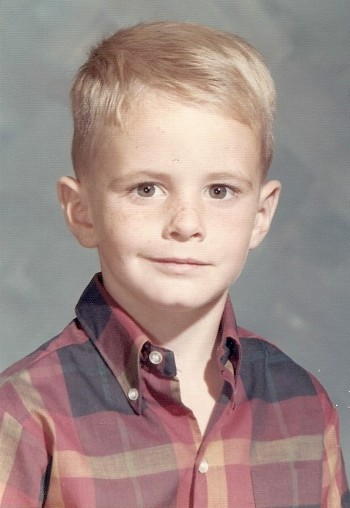 In this original BTB Investigation, we unveil the tragic story of Kirk Murphy, a four-year-old boy who was treated for “cross-gender disturbance” in 1970 by a young grad student by the name of George Rekers. This story is a stark reminder that there are severe and damaging consequences when therapists try to ensure that boys will be boys.
When we first reported on three American anti-gay activists traveling to Kampala for a three-day conference, we had no idea that it would be the first report of a long string of events leading to a proposal to institute the death penalty for LGBT people. But that is exactly what happened. In this report, we review our collection of more than 500 posts to tell the story of one nation’s embrace of hatred toward gay people. This report will be updated continuously as events continue to unfold. Check here for the latest updates.
In 2005, the Southern Poverty Law Center wrote that “[Paul] Cameron’s ‘science’ echoes Nazi Germany.” What the SPLC didn”t know was Cameron doesn’t just “echo” Nazi Germany. He quoted extensively from one of the Final Solution’s architects. This puts his fascination with quarantines, mandatory tattoos, and extermination being a “plausible idea” in a whole new and deeply disturbing light.
On February 10, I attended an all-day “Love Won Out” ex-gay conference in Phoenix, put on by Focus on the Family and Exodus International. In this series of reports, I talk about what I learned there: the people who go to these conferences, the things that they hear, and what this all means for them, their families and for the rest of us.
Prologue: Why I Went To “Love Won Out”
Part 1: What’s Love Got To Do With It?
Part 2: Parents Struggle With “No Exceptions”
Part 3: A Whole New Dialect
Part 4: It Depends On How The Meaning of the Word "Change" Changes
Part 5: A Candid Explanation For "Change"
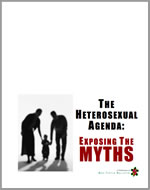 At last, the truth can now be told.
Using the same research methods employed by most anti-gay political pressure groups, we examine the statistics and the case studies that dispel many of the myths about heterosexuality. Download your copy today!
And don‘t miss our companion report, How To Write An Anti-Gay Tract In Fifteen Easy Steps.
 Anti-gay activists often charge that gay men and women pose a threat to children. In this report, we explore the supposed connection between homosexuality and child sexual abuse, the conclusions reached by the most knowledgeable professionals in the field, and how anti-gay activists continue to ignore their findings. This has tremendous consequences, not just for gay men and women, but more importantly for the safety of all our children.
Anti-gay activists often cite the “Dutch Study” to claim that gay unions last only about 1½ years and that the these men have an average of eight additional partners per year outside of their steady relationship. In this report, we will take you step by step into the study to see whether the claims are true.
Tony Perkins’ Family Research Council submitted an Amicus Brief to the Maryland Court of Appeals as that court prepared to consider the issue of gay marriage. We examine just one small section of that brief to reveal the junk science and fraudulent claims of the Family “Research” Council.
 The FBI’s annual Hate Crime Statistics aren’t as complete as they ought to be, and their report for 2004 was no exception. In fact, their most recent report has quite a few glaring holes. Holes big enough for Daniel Fetty to fall through.
“Google” is a trademark of Google Inc.
© Box Turtle Bulletin. All Rights Reserved.

 Posts
Posts  Posts via daily email: