Box Turtle Bulletin
 News and commentary about the anti-gay lobby
“Now you must raise your children up in a world where that union of man and box turtle is on the same legal footing as man and wife…”
News and commentary about the anti-gay lobbyA multi-part video interview series with Michael Bussee, co-founder of Exodus International turned critic.
May 24th, 2010
Yesterday Michael talked about how he perceived what it meant to be gay, which was based largely on his own experiences with being closeted.
Today Michael talks about Exodus’ early interaction with gay activists who not long after the group’s founding became a concern. Surprisingly at the speaking event where Michael announced he was leaving Exodus there happened to be a group of gay activists in the back of the audience. I’ll let Michael take it from here and tell the rest of the story.
On Monday we’ll look at what happened in Michael’s life when he finally renounced his attempts to change and came out as a gay man to his family, friends and fellow ministry leaders.
(transcript after the jump)
May 24th, 2010

Church of Uganda Bishop Christopher Senyonjo (Retired)
The LGBT community has always drawn its strength from among its many diverse members, but even in the earliest days of our modern history, we have also been able to count on the support of key straight allies. And these allies have been very critical in times of crisis and great danger. For more than a year now, we have been diligently following a long series of events in Uganda, beginning with a three-day conference in Kampala in March, 2009, by three American anti-gay activists, which led to a long series of events which ultimately culminated in the draconian “kill-the-gays” Anti-Homosexuality Bill in Uganda’s Parliament. Through it all, we have been impressed with the resilience and resourcefulness of the beleaguered LGBT community in Uganda. And I have come to especially appreciate the few brave Ugandan allies who have paid a heavy price for their advocacy on behalf of the the LGBT communities in East Africa.
A week ago, I had the privileged of attending the ordination of the Rt. Rev. Mary Glasspool as the first Lesbian bishop in the Episcopal Church, in a ceremony that took place in Long Beach on May 15. As exciting as that was to attend such a historic event, that wasn’t the reason for my trip. My real reason to go to Southern California was to meet with Bishop Christopher Senyonjo, the retired bishop who has been a stalwart supporter of the LGBT community in Uganda for more than ten years.
The Rt. Rev. Senyonjo studied at the Union Theological Seminary in 1963, and was ordained into the priesthood in 1964 in the Cathedral of St. John the Divine in New York City. He then served in the Church of Uganda, where he was elevated to bishop in 1974. He was the Bishop of West Buganda until his retirement in 1998. And that’s where his real story began, which we will get to in a moment.
Bishop Senyonjo is currently touring the United States to raise awareness of the plight of the LGBT community in Uganda. On the day that I met him in Newport Beach, he had just arrived at the home of our hosts, Ed and Scott, following the consecration in Long Beach. Bishop Senyonjo was among the consecrating bishops for that service, and he was in a very jubilant mood when I met him. Our hosts were getting everything ready for a fundraising party for that evening, so the Bishop and I sat down briefly at the dining table to get acquainted before the guests arrived.
Bishop Christopher is an amazing man, and I hardly know where to begin to describe him. He’s 78 years old yet full of energy and strength, but its a rather quiet energy and strength that I imagine may be easy to underestimate. The first thing I learned that when you talk with Bishop Christopher, the conversation would be long and deep. He’s not much for chit-chat or the one-liners. His narrative is that of a novel, not a short story, and what a story he has to tell.

L-R: Rev. Canon Albert Ogle, Bishop Christopher Senyonjo, Jim Burroway
Later, after the guests had all arrived — there were about thirty in all, I’d say — and after we became acquainted with one another, Bishop Christopher took his seat again at the dining table and the rest of the guests gathered around for a question and answer session led by Rev. Canon Albert Ogle, who is organizing Bishop Christopher’s six-week tour. One of the first questions on all of our minds was how was it that Bishop Christopher became such a great ally for the LGBT community in Uganda. This is what he said:
In Uganda at the beginning of 2001, there were some younger people who had suffered very much because of their sexual orientation, and they wanted to give them some kind of counseling. Because I had studied counseling in 1998, when I retired I decided to start counseling. And I’m very much interested in the area of human sexuality and marriage. Of course, other came and have been coming to me.
Now these young people, they knew that probably I could help them. So they were recommended to come, and I took to them and shared. They were so frightened and had hated themselves so much. Some of them were on the verge of committing suicide. But after discussing with them, of course they realized they are human beings like others. And that God, you know many people, I would say, in Africa believe in God. But they were being told that God doesn’t even love you because of what you are. God doesn’t love homosexuals. And there are a number of people who have hated God because of this. But with my counseling, many of them realize that God loves them as they are.
This is hard for some people, that God can love you as you are. As he loves somebody who may be heterosexual, he also loves LGBT people in the same way. For many people it is not easy who think they are religious. But I’ve been convinced that this is true. One doesn’t need to be converted first to another sexuality to be loved by God.
So this counseling has helped me to understand and to welcome people although they are different from others’ sexuality, I mean as far as sexuality is concerned.
When I spoke with Bishop Christopher earlier, he told me that he really hadn’t intended to become an advocate for LGBT people. After he retired, he thought he would put his education in human sexuality and marriage counseling to use by opening a counseling practice. But very early on he had his first gay client, and Bishop Christopher’s first reaction on learning that this client was gay was to do what he always does: he listened. He listened to the young man as he poured out his struggles and thoughts of suicide, which Bishop Christopher found alarming. The young man, in turn, experienced something that he hadn’t fully expected from the Bishop: a sympathetic ear of a churchman who would not condemn the young man.
As Bishop Christopher was able to help that client through his problems of dealing with his sexuality in such a repressive climate, that client then began to refer others to Bishop Christopher for help. Soon, he started seeing a larger number of LGBT people who came to him by word-of-mouth. And as Bishop Christopher explained to me, he gained as much from the experience of counseling gay people as his clients gained from him and each other. “I discovered,” he said, “that you cannot marginalize the person because of his or her sexuality. What is important is to respect each person for what that person is.” And that was his repeated refrain throughout that evening and in my later conversations with him: respect each person for what that person is.
Bishop Christopher decided that counseling wasn’t enough, so he went on to found Integrity Uganda as a branch of Integrity USA, the Episcopal Church’s LGBT outreach organization. He has opened a ramshackle community center where LGBT people can safely gather, and he has worked to provide housing and employment for those were were forcibly “outed.” And for that work, Bishop Christopher has paid a huge price. I’ll have more on that tomorrow.
(See also part 2 and part 3 of our talk with Bishop Senyonjo.)
This commentary is the opinion of the author and may not necessarily reflect those of other authors at Box Turtle Bulletin.
May 22nd, 2010

Steven Monjeza (L) and Tiwonge Chimbalanga (R). Tiwonge is wearing a traditional woman's headdress in this photo.
Transgender advocate Autumn Sandeen has published a post on Pam’s House Blend calling attention to something that we noticed on January 5th — that Tiwonge Chimbalanga, who was convicted and sentenced with Steven Monjeza to 14 years at hard labor under Malawi’s harsh anti-homosexuality law, actually identifies as a woman. Since learning of this, we’ve been extremely careful at BTB not to use the term “gay” to describe Tiwonge, and we’ve tried to avoid the use of male pronouns. (Actually, we’ve tried to avoid the use of pronouns altogether when talking about Tiwonge, as I’ll explain in a moment.) Unfortunately, other blogs and media outlets haven’t been so careful. Autumn notes:
[L]et’s be honest with ourselves — I believe we can safely say that from past coverage by the LGBT press and LGBT blogosphere that this story would not have gained as much traction in LGBT media if this were considered a transgender or intersex story.
And, that’s sad. Transphobia and homophobia both arise from the same root — that root has to do a lot with lesbian, gay, bisexual, transgender, intersex, and queer people not conforming with societal sex and gender norms…Especially societal sex and gender norms for those considered to be male. And, that root has a lot to do with misogyny.
But, the erasing of the woman in this story’s intersex, transgender, and/or transsexual history from this story says a lot about the lesbian, gay, bisexual, and transgender (LGBT) community and its media.
I agree wholeheartedly with Autumn’s point that this story does say a lot about the LGBT community and media. But I also think that Autumn’s position, as admirable and fully correct as it is from a Western point of view, says more about the construction of sexuality and gender in Western society than it does about how people in other cultures actually see themselves.
As I said, we have avoided describing Tiwonge and Steven as a “gay” couple, but we’ve also avoided describing Tiwonge as intersex, transgender or transsexual, and for good reason. None of these terms may describe Tiwonge very well because they speak to a Western, Euro-centric understanding of sexuality and gender, and not an African one.
And it’s critical that we wrap our brains around this because otherwise we will fail to fully honor Tiwonge. We know that Tiwonge identifies as a woman. We also know that Tiwonge wears women’s clothing. We also know that Malawi court officials assigned Tiwonge the “woman’s job” of mopping up her own vomit when she fell ill in court, although that was clearly an act of humiliation by assigning her a “woman’s” duty rather than a respectful recognition of her self-identity (which furthers Autumn’s point about misogyny.)
(And for the time being, I’ll use the female pronoun to describe Tiwonge although I have no idea if that’s the pronoun that Tiwonge prefers. Tiwonge may actually prefer male pronouns, for reasons I’ll get into in a moment.)
By Western standards, all of this evidence would be sufficient to remove Tiwonge from the “gay” box and placed her neatly and tidily in the “transgender” box, and the rest of the story would (or at least, should) proceed accordingly. And certainly if we must place Tiwonge in such a box, there is a much stronger case for using the transgender box than the gay one. But doing so may not be the best way to honor Tiwonge’s self-identity.
Research indicates that in contemporary western cultures where gender roles between men and women are more equalized, gender differences often are more pronounced when identified with a set of traits. Standardized measures for aggressiveness and openness to ideas correlate to males, while standardized measures for agreeableness, warmth and openness to feelings correlate more strongly to females. This finding, which has been replicated elsewhere, baffled researchers who expected the equalization of gender roles to result in a similar equalization of gender traits. And they were further surprised that gender traits were actually more equalized in traditional societies where gender role differences were much stronger.
It turns out that in many traditional cultures, it may be more acceptable for women to take on what westerners perceive as “masculine” traits, and for men to take on what westerners would label more “feminine” traits. Which means that many of the external peripheral markers that we use to understand the contours of our masculinity or femininity become less important in many traditional cultures. But in these non-western cultures, gender roles — what men and women do as opposed to who they are — are considered much more important in defining what is a man and what is a woman. Against that realty, our understanding of gay/straight/transgender/whatever has only a passing relevance.
And this research appears to confirm a trend that I have noticed in my own reading of LGBT narratives from Africa. I’ve noticed that some men in particular appear to shift quite easily back and forth between masculine and feminine gender identities, and that these shifts appear to mark an identification of gender roles, whether that role may be the role someone takes in an intimate setting, or a broader role in a community or society. I’ve seen narratives where a man may take a woman’s name, and then he later shifts back to his original male name with little apparent consternation or confusion to those around him. And where I’ve seen this happen, it has appeared to me to be a reflection of gender role more so than gender identity. These appear to be men who also sometimes see themselves as women, but with little apparent intention of seeing themselves as transgender. In other words, the identification appears to describe a role by taking on the cultural trappings of that role, but not a definitive declaration of a state of being as is generally the case among transgender people in the West. (Although, of course, it must be said that there really are transgender people in Africa, in precisely the same sense in which there are transgender people elsewhere in the world.)
So if I may, I would like to take three seconds to pat myself on the back for having avoided the term “gay” to describe Tiwonge. I wish others had been similarly careful. But I suppose I will now have to expose myself for a share of bricks being thrown my way for refusing to describe Tiwonge as transgender. I’m sorry, but I’m not fully convinced that “transgender” is an accurate description either, at least not until I hear it coming from Tiwonge himself or herself. I readily concede that if we must apply a Western term, transgender appears to be a much more accurate descriptor than gay. But in the interest of fuller accuracy, I will stick to the only description that Tiwonge provides, and the one I find to be the most accurate: Tiwonge identifies as a woman. And she does so according to her understanding of what it means to be a woman in the context of her culture. Until we hear otherwise from Tiwonge directly, there cannot be a more accurate description than that.
May 21st, 2010
 Levi’s loves the gays.
It’s one thing when Madonna loves the gays; they pay her bills. The same could be true with certain brands or products.
But Levi’s? Really, when is the last time you saw a gay guy or gal in a pair of Levi’s? I mean, I wore 501’s all through college, but that was in the early 80’s. I think I have maybe one pair of their jeans I once bought when I spilled something on my pants and didn’t have time to shop.
Maybe that should change. Maybe we should support Levi’s – because they definitely support us.
Levi Strauss and Co has for many many years provided non-discrimination protections and supported our non-profit endeavors even provided spousal coverage (they were the first Fortune 500 to do so). They gave money to oppose Proposition 8 and made a public statement of support. Now they are stepping it up.
As part of its ongoing commitment to equality, the Levi’s® brand is once again partnering with White Knot for Equality in support of same-sex marriage. White Knot for Equality is a non-profit organization dedicated to achieving equal rights for the LGBT (Lesbian, Gay, Bisexual, Transgender) population. In solidarity with White Knot’s mission, Levi’s® is expanding on its existing partnership with White Knot by displaying white ribbons in all Levi’s® stores nationwide beginning this week through the end of June 2010. As part of the program, mannequins will be outfitted with white ribbons, a symbol that combines two traditional signs of marriage – white and tying the knot. To further support the program, all stores will have a limited supply of white ribbons for employees and customers who want to show their support for equality.
Now the phobes love to accuse any company who treats gay customers with decency of “taking sides and supporting homosexual marriage!!” Levi’s is actually doing so.
This weekend I’m going to go buy be a pair of Levi’s jeans. Do they still make 501’s?
This commentary is the opinion of the author and may not necessarily reflect that of other authors at Box Turtle Bulletin
May 21st, 2010
California Senator Barbara Boxer has long been a friend of our community. But she has also long been considered a relatively weak candidate, and as the Democrat is 168 years old (ok, really only 69) and this is a “mid-term election”, there is a good chance that she could be defeated in November. Our community should be very concerned about who her Republican opponent will be.
There are three candidates for the Republican nomination:
Chuck Devore – Devore is the choice of the hard-core right. He’s is the old-school family values candidate who is running for office so as to protect the family from horrible people like you, me, and sinners of various flavors. He’s endorsed by the usual collection of knuckle-draggers.
Carly Fiorina – Fiorina is the “business candidate”. She was a successful executive at Hewlett Packard and is probably somewhat moderate on social issues. However, she is trying to sell herself as a “conservative” and thus distinguish herself from Campbell (including the now infamous Demon Sheep ad which seriously backfired). Fiorina created domestic partnership programs at HP, but also voted for Proposition 8. She has the endorsement of Sarah Palin.

Tom Campbell – Campbell is a fiscal conservative and social moderate, and a long-time friend of our community. In October 2008, Campbell wrote a piece for Reason Magazine in which he argued that Republicans should support gay marriage and oppose Proposition 8.
Depending on what poll you read, Campbell is either slightly ahead or about tied with Fiorina. And there are only three weeks left before the primary election. He needs our support.
That Campbell is an ally is a good reason to support him in the California Republican Primary. That he’s much needed in Washington is another.
Campbell is uniquely equipped to address the problems we are currently facing. Tom has a PhD in economics and has taught law at Stanford, with a particular emphasis on the application of economics to legal problems. It’s known in political circles that Tom is usually “the smartest person in the room.”
If there is one thing that the Senate is lacking, it’s people who understand economics. Or perhaps those who can do remedial math.
Campbell is a fiscal conservative, but not in a crazy way. Although he’s been twice rated as the most “fiscally responsible” member of Congress, he refuses to sign the wacky “no taxes” pledges or make promises that sound good to ideologues but are irresponsible in practice.
But perhaps the most convincing argument as to why you should support Tom Campbell is that the National Organization for Marriage has been running a campaign against him. Their biggest fear is that California might send a Republican to the Senate who supports marriage equality and harm their divisive game of playing one party off the other. If Campbell were to be elected, it would send a message that Republicans too can support basic fairness and equality.
So NOM has been running ads in the state trying to claim that Campbell is no different from “liberal Barbara Boxer”, in the hopes of hurting him in the primary. Tom, to his credit, has been classy in his response, refusing to throw us under the bus for a few votes. They have now started a campaign of robo-calls.
“The explicit message of this campaign is: don’t vote for Tom Campbell, because he supports gay marriage as well as raising taxes,” said Brian Brown, President of NOM, in a statement.
This is a blatant appeal to bigotry.
I desperately do not want this election to give NOM more perceived power or greater influence over the positions of future candidates. If Tom loses, there is no question but that they will threaten any other Republican who considers abandoning homophobia or anti-gay policies.
Please take a moment to consider whether and how you can help Tom Campbell and give him a chance to present his case against Barbara Boxer. I would very much like to know that whoever wins in November, California’s Senator will remain supportive of my rights.
(Please note that decline-to-state or independent voters may request the primary ballot of any party and can vote for Campbell in June)
A multi-part video interview series with Michael Bussee, co-founder of Exodus International turned critic.
May 21st, 2010
I expected my interview series with Michael to generate a lot of emotion, but in recent days the reader comments have taken a dramatic shift to questioning why Michael did not come out publicly against or make amends for his involvement in Exodus sooner. One expression that’s particularly common in YouTube comments is that Michael somehow has “blood on his hands,” hence the title for this post.
In today’s video Michael explains his delay in speaking out against Exodus. Of all the things Michael wanted to address on the day I interviewed him, this was foremost on his mind.
But before we get to the video let me personally address all the work I believe Michael has done for the ex-gay survivor community:
But enough of my opinion. Here’s Michael on the delay in speaking out against Exodus:
(transcript after the jump)
May 20th, 2010
The Brookings Institute is looking to see whether openly gay service is detrimental to the militaries of our Western allies. (CNN)
Representatives from Great Britain, Canada, Australia, Israel and the Netherlands gathered Wednesday at the Brookings Institution, a think tank in Washington, to describe how the militaries in those countries handled allowing homosexuals to serve openly in their militaries. The consensus was that, in spite of concerns before the change, when gays and lesbians were allowed to serve, it was a non-issue.
Not only did none of the projected problems materialize, but open service has unexpected benefits.
Jones said British military officials saw an unexpected benefit of allowing gays to serve openly – better retention of qualified soldiers and sailors in key positions. In the late 1990s and early 2000s, the British military had a 6 percent to 8 percent gap in unfilled positions. Now it’s down to the 2 percent to 3 percent range. Jones said one reason for that is the new policy allowing gays to serve. Now that gays are able to serve, military recruiters in the United Kingdom have more volunteers to choose from, Jones said. Also, having children is often cited by British troops as one reason why they leave the military in their late 20s or 30s. And Jones said because gays and lesbians are less likely to become parents, they tend to stay in the military longer.
May 20th, 2010
Following up on its commitment to recognize same-sex marriages conducted outside of the state, Maryland will now provide marriage benefits to same-sex married state employees. (WaPo)
State employees in Maryland can now sign up same-sex spouses as dependents, making them eligible to receive the same health care and other benefits afforded to husbands and wives of heterosexual state employees, according to Gov. Martin O’Malley’s (D) office.
The change, made public Wednesday, means that O’Malley’s administration has followed through in codifying a legal opinion issued in February by Maryland Attorney General Douglas F. Gansler.
May 20th, 2010
Peter LaBarbera is back to jousting at windmills. He’s decided to enact a one-man boycott on all businesses which value their gay employees or customers.
His first quest is Progressive Insurance and he’s found a Sancho Panza to help him. Jamil J. Adair of Horizon City, Texas, has canceled his insurance policy with Progressive.
You can read his entire rant on The Peter’s site, but here’s the amusing part:
Progressive Insurance: It may appear that I am merely one man … but my message resonates within the hearts and minds of millions, upon millions, of Americans who firmly believe what I believe. For every ONE GLBT member that you support, there are FOUR HUNDRED more of us, standing together, in opposition. I have passed this information to every member of my family, church group, and contact list. You will be receiving many more cancellation letters shortly. [emphasis in the original]
Four hundred to one. WOW!
And considering that there are a lot of folks who support gay rights and even more who would not use a company’s pro-gay positions as a reason to pay more for insurance, that’s quite a statement. What kind of crazy bigot-world do Adair and The Peter think they live in?
Do they really think that gays only make up less than one quarter of one percent of the population? Or is this just another example of the magic math that they teach in home schooling and evangelical private schools?
Oh, and one more thought… if you set out to publicly denounce a business because you don’t like their policies on gay issues, you may want to consider that folks may use the same criteria to judge you. Which, I suppose, means that Mr. Adair is perfectly fine with any loss of business he may suffer for his ideology.
Which is why I would recommend that those who are looking to change their insurance policy may want to consider Progressive. And that those who are responsible for making decisions about pay point or ATM machinery for their business may wish to avoid Merchants First Choice.
UPDATE: To make it clear, Mr. Adair is the President and CEO of Merchants First Choice.
May 20th, 2010
 Congressman Steve King of Iowa is probably best known for his anti-gay activism. Which gives him a rather skewed perspective on the world.
Take, for example, the press release he’s just issued:
“Just over one year ago, when the Iowa Supreme Court decided to ignore Iowa law and grant same sex couples the ability to get married in our state, I predicted that the decision, absent action by the state legislature to enact a marriage license residency requirement, would turn Iowa into the gay marriage Mecca.” King said. “Now, the Iowa Department of Public Health is reporting that of the more than 2,000 same-sex couples who were married in Iowa between April 27, 2009, and March 31, 2010, sixty percent were from out of state,” said King.
So there were over 1,200 people who came with family and friends into the state to spend money in this very depressed economy. They paid Iowa fees for marriage certificates, stayed in Iowa hotels, ate in Iowa restaurants, shopped in Iowa stores, tipped Iowa ministers, and came home to tell all their friends about what a great time they had in Iowa.
That should be cause for celebration. But not to King; no, he wants to stop all that Iowa commerce:
“This new report from the Department of Public Health reemphasizes the short-sightedness of the court’s decision to enact a same-sex marriage law from the bench, and it provides even more evidence of the need for a residency requirement and a constitutional amendment to repeal it.”
What an idiot.
The best thing a state can become is the Mecca for, well, just about anything that increases revenues without increasing crime, blight, or other social ills.
May 20th, 2010
Steven Monjeza (L) and Tiwonge Chimbalanga (R)
Declaring that he wanted to protect the public “from people like you,” Judge Nyakwawa Usiwa-Usiwa of Blantyre Magistrates Court sentenced Steven Monjeza, 26, and Tiwonge Chimbalanga, 20, to 14 years in prison with hard labor, the maximum sentence under Malawi law, after having found them found guilty of gross indecency and unnatural acts:
“I sentence you to 14 years imprisonment with hard labour each. That’s the maximum under the penal code,” magistrate Nyakwawa Usiwa Usiwa told the two men in a courtroom in the capital Blantyre.
“I will give you a scaring sentence so that the public be protected from people like you so that we are not tempted to emulate this horrendous example,” the judge added.
“Malawi is not ready to see its sons getting married to its sons.”
The BBC reports that Monjeza broke down in tears when he heard the sentence, while Chimbalanga remained calm.
As they were escorted away under heavy police guard, hundreds of onlookers outside the court shouted abuse at them,. One woman reportedly yelled, “Malawi should never allow homosexuality at any cost.”
The couple’s lawyer said that they would appeal the verdict to High Court.
Human rights groups call the ruling a significant blow:
Undule Mwakasungura, director of the Centre for Human Rights and Rehabilitation, said the sentence would drive gays into hiding. “Malawi needs to sit down and tackle the issue of gays,” he said. “We have many of them who need to publicly access information and HIV and AIDS medical care. It’s a big let-down.”
The U.S. State Department has condemned the conviction:
The United States is deeply disappointed in [the] conviction of same-sex couple Tiwonge Chimbalanga and Steven Monjeza in Malawi,” said assistant secretary Phillip J. Crowley at a press briefing Wednesday. “We view the criminalization of sexual orientation and gender identity as a step backward in the protection of human rights in Malawi. The government of Malawi must respect the human rights of all of its citizens. The United States views the decriminalization of sexual orientation and gender identity as integral to the protection of human rights in Malawi and elsewhere in the world.”
Britain has also denounced the move:
“We are deeply dismayed by the conviction for buggery and indecent practices of Mr. Tiwonge Chimbalanga and Mr. Steven Monjeza,” said a joint statement issued by the Foreign and Commonwealth Office (FCO). “We are also very concerned by the allegations of their mistreatment in police custody,” added FCO Minister Henry Bellingham, International Development Minister Stephen O’Brien and Equalities Minister Lynne Featherstone.
Three British MP’s have called for a Human Rights review in Malawi. In a press release, UK LGBT Advocate Peter Tatchell warns that a fourteen year sentence under Malawi’s harsh prison system could effectively mean the death penalty for Steven and Tiwonge:
“Fourteen years with hard labour could kill Steven and Tiwonge. Prison conditions are appallingly unhealthy,” he said.
“Detainees die in custody. Infectious diseases like TB are rife. Medical treatment is sub-standard. Food rations are very poor nutritional value; mostly maize porridge, beans and water, causing malnutrition. After only five months behind bars, Steven has been seriously ill and has not received proper medical treatment.”
A multi-part video interview series with Michael Bussee, co-founder of Exodus International turned critic.
May 20th, 2010
One of the most common reasons people go ex-gay is because they don’t believe a meaningful community exists in the gay world and fear losing their current church community. In today’s video I ask Michael how he viewed “the gay community” while he was still at Exodus.
Don’t miss the part where Michael talks about how Exodus viewed the Metropolitan Community Church. I had to bite my tongue to keep from laughing when he surprised me with that during filming.
(transcript after the jump)
May 20th, 2010
Here is the trailer for next week’s documentary on the role of the three American Evangelicals whose conference more than a year ago led to the introduction of the Anti-Homosexuality Bill in Uganda’s Parliament:
Vanguard correspondent Mariana van Zeller travels to Uganda to trace the influence of American evangelical leaders on a proposed law that could make being gay punishable by death. The episode “Missionaries of Hate” premieres on Wednesday, May 26 at 10/9c.
May 19th, 2010

Alan Chambers, thanking God for the end of a 22 year relationship.
Earlier today Ex-Gay Watch posted on a statement made by Exodus president Alan Chambers on his Facebook fan page:
Heard from a couple this morning who have been praying for their daughter and her partner to come to Christ for 22 years. Both accepted Jesus, broke off their relationship and are pursuing a life in Christ. God is faithful and answers prayers. Be encouraged no matter your circumstances!
Unfortunately celebrating misery and tragedy in the lives of gay and lesbian people is nothing new for leaders in the ex-gay movement. A while back I found, but didn’t post about, a passage from Mike Haley’s 2004 book “101 Frequently Asked Questions About Homosexuality.” Appearing on pages 46 & 47:
[Question #] 12. My son just told me he’s gay. He says he’s finally accepted who he is and that he’s never been happier. Can this really be true?
Mike Haley starts off his response with explaining how gay people often feel elated at coming out so let’s jump to the end of his response where he issues actual advise:
The key for your son in the weeks and months to come is for him to realize it’s not too late to turn back. This is where the church and loved ones like you come in. If he hears that change is possible, that he was not “made” this way, and that he is loved within godly boudaries even if his lifestyle choices don’t change immediately, there is hope that when the feeling of relief wears off and the emptiness sets in, he will try to live his life in line with God’s will.
In the meantime, I advise you to pray that he becomes as miserable as possible, as soon as possible, and that God will protect him through it. [emphasis added]

Mike Haley of Focus On The Family, advising you to pray God will make your gay child miserable.
As I said before, I discovered that passage years ago when I first read the book and in all that time have been unable to formulate a response to something so wicked and ugly. However with Ex-Gay Watch bringing light to Alan’s celebration I realized this sadly is not a unique case and that attention needed to be brought to it.
I should add the first page of Haley’s book is filled with endorsements by Alan Chambers, Jeff Konrad, Joe Dallas, and Dr. Joseph Nicolosi. I’m curious if they too wish for misery and tragedy to fall upon the lives of gay and lesbian people.
May 19th, 2010
Congratulations to residents of Logan, Utah, whose city council on Tuesday night banned employers and landlords from discriminating against gays, lesbians or transgender people (SL Tribune)
Modeled after anti-discrimination laws recently adopted in Salt Lake City, Logan’s housing and employment ordinances passed with four votes and one abstention, by Councilman Dean Quayle. A crowd, which filled the City Council Chambers halls and an overflow room, was mostly subdued throughout a one-hour public hearing. Following the tally though, the crowd erupted in applause and rewarded the council with a standing ovation.
…
On Tuesday night, Monson defended his support of the ordinances and clarified the stance of the area’s largest church after calling the LDS headquarters in Salt Lake City on Monday.“The [LDS] church supports nondiscrimination ordinances, period. Certainly, I was told that this applies to Logan as much as any other place in the world,” Monson said Tuesday before calling for the vote. “They do and I do and I agree that this is not the answer for everything … But it is a step in the right direction and it is long overdue in my thinking.”
It looks like the church may be on a “see, we don’t hate you” campaign. And if so… I welcome it.
Featured Reports
 In this original BTB Investigation, we unveil the tragic story of Kirk Murphy, a four-year-old boy who was treated for “cross-gender disturbance” in 1970 by a young grad student by the name of George Rekers. This story is a stark reminder that there are severe and damaging consequences when therapists try to ensure that boys will be boys.
When we first reported on three American anti-gay activists traveling to Kampala for a three-day conference, we had no idea that it would be the first report of a long string of events leading to a proposal to institute the death penalty for LGBT people. But that is exactly what happened. In this report, we review our collection of more than 500 posts to tell the story of one nation’s embrace of hatred toward gay people. This report will be updated continuously as events continue to unfold. Check here for the latest updates.
In 2005, the Southern Poverty Law Center wrote that “[Paul] Cameron’s ‘science’ echoes Nazi Germany.” What the SPLC didn”t know was Cameron doesn’t just “echo” Nazi Germany. He quoted extensively from one of the Final Solution’s architects. This puts his fascination with quarantines, mandatory tattoos, and extermination being a “plausible idea” in a whole new and deeply disturbing light.
On February 10, I attended an all-day “Love Won Out” ex-gay conference in Phoenix, put on by Focus on the Family and Exodus International. In this series of reports, I talk about what I learned there: the people who go to these conferences, the things that they hear, and what this all means for them, their families and for the rest of us.
Prologue: Why I Went To “Love Won Out”
Part 1: What’s Love Got To Do With It?
Part 2: Parents Struggle With “No Exceptions”
Part 3: A Whole New Dialect
Part 4: It Depends On How The Meaning of the Word "Change" Changes
Part 5: A Candid Explanation For "Change"
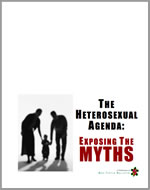 At last, the truth can now be told.
Using the same research methods employed by most anti-gay political pressure groups, we examine the statistics and the case studies that dispel many of the myths about heterosexuality. Download your copy today!
And don‘t miss our companion report, How To Write An Anti-Gay Tract In Fifteen Easy Steps.
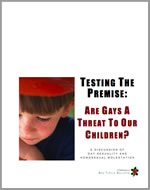 Anti-gay activists often charge that gay men and women pose a threat to children. In this report, we explore the supposed connection between homosexuality and child sexual abuse, the conclusions reached by the most knowledgeable professionals in the field, and how anti-gay activists continue to ignore their findings. This has tremendous consequences, not just for gay men and women, but more importantly for the safety of all our children.
Anti-gay activists often cite the “Dutch Study” to claim that gay unions last only about 1½ years and that the these men have an average of eight additional partners per year outside of their steady relationship. In this report, we will take you step by step into the study to see whether the claims are true.
Tony Perkins’ Family Research Council submitted an Amicus Brief to the Maryland Court of Appeals as that court prepared to consider the issue of gay marriage. We examine just one small section of that brief to reveal the junk science and fraudulent claims of the Family “Research” Council.
 The FBI’s annual Hate Crime Statistics aren’t as complete as they ought to be, and their report for 2004 was no exception. In fact, their most recent report has quite a few glaring holes. Holes big enough for Daniel Fetty to fall through.
“Google” is a trademark of Google Inc.
© Box Turtle Bulletin. All Rights Reserved.

 Posts
Posts  Posts via daily email: