Box Turtle Bulletin
 News and commentary about the anti-gay lobby
“Now you must raise your children up in a world where that union of man and box turtle is on the same legal footing as man and wife…”
News and commentary about the anti-gay lobbyJanuary 25th, 2010
Ugandan Pastor and staunch “kill-the-gays” supporter has recently gotten a lot of attention over the disgust he generated when he held a porn-laced presentation that did more to turn his audience against his message than it did against LGBT people. According to Uganda’s independent Monitor, the presentation was a “flop.”
Ssempa appeared to be puzzled by the reaction, and I doubt that he will be fazed by it. A week earlier, he had appeared on Ugandan state-owned UBC television to talk up the Anti-Homosexuality Bill, and he took that time to try to stigmatize gay people with a similarly lurid description of what gay people supposedly do.
(The video is closed-captioned. The video was captured by an anonymous BTB reader in Uganda using his mobile phone at great personal risk.)
As you can see, Charles Musana, host of the UBC program “Hot Seat,” was pretty skeptical throughout the program, leading the over-excited Ssempa to close the show with trying to cast out the demon of homosexuality from his host.
The Monitor reported:
Pastor Martin Ssempa on Tuesday plumbed the depths of notoriety when he offered graphic images of gay sex as proof of the need for tough penalties against homosexuals.
In the immediate aftermath of the presentation, which ended prematurely, Pastor Ssempa said he did not regret his actions. The press conference, the latest in a series of events he is holding in support of the 2009 Anti-Homosexuality Bill, had been called to unveil two Ugandans, a man and a woman, who say their homosexuality has been rehabilitated.
One man, who was part of a group of American students invited to the press conference by Rubaga North MP Beti Kamya, was seen crying, his colleagues consoling him as the group left the National Theatre.
But midway through his presentation, saved on a computer, most of his audience walked out, some visibly disturbed, leaving him to wonder if he had done anything wrong. The cleric seemed genuinely rattled when he asked: “Why should I be traumatised?”
It looks like Ssempa is trying to become the “Porno Pete” of East Africa.
[Video courtesy of an anonynmous BTB reader in Uganda]
Click here to see BTB\’s complete coverage of recent anti-gay developments in Uganda.
January 25th, 2010
In April of last year, Rob Tisinai prepared a video debunking many of the claims made by anti-gay activists about the consequences of marriage equality. Tisinai skillfully simplified each claim its essentials and by using easily understood graphics provided visual clarity to reveal the lies.
Tisinai has now taken the same approach to the false connection between homosexuality and pedophilia. Using data similar to that in Box Turtle Bulletin’s report Are Gays A Threat To Our Children?, Tisinai shows that there is a threat to the safety of children and that threat is fed by false assumptions and the political demonization of gay men.
January 25th, 2010
Richard Socarides was Pres. Bill Clinton’s special assistant and senior White House adviser on gay rights from 1997 to 1999. In an op-ed in this morning’s Wall Street Journal, he asks whether President Barack Obama is more interested in the constitutional rights for Guantanamo detainees than for LGBT citizens serving the military fighting terrorism:
What is especially troubling, however, is Mr. Obama’s oversensitivity to a dwindling minority of bigots on this issue. Hundreds of military careers have been destroyed on his watch for no valid reason. The country has been deprived of the talents of these service members and has wasted millions of dollars on their training.
Many wonder when their president will show the same kind of concern for the constitutional rights of gay American service members as he has for enemy combatants held at Guantanamo Bay. Many wonder what the administration’s willingness to treat gay Americans as second-class citizens says to Uganda and other countries that are considering laws that would subject gays to imprisonment and even death.
Gay Americans have been among the president’s most ardent supporters. Their enthusiasm, and that of their families and friends, could be crucial in this year’s elections. The president’s action—or inaction—on Don’t Ask Don’t Tell will be noticed.
January 24th, 2010
BTB contributors talk about whether there’s a difference between “principled opposition to homosexuality” and bigotry and discuss gay men in straight relationships. Also, an update on the Prop. 8 trial. Listen below or subscribe to the podcast on iTunes (click here, then click “subscribe” in the iTunes window).
[audio:http://gabrielarana.podbean.com/mf/web/hgizjt/BTBPODCAST12210.mp3]January 23rd, 2010
 In November we noted that the Supreme Court of Nepal had determined that sexual minorities were entitled to all the rights and remedies all other Nepali citizens enjoyed. Now they are a step closer to enacting that decision.
Reports from the Himalayan nation reveal that a new constitution will be adopted in May which will include equality provisions allowing for same-sex marriage. And Nepal wants to capitalize on the change to attract gay tourists. (Telegraph)
Sunil Babu Pant, a Communist legislator and leader of the country’s homosexual rights movement, has launched a travel company dedicated to promoting the former Hindu kingdom to gay tourists in an effort to tap the so-called “Pink Pound” and dollar.
The company will offer elephant-back bridal processions, Everest base camp ceremonies and weddings in remote Tibetan enclaves in the Himalayan republic.
Mr Pant is hoping to build on the government’s new determination to maximise income from tourism by targeting all potential markets. The country’s tourism minister wrote a welcome statement for the International Conference on Gay and Lesbian Tourism in Boston last October, in which he said he believed Nepal will benefit from an increase in gay visitors.
After disappointments in New York and New Jersey at the end of last year, it looks as though this spring will bring us the eighth (Portugal) and ninth (Nepal) nations to adopt marriage equality.
January 23rd, 2010
The Anti-Defamation League was founded in 1913 to oppose the defamation of Jewish people. Although their primary focus is still on anti-Semitism, they have expanded their focus to oppose all forms of bigotry, defend democratic ideals and protect civil rights for all.
One of their current projects is a school based anti-bullying program called No Place for Hate.
No Place for Hate® was developed to organize schools to work together and develop projects that enhance the appreciation of diversity and foster harmony amongst diverse groups. The campaign empowers schools to promote respect for individual and group differences while challenging prejudice and bigotry.
Every day we make choices. We can choose to let anti-Semitism, racism, and other forms of bigotry go unchallenged and potentially escalate, or we can choose to confront the bias that we see in our workplaces, homes, schools, and communities. As our world becomes smaller and our schools and communities more diverse, it is more critical than ever to actively build bridges to cross-cultural understanding and mutual respect.
 Schools across the nation participate in the program, including Wheatland High and West Elementary in Wheatland, Wyoming. They went through the steps of qualifying for participation and received banners which they hung at school, announcing that their campuses were No Place for Hate.
But then there were some protests and the banners were removed. In order to offer the program free to schools, ADL had sponsors whose names were included at the bottom of the banner.
They weren’t upset that Qwest, the communications company was listed. And they didn’t mind that the David & Laura Merage Foundation helped pay for the program. But that red circle with the words “Gay and Lesbian Fund” was simply unacceptable. So down they will stay. (WyomingNews)
Platte County School District 1 trustees voted 4-3 to keep the Anti-Defamation League’s “No Place for Hate” banners down at Wheatland High and West Elementary.
The trustees made no pretense at masking their anti-gay animus:
“If this is the way one chooses, then they can lead this particular lifestyle, but I don’t believe it needs to be publicly displayed in a school,” Dunham said.
Joe Fabian, another board member, said he believes the Anti-Defamation League is pushing an “agenda that is pro-gay marriage” and that the community of Wheatland is not supportive of that.
“They wouldn’t want the organization, the Anti-Defamation League, dictating to their children that an alternate lifestyle is a normal lifestyle,” he said.
Oh, but they like the rest of the program. Can’t they just continue with being a ‘not place for hate except for gays‘?
No. The ADL was quick to note the irony and will not not let the schools participate in the program if they encourage and reward biases.
So Wheatland, Wyoming, a seventy-five mile drive from Laramie, now has a new designation, an adopted identity. Wheatland IS a Place for Hate. And if you’re a gay kid attending those schools, now you clearly know it.
This commentary is the opinion of the author and does not necessarily reflect that of other authors at Box Turtle Bulletin.
January 22nd, 2010
I appreciate the Advocate for many reasons, not least of which is that they are a gay magazine that is still in business. But their recent effort to light-heartedly identify the “gayest cities” in the United States betrayed our community’s occasional inclination to still buy into the most negative stereotypes as though they define us.
“Intrepid amateur sociologist Mike Albo” wanted to make the point that gay folk have fled from big cities and now are now scattered to unlikely places (an unlikely assumption).
About 10 years ago everyone else moved back into these nicely gentrified metropolises, and the lavender diaspora began. Now a slew of secondary cities are becoming gay epicenters.
So to identify these secondary epicenters and find which is gayest, he came up with seven measurements, some of which are reasonable, some of which are perplexing, and some of which make me sad at heart.
First the reasonable: same-sex households per capita and gay elected officials. These both seem like good things to consider. A city is likely “gayer” if it has more gay couples and if it’s residents are more open to gay elected officials. gay bars per capita – while I might think that this is not the best criterion, gay bars are to some extent a measurement of gay social life, although I would compare them to the total number of bars, not the total number of people.
Now the perplexing: statewide marriage equality – I can see how this might make sense in a small homogenous state, but I find it odd that by this measure Fresno is gayer than Atlanta. gay films in Netflix favorites – I guess one might measure anti-gay hostility by who was willing to watch Milk, but this is in many ways based in a ghetto mindset. Those who feel “outside” or “other” may be more inclined to need the connection brought by gay specific cinema, while those who are in welcoming communities might be less inclined to watch films based solely on their gay content.
And now the self-loathing categories. First let me say that I’m not accusing Mr. Albo of being self-loathing; he may be the most happy and secure guy out there. And I do recognize that this was not intended to be anything other than a fun exercise. But caveats aside, the following two measurements are based on stereotypes that are tragic and reminiscent of the tales of woe from ex-gays and self-hating drama queens of the 70s. gay dating and hookup profiles for single male population – that is not a measure of gayness, that’s a measure of the extent to which that community discounts relationships or has limited alternatives to meeting someone. And the saddest is cruising spots per capita. First, cruising spots are frequently frequented by those who do not identify as gay and those who are married. And also, cruising spots are most frequent in places where there are no safe ways for gay people to meet. This is not a measure of gayness, this is a measure of the closet in a hostile environment.
A measure of gayness might include a wide variety of gay social groups, citywide laws about discrimination or benefits or couples registry, supportive churches and synagogues, estimations of the gay population, the presence of an active community center, programs for gay youth or elders, and a lack of hate crime incidences. Perhaps even some comparison of the way the city voted on gay marriage bans would be informative.
But not guys lurking furtively in the bushes. That’s not gay, that’s just sad.
January 22nd, 2010
Thanks to Courage Campaign and FireDogLake
On stand today is Dr. Greg Herek, a leading authority on the psychology of sexual orientation. Herek will discuss three opinions:
First Herek clarified that there are three different ways of observing sexual orientation: behavior, attraction, and identity. Because their focus is on STDs, health professionals use behavior. But when psychologist study discrimination, they focus on identity, since that is how people are singled out for prejudice. They measure in terms of relationships and attachments as these are a core part of human behavior.
Herek testified that the APA has considered reparative therapy many times, most recently in 2009, and found it ineffective. Further, there was anecdotal evidence that such efforts may cause harm.
Herek discussed how structural stigma give permission to discriminate against and to mistreat gay people. He presented studies that showed that gay people believe they had no choice of very little choice in their orientation.
In cross-examination, Neilson, attorney for Prop 8, distinguishes between social identity and personal identity (ie some persons may not want to identify with the gay community). Neilson tried to break the assertion that sexual orientation can be a distinct category by suggesting that different measures get different collections of people. Herek testified that there are small numbers of people for whom that might be true (ie those who have same-sex behavior but don’t call themselves “gay”), but that for most, the population is the same.
This is a very important aspect of the trial as this is where the Prop 8 supporters seek to attack one of the four qualifications for being a suspect class: the group is a discrete or insular minority. If a group is not a class, then they cannot be a suspect class. (However, while I’m not an attorney I seem to recall that Romer v. Evans established that gay people are a class – or rather Amendment 2 set them as a class and the SCOTUS didn’t disagree. This establishment of a class of people was, I believe, reinforced in Lawrence v. Texas).
In one fascinating interplay, Neilson tried to get Herek to agree with a statement from one of Lee Badgett’s books that there’s a “heated debate” over the definition of sexual orientation. Neilson kept asking and Herek kept saying that he’s not read the book and doesn’t know what she meant by that sentence. The Prop 8 supporters kept trying to enter the whole book based on questions asked to Herek even though they did not ask Badgett about her own book. This appears on the surface to be an exercise in deception.
He continued quite a bit in that vein, pulling a sentence from a book and demanding to know if Herek found it “unreasonable” (obviously going for the idea that it is “reasonable” that there’s no definition of homosexuality). Herek kept consistent, insisting that studies have different goals and thus different measurement criteria but that does not mean that we have no understanding of how to define sexual orientation: “It could be understood as an ongoing pattern of attraction, sexual behavior, or self-identification.”
Neilson is also very fond of old sources, the older the better. His quotes tend to come from books or articles from the 80s, and even include Kinsey’s research in the 50s.
One of Neilson’s gotchas is that most people who engage in same-sex behavior before 18 do not identify as gay. Thus “only 24 percent of men fit in all three categories” (attraction, behavior, and identity). He showed Venn diagrams. But Herek illustrated that those who identify as gay experience both behavior and attraction and that other measures are so vague that they can be meaningless (e.g. would having sex with another woman be “somewhat appealing”?)
(At one point in the afternoon Neilson may have erred in discussing social construction (the way that culture defines how people view reality). He and Herek got in a bit of a debate about whether it was appropriate to see sexual orientation and race only as social constructs and without merit as definitions. Neilson allowed sexual orientation to be equated with race.
And, indeed, the more that testimony goes in this vein, the more I see the comparisons to race. Is race measured by ancestry? I have a friend who has one black parent and one white parent and identifies as white while his brother identifies as black. Ironically, if one were going by skin hue and general appearance, you’d reverse the order. Are they the same race?
Or is “behavior” a measurement of ethnicity? I once dated someone who had Latino ancestory and appeared Latino but who “behaved” as though all of his ancestors were on the Mayflower. His brother deliberately cultivated an accent and adopted a style of dress and walk that was stereotypical. Are they the same ethnicity?
Or can we go by skin hue or appearance? I know many Latinos (and some blacks) with lighter skin than my own. I have a friend who is black/white but appears to be a Pacific Islander, a friend who is Italian/Native American but appears to be Latino/Asian.
The answer is that to study medical questions we might use genetic definitions while for discrimination we might use identity or appearance and cultural anthropologists might look to community or behavior.
Race, an immutable characteristic defining a suspect class, is no easier to define than sexual orientation.
Yet we know, without quibbling or arguing or looking for exceptions at the fringe, that most people can be clearly identified by race. Only a fool or a bigot would argue that discrimination against Aretha Franklin cannot be illegal because we can’t define her race.)
Next Neilson, the Pro-8 attorney, sought to attack the fixed nature of orientation. To prove that sexual orientation is mutable, they pointed out all of the gay people who used to be heterosexually married. (While that might work well in a high-school debate class, I doubt anyone really believes that this proves that gays can become straight).
Herek did agree that women’s sexuality can be fluid and change over time. But he pointed out that the much-touted studies that showed mutation in orientation of women was between the “bisexual” and the “no identity” categories and reflected change in labeling, not attraction.
Neilson pointed out that many of those who identify as gay have had heterosexual intercourse. (Shocking!! Surely, oh surely no gay folk here have ever had heterosexual intercourse at some point in their life!! Meh.)
Next the discussion revolved around the ex-gay studies. First was Dr. Spitzer’s sad little telephone survey. Then Freud’s 1935 letter. But he didn’t want to talk about Exodus, it seems.
Then much of the afternoon was spent trying to prove that women’s orientations are whimsy, undefinable, and due to education.
In redirect, Detmer walked Herek back over the very very lengthy cross-examination to see if it changed any of his views. It did not.
Herek pointed out that all of the pro-8 discussion was about those persons who fall on the edges, the exceptions. He reiterated that other groups (like race and ethnicity) have difficulty with definitions.
Herek reiterated that most gay and lesbian people are consistent within their orientation and that very few indicated any choice in the matter. And then Detmer brought the whole argument back into perspective:
Detmer: If two women want to marry, are they lesbians?
Herek: Yes
Detmer: If two men want to marry, are they gay men?
Herek: Yes
On Monday morning the plaintiffs will show ninety minutes of video and then the Prop 8 proponents will begin their testimony.
January 22nd, 2010
 The Hawaii Senate just voted to pass the civil unions bill by 18 to 7. Some in the House were arguing that unless it was veto-proof that it may not be brought up there. It’s veto proof. (Honolulu Advertiser)
The House passed a civil-unions bill last year that only applies to same-sex couples. The House came one vote short of a two-thirds’ majority — with one Democrat absent — but leaders do not want to go through the exercise again in an election year unless there is a realistic chance the bill will become law.
Gov. Linda Lingle has not said whether she would veto the bill, but has urged lawmakers to put off the issue and focus on the state’s budget deficit and job creation.
January 22nd, 2010
 The world is full of cheerful, unsung heroes. One of them passed away this morning and Tucson is a bit less cheerful for his passing.
Maurice Grossman, a former University of Arizona art professor, died this morning following heart valve replacement surgery. He was 82.
Born in Detroit, Michigan in 1927, he became an educator and ceramic artist in Arizona. He studied at Wayne State University and earned an MFA at Ohio State University. From 1955 to 1988, he was Professor of Ceramics at the University of Arizona in Tucson after founding their ceramics program. I came to know him during the campaign to try to defeat Arizona’s Prop 102. He was just one of those guys who seemed to know just about everyone, and no one he knew could ever be an enemy.
Last October, he was selected to be the Grand Marshal for Tucson’s Pride parade. (Tucson holds its parade in October as a concession to the typically scorching 105+ degree summer temperatures.) The UofA’s Arizona Daily Wildcat featured Maurice’s honor with a good description of his journey:
Grossman was a UA professor from 1955 to 1989 and started the three-dimensional arts program in the Art Department during that time. “I’m very proud of what I accomplished and am still acknowledged when I’m on campus,” Grossman said. “I loved my students; I love teaching. In a way I’m still teaching.”
Grossman said he lived the first part of his life trying to determine who he was. He got married in his 20s, and had two children with his wife, who died in 1978.
“Like most gay men, I was trying to understand more about myself,” Grossman said. “At that time, in my 20s, I met a very beautiful and lovely woman and we fell in love.”
Though he was married and in love with his wife until she died, Grossman said he knew he was gay before then. In 1978 Grossman became more politically active in the gay community. He volunteered with Wingspan and Stonewall Democrats in Tucson. He waited a few years before he told anyone he was gay.
“When I told (my children), they knew; they said, ‘we’ve known for years,'” Grossman said.
Grossman said there was no real fallout or loss of friendships because of his revelation.
If you had the pleasure of knowing Maurice, you’d understand why.
The thing that impressed me about him is that he didn’t think to bother about slowing down. Age was an occasional nuisance but never a hindrance. And nothing was going to get in the way of his good cheer. He remained very active in the LGBT community and in the local arts scene. The Dinnerware Gallery in 2007 threw a fifty-year retrospective for him to coincide with Maurice’s 80th birthday.
There are a lot of sad people here in Tucson today.
January 22nd, 2010
From the Washington Post:
A judge is giving a Virginia woman at the center of a lesbian custody dispute 30 days to appear in court with her 7-year-old daughter or face possible arrest.
Despite all the accusations of judicial activism from the supporters of Lisa Miller, Judge Cohen has been, to my way of thinking, extremely generous in giving Miller chance after chance after chance to simply conform to the custody to which she agreed. And even though it is clear that Miller is actively thwarting the will of the court, he generously gives her more time.
Of course those who see the world in terms of good (Miller) and evil (militant radical deviant homosexualist bloggers like me) will continue to denounce Cohen as a tool of Satan and see this continued generosity as a sign of the miraculous hand of God.
January 22nd, 2010
According to this report from Uganda’s independent NTV, the Cabinet has agreed to remove the death penalty from the proposed Anti-Homosexuality Bill, but apparently virtually nothing else.
This is neither a compromise nor an improvement. Remaining is a provision to punish homosexuality with lifetime imprisonment in a dank and overcrowded Ugandan prison. Can anyone believe that this is an improvement?
The other provisions of the Anti-Homosexuality Bill would:
Click here to see BTB\’s complete coverage of recent anti-gay developments in Uganda.
January 22nd, 2010
Yesterday, Rep. Tammy Baldwin (D-WI) chaired a meeting of the Tom Lantos Human Rights Commission to discuss the proposed Anti-Homosexuality Bill that is now before Uganda’s Parliament. Julius Kaggwa, a leader of the Kampala-based Civil Society Coalition on Human Rights & Constitutional Law, was among those who testified to say that personal involvement by President Barack Obama and First Lady Michelle would be helpful in stopping the bill.
According to written testimony supplied to BTB, Mr. Kaggwa described some of the abuses he and others have incurred in Uganda:
I have personally been a victim of this hostility on several occasions. In one case, I was forced to resign from a job for the simple reason that controversy around my identity had placed the reputation of the organisation I worked for in question. They felt that having me on their staff drew “unwanted” attention to their organisation. In another case, a house I rented was set on fire by unidentified people.
I personally know lesbians who have been raped by male relatives in order to so-called “cure them” of their lesbianism. Sadly, although they were thus infected with HIV, they cannot access justice. I know gay men who have been habitually blackmailed to avoid arrest. I have further seen first-hand the trauma of transgender Ugandans who have been sexually abused, including by the police, and arrested purely for their gender expression. One transgender woman had a gang of men violently insert rough pieces of wood in her anus to remind her that she was a biological man and not a woman. These and similar abuses are what LGBT Ugandans live with on a daily basis. In most cases, the government has not held the perpetrators accountable.
Mr. Kaggwa testified that as harsh as the situation has been for LGBT people, it has deteriorated further since MP David Bahati introduced the Anti-Homosexuality Bill before Uganda’s Parliament.
Since the bill\’s first reading in the Ugandan parliament, the Civil Society Coalition on Human Rights and Constitutional Law has been approached for help by homosexual people who have received death threats. We have also been approached by human rights activists whose offices have been raided by police and where police surveillance continues daily. Religious leaders have threatened to hunt homosexuals if the government does not pass the bill quickly.
The effects of the bill would be wide-ranging. If passed in its current form, it would not only impose a lifetime sentence on those who are convicted of homosexuality, it will add the death sentence if the accused is HIV-positive, a “serial offender,” or whose partner is deemed disabled — even if the relationship was consensual. The proposed statutes will also ban all advocacy on behalf of LGBT people with imprisonment if five to seven years, while “aiding and abetting” will garner a seven year sentence. Health, counseling, and HIV/AIDS workers fear that their work will be criminalized if they should aid LGBT people because of this proposal. Other proposals would force friends and family members to report LGBT people to police or risk a three year sentence, and criminalize landlords or hotel owners who knowingly rent to gay people with five to seven years’ imprisonment.
Kagwwa warned of the legal implications of all of this:
If passed, this bill will further worsen the access of sexual minorities to health services. The greatest scare for all sexual minorities in Uganda is how to protect themselves from HIV infection and to access treatment for those living with HIV. Sexual minorities in Uganda are already excluded from mainstream HIV and AIDS interventions. We are not able to readily access relevant health care and information. This bill makes this exclusion worse by proposing the death penalty for HIV positive homosexual Ugandans. If it is passed, most homosexual Ugandans will not be brave enough to seek the medical care that any human being needs and deserves. This provision also leaves a lot of room for malicious blackmail and venomous attacks and it threatens to further prevent homosexual Ugandans from voluntarily testing for HIV, and accessing preventive information and treatment.
According to Chris Johnson at DC Agenda, the panel explored several options for opposing the draconian measure. Kaggwa emphasized the importance of local Ugandans’ voices being heard as loudly as international voices:
“It is important that these local, indigenous voices are heard as heavily or as loudly as the international voices,” he said. “We believe that if that voice supplements our own voices, then we will be productive. But if the foreign voices are louder than ours, then I\’m afraid that might have a counter-productive effect.”
Karl Wycoff, deputy assistant secretary of state for East African Affairs, testified that the State Department has been working to prevent the bill from being enacted into law:
The introduction of this anti-homosexuality bill in Uganda characterizes just such a moment — one where we must say to our friends who\’s friendship we value that together we must stand against injustice, and in this case, injustice against the LGBT community,” he said.
Wycoff noted how the White House in January issued a statement in opposition to the legislation and said Secretary of State Hillary Clinton has expressed concerns about the bill with Ugandan President Yoweri Museveni in addition to publicly opposing the legislation in two speeches.
“Our embassy … has been very active on this subject with representatives of the Ugandan government, with civil society, with local gay and lesbian groups and with others who press for this bill to be dropped,” Wycoff said.
The panel discussed various options for dealing with the proposed law. Rep. Baldwin reminded the panel of Sen. Ron Wyden’s (D-OR) proposal to review Uganda’s trade status with the United States. Other options were explored, but reducing funding to Uganda under the President\’s Emergency Plan for AIDS Relief (PEPFAR) was seen by witnesses as inappropriate. Said Christine Lubinski, executive director of the HIV Medicine Association, the program’s $13 billion in aid is “too much of a day-to-day lifeline for too many people.” Cary Alan Johnson, executive director of the International Gay & Lesbian Human Rights Commission, however noted that the funds could be “channeled differently” to non-governmental organizations.
Yesterday, more than ninety members of Congress sent separate letters to President Barack Obama and Ugandan President Yoweri Museveni urging that strong measures be taken to block the bill from becoming law, calling the proposal “the most extreme and hateful attempt by an African country to criminalize their LGBT community.”
[Julius Kaggwa’s written testimony provided to BTB by the American Jewish World Service]
Click here to see BTB\’s complete coverage of recent anti-gay developments in Uganda.
January 21st, 2010
Thanks to Courage Campaign and FireDogLake
Cross-examination of Professor Gary Segura continued.
The result was evidence that many politicians opposed Proposition 8; that some churches supported marriage equality but that they were in the minority. Established a very strong correlation between those who believe in Biblical literalism and those who supported Proposition 8.
Thompson provided evidence that many gay groups supported domestic partnerships and hailed their passage. Segura agreed but pointed out that this was not in contrast to marriage but rather in contrast to nothing at all.
(The Prop 8 side seems to be encouraging testimony that shows that religion was the reason many voted for the proposition. I’m not sure where they are going with this other than perhaps arguing that religion, as a suspect class, is entitled to discriminate? Or that religion is by definition not animus?)
Thompson brought up the “violent” reaction after Prop 8 passed. (For the record, there was very little violence, “vandalism” seemed to be limited to spray paint, and “intimidation” seemed to consist mostly of boycotts of those who funded Prop 8 but sought gay or gay supportive customers for their business ventures.)
Judge Walker asked an interesting question. He asked whether there were times in which violence did not result in reduced support but rather in increased support. Segura said that happened when it was perceived as acts of desperation by an otherwise powerless group. However, he hesitated to make that leap.
Then Thompson brought up everyone’s favorite Mormon boycott victim, Marji of El Coyote. He referred to Steve Lopez’ column which claimed that police in riot gear were there. (For the record, that is not true. I was there, police were there, Steve Lopez was not. But they were NOT in riot gear and the ONLY interaction they had with the crowd – other than friendly chatting – was to direct people out of the street if they got too far.) Thompson is seeking to argue that the public rejected marriage equality because they heard media reports (or anti-gay exaggerations) about gays behaving badly after the vote. He tried to suggest that any lack of political power that gay people may have was due to a handful of incidences of bad behavior.
In redirect, Theodore Boutrous showed how boycotting is a tool that is employed by the otherwise powerless. He showed how it has a long history in our country and was used by colonialists colonists and by African Americans in the South during civil rights efforts. Segura noted that bad acts were not limited to the gay side but that vandalism and theft of signs also occurred on the pro-8 side. Such behavior, while counterproductive, does not influence many voters.
Because Thompson had brought up after-the-vote events, video, and articles, this opened the door for the ookie-spookie “Gathering Storm” video created by National Organization for Marriage. While it is preposterous and ridiculous, it is a good example of the effort by anti-gays to demonize gay people and portray them as a threat. Segura says that this reinforces disparity in power.
Segura finished by saying that any individual vote or political gain by gay people can be held up as an indication that gays have political power, he has to look at the broader scope of all bills and conclude that gays are indeed unable lacking in influence. To do otherwise would be malpractice.
Next up to the stand is Hak-Shing William “Bill” Tam, as a hostile witness. He is one of the five proponents of Proposition 8 who tried to drop out of the case.
After having previously petitioned the court as a deeply involved party, Mr. Tam now tried to downplay his connection to ProtectMarriage.com. (Frankly, his reluctance to answer honestly – even when the answer is obvious – does not credit his position.) Boies was able to show that Tam was involved with the Proposition 8 campaign since 2007 and before the proposition itself was written.
Tam testified that he believes that homosexuality is linked to pedophilia and that gays are 12 times more likely to molest children than heterosexuals and that gays want to legalize sex with children. Boies had to drag every admission from him. It was nasty.
Tam testified that he said that homosexuality is mutable based on what he had read at about Dr. Francis Collins on the NARTH website that “homosexuality is not hardwired” and has no genetic basis. (I hope that the plaintiffs have read Dr. Throckmorton’s website where he confirms that Dr. Collins said no such thing.) Tam said he never tried to find out what the APA says because NARTH is a better source.
Tam seemed to have consistently undermined his own integrity. In one example, Boies asked him about a rally and Tam tried to downplay his involvement. Then Boies showed documents proving that Tam was the one who brought in Ron Prentise as a speaker and was one of the two press contacts for the rally.
Boies also cleverly got Tam to show that his objection to gay marriage was really an objection to anything gay, supporting Prop 8 would oppose social moral decay including polygamy and incest. He testified that after the Netherlands legalized same sex marriage they legalized polygamy and incest. He testified that after Sweden passed Civil Unions, they allowed siblings to marry.
Boies showed that Tam was ready to believe and repeat anything negative about gay people, no matter how bizarre or heinous. Also, Tam says that he supports domestic partnerships, but it’s pretty clear that this is just a talking point and that he really opposes anything positive for gay people.
Tam testified that his statements were not representative of the campaign and that “Mr. White” called and asked him not to make them. (Based on Tam’s earlier, umm, mistaken testimony which had to be corrected by documents which proved him to have, umm, misspoken, I doubt the veracity of that claim).
Boies pretty much illustrated that everything that was coming out of Tam’s mouth was contrary to evidence. Tam claimed that the campaign was unaware of his OneManOneWoman website in an effort to separate the outrageous claims on the website from the motivations of the campaign.
Boies: Let\’s do more than infer, let\’s look at that August 22, 2008 memo from Mr Schubert\’s firm. What did Schubert\’s firm do again?
Tam: He ran the campaign.
…
Boies: Now look at the last page? Third bullet? Read that please?
Tam: “A website is up, OneManOneWoman.com”
In redirect, Moss tried to show that Tam was insignificant, a rogue, someone who did not clear his messaging with anyone or have his fliers approved.
(There was moment when Tam said he didn’t recognize the voices on the conference calls because English isn’t his first language and they all sound the same. Yikes.)
In redirect, Boies showed that contrary to his claim about being involved only in the “petition phase” and not the “campaign phase”, Tam could be proven to be involved a few days before the election.
Boies concluded the day by reminding Tam of the time in which Asian Americans could not marry the person they loved. He asked if Tam would have felt aggrieved. Yes, Tam said that he would have. Sad.
January 21st, 2010
Featured Reports
 In this original BTB Investigation, we unveil the tragic story of Kirk Murphy, a four-year-old boy who was treated for “cross-gender disturbance” in 1970 by a young grad student by the name of George Rekers. This story is a stark reminder that there are severe and damaging consequences when therapists try to ensure that boys will be boys.
When we first reported on three American anti-gay activists traveling to Kampala for a three-day conference, we had no idea that it would be the first report of a long string of events leading to a proposal to institute the death penalty for LGBT people. But that is exactly what happened. In this report, we review our collection of more than 500 posts to tell the story of one nation’s embrace of hatred toward gay people. This report will be updated continuously as events continue to unfold. Check here for the latest updates.
In 2005, the Southern Poverty Law Center wrote that “[Paul] Cameron’s ‘science’ echoes Nazi Germany.” What the SPLC didn”t know was Cameron doesn’t just “echo” Nazi Germany. He quoted extensively from one of the Final Solution’s architects. This puts his fascination with quarantines, mandatory tattoos, and extermination being a “plausible idea” in a whole new and deeply disturbing light.
On February 10, I attended an all-day “Love Won Out” ex-gay conference in Phoenix, put on by Focus on the Family and Exodus International. In this series of reports, I talk about what I learned there: the people who go to these conferences, the things that they hear, and what this all means for them, their families and for the rest of us.
Prologue: Why I Went To “Love Won Out”
Part 1: What’s Love Got To Do With It?
Part 2: Parents Struggle With “No Exceptions”
Part 3: A Whole New Dialect
Part 4: It Depends On How The Meaning of the Word "Change" Changes
Part 5: A Candid Explanation For "Change"
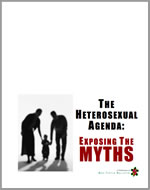 At last, the truth can now be told.
Using the same research methods employed by most anti-gay political pressure groups, we examine the statistics and the case studies that dispel many of the myths about heterosexuality. Download your copy today!
And don‘t miss our companion report, How To Write An Anti-Gay Tract In Fifteen Easy Steps.
 Anti-gay activists often charge that gay men and women pose a threat to children. In this report, we explore the supposed connection between homosexuality and child sexual abuse, the conclusions reached by the most knowledgeable professionals in the field, and how anti-gay activists continue to ignore their findings. This has tremendous consequences, not just for gay men and women, but more importantly for the safety of all our children.
Anti-gay activists often cite the “Dutch Study” to claim that gay unions last only about 1½ years and that the these men have an average of eight additional partners per year outside of their steady relationship. In this report, we will take you step by step into the study to see whether the claims are true.
Tony Perkins’ Family Research Council submitted an Amicus Brief to the Maryland Court of Appeals as that court prepared to consider the issue of gay marriage. We examine just one small section of that brief to reveal the junk science and fraudulent claims of the Family “Research” Council.
 The FBI’s annual Hate Crime Statistics aren’t as complete as they ought to be, and their report for 2004 was no exception. In fact, their most recent report has quite a few glaring holes. Holes big enough for Daniel Fetty to fall through.
“Google” is a trademark of Google Inc.
© Box Turtle Bulletin. All Rights Reserved.

 Posts
Posts  Posts via daily email: