Box Turtle Bulletin
 News and commentary about the anti-gay lobby
“Now you must raise your children up in a world where that union of man and box turtle is on the same legal footing as man and wife…”
News and commentary about the anti-gay lobbyAugust 4th, 2007
Eileen Flynn, of the Austin American-Statesman is reporting this on her “Of Sacred and Secular” blog:
Are you serious, I thought when I heard the voice mail. More than 80 Lutheran ministers will go public with their homosexual identity next week? Mind you, these clergy members serve a comparatively liberal branch of Lutheranism, the Evangelical Lutheran Church in America.
But still, many of those coming out on Tuesday are in homosexual relationships, and the ELCA restricts ordination to heterosexuals who are faithful in marriage or celibate homosexuals. As it happens, the ELCA will be debating the issue of dropping the celibacy requirement for gay ministers at its biennial assembly next week in Chicago.
The big coming-out party is slated to happen Tuesday at a press conference with Lutherans Concerned/North America.
August 4th, 2007
In the recent blogging debates over hate crimes legislation and civil equalities, much has been made about the changeable nature of sexual orientation. Anti-gay writers claimed that gay persons can reorient and are therefore undeserving of protection or equality. Pro-gay writers have responded by cries of hypocrisy against those who oppose sexual orientation protections because of purported mutability (which is disputed) but yet themselves enjoy protections based on religion which is in and of itself entirely “chosen”.
On his site, Dr. Warren Throckmorton questions the notion that religion is a choice:
Some things just seem right and make sense. I have had a similar sense throughout my adult life. I know there are inconsistencies in my beliefs but I have tried on many other worldviews and have found them full of cognitive inconsistencies as well. It does not seem like my beliefs are chosen as if from a menu. To me, it seems like our brains are wired to believe but not wired well enough to find a system without holes.
Throckmorton argues that the nature of faith is not such that it lends itself to conscious manipulation:
Suffice to say, as I experience religious belief and as it has been described to me by numerous clients, friends and colleagues, such beliefs are often not experienced as mutable or negotiable.
However, I think that Throckmorton has confused faith and dogma. Further, I speculate that the intrinsic – or hard wired – drive is not for religion per se, but rather is the combination of two other needs: the desire to know what is true and the desire to think well of oneself.
I believe there is an instinct built into the survival of man to obtain knowledge. It is the ability to process and evaluate “what is” that allows us to make decisions necessary to advance our genetic code and to enjoy life. Internal pleasure results from acquiring facts that fits with our understanding of the world. That confirmation of what is perceived as “true” brings a satisfaction, a feeling of ease.
So too does one have a need, a craving, to think well of oneself. The notion that one is justified in one’s actions is essential to one’s sense of peace. The field of psychology has long known that a perception of oneself as “bad” or “inferior” leads to destructive behaviors and ill health.
To me it seems illogical to assume that any specific religious belief is inborn or immutable. What then would such a belief be? Would it be monotheism like most Americans, or polytheism as experienced by certain Asian cultures. Would it be belief in the sanctity of life as most western religions share or the necessity of human sacrifice to appease the gods as was believed by our Greek and Roman forefathers. Would it be freedom of religion or the jihad of the infidel? Would it be Christianity’s abhorrence of minority sexualities or the special deference given by some Amerinds?
I suspect that the particular belief is not as important to the well being of individuals as is the notion that one is right. One’s innate drive is to pursue that which is true: the hidden reality as expressed by and through the gods; and that which is good: the commands and requirements of the gods. Those who claim that people of faith adhere to their beliefs solely to avoid “eternal punishment” do not understand this concept. It is not to appease an angry deity that draws adherents, but a desire to know the great unknown and to be seen as “good” in its sight.
But what is true and what is good?
I believe that we are instilled though environmental conditioning to affiliate ourselves with the religion that our parents bring. Or, at least, the values instilled by our parents and culture as to what is true and what is good. Our affiliation with certain matters of faith has more to do with our upbringing than it does to the irrefutable and obvious rightness of such matters.
What then are we to do with this idea? Are we to toss out faith entirely because we cannot know what is not capable of being known? I believe that to do so would leave most of us ill at ease. Our desires for knowing and being would be unmet.
And perhaps there is no real answer. Perhaps all we can do is work in the parameters of our faith – however we came to get it – and hope that God, or whatever there is out there, will be willing to see our intent and honor our efforts.
And one thing more. We need to be willing to accept that our confidence in our dogma is unwarranted. We must accept that our articles of faith are not unquestionable and that only the weak are afraid to question. Those who are afraid of knowledge scream the loudest about TRUTH because they are unwilling to grow to know what is true. And those unsure as to whether they are good are the ones quickest to label others as evil and sinful and degenerate.
And while such behavior is harmful to others, it also does not act to feed the drives of knowing and being “good”.
To know true peace, we need to be willing to challenge our certainties and ask ourselves if our values are beneficial, biased, or perhaps evil. And we must be able to let go of that which is unworthy of belief and embrace that which reflects growth and maturity. For while the drive for belief is deep and consequential, individual items of belief are indeed quite capable of change.
August 3rd, 2007
In the face of tremendous anti-gay sentiment in Russia, the Kvir publishing house is releasing a small print run of a new gay anthology, Liberty Life. Unfortunately, for a gay anthology, gayness is barely mentioned:
“I regularly think in my head about what the grandma in the bookstore who opens the book will say. I’m always a little afraid and am reluctant to have problems with the government,” (editor Vladimir) Kirsanov said. “I wanted a collection of authors that wouldn’t arouse such a reaction” as previous gay prose books had, he admitted.
One Russian-studies scholar noticed the role foreign words play in the anthology:
A surprising number of English words appear in the text, often connected with sex or relationships — “brief encounter” and “blind date,” for example. The word “Liberty” in the book’s title is also written in English. And the publisher’s name, Kvir, is a Russianized version of Queer.
This preponderance of foreign terms suggests that “the idea of queerness in itself is still associated with abroad — it couldn’t be something native Russian,” said Kevin Moss, head of the Russian department at Middlebury College in Vermont and editor of a collection of Russian literature on gay themes.
According to this review, it appears that Russian gay-themed literature is in a state similar to American gay-lit in the 1950’s, where gay themes are de-emphasized and the endings are often tragic. Contributing author Konstantin Kropotkin described his work this way: “This text is about a lack of freedom.”
The book will only be sold in two Moscow gay bookstores. I wonder if any of them would be interested in distributing Ruslan Porshnev’s Russian translation of “The Heterosexual Agenda: Exposing the Myths”?
August 3rd, 2007
The Evangelical Lutheran Church in America requires that its gay and lesbian clergy remain celibate. However, a resolution will be presented next week to lift this ban.
Almost a third of the church’s synods, or regional governing bodies, have endorsed a proposal that would permit gay and lesbian pastors in committed relationships to serve congregations and would reinstate those who have been removed because of a same-sex relationship.
There appear to be three camps in the debate: those who seek to lift the ban, those who believe gay persons should either not serve or should be celibate, and those who want to wait until a broader social statement on sexuality is scheduled to be released by the church in two years. We’ll report back on the outcome of any decision.
August 3rd, 2007
A study published in the British Medical Journal suggests that Abstinance Only programs are not effective in reducing risk to HIV. This is, to me, a no-brainer as such programs inevitably exclude any consideration of male gay youth. “Wait until you are married… which will be NEVER” does not seem to me to be a particularly effective approach to encouraging responsible sexuality.
However, this report appears to be addressing heterosexual HIV risks:
Compared with no program, safer sex programs, and various other control programs, the abstinence-only programs did not seem to reduce HIV risk. Specifically, abstinence-only programs did not influence the rate of unprotected vaginal sex, the number of sexual partners, condom use, or initiation of sexual activity.
However, as I’m certain the current administration is aware, Abstinance Only programs are very effective at doling out tax money to certain religious and quasi-religious institutions to advance their doctrines about sex.
August 3rd, 2007
The Memphis Commercial Appeal yesterday reported on a campaign by Tennessee pastors pressuring Rep. Steve Cohen (D) to vote against the proposed hate crimes bill, claiming it will restrict their rights to preach against homosexuality. This follows reports that the Family “Research” Council is targeting Sen. Lamar Alexander (R) with automated “robocalls” in Nashville.
The bill, which cannot and does not overturn the First Amendment, addresses only violence and direct threats of violence. It does not address speech or religion or what anyone says in the pulpit — or anywhere else for that matter. How do I know this? I posted the text of the bill on my web site. Three times! Funny how the Family “Research” Council is too cowardly to do the same.
It’s a shame that the Memphis Commercial Appeal would let these lies about hate crimes go unchallenged. Fortunately, Rep. Cohen doesn’t appear to be swayed. “That Crime Bill affects acts of violence, not acts of thought or speech,” Cohen said. “It never has in this country’s history, and it never will.”
August 3rd, 2007
 A Jackson, Tennessee-area woman was left partially blind and possibly brain damaged from an attack at a club. The fight broke out when a patron thought she looked like a man and assumed she was gay when she started dancing with a male friend. When he told her to leave using a gay slur, she replied that she was a woman, but yes, she’s a lesbian. Her assailant then punched Amanda in the face and jabbed her in the left eye about four times with the bottom of a beer bottle before smashing the bottle over the back of her head.
She lost sight in her left eye for a few days, and was scheduled to have an MRI on Thursday to check for possible brain damage. The Jackson Sun reports that they are planning a protest in front of the club on Saturday.
August 3rd, 2007
Peterson Toscano has announced that he will officially retire his one man play, “Doin’ Time In the Homo No Mo Halfway House” in February 2008. He promises that he will keep doing as many shows as he can between now and then. I had a chance to see his performance at the Ex-Gay Survivor’s conference last month. If you haven’t had a chance to see it yourself, I highly recommend you try to catch a performance.
But if you can’t, don’t worry. All will not be lost. Peterson hopes to have a DVD available during the spring of 2008. I’d definitely be pimping that DVD when it comes out. You can count on it.
August 3rd, 2007
Military policeman Pfc. Christopher Mastromarino, after months of harassment and anti-gay slurs, appears to have been targeted by Army leaders for dismissal because they think he is gay.
The decorated soldier with an exemplary service record was court-martialed in May after indecent assault charges were filed against him in February. Those charges were brought despite the sworn testimony from witnesses that they did not consider the physical contact between themselves and Mastromarino to be an assault. Mastromarino says the rumors and slurs started when he moved in with his openly gay cousin and partner who lived in the Washington, D.C. area.
A Poll last December found that two-thirds of military personnel who served with someone they knew to be gay did not believe their presence impacted unit cohesion. That same poll found that only 52% received training on prevention of anti-gay harassment. But Pfc. Mastromarino’s case shows how attitudes fostered by “Don’t Ask, Don’t Tell” can affect military cohesion, even involving straight servicemembers who fall under the pall of suspicion.
Joint Chiefs of Staff nominee Admiral Michael Mullen thinks it’s time to revisit the military’s ban on gays and lesbians. During his confirmation hearing Tuesday before the Senate Armed Services Committee, Adm. Mullen responded to Sen. Susan Collins’ (R-Me) question about continuing dismissals of qualified servicemembers. While he says that he supports the current policy while it is in place, he also believes that Congress ought to re-evaluate it:
“I really think it is for the American people to come forward, really through this body, to both debate that policy and make changes, if that’s appropriate.” Mullen indicated that he would like Congress “to make its own decisions” with respect to considering a repeal of the ban.
Meanwhile, the military continues to lower its standards for new recruits, with the number of incoming soldiers with prior felony arrests or convictions tripling in the past five years. CBS News reports that the Army accepted an estimated 8,000 recruits with criminal records. SLDN delves deeper into the numbers here. And now even gang members are preferred in today’s army over decorated patriots who merely fall under the suspicion of “Don’t Ask, Don’t Tell.”
August 2nd, 2007
The Swedish Lutheran Church (the Church of Sweden) was until 2000 the state church and claims membership of about 75% of Sweden’s citizenry. This Saturday for the first time the Church will be entering a delegation in Stockholm’s Gay Pride parade.
The Church said the delegation would include about 30 people including two deans from the Stockholm and Uppsala cathedrals.
Although Sweden has had domestic partnership laws since 1996, the country is expected to adopt gender neutral marriage early in 2008, with the support of the Church.
August 2nd, 2007
As I said in previous posts, most of the people who attended the “Love Won Out” ex-gay conference in Phoenix on February 10 were not gay or lesbian “strugglers” seeking change. That audience was mainly made up of concerned parents, family and friends of gays and lesbians. In fact, the whole purpose of the all-day “Love Won Out” conference was to introduce people to the world of ex-gay movement and the idea that “freedom from homosexuality is possible.”
But the very people most affected by this message — gays and lesbians themselves — were largely absent. There was just a small smattering according to one show of hands. And so most of the concerned parents, family members, and friends of gays and lesbians who made up the bulk of the audience were typically unaccompanied by the very people everyone was talking about. This meant that as these people heard speakers from Exodus, NARTH and Focus on the Family (some of whom described themselves as “former homosexuals”) talking about what it meant to be gay, but most of these audience members didn’t have their own children or loved ones with them to talk about the things they heard. So the speakers were free to characterize these loved ones’ lives without fear of contradiction.
And this, I believe, was one of the worst shortcomings of the whole experience. During breaks between sessions, I heard several parents project what they heard onto their own children — sometimes without any evidence that what they heard actually applied to their child’s experience. I personally witnessed one parent break into tears with the new-found certainty that her son must have been molested. “You heard her. That lady (Melissa Fryrear) said so,” she said between tears. I also heard other parents who had already had these conversations with their children but didn’t believe them because what they heard from the “experts” at the conference. “Well, she said nothing ever happened, but…”
And if the abject fear that one’s child might have been molested wasn’t bad enough, there were the fathers who blamed themselves for their sons’ homosexuality. My heart sunk when I heard them groan on hearing NARTH Presdient Joseph Nicolosi saying, “We advise fathers, if you don’t hug your sons, another man will.” I talked to quite a few fathers who seemed to take Nicolosi’s theory quite personally, and they were greatly burdened by it. More recently, I spoke with a father who attended a different Love Won Out conference. He referred to Nicolosi’s talk and confided, “I can only hope that someday Jesus will forgive me.”
The other main focus of the conference — when it wasn’t focused on the presumed “causes” of homosexuality — was on the meaning and nature of “change.” As speaker after speaker promised a “complete and radical change,” these parents pinned their hopes on each of these promises. And for every one of the featured speakers in the general sessions, the nature of change was simple: a very specific change in sexual attractions or orientation.
Joseph Nicolosi was the keynote speaker that morning, and he described a succession of clients who had “no more homosexual attractions” and whose homosexuality became “nonexistent.” Immediately following Nicolosi’s talk, we heard Exodus Board Chairman Mike Haley give his life story as a former homosexual, complete with pictures of his beautiful wife and children on the large multimedia screen behind him. Soon after that, we heard Focus On the Family’s Melissa Fryrear declare her infatuation with red-headed men who would look good in a kilt. (She jokingly declared, “That movie Braveheart changed my life!”) And later that afternoon, we heard Nancy Heche, actress Anne Heche’s mother, describe a special blessing that delivered her daughter from a “lesbian affair” with Ellen DeGeneres.
While I believe most of the descriptions of change were either misleading or unrealistic, there was one candid exception that I wish more of these parents could have heard. It would have given them a better idea of what their sons and daughters would be up against in pursuing “change” — especially the sort of change promised by the featured speakers.
During the first set of breakout sessions just before lunchtime, Exodus president Alan Chambers gave a talk titled, “Hope for Those Who Struggle.” As the title suggests, this workshop was targeted towards the few who were struggling with their sexuality — although undoubtedly there were a number of parents and family members there as well. But only about 75 people attended his session, a tiny fraction of the 800 attendees at the conference overall. So generally speaking, this was a relatively “safe” audience, safe enough for Alan to try to set realistic expectations for change and describe what change really means.
Alan began his talk by describing his own unrealistic expectations for “change.” When he first began to attend an Exodus-affiliated ministry at the age of eighteen, he thought that his sexual attractions would change from gay to straight in pretty short order. But after a few years in the ministry, he learned that his goals were unrealistic, and he warned his small audience that they needed to adjust their goals as well:
And I’m going to shatter your world here: heterosexuality shouldn’t be your number one goal. Whether that’s for yourself or for your kid or for your loved one or your friend or your family member. Heterosexuality shouldn’t have been my number one goal. The opposite of homosexuality isn’t heterosexuality. It’s holiness.
And I think we in the church often get that wrong. We think, okay, the best thing for this person who’s involved with homosexuality or involve with lesbianism is that they come out of that lifestyle and go into heterosexuality. If that’s all we think is necessary, we’re setting people up for a terrible fall. The opposite of homosexuality isn’t heterosexuality. It’s holiness.
Part of this statement reinforces a larger theme of the conference, that homosexuality is incompatible with Christianity. Here, he sets it as being “opposite” of holiness, which only adds to the burden of those who were there. After all, wickedness is more commonly understood as being the opposite of holiness. So casting homosexuality on the same side of the spectrum as wickedness is a terribly damaging way to characterize the lives of gays and lesbians everywhere. Besides, heterosexuality is not, in and of itself, holy either. But that went unsaid, which was pretty much on par for Love Won Out.
But most of this statement represents a dramatic departure from the rest of the conference in terms of the nature and likelihood of change. It certainly stands at the polar opposite of Dr. Nicolosi’s absolute confidence that homosexuality becomes “nonexistent” once an emotional connection is made. According to Allan, same sex attractions may not necessarily diminish no matter how hard one tries or how many prayers are said. Instead, the “change” that takes place is not a change in sexual orientation; it’s a change in faith. The “conversion” is not sexual orientation conversion, it’s a religious one.
More specifically, this change is actually the exchanging of one’s identity from gay to Christian, since the two identities cannot coexist in the worldview of Exodus or Focus On the Family. This emphasis on a change in identity is at the very heart of the ex-gay message. But even with this new identity as a Christian, merely forsaking the old identity of gay or homosexual doesn’t mean that one’s homosexuality will actually go away:
… Second Corinthians 5:17 says those who are in Christ are a new creation. The old is gone and the new has come. And again in the Christian community — I’m pointing my finger at myself too — we often hijack that verse to mean those who come to Christ, those who come to Jesus are perfect. Everything’s gone, the old life is gone, and the new has come and it’s all going to be wonderful from here.
And I think again, we do a disservice to people that we share that Scripture with, that we explain that Scripture to when we say that once you have a relationship with Jesus Christ that it’s all going to be better and you’re never going to struggle again. And the truth is, you’re going to dash your expectations that way. If that’s what we expect of ourselves and what we expect of other people, we’re going to be endlessly disappointed.
And this is where Alan’s talk turned very personal. He cited Matthew 16:24 (“Then Jesus said to his disciples, ‘If anyone would come after me, he must deny himself and take up his cross and follow me.'”) before getting to the very heart of the matter of “change” in his own life:
…In the early days of when I started speaking and debating and doing all sorts of things related to the issue of homosexuality and took my position with Exodus, people used to say, “Oh Alan, you’re just in denial.” I used to get so mad when they’d say, “You’re just in denial. You’re just denying who you’re really are.” And I’d say, “No I’m not. I’m not in denial! I’m not in denial!”
And then I came to the place where I realized, you know what? God calls us as Christians to a life of denial. I love that today I realize that I do live a life of denial. Not denial of who I used to be, not denial of who I could be today, but I deny what comes naturally to me.
…And so every single morning — this is a ritual for me — I wake up and I say, “Dear Lord, I can’t make it today without You. I choose to deny what comes naturally to me. I choose to submit my will to the Lordship of your Son, Jesus Christ. And I choose better. I choose to follow You, I choose to allow Your Holy Spirit to walk before me, to guide me, to speak for me.”
… And if we think we can get up one day and decide we don’t have to pray about it anymore, then we’re mistaken. So expect a life of obedience. Expect a life of denial.
Only 75 people heard this message that day, which is a terrible shame. This was, I think, the most honest, honorable, and vulnerable talk I heard the entire day. It seems to me that this was the message that everyone should have heard at Love Won Out.
But it appears that this reservoir of truth and vulnerability is rationed only to safe, like-minded listeners. How else to explain this talk talking place in a small breakout session instead of one of the main plenary sessions?
If everyone had heard that talk, they would have understood without question what “change” was all about. So why was this talk reserved for a small, safe audience of “those who struggle”? Were they afraid that parents would become disillusioned on hearing what the reasonable expectations for change should be? Did Love Won Out organizers not want the larger audience to know that their sons and daughters faced a lifetime of struggle? Were they afraid of shattering those parents’ dreams of weddings and grandchildren?
One thing’s for certain. If most of the Love Won Out audience wasn’t safe enough for Alan’s message, then the general public certainly isn’t. Four months before the Phoenix conference, Alan Chambers appeared on NPR’s “Fresh Air” and told Terry Gross:
I have talked with and met people who say that they have walked completely away and will never struggle with that again or have never struggled with that again. I believe it’s …. there’s everyone on the continuum. I often like to use the phrase that I will never be as though I never was. I can’t forget where I used to be and I can’t deny the fact that I’m still human and that I could be tempted in every way.
But today where I live my life, and I believe this is true of those who would say they have successfully left homosexuality, homosexuality isn’t something that controls them anymore. Where at one point in our lives, in my life, I could not resist homosexuality. I could not resist the urge. I could not get those thoughts out of my mind. I was exclusively attracted to members of the same sex and acted out on that on a regular basis. Today I have what I would describe as a Garden of Eden relationship with my wife and that she is the object of my desire. She is who I am attracted to…
Then, just a few days before this Love Won Out conference took place, Alan Chambers appeared on CNN where he denied trying to control his thoughts, while at the same time repeating the oblique phrase, “I will never be as though I never was.”
But just a week before the 2007 Exodus Freedom Conference, in Irvine, California, it appears that Alan decided to test the waters by giving the larger world an explanation more consistent with what he had been telling his much smaller Love Won Out audience. The Los Angeles Times reported:
With years of therapy, Chambers says, he has mostly conquered his own attraction to men; he’s a husband and a father, and he identifies as straight. But lately, he’s come to resent the term “ex-gay”: It’s too neat, implying a clean break with the past, when he still struggles at times with homosexual temptation. “By no means would we ever say change can be sudden or complete,” Chambers said.
And yet this small concession — which focused mainly on what sort of language to use for describing “change” — appeared to be too much. After mounting pressure from fellow anti-gay activists, Alan issued a partial retraction through an American Family Association web site:
“[‘Ex-gay’ is ] something that comes across as confusing,” he says. “And while I understand why people have used it over the years — it’s easy to use in a soundbite — to say that someone is primarily described by the behavior that they used to be involved in I think is a disservice to the people who have found freedom from homosexuality.”
And that includes himself, says Chambers. “[R]eally, more accurate labels for me would be, ‘I’m a man. I’m a Christian. I’m a husband. I’m a father. I’m a son.'” Chambers says he is considering whether to ask the newspaper to issue a clarification of his remarks.
Exodus and Focus On the Family appear to provide two distinct faces when they talk about change. There is the public face, the one that is given to the general population through billboards, radio commercials and web sites which promise that “change is possible.” A radio commercial promoting the Exodus conference in Irvine promised a “sudden, radical, complete change.” At Love Won Out, parents, friends and family members heard specific, clinical language in which homosexuality becomes “nonexistent.” And whenever Exodus and Focus On the Family speakers appear before the cameras and microphones of major media outlets, they are very careful to leave the definition of change to the assumptions of the audience: a change in sexual orientation, even if they rarely say it explicitly.
But in a small workshop targeted specifically to “those who struggle,” we get to see a far more private message about “change.” And Alan repeated and expanded on this message during the opening night of the Exodus Freedom conference in June. There, before another “safe” audience of more than eight hundred people (unlike at Love Won Out, the overwhelming majority of this audience was “strugglers”), Alan repeated and expanded upon the remarks he made during that tiny breakout session at Love Won Out. And here, he challenged his audience to think about how they might respond if their orientations didn’t change:
And the truth is, what if circumstances never change? I think you have to ask yourself that question. What if your circumstances never change, like my friend that I said her feelings haven’t changed much in twenty years? What if your feelings don’t change? What if your circumstances don’t change? What if it’s still difficult in a year as it is today? Are you going to stand on the promises of God? Are you going to choose to fight? Or are you going to give in?
Michael Bussee was one of the original founders of Exodus before leaving the organization and later becoming one of its sharpest critics. He described one current ex-gay Exodus leader as saying they were just “Christians with homosexual tendencies who would rather not have those tendencies.” Alan appears to be inching towards that candid assessment.
But I have to wonder if he can maintain this message for larger audiences while still holding out hope for a “complete, radical change.” And I have to wonder if he can sustain that message when Exodus’ political lobbying on Capital Hill depends on the assertion that if “real change” is possible, gays and lesbians don’t need equal rights. It seems that too much is at stake to allow too many doubts to creep in on what change really means.
We already saw the howls of protest when Alan made his comparatively innocuous remarks to the Los Angeles Times. While we can hope that the two-audiences, two-messages may fall by the wayside, only time will tell whether abandoning that approach will be compatible with the broader cultural and political goals of Exodus and Focus On the Family.
Prologue: Why I Went To “Love Won Out”
Part 1: What’s Love Got To Do With It?
Part 2: Parents Struggle With “No Exceptions”
Part 3: A Whole New Dialect
Part 4: It Depends On How The Meaning of the Word “Change” Changes
August 1st, 2007
 Ronald Reagan was our first “homosexual” president, and the Republican Party is a “sodomite organization” — according to Alan Stang, our latest LaBarbera Award winner.
Who is Alan Stang?
When I was in high school, a local AM radio station in my hometown used to carry a five-minute program called the “Alan Stang Report” produced by the John Birch Society. The program began with Alan Stang’s menacing voice announcing “This is Alan Stang… Stick Around!” before going to a brief commercial for the local sponsor (a candy and tobacco distributor). And he’d always end his report with “This is Alan Stang… Think about it!” In between, you’d hear another revelation from the strangest collection of conspiracy theories imaginable.
According to Alan Stang, Gerald Ford was a communist. So was his vice president, Nelson Rockefeller. Jimmy Carter and Walter Mondale were communists too. By the time Ronald Reagan was in office, I was in college so I never found out whether he was a communist or not.
But it doesn’t matter. Now I know something even juicier. Alan Stang’s latest book, Not Holier Than Thou: How Queer Is Bush? spills the beans. And you can trust it because Paul Cameron wrote the foreword.
Not Holier is not a squeamish dance around the issue. It exposes the homosexual ring in the Reagan and both Bush White Houses. It names names and tells who is in bed with whom: “If Clinton is our first ‘black’ President, Ronald Reagan is our first ‘homosexual’ President. . . . For the record, Bush strategist Karl Rove’s late father, Louis Rove, was a homosexual, which could be the reason Karl’s mother committed suicide.” [Ellipses in the original.]
That’s right. Ronald Reagan is our first “homosexual” president. I think I’ve heard just about everything. But it doesn’t end there. According to Alan Stang’s latest book:
“So, George Bush and Karl Rove have always used homosexuality as a weapon, have righteously opposed it and have routinely accused people of it, knowing that those people were normal, while all along they have colluded to make the Republican Party a sodomite organization from the top down.”
That’s the theme of the latest, incendiary book by Alan Stang, who says Republican leaders are using homosexuality to terrify critics into silence, so they can bring the United States to its knees. The foreword by Paul Cameron, Ph.D., chairman of the Family Research Institute, reinforces that theme.
I can’t wait to find out how Cameron reinforces Stang’s discovery of a “homosexual ring.” But after having had a glimpse into Cameron’s fascination with how the Nazis dealt with homosexuality, one might argue that the John Birch Society is actually a step in the right direction.
Well, one might argue it but it wouldn’t be worth the effort.
Hat tip: Jonathan Rowe. Graphic courtesy of Daimeon Pilcher.
August 1st, 2007
Dated June 22, but not posted until much more recently, the Methodist Federation for Social Action has posted an open letter on Dr. James Holsinger’s nomination for Surgeon General on their web site. The letter is addressed to the Senate Committee on Health, Education, Labor and Pensions, which heard testimony on his nomination last month. The MFSA’s letter cites my analysis of his 1991 paper as recommended reading and concludes:
At a time when our nation is deeply polarized on so many issues, it is important to have someone in the position of surgeon general who is widely trusted across the board, a person Americans believe will act with medical integrity… Perhaps most important, national leaders, including the surgeon general, should be persons who can bridge the inevitable divisions that arise between citizens in a pluralistic society such as ours. We question whether Dr. Holsinger is such a person.
August 1st, 2007
Edge magazine has printed the fourth installment of its thoughtful look at ex-gay ministries.
If you have not yet read them, review the first, second, and third installments.
August 1st, 2007
I offer this advice to all Baptist pastors and Christian radio personalities out there: When you get liquored up and put on a skirt and you stop to pee in front of children and then you get pulled over for drunk driving, that is not the time to offer the cops oral sex.
Featured Reports
 In this original BTB Investigation, we unveil the tragic story of Kirk Murphy, a four-year-old boy who was treated for “cross-gender disturbance” in 1970 by a young grad student by the name of George Rekers. This story is a stark reminder that there are severe and damaging consequences when therapists try to ensure that boys will be boys.
When we first reported on three American anti-gay activists traveling to Kampala for a three-day conference, we had no idea that it would be the first report of a long string of events leading to a proposal to institute the death penalty for LGBT people. But that is exactly what happened. In this report, we review our collection of more than 500 posts to tell the story of one nation’s embrace of hatred toward gay people. This report will be updated continuously as events continue to unfold. Check here for the latest updates.
In 2005, the Southern Poverty Law Center wrote that “[Paul] Cameron’s ‘science’ echoes Nazi Germany.” What the SPLC didn”t know was Cameron doesn’t just “echo” Nazi Germany. He quoted extensively from one of the Final Solution’s architects. This puts his fascination with quarantines, mandatory tattoos, and extermination being a “plausible idea” in a whole new and deeply disturbing light.
On February 10, I attended an all-day “Love Won Out” ex-gay conference in Phoenix, put on by Focus on the Family and Exodus International. In this series of reports, I talk about what I learned there: the people who go to these conferences, the things that they hear, and what this all means for them, their families and for the rest of us.
Prologue: Why I Went To “Love Won Out”
Part 1: What’s Love Got To Do With It?
Part 2: Parents Struggle With “No Exceptions”
Part 3: A Whole New Dialect
Part 4: It Depends On How The Meaning of the Word "Change" Changes
Part 5: A Candid Explanation For "Change"
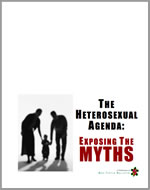 At last, the truth can now be told.
Using the same research methods employed by most anti-gay political pressure groups, we examine the statistics and the case studies that dispel many of the myths about heterosexuality. Download your copy today!
And don‘t miss our companion report, How To Write An Anti-Gay Tract In Fifteen Easy Steps.
 Anti-gay activists often charge that gay men and women pose a threat to children. In this report, we explore the supposed connection between homosexuality and child sexual abuse, the conclusions reached by the most knowledgeable professionals in the field, and how anti-gay activists continue to ignore their findings. This has tremendous consequences, not just for gay men and women, but more importantly for the safety of all our children.
Anti-gay activists often cite the “Dutch Study” to claim that gay unions last only about 1½ years and that the these men have an average of eight additional partners per year outside of their steady relationship. In this report, we will take you step by step into the study to see whether the claims are true.
Tony Perkins’ Family Research Council submitted an Amicus Brief to the Maryland Court of Appeals as that court prepared to consider the issue of gay marriage. We examine just one small section of that brief to reveal the junk science and fraudulent claims of the Family “Research” Council.
 The FBI’s annual Hate Crime Statistics aren’t as complete as they ought to be, and their report for 2004 was no exception. In fact, their most recent report has quite a few glaring holes. Holes big enough for Daniel Fetty to fall through.
“Google” is a trademark of Google Inc.
© Box Turtle Bulletin. All Rights Reserved.
 Posts
Posts  Posts via daily email: