Box Turtle Bulletin
 News and commentary about the anti-gay lobby
“Now you must raise your children up in a world where that union of man and box turtle is on the same legal footing as man and wife…”
News and commentary about the anti-gay lobbyFebruary 26th, 2007
Last week, we learned that financial guru Suze Orman would announce that she is a lesbian in a New York Times Magazine article that appeared this past Sunday:
Are you married? I’m in a relationship with life. My life is just out there. I’m on the road every day. I love my life.
Meaning what? Do you live with anyone? K.T. is my life partner. K.T. stands for Kathy Travis. We’re going on seven years. I have never been with a man in my whole life. I’m still a 55-year-old virgin.
Would you like to get married to K.T.? Yes. Absolutely. Both of us have millions of dollars in our name. It’s killing me that upon my death, K.T. is going to lose 50 percent of everything I have to estate taxes. Or vice versa.
It looks like talk about all this wealth rubbed Randy Thomas the wrong way. Thomas, who has recently been promoted to Vice President of Exodus International, provided a rather illogical reason for discounting the quest for equal rights for gays and lesbians as having anything to do with civil rights. His complaint? Apparently some among us are too rich and the rest of us haven’t suffered enough. This somehow disqualifies us from pressing for our civil rights:
From another angle, this also does not help some in the gay activist community with their attempts to make this battle, over redefining marriage, a “civil rights” issue. Suze and her partner worrying over their “millions” doesn’t have the same ring or impact as watching young black people being knocked down by fully opened fire hoses and mauled by tax payer funded police dogs. I don’t think Suze or Tammy would ever make that comparison but some in the activist community do equate the marriage battle with the civil rights battle of the African American community and that is tragic.
What great timing! As it happens, we are in our last days of Black History Month. So I’d like to take this opportunity to introduce Randy to one of the great heroes of African-American history.
 Madam C.J. Walker rose from being an uneducated washing woman in St. Louis to becoming one of the richest women in American. Through her own determination, she put herself and her daughter through school. And when she started to have problems with her hair falling out, she invented a line of hair care products which were designed and sold specially for African-American women. She soon become not just one of the wealthiest Black women in American, she was one of the wealthiest women in America period. She founded her business in 1906, and by 1913 her company employed twenty thousand sales agents in the United States, Central America and the Caribbean. Her sales agents, who were mostly of African descent themselves, earned $25 a week — a far cry from the $2 a week that washing women normally earned at that time. When Madam Walker died in 1915 at her New York mansion, she left behind an estate worth some seven million dollars in today’s money.
At a time when it was extremely difficult for women or blacks to succeed in the business world, Madam C.J. Walker broke both barriers and served as an inspiration for many generations of Black women throughout North America.
No, as Randy suggests, to try to compare Suze Orman to Black civil rights protests of the nineteen sixties would certainly miss the point. Suze’s success and wealth does nothing to negate her rights to equality in America any more than does Madam Walker’s. And neither woman’s success undermines the justness of equality for the rest of us.
If fire hoses and mauling police dogs are the measures by which you judge a civil rights movement, then I can truly thank God that in America at least, we fail those tests. You’ll have to look elsewhere for it. (Russia, Poland, Iran, Nigeria and Nazi Germany come to mind.) All we have is Stonewall. And while Stonewall represents a turning point for the gay rights movement, it’s not Selma.
But the legitimacy of one’s civil rights isn’t found in brutality or the lack of it, nor is it diminished by success or fortune. It is found simply in the recognition of what is right and just. Madam Walker succeeded despite the lack of voting rights legislation, hate crimes and anti-discrimination protections, the Civil Rights act, or Loving vs. Virginia. She also succeeded despite the fact that women were often not permitted to enter into financial agreements without the signature of a husband. She didn’t need any of those protections in order to be successful. But by no measure does that detract from the simple justness of the cause for equality for all African-Americans — and everyone else, for that matter.
Suze Orman didn’t have nearly the obstacles to overcome that Madam Walker did. Suze lives in a far better America than Madam Walker’s America, and Madam Walker had a lot to do with that. But equality is equality; it’s just that simple. And success, no matter how successful, is no substitute for it. That’s what makes it a civil rights issue.
February 26th, 2007
Andrew Anthos, 72, who was beaten by an assailant with a lead pipe at the back of the head, died Friday of injuries sustained during a horrendous hate crime incident that occurred the week before:
He had been riding the bus that evening (Feb 13) from the public library back to his Detroit apartment when another passenger annoyed with his singing approached him and asked if he was gay.
Anthos left the bus and helped a wheelchair-bound fellow passenger through the snow, only to be followed by the assailant who hit him in the back of the head with a metal pipe and fled.
 He was taken to a local hospital, where he was reportedly paralyzed from the neck down and had difficulty speaking. He was able to provide a brief description of his assailant to police before slipping into a coma Wednesday. He was given Last Rites Thursday evening.
Andrew was known around Detroit and Lansing for his quixotic twenty-year campaign to light the Michigan State Capital’s dome in red, white and blue for Independence day as a mark of patriotism in honor of military veterans and police officers.
It takes an incredibly cold-hearted, animalistic brutality to beat an elderly man, and to leave him for dead in the cold snows of Michigan. The National Gay and Lesbian Task Force has offered to pay for Mr. Anthos’ funeral at the request of the Triangle Foundation of Michigan.
February 22nd, 2007
Note: In this essay, I will try to talk about the theories of homosexuality that were presented at Love Won Out. For the time being, I will avoid a detailed critique of these theories. That may come later time. Instead, I want to delve a little deeper into the theme I began in Part One of this series by looking at Love Won Out through the eyes and ears of the parents of gay sons and daughters who attended.
As I describe my conversations with Love Won Out participants, I have changed several important details in order to protect the anonymity of those I talked to. The individuals who talked to me have a right to expect that their stories not be made individually recognizable. Nevertheless, the situations I describe are fully accurate in their substance.
I had a lot of preconceived ideas about Love Won Out ex-gay conferences before I finally attended one in Phoenix on February 10. Some of the awful things I thought I would see, I didn’t. In fact, I was pleasantly surprised to find some good things to report on, which I promise to tell you about later. There were some moment of thoughtfulness and encouragement which, to me as a gay activist, were surprising.
But there were other things that I didn’t expect to encounter that shook me to my core. And before I can move on to anything, I have to get this out of the way. This is a long essay, but it’s the most important one that I will write about Love Won Out. So, please, I ask for your indulgence on this.
The parents who attended Love Won Out seemed to have a lot of questions. Based on what I heard in the Q&A sessions and in casual conversations, most of these questions revolved around two specific themes: 1) “Why is my child gay?” and 2) “What can I do about it?” The Love Won Out organizers made sure there was plenty of information on hand to answer these questions. This essay will focus on the first question.
The first session of the day was conducted by Dr. Joseph Nicolosi, president of the National Association for Research and Treatment of Homosexuality (NARTH). He was there to provide a non-religious and scientific argument that homosexuality is “a developmental problem.” In his address, entitled “The Condition of Male Homosexuality”, he provided his theory of how gay men come into being, a theory based entirely on family dynamics.
Dr. Nicolosi began his talk this way:
Homosexuality is not a sexual problem, it’s a gender identity problem. And this is the foundation of our understanding. Gender identity is one’s sense of oneself as male or female. Homosexuality is not about sex. And homosexual apologists will say it’s only about sex. But rather, we understand homosexuality to be about a person’s sense of himself, about his relationships, about his past hurts, about childhood wounds, self-image, personal shame, and his belief in his ability to establish and sustain relational intimacy.
Homosexual behavior is always — my wife says when you speak publicly you never speak in absolutes, always and never — I’m telling you homosexuality, homosexual impulse is always prompted by an inner sense of emptiness. It’s not about sex.
He’s barely three minutes into his talk, and already he’s laid out several defining qualities of homosexuality from which he emphatically allows no exceptions. And yet, I knew from my own experience that clearly there were exceptions. He said that “homosexual apologists will say it’s only about sex”, but I had to wonder which “homosexual apologists” he was referring to. While I’m sure somebody somewhere has probably said such a ridiculous thing, I had never heard it. Everyone I’ve heard of speaks it as being about his or her personal sense of self and his relationships. More specifically, it’s about affection, love, and a particular way of caring for and relating with one another.
And when Dr. Nicolosi follows that absolute with another, that the “homosexual impulse is always prompted by an inner sense of emptiness”, I’m afraid this leaves a lot of room for doubt. When I see one absolute being absolutely false, I can’t place too terribly much faith in any other absolutes which immediately follow. I guess he should listen to his wife more often.
But that was my reaction. For the parents who attended, the reaction was very different. He was the expert after all, a man whose psychotherapy clinic in Encino “specialized in the treatment of men with unwanted homosexuality” for more than fifteen years. And because he has treated so many men and speaks with such confidence of his clinical experience, the audience hung onto his every word. He couldn’t have been more convincing if he had channeled Freud himself and spoken with an Austrian accent.
Dr. Nicolosi described the “pre-homosexual” child’s development in terms familiar to anyone who has read classic Freudian theory. He began with the first eighteen months of a child’s life, during the “androgynous phase,” in which the child is unaware of differences in gender. During this phase, he is naturally closely bonded with his mother. Then, at about the age of eighteen months to three years of age, the child enters what Nicolosi called the “Gender Identity Phase.” Here, the child acquires language, and with that a greater awareness of the world around him, which includes differences between male and female. At this stage, the child, who already has a close with his mother, is now supposed to recognize that he is a boy and that Dad is a boy, and that Dad is supposed to become the masculine role model for the little boy. When this “dis-identifying” with the mother and the identification with the father takes place, a heterosexual man is the guaranteed result.
But if his father is cold, rejecting, weak, or physically or emotionally unavailable, or conversely, if his mother is overprotective, domineering, or shows disdain for the father, that boy may not detach from his mother and identify with his father. If that happens, if the boy doesn’t identify with his father, he’ll experience what is called a “narcissistic hurt.” And this leads to all sorts of things:
And that’s why we see narcissism in the male homosexual. Narcissism is a preoccupation with oneself. It’s a high sensitivity to being hurt, being rejected, sensitized to people not liking me. It’s a defensive posture, what we call a shame posture. This boy was shamed for his masculine strivings, and so he abandons his masculine strivings.
…And that narcissistic injury produces an adult, a homosexually-oriented adult, who is cautious, fearful, easily hurt, easily slighted, easily offended, self-protective — that is what we call the shame posture. If men get to see me they’re not going to like me. There’s something inferior about me.
All of this is because the father did not bond with his boy. Either that or the mother wouldn’t let him. I began to wonder how the parents in the audience were taking all of this. I didn’t have to wonder very long, because that’s when Dr. Nicolosi let loose with this broadside.
We advise fathers, if you don’t hug your sons, some other man will.
With that, a very painful groan rose from the audience. This was probably the second-most effective line delivered that day (I’ll get to the most effective one in just a little bit). I looked around and saw heads shaking, couples looking at each other, and a general sense of horror filled the room. My cheeks flushed as I wondered how many of those groans came from fathers and mothers themselves who made up a sizeable chunk of the audience.
Nicolosi threw in several more absolutes as he went along. And with each absolute that he conveyed with such clinical certainty, his credibility seemed to grow with this audience. In the end, it would be the absolutes that everyone would remember:
If there is an older brother, Freud said a hundred years ago, if a homosexual has an older brother, it’s a feared, hostile relationship. I have never seen an exception to that. I have never met a client who is dealing with homosexuality who had a salient older brother.
The guy with a homosexual problem does not trust men. When he begins to trust men, his homosexuality disappears.
His cold, clinical descriptions of homosexuality, while alien to much of what I know to be true in my life, seemed to resonate with everyone else in that audience. After all, it matched everything else they had heard from their pastors and moral leaders. What’s more, it matched some of the more personal memories that every parent has about raising their children. What father cannot say he wished he could have spent more quality time with his son? What mother could say she was never overprotective or overly assertive? This is the story of every parent.
As I sat there listening to his lecture, I was reminded of that old joke about person A saying something terrible about person B, when person B speaks up and says, “Hey you do realize I’m in the room, don’t you?” These parents were right there as Nicolosi talked about how their failures produced a “Gender Identity Deficit” in their son, and that drove their son to be hugged by another man.
Later that morning, Melissa Fryrear, a gender issues analyst at Focus on the Family and a regional representative for Exodus International, spoke on the causes of female homosexuality. It’s odd that she would present a talk that was intended to be the female counterpart to Nicolosi’s clinical descriptions of male homosexuality. I say it’s odd because she doesn’t have a degree in psychology or the social sciences. Her degree is in Divinity. But nobody in the audience seemed to mind or even notice. Her credentials as an expert were accepted just as readily as Nicolosi’s, and because her talk was considerably warmer and more sympathetic to the parents, they seemed to take her messages more to heart, according on conversations that I had afterwards.
Her presentation was also somewhat more chaotic than Dr. Nicolosi’s “Maybe because women, we tend to be complex sometimes,” she explained. But her Freudian explanation for lesbianism was similar to Nicolosi’s, except here it was the mother who was cold and distant, while the father was stern, frightening, or even abusive. Unless, of course, the mother was exceptionally close and had a “best friends” relationship with her daughter and the father was distant. Fryrear’s mix of causes for female homosexuality was a Mulligan’s Stew of many different factors: lesbian chic, fashion, peer pressure, feminism, sexual abuse — the list was very long and occasionally contradictory.
But in very stark contrast to Dr. Nicolosi’s talk, Fryrear’s was much more sensitive to not blaming the parents for their child’s homosexuality. She peppered her talk with reassurances like this:
And I want to visit specifically with Moms and Dads, that if you have a daughter who is struggling with lesbianism, that you’re not to blame for her particular struggle. … Those of you that have children, and have especially more than one child, you know that your children are unique and their perception of the world and how they take the world in, their perception of themselves and you and the family dynamics. You know as parents that one thing you cannot control in your child’s life is his or her perception.
I don’t know what’s worse, parents blaming themselves or blaming their child’s “perceptions”. I later heard both, and it appeared that the parents who internalized the message about perceptions had a calmer sense of “what happened.” They didn’t appear as personally burdened as those who hadn’t internalized the message. In that context at least, her reassurances were a blessing. But as long as these parents are encouraged by self-described experts to look for something that “went wrong,” they will — either in themselves or in their child. There was a lot of that going on throughout the day, an activity that I can’t imagine to be very productive or healthy. I also can’t imagine it contributing very much towards family reconciliation.
But if parents found some comfort in the idea that it wasn’t all their fault, that comfort was rocked by another “cause” of homosexuality that Melissa Fryrear spoke about. Remember when I mentioned Nicolosi’s second-most effective sound-bite of the day? Melissa Fryrear came up with the grand prize:
I can draw anecdotally from having been a part of an Exodus member ministry for almost a decade, and in those years having met hundreds of women with this struggle, I never met one woman who had not been sexually violated or sexually threatened in her life. I never met one woman. And I never met one man either, that had not been sexually violated or sexually seduced in his life. [Emphasis mine.]
The audience sat in stunned silence as Fryrear, her voice shaking, went on to talk about sexual abuse in greater detail. She later described her own sexual abuse as a child, and her talk had just followed a testimony by Mike Haley in which he described having sex with another older man beginning at the age of eleven. As far as this audience knew, there were no exceptions. This went a long way toward reinforcing Nicolosi’s admonition, “if you don’t hug your sons, some other man will.”
So this is the point where I have to stop describing all of the so-called “causes” of homosexuality. Enough is enough. And I’ll save the examination of the social science literature for another day. There’s something much more important here that I need to get out of the way — and off my chest.
I said earlier that parents’ questions could be grouped into two themes: Why, and what do I do? I’ve described just a few of the lectures and breakout sessions which focused on the “why”, on what when wrong in the child’s life and what (and sometimes who) was to blame for that child’s homosexuality. The conference speakers were very clear: there is no biological basis for homosexuality whatsoever. Instead, they offered as a variable this uncontrollable built-in quality in the child called “temperament”, a “temperament” which helped to form the child’s “perceptions.”
This “temperament, when explained in more detail, sounded suspiciously like some sort of an in-born quality or trait that was somehow intrinsic to the child. And even though this can have a biological or an otherwise in-born basis, the conference speakers were clear in repeatedly conveying another absolute: there was no biological basis for homosexuality. (There was one exception. Mike Haley, during a Q&A breakout session attended by about a fifth of the participants, allowed that there may be a combination of biology in the form of “temperament” and developmental forces coming together. But he was otherwise dismissive of biology playing a role.)
So that pretty much left the fathers and mothers at the center of all of these discussions of “what went wrong.” While I heard some parents blame themselves, at least a few were able to “blame” their child’s “false perceptions” of them as a bad mother or a bad father.
But when Melissa Fryrear spoke so forcefully that she had never met a lesbian or a gay man who did not have some sort of experience with sexual abuse, that message would become a much-repeated refrain in conversations later that day.
It’s not fair to say that the parents and relatives were rife with suspicions, but I was surprised at the number of suspicions that did come up — and the circumstantial nature of the “evidence” which prompted many of them. I heard ex-boyfriends and babysitters suddenly come under suspicion where there had been none before. It seemed as if many of these relatives, taking Melissa Fryrear at her word, turned several possibilities over in their minds — dismissing some, but holding others for future consideration.
Sometimes, these suspicions got the better of them. Before that day, it had never even occurred to one mother that her son might have been molested. Now after Fryrear’s talk, she was momentarily certain of it. “There’s no other explanation!” she exclaimed. But as she thought about it, she remembered that she had no reason to suspect this, and that the only “evidence” she had was Fryrear’s statement. She was finally able to calm herself down after those around her reassured her that it probably didn’t happen.
Besides, she already had so many other reasons to think about for her son being gay. Yet I couldn’t help but feel that this mother’s burden was unnecessarily heavier now. Her long list of things she heard experts describe that “went wrong” in her son’s life — a list that she already blamed herself for as a mother — was now longer because of a hideous crime for which there is no reason to suspect to have happened in the first place.
Child sexual abuse, as we well know, is an all-too-tragic reality in our society. Those who have gone through it know the pain and terrible toll that it exacts on the child, especially in his or her ability to trust another human being. And every parent of a violated son or daughter goes through a period of tremendous guilt and shame over their “failure” to protect their little boy or girl. I cannot even begin to imagine the anguish that these parents must feel.
But I saw at least one parent at Love Won Out feel that same anguish for the first time. And afterwards, I felt as if I was carrying a lead weight around in the pit of my stomach for the rest of the day. I wondered what sort of conversations would be taking place the next time these parents talked to their sons and daughters (those who were on speaking terms, anyway, as most of them were.)
And I wondered whether these parents would even believe their children when they deny having been molested. After all, they had heard the “experts” describe gays and lesbians as having been universally abused. And according to these “experts”, this made them “cautious, fearful, easily hurt, easily slighted, easily offended, self-protective” and incapable of being honest with their feelings. This is a terrible setup for dialogue and familial reconciliation.
And I also wondered how many coaches, teachers, boy scout leaders, and neighbors fell under an unwarranted cloud of suspicion, all because Melissa Fryrear said she never met a lesbian or a gay man who had not been abused or threatened. There was tremendous cruelty in the “nevers” and the “always” that were thrown around with such ease at the conference. It’s a cruelty that these parents didn’t deserve. And what’s more, this cruelty is without merit. I will talk more about that in a later post.
Prologue: Why I Went To “Love Won Out”
Part 1: What’s Love Got To Do With It?
Part 2: Parents Struggle With “No Exceptions”
Part 3: A Whole New Dialect
Part 4: It Depends On How The Meaning of the Word “Change” Changes
Part 5: A Candid Explanation For “Change”
February 15th, 2007
Note: As I describe my conversations with Love Won Out participants, I have changed several important details in order to protect the anonymity of those I talked to. The individuals who talked to me have a right to expect that their stories not be made individually recognizable. Nevertheless, the situations I describe are fully accurate in their substance.
I’ve been asked several times now and it seems like people are dying to know: “Who goes to these conferences anyway? What were they like?” I’ve wondered how they imagine those who go to Love Won Out, but I’ve never asked. The tone of the question is often one of strange fascination, as if I had just told them I visited a tribe of cannibals in the South Pacific and they responded, “Good God! What were they like?” I can hardly blame them. I asked that question myself many times, before I had the chance to see them with my own eyes.
Well I can now report that there was nothing exotic or frightening about the seven hundred people who attended Focus on the Family’s and Exodus’ Love Won Out conference in Phoenix on February 10. In fact, I found the people there to be exceptionally warm, friendly and cheerful. It was a crowd which, much to my surprise, I found to be very pleasant and easy spend the day with. I enjoyed my time chatting and laughing with everyone as we stood in this line or that one. For the most part, I think the people I met there would make great friends and neighbors.
There was definitely a very friendly vibe here. And while I wasn’t open about my own sexuality, I suspect most would have accepted me quite well if I had told them I was gay. In fact, I suspect they would have treated me like a rock star, because even though the conference was all about homosexuality, there were surprisingly few homosexuals there. I would have been the living, breathing homosexual everyone was talking about.
Come to think of it, maybe that’s why some of the people I talked to treated me so well. Maybe they took one look at me and just knew, sort of the way I knew sometimes. I don’t know. But if I had told them explicitly, I’m sure it would have gotten in the way. I would have become a talker instead of a listener, and I wouldn’t have been able to hear what they had to say in their own words. So I kept those things to myself. Nobody asked and I didn’t tell. I was just there.
So who attends conferences like this? Love Won Out, which claims that “individuals don’t have to be gay and that a homosexual identity is something that can be overcome,” appears to draw mainly from three groups of people.
The first group consisted of church leaders, Bible study groups and youth groups who attended as part of their ongoing Christian education. For them, this was an all-day seminar on “the seldom-told side of the homosexual issue.” These were either true believers in their church’s stance on homosexuality or were well on their way toward becoming one. While this group was quite visible, they weren’t especially large. And since they all knew each other, they tended to hang around in clumps and talk among themselves. I didn’t interact with them very much at all. But there were specific breakout sessions for pastors and youth group leaders and I will probably address some of this much later in the series.
The second group consisted of those who were, in the parlance of Love Won Out, “struggling with same-sex attraction.” Now I have to confess that my gaydar isn’t necessarily the most accurately calibrated device on the planet, but it registered several loud, unmistakable pings throughout the day. Even so, like I said, this was a very small group, probably the smallest of the three. They were sometimes with their families, but they were more likely to be alone or with one or two others. They were generally rather subdued, not talking very much among themselves or with anyone else. Their reticence made them, to me at least, somewhat unapproachable. I was never good at mingling with people who were themselves quiet, something I guess I’m going to have to work on. So as it was, I didn’t have a good opening with which to casually strike up a conversation while standing in line for lunch or the coffee bar or during breaks in the lobby. I got the impression they generally wanted to be left alone and I respected that. As I looked through the day’s agenda, I saw only a couple of sessions that would be of direct interest to them, something I found to be a bit surprising.
But the third group — and this was by far the largest group (I think about two-thirds according to a show of hands during one of the general sessions) — consisted of relatives of those “affected by homosexuality.” And by my unsubstantiated estimation, it appeared to me at least that most of these were either parents or grandparents of gays and lesbians. The rest were brothers, sisters, aunts, uncles or close friends. Because of their sheer numbers, this was the most approachable group of the three.
I’ll probably address the relevance of Love Won Out to the first two groups, but it’s the third group, especially the parents and grandparents, who I want to keep in mind as I tell you about Love Won Out. I don’t think anyone can really understand what Love Won Out means without looking at it through the eyes of the mothers and the fathers of gays and lesbians, particularly those with children who came out to them and continue to live as “gay- or lesbian-identified,” to use Love Won Out’s way of speaking.
Many of my gay and lesbian friends assume that anyone who went to these conferences would be filled with incredible hate toward the gay community. When I attended the Love Won Out protests in Palm Springs last fall, I was dismayed to see that the local protest organizers kept pounding on the word “hate”, declaring Palm Springs a “hate-free zone” and characterizing everyone associated with Love Won Out as being motivated by “hate.”
Folks, I can now state categorically that this is not true and we need to stop saying that. Now mind you, I can’t look into the hearts of the conference leaders and I’m certainly won’t mount a defense on their behalf. They will have to defend their own actions and motivations however they can. But those who attend Love Won Out don’t go there because of hate. To say otherwise is to commit a terrible slander and we should abolish that kind of language from our discourse.
Instead, let me draw your attention to a gentleman I talked to in one quiet little corner of the church courtyard. He was there with his wife and we were talking when he began to tell me about his son. For a long time, this gentleman had been wondering why his very good-looking and popular son hadn’t gotten married yet, when about eight years ago his son came home for a special visit in order to explain why that wasn’t going to happen. This father was very forthcoming in telling me that he took the news very badly, and he said a lot of things that he shouldn’t have said. And when he talked to his son more in the months that followed, he repeated some of those awful things which brought their relationship to a terrible break.
Since then, he’s talked to his son on the phone many times, but too often it often hasn’t gone very well. There are too many times when the conversations between them break down as old patterns repeat themselves. There’s just too much pain and anger on both sides, although he’s careful not to blame his son. He wishes he knew how to talk to him, and as he said this he began to cry very softly. His wife, who had been standing silently next to him the whole time, gently reached for his hand and she began to cry as well. But she remained silent. She never shared her side of the story and I didn’t ask.
I just stood there and watched this man’s heart break before my very eyes. His lower lip quivered ever so slightly as he continued speaking — the hopes that he had for his son, the many things he admired about him, his pride in his son’s successful career, and yet, his utter puzzlement that his son could possibly be gay. Eight years later and he still can’t quite bring himself to fully believe it. All he wants is for his boy to come home.
And with that, he couldn’t say any more. The conversation came to a very awkward end. He struggled for just a few, very brief seconds before regaining his composure, and I struggled to keep mine.
This part of the conversation lasted, I don’t know, maybe thirty seconds, tops. Such profound stories can come tumbling out so quickly when you least expect it. But at that moment, as we stood there in that mercifully quiet corner of the church courtyard, it felt like a lifetime. And in a way, it was. It was two lifetimes intertwined, with the irony being that their lives were drawn together by a chasm which stood between them.
I wished that his son could have seen his father as I saw him right then. This man revealed himself to me in a way that he couldn’t to his son, and that is so incredibly unfair. It made me mad a little. Not at him or at his son, but at the whole situation. It was his son who deserved the great gift of seeing his father’s love, not me, and I wondered if his son had ever had a chance to see him like that. My heart broke for that father because of the incredible pain he felt, and my heart broke for his son for having missed the chance to see what I saw.
A grown man does not often shed tears in front of a perfect stranger when talking about his son unless he loves him with a power and depth that few people are privileged to witness. Those who say that Love Won Out is all about hate have it all wrong. It’s not. Tragically, it’s about something much deeper and far more personal for most of those who attend.
I want you to remember that gentleman and his wife as we go through the things I saw and learned at Love Won Out. I also ask that you to remember that couple and their son in your prayers.
Prologue: Why I Went To “Love Won Out”
Part 1: What’s Love Got To Do With It?
Part 2: Parents Struggle With “No Exceptions”
Part 3: A Whole New Dialect
Part 4: It Depends On How The Meaning of the Word “Change” Changes
Part 5: A Candid Explanation For “Change”
February 15th, 2007
When Dr. Robert Spitzer’s study of 200 gay men and women who reported a change in their sexual orientation appeared in the Archives of Sexual Behavior in 2003, anti-gay lobbyist seized on it as proof that homosexuality was, at its core, a choice that could be changed. But as Dr. Spitzer has said repeatedly, any appears to be exceptionally rare. Just last Monday The New York Times quotated him as saying:
“Although I suspect change occurs, I suspect it’s very rare,” he said. “Is it 1 percent, 2 percent? I don’t think it’s 10 percent.”
Dr. Spitzer consistently warned that his study should not be used as a part of political efforts to denying gays and lesbians, a warning which Focus on the Family, NARTH and Exodus have ignored with abandon. Now Truth Wins Out has released a video in which Dr. Spitzer registers his disappointment in no uncertain terms:
… of course, they [Focus on the Family] were delighted with that study. What they fail to mention — and it’s not, I guess, a big surprise — is that in the discussion I noted that it was so hard for me to find 200 subjects to participate in the study that I have to conclude that, although change is possible and does occur, it’s probably quite rare. And of course, they don’t want to mention that.”
This video comes out at a time when we noticed PFOX (Parents and Friends of Ex-gays and Gays) revamping their website and pulling one of Dr. Spitzer’s statements out of context, this time in an embedded video that rudely plays automatically as soon as the page is loaded. Maybe this is the Focus on the Family video that Dr. Spitzer mentions and is so unhappy with.
February 14th, 2007
A Valentine’s video from Wayne Besen and Truth Wins Out:
http://www.youtube.com/watch?v=4M-nFojvH84If you are gay and Mormon, you can find help and support at Affirmation. If you are a spouse in need of support, you can find it at the Straight Spouse Network or Straight Wives.
February 14th, 2007
This is pretty outrageous. Teach The Facts noticed that the website for PFOX (Parents and Families of Ex-Gays and Gays) has gotten quite a makeover. (It’s also a severely jumbled mess if you try to view it using Firefox or Safari) And in the process, they placed a video of Dr. Robert Spitzer front and center of the web page.
(For those of you at work, please note that the video loads and plays automatically, and depending on your browser you may have difficulty disabling it. The sound may be loud, and may be annoying or distracting for people working nearby. This is a huge no-no among professional web designers, who would never do this sort of thing out of simple courtesy to their visitors. But then PFOX has never been known for courteous behavior.)
In that video clip, Dr. Spitzer is heard to say:
The DSM stands for Diagnostic and Statistical Manual of Mental Disorders, it’s a publication of the American Psychiatric Association, and it’s kind of the Bible of psychiatry. I came up with a definition in 1973 that made it possible to argue that homosexuality was not a mental disorder. I mean, the gay activists have taken the viewpoint that from a political/strategic point of view they do better if they can convince society at large that once you’re homosexual you can never change. Now, I can appreciate that that helps them politically, and I’m sympathetic towards their political goals, but I think it’s just not true.
Dr. Spitzer has been at the center of the ex-gay controversy ever since he presented preliminary findings in 2000 of 200 ex-gays who reported some change in their sexual orientation. He revealed that it took him some sixteen months of repeated searching to find the two-hundred participants for the study, and even then, nearly a fifth of those participants were in leadership positions of ex-gay ministries and many more made public pronouncements about their “transformation” at church functions. The process of determining the degree of change for these participants consisted of a single telephone interview.
While he concluded that it was possible for some very highly-motivated people to undergo some sort of change in sexual orientation, the study’s many weaknesses prompted the Archives of Sexual Behavior to take the very unusual step of publishing some twenty-five peer review commentaries when they published the study in 2003. Most of those commentaries were highly critical of the study’s methodology and conclusions.
PFOX has a lot of nerve cherry-picking that single quote from Dr. Spitzer. What they don’t reveal is that as recently as this past Monday The New York Times reported:
But after enduring an avalanche of criticism from peers who said he had given too much credence to the accounts of his subjects, many of whom were leaders of ex-gay ministries, Dr. Spitzer now says many advocates of sexual reorientation have misrepresented his views.
“Although I suspect change occurs, I suspect it’s very rare,” he said. “Is it 1 percent, 2 percent? I don’t think it’s 10 percent.”
Dr. Spitzer has previously condemned misappropriations of his study by anti-gay lobbyists and activists in their efforts to limit civil liberties for gays and lesbians. It’s impossible to imagine that Dr. Spitzer would lend his endorsement to an organization like PFOX, which is among the more notorious for its unethical practices.
You may remember that PFOX was embarrassed last July when then-Board President Richard Cohen demonstrated his highly unorthodox conversion therapy techniques on national television. Cohen, who had been permanently expelled from the American Counseling Association two years earlier, finally left the organization, although it’s unclear whether he resigned or was forced out.
PFOX is now headed by Regina Griggs, who I saw at last Saturday’s Love Won Out conference in Phoenix at the PFOX booth. Love Won Out was jointly presented by Focus on the Family and Exodus. This brings to mind the following questions: Does Focus on the Family endorse PFOX’s blatant misappropriation of Dr. Spitzer’s image, voice, and good name to create a fraudulent endorsement of PFOX’s methods and message? And will Exodus, of which PFOX is a member ministry, condemn PFOX and strip that organization of its annual certification for carrying out such fraudulent representations?
February 13th, 2007
 Apparently not. If anything, they’re digging in their heals and becoming even more obstinate. Last week, they aired an update in which they refused to correct the many deficiencies in their original hit piece against the local gay and lesbian community.
Two weeks ago I told you about a lurid segment our local ABC affiliate aired as part of its “KGUN-9 On Your Side” series. In that segment, KGUN-9 co-anchor Jennifer Waddell portrayed gay men as being major culprits in public sex acts in Tucson area parks. In this report, Waddell and KGUN-9 pulled out all of the dangerous stereotypes of gay men in order to create fear and panic in the community, and to cynically use Tucson’s gay and lesbian community as fodder in a failed attempt to increase advertising rates for their shareholders during sweeps week.
Wingspan and GLAAD put out a call to action, as did I on this web site. I also provided a detailed critique of what was missing from that hit piece. Now it looks like KGUN-9 may be starting to listen what you’ve had to say. Wingspan has just released this letter that they sent to KGUN-9’s general manager and Jennifer Waddell:
Dear Jennifer Waddell and Andrew Stewart:
I received your telephone call inviting me to come on the air to respond to your story.
Wingspan, along with organizations such as the Gay and Lesbian Alliance Against Defamation (GLAAD), offered to work with you prior to broadcasting the story to ensure fair and accurate representation of the LGBT community. We are disappointed that you refused to work with us in advance. We have clearly articulated our concerns about the piece, and we know you have heard from countless others in our community who share these concerns. It is now your responsibility to listen to these critiques and evaluate whether your newscast was appropriate and met your profession’s code of ethics, such as the Society of Professional Journalist’s standard to “avoid stereotyping by race, gender, age, religion, ethnicity, geography, sexual orientation, disability, physical appearance or social status.”
As for appearing on the air to respond to your story, the damage is done and cannot be corrected. The time to do so would have been before the story aired. A follow up broadcast will only draw more attention to a non-story and further strengthen the negative impact of your generalizations of the LGBT community. It is your responsibility, not ours, to assess the merits of the complaints you have received and offer a correction or apology if it is merited.
We welcome further discussions with you, and strongly encourage you and KGUN 9 to work with GLAAD to ensure future reporting is done in a more balanced and responsible way.
Sincerely,
Kent Burbank, Executive Director
Wingspan (Southern Arizona’s LGBT Community Center)[All emphases in the original.]
We need to keep up the pressure. Believe it or not, you’re making a difference. I want to especially thank “Matthew,” who wrote to KGUN-9 and quoted what I said about the piece: “There’s no indication anywhere that local gays and lesbians also oppose this activity, especially those who are parents. They are completely left out of the picture.” His comment made it on the air. Good going, Matthew!
All of you are really making a difference. According to The Tucson Weekly, your pressure is being felt. So now’s the time to keep it up. Please call or send an e-mail to station management. Here is the contact information once again:
Jennifer Waddell
Reporter, KGUN-9 News
Tel: (520) 290-7719
Cell: (520) 260-6355
jwaddell@kgun9.com
Andrew Stewart
Vice President and General Manager, KGUN-9
Tel: (520) 290-7633
Fax: (520) 733-7080
astewart@journalbroadcastgroup.com
Bill Berra
Vice President, News, Journal Broadcast Group
Tel: (414) 967-5319
Fax: (414) 967-5378
bberra@journalbroadcastgroup.com
The original clip is no longer on the website. It looks like it may have simply “aged out.” But they still owe us an apology for the hit piece. And to correct the blatantly false impression they left with their viewers, they still need to air another “KGUN-9 On Your Side” segment about the positive contributions of gays and lesbians in our community. I would certainly appreciate having KGUN-9 on my side.
KGUN-9’s Anti-Gay Newscast Out-Gunned
Tucson’s KGUN-9 Gunning For Gays
Wingspan’s Statement: “Wingspan Responds to Jennifer Waddell’s Sensationalistic Journalism”
GLAAD Statement: “GLAAD Urges Tucson ABC Affiliate to Address Defamatory News Coverage”
February 13th, 2007
I’m still working on my next post about the Love Won Out conference I attended last weekend. Like I said, it’s going to take a while. So in the meantime, I’d like to present something that my friend and fellow P.H.S. alumnus Warren Throckmorton passed on to me. It’s a video done by students from our old high school in Portsmouth, Ohio.
I love this video for many reasons, not the least of which for its strange and compelling mix of small-town coolness that looks to the outside world for its cues yet cannot escape the confines of small-town reality. It’s perfect that way. Towns like Portsmouth, even small, economically-depressed and dying like towns Portsmouth need to learn from these kids and own their own coolness. That’s where all turn-arounds begin. Appropriately enough, the video is called “Bringing Portsmouth Back.”
I also like this video because you can hear mild traces of a very unique Appalachian accent that I grew up hearing and speaking, the one I still speak to this day with a little Texas coloration added from my fifteen years in Dallas. That accent is blend of the West Virginian, Kentucky Highlands, and Midwestern accents that cannot be found anywhere else. (They helpfully provide subtitles, in case you’re accent-impaired.) And that white brick neo-classical building you sometimes see out the window? That’s the real Portsmouth High School (or to these guys, the old abandoned high school), the one I know so well. Pay attention because that historic building is due to be razed in a terrible fit of short-sightedness.
http://www.youtube.com/watch?v=PaQha8IshxoThere now. Maybe that’ll buy me a day or two…
February 12th, 2007
Focus on the Family and Exodus’ traveling roadshow, “Love Won Out” came to Phoenix last Saturday (Feb 10). According to the Love Won Out website, the purpose of the conference is to “promote the truth that change is possible for those who experience same-sex attractions.” These all-day conferences are held about six times a year in different cities across America. They are aimed mainly to friends and family members, pastors, youth ministers, and ordinary citizens.
I went up to Phoenix from Tucson on Friday to meet with Daniel Gonzales of Ex-Gay Watch and Wayne Besen, founder of Truth Wins Out and author of Anything But Straight: Unmasking the Scandals and Lies Behind the Ex-Gay Myth.
Ex-Gay Watch has a couple of posts up already about their activities. The first post features a link to Daniel Gonzales’ interview with NPR which aired on Saturday. The second post has a couple of great videos of a press conference put together by the Arizona Human Rights Campaign and Good Shepherd Metropolitan Community Church, which featured Pastor Brad Wishon, Ruth and Ray Grove from PFLAG, Barbara McCollough Jones from AHRF, Wayne Besen, and Daniel Gonzales. That press conference was held on Friday. On Saturday, AHRF and No Longer Silent, a group of ministers in the Phoenix area, held a vigil in the morning in front of Bethany Bible Church where the Love Won Out conference took place. They also organized a protest at the church from 11:00 to 1:00.
Where was I in all that? Well, I attended the news conference on Friday, and met afterwards with Daniel, Wayne and others for some business and social time. Then on Saturday, while everyone else was voicing their opposition to LWO through public demonstrations, I did something I never thought I would do.
I walked up to the registration desk, gave them my name, got a blue wristband, and I sat right down to see what it was all about.
Why on earth did I do that? Well, I had gone to Palm Springs last fall to protest the Love Won Out conference when it was held there. That’s where Melissa Fryrear, of Focus on the Family and one of the conference’s main speakers, told the local press that if we would just put down our signs and attend, we would know that they don’t hate us and there’s nothing for us to be so upset about. Actually, I don’t remember her exact words and the Palm Springs newspaper articles are no longer online, so I’m going by memory here. But I do remember reading something to that effect. And I also remember believing that her invitation was nothing more than a stunt.
So anyway, while we were greeting the conference attendees as they drove in on that sunny fall morning, I had a chance to talk very briefly with Michael Bussee who was also walking the protest line. Michael had been involved with the founding of Exodus back in 1975, and served on its original board of directors. Another person involved with Exodus in its early years was Gary Cooper. Michael and Gary eventually left Exodus when they came to the conclusion that it wasn’t possible to change their sexual orientation, and more to the point, that they were in love with each other. They had a commitment ceremony and remained together until Gary’s death in 1991.
As I said, I talked very briefly with Michael that day, so briefly that I doubt he remembers it. I mentioned what Melissa Fryrear said, and thought that maybe I should attend myself so I could see first-hand exactly what was said and done at these things. The whole reason I run this website is so I can look at what other people claim what social science research says, examine that research directly myself, and demonstrate whether and how people take liberties with that research, either in fact or in interpretation.
I often say that you should never take anyone’s word for anything if you can observe things directly for yourself. So if I’m such a show-me kind of guy, if I believe so strongly in going directly to the source, why should I let my perceptions about Love Won Out be shaped by what others are saying? Why am I not practicing what I’m preaching in this case? The more I thought about it, the more obligated I felt to go directly to the source itself — just like I always try to do with everything else.
Michael encouraged me to go. He had been to conferences in the past, and even though everyone knew who he was and had every reason to throw him out, they welcomed him warmly and treated him kindly. This was one of my hesitations and he laid that fear to rest. Like I said, I doubt he remembers this since the conversation was so brief.
So that’s what I decided to do. I signed up and attended Love Won Out when it came to Phoenix.
So here I am, back at home, decompressing from a very long, all-day affair. I have whole notebooks of notes and armloads of material. And I have memories of people, conversations, camaraderie, laughter and tears. I now have a renewed appreciation for what Exodus is really all about.
Over the next several weeks, I plan to talk more about what I saw and learned there. It’s an incredibly rich and complex story. No, I did not go over to the other side, but as is true for so many things in life, I was better able to see so much more grey between the black and the white.
Some of what I will report on will be things you may already know. But I think also that some of what I will say will annoy some and anger others — on all sides. This is why I want to go slow on this. I want to be very clear in what I’m saying. I want to try to speak with the same precision of language that I observed at Love Won Out. I also want to portray what I saw at Love Won Out truthfully. I try very hard in whatever I do to present the material fairly and accurately, but I don’t always succeed. But I want to be as fair and generous as I can to the conference participants and leaders because they certainly deserve that much.
So don’t expect all of this to come pouring out of me right away. Including all the breakout sessions, there were more than twenty hours of presentations to go through. In addition, there were brochures, informal conversations both casual and serious, and thoughts and emotions to sort out. It will take a little bit of time for all of this to gell into coherence.
I saw some things that disturbed me very deeply, things which could very easily propel me to my soapbox — and I definitely will get to them. You can count on that. But I saw other things which told me there are a lot of misconceptions about Love Won Out which also need to be dealt with. And there were a few positives that I saw which need to be explained as well. The ordinary family members I laughed, cried, and prayed with certainly deserve nothing less.
Prologue: Why I Went To “Love Won Out”
Part 1: What’s Love Got To Do With It?
Part 2: Parents Struggle With “No Exceptions”
Part 3: A Whole New Dialect
Part 4: It Depends On How The Meaning of the Word “Change” Changes
Part 5: A Candid Explanation For “Change”
February 9th, 2007
From MTV via
So there it is. The end.
The Wizard Behind the Curtain
More From Donnie Davies
Is This For Real?
February 8th, 2007
If you buy the notion that Robinson’s integration of the national pastime was the first big wedge in the door to real societal change — the way that black entertainers were not — then you ought to buy the notion that breaking that barrier for gay athletes today can do the same.
 David Steele’s column in today’s Baltimore Sun is well worth reading. While welcoming the steady stream of gay former athletes coming out in recent years, he notes one problem. As long as all of these gay athletes are former athletes, attitudes won’t change.
Sure, he says, it’ll be extremely rough for that gay athlete who finally does come out while still playing on a major league team. Just as it wasn’t easy for the first major league black athlete:
Robinson became an American hero, an iconic figure to every race, and his number is retired on every team in major league baseball. He also lived only 16 years past retirement, dying at 53. The stress ruined his health. The fairy-tale version of this story doesn’t usually mention that part.
Imagine, though, if Robinson had simply returned to the Negro Leagues, and after his retirement, he’d written a book about how hard it was on him and others to have never played in the majors.
It would have been very enlightening. Others might have later written similar books: Willie Mays, Jim Brown, Michael Jordan. And we might still have separate leagues, schools and water fountains today.
That’s what’s going on now with gay athletes.
I don’t want to diminish the step that John Amaichi has take by coming out. I really don’t. It’s important for everyone to come out, and everyone has a right to do so at their own time and manner. And besdies that, John Amaichi will be a great role model for LGBT youth. Nor do I want to diminish Esera Tuaolo’s, Roy Simmons’, Billy Bean’s, or Dave Kopay’s stories either. They, too, are very important and must be told.
But as we continue to look to the civil rights movement for inspiration in our efforts for acceptance, we ought to consider the very real personal risk and sacrifice that are exemplified by the towering heros of that movement. They didn’t wait until things got easier. If they had, they’d still be waiting today.
As David Steele says, this is all easy for me to say. And yet, it’s hard to argue otherwise.
February 8th, 2007
Update: An brief interview with Cleveland standout LeBron James appeared in the Columbus Dispatch showing the bind that gay athletes find themselves in.
 Outsports is reporting that John Amaechi, a former player for the Cleveland Cavaliers, Utah Jazz and Orlando Magic, has become the first NBA player to come out as gay.
He has a book coming in a couples of weeks. In Man In The Middle he talks about the difficulties of being a closeted professional athlete in the NBA. Ironically, it wasn’t until he was on contract with the Utah Jazz in the middle of conservative Mormon country that he felt secure enough to begin spending his off time in gay establishments and hanging out with a mostly gay circle of friends:
“Those grumpy social conservatives who continue to insist that gay life is lonely and unhappy have obviously never met my friends,” Amaechi wrote.
…He also acknowledges that those in gay clubs like New York’s Splash and Los Angeles’ Abbey who have claimed in the past to have spotted him there while he was with the Jazz may, in fact, have done so.
“By the end of my second Utah season, I was practically daring reporters to take the bait and out me,” he wrote. “But it never happened. My sexuality, I felt, had become an open secret, which was fine by me. I’d left enough open to interpretation that suspicions were gaining momentum.”
Rumors about Amaechi had swirled for quite a while, egged on by his enjoyment of gardening, writing poetry, and listening to opera before gametime.
An interview with Cleveland Cavaliers forward LeBron James reveals the impossible double-bind in which gay athletes in the professional leagues are placed. On the one hand, LeBron doesn’t think an openly gay athlete could survive in the NBA. But on the other hand, the fact that a gay athlete has to hide presents problems as well:
“We spend so much time together, honestly, that we’re kind of like a family,” James said. “We take showers with each other after practice. You’re on the bus talking about a lot of things. If you’re sitting there and you’re conversing with us but you’re not sincere about it … you’re kind of hiding it.
“As teammates, you have to be trustworthy, and if you’re gay and you’re not admitting it that you are, you’re not trustworthy.”
And yet, if you’re gay and you are admitting it, you’re running around on the court with a bulls-eye on your back. That’s a lot to deal with. For gay athletes in the major leagues thinking about coming out, it’s damned if you do and damned if you don’t.
Young people often look to sports figures as role models, and unfortunately many of the examples set by athletes are questionable at best. LGBT youth need good role models more than anyone. So far, they’ll have to settle on retired athletes. But if the excerpts from his forthcoming book are any indication, it looks like John Amaechi will make a fine role model.
Welcome out, John Amaechi.
February 7th, 2007
Last December, Focus on the Family’s Dr. James Dobson wrote an opinion piece in Time Magazine responding to news that Mary Cheney, daughter of Vice-President Dick Cheney, was expecting a child with her partner Heather Poe. In that article, Dobson wrote:
The fact remains that gender matters–perhaps nowhere more than in regard to child rearing. The unique value of fathers has been explained by Dr. Kyle Pruett of Yale Medical School in his book Fatherneed: Why Father Care Is as Essential as Mother Care for Your Child. Pruett says dads are critically important simply because “fathers do not mother.”
Dr. Pruett wrote a letter demanding that Dr. Dobson stop misrepresenting his research:
There is nothing in my longitudinal research or any of my writings to support such conclusions. On page 134 of the book you cite in your piece, I wrote, “What we do know is that there is no reason for concern about the development or psychological competence of children living with gay fathers. It is love that binds relationships, not sex.”
With no constructive response from Dr. Dobson, Wayne Besen of Truth Wins Out has released a video in which Dr. Pruett discusses the research that Dr. Dobson misused.
In the video, Dr. Pruett explains how Dr. Dobson cherry-picked quotes from his book:
He neglected the part of the book that deals directly with the fate of the children of the families that grow up in gay and lesbian relationships. There is no science that says that those children are at risk.
Dr. Pruett, the son of a Baptist minister, says he wrote Dr Dobson a letter asking to talk with him about his research:
Dr. Dobson, I’d like to discuss with you what my research does say about fathers, and what it does not say. You’re quite right that you quoted from my book that fathers are vitally important because they do not mother and that children thrive when they have the input of a mother and a father, partly because they go about this in such different ways.
But that’s not all I said, Dr. Dobson. I also said that it is the love that surrounds children that prepares them to give to the world and protect themselves from its difficulties and its confusions and its dangesr.
I am far more interested in progress in these matters than I am either in partisanship or polarization or politicization of these incredibly intimate matters, and that I was asking for a dialog.
But he called my request preposterous. He called me a homosexual activist. I’m not sure what that is. Maybe I am and maybe I’m not, but dialog is how you get things understood, not name-calling. I learned that in church too.
Dr. Pruett is the second researcher to speak out on video in the wake of Dr. Dobson’s Time commentary. Last December, New York University professor Dr. Carol Gilligan appeared in another video saying she was mortified by Dobson’s use of her research.
A Third Researcher Condemns Dobson
Dr. Gilligan Speaks Out Against Dr. James Dobson — On Video
Dobson Doesn’t Know When To Quit
James Dobson Misrepresents Research In Time Magazine
Exodus President Alan Chambers appeared on CNN last night. I compare what he told Anderson Cooper with what he wrote in his book, God's Grace and the Homosexual Next Door.
February 7th, 2007
I’ll bet if you were to poll ordinary Americans on the street today, you would find the whole concept of “ex-gay” to be largely unknown. While we talk about ex-gay programs on this website, Exodus and other ex-gay ministries have for the most part escaped the limelight among the general public. Focus in the Family’s Mike Haley once told a Love Won Out audience that Exodus was “one of the church’s best kept secrets.” CNN Producer Jim Spellman says that until he talked with Melissa Fryrear, also from Focus on the Family, he had never met or talked to anyone who considered themselves ex-gay. But with Ted Haggard’s recent miraculous transformation from fallen boy-toy customer to “completely heterosexual” in only three weeks, people are starting to ask questions.
Last night’s edition of “Anderson Cooper 360” on CNN explored the claims of the ex-gay movement. Melissa Fryrear, a “former lesbian” who claimed to no longer have any homosexual feelings, threw cold water on the idea that change can happen as rapidly as three weeks. She told reporter Joe Johns:
“It’s not quantifiable in the sense of years. It’s… For me it was gradual change that was recognizable one year to the next year to the next year. But again, the issues were so complicated contributing to my struggle that it took a significant amount of time to work through those.”
(Note: These transcripts are my own from the DVR. CNN’s rush transcript is here.)
Salon.com’s Mark Benjamin provided what is probably the most startling quote. He talked to dozens of people who underwent ex-gay therapy and said:
“I was unable to find one single person who is not on the payroll of one of these organizations that does this therapy who said, ‘yes, after going through the therapy, in fact, I’m cured of homosexuality.'”
After Joe Johns’ report aired, Alan Chambers, President of Exodus International then appeared with Mark Shields of the Human Rights Campaign to talk with Anderson Cooper. Mark Shields said that Ted Haggard’s claim did not pass the “laugh test.” Alan Chambers, in probably the world’s first instance of an official of Exodus agreeing with a spokesman from the HRC, replied, “I don’t know Ted Haggard’s journey over the last three weeks, but like Mark, I would say that it’s something that… it doesn’t seem like something that is really the case.”
But what’s even more interesting, I think, is that when Anderson Cooper tried to press Alan Chambers on whether he himself was heterosexual and no longer experienced same-sex attractions, Alan ducked and weaved:
Anderson Cooper: So you entered counseling. Do you still have attraction to men, you know, you’re just choosing not to act on it?
Alan Chambers: My attraction greatly dimminished over the course of many years. Sixteen years into it my life isn’t even remotely the same as it once was. But I often say that I will never be as though I never was. And the truth is I’m a human being and for me to say that I could never be attracted to men again or that I couldn’t be tempted would mean that I’m not human and that’s just not the case.”
And a little later:
Anderson Cooper: Even now, you are essentially saying you are trying to control your thoughts, you try to alter your fundamental attraction.
Alan Chambers: No, I wouldn’t say that’s the case at all. No, what I have found over the course of sixteen years is that feelings aren’t everything about you and I live beyond those feelings. Today, ….
Anderson Cooper: What does that mean…
Alan Chambers: … my feelings are, my feelings are much, much different. And the truth is I didn’t leave homosexuality because it was so bad. I left it because I found something better. And today, my life is far better than it was as a gay man. And for those of us, and there are thousands of people just like me who choose to live beyond their feelings, who choose to move beyond the issue of homosexuality, we live wonderful lives, and that’s something we think should be available for everyone who wants it.
Anderson Cooper: And is that based on a belief that you cannot be Christian and gay? I mean is the wonderful life you’re talking about a religious life that you feel is not accessible to you as a openly [sic], proud, happy gay man?
Alan Chambers: Not at all. I think there are plenty of gay people out there who are Christians as well, but for me homosexuality wasn’t compatible with my faith and my faith was much more important than that.
This was a very interesting segment and there is so much to chew on here. Here are a few of my observations:
I think the HRC’s Mark Shields summed it all up best:
You know, I wonder if Ted Haggard had been told as a child that it was OK to be gay and that he could have a rich, full life, if his life story wouldn’t have been less painful and contorted.
Featured Reports
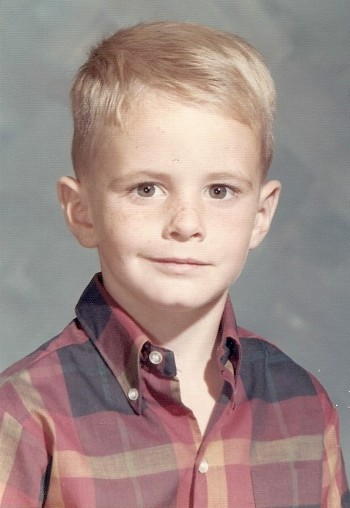 In this original BTB Investigation, we unveil the tragic story of Kirk Murphy, a four-year-old boy who was treated for “cross-gender disturbance” in 1970 by a young grad student by the name of George Rekers. This story is a stark reminder that there are severe and damaging consequences when therapists try to ensure that boys will be boys.
When we first reported on three American anti-gay activists traveling to Kampala for a three-day conference, we had no idea that it would be the first report of a long string of events leading to a proposal to institute the death penalty for LGBT people. But that is exactly what happened. In this report, we review our collection of more than 500 posts to tell the story of one nation’s embrace of hatred toward gay people. This report will be updated continuously as events continue to unfold. Check here for the latest updates.
In 2005, the Southern Poverty Law Center wrote that “[Paul] Cameron’s ‘science’ echoes Nazi Germany.” What the SPLC didn”t know was Cameron doesn’t just “echo” Nazi Germany. He quoted extensively from one of the Final Solution’s architects. This puts his fascination with quarantines, mandatory tattoos, and extermination being a “plausible idea” in a whole new and deeply disturbing light.
On February 10, I attended an all-day “Love Won Out” ex-gay conference in Phoenix, put on by Focus on the Family and Exodus International. In this series of reports, I talk about what I learned there: the people who go to these conferences, the things that they hear, and what this all means for them, their families and for the rest of us.
Prologue: Why I Went To “Love Won Out”
Part 1: What’s Love Got To Do With It?
Part 2: Parents Struggle With “No Exceptions”
Part 3: A Whole New Dialect
Part 4: It Depends On How The Meaning of the Word "Change" Changes
Part 5: A Candid Explanation For "Change"
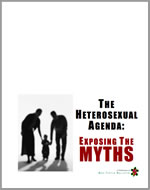 At last, the truth can now be told.
Using the same research methods employed by most anti-gay political pressure groups, we examine the statistics and the case studies that dispel many of the myths about heterosexuality. Download your copy today!
And don‘t miss our companion report, How To Write An Anti-Gay Tract In Fifteen Easy Steps.
 Anti-gay activists often charge that gay men and women pose a threat to children. In this report, we explore the supposed connection between homosexuality and child sexual abuse, the conclusions reached by the most knowledgeable professionals in the field, and how anti-gay activists continue to ignore their findings. This has tremendous consequences, not just for gay men and women, but more importantly for the safety of all our children.
Anti-gay activists often cite the “Dutch Study” to claim that gay unions last only about 1½ years and that the these men have an average of eight additional partners per year outside of their steady relationship. In this report, we will take you step by step into the study to see whether the claims are true.
Tony Perkins’ Family Research Council submitted an Amicus Brief to the Maryland Court of Appeals as that court prepared to consider the issue of gay marriage. We examine just one small section of that brief to reveal the junk science and fraudulent claims of the Family “Research” Council.
 The FBI’s annual Hate Crime Statistics aren’t as complete as they ought to be, and their report for 2004 was no exception. In fact, their most recent report has quite a few glaring holes. Holes big enough for Daniel Fetty to fall through.
“Google” is a trademark of Google Inc.
© Box Turtle Bulletin. All Rights Reserved.
 Posts
Posts  Posts via daily email: