Box Turtle Bulletin
 News and commentary about the anti-gay lobby
“Now you must raise your children up in a world where that union of man and box turtle is on the same legal footing as man and wife…”
News and commentary about the anti-gay lobbyMarch 20th, 2007
Wayne Besen, Executive Director of Truth Wins Out was featured in a segment that aired on Comedy Central’s “The Daily Show” last night. He shared the spotlight with former PFOX president Richard Cohen. You’ve got to see it to believe it.
March 20th, 2007
Note: This post began as a comment I left on Warren Throckmorton’s web site.
Rev. Karen Booth, Executive Director of Transforming Congregations, an Exodus-affiliated ex-gay ministry based in Delaware, left this comment more than a week ago describing her ministry:
My “organization” is not politically involved, so we don’t have the goal of squelching equal rights. In fact, we’re also connected to the United Methodist Church, which takes a strong stand on the rights of the LGBT community.
But then, last Friday Rev. Booth left a comment in a free-wheeling thread on Warren Throckmorton’s web site that led me to look around a little. That’s when I found this on Transforming Congregations’ web site:
TED HAGGARD MASSAGE TABLE ON EBAY
I recently discovered that Mike Jones, the gay prostitute that “outed” Rev. Ted Haggard, is selling his massage table on eBay… Even though Jones claims the proceeds will go to an AIDS charity, this act is reprehensible.
It is very difficult to register a complaint with eBay, and almost impossible to do so through their website… I have sent a message (which follows at the end of this report) that can be used as a model for you to fax eBay with your concerns…
So if Rev. Booth’s ministry is not political, why is she encouraging her supporters to engage in a political act? What exactly does interfering with a charity auction have to do with “equipping the local church” to “meet the needs of confused, trapped and hurting people”?
Later in that same thread on Warren’s site, she returned to taunt everyone there:
BTW – Mike Jones eBay auction was cancelled by eBay. I’m really glad, and hope they got a ton of complaints. Interesting that I didn’t see any criticism of Mike’s action (who was also on the Montel show) in this thread. But then, it’s so much easier to just keep bashing Alan [Chambers].
I spent the rest of the weekend wondering why nobody — myself included — rushed to Mike Jones’ defense. And I guess we all know why, really. He’s a former prostitute.
Sure, it’s salacious and in poor taste for Mike Jones to put his massage table up on eBay for charity. The proceeds of the auction were to go to Project Angel Heart, which “promotes the health, dignity and self-sufficiency of people living with HIV/AIDS, cancer and other life-threatening illnesses by providing nutritious, home-delivered meals with care and compassion.”
Yes, putting the “Ted Haggard massage table” on eBay is in extremely poor taste. Also in poor taste? How about the Sisters of Perpetual Indulgence, who organized some of the first safe-sex messages when official health departments were afraid to touch the subject? They also raised money for home AIDS care, food and housing when nobody else would.
And don’t forget all those leather daddies, also in extremely poor taste and a terrible influence, many of them. They also have a reputation for being among the most generous donors of time, money and talent towards AIDS care at the height of the crisis.
And we cannot forget the Dykes on Bikes, who cleaned apartments, cooked meals and walked the dogs. You get my drift…
Now don’t get me wrong. The Sisters of Perpetual Indulgence deeply offend my Catholic sensibilities. Leather daddies are not my scene — in fact, I find all public displays of sexual fetishes offensive. As for the Dykes on Bikes, I have nothing against them — they just scare the bejeezus out of me.
But Sunday evening, Chris and I had several friends over for dinner, including two gentlemen who had lived in New York City during the early ’80’s, just as the AIDS epidemic was getting started. They reminded us of the abject fear they felt of not knowing what was happening, the feeling that nobody anywhere in the country cared about what was going on, and of course, of attending memorials two or three times a week. Alan said, “it was simply exhausting.”
And I can tell you right now that if you had been in my home Sunday evening, you would have heard nothing but gratitude for everyone — no matter who they were or where they came from — who worked hard and tried to make a difference. You would have heard words of immense gratitude for the Sisters, the Dykes, the daddies, the drag queens — every blessed one of them. They were among the more prominent groups who were key to establishing and funding many of the AIDS service organizations that exist today, organizations which continue to do the hard work that nobody else is interested in. They all did this because nobody else would.
And where was the church during all that? Well, I think we don’t really have re-hash all of that, do we? Everyone knows the answer. Ex-gay author and counselor Joe Dallas gave a powerful, emotional talk at Love Won Out on the church’s shameful failure. He listed the church’s sins of omission as well as its sins of commission. And he concluded that portion of his talk in a thunderous voice, “And they [they gay community] will never forget it!” By the tone of his voice and the look in his eye, he left unspoken the words “… and who can blame them?” He left that part unspoken, but I think everyone there understood it that way anyway.
Rev. Booth, if you really want to know why many in the gay community are not willing to condemn Mike Jones or any of the other “salacious” groups, it’s because when the chips are down, there are still today — twenty-five years later — only two responses: thunderous condemnations or silence on the one hand, or rolling up your sleeves and getting to work on the other.
So today, we have Mike Jones, a prostitute. I’m not going to defend his profession. Not by a long shot. But the folks at New Life Church made the brave decision to embrace him and forgive him. No, not forgive him, thank him for revealing what Ted Haggard was doing.
And if he wants to raise money for a worthwhile AIDS charity, nobody’s going to hear any protest out of me. I’d rather follow Christ’s example and choose the prostitutes over the Pharisees any day.
Update: Rev. Booth responds in the comments. I reply to Rev. Booth at Ex-Gay Watch.
Update: The auction is back up and Rev. Booth has a partial change of heart.
March 16th, 2007
I guess the Rev. Albert Mohler got quite an earful after he green-lighted the “curing” of gay babies before they’re born, should such a treatment be developed. Surprisingly, that earful came from other Evangelicals. For one thing, they don’t like him conceding the mere possibility of a biological factor in the development of sexuality.
But the sin I found most interesting was this one, where he’s chastised for not using their politically-correct language. Rev. Mohler doesn’t buy it:
Some Christians seem absolutely convinced that there is no such thing as sexual orientation. There is a point to be made here. No “orientation” can alter the sinful status of sinful acts. Some have written me to say that there is no such reality as a homosexual, only those who perform homosexual acts. This flies in the face of the Bible, however, which speaks of those who commit such sins by their sin — murderers, liars, adulterers, gossips, etc. It does not help to deny this. But, even though no “orientation” can alter the moral status of actions, the fact remains that some persons are sexually attracted to persons of the same sex while the majority are sexually attracted to persons of the opposite sex. There are other terms to use here, ranging from “sexual attraction pattern” to “sexual arousal profile,” but sexual orientation seems a bit less explicit and is generally understood within the culture.
Much of the problems that I have with Exodus is its utter refusal to speak clearly. I gave you some insight already into their carefully craft language which denies the very concept of sexual orientation. It took about seven pages of material to tell you how Exodus and Focus in the Family described “homosexuals” at Love Won Out. I’m currently working on another long post just to talk about how they use the word “change.” That single word alone will take another seven or eight pages. It shouldn’t be that way. My family heirloom Oxford Universal Dictionary (a gift from my great-great aunt as I left for college), as thorough and comprehensive as it is, dispatched with the job using a mere six inches of text.
Rev. Mohler ends his post with a few comments directed to gays and lesbians, in which he’s most clearly not “on our side.” But I can understand perfectly his apparent impatience with those who insist on using an artificial language that evades clarity and is, in his words, unbiblical.
March 15th, 2007
Rev. R. Albert Mohler, president of the Southern Baptist Theological Seminary in Louisville and one of the nation’s leading evangelical theologians, stirred a hornets nets by calling the bluff of many gay rights advocates who adamantly proclaim that the origins of homosexuality are strictly biological.
Rev. Mohler recently discussed the possible “ram”-ifications of the gay sheep studies taking place at the Oregon Health and Science University and acknowledges that there may indeed be a biological basis for homosexuality. And if this does prove to be a scientific certainty, conservative Christianity would have to respond accordingly — but not in a way that gay rights advocates might have anticipated:
Given the consequences of the Fall and the effects of human sin, we should not be surprised that such a causation or link is found. After all, the human genetic structure, along with every other aspect of creation, shows the pernicious effects of the Fall and of God’s judgment.
The biblical condemnation of all homosexual behaviors would not be compromised or mitigated in the least by such a discovery. The discovery of a biological factor would not change the Bible’s moral verdict on homosexual behavior.
…If a biological basis is found, and if a prenatal test is then developed, and if a successful treatment to reverse the sexual orientation to heterosexual is ever developed, we would support its use as we should unapologetically support the use of any appropriate means to avoid sexual temptation and the inevitable effects of sin.
Well that got him into a lot of hot water around the web. Some raised comparisons to Joseph Mengele and the “Final Solution”. While the comparisons may be extreme, they certainly raise a point. Where are we prepared to go when it comes to the ethical landmines that litter the designer baby debate? Should we eliminate left-handedness, which also may have a prenatal hormone link? Some suggest that lefties have a shorter lifespan. (Others dispute this.) And what about red-heads? They have an increased risk of skin cancer. As do all Caucasians, for that matter. Would we really “do the right thing” and eliminate white skin from the gene pool if we could? From a strictly medical standpoint, all of us really would be better off if we did. Who’s with me here?
These arguments are all well and good, but on a far more practical level, I really don’t think we have a whole lot to worry about. All treatments start out experimentally, and at some point those experiments would have to move toward human experiments. Can you imagine the ethical considerations of performing medical experiments on fetuses which would involve altering the developing brain? After all, that’s what we would be talking about here. Would you subject your child to such an experiment when we don’t know what the consequences might be?
We know that the developing brain is a very delicate thing. From Fetal Alcohol Syndrome, trace amounts of mercury poisoning, and observations of the effects of lead in the atmosphere — these examples and more have shown us that it doesn’t take much to set a baby’s developing brain all akilter. I don’t see how an experimental hormone treatment for pregnant mothers could pass muster with any ethics compliance boards when we have no idea what sort of unintended consequences may come from it. Will the fetus suffer other developmental difficulties? Will the boy grow up to be abnormally aggressive, impulsive or violent? Will the “cure” induce other personality or cognitive problems? We don’t know, And in some cases, we may not know until ten to twenty years after the child is born. Many types of schizophrenia for example don’t become apparent until adolescence.
Rev. Mohler’s comments reveal a troubling trend in how conservative Christianity may incorporate biological theories on the origin of homosexuality. (His controversial views, however, are not surprising. He once called the Roman Catholic Church “a false church” that “teaches a false gospel.”) Nevertheless, the prospect of a medical “cure” is fraught with a lot of very practical difficulties. A “Final Solution” is not on the horizon, and for that we can all take a deep breath and chill a little.
But this episode does go to show how short-sighted it is, for so many reasons, for gay-rights advocates to put all of their eggs into the biological basket. The fact is, we simply don’t know what “causes” homosexuality. And what’s more, except as an exercise of pure intellectual curiosity (a curiosity that I share), we really shouldn’t care. As I said before, our Creater bestowed on us our inalienable rights not because of how we were born, but by the fact that we were born. In our Republic, that must always be the bottom line.
March 13th, 2007
Gen. Peter Pace, chairman of the Joint Chiefs of Staff, told the Chicago Tribune yesterday that he supports “Don’t Ask, Don’t Tell” because homosexual acts “are immoral”:
“I believe homosexual acts between two individuals are immoral and that we should not condone immoral acts,” Pace said in a wide-ranging discussion with Tribune editors and reporters in Chicago. “I do not believe the United States is well served by a policy that says it is OK to be immoral in any way.
“As an individual, I would not want [acceptance of gay behavior] to be our policy, just like I would not want it to be our policy that if we were to find out that so-and-so was sleeping with somebody else’s wife, that we would just look the other way, which we do not. We prosecute that kind of immoral behavior,” Pace said.
Now Gen. Pace is expressing extremely limited regret over his comments:
In a statement Tuesday, he said he should have focused more in the interview on the Defense Department policy about gays — and “less on my personal moral views”.
However, Gen. Pace’s senior staff members who wished to remain anonymous said that the general had no intention of apologizing. Senator John Warner, the senior Republican member of the Senate Armed Services Committee, strongly rebuked Pace’s comments, saying “I respectfully, but strongly, disagree with the chairman’s view that homosexuality is immoral.”
Staff Seargent Eric Fidelis Alva, who is America’s first serious Marine casualty in the Iraq War, responded this way:
“Judging gay men and women in the military for factors unrelated to their fitness to serve undermines our military’s effectiveness. Certain leaders’ bigotry should not be a rational basis for discrimination. This kind of prejudice is going to continue to have a direct impact on our national security as we allow qualified gay men and women to lose their jobs for no good reason. This policy — and General Pace’s bigotry — is outdated, unnecessary and counter to the same American values our soldiers are giving their lives for each and every day.”
So here’s a question that Gen. Pace ought to answer: is Staff Seargent Alva immoral? Alva, you may remember, lost his right leg to a land mine during the early days of the war, and was awarded a Purple Heart from President Bush himself. He also publicly came out as gay three weeks ago and is now the Human Rights Campaign’s spokesman against “Don’t Ask, Don’t Tell.”
Gay men and women are serving this nation with distinction in Iraq, Afganistan and elsewhere. Thousands more want to, but can’t. The Williams Project at UCLA (PDF: 246KB/22 pages) estimated that there are about 65,000 gay and lesbian troops in the US military, and another one million gay American military veterans. The Government Accountability Office found in 2005 (PDF: 1,007KB/50 pages) that of the 9,488 service members who had been discharged since 1993 under “Don’t Ask, Don’t Tell,” about 757 “held critical occupations,” including 322 with “skills in an important language such as Arabic, Farsi or Korean.”
If there is an “immorality” problem, it’s not with those who have served our country. That immorality rests with those who would prefer that we accept convicted felons over proud, brave, and loyal men and women exemplified by Staff Sgt. Alva.
March 13th, 2007
Slow learners, that bunch. Exodus Vice President Randy Thomas is at it again, spreading his total misunderstanding about how hate crimes legislation works. Well, near total anyway. He now acknowledges that hate crimes laws cannot infringe on speech in America, but he’s still worried about some sort of slippery slope effect. But his first two paragraphs are whoppers in cluelessness:
We have been saying that hate crimes laws are inherently unfair in that they punish some crimes more severely against gay people than they would against any other person. If I were attacked, my attacker would get more of a punishment 15 years ago when I identified as gay than they would now that I don’t.
Plus, if a gay identified man or woman attacked me (some have threatened to do just that), they would get less of a sentence than if a truly homophobic person attacked them along the exact same lines.
Rest assured Randy. If anyone were to attack you because of your sexual orientation — regardless of your sexual orientation — then that is a hate crime. When the law reads “regardless of sexual orientation”, it means exactly that. And if you think I’m wrong on this, then please explain why the FBI bothered to count twenty-three anti-heterosexual hate crime incidents in 2005? (2005 is the most recent year for which statistics are available.) I think it’s also important to note that there were 935 anti-White incidents and 58 anti-Protestant incidents during the same year.
These laws aren’t about special protections available only to a select few. They about recognizing that particular types of crimes based on motivation have particular impacts on society. We already distingush between capital murder and manslaughter. Our laws also distingush between ordinary assualt and aggrivated assault. Same with robbery. The law already takes into account the fact that some crimes have a more far-reaching impact than others.
Hate crime legislation simply says that crimes in which victims are singled out by race, sexual orientation, religion or national origin deserve special protection because there is a special history of people being singled out solely for those reasons. And the great thing about it, the proposed legislation recognizes that the tables can always be turned. Which means these protections are extended to your race, sexual orientation, religion or national origin, whatever they may be. Because everyone — yes, even you Randy — deserves to be protected whenever anyone lashes out against them based on their own self-righteous, misguided beliefs.
March 8th, 2007
Editor’s Note: Columnist Paul Varnell, another fan of satire, sent this to me with permission to publish it here. This column originally appeared in the Chicago Free Press on February 28, 2007.
I’ve been wondering what makes people heterosexual. I’ve read what I can find of the research on the origins of heterosexuality — there isn’t much — and no one seems to have any clear idea.
If you ask a heterosexual, he or she will generally deny that they had any kind of choice in the matter. They say that they were just born that way or at least knew at the first stirrings of sexual awareness that they were heterosexual. “It just feels natural,” they say and seem genuinely puzzled that anyone would wonder about it.
But science isn’t so sure. The fact that any phenomenon occurs most of the time is not an explanation of why it occurs. The fact that most stars are hot is not an explanation of why they are hot.
No one seems to have found any genes for heterosexuality. Nor have studies of human brain found anything that impels males to be attracted to females or vice versa. Even that zealous proponent of heterosexuality Sigmund Freud confessed in 1915 that “the exclusive sexual interest felt by men for women is also a problem that needs elucidating and is not a self-evident fact…”
Freud, of course, concluded that heterosexuality was a hard-won achievement that required successfully negotiating a path through a minefield of childhood complexes, identifications, fixations, attachments, transferences and repressions. But so many people nevertheless seem to achieve heterosexuality that his model of a single tortuous pathway scarcely seems credible. So we are inclined to conclude that there are multiple routes to adult heterosexuality.
So it may be useful to offer some speculative hypotheses for future research without claiming certainty for any one of them. (We confine ourselves here to male heterosexuality.)
It is possible for instance that young pre-heterosexual males may become fixated on their mothers as sources of nourishment and care, but, finding as they grow up that an erotic attachment to the mother violates a cultural taboo, they repress their early childhood desires and find a way to transfer their attraction to another female who can more safely serve the same psychological function. The obsession of most heterosexual males for the female breast is well known.
Alternatively, they may become alienated from their mother through resentment against their early dependence on a female. In that case they may repress their resentment but react by seeking out a female who is (or pretends to be) similarly dependent upon them, thus revenging themselves upon the mother figure. Occasional instances of spousal abuse by males may be an example of the “return of the repressed,” offering possible support for this model.
Or it may be that an early identification by the male child with the father as a figure of power and authority combined with the father’s rejection of an overly close attachment (more than 80 percent of fathers are heterosexual) can result in resentment and repression by the pre-heterosexual child and a subsequent inability to relate emotionally and romantically to other males.
This model could help explain the social reproduction of a predominant heterosexuality. It was, after all, Freud himself who observed in 1919 that every human “is capable of making a homosexual object-choice and has done so at some time in his life and either still adheres to it in his unconscious or else protects himself against it by vigorous counter-attitudes.” If so, could this be an explanation for homophobia (“counter-attitudes”) and physical gay bashing?
Or the pre-heterosexual male may develop a resentment against that early paternal source of discipline and punishment. Although he may repress the hostility to the actual father, his resentment may inhibit his ability to feel any romantic and emotional closeness with other males, to whom he transfers his original hostile feelings toward the father figure. Thus either a suppressed desire for or hostility to the father may result in the clinically identical outcome of heterosexuality.
Of course, if a father is neither a source of authority or discipline, a male child may respond to the weak or distant father with disgust and contempt which he may transfer to other males as he encounters them, thus inhibiting his ability to form emotional (pre-erotic) connections with other males. Or if the mother is weak and subservient, the male child may develop feelings of pity and protectiveness that he subsequently transfers to another woman in order to belatedly compensate for his childhood inability to protect his mother.
It will be evident that we have barely scratched the surface of the various parental dynamics that may prompt a heterosexual outcome. Nor have we even touched the role of sibling resentment, rivalry and affection. These must await future exposition.
© Paul Varnell. All rights reserved by the copyright owner. Some of Paul Varnell’s previous columns are available at the Independent Gay Forum.
March 7th, 2007
It seems that everyone, liberal and conservative, has something to day about Ann Coulter’s anti-gay slur she uttered to an overflow crowd at a Conservative Political Action Conference (CPAC):
“I was going to have a few comments on the other Democratic presidential candidate John Edwards, but it turns out you have to go into rehab if you use the word ‘faggot,’ so I — so kind of an impasse, can’t really talk about Edwards.”
Andrew Sullivan had, I think, the best response to her comments. Pam Spaulding did a great job of showing why language like that is so damaging. And I’ve noticed a lot of conservatives also were calling Ann Coulter to task, although that response isn’t uniform. A few have rushed to her defense, and others are upset more because it’s such a bad tactical move than they are with the slur itself.
And so in the midst of all of this — and as I continue to talk about my observations from last month’s Love Won Out conference — I noticed that Alan Chambers, president of Exodus International, wrote this on his blog. He hasn’t been updating it much lately. In fact, I pretty much thought he was letting it go dormant. But today, he broke a nearly four-month hiatus to say this:
We do not need this kind of childish vitriol. We can disagree on politics, legislation, moral issues, whatever, but this is way out of line. Faggot is a word that school bullies and ignorant people use to inflict emotional pain on their victims. Ann Coulter should know better and her friends and those that pay her bills would do well to remind her of that fact.
He followed this with a press release on the Exodus web site:
“Used in any context, this hurtful word is used to demean an individual who is valuable to God. There is nothing to be gained by denigrating others with crude slurs. In doing so, we disgrace ourselves and discredit the truths we seek to publicly elevate.”
Simple. Direct. To the point. Thanks, Alan. You might want to consider speaking up more often. And when you run into PFOX’s Regina Griggs at the next Love Won Out conference in Omaha, maybe you can show her how it’s done.
March 6th, 2007
One of the first phrases that we learned in high school Spanish class was how to say that you like something. In English, it’s a simple three-part sentence: “I like ice cream.” I, the subject, does something, namely, like. And the object of my affection, called the direct object, the thing that receives the action, is the ice cream. It can’t get much simpler than that.
But in Spanish, there is no word for “like.” The word they use instead, gustar literally means “pleases”. So instead of saying “I like ice cream,” I would say, “Ice cream pleases me.” Notice how this turns everything around. In English, if I don’t like something, it’s up to me to explain myself since I am on the acting part of the verb — Why don’t you like it? But in Spanish, if something doesn’t please me, it’s not my problem. You need to look to the ice cream to understand what’s wrong with it.
I’ve often though about that example and wondered if that subtle difference — do we like something or does that something please us? — influences how I see the world around me, and in what ways that influence might be different for someone who’s a native Spanish speaker. If it’s true that language shapes how we view the world — and I join Madison Avenue and political spin doctors in believing this to be true — I thought it might be worthwhile to examine the particular language that I heard at Love Won Out.
For me, attending the Love Won Out ex-gay conference in Phoenix was very much like being an anthropologist on Mars, as Oliver Sacks once put it. I observed a culture with its own vaguely familiar language and customs. And learning its language was key to understanding the framework and worldview from which Love Won Out operated. But as is true with many cultures, it almost requires a total immersion inside the culture of Love Won Out to pick up on the nuances of those terms and customs.
There’s nothing particularly odd about this. Every group of people has its own version of “inside baseball.” And at Love Won Out, much of their dialect is built upon the common theological expressions that are a part of the Evangelical Christian movement. But what was spoken at Love Won Out went beyond the language of Evangelical Christianity. The language of Love Won Out represented a particular dialect of the larger Evangelical Christian culture.
Focus on the Family and Exodus, among others, exercise an amazing degree of message discipline, and they construct their messages differently according to the particular audience they’re addressing. This is why their messages have been so effective. Mike Haley, director of gender issues at Focus on the Family’s Public Policy Division talked about this during a morning plenary session, and he gave a good example of how this lesson might be used:
You know, in the year 2004 when I was doing the research for my book, I found that we spent twenty billion dollars that year in the United States for the work of missions. And what do we do with that money? Well what we do with that money is we take individual’s lives — they are committed to a people group — we set them aside, we support them, we pray for them, we pour money into their lives. We help them get to that people group. We help them study and learn another language often so that they can reach a people for Christ. Those people will take the time out of their own lives and study the social nuances of that people group they want to reach, so that when they become a part of them, they won’t offend them. Instead what they’ll do is they will draw them to Christ.
And my challenge for us is how much money, effort, and energy are we putting in to reaching what one of my friends calls “the unwanted harvest” known as the gay and lesbian community? And there’s some things that we do within the Body of Christ that are incredibly offensive, and let me just offer you one, the use of the phrase, “Love the sinner and hate the sin.” …
And what are we saying ultimately when we use that phrase? Well what we’re saying to someone is “I love you, but I hate what you’re doing.” But you have to see it from a gay person’s perspective. They see themselves as defined by the very thing that they’re doing. So they believe that when you hate what they’re doing, you hate them to their very core. We have got to lose that phrase out of our vocabulary. It does not translate in the marketplace.
I think Mike Haley only has it about half right in explaining why the phrase is offensive, but that’s not the point. The point is really this: you probably haven’t noticed this — because the phrase “love the sinner and hate the sin” is used so often among anti-gay Christians — but it turns out that neither Focus on the Family nor Exodus use this particular phrase much anymore. They’ve moved far beyond “love the sinner and hate the sin,” both in nuance and in sophistication. The sentiment is still very much there, but it’s expressed in a very different way. They are extremely conscious of how words are received by their target audience, no matter who that audience may be. It’s just that their audience is almost never the LGBT community. If it were, you can bet their choice of language would be very different.
Focus in the Family and Exodus have expended a great deal of resources to develop the phrases and the terminology they use. In doing so, they’ve crafted an entire language, complete with its own lexicon and syntax. For example, the terms they used for describing gay people were very different from yours or mine, and Mike Haley’s problem with “love the sin, hate the sinner” provides a glimpse into that difference. Their language is specially designed to treat people and their sexuality as if they were two completely separate entities, as if sexuality were a separate thing outside of the person. As Melissa Fryrear put it in a breakout session, they constantly work to “separate the ‘who’ from the ‘do’,” or, as others have put it more crudely in Mike Haley’s example, “the sinner” from “the sin”.
And since we’re only talking about sexuality and not romantic yearnings or affairs of the heart, this separation of gays and lesbians from their sexuality appears reasonable to Love Won Out attendees. If we included romance, then we would have to introduce such notions of soulmate, the yearnings of the heart, the love of all one’s might — all of these things which involve the whole person, which poets cannot separate and compartmentalize.
But at Love Won Out, gay romance, love or relationships are treated as evidence of a pathology. Dr. Joseph Nicolosi, president of NARTH (the National Association for Research and Treatment of Homosexuality), describes gay relationships in men as an attempt to capture the masculinity of another man that is missing in oneself because his own sense of masculinity is broken. This reduces all notions of romance to “a reparative drive.” He sums it up later in a breakout session by saying, “Heterosexuality is complementary, homosexuality is compensatory.”
Since homosexuality is seen as something that “happens” to someone due to poor parenting, sexual abuse and other factors, then it’s not the child’s fault. When they boy grows up, he tries to “fill” his damaged masculinity with other men. Similar explanations are offered for lesbians. Following this lead, Alan Chambers, president of Exodus, and Melissa Fryrear of Focus on the Family both refer to gay relationships as an “illegitimate way of meeting a legitimate need.”
Another way of saying this then, is that the problem is not that I, as a gay man, like other men. The problem is that other men are pleasing to me. Using language to separate the person from his or her sexuality is one of the most important concepts in Love Won Out’s dialect.
Since the language of Love Won Out represents a distinct dialect of Evangelical Christianity, the first order of business for the day was to teach us the elements of that dialect. First up was Dr. Nicolosi. He began his talk by proclaiming that “there is no such thing as a homosexual.” Knowing this was a head-scratcher to most people there, he repeated it again: “There is no such thing as a homosexual… He is a heterosexual, but he may have a homosexual problem.”
So here’s the first lesson: the words “gay,” “lesbian,” and “homosexual” aren’t nouns; they’re adjectives. And even as an adjectives they are never used to describe a person. There are no gay teenagers, there are no homosexual men, there are no lesbian women. Instead these adjectives are always used as modifiers to something else: a problem, a struggle, an identity, or an issue that is separate from the person. This is important because it’s very different from how these terms are normally used in the broader culture. It is also very different from how these terms are used even by other anti-gay activists.
If this sounds confusing, believe me, I felt the same way during the first few hours that morning. These words and phrases sounded odd or stilted — as is true with the first words we learn in any new language. But by hearing them repeated over and over in the very particular ways they were used, they started to become second nature. By the second hour, their “oddness” started to wear off and by the time the conference was over, it was easy to forget that these words could be used any other way.
All of the speakers at Love Won Out clung to this grammar with incredible consistency, reflecting a highly evolved discipline that comes from discovering the particular phrases that have had an impact in the past, and sticking with them from then on. And if a speaker somehow slipped up and use these words “incorrectly,” he was usually very quick to correct himself — as Nicolosi did during his breakout session, “Prevention of Male Homosexuality” later that afternoon:
From our own case studies, we see three types of fathers who are the fathers of homosexual men… Again, when I say “homosexual,” I don’t mean he’s intrinsically homosexual. He’s a heterosexual with a homosexual problem…”
You see, he almost used the word “homosexual” as an adjective to describe men — a no-no in Love-Won-Outeese. Slip-ups like this happened occasionally — Mike Haley did the same thing when he used the phrase “gay person” in my earlier example — but they were rare.
So having laid this groundwork, it’s time for me to give you some real examples of how this worked. Love Won Out speakers had very specific ways to describe gays, lesbians, and anyone else who experienced sexual and/or romantic attractions for others of the same sex. (Bisexuals and transsexuals were largely left out of the discussions.) Generally speaking, these descriptions fell into four broad categories, and each category was described using adjectives to reinforce the separation of “the ‘who’ from the ‘do’.”
The definition for this group was rather unclear. Mostly, this expression was used to describe someone who experienced “unwanted same-sex attractions”, another phrase that made an occasional appearance. (Alan Chambers often went even further in separating the “who” from the “do” by using the phrase, “those who struggle with the issue of homosexuality,” making homosexuality itself even more abstract.) For the most part, “those who struggle with homosexuality” described anyone who believed that homosexuality was wrong, but found themselves to be sexually attracted to others of the same sex.
But the odd thing about “those who struggle with homosexuality” is that believing that homosexuality was wrong wasn’t always a requirement to be a part of this category. This mean that those who “struggle with homosexuality” sometimes included relatives of conference attendees — sons, daughters, nieces, nephews, and so forth — who weren’t at the conference and most likely weren’t struggling at all — including gay friends and family members who were completely out to their family and coworkers, often in relationships, and who felt no conflict about their sexuality. Many comments were addressed to parents (“If your son or daughter is struggling with homosexuality…”) that assumed that being gay required that there be a struggle. If my mother had attended the conference, she might have understood that I was among those they were talking about when they talked about those who were “struggling with homosexuality.”
But if the conference speakers were really careful, they might concede that I’m not struggling. They would instead put me into the second group where I would be described as “gay-identified.” (A woman would be “lesbian-identified.”) Again, notice the separation of the “who” from the “do.” I’m not gay, I just have a gay identity. I am, at most, gay-identified. All notions of intrinsic orientation, healthy relationships or romantic attachments were ignored, except as aspects of pathology. And if indeed there is no such thing as a homosexual, then it must also be true that there no such thing as a gay or a lesbian. Our identity is just something like a coat that we put on, a coat that can be taken off as well.
Anyone who is “struggling with homosexuality” is seen as being at a crossroads of sorts, and there are two directions he or she may go from there. One direction is to accept the “Biblical sexual ethic” and begin a “journey out of homosexuality.” Failing that, the other direction is to fall into the world of the “gay-identified” or “lesbian-identified”.
This second option, of course, is considerably more tragic since the “gay-identified” and “lesbian-identified” were generally regarded as less reachable. Because they were “gay-identified,” they were, by definition, involved in the gay community and the gay “lifestyle” — a lifestyle that was fraught with all sorts of dangers and misery: sexual addictions, drug addictions, emotional addictions, impossible relationships that never lasted. The idea that gays and lesbians could be satisfied, happy and stable was a foreign concept to Love Won Out. And just as there are tribes in the tropics that have no word for snow, Love Won Out spoke no words to describe people who didn’t fit their notions of someone who was “gay-identified.”
When someone who is “struggling with homosexuality” decides he or she doesn’t want to be “gay-identified”, then that person is said to have embarked on a “journey out of homosexuality.” This is where the poorly-defined concept of “change” comes in. This “change” was much talked about, but never really defined except in its most important aspect: a new identity in Christ.
Exodus sometimes provides something of a non-religious public face, although that face is never entirely a secular one. Focus on the Family, however, is unabashedly evangelical in the public stage. At Love Won Out, both groups were free to be who they really are with the like-minded audience. Everyone who spoke did so from a plainly religious perspective. Even Joseph Nicolosi, the “secular scientist” closed his plenary session on male homosexuality saying, “When we live our God-given integrity and our human dignity, there is no space for sex with a guy,” and arguing that “good psychology is compatible with good theology.” Melissa Fryrear’s personal story (known as a “testimony” in evangelical circles, and was labeled as such on Love Won Out’s published agenda) was not so much a clinical struggle to change her sexual feelings as it was an unabashedly emotional religious transformation.
And this appears to really be the only transformation that matters. As the day wore on, it became clear that Love Won Out wasn’t there just to convince us that gays and lesbians needed to become heterosexuals. The goal was actually much, much higher. Mike Haley alluded to it earlier when he described gays and lesbians as “the unwanted harvest.” In his personal testimony that morning, he attributed his “journey out of homosexuality” and, ultimately, his marriage and career to an irrevocable calling from God. Alan Chambers reinforced the religious theme by repeating that “the opposite of homosexuality isn’t heterosexuality. It’s holiness.” And throughout the day, everybody thanked the Lord, prayed with and for one another, and supported each other through Scripture and fellowship.
Love Won Out wasn’t a tent revival meeting, nor was it a day-long church service. But it was a day-long series of seminars that were firmly rooted in the theology of evangelical Christianity with Dr. Nicolosi providing scientific cover. As such, the “journey out of homosexuality” isn’t a journey from one sexual orientation to another, it’s a journey toward accepting Jesus Christ as Savior, and with that, the faith that with Christ, all things are possible from there, including inclusion in the fourth group.
Several of the speakers at Love Won Out placed described themselves as having either “left homosexuality,” “walked away from homosexuality” or having “found freedom from homosexuality” — as if they had been released from prison, as one commenter put it. (My favorite was “walked away”, as if someone had just stepped out for a coffee.) And indeed, the testimonies of those who “found freedom” followed the familiar trajectory of all great salvation stories, of having been lost but now found.
The stories began in the misery of “struggling with homosexuality”, the misery that presumably was a common experience of everyone who “struggles,” including the “gay-identified” — a misery of broken relationships, of drug and alcohol abuse, of sexual abuse and absent fathers or mothers, and a misery of an unrelenting longing for something that is clearly missing from their lives, that their “reparative” impulse was unable to fill.
But at the end of these stories comes triumph. After all, it’s theologically impossible for a story to end otherwise after having put their faith in Jesus Christ. And evidence of that triumph was often found in references to wives and children. As far as the audience was concerned, what better proof is there that they had “left homosexuality behind?” Mike Haley’s testimony closed with a wedding photo and pictures of his beautiful children. (And his children really are adorable. No wonder he’s such a proud husband and father.) Joe Dallas and Alan Chambers also spoke of their wives and families. The only speaker who “left homosexuality” but wasn’t married was Melissa Fryrear. Since she didn’t have any wedding photos or adorable children to talk about, she was reduced to describing what her ideal man would look like — “tall, red-headed, looks good in a kilt!” — while joking, “Is it hot in here?”
And while these speakers mentioned the wives and children that came along after they “found freedom”, they were just as cautious to discourage the idea that anyone should get married to either prove they were no longer gay, or to hasten their “journey out of homosexuality.” Alan Chambers and Melissa Fryrear in particular warned against that during their breakout sessions as they described the dangers this brings to the spouses of “those who struggle with homosexuality.”
And yet, every good story has to have a happy ending. And as far as Love Won Out is concerned, that happy ending comes only after accepting Jesus as Savior, and through that, finding “freedom from homosexuality” — whatever that freedom may mean.
In the end, the dialect of Love Won Out actually served not just one, but two purposes: to separate the gay and lesbian from his or her innate sexuality, and to deliver that person to Christ. Or more accurately, the goal of Love Won Out was to encourage the pastors, teachers, youth group leaders, parents, and other relatives and friends to bring the message of redemption through Christ to their gay and lesbian loved ones, since so few people who were “struggling with homosexuality” were actually there.
From a faith standpoint, this is all well and good. Christ’s Great Commission was to spread the Good News of the Gospel to all the corners of the earth. It’s hard to expect that a Christian organization would not evangelize, or that they would discourage others from doing so — especially where wayward family members are concerned.
And if an Evangelical Christian was truly struggling with his or her homosexuality, there is, all too often, a stark choice which must be made: to either embark on the long “journey out of homosexuality” and find acceptance in the Evangelical community, or to forsake that community and join the ranks of the “gay-identified.” As far as Love Won Out is concerned, there is no other way.
Life is full of choices, and each choice brings rewards and consequences. We don’t choose our sexuality — everyone at Love Won Out was in full agreement on that. But we do have a choice in how we deal with our sexuality in our daily lives. If someone concluded that the best thing for them was to join an ex-gay ministry to conform their behavior with their religious beliefs, then that is their right.
But most of those who attended Love Won Out weren’t in the position of making that decision. They were there to try to figure out how to convince their brothers, sisters, sons and daughters to make that decision. And since their loved ones didn’t appear to be interested in such a decision — most of them weren’t there after all, except for a few teenagers dragged there by their parents — I’m not sure ultimately what useful purpose Love Won Out served, except to offer some sort of hope to the families and friends of gays and lesbians.
But what kind of hope is it? Is it grounded in realistic expectations? Did they get a better perspective on the possibility of change? Did the friends and relatives leave that conference any better equipped than they were when they arrived that morning?
Given Christianity’s mission to proclaim the Truth with a capital “T,” it’s fair to ask how much of these “truths” with a small “t” we learned at Love Won Out are really true. I will explore that some more next week with the meaning of “change”.
Prologue: Why I Went To “Love Won Out”
Part 1: What’s Love Got To Do With It?
Part 2: Parents Struggle With “No Exceptions”
Part 3: A Whole New Dialect
Part 4: It Depends On How The Meaning of the Word “Change” Changes
Part 5: A Candid Explanation For “Change”
March 5th, 2007
I’d like to thank everyone for your comments on my four questions I was quite surprised and gratified at how many of you took the time to answer the questions thoughtfully and honestly.
I posed those questions because the terms that I quoted were used quite heavily at Love Won Out. I knew how those terms were understood by those who attended that conference, but I wanted to get a sense of whether those same terms are understood the same way generally. The answers you provided seem to come from a pretty wide range of perspectives and backgrounds, but for the most part, they generally agree — although “homosexual” as a noun carries an awful lot of baggage on both sides for different reasons.
The thing I was trying to assess was whether the phrases they used, many of which are quite euphamistic, were deceptive or not. For the most part, they’re not — at least according to your responses. Whether these terms are complete or whether they reveal more than they conceal is another matter and subject to debate. But by themselves, and in the very limited context in which I presented them, it appears that your interpretations broadly match those of the participants at Love Won Out. But it’s the nuances — especially those surrounding the first one, “homosexual” that are key.
I’ll talk more about that in another post in a day or two. But you’ve helped give me some direction on where to go on it, and for that, many thanks.
And if you haven’t had a chance to comment or if you have more to say about it, please feel free do so.
Update: Something else I should add. The word “change”, for the most part, was understood more or less the same way by commenters here and many of those who attended Love Won Out — but with a twist that most non-Evangelicals miss. Surprised? I was too. I’ll have more on that next week.
Update and Clarification: I think I see a point of confusion in some of the comments. The confusion is my fault. I’m really only talking about how these terms were used at Love Won Out, and whether the terms conveyed by the speaker 1) match how that audience interpreted the term and 2) match how we would interpret the terms. I’m not talking about how they are used by Exodus or Focus on the Family elsewhere. Nor am I talking about how any other ex-gay groups use these terms.
March 4th, 2007
My next essay on Love Won Out is a study of how they use language to describe homosexuality, the process of change, and the result of that change. In preparation, I’d like to ask you to take a few moments to answer these questions in the comments:
I would appreciate your serious answers to these questions. This will be the theme of my next Love Won Out essay.
And by the way, no fair looking at everyone else’s answer before you give yours. Besides, as they like to say, there are no right answers.
Part 2: Parents Struggle With “No Exceptions”
Part 1: What’s Love Got To Do With It?
Prologue: Why I Went To “Love Won Out”
March 1st, 2007
When I was in Phoenix for Love Won Out on February 10, I had the distinct pleasure of meeting Rene Gutel of Phoenix’s NPR affiliate KJZZ (a great nighttime Jazz station, by the way!). Her coverage of the conference aired last week, which I somehow managed to miss. You can hear the KJZZ report here.
Since then, NPR’s All Things Considered picked up her report last night and gave it a national audience. You can hear the national report here. Although they are two different links, it sounded to me as if the two reports were basically the same. (I’m providing both in case one of them should go dark.)
For those who are unable to hear the report, NPR has an accompanying write-up. While it’s not exactly a transcript, it’s matches the audio report pretty closely.
Part 2: Parents Struggle With “No Exceptions”
Part 1: What’s Love Got To Do With It?
Prologue: Why I Went To “Love Won Out”
February 28th, 2007
 Marine Staff Sgt. Eric Alva, became the first American to be injured during the invasion of Iraq when he stepped on a land mine and lost his leg in the explosion. As he was recovering at Bethesda Naval Hospital, he was visited by President George Bush, first lady Laura Bush, and Defense Secretary Donald Rumsfeld. None of then knew that Staff Sgt. Alva was gay.
Things today are considerably different. Staff Sgt. Alva will stand alongside Rep. Marty Meehan (D-MA) as a bipartisan group of Congressional representatives introduce legislation to overturn “Don’t Ask, Don’t Tell”:
He imagines conversations with the political opponents he knows he will now face.
“‘OK buddy,'” he said, “‘you pick up a gun and you go fight in Iraq or Afghanistan for a while, then you could come back and we can have a talk because I’ve actually sacrificed, I’ve actually done duty and served in this country for your rights and freedom.'”
Even though Staff Sgt. Alva served under “Don’t Ask, Don’t Tell”, he felt comfortable enough around many of those he served with the share his life with them:
“I told tons of people,” he said, with a laugh. “A lot of my friends, my buddies, my closest Marines, people I had served in combat with. Straight guys, married, with children and everything, three of them which I have become their sons’ godfather now. Everybody was just respectful and was just like ordinary. ‘That’s it? That’s your big news?'”
The Government Accountability Office found in 2004 that of the 9,488 service members who had been discharged since 1993, approximately 757 “held critical occupations”, including 322 with “skills in an important language such as Arabic, Farsi or Korean.”
Critics argue that “Don’t Ask, Don’t Tell” is necessary for “unit cohesion”, an argument that falls apart not only in Alva’s experience, but also according to a recent Zogby International poll of current and former military service members. This data shows that the current policy on gays and lesbians in the military not only harms military cohesion and unit effectiveness, it is also having a serious impact on our nation’s ability to attract and retain some of the most important skills this country needs right now.
Our soldiers, sailors and air personnel all deserve the best. Staff Sgt. Alva lost his leg and became the first American to be seriously wounded in Iraq. He has been recognized as a credit to the corps. He deserves no less than to have America stand beside him and everyone else who is serving our country and sacrificing so much.
February 28th, 2007
Andrew Anthos, the 72 year old gay man who was beaten after getting off a bus Feb. 13 in Detroit, will be laid to rest this afternoon. The attack left him paralyzed from the neck down, and he died last Friday from those injuries. His killer has not been found. State Senator Hansen Clarke (D-Detroit) will do what he can to see that Anthos did not die in vain:
Clarke said Tuesday he will introduce the hate crime legislation in the next couple of weeks. He also will talk to Capitol officials to make sure that Anthos’ desire to get the Capitol dome lit will come true.
“I believe Mr. Anthos death will be a watershed,” said Clarke, who was a co-sponsor of similar hate crime legislation that didn’t pass last year. “It’s going to be successful.”
When I attended the Love Won Out conference in Phoenix on February 10, the question of hate crimes legislation came up in a Q&A session. Alan Chambers, President of Exodus International, and Mike Haley, of Focus on the Family both stated their opposition to hate crime enhancements for violent crimes like this one, characterizing it as an attack on freedom of speech. This, of course, is nonsense. Hate crimes legislation targets violent crime, not speech. Our First Amendment — the very same First Amendment that permitted neo-Nazis to march in Skokie, Ill., and allows the Klan to hold rallies wherever they feel like it — will always permit Exodus and Focus to say, print, and broadcast whatever they want.
But I was pleased to hear Mike Haley close that discussion on what I believed to be a somewhat positive note:
I think, too, we also have to be just as quick to also stand up when we do see the gay and lesbian community being come against as the Body of Christ. We need to be the first to speak out to say that what happened to Matthew Shepard was a terrible incident and should never happen again. And that we within the Body of Christ are wanting to protect that community and put our money where our mouth is…
While I thought that was a very positive sentiment at the time, it appears now that it was just an empty platitude. Andrew Anthos was attacked just three days later. There was no comment from either Exodus or Focus on the Family.
Ten days after that, Andrew Anthos died. Again, the Body of Christ — at least that portion of it represented by Focus on the Family and Exodus — has not spoken out.
Today, two full weeks after he was beaten with a metal pipe and left paralyzed in the cold Detroit snow, Andrew Anthos is being laid to rest. The silence from Focus on the Family and Exodus is deafening.
Now let me be clear. I don’t believe for one second that there is anyone at Focus on the Family or Exodus who feels anything but profound sorrow for Andrew Anthos’ brutal death. But I can’t help but notice that in the very same week when Focus had a chance to reach out to the gays and lesbians that they professed to love at Love Won Out, they chose instead to scour the Internet and find an extremely obscure, unpublished, non-peer-reviewed study — from China, of all places — to figuratively bash gays and lesbians here at home.
So this begs the question: Does Focus on the Family and Exodus say one thing to their Evangelical base and something else to the rest of us? Mike Haley’s right. They need to put their money where their mouth is. Unfortunately, I’m afraid that’s exactly what they did.
I’ll share my observations on how they tailor their messages based on their audience in greater detail next week. Meanwhile, you can see a few examples of that in action in the latest video from Ex-Gay Watch.
February 27th, 2007
Wayne Besen of Truth Wins Out has announced the launch of a new web site called Respect My Research:
In a new trend, several researchers have come forward this year to say that Focus on the Family has distorted or exaggerated their work. www.RespectMyResearch.org features six such esteemed scientists who were “mortified” when they learned how Focus on the Family leader James Dobson cravenly manipulated their findings. The new website contains exclusive Truth Wins Out videos interviewing these professors. Letters from scientists, obtained by Truth Wins Out, are also posted asking for Dobson to either stop using their work or to accurately portray their studies.
It looks like this will be a great resource for those researchers who are willing to speak out when their own research is distorted for political purposes. It should also be a great resource for everyone else.
Featured Reports
 In this original BTB Investigation, we unveil the tragic story of Kirk Murphy, a four-year-old boy who was treated for “cross-gender disturbance” in 1970 by a young grad student by the name of George Rekers. This story is a stark reminder that there are severe and damaging consequences when therapists try to ensure that boys will be boys.
When we first reported on three American anti-gay activists traveling to Kampala for a three-day conference, we had no idea that it would be the first report of a long string of events leading to a proposal to institute the death penalty for LGBT people. But that is exactly what happened. In this report, we review our collection of more than 500 posts to tell the story of one nation’s embrace of hatred toward gay people. This report will be updated continuously as events continue to unfold. Check here for the latest updates.
In 2005, the Southern Poverty Law Center wrote that “[Paul] Cameron’s ‘science’ echoes Nazi Germany.” What the SPLC didn”t know was Cameron doesn’t just “echo” Nazi Germany. He quoted extensively from one of the Final Solution’s architects. This puts his fascination with quarantines, mandatory tattoos, and extermination being a “plausible idea” in a whole new and deeply disturbing light.
On February 10, I attended an all-day “Love Won Out” ex-gay conference in Phoenix, put on by Focus on the Family and Exodus International. In this series of reports, I talk about what I learned there: the people who go to these conferences, the things that they hear, and what this all means for them, their families and for the rest of us.
Prologue: Why I Went To “Love Won Out”
Part 1: What’s Love Got To Do With It?
Part 2: Parents Struggle With “No Exceptions”
Part 3: A Whole New Dialect
Part 4: It Depends On How The Meaning of the Word "Change" Changes
Part 5: A Candid Explanation For "Change"
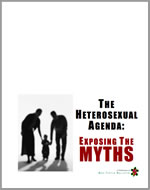 At last, the truth can now be told.
Using the same research methods employed by most anti-gay political pressure groups, we examine the statistics and the case studies that dispel many of the myths about heterosexuality. Download your copy today!
And don‘t miss our companion report, How To Write An Anti-Gay Tract In Fifteen Easy Steps.
 Anti-gay activists often charge that gay men and women pose a threat to children. In this report, we explore the supposed connection between homosexuality and child sexual abuse, the conclusions reached by the most knowledgeable professionals in the field, and how anti-gay activists continue to ignore their findings. This has tremendous consequences, not just for gay men and women, but more importantly for the safety of all our children.
Anti-gay activists often cite the “Dutch Study” to claim that gay unions last only about 1½ years and that the these men have an average of eight additional partners per year outside of their steady relationship. In this report, we will take you step by step into the study to see whether the claims are true.
Tony Perkins’ Family Research Council submitted an Amicus Brief to the Maryland Court of Appeals as that court prepared to consider the issue of gay marriage. We examine just one small section of that brief to reveal the junk science and fraudulent claims of the Family “Research” Council.
 The FBI’s annual Hate Crime Statistics aren’t as complete as they ought to be, and their report for 2004 was no exception. In fact, their most recent report has quite a few glaring holes. Holes big enough for Daniel Fetty to fall through.
“Google” is a trademark of Google Inc.
© Box Turtle Bulletin. All Rights Reserved.
 Posts
Posts  Posts via daily email: