Box Turtle Bulletin
 News and commentary about the anti-gay lobby
“Now you must raise your children up in a world where that union of man and box turtle is on the same legal footing as man and wife…”
News and commentary about the anti-gay lobbyPosts for 2009
May 27th, 2009
Many politicians duck and weave whenever “the question” comes up. But not Steve Kornell. He’s running for city council in St. Petersburg, Florida. He was asked a three part question at a community forum: 1) are you gay? 2) how will that affect your ability to do your job? and 3) will you be persuing a gay agenda? This was his response:
That’s a fair question, and I’m happy to answer it. First of all let me say I believe that if I’m going to be your city council member, that I need to be open and honest completely about everything. And how can I do that if I can’t be open and honest about who I am? And so the answer to that is yes.
But what I’m going to tell you is also that in those five months that I have walked door to door, nobody has asked me that question. But they have asked me about juvenile crime, they have asked me about what are you going to do to creat jobs for our citizens, what are you going to do to protect our coast. And those are the issues I’m going to focus on.
I’ve been in this community twenty-three years working, almost my entire life I’ve been in this community. People know me well. When I go on city council I will bring openness and honesty onto the city council. And so those are the issues I’m going to talk about. Those are the issues that are going to matter to the citizens of St. Petersburg. So I think that’s a fair question, and that’s my answer.
May 27th, 2009
I welcomed conservative Attorney Theodore Olson’s eagerness to try to overturn Prop 8 in federal court. But when I wrote that, I only addressed the fact that even conservatives are coming around to the idea that discrimination is fundamentally un-American.
What I didn’t address was the wisdom of trying to bring about change in the courts, especially when this particular tactic has almost no chance for success. I don’t think it’s wise to proceed in the courts. Eight prominent LGBT organizations agree:
In response to the California Supreme Court decision allowing Prop 8 to stand, four LGBT legal organizations and five other leading national LGBT groups are reminding the LGBT community that ill-timed lawsuits could set the fight for marriage back. The groups released a new publication, “Why the ballot box and not the courts should be the next step on marriage in California” (PDF: 70KB/3 pages). This publication discourages people from bringing premature lawsuits based on the federal Constitution because, without more groundwork, the U.S. Supreme Court likely is not yet ready to rule that same-sex couples cannot be barred from marriage. The groups also revised “Make Change, Not Lawsuits” (PDF: 105KB/7 pages). which was released after the California Supreme Court decision ending the ban on marriage for same-sex couples in California. This publication encourages couples who have legally married to ask friends, neighbors and institutions to honor their marriages, but discourages people from bringing lawsuits. [Hyperlinks added]
I tend to agree. The problem though is this: the LGBT movement has never been a monolith. Unlike the caricature painted by our opponents, there really has never been a behind-the-scenes entity to dictate a coordinated strategy. Advancement has been a messy process, at the ballot box, in the legislatures and in the courts.
But the whole reason that we have courts is they are the ones charged with dispensing justice for those with legitimate grievances. And when someone has a legitimate grievance, it’s hard to argue that they should not exercise their constitutional right to their day in court. This true whether that grievance is against negligent employer operating an unsafe work environment, a drunk driver whose recklessness resulted in the death of a loved one, or a state with discriminatory laws.
But I do think that the LGBT advocacy groups’ advice is what we need to heed now (PDF: 70KB/3 pages):
Rather than filing premature lawsuits, we need to talk to our friends, family and neighbors, and help them understand why denial of the freedom to marry is wrong. We need to build a vigorous, aggressive campaign to overturn Prop 8 and restore the freedom to marry in California. This is the moment to convince California and America that we should have the freedom to marry.
I hope Mr. Olson will consider deploying his considerable legal talents to help us win in other ways.
May 27th, 2009
The California Supreme Court’s decision yesterday centered not on a single question, but a few. Of the challenges to Prop. 8, the most salient was the procedural question of whether the effect of Prop. 8 was “big enough” to constitute a revision of the equal protection clause. I discuss the three issues the court considered as well as some related questions.
QUESTION 1: The judges were asked to decide whether Prop. 8 modified equal protection substantively enough to constitute a revision. Basically, the state’s Supreme Court found that NO, Prop. 8 did not constitute a fundamental revision of equal protection, which requires passage by the legislature and a public referendum, and therefore could stand as an amendment.
Instead, the measure carves out a narrow and limited exception to these state constitutional rights, reserving the official designation of the term “marriage” for the union of opposite-sex couples as a matter of state constitutional law, but leaving undisturbed all of the other extremely significant substantive aspects of a same-sex couple\’s state constitutional right to establish an officially recognized and protected family relationship and the guarantee of equal protection of the laws.
The court is pointing out here that the only thing at stake here is the term “marriage.” Gays and lesbians retain all the rights granted by marriage in the state as articulated in In Re Marriage Cases, the decision which overturned the statutory ban on gay marriage last May. The court’s previous decision also elevated protections for gays and lesbians to the level offered to blacks and women; these protections, too, remain intact.
The passage of Prop. 8 has, according to the justices, “minimal effect on the governmental plan or framework of California that existed prior to the amendment” and therefore cannot be considered a revision to the state constitution. The judges relied heavily on this criteria — effect on governmental framework — in deciding that Prop. 8 was not a revision. They also considered the “qualitative” effect of Prop. 8 — how it affected the nature and credibility of the constitution — but fell back on the “qualitative” question of its concrete effects in deciding the matter.
Can rights be taken away by a simple majority vote?
The short answer is, yes. There have been many instances in which the California Supreme Court allowed a fundamental right to be altered in some way because of an amendment. For instance, after the court found in 1972 that the death penalty constituted “cruel and unusual punishment,” voters reinstated it by using a ballot measure. One point the justices brought up was that there have also been many instances in which a right was extended by amendment — why then, they reason, could it not be curtailed?
As many commentators have pointed out, the amendment process in California is liberal as compared to other states, which is part of the reason why hundreds of amendments to the state constitution (as opposed to 27 for the U.S. Constitution) have been enacted. More importantly, the justices pointed out, the California Constitution has no provision in it preventing an amendment that revises fundamental rights. Massachusetts, on the other hand, does; you can’t revise the state constitution’s Bill of Rights. It would also be another thing if we were talking about the U.S. Constitution.
It’s important to keep in mind that the constitutional structure of California government in part constrains what the judges can rule in favor of; unlike other state constitutions, California’s does little to stand in the way of majority rule. Even gay legal advocates thought this was a long shot.
Is this like “separate but equal”?
Yes and no. Many BTB readers have commented on how this decision is reminiscent of the “separate but equal” decision that allowed segregation to continue. I think it’s important to note that the right in question here is not really equivalent in scale to segregation. We are not talking about separate public accommodations — we’re talking about the right to a label, which, while culturally and politically significant, does not approach the rights in question in Plessy v. Ferguson. I am not saying I think the decision is just or fair, only that comparing it to “separate but equal” strikes me as a bit hyperbolic.
A larger question is whether we should be concentrating our efforts on the symbolic “civil unions” vs. “marriage” distinction when millions of gays and lesbians can still be legally fired for being gay, cannot adopt children, and have no rights comparable to those offered by marriage or civil unions in places like California.
QUESTION 2: The second argument the justices considered was whether Prop. 8 violated the “separation of powers” by allowing the electorate to decide on a matter already settled by the courts. The justices rejected this argument outright, saying that the California Constitution “explicitly recognizes the right of the people to amend their state Constitution.”
This argument was even more of a long shot than the first. It was basically saying that the electorate “usurped” the power of the judiciary.
QUESTION 3: The final question the judges considered was not proposed by Lambda Legal, which brought the case to the court, but by the state’s Attorney General. He argued that certain rights enshrined in the state constitution are “inalienable” and “not subject to ‘abrogation.'” Again, the justices fell back on the fact that the state constitution does not explicitly designate certain rights as such, as opposed to other constitutions that do.
The court’s decision is of course a personal regret, but I think the moral question of whether this is, in a sense, “right” is different from the legal question of whether Prop. 8 could be overturned. It is telling that the justices voted 6-1 in favor of upholding Prop. 8, though for the dissenting opinion one can look to the decision here (it’s at the end).
May 27th, 2009
The Associated Press is reporting:
Two of the nation’s top litigators who opposed each other in the Bush v. election challenge in 2000 have joined forces to seek federal court intervention in California’s gay marriage controversy. Theodore B. Olson and David Boies have filed a U.S. District Court lawsuit on behalf of two gay men and two gay women, arguing that the California constitutional amendment eliminating the right of gay couples to marry violates the U.S. constitutional guarantee of equal protection and due process.
That’s right. Teaming up to fight Prop 8 in the Federal Courts are two lawyers, one of which fought hard to put President George W. Bush in the White House, and one who fought just as hard to try to keep him out. Theodore Olson went on to become Bush’s Solicitor General.
Olson may seem like an unlikely person to tackle a quixotic attempt to overturn Prop 8 in federal court (I don’t think it stands a whisper of a chance), but Olson seems committed. This is what he told the Washington Examiner:
“I personally think it is time that we as a nation get past distinguishing people on the basis of sexual orientation, and that a grave injustice is being done to people by making these distinctions,” Olson told me Tuesday night. “I thought their cause was just.”
I asked Olson about the objections of conservatives who will argue that he is asking a court to overturn the legitimately-expressed will of the people of California. “It is our position in this case that Proposition 8, as upheld by the California Supreme Court, denies federal constitutional rights under the equal protection and due process clauses of the constitution,” Olson said. “The constitution protects individuals’ basic rights that cannot be taken away by a vote. If the people of California had voted to ban interracial marriage, it would have been the responsibility of the courts to say that they cannot do that under the constitution. We believe that denying individuals in this category the right to lasting, loving relationships through marriage is a denial to them, on an impermissible basis, of the rights that the rest of us enjoy…I also personally believe that it is wrong for us to continue to deny rights to individuals on the basis of their sexual orientation.”
This is huge. Olson is as conserviative as they come. As John Aravosis at AmericaBlog points out, Olsen much more than a mere Bush White House operative (Warning: noisy ads at AmericaBlog):
He was a member of the board of the American Spectator, the magazine that investigated Bill Clinton in the early 90s, and got that entire ball of wax rolling. Olson was the guy who was so conservative that Harry Reid torpedoed Bush’s desire to make Olson Attorney General after Gonzales. Olson is so conservative that Bob Novak (aka Novakula) called him “highly esteemed.”
It just goes to show, you never know where our allies will come from next. It’s also the best example I can think of to remember that the hard work of dialog with those who oppose us is a worthy effort. And if there was ever reason to be optimistic about where we’re headed, this is another one. Olson joins John McCain’s chief strategist Steve Schmidt and McCain’s daughter Meghan as outspoken supporters for marriage equality.

(via Towleroad)
And all of this of course begs raises the question: where are Obama and the Democrats?
May 27th, 2009
LGBT civil rights pioneer Phyllis Lyon, along with her partner Del Martin, helped to found the Daughters of Bilitis in San Francisco clear back in 1955. By then, Phyllis and Del had already been together for five years. Their concerns at that time were much simpler than marriage. People were regularly getting fired and thrown out of their homes for being gay. Besides, marriage was just not an option — not even something to fantasize about, as far as they were concerned.
 But Phyllis and Del made history by becoming the first same-sex couple to be married in the state of California. They were first twice — once when Gavin Newsom began issuing licenses in 2004, and again for keeps after the California State Supreme Court ruled for same-sex marriage in 2008. Del passed away in August, a married woman.
Writing in the Los Angeles Times, Phyllis expressed her disappointment over Prop 8, but she knows that history is on our side:
I’m optimistic about the future. Look at all the states that have now done this. Boom. Boom. Boom. Boom. They may not all last. But it’s going to be all right. It may not be while I’m alive, but eventually it will work out that if two people want to get married, they can get married and it won’t matter to whom. We went through this before with people of color. It will be OK.
 I share her optimism. She knows as well as anyone how far we’ve come. As I said yesterday, it’s time we took the long view because this has been long struggle. There will be setbacks, but there will be more victories. No one could have imagined ten hears ago that we’d where we are today. Prop 22, which limited marriage to opposite-sex couples in California, passed with a margin of 23% in 2000. Eight years later, Prop 8 passed with a margin of just over 4%.
Prop 8 is a huge disappointment today, and we are all justifiably angry that our rights can be put to a popular vote. No one else has had their rights stripped at the ballot box in the history of this republic. But there will be a time when we will look back on Prop 8 as a blip. Just remember how far we’ve come, and how close we are to achieving equality. And look at where we have equality today in places we never dreamed possible just a yeara ago, let alone nine years ago when Prop 22 passed by a landslide. It may not feel like it today, but we really are getting there. Take heart.
May 26th, 2009
Nate Silver, the genius behind FiveThreeEight’s voter trend analysis, has looked at attitudes towards gay marriage in **White voters and Hispanic voters and found them to be virtually identical.
There is a somewhat persistent conservative myth that Hispanic voters are vehemently opposed to gay marriage. Although a majority of Hispanics are probably are opposed to gay marriage — as most (though no longer all) surveys suggest are a majority of Americans in general — Hispanics appear to be no more opposed to gay marriage than are whites.
Silver weighted several recent surveys on the issue and found that nationally Whites and Hispanics support marriage equality at about 47%. Blacks averaged around 31%
California has a disproportionatly large population of Hispanic voters. In the efforts to overturn Proposition 8 by means of initiative, this time round leaders had best not make the mistake of ignoring racial minorities or assuming that they are, by definition, not supportive.
– – – –
** I’m always bemused at the White v. Hispanic classifications as it often leaves my friends in a bit of nowhere land. More than a few have Hispanic ancestory or a Spanish last name but are often fully assimilated into “mainstream” culture. Since Miguel speaks no Spanish, what box is he to tick? Is he culturally any less “white” than, say, my Armenian friends?
May 26th, 2009
From the decision to let Prop 8 stand (pdf):
Nor does Proposition 8 fundamentally alter the meaning and substance of state constitutional equal protection principles as articulated in that opinion. Instead, the measure carves out a narrow and limited exception to these state constitutional rights, reserving the official designation of the term “marriage” for the union of opposite-sex couples as a matter of state constitutional law, but leaving undisturbed all of the other extremely significant substantive aspects of a same-sex couple\’s state constitutional right to establish an officially recognized and protected family relationship and the guarantee of equal protection of the laws.
Or, in other words, “What’s the problem? It’s all the same water. Who cares what fountain it comes from?”

Those who object to my comparison of separate recognition for gay couples to a symbol of racial inqualities in our Nation’s history may wish to heed the eloquence warning of Justice Moreno’s dissent:
The rule the majority crafts today not only allows same-sex couples to be stripped of the right to marry that this court recognized in the Marriage Cases, it places at risk the state constitutional rights of all disfavored minorities. It weakens the status of our state Constitution as a bulwark of fundamental rights for minorities protected from the will of the majority. I therefore dissent.
As civil rights hero John Lewis said in 2003,
I have fought too hard and too long against discrimination based on race and color not to stand up against discrimination based on sexual orientation. I’ve heard the reasons for opposing civil marriage for same-sex couples. Cut through the distractions, and they stink of the same fear, hatred, and intolerance I have known in racism and in bigotry.
Some say let’s choose another route and give gay folks some legal rights but call it something other than marriage. We have been down that road before in this country. Separate is not equal. The rights to liberty and happiness belong to each of us and on the same terms, without regard to either skin color or sexual orientation.
The problem is that there is no such thing as a “narrow and limited exception” to equality. Equality that has exceptions is not equality at all. And narrow and limited exceptions for one in turn justify narrow and limited exceptions for the next minority that falls from favor.
May 26th, 2009
 Levi Strauss and Co. is no shrinking violet when it comes to public support for equality. Levi’s was a leader in getting business organized in opposition to Proposition 8 last year. And now Levi’s is giving their support for marriage equality a higher profile. (NYT)
LEVI\’S is getting in the spirit of the season by dressing its storefront mannequins in white. In Levi\’s-owned stores in New York, Los Angeles, Chicago and San Francisco, that means more than just marking the passing of Memorial Day, the traditional date to begin wearing white: in 20 stores, the mannequins\’ white Levi\’s jeans and shirts are adorned with White Knots, a symbol of solidarity with the same-sex marriage movement.
May 26th, 2009
The Chicago Tribune is reporting
On the same day that the California Supreme Court upheld a ban on gay marriage, an Illinois House committee advanced a measure that at would allow civil unions for same-sex couples in the state.
This is an attachment to the “shell bill” (SB 1716) that we told you about last week.
Harris said he is unsure if he has enough support for the measure to pass the full House. The Senate and the governor also would need to sign off for civil unions to become legal in Illinois. With the legislative adjournment date set for Sunday, Harris is running short of time to win approval for the bill this spring.
The bill’s sponsor, Democratic Rep. Greg Harris of Chicago, said he is still counting votes in the House to determine whether the bill can pass. Sixty votes would be needed for passage.
May 26th, 2009
USA Today has an collection of responses from both supporters and opponents of marriage equality. Interestingly, no one seems pleased.
Supporters of marriage are saddened but most look forward to the day when same-sex marriage is recognized in our state. Senator Diane Feinstein:
I know today\’s decision is a tremendous disappointment for many people. But I also know that the opinions of Californians are changing on this issue, and I believe that equal marriage rights will one day be the law in this state. This is already the case in Connecticut, Iowa, Maine, Massachusetts and Vermont. So, I believe this issue will come before the voters again, and I am very hopeful that the result will be different next time.
Opponents are all indignant that those 18,000 couples who joined before God and man have not been stripped of their legal recognition. Anti-gay activist Mathew Staver:
He said the court’s decision to let stand the 18,000 marriages “makes absolutely no sense and is not consistent with rule of law.” He compared it to the 13th amendment that abolished slavery and noted there were “no grandfather rights” in that and that the same-sex couples’ marriages should not be recognized.
And of course there is the opinion of the raging homophobe who selected the picture to accompany the story. Because nothing embodies the debate over marriage like a picture of a man in a nun’s habit. Really, if it were left up to me, that person would be fired.
May 26th, 2009
A state has an obligation to protect the interests of its citizens. And California has long determined that bigamy is contrary to the state’s interest.
California has a need to ban a current type of marriage that is resulting in bigamy: eternal marriages. Those marriages that are eternal and extend beyond this life into the next leave widows and widowers that remarry in a state of bigamy. This should be stopped.
Therefore, the constitution should be amended so as to make immediately invalid any marriage based on the belief that such marriage would be eternal and any church, institution, or religious body that purports to offer eternal marriage should be “narrowly” excluded from the equal protections provided by the California State Constitution.
That Mormons are the only church to offer eternal marriage is purely coincidental. We are not anti-Mormon-marriage. We simply support the way marriage has been defined for 5,000 years: marriage of living people on earth until death do us part.
All we need to make this important protection of traditional marriage and defend our cherished institution from radical revision and bigamy is the signature of 8% of voters in the last gubernatorial election (695,000) and a majority vote of the people.
Anyone want to start collecting signatures?
May 26th, 2009
As the California Supreme Court has upheld the decision by 52% of voters to restrict the word “marriage” to apply to only those unions that are between a man and a woman, perhaps it’s time to revisit the nomenclature assigned to same-sex unions.
Currently California uses the somewhat dismissive term “Domestic Partnership”. This term, by its very nature, assumes that same-sex unions are defined only in terms of domicile and not in terms of emotion, commitment, love, and the bonds that make two into one.
Similarly “Civil Unions” is a term that, while recognizing the union of two, excludes a very important aspect of the establishment of family. By reminding us that it is but a civil contract, it downplays the participation of faith, family, and community that are such an important part of marriage in our society.
Therefore, I propose that we select a term that allows for celebration of the joining of hearts and lives but which does not include reminders that the parties are less than, limited, and inferior to those in a marriage: Weddings.
The legislature should simply rename “Domestic Partnerships” to be “Weddings”. Then California can have two institutions, marriage and wedding. Yes, they would continue to be “separate but equal”; however, the major distinction would be that marriage would be excluding and discriminatory while wedding would be open to all.
May 26th, 2009
The California Supreme Court gave us a half-and-half opinion today concerning same-sex marriage in that state. They upheld Proposition 8 as a valid state constitutional amendment, while also holding that the proposition’s passage does not retroactively invalidate the approximately 18,000 same-sex marriage that were solemnized last year. While it’s small consolation, it’s not nothing — especially to those who are married and had a very personal stake in the decision.
Given the tremendous gains we’ve seen in Iowa and the Northeast, this California setback is sobering if not unexpected. But we must remember that the advancement of civil rights for any marginalized group has never been a smooth progression. It has always been a history of fits and starts, advances and setbacks, defeats and victories. Ours has been no different.
So if you might be discouraged, I would encourage you to look at where we are today and compare it to where we started ten years ago. And ask yourself this: Where do you think we will be ten years from now? Just imagining that has me more energized than ever before.
May 26th, 2009
As most in our community expected, the Supreme Court of the State of California has upheld the constitutionality of Proposition 8, the voter initiative that excluded gay and lesbian couples from the equal protections promised in the state Constitution. Same-sex marriages will continue to be disallowed.
Tomorrow we start on the long process of making our case before the people of California and convincing them that equality under the law is worth upholding for everyone, including gay couples.
We will get another initiative on the ballot to reverse the declaration of discrimination that is Proposition 8. And we will win; if not in 2010 then in 2012. We have the advantage of a most moral and judicious position. And time is on our side.
UPDATE: It seems that the 18,000 marriages will remain intact.
The court’s website is unable to handle capacity and so far I’ve not heard from anyone who has seen the opinion. The LA Times is reporting a 6-1 split on the constitutionality of the proposition with only Justice Moreno voting to overturn it.
UPDATE 2: The LA Times reminds us:
Even with the court upholding Proposition 8, a key portion of the court’s May 15, 2008, decision remains intact. Sexual orientation will continue to receive the strongest constitutional protection possible when California courts consider cases of alleged discrimination. The California Supreme Court is the only state high court in the nation to have elevated sexual orientation to the status of race and gender in weighing discrimination claims.
Taken literally, this would then mean that an amendment to the California Constitution to exclude citizens from certain rights based solely on their race would also be constitutional on a state level.
May 26th, 2009
Sam Schulman, writing for the Weekly Standard, has dredged up a whole host of quaint nineteenth century-style arguments to explain why same-sex marriage “won’t work.” He seems to believe that same-sex marriage will always be different because of “the duties that marriage imposes on married people — not rights, but rather onerous obligations — which do not apply to same-sex love.” Duties like prevention of rape and the protection of a lady’s honor. That’s right, it facilitated the protection of a woman’s “virginity until the time came when marriage was permitted or, more frequently, insisted upon.” Schulman continues:
“Virginity until marriage, arranged marriages, the special status of the sexuality of one partner but not the other (and her protection from the other sex)–these motivating forces for marriage do not apply to same-sex lovers.”
Well, I guess he has us there.
He goes on to suggest that opposite-sex marriage served as a bulwark against incest and child molestation, but for whatever reason believes that “Gay marriage is blissfully free of these constraints.”
Is it? Really? Are gay people not just as revulsed by incest and child molestation? Especially gay people with children of their own, let alone the rest of us with nieces and nephews and would fight to the death to protect them from predators both inside and outside the family? Does Schulman really believe that such gay people don’t exist?
I actually believe that this is exactly what he believes: that we don’t come from real families and we don’t form bonds of kinship — which is his entire thesis — and that we are blissfully free of the constraints that kinships impose. It’s as if we were put on this earth through some form of abiogenesis and we’ve lived outside the experience of kinship our entire lives. He continues:
Gay marriage may reside outside the kinship system, but it has all the wedding-planning, nest-building fun of marriage but none of its rules or obligations (except the duties that all lovers have toward one another). Gay spouses have none of our guilt about sex-before-marriage. They have no tedious obligations towards in-laws, need never worry about Oedipus or Electra, won’t have to face a menacing set of brothers or aunts should they betray their spouse. But without these obligations–why marry? Gay marriage is as good as no marriage at all.
Schulman clearly doesn’t live in the real world, where 95% of straight people — including young Conservative Christians — have abandoned their guilt about sex before marriage. And he most definitely doesn’t live in mine. If I were to dump my partner or he were to dump me, believe me, there would be a line of angry in-laws, brothers, aunts and uncles lined up to beat the living tar out of whoever the offending party might be.
But someone who hasn’t spent any time about gay people would never know any of this, would he? But he does get to write columns as if he did. Maybe the Weekly Standard ought to hire me to write a column on the merits of the NCAA football bowl system. That way, I too could be paid to whip up an intricate opinion about something of which I have no relevant or working knowledge.
Just like he did.
Featured Reports
 In this original BTB Investigation, we unveil the tragic story of Kirk Murphy, a four-year-old boy who was treated for “cross-gender disturbance” in 1970 by a young grad student by the name of George Rekers. This story is a stark reminder that there are severe and damaging consequences when therapists try to ensure that boys will be boys.
When we first reported on three American anti-gay activists traveling to Kampala for a three-day conference, we had no idea that it would be the first report of a long string of events leading to a proposal to institute the death penalty for LGBT people. But that is exactly what happened. In this report, we review our collection of more than 500 posts to tell the story of one nation’s embrace of hatred toward gay people. This report will be updated continuously as events continue to unfold. Check here for the latest updates.
In 2005, the Southern Poverty Law Center wrote that “[Paul] Cameron’s ‘science’ echoes Nazi Germany.” What the SPLC didn”t know was Cameron doesn’t just “echo” Nazi Germany. He quoted extensively from one of the Final Solution’s architects. This puts his fascination with quarantines, mandatory tattoos, and extermination being a “plausible idea” in a whole new and deeply disturbing light.
On February 10, I attended an all-day “Love Won Out” ex-gay conference in Phoenix, put on by Focus on the Family and Exodus International. In this series of reports, I talk about what I learned there: the people who go to these conferences, the things that they hear, and what this all means for them, their families and for the rest of us.
Prologue: Why I Went To “Love Won Out”
Part 1: What’s Love Got To Do With It?
Part 2: Parents Struggle With “No Exceptions”
Part 3: A Whole New Dialect
Part 4: It Depends On How The Meaning of the Word "Change" Changes
Part 5: A Candid Explanation For "Change"
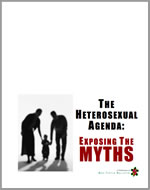 At last, the truth can now be told.
Using the same research methods employed by most anti-gay political pressure groups, we examine the statistics and the case studies that dispel many of the myths about heterosexuality. Download your copy today!
And don‘t miss our companion report, How To Write An Anti-Gay Tract In Fifteen Easy Steps.
 Anti-gay activists often charge that gay men and women pose a threat to children. In this report, we explore the supposed connection between homosexuality and child sexual abuse, the conclusions reached by the most knowledgeable professionals in the field, and how anti-gay activists continue to ignore their findings. This has tremendous consequences, not just for gay men and women, but more importantly for the safety of all our children.
Anti-gay activists often cite the “Dutch Study” to claim that gay unions last only about 1½ years and that the these men have an average of eight additional partners per year outside of their steady relationship. In this report, we will take you step by step into the study to see whether the claims are true.
Tony Perkins’ Family Research Council submitted an Amicus Brief to the Maryland Court of Appeals as that court prepared to consider the issue of gay marriage. We examine just one small section of that brief to reveal the junk science and fraudulent claims of the Family “Research” Council.
 The FBI’s annual Hate Crime Statistics aren’t as complete as they ought to be, and their report for 2004 was no exception. In fact, their most recent report has quite a few glaring holes. Holes big enough for Daniel Fetty to fall through.
“Google” is a trademark of Google Inc.
© Box Turtle Bulletin. All Rights Reserved.
 Posts
Posts  Posts via daily email: