Box Turtle Bulletin
 News and commentary about the anti-gay lobby
“Now you must raise your children up in a world where that union of man and box turtle is on the same legal footing as man and wife…”
News and commentary about the anti-gay lobbyPosts Tagged As: Daily Agenda
January 1st, 2013
TODAY’S AGENDA:
Same-Sex Marriages Begin: Maryland. Last November, Maryland voters approved Question 6 which ratifies a law passed by the legislature earlier this year to provide marriage equality. On December 6, Gov. Martin O’Malley (D) formally signed a proclamation certifying the election results, allowing the law to go into effect today. The state Attorney General authorized (but did not require) individual counties to begin issuing post-dated marriage licenses so that couples could begin marrying today after having already gotten the mandatory 48-hour waiting period out of the way. For those living in counties which didn’t issue post-dated licenses — that’s probably fewer than a third of the counties — they can legally obtain licenses beginning today or whenever those county offices open following the holiday. They will be able to marry by the weekend.
Because today is a holiday, most city and county offices will be closed, but Baltimore’s Mayor Stephanie Rawlings-Blake opened City Hall at 12:30 a.m., so that seven couples could marry. The first couple to marry will be the mayor’s aide and his partner of 35 years.
TODAY IN HISTORY:
English Criminal Law Amendment Act Takes Effect: 1885. English law had long held that homosexuality was an “abominable crime” punishable with death by hanging, but in 1861, the law was modified to provide imprisonment from ten years to life instead. But crime of sodomy was always difficult to prosecute because it required a witness and evidence that the sexual act had been fully consummated, complete with penetration and what we would call a happy ending. Obviously, that made convictions rare.
That changed in 1885, although the change may have been somewhat unintentional. During the middle of the nineteenth century, there was a growing concern over the dangers suffered by England’s daughters over the “gross indecencies” imposed upon them. But again, convictions were rare because the statute required that the sexual assault take place in a “public place.” And so on January 1, 1885, a revision to the criminal code raised the age of consent for girls from thirteen to sixteen, and it made “gross indecencies” punishable regardless of age and place a misdemeanor, punishable with up to two years imprisonment. It didn’t take long for “gross indecency” to be interpreted by the courts to include homosexuality. In fact, it would be under this statute that Oscar Wilde would be convicted and sentenced to the maximum two year term ten years later.

San Francisco Police Raid New Year’s Day Ball: 1965. Early San Fransisco LGBT-rights advocates had long recognized that much of the opposition to homosexuality rested on religious objections, and that if any progress was to be made, it was necessary to foster links between the gay community and the bay area’s religious leaders — at least those leaders who might be inclined to be supportive, whether publicly or privately. Earlier in 1964, Daughters of Bilitis founders Phyllis Lyon (see Nov 10) and Del Martin (see May 5), together with Glide Memorial Methodist Church, formed the Council on Religion and the Homosexual. CRH was notable for two reasons: not only was it the first organization in the U.S. to incorporate the word “Homosexual” in its name, but it was also the first organization to bring straight and gay people together to minister to the gay community.
And that opportunity for those early straight allies to get a first-hand taste of what gay people routinely experienced came on New Year’s Day of 1965, when CHR held a New Years Mardi Gras as a fundraiser at California Hall. When the ministers informed the San Francisco Police Department on December 23 of their planned costume party, the police tried to coerce the hall’s owners into cancelling the rental. Organizers again met with police on December 29, for negotiations which the ministers described “strained.” SFPD officials couldn’t understand why these ministers were arguing on behalf of gay people. Observing the wedding bands on the ministers’ fingers, one officer reportedly said, “We see you’re married. How do your wives accept this?” Their wives, the ministers explained, would be at the ball also, along with other members of their congretations. Police tried to question them on theology and warned them that they were being “used” by local homophile organizations, but the ministers persisted. Finally, the two parties reached a deal where police promised not to arrest anyone in costume, including those in drag.

A couple walks past police officers to attend the New Year’s Mardi Gras ball.
Those promises quickly proved empty. As guests began arriving at 9:00 p.m. on New Year’s Day, they encountered police officers snapping photographs of everyone as they entered the building. The obvious attempt at intimidation deterred many — organizers expected 1500 to show up but only about 500 actually attended. Later that evening, police demanded entry into the building. Three CRH lawyers explained that the party was a private party under California law and that police could not enter without buying tickets or showing a warrent. The lawyers were arrested, along with a ticket-taker, and charged with obstructing an officer. Two other gay men were arrested for “disorderly conduct” after one of them tripped over a chair; police accused him of trying to kiss another man and both were hauled in.
Throughout the night, police repeatedly entered the hall to conduct “fire code inspections.” The ball was scheduled to end at midnight, but organizers decided to end the ball an hour earlier. Their next job was get get their guests safely out of the building. One minister was threatened with arrest while escorting two guests to their cars.

Police photographer snaps photos of everyone as they enter California Hall.
For many of the straight attendees, this was their first exposure to routine police intimidation tactics against the gay community. Del Martin said, “This is the type of police activity that homosexuals know well, but heretofore the police had never played their hand before Mr. Average Citizen … It was always the testimony of the police officer versus the homosexual, and the homosexual, fearing publicity and knowing the odds were against him, succumbed. But in this instance the police overplay their part.”
The following morning seven of the ministers who had attended the party held a press conference where they described the pre-event negotiations and the resulting “intimidation, broken promises and obvious hostility” of the San Francisco Police. The American Civil Liberties Union agreed to represent those under arrest.
The New Year’s Mardi Gras party, occurring as it did some five years before Stonewall, proved to be a turning point for gay rights in San Francisco. As the Mattachine Society’s Hal Call (see Sep 20) recalled, “That was when we got newspapers, TV, and radio on our side. The police were so brutal. And with some respectable clergymen on our side, that was a turning point.” Phyllis Lyon said that it was “our first step into some kind of connectedness with the rest of the city.” City officials, embarrassed by the obvious police misconduct, responded by designating officer Elliot Blackstone as the first liaison between the department and the LGBT community. (At his retirement dinner in 1975, Blackstone was saluted by LGBT community leaders for his ensuing twenty years of advocacy and support.)
When the three lawyers’ trial began in February, the police department were still trying to figure out the legal basis for their actions. When asked why police were taking pictures of guests arriving at the ball even though no crime had occurred, one official replied that police “wanted pictures of these people because some of them might be connected to national security.” He also said that the contingent of more than a dozen officers and two photographers were needed because “we went just to inspect the premises.” After four days of prosecution testimony and before the defense could begin presenting their case, the judge ordered a directed verdict of “not guilty” after four days of prosecution testimony. One of the lawyers who had been arrested and charged, Herb Donaldson, would go on to become San Francisco’s first openly gay judge.
A documentary, “The Last Dance Raid,” is currently in production with a targeted release sometime in 2013. The documentary will include eyewitness interviews and vintage photos. Donations for the project are being accepted here. Here is the film’s trailer:
[Other sources: Kay Tobin. “After the ball…” The Ladder 9, no. 5 (February 1965): 4-5.
Unsigned. “Cross currents.” The Ladder 9, no. 9 (June 1965): 14-16.
Edward Alwood. Straight News: Gays, Lesbians and the News Media
Marcia M. Gallo. Different Daughters: A History of the Daughters of Bilitis and the Rise of the Lesbian Rights Movement
LGBT Religious Archives Network. “Raid at New Year’s Day Ball at California Hall.”]
 Los Angeles Gay Bar Raided: 1967. It all was sparked by the temerity of a kiss, when a small group of gay men at Silverlake’s Black Cat bar, upon the countdown to midnight on New Years’ Eve, had the gall to kiss each other “on the mouth for three to five seconds” in the presence of about six undercover policemen who had infiltrated the gay bar. As soon as the pecks on the lips began, police identified themselves and began viciously beating and arresting the kissing offenders. As the melee widened, several people tried to escape to the New Faces bar across the street. Undercover officers followed and raided that bar as well. One of the New Faces workers was beaten so badly by police that they cracked a rib, fractured his skull and ruptured his spleen. Six Black Cat kissers were tried and convicted of “lewd or dissolute conduct” in a public place — legaleese for, in this instance, hugging and kissing.
Just as with the New Year’s Mardi Gras raid in San Francisco two years earlier, the Black Cat raid had the effect of galvanizing the gay community in Los Angeles. Gays turned out for protests and demonstrations in the months that followed, and they began to pass a newsletter around which would eventually morph into The Advocate. By the time a similar police raid took place in a dive bar in Greenwich Village two years later, the ground was well prepared for gays to come out nationally to declare their presence in society. In 2008, the Black Cat bar was declared a historical-cultural landmark by the city of Los Angeles, in a move that was partly inspired by the story of the Black Cat bar posted on BTB in 2006.
Homosexuality decriminalized: The first day of the year often marks the day in which new state laws take effect, which explains why on this day in history, a number of states officially decriminalized homosexuality effective January 1. Among the states that I know of in which laws prohibiting same-sex relations include: Arizona (1980), California (1975), Colorado (1971), Hawaii (1972), Illinois (1962), Iowa (1976), New Mexico (1975), North Dakota (1978). Ohio (1974), Oregon (1971) and Vermont (1977). If you know of any others, please let me know in the comments below.
If you know of something that belongs on the agenda, please send it here. Don’t forget to include the basics: who, what, when, where, and URL (if available).
And feel free to consider this your open thread for the day. What’s happening in your world?
December 31st, 2012
TODAY IN HISTORY:
Is Homosexuality Normal or Not?: 1971. That was the burning question for Life magazine, and they tackled it pretty much the way everyone did back then: by talking to a lot of straight people about gay people, but without quoting from a single gay person. Featured in the article was noted anti-gay therapists Edmund Bergler (despite being dead for nearly ten years), Lawrence Hatterer (who conducted electric shock aversion therapy), Irving Bieber, and Charles Socarides — who would later go on to co-found the National Association for Research and Therapy of Homosexuality (NARTH). The article tried to present a rundown on what makes gay men gay (there was virtually no mention of lesbians in the article), and then, without quoting from a single “homosexual militant”, asserted that these militants opposed all research on homosexuality. All of this led to the article’s final two paragraphs:
Whether liberationists choose introspection, militancy, or violence as a course of action, the basic stumbling block remains the same: heterosexual antipathy to homosexuality. Will this ever change? Dr. Hatterer has observed that society’s tolerance of homosexuality is increasing but he doubts that we will ever accept it as a desirable “alternative lifestyle.” Nonetheless he and virtually all other psychiatrists advocate repealing the laws that violate this minority’s civil rights.
On the question of “normality,” much remains to be learned. In opposing all inquiry, the militants expose fears of what science might find out about them. Dr. (Evelyn) Hooker’s task force on homosexuality makes the sensible recommendation that the National Institute of Mental Health fund a center for the study of all sexual behavior. “It is essential,” says the report, “that a study of homosexuality be placed within the context of the study of the broad range of sexuality, normal and deviant.”
You can read the article here.
TODAY’S BIRTHDAY:
 Jennifer Higdon: 1962. Who says playing flute in a Tennessee high school band is a dead end? It certainly wasn’t for Jennifer Higdon, who majored in the instrument at Bowling Green State University where she also began composing. After graduation, she served as Composer-in-Residence with the Pittsburgh Symphony, the Gren Bay Symphony, the Philadelphia Orchestra and the Fort Worth Symphony. Her one-movement tone poem blue cathedral, inspired by her brother’s death from cancer, has become among the most performed modern orchestral works by a living American composer. Her Violin Concerto, which premiered in 2009 in Indianapolis, was awarded the 2010 Pulitzer Prize. That same year, her Percussion Concerto won a Grammy for Best Contemporary Classical Composition. Higdon lives with her high school sweetheart, Cheryl Lawson, in Philadelphia, where Higdon teaches composition at the Curtis Institute.
If you know of something that belongs on the agenda, please send it here. Don’t forget to include the basics: who, what, when, where, and URL (if available).
And feel free to consider this your open thread for the day. What’s happening in your world?
December 30th, 2012
TODAY’S BIRTHDAY:
 Beauford Delaney: 1901. His mother had been born into slavery and never learned to read or write. Because of her experiences, and in keeping with the family’s hard-fought position of respectability in Knoxville where his father was a Methodist minister, the values of dignity, education and a keen awareness of injustices were paramount in the Delaney household. Beauford and his younger brother, Joseph, developed an interest in art at an early age, when they drew copies of pictures they saw on Sunday school cards and the family Bible. As a teenager, Beauford got a job at a local sign company, where his work was noticed by Lloyd Branson, Knoxville’s best known artist. Delaney became Branson’s apprentice and, with Branson’s backing, moved to Boston to study art in 1924. His escape from the Jim Crow south opened up a huge world, where he learned the essentials of painting techniques, was first exposed to the black activist politics, and experienced his first intimate encounter with another young man.

Beauford Delaney, “Can Fire In The Park”, 1946
By 1929, Beauford used up Boston and moved to Harlem, which coincided with the great artistic and political flowering known as the Harlem Renaissance. Despite being penniless during the early crushing years of the Great Depression, Delaney found an affinity with the “multiple of people of all races [who] spend every night of their lives in parks and cafes.” As he wrote in his journal, their courage inspired him to believe that “somehow, someway there was something I could manage if only with some stronger force of will I could find the courage to surmount the terror and fear of this immense city and accept everything insofar as possible with some calm and determination.”
That calm and determination became the subject of some of his greatest works. Delaney eventually found work here and there — as a bellhop, telephone operator, doorman, janitor — while also finding, slowly, an audience for his paintings. He rubbed shoulders Georgia O’Keefe and Henry Miller, and became close friends with author James Baldwin (see Aug 2), and yet he remained an isolated individual, presenting carefully crafted faces to the people he encountered depending on where he was. To his neighbors in Greenwich Village, where his studio was, he was part of a larger gay (and mostly white) circle of friends; in Harlem, he kept his other life hidden. The decidedly macho world of modernist and impressionist art in New York undoubtedly added to his isolation. Those who knew him saw an introverted and private person, one who had apparently never formed any lasting romantic relationships.

Beauford Delaney, “Nativity Scene,” 1961.
In 1953, Delaney moved to Paris where he found a greater sense of freedom in an already well-established expatriate community of ex-patriate African-American artists. His paintings shifted from the figurative images of his New York period to more of an abstract impressionist exploration of color and light. But by 1961, his mental and physical health began to deteriorate, problems which were compounded by continuing poverty, hunger, and heavy drinking. Baldwin remembered, “He has been starving and working all of his life – in Tennessee, in Boston, in New York, and now in Paris. He has been menaced more than any other man I know by his social circumstances and also by all the emotional and psychological stratagems he has been forced to use to survive; and, more than any other man I know, he has transcended both the inner and outer darkness.”
Delaney returned briefly to the U.S. in 1969 to visit family, but he was dogged by paranoia and hallucinations. He returned to Paris in 1970 and tried to resume working, but it became increasingly clear to his friends that he was no longer capable of living independently. In 1975, he was hospitalized, then committed to St. Anne’s Hospital for the Insane. He died there in 1979, and was buried in an unmarked grave.
Denaley’s work was mostly forgotten through much of the 1970s and 1980s, despite his influence on fellow artists. In 1986, Baldwin wrote that Delaney was “the first living proof, for me, that a black man could be an artist. In a warmer time, a less blasphemous place, he would have been recognised as my Master and I as his Pupil. He became, for me, an example of courage and integrity, humility and passion. An absolute integrity: I saw him shaken many times and I lived to see him broken but I never saw him bow.”
December 29th, 2012
TODAY’S AGENDA:
Marriages Begin In Maine. Elections matter, which is why beginning today at the stroke of midnight, marriage equality became the law of the land in the Pine Tree State. Many towns and cities have announced special hours for couples to pick up their marriage licenses, with Falmouth and Portland announcing that they will open their offices at midnight. Bangor, Brunswick and Augusta will also hold special Saturday hours.

John Addington Symonds (left) and Edward Carpenter (right)
TODAY IN HISTORY:
Letter from John Addington Symonds to Edward Carpenter: 1892. Symonds was an English poet and literary critic who, although married and a father, was an early advocate of male homosexuality (see Oct 5). Edward Carpenter was a poet, socialist philosopher, and an early gay advocate — and among the very few who lived openly as a gay man (see Aug 29) in Victorian England. In 1892, Symonds was beginning his collaboration with sexologist Havelock Ellis for Ellis’s first installment of his six-volume Studies in the Psychology of Sex, when Symonds wrote to Carpenter to discuss some of the topics he intended to cover. While Ellis intended to stick strictly to a psychological discussion on homosexuality (or Sexual Inversion, as it was called at the time), Symonds wanted to open the topics up to historical and ethical considerations:
It is a pity that we cannot write freely on the topic. But when we meet, I will communicate to you facts which prove beyond all doubt to my mind that the most beneficial results, as regards health and nervous energy, accrue from the seuxal relations between men: also, that when they are carried on with true affection, through a period of years, both comrades become united in a way which would be otherwise quite inexplicable.
The fact appears to me proved. The explanation of it I cannot give, & I do not expect it to be given yet. Sex has been unaccountably neglected. Its physiological & psychological relations even in the connection between man & woman are not understood. We have no theory which is worth anything upon the differentiation of the sexes, to begin with. In fact, a science of what is the central function of human beings remains to be sought.
This, I take it, is very much due to psychologists, assuming that sexual instincts follow the build of the sexual organs; & that when they do not, the phenomenon is criminal or morbid. In fact, it is due to science at this point being clogged with religious & legal presuppositions.
…My hope has always been that eventually a new chivalry, i.e.., a second elevated form of human love, will emerge & take its place for the service of mankind by the side of that other which was wrought out in the Middle Ages.
…How far away that dream seems! And yet I see in human nature stuff neglected, ever-present — pariah and outcast now — from which I am as certain as I live, such a chivalry could arise.
Whitman, in Calaumus, seems to strike the key-note. And though he repudiated (in a very notable letter to myself) the deductions which have logically to be drawn from Calamus, his work will remain infinitely helpful.
[Source Chris White’s Nineteenth-Century Writings on Homosexuality: A Sourcebook
Catholic Church Reaffirms Opposition to Homosexuality: 1975. It wasn’t the first time, and it certainly wouldn’t be the last. But on this date in 1975, the Congregation for the Doctrine of the Faith — think of it as the Vatican’s equivalent of the Justice Department (so to speak) — issued Persona Humana, addressing “certain questions concerning sexual ethics.” On the subject of homosexuality, the Congregation stated:
A distinction is drawn, and it seems with some reason, between homosexuals whose tendency comes from a false education, from a lack of normal sexual development, from habit, from bad example, or from other similar causes, and is transitory or at least not incurable; and homosexuals who are definitively such because of some kind of innate instinct or a pathological constitution judged to be incurable.
In regard to this second category of subjects, some people conclude that their tendency is so natural that it justifies in their case homosexual relations within a sincere communion of life and love analogous to marriage, in so far as such homosexuals feel incapable of enduring a solitary life.
In the pastoral field, these homosexuals must certainly be treated with understanding and sustained in the hope of overcoming their personal difficulties and their inability to fit into society. Their culpability will be judged with prudence. But no pastoral method can be employed which would give moral justification to these acts on the grounds that they would be consonant with the condition of such people. For according to the objective moral order, homosexual relations are acts which lack an essential and indispensable finality. In Sacred Scripture they are condemned as a serious depravity and even presented as the sad consequence of rejecting God. This judgment of Scripture does not of course permit us to conclude that all those who suffer from this anomaly are personally responsible for it, but it does attest to the fact that homosexual acts are intrinsically disordered and can in no case be approved of.
The same statement also reaffirmed the Church’s opposition to premarital sex, extramarital sex and masturbation (which is also branded “an intrinsically and seriously disordered act”).
TODAY’S BIRTHDAY:
 Billy Tipton: 1914. It wasn’t until his death in 1989 when it became widely known that the American jazz pianist, saxophonist and bandleader was a transman. Early in his career, Tipton performed as a man while continuing to present as a woman otherwise, but by the 1940s, he had transitioned his gender identity fully to male — except for when he went home to his family, where he became Dorothy again, leading fellow musicians to believe he was lesbian.
By the 1950s, Tipton was identifying solely as a man. It was during that time when he was awarded a recording contract with Top records, for whom he recorded two albums of jazz standards. The albums were reasonably successful, and he was given the opportunity to sign a contract for four more. He declined the offer, and took his Billy Tipton Trio to Spokane where he performed weekly at a downtown nightclub called Allen’s Tin Pan Alley and worked as a talent broker at the Dave Sobol Theatrical Agency. He also entered into at least five heterosexual relationships, including a common-law marriage with Kitty Kelly with whom Tipton adopted three sons. One son, William, remembered Billy as a good father who loved to go on Scout camping trips. It was William who would learn that his father had been born a woman, when he was looking on as paramedics tried to resuscitate him after collapsing with a hemorrhaging peptic ulcer.
If you know of something that belongs on the agenda, please send it here. Don’t forget to include the basics: who, what, when, where, and URL (if available).
And feel free to consider this your open thread for the day. What’s happening in your world?
December 28th, 2012
TODAY IN HISTORY:
 Closeted Anti-Gay Activist Dies of AIDS: 1986. Terry Dolan, who helped to found the National Conservative Political Action Committee, was pretty well known in elite gay circles. According to Randy Shilts’s And the Band Played On
Among those awful things was sending out fundraising letters for NCPAC, which claimed that “Our nation’s moral fiber is being weakened by the growing homosexual movement and the fanatical E.R.A. pushers (many of whom publicly brag they are lesbians).” Meanwhile, Dolan had, at the time of that 1984 encounter with Kramer, had just ended an affair with a male epidemiologist at the New York City Health Department, and was then enjoying everything the gay social scene had to offer.
Dolan knew how to raise money. “The “shriller you are,” he said in 1982, “the easier it is to raise money.” That’s been the recipe for anti-gay activists ever since. But four years later, Dolan himself was dead of AIDS at the age of 36. The following May, The Washington Post published an article about “the cautious closet” of Terry Dolan. His brother, Reagan White House speechwriter Anthony Dolan was livid, and took out an two-page ad in The Washington Times, arguing that “the greatest and most malicious falsehood in this story was its entire thrust, its basis: the claim that my brother lived and died a homosexual.” But he did live and die a homosexual, and a deeply closeted one at that. But despite his and the family’s best efforts, the secret was out, and no amount of wishful thinking otherwise would ever change that.
If you know of something that belongs on the agenda, please send it here. Don’t forget to include the basics: who, what, when, where, and URL (if available).
And feel free to consider this your open thread for the day. What’s happening in your world?
December 27th, 2012
THIS MONTH IN HISTORY:
Masturbate Your Way To Heterosexuality: 1970. The basis of Behavioral Therapy is that the experience of rewards and punishments were a determining factor for a wide range of human behaviors. In the late 1960s when Behavioral Therapy rivaled classic Freudian psychoanalysis as the predominant school of thought in the mental health professions, BTs began to exhibit some of the same kinds of hubris that they had accused psychoanalysts of exemplifying, especially when BTs began classifying all forms of human thoughts and feelings as “behavioral” and, therefore, amenable to modifications through punishment and rewards. As we now know, much of those punishments were appallingly cruel, torturous, and ineffective. (One example is illustrated in our award-winning report “What Are Little Boys Made Of?”, about the tragic aftermath of Kirk Murphy’s treatment at the hands of a Behavioral Therapist by the name of George Rekers.)
But some patients, if they were lucky I suppose, underwent Behavioral Therapy that emphasized the “reward” end of the punishment/reward dichotomy. Some of those patients were clients of Dr. John N. Marquis, a psychologist at the Veterans Administration Hospital in Palo Alto, California. His paper appeared in the December 1970 issue of the Journal of Behavior Therapy and Experimental Psychiatry, in which he argued that by encouraging clients to think of opposite-sex partners while masturbating, he could change their “behavior” — remember, to Behavioral Therapists, sexual orientation was nothing but “behavior” — to heterosexuality. He didn’t rule out aversion therapy (i.e. electric shock, etc.) if he thought it was needed — “often… aversive conditioning to the perverse stimuli are indicated…” — but he felt that it was best to hold that off until at least some level of “behavior” — by which he meant attractions — was exhibited towards the opposite sex. And how was that accomplished?
The client is instructed to masturbate to the point where he feels the inevitability of orgasm using whatever fantasy is most arousing. Then he is to switch to the appropriate fantasy. He is warned that he may experience some difficulty at first, but that he will not lose his sexual arousal at that point. After he has successfully shifted to the appropriate stimulus four or five times (this is arbitrary but seems to work) he is instructed to start moving the introduction of the appropriate fantasy backward in time toward the beginning of masturbation. An attempt is made at the outset to get a commitment from the client never to continue picturing the inappropriate fantasy through the occurrence of an orgasm, whether in masturbation or overt sexual behavior.
That was the procedure. Dr. Marquis also had some practical advise:
If the client is generally tense he is instructed to relax before masturbating, because sexual arousal and anxiety are incompatible. If he reports feeling guilty after masturbating he is instructed to relax after masturbating as well. It may be suggested that he increase the frequency of masturbation in order to speed the process of reorientation or to decrease the frequency in order to increase drive level if he masturbates more than once a day. It is often helpful to suggest the use of a lubricant to enhance physical stimulation.
Marquis wrote that he had been prescribing this therapy for patients since 1965, and that “all of the cases described below were seen because they were suffering human beings seeking help, and not as experimental subjects.” That, of course, is crucial: it’s your first clue that this is by no means a controlled, scientific study. He provided detailed case studies of two of his patients, and brief descriptions of twelve more. All but one were “successes” to varying degrees, although only one case had anything remotely resembling a long-term follow-up. And that only happened because Marquis happened to run into that former client and his new wife three years later at a cocktail party. At least some of those successes were dubious, and not all of them involved gay people. One was a pedophile, another woman enjoyed “sado-masochistic masturbation” which, Marquis explained, were not “normal heterosexual fantasies” (although he doesn’t mention whether her fantasies involved men or women), and one was someone we would today see as just another socially-awkward nerd:
Case 13. A 24-year-old male computer programmer who was very shy had had intercourse rarely but had frequently masturbated to fantasies and pictures of beautiful girls. As a result he was completely unattracted to girls who were not strikingly beautiful. This was a serious problem since he was homely and inarticulate. Orgasmic reconditioning led to considerable improvement, but he remains a little bit too particular.
As you can see, the measurements that would constitute “considerable improvement” are what real scientists would call “anybody’s guess.” The only thing we can know from this study is that Marquis believes that most of his clients are able to masturbate to a “normal heterosexual fantasy.” We know nothing about any actual changes in his clients’ preferred masturbatory fantasies, let alone any actual or even perceived changes in sexual orientation. But that flimsy standard is precisely the kind of evidence that the National Association for Research and Treatment of Homosexuality holds in very high esteem. When NARTH published their 2009 “journal”, they claimed to have “examined more than 100 years of professional and scientific literature from 600-plus studies and reports,” all of it proving, in their minds at least, that “sexual orientation can be changed.” And of course, Marquis’s paper made the cut.
[Source: John N. Marquis. “Orgasmic reconditioning: Changing sexual object choice through controlling masturbation fantasies.” Journal of Behavior Therapy and Experimental Psychiatry 1, no. 4 (December 1970): 263-271.]
If you know of something that belongs on the agenda, please send it here. Don’t forget to include the basics: who, what, when, where, and URL (if available).
And feel free to consider this your open thread for the day. What’s happening in your world?
December 26th, 2012
TODAY IN HISTORY:
Body Build of Male Homosexuals: 1959. In many ways, just about everyone (including most of the mental health community) saw gay people, particularly gay men, as being so alien as to almost constitute a different species. Well, maybe not a different species literally, but for some, gay men were at least some sort of a mutation of homo sapiens, and were not like just any common man on the street. On December 26, 1959, the august British Medical Journal published a short paper by Dr. A.J. Coppen, of the Institute of Psychiatry in London who believed that he had proven, on the basis of physical measurements of just thirty-one gay men, that there was a distinct body build associated with homosexuality in men — and it was the same body build associated with mental patients.
He came to this determination by measuring the shoulders and hips of three groups of people. “The homosexual group,” he wrote, “consisted of 31 patients who had been either exclusively homosexual or predominantly homosexual, with only occasional heterosexual activity. The patients had attended the Maudsley Hospital primarily for homosexuality; the majority had been referred from the courts after they had been convicted of homosexual offences.” Because a number of them had “psychiatric symptoms” of “mainly depression or anxiety” (is there any wonder?), he included “another control group of 22 heterosexual neurotics, … as any differences found in the homosexuals may be related to the differences widely reported in psychiatric patients rather than to their specific sexual abnormalities.” The third group, a control group, consisted of 53 members of a business organization “who were attending for mass radiography,” and who agreed to be part of the study.
For all three groups, they measured around their shoulders (biacromial) and hips (bi-illiac), calculated an equivalent diameter (he doesn’t say how), and used those measurements to determine what was called an “androgyny score” (3 x biacromial – x bi-iliac diameters, in cm.). And with those measurements, Coppen found:
The results show that homosexuals have a decreased androgyny score and biacromial diameter compared with the control group. This difference, however, is not specific for homosexuality, as the neurotic patients in this study also differ from the controls to approximately the same extent as regards both androgyny and biacromial width. The androgyny score does not discriminate between homosexuals and controls better than does the biacromial diameter, though, as the Chart shows, three homosexual patients have very low androgyny scores, outside the range of the other two groups. It appears, therefore, that homosexuals are similar to people with other psychiatric disorders in having decreased breadth measurements, but that their sexual abnormality is not specifically related to these. Rather it seems that the homosexual is influenced by the similar (unknown) factors that produce the abnormalities in body-build found in other psychiatric patients.
This article from 1959 is an interesting holdover from an early path of investigation that is reminiscent of nineteenth-century Phrenology. That discarded science is perhaps best known today for its busts and diagrams of human skulls with dotted outlines of areas denoted with labels like “Friendship” or “Adhesiveness.” Phrenologists believed that different areas of the brain consisted of “organs” relating to different character traits. Early on, they also believed that it was possible to determine the different developmental levels of these “organs” by relating them to the shape of an individuals skull with its various bumps and bulges. That last theory was soon discarded, but the idea that an individual’s character traits could somehow be imprinted on that person’s physical development was firmly established in the scientific imagination. The appearance of children with Down’s Syndrome, of course, only seemed to confirm the theory. Texts on homosexuality through the 1950s often had several paragraphs dwelling on the physical characteristics of their study subjects, and some even included nude photos to demonstrate how “feminine” some of the subjects were.
By the 1950s, those descriptions had mostly disappeared from the literature, which make this 1959 article something of an interesting anachronism. But today, with researchers now investigating the connection between body-build, body self-image, and health factors in our body-conscious society, some of those physical descriptions and measurements are starting to make a comeback. Nude pictures, however, have not re-appeared in the professional literature.
If you know of something that belongs on the agenda, please send it here. Don’t forget to include the basics: who, what, when, where, and URL (if available).
And feel free to consider this your open thread for the day. What’s happening in your world?
December 25th, 2012

All of us at Box Turtle Bulletin wish you a very fabulous Christmas.
And speaking of fabulous…
TODAY’S BIRTHDAY:
 Quentin Crisp: 1908. He was always a gender-bending raconteur, even going back to when he was the object of endless teasing in elementary school. In 1926, he studied journalism at King’s College London, but switched to art at Regent Street Polytechnic. He also visited the cafes and pubs of Soho’s Old Compton Street, which is still the heart of the gay community in London. It was then that he decided that his life’s work would be “making the existence of homosexuality abundantly clear to the world’s aborigines,” and he did so by developing the flamboyant style that would become his signature. When World War II broke out, he tried to join the Army, but was rejected on medical grounds — “sexual perversion” was the diagnosis. He remained in London during the Blitz, and placed himself at the service of American G.I.’s, so to speak. That’s where Crisp picked up his love for all things American.
In 1968, he achieved success with his third book, an autobiography he titled The Naked Civil Servant

Here he is in a Q&A session in Los Angeles following a lecture on style:
If you know of something that belongs on the agenda, please send it here. Don’t forget to include the basics: who, what, when, where, and URL (if available).
And feel free to consider this your open thread for the day. What’s happening in your world?
December 24th, 2012
 TODAY’S BIRTHDAYS:
Lee Daniels: 1959. The actor, producer and director became the first African-American to solo produce an Academy Award winning film with 1992’s Monster’s Ball


His latest film, 2012’s The Paperboy, a 1960s erotic thriller starring Matthew McConaughy, Zac Efron, Nicole Kidman, John Cusack, David Oyelowo, Macy Gray and Scott Glenn, opened to decidedly mixed reviews. The strong cast appears to have saved the film from ignominy. The Village Voice Film Poll sprinkled best actor/actress nominations for jsut about about the entire cast, but nominated Lee Daniels for Worst Film.
 Ricky Martin: 1971. Born Enrique MartÃn Morales, the Puerto Rican singer first achieved fame as a member of boy band Menudo before embarking on a solo career in 1991. His early popularity in Latin markets was boosted by his appearance in the second season of a Mexican telenovela, Alcanzar Una Estrella (“Reach for a Star”) in which he played the part of a member of a boy band which achieves fame and fortune. In 1999, Martin found crossover appeal with “Livin’ la Vida Loca” and “She’s All I Ever Had,” form his first English language album. That was followed with “She Bangs” in 2000. In 2007, he took a break from his career, but returned again with a new album in 2010, along with his autobiography, Me
If you know of something that belongs on the agenda, please send it here. Don’t forget to include the basics: who, what, when, where, and URL (if available).
And feel free to consider this your open thread for the day. What’s happening in your world?
December 23rd, 2012
TODAY IN HISTORY:
Wild Bill Dannemeyer’s Op-Ed on Gays in the Military: 1991. It’s been a year and a day since President Barack Obama signed the Don’t Ask Don’t Tell Repeal Act into law. In 1991, the debate was well underway over whether the Defense Department should rescind its policy barring gays in the military. In the pre-DADT era, the ban was a matter of DoD policy, not the law. Conservatives then, as now, wanted to keep the ban in place, and few were more hard core about it — or more obnoxious — than Rep. William Dannemeyer (R-CA). On December 23, 1991, he was true to form in his op-ed lambasting gay people with his usual class:
A very poor joke asks: What is meaner than a pit bull with AIDS? The guy who gave the dog AIDS, of course. This could be the fightingest son-of-a-gun in the whole Army. But should he be?
I have seen how aggressive the lunatics of ACT-UP can be-rioting in the streets, smashing windows, fighting with anyone in disagreement-and have often thought how effective they might be on the front lines of combat. But does this prowess and compunction for destruction automatically certify the few and the proud?
…Many people still believe that homosexual sodomy is a perverse behavior, that someone choosing to do so isn’t playing with a full deck. Survey after survey of military personnel supports this belief. …For homosexuals to blame others for reacting adversely to their chosen lifestyle is absurd. The notion of punishing “homophobes” (the label applied to people who find homosexual sodomy repugnant) in the military as perverts rather than those persons who define their very existence by a sex act is itself perverse…
Those were the arguments against gays in the military in the early 1990s. When Bill Clinton ran for President, he promised to overturn the ban. But as soon as he was sworn into office, he ran into a buzz saw of opposition led by fellow Democratic Sen. Sam Nunn of Georgia. In 1993, Congress shifted the ban from administrative policy to legal imperative with the passage of the Defense Authorization Bill, which included the codification of “Don’t Ask, Don’t Tell” into law. According to Servicemembers United, 14,346 soldiers, sailors and airmen/women would be discharged under “Don’t Ask, Don’t Tell” over the next eighteen years.
If you know of something that belongs on the agenda, please send it here. Don’t forget to include the basics: who, what, when, where, and URL (if available).
And feel free to consider this your open thread for the day. What’s happening in your world?
December 22nd, 2012
TODAY IN HISTORY:
 President Obama Signs DADT Repeal Into Law: 2010. It all came down to the wire during the closing days of the 111th Congress. If it hadn’t been for the heroic efforts of Sens. Susan Collins (R-ME) and Joe Lieberman (I-CT) when all hope for DADT’s repeal appeared to be dead, President Barack Obama never would have been able to place his signature on the Don’t Ask, Don’t Tell Repeal Act of 2010. But sign it he did, and that act kicked off a nine month process to implementDADT’s repeal. Don’t Ask, Don’t Tell officially came to an end on September 20. Since then, DADT’s end has been largely considered a non-event within the military. Even Marine Corps Commandant Gen. James Amos, who had been on record as opposing DADT’s repeal, now says he is “very pleased with how it has gone.”
If you know of something that belongs on the agenda, please send it here. Don’t forget to include the basics: who, what, when, where, and URL (if available).
And feel free to consider this your open thread for the day. What’s happening in your world?
December 21st, 2012

Today’s date in Mayan. (Glyph generated here.)
With yesterday being 12 b’ak’tuns, 19 k’atuns, 19 tuns, 17 uinals, and 19 k’in (or days) — written as 12.19.19.17.19 — in the Mayan Long Count, some say that the world as we had known it came to an end last night at approximately midnight Guatemalan/Yucatan time. Others say baloney — it’s just another b’ak’tun. Get a grip.
The Mayans actually used four independent calendars for their reckoning of days; three of them were cyclical. The first cyclical calendar was the 365-day roughly solar calendar known as the Haab’, which, when combined with another cyclical 260 day calendar known as the Tzolkin, resulted in the longer cycle making up a 52-Haab’ calendar round. After completing a calendar round, you simply started over again. The Haab’ and Tzolkin were the everyday workhorse calendars, and they are still used in parts of the Guatemalan highlands today. The third cyclical calendar, called the Lords of the Night, is similar to our days of the week. There are nine Lords of the Night.
But those calendars aren’t what’s gotten everyone’s attention. It’s the linear calendar, known as the Long Count, that everybody is excited about. Unlike the cyclical calendars, the Long Count was a very precise way of expressing dates far into the past or future, and it marked the number of days since the start of the Fourth World. (The first three worlds were mistakes; the gods finally got it right on the fourth try.) It is based on a modified base-20 scheme, where all the units are in cycles of 20 except for uinals, of which there are only 18. A long count was worked out this way: there are 20 days in a uinal, 18 uinals in a tun, 20 tuns in a k’atun, and 20 k’atuns in a b’aktun.
A complete representation of the date was written as the Long Count, followed by the Tzolkin Date, then the Haab’ date, then the Lord of the Night. Which makes today’s date, when written in full: 13.0.0.0.0, 4 Ahau, 3 Kankin, Ninth Lord.
What makes the Mayan’s Long Count so remarkable is that it was also extendable. Once we complete 20 b’ak’tuns — that will be on Friday, October 13, 4772 — we will then start a new piktun by adding another set of digits from 1 to 20 to the front. (I guess the zero is already there; it’s just implied and therefore never written.) And there are higher orders waiting in the wings after that: kalabtuns, k’inchiltuns, alautuns… you get the picture. We can go on literally forever. All of this makes the Mayan Long Count among the most rational calendars ever created. And that coherence was made moreso by the fact that, unlike our calendar, they used zeros as part of their dating scheme.
So why did everyone get all excited over the rollover to 13.0.0.0.0? Well, according to the Mayan creation myths recounted in the Popol Vuh, the third world ended when the prior long count reached 13.0.0.0.0. People saw that and assumed that completing 13 b’aktuns was pretty important — which it was, historically. But connecting it to a prediction that the fourth world would also end after another 13 b’aktun was a stretch the Mayans apparently never made. Some inscriptions anticipate dates far beyond our own time.
Besides, these are the same people who failed to predict the demise of their own civilization somewhere between the 8th and 9th centuries — or at about 9.16.0.0.0 or so.
So contrary to popular belief, the Mayans didn’t predict the literal end of the world at the end of this b’ak’tun. They only predicted that the 14th b’ak’tun would follow the 13th, in the same way our calendar accurately predicted that the third millennium would follow the second. And just as we partied like 1999 on the last day of 1999, the Mayans threw elaborate parties whenever they crossed a major cycle on their calendar. Last night would have been the biggest party in about 394 years (144,000 days to be exact).
So with this being an open thread, what are your new b’ak’tun resolutions?
TODAY IN HISTORY:
Time Magazine’s “Opportunistic Diseases”: 1981. Nearly seven months had passed since the CDC had issued its first notice of a puzzling new condition that was appearing in gay men (see Jun 5). A month after the CDC raised the alarm, the New York Times picked up the story (see Jul 3). But beyond that, the news was slow to spread outside of gay publications. In fact, the media seemed to go out of its way to keep from looking at AIDS. Randy Shilts described the problem in And the Band Played On
The difference, (the CDC’s James W.) Curran knew, was media attention. Once Toxic Shock Syndrome hit the front pages the heat was on to find the answer. Within months of the first MMWR report, the task force had discovered the link between tampons and the malady. Back in 1976, the newspapers couldn’t print enough pictures of flag-draped coffins of dead American Legionnaires. However the stories just weren’t coming on the gay syndrome. The New York Times had written only two stories on the epidemic, setting the tone for noncoverage nationally. Time and Newsweek were running their first major stories on the epidemic now, in late December 1981. There was only one reason for the lack of media interest, and everybody on the (CDC’s) task force knew it: the victims were homosexuals. Editors were killing pieces, reporters told Curran, because they didn’t want stories about gays and all those distasteful sexual habits littering their newspapers.
 The December 21 edition of Time, which featured Libya’s Muammar Gaddafi on the cover, placed the article titled “Opportunistic Diseases” deep inside. The article provided little context, information, or hope. Truth be told, there was little to give of any of those thus far. No one knew what caused it, nor did they even know what to call it. Acquired Immune Deficiency Syndrome wouldn’t get its name until July 1982. Time, instead, focused on the prevailing image of gays as diseased, while simultaneously expressing surprise that lesbians weren’t coming down with the strange new infections. Of the speculations about the disease, Time wrote:
One possible culprit in the syndrome is cytomegalovirus, which is known to weaken immune defenses and can be transmitted in semen more than a year after infection. In a recent study, traces of CMV were found in 94% of homosexual men, as opposed to 54% of heterosexual men. U.C.L.A.’s Dr. Michael Gottlieb believes that CMV does contribute to the immune deficiency, but, he points out, both the virus and homosexuality “have been around for thousands of years.” Thus, he concludes, “there is a piece of the puzzle missing.”
The missing link could be “poppers,” drugs like amyl nitrate and butyl nitrate, which are said to enhance orgasm. More than 85% of the CDC patients admitted to inhaling them. Another possible explanation is the so-called immunologic overload theory, says San Francisco’s Dr. Robert Bolan. Homosexuals with many sexual partners often contract numerous venereal diseases, intestinal disruptions (gay bowel syndrome), mononucleosis and other infections, explains Bolan. “This constant, chronic stimulation to their immune system may eventually cause the system to collapse.”
All of those theories would soon be proven wrong, although some of them would continue to linger among the conspiratorially-minded AIDS deniers who insist, against all evidence to the contrary, that the Human Immunodeficiency Virus (HIV) doesn’t cause AIDS. It’s been said that there is no such thing as bad publicity. Time proved that aphorism wrong.

Kirk Murphy, in 2003
“The darkness keeps calling and I must go”: 2003. With those words written on a suicide note, Kirk Andrew Murphy ended his life in a New Delhi apartment. “”I’ll never forget this as long as I live,” said Frank, his supervisor back in Phoenix, Arizona. He was the first outside of India to receive the news. “I got a phone call from the account manager who reported to me. It was midnight or one o’clock in the morning. I was totally shook up.” Frank contacted Kirk’s sister, Maris, in New York, and together they went to India for the funeral.
What happened seemed utterly senseless to Maris, but seven years later she would learn something that would suddenly make so many things about her brother click. That’s when she learned that in 1970, when Kirk was just about to turn five years old and Maris herself was just an infant, their mother took Kirk to see a specialist at UCLA’s Gender Identity Clinic after a well-known researcher appeared on television to warn parents that gender-variant children would grow up to be homosexual. According to that researcher, UCLA had a new program, paid for with federal grants, to prevent homosexuality in children. Kirk’s mother saw that program and made an appointment. Kirk came under the care of a young grad student by the name of George Rekers, who worked with Kirk for about nine months before pronouncing him “cured.” Rekers went on to build a career on Kirk’s case, which Rekers mentioned in nearly twenty journal articles, chapters, and books. As late as 2009, referring to Kirk as “Craig,” Rekers wrote:
Follow-up psychological evaluations three years after treatment indicates that Craig’s gender behaviors became normalized. An independent clinical psychologist evaluated Craig and found that post-treatment he had a normal male identity. Using intrasubject replication designs, this published case was the first experimentally demonstrated reversal of a cross-gender identity with psychological treatment, and the journal article on this case was among the top 12 cited articles in clinical psychology in the 1970s

Kirk, at the age of 4 years and 6 months, just a few months before entering treatment at UCLA’s Feminine Boy Project (Photo courtesy of the Murphy family)
Nothing could be further from the truth. Well, it is true that Rekers’s initial case report did become one of the most widely cited articles in the 1970s. But to say that Kirk had “become normalized” according to Rekers’s definition turned out to be misleading, to put it extremely mildly. Rekers’s went on to become an important anti-gay activist. He co-founded the Family Research Council in 1983 and served as its first chairman and CEO. He also became an important figure in the ex-gay movement, serving on the Scientific Advisory Committee and the Board of Directors for the National Association for Research and Therapy of Homosexuality (NARTH). All that came to an end in 2009 when Penn Bullock and Brandon K. Thorp, two from the alternative newsweekly Miami New Times, photographed Rekers at Miami International Airport as he returned from a European vacation in the company of a handsome male escort.
Last year, BTB was privileged to bring you the real story of Rekers’s most famous case history. In our award-winning investigation, What Are Little Boys Made Of?, we interviewed Kirk’s family, friends and associates, and we revealed the horrible treatment that Kirk and his brother went through while under UCLA’s care, and we learned of its terrible aftermath. We also investigated the state of psychology in 1970 and its evolution in the decades since, we looked into the claims that Kirk received “independent” follow-up evaluations indicating that he was healthy and straight, and we tried to get to the bottom of who exactly was in charge of Kirk’s treatment at the hands of that inexperienced grad student.
You can find all of that information here, along with statements from Kirk’s brother and sister, eulogies from family and friends, links to original published reports about Kirk’s case and the controversy it generated among behavioral therapists, and more information on the ex-gay movement and attempts to change sexual orientation.
If Kirk were alive today, he would be 47. He is still missed by his mother, sister, brother, and everyone who knew him.
If you know of something that belongs on the agenda, please send it here. Don’t forget to include the basics: who, what, when, where, and URL (if available).
And feel free to consider this your open thread for the day. What’s happening in your world?
December 20th, 2012

TODAY IN HISTORY:
Frank Kameny Fired From Government Job for Being Gay: 1957. Frank Kameny was a World War II veteran and Harvard-trained astronomer working for the Army Map Service. In Eric Marcus’s compendium of oral histories, Making History
When I was on assignment in Hawaii in November or December of 1957, I got a call from my supervisor in Washington, D.C., to come back at once. I told him that whatever the problem, it could wait a few days, and I returned to Washington at the end of the week. As soon as I got back, I was called in by some two-bit Civil Service Commission investigator and told, “We have information that leads us to believe that you are a homosexual. Do you have any comment?” I said, “What’s the information?” They answered, “We can’t tell you.” I said, well, then I can’t give you an answer. You don’t deserve an answer. and in any case, this is none of your business.” I was not open about being gay at that time — no one was, not in 1957. But I was certainly leading a social life. I went to the gay bars many, many evenings. I’ve never been a covert kind of a person, and I wasn’t about to be one simply because I was working for the government. I’ve never been one to function on the basis that Big Brother may be looking over my shoulder.
So they called me in, and ultimately it resulted in my termination. They did it the way the government does anything: They issued a letter. They said they were dismissing me for homosexuality. I was in shock.
…Keep in mind I had been training all of my life for a scientific career, for this kind of occupation. I was not at all familiar with the job market. When I was thrown out, I had nowhere to go. Perhaps if this had happened five or ten years later, I would have had a professional reputation to fall back on, but in this case I didn’t. For a long time I applied for jobs in astronomy, but there was nothing. Ultimately, in 1959, I got a job doing something in physics. My bachelor’s degree is in physics, in the area of optics.
But meanwhile, I had decided that my dismissal amounted to a declaration of war against me by my government. First, I don’t grant me government the right to declare war on me. And second, I tend not to lose my wars.
Kameny launched a string of appeals, first through the Civil Service commission itself, then through the courts. He took his appeals all the way to the U.S. Supreme Court — writing his own brief (which is available here
Kameny went on to co-found the Mattachine Society of Washington, D.C., which in 1963 launched a long campaign to overturn sodomy laws. He participated in the very first picket line in front of the White House on April 17, 1965. He was also an instrumental player in the fight to remove homosexuality from the American Psychiatric Association’s list of mental disorders. In 1971, he became the first openly gay candidate for the U.S. Congress when he ran for D.C’s non-voting Congressional delegate. In 1975, the U.S. Civil Service Commission notified him that they had changed their policies and were now allowing gay people to work in federal jobs (see Jul 3). In 2009, the U.S. government officially repudiated Kameny’s firing when John Berry, the openly gay Director of the Office of Personnel Management, delivered a formal apology during a special OPM ceremony in his honor. Upon receiving the apology, Kameny tearfully replied, “Apology accepted.” He passed away in 2011 at the age of 86.
Vermont Supreme Court Rules State Must Recognize Same-Sex Unions: 1999. In a unanimous decision, the Vermont Supreme Court ruled that the state must provide the same benefits, protections and obligations to same-sex couples as it does to heterosexual couples. The Supreme Court left it up to the legislature to decide how it would end the discrimination, either through marriage or through civil unions. Most state political leaders opted for the latter. State Attorney General William Sorrell, predicted, “It would likely be a civilly sanctioned relationship that would, for all intents and purposes, have the benefits and protections a traditionally married couple would have but wouldn’t be called a marital relationship. They wouldn’t be called spouses, they’d be called domestic partners, and for a number of people, that makes an enormous difference.” Gov. Howard Dean concurred, saying that same-sex marriage “makes me uncomfortable, the same as anybody else.” Beth Robinson, the lawyer for the winning plaintiffs, dismissed that idea and pressed for full marriage. “The Legislature will come to understand that as a practical matter, you can’t call it something different and have it be truly equal.”
It would take another decade before the Legislature would come to that understanding, opting instead to go for civil unions, which Gov. Dean signed into law 0n April 26, 2000. It took effect on July 1, 2000. In 2009, the Legislature revisited the issue again and passed a same-sex marriage bill with bipartisan support, only to see it vetoed by Gov. Jim Douglas (R). The legislature then overturned the governor’s veto, and same-sex marriages finally became available in the Green Mountain State on September 1, 2009.

TODAY’S BIRTHDAY:
Elsie de Wolfe: 1865. She was the legendary interior designer who finally put gloomy victorian styles out of its misery. And for that, she is hailed as America’s first decorator and her designs, nearly a century later, are still just as fresh today as they were bold in at the turn of the last century. She began her creative life as an actress in the 1890s, but her appearances were appreciated more for her stylish clothes than her performing abilities.
At about 1887, she began what was called “A Boston marriage” with Elisabeth “Bessie” Marbury — a New York socialite, literary agent, and business manager with such illustrious clients as Oscar Wilde, George Bernard Shaw, and Sarah Bernhardt. The two bought and restored Villa Trianon in Versailles, France, where de Wolfe became enamored with the light colors and brightly-lit rooms that defined French style. She then drew on those influences as she set about redecorating Marbury’s New York home by throwing out all of that dark Victorian furnishings and cluttering bric-a-brac, and people took notice. When a group of wealthy women formed the exclusive Colony Club, de Wolfe was tapped to design the clubhouse’s interiors. The Colony opened in 1907 and with it, de Wolfe’s reputation was set.

A photo from A House In Good Taste, 1913.
Instead of the dark paneled rooms and heavy atmosphere common with men’s clubs, The Colony featured light draperies, pale walls, wicker furniture, chintz — she became known as “the Chintz Lady” — and light, lots of natural light. Her design practice exploded overnight, with commissions for private houses, clubs, opera boxes, and a dorm at Barnard College. Her 1913 book, The House in Good Taste
De Wolfe was an iconoclast in many ways. She single-handedly turned the design profession from a “man’s world” into one in which women could excel. She embroidered her own pillows with the motto, “Never complain, never explain.” At her home in France, she had a dog cemetery where each headstone carried the epitaph, “The one I loved the best.” And speaking of France, When World War I came along, she broke from all expectations by volunteering to become a nurse — where she was awarded the Croix de Guerre and the Legion of Honour for her work with mustard gas victims. In 1926, she scandalized French society with her grand entrance to a society ball dressed as a Moulin Rouge dancer while turning handsprings — at the age of 61 — her many years of practicing yoga did well for her. Her marriage that same year to the diplomat Sir Charles Mendl was also a surprise because, as The New York Times dryly observed, “When in New York she makes her home with Miss Elizabeth [sic] Marbury at 13 Sutton Place.” Her marriage now made her Lady Mendl, immortalized in the Cole Porter lyric:
When you hear that Lady Mendl, standing up
Now turns a handspring landing up-
On her toes
Anything goes!
When World War II broke out, Mendl and de Wolfe moved to Hollywood. After the war, they returned to Villa Trianon where de Wolfe died in 1950.
If you know of something that belongs on the agenda, please send it here. Don’t forget to include the basics: who, what, when, where, and URL (if available).
And feel free to consider this your open thread for the day. What’s happening in your world?
December 19th, 2012
TODAY’S BIRTHDAY:
 Michelangelo Signorile: 1960. After graduating with a degree in journalism at at Syracuse University, the Brooklyn native returned to New York where he got his first job at a public relations firm which specialized in placing stories about their entertainment clients in gossip columns. That naturally meant that he was collecting and trading in gossip, which is where he noticed the double standard in how the media glamorized the heterosexuality of celebrities while maintaining a veil of silence around anything that might be remotely gay. But it wasn’t until his friends began dying in the early years of the AIDS crisis that he began to draw a line from gay invisibility to the ease with which media and public officials could turn a blind eye on what was happening. He became an activist in 1988 when he joined ACT UP, which led to his arrest during a speech by Cardinal Joseph Ratzinger (later to become Pope Benedict XVI) who was the Vatican’s point man on Catholic orthodoxy and the author of papers against homosexuality and against condom use to prevent the spread of AIDS. Signorile had gone simply to watch the protesters, but as he heard the Cardinal speak, he thought of the homophobia he had experienced growing up in the church, and he couldn’t contain himself. As he wrote later in Queer In America: Sex, The Media, and the Closets of Power
Suddenly, I jumped up on one of the marble platforms, and looking down, I addressed the entire congregation in the loudest voice I could. My voice rang out as if it were amplified. I pointed at Ratzinger and shouted, “He is no man of God!” The shocked faces of the assembled Catholics turned to the back of the room to look at me as I continued: “He is no man of God—he is the devil!'”
So yeah, he was arrested, and another gay rights activist was born.
Signorile is considered the pioneer of the controversial act of outing public figures. He was the co-founding editor of OutWeek, where, in a weekly column called “Gossip Watch,” a watch column of the city’s gossip columns, he railed against the media’s double standard on how they treated gay and straight public figures, and he argued that this double standard drove the gay community to invisibility in the midst of an growing health catastrophe. He outed Hollywood producer David Geffen, who was promoting Guns ‘N’ Roses and comedian Andrew Dice Clay, two acts which were attacked for crude anti-gay lyrics and “jokes” about the AIDS crisis. He also outed gossup columnist Liz Smith and publishing tycoon Malcolm Forbes. It was actually Time magazine which coined the term “outing”, but Signorile always considered the term itself biased. He preferred to call what he did “reporting,” and insisted that it was no different from the same kind of reporting that media outlets routinely do with straight people.
Signorile later worked at the Advocate and Out magazines, and he also wrote columns for Gay.com. In 2000 he began working in internet radio, and that eventually led to the gig he has today, hosting The Michelangelo Signorile Show on SiriusXM OutQ from 2:00 to 6:00 EST. He has written three other books, including Life Outside: The Signorile Report on Gay Men


If you know of something that belongs on the agenda, please send it here. Don’t forget to include the basics: who, what, when, where, and URL (if available).
And feel free to consider this your open thread for the day. What’s happening in your world?
December 18th, 2012
TODAY IN HISTORY:
New York Court of Appeals Strikes Down Sodomy Law: 1980. New York became the twenty-fourth state in the nation to legalize homosexuality when the Court of Appeals, the state’s highest court, struck down the New York’s consensual sodomy law. In a 5-2 decision, the court ruled that the law violated Constitutional rights to privacy and equal protection, noting that the law banned anal and oral sex only when those acts were performed by unmarried couples. Married couples were exempt under the law. Writing for the majority, Judge Hugh Jones wrote:
“We express no view as to any theological, moral or psychological evaluations of consensual sodomy. It is not the function of the Penal Law or our governmental policy to provide for the enforcement of moral or theological values. …the People have failed to demonstrate how government interference with the practice of personal choice in matters of intimate sexual behavior out of view of the public and with no commercial component will serve to advance the cause of public morality or do anything other than restrict individual conduct and impose a concept of private morality chosen by the State.”
TODAY’S BIRTHDAY:
 Jay Bakker: 1975. Having grown up in front of television cameras as the son of televangelists Jim and Tammy Faye Bakker at their Christian theme park home in Charlotte, North Carolina, he was deeply affected when his father’s empire came crashing down. His father was sent to prison for financial irregularities and mail fraud, and his family was subsequently ostracized by fellow Evangelicals. For Jay, that led to a downward spiral of rebellion and drug abuse. But he eventually turned his life around and committed himself to a different vision of Christianity, one with God as a loving and accepting being rather than a God of judgment and wrath. In the process, he became a very different kind of minister, an “evangelical punk preacher,” as he describes himself. Jay’s experience of being outcast informed his own philosophy of inclusiveness which extends to LGBT people. In the 2006 documentary One Punk Under God, Jay is seen explaining why he supports same-sex marriage to a congregation that is not ready to accept that message:
In 2011, Jay Bakker released his book, Fall to Grace: A Revolution of God, Self and Society
If you know of something that belongs on the agenda, please send it here. Don’t forget to include the basics: who, what, when, where, and URL (if available).
And feel free to consider this your open thread for the day. What’s happening in your world?
Featured Reports
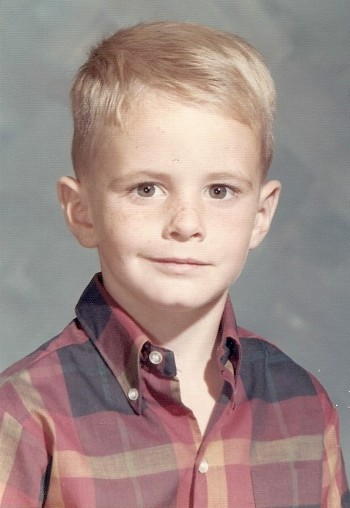 In this original BTB Investigation, we unveil the tragic story of Kirk Murphy, a four-year-old boy who was treated for “cross-gender disturbance” in 1970 by a young grad student by the name of George Rekers. This story is a stark reminder that there are severe and damaging consequences when therapists try to ensure that boys will be boys.
When we first reported on three American anti-gay activists traveling to Kampala for a three-day conference, we had no idea that it would be the first report of a long string of events leading to a proposal to institute the death penalty for LGBT people. But that is exactly what happened. In this report, we review our collection of more than 500 posts to tell the story of one nation’s embrace of hatred toward gay people. This report will be updated continuously as events continue to unfold. Check here for the latest updates.
In 2005, the Southern Poverty Law Center wrote that “[Paul] Cameron’s ‘science’ echoes Nazi Germany.” What the SPLC didn”t know was Cameron doesn’t just “echo” Nazi Germany. He quoted extensively from one of the Final Solution’s architects. This puts his fascination with quarantines, mandatory tattoos, and extermination being a “plausible idea” in a whole new and deeply disturbing light.
On February 10, I attended an all-day “Love Won Out” ex-gay conference in Phoenix, put on by Focus on the Family and Exodus International. In this series of reports, I talk about what I learned there: the people who go to these conferences, the things that they hear, and what this all means for them, their families and for the rest of us.
Prologue: Why I Went To “Love Won Out”
Part 1: What’s Love Got To Do With It?
Part 2: Parents Struggle With “No Exceptions”
Part 3: A Whole New Dialect
Part 4: It Depends On How The Meaning of the Word "Change" Changes
Part 5: A Candid Explanation For "Change"
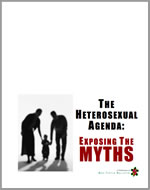 At last, the truth can now be told.
Using the same research methods employed by most anti-gay political pressure groups, we examine the statistics and the case studies that dispel many of the myths about heterosexuality. Download your copy today!
And don‘t miss our companion report, How To Write An Anti-Gay Tract In Fifteen Easy Steps.
 Anti-gay activists often charge that gay men and women pose a threat to children. In this report, we explore the supposed connection between homosexuality and child sexual abuse, the conclusions reached by the most knowledgeable professionals in the field, and how anti-gay activists continue to ignore their findings. This has tremendous consequences, not just for gay men and women, but more importantly for the safety of all our children.
Anti-gay activists often cite the “Dutch Study” to claim that gay unions last only about 1½ years and that the these men have an average of eight additional partners per year outside of their steady relationship. In this report, we will take you step by step into the study to see whether the claims are true.
Tony Perkins’ Family Research Council submitted an Amicus Brief to the Maryland Court of Appeals as that court prepared to consider the issue of gay marriage. We examine just one small section of that brief to reveal the junk science and fraudulent claims of the Family “Research” Council.
 The FBI’s annual Hate Crime Statistics aren’t as complete as they ought to be, and their report for 2004 was no exception. In fact, their most recent report has quite a few glaring holes. Holes big enough for Daniel Fetty to fall through.
“Google” is a trademark of Google Inc.
© Box Turtle Bulletin. All Rights Reserved.
 Posts
Posts  Posts via daily email: