Box Turtle Bulletin
 News and commentary about the anti-gay lobby
“Now you must raise your children up in a world where that union of man and box turtle is on the same legal footing as man and wife…”
News and commentary about the anti-gay lobbyPosts Tagged As: Daily Agenda
January 16th, 2013
TODAY’S AGENDA:
Events This Weekend: Aspen Gay Ski Week, Aspen, CO; Midsumma, Melbourne, VIC.
TODAY IN HISTORY:
Louisiana Supreme Court Upholds Conviction of Lesbians for “Unnatural Carnal Copulation”: 1967. Convictions of women for “crimes against nature” have been exceedingly rare in our nation’s history, but the Louisiana Supreme Court in 1967 upheld two such convictions. In 1966, Mary Young and Dawn DeBlanc were arrested and charged with “having committed a crime against nature” under Louisiana law during the course of a prostitution sting. A police officer testified in court that he had spoken with DeBlanc over the phone about arranging to meet her and Young at a motel. As they settled on a price for services rendered, DeBlanc said that sometimes they “gave a show” for an additional charge. The evidence at trial for the crime against nature charge was slim: A photo of the girls naked in the motel room when they were arrested and certain comic books in one of the girls’ purses which was labelled obscene. Judge Frank Shea refused to throw out the flimsy evidence, and in stead instructed the jury that the law defining “crimes against nature” included any joining or connection of a genital organ of one person with the mouth of another. He also refused to instruct the jury on laws on entrapment.
Young and DeBlanc were convicted and sentenced to thirty months in the Orleans Parish prison. They appealed the case to the Louisiana Supreme Court on the grounds that the charge was vague. In 1967, the court ruled:
The statute, of course, requires proof of an “unnatural carnal copulation.” As pointed out by this court … this phrase simply means “any and all carnal copulation or sexual joining and coition that is devious and abnormal because it is contrary to the natural traits and/or instincts intended by nature, and therefore does not conform to the order ordained by nature. … Oral copulation by and between two women constituted “unnatural carnal copulation” within statute proscribing such conduct.
[Source: Jonathan Katz. Gay American History: Lesbians and Gay Men in the USA (New York: Thomas Y. Crowell Co., 1976): pp 127-128.]
If you know of something that belongs on the agenda, please send it here. Don’t forget to include the basics: who, what, when, where, and URL (if available).
And feel free to consider this your open thread for the day. What’s happening in your world?
January 15th, 2013

TODAY’S BIRTHDAY:
Ivor Novello: 1893. The Welsh screen idol did it all: actor on stage and silent screen, playwright and composer. When the Great War broke out, he wrote the music for the song “Keep the Home Fires Burning” to lyrics written by American Lena Guilbert-Ford. That hit was Novello’s debut in the the entertainment business. In 1916, he was drafted into the Royal Naval Air Service and trained as a pilot, but after crashing twice, he was transferred to central London to work as a clerk. That allowed him to work as a composer for theater during his off hours. That’s when he met actor Bobbie Andrews, who would become Novello’s life partner. He also met Noel Coward, who envied “the magic atmosphere in which (Novello) moved and breathed with such nonchalance”
After the war, Novellow continued to find success in composing for musical comedy. He also began making a career of acting, first on the stage and then in film. He appeared in D.W. Griffith’s The White Rose (1923) and in two early Alfred Hitchcock silent thriller The Lodger (1926) and Downhill (1927). A lucrative contract from a British film company allowed him to buy a country house west of London which he renamed Redroofs, and entertained with little regard for convention. Those parties led to the rise of “the Ivor/Noel naughty set,” named for Novello, Noel Coward, and, shall we say, those sorts of people. During the late 1920s Novello was perhaps the most popular star in British films. In 1930, he took his plays Symphony in Two Flats and The Truth Game to Broadway, where he was offered a contract with MGM. But beyond writing the dialogue for Tarzan the Ape Man (including the famous line, “Me Tarzan, you Jane”), his Hollywood career failed to pan out.
Hollywood’s loss was London’s gain. On his return, he added playwriting to his repertoire of talents, which, along with his compositions, made him a powerhouse of British theater. A string of hits followed through the 1930s and 40s. He died suddenly in 1951, while still at the top of his game, from a coronary thrombosis and with Andrews at his side. Coward wrote in his diary, “Another landmark swept away. Poor, poor Bobbie… he will be utterly devastated.” Thousands of fans lined the streets to give their final goodbyes and his funeral was broadcast live on BBC. Four years later, the British Academy of Songwriters, Composers and Authors (BASCA) established the Ivor Novello Awards for songwriting and composing. The Ivors, as the awards are called, remain the only award that is judged by the writing community, and not by publishers and recording companies.
If you know of something that belongs on the agenda, please send it here. Don’t forget to include the basics: who, what, when, where, and URL (if available).
And feel free to consider this your open thread for the day. What’s happening in your world?
January 14th, 2013
THIS MONTH IN HISTORY:
Addressing “A Horror of Everything Related to the Homosexual Tendency”: 1899. In 1897, British sexologist Havelock Ellis published the first installment of his six-volume Studies in the Psychology of Sex. Volume 1 was subtitled Sexual Inversion, as homosexuality was more often called in the English language at that time. Two years later, his book was still making waves. In the January 1899 edition of the International Journal of Ethics, reviewer H. Sturt reviewed Ellis’s book, calling it “a solid and valuable contribution to psychology” and commending Ellis as “give(ing) the impression that he is a genuine scientific man doing his best to illustrate an obscure… province of human nature.” Sexual Inversion was revolutionary, being the first publicly-available scientific book in the English language to discuss homosexuality in a humane and nonjudgmental way. Ellis argued against the contemprary attitudes about homosexuality being abnormal, criminal, or immoral, and presented it instead as a variation in a broad spectrum of sexual expressions. Ellis concluded that it was useless to try to change sexual orientation, and he advocated for the abolishment of Britain’s anti-gay laws like the “gross indecency” law under which Oscar Wilde was prosecuted in 1895.
Most books about homosexuality at the turn of the century were severely restricted in their distribution in England. Sexual Inversion was first published in German in 1896 because Ellis feared it would be censored in England. Since several other books on sexuality had already been published there, German had become the lingua franca, so to speak, of sexuality research, so Ellis’s had a certain logic to it. Besides, when many of those German books were later translated into English, their carefully restricted distribution to solely the professional trade in England typically went unchallenged by the authorities. And so Ellis followed that route as the first English edition was published in London in 1897, with its distribution similarly restricted.
The ploy didn’t work. George Bedborough, a London bookseller, arrested in 1898 and charged with selling obscene material. In court the book was described as being a “certain lewd, wicked, bawdy, scandalous libel.” The judge warned Bedborough, “So long as you do not touch this filthy work again with your hands and so long as you lead a respectable life, you will hear no more of this. But if you choose to go back to your evil ways, you will be brought up before me, and it will be my duty to send you to prison for a very long time.” Ellis withdrew Sexual Inversion from sale in England, and thereafter published his works only in the U.S. and Germany. Sturt, in his review of Sexual Inversion a year later, argued that this established a very bad precedent:
There are some who would raise the general question whether a subject like the present can fitly be made the matter of a published treatise. Many excellent persons have a horror of everything related to the homosexual tendency. Their feelings commands our respect, and yet it seems better to have the subject brought out publicly. That all sorts of immature and half-educated people should read Mr. Ellis’s book is, of course, most undesirable. But in view of the prevalence of sexual inversion it is necessary that every schoolmaster, every criminal lawyer, we had almost said every head of a family, should be acquainted with its phenomena. Were the subject better understood, mistakes would be avoided that have ruined thousands of lives.
[Source: Jonathan Ned Katz. Gay/Lesbian Almanac: A New Documentary (New York: Harper & Row, 1983): pp 296-297.]
If you know of something that belongs on the agenda, please send it here. Don’t forget to include the basics: who, what, when, where, and URL (if available).
And feel free to consider this your open thread for the day. What’s happening in your world?
January 13th, 2013
TODAY’S AGENDA:
Events This Weekend: Arosa Gay Ski Week, Arosa Switzerland; Aspen Gay Ski Week, Aspen, CO; Midsumma, Melbourne, VIC; Utah Gay and Lesbian Ski Week, Park City, UT; Mid-Atlantic Leather Weekend, Washington, DC.
TODAY IN HISTORY:
Unitarian Church Sponsors Symposium on Homosexuality: 1954. The Unitarian Universalist Association has a long history of inquiry on a large number of contentious topics. In 1954, the First Unitarian Church of Miami hosted a forum called “Homosexuality: Cause, Society, and Crime.” According to a write-up in ONE magazine, the nation’s first gay publication, the attendance “broke all existing records.” The panel included Miami Mayor Abe Aronovitz, psychologist Dr. Syvil Marquit (no affiliation was given), Dr. Jack Capschan of the University of Miami’s psychology department, and Dr. Alvin Winder, psychologist for the Veterans Administration. The psychologists generally agreed that homosexuality wasn’t an illness, but they differed on whether it was “curable” or whether society was the problem. Mayor Aronovitz however pleaded ignorance on the subject, saying he was only there because “in his desire to, please, he had instructed his secretary to accept all speaking engagements.”:
He said that there are three or four places in Miami where homosexuals gather, but that the proprietors were not in business to help these people, only to profit monetarily from their suffering. He said that he didn’t want Miami known as a haven for homosexuals or divorce getting or any other criminals, but that homosexuals should not be persecuted or hounded, because they were undoubtedly suffering from a sickness of the mind. To conclude, he added, “They certainly need kindly understanding, but whose rights shall we consider?”
The discussion was then opened to questions from the audience. The first question was “How can we cure homosexuality?” Dr. Kapschan answered with this question, “Is it not possible that instead of sick homosexuals, we have a sick society?” Dr. Marquit added that we must have a wider acceptance of homosexuals. “In other words,” he said, “your sex life is your own business.”
…Then Mayor Aronovitz asked, “I would like to know if there are any individuals who have had the glorous experience of normal sexual relations who prefer homosexual relations?” “I’m sorry to disappoint the Mayor,” answered Dr. Marquit, “but it has been proven that a large percentage of confirmed homosexuals have experienced ‘glorious’ heterosexual relations. Then it was asked “If these, people are to be driven from the bars, beaches, and other gathering places, where would you have them spend their leisure time?” Mayor Aronovitz answered that if society accepted this, it should not be persecuted.
To the question “Is prejudice against homosexuality related to intolerance?” Dr. Kapschan answered, “Yes, research has proven that prejudice is generally against a number of minority groups, not just homosexuality. The authoritarian personality that condemns persons for their homosexual behavior is much more of a threat to society than the homosexual himself. They are psychoneurotics who need psychiatric treatment, not the harmless homosexual who varies from the so-called normal, criticized only insofar as what he does in bed. Prejudice against the homosexual makes an especially good scapegoat for the authoritarian personality.”
ONE’s editors were greatly encouraged by the forum, and hoped that it would “lead to more stimulated discussions by qualified people, sponsored by churches and other civic-minded groups.” Those hopes were short-lived however, as Mayor Aronovitz would go on that year to lead a notoriousanti-gay witch hunt in his city (see Aug 3, Aug 11, Aug 12, Aug 13 (twice that day), Aug 14, Aug 26, Aug 31, Sep 1, Sep 2, Sep 7, Sep 15, Sep 19, Oct 6, Oct 20, Nov 12 and Dec 16).
[Source: Unsigned. “Who’s Sick?” ONE 2, no. 2 (February 1954): 4-5.]

US Supreme Court Issues First Gay Rights Ruling: 1958. It was barely a ruling, just a terse, one-sentence line without even hearing oral arguments. But that was all it took for the US Supreme Court to affirm the rights of the first major gay magazine, ONE, to be distributed by the U.S. Postal Service without its subject matter, homosexuality, being declared obscene. It all began in 1953, when the L.A. Postmaster confiscated copies of the October issue (ironically, the cover story was “You Can’t Print It!”) and claimed that it violated 1873 Comstock Act, which prohibited sending “obscene, lewd, and/or lascivious” material through the mail.
What was considered “obscene” is hard to say. The entire magazine is mild — no photos, no description of sexual activity, nothing that could be remotely considered pornographic, then or now. It did however contain articles which spoke frankly about issues facing gay people, including, in the cover article, the legal tightrope the magazine had to navigate in order to remain in print. ONE sued the postmaster, citing their First Amendment rights to free speech. They lost their case in Federal District Court, with Judge Thurman Clark calling it “filthy and obscene material obviously calculated to stimulate the lust of the homosexual reader.” ONE appealed and lost again at the Ninth Circuit Court of Appeals, which called ONE , “morally depraving and debasing.” And so it was a major surprise — although it shouldn’t have been — when the U.S. Supreme Court ruled unanimously and without even bothering to hear oral arguments that even gay people enjoyed the same protections under the First Amendment as everyone else. Editor Don Slater celebrated the decision in the February 1958 issue: “By winning this decision ONE Magazine has made not only history but law as well and has changed the future for all U. S. homosexuals. Never before have homosexuals claimed their right as citizens.”
You can read the full, fascinating story of how a tiny magazine in Los Angeles beat the incredible odds here.
 Jesse Helms Calls Gays “Disgusting People”: 1990. When the three-term Senator from North Carolina stood on the platform at the state fairgrounds before a crowd of 1,700 to announce his intention to run for a fourth term, there was no doubt whatsoever what his platform would be: abortions and gays. “Family values in American are under attack as never before,” he said. “Think about it. Homosexuals and lesbians, disgusting people marching in our streets demanding all sorts of things, including the right to marry each other. How do you like them apples?” Helms won that election, and another one again in 1996 before finally leaving the Senate in 2003. Helms is currently dead.
TODAY’S BIRTHDAY:
 Charles Nelson Reilly: 1931. He was a very well respected Broadway actor, director and drama school teacher, but he was best known and beloved for his campy comedic roles and as a panelist on the game show The Match Game. His break on Broadway came in 1960 with Bye Bye Birdie. His part was small, but it opened the door to 1961’s Pulitzer prize-winning musical How To Succeed in Business Without Really Trying. He was also featured in 1964’s Hello, Dolly! Through the 1960s and 70s, he had several comedic guest appearances on television. He was a regular on The Dean Martin Show and made countless appearances on The Tonight Show with Johnny Carson. His campy character and his flamboyant dress marked him as a gay man. He never explicitly acknowledged it, although he would joke about how “butch” he was on The Match Game. No one asked, he didn’t tell, but everyone knew and no one bothered much with keeping the secret. In 2002, he finally discussed his private live in his one-man show Save It for the Stage, which became the basis for the autobiographical independent film, The Life of Reilly. He was too ill to attend its premiere in 2006 at South by Southwest, and he died at home on in 2007.
 Edmund White: 1940. He was born in Cincinnati and grew up in Chicago, then studied Chinese at the University of Michigan. He worked as a journalist in New York, then moved to France and settled in as a writer. In 1973, he co-wrote the first edition of The Joy of Gay Sex with psychiatrist Charles Silverstein, and that set him on his course of what one observer called his dedication to sexual truth-telling. His best known work, A Boy’s Own Story


White is currently a member of the faculty of Princeton University’s Creative Writing Program. His most recent novel, Jack Holmes and His Friend
 Nate Silver: 1978. The math whiz, baseball fanatic, poker player, and political polling savant who accurately predicted the outcome of the 2012 presidential election in each of the fifty states and the District of Columbia, wants it to be known that he is not a gay statistician, but a statistician who happens to be gay, while “ethnically straight.” To those who take such identity labels oh so seriously, Silver’s remarks challeneged an established orthodoxy, but one that is becoming increasingly irrelevant to those of Silver’s generation. As he recently explained in a Reddit “Ask Me Anything”:
My quick-and-dirty view is that people are too quick to affiliate themselves with identity groups of all kinds, as opposed to carving out their own path in life.
Obviously, there is also the issue of how one is perceived by others. Living in New York in 2013 provides one with much a much greater ability to exercise his independence than living in Uganda — or for that matter living in New York forty years ago. So perhaps there’s a bit of a “you didn’t build that” quality in terms of taking for granted some of the freedoms that I have now.
And/but/also, one of the broader lessons in the history of how gay people have been treated is that perhaps we should empower people to make their own choices and live their own lives, and that we should be somewhat distrustful about the whims and tastes and legal constraints imposed by society.
Silver, the author of The Signal and the Noise: Why So Many Predictions Fail — but Some Don’t
If you know of something that belongs on the agenda, please send it here. Don’t forget to include the basics: who, what, when, where, and URL (if available).
And feel free to consider this your open thread for the day. What’s happening in your world?
January 12th, 2013
TODAY’S AGENDA:
Events This Weekend: Arosa Gay Ski Week, Arosa Switzerland; Aspen Gay Ski Week, Aspen, CO; Midsumma, Melbourne, VIC; Utah Gay and Lesbian Ski Week, Park City, UT; Mid-Atlantic Leather Weekend, Washington, DC.
TODAY IN HISTORY:
Gay Men’s Health Crisis Founded: 1982. Several dozen men gathered in writer Larry Kramer’s New York apartment to discuss the mysterious “gay cancer” that had been claiming the lives of their friends and lovers, and to figure out how to raise money for research. The group originally thought they were coming together for a one-time thing: persuade a club to hold a benefit, invite a bunch of A-listers to come and donate, give the money to a suitable research organization, and go home. But it quickly became apparent that there was much, much more work to be done. Forced by widespread apathy on the part of the news media, city officials, local health authorities, and even “confirmed bachelor” and barely closeted Mayor Ed Koch, the Gay Men’s Health Crisis (GMHC) quickly went from being an ad-hoc group to organize a fundraiser to a full-fledged charitable service organization to fill the void that the city refused to fill.
GMHC would go on to raise money to provide services and assistance for people with HIV/AIDS, including assistance from a large army of volunteers to meet day-to-day needs like cooking, housecleaning, dog-walking, and transportation to medical appointments, as well as help in navigating the apathetic bureaucratic maze. They also, just as critically, hounded the news medial trying to get attention to the disease. When that mostly failed, GMHC started a crisis hotline, which became one of the organization’s most important avenue for distributing AIDS information in the pre-Internet era. They also distributed material to help educate the general public on the need for safer sex. In these areas, GMHC worked hard to meet the needs which had been, at best, ignored by local and national health authorities and charities (most shockingly, including most faith-based charities). GMHC also battled the overt stigmatization and hostility which grew among well-known public figures, nationally as well as locally.
GMHC quickly established itself as a well-regarded authority for HIV/AIDS education and service. By 1984, the Centers for Disease Control called on GMHC’s help in planning public conferences on AIDS. As the epidemic continued to grow, GMHC expanded its reach by assisting heterosexual men and women, hemophiliacs, intravenous drug users, and children. Today, the GMHC continues its work as one of the nation’s leading non-profit, volunteer-supported AIDS service and educational organizations.

John Singer Sargent, Self Portrait, 1906.
TODAY’S BIRTHDAY:
John Singer Sargent: 1856. Was he or wasn’t he? Scholars have scratched their heads over that question. He was born in Florence to American parents, who were well off enough to casually travel throughout Europe. Sargent’s drawing skills developed early, and at the age of eighteen he went to Paris to study painting. His early masterpiece, El Jaleo (1882), which portrayed a bare-armed Spanish Gypsy dancer in full movement, was both sensual and exotic — and, therefore, scandalous in the closing days of the Victorian era. Other portraits were similarly controversial. His full-length portrait of New Orleans-born Parisian socialite Virginie Gautreau (1884), depicting her in a strapless gown and a plunging neckline, had much of Europe clutching its pearls.
Almost immediately, Sargent established himself as the defining painter of what would soon become known as the Edwardian era. He worked on the edge between respectability and sensuality. But he also had a commercially-successful knack for finding beauty in everyone he painted while simultaneously preserving a candid honesty to his portraits. And just about everyone who was anyone sat for a portrait.

John Singer Sargent, portrait of Nicola D’Inverno, 1892.
For all of Sargent’s notoriety through his paintings, he was profoundly circumspect in his private life. He was flirtatious with women, but had no significant romantic attachments. He formed deep friendships with men — including Henry James, Oscar Wilde, and Robert Montesquiou, and perhaps most significantly, his assistant of twenty-six years and sometimes model Nicola d’Inverno — but there is no evidence that his relationships went beyond deep friendship.
And yet, the talk has always been there, and it was only amplified when, upon his death in 1925, his family destroyed his personal papers. And that talk centered on his male nudes, much of which were created for his own personal study and enjoyment, and not for public exhibition. In Donna Hassler’s preface in John Esten’s John Singer Sargent: The Male Nudes

John Singer Sargent, Thomas E. McKeller as Apollo, 1921-25.
To Sargent, however, rendering the nude male figure was more than just an academic pursuit… He showed a strong preference for portraying the masculine form throughout his career (few Sargent drawings or paintings of the nude female figure are extant), and his work ranges from a straightforward student study of an unidentified male model wearing an posing strap to an emotionally charged, fully nude drawing of an identifiable male model, Thomas E. McKeller.
As Esten points out, “Like beauty, homoeroticism is in the eye of the beholder.” And many beholders have seen it in Sargent’s paintings. Several of his male nudes made their way into the famous mural in the Rotunda of Boston’s Museum of Fine Arts, some of them, including his sketch of McKeller as Apollo, refashioned into female figures.

Felipe Rose: 1954. You know him as “the Indian” for his appearance as a founding member of the Village People. The son of a Puerto Rican mother and Lakota Sioux father, Rose grew up in Brooklyn where he took up dancing at a very young age. When he was sixteen, he studied dance with the Ballet de Puerto Rico and participated in a Lincoln Center dance recital with the Ballet Company. At the urging of an aught, he began dressing in tribal regalia and exploring Native American influences in dance as an homage to his father’s heritage. He also, at about the same time, began exploring New York’s gay nightlife. Soon after French producer Jacques Morali saw him working as a go-go dance in his “Indian” get-up at a New York gay bar, he recruited Rose into a new singing group in which members wore costumes representing different “masculine” occupations. The Village People scored their first major disco hits, “Macho Man” and “Y.M.C.A” in 1978.
There have been numerouls personnel changes in the Village People over the years, but there has only been one Indian. Rose is one of only two only Village People to have never left the group, and with Alex Briley (the G.I/Sailor), he remains one of only two original members.
While the Village People is all camp, Rose takes his Native American heritage seriously. In 2000, he recorded the single “Trails of Tears,” Which was nominated for 3 NAMMYs (Native American Music Awards). He is a member of the Advisory Board of the Native American Music Association.
If you know of something that belongs on the agenda, please send it here. Don’t forget to include the basics: who, what, when, where, and URL (if available).
And feel free to consider this your open thread for the day. What’s happening in your world?
January 11th, 2013
TODAY’S AGENDA:
Events This Weekend: Arosa Gay Ski Week, Arosa Switzerland; Aspen Gay Ski Week, Aspen, CO; Midsumma, Melbourne, VIC; Utah Gay and Lesbian Ski Week, Park City, UT; Mid-Atlantic Leather Weekend, Washington, DC.
TODAY IN HISTORY:
Britain Lifts Its Ban on Gay Military Personnel: 2000. Once they put their minds to it, there wasn’t much dithering. It just took them a while to put their minds to it. Unlike the U.S. (in theory, anyway), Britain had an outright ban on gays serving in the military, whether they were open about it or not. Anyone was subject to being followed or interrogated by the SIB (Special Investigations Branch) for any suspicion, or even no suspicion at all. In 1997, three gay men and a lesbian sued after they were discharged from the Royal Navy and RAF. Their case went all the way up to the European Court of Human Rights, which ruled in September 1999 that the Ministry of Defense’s policy violated the service members’ human rights.
The following December, the Labour government of Prime Minister Tony Blair announced the MoD would comply with the ruling. Members of the opposition Conservative Party were appalled. M.P. Gerald Howarth said, “This appalling decision will be greeted with dismay among ordinary soldiers in the armed forces, many of whom joined the services precisely because they wished to turn their back on some of the values of modern society.” Officers predicted sexual mayhem in the barracks or — horrors! — male couples dancing at a mess function. But one month after the announcement was made, the ban was lifted, and all of the fears came to naught. A review two years later across all the branches found widespread acceptance for lifting the ban, and gay and lesbian service members served with distinction in Afghanistan and Iraq alongside their American counterparts who still had to remain hidden and in the closet.
Prop 8 Trial Begins: 2010. Lawyers for the plaintiffs in the lawsuit against the state of California seeking to overturn Proposition 8 began their opening remarks. Attorney Ted Olsen promised to argue the case on three fundamental points:
Olsen and co-counsel David Boies would ultimately prevail and U.S. Federal District Judge would rule that Prop 8 was unconstitutional. The case was appealed to the Ninth Circuit Court of Appeals which upheld the lower court’s ruling but on much narrower grounds, namely that once a right has been granted and enjoyed by a class of people, it is unconstitutional to then strip them of that right. The case, now know as Hollingsworth v. Perry, is before the U.S. Supreme Court, which has scheduled oral arguments for March 26 at 10:00 a.m.
If you know of something that belongs on the agenda, please send it here. Don’t forget to include the basics: who, what, when, where, and URL (if available).
And feel free to consider this your open thread for the day. What’s happening in your world?
January 10th, 2013
TODAY’S AGENDA:
Events This Weekend: Arosa Gay Ski Week, Arosa Switzerland; Aspen Gay Ski Week, Aspen, CO; Midsumma, Melbourne, VIC; Utah Gay and Lesbian Ski Week, Park City, UT; Mid-Atlantic Leather Weekend, Washington, DC.
TODAY IN HISTORY:
 Gore Vidal’s “The City and The Pillar” Published: 1948. It turns out that the month of January, 1948 was a rather scandalous month for the American Public. On January 5, Sexual Behavior In the Human Male, the first of the the two Kinsey Reports, was released. Then just five days later, Gore Vidal’s novel, The City and the Pillar came out. Vidal wrote this novel, his third, at the relatively tender age of twenty-one, and it was the first mainstream novel dealing with homosexuality in its central characters. It was, in its day a kind of a Brokeback Mountain, a coming of age story in which the main protagonist awakens to his sexuality. Gore also smashed the prevailing stereotyes of the day by portraying the central characters as masculine. I guess both books coming out within the space of less than a week was too much for the New York Times. Their review the next day went like this:
Presented as the case history of a standard homosexual, this novel adds little that is new to a groaning shelf. Mr. Vidal’s approach is coldly clinical: there is no real attempt to involve the reader’s emotions, as the author sets down Jimmie’s life story — his first experience during his high school days, his life as a cabin boy, a tennis bum, his adventures in Hollywood and points East. Backdrops are gaudy, and Jimmie’s more ardent acquaintances include a picture star (the idol of a million bobby soxers), a fashionable novelist and members of the armed forces. But the over-all picture is as unsensational as it is boring…
Boring. Perhaps the worst thing that could be said about any novel, if anything was to be said at all. Most papers refused to review it, but a few saw it as a triumph. The Washington Post called it “an artistic achievement” and the Atlantic Monthly said it was “a brilliant exposé of subterranean life.” Despite it’s “subterranean” themes and The New York Times’ great displeasure, The City and the Pillar nevertheless made it to the best-seller’s list. The Times so thoroughly disliked it that it refused to run ads for it and ignored Vidal’s next five books. Cut off from an important promotion vehicle, Gore resorted to writing several mystery novels in the early 1950s under the pseudonym Edgar Box.
Although the gay characters’ portrayals in The City and the Pillar were generally positive, the tone was dark and the ending tragic, with the main character being murdered by his lover. It’s been widely reported that the publishers forced Vidal to change the ending to an unhappy one, but Gore himself denies this. But twenty years later, he published the novel again as The City and the Pillar, Revised and changed the overall tone to be less dark.
 Episcopal Church Ordains First Open Lesbian: 1977. Before Bishop Paul Moore of New York ordained Rev. Ellen Marie Barrett as a priest in his Episcopal diocese, there is a point in the service in which the ordaining bishop asks the congregation, “If any of you know any impediment or crime because of which we should not proceed, come forward now, and make it known.” Rev. James Wattley, who was an active opponent of the church’s decision to ordain women to the priesthood, rose to denounce the ordination as a “travesty and a scandal.” He went on: “my objection is for myself alone on the grounds that she is a self-proclaimed lesbian.”
Bishop Moore appeared prepared for the answer. “Attention has been drawn to the ordination because Ms. Barrett has not made a secret of her homosexual orientation,” the Bishop announced. “However, her personal life has never been under criticism. Many persons with homosexual tendencies are presently in the ordained ministry. Ellen Barrett’s candor in this regard is not considered a barrier to ordination. She is highly qualified intellectually, morally and spiritually. … Historically, many of the finest clergy in our church have had this personality structure, but only recently has the social climate made it possible for some to be open about it.”
Rev. Barrett’s ordination sparked another round of controversy in a church still split over its 1976 decision to admit women to the priesthood. Within a month of Barrett’s ordination, nine parishes announced they were leaving the church. In an unusual move, one Florida pastor read out an “excommunication decree” from the altar of his church against Bishop Moore and Rev. Barrett.
The following October, the church’s House of Bishops sought to calm the controversy with a resolution declaring that gay people should not be ordained as priests, saying that such an ordination would “require the Church’s sanction of such a lifestyle not only as acceptable but worthy of emulation.” The House of Bishops also gave a nearly unanimous consent to another resolution to support Bishops who “by their own conscience” refuse to ordain women priests or allow them to serve in their dioceses. But in a 28-62 vote, the House refused to censure Bishop Moore, and in a 49-68 vote refused to advise California Bishop Kilmer Myers against licensing Rev. Barrett in his diocese. Thus the precedent was set, and bishops continued ordaining openly gay priests under the same “conscience” principle which permitted other bishops to bar women from the altar.
TODAY’S BIRTHDAYS:
 Johnnie Ray: 1927. When his career broke open in 1951, he was quickly dubbed “The Prince of Wails” in a nod to his highly emotional brand of white R&B. His intense performances forshadowed the energy of Rock And Roll which would hit the charts hard a few years later. Ray’s first hits, “Cry,” and “The Little White Cloud That Cried”, were sides A and B of his first single, with both sides dominating the charts for several months. They were followed by a string of a couple dozen top-forty hits through 1957. He married very briefly in 1952, a marriage that ended a year later. His wife knew he was gay going in — he had been arrested for soliciting an undercover police officer in Detroit for sex before his career took off — but the aspiring Mrs. Ray was confident she could “straighten him out.” All the while, it appears that Rays true long-term relationship was with his manager, Bill Franklin.
His popularity in the U.S. faded by the late ’50s, but he continued to do well in the UK, where his show at the Palladium became legendary. But by 1960, his star began to fade, dimmed by alcoholism and a bout of turberculosis. There was a brief possibility of a revival in the early 1970s, but it turned out to be short lived. Frankin left him in 1976 and cut off all contact a few years later. By the time the 1980s rolled around, gen-X’ers had little idea of who he was except for a line in the 1982 hit “Come On Eileen” by Dexys Midnight Runners. (“Poor old Johnnie Ray sounded sad upon the radio / he moved a million hearts in mono.”). He died of liver failure in 1990.
Here is a performance of “The Little White Cloud That Cried.” When you watch this, imagine seeing it in 1951 when the top acts that year included Perry Como, Nat King Cole and Tony Bennett — five years before Elvis.
http://www.youtube.com/watch?v=myu_wBPfpxs
 Sal Mineo: 1939. He was a talented young actor who some say peaked with his first major role as John “Plato” Crawford in Rebel Without a Cause, the 1955 classic staring James Dean and Natalie Wood. That role got him an Academy Award nomination for best supporting actor. He also appeared in another James Dean vehicle Giant as a Mexican boy, and for a while he became typecast as a troubled teen. In 1957, he made a brief stab at pop music, and in 1959, he appeared as the famous jazz drummer Gene Krupa in The Gene Krupa Story. He received another Academy Award nomination for Best Supporting Actor in the epic Exodus in 1960. By the late 1960s, Mineo became one of the first Hollywood actors to acknowledge his homosexuality. He died in 1976, stabbed to death during a mugging as he was walking home from a rehearsal in West Hollywood. He was only 37.
 But back to Rebel Without A Cause. By the time I saw the film for the first time as a teenager in the late 1970s, I had already read a lot about the classic. Critics and observers wrote about the movie’s themes of alienation, aimless adolescence, the ambivalence of impending adulthood — all those things and more. And so when the movie appeared on television one night (remember, this was before you could rent movies on VHS), I was unprepared for what looked to be the most obvious theme of the movie: the sexual tension between Sal Mineo and James Dean. At the time I had no idea that Mineo was gay or that Dean was bi. But seeing their chemistry together on the screen, it was so bright, so combustible, so obvious! Well good lord, why wasn’t anybody talking about that? Yeah, I know. I would later find out that others noticed it too. But remember, this was the 1970s and I was growing up in Appalachia. And man, what an eye-opener.
If you know of something that belongs on the agenda, please send it here. Don’t forget to include the basics: who, what, when, where, and URL (if available).
And feel free to consider this your open thread for the day. What’s happening in your world?
January 9th, 2013
TODAY’S AGENDA:
Marriage Equality Bill Introduction: Springfield, IL. The legislative sponsors of the Illinois marriage equality bill plan to file separate Senate and House bills on the first day of the new legislative session. Sponsors Senator Heather Steans (D-Chicago) and Representative Greg Harris (D-Chicago) will file the Religious Freedom and Marriage Fairness Act, shortly after members of the 98th General Assembly are sworn in. Illinois marriage advocates believe that they have a strong chance to bring marriage equality to the Land of Lincoln thanks to Democratic supermajorities in both houses. The bill also enjoys the support of Illinois GOP Chairman Pat Brady.
Events This Weekend: Arosa Gay Ski Week, Arosa Switzerland; Aspen Gay Ski Week, Aspen, CO; Midsumma, Melbourne, VIC; Utah Gay and Lesbian Ski Week, Park City, UT; Mid-Atlantic Leather Weekend, Washington, DC.

An unidentified patient at Worcester State Hospital (Photo by Herbert Gehr/Life Magazine, 1949)
THIS MONTH IN HISTORY:
Hormone Treatments Found Ineffective for Altering Homosexuality (Or, More Precisely, Gender Identity): 1941. It’s a good thing this idea was knocked down rather early in the twentieth century. Unfortunately, it took a series of medical experiments on a mental hospital patient (almost certainly without the patient’s consent) to arrive at that conclusion. Worse, in an example which brings to mind the infamous Tuskegee syphilis experiments, the experiments were performed on an African-American patient. According to Dr. Saul Rosenzweig and R.G. Hoskins, working at Worcester State Hospital in Massachusetts, the patient, apparently transgender (in 1941, the concept of gender identity being distinct from sexual orientation was still unknown in the medical literature), was admitted to the hospital following the death of her male lover:
The patient, A.D., a male negro of 46, entered the Northampton State Hospital in 1921 and 4 years later was transferred to the Worcester State Hospital with a diagnosis of “constitutional psychopathic personality without psychosis.” …[His symptoms] consisted mainly of seclusiveness, shyness, pronounced effeminacy, and excessive preoccupation with drawing, painting, designing of women’s clothes and similar “artistic” activities. His speech became disjointed and unresponsive and for two years he refrained from leaving his home. He talked of wearing women’s clothes and often went to bed with presumably imaginary ailments. Upon admission to the Worcester State Hospital he showed no pronounced psychotic symptoms.
He is a short, stocky negro who, except for his large masculine genitals, is in every respect a woman. He shows an exaggerated female gait and speech and all the mannerisms of a clinging-vine type of female, spends hours at his toilette, and says he is fond of being well-groomed. With men he is coy, silly, and affected. With the other sex he talks as one woman to another. He daily asks for cathartics and is overinterested in the needs of his lower intestinal tract. He knows he is considered effeminate, but says that that is the way God made him. He further excuses his peculiarities on the ground that he is an artistic genius and therefore entitled to a few eccentricities.
A.D. had been a patient for 20 years with little change in his mannerisms or appearance. What is alarming about this report so far is the admission that A.D. is a long-term mental patient “without psychosis.” It’s hard to imaging what the doctors would be looking for as a sign that A.D. was ready to be discharged, although it’s equally hard to imagine how A.D. would have been able to function in the world if he had been discharged after 21 years of confinement. But of course, the alarm doesn’t end there. Rosenzweig and Hoskins decided that A.D. was the perfect candidate for a series of experiments:
From October 16 to November 10, 1939 he was given orally the potent synthetic estrogen, Stilboestrol (Squibb), in dosage of 5 mgm. three times a week.
On December 6 he received an implant of a 150-milligram tablet of Testosterone (Schering), which was embedded in the subcutaneous tissues beneath the inferior angle of the left scapula.
On December 20, 1939 to February 7, 1940, intramuscular injections were given of a gonadotropic preparation derived from pregnant-mare serum (Anteron-Schering). The dosage was 1 cc. or 250 units twice weekly. Because of an upper respiratory infection medication was omitted during the week of January 11.
An attempt was then made to enhance the responsivity to sex hormones by the use of desiccated thyroid (Armour). This was begun on February 1 at 1 grain daily and continued throughout the remainder of the study.
On February 9, Pituitary Gonadotropic — Pranturon (Schering) — was substituted for the pregnant-mare preparation, also in dosage of 1 cc. twice weekly. At the same time Testosterone Propionate by intramuscular injection was begun in dosage of 50 mgm. twice a week. Both were continued until February 29.
On March 9 another estrogenic preparation was begun, Ayerst Mc-Kenna and Harrison’s Emmenin being used in dosage of 1 teaspoonful three times daily. This was discontinued on March 11.
Finally, from April 6 to 11 another estrogen, Estriol (Lilly), was given in the large dosage, 6.24 mgm. three times a day.
What was the point of all of this bizarre hormonal treatments on A.D.? Rozenzweig and Hoskins believed that homosexuality was caused by an “imbalance of male and female sex-hormone production,” and that by altering that ratio, they hoped to be able to observe changes in A.D.’s behavior. They failed. “No influence upon the behavior or the personality of the patient could be detected.” For Rozenzweig and Hoskins, it was back to the drawing board. But for A.D., we may never know what became of her.
[Source: Saul Rosenzweig & R.G. Hoskins. “A note on the ineffectualness of sex-hormone medication in a case of pronounced homosexuality.” Psychosomatic Medicine 3, no. 1 (January 1941): 87-89.]
If you know of something that belongs on the agenda, please send it here. Don’t forget to include the basics: who, what, when, where, and URL (if available).
And feel free to consider this your open thread for the day. What’s happening in your world?
January 8th, 2013
TODAY IN HISTORY:
Arrest for “Abominable Act and Detestable Crime Against Nature”: 1962. Read that year again. It was in 1962, not 1562, when Max Perkins and Robert McCorkle were arrested in Charlotte, North Carolina, on the charge that they “did unlawfully, willfully, maliciously and feloniously commit the abominable and detestable crime against nature with each other.” The North Carolina statute they were charged under was a 429-year-old law carried over from England which provided imprisonment of between five to sixty years, after having been modified in 1869 to remove the death penalty. McCorkle pleaded no contest and received the minimum sentence of 5 to 7 years. He served a portion of that sentence (I don’t know how long) and was released. Perkins, who was at the very least a cross dresser but more likely may have been transgender, pleaded innocent. The jury however found Perkins guilty, and the same judge who sentenced McCorkle earlier sentenced Perkins to 20 to 30 years in prison.
Perkins went to Federal Court, and on October 5, 1964, Federal Judge J. Braxton Craven ruled that Perkins was wrongly convicted. Craven found that if the statute outlawing the “detestable crime” was a new one, it would be unconstitutionally vague. But since it wasn’t, he held that the weight of historical interpretation and common law pointed to a much more specific crime. “It has been interpreted many times by the North Carolina Supreme Court,” Craven wrote. “Although the court has said it means much more than it meant at common law or at enactment during the reign of Henry VIII, its decisions have made equally clear that crime against nature does not embrace walking on the grass.” Based on those decisions, Craven found that the specific crime being outlawed was “buggery”; Perkins’s “detestable crime” was fellatio. He also found that Perkins’s excessive punishment, when compared to McCorkle’s, was obviously imposed because “his not guilty plea inconvenienced the court and that he was punished for it.” Further, he found that Perkins’s court-appointed counsel refused to mount a defense or call any of Perkins’s witnesses. Judge Craven ordered Perkins released before concluding his opinion:
Is it not time to redraft a criminal statute first enacted in 1533? And if so, cannot the criminal law draftsmen be helped by those best informed on the subject — medical doctors — in attempting to classify offenders? Is there any public purpose served by a possible sixty year maximum or even five year minimum imprisonment of the occasional or one-time homosexual without treatment, and if so, what is it? Are homosexuals twice as dangerous to society as second-degree murderers — as indicated by the maximum punishment for each offense? Is there a good reason why a person convicted of a single homosexual act with another adult may be imprisoned six times as long as an abortionist, thirty times as long as one who takes indecent liberties with children, thirty times as long as the drunk driver — even though serious personal injury and property damage results — twice as long as an armed bank robber, three times as long as a train robber, ten times as along as one who feloniously breaks and enters a store, and 730 times as long as the public drunk?
These questions, and others like them, need to be answered.
Judge Craven would go on to serve on the US Court of Appeals for the Fourth Circuit from 1966 until his death in 1977. Perkins received a new trial and was found not guilty.
TODAY’S BIRTHDAY:
 Graham Chapman: 1941. When Graham was growing up, his favorite radio program was the surreal British sketch comedy program The Goon Show, which made Spike Milligan and Peter Sellers household names. Chapman acknowledged that it was a major influence on him: “From about the age of seven or eight I used to be an avid listener…. In fact, at that stage I wanted to be a Goon.” He never got that chance, but he did go on to become a part of the Goon Show’s obvious successor: Monty Python’s Flying Circus. Chapman’s characters tended to epitomize the famous British Upper Lip, although those characters were often undone when their masks slipped to reveal a loony madness underneath. He also co-wrote the “Dead Parrot” sketch about a man who tries to return a dead Norwegian Blue Parrot to the pet shop, a sketch which is one of the Monty Python classics. Chapman played King Arthur in Monty Python and the Holy Grail, and he played the title character in Life of Brian.
Chapman came out as gay just before Monty Python’s Flying Circus went on the air in 1969, and he was committed to his life-long partner, David Sherlock, since 1966. In 1972, he helped to co-found the publication Gay News in an effort to change the way gay people were perceived by the public. Chapman was a raging alcoholic through much of his career, but he went sober in 1977 following a drunken interview on British television. He died on October 4, 1989 of throat cancer, on the day before a planned twentieth anniversary celebration of the first Flying Circus broadcast. Fellow Python Terry Jones called it “the worst case of party-pooping in all history.” John Cleese delivered the eulogy: “Graham Chapman, co-author of the ‘Parrot Sketch’, is no more. He has ceased to be. Bereft of life, he rests in peace. He’s kicked the bucket, hopped the twig, bit the dust, snuffed it, breathed his last, and gone to meet the great Head of Light Entertainment in the sky.”
If you know of something that belongs on the agenda, please send it here. Don’t forget to include the basics: who, what, when, where, and URL (if available).
And feel free to consider this your open thread for the day. What’s happening in your world?
January 7th, 2013
 Merry Christmas! Yes, today is Christmas day — if you grew up in or are a member of an Orthodox Church which follows the Julian calendar. That would include churches in Ethiopia, Russia, Georgia, Armenia, Ukraine, Serbia, Macedonia, Montenegro and Moldova. (Greek, Bulgarian, Romanian, Antiochian and others celebrates Christmas on December 25). Christmas day formally ends the 40-day Nativity Fast. In Russia, the main celebration takes place on Christmas Eve, where the family returns home from services for the traditional “Holy Supper” consisting of 12 dishes, one for each of the apostles. In Georgia, people dress up and go an an “Alilo walk” and wish each other Christmas greetings and hand out sweets to children. Serbs spread their Christmas celebrations out over three days with numerous feasts, gatherings and traditional activities for each day.
TODAY’S AGENDA:
Court Hearing In Lawsuit Against Scott Lively: Springfield, MA. Last March, the Center for Constitutional Rights announced that they were suing Scott Lively in Federal District Court on behalf of Sexual Minorities Uganda for Lively’s “decade-long campaign he has waged, in coordination with his Ugandan counterparts, to persecute persons on the basis of their gender and/or sexual orientation and gender identity.” He is being sued under the Alien Tort Statute, which provides federal jurisdiction for “any civil action by an alien, for a tort only, committed in violation of the law of nations or a treaty of the United States.” Oral arguments on Lively’s motion to dismiss are set for today before Judge Michael A. Ponsor at the Federal Courthouse in Springfield, Massachusetts. Oral arguments are set for 11:00 a.m. For those planning to attend either the hearing or a planned rally, CCR provides this advice:
WHEN: You are advised to arrive at 9:00am. The hearing is at 11:00am, however, word is that Lively’s people have been advised to arrive at 9:30am. It also takes one hour in advance to allow time for going through courthouse security. After the argument, there will be a press conference and rally in front of the courthouse, organized by CCR and the Stop the Hate and Homophobia Coalition of Western Massachusetts.
Prior to the hearing, starting at 10:00am, the Stop The Hate And Homophobia Coalition is organizing a “stand-out” along State Street in front of the courthouse, where we will be holding supporting signs and informational flyers.
CCR and Sexual Minorities Uganda are also organizing a Twitter Rally from 12:00 noon to 2:00 p.m. EST using the #StoptheHate hashtag. CCR will hold a press conference in front of the Court House after the hearing, which is expected to take less than two hours. You can learn more about the lawsuit at the CCR’s website. Vince Warren, CCR’s Executive Director, wrote this op-ed for The Washington Post.

Murder, she wrote.
THIS MONTH IN HISTORY:
Phyllis Lyon Kills Ann Ferguson: 1957. When the Daughters of Bilitis began publishing The Ladder in October 1956, it’s masthead identified its first editor as Ann Ferguson. In the second issue, Ferguson penned a short article addressing the first problem they encountered in publishing what would become the nation’s first magazine for lesbians. As Ferguson explained it, too many people feared “that names on our mailing list may fall into the wrong hands, or that by indicating interest in this magazine a person will automatically be labeled a homosexual.” She assured readers that subscribers included all kinds of people, including lawyers, social workers, psychiatrists, business, and other professionals. She also assured readers that “Daughters of BIlitis is not outside the law — we advocate no illegal actions by anyone.”
Ferguson revealed that the organization had obtained legal council and would file for incorporation under the laws of California. She also explained a recent Supreme Court decision which upheld the rights of citizens to refuse to reveal to Congressional committees the names on subscription lists or lists of purchases. So in addition to the organization’s own bylaws prohibiting the disclosure of The Ladder’s subscription lists, “the decision also guarantees that your name is safe!”
Ferguson had been at the helm for only thee months when the January 1957 issue included this startling announcement:
ANN FERGUSON IS DEAD!
I confess. I killed Ann Ferguson. Premeditatedly and with malice aforethought. We ran an article in the November issue of THE LADDER entitled “Your Name is Safe”.” Ann Ferguson wrote that article. Her words were true, her conclusions logical and documented — yet she was not practising what she preached.Somehow it didn’t seem right,
She spent some time considering the situation. Then came to a conclusion. At the November public discussion meeting of the Daughters of Bilitis we got up — Ann Ferguson and I — and did away with Ann. Now there is only Phyllis Lyon.
Seriously, my pseudonym was taken in the first place without much thought. Somehow, it seemed the thing to do. But all it did was create problems. If you’re going to write under a pseudonym then you should go by that name in personal contacts. But everybody connected with the Daughters of Bilitis already knew me as Phyllis and the attempt to call me Ann confused everyone, including me.
I’m sure that I’m not placing myself in any jeopardy by using my real name — and I’m only simplifying matters and practising what I preach.
Phyllis Lyon (see Nov 10) with her partner Del Martin (see May 5) were among eight women who founded the Daughters of Bilitis in 1955 (see Oct 19). In 2008, they Phyllis and Del became the first same-sex couple to be legally married in the state of California. Del passed away later that year. At last report, Phyllis still lives in their home in San Francisco.
[Sources: Ann Ferguson. “Your Name Is Safe!” The Ladder, 1, no. 2 (November 1956): 10-12.
Phyllis Lyon. “Ann Ferguson Is Dead!” The Ladder, 1, no. 4 (January 1957): 7.]
TODAY’S BIRTHDAY:
 Jann Wenner: 1946. He founded Rolling Stone in 1967 when he was just 21, after borrowing $7,500 from family members. In 1977 he founded Outside magazine, and in 1985 he bought a share of US. In 1995, he separated from his wife, Jane Wenner, to live with Matt Nye, a former model and fashion designer. Jann and Jane have never divorced — she is still vice president of Wenner Media — and Jann and Matt are still together. In addition to the three sons he had with Jane, Jann and Matt also have three children.
If you know of something that belongs on the agenda, please send it here. Don’t forget to include the basics: who, what, when, where, and URL (if available).
And feel free to consider this your open thread for the day. What’s happening in your world?
January 6th, 2013
TODAY IN HISTORY:
Suspect Arrested In Miami “Hairdresser Murder” Case: 1955. Only a day had passed since Miami Beach police were called to an apartment on 82nd Street where William Bishop’s roommates discovered his dead body on the floor of an enclosed porch (see Jan 5). When police arrived, they examined his nude body with his hands tied behind his back, his ankles tied together, and a dish towel and handkerchief fashioned into a gag around his mouth. The Dade County sheriff’s legal-medical advisor told reporters that Bishop probably died from strangulation, but he wouldn’t be able to make a final determination until an autopsy was performed. A separate Associated Press report the next day would reveal that the autopsy showed that “Bishop died of strangulation and that he had been sexually abused.”
If this were Dragnet’s Sgt. Joe Friday briefing reporters on the case, those would have been, in his words, “just the facts, ma’am.” But this murder had taken place against the backdrop of a long-running anti-gay witchhunt (see Aug 3, Aug 11, Aug 12, Aug 13 (twice that day), Aug 14, Aug 26, Aug 31, Sep 1, Sep 2, Sep 7, Sep 15, Sep 19, Oct 6, Oct 20, Nov 12 and Dec 16), and The Miami News was often eager to fan the flames of anti-gay prejudice throughout much of the year. They played this latest incident they way they played all of the other developments: to maximum effect. In yesterday’s report, Bishop was identified as a hairdresser — not just once but four times, including twice in the headlines, just in case anyone missed it. The reporter, Frank Fox, dutifully pointed out that the roommates were also a hairdresser and a florist, and they were “hysterical” — Fox used that word twice — when they called the police. Police allowed Fox a close-up look at the body so he could report, in detail, Bishop’s “silk dressing gown sash” which was used to tie Bishop’s hands together. Fox apparently was also given the run of the apartment. He described the full layout of the U-shaped apartment and “the reading matter about homosexuals” scattered about. Fox did leave it to the homicide detective to say openly what Fox and his Miami News readers already concluded: “It looks to me like a sadistic murder.”

Detective Charles Sapp handcuffs Thomas F. McDonald
William Bishop’s death looked like it was shaping up to being just one more crime that police and the public would refuse to take seriously. Which makes it all the more surprising when the following day, police announced the arrest of “a 21-year-old Korean War veteran” by the name of Thomas Francis McDonald. Miami News reporter Sanford Schnier described him as a veteran of the U.S. Army Signal Corps, a private first class who served “11 months in Korea with the 71st Regiment, 7th Infantry (Hourglass) Division as a switchboard operator (with) several battle stars who, in effect, had little choice but to attack William Bishop. The story went like this:
McDonald, who has a wife and 6-month-old child, related this story: He left home several days ago feeling despondent over an argument with his wife and because of the recent deaths of his mother and father. He checked into the Tuscany Hotel in Hollywood, and came to Miami Beach Tuesday night. In a 74th Street bar he met Bishop. They played shuffleboard and had a few drinks, he said. Bishop invited him to his apartment and he accepted.
When they go there, McDonald stated, Bishop “tried to make some improper advances towards me. I hit him with my first three or four times, and he struck back and got me on the jaw twice. He fell when I hit him again.”
The, he said, he tied him up “Because I figured he might follow me,” and left the scene. He went back to Hollywood, checked out at 7:15 a.m. yesterday and came back to Miami, where he planned to check in.”
Asked by detectives if he knew Bishop was a homosexual, McDonald answered, “I never had any use for them and I still don’t.”
McDonald, 210 pounds and 5 feet, 11 inches tall, said he took Bishop’s gold watch, $5 in case, two shirts and a tan sport jacket, which he was wearing when arrested. McDonald admitted in his statement to Miami Beach police that ho took a ring from Bishop and hocked it later in the day at a Miami pawnshop for $35.
“I swear he was breathing when I left; you got to believe me,” he implored detectives.
That’s how the story ended on January 6: a burly Korean war vet and married father who attacked a silk dressing-gowned hairdresser. It would appear that, in The Miami News’ opinion, the case was more or less closed — except for the small matter of a dead body. The News dropped the story until May, when a judge ruled that McDonald was competent to stand trial and jury selection began. The story then fell back off of the paper’s pages, so I don’t have much information about what happened during the trial until May 24, when the paper’s late edition carried a very brief one-paragraph description of McDonald’s testimony:
Accused Testified in Murder Trial.
Thomas F. McDonald, accused of murdering William B. Bishop, took the stand in his own defense today and reiterated that Bishop was still alive when he left Bishop’s apartment at 235 82nd St., Miami Beach, the night of Jan 5. McDonald, a 21-year-old Korean veteran, told the court that he beat, bound and gagged the 29-year-old hairdresser because he was “acting like a mad dog.”
Later that day, the jury found McDonald guilty of murder, “and recommended mercy, thus saving him from death in the electric chair.” Fortunately, Florida law placed a limit to that mercy: a life sentence was the mandatory minimum. McDonald was formally sentenced to life on May 27.
If you know of something that belongs on the agenda, please send it here. Don’t forget to include the basics: who, what, when, where, and URL (if available).
And feel free to consider this your open thread for the day. What’s happening in your world?
January 5th, 2013
TODAY IN HISTORY:
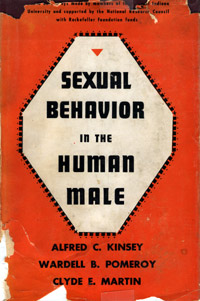 Kinsey’s “Sexual Behavior in the Human Male” Released: 1948. The dry, scientific, statistics-laden Sexual Behavior in the Human Male was published by W.B. Saunders, a respected publisher of medical textbooks and journals who had no idea what they were getting into when they agreed to publish this book. Their experience was with a limited customer base where a run of 5,000 copies was considered a huge success. W.B. Saunders ended up publishing a quarter of a million copies during that first year instead.
The only person who wasn’t surprised by the runaway success of what became known simply as “The Kinsey Report” was Alfred Kinsey himself. He and his colleagues had spent the previous nine years interviewing nearly 12,000 people across the country, asking them questions covering more than five hundred details of their intimate, sexual lives. When the book was finally published, America was emerging from the frugality that marked the Great Depression and World War II, full of economic and cultural vitality and itching to settle down in their Levittown houses and start making thousands of babies. The Kinsey Reports quickly entered popular culture along with Tiki-chic, bachelor pads, and a huge post-war baby boom. Sex was breaking out all over, and “Kinsey” became a popular code-word for anything risque. It also introduced millions of Americans to the notion that gay people — and a lot of other people as well — were have gay sex. Now more than sixty years later, Sexual Behavior in the Human Male (and its companion volume, 1953’s Sexual Behavior in the Human Female) are still the books that everyone loves — especially those who have never read them. They are also the books that social conservatives love to hate, blaming them for sparking the sexual revolution of the 1960’s. For more information about the book’s impact, you can check out our report, “According To The Kinsey Reports,” which was written on the occasion of the book’s sixtieth anniversary.
“Male Hairdresser” Found Murdered: 1955. Miami’s Miami’s long-running anti-gay witchhunt had been going on for much of 1954 (see Aug 3, Aug 11, Aug 12, Aug 13 (twice that day), Aug 14, Aug 26, Aug 31, Sep 1, Sep 2, Sep 7, Sep 15, Sep 19, Oct 6, Oct 20, Nov 12 and Dec 16), but it almost seemed as though things might be calming down again for South Florida’s gay community as the new year began. Those hopes were shattered when Miami Beach police were called to an apartment when a resident discovered that his roommate, 29-year-old William B. Bishop, had been murdered. The Miami News’ front page report was very nearly as “hysterical” as the phone call that Bishop’s roommate reportedly made to police when he discovered the body. According to The Miami News:
Bishop’s nude body was trussed with handkerchiefs, a silk dressing gown sash and an electric wire cord, and he had been wounded. The exact cause of his death was unknown hours after one of the nearly hysterical roommates notified police at 8:10 a.m. Beach detectives and sheriff’s office homicide investigators found the body on the terrazzo floor of a jalousied porch in the apartment at 235 82nd St. Bishop shared the living quarters with two friends.

“Edward Hedgepeth, left, and William H. Tower, roommates of slain William B. Bishop, are escorted to a telephone by Officer C.E. Hobson of Miami Beach. The two said they slept undisturbed while Bishop was dying on apartment porch. — Miami Daily News photo by Spencer.
The Miami News didn’t identify Bishop as gay, but it may as well have. Not only was he identified as a “male beautician” in the headline, but his two room mates were also identified by name and professions: another hairdresser and a florist. The florist, William H. Tower, 22, told detectives that he went to bed at 6:30 p.m. the night before while the other roommate, Edward B. Hedgepeth, 27, went to bed at about 11 p.m. Neither of them heard anything unusual overnight. When Tower got up the next morning, he found Bishop on the porch.
Detectives apparently regarded the crime scene as quite a spectacle, and they invited reporters onto the porch to get a closer look at the body. The Miami News happily supplied the details:
Bishop’s hands were tied behind him with a man’s handkerchief and the dressing gown sash, which were twisted together. The wrists and ankles were bound together with the electric extension cord, and a dish towel and another handkerchief were knotted around the face as a gag. … John Berdeaux, sheriff’s homicide investigator, said: “It looks to me like a sadistic murder.”
The police also appeared to have allowed reporters to go through the apartment as well:
A desk in the apartment was littered with reading matter about homosexuals, including the book, “Strange Loves,” by Dr. LaForest Potter. The book was described on the jacket as a study in sexual abnormality.”
Reporters also drew parallels to another unrelated murder which had occurred the summer before of a “Coral Gables schoolboy (who) was found dead in a tree near his home… The youth had been bound with rope to a pole held between forks in a tree.” After noting that that crime was still unsolved (in fact, investigators weren’t even sure whether that death was a murder or suicide), the reporters apparently ran out of anti-gay stereotypes to exploit, and so the article came to an end.
TODAY’S BIRTHDAYS:
 Kay Lahusen: 1930. Her life partner, pioneering lesbian rights advocate Barbara Gittings, was probably more famous, but Kay Lahusen was an equal partner in the couple’s active participation in the early gay rights movement. She had been raised in Cincinnati by her Christian Science grandparents, and she encountered her first crisis over her sexuality while still in high school when she fell in love with another girl and developed what she thought was “the world’s greatest friendship.” But that friendship also stirred feelings of love, desire, and sex, “just like straight people feel. I have to tell you, I had a breakdown over this revelation.” She went to bed and stayed there for two weeks. When her grandparents called a Christian Science practitioner to the house to pray over her, Lahusen decided that she had no choice but to figure out how to pull herself up and deal with the situation head-on. “I just decided that I was right and the world was wong, and that there couldn’t be anything wrong with this kind of love.”
After a difficult breakup with that same girlfriend in college, she moved to Boston to work in the Christian Science Monitor’s reference library, where she observed that “they filed homosexuality under ‘vice’.” In 1961, she read Voyage from Lesbos: the Psychoanalysis of a Female Homosexual

Photo of Lilli Vincenz, by Kay Lahusen, on the January 1966 cover of The Ladder
Together, they established a much more politically active wing of the Daughters of Bilitis, and their strong push for visibility came to epitomize the East Coast approach to gay advocacy. When Barbara began editing The Ladder in 1962, she pushed the magazine into a much bolder direction. She quickly replaced the magazine’s hand-drawn covers with photos of real lesbians, photos which were often supplied by Kay — credited as “Kay Tobin” because, she said, “Lahusen is too hard to pronounce.” By then, Lahusen was becoming “the first gay photojournalist” by photographing an increasing number of gay rights pickets on the East Coast.

Kay Lahusen, walking a picket line in front of Independence Hall in 1969, just a few days after the Stonewall rebellion.
It was those pickets, including at Philadelphia’s Independence Hall (see Jul 4), the White House and Pentagon (see Jul 31), which became a source of growing tension between the East and West Coast branches of the DOB. Lahusen and Gittings, along with other East Coast gay rights activists like Frank Kameny (see May 21) and Randolphe Wicker, believed that a more direct and confrontational approach was needed if anything was truly going to change, and they were increasingly frustrated by the cautious and accommodating approach advocated by West Coast leaders. When the national DOB became paralyzed over how to respond to a police raid on a lesbian bar in Philadelphia, Lahusen and Gittings decided it was time to move on.
After leaving DOB in 1966, they began working with other men and women on the East Coast through a host of other organizations, including the Homophile Action League, the East Coast Homophile Organization (ECHO), the North American Conference of Homophile Organizations (NACHO) and, after Stonewall, the Gay Activist Alliance (GAA). They also played key roles in the drive to get the American Psychiatric Association to drop homosexuality from its list of mental disorders. Kay’s activism continued into the 1980s when, after becoming a realtor, she organized a group of agents to march in New York’s Gay Pride Parade. Kay and Barbara remained together for 46 years, until Barbara’s death from breast cancer in 2007. Key currently lives in an assistance living facility in Pennsylvania.
[Source: Eric Marcus. Making History: The Struggle for Gay and Lesbian Equal Rights : 1945-1990 : An Oral History
 Alvin Ailey, Jr.: 1931. It can be said that Alvin Ailey single handedly elevated African-American dance from popular steps to modern art. It’s hard to imagine African-American modern dance without his Alvin Ailey American Dance Theater, even though he was always proud of the fact that his dance company was integrated. Ailey combined modern dance with classical styles, bringing together a long, unbroken leg line (“a ballet bottom”) and a dramatically expressive upper torso (“a modern top”). “What I like is the line and technical range that classical ballet gives to the body. But I still want to project to the audience the expressiveness that only modern dance offers, especially for the inner kinds of things,” he once explained. His signature work, Revelations, drew on his memories of his early childhood in Texas, combining elements of blues, spirituals, and gospel music with a thoroughly modern choreography. His 1970 American Ballet Theatre commission, The River, had the ABT’s ballet company employing classical dance styles with the music of Duke Ellington.
 Ailey relative openness about his sexuality was the source of continued tensions between him and his mother. When he was dying of AIDS in 1989, he asked his doctor to announce that he had died of a blood disorder to spare his mother the social stigma of dying from AIDS. Considering the many barriers that Ailey smashed to smithereens during the course of his career in dance, his final act stands as a sad anomaly. And yet his work endures. His dance troupe carries on his legacy through performances, commissions and in providing higher education to dance students through The Ailey School.
If you know of something that belongs on the agenda, please send it here. Don’t forget to include the basics: who, what, when, where, and URL (if available).
And feel free to consider this your open thread for the day. What’s happening in your world?
January 4th, 2013
THIS MONTH IN HISTORY:
 The Bicycle in the Treatment of Homosexuality: 1892. In the late 1800s, the entire country was swept up in a massive bicycling craze. We tend to think of bicycling today as a hobby or recreation, but in the late 1800s, it was an amazingly practical, efficient, cheap and speedy way of getting around. Before the bike came along, transportation was either by horse (cumbersome and expensive) or by foot (slow). By 1885, over 400 bicycle factories were working non-stop to keep up with demand. That year alone, Americans bought 2 million bikes, one for every 27 people in the country.
Bicycling also had the added benefit of being healthy exercise. And so it should come as no surprise that it would inspire doctors to find novel prescriptions for their patients’ ailments. Dr. Graeme M. Hammond of New York City wrote to the Journal of Nervous and Mental Disease about the new contraption’s ability to calm his patient’s nervous disorders. He presented thirteen cases, which included “one of sexual perversion, and the thirteenth case was one of abnormally developed sexual appetite”:
CASES XII. and XIII. both suffered from abnormal sexual appetites. Case XII. a young man, twenty-four years of age, had observed for the past year a gradually increasing desire for members of his own sex. He had been able to control his appetite so far, but was fearful lest it should finally overcome him and lead him to perpetrate acts which were naturally abhorrent to him. Case XIII. was a man, thirty years of age, whose naturally vigorous sexual appetite had been fed by indulgence, till it seemed as if the gratification of his desires was his only object in life.
I have observed during my twenty years experience among athletes, that physical fatigue is antagonistic to the sexual appetite, and that men who devote their lives to the cultivation of their physical strength are seldom, if ever, immoderate sexually, and during the periods of active training are often abstemious simply from lack of desire. Energy, which, in others might be expended sexually, is in them consumed by hard physical work. It has, therefore, been my custom in those cases, in whom I have considered it advisable to diminish or to abolish the sexual appetite, to prescribe severe and fatiguing exercise in conjunction with suitable medicinal treatment. I have found nothing more serviceable than the bicycle to accomplish this object. It should be used daily, preferably in the afternoon, and the patient should be directed to ride long distances at a rapid rate of speed, not carrying it to such an extent as to produce exhaustion, yet sufficiently so to induce well-marked fatigue.
Both of these patients have repeatedly told me that a hard ride would invariably abolish all sexual desire, even if the appetite was at its strongest just before the ride was taken. Of course, medicinal treatment was administered in both instances; but there can be no doubt that their recovery was hastened and facilitated by the hard physical labor they were subjected to by the use of the bicycle.
Paging NARTH…
[Source: Graeme Hammond. “The bicycle in the treatment of nervous diseases.” Journal of Nervous and Mental Disease 17, no. 1 ( January 1892): 36-46.]
TODAY’S BIRTHDAY:
 Michael Stipe: 1960. Stipe met bandmate Peter Buck at a record store in Athens, Georgia, that Peter managed. “He was a striking-looking guy and he also bought weird records, which not everyone in the store did.” Buck later recalled. They formed R.E.M. with Bill Berry and Mike Mills, and with Stipe as lead singer. The band’s first album, Murmer (1983), found critical success, even though critics couldn’t make out the lyrics due to Stipe’s mumbling. His vocal styling continued on their second album Reckoning (1984), by which time Stipe’s mumbling became fodder for parodies. Stipe answered his critics: “It’s just the way I sing. If I tried to control it, it would be pretty false.”
In 1985, R.E.M. finally began to hit their musical stride when Stipe decided to enunciate more clearly for Fables of the Reconstruction. The clearer singing began to reveal an earnest, albeit nonlinear, writing style in his lyrics. That nonlinearity extends to his personal life as well: he doesn’t consider himself gay. “I don’t,” he reiterated in 2005. “I think there’s a line drawn between gay and queer, and for me, queer describes something that’s more inclusive of the grey areas.” In a 2011 interview, Stipe said that he was “around 80-20” gay, but still prefers to identify as queer. “A lot of younger people have a much more it-is-what-it-is approach to sexuality. The black and white binary approach just does not work. So you find the terms that make you most comfortable.” R.E.M announced their retirement as a band in September 2011.
If you know of something that belongs on the agenda, please send it here. Don’t forget to include the basics: who, what, when, where, and URL (if available).
And feel free to consider this your open thread for the day. What’s happening in your world?
January 3rd, 2013
THE AGENDA:
Events This Weekend: Arisa Gay Ski Week, Arosa, Switzerland.
MARK YOUR CALENDAR:
Jan 7: Court Hearing In Lawsuit Against Scott Lively. Uganda Transgender advocate Pepe Julian Onziema passes along this reminder:
TWITTER ACTION: On Jan 7, 2013 take to Twitter to show your support for our corageous plaintiffs from Sexual Minorities Uganda (SMUG) and Pam Spees of The Centre for Constitutional Rights (CCR) who will be arguing the case. @theCCR will be providing live updates of the hearing, the rally and press conference using the hashtag #StoptheHate. Also follow @SMUG2004 @onziema @frankmugisha for updates.
Scott Lively is being sued in Federal District Court by the Center for Constitutional Rights on behalf of Ugandan advocates for for his role in “the decade-long campaign he has waged, in coordination with his Ugandan counterparts, to persecute persons on the basis of their gender and/or sexual orientation and gender identity.” He is being sued under the Alien Tort Statute, which provides federal jurisdiction for “any civil action by an alien, for a tort only, committed in violation of the law of nations or a treaty of the United States.” Oral arguments on Lively’s motion to dismiss are set for Monday at the Federal Courthouse in Springfield, Massachusetts.
TODAY’S BIRTHDAY:
 Dorothy Arzner: 1897. Hollywood was a man’s world, but Dorothy Arzner managed to become a director despite the obstacles. When she first decided that her future lay in motion pictures after serving in the ambulance corps during World War I, she was hired right away by Paramount. As as stenographer. But she used that position to move on to script writer, then film editor. That’s where her work in the 1922 classic Blood and Sand
When Paramount refused to promote her to director, she threatened to move to Columbia Studios. Paramount relented and named her director for the successful silent comedy Fashions for Women. She directed the first talkie for “The It Girl,” Clara Bow, in The Wild Party (1929). Arzner showed considerable ingenuity in making the film: She invented the boom mike when she had the sound crew suspend a microphone from a fishing rod so Bow could move uninhibited around the set. The Wild Party, set in a women’s college, introduced coded references to lesbian themes. Similar themes would emerge in Anybody’s Woman (1930) and Working Girls (1931). Arzner launched the careers of Katherine Hepburn in Christopher Strong


Dorothy Arzner and Joan Crawford
When World War II came along, Arzner directed several army training films. By 1943, Arzner stopped directing major studio feature films due to an illness. When she was ready to return after the war, she found that the workplace had grown impatient with women holding on to “men’s” jobs now that men were returning from fighting overseas. Arzner turned to teaching instead, first at the Pasadena Playhouse and then at the newly-established film school at UCLA, where Francis Ford Coppola was one of her students. Meanwhile, her old friend (and rumored paramour) Joan Crawford, who had married the chairman of Pepsico, got Arzner hired to make more than 50 television commercials in the 1950s. In 1975, Aarzner was recognized with a special tribute by the Directors Guild of America, after having become the guild’s first female member in 1936. She continued teaching until her death in 1979 at the age of 82.
Here are a couple of clips from The Wild Party:
http://www.youtube.com/watch?v=L0ZOGBj3cMM
If you know of something that belongs on the agenda, please send it here. Don’t forget to include the basics: who, what, when, where, and URL (if available).
And feel free to consider this your open thread for the day. What’s happening in your world?
January 2nd, 2013
TODAY IN HISTORY:
Governor vows to rid islands of homosexuals: 1963. The following item appeared below the fold of the front page of the Virgin Islands Daily News:
Action to Rid Here of Deviates Begins
Governor Paiewonsky today declared that his Administration has no intention of permitting the Virgin Islands to become a haven for homosexuals in which to spread their peculiar perversions.
To this end he has directed Commissioner of Public Safety, Otis L. Felix to undertake an immediate investigation into the extent of the problem in the Virgin Islands simultaneous with an all out drive against offenders.
If existing law is inadequate, says the Governor, the Attorney General will prepare legislation designed to eliminate this offensive activity in the Islands.
Noting that a large number of such persons are reported to have come to the Virgin Islands from other places, the Governor stated that the public interest required that our children be protected from the spread of homosexual practices.
The U.S. Virgin Islands repealed its sodomy law on October 18, 1984, with repeal going into effect on January 16, 1985.
TODAY’S BIRTHDAY:
 William “Billy” Haines: 1900. Throughout his life, Haines refused to deny his homosexuality. At the age of 14, he ran way from home with his boyfriend. Five years later he became a top model, and from 1924 through 1930, he was one of Hollywood’s most dashing leading men during the Silent era. He was already starting to successfully transition to talkies when he picked up a sailor in Los Angeles’s Pershing Square and took him to a room at the YMCA. The police raided the Y and Haines was arrested. MGM head Louis B. Mayer demanded that Haines enter into a sham marriage to salvage his career, but Haines refused to leave his longtime lover Jimmie Shields. Haines was fired and his name was entered into the so-called Doom Book, the blacklist maintained by Hays Commission.
Haines and Sheilds turned their attentions to each other and to interior design. Their design business took off quickly, thanks to Haines’s connections in Hollywood which allowed them to become the designers to the stars. Clients included Joan Crawford, Gloria Swanson, Carole Lombard, George Cukor, Betsy Bloomingdale, the Annenbergs and the Reagans. Haines and Shields remained together for nearly fifty years, prompting their friend Joan Crawford to dub them the “the happiest married couple in Hollywood.” Gloria Swanson tried to get Haines back into the movie studio for Sunset Boulevard in 1950, but Haines declined. Haines died on December 26, 1973 of cancer. Soon after, Jimmie Shields put on Haines’s pajamas, crawled into their bed, and took an overdose of pills. They are buried together at Woodlawn Memorial Cemetery. In 1999, Haines was the subject of a biography, Wisecracker: The Life and Times of William Haines, Hollywood’s First Openly Gay Star

Michael Tippett: 1905. Britain, in some respects, is a small island, very nearly not quite big enough to simultaneously host two acclaimed openly gay classical composers who were pacifists during WWII. And so Michael Tippett has often been overshadowed by his contemporary, Benjamin Britten (see Nov 22). Tippett was imprisoned as a conscientious objector (Britten avoided imprisonment), and that, with his broader interest in humanitarian work, often influenced his music. His wartime premiere of his pacifist oratorio, A Child of our Time, (with Britten’s partner, Peter Pears, cast as soloist) received wide acclaim. The Times of London called it “strikingly original in conception and execution,” and The Observer hailed it as “The most moving and important work by an English composer for many years.”
The premier of his First Symphony, Third Quartet, and Fantasia Concertante on a Theme of Corelli — one of his most popular and frequently performed works — soon followed. But audiences and performers alike found his 1955 opera The Midsummer Marriage confusing. Modeled after Mozart’s The Magic Flute, Tippett’s work recast it as a Jungian manifesto where, as he put it, “a warm and soft young man was being rebuffed by a cold and hard young woman to such a degree that the collective, magical archetypes take charge.” The music, however, was well received, and he re-used the Four Ritual Dances from the opera as a separate concert work. Controversy surrounded premieres of two following works, the Piano Concerto (1955, its first appointed soloist backed out after declaring it unplayable), and the Second Symphony (1957). During the symphony’s premiere, the BBC Symphony orchestra actually broke down live on air a few minutes into the first movement and had to be restarted.
In 1965, Tippet visited America for the first time, and that experience marked a major turning point as he began incorporating jazz and blues into his music. His third opera The Knot Garden not only explored the complex themes of the Sexual Revolution, but also incorporated electric guitar and a drum set in the orchestra. His Third Symphony (1973) also was influenced by American blues, with the solo soprano’s part becoming a tribute to the late blues singer Bessie Smith. But his fourth opera The Ice Break was roundly criticized for its hackneyed use of American slang and the inclusion of race riots and a psychedelic trip giving what The Telegraph calls “toe-curling results.” Nevertheless, Tippett’s popularity grew through the 1970s and 1980s. He died in 1998, just six days after his ninety-third birthday.
If you know of something that belongs on the agenda, please send it here. Don’t forget to include the basics: who, what, when, where, and URL (if available).
And feel free to consider this your open thread for the day. What’s happening in your world?
Featured Reports
 In this original BTB Investigation, we unveil the tragic story of Kirk Murphy, a four-year-old boy who was treated for “cross-gender disturbance” in 1970 by a young grad student by the name of George Rekers. This story is a stark reminder that there are severe and damaging consequences when therapists try to ensure that boys will be boys.
When we first reported on three American anti-gay activists traveling to Kampala for a three-day conference, we had no idea that it would be the first report of a long string of events leading to a proposal to institute the death penalty for LGBT people. But that is exactly what happened. In this report, we review our collection of more than 500 posts to tell the story of one nation’s embrace of hatred toward gay people. This report will be updated continuously as events continue to unfold. Check here for the latest updates.
In 2005, the Southern Poverty Law Center wrote that “[Paul] Cameron’s ‘science’ echoes Nazi Germany.” What the SPLC didn”t know was Cameron doesn’t just “echo” Nazi Germany. He quoted extensively from one of the Final Solution’s architects. This puts his fascination with quarantines, mandatory tattoos, and extermination being a “plausible idea” in a whole new and deeply disturbing light.
On February 10, I attended an all-day “Love Won Out” ex-gay conference in Phoenix, put on by Focus on the Family and Exodus International. In this series of reports, I talk about what I learned there: the people who go to these conferences, the things that they hear, and what this all means for them, their families and for the rest of us.
Prologue: Why I Went To “Love Won Out”
Part 1: What’s Love Got To Do With It?
Part 2: Parents Struggle With “No Exceptions”
Part 3: A Whole New Dialect
Part 4: It Depends On How The Meaning of the Word "Change" Changes
Part 5: A Candid Explanation For "Change"
 At last, the truth can now be told.
Using the same research methods employed by most anti-gay political pressure groups, we examine the statistics and the case studies that dispel many of the myths about heterosexuality. Download your copy today!
And don‘t miss our companion report, How To Write An Anti-Gay Tract In Fifteen Easy Steps.
 Anti-gay activists often charge that gay men and women pose a threat to children. In this report, we explore the supposed connection between homosexuality and child sexual abuse, the conclusions reached by the most knowledgeable professionals in the field, and how anti-gay activists continue to ignore their findings. This has tremendous consequences, not just for gay men and women, but more importantly for the safety of all our children.
Anti-gay activists often cite the “Dutch Study” to claim that gay unions last only about 1½ years and that the these men have an average of eight additional partners per year outside of their steady relationship. In this report, we will take you step by step into the study to see whether the claims are true.
Tony Perkins’ Family Research Council submitted an Amicus Brief to the Maryland Court of Appeals as that court prepared to consider the issue of gay marriage. We examine just one small section of that brief to reveal the junk science and fraudulent claims of the Family “Research” Council.
 The FBI’s annual Hate Crime Statistics aren’t as complete as they ought to be, and their report for 2004 was no exception. In fact, their most recent report has quite a few glaring holes. Holes big enough for Daniel Fetty to fall through.
“Google” is a trademark of Google Inc.
© Box Turtle Bulletin. All Rights Reserved.
 Posts
Posts  Posts via daily email: