Box Turtle Bulletin
 News and commentary about the anti-gay lobby
“Now you must raise your children up in a world where that union of man and box turtle is on the same legal footing as man and wife…”
News and commentary about the anti-gay lobbyFebruary 6th, 2014
TODAY’S AGENDA:
Events This Weekend: The Big Gay Out, Auckland, NZ; Belgium Leatherpride, Antwerp, Belgium; Plymouth Winter Pride, Plymouth, UK; Sydney Mardi Gras, Sydney, NSW.
TODAY’S AGENDA is brought to you by:

From the Bay Area Reporter, March 7, 1985, page 28.
By 1985, it had been well established that AIDS was caused by the Human Immunodeficiency Virus, and that the virus was transmitted via the blood or semen, and not by “a hug, holding hands, having a good talk, fixing dinner, or going for a drive.” But it would still be many years before that message would take hold.
TODAY IN HISTORY:
Reagan Orders AIDS Report: 1986. Reagan’s first mention of AIDS was during a news conference five months earlier (see Sep 17). In a message sent to Congress two days after the State of the Union Address, President Ronald Reagan made his second public mention of AIDS:
We will continue, as a high priority, the fight against Acquired Immune Deficiency Syndrome (AIDS). An unprecedented research effort is underway to deal with this major epidemic public health threat. The number of AIDS cases is expected to increase. While there are hopes for drugs and vaccines against AIDS, none is immediately at hand. Consequently, efforts should focus on prevention, to inform and to lower risks of further transmission of the AIDS virus. To this end, I am asking the Surgeon General to prepare a report to the American people on AIDS.
That last sentence in this report to Congress came as a surprise to Surgeon General C. Everett Koop. As he wrote in Koop: The Memoirs of America’s Family Doctor

TODAY’S BIRTHDAY:
115 YEARS AGO: Ramón Novarro: 1899-1968. The Mexican leading man was hailed as the next male sex symbol after Rudolph Valentino died. His first major success was in the 1923 silent film Scaramouche, but his greatest fame came with 1925’s Ben-Hur. His transition to talkies was mildly successful — he was a talented singer, but he was often miscast. By 1935, MGM decided against renewing his contract. Besides, MGM feared trouble: Novarro had already rejected Louis B. Mayer’s demand that he enter into a “lavender marriage.” From then on, Novarro worked only sporadically in films and television. Fortunately for him, Navaro made some wise investments in real estate early in his career.
He was murdered in 1968 by two brothers, Paul and Tom Ferguson, who Navaro had solicited for sex, but who beat him mercilessly for several hours in an attempt to get him to reveal where he kept his money. They scrawled the message Us girls are better than those fagits” on a bathroom mirror, then left with $20, leaving Novarro to choke to death on his own blood. The brothers were convicted of murder in a trial in which Novarro was more on trial than the defendants. “”Back in the days of Valentino,” a defense attorney told the jury, “this man who set female hearts aflutter, was nothing but a queer. There’s no way of calculating how many felonies this man committed over the years, for all his piety.” He also played the gay panic defense. The brother were sentenced to life in prison for their crimes, but they released on parole in the mid-1970s after serving less than a decade.
If you know of something that belongs on the agenda, please send it here. Don’t forget to include the basics: who, what, when, where, and URL (if available).
And feel free to consider this your open thread for the day. What’s happening in your world?
February 5th, 2014
 I haven’t had much time to post lately (still don’t), but I thought I’d share with you this little item I saw at the clearance shelf at Bed, Bath and Beyond. It looks like Duck Dynasty didn’t realize that their core audience wouldn’t appreciate a ‘War on Christmas’ cup.
February 5th, 2014
TODAY’S AGENDA:
Events This Weekend: The Big Gay Out, Auckland, NZ; Belgium Leatherpride, Antwerp, Belgium; Plymouth Winter Pride, Plymouth, UK; Sydney Mardi Gras, Sydney, NSW.
TODAY’S AGENDA is brought to you by:

From The Advocate, March 5, 1981, pages 16, 17 of the classifieds section.

TODAY IN HISTORY:
Toronto Police Conduct Massive Bathhouse Raids: 1981. Operation Soap was a meticulously planned police action, six months in the making. It’s genesis is believed to have been the result of a successful anti-gay political campaign that drove a pro-gay administration from City Hall. At precisely 11:00 p.m. More than 160 police, using an unusual interpretation of an anti-prostitution law banning “bawdyhouses,” conducted a massive, simultaneous raid on four bathhouses: the Club Baths, Romans II Health and Recreation Spa, the Barracks, and the Richmond Street Health Emporium. Peter Bochove, co-owner of the Richmond Street Health Emporium remembered:
They leapt the counter and grabbed the cashier and bust the door open. And the first fifty arrived in the first wave. They spread out and very quickly began running around and rounding people up. … The other fifty officers arrived fairly quickly, I guess they must have had them standing by. And then they went out to their police cars and came in with their tools. They came in carting incredible numbers of crowbars and sledgehammers. At that point they were offered the keys to the lockers and the room. They held up a crowbar to me and said, “We brought out own.”
 Armed with crowbars and sledgehammers, police herded patrons into the lobbies, with many of them dressed only in towels, and marked numbers on their arms. At one bathhouse, towel-clad patrons were lined up in the snow on the street for questioning. One patron at the Barracks had a different experience:
We ended up in the shower room and we were all told to strip… But I think one of the most chilling things was… one of the cops said, looking at all the showers and the pipes going into the shower room; he said “gee, it’s too bad we can’t hook this up to gas”.
The Richmond Street Health Emporium was so badly damaged by police that it never reopened. Many of those arrested were pressured to reveal the names of their wives and employers. All told, 286 men were charged as “found-ins” and twenty owners were charged with “keeping a common bawdyhouse.”
 The mass arrest was Canada’s largest in more than a decade. The following night, 3,000 protesters staged a mass demonstration that descended into a riot, with fires and smashed car windows. When police responded, many of them removed their badges so they couldn’t be identified. The entire confrontation quickly drew comparisons to New York’s Stonewall rebellion twelve years earlier.
In the aftermath, two Toronto aldermen called for an investigation by the attorney general. A local pastor, Rev. Brent Hawkes, went on a hunger strike demanding that police be held accountable. But the investigations went nowhere. The gay community organized like never before, with 1,400 people joining the Right to Privacy Committee to set up a defense fund for those charged. They also organized a second demonstration on February 20, where 4,000 protesters marched in a peaceful demonstration from Queen’s Park to the 52 Division headquarters. Thirty-five undercover police tried to disrupt the march by trying to take over the front banner. Their actions were later revealed to the press. Two weeks later on March 6, a “Gay Freedom Rally” was held, which became, in effect, Toronto’s first Gay Pride event.
Court cases stemming from the raid dragged on throughout the next two years. By 1983, 87% of the “found-ins” were acquitted. Thirty-six were found guilty but received absolute or conditional charges. Many owners however were found guilty and fined. Smaller scale raids continued over the next several years. But the raids, which were meant to silence an emerging gay community, had the opposite effect of galvanizing the gay community to organize and become politically involved in the city’s political life and, ultimately, in national politics.

Rep. Jon Hinson Arrested on Sodomy Charge: 1981. The closet can be a crazy place. When Rep. Jon Hinson (R-MS) was running for re-election to a second term in 1980, he admitted that in 1976, while he was working as a Congressional aide, he had been arrested for exposing himself to an undercover policeman at the Iwo Jima Memorial in Arlington National Cemetery. At that same news conference, Hinson also revealed that he was one of the survivors of a 1977 fire that broke out at Cinema Follies, a gay theater in Washington’s seedy Southeast. That fire killed nine people. “I must be totally frank and tell you that both of these incidents were in areas frequented by some of Washington’s homosexual community,” he told reporters. But he vowed to stay with his wife and denied that he was gay, blaming those incidents on heavy drinking, which he said that he had now gotten under control. Mississippi’s Republican party rallied around the Congressman and he was elected to a second term.
But just barely a month into that second term, Hinson was in trouble again. Hinson was arrested, along with another man, for having sex in a public men’s room in the Longworth House Office building. Hinson and the other man were arrested on charges of sodomy, a felony which carried a maximum penalty of ten years in prison. The charge was reduced to attempted sodomy, a misdemeanor — then a standard practice in D.C. — to which Hinson entered a plea of not guilty and promptly checked himself into a hospital for “mental and physical fatigue.” He finally yielded to calls for his resignation in April and later changed his plea to no contest, for which he was given a 30-day suspended sentence and one year’s probation.
Soon after, Hinson finally came out as gay. He helped organize Virginians for Justice — by then he decided to remain in Fairfax, Virginia rather than return to Mississippi — and became something of a local gay rights activist as a founding member of the Fairfax Lesbian and Gay Citizens Association. Hinson died in 1995 from complications of AIDS.

TODAY’S BIRTHDAY:
100 YEARS AGO: William S. Burroughs: 1914-1997. A canonical figure of the Beat Generation, the novelist, poet, and spoken word performer’s best-known work is his third novel, Naked Lunch
If there was a secret to Burroughs’s art, it was this: He simply put his chaotic life to paper. A longtime heroin addict, he and his wife fled to Mexico in 1950 after Louisiana police discovered letters between himself and Allen Ginsberg discussing a drug delivery. While there, he shot and killed his wife while playing “William Tell” at a party. He was eventually able to avoid imprisonment after witnesses testified that the gun went off accidentally. For the several decades, he was in and out of drug rehab and financially destitute much of the time before finally kicking the habit, temporarily, in the mid-1970s. It was at about that time when friends hit on the idea of booking him to read from his works in bookstores and other small performance spaces. His career as a performance artist was launched, which also revived his literary career. He went on to collaborate with Laurie Anderson, Throbbing Gristle, Kurt Cobain, Ministry, and Sonic Youth. He also appeared in Gus Van Sant’s 1989 film Drugstore Cowboy. He died in 1997 following a heart attack.
If you know of something that belongs on the agenda, please send it here. Don’t forget to include the basics: who, what, when, where, and URL (if available).
And feel free to consider this your open thread for the day. What’s happening in your world?
February 4th, 2014

Members of Scotland’s Parliament have overwhelmingly approved a marriage equality bill in a historic 105-18 vote:
And Health Secretary Alex Neil revealed the first marriages could take place this autumn – earlier than first thought.
He added: “We’re doing a remarkable thing today, we are saying on behalf of Scotland to the world, loud and clear that we believe in recognising love between same sex couples as we do between opposite sex couples.”
Neil said the legislation would “allow same sex couples to do what thousands of opposite sex couples do every year – get married”.
But he stressed the Scottish Government “respected the decision” of those religious groups who did not want to perform same-sex marriage, with protections included in the legislation “so they can not be forced to solemnise a same sex marriage”.
Scottish ministers have also reached an agreement with the UK government for an amendment to the 2010 Equality Act, which protects religious individuals and institutions which do not solemnize same-sex marriages from discrimination lawsuits . That amendment will need to be approved by Westminster before Scotland’s law can take effect. Scottish officials believe that same-sex marriage may become available in Scotland by fall.
Marriage equality will become available in England and Wales beginning March 29.
February 4th, 2014
TODAY’S AGENDA:
 Federal District Court to Hear Oral Arguments in Virginia Marriage Lawsuit: Norfolk, VA. Judge Arenda L. Wright Allen of the Federal District Court of Eastern Virginia will hear oral arguments today in the case of Bostic v Rainey, a case brought by two same-sex couples challenging the constitutionality of Virginia’s state constitutional amendment banning marriage equality. Representing the pro-equality side is Americans for Equal Rights, led by California Prop 8 lawyers Ted Olson and David Boies. Arizona-based Alliance Defending Freedom, the same group that defended Prop 8 in Federal court, is again representing the anti-equality side. Oral arguments had originally been scheduled for last Thursday, but were rescheduled for today due to the snow storm that hit the East and South. Oral arguments begin this morning at 10:00 a.m EST, and is expected to last about two and a half hours.
 Scottish Parliament to Hold Final Vote on Marriage Equality Bill: Edinburgh, Scotland. Members of the Scottish Parliament are expected to conduct a final vote today on the Marriage and Civil Partnership (Scotland) Bill, a bill granting marriage equality to same-sex couples in Scotland. Before that final vote is taken, several MSPs are expected to offer amendments to the bill to provide special exemptions for those who oppose marriage equality. If the bill clears Holyrood, the British Parliament in Westminster will have to alter the UK marriage law before marriages can begin in Scotland. If all goes well, marriage may begin in Scotland by autumn, and perhaps as early as July. Meanwhile, same-sex marriages will become available in England and Wales on March 29, nearly nine months after Westminster approved its marriage equality bill.
TODAY’S AGENDA is brought to you by:

From the Arizona Gay News, February 18, 1977, page 2.
The Bandit’s Den of Show Low, Arizona, was happy to announce its upcoming grand opening in the pages of the Arizona Gay News. But lest anyone forget the nature of the small, predominately Mormon town high on the Mogollon Rim, the ad reminds potential gay patrons that the clientele will be a “mixed group… be discreet.”

The Congo River, north of provincial capital of Mbandaka, Équateur province.
TODAY IN HISTORY:
AIDS Cases Discovered from 1976: 1988. Common wisdom today, even with all that we know about the history of the epidemic, often still sets the start of AIDS with the June 1981 report from the Centers for Disease Control and Prevention describing five gay men who had died of a mysterious disease in Los Angeles (see Jun 5). When the HIV virus was isolated in 1984 and a test for the virus became available in 1985, several avenues of research opened up to try to figure out where this virus came from. Doctors in Paris and Brussels, who had long been treating wealthy African patients from their former colonies bearing all of the hallmarks of the new disease, pointed to Africa as a possible source for the virus. On February 4, 1988, the New England Journal of Medicine published a report by Dr. Nzila Nzilambi from Kinshasa, Zaire and other doctors from Belgium and the CDC which strongly suggested an African source for the virus, and revealed that AIDS had been a persistent health problem in rural Zaire as early as the mid 1970s.

Commercial center of Mbandaka, Équateur province.
In 1976, there had been an outbreak of Ebola in the northeastern Zaire province of Équateur along the Congo river. In the course of the medical investigations, hundreds of serum samples were collected from people throughout the area. Those samples remained preserved Zaire and were flown to Atlanta for testing. Investigators then went back out to Équateur in 1986 and collected more samples from as many people as possible, 388 in all. Ninety of them had also been among the 659 samples collected in 1976. Five of the samples from 1976 tested positive for HIV. Two were still alive ten years later; one was healthy, but the other was already showing signs of a suppressed immune system. Three were dead. One woman tested positive in 1976 was confirmed dead, “after a prolonged illness characterized by weight loss, fever, cough, and diarrhea” — all common symptoms of diseases associated with AIDS. Another woman, the wife of one of the two HIV-positive men still alive, “died in 1981 after a long illness associated with fever, weight loss, skin rash, and oral lesions.” Again an apparent death from AIDS. The third was a child who was seven years old in 1976, who “died of pneumonia and weight loss at the age of 16.”
The doctors concluded: “The results of our study showed that HIV infection was already present in an isolated area of the Équateur province of Zaire in 1976 and that the prevalence of infection in the general population there did not change significantly over the 10-year observation period.”
[Source: Nzila Nzilambi, Kevin M. De Cock, Donald N. Forthal, et al. “The prevalence of infection with human immunodeficiency virus over a 10-year period in rural Zaire.” New England Journal of Medicine 318, no. 5 (February 4, 1988): 276-279.]
If you know of something that belongs on the agenda, please send it here. Don’t forget to include the basics: who, what, when, where, and URL (if available).
And feel free to consider this your open thread for the day. What’s happening in your world?
February 3rd, 2014
In a 65-32 vote, the GOP-controlled Virginia House of Representatives approved HB706, which “[p]rovides that a member of the General Assembly has standing to represent the interests of the Commonwealth in a proceeding in which the constitutionality, legality, or application of a law established under legislative authority is at issue and the Governor and Attorney General choose not to defend the law.” The bill was introduced into the House on January 7 in anticipation of Virginia Attorney General Mark R. Herring’s announcement that the state of Virginia would not defend the state’s ban on marriage equality in Federal court. According to the Washington Post:
The vote fell mostly along party lines, with Democrat Del. Johnny S. Joannou (Portsmouth) joining Republicans to support the bill and Republican Thomas Davis Rust (Fairfax) voting against. There were two abstentions: Robert Dickinson Orrock Sr. (R-Caroline) and Barry D. Knight (R-Virginia Beach).
The bill moves to the Democratic-controlled Senate, where The Post says they will likely kill it.
Federal District Judge Andrea Wright Allen will hear oral arguments challenging the state’s marriage ban tomorrow in Norfolk. Last Friday, a Federal Judge Michael F. Urbanski certified a second lawsuit challenging the state’s ban as a class action.
February 3rd, 2014
TODAY’S AGENDA is brought to you by:

From The Los Angeles Advocate, July 1968, page 21.
TODAY IN HISTORY:
Paterson, New Jersey Censors Mae West’s “The Drag”: 1927. Before going to Hollywood and becoming a major screen star, Mae West sought to make her mark on Broadway. In 1926, she staged the highly controversial play Sex, which was a sensation and played to packed houses for a year before the police finally shut it down and arrested her for ” lewdness and the corrupting of youth,” a charge that got her a ten day jail sentence. Undaunted, her follow-up play, The Drag was inspired by the gay men that she knew at the time. When her plans to bring it to Broadway were thwarted by objections from the Society for the Prevention of Vice, she opened it to great financial success in Bridgeport, Connecticut, and to critical and official disgust. On February 1, police arrested Mae West’s sister, Beverly, and the play’s director, Edward Elsner, and charged them with breach of peace. When The Drag went to Paterson, New Jersey, two days later, the following item appeared in several papers across the country:
Order Censoring “Drag” Enforced by Police Squad
Paterson, N.J., February 3. — A squad of police was on hand Thursday night to see that “the drag,” a homosexual play which caused a furore when it opened this week in Connecticut, was presented in the form in which an impromptu board of local censors left it after deleting objectionable lines.
The group of censors included a girls’ advisory committee, a welfare organization, an citizens’ committee, and Police Chief John Tracy.
“Paterson will have clean entertainment if it takes the entire police force to make it clean, Chief of Police John Tracy said, after the censors had struck out all the lines they found objectionable.
The play was next slated to go to Bayonne, but was banned on February 10, despite some 800 people already packing the Bayonne Opera House for the opening matinee.
Justice Department Announces It Will No Longer Defend DOMA: 2011. In a letter to Speaker of the House John Boehner (R-OH), Attorney General Eric Holder announced his determination that Section 3 of the Defense of Marriage Act, which barred the federal government from recognizing legal marriages of same-sex couples, was a violation of the equal protection clause of the Fifth Amendment of the U.S. Constitution. Holder explained that the Administration had defended Section 3 in the past where courts had already held that the law was subject to rational basis review. But, in responding to two newer cases:
These new lawsuits, by contrast, will require the Department to take an affirmative position on the level of scrutiny that should be applied to DOMA Section 3 in a circuit without binding precedent on the issue. As described more fully below, the President and I have concluded that classifications based on sexual orientation warrant heightened scrutiny and that, as applied to same-sex couples legally married under state law, Section 3 of DOMA is unconstitutional.
One of those lawsuits, Windsor vs United States, would ultimately make it to the U.S. Supreme Court, with the House Bipartisan Advisory Group, under the direction of Speaker Boehner, intervening in the Justice Department’s stead. On June 26, 2013, the U.S. Supreme Court struck down Section 3 of the Defense of Marriage Act as unconstitutional.

Portrait of Gertrude Stein by Pablo Picasso
TODAY’S BIRTHDAY:
140 YEARS AGO: Gertrude Stein: 1874-1956. Her legacy is, well, complicated. On the one hand, she was undeniably the embodiment of a life of art, and the art of life. The novelist, poet, and art collector literally defined — and named — the “Lost Generation” of illuminati who frequented the Parisian salons of the early twentieth century. Her art collection was particularly bold, including works by Renoir, Matisse, Picasso, Gauguin, Cézanne, Toulouse-Lautrec, and many other notable impressionists, post-impressionists and other contemporary artists. In 1903, she wrote one of the first personal coming-out stories in her autobiography, Q.E.D.
But if the pre-war year brought out the best of Stein’s contributions to the arts, her politics during World War II brought out the worst. Her politics always included progressive feminism and anti-patriarchal ideals, but she was also, simultaneously, stridently conservative and reactionary. She hated F.D.R. and publicly supported Generalissimo Francisco Franco during the Spanish Civil War. In 1934, she told the New Yorker that Hitler deserved the Nobel Peace Prize. When Hitler invaded France, she became a supporter of the Vichy leader Philippe Pétain. She agreed to translate Pétain’s speeches into English, and she wrote an introduction comparing him to George Washington. All this, despite Stein’s Jewish parentage. Some have defended her support for Vichy France as a tactic to preserve her own life, yet Stein continued to praise Pétain after the war.
That praise however didn’t last long. Stein died in 1946 from stomach cancer at the age of 72. Toklas survived her by another twenty-one years. They are buried next to each other in Père Lachaise Cemetery in Paris.

Randolfe Wicker: 1938. Charles Gervin Hayden, Sr., read Charles Gervin Hayden, Jr.’s diary one day during his son’s freshman year in college, and discovered that his only son was gay. “Fortunately,” the son later recalled, “he went to a decent psychiatrist who told him I would probably be gay all my life.” When the father later confronted his son, the father gave his assurances that all he wanted was for his son to be the best-adjusted homosexual he could be. And when the son told his father about his intention to become a gay activist, the father only asked for one favor: “Just don’t involve my good name.” As Randolfe Hayden Wicker recalled, “How could I refuse such a ‘reasonable’ small request from a father who, while not close emotionally, was someone who put the needs of his wife and his child ahead of his own?”
Wicker was outspoken from the beginning. While attending the University of Texas at Austin, he came across a copy of ONE magazine, where he learned about the New York City chapter of the Mattachine Society. In 1958, he moved to New York and set to work drumming up publicity for the group, when he took it upon himself to print up fliers and plastering them all over Greenwich Village announcing a Mattachine talk called “Homosexuality and the Law.” Even though a record-breaking 300 people showed up, neither the lawyer giving the talk nor the Mattachine leadership appreciated Wicker’s publicity stunt. Arthur Maule, the Mattachine’s president, later recalled, “We didn’t know what to make of Randy Wicker. …He was, let’s say, a disturbing acquisition for the movement.”
 Wicker’s arrival on the scene marked an important transition from the more conservative approach to gay rights among the older generation and the more direct tactics of the emerging younger generation of “radicals.” To get out from under Mattachine’s reticence, he founded a one-man group he called the “Homosexual League of New York,” which gave him the credibility to approach media outlets and create the kind of publicity that the Mattachine Society was reluctant to do. His 1962 appearance on a ninety-minute program on radio station WBAI with several other gay men to talk about what it was like to be gay (see Jul 15) soon drew the attention of The New York Times, the Herald Tribune, Newsweek, and Variety to Wicker’s “League” and to Wicker himself.
Thanks to that publicity, Wicker became one of the most visible gay personalities in New York, a visibility that was extended in 1964 when he appeared in WABC’s The Les Crane Show (see Jan 31). Later that year, Wicker’s “League” organized the very first gay rights picket in the United States when he and his League protested in front of the U.S. Army’s Whitehall Induction Center over the army’s failure to keep gay men’s draft records confidential (see Sep 19). And where the New York Mattachine Society was still hesitant to take on psychiatry’s indictment of gay people as mentally ill (many argued that they should “wait until more research had been done before we decide to take a stand”), gay rights activist Jack Nichols remembered that Wicker challenged the mental health establishment head on and was “adept at making the statures of shrinks shrink noticeably.”
Wicker’s activism went far beyond media appearances and protests. He made his day-to-day living as “the Button King” of the hippie era. As he later wrote: “By 1964, I’d become a passionate opponent to the War in Vietnam. My best friend’s girlfriend nearly died terminating an unwanted pregnancy. Other friends “turned me on to pot” and I’d become naively enamored by it. I joined the anti-war, sex freedom and legalize pot movements. Publishing “issue buttons” was my hobby. “Equality for Homosexuals” was my first big success. By 1967, my hobby had become a lucrative business. I became the ‘Button King’ of the hippie era.”
 He sold his buttons out of his East Village head shop, the Underground Uplift Unlimited, and through mail order from ads placed in magazines nationwide. His activism spread accordingly, to civil rights, marijuana decriminalization, censorship, anti-war sentiment, abortion rights, and sexual freedom. His entrepreneurialship was above all else however. By the late 1960s, he identified as a moderate Republican, much to the dismay of the more left-leaning gay activists, and despite his most popular button of 1968 reading “Lick Dick.”
Wicker continued to make waves all his life. He became a regular contributor for Gay magazine, and then for Screw, where he wrote a memorable article giving detailed instructions on “how to get maximum satisfaction out of sodomy” in an article titled, “Up The Ass Is A Gas”. After scientists announced the cloning of Dolly the Sheep, Wicker became a cloning rights activist, arguing that every person’s DNA is his or her personal property and that the right to bear one’s “later-born identical twin” was a human right. Has no problem if people regard him as a gadfly. He long ago recognized that it was what he was best at:
Anyone who really thinks and speaks for himself makes waves. I’ve always liked challenging stereotypical thinking. I would have preferred to be a beloved popular political leader. However, I found that required being two-faced and duplicitous. At the minimum being a beloved political leader requires compromising away most of what you believe in to achieve popularity.
Here is a television appearance by Randolfe Wicker on a local Pittsburgh talk show from 1972:
[Additional source: Jack Nichols. “Randolfe Wicker (1938-).” In Vern L. Bullough’s Before Stonewall: Activists for Gay and Lesbian Rights in Historical Context

Nathan Lane: 1956. When Lane came out to his mother at age 21, she responded, “I’d rather you were dead.” Lane replied, “I knew you’d understand.” When a reporter asked if he was gay, Lane said, “I’m 40, single and work a lot in the musical theater. You do the math.” While he’s been in a few films and television shows, his award-winning work on Broadway is his main calling card, with roles in The Producers, Guys and Dolls, Love! Valour! Compassion!, and A Funny Thing Happened on the Way to the Forum. His big break in film came when he played opposite Robin Williams in The Birdcage. He also reprised his Broadway role for the film version of The Producers.
Lane’s successful runs on Broadway have continued with nary a break. Last year, he starred in the title role of The Nance, which is set in a burlesque house in the 1930s. The role earned him Tony and Drama Desk Award nominations, and he won the Outer Critics Circle Award and the Drama League Award for Distinguished Performance.
If you know of something that belongs on the agenda, please send it here. Don’t forget to include the basics: who, what, when, where, and URL (if available).
And feel free to consider this your open thread for the day. What’s happening in your world?
February 2nd, 2014
TODAY’S AGENDA:
Events Today: Midsumma, Melbourne, VIC; BeefDip, Puerto Vallarta, JAL; Rainbow Reykjavik Winter Festival, Reykjavik, Iceland; GayWhistler Winter Pride, Whistler, BC.
TODAY’S AGENDA is brought to you by:

From ONE, August 1960, page 21.
Selling books on sexuality, particularly where minority sexuality was concerned, was always fraught with peril. If a book became too popular, its popularity might bring it to the attention of local and national censorious authorities, whether it be the local vice squad, an ambitious district attorney or the Post Office. Many publishers tried to inoculate themselves against charges of peddling obscenity by placing notices on the title pages of their publications that the sale of the book was restricted to the medical or legal professions, regardless of whether the book itself had any medical or legal value whatsoever. But those messages also meant that the typical popular bookseller wouldn’t bother to stock these books. So with the opening of the first gay bookstore still several years away (see Nov 24), mail order from “medical book departments” was perhaps the most reliable way of obtaining such hard to find titles. This ad, appearing as it does in the nation’s first nationally distributed gay magazine, has all of the winks and nods needed to pass muster with the authorities while still getting its message across to “the serious reader.”
THIS MONTH IN HISTORY:
130 YEARS AGO: Why Should It Be a Crime To Dress As You Please?: 1884. The following letter to the editor appeared in the February 1884 edition of the journal Alienist and Neurologist (an alienist is an archaic term for a psychiatrist). The letter was notable for two reasons. Nearly all letters to the editor were routinely signed, but this one is kept anonymous. And it is also a very rare early example of an American writer, apparently a professional, asking whether those who don’t conform to the rigid gender roles of the day should be left alone (or at least relatively alone) and not treated as a criminal:
MR. EDITOR: — Will you kindly permit me to say a few words about Sexual Perversion, in reply to Dr. Rice’s paper. The latter says that it has but little forensic interest in this country, and I beg to differ with him. In the first place, it is quite generally admitted that lunatics and maniacs are not responsible, and irresponsible people are not to be punished for a thing that they cannot help doing.
When a man dons female attire, or vice versa, he either has an object or he has none. If he has an object, it may be good, bad or indifferent. If it is to conceal past crime, or as an aid to future crime, it is bad, and deserves punishment. If he seeks the disguise to enable him to ferret out a crime, the object is praiseworthy, — detectives are allowed it. In the third case, it must be said that the sole object is pleasure or satisfaction of some sort. Crime may be a pleasure to some, but if we exclude all evil intent, is it not harmless? Another case that resembles, sometimes one and sometimes another of the above, is when it is done for a livelihood; women give this as an excuse, a plea to be allowed men’s dress; men rarely.
Quite a large number of cases are occurring in all large cities, of persons arrested for dressing like the opposite sex. But few are criminals; many are highly respectable and honorable. Should they be punished as criminals? If the object is good, No! If bad, Yes! If neither, what then?
It is self-evident that no sane man will take the pains and go to the expense of obtaining a full set of female attire, and persist in the practice of wearing it until he becomes expert in its uses, initiating himself into all the mysteries of a lady’s toilet, submitting voluntarily to the tortures of tight corsets and high-heeled boots and false hair, hoops, pull-backs and frizzes, unless impelled thereto by some motive stronger than mere mischief. There can be no doubt in my mind that such a miserable being deserves pity rather than punishment. There have been several arrests in this city within five or six years for wearing female attire, and I believe nearly all the victims belonged to that innocent class, since no other object or purpose was ever proved against them.
Why should it be a crime, to dress as you please? The dress itself inflicts punishment enough on its wearer. No one but the wearer is injured, nor need others be any the wiser for it. Certain it is that many of these poor people have suffered severe punishment at the hands of our judges, and with no one bold enough to defend them.
Is it not sad enough that they must suffer daily between two fires — love of this dress, and fear of punishment, which they have known to be swift and certain? Would the world be any the worse for allowing them this little modicum of comfort, the only pleasure they have in life, under proper restrictions? What these restrictions should be I am not prepared to say. Perhaps an asylum or retreat might be provided, where they could resort when these paroxysms came on, and there enjoy (?) in seclusion from the public eye, where the law could not reach them, such indulgences as might be deemed proper, or compelled to follow these practices until they were thoroughly cured of such desires. I know of one case, at least, that would be benefited, perhaps cured, by suitable treatment of this sort. I should be glad to hear the opinion of those of greater experience than myself.
E.J.H.
[Source: E.J.H. (Anonymous) “Correspondence.” Alienist and Neurologist 5 no. 2 (February 1884): 351-352. All italics and parentheticals in the original.]

TODAY’S BIRTHDAY:
155 YEARS AGO: Havelock Ellis: 1859-1939.When it came time to choose a career, he chose an unorthodox one for a Victorian Englishman: that of a sexologist. To prepare, he studied to be a physician, since medical science was considered to be essential in understanding all matters sexual. Then he joined the Fellowship of the New Life, a social group influenced by Emerson and Thoreau, where he met Edward Carpenter (see Aug 29), whose unabashed homosexuality must surely have been a great influence on him. Another influence: his wife, women’s rights activist Edith Lees, who was openly lesbian, and who insisted on an open marriage, an arrangement to which he readily agreed although he himself was impotent until the age of 60.
When in 1896 he co-authored (with JohnAddington Symonds, see Oct 5) the first installment of his six-volume Studies on the Psychology of Sex, that volume, titled Sexual Inversion go on to become the first English medical textbook on homosexuality. But first, he published it in German, and then translated it into English in 1897 in a bid to avoid British censors. German scholars, by then, had already written several influential works on homosexuality, making German the de facto language of sexology. It was thought that by translating a German work, censors might look the other way as they had for other publications of continental origin. They didn’t. A bookseller was prosecuted for stocking Sexual Inversion, although the charges were eventually thrown out.
Ellis can claim several firsts. He was the first to study what we today recognize as transgender identities as a distinct phenomenon from homosexuality. He is also credited for creating the ideas of narcissism and autoeroticism, concepts which were later adopted by psychoanalysis. He is also often credited for introducing the word “homosexual” into the English language, although in fact he hated the word’s made-up mixture of Greek and Latin roots: “‘Homosexual’ is a barbarously hybrid word, and I claim no responsibility for it.” He wrote instead about “sexual inversion,” and in ways that no major English writer had done before: as an objective field of study without characterizing it as a disease, immorality or a crime.
If you know of something that belongs on the agenda, please send it here. Don’t forget to include the basics: who, what, when, where, and URL (if available).
And feel free to consider this your open thread for the day. What’s happening in your world?
February 1st, 2014
TODAY’S AGENDA:
Events This Weekend: Doncaster Winter Pride, Doncaster, UK; Lahti Pride, Lahti, Finland; Midsumma, Melbourne, VIC; BeefDip, Puerto Vallarta, JAL; Rainbow Reykjavik Winter Festival, Reykjavik, Iceland; Bay Area American Indian Two Spirit (BAAITS) Powwow, San Francisco, CA; GayWhistler Winter Pride, Whistler, BC.
TODAY’S AGENDA is brought to you by:

From The Voice, January 15, 1982, page 24.
TODAY IN HISTORY:
Los Angeles Police “Purity Squad” Raids Private Party: 1920. Angelinos awoke to an odd story in that day’s Los Angeles Times:
Twenty Los Angeles men, some said the be prominent in social and business circles, were arrested last night by the police at a stag party in the home of Former Mayor Harper and were booked on the charge of social vagrancy.
Seven of the men, including the host, Joseph Harper, 24 years old, are alleged by the officers making the raid to have been gowned in feminine apparel.
The house, at 1128 West Twenty-eighth street, was surrounded when the gaiety was at its height.
Just after the police had raided the residence, Ex-Mayor Harper and Mrs. Harper arrived home. They had returned, unexpectedly, from a trip to Bakersfield. Mrs. Harper was prostrated by the incident and became hysterical. Mr. Harper also was overcome with emotion.
…According to Police Sergeant Gifford and the officers of the “purity squad” who conducted the raid, a degenerate orgy was in progress when they entered the house.
Two naval petty officers and two unlisted sailors, whose names were withheld by the police were at the “party” in uniform, it is said.
The four naval personnel were the only ones accorded the courtesy of their names not being released to the press. For everyone else, The Times dutifully noted in the next two paragraphs party-goers’ names, addresses and occupations, with the first paragraph listing the six who were “all taking ‘female’ parts in the party,” and the second listing those who “remained in male attire.” The following day, The Times carried a much more lengthy account:
Two of the score of prisoners were released on bail yesterday, eight of them were ordered held without bail after they failed to pass the medical quarantine examination, and the other ten are being held in various tanks and cells, some still awaiting masculine clothes to take the place of the feminine finery which Purity Squad officers unceremoniously removed from them in the jail.
The ever-diligent Times then went on to list the names, addresses and occupations of everyone who “failed to pass the medical examination for infectious disease,” those who were released on bail, and those who remained in jail. Former Mayer Harper, whose son was released on a $500 bond, told reporters: “I believe absolutely in my son’s innocence. I wouldn’t say that the police are misrepresenting the facts, but I reserve for myself a few opinions along that line.” The Times, having gotten that quick statement out of the way, then went on to describe some of the more titillating details:
Central Police Station buzzed with activity all through the night and the day yesterday. Early in the morning, after Jailer Shand arrived, he and his assistants went upstairs to the big tank and began stripping eight of the “guests” of the female attire in which they had draped themselves.
The dresses, some of them very costly and elaborate, were unceremoniously packed into suit cases and marked as evidence. Some of the men were supplied with bathrobes and others had to content themselves with jail blankets.
The arresting officers yesterday related the details of the raid and the evidence they assert they have to substantiate their charges. News that the party was to take place Saturday night was received about two weeks ago, they stated. At that time, the officers say, there was another party at which some of the men arrested Saturday were present.
Arrangements were made to have some of the officers in the house. While the scheme of the operation was not disclosed, it was whispered yesterday that at least one of the purity squad’s experts was under a bed in one of the rooms, another one was among the original members of the party wearing a uniform, and a third member managed to get into the house at the last hour. The officers say liquor was served int he shape of punch, and that there was music and much hilarity.
In an odd turn two months later, the charges in the Harper raid were dropped due to “confusion” and the fact that an “important witness is said to have disappeared.”

TODAY’S BIRTHDAY:
Langston Hughes: 1902-1967. He was one of the innovators of a new form of poetry: jazz poetry. Born in Joplin, Missouri, he moved to New York City to attend Columbia, but was more interested in the goings-on in Harlem. He traveled throughout the world, and while his writings reflect those travels, he remained rooted in the experience of the Harlem Renaissance. His 1934 collection of short stories, The Ways of White Folks
January 31st, 2014
TODAY’S AGENDA:
Events This Weekend: Doncaster Winter Pride, Doncaster, UK; Lahti Pride, Lahti, Finland; Midsumma, Melbourne, VIC; BeefDip, Puerto Vallarta, JAL; Rainbow Reykjavik Winter Festival, Reykjavik, Iceland; Bay Area American Indian Two Spirit (BAAITS) Powwow, San Francisco, CA; GayWhistler Winter Pride, Whistler, BC.
TODAY’S AGENDA is brought to you by:

From the Eastern Mattachine Magazine, June 1965, page 26.
The Golden Calf, located just south of Thomas Circle, operated from 1963 to 1970. It was a popular meeting place for the Mattachine Society of Washington, D.C.
TODAY IN HISTORY:
50 YEARS AGO: Randolphe Wicker Appears on the Les Crane Show: 1964. Randolfe Wicker was never afraid of publicity. When he moved to New York City and became involved in the local Mattachine Society chapter, he pushed for the group to become more visible and to publicize its activities. Some of the more conservative members of the group feared that he was pushing too hard and too fast. So Wicker got around the problem by starting a one-man group he called Homosexual League of New York. That way, if Mattachine members became too uncomfortable with his planned actions, he could just switch and do them under the guise of the alternative “group.” In 1962, he had already talked WBAI, a listener-supported radio station, to air a 90 minute program with gay people on a panel (see Jul 15). That appearance led to listener complaints to the FCC, which finally ruled in favor of the station in 1964 (see Jan 23).
Just one week after the FCC’s ruling, Wicker found a somewhat larger audience when he appeared in WABC’s Les Crane Show to answer questions about homosexuality. True, the program aired at 1:00 a.m., and it took place about eight months before Crane’s show went nationwide, but Wicker’s appearance remains an important landmark in gay activism on the East Coast.
Washington Post Publishes “Those Others: A Report on Homosexuality”: 1965. We often talk about 1969, the year of the Stonewall rebellion, as being the pivotal year in the history of the gay rights movement. We even divide our history into “pre-Stonewall” and “post-Stonewall” areas. But as I’ve been putting these posts together, I’ve come to the conclusion that if one had to pick just one single year in which things truly began to change for gay people, the year to really pay attention to would be 1965, as the events of that year laid the groundwork which allowed the transformation which took place after Stonewall possible. The year already started off with a bang when San Francisco police raided a New Years’ Day party attended by straight couples as well as gay (see Jan 1). For the first time, straight people witnessed first hand the police harassment that gay people experienced on a routine basis. That event would have a lasting impact on city politics.
Another important development came on the last day of that month, on January 31, on a Sunday morning, when Jean M. White, a staff reporter for The Washington Post, was able to accomplish a most remarkable thing. She published the first installment of a five part series titled, “Those Others: A Report on Homosexuality,” which was the first relatively judgment-free, balanced, mostly accurate and sympathetic overview in a major newspaper of what it meant to be gay in the 196os. The first installment began:
This series of articles would not have been written five years ago.
Then, a frank and open discussion of homosexuality would have been impossible. It was a topic not to be mentioned in polite society or public print because lit; could be distasteful, embarrassing and disturbing.
So, like mental illness and venereal disease earlier, homosexuality was stored out of sight in society’s attic, carefully hidden under a blanket of silence — except for snide jokes or oblique allusions.
Now, there is a growing awareness and concern about the problem of homosexuality — brought about in part by a more open and liberal public attitude toward sex in general.In recent years, the subject has been debated debated in the British Parliament, discussed in statements by doctors, lawyers and churchmen and examined, if somewhat gingerly, in the public media.
The conspiracy of silence of the past nurtured myths, misconceptions, false stereotypes and feelings of disgust and revulsion. They still cloud any discussion of homosexuality. But more and more, recognition has come of a need to reappraise our laws — and our attitudes.
This series was quite unlike another series of articles published by The New York Times just two year earlier (see Dec 17). This series focused mainly on male homosexuals “because female homosexuality poses less of a social problem. The Lesbian has been treated more tolerantly by society and seldom comes into conflict with the law.” The first article of the series included a broad overview of the gay community — its organizations, magazines, and the difficulties both of life in the closet and outside of it. It also included a few vignettes of some of the individuals in the D.C. area. Twenty-five year old “David” represented one who lived more or less in the gay community, attending parties and having been a patient at St. Elizabeth’s Psychiatric Hospital “to try to change but ‘it didn’t take.” Another person described in the opening article was for some unknown reason unnamed, but an astute observer today would recognize him as Frank Kameny (see May 21), the late pioneering gay rights advocate:
The astronomer speaks articulately of civil rights and job discrimination and cites studies in anthropology and psychoanalytic theory. Seven years ago he lost his Government job because of a report that he was a homosexual.
“I decided then that I had run long enough,” ‘he recalls. “All of us have to make our own compromises in life. I decided not to hide any more.”
He fought his job dismissal in the courts. Since then he has appeared before a congressional subcommittee to speak for the local Mattachine Society and has defended homosexuality on radio and television programs.
After long months without work and then a temporary job as a technician, he finally was hired as a physicist a year ago by a private employer, who knows he is a homosexual.
This middle-class homosexual with college degrees deplores the perverts and -queens” and points out that heterosexuals also have their rapists, child molesters, sadists and neurotics. He sometimes drops in at a “gay” bar for conversation and a drink and attends the Mattachine meetings. He has sought a lasting relationship without success.
This is not the type of homosexual that the police generally meet. They know the homosexual as the predatory man who loiters in public men’s rooms. Or they see the man who compulsively seeks a quick partner in the park.
The opening installment of the article continued with a review of Kinsey’s 1948 Sexual Behavior in the Human Male and noted the early emerging debate about whether homosexuality was a mental illness. Four more installments in the series would be published over the next for days. Part two focused on the disagreements among psychologists about whether homosexuality can or ought to be “cured,” and it featured quotations from Sigmund Freud’s 1935 letter to an American mother discounting the possibility of changing her son’s sexuality (see Apr 9). Part three introduced readers to the idea that gay people could be found throughout society and in all professions. Part four explored the legal difficulties that gay men experienced in a country where every state except Illinois and every territory and the District of Columbia criminalized gay relationships (including the North Carolina case where a man was sentenced to a minimum of twenty years — see Jan 8). Part five delved into the federal ban on hiring gay people for government jobs, and the efforts of the Mattachine Society of Washington, D.C., to overturn that ban.
While the series was exceptionally balanced for 1965, it wasn’t entirely free of the typical hangups and prejudices of that era. For example, in Part 3, White wrote:
It is true, however, that homosexuals seem to cluster around certain “arty” professions — the fashion industry, hairdressing, the theater and entertainment world. In fact, there seems to be some basis for the charge of “reverse discrimination” — that homosexuals hire their own kind and set up a “homosexual closed shop.”
But whatever faults may be found in the series by today’s standards, they pale when considering the abject invisibility that the gay community experienced in the 1960s. Which is why this series was so important. At that very moment, gay activists on the East Coast were already coming together to devising strategies for bringing the entire community out of the shadows. Barbara Gittings (see Jul 31), the Philadelphia-based gay rights advocate who edited the Daughters of Bilitis’s magazine The Ladder, praised it as “the most astute, as well as most extensive, coverage so far in U. S. papers. …The POST’s survey of the conflicting ‘expert’ views of homosexuality is one of the most comprehensive run-downs in print anywhere.”
Not only did most of the series appear in the front page of The Washington Post, but abbreviated versions of it appeared in several other newspapers around the country, including The Providence Sun-Journal in Rhode Island and The Chicago Sun-Times. It would wind up providing a well-timed introduction of gay people to the general public, ahead of a series of protests that would take place later that year.
[Sources: Jean M. White. “Those Others: A Report on Homosexuality.” Washington Post (February 1, 1965): A1.
Jean M. White. “Those Others — II. Scientists Disagree on Basic Nature of Homosexuality, Chance of Cure.” Washington Post (February 1, 1965): A1.
Jean M. White. “Those Others — III. Homosexuals Are in All Kinds of Jobs, Find Place in Many Levels of Society.” Washington Post (February 2, 1965): A1.
Jean M. White. “Those Others — IV. 49 States and the District Punish Overt Homosexual Acts as Crimes.” Washington Post (February 3, 1965): A1.
Jean M. White. “Those Others — V. Homosexuals’ Militancy Reflected in Attacks on Ouster in U.S. Jobs.” Washington Post (February 4, 1965): A1.
Barbara Gittings (as Gene Damon). “Cross-Currents.” The Ladder (April 1965): 19.]
“Suitcase Murderer” Found Guilty: 2005. Witnesses saw Josh Cottrell, 22, and Guinn “Ritchie” Phillips, 36, eating lunch at a restaurant in Elizabethtown, Kentucky, on July 17, 2003. Seven days later, Phillips’s truck and other belongings were found abandoned in southern Indiana. The next day, two fishermen pulled a suitcase out of Rough River Lake, opened it, and found Phillips’s body inside. When police arrested Cottrell on June 27, they charged him with murder and announced they would seek the death penalty in the case. And by all rights he should have been convicted very easily: he confessed to bludgeoning Phillips to death and stuffing him into the suitcase. His own family members even testified that Cottrell planned to kill Philips because he was gay, and lured Phillips into his hotel room where the murder took place.
But in court, Cottrell deployed the gay panic defense. He testified that Phillips came to the motel room uninvited and tried to kiss him and force him into oral sex. Phillips panicked, he claimed, and bludgeoned him to death. His lawyers argued that Cottrell was within his rights to defend himself.
After deliberating for nine hours, the jury returned its verdict. They found Cottrell guilty. Of manslaughter, not murder. Phillips’s brother sized it up this way to a local newspaper: “I think they (the jury) were looking at my brother being a homosexual when they made their decision to pick the lesser charge.” The judge sentenced Cottrell to 20 years in prison, the maximum allowed under the law.

TODAY’S BIRTHDAYS:
Fred Karger: 1950. The political consultant and gay rights activist was largely responsible for drawing attention to the massive Mormon funding of the fight to strip LGBT Californians of their right to marry. Before becoming a gay rights advocate, he was a Republican political consultant at the Dolphin Group, where he worked in the Presidential campaigns of Gerald Ford, Ronald Reagan, and George H.W. Bush. In 2012, he decided to return to presidential politics, launching his own bid for the GOP presidential nomination. His campaign may have seemed quixotic, but Karger was serious about his goal to “open up” the Republican party and to send a message to young people to “stand up and be proud in a tough atmosphere.” He also achieved a notable first by becoming the first openly gay presidential candidate from a major political party in American history.

Portia de Rossi: 1973. That’s her professional name. Another name she goes by is Portia Lee James DeGeneres. The Australian-born actress is best known for her roles as Nelle Porter on Ally McBeal and as Linsay Bluth Fünke on Arrested Development. She married Ellen DeGeneres in 2008, and on August 6, 2010 she field a petition to take Ellen’s name. She became a US citizen in 2012.
If you know of something that belongs on the agenda, please send it here. Don’t forget to include the basics: who, what, when, where, and URL (if available).
And feel free to consider this your open thread for the day. What’s happening in your world?
January 30th, 2014
TODAY’S AGENDA:
Events This Weekend: Doncaster Winter Pride, Doncaster, UK; Lahti Pride, Lahti, Finland; Midsumma, Melbourne, VIC; BeefDip, Puerto Vallarta, JAL; Rainbow Reykjavik Winter Festival, Reykjavik, Iceland; Bay Area American Indian Two Spirit (BAAITS) Powwow, San Francisco, CA; GayWhistler Winter Pride, Whistler, BC.
TODAY’S AGENDA is brought to you by:

From The Los Angeles Advocate, October 1968, page 5.
Thanks to ongoing bar raids, entrapment operations and general police harassment, the risk of arrest was an ever-present worry in the gay community, making ads for bail bond agencies a not altogether uncommon feature in gay publications of the 1960s.
TODAY IN HISTORY:
Gay Man Falsely Arrested for “Sex Crime”: 1957. In 1955, a horrific crime took place, with the “sex slaying” of three teenage brothers in Chicago. The bodies of the three brothers were found in a forest preserve, nude and strangled, on October 18, 1955, two days after leaving their homes for a Sunday movie matinee. Fifteen months later, Chicago police had their suspect, a “good-looking, mild-mannered” thirty-nine year old engineer, William Rexroad Brooke, who was working in Iran with an oil company.
On January 30, a bewildered Brooke was arrested by eighteen police and detectives, with a swarm of reporters looking on, as he walked off a KLM airliner from Amsterdam. Brooke asked detective why he was being arrested. Told that he was wanted by Chicago police, reporters heard him say, “I don’t know what for.” He then asked reporters, “What is this all about?”
Newspapers blared the story the next day under huge headlines, along with details on the Chicago Police Department’s suspicions: Brooke had worked at a metal products firm near where the boys were found, his storage shed contained newspapers which included stories about the well-publicized murder, and his apartment was in “the general area” where they boys disappeared. More to the point, they found evidence that Brooke was gay, and that was enough to clinch the deal, despite the lack of any evidence whatsoever connecting him to the crime. Brooke was indicted in absentia by a Cook County grand jury and a warrant was issued for his arrest. When Brooke made his trip back from Iran, his name showed up on the passenger list and police were notified. And soon, everyone around the country knew about Brooke’s story, thanks to front page headlines that were impossible to miss.
Easier to miss was a tiny, one-paragraph Associated Press report that appeared four days later buried in the inside pages of the few papers that cared to carry it:
Suspect Cleared in Boy Killings
CHICAGO, Feb 3 (AP) — Lie detector tests have cleared a 39-year-old efficiency expert of any connection in the 1955 sex slaying of an Evanston, Ill., Boy Scout, police say William Rexroad Brooke was absolved for the killing of Peter Gorham, 12, who was found shot to death Aug 14, 1955 near Muskegon, Mich., and he also has been cleared in the strangling of three boys found Oct 18, 1955, in Robinson Woods, northwest of Chicago.
[Source: “Seized on Plane from Europe in ’55 Deaths of 3 Chicago Boys.” Mattachine Review 3, no. 3 (March 1957): 12-13.]
Oregon Doctors Claim Gay Cure Breakthrough: 1958. The San Francisco Examiner provided the following report:
Doctors Claim Cure for Sex Criminals
CARMEL, JAN 30. — A medical team claimed here today that homosexuals and sex fiends can be tamed down into useful, law-abiding citizens by daily doses of simple synthetic hormones. The report came from Drs. William M. Laidlaw, Donald J. Moore and Carl G. Heller of the University of Oregon Medical School.
Doctor Heller told the annual meeting of the Western Section of the American Federation for Clinical Research that he and his colleagues experimented with 55 volunteer convicts serving terms in Oregon State Penitentiary for sex crimes.
After six to nine weeks of daily treatment with progesterone, a female sex hormone, or synthetic versions of it, every convict in the group was infertile, impotent and lost all sexual desire. They stayed that way as long as they got their daily hormone pills.
Doctor Heller said the convicts were happy about the results. He reported the Oregon State parole board is deeply interested in the experiment.
The suggestion has been made that many sexual deviants and sexual psychopaths could be released from prisons if continuing daily doses of the hormones were made a condition of parole.
Of course, the article itself clamed no such cure, only that “homosexuals and sex fiends” could be “tamed down.” They were simply “de-sexed,” as one critic of the procedure put it in a letter to the Mattachine Review. But a de-sexed homosexual was good enough as far as these doctors were concerned, given that they apparently couldn’t imagine a homosexual who was already a useful, law-abiding citizen rather than a “sex fiend.” As to whether the prisoners undergoing the experiment were truly happy with the result, their happiness was likely tied to their prospects for parole.
[Source: “Doctors Claim Cure for Sex Criminals.” San Francisco Examiner (January 31, 1958). As reprinted in the Mattachine Review, 4, no. 3 (March 1958): 13-14.]
If you know of something that belongs on the agenda, please send it here. Don’t forget to include the basics: who, what, when, where, and URL (if available).
And feel free to consider this your open thread for the day. What’s happening in your world?
January 29th, 2014
The Indiana House of Representatives yesterday gave its final approval to a bill that would place a proposed constitutional amendment banning same-sex marriage before the state’s voters. The 57-40 vote sends the measure on to the Senate.
The move comes a day after the House amended the marriage ban by removing a sentence that would also ban any “legal status identical or substantially similar to that of marriage for unmarried individuals,” which would also ban civil unions and domestic partnerships. Indiana’s constitution requires that the identical language must pass two separately elected General Assemblies before a proposal can be placed on the ballot. The prior General Assembly passed the ban with the second sentence included in 2011.
The bill now goes to the state Senate, which is expected to take up the measure next week. If the Senate approves the measure with the second sentence removed, then the next General Assembly will also have to approve the identical language before it can be placed before the voters. Under that scenario, the earliest that it could be placed on the ballot would be 2016, which would coincide with a presidential and gubernatorial election.
But anti-gay activists are now pressuring the Senate to restore the proposal to its original form. If it does so, the bill would then go to conference committee between the two Houses. If the second sentence survives the conference negotiations and is approved by the House, then the measure will appear on the 2014 ballot for the mid-term elections.
January 29th, 2014
TODAY’S AGENDA:
Events This Weekend: Doncaster Winter Pride, Doncaster, UK; Lahti Pride, Lahti, Finland; Midsumma, Melbourne, VIC; BeefDip, Puerto Vallarta, JAL; Rainbow Reykjavik Winter Festival, Reykjavik, Iceland; GayWhistler Winter Pride, Whistler, BC.
TODAY’S AGENDA is brought to you by:

From the Arizona Gay News (Tucson, AZ), May 12, 1977, page 6.
The Ramrod first opened in 1971 as a biker/leather/cowboy bar, and like its namesakes elsewhere in the U.S., Phoenix’s Ramrod had a reputation for being the most notorious gay bar in Arizona. It was also the only gay bar to sponsor a motorcycle club, the Sons of Apollo, whose bikes were often seen lined up in front of the bar. The bar was world famous, attracting bikers across North America and as far away as Frankfurt, Germany and Australia. There is now a nondescript warehouse where the Ramrod once stood.

TODAY’S BIRTHDAYS:
Greg Louganis: 1960. During the 1976 Montreal Olympics, he came in second for the tower diving behind Italy’s Klaus Dibiasi. When Dibiasi retired two years later, Louganis won his first world title and was a favorite for the 1980 Olympics. Unfortunately, that was the Moscow Olympics, which the U.S. boycotted overt the Soviet Union’s invasion of Afghanistan. But in the 1984 Olympics in Los Angeles (which the Soviets boycotted in retaliation), Louganis won his gold metals in springboard and tower diving. During the 1988 Seoul Olympics, he hit his head on the springboard during preliminaries, resulting in a concussion. But he went on to earn a gold during the finals.
He came out as gay in 1995 — where else? — on The Oprah Winfrey Show, and his 1996 memoir, Breaking the Surface


Sara Gilbert: 1975. Kid sister of Melissa Gilbert, Sara is perhaps best known for her role as the sardonic Darlene Conner on the ABC sitcom Roseanne, who was far and away my favorite character on the series (aside, of course, from a minor character played by a very young George Clooney in the first four seasons). Later, Sara juggled her work in Rosanne with studies at Yale where she majored in art photography, with producers accommodating her academic schedule by shooting remote segments in New York. She has had a recurring role on The Big Bang Theory, and in 2010 she became the co-host and executive producer of The Talk. That same year, she came out as a lesbian. She and her former partner, TV producer Allison Adler, separated amicably in 2011 after a ten year relationship and two children. She is now engaged to former 4 Non Blondes frontwoman Linda Perry.

Adam Lambert: 1982. Critics agreed: he had the talent to win the eighth season of American Idol, but Christian conservatives, appalled by his open sexuality, thought otherwise and mounted a phone campaign to make sure the ‘mo didn’t win. He wound up coming in second place, but his career was set. (Trivia question: does anyone remember who came in first? No fair Googling.) His first studio album, For Your Entertainment

If you know of something that belongs on the agenda, please send it here. Don’t forget to include the basics: who, what, when, where, and URL (if available).
And feel free to consider this your open thread for the day. What’s happening in your world?
January 28th, 2014
Last December, India’s Supreme Court reinstated a colonial-era sodomy law criminalizing same-sex relationships by overruling a High Court decision four years earlier which struck down the law as unconstitutional. Today, the Supreme Court turned back a request for it to reconsider its decision.
On Tuesday, a bench of Justices H.L. Dattu and S.J. Mukhopadhaya dismissed the review petitions observing that there are no grounds to interfere. In its review petition the Centre had assailed the December 11 judgment contending that law must reflect social change and the aspiration of the society and not operate on vacuum. The review petitions were dismissed in the chamber.
In view of the dismissal of review petitions the next option for the Centre and others is to file a curative petition, which will be heard by a minimum of four senior-most judges and a maximum of five judges.
India’s colonial-era law provides a maximum term of ten years’ imprisonment.
January 28th, 2014
TODAY’S AGENDA is brought to you by:

From The Blade (Washington, D.C.), June 1977, page 23.
The Windward Resort started life as a classic mid-century post-war motel on Florida’s famed A1A Highway catering to families making the exotic trip to the palm-lined beaches of North Miami Beach. By the 1970s, newer and more fashionable options abounded all over South Florida, and the Windward Resort was catering to a much more niche clientele. The property is now the site of a twin high rise condo development where prices for the larger units top out at over $7 million.

TODAY IN HISTORY:
Three Year Old Murdered for Being “Soft”: 2005. Ronnie Paris, Jr. was had a hard life at the hands of his abusive father. He was only one year old, in 2002, when he had been admitted to the hospital for malnourishment and a broken arm. The Florida Department of Children and Family Services removed Ronnie from his home and placed him in protective custody. On December 14, 2004, five days after this third birthday, he was returned to his parents. Just a month later on January 22, he slipped into a coma while sleeping on the couch of a family friend as his parents attended a Bible study. He died six days later from brain injuries.
Ronnie’s mother later told detectives that her husband, Ronnie Paris, Sr., had repeatedly beaten his son, slammed him into walls, and forced him to participate in father-son boxing matches until he would shake, cry, and wet himself. Ronnie’s father did all this because he though his son was gay, so he beat him to keep Ronnie from growing up “soft.” Ronnie Paris, Sr. was convicted of second degree manslaughter and aggravated child abuse and was sentenced to 30 years in prison.

TODAY’S BIRTHDAYS:
Richmond Barthé: 1901-1989. Mississippi-born Richmond Barthé spent his formative years in New Orleans, where his parish priest, Father Harry Kane, encouraged his aesthetic development as a painter. But since he couldn’t enroll in art school during his teenage years because of segregation, he remained self-taught until Kane was able to get him enrolled in the Art Institute of Chicago. During his senior year, Barthé discovered sculpting and never looked back. He moved to New York, won a Guggenheim fellowship (twice), and became a celebrated figure of the Harlem Renaissance. His work explored both race and eroticism. When crime in New York began rising after the war, Barthé moved to Jamaica. With crime rising there in the 1960s, he moved to Switzerland for five years, then to Pasadena. When he moved to an apartment above a garage, the city decided to name the street after him. There, he worked on his memoirs and editioned many of his most important works, with actor James Garner being among his most important patrons. He died in 1989.

Bobbi Campbell: 1952-1984. An early AIDS activist, Campbell was the 16th person in San Francisco to be diagnosed with Kaposi’s sarcoma, one of the more common opportunistic infections associated with AIDS. He came by activism rather simply but boldly: by simply refused to hide his face, he became known as the “KS poster boy” in 1981 when he began writing a column for the San Francisco Sentinel (see Dec 10) He gained nationwide attention on August 8, 1983 when he appeared on the cover of Newsweek holding his partner. That same year, he co-founded the People with AIDS Self-Empowerment Movement, and helped establish the Denver Principles which rejected the notion that people with AIDS (PWA) were “victims” and demanded the inclusion of PWAs in all aspects of organized responses to the epidemic, including the right to make informed decisions with regard to their own care. He died of crypytococcal meningitis, a complication from AIDS, on August 15, 1984.
If you know of something that belongs on the agenda, please send it here. Don’t forget to include the basics: who, what, when, where, and URL (if available).
And feel free to consider this your open thread for the day. What’s happening in your world?
Featured Reports
 In this original BTB Investigation, we unveil the tragic story of Kirk Murphy, a four-year-old boy who was treated for “cross-gender disturbance” in 1970 by a young grad student by the name of George Rekers. This story is a stark reminder that there are severe and damaging consequences when therapists try to ensure that boys will be boys.
When we first reported on three American anti-gay activists traveling to Kampala for a three-day conference, we had no idea that it would be the first report of a long string of events leading to a proposal to institute the death penalty for LGBT people. But that is exactly what happened. In this report, we review our collection of more than 500 posts to tell the story of one nation’s embrace of hatred toward gay people. This report will be updated continuously as events continue to unfold. Check here for the latest updates.
In 2005, the Southern Poverty Law Center wrote that “[Paul] Cameron’s ‘science’ echoes Nazi Germany.” What the SPLC didn”t know was Cameron doesn’t just “echo” Nazi Germany. He quoted extensively from one of the Final Solution’s architects. This puts his fascination with quarantines, mandatory tattoos, and extermination being a “plausible idea” in a whole new and deeply disturbing light.
On February 10, I attended an all-day “Love Won Out” ex-gay conference in Phoenix, put on by Focus on the Family and Exodus International. In this series of reports, I talk about what I learned there: the people who go to these conferences, the things that they hear, and what this all means for them, their families and for the rest of us.
Prologue: Why I Went To “Love Won Out”
Part 1: What’s Love Got To Do With It?
Part 2: Parents Struggle With “No Exceptions”
Part 3: A Whole New Dialect
Part 4: It Depends On How The Meaning of the Word "Change" Changes
Part 5: A Candid Explanation For "Change"
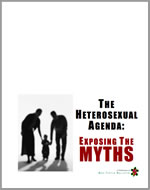 At last, the truth can now be told.
Using the same research methods employed by most anti-gay political pressure groups, we examine the statistics and the case studies that dispel many of the myths about heterosexuality. Download your copy today!
And don‘t miss our companion report, How To Write An Anti-Gay Tract In Fifteen Easy Steps.
 Anti-gay activists often charge that gay men and women pose a threat to children. In this report, we explore the supposed connection between homosexuality and child sexual abuse, the conclusions reached by the most knowledgeable professionals in the field, and how anti-gay activists continue to ignore their findings. This has tremendous consequences, not just for gay men and women, but more importantly for the safety of all our children.
Anti-gay activists often cite the “Dutch Study” to claim that gay unions last only about 1½ years and that the these men have an average of eight additional partners per year outside of their steady relationship. In this report, we will take you step by step into the study to see whether the claims are true.
Tony Perkins’ Family Research Council submitted an Amicus Brief to the Maryland Court of Appeals as that court prepared to consider the issue of gay marriage. We examine just one small section of that brief to reveal the junk science and fraudulent claims of the Family “Research” Council.
 The FBI’s annual Hate Crime Statistics aren’t as complete as they ought to be, and their report for 2004 was no exception. In fact, their most recent report has quite a few glaring holes. Holes big enough for Daniel Fetty to fall through.
“Google” is a trademark of Google Inc.
© Box Turtle Bulletin. All Rights Reserved.
 Posts
Posts  Posts via daily email: