Box Turtle Bulletin
 News and commentary about the anti-gay lobby
“Now you must raise your children up in a world where that union of man and box turtle is on the same legal footing as man and wife…”
News and commentary about the anti-gay lobbyJune 26th, 2013
Rand Paul, darling of the Tea Party, weighed in on the DOMA3 ruling: (ABC)
Sen. Rand Paul, R-Ky., told ABC News he believes the Supreme Court ruling on the Defense of Marriage Act was appropriate, and that the issue should be left to the states. He praised Justice Anthony Kennedy for avoiding “a cultural war.”
“As a country we can agree to disagree,” Paul said today, stopping for a moment to talk as he walked through the Capitol. “As a Republican Party, that’s kind of where we are as well. The party is going to have to agree to disagree on some of these issues.”
Republicans have, on whole, been pretty muted in response. This may well indicate that the party has abandoned its desire to pass a federal marriage amendment and even its ‘litmus test’ on the issue.
June 26th, 2013
While many grass-roots conservatives will rally the troops and, well, send out fund-raising letters, the national Republican leadership seems intent on packing up the marriage issue and shipping it out of the Capital. (Politico)
House Speaker John Boehner, whose leadership spent millions to defend DOMA, said he was “disappointed” in the decision, but did not promise action in the Republican House.
“While I am obviously disappointed in the ruling, it is always critical that we protect our system of checks and balances,” Boehner said in a statement. “A robust national debate over marriage will continue in the public square, and it is my hope that states will define marriage as the union between one man and one woman.”
House Majority Leader Eric Cantor, a Virginia Republican, said he’s “disappointed in this decision, and the marriage debate will continue in the states”
Sen. John Cornyn of Texas, the No 2. Senate Republican, said “like it or not, the Supreme Court is the final word on constitutional matters.”
“It sounds to me that that battle will be moving to the states,” Cornyn said. “The issue is not going away and there are going to be havens of traditional values like Texas where I don’t think the law is going to be changed.”
Why yes, campaign donor and right wing grassroots activist, they support your effort to go against the nation’s growing consensus. Just somewhere else. Now move along while they do something that won’t hurt their reelection abilities.
Read more:
June 26th, 2013
You already know what the National Organization for Marriage (theirs not yours) has to say, but here’s their message in short.
“… dismay and outrage … illegitimate … will be rejected by tens of millions of Americans … demanded … miscarriage of justice … overturn the perfectly legal action … over 7 million California voters … rewards corrupt politicians … preserve the right of states … refuse to recognize faux marriages … over 52% of the vote … homosexual groups and activists … a homosexual judge in San Francisco … Ninth Circuit Court of Appeals … liberal judge Stephen Reinhardt … stench … stained … corrupt … betray the voters … illegitimate decision … refuse … rogue decision … corruption … so-called gay marriages … vast majority of American voters … marriage as the union of one man and one woman … major victory for those defending Proposition 8, especially Chuck Cooper and his firm, along with the attorneys at the Alliance Defending Freedom, and Andy Pugno of the Prop 8 Legal Defense Fund.”
Clearly there’s a staining stench over there in nomian reality which leads to delusion.
June 26th, 2013
Posted on Facebook:
At 10:30 a.m. EDT this morning in a New York Immigration Court, attorneys from our law firm (Masliah Soloway) requested and were granted a continuance in removal (deportation) proceedings for a Colombian gay man married to an American citizen for whom we had filed a marriage-based green card petition last year. A copy of the 77-page Supreme Court decision in United States v. Windsor was delivered to the court by our summer intern, Gabe, who ran five blocks and made it in time for the decision to be submitted to the Immigration Judge and to serve a copy on the Immigration & Customs Enforcement Assistant Chief Counsel. DOMA is DEAD and it had its first impact on a binational couple within 30 minutes of the Supreme Court ruling.
June 26th, 2013
President Barack Obama issued the following statement:
I applaud the Supreme Court’s decision to strike down the Defense of Marriage Act. This was discrimination enshrined in law. It treated loving, committed gay and lesbian couples as a separate and lesser class of people. The Supreme Court has righted that wrong, and our country is better off for it. We are a people who declared that we are all created equal – and the love we commit to one another must be equal as well.
This ruling is a victory for couples who have long fought for equal treatment under the law; for children whose parents’ marriages will now be recognized, rightly, as legitimate; for families that, at long last, will get the respect and protection they deserve; and for friends and supporters who have wanted nothing more than to see their loved ones treated fairly and have worked hard to persuade their nation to change for the better
So we welcome today’s decision, and I’ve directed the Attorney General to work with other members of my Cabinet to review all relevant federal statutes to ensure this decision, including its implications for Federal benefits and obligations, is implemented swiftly and smoothly.
On an issue as sensitive as this, knowing that Americans hold a wide range of views based on deeply held beliefs, maintaining our nation’s commitment to religious freedom is also vital. How religious institutions define and consecrate marriage has always been up to those institutions. Nothing about this decision – which applies only to civil marriages – changes that.
The laws of our land are catching up to the fundamental truth that millions of Americans hold in our hearts: when all Americans are treated as equal, no matter who they are or whom they love, we are all more free.
Attorney General Eric Holder is responds to the President’s request:
Today’s historic decision in the case of United States v. Windsor, declaring Section 3 of the Defense of Marriage Act unconstitutional, is an enormous triumph for equal protection under the law for all Americans. The Court’s ruling gives real meaning to the Constitution’s promise of equal protection to all members of our society, regardless of sexual orientation. This decision impacts a broad array of federal laws. At the President’s direction, the Department of Justice will work expeditiously with other Executive Branch agencies to implement the Court’s decision. Despite this momentous victory, our nation’s journey – towards equality, opportunity, and justice for everyone in this country – is far from over. Important, life-changing work remains before us. And, as we move forward in a manner consistent with the Court’s ruling, the Department of Justice is committed to continuing this work, and using every tool and legal authority available to us to combat discrimination and to safeguard the rights of all Americans.
Secretary of Defense Chuck Hagel also issued a statement promising to “immediately begin the process” of ensuring all military spouses enjoy the same benefits “as soon as possible“:
The Department of Defense welcomes the Supreme Court’s decision today on the Defense of Marriage Act. The department will immediately begin the process of implementing the Supreme Court’s decision in consultation with the Department of Justice and other executive branch agencies. The Department of Defense intends to make the same benefits available to all military spouses — regardless of sexual orientation — as soon as possible. That is now the law and it is the right thing to do.
Every person who serves our nation in uniform stepped forward with courage and commitment. All that matters is their patriotism, their willingness to serve their country, and their qualifications to do so. Today’s ruling helps ensure that all men and women who serve this country can be treated fairly and equally, with the full dignity and respect they so richly deserve.
June 26th, 2013
The overturn of DOMA3 provides a number of benefits for citizens of the marriage equality states. But it simultaneously creates a situation of discrimination for those who live in civil union states.
Before today same-sex couples in New Jersey, for example, had all of the same rights as married couples in New York. That is to say, both were afforded all of the marriage rights and obligations that a state confers but none of the federal rights or obligations. Now, however, New York same-sex couples can avail themselves of a whole host of federal benefits while New Jersey couples remain subjected to a lesser status – not only in name, but in practice.
Currently the states with civil unions (or domestic partnerships) are Colorado, Hawaii, Illinois, New Jersey, Nevada, and Oregon (Wisconsin offers limited rights). Of these, Colorado, Nevada, and Oregon are banned by state constitution from offering equal marriage status to same-sex couples. Which leaves our next battlegrounds to be Hawaii, Illinois, and New Jersey.
In Hawaii, the legislature has been either voting down (or letting die) marriage equality bills, including one submitted in January of this year. However, this changes the picture and it is likely that marriage will finally come to the state which brought the issue to the nation’s attention.
Illinois’ speaker of the House let die a marriage bill just last month. Equality is likely when the House reconvenes in November.
But New Jersey will be the interesting battle. Governor Christie vetoed a marriage bill in February 2012. But he has also supported civil unions and asserted that “discrimination should not be tolerated”. Although marriage and civil unions simply are not equal, his position was not necessarily contradictory before today.
Now, however, a state can decide if federal benefits should be afforded to their gay citizens. Should the legislature send Christie another marriage bill – and I anticipate that they will – he will have to decide whether he opposes unequal treatment or whether he supports tradition and the teachings of his church. And as Christie has presidential aspirations, this might be the first indicator as to whether the Republican Party can acclimate to the new reality.
June 26th, 2013
From Thomas Peters, Communications Director at NOM:
SCOTUS makes bad decision on Doma, saying its up to the states. Refuses to rule on prop8. But gay activists failed to get what they wanted.
— Thomas Peters (@AmericanPapist) June 26, 2013
His little mental horizon is focused entirely on SCOTUS’ failure to go to the very limits of what it could do, stamping his foot at our celebration and insisting, “But you shouldn’t be happy!”
Hey, whatever it takes to convince your donors you’re not a complete waste of space, I guess.
June 26th, 2013

Everyone at the apartment of Roberta Kaplan, the lawyer who argued Edith Windsor’s successful challenge to the Defense of Marriage Act, exploded in screams and sobs when the ruling came down. Kaplan called her mother and said, “Total victory, Mom: it couldn’t be better.” Windsor said, “I wanna go to Stonewall right now!” Then she called a friend and said, “Please get married right away!”
The New Yorker updated that post with a call from the President.
June 26th, 2013
Today's DOMA ruling is a historic step forward for #MarriageEquality. #LoveIsLove
— Barack Obama (@BarackObama) June 26, 2013
June 26th, 2013
Here’s one easily-overlooked bit from the SCOTUS ruling that I dearly love. SCOTUS grants us the dignity of recognizing we not only want the rights of marriage, but the responsibilities too. Contrary to our opponents’ accusations, we are not cry-babies demanding rights, but adults with dignity claiming our full citizenship. This may not be the juiciest quote you read all day, but it’s so very important.
DOMA divests married same-sex couples of the duties and responsibilities that are an essential part of married life and that they in most cases would be honored to accept were DOMA not in force. For instance, because it is expected that spouses will support each other as they pursue educational opportunities, federal law takes into consideration a spouse’s income in calculating a student’s federal financial aid eligibility… Same-sex married couples are exempt from this requirement. The same is true with respect to federal ethics rules. Federal executive and agency officials are prohibited from “participat[ing] personally and substantially” in matters as to which they or their spouses have a financial interest…A similar statute prohibits Senators, Senate employees, and their spouses from accepting high-value gifts from certain sources…and another mandates detailed financial disclosures by numerous high-ranking officials and their spouses…Under DOMA, however, these Government-integrity rules do not apply to same-sex spouses.
June 26th, 2013
In a 5-4 decision, the U.S. Supreme Court rejected the challenge to Prop 8, finding that after the state of California decided not to defend the law and Prop 8 proponents stepped in, the Prop 8 supports had no standing to appeal the lower court’s decision. What makes this remarkable is that the narrower Ninth Circuit Court’s decision has been vacated and the broader ruling by Federal District Judge Vaughn Walker prevails (PDF: 173KB/35 pages):
We have never before upheld the standing of a private party to defend the constitutionality of a state statute when state officials have chosen not to. We decline to do so for the first time here.
Because petitioners have not satisfied their burden to demonstrate standing to appeal the judgment of the District Court, the Ninth Circuit was without jurisdiction to consider the appeal. The judgment of the Ninth Circuit is vacated, and the case is remanded with instructions to dismiss the appeal for lack of jurisdiction.
The majority opinion represents an unusual lineup: Chief Justice Roberts and Justices Antonin Scalia, Elena Kagan, Ruth Bader Ginsberg and Stephen Breyer. Justice Anthony Kennedy, writing in a dissent joined by Justices Clarence Thomas, Samuel Alito and Sonia Sotomayor argued that Califirnia’s initiative process warranted an exception.
In the end, what the Court fails to grasp or accept is the basic premise of the initiative process. And it is this. The essence of democracy is that the right to make law rests in the people and flows to the government, not the other way around. Freedom resides first in the people without need of a grant from government. The California initiative process embodies these principles and has done so for over a century. “Through the structure of its government, and the character of those who exercise government authority,a State defines itself as sovereign.” Gregory v. Ashcroft, 501 U. S. 452, 460 (1991). In California and the 26 other States that permit initiatives and popular referendums, the people have exercised their own inherent sovereign right to govern themselves. The Court today frustrates that choice by nullifying, for failure to comply with the Restatement of Agency, a State Supreme Court decision holding that state law authorizes an enacted initiative’s proponents to defend the law if and when the State’s usual legal advocates decline to do so. The Court’s opinion fails to abide by precedent and misapplies basic principles of justiciability. Those errors necessitate this respectful dissent.
Because this is a narrow technical ruling, it does not address the broader questions of whether California’s Prop 8 or any other state ban on same-sex marriage is constitutional or not. That decision will await a different court challenge, which makes this one something of a let-down. But this punt at least will allow another 34 million Americans to live in a jurisdiction with marriage equality. We await further word on when that will go into effect.
June 26th, 2013
BOTTOM LINE: The federal government will now recognize same-sex marriages from states that allow such marriages, and California now joins that list . The California decision is based the premise that the private party who defended Prop 8 in court had no standing to do so. The decision does not establish whether or not there is a Constitutional right to such marriages for all citizens.
Update: I’ve corrected the last sentence: “The decision does not establish…” Thanks to those who brought that to my attention.
June 26th, 2013
SCOTUS punts, 5 to 4. The proponents did not have standing to appeal. Marriage comes back to California. It’s the “one state” solution.
June 26th, 2013
In a 5-4 decision, the US Supreme Court struck down Section 3 of the Defense of Marriage Act, the part that bars the federal government from recognizing same-sex marriage, has been struck down as unconstitutional.
The opinion is here (PDF: 329KB/77 pages). Justice Kennedy, writing for the majority:
DOMA is unconstitutional as a deprivation of the equal liberty of persons that is protected by the Fifth Amendment. Pp. 13–26.
(a) By history and tradition the definition and regulation of marriage has been treated as being within the authority and realm of the separate States. Congress has enacted discrete statutes to regulate the meaning of marriage in order to further federal policy, but DOMA, with a directive applicable to over 1,000 federal statues and the whole realm of federal regulations, has a far greater reach. Its operation is also directed to a class of persons that the laws of NewYork, and of 11 other States, have sought to protect. Assessing the validity of that intervention requires discussing the historical and traditional extent of state power and authority over marriage.
Subject to certain constitutional guarantees, see, e.g., Loving v. Virginia, 388 U. S. 1, “regulation of domestic relations” is “an area that has long been regarded as a virtually exclusive province of the States,” Sosna v. Iowa, 419 U. S. 393, 404. The significance of state responsibilities for the definition and regulation of marriage dates to the Nation’s beginning; for “when the Constitution was adopted the common understanding was that the domestic relations of husband and wife and parent and child were matters reserved to the States,” Ohio ex rel. Popovici v. Agler, 280 U. S. 379, 383–384. Marriage laws may vary from State to State, but they are consistent within each State.
DOMA rejects this long-established precept. The State’s decision to give this class of persons the right to marry conferred upon them a dignity and status of immense import. But the Federal Government uses the state-defined class for the opposite purpose—to impose restrictions and disabilities. The question is whether the resulting injury and indignity is a deprivation of an essential part of the liberty protected by the Fifth Amendment, since what New York treats as alike the federal law deems unlike by a law designed to injure the same class the State seeks to protect. New York’s actions were a proper exercise of its sovereign authority. They reflect both the community’s considered perspective on the historical roots of the institution of marriage and its evolving understanding of the meaning of equality.
(b) By seeking to injure the very class New York seeks to protect,DOMA violates basic due process and equal protection principles applicable to the Federal Government. The Constitution’s guarantee of equality “must at the very least mean that a bare congressional desire to harm a politically unpopular group cannot” justify disparate treatment of that group. Department of Agriculture v. Moreno, 413
U. S. 528, 534–535. DOMA cannot survive under these principles. Its unusual deviation from the tradition of recognizing and accepting state definitions of marriage operates to deprive same-sex couples of the benefits and responsibilities that come with federal recognition of their marriages. This is strong evidence of a law having the purpose and effect of disapproval of a class recognized and protected by state law. DOMA’s avowed purpose and practical effect are to impose a disadvantage, a separate status, and so a stigma upon all who enter into same-sex marriages made lawful by the unquestioned authority of the States.
DOMA’s history of enactment and its own text demonstrate that interference with the equal dignity of same-sex marriages, conferred by the States in the exercise of their sovereign power, was more than an incidental effect of the federal statute. It was its essence. BLAG’s arguments are just as candid about the congressional purpose.DOMA’s operation in practice confirms this purpose. It frustrates New York’s objective of eliminating inequality by writing inequality into the entire United States Code.
DOMA’s principal effect is to identify and make unequal a subset of state-sanctioned marriages. It contrives to deprive some couples married under the laws of their State, but not others, of both rights and responsibilities, creating two contradictory marriage regimes within the same State. It also forces same-sex couples to live as married for the purpose of state law but unmarried for the purpose of federal law, thus diminishing the stability and predictability of basic personal relations the State has found it proper to acknowledge and protect. Pp. 20–26.
The justices recognize the broad reach of DOMA:
DOMA instructs all federal officials, and indeed all persons with whom same-sex couples interact, including their own children, that their marriage is less worthy than the marriages of others. The federal statute is invalid, for no legitimate purpose overcomes the purpose and effect to disparage and to injure those whom the State, by its marriage laws, sought to protect in person hood and dignity. By seeking to displace this protection and treating those persons as living in marriages less respected than others,the federal statute is in violation of the Fifth Amendment. This opinion and its holding are confined to those lawful marriages. [Emphasis mine]
Chief Justice John Roberts dissented with Justice Antonin Scalia both on the question of standing and on the merits of the case. In Roberts’s dissent:
I agree with JUSTICE SCALIA that this Court lacks jurisdiction to review the decisions of the courts below. On the merits of the constitutional dispute the Court decides to decide, I also agree with JUSTICE SCALIA that Congress acted constitutionally in passing the Defense of Marriage Act (DOMA). Interests in uniformity and stability am- ply justified Congress’s decision to retain the definition of marriage that, at that point, had been adopted by every State in our Nation, and every nation in the world. Post, at 19–20 (dissenting opinion).
Scalia’s dissent, naturally, was much more pointed as to standing:
This case is about power in several respects. It is about the power of our people to govern themselves, and the power of this Court to pronounce the law. Today’s opinion aggrandizes the latter, with the predictable consequence of diminishing the former. We have no power to decide this case. And even if we did, we have no power under the Constitution to invalidate this democratically adopted leg- islation. The Court’s errors on both points spring forth from the same diseased root: an exalted conception of the role of this institution in America.
The Court is eager—hungry—to tell everyone its view of the legal question at the heart of this case. Standing in the way is an obstacle, a technicality of little interest to anyone but the people of We the People, who created it as a barrier against judges’ intrusion into their lives. They gave judges, in Article III, only the “judicial Power,” a power to decide not abstract questions but real, concrete “Cases” and “Controversies.” Yet the plaintiff and the Government agree entirely on what should happen in this lawsuit. They agree that the court below got it right; and they agreed in the court below that the court below that one got it right as well. What, then, are we doing here?
Scalia describes the court’s decision to hear the case “jaw drawing.” But since the court decided to hear the case on its merits, Scalia addressed them as well:
As I have observed before, the Constitution does not forbid the government to enforce traditional moral and sexual norms. See Lawrence v. Texas, 539 U. S. 558, 599 (2003) (SCALIA, J., dissenting). I will not swell the U. S. Reports with restatements of that point. It is enough to say that the Constitution neither requires nor forbids our society to approve of same-sex marriage, much as it neither requires nor forbids us to approve of no-fault divorce, polygamy, or the consumption of alcohol.
However, even setting aside traditional moral disapproval of same-sex marriage (or indeed same-sex sex),there are many perfectly valid—indeed, downright boring—justifying rationales for this legislation. Their existence ought to be the end of this case. For they give the lie to the Court’s conclusion that only those with hateful hearts could have voted “aye” on this Act. And more importantly, they serve to make the contents of the legislators’ hearts quite irrelevant: “It is a familiar principle of constitutional law that this Court will not strike down an otherwise constitutional statute on the basis of an alleged illicit legislative motive.” United States v. O’Brien, 391 U. S. 367, 383 (1968). Or at least it was a familiar principle. By holding to the contrary, the majority has declared open season on any law that (in the opinion of the law’s opponents and any panel of like-minded federal judges) can be characterized as mean-spirited.
Scalia dismissed the animus behind DOMA:
But the majority says that the supporters of this Act acted with malice—with the “purpose” (ante, at 25) “to disparage and to injure” same-sex couples. It says that the motivation for DOMA was to “demean,” ibid.; to “impose inequality,” ante, at 22; to “impose . . . a stigma,” ante, at 21; to deny people “equal dignity,” ibid.; to brand gay people as “unworthy,” ante, at 23; and to “humiliat[e]” their children, ibid. (emphasis added).
I am sure these accusations are quite untrue. To be sure (as the majority points out), the legislation is called the Defense of Marriage Act. But to defend traditional marriage is not to condemn, demean, or humiliate those who would prefer other arrangements, any more than to defend the Constitution of the United States is to condemn, demean, or humiliate other constitutions. To hurl such accusations so casually demeans this institution. In the majority’s judgment, any resistance to its holding is beyond the pale of reasoned disagreement. To question its high-handed invalidation of a presumptively valid statute is to act (the majority is sure) with the purpose to “dis- parage,” “injure,” “degrade,” “demean,” and “humiliate” our fellow human beings, our fellow citizens, who are homosexual. All that, simply for supporting an Act that did no more than codify an aspect of marriage that had been questioned in our society for most of its existence—indeed, had been unquestioned in virtually all societies for virtually all of human history. It is one thing for a society to elect change; it is another for a court of law to impose change by adjudging those who oppose it hostes humani generis, enemies of the human race.
…By formally declaring anyone opposed to same-sex marriage an enemy of human decency, the majority arms well every challenger to a state law restricting marriage to its traditional definition.
The Family “Research” Council will undoubtedly be quoting Scalia extensively in the days to come.
Alito’s dissent is similar to Scalia’s, if not quite as entertaining, but he does manage to parrot FRC and NOM:
The family is an ancient and universal human institution. Family structure reflects the characteristics of a civilization, and changes in family structure and in the popular understanding of marriage and the family can have profound effects. Past changes in the understand-ing of marriage—for example, the gradual ascendance of the idea that romantic love is a prerequisite to marriage— have had far-reaching consequences. But the process by which such consequences come about is complex, involving the interaction of numerous factors, and tends to occur over an extended period of time.
We can expect something similar to take place if same sex marriage becomes widely accepted. The long-term consequences of this change are not now known and are unlikely to be ascertainable for some time to come.
June 26th, 2013
It’s 5 to 4 on 5th Amendment grounds.
Featured Reports
 In this original BTB Investigation, we unveil the tragic story of Kirk Murphy, a four-year-old boy who was treated for “cross-gender disturbance” in 1970 by a young grad student by the name of George Rekers. This story is a stark reminder that there are severe and damaging consequences when therapists try to ensure that boys will be boys.
When we first reported on three American anti-gay activists traveling to Kampala for a three-day conference, we had no idea that it would be the first report of a long string of events leading to a proposal to institute the death penalty for LGBT people. But that is exactly what happened. In this report, we review our collection of more than 500 posts to tell the story of one nation’s embrace of hatred toward gay people. This report will be updated continuously as events continue to unfold. Check here for the latest updates.
In 2005, the Southern Poverty Law Center wrote that “[Paul] Cameron’s ‘science’ echoes Nazi Germany.” What the SPLC didn”t know was Cameron doesn’t just “echo” Nazi Germany. He quoted extensively from one of the Final Solution’s architects. This puts his fascination with quarantines, mandatory tattoos, and extermination being a “plausible idea” in a whole new and deeply disturbing light.
On February 10, I attended an all-day “Love Won Out” ex-gay conference in Phoenix, put on by Focus on the Family and Exodus International. In this series of reports, I talk about what I learned there: the people who go to these conferences, the things that they hear, and what this all means for them, their families and for the rest of us.
Prologue: Why I Went To “Love Won Out”
Part 1: What’s Love Got To Do With It?
Part 2: Parents Struggle With “No Exceptions”
Part 3: A Whole New Dialect
Part 4: It Depends On How The Meaning of the Word "Change" Changes
Part 5: A Candid Explanation For "Change"
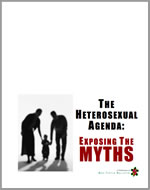 At last, the truth can now be told.
Using the same research methods employed by most anti-gay political pressure groups, we examine the statistics and the case studies that dispel many of the myths about heterosexuality. Download your copy today!
And don‘t miss our companion report, How To Write An Anti-Gay Tract In Fifteen Easy Steps.
 Anti-gay activists often charge that gay men and women pose a threat to children. In this report, we explore the supposed connection between homosexuality and child sexual abuse, the conclusions reached by the most knowledgeable professionals in the field, and how anti-gay activists continue to ignore their findings. This has tremendous consequences, not just for gay men and women, but more importantly for the safety of all our children.
Anti-gay activists often cite the “Dutch Study” to claim that gay unions last only about 1½ years and that the these men have an average of eight additional partners per year outside of their steady relationship. In this report, we will take you step by step into the study to see whether the claims are true.
Tony Perkins’ Family Research Council submitted an Amicus Brief to the Maryland Court of Appeals as that court prepared to consider the issue of gay marriage. We examine just one small section of that brief to reveal the junk science and fraudulent claims of the Family “Research” Council.
 The FBI’s annual Hate Crime Statistics aren’t as complete as they ought to be, and their report for 2004 was no exception. In fact, their most recent report has quite a few glaring holes. Holes big enough for Daniel Fetty to fall through.
“Google” is a trademark of Google Inc.
© Box Turtle Bulletin. All Rights Reserved.
 Posts
Posts  Posts via daily email: