Box Turtle Bulletin
 News and commentary about the anti-gay lobby
“Now you must raise your children up in a world where that union of man and box turtle is on the same legal footing as man and wife…”
News and commentary about the anti-gay lobbyJune 26th, 2013
TODAY’S AGENDA:
U.S. Supreme Court to Issue Marriage Decisions: Washington, DC. This is the day we’ve all been waiting for, as the U.S. Supreme Court issues its verdicts on two critical marriage equality cases. The court couldn’t have picked a more auspicious date to issue its rulings: Today also happens to be the tenth anniversary of Lawrence v. Texas, which declared all remaining state sodomy laws unconstitutional (see below).
The first marriage case, with obvious national implications, is Windsor v U.S., which challenges the constitutionality of Section 3 of the Defense of Marriage Act. Section 3 is the portion of the federal law which bars the U.S. government from recognizing same-sex marriage performed by the states. This case was brought by Edith Windsor, the widow of Thea Spyer, who is being forced to pay $363,000 in federal estate taxes because the government is barred from recognizing their marriage. The couple had been together since 1965, and they were finally able to wed in Toronto in 2007, two years before Thea’s death. A Federal District Judge ruled in Windsor’s favor and struck down DOMA’s Section 3 as unconstitutional, and the case was on its way to the Second Circuit Court of Appeals when Windsor’s attorneys, citing her age and poor health (she’s 83), asked the Supreme Court to take the case directly. (The Second Circuit ended up upholding the lower court’s ruling.) During oral arguments, justice’s expressed their frustration over the Obama Administration’s decision that the law was too unconstitutional to defend in court, but wasn’t unconstitutional enough to enforce. As for the constitutionality of the law itself, several justices appeared to believe that DOMA is an unconstitutional over-reach by the federal government into an area normally reserved to the states. We’ll find out how the court sorts it all out later this morning.
The second case is Hollingsworth v. Perry, the challenge to California’s Proposition 8 which bans marriage equality for same-sex couples. In that case, the Federal District Court ruled that Prop 8 was unconstitutional on numerous grounds. The Ninth Circuit Court of Appeals upheld the decision, but narrowed the legal arguments considerably: that a state cannot provide a right to everyone, only to turn around and it away from a minority that had just enjoyed that right. But since the State of California refused to defend Prop 8 in court and left it to Prop 8 supporters to defend it in court, the question of standing is a major point of contention. The court could conceivably rule on Prop 8’s merits, but the possibility of punting the entire question over standing may be too tempting for the court to resist.
The New York Times published a very handy flowchart detailing the possible ways in which the court’s rulings on the two cases can play out. However the court rules, there are a large number of Decision Day rallies planned across the U.S. They will either be protests or celebrations or, perhaps, some kind of a mixture of the two. To find a Decision Day rally near you, click here.
Pride Celebrations This Weekend: Albuquerque, NM; Bangor, ME; Barcelona, Spain; Cheyenne, WY; Chicago, IL; Cincinnati, OH; Cleveland, OH; Doncaster, UK; Dublin, Ireland; Finnmark, Norway; Harlem, NY; Helsinki, Finland; Houston, TX; Istanbul, Turkey; Lexington, KY; London, UK; London, UK (Black Pride); Malmö, Sweden; México, DF, México; Oslo, Norway; Paris, France; Minneapolis/St. Paul, MN; New York, NY; Oslo, Norway; St. Louis, Mo; St. Petersburg, FL; Salem, MA; San Antonio, TX; San Francisco, CA; San José, Costa Rica; Sardinia, Italy; Seattle, WA; Swansea, UK; Toronto, ON; Utrecht, Netherlands; Valencia, Spain; VästerÃ¥s, Sweden.
Other Events This Weekend: Frameline 37 Film Festival, San Francisco, CA; Pink Dot Festival, Singapore; Canadian Rockies International Rodeo, Strathmore, AB.

TODAY IN HISTORY:
Life Magazine’s “Homosexuality In America”: 1964.
“Homosexuality shears across the spectrum of American life — the professions, the arts, business and labor. It always has. But today, especially in big cities, homosexuals are discarding their furtive ways and openly admitting, even flaunting, their deviation. Homosexuals have their won drinking places, their special assignation streets, even their own organizations. And for every obvious homosexual, there are probably nine nearly impossible to detect. This social disorder, which society tries to suppress, has forced itself into the public eye because it does present a problem — and parents especially are concerned. The myth and misconception with which homosexuality has so long been clothed must be cleared away, not to condone it but to cope with it.”
 Over the next fourteen pages, Life magazine explored what they called the “sordid world” of the gay community. The articles provide interesting vignettes and photos of gay life in the pre-Stonewall era, but reading through them today probably tells us more about society’s revulsion towards gay people than it does about gays themselves. At one point, author Paul Welch accompanies a Los Angeles police officer acting as a decoy to try entrap a gay man into propositioning him. Even if the proposition involves going to a private home for the evening — the same type of invitation being made in straight bars all across Los Angeles that very same night — it would end badly with an arrest and possible lifetime registration as a sex offender. LGBT activist Dale Jennings arrest in the privacy of his own home and the city’s embarrassing failure to secure a conviction in a well-publicized case twelve years earlier (see Jun 23) had done nothing to stem police harassment.
One education pamphlet compiled for Los Angeles police warned that what gay men really want is “a fruit world.” Welch continued: “Although the anti-homosexual stand taken by the Los Angeles police is unswervingly tough, it reflects the attitude of most U.S. law-enforcement agencies on the subject.”Three years later, gay Angelenos would reach their breaking point and the Black Cat riots would become the high water mark in police harassment in Los Angeles (see Jan 1), more than two years before the Stonewall rebellion in New York.
[Source: Paul Welch. “The Homosexual In America.” Life 26, no. 26 (June 26, 1964): 66-74. Available online via Google Books here.]

Mattachine Society of Washington, D.C. Pickets the Civil Service Commission: 1965. Picketing was a new and controversial tactic for East Coast gay rights activists, but the year 1965 saw them finally shed their reservations and, in keeping with the times, assumed a more confrontational posture in their demands for equal treatment. To test the waters for picketting, Mattachine Society of Washington, D.C. held their first gay rights protest in front of the White House in April (see Apr 17). They had decided not to publicize the hour-long protest ahead of time because they didn’t want to give the police time to invent an excuse to block their demonstration. They were so excited over how well that protest went, that they decided to do it again a month later, and this time they invited the press to cover it (see May 29).
But it was the federal government’s ban on employment of gay people that really stuck in the Mattachine Society’s president and co-founder Frank Kameny’s crawl. Eight years earlier, Kamany had been fired from his civilian job by the U.S. Army map service over his homosexuality (see Dec 20), and after he exhausted his appeals to the U.S. Supreme Court, Kameny turned his attention to organizing local activists to confront the Civil Service Commission over its discriminatory ban. Their earlier efforts to sit down with the Commission to discuss the matter were curtly rebuffed (see Sep 28: “It is the established policy of the civil Service commission that homosexuals are not suitable for appointment to or retention in positions in the Federal service. There would be no useful purpose served in meeting with representatives of your Society.”), and all further requests for meetings were stonewalled.
So the Mattachine Society of Washington, D.C. decided to take it to the streets once again, as eighteen men and seven women, all conservatively dressed — “If you’re asking for equal employment rights, look employable!”, Kameny ordered — carrying picket signs demanding and end to the employment ban. The two-hour protest in front of the Civil Service Commission headquarters generated just enough publicity for the CSC to request a meeting in September. Nothing much came from that meeting, but for the first time in history, Federal officials were forced to justify their policies directly to the very group that was most affected by them. That meeting was followed by another ten years of letters, phone calls and meetings before the CSC finally capitulated, in a phone call to Frank Kameny personally, in 1975 (see Jul 3). Times continued to change, and in 2009, Frank Kameny received a formal apology from the openly gay director of the Office of Personnel Management, the modern-day successor to the Civil Service Commission.
[Source: Unsigned. “Homosexuals Picket in Nation’s Capital.” The Ladder 9, no. 10-11 (July-August 1965): 23-25.]
10 YEARS AGO: Lawrence v. Texas: 2003. One of the most important gay rights cases to reach the Supreme Court had its beginnings under very unusual circumstances. In 1998, Houston police were called to the apartment of John Geddes Lawrence over what was supposed to be some kind of a”weapons disturbance.” As the story went, police arrived and caught Lawrence and Tyrone Garner having oral sex, or anal sex, or no sex at all, depending on which eyewitness you want to believe. If they were having sex, then that meant that they were breaking Texas’s anti-sodomy law. They were held overnight in jail and charged with violating Chapter 21, Sec. 21.06 of the Texas Penal code, a class C misdemeanor for engaging “in deviate sexual intercourse with an individual of the same sex.”
But in reality, Lawrence and Garner hadn’t had a sexual relationship, as author Dale Carpenter revealed in his 2012 book, Flagrant Conduct: The Story of Lawrence v. Texas
On June 23, the U.S. Supreme Court issued its landmark ruling striking down Texas’s sodomy law, and laws like it in thirteen other states. In the 6-3 decision, Justice Anthony Kennedy wrote for the majority that the decision specifically overruled the 1986 Bowers v. Hardwick decision which upheld Georgia’s sodomy law. “Bowers was not correct when it was decided, and it is not correct today. It ought not to remain binding precedent. Bowers v. Hardwick should be and now is overruled.” Antonin Scalia wrote a scathing dissent, one part of which is very prescient given current court challenges to the Defense of Marriage Act:
If moral disapprobation of homosexual conduct is “no legitimate state interest” for purposes of proscribing that conduct…what justification could there possibly be for denying the benefits of marriage to homosexual couples exercising “the liberty protected by the Constitution”? Surely not the encouragement of procreation, since the sterile and the elderly are allowed to marry.
TODAY’S BIRTHDAY:
 Lance Loud: 1951. PBS aired the groundbreaking documentary series An American Family in 1973 which would become the first reality television series in history. Millions of Americans were glued to their television sets watching the Loud family of Santa Barbara, California, go about their daily lives with film cameras in tow. Lance Loud, the family’s eldest twenty-year-old son who was living in New York City, quickly became the star of the program. He came out to America in the second episode when his mother went to visit him at the Chelsea Hotel, and his daring nonconformity became an inspiration for young Americans, gay and straight.
Loud had returned to California by the time the series aired, so he decided to move back to New York City to take advantage of his new-found fame. He formed a band called the Mumps, which played New York’s famed CBGB and Mix, and toured with the Talking Heads, Television, Ramones, Cheap Trick and Van Halen. But after five years and a loyal following, they failed to attract a major recording contract. After the band broke up, Loud returned to Los Angeles and became a writer. His articles were published in Interview, Details, Vanity Fair, among others. He also had a regular column, “Out Loud,” in The Advocate.
Loud found the fame he earned from An American Family to be hollow. Americans had watched as his parents’ relationship careened toward divorce, leading Loud to say, “Television ate my family.” Loud himself went through years of substance abuse. When he was diagnosed with AIDS and hepatitis C, Loud agreed to appear in one final cinema verité documentary for PBS. But this time he made the decision to perform as a role model for what not to do with one’s life. Lance Loud! A Death in An American Family aired in 2003, two years after he died of liver failure.
If you know of something that belongs on the agenda, please send it here. Don’t forget to include the basics: who, what, when, where, and URL (if available).
And feel free to consider this your open thread for the day. What’s happening in your world?
June 25th, 2013
The New Jersey Assembly approved A3371, a bill to prohibit licensed therapists in the state of New Jersey from providing therapies intended to change sexual orientation to minors:
Supporters of the bill, including the American Psychological and American Psychiatric associations, have called the practice damaging and demoralizing, while opponents have accused state lawmakers of interfering with the counselor-patient relationship and intruding on parents’ rights.
…The bill’s Assembly sponsor, Tim Eustace (D-Bergen) called the practice, “an insidious form of child abuse. The Assembly approved the bill, (A3371) by a 56-14 vote with seven abstentions.
The bill will now to to the Senate. Gov. Chris Christie (R) has not said whether he will sign the measure, although he has spoken out againztr conversion therapy generally.
June 25th, 2013
The marriage decisions are almost certainly going to be announced tomorrow. There are only three rulings as yet unpublished, United States v. Windsor (DOMA3), Hollingsworth v Perry (Prop 8), and Sekhar v. United States (a case involving the definition of terms in the federal extortion law), and it seems unlikely that tomorrow will be devoted to Sekhar.
By now all the pundits have read their crystal balls and declared their expectations of the results – and the result of the results. Now it’s your turn.
But first, here are mine:
DOMA3 – I’ve having trouble fathoming much support for this steaming pile of law. Liberal justices will likely find it offensive in its blatant discrimination and conservative justices will likely find the states rights arguments to be compelling. My prediction is quite a bit out on the limb, but I’m going for 8-1 overturn. Scalia, of course, believes in the original intent of the Constitution – as revealed by the traditions and teaching of the Catholic Church – and will discover that the founding fathers intended that family law be left to the states other than when Teh Ghey is involved.
Reactions:
* – My friend James will get married in New York (his fiance is Australian).
* – Politically minded Democrats, Liberals, and moderate Republicans will celebrate.
* – Most people will say, “huh” and go back to watching TV.
* – Republican leaders will say that now that the courts have decided, it’s time to move on.
* – The wackadoodles will scream and yell a bit before going back to Obamacare, abortion, and Hollywood.
Prop 8 – I think that SCOTUS will find that the proponents do not have standing to defend a proposition once the duly elected state representatives have opted not to appeal (I find it odd that the decision whether or not to appeal a ruling should be left to anyone other than the state). And that may be the end of it: Prop 8 is overturned and nothing else changes on the state level. However, since I’m in a gambling mood I’m going back out on my limb. I think that they will also rule on the merits of the case. And of all the possible outcomes (there are several) I think that the courts will rule that should a state offer all of the rights and benefits of marriage to same-sex couples, it cannot create a nomenclature designed for no purpose other than to designate same-sex couples to be of lower status. They will also be clear that they are not ruling on the constitutionality of marriage bans in general, just in whether a state can offer second class status if they do offer rights.
Reactions:
* – Politically minded Democrats, Liberals, and moderate Republicans will celebrate.
* – Most people will say, “huh” and go back to watching TV.
* – Republican leaders will say that now that the courts have decided, it’s time to move on.
* – Wackadoodles will declare that they were right all along that civil unions really are the evil militant homosexual activists’ way to force gay marriage down the throats of the people. They’ll call for a Federal Constitutional Amendment, which will get no traction. And they’ll declare this decision the ‘Roe v Wade of the 21st Century’ … before going back to Obamacare, abortion, and Hollywood.
* – We begin the long hard slog of reversing bans, state by state.
* – Within a few years, Olson and Boies will bring a lawsuit in another state and begin the process all over again. This time we win big.
What do you predict?
June 25th, 2013
TODAY IN HISTORY:
Execution in New Netherlands: 1646. The New Netherlands Colony court sentenced “Jan Creoli, a negro,” for a second “sodomy” offense. The record stated: “this crime being condemned of God…as an abomination, the prisoner is sentenced to be conveyed to the place of public execution, and there choked to death, and then burnt to ashes….” The rationale was cited as Genesis c. 19; Leviticus c. 18: 22, 29. The margin of the court record states: “he was executed at New Haven.”
[Source: Jonathan Ned Katz, Gay/Lesbian Almanac (NY: Harper & Row, 1983), p. 90.]

Supreme Court Declares Physique Magazines Non-Pornographic: 1962. In the 1950s, Herman L. Womack published three beefcake magazines: MANual, Trim and Grecian Guild Pictorial. Although the magazines were marketed to gay men, they made no mention whatsoever of homosexuality, instead presenting themselves as bodybuilding and physique magazines. In 1960, the postmaster in Arlington Virginia seized a shipment of the three magazines and declared that because the magazines were marketed to gay men, they were obscene and therefore “nonmailable,” even though the magazines contained no actual nudity. (Models wore “posing pouches” to conceal their genitalia.) In other words, it wasn’t that the photos themselves were pornographic, but that the gay audience made the photos pornographic and therefore illegal. Womack sued in federal court, but after the court granted the govermnent’s move for summary judgment, he appealed all the way to the Supreme Court.
On June 25, 1962, the U.S. Supreme Court ruled in MANual Enterprises v. Day that the materials in question were not pornographic. Writing for the majority, Justice John Marshall Harlan II wrote that the photos themselves were not “patently offensive” or “indecent.” “[We] need go no further in the present case than to hold that the magazines in question, taken as a whole, cannot, under any permissible constitutional standard, be deemed to be beyond the pale of contemporary notions of rudimentary decency.” And since the magazines didn’t reach that level of indecency, it didn’t matter who the materials were being marketed to. The mere portrayal of the male nude — even if it happens to be the portrayal of the gay male nude — “cannot fairly be regarded as more objectionable than many portrayals of the female nude that society tolerates.” If nude or semi-nude photos marketed to straight men weren’t pornographic (Playboy had already been around since 1953), then similar photos marketed to gay men couldn’t be pornographic either.

35 YEARS AGO: Rainbow Flag Debuts: 1978. The original rainbow flag, hand-dyed by Gilbert Baker, first flew in the San Francisco Gay Freedom Day parade on June 25, 1978. The original 1978 flag consisted of eight stripes, with each stripe assigned a specific meaning. From top to bottom, the stripes were:
After Harvey Milk’s assassination on November 27, 1978, demand for the flag went up sharply. But since Gilbert had hand-dyed his flag and hot pink fabric wasn’t available as a commercially available color, the top stripe was removed and the flag became a seven stripe flag. Then, the story goes, organizers planned to hang rainbow flags vertically from lamp posts for San Francisco’s 1979 pride celebration and they noticed that the lamp post would obscure the middle stripe. Another version of the story had it that it was cheaper to produce a six-stripe flag because flag makers could sew two stripes together, and then sew together three two-stripe blocks. Whatever the explanation, the turquoise stripe was dropped, the indigo was changed to royal blue, and the rainbow flag became the familiar six-stripe flag we’ve come to know ever since.
 The rainbow flag is now a world-wide symbol for LGBT communities everywhere, and it has come to mean many things to many different people. For some, it’s a gesture of visibility, a way of saying we’re here. For others, its a reminder of all that we’ve gone through as a community. And some in the LGBT community consider it a silly expression of separatism and self-segregation from society. In 2007, Gilbert Baker penned an essay to explain what the flag meant to him. He describes growing up gay in Middle America and being harassed while serving in Viet Nam. He was sent stateside to work as a nurse in San Francisco, where he met Harvey Milk:
Stationed in San Francisco as a nurse, I cared for the wounded. I also met my closet [sic] friend and mentor, Harvey Milk. Harvey had an aggressive charm that attracted the wicked and the wise. His charisma and fearlessness are at the heart of all I hold dear.
Harvey was a pioneer, a trailblazer, and with the community by his side, he became a San Francisco Supervisor. One day he said to me that we needed a logo, a symbol. We needed a positive image that could unite us. I sewed my own dresses, so why not a flag? At Harvey’s behest, I went about creating our Rainbow Flag. I had never felt so empowered, so free.
My liberation came at a painful cost. In the ultimate act of anti-gay violence, Harvey Milk and Mayor George Moscone were assassinated. The bullets were meant for Harvey, to silence him, and, by extension, every one of us. Uniting a community cost him his life.
I remember when I was still coming out how reassuring it was for me to see it and know that it marked a place of safety and refuge. And even now, when I go to a strange town and I see a small sticker on a doorway or a car’s bumper, I know that I’m among friends.

TODAY’S BIRTHDAY:
Larry Kramer: 1935. He is probably the most pissed-off gay man in America. His defenders will say that has has as many reasons to be pissed off as anyone. Kramer’s crotchety reputation goes way back, to his 1978 novel Faggots
Two years later, he would find himself in the middle of another whirlwind, but this one wasn’t of his making: a strange new set of diseases began claiming the lives of close friends. In 1982, Kramer convened a meeting in his apartment that led to the founding of the Gay Men’s Health Crisis. Three years later, he would be forced out of GHMC due to controversy over his confrontational style. At another meeting in 1987 at the Lesbian and Gay Community Services Center in New York, Kramer asked two-thirds in the room to stand up, told them in five years they would be dead. “If my speech tonight doesn’t scare the shit out of you, we’re in real trouble. If what you’re hearing doesn’t rouse you to anger, fury, rage, and action, gay men will have no future here on earth. How long does it take before you get angry and fight back?”
The fight back found its voice in the founding of the AIDS Coalition to Unleash Power (ACT-UP). Their first target was the Food and Drug Administration, which was accused of moving slowly to approve badly needed AIDS medications that had already been made available in Europe. While controversial at the time, ACT-UP’s confrontational tactics made people with AIDS visible and impossible to ignore. They were no longer faceless patients of victims, but people fighting for life. That visibility is credited by many within the FDA and the National Institutes of Health with effecting real changes in national health policy.
Meanwhile, Kramer kept writing. In 1985, he wrote the mostly-autobiographical play The Normal Heart
In 1989, he published a collection of essays in Reports from the Holocaust: The Story of an AIDS Activist, which was revised and expanded in 1994. In 1992, he wrote the play The Destiny of Me
George Bush won his Presidency of our country by selling our futures. Almost 60 million people whom we live and work with every day think we are immoral. “Moral values” was top of many lists of why people supported George Bush. Not Iraq. Not the economy. Not terrorism. “Moral values.” In case you need a translation that means us. …he new Supreme Court, due any moment now, will erase us from the slate of everything possible in no time at all. Gay marriage? Forget it. Gay anything, forget it. Civil rights for gays? Equal protection for gays. Adoption rights? The only thing we are going to get from now on is years of increasing and escalating hate.
Which goes to show that he’s not always a prophet in the wilderness. Sometimes he’s just plain wrong. But he has used his Cassandra complex to great effect in lighting a fire under an often-complacent gay community. In 2011, he told Metro Weekly’s Chris Geidner that anger is “a wonderfully healthy emotion.” In 2011, The Normal Heart was revived on Broadway and brought to a whole new generation of theater-goers. Ellen Barkin and John Benjamin Hickey won Tony Awards for Best Performance by a Featured Actress and Actor, and the production won Best Revival of a Play. A film version for HBO is in the works, with a cast that includes Julia Roberts, Joel Grey, Mark Ruffalo, Jim Parson, Alfred Molina, Alec Baldwin, and Matt Bomer.

50 YEARS AGO: George Michael: 1963. He may be a talented performer, but what a hot mess he’s become since 1996’s “Fastlove,” his last single to make it onto the U.S. charts. He started out as half of Wham!, which he formed with his school chum Andrew Ridgeley in 1981. The first album Fantastic reached number 1 on the U.K. charts, and their second album Make It Big hit number one in the U.S. Wham!’s 1985 tour of China was the first by a major Western music group, generating worldwide attention. Two Wham! singles, 1984’s “Careless Whisper” and 1986’s “A Different Corner,” both featured Michael as a solo singer, and were sufficiently successful to guarantee a promising solo career.
Wham! came to an end in 1986, and the following year, Michael’s album Faith featured his sexy voice and his sexy butt to propel the singles “Faith” and “I Want Your Sex” to the top of the charts. But his recording output was sporadic: Listen Without Prejudice came out in 1990, and he waited until 1996 to release Older. Songs from the Last Century came out in 1999 and Patience in 2004. As far as solo albums go, that’s about it.
It was a few years after the release of Older when his personal problems started to become public ones. In 1998, he was arrested for “engaging in a lewd act” in a public toilet in Beverly Hills, a charge which effectively outed him as gay. He was arrested again on similar charges in London’s Hampstead Heath in 2006. In 2007, he was arrested in Northwest London when police found his car blocking traffic and him behind the wheel zonked out on drugs. He’s had several other drug arrests since then.
In 2011, he began his Symphonica tour when his health took a severe turn. He was admitted to a hospital in Vienna on November 21 complaining of chest pains. A few days later he was put in intensive care for over a week after developing pneumonia. After emerging from intensive care, he remained in the hospital for three more weeks, and was finally discharged on December 21. Two days later, he publicly acknowledged that doctors there had saved his life and that he had undergone a tracheotomy. His attraction to drama wasn’t over with yet. In May 2013, he somehow managed to fall out of a passenger seat of a Range Rover and onto the M1 motorway, requiring his airlift to a hospital with for minor head injuries.
If you know of something that belongs on the agenda, please send it here. Don’t forget to include the basics: who, what, when, where, and URL (if available).
And feel free to consider this your open thread for the day. What’s happening in your world?
June 24th, 2013
 In anticipation of the SCOTUS ruling, I made a small improvement to the Equality graphic people are using as a profile pic. We’re gay, we should have more flair. Feel free to steal it.
June 24th, 2013
Usually congratulations are given upon marriage, not divorce. However, I want to offer congratulations to John and Anne Paulk for ending their marriage.
John and Anne were, in the 90’s, the public image of the ex-gay movement, appearing on television shows and on the cover of Newsweek. They were Exhibit A for the restorative power of Christ (and reparative therapy) to cure homosexuality. John was even president of Exodus International from 1995 to 2000, until Wayne Besen photographed him coming out of a gay bar.
But in recent years they have had increasingly differing perspectives. Anne has become involved in Restored Hope Network, the organization of militant anti-gay members of the ex-gay movement, while John has recanted his former claims and has apologized for the harm he caused.
To stay together would obviously not be healthy for either of them. A house divided against itself cannot stand as, indeed, the Paulk house could not. On Thursday their divorce became final.
I believe that a divorce – in this instance – is what is best for both John and Anne Paulk and that they will be both much happier. I wish them both congratulations and best wishes for their future apart.
June 24th, 2013
Ah, the National Organization for Marriage (theirs, not yours) is an ever flowing font of amusing silliness. And seldom do they entertain more than when they try for visual illustration.
Often it’s stock imagery. Sometimes it’s downright fraudulent, pretending to be one thing when it’s truly the opposite. And sometimes it’s unintentional irony.
Take, for example, this picture they presented to illustrate their usual claptrap about the importance of “one man one woman” marriage. In this instance they are arguing that while race is irrelevant to marriage, gender is all important.

Cute, huh? A bit simplistic and lacking in meaning, but cute.
Except they just weren’t paying attention. It doesn’t take more than a quick glance to see that this particular finger marriage is not only of the same race, they are of the same gender. This isn’t a ‘one man finger, one woman finger’ marriage, it’s two women fingers, with the lesbian on the right opting for a more masculine look.
June 24th, 2013
 I’m taking a road food break at a remote exit for Dateland, AZ where I’m enjoying this delicious homemade date shake and reading this essential news item from The Onion:
Impatient Nation Demands Supreme Court Just Get To The Gay Stuff
June 24th, 2013
I have an inexcusably selfish reason to be relieved that the U.S. Supreme Court didn’t issue any of its marriage rulings today: I’m driving back to Tucson from Southern California after attending last week’s historic last-ever Exodus Freedom Conference. And if the Supreme Court had issued its rulings, my only chance to post something would have been during this stop at Mexicali, or perhaps a little further down the road at Yuma.
It’s been a very intense, busy four days at Exodus. I took yesterday off, hanging around Laguna Beach in the morning, stopped in at a Sunday beer bust in San Diego for a few hours of mingling with my tribe, and watched the sun set at Mission Beach.
Blogging from me will be light this week. I have a lot I want to say about Exodus, and even more I want to think about. But soon as I get back to work tomorrow, I anticipate a tidal wave of Very Urgent Crises (VUCs, in the trade) requiring my attention. So so in actually trying to think as little as possible now.
Right. Don’t be cute.
There is one thing that weighs heavily on my mind though. When I’m on a road trip, all of my healthy eating habits go right out the window. A key, enjoyable component of a perfect road trip is indulging in every awful greasy dinner and manufactured junk food product that I would never touch at home. Hostess Ho Hos were meant to be enjoyed from the front seat of a car, but they won’t be back for another three weeks. Life is so hard.
 Update: The cool thing about driving alongside the Mexican border that the 7-11s here carry alternatives imported from south of the line.
June 24th, 2013

TODAY IN HISTORY:
40 YEARS AGO: 32 Killed in Arson Fire At New Orleans Gay Bar: 1973. It was a Sunday. The UpStairs Lounge, a second floor gay bar in New Orleans’s French Quarter, had hosted members of the local Metropolitan Community Church who attended a beer bust following church services. The evening was still early, not quite eight o’clock when the bartender heard the door buzzer downstairs ring, a sound that usually meant that a cab was outside the take a patron home. When another bar employee went to check on the cab, he found instead that the staircase was engulfed in flames from a molotov cocktail that had been tossed into the entrance, and those flames were rapidly climbing the wooden staircase into the bar.
The bartender, Buddy Rasmussen, led about twenty or thirty people through an unmarked exit which led to the roof, and they were able to hop onto other buildings and make their escape. But more than thirty others in the lounge ran to the windows instead, only to discover they were barred. By the time one of the patrons managed to squeeze through the bars, his body was already in flames and he died right after landing in the street below. Another patron escaped, but when he realized his boyfriend didn’t make it out, he went back in to find him. Fire crews later discovered their burned bodies holding each other. MCC pastor Rev. Bill Larson clung to the bars at a window where he died, his body melted into the window frame. His charred body remained visible from the street below for several hours afterwards.
Twenty-nine people died that night, and three more died later from their injuries. The fire at UpStairs lounge may very well have been the worst mass murder of gays in American history, but aside from the first day’s coverage, New Orleans could barely muster a yawn. Newspaper photos of Rev. Larson’s body against the window frame came to symbolize the city’s apathy toward the tragedy. Talk radio hosts told jokes (“What will they bury the ashes of queers in? Fruit jars.”), and the press quoted on cab driver saying “I hope the fire burned their dresses off.” Not only did the New Orleans Police Department barely investigate the crime, they could hardly be bothered to identify the victims. Major Henry Morris, chief detective of the New Orleans Police Department said, “We don’t even know these papers belonged to the people we found them on. Some thieves hung out there, and you know this was a queer bar.” Churches refused to allow families to hold funerals on their premises. Other families refused to claim their dead sons’ bodies. Four unidentified bodies ended up being dumped in a mass grave. No one was ever charged.
Here are two news reports of the fire, a lengthy film report from CBS news, and a shorter one from NBC:

The first Sydney Gay Mardi Gras march
35 YEARS AGO: Sydney Police Block Pride Parade: 1978. This was supposed to be Sydney’s first Gay Pride Parade, known locally as Mardi Gras, and was planned as a night-time celebration after a morning march and commemoration of the Stonewall riots. (You can see film of the morning march taken with a super-8 camera here.) While homosexuality was still against the law in New South Wales, organizers had obtained all the necessary permits for the celebration beforehand. The evening celebration began simply, with a small crowd walking down Oxford Street on a chilly Australian winter day. The idea was to encourage people to come out from the bars and join the fun. But the crowd aroused suspicions of the police, which had gathered around the group.

Sydney police arresting Mardi Gras marchers.
By the time the small crowd, estimated at between five hundred and a thousand, reached the end of the street, the police confiscated the sound system, removed their identification badges and turned on the crowd. One participant recalled, “There was, you know, pretty serious bashing and kicking and all sort of things going on. It was a real riot.” Fifty-three marchers were arrested. One marcher recalled that while in police custody, he was beaten so badly he began to convulse on the floor.
“They took me along a long corridor in the police station through a U-shaped route into a room and then just beat the hell out of me. There were two police officers who did that – one in particular – bashing me with their fists in the head and saying ‘you’re not so smart now are you’.” Mr Murphy said he was beaten solidly until a blow to the solar plexus floored him. He was thrown into a solitary cell where he could hear protesters gathered outside chanting his name. “They tried to break my leg but fortunately the bones didn’t snap,” he said. “I was (literally) pissing my pants.”
Although most of the charges were dropped, the Sydney Morning Herald published the full names of everyone who was arrested, outing many to their family, friends and employers. Many lost their jobs. Thirty-five years later, surviving marchers are still waiting for an official police apology.
If you know of something that belongs on the agenda, please send it here. Don’t forget to include the basics: who, what, when, where, and URL (if available).
And feel free to consider this your open thread for the day. What’s happening in your world?
June 23rd, 2013
TODAY’S AGENDA:
Pride Celebrations Today: Berlin, Germany; Chicago, IL; Columbia, SC (Black Pride); Houston, TX; Napa, CA; New Orleans, LA; Olympia, WA; Palermo, Italy; Skopje, Macedonia; Wilton Manors, FL.
Other Events Today: Frameline Film Festival, San Francisco, CA.
TODAY IN HISTORY:
“5 Beastly Sodomiticall boyes”: 1629. The Puritans were having a particularly rough time of it in Old England in the early seventeenth century, leading to the first batch of them to board the Mayflower and establish the colony of Plymouth in New England in 1620. For those who remained behind, things only got worse when Charles I became King in 1623. The Rev. Francis Higginson, a preacher with a Puritan bent in the Church of England, left his parish and, in 1628, accepted an offer to join the Massachusetts Bay Company. In 1629, the Company was granted a Royal Charter to establish a “plantation” in New England, and Higginson and several of his Puritan followers were given permission to establish a colony — and in the process, remove their troublesome lot from England.
Higginson obtained six ships, each armed with cannons to protect against pirates. The fleet set sail on May 1, 1629, with 350 Puritan settlers, 115 head of cattle, 41 goats and, apparently, five “beastly Sodomiticall boys.” An entry in his diary for June 23, 1629, reads:
Tewsday the wind n:E: a fayre gale. This day we examined 5 beastly Sodomiticall boyes, which confessed their wickedness not to bee named. The fact was so fowl we reserved them to bee punished by the governor when we came to new England, who afterward sent them backe to the company to bee punished in old England, as the crime deserved.
The laws of England held that the crime deserved death by hanging. We don’t know the fate of the “beastly boyes” after they arrived in old England.

Dale Jennings
Dale Jennings Cleared of Morals Charge: 1952. The nightmare began as many such nightmares did in Los Angeles in the 1950s. In February of 1952, Dale Jennings (see Oct 21) was in a public men’s room at Westlake Park (now MacArthur Park) when a man walked up to him with his hand on his crotch. Jennings wasn’t interested. “Having done nothing that the city architect didn’t have in mind when he designed the place, I left,” Jennings later explained. The man, however, insisted on striking up a conversation and following Jennings home. When they arrived at Jennings’s house, Jennings said good-bye and went inside, but the man decided to invite himself inside. The stranger continued to make sexual advance to Jennings — in Jennings’s own home — but Jennings refused. “At last he grabbed my hand and tried to force it down the front of his trousers. I jumped up and away. Then there was the badge and he was snapping the handcuffs on with the remark, ‘Maybe you’ll talk better with my partner outside’.”
As Jennings continued the story:
“I was forced to sit in the rear of a car on a dark street for almost an hour while three officers questioned me. It was a particularly effective type of grilling. They laughed a lot among themselves. Then, in a sudden silence, one would ask, ‘How long have you been this way?’ I sat on my hands and wondered what would happen each time I refused to answer. Yes, I was scared stiff. … At last the driver started the car up. Having expected the usual beating before, now I was positive it was coming–out in the country somewhere. They drove over a mile past the suburb of Lincoln Heights, then slowly doubled back. During this time they repeatedly made jokes about police brutality, and each of the three instructed me to plead guilty and everything would be all right.”
Jennings was formally arrested and charged with solicitation. While in jail, he called his friend Harry Hay. The two of them, along with several others, had founded the Mattachine Foundation two years earlier. Jennings’s troubles would soon become the fledgling organization’s first gay rights victory. Hay bailed Jennings out and the two set about devising a strategy for Jennings’s trial. Jennings would admit to being gay, but he would refuse to plead guilty and would forcefully defend himself against police witnesses. Meanwhile, Mattachine would support Jennings’s legal fight through its Citizens Committee to Outlaw Entrapment, which raised money for Jennings’s defense. They hired George Shibley, an Arab-American lawyer who was well known for taking on controversial civil rights and union causes in the 1930s and ’40s. As Jennings later wrote:
The attorney, engaged by the Mattachine Foundation, made a brilliant opening statement to the jury in which he pointed out that homosexuality and lasciviousness are not identical after stating that his client was admittedly homosexual, that no fine line separates the variations of sexual inclinations and the only true pervert in the courtroom was the arresting officer. …
…The Jury deliberated for forty hours and asked to be dismissed when one of their number said he’d hold out for guilty till hell froze over. The rest voted straight acquittal. Later the city moved for dismissal of the case and it was granted.
News of that victory spread throughout the Mattachine Foundation, leading not only to its rapid growth, but also to unforeseen growing pains (see Apr 11). The following year, Jennings became the first managing editor of ONE magazine, the first nationally distributed publication for a gay audience. His account of his arrest and trial appeared in the magazine’s first issue, which helped to spread the news further. The case didn’t bring an end to official harassment of gay men by the Los Angeles police. That would continue for nearly two more decades. But it did signal to the nation’s fearful gay community that false charges could be fought and defeated. Sixty years ago, that was big news indeed.
[Source: Dale Jennings. “To be accused is to be guilty.” ONE 1, no. 1 (January 1953): 10-13.]

TODAY’S BIRTHDAY:
Alan Turing: 1912. It’s hard to imagine what the 21st century would have looked like without him. The English mathematician, logician, and cryptanalyst practically invented computer science when he formalized the idea of “algorithm” and “computation” with the what became known as the Turing machine. It was a conceptual device, imagined to consist of an infinitely long tape which would be capable of write, read and changing arbitrary symbols, much as a hard drive can do so today. With that concept defined, he proved that relatively simple Turing machines would be capable of making computations — hence the very term computer that we use today.

A working replica of a Turing Bombe on display at Bletchley Park (Click to enlarge)
Turing became a Fellow at the University of Cambridge just four years after entering as an undergrad. He earned his Ph.D. at Princeton in just two years, just in time to head home to Britain before World War II. After a brief stint at Cambridge, he joined the famous Government Code and Cypher School at Bletchley Park, where he headed the section responsible for German naval cryptanalysis. He devised a number of techniques for breaking German ciphers, the most important of which was the BOMBE, an electromechanical machine that could determine the settings for Germany’s “unbreakable” Enigma machine. Turing’s Bombes were instrumental in Germany’s ultimate defeat when the Enigma code was cracked.
Following the war, Turing worked at the National Physical Lab (NPL) in London on the design of the Automatic Computing Engine (ACE). In 1946, he presented the design for the first stored-program computer. But because his work at Bletchley Park was classified, he found it difficult to translate what he invented there to the NPL. He left NPL in frustration and returned to academia at the University of Manchester, where he devised what is now known as the Turing Test. The Turing Test still serves as a standard for whether a computer could be considered “intelligent.” The test was simple: a computer could be considered a “thinking machine” if a human, through ordinary conversation, could not tell its responses apart from those of another human being. He then set about writing a program to play chess, but he was frustrated by the fact that there was no computer powerful enough to execute it.
It was in Manchester where, in 1952, he met Arnold Murray outside a theater and asked him for a lunch date. After a few weeks, the man spent the night at Turing’s house. Sometime later, Murray stole a gold watch and some other items from Turing’s home. Turing reported the crime to police. When police investigated, they asked Turing how he knew Murray. Turing, who had become relatively open about his homosexuality by that time, acknowledged the sexual relationship.
But with homosexuality being illegal in England, Turing was charged with gross indecency, the same crime for which Oscar Wilde was convicted more than half a century earlier. Turing was given a choice between imprisonment or probation on the condition he underwent chemical castration via estrogen hormone injections. Turing chose the latter, but his conviction led to his security clearance being revoked, which seriously damage both his career and reputation. And as the Red Scare rose its ugly head in the early 1950s, and with gay men coming under growing suspicion for being a danger to national security, Turing found himself under increasing surveillance. His estrogen injections themselves may have added to his feelings of hopelessness; one of the side effects of the synthetic estrogen he was prescribed was depression. Finally on June 7, 1954, Turing’s cleaning woman found him dead in his bedroom with a half-eaten apple laying beside his bed. An autopsy revealed that he died of cyanide poisoning. That apple was never tested for cyanide, but it is believed that this was how he ingested the fatal dose.
After the secrets of Bletchley Park were declassified, Turing’s posthumous reputation as a war hero only added to growing recognition of his impressive contributions to computer science. In 1966, the Association for Computing Machinery (ACM) began awarding the Turing Prize for outstanding technical contributions to computing. His childhood home in London has been designated a English Heritage site with an official Blue Plaque. Another Blue Plaque was placed at his home in Wilmslow where he died, and today a third will be unveiled in front of King’s College at Cambridge. In 2009, Prime Minister Gordon Brown formally apologized: “On behalf of the British government, and all those who live freely thanks to Alan’s work I am very proud to say: we’re sorry, you deserved so much better.” A petition to have him formally pardon, however was denied by Justice Minister Lord McNally in 2012, who said:
A posthumous pardon was not considered appropriate as Alan Turing was properly convicted of what at the time was a criminal offence. He would have known that his offence was against the law and that he would be prosecuted. It is tragic that Alan Turing was convicted of an offence which now seems both cruel and absurd—particularly poignant given his outstanding contribution to the war effort. However, the law at the time required a prosecution and, as such, long-standing policy has been to accept that such convictions took place and, rather than trying to alter the historical context and to put right what cannot be put right, ensure instead that we never again return to those times.
If you know of something that belongs on the agenda, please send it here. Don’t forget to include the basics: who, what, when, where, and URL (if available).
And feel free to consider this your open thread for the day. What’s happening in your world?
June 22nd, 2013
TODAY’S AGENDA:
Pride Celebrations This Weekend: Augusta, GA; Berlin, Germany; Biarritz, France; Chicago, IL; Columbia, SC (Black Pride); Columbus, OH; Durango, CO; Essex, UK; Fribourg, Switzerland; Gloucester, UK; Houston, TX; Knoxville, TN; Napa, CA; New Orleans, LA; Olympia, WA; Palermo, Italy; Regina, SK; Salisbury, NC; Santa Fe, NM; Skopje, Macedonia; Sofia, Bulgaria (Cancelled by authorities, citing security concerns); Wausau, WI (Cancelled by organizers, citing security concerns); Wilton Manors, FL.
AIDS Walks This Weekend: Oakland, CA.
Other Events This Weekend: Frameline Film Festival, San Francisco, CA.
TODAY IN HISTORY:
Robert Hillsborough Murdered: 1977. A brutal murder thirty-six years ago in San Francisco has been largely forgotten today, but at the time it was credited as being the event that catalyzed the gay community and awoke the larger city to the growing violence against gay people. On the night of June 21, 1977, Robert Hillsborough, 33, and his friend, Jerry Taylor, 27, went out to a disco called The Whiz for a night of dancing, and sometime after midnight they stopped for a burger a few blocks from Robert’s apartment in the Mission District. When they left the burger joint, they were followed in their car by four young men, who attacked them when they parked their car at the sidewalk in front of Robert’s apartment.
Taylor was beaten, but he managed to escape and flee to a friend’s apartment. Robert wasn’t so lucky. He was beaten and stabbed 15 times by 19-year-old John Cordoba while yelling “Faggot! Faggot!” Some witnesses also reported that Cordoba yelled, “This one’s for Anita!” Neighbors were awakened by the commotion, and they rushed to Robert’s aid. But it was too late. Hillsborough died 45 minutes after the 12:45 a.m. attack at Missions Emergency Hospital. Cordoba and the three other assailants were arrested later that morning.
 Hillsborough’s death struck a deep nerve in the gay community, which had sensed increasing violence in the wake of Anita Bryant’s anti-gay campaign in Miami which resulted in the defeat of a gay rights ordinance three weeks earlier (See Jun 7). “We live in a paranoid state,” said Harvey Milk, who was preparing his run for the San Francisco Board of Supervisors, “and the death of Robert is only the culmination of a lot of violence that’s been directed at us.” The tragic event, coupled with Bryant’s win, galvanized the gay community, and San Francisco’s Pride celebration just a few days later attracted a record-breaking 300,000 people. The parade became an impromptu memorial march with participants erecting a makeshift shrine at City Hall.
Cordoba was charged with a single count of murder, along with Thomas J. Spooner, 21. The other two passengers in the car were not charged. Charges were later dropped against Spooner, and Cordoba was convicted of second degree murder and sentenced to 10 years in prison.

TODAY’S BIRTHDAYS:
Jimmy Somerville: 1961. The Scottish pop singer had his moment in the sun in the 1980s as lead singer with the synth pop group Bronski Beat (those of us of a certain age might remember “Smalltown Boy”) and the Communards. After the Communards split in 1988, he embarked on an off-again on-again solo career. His most recent album, 2009’s Suddenly Last Summer

Jai Rodriguez: 1979. He was the “culture vulture” for Bravo’s Queer Eye for the Straight Guy. He’s has also done some acting and some singing. In 2002, he created his own musical cabaret show, titled “Monday Night Twisted Cabaret,” which ran at New York gay club xl for a year. In 2005, he created and performed his own one night stage show, “Jai Rodriguez: xPosed,” which told the story of Rodriguez’s life and struggle to come out to his religious family. In 2012, he was a regular in the short-lived ABC sitcom, Malibu Country, starring Reba McEntire.
If you know of something that belongs on the agenda, please send it here. Don’t forget to include the basics: who, what, when, where, and URL (if available).
And feel free to consider this your open thread for the day. What’s happening in your world?
June 21st, 2013
In response to the announcement that Exodus will cease to exist and will be replaced with an organization that will “come alongside churches to become safe, welcoming, and mutually transforming communities”, Mark Yarhouse (co-author of the Jones and Yarhouse study on religiously mediated orientation change) had this to say,
When I think about what may be interesting in the years to come is this: Is there is room in a diverse and pluralistic culture for a Christian ministry to retain its beliefs and values about sexuality and marriage while moving away from the expectation of change (at least in the form of reparative therapy)? … A ministry would then have to ask: Is there an audience for that kind of ministry when many people (most?) who come to a ministry want the very change held out as normative in reparative therapy? All indications are that the message will be that of Christlikeness (or what Christian refer to as sanctification), and, I would guess, that the focus on sanctification will be independent of the question of whether attractions change.
Yarhouse is correct in noting that if a ministry seeks to encourage a life in accordance with one’s faith, then the question of whether one’s orientation changes is irrelevant. Whether same-sex attracted, opposite-sex attracted or possessed of little sexual attraction at all, we each choose how we express our sexuality.
But that isn’t really a revelation. Other than to the wackadoodles who (to comport with their own political and religious demands on society) insist that Christian doctrine demands that one make impossible changes, this is intuitive.
But Yarhouse does raise the one question that no one seems to have pondered: is there an audience for this message?
I believe that there is value in providing a safe haven for conservative Christians who are negotiating their sexuality. Those who are as yet uncertain – or even those who have concluded that they want a life of celibacy – can benefit from fellowship with others who share their experiences and values. And it goes without saying that many a conservative church needs to hear that their rejection of their gay and lesbian youth is an affront to Christ.
But does anyone want it?
Will the young conservative Christian man who discovers his own attractions seek out a support group that encourages celibacy? Or will he desperately look for a cure, a solution, a way that lets him be like his brothers? The old Exodus would have an appeal to him, but will the post-Exodus group?
And will the youth pastor confronted with a young woman in his church who discovers that her crushes on other girls is not a passing phase have any use for counsel that advises him to accept and support her and that she’s not going to ever fit the church’s presumptions? Or will he be drawn to a group that says, “you don’t have to mellow your rhetoric, she’s broken and we can fix her”? I suspect that the latter is less of a challenge to him than the former.
I think that the post-Exodus group has something to say to the Christian community. But I think Mark Yarhouse’s question is a good one, Is there anyone who wants to hear it?
June 21st, 2013
Exodus International’s apology and announcement that it was shutting down is still provoking commentary all over the news media and Internet-o-sphere. That chatter got an additional boost with last night’s airing of Our America with Lisa Ling on OWN featuring a group of ex-gay survivors confronting Exodus president Alan Chambers with stories of the traumas that they experienced as a result of their trusting Exodus and other similar orientation change programs’ promises that they could change.
I haven’t been able to keep up with all of those reactions very well, as I’ve been continuing attend the Exodus Conference in Irvine, California which, despite Exodus’s demise, is still continuing through Saturday. This conference is shaping up to be very different from years past. I would describe the those prior conferences as a cross between a lively contemporary praise revival and a convivial summer camp. But this year, Chambers’s somber opening night talk on Wednesday, with its surprise revelation that Exodus was going out of business, seemed to really take the wind out of the audience’s sails yesterday. The worship services were somewhat more subdued and the chatter in the cafeteria was quieter than normal. There’s a kind of grieving taking place here, with some people feeling abandoned and perhaps a touch betrayed, although I don’t think I’ve heard anyone use that particular word. While some are encouraged that Exodus has finally taken the steps that it has, others are not on board and are sorely disappointed. To understand that latter reaction, I think it’s important to remember that the people coming here, unlike many who have left the ex-gay movement, don’t feel they’ve been harmed by Exodus (not yet, anyway, and some perhaps never will), feel that they have a home and community here, and turn to Exodus as perhaps the only place where they feel safe, surrounded by other people who understand them. Some of them are taking the news rather hard.
And if things weren’t somber enough, the tough Thursday morning sessions only added to the discomfort. The morning plenary was given over to Rob and Linda Robertson, Seattle residents, avid recyclers, their car had a “Hate is Not A Family Value” bumper sticker on their car in support of Linda’s gay brother. They are parents of four children including a son, Ryan, who came out to them as gay when he was twelve years old. As is true with many parents, their live-and-live attitudes crashed straight into their religious principles when they were confronted with the reality that Ryan was gay. Their reaction, which was perfectly in line with what Exodus had taught, was:
We love you. We will ALWAYS love you. But if you are going to follow Jesus, holiness is your only option. You are going to have to choose to follow Jesus, no matter what. And since you know what the Bible says, and since you want to follow God, embracing your sexuality is NOT an option.
Basically, we told our son that he had to choose between Jesus and his sexuality. We forced him to make a choice between God and being a sexual person. Choosing God, practically, meant living a lifetime of loneliness (never to fall in love, have his first kiss, hold hands, share intimacy companionship, experience romance), but it also meant the abundant life, perfect peace and eternal rewards. So, for the first six years, he tried to choose Jesus. Like so many others before him, he pleaded with God to help him be attracted to girls. He memorized Scripture, met with his youth pastor weekly, enthusiastically participated in all the church youth group events and Bible Studies, got baptized, read all the books that claimed to know where his gay feelings came from, dove into counseling to further discover the “why’s” of his unwanted attraction to other guys, worked through painful conflict resolution with my husband and I, and built strong friendships with other guys – straight guys – just like he was told to. He even came out to his entire youth group, giving his testimony of how God had rescued him from the traps of the enemy, and sharing – by memory – verse after verse that God had used to draw Ryan to Himself.
The Robertsons did everything that Exodus taught them to do, or, as Linda told the crowd yesterday morning, “We did everything right.” But as she emphasized the word right, it was as if she had uttered unspoken scare-quotes around the word. What came next was tragic: Ryan became disillusioned and exhausted with trying to change, dropped out, started self-medicating with pot, cocaine, heroin. He left home and disappeared completely for eighteen months, cutting off all contact.
When he finally resurfaced and called home, he asked if they could still love him after all he had done. Could they still live him even if he had a boyfriend. Linda responded, “We’d love you even if you had fifteen boyfriends, just come home.” They reconciled, met Ryan’s boyfriend Devon, helped Ryan through rehab, but when things were going well, Ryan one night decided to go and visit his old friends — his old, still using friends — for a movie. That night, he O.D’d, went into a coma, and died.
And we lost the ability to love our gay son… because we no longer had a gay son. What we had wished for… prayed for…hoped for.. that we would NOT have a gay son, came true. But not at all in the way we used to envision.
I had the privilege of meeting the Robertsons the night before they gave the talk. They said that they were surprised to be invited to the Exodus conference, let alone invited to speak. They spoke on the condition that they could say whatever they wanted, which was important because the lesson behind their story was unmistakable: following Exodus’s advice led to a tragic end. This is the kind of story that never would have been told in prior Exodus conferences.
The round table discussion that followed was similarly impressive. The Robertsons were joined by several Exodus and affiliated ministry leaders and pastors. The consensus that emerged was that people need a safe place to work out their beliefs, rather than having “truths” thrown at them. Julie Rogers, who works with inner city kids in West Dallas, put it this way: “So many young people are getting ‘truth grenades’ thrown at them from afar from the church. But truth grenades don’t change people. It’s been relationships that affect people. If we want people to meet Christ then it’s going to have to be through relationships. Because if people treat me more as a project than a person, then I’ve been left, alone. It leads to a lot of shame and heartache.” Rogers also emphasized that the need was not to change people but to be “restorers”. “We need to be more concerned with kids being bullied, entering into their pain and being with them rather than just telling them what we believe.”
Jill Rennick, of Milwaukee-based Grace Place ministry, described the unorthodox (for Exodus) approach she took in her ministry. She emphasized that their approach was not to try to coerce people’s behavior. “It’s easier to run a ministry like that” without taking on the burden of that responsibility. She encourages people to explore the Gay Christian Network as well other more traditional resources. She summed up her approach this way: “The Gospel has no asterisks.”
All of this is to say that the conference on Tuesday morning took a much more serious, thoughtful turn. Contrary to prior conferences, there is a lot more willingness to dwell in the grey areas. If that’s an uncomfortable position for almost everyone, you can imagine how difficult that is for an audience that had been raised in the black-and-white. Exodus International’s message had always been about change — about changing sexual orientation or identity. Exodus’s reason for existence was in the acknowledgment that the process of change that they had been talking about was very difficult. It seems kind of fitting to me to observe that now that Exodus itself is now going away to become something else (and what that will be exactly is still not clear) — in other words, undergoing a profound kind of change of a different kind — the conference’s attendees are exhibit A for how difficult change really is.
So yes, yesterday was, in many ways, a rather somber day. We still have two more days to go.
June 21st, 2013
A mob — I mean, a horde — I mean, a coalition — of Christian-based anti-gay activists has taken a stand against any Supreme Court decision that favors marriage equality. They vow to…well, that part’s a little vague. Some excerpts:
As Christian citizens united together, we will not stand by while the destruction of the institution of marriage unfolds in this nation we love…
We stand together in solidarity to defend marriage and the family and society founded upon them…
We cannot and will not allow this to occur on our watch…
But, make no mistake about our resolve. While there are many things we can endure, redefining marriage is so fundamental to the natural order and the true common good that this is the line we must draw and one we cannot and will not cross…
Not sure what they’re promising to do, but this echoes the Manhattan Declaration:
And so just as Christ was willing, out of love, to give Himself up for the church in a complete sacrifice, we are willing, lovingly, to make whatever sacrifices are required of us for the sake of the inestimable treasure that is marriage…
[We will not] bend to any rule purporting to force us to bless immoral sexual partnerships, treat them as marriages or the equivalent…
Yes, they’re brave and resolute — and surprisingly reluctant to tell us what all this will look like in practice. Or perhaps not so surprising when you start imagining examples. Say, this one: Denying health care to children.
It’s easy to see how it could happen. It takes just one employer with the courage to say:
Whatever the law says, I refuse to grant spousal and family benefits to your same-sex “spouse,” to your “spouse’s” biological child, or (shudder!) to the child you have adopted together. Such arrangements are abhorrent to God, and recognizing them would violate my promise never to treat them as marriage or even the equivalent. I stand my ground, ready to accept any sacrifice or harm it does to me.
And suddenly those children lose access to anything but emergency health care. No more long-term care. No more preventive care, the sort that catches problems while they can still be treated. So I have to ask these brave and resolute Christians:
How brave will you feel when the first child dies?
If experience is any guide, somebody will read that and express their concern that it’s needlessly inflammatory. It’s inflammatory, to be sure, but needlessly so? Sometimes the truth is inflammatory all on its own.
Featured Reports
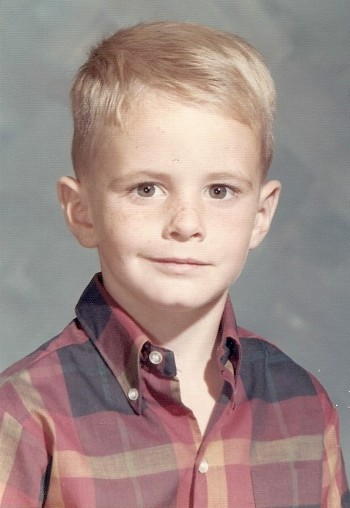 In this original BTB Investigation, we unveil the tragic story of Kirk Murphy, a four-year-old boy who was treated for “cross-gender disturbance” in 1970 by a young grad student by the name of George Rekers. This story is a stark reminder that there are severe and damaging consequences when therapists try to ensure that boys will be boys.
When we first reported on three American anti-gay activists traveling to Kampala for a three-day conference, we had no idea that it would be the first report of a long string of events leading to a proposal to institute the death penalty for LGBT people. But that is exactly what happened. In this report, we review our collection of more than 500 posts to tell the story of one nation’s embrace of hatred toward gay people. This report will be updated continuously as events continue to unfold. Check here for the latest updates.
In 2005, the Southern Poverty Law Center wrote that “[Paul] Cameron’s ‘science’ echoes Nazi Germany.” What the SPLC didn”t know was Cameron doesn’t just “echo” Nazi Germany. He quoted extensively from one of the Final Solution’s architects. This puts his fascination with quarantines, mandatory tattoos, and extermination being a “plausible idea” in a whole new and deeply disturbing light.
On February 10, I attended an all-day “Love Won Out” ex-gay conference in Phoenix, put on by Focus on the Family and Exodus International. In this series of reports, I talk about what I learned there: the people who go to these conferences, the things that they hear, and what this all means for them, their families and for the rest of us.
Prologue: Why I Went To “Love Won Out”
Part 1: What’s Love Got To Do With It?
Part 2: Parents Struggle With “No Exceptions”
Part 3: A Whole New Dialect
Part 4: It Depends On How The Meaning of the Word "Change" Changes
Part 5: A Candid Explanation For "Change"
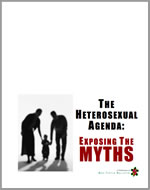 At last, the truth can now be told.
Using the same research methods employed by most anti-gay political pressure groups, we examine the statistics and the case studies that dispel many of the myths about heterosexuality. Download your copy today!
And don‘t miss our companion report, How To Write An Anti-Gay Tract In Fifteen Easy Steps.
 Anti-gay activists often charge that gay men and women pose a threat to children. In this report, we explore the supposed connection between homosexuality and child sexual abuse, the conclusions reached by the most knowledgeable professionals in the field, and how anti-gay activists continue to ignore their findings. This has tremendous consequences, not just for gay men and women, but more importantly for the safety of all our children.
Anti-gay activists often cite the “Dutch Study” to claim that gay unions last only about 1½ years and that the these men have an average of eight additional partners per year outside of their steady relationship. In this report, we will take you step by step into the study to see whether the claims are true.
Tony Perkins’ Family Research Council submitted an Amicus Brief to the Maryland Court of Appeals as that court prepared to consider the issue of gay marriage. We examine just one small section of that brief to reveal the junk science and fraudulent claims of the Family “Research” Council.
 The FBI’s annual Hate Crime Statistics aren’t as complete as they ought to be, and their report for 2004 was no exception. In fact, their most recent report has quite a few glaring holes. Holes big enough for Daniel Fetty to fall through.
“Google” is a trademark of Google Inc.
© Box Turtle Bulletin. All Rights Reserved.
 Posts
Posts  Posts via daily email: