Box Turtle Bulletin
 News and commentary about the anti-gay lobby
“Now you must raise your children up in a world where that union of man and box turtle is on the same legal footing as man and wife…”
News and commentary about the anti-gay lobbyApril 8th, 2013

TODAY’S BIRTHDAY:
Sean Kennedy: 1987. He would have been twenty-five today if he hadn’t been killed on May 16, 2007 at about 3:45 a.m. as he left a local bar in Greenville, South Carolina. According to local news reports, Stephen Andrew Moller got out his his car, walked up to Sean, called him a faggot, and punched him hard enough to break several facial bones. When Sean fell, his head hit the pavement so hard that his brain separated from his brain stem. Fifteen minutes later, one of Sean’s friends received a voice mail from Moller:
Hey. (laughter) Whoa stop. (laughter) Hey, I was just wondering how your boyfriend’s feeling right about now. (laughter) (??) knocked the fuck out. (laughter). The fucking faggot. He ought to never stick his mother-fucking nose (??) Where are you going? Just a minute. (laughter). Yea boy, your boy is knocked out, man. The motherfucker. Tell him he owes me $500.00 for breaking my goddamn hand on his teeth that fucking bitch.
Greenville County sheriff’s office arrested Moller as part of a homicide investigation; his arrest warrant described the act as “a result of the defendant not liking the sexual identity of the victim.” But by the time the case reached the grand jury in October, the indictment was reduced to involuntary manslaughter, for which South Carolina law set the maximum penalty at five years. Moller’s attorney argued that Moller “had no idea (Sean) was gay until after the fact. It’s just a freak incident that should never have happened.”
As part of a plea deal, Moller was sentenced to three years, minus seven months for time served. After getting his GED, Moller’s sentenced was reduced again and he was released after just 13 months, his “goddamn hand” having healed quite nicely in the meantime.
If you know of something that belongs on the agenda, please send it here. Don’t forget to include the basics: who, what, when, where, and URL (if available).
And feel free to consider this your open thread for the day. What’s happening in your world?
April 7th, 2013
I hope this video will convince people once and for all that same-sex couple have no right to “marry,” because their unions do not satisfy a compelling State interest. And then we can stop this whole silly debate.
And when you’re finished, please, come and visit my organization’s web site.
Please, please, please.
April 7th, 2013
TODAY’S AGENDA:
Events This Weekend: Spring Diversity, Eureka Springs, AR; AIDS Walk, New Haven, CT; Dina SHore Weekend, Palm Springs, CA; Phoenix Pride, Phoenix, AZ; Gay Snow Happening, Solden, Austria.

TODAY’S BIRTHDAY:
Harry Hay: 1912. Hay was more than just a co-founder of the Mattachine Foundation (renamed Mattachine Society two years later) which became the first successful organization of gay men (and, to a much lesser extent, lesbians). It was Hay who conceived of the idea of forming an organization to bring gay people together. It wasn’t the first such society; that distinction went to the short-lived Chicago Society for Human Rights, which didn’t last a year (See Dec 10). But Hay wound up holding a curious and tenuous link between the Chicago group and the Mattachines when, in 1930, at the age of 17:
I enticed an “older” gentleman (he must have been at least 33 ) to “bring me out” by finagling his picking me up in Los Angeles’s notorious Pershing Square. Poor guy–he was appalled to discover, subsequently, that I was both a virgin and jailbait. Champ Simmons didn’t really turn me on, but he was a very decent human being; he was gentle and kind and taught me a great deal.
…Champ, the guy I seduced into picking me up and bringing me out into the gay world, had himself been brought out by a guy who was a member of that Chicago group. So I first heard about that group only a few years after its sad end. My impression was that the society was primarily a social thing. But just the idea of gay people getting together at all, in more than a daisy chain, was an eye-opener of an idea. Champ passed it on to me as if it were too dangerous; the failure of the Chicago group should be a direct warning to anybody trying to do anything like that again.
Hay wasn’t put off by dangerous ideas, a propensity which would always mark him as a controversial figure throughout his life. He joined the Communist Party in 1934, and remained a member until the early 1950s. He also became active in theater, where he briefly became the lover of actor Will Greer. In 1938, he married at the urging of his therapist and party members. He and his wife adopted two daughters, but the couple divorced in 1951.
In 1948, Hay went to a party at USC with several other gay men who supported the presidential campaign of Progressive Party candidate Henry Wallace. It was at that party that Hay conceived of organizing a gay activist group. His first efforts to found the “Bachelors for Wallace” failed, but Hay stuck with the idea of creating an organization specifically for gay people. Finally, on November 11, 1950, Hay and several others met at Hay’s home for the first meeting of “The Society of Fools”, which later became the Mattachine Foundation, named after the Medieval French secret societies of masked men whose anonymity allowed them to criticize the ruling monarchs. As the Mattachines got off the ground, Hay left the Communist Party, which didn’t allow gays to be members.
By 1953, Mattachine grew to over 2,000 members in Southern California. And also by 1953, Sen. Joseph McCarthy’s red and pink scares were in full swing. With homosexuality being equated with subversion and treason, many Mattachine members became concerned about the communist connections of some of Mattachine’s founders, principally, Hay. They were also concerned that the Mattachine Foundation was being too public and too “radical” in advocating for gay people. When Hal Call and other Mattachine members from San Francisco sought to amend the Mattachine’s constitution to oppose “subversive elements” and to affirm that members were loyal to the U.S., Hay resigned, he said later, to save the organization from investigations related to the Red Scare. (In 1955, Hay would, in fact, be called to testify before the House Un-American Activities Committee.) The Foundation then re-organized itself into the Mattachine Society, elected publicly named directors for the first time, disavowed its prior links with Hay, and reassured the public that the organization had no interest in changing the nation’s sodomy laws.
In the 1960s, Hay and his partner, John Bernside, became involved again with gay activism, helping to found the North American Conference of Homophile Organizations (NACHO), the Los Angeles chapter of the Gay Liberation Front, and, in 1979, a gay spirituality movement called the Radical Fairies. It was during this time when his opposition to assimilationist attitudes within the gay community really began to stand out:
“We pulled ugly green frog skin of heterosexual conformity over us, and that’s how we got through school with a full set of teeth,” Hay once explained. “We know how to live through their eyes. We can always play their games, but are we denying ourselves by doing this? If you’re going to carry the skin of conformity over you, you are going to suppress the beautiful prince or princess within you.”
Hay’s concept of homosexuality, it could be said, was more of a nineteenth century conception than a twentieth century one. He was enamored with the concepts of androgyny, with some of his ideas being similar to the nineteenth-century formulation of homosexuality being a “third sex.” He was influenced by Edward Carpenter, who wrote of gay people as a distinct, well-defined group with its own unique ideals that set if apart from society. Carpenter also wrote of “Greek love” and its pederastic ideals. This perhaps explains how Hay’s radical and anti-assimilationist politics could reach its most controversial limits when, in the early 1980s, he protested NAMBLA’s exclusion from LGBT organizations and activities. He was forcibly removed from the Los Angeles pride parade in 1986 when he showed up with a sign reading “NAMBLA walks with me.” Even some of Hay’s most dedicated supporters and closest friends couldn’t abide this stance. The majority of the gay community had grown, matured, and move in directions that Hays couldn’t accept.

This is perhaps the most difficult aspect of Hay’s legacy that we are left to grapple with. And yet, without Hay’s extremely radical idea — radical for 1950 — that gay people should come together from out of the shadows and begin to ask for simple things like the freedom to gather in bars or not to be arrested or not to have their newsletters and magazines confiscated by the post office, it’s hard to know how long the fruition of a far more radical idea would have been delayed — the extremely radical, impossible-to-fathom-in-1950 idea that gays and lesbians could assimilate, that they could become police officers, run businesses, publish newspapers, serve in the military, run for office, marry, raise children, join PTAs and churches and car pools and homeowners associations and march openly in parades down the middle of public streets in June, and do all of those things without hiding or retreating back into the closet. If Hay saw himself as the sworn enemy of assimilation, his pioneering efforts in 1950 were ultimately what made that assimilation possible. And for that, I think that perhaps the late Paul Varnell put it best:
Hay may have been wrong about almost everything. But in the end we do not insist that founders have the right answers, not even ask the right questions. We can honor them as founders and leave it at that.

Janis Ian: 1951. She was only thirteen when she wrote her first hit single, “Society’s Child.” The song’s subject, about a young girl’s interracial romance, was way too controversial for radio stations to touch when it was first released in 1964. Re-released again, and then again, the third time proved to be the charm in 1967 when “Society’s Child finally made it to number fourteen on Billboard’s Hot 100. She was on the verge of being a one-hit wonder when “At Seventeen” was released in 1975, hit number one on Billboard’s Adult Contemporary charts, dragged her album, Between the Lines to the number one spot on Billboard’s Album chart, and earned her a Grammy for Best Pop Vocal. She performed “Seventeen” as the very first musical guest for Saturday Night Live’s debut that year. Thanks to the lyric, “To those of us who knew the pain / of valentines that never came,” she reportedly received over four hundred Valentine cards on Valentine’s Day 1977.
Ian’s career since then has been considerably more low-keyed, although she has never stopped recording and touring. In 1993, her album Breaking Silence broke several silences, including the silence of her closet. She married Patricia Snyder in 2003. In 2008, Ian published her autobiography, Society’s Child

If you know of something that belongs on the agenda, please send it here. Don’t forget to include the basics: who, what, when, where, and URL (if available).
And feel free to consider this your open thread for the day. What’s happening in your world?
April 6th, 2013
 Joe Dallas, who heads the Exodus International-affiliated Genesis Counseling in Tustin, California, appeared on The Steve Deace Show on Tuesday, where the topic was the growing acceptance of LGBT people in general and same-sex marriage in particular. Dallas blamed the Internet and its easy access to porn for the rise of “sexual immorality” in the culture. “Where you have high accessibility, you will have more consumer use,” Dallas told Deace (Second hour, 23:16):
Dallas: And that has not only in and of itself been a problem to have it and using porn, but it’s also a gateway to a number of other behaviors because through the Internet, people begin exploring options like hiring a prostitute or consider going to a massage parlor or hooking up anonymously with someone. And because all of that is so accessible now, we absolutely have a higher percentage of people who become literally dependent on these very hyper-stimulating experiences whether its the viewing of pornography or going to a strip club or hiring a prostitute. And that dependency absolutely disrupts many of their lives.
Of course, I certainly don’t think that everyone who is homosexual is sexually addicted and when we’re speaking about same-sex marriage I certainly don’t believe that because someone is attracted to the same sex that means they use pornography or engage in these types of behaviors. Those are really two different issues. But they both do get to the heart of on what we base as a nation our system of sexual ethics, and it seems that that base is shifting.
Beyond porn, Dallas also blamed the media — television, openly gay celebrities, etc — for increasing broader acceptance of LGBT people, and he argued that the increased visibility of LGBT people has meant that more people are “succumbing” to homosexuality. And when that increased visibility is combined with a forty-year movement, “a movement which has built for decades without as much public awareness as we have now, now that momentum has reached a critical mass.” At this point, Deace asked, “where does this end”? (31:11):
Deace: Joe, I wrote a piece for USA Today over the weekend asking, why not polygamy then? Why not polyamory? Why not everything? Why just draw the line here. We’ve got stories at CNN about six year old boys demanding that they’re actually girls and they are transgendered, they get to use the girls’ bathroom, and so we change all of social policy at a public school for a six year old. And where does this end ultimately? What happens to the individuals here that are struggling with their sexuality when we allow public policy to essentially say, “do whatever you want.” What ultimately will be the price they will pay?
Dallas: The individuals will be given a green light to express their desires as they see fit. Some will claim to find deep fulfillment in that, some will form relationships that they report as being very healthy and satisfying, others will find that their lives take directions that they didn’t expect and they’ll be deeply disappointed.
There’s really two ways I look at this: one is theologically and one is socially. Socially I think it will be one more step down the ladder towards a much lower standard of human behavior. Theologically, I think it will be a green light to engage in behaviors that bring the judgment of God. So either one looks pretty dismal to me.
I think that ultimately, this is just as you said: It’s not going to end just at homosexuality. I can’t think of too many logical arguments you can make polygamy if you are in favor of revising our norms to include homosexuality. And in fact, as you know Steve, I believe they call it the polyamorous movement is riding the coat tails of the push for same-sex marriage. And no doubt, if we legitimize same-sex marriage, we will see the legitimization of polygamy as well.
Alan Chambers began changing Exodus International’s direction more than a year ago by acknowledging that “the majority of people that I have met, and I would say the majority meaning 99.9% of them, have not experienced a change in their orientation.” He repudiated the particular from of conversion therapy known as “reparative therapy,” he swiftly responded with a statement opposing criminalization soon after a board member spoke in Jamaica in support of its anti-gay laws (that board member quickly resigned), he condemned the Family Research Council for honoring a pastor who called gays “worse than maggots” and that God had an “urban renewal plan for Sodom and Gomorrah,” and declined to oppose a California law that bans sexual orientation change efforts for minors. More generally, Exodus has refused to take political positions on hot-button topics, with Chambers recently posting videos saying that Exodus no longer has an official position on same-sex marriage, and encouraging students to cooperate with rather than confront gay-straight alliances in the schools.
Those changes within Exodus has prompted other prominent ex-gay leaders to publicly denounce Exodus’ change in direction, and a number of ministries have left the organization. Many of those ministries have joined up to form a rival organization called the Restored Hope Network. Dallas was a founding member of RHN and was a no-show at Exodus International’s annual conference in St. Paul, MN in 2012 (his wife was there to present a couple of workshops), but he retained his ties to Exodus in an attempt to be a member in good standing with both groups. But with this week’s statements on Deace’s radio program, I don’t see how Dallas’s continued association with Exodus is tenable.
April 6th, 2013
TODAY’S AGENDA:
Events This Weekend: Spring Diversity, Eureka Springs, AR; AIDS Walk, New Haven, CT; Dina SHore Weekend, Palm Springs, CA; Phoenix Pride, Phoenix, AZ; Gay Snow Happening, Solden, Austria.
TODAY IN HISTORY:
Study of 100 Homosexuals: 1957. There had been a string of high profile arrests of very prominent and well-known men in Britain in the early 1950s, including Lord Montagu (see Oct 20), his cousin, Maj. Michael Pitt-Rivers, and journalist Peter Wildeblood, all of whom had been charged and convicted of homosexual offenses. Their arrests opened the debate over whether homosexual acts between consenting adults should remain criminalized. In 1954, the Home Secretary, David Maxwell-Fyfe, convened a committee to study the issue under the leadership of Lord John Wolfenden, and they would study the question for the next three years. The multi-disciplined committee, which included theologians, psychiatrists, educators, judges, lawyers, and several other leading figures, was tasked with reviewing the medical, legal, and moral aspects of homosexuality (along with prostitution, as laws forbidding it were also open for discussion.)
One of the psychiatrists on that committee was Dr. Desmond Curran of the Department of Psychiatry at St. George’s Hospital in London. Curran and fellow researcher Dr. Denis Parr, took on the task of preparing a study of 100 gay men, which appeared in the April 6, 1957 edition of the British Medical Journal titled “Homosexuality: An Analysis of 100 Male Cases Seen in Private Practice.”
The men described in this paper were referred to the authors for evaluation and treatment for the following reasons:
The authors noted that homosexuality was a criminal offense in Britain in three very distinct ways. The crime of “buggery,” which was generally interpreted as penetrative anal intercourse, carried a maximum penalty of life imprisonment. The crimes of “indecent assault” and “gross indecency” provided maximum penalties of ten years and two years respectively. “Indecent assault” generally was used for sexual behavior with minors under the age of 16, while “gross indecency” was any contact or exposure of genitalia for sexual excitement.
One problem with the published research on gay men was that virtually all of it was based on clinical or criminal populations, which Curran and Parr acknowledged would not necessarily be representative of the general population of gay men. In their report, they acknowledged that their sample would likely exhibit higher rates of psychiatric problems or criminal recidivism. But when they looked into the files of these 100 men who had been referred to their practice, the authors observed:
…[I]n spite of the probability that any group of homosexuals referred to a psychiatrist might be expected to be heavily weighted in the direction of psychiatric abnormality, no fewer than 51 % were considered to be free from gross personality disorder, neurosis, or psychosis during their adult lives. Only one was certifiably defective and none certifiably insane. They included a number of important and talented individuals of high integrity, successful, efficient, and respected members of the community. Only two had been on any criminal charge other than homosexuality. Very few showed the traditional “pansy” picture of homosexuals; indeed, only 21 were noted to have at all obvious homosexual personality traits, only one of these being a paedophiliac.
As for the treatment programs the men underwent:
The objects of treatment can be arbitrarily divided under four main headings : (1) change in direction of the sex urge, (2) greater continence, (3) greater discretion, and (4) better adaptation to the sexual problem and to life in general.
The authors don’t go into much detail of what kind of treatment the men underwent, saying simply that “treatment consists in a mixture of physical, psychological, social, and environmental measures, in varying proportions according to the case.” In general, it appears to have been confined to psychotherapy or simple counseling, although in some cases the “prescription of medications or environmental adjustments” were noted. As for the attempts at changing sexual orientation, the results weren’t very encouraging:
Of the 59 patients about whom sufficient information was available, 9 (or roughly 1 in 6) reported less intense homosexual feelings, or increased capacity for heterosexual arousal, 3 became more homosexual in preference than when first seen, and no change, even of a minor order, was found in the sexual orientations of the other 47. When a change was found it often amounted only to a slight alteration in the balance of masturbatory fantasies.
Eight of the nine who claimed a “slight alteration” toward heterosexuality were classified as bisexual or “predominately” homosexual (as distinct from “100% homosexual”). What isn’t stated in the article is how many of those who claimed to have experience a “slight alteration” were among the thirty men who faced criminal charges. This would be important; the authors noted elsewhere in their paper that those who were criminally charged had “come in the hope of establishing medical reasons for mitigating the rigours of the law.”
Since the prospect of “slight alteration” of homosexuality was minimal, the only other question remaining was whether there was anything intrinsically wrong with being gay. Curran and Parr found little evidence for it:
Only half the patients showed significant psychiatric abnormality other than their sexual deviation, and such associated abnormalities were often slight. Moreover, many of these abnormalities were explicable as a reaction to the difficulties of being homosexual. Symptomatic homosexuality was rare. If homosexuality is a disease (as has often been suggested), it is in a vast number of cases monosymptomatic, non-progressive, and compatible with subjective well-being and objective efficiency. In our series, both practising and non-practising homosexuals were on the whole successful and valuable members of society, quite unlike the popular conception of such persons as vicious, criminal, effete, or depraved. Only one-fifth were at all obviously ” pansy,” and we found no reason to regard most of the patients as physically, intellectually, or emotionally immature (unless the basic criterion for ” immaturity” is that of being homosexual-a circular argument).
This study, among others, would find its way into the Wolfenden Report later that year, which recommended that “homosexual behaviour between consenting adults in private should no longer be a criminal offence.” It would take Parliament another ten years to act on that recommendation.
If you know of something that belongs on the agenda, please send it here. Don’t forget to include the basics: who, what, when, where, and URL (if available).
And feel free to consider this your open thread for the day. What’s happening in your world?
April 5th, 2013
 Sen. Mary Landrieu (D-LA), one of only four Democratic U.S. Senators who doesn’t support marriage equality, takes the most cowardly stance possible:
Landrieu told CNN National Political Correspondent Jim Acosta in an interview Friday that she personally believes “people should love who they love and marry who they want to marry,” but that her obligation rests with the people of Louisiana who elected her.
“My state has a very strong constitutional amendment not only against gay marriage but against gay partnerships. So I’m looking at the people of Louisiana trying to represent their interests,” she said.
As a Senator, the only thing that matters is what she will do as Senator. Save the “people should love who they love” bullcrap for Oprah.
April 5th, 2013
National Journal names five likely candidates, and Talking Points Memo has a handy five-part formula on how to change your position on marriage.
April 5th, 2013
Here’s Sen. Joe Donnelly (D-IN)’s statement supporting “marriage equality for all“:
In recent years, our country has been involved in an important discussion on the issue of marriage equality. While serving in the House of Representatives, I had the opportunity to act on a core belief of mine: we are a stronger country when we draw on the strengths of all Americans. I voted to repeal ‘don’t ask, don’t tell’ and was an original supporter of the bill that would make it illegal to discriminate against someone in the workplace because of their sexual orientation. It is also for that reason that I oppose amending either Indiana’s or our nation’s constitution to enshrine in those documents an ‘us’ and a ‘them,’ instead of a ‘we.’ With the recent Supreme Court arguments and accompanying public discussion of same-sex marriage, I have been thinking about my past positions and votes. In doing so, I have concluded that the right thing to do is to support marriage equality for all.”
-Joe
At about the same time as Donnelley’s statement came out — within minutes of each other, according to news reports — Sen. Heidi Heitkamp (D-ND) also released a statement which, in a somewhat less direct way, comes around to supporting marriage equality:
In speaking with North Dakotans from every corner of our great state, and much personal reflection, I have concluded the federal government should no longer discriminate against people who want to make lifelong, loving commitments to each other or interfere in personal, private, and intimate relationships. I view the ability of anyone to marry as a logical extension of this belief. The makeup of families is changing, but the importance of family is enduring.
Sens. Donnelly and Heitkamp join fellow Democratic Sens. Claire McCaskill (MO), Mark Warner (VA), Mark Begich (AK), Jay Rockefeller (WV), Jon Tester (MT), Kay Hagen (NC), Bob Casey(PA), Tom Carper (DE), and Bill Nelson (FL) in shifting to the right side of history over the past two weeks. This leaves only four Democratic holdouts in the Senate: Tim Johnson (SD), Mary Landrieu (LA), Joe Manchin (WV), and Mark Pryor (AR). The avalanche of new support for marriage equality in the Senate began on March 15 when Sen. Rob Portman(R-OH) became the first sitting Republican Senator to announce his support for marriage equality. On Tuesday, Sen. Mark Kirk (R-IL) joined his fellow Republican in making the switch. At this point, I am seriously, seriously wondering what on earth is keeping Sen. Susan Collins (R-ME) from making a similar announcement.
April 5th, 2013
TODAY’S AGENDA:
Events This Weekend: Spring Diversity, Eureka Springs, AR; AIDS Walk, New Haven, CT; Dina SHore Weekend, Palm Springs, CA; Phoenix Pride, Phoenix, AZ; Gay Snow Happening, Solden, Austria.
TODAY IN HISTORY:
Oscar Wilde Loses Criminal Libel Case: 1895. It had already been a bad year for the acclaimed author, and the year was barely a quarter of the way through. In February, Wilde was dining at the Albermarle Club when the Marquess of Queensbury left a calling card with the porter. It read, “For Oscar Wilde posing as a somdomite.” The misspelling may have been the product of Queensbury’s rage over the relationship between his son Lord Alfred “Bosie” Douglas and Wilde. Lord Alfred refused to end it despite Queensbury’s arguments and threats, including the threat to publicly expose Wilde, which he accomplished with that calling card. Friends urged Wilde to ignore it, but Wilde felt that such an insult required a vigorous response, namely a lawsuit against Queensbury for criminal libel. If he didn’t respond, he reasoned, it would be tantamount to admitting the truth, something that Wilde knew would be disastrous not only to his reputation and career, but also to his very freedom. Homosexuality was a criminal offense.
Unfortunately, Wilde’s libel case collapsed on the second day of the sensational trial, when Wilde took the stand and Queensbury’s lawyer asked whether he had ever kissed a young man named Walter Grainger. Wilde replied, “Oh, dear no. He was a peculiarly plain boy. He was, unfortunately, extremely ugly. I pitied him for it.” Queesnbury’s lawyer pounced on Wilde’s reason for not kissing Grainger: it wasn’t that Wilde didn’t like kissing men, but that he didn’t want to kiss this particular “ugly” man. That was on April 4. The next day, Queensbury’s lawyer announced that he planned to call several male prostitutes to testify against Wilde. Wilde’s lawyer, after conferring with Wilde, asked the court to drop the charges and return a verdict of “not guilty” against Queensbury. But if Queensbury was not guilty of libel when he accused Wilde of “posing as a sodomite,” then that meant under English law that Queensbury’s statement, as the judge announced, “is true in fact and substance, and that the publication is for the public benefit.”
With that verdict as evidence, Wilde was arrested and charged with gross indecency the very next day, April 6. The first trial ended in a hung jury, but the second resulted in a guilty verdict and a sentence of two years at hard labor, the maximum sentence allowed by law.
If you know of something that belongs on the agenda, please send it here. Don’t forget to include the basics: who, what, when, where, and URL (if available).
And feel free to consider this your open thread for the day. What’s happening in your world?
April 4th, 2013
I’ll have to push today’s video for the National Marriage Organization to tomorrow. Unlike my allies, Brian Brown and Thomas Peters of NOM, I don’t get paid to do this, and thus have other work to complete.
Speaking of Thomas Peters, could you all help me out? Thomas made me sad the other day when he tweeted this:
most gay activists who attack me have less than 10 followers. They don't even have the courage to say mean things with their real account!
— Thomas Peters (@AmericanPapist) April 2, 2013
Actually, it wasn’t Thomas Peters who made me sad, but the gay activists who mocked him for this tweet. See, apparently Thomas’ very big brain is so very strained with his many main arguments against same-sex marriage that he has forgotten about his very sensible policy of blocking gay activists who address him with their real accounts.
I mean, he did that to me, and I totally deserved it. What kind of decent person would ambush the Communications Director of an organization by calling him at work to ask about one of the organization’s communications?
But I also realized — now that I’m blocked I have no way of telling Thomas I’ve switched to his side! Since I don’t have a video to post today, would you mind taking those 60 seconds to tweet one or more of my videos to Thomas? And also to NOM?
I’d surely appreciate it. I feel confident in saying my little videos completely capture the spirit and depth of their organization.
PS Here are some short links for you:
April 4th, 2013
 With the Florida Democrat’s announcement, we now have 51 supporters in the Senate:
It is generally accepted in American law and U.S. society today “… that all Men are created equal, that they are endowed by their Creator with certain unalienable Rights, that among these are Life, Liberty and the Pursuit of Happiness. I believe that. The civil rights and responsibilities for one must pertain to all.
Thus, to discriminate against one class and not another is wrong for me.
If we are endowed by our Creator with rights, then why shouldn’t those be attainable by Gays and Lesbians?
Simply put, if The Lord made homosexuals as well as heterosexuals, why should I discriminate against their civil marriage? I shouldn’t, and I won’t.
So I will add my name to the petition of senators asking the Supreme Court to declare the law that prohibits gay marriage unconstitutional.
Sen. Nelson joins fellow fellow Democratic Sens. Claire McCaskill (MO), Mark Warner (VA), Mark Begich (AK), Jay Rockefeller (WV), Jon Tester (MT), Kay Hagen (NC), Bob Casey (PA) and Tom Carper (DE) in shifting to the right side of history over the past two weeks. The cascade of new support for marriage equality in the Senate began on March 15 when Sen. Rob Portman (R-OH) became the first sitting Republican Senator to announc his support for marriage equality. On Tuesday, Sen. Mark Kirk (R-IL) joined his fellow Republican in making the switch.
The remaining Democratic holdouts in the Senate are Joe Donnelly (IN), Heidi Heitkamp (ND), Tim Johnson (SD), Mary Landrieu (LA), Joe Manchin (WV), and Mark Pryor (AR).
April 4th, 2013
 Ronald Reagan’s daughter, Patti Davis, is saying that she believes that her father would support marriage equality. She also filled out a bit more about her family’s relationships with gay people which has often in the press been limited to a mention of Rock Hudson.(NY Times)
Ms. Davis, now 60, offered several reasons her father, who would have been 102 this year, would have bucked his party on the issue: his distaste for government intrusion into private lives, his Hollywood acting career and close friendship with a lesbian couple who once cared for Ms. Davis and her younger brother Ron while their parents were on a Hawaiian vacation — and slept in the Reagans’ king-size bed.
“I grew up in this era where your parents’ friends were all called aunt and uncle,” Ms. Davis said. “And then I had an aunt and an aunt. We saw them on holidays and other times.” She added, “We never talked about it, but I just understood that they were a couple.”
It’s impossible to know the beliefs of a man who is dead, but that doesn’t stop speculation. And those who best knew the person are most suited to make such a guess.
Nancy Reagan has not, to my knowledge, made any comments about same-sex marriage or expressed her husband’s views. But during their administration, her decorator and his partner were the first known gay couple to stay at the white house, and Nancy joined Patti in their outrage at a television depiction of Ronald Reagan which portrayed him as personally hostile to gay people.
I certainly don’t know that Reagan would have supported equality. But Patti’s voice is a welcome rebuttal to those in the Republican Party who would use the former President’s name to oppose marriage and serves as a reminder that the Party of Reagan has in many ways morphed into an entity in which he would no longer feel welcome.
April 4th, 2013

That’s Kathy Snowden and Deborah Grier, the proprieters of Finders Keepers Antiques and Collectables, my favorite antique store in Bisbee, Arizona, which is saying something because tiny “Keep Bisbee Freeky” has quite a selection of antique stores and junk shops to chose from. Kathy and Deboray, who have been together for twenty years, are some of the nicest people you will ever know, and I was thrilled to see their photo illustrating this story in USA Today about how Bisbee wound up becoming a center of statewide and national attention in the battle for marriage equality:
Grant Sergot, 63, who is heterosexual and has lived in Bisbee for nearly 40 years where he owns Óptimo Hatworks, described Bisbee as a “well-informed and educated community.”
“Very independent-type people live here, free-thinking people,” he said.
Kathy Sowden, who has been with her partner for 20 years and owns Finders Keepers Antiques and Collectibles, said a civil ordinance seemed natural for Bisbee.
“We’re a border town,” she said. “We thrive on diversity. It’s not surprising at all that little Bisbee is the first to do this.”
(By the way, I also have two custom-fit hats from Óptimo Hatworks.)
The town’s Civil Unions ordinace was staunchly opposed by several of the town’s churches, Arizona Attorney General Tom Horne, and the Center for Arizona Policy (a Focus On the Family state policy council). But as Mark Hundley told the packed council chambers Tuesday, in answer to remarks made by some of those religious opponents, “I am not an abomination. It’s strange to have to say that.” The Bisbee council agreed, and voted 5-2 to make civil unions legal.
You can read more about what I love about Bisbee here. And maybe next time I’m in Bisbee, maybe I’ll finally break down and get that Roseville vase I’ve had my eye on at Kathy and Deborah’s shop.
April 4th, 2013
TODAY’S AGENDA:
Events This Weekend: Spring Diversity, Eureka Springs, AR; AIDS Walk, New Haven, CT; Dina SHore Weekend, Palm Springs, CA; Phoenix Pride, Phoenix, AZ; Gay Snow Happening, Solden, Austria.

TODAY IN HISTORY:
Anita Bryant Advocates Imprisoning Gays For 20 Years: 1978. Newspapers across the country got a bit of a tease from Playboy, which released a few tantalizing tidbits from an interview with anti-gay activist Anita Bryant that would appear in the May 1978 edition. In a small preview released to the wire services, Bryant was quoted as suggesting that sending gays to prison for 20 years “might make them think twice, especially the young ones. Any time you water down the law, it just makes it easier for immorality to be tolerated.” She went on: “Why make it easier for them? I think it only helps to condone it and make it easier for kids who wouldn’t be so concerned if it was a misdemeanor, whereas a felony might make them think twice, especially the younger ones.” When asked whether prison life might not be conducive to homosexuality, she answered, “They’ll have plenty of time to think. Just because prisons are corrupt and not doing the right thing in rehabilitation because they don’t have enough emphasis on spiritual emphasis doesn’t mean there should not be a strong punishment for that.”

TODAY’S BIRTHDAY:
Anthony Perkins: 1932. Best known for his role as the sexually-conflicted Norman Bates in the Alfred Hitchcock classic Psycho, Perkins’s own sexuality was the subject of rumors throughout his career. He shared a long-term relationship with fellow 1950s teen idol Tab Hunter (See Jul 11. Hunter discussed their time together in his 2005 memoir Tab Hunter Confidential) 

Graham Norton: 1963. When the Irish comic’s 1992 stand up comedy performance at the Edinburgh Festival Fringe as a tea-towel clad Mother Teresa, it caught the attention of Scottish Television, which, bizzarely, mistook him for the real Mother Teresa. Soon he was appearing on BBC radio, then as a stand-in late night talk show host for Britain’s Channel 5. He eventually took his openly-camp act to Channel 4 for his own weely talk show, So Graham Norton, then V Graham Norton. In 2004, he tried to take his show to America, with The Graham Norton Effect on Comedy Central, but the controversy over Janey Jackson’s “wardrobe malfunction” at the Super Bowl that year soured Norton on bringing his raunchy, innuendo-laden comedy to the U.S. He returned to Britain in 2005, and landed several gigs on BBC. In 2007, he returned to weekly late-night talk with The Graham Norton Show on BBC Two, and in 2009 his show moved to BBC One, where Series 13 begins tomorrow night with guests Tom Cruise, Olga Kurylenko, Gerard Butler and Paramore. North Americans can catch butchered versions of the show at impossibly odd times on the disasterously programmed BBC America, or on BBC Canada.
If you know of something that belongs on the agenda, please send it here. Don’t forget to include the basics: who, what, when, where, and URL (if available).
And feel free to consider this your open thread for the day. What’s happening in your world?
April 3rd, 2013
We’re having trouble keeping to the schedule and had to rush this one through production (who’d have thought creating sound arguments against gay marriage would be so hard?). Hopefully the editors got everything right.
And when you’re finished, please, come and visit my organization’s new web site. Seriously.
Featured Reports
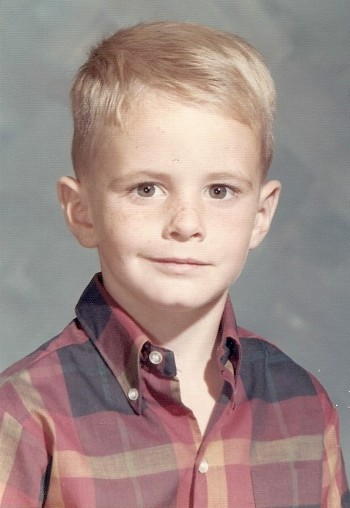 In this original BTB Investigation, we unveil the tragic story of Kirk Murphy, a four-year-old boy who was treated for “cross-gender disturbance” in 1970 by a young grad student by the name of George Rekers. This story is a stark reminder that there are severe and damaging consequences when therapists try to ensure that boys will be boys.
When we first reported on three American anti-gay activists traveling to Kampala for a three-day conference, we had no idea that it would be the first report of a long string of events leading to a proposal to institute the death penalty for LGBT people. But that is exactly what happened. In this report, we review our collection of more than 500 posts to tell the story of one nation’s embrace of hatred toward gay people. This report will be updated continuously as events continue to unfold. Check here for the latest updates.
In 2005, the Southern Poverty Law Center wrote that “[Paul] Cameron’s ‘science’ echoes Nazi Germany.” What the SPLC didn”t know was Cameron doesn’t just “echo” Nazi Germany. He quoted extensively from one of the Final Solution’s architects. This puts his fascination with quarantines, mandatory tattoos, and extermination being a “plausible idea” in a whole new and deeply disturbing light.
On February 10, I attended an all-day “Love Won Out” ex-gay conference in Phoenix, put on by Focus on the Family and Exodus International. In this series of reports, I talk about what I learned there: the people who go to these conferences, the things that they hear, and what this all means for them, their families and for the rest of us.
Prologue: Why I Went To “Love Won Out”
Part 1: What’s Love Got To Do With It?
Part 2: Parents Struggle With “No Exceptions”
Part 3: A Whole New Dialect
Part 4: It Depends On How The Meaning of the Word "Change" Changes
Part 5: A Candid Explanation For "Change"
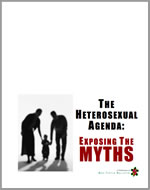 At last, the truth can now be told.
Using the same research methods employed by most anti-gay political pressure groups, we examine the statistics and the case studies that dispel many of the myths about heterosexuality. Download your copy today!
And don‘t miss our companion report, How To Write An Anti-Gay Tract In Fifteen Easy Steps.
 Anti-gay activists often charge that gay men and women pose a threat to children. In this report, we explore the supposed connection between homosexuality and child sexual abuse, the conclusions reached by the most knowledgeable professionals in the field, and how anti-gay activists continue to ignore their findings. This has tremendous consequences, not just for gay men and women, but more importantly for the safety of all our children.
Anti-gay activists often cite the “Dutch Study” to claim that gay unions last only about 1½ years and that the these men have an average of eight additional partners per year outside of their steady relationship. In this report, we will take you step by step into the study to see whether the claims are true.
Tony Perkins’ Family Research Council submitted an Amicus Brief to the Maryland Court of Appeals as that court prepared to consider the issue of gay marriage. We examine just one small section of that brief to reveal the junk science and fraudulent claims of the Family “Research” Council.
 The FBI’s annual Hate Crime Statistics aren’t as complete as they ought to be, and their report for 2004 was no exception. In fact, their most recent report has quite a few glaring holes. Holes big enough for Daniel Fetty to fall through.
“Google” is a trademark of Google Inc.
© Box Turtle Bulletin. All Rights Reserved.
 Posts
Posts  Posts via daily email: