Box Turtle Bulletin
 News and commentary about the anti-gay lobby
“Now you must raise your children up in a world where that union of man and box turtle is on the same legal footing as man and wife…”
News and commentary about the anti-gay lobbyApril 3rd, 2013

The tiny southeastern Arizona town of Bisbee — pop: 6,000; unofficial motto: “Keep Bisbee freaky;” located just four miles from the Mexican border — has adopted an ordinance to legalize civil unions for same-sex couples. The terms of the city’s civil unions are extremely limited: while it covers joint property ownership, property inheritance, guardianship and adoption rights, it only applies within the city’s boundaries, which effectively makes it no different from a number of domestic partnership registries in Tucson, Phoenix, and other Arizona cities. Bisbee City Attorney John MacKinnon acknowledged that in the end, the ordinance’s impact will apply only to things within the city’s control, such as personnel policies.
But it’s the term “civil unions” which has caught Arizona’s conservatives off guard. Who knew that they would suddenly become all riled up over the sanctity of civil unions?
And just hours before the meeting, Arizona Attorney General Tom Horne, at the urging of state lawmakers from Cochise County, sent a letter warning Bisbee that his office would take legal action against the city if council members approved the ordinance.
Horne said Bisbee does not have the authority to offer civil unions and that “the impact goes beyond (city) boundaries.”
MacKinnon, referring to Horne and the state, said: “They chose to interpret it broadly. We believe this was a desire to make a political statement.”
MacKinnon said he was proud to bring the issue to the council. “I think for too long many of us have been silent while we have witnessed discrimination against some in this community,” he said. “It’s time to stand up.”
In fact, state law does not address domestic partnerships or civil unions. Arizona voters in 2006 refused to adopt Prop 108, a constitutional amendment which would have banned domestic partnerships and civil unions in addition to same-sex marriage. In 2008, conservatives placed Prop 102 on the ballot to ban same-sex marriage only. That proposition passed by a margin of 56% to 44%.
However, there is a possibility that Bisbee’s civil unions ordinance may be successfully challenged in court. The ordinance addresses, for example adoption rights, which are regulated by state law. These clauses are moot in the city of Bisbee since there are no adoption agencies in the city. But even if there were, those agencies would be regulate by state law, which cannot be superseded by a city ordinance. Horne has promised to challenge the law in court. The Center for Arizona Policy, an official state policy council for Focus On the Family, has also promised to sue, and threatened additionally to bankrupt the city.
And you can safely bet your life savings that the neanderthal state legislature will quickly act to patch any other legal holes they can find to ban local governments from recognizing same-sex relationships altogether. After all, it’s one of two things our state government loves to do more than anything else in the world. The other is panicking over made-up stores about kidnapping, headless corpses and other wild imaginings from the anti-immigration crowd.
In 2010, Bisbee was named the gay-friendliest city in Arizona. You can read more about Bisbee here.
April 3rd, 2013
TODAY’S AGENDA:
Events This Weekend: Spring Diversity, Eureka Springs, AR; AIDS Walk, New Haven, CT; Dina SHore Weekend, Palm Springs, CA; Phoenix Pride, Phoenix, AZ; Gay Snow Happening, Solden, Austria.

The justices of the Iowa Supreme Court who made history in the Midwest
TODAY IN HISTORY:
Iowa Supreme Court Declares Ban on Same-Sex Marriage Unconstitutional: 2009. In a unanimous ruling, the Iowa Supreme Court upheld a lower court ruling which held that the state’s marriage statute was unconstitutional. The Court concluded that:
We are firmly convinced the exclusion of gay and lesbian people from the institution of civil marriage does not substantially further any important governmental objective. The legislature has excluded a historically disfavored class of persons from a supremely important civil institution without a constitutionally sufficient justification. There is no material fact, genuinely in dispute, that can affect this determination.
Senate Majority Leader Mike Gronstal and House Speaker Pat Murphy issued a joint statement welcoming the court’s decision. Citing Iowa’s long tradition in being a leader in civil rights, they congratulated “the thousands of Iowans who now can express their love for each other and have it recognized by our laws.” Iowa’s same-sex couples began marrying on April 27.

TODAY’S BIRTHDAY:
Anne Lister: 1791. Her father was a veteran British soldier who fought with the Redcoats at the Battles of Lexington and Concord (he later wrote a book about it) during the American War for Independence. After the war, he married and became a wealthy country gentleman in Yorkshire. His eldest daughter, Anne, was brought up with all of the advantages education and erudician, the latter resulting in an intense interest in classical literature. In 1826, she inherited the family estate, Shibden Hall, and with it a steady income from the estate’s tenants. That modest wealth was enough to afford her a measure of independence and deference from those who might otherwise criticize her “masculine appearance.” She was sometimes referred to as “Gentleman Jack,” for her propensity to enter into business (she became engaged in the very male-dominated coal mining business) and recreational affairs (she was the first woman to climb Mont Perdy in the Pyrenees in 1830) that were not considered normal for a woman of her standing.
What’s more, private life was not considered normal for a woman of any standing. Lister had a long term relationship with Marianna Belcombe, which lasted lasting several years including a period of time when Belcombe was married. In 1832, Lister met and fell in love with a wealthy landowner Ann Walker, and the two of them would remain together for the rest of Lister’s short life. Their relationship was as close to a marriage as was possible, given the times. Lister died in 1840, at the age of 49, while traveling with Walker in Eastern Europe.
Lister left behind a 26-volume diary covering the years 1806 to 1840. Most of the diary covered various mundane topicc — the weather, social events, business concerns, her travels — but about a sixth of the diary was encrypted in a simple code. Those coded sections describe her lesbian nature and affairs. When a relative, John Lister, who was the last to inhabit Shibden Hall, decoded the diaries and discovered the contents, he was advised to burn them. He didn’t, but decided instead to hide them. A century later, Helena Whitbread published portions of the diaries in two


If you know of something that belongs on the agenda, please send it here. Don’t forget to include the basics: who, what, when, where, and URL (if available).
And feel free to consider this your open thread for the day. What’s happening in your world?
April 2nd, 2013
 Uruguay’s Senate, after several hours of debate, approved a bill which would provide marriage equality to same-sex couples in a 23-8 vote.
Sen. Rafael Michelini opened the hours long debate by declaring that same-sex marriage represented a “radical change” that future generations may compare to the abolition of slavery. “Of course I cannot compare it to finaly abolishing slavery, because they were fighting that for hundres of years, but for the purposes of a person acquiring rights, is it not a kind of liberation?” Opposition Senator Francisco Gallinal objected to characterizing same-sex marriage as “marriage equality,” warning that other members of society may demand the legalization of polygamy. The bill was strongly supported by the ruling Broad Front party, while the main opposition parties allowed their members a conscience vote.
The Senate version of the bill is slightly different from the version approved by the Chamber of Deputies in December. The bill now goes back to the lower house for final approval. President José Mujica has said he will signed the bill into law when it reaches his desk.
April 2nd, 2013
Here’s the second video for my new organization promoting traditional marriage. It’s harder hitting than the first one, but these are tough times.
And when you’re finished, please, come and visit my organization’s new web site.
April 2nd, 2013
 Sen. Mark Kirk (R-IL) today has become the second sitting Republican Senator to announce his support for marriage equality, in a statement released by his office:
When I climbed the Capitol steps in January, I promised myself that I would return to the Senate with an open mind and greater respect for others.
Same-sex couples should have the right to civil marriage. Our time on this Earth is limited, I know that better than most. Life comes down to who you love and who loves you back– government has no place in the middle.
In January 2012, Kirk suffered a serious stroke at the relatively young age of 52. It took him a full year of recovery before he was able to return to the Senate this year.
When Kirk, then as Congressman, voted against repealing “Don’t Ask, Don’t Tell” in 2010, activist Mike Rogers outed Kirk as gay, an outing that the unmarried then-recently divorced and currently unmarried Senator has never acknowledged. That same year, Kirk announced his support for civil unions, and when the Senate took up DADT repeal at the end of the year, the newly sworn-in Sen. Kirk switched his vote to “yes.” More recently he has backed Illinois GOP chairman Pat Brady against a failed recall attempt after Brady announced his support for a marriage equality bill in the Illinois state legislature.
Kirk’s announcement comes three weeks after Ohio Sen. Rob Portman became the first sitting Republican Senator to back marriage equality. Since then, eight Democratic Senators have announced their support for same-sex marriage. With Kirk’s announcement, there are an even fifty Senators who are now on the right side of history.
Update: The penultimate paragraph was updated to more accurately reflect Kirk’s marital status and his votes on DADT repeal.
April 2nd, 2013
 Given that Sen. Tom Carper is a Democratic Senator from Delaware, where residents strong pro-marriage equality sentiment, this hardly qualifies as a profile in courage. It nevertheless brings to 49 the number of Senators who are now on record as supporting same-sex marriage:
As our society has changed and evolved, so too has the public’s opinion on gay marriage – and so has mine. I pray every day for God to grant me the wisdom to do what is right. Through my prayers and conversations with my family and countless friends and Delawareans, I’ve been reminded of the power of one of my core values: the Golden Rule. It calls on us to treat others as we want to be treated. That means, to me, that all Americans ultimately should be free to marry the people they love and intend to share their lives with, regardless of their sexual orientation, and that’s why today, after a great deal of soul searching, I’m endorsing marriage equality.
Delaware’s sole Congressman, John Carney, Jr., (D) has also announced his support for marriage equality. A bill to allow same-sex marriage is expected to be introduced in the Delaware statehouse sometime this year.
Sen. Carper is the latest to join Sens. Claire McCaskill (D-MO), Mark Warner (D-VA), Mark Begich (D-AK), Jay Rockefeller (D-WV), Jon Tester (D-MT), Kay Hagen (D-NC), and Bob Casey (D-PA) in shifting to the right side of history. Not only are we grateful, but so will be their grandchildren and great-grandchildren. Remaining holdouts among Democratic Senators are Joe Donnelly (IN), Heidi Heitkamp (ND), Tim Johnson (SD), Mary Landrieu (LA), Joe Manchin (WV), Bill Nelson (FL) and Mark Pryor (AR). Sen. Rob Portman (R-OH) remains the only sitting Senator GOP to announce his support for marriage equality.
April 2nd, 2013

MP Moses Balyeku hears from his constituents about the Marriage and Divorce Bill (Daily Monitor/Denis Edema)
Uganda’s Parliament returns today following an extended Easter break, when MP’s heard several earfuls from their constituents over the controversial Marriage and Divorce Bill. I’m not up on the bill’s provisions, but Ugandan media reports seem to indicate that the bill, part of a four-year effort to modernize Uganda’s marriage and divorce laws, has run into a buzz saw of controversy from several quarters. Religious leaders have come out against it, as have traditional community leaders. In Karamoja, a subregion in northeast Uganda along the border with Kenya and South Sudan, local elders have threatened to visit their traditional spiritual sites to place a curse on politicians supporting the bill. “We are going to slaughter several bulls and eat blood for seven days in the Atekerin Mountain to fail that Bill and curse those MPs pushing for it,” said one resident. President Yoweri Museveni is now backtracking from the bill, and Daily Monitor reports that other MP’ have “asked Parliament to abandon the Bill and address other issues crucial to the population.”
What does this have to do with the Anti-Homosexuality Bill? Well, according to the most recent Orders Paper (Word: 41KB/2 pages) posted by Parliament from last month, one of those “other issues crucial to the population” is the kill-the-gays bill, which was number 3 under “Notice of Business to Follow.” It has been hovering in the top half of that on-deck list since last November, waiting in the wings as Parliament tears itself apart over other divisive and contentious issues. The thing about the AHB to remember is that it is in no way contentious or controversial, at least not inside Uganda where it enjoys overwhelming support, death penalty and all. But controversy outside of Uganda has made the bill an enormous headache for the country’s political leaders. Already, several European countries made good on their threats to cut direct aid over rampant corruption. When Germany joined five other nations in cutting aid, it added the pending Anti-Homosexuality Bill to its list of concerns.
This places Ugandan politicians in a bind. On the one hand, the AHB is hugely popular with their constituents, and there is no political advantage whatsoever in opposing the bill. On the other hand, being linked to the bill threatens to make those same politicians pariahs outside of Uganda. As the opposition Observer reports, this has led many politicians to call for debating the bill in private:
However, The Observer understands that some lawmakers have toyed with the idea of lobbying Speaker Rebecca Kadaga for a closed-door session when debate on the bill starts. National Youth MP, Monica Amoding, told The Observer that some MPs on the Legal and Parliamentary Affairs committee proposed the move because of the sensitive nature of the bill.
“This subject is very sensitive and some of us fear that if it is discussed in public view, we will be persecuted for holding particular views,” Amoding said. Not surprisingly, she refused to state whether she supports the bill.
Another MP, who requested anonymity, explained that supporting the bill publically could lead to being blacklisted. He cited David Bahati, the main promoter of the bill, saying the MP has been ostracised by some elements in the West because of his views.
“We have some projects that are funded by donors and at the same time we don’t want to be misunderstood by voters. So, it is better to remain silent to avoid being blacklisted,” he said.
The Observer goes on to list the names of 34 MP’s who publicly support the Anti-Homosexuality Bill. It might be prudent to retain this list for future reference.
Yahaya Gudoi (Bungokho North,NRM)
Isabirye Idi (Bunya South,NRM)
Lyndah Timbigamba (Kyenjojo Woman, NRM)
Jovah Kamateka (Mitooma Woman,NRM)
Cyrus Amodoi (Toroma, Indep)
Barnabas Tinkasiimire (Buyaga West, NRM)
Chris Baryomusi (Kinkizi East, NRM),
Arinaitwe Rwakajara (Workers, NRM)
Hellen Asamo (PWD Eastern, NRM)
Martin Drito (Madi Okollo, NRM)
Amos Mandera ( Kooki, NRM)
George Ekuma (Bukedea, NRM)
Rose Akol (Bukedea Woman, NRM),
Michael Ayepa (Labwor, NRM),
Remigio Achia (Pian, NRM)
Elizabeth Karungi (Kalungu, NRM),
Hatwib Katoto (Katerera, NRM)
Hanifah Kawooya (Sembabule Woman, NRM)
Twa Twa Mutwalante (Iki Iki,NRM)
Geofrey Ekanya (Tororo,FDC)
Olivia Kabala Kwagala (Iganga, NRM)
Benard Atiku (Ayivu,FDC)
Bakaluba Mukasa (Mukono North, NRM)
Stephen Birahwa (Buliisa, NRM)
James Kakooza (Kabula, NRM)
Kaps Fungaroo (Ubongi, FDC)
Tophace Kaahwa (Hoima Woman, NRM)
Mary Turyahikayo (Rubabo, NRM)
Abdu Katuntu (Bugweri, FDC)
Mathias Mpuuga (Masaka Municipality, Indep)
Joseph Ssewungu (Kalungu West, DP)
Vincent Ssempija (Kalungu East, Indep)
Mariam Nalubega (Butambala Woman, Indep)
Muwanga Kivumbi (Butambala, DP)
Jesca Ababiku (Adjumani Woman, Indep).
April 2nd, 2013
TODAY’S AGENDA:
 Uruguay Senate To Vote on Marriage Equality Bill: Montevideo, Uruguay. The Uruguay Senate today is expected to vote on a marriage equality bill, which passed overwhelmingly in the country’s lower house last December. The bill, which is backed by the ruling party, is expected to easily pass in the Senate despite increasing opposition from the nation’s Roman Catholic hierarchy. Bishop Jaime Fuentes of Minas denounced the legislation as “a move by the father of lies that seeks to confuse and deceive the children of God.” The bill nevertheless has been largely uncontroversial, with a majority of Uruguayans supporting it. Uruguay has provided civil unions to same-sex couples since 2008.
THIS MONTH IN HISTORY:
ONE Magazine Educates Readers on Legal Definition of Entrapment: 1954. Police entrapment was a very real concern for LGBT people everywhere, with many police departments being particularly aggressive in their pursuit of gay people. But the difficulty of proving entrapment made it an extremely rare defense, as an article from the April 1954 issue of ONE illustrates. The unsigned article,written by “ONE’s legal counsel” (possibly Eric Jubler, who would later successfully defend ONE in a landmark censorship case (see Jan 13)) begins with a brief overview of the relevant law, and then provides three specific examples to illustrate what does and does not constitute entrapment:
1 — The first situation is that where an officer offers to buy a prohibited article, and the defendant is willing to sell. This can arise in narcotics cases, liquor cases, or in prostitution. In these cases, it is no defense that the officer disguised his identity. Where the de-fendant is motivated by a desire for money, there is no entrapment by an officer who offers money.
2 — The second type of case involves more active activity on the part of the officer. He may secure the confidence of a thief and loan him a gun with which to commit a robbery; he may pretend to be an accomplice; he may take narcotics into a city and there-by attract narcotic peddlers anxious to buy. In these situations, the officer creates situations which make it easier for a criminal to commit an offense which he seeks an opportunity to commit. The idea for the offense has, however, originated with the defendant.
3 — In the third situation, the officer suggests the commission of the crime. He overcomes the defendant’s unwillingness by threats or appeals to sympathy, pity or friendship. In this situation, entrapment exists. (For example, in a famous case, a prostitute induced a man to live with her outside of wedlock. She had been hired to do so by police, who arrested the man for violation of a morals law. It was held the man had been entrapped.) But in this situation, the proof of the defendant’s reluctance must be clear and overwhelming. CASES ARE EXTREMELY RARE IN WHICH A CLAIM OF ENTRAPMENT IS SUCCESSFUL AS A DEFENSE.
In situations of homosexual life, we can apply the law as obtained from the above situations and lay down the following general rules, dependent in each case, of course, upon the particular facts:
It is obvious that, for instance, a homosexual who makes the acquaintance of a strange man, perhaps in a public place, and proposes to him the commission of an illegal act, cannot urge the defense of entrapment, even though the stranger was a vice-squadder “staked out” as a decoy to attract such defendants.
If, in the same situation, it was the vice-squadder who proposed the illegal act the same would be true. A MERE SOLICITATION BY A VICE SQUAD OFFICER DOES NOT CREATE ENTRAPMENT. These cases are similar to situation (2) above: the officer has merely created a situation in which a defendant can commit an act with more ease.
Only in the third situation can en-trapment truly be claimed: If the officer “picks up” the defendant, gains his acquaintance, proposes the act, and proceeds to overcome the defendant’s genuine reluctance and unwillingness by appeals to sympathy, pity. friendship, etc., entrapment exists, but IF, AND ONLY IF the defendant was in fact unwilling, and the officer’s appeals were such as to leave no doubt that he was the procuring party. To prove such a state of fact requires a strong degree of proof; obviously, the defendant is forced to take the stand in his own defense, and his version of the facts must be so strong and believable as to convince a judge or jury of its truth and validity.
This discussion by ONE was not only in the immediate interest of many of its readers, but it also came about as the result of direct experience of least one member of ONE’s founding staff members. Dale Jennings recounted in ONE’s very first issue on 1953 of his own narrow escape after having been arrested in a clear case of entrapment by the Los Angeles Police (see Jun 26). Jennings surprised everyone by publicly proclaiming his homosexuality in court while refusing to plead guilty to the charges. His case was finally dismissed, not because he was exonerated, but because the jury couldn’t agree on whether to believe his claims of entrapment.
[Source: Unsigned. “The law: A discussion of entrapment.” ONE 2, no. 4 (April 1954): 7-8.]
April 1st, 2013
I’ve given up the battle for so-called marriage equality. In fact, I’ve started an organization to promote traditional marriage. For each of the next five days, I’ll post a Public Service Announcement promoting my new cause. Here’s the first. There’s timid or mild about it. Nothing but the truth. I can only hope webmaster Jim Burroway won’t censor me.
And when you’re finished, please, come and visit my organization’s new web site.
April 1st, 2013
After much deliberation and after reviewing the legal, public policy and civil-rights questions presented, I support marriage equality for same-sex couples and believe that DOMA should be repealed,” Casey (D-PA) said in a statement exclusively first released to PGN (Philadelphia Gay News) Monday afternoon.
..Part of that process (of reassessing his position) included considering feedback from LGBT Pennsylvanians and their families, Casey said.
“These stories had a substantial impact on my position on this issue,” the senator said. “If two people of the same sex fall in love and want to marry, why would our government stand in their way? At a time when many Americans lament a lack of commitment in our society between married men and women, why would we want less commitment and fewer strong marriages? If two people of the same sex want to raise children, why would our government prevent them from doing so, especially when so many children have only one parent or none at all?”
Casey referenced one lesbian woman from Southeastern Pennsylvania who contacted him, detailing the financial and societal setbacks she, her partner and their children have faced from being denied the right to marry.
“As a senator and as a citizen, I can no longer in good conscience take a position that denies her and her family the full measure of equality and respect,” Casey said.
Sen. Casey joins Sens. Claire McCaskill (D-MO), Mark Warner (D-VA), Mark Begich (D-AK), Jay Rockefeller (D-WV), Jon Tester (D-MT), and Kay Hagen (D-NC) in ambling over to the right side of history. Remaining holdouts among Democratic Senators include Tom Carper (DE), Joe Donnelly (IN), Heidi Heitkamp (ND), Tim Johnson (SD), Mary Landrieu (LA), Joe Manchin (WV), Bill Nelson (FL) and Mark Pryor (AR). Sen. Rob Portman (R-OH) remains the only sitting Senator GOP to announce his support for marriage equality.
April 1st, 2013
Ahead of last week’s Supreme Court arguments in two same-sex marriage cases, Alan Osmond led a rally against marriage equality in Utah. But this weekend, Marie Osmand’s voice proved louder.
She says that her lesbian daughter “deserves everything that she desires in life.”
April 1st, 2013
Georgia’s state GOP chair Sue Everhart says that once same-sex marriage is legal, straight people will be gay-marrying themselves just to get the benefits:
“Lord, I’m going to get in trouble over this, but it is not natural for two women or two men to be married,” Everhart said. “If it was natural, they would have the equipment to have a sexual relationship.”
…”You may be as straight as an arrow, and you may have a friend that is as straight as an arrow,” Everhart said. “Say you had a great job with the government where you had this wonderful health plan. I mean, what would prohibit you from saying that you’re gay, and y’all get married and still live as separate, but you get all the benefits? I just see so much abuse in this it’s unreal. I believe a husband and a wife should be a man and a woman, the benefits should be for a man and a woman. There is no way that this is about equality. To me, it’s all about a free ride.”
I guess that explains the massive tidal wave of straight people gay marrying in Massachusetts all these years. She’s also against “the gay marriage” kids are so impressionable, ignoring the evidence of gay kids coming out of a complete and total immersion in the straight lifestyle:
“You’re creating with this child that it’s a lifestyle, don’t go out and marry someone else of a different sex because this is natural,” Everhart said. “But if I had a next door neighbor who was in a gay relationship, I could be just as friendly to them as I could be to you and your wife or anybody else. I’m not saying that we ostracize them or anything like that. I’m just saying I’m against marriage because once you get the gay marriage you get everything else.”
April 1st, 2013
TODAY IN HISTORY:
Canada Reduces Criminal Penalty for Sodomy: 1955. Canada enacted the first of a long series of consolidations of its federal statues, with a new amended Criminal Code going into effect on April 1, 1955, which replaced the Section 202 of the old Code:
“Everyone is guilty of an indictable offence and liable to imprisonment for life who commits buggery, either with a human being or with any living creature.”
with Section 147, which reduced the penalty from life imprisonment to fourteen years:
“Everyone who commits buggery or bestiality is guilty of an indictable offence and is liable to imprisonment for fourteen years.”
The Criminal Code would undergo another round of consolidation and modernization with the Criminal Amendement Act of 1968, which, when it was finally passed in 1969, resulted in the full decriminalization of homosexuality (see May 14).

First Openly Lesbian Candidate Wins Public Office: 1974. For most of the previous decade, politics was the lifeblood of The University of Michigan’s Ann Arbor campus. In 1964, President Lyndon B Johnson chose that progressive campus to unveil his Great Society proposals during the commencement ceremony. In 1965, the anti-war movement was born when UM faculty members and 3,000 students held the nation’s first faculty-led “teach-in” to protest the Vietnam war. By 1974, protests, demonstrations, sit-ins and teach-ins to support all sorts of counter-cultural causes — civil rights, peace, women’s liberation, marijuana decriminalization, and all sorts of other progressive and radical causes — became mundane events in Ann Arbor’s student life.
And so when Ann Arbor city elections came around in 1974, few eyebrows were raised when a local political party, the Human Rights Party (HRP), ran Kathy Kozachenko to represent the second ward surrounding the UM campus. Republicans, which until then had held a solid lock on city government, couldn’t find anyone to run in the second ward, leaving a lone Democratic candidate to run against Kozachenko. With Kozachenko running openly as a lesbian, it proved to be a tight race. After expressing fears that she might lose on election day, she ended up winning by just nine votes. “This is so goddamn great!” she told reporters. “Our victory cannot be attributed simply to gay people and the HRP ‘core’. I think people really understood the difference between actions and words.” Meanwhile, Kozachenko’s opponent, Mary Richman, gave what was perhaps the most unlikely concession speech in the history of American politics: “Apparently all the Republicans voted for Kathy.” In fact, Kozachenko may have been helped by a successful HRP-sponsored ballot initiative which proved popular with UM students: the so-called “dope ordinance” which reduced the fine for possession of marijuana to $5.
First Gay Couples Marry in Netherlands: 2001. In 1998, the Netherlands became the first non-Scandinavian country to institute registered partnerships (geregistreerd partnerschap). That law was written so that opposite-sex couples could also enter into registered partnerships, making it a viable alternative to marriage for straight people while, at the same time, being the only option available for gay couples. That changed in April 1, 2001, when the Netherlands became the first country in the world to grant marriage equality to same-sex couples. At the stroke of midnight, three couples — two male and one female — were pronounced legal spouses in ceremonies at Amsterdam City Hall.
If you know of something that belongs on the agenda, please send it here. Don’t forget to include the basics: who, what, when, where, and URL (if available).
And feel free to consider this your open thread for the day. What’s happening in your world?
March 31st, 2013

Easter and her Easter Lilly, about 1925.
Easter Wishes: On April 10, 1898, which just happened to fall on Easter Sunday that year, Margaret Nash gave birth to a little girl. Her husband, Louis, wanted to name the infant Easter Lilly Nash, but Margaret, being an eminently sensible woman, had no intention of giving her daughter such a frivolous name. They compromised, and the infant who would become my great grandmother was named Easter Mary Nash. When I came along, I always knew her as “Easter” and not grandma because, she later informed me, she wasn’t nearly old enough to be a grandma. She was, I think, already seventy when she said that.
She was a remarkable woman, one who never let this small matter of being a woman get in her way. She was a working woman in the 1920’s and was an entrepreneur throughout the rest of her life — at a time when women simply didn’t do these things, and in Appalachian Ohio where this was doubly unusual. She hated being told that she couldn’t do something. More often than not, she’d take such a statement as a personal challenge and she’d go out of her way to prove the challenger wrong. She and her husband, Cecil, brewed beer and made bathtub gin during Prohibition, perhaps because the government said they couldn’t, but more likely because, well, you had to offer your guests something whenever they paid a call (although none was ever offered to her husband’s relatives: they were teetotalers.) When an aspiring writer in the neighborhood complained that he couldn’t get published, she got tired of his bellyaching and, on a dare, wrote a short story and got it published in a popular romance magazine. Later in life, she took up oil painting with passable success (I have a number of her paintings hanging in our home). The only challenge she didn’t meet is that she never learned to drive. That didn’t bother her — that was Cecil’s job — and besides, she was a great story-teller and she loved to regale her audience with the hilarious misadventures of her lone spin (literally) behind the wheel.

Easter (left) with a customer at her grocery store’s soda fountain, about 1955.
But that small failure didn’t slow her down. Easter took pride in being an independent and shrewd business woman. She operated shoe stores around town, and later she owned a grocery store and rented houses — all on her own, even though she was married to a perfectly dependable husband who was quite capable of supporting her. She was often told that women couldn’t do these things, and that married women with children shouldn’t. “Maybe your husband should look over these papers,” bankers and wholesalers would say, but she’d just remind them that she was the one taking care of business, not him. When she was building her grocery store, the building inspector came out to check on the stakes that the contractor had laid out to determine where the building would go, and declared that the stakes were too close to the street and needed to be set back another five feet. She argued with him for more than an hour, but he wouldn’t budge. She relented, the contractor moved the stakes back, and the inspector gave the okay and left. That night, she returned to the lot and moved the stakes forward five feet, and the building went up right where she wanted it in the first place.
You might be forgiven if you called her a feminist, but probably not by her. She hated labels, and she regarded feminism as silly and politics irrelevant. The only political statement I ever heard pass her lips was that she thought JFK was sexy. It’s not that she didn’t understand that a woman’s place was in the home; she just didn’t see how it applied to her. Her only interest was in the things that she wanted to do, and she was determined never to allow anyone to stand in her way. If you were to insist on pinning a label on her — and since she’s dead I think it’s probably safe to do so now — you could say that Easter was a post-feminist woman in a pre-feminist world.

Easter and me, Christmas, 1961.
Easter loved the age in which she lived: 1898 to 1990. I grew up just a few blocks from her house, and I’d often go over there and ask, “Easter, tell me about the olden days.” That would always get a laugh out of her since, like I said, she didn’t think of herself as particularly olden. But she’d tell me about her childhood and the many things she did and saw: the first time she lived in a house with electricity, the first time she saw a car or heard a phonograph. Her stories were as captivating to me as any movie. And she’d always end with the observation that she couldn’t have been born in a more fascinating time. “I’ve seen us go from the horse and buggy to the moon. No one will ever witness a greater span of progress than that.”
My Easter was very special to me. She’s been gone for almost twenty-three years and I can still hear the sound of her chuckle and the way she spoke, with that particular Appalachian accent that has all but died out with her generation. As I grow older, I appreciate and honor her more and more. I hope your Easter is just as precious.
TODAY’S AGENDA:
Events This Weekend: BEARcelona, Barcelona, Spain; White Party, Palm Springs, CA.

TODAY’S BIRTHDAY:
Richard Chamberlain: 1934. He first gained fame as the handsome young intern, Dr. Kildare, in the television series fo the same name in 1961, a role that lasted until the series ended in 1966. From there, he became involved in repertory theater and film roles which had a more literary bent: The Tree Musketeers, The Count of Monte Cristo, The Music Lovers, and The Lady Carline Lamb (his 1974 appearance in The Towering Inferno being a notable departure.) He returned to television in the 1970s in several popular miniseries, including Centennial, ShÅgun, and The Thorn Birds as Father Ralph de Bricassart. He lived in Hawaii with his partner, Martin Rabbett, from 1976 to 2010; and it was during that time that he was outed by a French women’s magazine in 1989. While that outing didn’t really stick very well with the general public, it didn’t surprise many people when Chamberlain finally and officially came out in 2003 in his autobiography Shattered Love

Barney Frank: 1940. He represented Massachusetts’s 4th Congressional district from 1981 until his retirement in 2012, and he did so as an openly gay representative since 1987. When he came out to The Advocate that year, he became the first member of Congress to do so voluntarily. He recalled that when Rep. Stewart McKinney of Connecticut died of complications from AIDS (McKinney’s physician claimed that McKinney became infected from a blood transfusion, but many didn’t believe it.), there was “an unfortunate debate about ‘Was he or wasn’t he? Didn’t he or did he?’ I said to myself, I don’t want that to happen to me.” After coming out, Frank easily won re-election in 1988 and in just about every election since then.
He earned a reputation for being one of the House’s quickest wits, saying, for example, that he was unable to finish reading the Starr Report about President Bill Clinton’s relationship with Monica Lewinsky because it was “too much reading about heterosexual sex.” In 2006, Rep. John Ostettler (R-IN) accused Frank of pushing a “radical homosexual agenda.” Frank responded to that charge by point out, “I do not think that any self-respecting radical in history would have considered advocating people’s rights to get married, join the army, and earn a living as a terribly inspiring revolutionary platform.” He married his partner, Jim Ready, in July of 2012, making Frank the first gay-married Congressman in history.
If you know of something that belongs on the agenda, please send it here. Don’t forget to include the basics: who, what, when, where, and URL (if available).
This your open thread for the day. What’s happening in your world?
March 30th, 2013
TODAY’S AGENDA:
Events This Weekend: BEARcelona, Barcelona, Spain; AIDS Walk, Ft. Worth, TX; White Party, Palm Springs, CA; European Snow Pride, Tignes, France.
THIS MONTH IN HISTORY:
“Yes, I Am!”: 1958. It seems that much of gay history before the rise of the women’s movement in the 1960s is often centered on the experiences of gay men. It was men were being arrested and jailed, in numbers which far exceeded the experiences of lesbians, although lesbian bars were also targeted by police (see for example, Mar 8, Sep 8, Sep 21). We can all imagine what it was like to be a gay man fifty-five years ago thanks to the early homophile magazines ONE and The Mattachine Review. The latter was devoted almost exclusively to male concerns (although lesbians made an occasional appearance from time to time) while ONE, in its early days, mostly relegated women’s concerns to a segregated regular column called “The Feminine Viewpoint.”
In 1956, the Daughters of Bilitis began publishing The Ladder to provide women with a voice separate from men — and indeed, for much of the fifties, the gay men’s movement and the lesbian movement, such as they were, were mostly separate movements which only sometimes recognized the common cause between them. But thanks to The Ladder, we have, preserved like a time capsule, a collection of voices from, well, the feminine viewpoint. And so what was it like to be a lesbian in the 1950s? Well, an article that appeared in the March 1958 issue of The Ladder provides one illustration of how invisible lesbians often were — and often made themselves — in those year. The article was signed with the name of Sandra Pine, although that was probably a pen name. It was titled, simply, “Yes, I Am!”:
I wish it were possible for me to wr1te this on my letterhead, but my “world” would be too shocked if they were to learn their perfectly proper and “normal” appearing friend, business and professional member of their society were any different than she appears. And more shocked to know that she is secretly glad to be a Lesbian.
I’ve never consulted a psychiatrist (but many have with me) as I am not emotionally disturbed nor suffering from a guilt complex. I am perfectly healthy, have no need or use for drugs, cigarettes or alcohol. Although I move in a society that uses them with the rest of their problems, I’m not concerned with their use.
I’ve only had one “friend”. Fifteen years ago we “discovered” one another at a rather boring society tea and instantly we knew there was a tie that bound us. We’ve been true. There is nothing “cheap” about the deep love that we have shared. We are both very prominent women. There has never been the slightest finger of suspicion pointed at us. Our manners in public are such as not to attract any undue attention. We are both attractive, well groomed, fashionably dressed, completely feminine.
If occasionally our hands meet under the table when dining out it is with complete fulfillment and security. We have found what few individuals ever do – that is complete compatibility and understanding, without jealousy or distrust.
I am always secretly amused when some wise person says “I can tell one a mile away”. When my secretary, a clever young woman who has been with me for 10 years, said to me recently when she accidentally saw my copy of THE LADDER: “What do you want with that stuff – you’re no homosexual” I knew my mask had never slipped, and I was secretly proud of the fact. But I long f or the day when I could say “I am a Lesbian” with the same ease I say “I am a Republican”.
My friend and I do not and never have lived together. We have conventional families who never even guess we are “different”. We manage to have a day a week together. We meet at social affairs and quite often we weekend, or take a vacation somewhere, even Europe.
I would not change my way of life, even if I could. Of course, we all should come out in the open and proclaim our status, but the world is not quite ready for that. While I’m not afraid of men, mice, ‘ snakes or storms, I’m just not brave enough — yet — to say “Ye s, I am!”
As an answer to that odd, contradictory, and yet, given the times, understandable declaration of deeply closeted pride, The Ladder published another article the following July by Jule Moray, titled, “An Open Letter to Sandra Pine”:
I was touched by your article, “Yes, I Am” in the March edition of THE LADDER; touched, and a little terrified.
I see two well dressed women, perfeotly groomed, at whom the finger of suspicion has never pointed; their hats fashionably perched above m~sks that never slip. Two perfect ladies, completely feminine. Miss Pine, might I ask what are you being feminine for?Whom are you trying to deceive? Yourself, or the well dressed, well groomed, completely masculine men you meet every day? Or your conventional families, who trust you and would never guess? Is it not possible that these normal business and professional friends are as afraid of showing you that they know, as you are afraid of knowing they know? Let us by all means keep our personal lives as private as can be; but if we are lucky enough (and many are not) to have private lives why not let them be as full and satisfying as we can possibly make them? A hand touched beneath the table; one day in seven alone; the occasional week-end; even a trip to Europe in fifteen years -is that the best you can do for your love life, Miss Pine?
Would you lose your job, your mother’s love or your right to vote Republican if you let slip just a couple of small hairpins, took a flat with you friend (sic), and started to make up for all the time you two have lost? Who is going to worry? Not your secretary — you haven’t made a pass at her in ten years — we know that. Not those professional and business gentlemen — you’ve been giving them the red light all along. Who else is there? The ladies at your social gatherings — they’ll be only too thankful you’re not after their men. And at the very worst, if the whole town knows you’ve left home and are sharing with a roommate; is that going to rock anybody?
My friend and I have been together for twenty years; it took us eight years, owing to the war before we were able to live together. We’re not at all smart or well groomed, and I don’t honestly know if you’d say we are feminine or not. Probably in every plaoe we’ve ever lived everyone has known we are Lesbians. We rarely think about it, and we never worry about it. Certainly no one has ever hinted that our relationship is at all strange. Most of our friends are married and no one has ever refused to come to our house. We, in fact, think ourselves liked, sometimes well-liked, very rarely disliked.
Miss Pine, you are not afraid of men, mice, snakes or storms? All right; why don’t you take that flat? A comfortable one, serviced, you can afford it. Let yourselves go a bit over the decor, be bold, but cosy; and, before it’s too late, see to it that there’s only one bedroom with a full size double bed. You won’t, either of you be so well groomed in the future — but it will be worth it.
[Sources: Sandra Pine. “Yes, I Am!” The Ladder 2, no. 6 (March 1958): 12-13.
Jule Moray. “Open Letter to Sandra Pine.” The Ladder 2, no. 10 (July 1958): 16-17.]
If you know of something that belongs on the agenda, please send it here. Don’t forget to include the basics: who, what, when, where, and URL (if available).
This your open thread for the day. What’s happening in your world?
Featured Reports
 In this original BTB Investigation, we unveil the tragic story of Kirk Murphy, a four-year-old boy who was treated for “cross-gender disturbance” in 1970 by a young grad student by the name of George Rekers. This story is a stark reminder that there are severe and damaging consequences when therapists try to ensure that boys will be boys.
When we first reported on three American anti-gay activists traveling to Kampala for a three-day conference, we had no idea that it would be the first report of a long string of events leading to a proposal to institute the death penalty for LGBT people. But that is exactly what happened. In this report, we review our collection of more than 500 posts to tell the story of one nation’s embrace of hatred toward gay people. This report will be updated continuously as events continue to unfold. Check here for the latest updates.
In 2005, the Southern Poverty Law Center wrote that “[Paul] Cameron’s ‘science’ echoes Nazi Germany.” What the SPLC didn”t know was Cameron doesn’t just “echo” Nazi Germany. He quoted extensively from one of the Final Solution’s architects. This puts his fascination with quarantines, mandatory tattoos, and extermination being a “plausible idea” in a whole new and deeply disturbing light.
On February 10, I attended an all-day “Love Won Out” ex-gay conference in Phoenix, put on by Focus on the Family and Exodus International. In this series of reports, I talk about what I learned there: the people who go to these conferences, the things that they hear, and what this all means for them, their families and for the rest of us.
Prologue: Why I Went To “Love Won Out”
Part 1: What’s Love Got To Do With It?
Part 2: Parents Struggle With “No Exceptions”
Part 3: A Whole New Dialect
Part 4: It Depends On How The Meaning of the Word "Change" Changes
Part 5: A Candid Explanation For "Change"
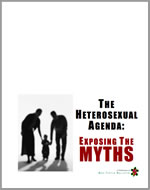 At last, the truth can now be told.
Using the same research methods employed by most anti-gay political pressure groups, we examine the statistics and the case studies that dispel many of the myths about heterosexuality. Download your copy today!
And don‘t miss our companion report, How To Write An Anti-Gay Tract In Fifteen Easy Steps.
 Anti-gay activists often charge that gay men and women pose a threat to children. In this report, we explore the supposed connection between homosexuality and child sexual abuse, the conclusions reached by the most knowledgeable professionals in the field, and how anti-gay activists continue to ignore their findings. This has tremendous consequences, not just for gay men and women, but more importantly for the safety of all our children.
Anti-gay activists often cite the “Dutch Study” to claim that gay unions last only about 1½ years and that the these men have an average of eight additional partners per year outside of their steady relationship. In this report, we will take you step by step into the study to see whether the claims are true.
Tony Perkins’ Family Research Council submitted an Amicus Brief to the Maryland Court of Appeals as that court prepared to consider the issue of gay marriage. We examine just one small section of that brief to reveal the junk science and fraudulent claims of the Family “Research” Council.
 The FBI’s annual Hate Crime Statistics aren’t as complete as they ought to be, and their report for 2004 was no exception. In fact, their most recent report has quite a few glaring holes. Holes big enough for Daniel Fetty to fall through.
“Google” is a trademark of Google Inc.
© Box Turtle Bulletin. All Rights Reserved.

 Posts
Posts  Posts via daily email: