Box Turtle Bulletin
 News and commentary about the anti-gay lobby
“Now you must raise your children up in a world where that union of man and box turtle is on the same legal footing as man and wife…”
News and commentary about the anti-gay lobbyApril 11th, 2013
ABC:
Gov. Jack Markell and Attorney General Beau Biden planned to join lawmakers Thursday in Wilmington to announce the filing of the legislation.
Crafting of the bill has been led by members of the gay rights group Equality Delaware.
Markell has pledged to sign the bill if it passes the General Assembly, where it has the support of Democratic leaders in both chambers.
April 11th, 2013
 As France concludes its drive towards equality, a victim of a homophobic beating has become the face of the movement. Earlier this week, Wilfred de Bruijn was beaten unconscious by anti-gay hooligans, and equality supporters have used pictures of his cut and bruised face in placards at rallies and social media to show the nation the consequences of the Catholic Church’s message of opposition.
Anti-gay activists, such as those at the National Organization for Marriage (which has strongly pushed and promoted France’s anti-marriage movement), pretend that they only support the sanctity of marriage. They seek to distinguish their marriage-for-anyone-but-gays movement from the motivations and attitudes that lead to violence against gay people, asserting (despite significant evidence to the contrary) that they love gay people, they just are looking out for children.
But de Bruijn very eloquently ties it together: (WaPo)
“What (the anti-gay marriage campaign) are saying is that they’re not homophobic: lesbians and gays are nice people, but don’t let them get close to children — that’s very dangerous. It’s OK for them to live together, but not like other couples with the same protection because it’s not really the same thing,” De Bruijn said.
“These people are all professionals of the spoken word. They know very well what can happen if you repeat, repeat, repeat that these people are lower human beings. Of course it will have a result.”
When such things as these happen, the anti-gays rush to denounce the specific act and claim no connection. “No, we love the homosexual, don’t blame us for the beatings and the expressions of hatred.”
But the connection is clear. The increased anti-gay hate speech surrounding the 2004 anti-gay presidential campaign in the US, the murder of David Kato following the Kampala Conference, and the spike in anti-gay violence in France now are not coincidental.
“It was not Frigide Barjot who was hitting my head, or the bishop of Avignon lurking in that street to attack us,” he said. “But they are responsible.”
April 11th, 2013
Montana’s law currently reads: “‘Deviate sexual relations’ means sexual contact or sexual intercourse between two persons of the same sex or any form of sexual intercourse with an animal.” Section 45-5-505 then provides the penalties.
45-5-505. Deviate sexual conduct.
(1) A person who knowingly engages in deviate sexual relations or who causes another to engage in deviate sexual relations commits the offense of deviate sexual conduct.(2) A person convicted of the offense of deviate sexual conduct shall be imprisoned in the state prison for any term not to exceed 10 years or be fined an amount not to exceed $50,000, or both.
(3) The fact that a person seeks testing or receives treatment for the HIV-related virus or another sexually transmitted disease may not be used as a basis for a prosecution under this section and is not admissible in evidence in a prosecution under this section.
That last clause suggests that the Montana legislature found time to reconsider the law sometime over the past thirty years and decided to leave it in place. The law was struck down by the Montana Supreme Court in 1997, but lawmakers have, until now, refused to remove it from the statutes.
During Tuesday’s floor debate of the Montana House of Representatives on a bill for a final vote to remove that law from the state’s books, opponents sought to clarify why they thought the bill should be kept. KXLH TV posted a clip online of Rep. Dave Hagstrom (R-Billings) saying:
I have a lot of love and respect for a whole number of homosexual friends, so there’s no homophobic issues going on here at all with me. My question is, what’s the purpose of sex?
… I’ll just speak to the bill. I’m going to vote no on this bill, but it’s just for this reason. I don’t think that homosexual sex is necessarily not deviant. “Deviant” isn’t a bad word. Deviant simply means that it’s not normal, it’s not typical. I kinda liken it like this: this pen has two purposes. The first purpose, of course, is to write. The second purpose is to retract so that it doesn’t leave a stain on your shirt or your purse. So it has two purposes, but one is primary and the other is secondary. To me, sex is primarily purposed to produce people. That’s why we’re all here. Sex that doesn’t produce people is deviate. It doesn’t mean that it’s a problem. It just means it’s not doing its primary purpose.
According to Hagstron, about 99% of all heterosexual sex is also deviate sex. Hagstrom only has four children. Poor guy. Also, I was looking forward to meeting his “whole number of homosexual friends,” but then I drew on my outstanding Catholic school education and remembered that whole numbers were just numbers without fractions, including zero.
Another Representative was more blunt:
Representative Jerry Bennett (R-Libby) told the House he pledged his life to his wife and to God and supporting the bill would violate those pledges.
“It is the thief, the devil, that comes to steal our life, to kill us, to rob us. Christ said I come so that you might have life to the fullest,” Bennett said. “That’s my desire for everyone here.”
Those voices are what’s left of an ever-shrinking minority. The House voted Tuesday, 64-36 to advance the bill for a third and final vote. That vote took place on Wednesday, with the House passing it, 65-34, and sending it to Gov Steve Bullock (D) for his signature.
April 11th, 2013
Last night the Uruguay Chamber of Deputies reconfirmed their vote of last December and, following last week’s vote in the Senate, the legislature of Uruguay legalized equality in that nation. (Independent)
Supporters of the law, who had filled the public seats in the legislative building, erupted in celebration on Wednesday when the results were announced. The bill received the backing of 71 of the 92 members of the Chamber of Deputies present.
“We are living a historic moment,” said Federico Grana, a leader of the Black Sheep Collective, a gay rights group that drafted the proposal. “In terms of the steps needed, we calculate that the first gay couples should be getting married 90 days after the promulgation of the law, or in the middle of July.”
Today or tomorrow, France should join the Equality Nations:
2001 Netherlands
2003 Belgium
2005 Spain
2005 Canada
2006 South Africa
2009 Norway
2009 Sweden
2010 Portugal
2010 Iceland
2010 Argentina
2012 Denmark
2013 Uruguay
April 11th, 2013
TODAY’S AGENDA:
Events This Weekend: AIDS Walk, Belmont, NC; Women’s Fest 2013, Camp Rehoboth, DE; AIDS Walk, Cincinnati, OH; AIDS Walk, Des Moines, IA; AIDS Walk, Honolulu, HI; AIDS Walk, Las Vegas, NV; Miami Beach Pride, Miami, FL; Ride for AIDS, Pasadena, CA; Gay Snow Happening, Solden, Austria; Tallahassee Pride, Tallahassee, FL.
TODAY IN HISTORY:
First Mattachine Constitutional Convention: 1953. The Mattachine Foundation, founded in Los Angeles in 1950, was the brain child of Harry Hay (see Apr 7), Dale Jennings (see Oct 21), Chuck Rowland, and Bob Hull, all of whom felt that the time was right to push for gay rights. As Rowland later commented, “We had just won the war. We had rid the world of fascism, except in Spain. We came back and we were going to save the world.” Idealism came naturally to Rowland, Hay and Hull: they had earlier been members of the Communist Party.
When they formed the Mattachine Foundation, one of their chief concerns was secrecy. The Lavender Scare was just getting underway in American, and the group feared that if one member was picked up by the FBI and interrogated, he might reveal the names of other members of the Foundation. To alleviate those concerns, they decided to borrow a secretive membership structure from American Communists, with Freemasonry providing the inspiration for a series of “orders,” with the founding members serving as anonymous members of the Fifth Order, and members in lower orders in charge of local chapters, and with all of them remaining anonymous through the use of pseudonyms. Once the organization structure was set, they then set about articulating the Foundation’s goals: educating the public about homosexuality, advocating for tolerance, and engaging in “political advocacy,” which presumably meant challenging the anti-sodomy laws which were then in force in all fifty states.
The Mattachine Foundation first became known to general public following Dale Jennings’s 1952 arrest in an LAPD entrapment operation (see Jun 23). Hays and Jennings decided to fight the charges, with Jennings admitting in open court that he was a homosexual — a very daring move — but insisting that he was innocent of the particular charges against him. The jury deadlocked and the charges ended up being dropped.
This court victory was a massive public relations coup for Mattachine. Suddenly new members were joining in droves and creating new discussion groups all across California. By 1953, it was estimated that membership stood at more than 2,000 with as many as 100 joining a single discussion group. This exponential growth diversified the group considerably, attracting more women to the discussion groups and drawing in those from a much broader political spectrum, many of whom didn’t share the radical vision of Mattachine’s founders. Some worried that the group wouldn’t be able to withstand an investigation by a Senate committee if some of the founders’ former Communist ties were made public. Others feared that including an explicit call for gay equality as part of its mission would endanger the security of the group’s members. That concern was amplified in March 1953 when Los Angeles Mirror columnist Paul Coates obtained copies of the Mattachine’s lobbying questionnaires, and published an article questioning the group’s legitimacy and charging that its members were “bad security risks.”
New members from Northern California made bulk of the growing internal dissension within Mattachine. Hal Call (see Sep 20), who joined the group in Berkeley, was especially concerned. “We wanted to see Mattachine grow and spread, and we didn’t think that this could be done as long as Mattachine was a secret organization.” But before the group went public, it had some housecleaning to do. “We wanted to make sure that we didn’t have a single person in our midst who could be revealed as a Communist and disgrace us all.” The Mattachine’s founders “had to go. Mattachine had to be free of Communists.”
It all came to a head in April 1953, during the first constitutional convention to re-organize the Mattachine Foundation. Rowland delivered a speech which lifted the veil of secrecy of the group’s leadership. “You will want to know something about the beginnings of the Mattachine Society, how the Fifth Order happened to be. … I think it is reasonable that you should ask this and important that you understand it,” he said. He then introduced five of the founding members to the rank-and-file.
The meeting broke down into an ideological battle between two distinctive camps. The first camp was represented by most of the founding members who had set up the secret society. Hay, Rowland and Hull advocated a view that homosexuals were a unique minority, and, as with other minorities, they were possessed with special qualities and a unique culture. The opposing camp, made up of Call, Kenneth Burns, Don Lucas, David Finn, and others, countered that homosexuals were no different from any other American except for their sexuality. Dale Jennings, while a founding member, would have been sympathetic with this group’s philosophy if he hadn’t already left Mattachine to join the fledgling ONE magazine (see Oct 15). He had long argued that the task for the group wasn’t homosexual emancipation, but sexual freedom for everyone. This second camp also feared an FBI investigation, and for good reason. Finn and Lucas were already acting as informants for the FBI and the police, and they were desperately trying to convince the FBI that Mattachine posed no danger to national security.
With the group unable to come to an agreement, the first attempt at a constitutional convention broke down and a second meeting was called for May. At that meeting, Mattachine’s founders grew tired of the argument and resigned. The group then declared the work of the Mattachine Foundation completed and disbanded the organization, replacing it with a new one to be known as the Mattachine Society. Leadership then passed to a new group led by Call and Burns, who called for another general meeting in November to establish a new constitution which would open up the group to greater transparency while setting the group on a much less confrontational path.
[Sources: Douglas M. Charles “From subversion to obscenity: The FBI’s investigations of the early homophile movement in the United States, 1953-1958.” Journal of the History of Sexuality 19, no. 2 (May 2010): 262-287.
Martin Meeker. “Behind the mask of respectability: Reconsidering the Mattachine Society and male homophile practice, 1950s and 1960s.” Journal of the History of Sexuality 10, no. 1 (January 2001): 78-116.]
If you know of something that belongs on the agenda, please send it here. Don’t forget to include the basics: who, what, when, where, and URL (if available).
And feel free to consider this your open thread for the day. What’s happening in your world?
April 10th, 2013
TODAY’S AGENDA:
Events This Weekend: AIDS Walk, Belmont, NC; Women’s Fest 2013, Camp Rehoboth, DE; AIDS Walk, Cincinnati, OH; AIDS Walk, Des Moines, IA; AIDS Walk, Honolulu, HI; AIDS Walk, Las Vegas, NV; Miami Beach Pride, Miami, FL; Ride for AIDS, Pasadena, CA; Gay Snow Happening, Solden, Austria; Tallahassee Pride, Tallahassee, FL.
TODAY’S BIRTHDAYS:
James Ogilvy, 7th Earl of Findlater, 4th Earl of Seafield: 1750. The Scottish peer and landscape architect is known for lavish British landscape garden designs in mainland Europe, where he spent most of his life. Some say he was exiled to Europe, but others say his exile was voluntary. In either case, the cause of his exile appears to be related to his homosexuality which, while a capital offense in Britain, was somewhat more tolerated on the mainland as long as things were kept discreet. And besides, they did like his gardens, particularly in Carlsbad, Bohemia, where he became a major patron of the city’s charities and parklands. Findlater trail is still well-used today.
In 1803, Findlater’s private secretary, Johan Georg Fischer purchased Helfenberg Manor near Dresden on Findlater’s behalf. Its lands gave Findlater yet another opportunity to create a garden of considerable renown. Findlater died in 1811, and his will named Fischler his sole heir. Findlater’s family in Scotland contested the will on the grounds that it was made “for a base cause,” suggesting an unspecified immorality between the two. The lawsuit created a huge scandal, but Findlater’s relatives were partly successful, having been awarded Findlater’s lands and estate in Scotland. Fisher remained at the estate in Dresden until his own death in 1860, when he was buried alongside Findlater at the Loschwitz parish church.

Frances Perkins: 1880. There’s no doubt that Franklin Delano Roosevelt’s New Deal forever changed America, mostly for the better. But what isn’t well known is that the individual responsible for the lion’s share of the New Deal’s enduring legacy was Frances Perkins, who, as Secretary of Labor, already made history by becoming the first woman cabinet secretary barely thirteen years after the Nineteenth Amendment guaranteed women the right to vote. Lesser-known still was the fact that by being a woman, Perkins broke an important code in Washington society, one in which a Cabinet secretary was expected to guests to his home with his wife playing the role of gracious host, which entailed a lot of planning, coordinating, preparations, etc. Perkins, having no wife, could not be expected to perform all of those functions while also still put in a full day’s work as Labor Secretary. Perkins’s husband was of no use; he was permanently sidelined with debilitating mental illness. But her special friend, railroad heiress Mary Harriman Rumsey, came to the rescue, with a finely-appointed Georgetown home which the two shared, and where the consummate power-couple hosted dinner parties said to include Eleanor Roosevelt, Will Rogers, Margaret Bourke-White, Gen. Douglas MacArthur, and unknown Appalachian folk singers.
Perkins became interested in labor issues while in New York, where she personally witnessed the tragic Triangle Shirt Factory Fire of 1911. The fire killed 147 young men and women, mostly seamstresses, who were unable to escape because the owner locked the exists for fear that feared theft from his employees. Perkins joined a commission that investigated the fire and recommended changes to the state’s labor laws. She then served in several labor-related commissions in state government under Gov. Alfred Smith. When Franklin D. Roosevelt was elected governor in 1929, Perkins served as his first State Commissioner of Labor. It would only be natural, then, that Perkins would follow follow him to Washington as his Labor Secretary when FDR was elected President.

Frances Perkins on the cover of Time, Aug 14, 1933.
When Perkins arrived in D.C., she was brimming with ideas. She saw hundreds of thousands of productive, employable people who were out of work, and she came up with an unemployment insurance fund which would be payed into during good years and drawn from in bad. She saw the elderly, no longer able to work, being thrown out of their homes after draining their life savings, and thought that there ought to be some kind of a social security that could protect them. She saw companines hiring children instead of adults to cut costs, children who should be in school and not supporting their families, and argued that child labor laws were needed. And with FDR’s backing, she set about putting those ideas into action.
Perkins’s most enduring legacy, Social Security, came about during a particularly trying time. While struggling to meet a Christmas 1934 deadline for her committee to complete its work designing the system, Rumsey died on December 19 from complications from a fall from a horse. Amid the intense political pressure of designing a brand-new federal program, Perkins also was mourning Rumsey’s death, quietly and alone. And so on the very same week Rumsey died, Perkins called the committee members to her home — a home she would soon lose because only Rumsey could afford the rent — sat a bottle of Scotch on the table, and announced that no one would leave that night until the work was done.
As Labor Secretary, Perkins oversaw the creation of the Civilian Conservation Corps and the Federal Works Agency. She established the minimum wage and the forty-hour work week through the Fair Labor Standards Act. Perkins remained Labor Secretary for all four terms of FDR’s presidency. In 1945, President Harry Truman asked her to serve in the Civil Service Commission, a post that she held until 1952 when her husband finally died. After her career in government service, she taught at Cornell until her death in 1965 at the age of 85.
Perkins’ parents were Maine natives, and that’s where she was buried. It’s also where an eleven-panel mural celebrating labor throughout history — including colonial shoe cobblers, lumberjacks, “Rosie the Riveter, striking paper mill workers, and Frances Perkins in a conversation with a family — was on display at Maine’s Department of Labor. In 2011, Maine’s tea-party governor, Paul LePage, ordered the mural’s removal. His spokesman claimed that the mural was reminiscent of “communist North Korea where they use these murals to brainwash the masses.” LePage also ordered the re-naming of seven conference rooms, including one originally named for Perkins.
[Source: Kirsten Downey. The Woman Behind the New Deal: The Life and Legacy of Frances Perkins, Social Security, Unemployment Insurance,
If you know of something that belongs on the agenda, please send it here. Don’t forget to include the basics: who, what, when, where, and URL (if available).
And feel free to consider this your open thread for the day. What’s happening in your world?
April 10th, 2013
The Washington Blade passes along the info:
The French Senate on Tuesday approved a proposed amendment to a same-sex marriage and adoption bill that would extend nuptials to gays and lesbians.
Le Monde reported the provision passed by a 179-157 vote margin after senators debated it for more than 10 hours — lawmakers on April 2 began to consider the same-sex marriage and adoption bill the National Assembly approved in February by a 329-229 vote margin.
…French lawmakers still need to consider the bill’s remaining provision before it receives final approval, but observers noted the same-sex marriage amendment was the most important hurdle that supporters had to overcome.
The marriage equality law is in multiple parts, and opponents of marriage equality have apparently proposed numerous amendments, according to John Avarosis. He says votes will continue to be taken on various proposals for another month or so. But the most important vote occurred today, making marriage equality a done deal sometime this summer.
Update: This AFP story says the final votes for the full bill will take place Thursday or Friday.
April 9th, 2013
Can you imagine what that must have been like? Go ahead… imagine it. Then read Brandon Ambrisono’s account in The Atlantic of his time there, asking, “Why would I, the world’s most hypersexual fag, come to Jerry Falwell’s university?!” It turns out it’s probably a bit different from what you imagined:
Many of us view the world as an ugly place with a few beautiful redeeming characteristics. Unfortunately, that’s also how we view humans. But what I learned at Liberty was that this idea is the exact opposite of reality: The world and the people in it are really wonderful with just a smidge of ugliness about them. I think the really vocal anti-gay Christians display this smidge, but I also think the really vocal anti-Christian gays display it as well. Not tolerating someone for his narrow-mindedness is perhaps the epitome of intolerance. I learned from my time at Liberty that this bigotry happens on both sides: not only were there some Christians who wanted to stone some gays, but there were even some gays who wanted to stone a few Christians.
April 9th, 2013
This is the last video introducing the National Marriage Organization.
Now that you’re convinced, come and visit our web site.
April 9th, 2013

TODAY IN HISTORY:
Freud’s Letter to a Concerned Mother: 1935. The letter is often described as being to “an American mother,” perhaps because it was sent anonymously to the American sexologist Dr. Alfred Kinsey from “a grateful mother.” We don’t actually know who that mother was. Kinsey, in turn, shared it with the American Journal of Psychiatry, where it appeared in the April 1951 edition. The handwritten letter reads as follows:
April 9th, 1935.
Dear Mrs. ——
I gather from your letter that your son is a homosexual. I am most impressed by the fact that you do not mention this term yourself in your information about him. May I question you, why you avoid it? Homosexuality is assuredly no advantage but it is nothing to be ashamed of, no vice, no degradation, it cannot be classified as an illness; we consider it to be a variation of the sexual function produced by a certain arrest of sexual development. Many highly respectable individuals of ancient and modern times have been homosexuals, several of the greatest men among them. (Plato, Michelangelo, Leonardo da Vinci, etc.) It is a great injustice to persecute homosexuality as a crime and cruelty too. If you do not believe me, read the books of Havelock Ellis.
By asking me if I can help, you mean, I suppose, if I can abolish homosexuality and make normal heterosexuality take its place. The answer is, in a general way, we cannot promise to achieve it. In a certain number of cases we succeed in developing the blighted germs of heterosexual tendencies which are present in every homosexual, in the majority of cases it is no more possible. It is a question of the quality and the age of the individual. The result of treatment cannot be predicted.
What analysis can do for your son runs in a different line. If he is unhappy, neurotic, torn by conflicts, inhibited in his social life, analysis may bring him harmony, peace of mind, full efficiency, whether he remains a homosexual or gets changed. If you make up your mind he should have analysis with me — I don’t expect you will –, he has to come over to Vienna. I have no intention of leaving here. However, don’t neglect to give me your answer.
Sincerely yours with kind wishes,
Freud.P. S. I did not find it difficult to read your handwriting. Hope you will not find my writing and my English a harder task.
[Source: Sigmund Freud. “Letter (to an American mother, 1935)” American Journal of Psychiatry 107, no. 10 (April 1951): 786-787.]
Daily Express Calls for Homosexual Purge from London’s Theaters: 1959. Under the ownership of Canadian-born Max Aitken (who, in 1917, became the first Lord Beaverbrook when he was granted a peerage), London’s Daily Express had long enjoyed a reputation for both forming and reflecting the prejudices and outrages of its conservative and working class readers. Following World War II, the Express newspapers enjoyed the world’s largest circulation and Beaverbrook was known as “the first Baron of Fleet Street.” In 1959, author and historian John Deane Potter took to the pages of the Daily Express to warn its readers about a terrible menace in London’s theater district:
I read with dismay the news yesterday that a 31-year-old South African called John Cranko was fined £10 at Marlborough-street police court.
It was not the fine. It was the man and the offence. Because he pleaded guilty to a crime which has become known as the West Side vice.
Cranko is the latest on the list of famous stage names who have been found guilty of this squalid behaviour. He is a talented man of the theatre. He was the co-author of the spectacularly successful review “Cranks.”
The private lives of people, whether they are a brilliant ballet designer and author like Cranko, or an ordinary office worker on the 6.15, should, according to the Wolfenden Report, be their own business. But this question is public business.
It has become a sour commonplace in the West End theatre that unless you are a member of an unpleasant freemasonry your chances of success are often lessened.
For the theatre is far too full of people belonging to a secret brotherhood.
Most of them are not tortured misfits. They do not want psychiatric treatment or cures.
They live complacently in their own remote world, with its shrill enthusiasms.
But they are evil. For two reasons.
One is their PERSONAL POWER.
Corruption is an outmoded word that used to be thundered with hellfire vigour from Victorian pulpits. Now this West End weakness is the subject of sophisticated wit.
Their chi-chi world may seem remote from the normal theatregoer. Except for this.
If your son wants to go on the stage — what will his future be? It is a shivering thought.
So many talented young men have said to me: “It is no good in the theatre unless you are camp. You must be queer to get on.”
Those are just two expressions from the cryptic slang they use to describe the social disease from which they suffer.
The boy, whatever his talents, may become bitter and frustrated.
Or worse. He does not have to travel far along the corridors of the West End back-stage to meet the smooth, unspoken. proposition. He may, through ambition, try to play along with it. And, make no mistake, many of these men take pleasure in corrupting the young.
Danger number two is their PROFESSIONAL POWER.
Some of the stuff they produce is beautiful, witty, and clever. But too often they try to foist upon the public a false set of values.
What is often received with trills of praise by the closed West End set remains puzzling to the formal mind of the average theatregoer who is unaware of the lace-like intricacies of the decor or the obscure oddities of the plot.
And the theatre has an expensive flop on its hands.
No one likes to indulge in a Jehovah-like loftiness about other people’s lives.
But I repeat: these are evil men. They have spun their web through the West End today until it is a simmering scandal.
I say they should be driven from their positions of theatrical power.
[Source: John Deane Potter. “Isn’t It About Time Someone Said This… Plainly and Frankly” The (London) Daily Express (April 9, 1959). As reprinted in The Mattachine Review 5, no. 6 (June 1959): 21.]
APA Membership Affirms Decision To Remove Homosexuality From DSM-II: 1974. When the American Psychiatric Association’s board of trustees ratified the Nomenclature Committee’s recommendation to remove homosexuality from the second edition of the Diagnostics and Statistics Manual (DSM-II, the APA’s official list of mental disorders — see Dec 15), the faction within the APA opposing the move, led by Charles Socarides, vowed to overturn the board’s decision and return the nation’s gays and lesbians to the ranks of the mentally ill. Until the APA’s board took its stand after a long, multi-year consultative process in which the evidence for and against the argument that homosexuality was a mental illness was poured over, discussed, and debated by a large number of experts in the field, and by gay people themselves (see Nov 7).
But after the APA made its decision on the basis of scientific evidence, Socarides’s Ad Hock Committee Against the Deletion of Homosexuality from DSM-II moved quickly to put the board’s decision to a vote of the membership. This demand was most remarkable: having lost the scientific argument, the dissident committee sought to use the organization’s by-laws which were intended to democratize the APA’s policy decisions and turn it into a referendum on a scientific finding. In other words, they decided to put facts up for a vote. The referendum was approved on December 16, the day after the board’s decision. Ballots were mailed out to the membership, and the controversy was hotly debated in the APA’s publication Psychiatry News. On April 9, 1974, the APA released the results:
| Result | ||
|---|---|---|
| Favoring the board’s decision | 5,854 | 58% |
| Opposing the board’s decision | 3,810 | 37% |
| Abstaining | 367 | 3% |
| Invalid votes | 9 | <1% |
| Not voting on this issue | 51 | <1% |
| TOTAL | 10,091 | |
Socarides and others were never able to reconcile themselves to the APA’s decision, and for some, efforts by mainstream psychiatrists to “cure” homosexuality continued into the 1990s. In 1992, Socarides joined Benjamin Kaufman and Joseph Nicolosi in founding the National Association for Research and Therapy of Homosexuality (NARTH), which continues to argue that homosexuality is pathological and can be cured, against all scientific evidence to the contrary.
[Source: Ronald Bayer. Homosexuality and American Psychiatry: The Politics of Diagnosis

TODAY’S BIRTHDAY:
Cynthia Nixon: 1966. Daughter of actress Anne Knoll and radio journalist Walter E. Nixon, Cynthia Nixon already was in two simultaneous hit Broadway plays while also a freshman at Barnard College in 1984. Her roles were short and the two theaters were just two blocks from each other, close enough that she could run from one to the other in time to get dressed and deliver her performances. She had minor roles in a number of films and made-for-TV movies before landing her first major supporting part in 1986’s The Manhattan Project. But of course, her best-known role was that of Miranda Hobbes in HBO’s Sex and the City, which ran from 1998 to 2004 and spawned two moves, one okay and one awful. In 2006, she won a Tony for Best Actress in the Pulitzer Prize-winning drama Rabbit Hole and she won a 2008 Emmy for a guest appearance in an episode of Law & Order: Special Victims Unit. In 2009, she shared a Grammy, with Beau Bridges and Blair Underwood for Best Spoken Word Album for the audio CD of Al Gore’s An Inconvenient Truth.
But perhaps her most important prize came in May of 2012 when she married her partner, Christine Marinoni after a three year engagement. When she came out as bi in 2007, Nixon, who had been previously married to photographer Danny Mozes, said “I don’t really feel I’ve changed. I’d been with men all my life, and I’d never fallen in love with a woman. But when I did, it didn’t seem so strange. I’m just a woman in love with another woman.”
If you know of something that belongs on the agenda, please send it here. Don’t forget to include the basics: who, what, when, where, and URL (if available).
And feel free to consider this your open thread for the day. What’s happening in your world?
April 9th, 2013
I’ll admit that this is not the first thing I think of when I ponder marriage inequality. But any injustice is worth fighting. (LATimes)
A Republican candidate for U.S. Senate in Massachusetts who supports gay marriage has asked the Federal Election Commission to determine whether gay couples have the right to make joint contributions to political candidates.
In a request for an advisory opinion Friday, attorneys for state Rep. Dan Winslow, a moderate Republican running in a special election to fill the seat vacated by Secretary of State John F. Kerry, asked the commission whether gay couples could donate to his campaign with a single check, as heterosexual married couples were allowed to do.
In heterosexual families, if wifey is the breadwinner, both her and hubby can contribute to the candidate of their choice using just one income. But if wifey’s spouse is a woman, then federal election law steps in and says “you ain’t really married; you’re just skim-milk married; you can only give half as much.”
So Winslow has teamed up with Log Cabin to have DOMA questioned in an area most of us haven’t thought of. And due to his election deadline, he’s asked for expedited ruling.
And while this may seem a bit, well, non-essential, it’s actually quite important that election law not discriminate against those who support equality.
April 8th, 2013
Sen. Rand Paul (R-KY) calls for a tactical retreat on the federal level in the short term in exchange for a thirty-year state-by-state ground game:
(at 5:29) I think that we’ve got a long history with marriage. I’m not willing to give up on it yet, and the family unit, even above and beyond America and before America, the family unit is something that has come about for thousands of years, you know. We’ve had a family structure and thing it’s an important structure. And not everybody in the country is going to agree with me on that. You know, there are people, and young people seem to be changing their opinions. But I think we should still be in favor of what what we’re in favor of. And that there is a traditional family unit and that it’s important.
The law is going to be someone different in the sense of where marriage is adjudicated, whether it’s at the federal level or at the state level. We’ve always had marriage certificates and we’ve had them at the state level. If we keep it that way, maybe we can still have the discussion going on without making the decision go all the way one way or all the way the other way. Because I think right now if we say we only believe in a federally-mandated one-man, one-woman marriage, we’re going to lose that battle because the country is going the other way right now. If we were to say each state can decide, I think a good 25, 30 states still do believe in traditional marriage, and maybe we allow the debate to go on for another couple of decades and see if we can still win back the hearts and minds of people.
April 8th, 2013
 Sen. Orrin Hatch (R-UT) suggests that if states offered civil unions to same-sex couples, that would put an end to the marriage equality debate and let him keep DOMA:
I’ll say this, I do believe this could be solved greatly by a civil-union law that would give gay people the same rights as married people,” said Hatch, who mentioned hospital visitations and tax benefits. “I think we can solve this problem without undermining the very basis of marital law in our country.”
It looks like someone has decided to jump on board the last decade’s bandwagon.
April 8th, 2013
 Sen. Tim Johnson (D-SD), who has already said that he will not seek re-election next year, has now come out in support for same-sex marriage:
“After lengthy consideration, my views have evolved sufficiently to support marriage equality legislation,” Johnson said in a statement. “This position doesn’t require any religious denomination to alter any of its tenets; it simply forbids government from discrimination regarding who can marry whom.”
Since March 15, when Sen. Rob Portman (R-OH) became the first sitting Republican Senator to announce his support for marriage equality, there has been a veritable avalanche Senators following with their announced support for same-sex marriage: Sens. Claire McCaskill (D-MO), Mark Warner (D-VA), Mark Begich (D-AK), Jay Rockefeller (D-WV), Jon Tester (D-MT), Kay Hagen (D-NC), Bob Casey(D-PA), Tom Carper (D-DE), Mark Kirk (R-IL), Bill Nelson (D-FL), Joe Donnelly (D-IN) and Heidi Heitkamp (D-ND) have all joined the march to the right side of history.
There are only three Democratic Senators — Sens. Mary Landrieu (LA), Joe Manchin (WV), and Mark Pryor (AR) — who still do not support marriage equality. Manchin reitreated his opposition last week and Pryor has said he is undecided. Meanwhile Landrieu is trying to take the coward’s way out by saying that she’s on board personally but won’t go against her constituents, citing her state’s voter-approved constitutional amendment banning same-sex marriage. Someone might want to remind her that Portman — Republican Portman — also represents a state with a voter-approved marriage ban, as do Begich, Hagen, Heitkamp, Nelson, Tester, Warner and, of course, Johnson, whose announcement means that there are now 54 supporters for marriage equality in the Senate.
April 8th, 2013
Richard Socarides, a former Senior Advisor to President Bill Clinton, has an unusual background. Not only is he gay, but his father, Charles Socarides, was one of the most vocal defenders of attempts to cure gay people. The homosexual is ill,” he said in a 1963 New York Times article, “and anything that tends to hid that fact reduces his changes of seeking and obtaining treatment. If they were to achieve social acceptance it would increase this difficulty.” In 1967, Charles Socarides appeared on the infamous CBS Reports special “The Homosexuals” where he described the idea of happy gay people as “a mythology.” The elder Socarides was an outspoken opponent of the American Psychiatric Association’s 1973 decision to remove homosexuality from its list of mental disorders, and he went on to co-found the National Association for Research and Therapy of Homosexuality (NARTH) in 1992. So imagine what it must have been like to be Charles Socarides’s gay son:
…We lived on the Upper East Side on 78th Street in a Townhouse and his office was downstairs. So there was this, kind of on this one level is this kid coming out, on the top level there was this kid coming out, and on this bottom level there were these people going to be cured of their homosexuality. His idea was they should be treated like any other neurotic. Couple of trips to a therapist and it should be just fine.
Richard Socarides has recorded a video for the web site I’m From Driftwood, describing what it was like to come out to the most famous conversion therapist in the country:
As this video makes the round, much is made of Charles Socarides’ “founding” or “pioneering” converstion therapy for gay people. But as regular readers of The Daily Agenda know, Charles Socarides was far from the first to do so, or to consider homosexuality a mental illness. That idea had been ingrained in psychology for more than a century. But as NARTH’s co-founder, Socarides certainly was a huge part of the movement which shifted those attempts to “cure” gay people from what had been considered a scientific basis towards a much more dogmatic and political foundation. How strange it must have been for a gay son to maintain a relationship with his father while his father became increasingly doctrinaire in his approach to homosexuality.
Featured Reports
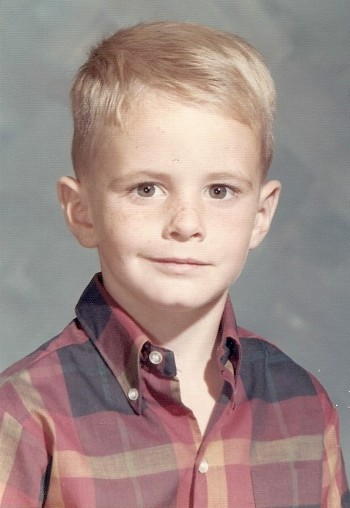 In this original BTB Investigation, we unveil the tragic story of Kirk Murphy, a four-year-old boy who was treated for “cross-gender disturbance” in 1970 by a young grad student by the name of George Rekers. This story is a stark reminder that there are severe and damaging consequences when therapists try to ensure that boys will be boys.
When we first reported on three American anti-gay activists traveling to Kampala for a three-day conference, we had no idea that it would be the first report of a long string of events leading to a proposal to institute the death penalty for LGBT people. But that is exactly what happened. In this report, we review our collection of more than 500 posts to tell the story of one nation’s embrace of hatred toward gay people. This report will be updated continuously as events continue to unfold. Check here for the latest updates.
In 2005, the Southern Poverty Law Center wrote that “[Paul] Cameron’s ‘science’ echoes Nazi Germany.” What the SPLC didn”t know was Cameron doesn’t just “echo” Nazi Germany. He quoted extensively from one of the Final Solution’s architects. This puts his fascination with quarantines, mandatory tattoos, and extermination being a “plausible idea” in a whole new and deeply disturbing light.
On February 10, I attended an all-day “Love Won Out” ex-gay conference in Phoenix, put on by Focus on the Family and Exodus International. In this series of reports, I talk about what I learned there: the people who go to these conferences, the things that they hear, and what this all means for them, their families and for the rest of us.
Prologue: Why I Went To “Love Won Out”
Part 1: What’s Love Got To Do With It?
Part 2: Parents Struggle With “No Exceptions”
Part 3: A Whole New Dialect
Part 4: It Depends On How The Meaning of the Word "Change" Changes
Part 5: A Candid Explanation For "Change"
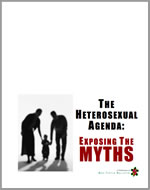 At last, the truth can now be told.
Using the same research methods employed by most anti-gay political pressure groups, we examine the statistics and the case studies that dispel many of the myths about heterosexuality. Download your copy today!
And don‘t miss our companion report, How To Write An Anti-Gay Tract In Fifteen Easy Steps.
 Anti-gay activists often charge that gay men and women pose a threat to children. In this report, we explore the supposed connection between homosexuality and child sexual abuse, the conclusions reached by the most knowledgeable professionals in the field, and how anti-gay activists continue to ignore their findings. This has tremendous consequences, not just for gay men and women, but more importantly for the safety of all our children.
Anti-gay activists often cite the “Dutch Study” to claim that gay unions last only about 1½ years and that the these men have an average of eight additional partners per year outside of their steady relationship. In this report, we will take you step by step into the study to see whether the claims are true.
Tony Perkins’ Family Research Council submitted an Amicus Brief to the Maryland Court of Appeals as that court prepared to consider the issue of gay marriage. We examine just one small section of that brief to reveal the junk science and fraudulent claims of the Family “Research” Council.
 The FBI’s annual Hate Crime Statistics aren’t as complete as they ought to be, and their report for 2004 was no exception. In fact, their most recent report has quite a few glaring holes. Holes big enough for Daniel Fetty to fall through.
“Google” is a trademark of Google Inc.
© Box Turtle Bulletin. All Rights Reserved.
 Posts
Posts  Posts via daily email: