Box Turtle Bulletin
 News and commentary about the anti-gay lobby
“Now you must raise your children up in a world where that union of man and box turtle is on the same legal footing as man and wife…”
News and commentary about the anti-gay lobbyDecember 4th, 2012

Roxanne Ellis (L) and Michelle Abdill (R)
TODAY IN HISTORY:
Roxanne Ellis and Michelle Abdill Murdered: 1995. Roxanne and Michelle had had it up to here with living in Colorado Springs, where they felt that the atmosphere was very hostile to gays and lesbians. And after seven years, they decided that it wasn’t going to get better anytime soon, so they packed up and moved to Oregon’s Rogue Valley, just north of the California line. They quickly adapted to their new home in Medford, where they started a property management business, became board members at their church, began restoring their old Craftsman home, and visited Roxanne’s thee-year-old granddaughter as much as possible. They also became active in state politics, working to defeat Measure 9 in 1992 (which would have amended the state constitution to declare homosexuality “abnormal, wrong, unnatural and perverse” and prohibit its “promotion.”) and Measure 19 in 1993 (which would have restricted library access for materials related to homosexuality).
On December 4, 1995, Roxanne met with a potential tenant to show him an apartment. At about 5:00, Michelle left the office, saying she had gotten a call from Roxanne saying her pickup wouldn’t start. Neither Roxanne nor Michelle were seen until their bodies were discovered four days later in the back of Roxanne’s pickup. Both had been shot in the head, and their bodies were covered with drapes and cardboard moving boxes.
That prospective tenant, twenty-seven year old Robert Acremant had just moved to Medford with his mother three weeks earlier. A witness had seen Acremant park the pickup truck and walk away. When police circulated a composite sketch based on the witness’s account, his mother recognized the face as her son who, she thought, was acting strangely. She called the police. When detectives matched the address labels on her moving boxes to those covering Roxanne and Michelle’s bodies, they new they had their man.
He confessed to the murder, claiming it was a simple robbery. But the district attorney was skeptical. After all, victims’ purses, wallets, jewelry, cell phones and money were left at the crime scene. Acremant also confessed to killing Scott Gordon in Visalia, California two months earlier. Later in 1996, he wrote a letter to his hometown newspaper stating that while he had intended to rob the couple, he found it was easier to just kill them knowing they were lesbians. He also wrote that he killed Gordon because Gordon had made a pass at him. He later recanted his story about why he killed his victims, but the reasons he gave remained incoherent. Perhaps the best indication of the state of his mind is the one part of his story which remained consistent: He was trying to raise money so he could afford to resume his relationship with his “girlfriend,” a call girl in Las Vegas who had broken off contact with him after he ran out of money and began stalking her.
On September 11, 1996, Acremant pleaded guilty to the murders of Roxanne and Michelle, and was sentenced to death by lethal injection. It would emerge later that he had been complaining for years that he heard voices and that there was a transmitter in his head so others can control him. On February 18, 2011, his sentenced was reduced to life imprisonment after he had been found mentally delusional and unable to assist in his own appeals.
TODAY’S BIRTHDAYS:
Ed Flesh: 1931. If you’ve ever watched the game show Wheel of Fortune, then you’ve seen Flesh’s most famous handiwork. The prolific art director designed the famous horizontally-spinning wheel that is the show’s trademark. He also designed the sets for Jeopardy!, the Newlywed Game, The $25,000 Pyramid, and Name That Tune. Ed died this past July at the age of 79, leaving behind his partner of 44 years.
 A. Scott Berg: 1949. The biographer has won numerous awards in his career, beginning with his first book in 1978 about editor Maxwell Perkins, which won a National Book Award. He also wrote the story for Making Love, the groundbreaking 1982 film which was the first major Hollywood release to deal with homosexuality in a serious way. In 1998, his highly acclaimed best-seller, Lindbergh

If you know of something that belongs on the Agenda, please send it here. Don’t forget to include the basics: who, what, when, where, and URL (if available).
As always, please consider this your open thread for the day.
December 3rd, 2012
The U.S. Supreme Court issued its Orders this morning, with none of the marriage-related cases making the list. This likely means that at least some of those cases will be scheduled for another Conference on Friday morning. It is not unusual for the Court to require several Conferences before deciding whether to take a case. The delay for some of the cases — the Prop 8 appeal could be one candidate — could also mean that the court has denied certiorari for one or more of the cases and is awaiting a dissent from one of the justices.
Update: Hollingsworth v. Perry (the Prop 8 case), Windsor v US, US vs Windsor, BLAG v Gill, HHS v Massachusetts, OPM v Golinskey, Pedersen v OPM, OPM v Pedersen, (the DOMA cases) and Brewer v Diaz (the Arizona domestic partnership benefits case) have all been moved to the December 7 conference according to their respective docket pages. (Note: Some of the DOMA cases have two dockets because representatives from both sides have appealed to the Supreme Court.) Chris Geidner says that if they don’t make up their minds on December 7, the next scheduled Conference is January 4.
Update: Lambda Legal’s Jon W. Davidson explains the complexity facing the Supreme Court, with each case bringing with it its own unique set of arguments and prcedural questions:
Justice Kagan needs to decide whether to recuse herself from GLAD’s Gill v. OPM case. The ACLU’s Windsor v. United States case involves the additional wrinkle of how New York treats marriages entered in Canada. Lambda Legal’s Golinski v. OPM case, GLAD’s Pedersen v. OPM case, and Windsor, all came to the Supreme Court in an unusual way—with requests for review having been filed before decisions from the intermediate appellate courts were issued. And there have been questions raised about the right of various parties to ask for Supreme Court review because of who the party asking is or because that party won below.
The Supreme Court has to decide not only which challenge to DOMA to hear, but also whether to hear the Perry or Diaz cases now, or wait until after a DOMA case is decided. Although the questions in these two cases are different from the DOMA challenges, a decision in a DOMA case that laws that discriminate based on sexual orientation should be given heightened scrutiny by the courts and presumed unconstitutional could make the Perry and Diaz cases easier to decide, and the Court might choose to hold one or both of those cases for that reason. If Perry is to be considered now, the justices may direct the parties to brief only the narrow ground decided by the Ninth Circuit that involves the unusual circumstances of California’s marriage ban or broader grounds as well, in addition to the question of whether or not the proponents of Prop 8 have the right to appeal. In Diaz, the Court needs to consider whether to get involved at this point (wading in on whether a preliminary injunction was properly issued keeping insurance coverage in place while the case proceeds), when the case is not yet fully resolved at the trial court.
December 3rd, 2012
 Pennsylvania Republican State Rep. Mike Fleck made a few headlines over the weekend when he came out as gay, making him the first openly gay Republican state legislator in Pennsylvania. Fleck, identified as a devout Christian, first won his seat in 2006. He described his coming out this way:
Coming out is hard enough, but doing it in the public eye is definitely something I never anticipated,” he said. “I’m still the exact same person and I’m still a Republican and, most importantly, I’m still a person of faith trying to live life as a servant of God and the public. The only difference now is that I will also be doing so as honestly as I know how.”
Fleck, was an executive at the Boy Scouts of America, felt compelled to remain in the closet even though he knew he was gay. He married in 2000, but they divorced in the past year. He also tried ex-gay therapy:
“I sought out treatment from a Christian counselor, but when that didn’t work out, I engaged a secular therapist who told me point blank that I was gay and that I was too caught up in being the perfect Christian rather than actually being authentic and honest,” Fleck said.
He said the hardest part of the process has been reconciling his faith with his sexuality.
“Through years of counseling, I’ve met a lot of gay Christians who have tried hard to change their God-given sexual orientation, but at the end of the day, I know of none who’ve been successful,” he said. “They’ve only succeeded at repressing their identity, only to have it reappear time and time again and always wreaking havoc not only on themselves, but especially on their family.”
Fleck says that he and his wife remain close friends.
He will be joined in Harrisburg in January by Democrat Brian Sims of Philadelphia, who is the first openly gay candidate to run and win a state office in Pennsylvania.
Fleck is currently the only openly gay Republican state legislator in the country. But in January, he will give up that distinction when Ohio Republican Tim Brown is sworn in to that state’s House of Representatives in January.
Early reports had it that Fleck was the first openly gay GOP state lawmaker in the country, but that is incorrect. I don’t know who holds that distinction, but former Arizona Rep. Steve May came out in 1999 during a speech on the House floor. He was then discharged from the Army Reserves for violating “Don’t Ask, Don’t Tell.” May served as chair of the House Ways and Means Committee where he played a role in repealing the state’s sodomy law. He lost his House seat in 2002.
December 3rd, 2012
Chris Johnson at the Washington Blade followed up on last week’s announcement by Dirk Niebel, Germany’s Minister of Economic Cooperation and Development (BMZ), that Germany has suspended its foreign aid to Uganda. Mark Bromley, chair of the Council for Global Equality, told Johnson that the announced cuts were related to direct governmental assistance and wouldn’t affect programs:
“My understanding is that the German government decided to cut direct structural assistance from Germany to the government to the government of Uganda, but that their investments in development and other programs will continue,” Bromley said. “So, it’s not an across-the-board cut, but it’s a temporary suspension of direct structural assistance to the government.”
But Uganda’s Sunday Monitor, the nation’s largest independent newspaper, contends that Germany’s ambassador to Kampala, Klaus Dieter Düxmann, has denied Germany was cutting aid. In an article headlined, “Germany says no to cutting aid,” John Njoroge reported:
“It is not true. We are maintaining development assistance to Uganda,” Mr Düxmann said yesterday. “The embassy will give further communication in this respect in the coming days.”
But a close look at what Ambassador Düxmann said — “We are maintaining development assistance to Uganda.” — does not contradict what Bromley said, nor does it address direct government-to-government structural aid, which the Ugandan news magazine The Observer described as “budget-support aid to Uganda” — in other words, aid that was given directly to the Ugandan government to support specific governmental functions.
In last week’s announcement, Niebel cited a massive corruption in the Ugandan Prime Minister’s office in which funds from Europe were discovered in the private bank accounts of more than a dozen Ugandan officials. German also cited a U.N. report accusing Uganda and Rwanda of supporting the M23 rebels in the Democratic Republic of Congo, and Parliament’s decision to consider passing the Anti-Homosexuality Bill.
It’s interesting that, so far, neither The Observer nor Monitor have mentioned the Anti-Homosexuality Bill as a factor in Germany’s announcement.
The pro-government New Vision’s report however was more-or-less straightforward, both in the fact of Germany’s announcement and the reasons why. Of course, being pro-government meant that there has to be some amount of spin:
Uganda has said it is determined to punish all officials involved in embezzling the money, which was meant to fund recovery efforts in northern areas of the country after a lengthy insurgency by the Lord’s Resistance Army.
Germany was equally concerned about legislation that will impose an array of jail terms for convicted homosexuals, including life imprisonment in certain circumstances. U.S. President Barack Obama has branded the bill as “odious”.
“If discrimination against human rights is voted through by the Ugandan parliament, this would have consequences for our cooperation,” said Niebel.
Aid accounts for about 25 percent of Uganda’s annual budget.
Cutting the funds would put public investments in health and education at risk in Africa’s largest coffee exporter.
Of course, New Vision neglects to mention the death penalty, which is still in the Anti-Homosexuality bill despite rumors and false reports to the contrary.
Perhaps Monitor’s confusion over what Germany has done stems from another lengthy article by Eriasa Mukiibi Sserunjogi which was published Saturday under the title, “Why Germany will not cut aid over gay bill.” Basing her thesis on an interview with Markus Loning, commissioner for human rights policy and humanitarian aid in Germany’s Foreign Office on November 22 — a little over a week before last week’s announcement — Sserunjogi wrote that the German government was following the advice of local Ugandan LGBT advocates:
The German government is taking advice from gay rights activists and will not cut aid to Uganda due to the anti-gay bill now before parliament but will pressure individual politicians to block it. A German official says that they have been convinced that aid cuts don’t produce the desired results.
“Activists on the ground are asking us to do it privately and talk to people responsible to see that the law does not pass,” said Mr Markus Loning, commissioner for human rights policy and humanitarian aid at the federal foreign office. Mr Loning was speaking at a conference on homosexuality and religion in Berlin on November 22.
When the Bill was first tabled in the last parliament, Mr Loning travelled to Uganda and talked to the then Speaker Edward Ssekandi and human rights activists.
Another official told us that the German foreign office told President Museveni that bilateral cooperation would cease if the Bill was passed. In short, Germany was threatening to withdraw aid to Uganda.
That threat is now on hold. “We get the backlash when aid is cut or Ugandan public figures are humiliated over gay rights,” Christine Kasha of Freedom and Roam Uganda told the conference. Ms Kasha, who is a lesbian, says gays are also Ugandans and the projects funded by donors help them too.
Sserunjogi’s article is quite sympathetic, particularly when she describes comments made at a conference in Berlin where the documentary film Call Me Kuchu was screened. The documentary described the struggles of the gay community in Kampala to secure even the most basic human rights, and ends with the murder of LGBT advocate David Kato. Sserunjogi wrote:
And the German government takes the issue seriously. “We take interest in human rights because it is an obligation from our history,” said Mr Loning. Nazi dictator Adolph Hitler infamously tortured and killed gays.
Given the experiences of Nazism and later the Germany Democratic Republic in the former East Germany, said Mr Stefan Boberg, the Germans said “Never again”. Mr Boberg specialises in Nazi history and is a guide at the former concentration camp, Sachsenhausen, where tens of thousands died of starvation, labour and execution. Some of them were gays. He said the Nazis tortured and killed gays to “cleanse the German race”. …During the Nazi rule, he said, almost 30,000 men were sent to jail for homosexual practices while the more unfortunate ones ended up in concentration camps.
Sserunjogi also profiled an openly gay Muslim Cleric from South Africa and the Rev. Michael Kimindi from Other Sheep Africa Church in Kenya.
The Observer, for its part, very briefly reported on Germany’s announcement on aid cuts, along with the news that several local civil society organizations will mount an anti-corruption campaign beginning today:
Led by the Anti-Corruption Coalition of Uganda (ACCU), the CSOs [civil society organizations] gave the theme of the week as ‘Act against corruption now’. Other organisations include Action Aid, Uganda Debt Network (UDN), Transparency International, and Uganda National NGO Forum. They said the campaign would help expose the thieves in the country, citing scandals in the pension section in the ministry of Public Service, Office of the Prime Minister, and ministry of Local Government (LC bicycles), among others.
In one of the present scams, about Shs 50bn is believed to have been swindled in the OPM, with a host of civil servants, including OPM [Office of the Prime Minister] Principal Accountant Geoffrey Kazinda, already interdicted over the graft. The East African Bribery Report 2012, by Transparency International, ranks Uganda the most corrupt country in the region, with most bribery being recorded in the public service sector instead of private sector.
To give you an idea of the size of the scandal, 50 billion Uganda Shillings is about US$18.7 million.
December 3rd, 2012
TODAY’S AGENDA:
Supreme Court May Announce Whether It Will Hear Marriage Cases: Washington, D.C. Or, it may not. But according to custom, the Court is expected it release its next orders list this morning. According to Lyle Denniston at SCOTUSblog:
The next opportunity for the Court to issue orders will be at 9:30 a.m. Monday. Nothing has ruled out the possibility that some actions on same-sex marriage could be announced at that time, although there is no indication that that will occur. It may be that the Court needs more time to decide what it wants to do next on any of the cases. If the Court has chosen to deny review of all of the cases, even that might not come out on Monday, since the chances are that there would be dissents from some of the denials, and it would take some time to prepare dissenting opinions. But denial of all of the cases is an extremely remote possibility anyway.
If no orders on any of these cases emerge on Monday, the next indication of what the Court may be doing with the issue could come with re-setting them for the private Conference that will be held next Friday. It is not uncommon, in cases that have some complexity, for the Court to require more than one Conference sitting to decide how to proceed. Ordinarily, the Court re-schedules cases after releasing orders and opinions from a Conference. Thus, that could happen on Monday or Tuesday of next week — orders are due Monday, one or more opinions Tuesday, but only in cases already heard.
About a half-dozen cases challenging the constitutionality of Section 3 of the Defense of Marriage Act are also before the Court. This decision is probably the more complicated one for the Court to take because they can decide to pick one or more of them, and there are undoubtedly strong arguments over which one to pick. (Not picking any appears highly unlikely, as that would render DOMA Section 3 unconstitutional in some states but not in others.) U.S. v. Windsor. this case brought by Edie Windsor who is being forced to pay an inheritance tax of $363,053 after her legally married wife passed away, is considered a very strong contender for two reasons: not only did the Second Court of Appeals rule that Section 3 was unconstitutional, but also that the case merited heightened scrutiny in reaching the decision. The U.S. Justice Department urged the court to consider this case. The House Bipartisan Legal Advisory Committee (BLAG) urged the court take a different case: BLAG vs. Gill, formerly Gill vs. Office of Personnel Management.
The second marriage-related question before the court is Hollingsworth v. Perry, the Ninth Circuit Court of Appeals issued a very narrow ruling which declared California’s Proposition 8 banning same-sex marriage unconstitutional. Some Court observers believe that the Court may decide to pass on hearing this appeal because of the narrowness of the Ninth’s ruling. But if the Court does decide to deny certiorari, I suspect we wouldn’t hear about it today. I can’t imagine that Scalia could get his blistering dissent written and spell-checked so quickly. If the Court denies certiorari, then California’s same-sex couples may have their marriage rights restored to them before the year is out.
A third somewhat marriage-related issue before the court is Brewer v. Diaz, in which the Ninth Circuit Court of Appeals struck down an attempt by the Arizona legislature to eliminate health care benefits for the same-sex partners and dependents of state employees following the passage of Proposition 102 in 2008. The question before the Court is whether Arizona’s action violates the Equal Protection Clause by limiting healthcare benefits to married spouses and dependents.
TODAY IN HISTORY:
New York Business Group Says People with AIDS Should Be Forced to Work at Home: 1985. Just as the state of New York was about to release a report showing that workplace AIDS discrimination complaints had gone up from four the previous year to nineteen in 1985 (one was a heterosexual security guard who was fired after a one-week hospital stay), the New York Business Group on Health, which advised 265 businesses including Bloomingdale’s and New York Telephone Co., recommended that employees diagnosed with AIDS should be required to work from home. The group also suggested that supervisors treat workers as they would any other seriously ill employee.
“Our theses is employers should recognize the importance of AIDS as a problem and prepare for its eruption,” said Dr. Leon Warshaw, the group’s Executive Director. “They should form fairly explicit policies and procedures. Otherwise, they’ll find themselves suddenly involved in a crisis situation and as a result they will be liable to take ill-ocsidered actions, knee-jerk reactions that could boomerang.” Like, say, telling a Bloomies sales clerk to try doing his job from his walk-up, instead of following the group’s other recommendation: that companies educate their employees of the then-prevailing medical opinion that AIDS couldn’t be spread through casual contact.
Ron Najman of the National Gay Task Force blasted the proposal. “That suggestion is totally inappropriate,” he said. “It’s counterproductive, and it leads to de facto discrimination. They are speaking with forked tongue here. It’s opening the door to tolerating hysteria and panic.”
TODAY’S BIRTHDAY:
 Allan Bérubé: 1946. He is best known as the author of the best-selling book, Coming Out Under Fire, about the stories of gay men and women who served during World War II. The book, which drew on GIs wartime letters, interviews with veterans and declassified military documents, Bérubé revealed a history that had previously been hidden. What’s more, his timing was prescient; the book came out just three years before “Don’t Ask, Don’t Tell” was enshrined into law. The book earned Bérubé an Lambda Literary Award for outstanding Gay Men’s Nonfiction. The book was made into a documentary
If you know of something that belongs on the Agenda, please send it here. Don’t forget to include the basics: who, what, when, where, and URL (if available).
As always, please consider this your open thread for the day.
December 2nd, 2012
Events This Weekend: International Bear Pride, Cologne, Germany; Hong Kong Gay and Lesbian Film Festival, Hong Kong, China; Holly Folly, Provincetown, MA.
THIS MONTH IN HISTORY:
What Probation Officers Can Do For Homosexuals: 1949. Until Illinois became the first state in the nation to decriminalize homosexuality in 1961 (see Jul 28), it was illegal, and often a felony, in all fifty states and the District of Columbia. When caught, some were imprisoned, some were sent to mental institutions, some were fined (and some were blackmailed and forced to pay bribes), and some were placed on probation. Which meant that the question of who to do with gay people became a probation officer’s problem, whose task it was to serve multiple roles: law enforcer, social worker, employment counselor, and psychologist. Naturally, probation officers sought the opinions of psychologists and psychiatrists on how to deal with the many problems that they encountered.
In December 1949, the professional journal Federal Probation published an article by Dr. Manly B. Root, staff psychiatrist at the U.S. Penitentiary in Lewisburg, Pennsylvania, which the journal’s editor emphasized, “is mustreading for all probation officers.” Dr. Root wrote that one of the more perplexing questions confronting probation officers is “how a normal baby with all potentialities for good grows into an individual whose lax moral standards, thoughtless hedonism, callous conscience, and rebellious aggressiveness make of his character and personality a person who has to be locked up by society for its own protection.” And among the different characters Root addressed were alcoholics, drug addicts, psychopathic personalities, neurotics, psychotics, and “sexual deviates.” Of the latter, he identified four categories:
Root defined the second and third categories this way:
Active homosexuality.– These persons have as their sexual object a person of the same sex; as their sexual aim, sexual union with the other person. They desire the masculine role, acting toward their homosexual lover as a normal person would toward a lover of the opposite sex.
Passive homosexuality.– These persons have as their sexual object a person of the same sex; as their sexual aim, sexual union with the other person. They desire the feminine role, acting toward their lovers as normal persons would toward lovers of the opposite sex.
Remember these distinctions: the active homosexual (when a man) treats a male lover as though he were a female. The passive homosexual (when a man) treats the male lover as though the lover were a male, and he (the passive homosexual) a female. All three of these types [Here, Root includes “uncontrolled heterosexuals”] may be aggressive or not; that is, they may seek the lover or may respond to the lover’s seeking. All three may be constantly true to their abnormal type, or may be what we call facultative; that is, sometimes “normal” and sometimes “abnormal.” In the field of personality distortions hardly anyone is the same sort of person all of the time.
As you can see, in 1949, the gender role played by gay men (and it was mostly men who were convicted) was still deemed to be of great significance, even though the advice Root gave was undifferentiated based on whether he was “active” or “passive.” His first piece of advice, aside from suggesting that probation officers read Freud’s Three Contributions to the Theory of Sex, was to “advise and discuss, but do not be ‘preachy’. Almost everyone has some peculiarities and worries and guilt feelings and conflicts about his or her sex life.” He also reminded his readers that “you cannot control another person’s sex life. You can only give guidance and leadership.” He continued:
Much of the good done by doctors, by friends, and by priests at the confessional, comes from what psychoanalysts call catharsis — letting off steam and relieving tension by talking to a sympathetic listener. Another point to remember is that the tension caused by a person tortured by psychosexual pathology can be relieved in only four ways, as follows:
(1) Frank acceptance of the abnormal sexual desires and frank yielding to them. This results in the individual becoming an overt participant in his particular kind of sexual pathological activity. He is then no longer ashamed of his longings and activities, enjoys them, and considers the people we call normal as narrow-minded. Tension leaves him for he has avoided conflict about the matter.
(2) Frank acceptance of the abnormal sexual desires but refusal to yield to them. This results in some tension because of the constant restraint, but the acceptance of the abnormal desires does away with the more serious conflict which always occurs when an individual refuses to admit his personality or character peculiarities, sexual or otherwise. His mental state is then to be compared on a heterosexual level to the normally sexed man or woman who for some reason remains unmarried and continent. He is consciously exercising self-control, not fighting an inward conflict.
(3) Relief of tension by sublimation. This word, which is taken from physics, refers to the purification of an impulse or tendency or desire into a socially acceptable form of activity. This is not done consciously like the solution discussed under (2), but is an unconsciously developed mechanism. Its explanation lies in the field of psychoanalytic theory, not at all universally accepted. It is pretty generally believed, however, that many people find happiness by satisfying their antisocial tendencies in a way which does good instead of harm. To give specific examples of this sublimation in a paper prepared for nonmedical readers might cause embarrassment. Suffice it to say here that any overpowering interest or vocation or avocation which your clients show may lead the way to a possible sublimation of antisocial or abnormal sexual tendencies.
I’m going to pause here to wonder aloud what he meant when he said that giving examples of sublimation “might cause embarrassment.” Did he sense there were a number of people with “abnormal sexual desires” among probation officers? Among mental health professionals? Anyway, he continued:
(4) Repression of the sexual conflict. Another and always tragic solution of an individual’s conflict about his sexual peculiarities involves its repression. According to psychoanalytic theory, at least, such a person is actually able to repress his conflict. Thus a homosexual, for instance, comes to believe that he is not a homosexual at all. If this were all, it would be a happy solution. Unfortunately for such a patient — for such persons then become psychotic — the repressed desires remain active and seek expression in some way. These ways take place through delusions and hallucinations in which homosexual threats seem to come from other persons. Depending upon the subject’s personality makeup, varied symptoms may develop and the individual becomes the victim, as he sees it, of a hostile world which is trying to force him into homosexuality, and of hallucinations and voices which accuse him of the very perversions he has repressed. Thus a person cannot safely repress his desires without becoming psychotic or exhibit some sex deviation.
Root conlcuded that “the only safe way of keeping his mental health are the first three alternatives,” ruling out the fourth for obvious reasons. But he advised probation officers to try to direct their charges to the second and third alternatives because “it is probable that we can do little to help the probationer as to the way in which he solves the conflict.” He left unmentioned that the first option might get the probationer in trouble with the law all over again, an option that the very audience Root is writing to would reject out of hand. Besides, Root added, “He is never as effective an individual as is the man who accepts his peculiarities and succeeds in controlling them” — and by “controlling them,” he meant “not doing it.” Easy advice for Root to dispense; he went home every night to his wife Dorothy and son Charles.
[Source: Manly B. Root “What the probation officer can do for special types of offenders.” Federal Probation 13, no. 4 (December 1949): 36-46.]
If you know of something that belongs on the Agenda, please send it here. Don’t forget to include the basics: who, what, when, where, and URL (if available).
As always, please consider this your open thread for the day.
A Commentary
December 1st, 2012
Some years ago my friends John and Terry lived across the street from a frumpy older woman who was, according to them, pretty much indistinguishable from any other frumpy older woman. Her name was Christine Jorgensen.
But six decades ago Jorgensen was anything but frumpy or older. But she was a woman. Named George. And sixty years ago this weekend she set about the process of having her body match her gender. Hers was the first widely known successful transexual transition.
Much of the rest is known. She was a curiosity, a celebrity. And Christine did what she could to educate and inform an incredulous public. BBC has a nice write up of her life.
But for me, the point is that at the end, after the glamour was gone she was exactly what she was all the time: a woman.
We can sometimes forget this from the way that Hollywood or the media can at times report on the subject. A transgender woman or man is almost always just that: a “transgender woman” and “transgender man”, as though there must be an asterisk on their gender.
But while politics and prejudice can very often demand that trans folk place this aspect of their being first and fight for their rights, they are not the “colorful edge” of the LGBT community and the processes they may have chosen to align their body with their gender does not define their gender.
Transgender poeple are neither exotic flowers or freaks. They are not as a whole glamorous and exciting or “a man in a dress”. They’re just people. And, in my experience, the novelty soon wears off and then you see transgender people through their humanity – some good, some less so – all just living their lives with integrity, but no asterisk.
December 1st, 2012
TODAY’S AGENDA:
 World AIDS Day: Everywhere. Today is the day set aside to increase awareness, fight prejudice, and improve education about HIV/AIDS. Worldwide, it is estimated that about 35 million people are are living with HIV/AIDS. The good news is that the rate of new HIV infections worldwide are still declining, as have AIDS-related deaths. Where access to antiretroviral (ARV) medications is available, AIDS changed from being a fatal disease to a chronic one, albeit a very serious one. Those who are on ARVs can now expect a near–normal lifespan.
The bad news is that men who have sex with men (MSM) made up 64% of all new HIV infections in 2010. Alarmingly, African-American men make up about 37% of that category (PDF: 1.9MB / 79 pages; see page 26). The epidemic has also shifted from the major Northeastern, Midwestern and West Coast cities of the 1990s to becoming an increasing problem in rural and urban areas of the Southeast. While ARV’s have proven to be a literal lifesaver, access remains difficult. Treatment in the U.S. can run about $10,000 per year per person. Young people under 25 represent more than a quarter of new HIV infections each year (26 percent) and most of them (60 percent) don’t know they’re infected. All told, an estimated 75% of people with HIV do not have their virus under control because about quarter of all people with HIV don’t even know they have it. Do you know your status? Find out today. You can even do it from the comfort of your own home, so there’s no excuse not to.
Events This Weekend: International Bear Pride, Cologne, Germany; Hong Kong Gay and Lesbian Film Festival, Hong Kong, China; Holly Folly, Provincetown, MA.
TODAY IN HISTORY:
Connecticut Passes It’s First Sodomy Law: 1642. “If any man lyeth with mankind as hee lyeth with woman, both of them shave committed abomination, they both shall surely be put to death. — Levit. 21. 13.” If it’s any consolation, the same penalty also applied to adultery.
TODAY’S BIRTHDAY:
 Matthew Shepard: 1976. I’m not sure what to say about him that hasn’t already been said. He has become so much larger in death than he was in life — except, of course, to those who knew him. For the rest of us, he’s an icon, not unlike the golden images venerated in Orthodox churches of impossibly heroic saints who suffered their unimaginable tortures in stoic silence. Most of what we know about him can be summed up in a simple creed: he suffered, died, and was buried. Even one popular description of how he was found — tied to a fence with his arms outstretched — took on religious significance, even if the image it portrayed was inaccurate. Judy Shepard, Matthew’s mother, has always been uncomfortable with the deification.
“People call him a martyr, but I take exception to that,” she said. “I’ve tried very hard to keep him real. It’s unfair to make him larger than life. He had foibles. He made mistakes. He was not a perfect child by any means.
“When he was killed he was not on a victory march or a protest march or anything that you would consider fighting for gay rights. He was just living his life as a 21-year-old college student who smoked too much, drank too much and didn’t study enough.
“He was a college kid trying to figure out his future.”
But he wasn’t given the chance to figure it out. If he had not been beaten and left to die on a cold rural Wyoming fence, he would have turned 36 today. Instead, he is forever 21 and still much too young to die.
If you know of something that belongs on the Agenda, please send it here. Don’t forget to include the basics: who, what, when, where, and URL (if available).
As always, please consider this your open thread for the day.
November 30th, 2012
Walter Olson of the libertarian-leaning Cato Institute took a look at the voting results from this month and found something interesting: marriage equality passed in three states – and a ban was defeated in one – in part due to suburban Romney voters.
The Maryland ballot referendum, Question 6, essentially asked voters to confirm or reject a new law allowing same-sex marriage. In 11 of the 18 counties that Mitt Romney carried, Question 6 fared better than President Obama, a sign that GOP voters had crossed over in support. While the phenomenon could be seen everywhere from farm towns to blue-collar inner suburbs, the biggest swings tended to come in affluent bedroom communities. At one precinct in Hunt Valley, north of Baltimore, with 2,116 votes cast, there was a 28 percentage-point swing, leading to a landslide for Romney and the ballot question: Obama drew a paltry 37 percent, but Question 6 carried the precinct with a whopping 65 percent.
And it wasn’t just an odd quirk. Consistently, in all four states, a significant number of suburban Republicans went to the polls and voted for Mitt Romney and marriage equality.
This isn’t to say that Republicans supported marriage equality as a whole or that Democrats did not. Rather, it says that enough Republicans in suburban counties went against their party – exit polls suggested 20 to 25 percent – to make up for those rural conservative Democrats who voted to oppose our marriage rights.
It turns out that in 2012, demographics drove the marriage vote in significant ways. While party registration and presidential selection may have influenced most personal votes, the culture of the community voters live in had tremendous impact on Republicans (and to some extent Democrats).
One quick way to look for towns where Republicans were especially likely to approve same-sex marriage is to consult the state-by-state Yahoo.com “Best Places to Live” series, which highlights communities with high incomes, high education levels and low rates of property crime. The list of “Best Places to Live in Minnesota” is dominated by outlying Twin Cities suburbs, most of which tilt strongly GOP: Sixteen of the 20 supported Romney — six of them by 60 percent or more. But only one town among the 20 voted to ban same-sex marriage, and by an anemic 50.28 percent (had nine voters there switched sides, the outcome would have been different).
This sort of information is valuable in that causes us to nuance our thinking and opens possibilities that we might have been otherwise quick to dismiss.
November 30th, 2012
That’s according to SCOTUSblog’s publisher Tom Goldstein:
At their Conference today, the Justices will consider petitions raising federal constitutional issues related to same-sex marriage. These are the most significant cases these nine Justices have ever considered, and probably that they will ever decide.
I have never before seen cases that I believed would be discussed two hundred years from now. Bush v. Gore and Obamacare were relative pipsqueaks. The government’s assertion of the power to prohibit a loving couple to marry, or to refuse to recognize such a marriage, is profound. So is the opposite claim that five Justices can read the federal Constitution to strip the people of the power to enact the laws governing such a foundational social institution.
While the cases are historic, the justices are being called upon to judge them today:
Our country and societies around the world will read the Justices’ decision(s) not principally as a legal document but instead as a statement by a wise body about whether same-sex marriages are morally right or wrong. The issues are that profound and fraught; they in a sense seem to transcend “law.” Given the inevitability of same-sex marriage, if the Court rules against those claiming a right to have such unions recognized, it will later be judged to be “on the wrong side of history.”
But the verdict of history cannot decide the legal questions presented by these cases. The cases arrive today, in this moment, before our cultural transition has completed. In a sense, it is a shame that there is such pressure to hear the cases now; the judgment for the rest of the nation’s history would certainly favor these claims. But if they do decide to grant review, the Justices cannot merely choose to embrace the past or the future. They will have to make a judgment now.
You’ve got to read the whole thing. He’s right: this is history before our eyes, whether it winds up being Dred Scott or Loving v. Virginia.
November 30th, 2012
Dirk Niebel, Germany’s Minister of Economic Cooperation and Development (BMZ), has announced that Germany has “placed on ice” its foreign aid to Uganda (via Google Translate):
The budget support for Uganda of the BMZ has been exposed. That gave Dirk Niebel, Federal Minister for Economic Cooperation and Development, announced today in Berlin. Reasons are a massive corruption scandal in Prime Minister’s Office, the allegations of the United Nations, the Ugandan military support the rebel group M23 in eastern Congo, and the debate that has flared up again about an anti-gay legislation in Uganda.
Ugandan Court had uncovered one of the most serious corruption scandals in recent years, in which 13 million euro budget support funds were embezzled from a program for the development of Northern Uganda. German funds are not affected.
Dirk Niebel: “I welcome the fact that the Ugandan Court’s task was just here Even if German agents were not concerned, I have arranged to Germany in accordance with all other donors holding back the pending disbursement of budget support We are setting a clear.. Signs: Budget support is an anomaly It reflects the highest confidence in the good governance of partners where trust has been disappointed, we must draw the appropriate consequences Therefore, the preparation for a new budget support commitments, which was planned for the period 2013 to 2015… placed on ice. ”
Reason for the decision also allegations against Uganda, the rebel group M23 in eastern Congo are to support logistically and financially. Such accusations are for the first time in the UN report of 12 October has been mentioned.
Dirk Niebel. “There is evidence that M23 was also supported by Ugandan locations logistically and materially to what extent, the Ugandan government is actively involved, remains to be the expert group of the United Nations is mandated to verify the allegations in more detail..”
The human rights situation in Uganda observed BMZ remains critical. Dirk Niebel: “We are concerned that the debate about a tightening of legislation against homosexuals in Uganda resurgence Who fired the debate in Uganda, know the needs that he so the international image of the country causing damage Should human rights discrimination in.. Ugandan Parliament be adopted, it could not remain without consequences for our cooperation. “
While the debate over the Anti-Homosxuality Bill is mentioned in the BMZ’s announcement, the main catalyist for the cuts appear to be the massive corruption scandal that was exposed in the Uganda Prime Minister’s office and the UN report alleging Uganda’s covert support for the M23 rebels in the neighboring Democratic Republic of Congo.
Britain, Ireland, Norway, Denmark, and Sweden have previously announced that they were cutting direct aid to the Ugandan government after learning that much of it went into the personal bank account of Prime Minister Amama Mbabazi. Britain then followed with another announcement that it had gone further by freezing all bilateral aid, including aid to NGO’s and Ugandan financial institutions as well. Total bilateral aid for this year was set for £98.9 million (US$157 million), but it’s not known how much of that aid was already disbursed.
Sweden, Britain, and the European Union have previously stated that they would cut foreign aid to Uganda if the Anti-Homosexuality Bill becomes law. LGBT and other human rights advocates in Uganda argue that public statements like these are unhelpful because they have the opposite of their intended effect. They embolden Anti-Homosexuality Bill supporters to not only prove their contempt for gay people but also to prove their patriotism and “African-ness” against what they see as foreign (read: colonial) coercion.
November 30th, 2012
The lead paragraphs in this Associated Press article states:
The Ugandan lawmaker who originally authored an anti-gay bill proposing death for some homosexual acts said Friday that a new version of the proposed legislation doesn’t contain the death penalty.
Parliamentarian David Bahati said the bill, which is expected to be voted on next month, had “moved away from the death penalty after considering all the issues that have been raised.”
“There is no death penalty,” he told The Associated Press.
And because its the AP, the lie that has been heard at least fifteen times around the world over the past three years is embarking on yet another world tour, first in the New York Times, Washington Post and Fox, and from there to local news outlets. LGBT outlets and blogs — all of which have no excuse for not knowing better — are picking it up, including Queerty and Pink News. Even Huffington Post has jumped on board to turn its erstwhile progressive pages over to Bahati’s publicist.
But despite these latest reports you’ve read — or the fifteen or more before them — the death penalty has not been removed. That can only happen when the full Parliament decides to vote on the Legal and Parliamentary Committee’s recommendation to remove the death penalty from Clause 3. And that will only stand the greatest chance of happening if the Legal and Parliamentary Committee actually recommends making that change — which its members claims was done but can’t show you the committee’s draft report because its a “secret.” Which should be a red flag the size of North Korea’s because the last time the Legal and Parliamentary Committee claimed it recommended removing the death penalty, it actually did no such thing.
What short memory spans everyone has. It was just last week when the BBC — per its usual jumping-the-gun instinct — announced that the decision to drop the death penalty was a done deal. In case you’re counting, that’s at least the third time the BBC announced the death penalty’s demise, and its third announcement proved just as wrong as the earlier two. So when an unnamed source at the U.S. Embassy in Kampala confirmed to the Washington Blade that:
…the committee can only compile a report on the bill for recommendations to the bill, and can’t make changes to it. That means the panel can’t take out the death penalty provision for “aggravated homosexuality,” which media sources reported was removed.
… — which is what we’ve been saying — Queerty was over there wondering how the death penalty ever got “put back in.”
But as we’ve said repeatedly, it has never been removed. And we will never tell you that it has been removed until and unless, you know, it has been removed — which has never happened in the bill’s entire three year history. Although the bill’s supporters have done their best to try to convince you otherwise.
And by the intensity of the campaign to try to convince media outlets that it either has been dropped or will be dropped, I don’t believe it will go through Parliament without it. Maybe if they tell you the same lie for the seventeenth time, that will be the time you should believe it. But not me.
As we go forward in this process, please keep these links handy for future reference:
How a Private Member’s Bill Becomes Law In Uganda: When someone says the death penalty has been removed or any other change was made to the bill, remind yourself to ask at what stage in the process is the bill in?
Don’t Believe It Until You See It: News Reports Claim Uganda Drops Death Penalty From Anti-Gay Bill: And when someone says the death penalty has been removed or the bill was dropped, remind yourself of the many other times you’ve heard that story before.
And by the way, even if a miracle happens and the death penalty is removed at some point, there are still nineteen odious clauses of the bill, each of which, on their own, represents a serious threat to human rights in Uganda for gay and straight people alike:
Clauses 1 and 2: Anybody Can Be Gay Under the Law. The definition of what constitutes “homosexual act” is so broad that just about anyone can be convicted.
Clause 3: Anyone Can Be “Liable To Suffer Death”. And you don’t even have to be gay to be sent to the gallows. There has been talk of removing the death penalty — which has not happened yet; it’s just talk — and replacing it with a life sentence. But can anyone seriously imaging that spending a lifetime in Uganda’s notorious Luzira prison is any better? Especially once your fellow prisoners learn that you were sent there for “aggravated homosexuality”?
Clause 4: Anyone Can “Attempt to Commit Homosexuality”. All you have to do is “attempt” to “touch” “any part of of the body” “with anything else” “through anything” in an act that does “not necessarily culminate in intercourse.”
Clauses 5, 6, 8, 9, and 10: How To Get Out Of Jail Free. The bill is written to openly encourage — and even pay — one partner to turn state’s evidence against another.
Clauses 7, 11, and 14: Straight People In The Crosshairs. Did you think they only wanted to jail gay people? They’re also targeting family members, doctors, lawyers, and even landlords.
Clause 12: Till Life Imprisonment Do You Part. And if you officiate a same-sex wedding, you’ll be imprisoned for up to three years. So much for religious freedom.
Clause 13: The Silencing of the Lambs. All advocacy — including suggesting that the law might be repealed — will land you in jail. With this clause, there will be no one left to defend anyone.
Clause 14: The Requirement Isn’t To Report Just Gay People To Police. It’s To Report Everyone. Look closely: the requirement is to report anyone who has violated any the bill’s clauses.
Clauses 16 and 17: The Extra-Territorially Long Arm of Ugandan Law. Think you’re safe if you leave the country? Think again.
Clause 18: We Don’t Need No Stinking Treaties. The bill not only violates several international treaties, it also turns the Ugandan constitution on its head.
Clauses 15 and 19: The Establishment Clauses For The Ugandan Inquisition. These clauses empower the Ethics and Integrity Minister to enforce all of the bill’s provisions. He’s already gotten a head start.
November 30th, 2012
Today the Supreme Court of the United States will meet and discuss a number of cases of importance to our community. The two highest profile cases are California’s Proposition 8 (currently called Hollingsworth v. Perry), and the collective challenges to the Third Clause of the Defense of Marriage Act.
Today they will decide whether to hear challenges in those cases or to let them stand. For a case to be heard, four justices must agree that they wish to deliberate the appeal. Their decisions will be announced Monday.
It’s all guesswork at this time, but my prediction (a common one) is that the judges will refuse to hear the appeal to the overturn of Proosition 8, agreeing with the Ninth Circuit Court of Appeals that once a right has been granted to citizens, it then cannot be taken away from one group of people based on dislike or disapproval, thus returning marriage equality to California. Thus the Court can, for now, delay a decision on the larger question about the constitutionality of anti-gay marriage bans.
Should they decide to hear Perry, it may mean that the court is prepared to decide whether heterosexual and homosexual citizens have equal standing under the law.
As for DOMA3, that is clearly unconstitutional. It is almost certain to get a writ of certiorari. The cases will probably be clumped, but common wisdom suggests that the Edie Windsor case will be the vehicle through which the challenge is argued. On the face of it “gay couples should pay higher taxes than straight couples” is and argument that does not sit comfortably with pro-gay liberals or anti-tax conservatives. Also going against DOMA3 is that it is a federal usurpation of an area of law that has traditionally been left to the states.
Of course, there is a chance that the court will not even hear DOMA3 but will simply agree that this is an unconstitutional law and let it be stricken next week. Monday will be exciting no matter the decisions made today.
November 30th, 2012
TODAY’S AGENDA:
Protest At Uganda House: New York, NY. According to the American Equality Bill Project’s Facebook page, there will be a peaceful protest in front of the Ugandan Mission in New York. Picket signs will include messages like “Shame on Uganda” and “Gays Like Christmas, Too,” in reference to Speaker Rebecca Kadaga’s vow to pass the Anti-Homosexuality Bill by Christmas. The protest will take place at noon, at 336 East 45th Street.
US Supreme Court To Consider Hearing Multiple Marriage Cases: Washington, D.C. the Supreme Court Justices will gather this morning for a private conference to decide which of the many cases that have been appealed to the Court they will hear for this term. The conference doesn’t go into the substance of the cases themselves, but whether there is a compelling reason for the Court to take the case or let the lower court’s ruling stand. It only takes four of the nine justice to agree to hear the case for the Court to issue a writ of certiorari, which is the Court’s go-ahead for the case to proceed. Here’s an interesting statistic: For the 2009-1020 term, the Court received 8,159 petitions for writ of certiorari. They only accepted 87, or 1.005%.
It would take a pretty complicated scorecard to keep track of all of the marriage equality-related cases that are before the court this morning, but, broadly speaking, they fall nicely into three distinct categories. Let’s take the easiest one first:
Hollingsworth v. Perry. Formerly Perry v. Brown which was formerly Perry v. Schwarzenegger, this case comes to the Supreme Court after the Ninth Circuit Court of Appeals issued a very narrow ruling which declared that California’s Proposition 8 banning same-sex marriage unconstitutional. The Ninth Court didn’t rule on whether denying marriage violates the Constitution. Instead, its decision declaring Prop 8 unconstitutional hinged on the fact that same-sex couples saw their rights to marry taken away after having been able to legally marry for several months. It was the removal of an existing right that the Court found problematic.
Because of the narrowness of the Ninth’s decision, many legal observers speculate that the court may decline to take the case. And if that happens, then the Ninth Circuit Court of Appeals’ decision striking down Prop 8 as unconstitutional will stand and California’s same-sex couples will have their marriage rights restored. But if the Supreme Court takes the case — especially if it also decides to take one or more of the DOMA cases that are also before the court — then it may signal that the court is willing to take a more ambitious (and possibly aggressive) look at marriage for same-sex couples. The Court also has the option of holding Hollingsworth v. Perry for consideration later.
The DOMA Cases. While more than a dozen cases challenging Section 3 of the Defense of Marriage Act are working their way through the federal court system, I’ve managed to track down five of them in which one party or another has asked the Supreme Court to consider this term. They are:
U.S. v. Windsor. This case was brought by Edie Windsor, who is being forced to pay an inheritance tax of $363,053 after her legally married wife passed away. If she had been married to a man, would not have been required to pay the tax. But because DOMA’s Section 3 prohibits the federal government from recognizing same-sex marriages for any purpose, the IRS has billed her for the tax on her wife’s estate. Last October, the Second Court of Appeals in Manhattan has affirmed a lower court’s decision which held that Section 3 of the Defense of Marriage Act is unconstitutional. What makes this case notable is that the Court found that heightened scrutiny is justified in evaluating the constitutionality of DOMA. Of the DOMA challenges before the court, many feel that this case is the most likely one for the justices to take. It is also the case that the Justice Department selected as its preferred case.
BLAG vs. Gill. Formerly Gill vs. Office of Personnel Managementm the case was brought on behalf of several same-sex couples who were denied specific benefits which are routinely granted to opposite-sex married couples. The First Circult Court of Appeals ruling employed the rational basis test to evaluate the constitutionality of Section 3 because of a prior binding Circuit precedent which prohibited it from considering a higher level uf scrutiny. But even under rational basis, the court found that Section 3 violates the equal protection component of the Due Process Clause of the Fifth Amendment. This is the case that the House Bipartisan Legal Advisory Committee selected as its preferred case to defend Section 3 with. BLAG stepped in to defend DOMA when the Justice Department announced that they could find no constitutional reason to defend it. But one possible strike against this case is that Justice Elena Kagan is expected to recuse herself from this case because she served as the top appellate lawyer in the Obama administration before joining the court. She joined the court after Windsor made its way to the Appelate Court stage.
HHS v. Massachusetts. This case was brought by the State of Massachusetts, alleging that Section 3 of DOMA forced Massachusetts to discriminate against its own legally-married citizens while administering federally-funded programs. The First Circuit combined this case with what is now BLAG vs. Gill when it struck down Section 3.
Other DOMA cases which the Supreme Court may take up include:
The Court has the option of selecting any one or more these cases to hear. If it decides to hear more than one case, the Court may decide to combine the cases and hear them together. Of course, the court could decide to deny certiorari to all of these cases and leave the lower court decisions intact, but that is extremely unlikely.
A third marriage-related case (sort of) before the court is Brewer v. Diaz, in which the Ninth Circuit Court of Appeals struck down an attempt by the Arizona legislature to eliminate health care benefits for the same-sex partners and dependents of state employees following the passage of Proposition 102 in 2008. Prop 102 was a “narrow” same-sex marriage ban, one which did not eliminate domestic partnerships or other arrangements. Prop 102 supporters claimed that if it passed, they wouldn’t go after domestic partner benefits. But wouldn’t you know it, that turned out to be one of Gov. Janet Brewer’s (R) top priorities when she took office. None of that backstory is relevant to this case though; I’m just airing my gripes. The question before the Court is whether Arizona’s action violates the Equal Protection Clause by limiting healthcare benefits to married spouses and dependents. The Ninth says it does. Brewer says it doesn’t.
So what’s next? After the conference, the Court could announce which cases it will hear as early as this afternoon. If not, then we will probably know more on Monday morning when the Court is expected to release an Order List, which will list the cases that the court decided to deny certiorari. And if these cases don’t appear on either set of announcements, then that means that the court is continuing to hold the cases pending further consideration.
Events This Weekend: International Bear Pride, Cologne, Germany; Hong Kong Gay and Lesbian Film Festival, Hong Kong, China; Holly Folly, Provincetown, MA.

Robert T. Odeman (right) and Martin Ulrich “Muli” Eppendorf (left).
TODAY’S BIRTHDAY:
Robert Odeman: 1904. Born Martin Hoyer in Hamburg, he took his stage name when he began traveling throughout Europe performing as a classical pianist. When his playing career ended after suffering a hand injury, he turned to the theater as an actor. He met his first love, Martin Ulrich Eppendorf, at the age of 17, and they remained together for the next ten years. After his beloved Muli died in 1932, Odeman became musical director of a theater in Hamburg, and in 1935 he opened his own cabaret. The Nazis closed it a year later on the grounds that it was politically subversive. A year after that, in 1937, the Nazi’s pressured a bookseller to renounce Odeman as a homosexuals, and he was convicted under Paragraph 175, Germany’s notorious statute that outlawed homosexual acts between men.
After serving in prison for 27 months, he was released in 1940 under the terms of a Berufsverbot, or a professional ban on certain professions including public performances. He was also kept under police surveillance. In 1942, he was arrested again under Paragraph 175 and was sent to Sachsenhausen concentration camp. He was assigned an office job, which probably saved his life. An estimated 30,000 prisoners lost their lives there, from exhaustion through forced labor, disease, or were executed. When the Red Army advanced on Sachsenhausen, the camp’s SS guards ordered the 33,000 remaining inmates on a forced March. Thousands more prisoners did not survive the death march. But Odeman and two other “175’ers” were able to escape.
After the war, Odeman returned to Berlin, where he worked as an actor, composer, and author of satirical poems. Because Paragraph 175 remained on the books, Odeman continued to be regarded as a convicted criminal under the law and, like others convicted under the statute, he was denied compensation. He died in 1985 at the age of 81.
If you know of something that belongs on the Agenda, please send it here. Don’t forget to include the basics: who, what, when, where, and URL (if available).
As always, please consider this your open thread for the day.
November 29th, 2012
TODAY IN HISTORY:
Der Spiegel Reports On Arrests of 750 Gay Men: 1950. The Third Reich had been defeated five years earlier, but Germany’s notorious Paragraph 175 lived on to claim more victims. On this date in 1950, Germany’s news weekly Der Spiegel featured a surprisingly sympathetic report on the arrest of 750 gay men by the Frankfurt Criminal Police resulting in 140 criminal charges as of November 25. Magistrate Kurt Romini denied that an official campaign had been launched, saying he was only responding to complaints from “young persons.” But it turns out that Romini himself had been in charge of handling criminal cases against gay men as State Attorney during the Nazi regime. “During his work in the Third Reich,” Der Spiegel reported, “it was not in the interest of a defendant to admit to homosexuality. As soon as he confessed, he was on the way to the concentration camp (with a pink triangle on his chest) and certain to eventually be castrated.”
Castration was no longer in vogue, but Der Spiegel discovered a new twist in this latest campaign. Police relied almost entirely on street hustlers to make arrests and build cases. “They (the hustlers) are driven, for example, through the city in unmarked cars. Then they indicate which passers-by they recognize in the street traffic. The auto stops, and the subject is arrested and interrogated. Moreover, he is entered into the criminal records system. That is, he is photographed; the picture is then shown to all hustlers in custody and informants until someone recognizes him. When someone admits that he visits bars frequented by homosexuals, then a detailed description of a sex act by a hustler is sufficient for a court to convict him. There are known cases where such relationships persons with homosexual tendencies with a certain hustler did not exist. The ‘boys’ invented experiences, and a conviction resulted.”
One hustler, identified as 19-year-old Otto Blankenstein, had been the star witness (and often the only witness) in at least 40 cases. This was true even though “tangible symptoms of mental illness are apparent” in Blankenstein. Der Spiegel also reported that a number of the cases involved blackmail, where the men refused to pay a bribe to some of the street hustlers in exchange for not naming them to police. It’s likely that some of the men weren’t even gay. Their only “crime” was to respond to a few innocuous questions from a hustler at a train station, who then surreptitiously followed them as they walked home. On learning the man’s address, the hustler could then learn more about him; if he was unmarried, the hustler was extra-lucky and his mark would be easier for the inevitable blackmail demands. Refusal to pay resulted in being turned over to police.
If the victim was lucky and wasn’t convicted, his problems still weren’t over. “The citizen is recorded as a suspected homosexual, and a duplicate of his mug shot, which he had to let the police take, is now placed in the Frankfurt mug shot library, and will be shown to hustlers and other people in custody. They will point at it and say, ‘That one, that one, I saw him too in the Kleist Kasino (a popular gay bar), and he offered me DM10 for the night.'” At the peak of the campaign, Judge Romini, who was in charge of all Paragraph 175 cases, was presiding over four trials per day. At least six of the accused men committed suicide.
On February 14, 1951, Der Spiegel carried a brief update revealing that Romini’s star witness, Otto Blankenstein, had been declared mentally ill, and Romini himself had been accused by his housekeepers of “severe night-time disorderly conduct and outburst in the presence of his professional colleagues.”
[Thanks to Rob in NYC for the translations]
If you know of something that belongs on the Agenda, please send it here. Don’t forget to include the basics: who, what, when, where, and URL (if available).
As always, please consider this your open thread for the day.
Featured Reports
 In this original BTB Investigation, we unveil the tragic story of Kirk Murphy, a four-year-old boy who was treated for “cross-gender disturbance” in 1970 by a young grad student by the name of George Rekers. This story is a stark reminder that there are severe and damaging consequences when therapists try to ensure that boys will be boys.
When we first reported on three American anti-gay activists traveling to Kampala for a three-day conference, we had no idea that it would be the first report of a long string of events leading to a proposal to institute the death penalty for LGBT people. But that is exactly what happened. In this report, we review our collection of more than 500 posts to tell the story of one nation’s embrace of hatred toward gay people. This report will be updated continuously as events continue to unfold. Check here for the latest updates.
In 2005, the Southern Poverty Law Center wrote that “[Paul] Cameron’s ‘science’ echoes Nazi Germany.” What the SPLC didn”t know was Cameron doesn’t just “echo” Nazi Germany. He quoted extensively from one of the Final Solution’s architects. This puts his fascination with quarantines, mandatory tattoos, and extermination being a “plausible idea” in a whole new and deeply disturbing light.
On February 10, I attended an all-day “Love Won Out” ex-gay conference in Phoenix, put on by Focus on the Family and Exodus International. In this series of reports, I talk about what I learned there: the people who go to these conferences, the things that they hear, and what this all means for them, their families and for the rest of us.
Prologue: Why I Went To “Love Won Out”
Part 1: What’s Love Got To Do With It?
Part 2: Parents Struggle With “No Exceptions”
Part 3: A Whole New Dialect
Part 4: It Depends On How The Meaning of the Word "Change" Changes
Part 5: A Candid Explanation For "Change"
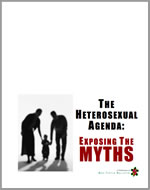 At last, the truth can now be told.
Using the same research methods employed by most anti-gay political pressure groups, we examine the statistics and the case studies that dispel many of the myths about heterosexuality. Download your copy today!
And don‘t miss our companion report, How To Write An Anti-Gay Tract In Fifteen Easy Steps.
 Anti-gay activists often charge that gay men and women pose a threat to children. In this report, we explore the supposed connection between homosexuality and child sexual abuse, the conclusions reached by the most knowledgeable professionals in the field, and how anti-gay activists continue to ignore their findings. This has tremendous consequences, not just for gay men and women, but more importantly for the safety of all our children.
Anti-gay activists often cite the “Dutch Study” to claim that gay unions last only about 1½ years and that the these men have an average of eight additional partners per year outside of their steady relationship. In this report, we will take you step by step into the study to see whether the claims are true.
Tony Perkins’ Family Research Council submitted an Amicus Brief to the Maryland Court of Appeals as that court prepared to consider the issue of gay marriage. We examine just one small section of that brief to reveal the junk science and fraudulent claims of the Family “Research” Council.
 The FBI’s annual Hate Crime Statistics aren’t as complete as they ought to be, and their report for 2004 was no exception. In fact, their most recent report has quite a few glaring holes. Holes big enough for Daniel Fetty to fall through.
“Google” is a trademark of Google Inc.
© Box Turtle Bulletin. All Rights Reserved.
 Posts
Posts  Posts via daily email: